 @mc5punk
more from that month
@mc5punk
more from that month
Short story: The Map of Silences
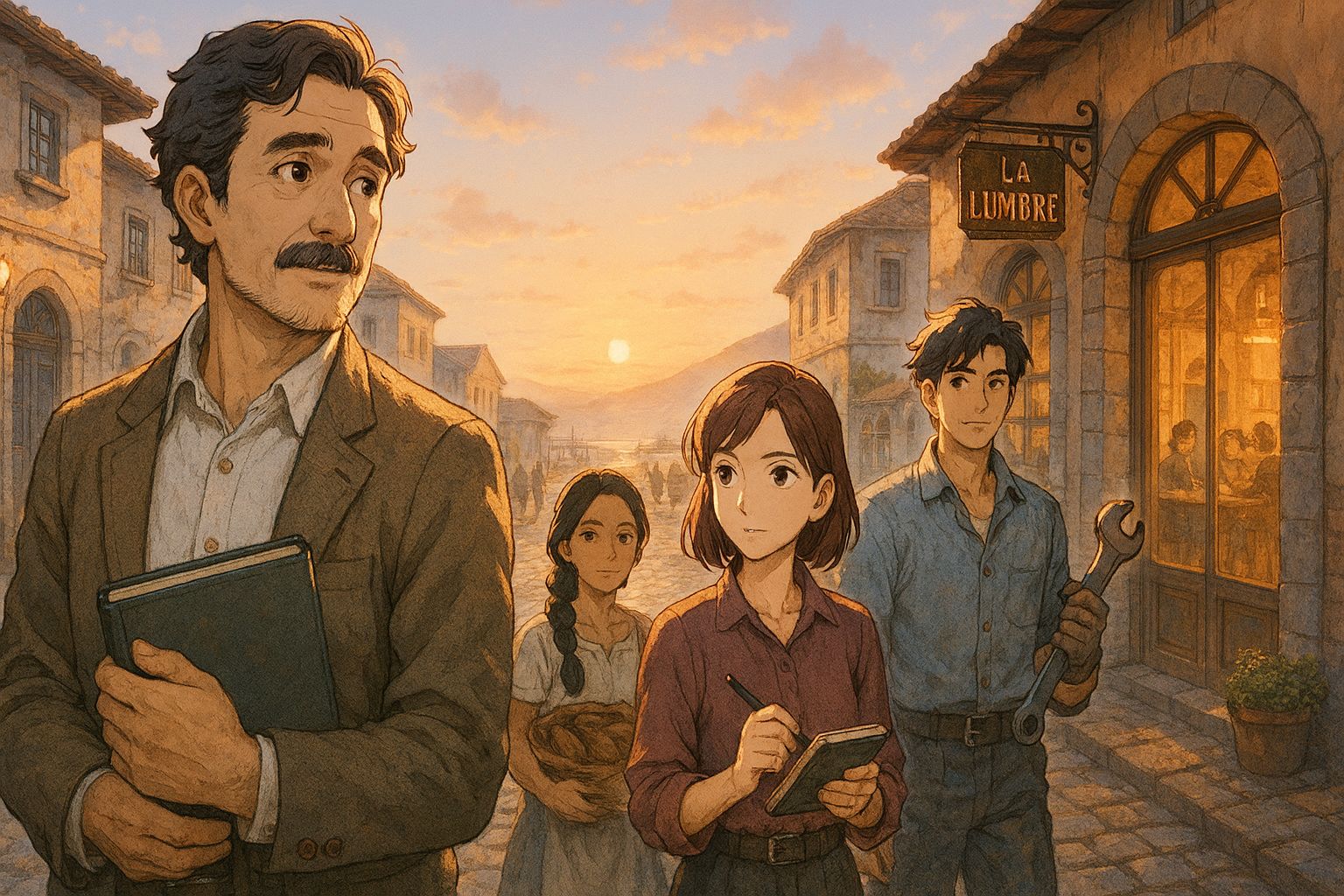
The dawn light in Santa Esperanza had its own rhythm: it not only woke people, drew back curtains and opened shops, but seemed to slip into the folds of a repeating story with slight variations. In that tranquil town, full of cobbled streets and wrought‑iron doorways worn by time, life moved between ancestral trades and contained hopes. Marco León lived there, a middle‑aged schoolteacher with a serene gaze and hands hardened by chalk and patience. Marco had spent decades in classrooms that smelled of old books and warm coffee; he had watched generations be born and leave, and he learned to read in people’s gestures what words often kept silent. Marco was not a man of grandiloquent speeches. His convictions were forged in daily observation: in the closing of workshops, in the silence left by darkened factories, in parents’ anguish when they could not find work for their children. Over time that observation turned into a deep unease. He knew that the country’s problems were not mere statistics but stories of lives that needed practical answers. He felt that solutions should not remain in rhetoric; they had to be laid out with maps, with concrete, tangible steps. Thus, little by little, his home and the back table of the café La Lumbre became the workshop where ideas were sketched. Clara Morales arrived in Santa Esperanza searching for stories. An independent journalist with a restless spirit, she carried a notebook full of questions and an unwavering faith in the written word as a bridge between reflection and action. She found in Marco someone willing to listen and to articulate what the town was whispering. Before long the café became an epicenter of gatherings: people met there to share proposals and pool solutions. They were not politicians with offices nor businessmen in suits; they were teachers, artisans, engineers, doctors, young entrepreneurs and worried mothers. From that crucible came a conversation that, over time, took the shape of a project. One evening Marco opened his notebook and, with his characteristic calm, said that the structure of the State must be reviewed. For years centralized administration had concentrated decisions and resources, and that hampered the response capacity of entire regions. He proposed, then, a transition to a federal system that would return autonomy to the territories: allowing regions to manage their resources, design their priorities and execute projects without depending on bureaucracy that often slowed down or distorted local initiatives. It was not about fragmenting the country, Marco explained, but about strengthening governance from the local level, with clear mechanisms for coordination and transparency. Clara took notes and looked up. She imagined headlines, but also schools deciding swiftly how to invest in their needs and hospitals responding promptly to community emergencies. Among those listening was Rosa, an agricultural producer who saw in decentralization the opportunity to manage production and marketing cycles without intermediaries that eroded her income. There was Julio, a mechanic and enthusiast for restoring railways, who dreamed of towns connected by rains that would revive bygone life. And there were Don Ernesto and Señora Merced, local authorities who brought historical memory and, with it, the prudence necessary to build consensus. The conversation drifted toward the economy. Having seen interventionist schemes over the years that, in his view, had not prospered, Marco argued that the economy should shift toward a capitalist model, understood as a system where the private sector, through incentives and access to credit, becomes the primary engine of employment and wealth. It was not a dogmatic assertion. Marco emphasized that adopting this model would require robust regulation, a clear legal framework and social protection measures to prevent the most vulnerable from being left unprotected. He also proposed privatizing state assets that lacked an essential social character and reinforcing the State’s role in strategic areas: primary and secondary education, public health and citizen security. The proposal met with doubts and questions. Don Ernesto, with his hoarse voice and experience in local administration, recalled episodes in which poorly designed privatizations caused job losses and low‑quality services. Marco acknowledged those risks and accepted that any process must include safeguards, evaluation procedures and clauses that guarantee universal access to essential services. The discussion enriched itself: legal professionals, economists and ordinary citizens contributed criteria to design an orderly privatization with transparency, public tenders and mechanisms prioritizing the public interest. Clara insisted that without civic education any reform would be fragile. She proposed that civic formation become a mandatory subject at all levels — not as an instrument of indoctrination but as a tool to develop critical thinking, public ethics and social responsibility. The goal was to plant a republican culture: values such as participation, tolerance, respect for the law and the common good should be part of everyday teaching. Teacher Merced, who had devoted her life to teaching, also proposed a plan to train teachers, renew curricula and provide schools with modern pedagogical resources. That point linked to another necessity: educational quality. Marco insisted on sustained investment in education to raise the country’s intellectual and productive capital. It was not just about training professionals but about producing citizens with the abilities to undertake, to question constructively and to participate in public life. They proposed programs for teacher professional development, dignified school infrastructure, libraries and laboratories, and tying education to local productive needs. Rosa imagined agricultural training centers tied to universities and technical schools teaching processing and marketing of products; in that way, young people could find alternatives in their own territory. The group also agreed to rethink access to higher education. They suggested guaranteeing public, free education up to the baccalaureate level and opening the possibility of universities operating mostly under private and mixed management, with regulations ensuring quality and equity. At the same time, they promoted a strengthened network of technical schools — vocational training centers — offering practical training in trades demanded by industry: mechanics, electricity, welding, agricultural technologies, logistics and port management. Julio, enthusiastic, proposed agreements between these technical schools and companies for internships that would ease youth entry into the labor market. The conversation incorporated the voice of Mariana, an engineer specialized in industrial processes, who urged prioritizing the industrialization of strategic sectors: agriculture, livestock, tourism, responsible mining, fishing and housing. Her proposal contemplated value‑added policies: not merely producing raw materials but processing them and creating productive chains that generated jobs and foreign exchange. She proposed investment incentives, temporary tax breaks, technical assistance and access to international markets. Samuel, a young tech entrepreneur, added the need to promote innovation with technology centers, business incubators and financing programs for startups. As the plan grew, it became necessary to think about logistics: producing goods that cannot be transported is useless. That is why Marco and the others considered it essential to modernize and integrate transportation systems. They spoke of public and private maritime, rail and air transport companies to facilitate the movement of goods and people within and outside the country. The old pier, visited one afternoon by the group, became a symbol of neglect in need of investment. Julio, with a mechanic’s hands and a railman’s heart, proposed rehabilitating rail lines to connect inland regions with ports; Rosa imagined export routes for cacao and coffee that would take local production to foreign markets without exorbitant intermediaries. The discussion, long and sometimes sharp, also addressed sustainability and resource use. Participants agreed that any industrialization and exploitation of natural resources should follow environmental and social responsibility standards. Mariana proposed environmental impact assessments, sustainable management plans, and community participation in decisions related to land use. If mining or fishing were to be reactivated, they insisted on doing so in ways that benefited communities and protected ecosystems. Over time the project matured and turned into documents: policy drafts, proposed laws, financing schemes and educational plans. Each document bore the signatures of diverse voices: teachers, health professionals, engineers, artisans and ordinary residents of Santa Esperanza and neighboring towns. La Lumbre became an archive and witness to prolonged debates, sleepless nights correcting figures and meetings with rural community representatives who contributed field data and concrete needs. Months brought resistance and adjustments. Don Ernesto, persistent in his doubts, demanded guarantees to prevent privatization from leaving the poorest without services. The group responded with proposals for regulatory frameworks, time‑limited targeted subsidies and citizen monitoring systems to oversee the quality of privatized services. Journalist Clara organized open forums in the plaza to dialogue with the populace: they listened to merchants, workers, self‑employed professionals and housewives. Those encounters not only expanded the plan but gave it social legitimacy. Another challenge was financing. Marco and his colleagues explored mixed models: international loans conditioned on structural reforms and productive projects, local bonds to finance infrastructure and public‑private partnerships to rehabilitate ports and railways. Samuel worked on proposals to attract investment in tech innovation, while Mariana outlined projects for rural processing plants that reduced production costs and increased added value. At the same time, the community launched small pilot initiatives. On a communal farm, Rosa and a group of young people implemented a drying and packaging plant for cacao; at the abandoned train station a workshop was organized to repair wagons and machinery; the local school revived an annual science and trades fair that showcased prototypes developed by technical school students. Those local successes fed the belief that ideas could translate into tangible reality. Conflicts, natural in processes of transformation, became learning points. There were frictions over the speed of privatization, the protection of strategic assets and the State’s role in market regulation. The group learned to design democratic control mechanisms, propose citizen audits and monitoring committees that included civil society representatives. Clara documented those experiences and published reports that circulated beyond Santa Esperanza, arousing interest in neighboring municipalities. The outreach campaign culminated in a massive assembly in the central plaza: farmers, artisans, students, teachers, workers and merchants gathered to hear the public reading of the document compiled by the collective. Clara, with a firm voice, outlined the main points: transition to a federal system with controls and national coordination; economic opening oriented to foster the private sector and social protection for the vulnerable; guaranteed public education up to the baccalaureate and strengthening of technical schools; investment in educational quality; prioritized industrialization of strategic sectors; modernization of transportation; promotion of technological innovation and environmental safeguards. When the reading ended, the plaza filled with murmurs and then with spontaneous applause. Not everyone agreed with everything, but there was consensus on the need for structural change. Marco, who had listened attentively, spoke at the end: his message was clear and unornamented. He reminded the crowd that lasting transformations require time, patience and persistence. He emphasized that change must begin in collective mentality: that citizens assume responsibilities, participate actively and demand transparency. He also proposed that the map they had drafted become an open platform, enriched by new voices and implemented through pilot projects before being generalized. The impact transcended Santa Esperanza. Other communities replicated pilot initiatives: a cooperative of producers in the neighboring valley set up a processing plant similar to Rosa’s; a consortium of regional technical schools signed agreements with companies for internships and employment; a network of young entrepreneurs opened a tech incubator with local financing. The spread of those experiences nourished a fabric of shared learning. However, the path was not linear. Political resistance arrived, attempts to discredit the proposals and legal issues that required legal counsel. The process tested the collective’s resilience. They had to learn to negotiate, to concede on certain points without abandoning core principles and to build alliances with regional and national actors who saw the proposal as an opportunity for reconstruction. On a personal level, the characters grew and changed. Marco, beyond his role as a teacher, became an interlocutor with various institutions and a facilitator of consensus; Clara gained recognition for her journalistic work and saw her reports stimulate public debate; Rosa and Julio moved from local protagonists to references for productive and training initiatives; Mariana and Samuel managed to get their technical projects considered in regional plans. La Lumbre ceased to be merely a café: it was a seedbed of ideas, a civic observatory and an archive of experiences. Beyond tangible achievements, an intangible but crucial shift occurred: in Santa Esperanza people recognized the value of public conversation and civic participation. They understood that waiting for top‑down solutions was not enough; transformation implies getting involved, working together and building institutions capable of responding effectively. A culture of oversight and accountability was forged: neighborhood committees that monitored contracts, periodic assemblies to evaluate projects and mechanisms of accountability that helped prevent misdirection. The Map of Silences, which at first looked like a notebook filled with good intentions, had become a living roadmap. Its lines were rewritten as new ideas emerged, corrected by mistakes and enriched by many contributions. It was not a perfect guide nor a miraculous recipe, but it was a collective instrument to orient action. In the memories of those involved remained the sense that systemic change requires time and courage; that hope is not inexhaustible but can be renewed through hard work, transparency and solidarity. There were moments of discouragement: failed projects, delayed funds and resistances that seemed insurmountable. But there were also concrete rewards: rebuilt schools, jobs created in small plants, reactivated transport routes on critical stretches and increased citizen participation in local governance. At dusk, in one of the final meetings recorded in the documents, Marco looked over the plaza from La Lumbre’s table. The map, spread out and full of notes, looked like a living cartography where each ink blot represented an idea and each correction an experience. Clara placed a folder of testimonies and audiovisual records beside the map. Young people who had once only dreamed of emigrating began to think of staying, of starting businesses, of teaching in technical schools or working in the cacao, coffee or rural tourism value chains. The novel of that process, without a closed ending, left a lesson: structural change is not the work of an instant nor of a solitary leader, but of collective persistence. Each step taken by Santa Esperanza’s inhabitants was a lesson in designing public policy from below: combining vision, technical knowledge and social participation. And although the country still faced greater challenges, the small town became a modest beacon that illustrated possible paths. Over time other regions took up the task and the Map of Silences became a shared testimony. Marco continued teaching; Clara kept telling stories; Rosa and Julio consolidated productive and training projects. New people arrived at La Lumbre with proposals that enriched the map. Thus, amid successes and stumbles, the community learned to govern itself with greater autonomy, to produce with added value, to educate for life and to move goods and hopes along routes that made projects real. The work remained open: the map was no longer in the hands of a few but in the hands of many. The final scene shows Marco leaving the café at night, the notebook closed under his arm, knowing that the true work was only beginning. The lanterns lit the plaza and, in the houses, families discussed the proposals in low voices; these were not resigned silences but silences beginning to outline actions. Santa Esperanza had begun to write a new page of its history, with a map that, imperfect as it was, offered real routes to travel. Source of the images. Image created with Bing.
No comments yet