 @mc5punk
more from that month
@mc5punk
more from that month
Short story: The melancholy of the grooves
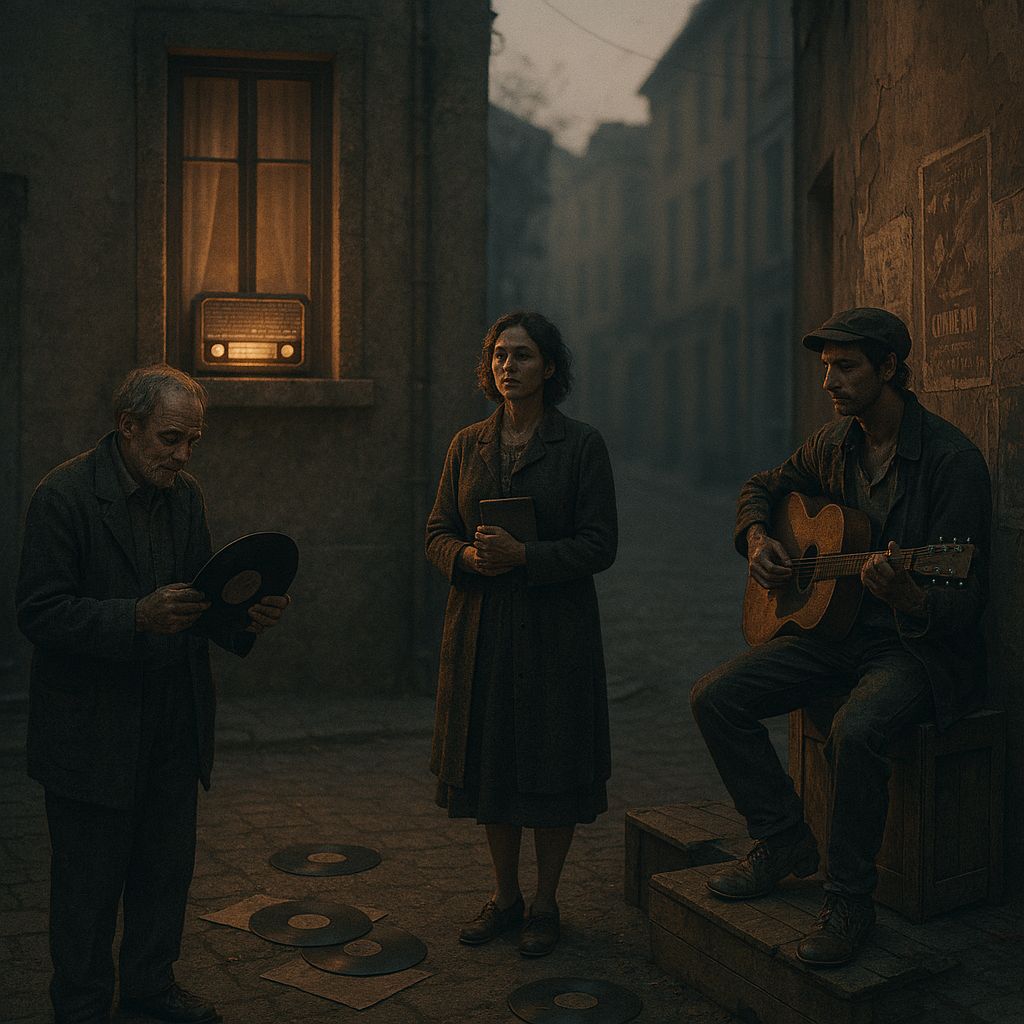
Mateo Cruz collected absences. His hands, weathered by years of microphone and early morning, still knew the exact gesture of taking a vinyl, wiping it with his sleeve and letting the needle descend with the reverence of one who turns off an altar. She had been the voice of a local radio station: she woke up shops, presented batches, read letters with a tone that promised consolation. When the radio closed — one more branch of progreso that comes to save noise and dismiss trades— Mateo did not change his habit; only the audience changed. The walls of his tall, narrow house breathed old records and a silence that had the texture of lead. He lived with the routine of a caretaker of memories, like one who waters plants that no one will see bloom. The album appeared the afternoon it rained without warning. He found it in one of those boxes that one opens only with the excuse of looking for something else: no label, no cover, with the surface dotted with small stripes that told of clumsy hands and forgotten trips. Mateo looked at him with that mixture of curiosity and superstition that we usually reserve for objects that seem to survive by accident. He picked it up, wiped it with his sleeve, placed it on his record player and, for the first time in months, let the music reach him before thinking about what he would do with it. The melody was not a hit, but a leak. It came in waves that hinted at landscapes: a cobbled courtyard, laughter that smelled of bread, a rumor of footsteps on a staircase that no longer existed. They were not memories of his, and yet they invaded his senses with the authority of true memories. Mateo felt, for a second, the weight of a face that he could not complete; he heard a lullaby that he did not recognize, but that broke something with his honesty. When the melody died down, the house returned to silence but the images remained there, as if someone had left a set of photographs on the table. He called Clara because Clara was one of those people who attend to what an object says in its silence. A librarian all her life, Clara kept files and rituals: she knew how to fold pages so that regrets wouldn't get lost, invited the neighbors to tea while they collated stories and wrote down names that no one else seemed to remember. She arrived at Mateo's house calmly, with her bag on her shoulder and that gesture of closeness that only those who have made caring their job have. "It's not just any record," Mateo said when he put the needle in for the second time. Listen to how there are things that are not one's and they hit you the same. Clara let the melody run through her. His eyes, accustomed to reading the margins of books and the seams of the city, were barely moistened. "It brings gaps," he muttered. Holes that someone closed and that are still beating. They didn't make any hasty plans. They went to look for Lucho one too cold sunny day, Lucho who lived off the street corners and the applause crumbs that people throw at a busker to say, "Keep me company for a while."Lucho arrived with his guitar patched up, with a strap that had been a truck belt and a smile that fit in his pockets. They listened to the album on the bench in the square, at the fair where the merchants packed oranges and newspapers, in the reading room of the library where Clara had, until then, put the object in a place of honor. Each reproduction acted as a small cataclysm. It didn't explode on the street; it insinuated itself, it stuck like an ancient moisture. There were reactions that were almost imperceptible: a salesman stopped counting the change for an instant because he remembered his mother's name; a woman put her hand to her chest as if recognizing a taste of the past; a child pointed with certainty to the outline of a building that no longer existed. It was not an easy call to nostalgia; it was, rather, the restitution of suppressed scraps. The sessions multiplied. At first they were intimate — Mateo, Clara, Lucho, a handful of curious people -; then people started coming of their own free will, attracted by the rumor that something in the neighborhood was being renamed again. In the library, Clara organized formal meetings: "Memory Nights," she called them, with a handwritten sign and cups of tea served in chipped ceramic glasses. The tables were filled with objects brought by the neighbors: photographs with edges bitten by time, letters with faded ink, recipes with oil stains that spoke of meals that no one made anymore. Don Andrés, the carpenter, left on the table an oil-stained key and a piece of sheet metal that belonged to the old factory in the neighborhood. His hands, so strong that they seemed to have been designed to hold things that do not want to be held, trembled when he told the story. "My father worked there—" he said in a raspy voice. He taught me to measure with my eye. But he disappeared. They said it was for progress. A young woman, who used to pass by the square with her eyes on her phone, held the key between her palms and, for a minute, seemed to carry the weight of the stories she was holding. He proposed an exhibition: "Tools of Oblivion," they put it at the end, with the gentle irony of those who know that naming is also claiming. Lucho began to compose with the fragments that the melody seemed to leave as crumbs. His music was not a tracing, but a translation: the harmonies of the album gave shape to verses that spoke of factories, squares, mothers who sewed late, children who ran between columns and parties that stopped calling each other for fear of being remembered. Matthew found in his old voice a new purpose. He no longer transmitted from a booth with microphones for an entire city; he transmitted on Sundays from a wooden box that served as a mixing desk. He read letters that people gave him, he told anecdotes, he named the forgotten ones. His voice once again had real recipients. The memories that surfaced were not all benign. In the meetings wounds were uncovered: contracts that were wet paper, workshops closed without compensation, families dismembered by promises that went with the wind. Sometimes the sessions ended in thick discussions, in denunciations that needed more than memories; at others, in small reconciliations: a son who found the mother he was talking about again, neighbors who agreed to rebuild the mural that had been erased by a municipal work. Music, and with it memory, began to be a civic tool as well. The group of young people led the sample of tools, the stories were compiled in a booklet that was distributed around the neighborhood, and the library was transformed into a community archive. They weren't looking for revenge; they were looking for visibility. Demanding reparation, when necessary, became a natural consequence: naming that the square was demolished to build "green spaces" that never worked, or that the children's kiosk had been removed without consultation, placed the need for dialogue at the center. There were long nights when the excess of memories weighed like a badly laid cot. Some neighbors felt betrayed by what he was reliving: to remember was also to meet again with their own decisions, with omissions and guilt. Mateo, who had known many goodbyes, learned to listen without judging. His role changed from announcer to lay confessor; from bridge between scattered stories, into custodian of said stories. Clara, on the other hand, worked tirelessly: she catalogued photos, transcribed letters, organized chronologies with the patience of one who builds a map over shifting territory. The melody became a rite of passage out of necessity. It was not an object of spectacle, but an instrument of care: it was reproduced when the community asked for it, at the precise moment when someone felt that he needed to name. Clara assigned a label to the album — "To listen to it when needed" - and kept it on a shelf in the library along with other documents that people had rescued. There was an unspoken consensus: it would not be used out of curiosity or to manipulate; it was medicine. Over the months, the neighborhood was changing in nuances. Murals were painted with scenes that had reappeared in the stories: a lantern party reconstructed in bright colors, a bakery that returned to baking with recovered recipes, benches placed in the square with plaques honoring the workers who had been displaced without explanations. Not all losses were recovered. No demolished buildings were erected and no debts were erased. But the city recovered names. And with names, something akin to dignity. One summer morning, when the square was sleeping and the breeze smelled of warm earth, Mateo walked to the library window with the radio under his arm. Outside, half a block away, a group of neighbors were chatting quietly: going over dates, reliving anecdotes, planning the next meeting. Mateo put the needle on the record and let the melody emerge, faint, like a heartbeat. "There used to be a party," said an old man. They called it the night of the lampposts. Now it's hard for us to believe that he existed. "We can do it again," a young woman proposed, hoping that someone who knows that memory needs a gesture to become real. Not the same, but with whatever is left. Mateo looked at Clara and Lucho. Their faces were marked by the passage of nights and by the tenderness of which one knows witness. Clara held the case of the disc in her hands, like one who holds the latest remedy from a small pharmacy. "We don't fix houses," Mateo said. We don't bring back everything that left. But we return words. And sometimes that's enough to make something stop hurting in silence. Lucho tuned the guitar and barely smiled. "Then we'll play—" he said. And we'll sing the names that come back. The melody was still there, still in its case, with the handwritten label: To listen to it when needed. The library became a refuge and the square became an audience. The neighborhood learned to name itself again, not to be petrified in the past, but to build a present that knew what it had been: its pains, its holidays, its working hands. In the early morning, the voices multiplied in the gloom, small memory fires that did not consume, but illuminated. The last image is simple and loaded: Mateo closes the window, listens to the murmur of voices and thinks about the many nights he has left to guard stories. Clara organizes a folder with the new stories; Lucho leaves the guitar in the corner, with the worn wood, as if each groove was now a healed scar. Outside, the square is breathing, and the melody, when it sounds, is no longer a key that opens losses but a fabric that unites again. Mateo feels that the city finally has a more complete map: not the official map that forgets people, but the map that voices draw when they dare to say their names. Source of the images. Image created with Bing.
No comments yet