 @mc5punk
more from that month
@mc5punk
more from that month
Short story: The Bench by the Lighthouse
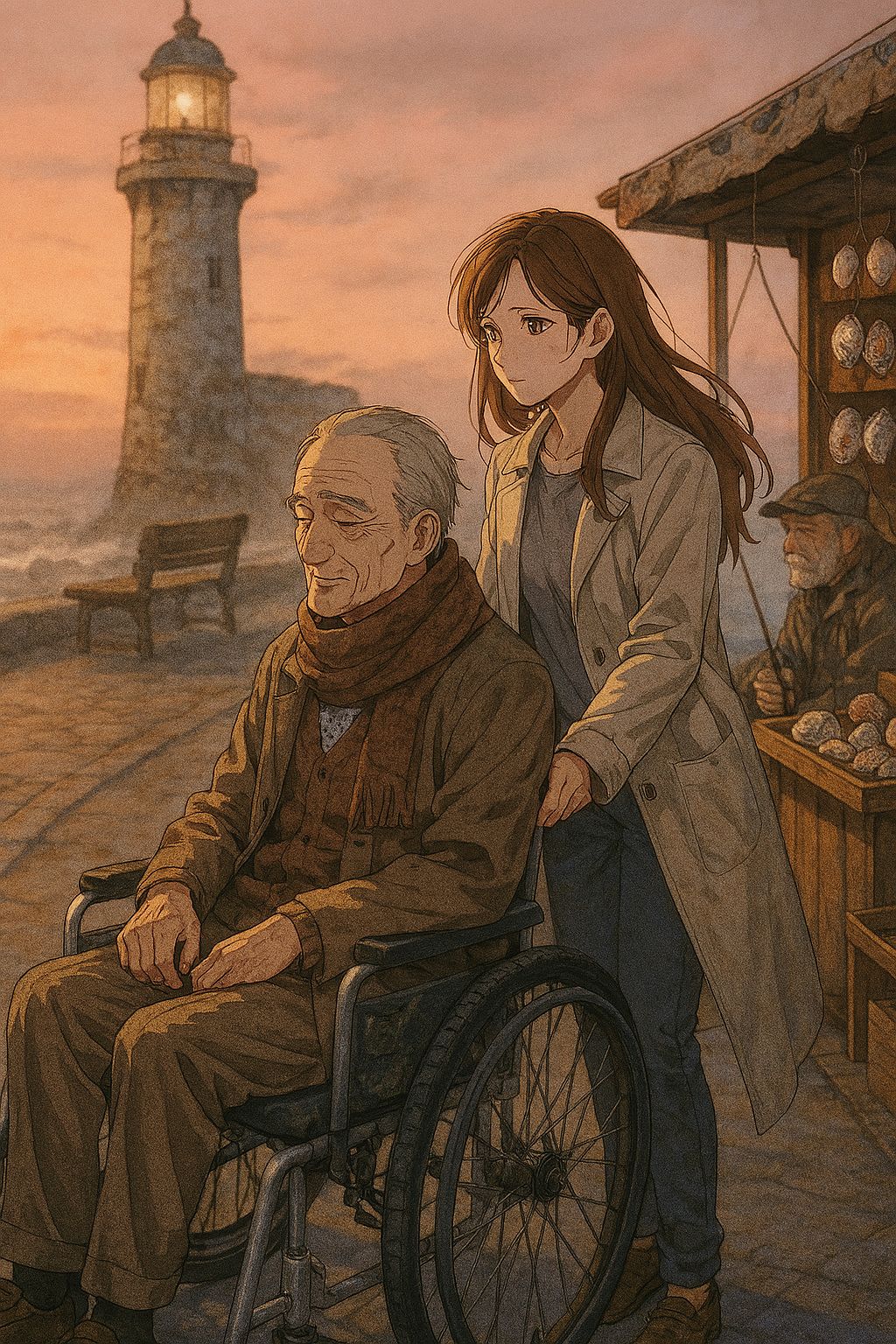
The coastal promenade opened like a fresh wound: the gray sky stretched across an immense canvas and the sea returned its sheen with an ancient indifference. Julio moved in his wheelchair with the metallic calm of someone who has learned to measure every push. Marta pushed him slowly, with that patience that is no longer merely a virtue but an affectionate duty; their movements formed a language forged by years of care, sleepless nights, and small decisions that now filled each day. The air smelled of salt and dry seaweed, and every breath seemed to bring fragments of a past clinging to the skin. They sought neither company nor haste: the walk was a daily ceremony to tame the monotony the illness had imposed. Life in the neighborhood continued at its own pace along the boardwalk. Rosa, the artisan who sold painted shells and jewelry from her small stall, was gathering her pieces with paint-stained hands. Tomás, the retired fisherman whose beard seemed made of sea foam, practiced the patience of casting and reeling in his line from the railing. Beyond them, children ran and a couple of tourists consulted a map with lost expressions. None of that interrupted the intimate landscape of father and daughter; on the contrary, it formed the backdrop for their conversation. "What are you thinking about?" Marta asked, as if naming the thought was a necessary beat. "About everything and nothing," Julio replied with a worn voice. "About the cane I tucked away and the afternoons that used to belong to us when we still knew they did." They stopped at the railing. Julio looked at the horizon with a gaze that contained tides of memory. For him, each wave brought a scene: his wife's laughter, his daughter's bare feet on the sand, the small towel they always forgot in the trunk of the car. It was as if the sea were an album whose photographs still moved. Rosa, who recognized them at once, came over with a steaming cup of tea. There was something in her gesture—the warm offering, the look that asked for no reward—that softened the day's hardness. "Here, so you don't get cold," Rosa said. "The wind bites differently today." "Thank you," Marta answered. "You always take care of us." Soon other neighbors joined them. Tomás adjusted his line with expert movements and cast a dry joke that produced a nostalgic smile from Julio. Lucas, the young man from the neighborhood who made documentaries for the cultural club, also appeared: he'd heard that Julio remembered stories and wanted to record a fragment. Lucas was persistent and discreet; his camera had already immortalized local dances, old doors, and Rosa's smile on many Sundays. The boy asked permission shyly and Marta nodded—not out of vanity but because she understood those words could become tomorrow's bridge between absence and memory. Julio began to speak slowly, with pauses that revealed the effort of ordering memories that refused to be arranged. He spoke of his youth on the coast, of the woman who had been his partner, and of the impromptu trips with a crumpled map in the glove compartment. He told how, during a particularly fierce storm, instead of panicking, they laughed and shared confidences until sleep took them. He revealed small regrets: a silence he didn't dare to break, a promise swallowed by pride, the time he failed to return early for a family meal. There were also gentle confessions—hidden letters in old books, coins tucked beneath piano boards, nights spent waiting for the home's light to signal her return. "I don't want my silence to become another burden for you," he said at one point, with the kind of honesty that comes when truth hurts less than evasion. Marta gripped the wheelchair's handle tightly. Her father's words rearranged things in her chest she had normalized: absence as habit, discretion as a shield. She had learned to care without expecting reciprocity; now, in his confessions, Julio seemed to offer her instead the possibility of understanding. Rosa, seated on an empty crate near her stall, shared an anecdote from her youth that echoed Julio's: a quarrel that ended in reconciliation by a lighthouse, a promise to return that went unkept. Tomás, leaning against the railing, said in his rough voice, "Memories turn to sand—until someone collects them and makes sure they don't get lost." Meanwhile, a boy named Mateo threw a ball that bounced to the edge of the promenade; a neighbor returned it with a playful air, and in that small gesture the afternoon regained some lightness. Lucas, camera in hand, captured Julio's contained laughter, the way his eyes clouded and then brightened as memory dictated. The conversation turned to simple rituals: the wooden bench by the lighthouse where Julio and his wife used to sit on Sundays, the blanket they always brought, the cheap bottle of wine that seemed part of their liturgy. Julio requested, with the humility of a private wish: "Keep the Sundays," he said. "Bring me to the bench, even if you change the bottle. Let the bench remember that we passed through." Marta accepted the promise without dramatics; she kept it like a small everyday treasure. They began the return as the sunlight grew dimmer and the shadows lengthened like fingers trying to hold them back. Behind them remained the murmur of the sea, the salt-splattered railing, Rosa's stall with its shells like reliquaries of simple life. That night in the house Julio and Marta shared, the recording of his voice was placed in a box with yellowed photographs and an old postcard with a faded stamp. The cane Julio had remembered leaned against the wardrobe as if it might be needed again. Hours stretched into routines of care: medicines given with exactness, brief pauses for meals, neighbor phone calls leaving messages of support. It was a life made of fragments, of punctual interventions, of affections woven around the everyday. As days passed—some better, some harsh—the neighborhood found its own ways to accompany them. Rosa brought empanadas that smelled of an old oven; Tomás told sea stories that made Julio smile; Lucas returned with more recordings, asking whether some words could be preserved for a project about local memory. The house filled with voices trying to sustain what the illness was slowly eroding. The night Julio stopped breathing, time seemed to fold in on itself. It was not a violent, dramatic exit; rather, it was a departure wrapped in the same calm that had marked many of his final hours: the radio silent, photographs spread on the table like mute witnesses, the living room light dimmed to a space of waiting. Marta had slept from exhaustion in an adjacent room after a long day of care. It was Rosa who, bringing coffee the next morning, found the house in the quiet of finality. The discovery lacked the shock of surprise and carried instead the dull weight of inevitability. The funeral gathered the neighborhood around the wooden bench by the lighthouse. People arrived with small offerings that became part of the ritual: Rosa left a painted shell; Tomás placed his cap on his knees and recounted how Julio taught him to look at the horizon without despair; Mateo laid his ball among the flowers, hands too small to fully grasp the meaning of loss but compelled to participate. Lucas played the recording and Julio's voice filled the morning—the cadence of his memories, his contained laughs, the simple plea to keep Sundays. The words, now without the mouth that had pronounced them, held the force of a lesson: what seems trivial, when spoken, can become a shared heritage. After the burial, Marta went to the wooden bench by the lighthouse. The place was damp with mist; the wood smelled of salt and old sun. She took from her bag the crumpled bottle and the map Julio had mentioned—the same map that had been both excuse and truth for years. She set them on the bench with a ceremonial gesture. She sought no public drama or grand display; she did it to seal a private promise that needed no witnesses. Feeling the air on her face, a gentle cold that pierced her hands, she believed for a moment she heard her father's voice carried over the distance. Life went on—because life always goes on—but something in the neighborhood had shifted in tone. Sundays acquired a different texture: neighbors met on the promenade to share bread or mate; stories circulated, aided by Lucas's recording, at gatherings; the wooden bench became a point of memory—not for its size but for the density of what had been left there. Marta kept her promise: she went every Sunday, brought blankets and bread, spoke of her father, and above all allowed Julio's presence to remain active through small gestures. Over time, losses fit into houses like old furniture: there are empty spaces that never vanish, but people learn to walk around them. The bottle and the map, now faded by salt, lay half-covered by leaves and letters neighbors left as offerings. Julio's recording circulated at parties and meetings, and his laughter—laughter he had feared the illness would steal—returned again and again in the mouths of those who reclaimed it as their own. The bench by the lighthouse continued to bear witness. Sometimes, when the tide was low and the wind promised rain, Marta sat there not to remember but to converse: she spoke aloud as if keeping alive a memory that needed tending. Other times she simply gazed at the horizon—the line separating the known from the unknowable—and let time do its patient work. In the rhythm of those Sundays she found a way to hold the absence: not by denying it or dressing it in grandeur, but by making it part of the everyday landscape so that, as years passed, new generations would know someone had lived, loved, and waited there, beside that bench. Source of the images. Image created with Bing.
No comments yet