 @mc5punk
Short story: A Bench in the Forest
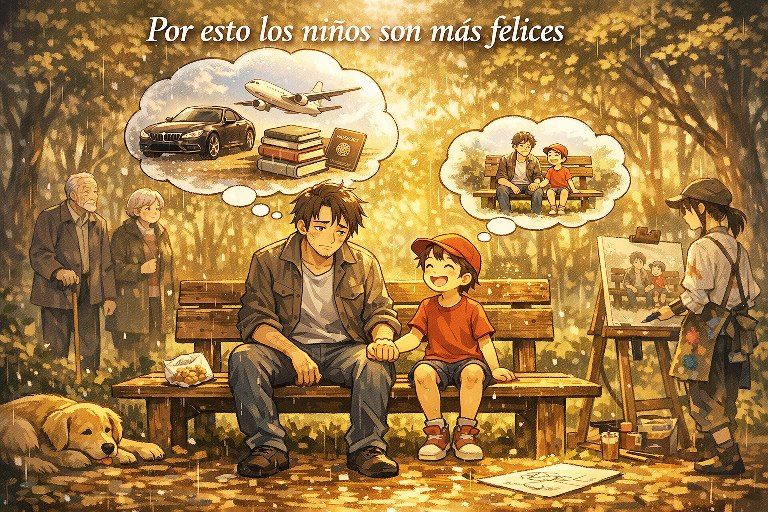
In a clearing of the forest where light filtered in golden threads, a weathered wooden bench welcomed two figures who, at first glance, seemed to contradict each other: a man with a tired gaze and a boy with an open smile. The ground smelled of leaf litter and damp; the air, of wood and possible rain. Above their heads floated, like bubbles of soap with different weights, the thoughts that inhabited them: the man's filled with objects—a luxury car, an airplane, books, a passport; the boy's, a single image: him and the man sharing that moment on the bench. They were not entirely alone in that corner of the wood. A short distance away, among the trunks, other lives could be seen approaching without haste: a woman with gray hair and a worn coat, with clear eyes and a voice that seemed to have learned to weigh words; an elderly man taking short steps with a wooden cane, his deep wrinkles like navigation maps; a golden retriever lying in the sun, watching with the infinite seriousness of animals; and a young painter, her clothes splattered with oil and an energy that seemed to contradict the stillness of the place. The painter carried an easel and a bag of brushes as if it were an emotional modus operandi: paint life in order to understand it. The gray‑haired woman stopped behind a fir tree and watched the scene with the patience of someone who has seen the human habit of loading the soul with ghosts repeat itself. "Do you notice?" whispered the woman, whose name was Clara, leaning to speak to the elderly man. "That man has a whole world on his head." "Men sometimes buy not things but expectations," replied the elderly man, Don Emilio, resting his palm on his cane. "I bought watches; they didn't stop anything. They taught me to measure absences." Mateo, the boy, soon noticed them. He had the smile of someone who easily recognizes an opportunity for conversation. "Hi!" he exclaimed, his voice still carrying traces of candy. "Did you come too so the trees can listen to you?" The painter, Lucía, with blue‑stained fingers, put her easel down and approached with small strides of enthusiasm. "I came to have the colors look at me," she said theatrically. "But if the trees also gossip, even better. And what are you looking at, little philosopher?" Mateo pointed with one finger to the bubble above his own head, where the image was simple: him and Andrés—the man seated—sharing the bench. "I'm looking at this," he answered. "I like that he's here with me." Andrés held back a smile that wanted to be wider but got stuck halfway. His hands, large and marked from work, rested on his knees as if trying to hold something slippery: calm, air, numbers. "I'm thinking about important things," he said at last, with the voice of someone trying to put paperwork in order. "Work, bills… whether someday we can go somewhere nice." The dog rolled her eyes with the nobility dogs use to give lessons without words and rested her head on Don Emilio's legs, who let out a short cough and a grave phrase. "Time charges you in its own way," the elderly man reflected. "It charged me time; others, dreams; and some, decisions not made." Lucía fixed her gaze on Andrés, measuring his profile as if she already saw him on a canvas. Then, with a laugh that tried to hide concern, she intervened lightly. "Listen to me: paint your debts. Give them color and sell them as modern art," she said, then added more seriously: "Or share the burden. That works better than a gallery's commission." Clara drew closer enough to rest the pad of her fingers on the bench's back, a gesture of solidarity that asked no permission. "It's not giving up," she whispered. "It's remembering why you want things. If it's for security, that's fine. If it's to cover emptiness, try a worse remedy: sit with it until it makes less noise." Andrés let out a laugh that sounded between bitter and sincere. "And if I don't have enough to lower the backpack of expectations?" he asked, his voice breaking at a point that let sensitivity in. "What if all my good ideas are paid for with invoices?" Don Emilio placed his trembling hand on his knee and looked at Andrés with the mix of hardness and tenderness of someone who has known many comic defeats. "I learned that there are things money can't pay for," he said. "They accompany you even if you have no bank account: a laugh, a shoulder, an hour given. It's sad but true." Mateo, who had been listening intently as if taking mental notes, pulled from his pocket a small bag of cookies that Clara had brought. With a ceremonial gesture, he offered one to the man. "For hard decisions," he announced with the solemnity of a child judge. "They're easier with sugar." The line evoked general laughter. Lucía, with the spontaneity of creatives, seized the moment and said dramatically: "This is the climax, folks. If I were a screenwriter, I'd say the character decides now." She looked up at Andrés. "Will you decide, or will you make us suffer like a dramatic subplot?" Andrés looked at her and, for the first time, his thought bubble seemed to float lighter, as if someone had discreetly popped some of the images. The mental photos of the car and the airplane were still there, but around them small scenes emerged: a shared dinner, a book read aloud, laughter at night. They did not erase the bills, but they gave them context. "I'll decide," he said at last. "I can't promise everything will change in a second. I'm not a narrative magician. But I can try to make the first alarm of the morning be your laughter instead of the bank balance." The dog barked, approving the proposal. Don Emilio smiled with evident irony and added: "Then let it be soon. Good decisions lose strength if they become memories of will." Minutes passed with the warm slowness of dusk; the forest breathed and gave space to the conversation. Lucía, always hunting for an image, set up her easel and began to sketch. Her strokes were quick, a set of lines that wanted to catch the scene before it turned into mere recollection. "I'll paint this," she announced. "I'll take the scene to the city. I'll write at the top: 'That's why children are happier.' It will be ironic and honest at once." Clara smiled and left a bag of cookies on the bench as if she had decided to contribute something concrete to the tacit pact forming. "Not everything that matters has a price," she said. "Sometimes a cookie solves decisions and, why not, does poetic justice." Don Emilio furrowed his brow, trying to tell an old joke that seemed to have lost three words along the way. Nobody understood half of it, which prompted looks and laughter that removed tension from the air. "See?" Mateo said when the laughter subsided. "Things get fixed better with people. And with cookies." Andrés bit into the cookie Mateo offered. The gesture, simple, became an intimate ceremony: sweetness on the tongue, a faint crunch, the companionship that demanded nothing more than presence. "I promise that when I take you on a plane, it will be because I want you to fly with me and not because I need a photo," Andrés said, his mouth still full. Mateo, who already had the seriousness of a small diplomat, made a face as if reading a contract clause. "Then call my aunt," he replied. "She knows where the discounts are. And if they give us separate seats, don't accept; it's very sad to see people eating plastic grass on the plane." Laughter burst out and even Don Emilio seemed to regain some color in his face. Lucía's painting acquired tones: the bench, the figures, the light touching them; in the corner, a quick‑written title offered a simple, forceful sentence. The rain began to fall, first as a whisper, then with a firmer cadence that splashed the leaves and left droplets on the lips of the gulls crossing the sky. Lucía covered herself with an improvised tarp and protected the canvas with expert movements. Don Emilio, with the dignity of one who knows storms, sheathed his cane and offered his arm to Clara to accompany her. "Rain helps you think," he said softly. "It washes what got stuck to memory." As the afternoon declined and the sky's ink darkened, people said their goodbyes with small gestures and fragile promises that nevertheless carried weight: Lucía said she'd return with coffee and the finished painting; Don Emilio announced he would stop by the bakery for croissants; Clara offered her number, which was more an open hand. Mateo split another cookie in half and offered a half to Andrés. "So decisions are shared," he explained as if reciting a learned lesson. Andrés accepted, and for the first time that afternoon, his smile bore no usual shadow. In his bubble, the images of the car and passport remained, but the picture of the bench and small everyday scenes gained space and color. It was not a miraculous conversion; it was a rearrangement, a giving up of priority. When they rose to leave, the group left a multiple trace on the bench: a bag of cookies, a half‑dry sketch, a mud paw print from the dog, a tag with a line Lucía had written in marker: "That's why children are happier." Their walk back was now less heavy. Andrés took the boy's hand and held it without hurry, feeling the small, steady warmth. Mateo jumped now and then, making pantomimes that he was a captain of a plane losing control of imagination, not of the craft. "What if I can't pay for an expensive plane?" Mateo asked in a burst. "We can fly by pretending the bench is a spaceship." "Perfect," Andrés answered. "Then this bench will be our airline for now." Don Emilio, walking behind, watched them with a mix of irony and tenderness. "May the airline have good seats," he said. "And don't accept the goat's snack offer." Lucía's painting remained with imperfect but vibrant strokes. She hadn't captured all the nuances of the dialogue, nor the exactness of Mateo's laugh, nor the tremor in Andrés's voice when admitting his fears. But something did remain: the scene showed how priorities could be rearranged if someone—even a child with cookies—proposed it. That night the bench stayed empty and damp, holding the echo of the conversation. It did not change anyone's economy overnight; debts, passports and expectations continued to exist. But something in Andrés's head had moved: a pocket of calm where the boy's laughter weighed as much as a promise to use money well. Mateo, for his part, fell asleep dreaming the bench was a plane and that the world had no bills, only destinations to explore with friends. The story offered no easy redemption or neat endings. Instead, it carried the small tokens of a possible change: everyday agreements, shared cookies, promises that did not settle accounts but did ignite other, more human urgencies. In the end, the imaginary phrase Lucía had painted on the canvas—"That's why children are happier"—floated without judgment, like a simple reminder: happiness often fits in a borrowed seat, a hand holding it, and the decision to hear laughter before the invoice. The forest kept the scene in its vegetal memory. The next day the sun returned and the birds resumed their old quarrels over branches. People in the city, where Lucía planned to take the painting, might see only a picturesque image. But those who had been there knew something else: that a bench, a cookie and a thought bubble can change a man's direction—not because they erase his past, but because they show him that some things can't be bought and yet sustain the rest. Source of the images. Image created with Bing.
No comments yet