 @mc5punk
Short story: Chase in San Lucas
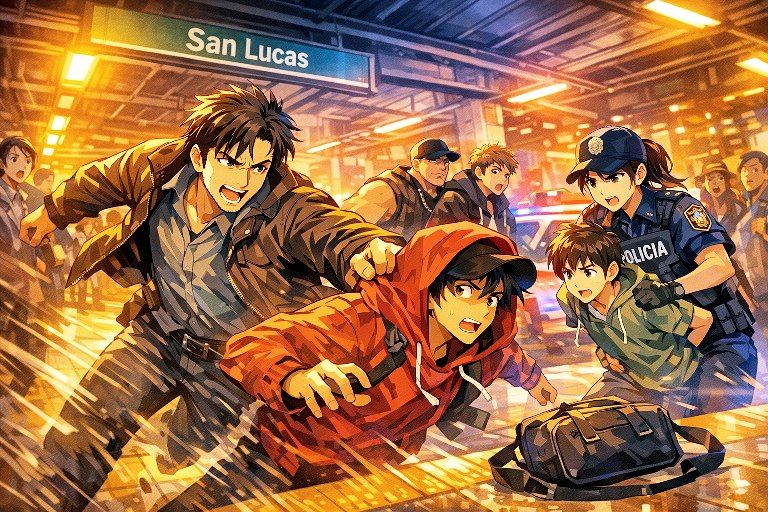
The afternoon stretched with a warm sluggishness over San Lucas. The station lights were taking on an orangey hue that mixed bus exhaust with the evening haze. People returning home, students with backpacks, vendors packing their goods, a couple or two. Everything seemed to follow the city’s habitual cadence until, in a brief, sharp instant, that cadence snapped. Laura Castillo sat on a bench on the platform, her bag resting between her knees. She had had a long day at the design agency: last-minute revisions, an impatient client, a spilled coffee over drafts. Her mind was replaying details while her hand checked the bag’s zipper to make sure everything was still there. Then a hard yank pulled her out of her reverie. The bag flew, a stranger’s hand tore it away, and a body already in retreat tugged it through the crowd. It wasn’t a prolonged scream — more a sharp, sudden cry — but it was enough to make the distance between victim and thief obvious. The crowd turned like a sea of small waves; some lifted phones, others stopped to watch. Among the human tide, a man at the margin felt the clarion of duty sound inside him. Mateo Ríos did not have a visible badge; his jacket had the ordinary look of someone who left the office and disappeared into the city. Yet his body retained the memory of years in the Robbery Unit: how to read a thief’s flight in a single gesture, how to intuit the escape routes they preferred, how to calculate a second’s advantage. He wasn’t on duty, but for him the gap between thinking and acting was barely a breath. He saw the yank, saw the bag in the hands of four shadows dissolving down the stairs, and he gave chase. The run became a choreography of impulse and calculation. Mateo cut across the platform, dodging purses and umbrellas; he knew the station’s micro-map like few others: a shortcut via the side staircase, an exit that opens into a pedestrian passage, a service door often left ajar. “Mono” — Rafael López, as later records would show — led, head down, hauling the bag with practiced ease. Beside him, Hernán “Gavilán” Duarte stuck to the shadows looking for gaps between bodies; Tomás “Fierro” Mendoza supplied the physical shove, the bulk meant to force a way through; Iván Salcedo, the youngest, glanced back with the wide eyes of someone who still cannot measure the consequences. Mateo shouted with a voice that needs no identification: a brief command, the clarity of someone who doesn’t ask for permission. “Stop!” was more diagnosis than plea. He had no weapon in hand; protocol wouldn’t wait. He leaped over a bench, lost a shoe for an instant, and gained ground. A taxi nearly blocked the path; a vendor stepped in with a shout; the city’s elements seemed to conspire to return them. Crossing onto the avenue, the dynamics of the chase shifted. The light let faces and details come into view. One of the thieves tripped over a loose cable left from recent works on the platform; Iván lost his balance and fell. A stumble that fear and fatigue turned into instant defeat. Mateo, who had measured that bollard on the route, closed in, grabbed him by the lapel, and applied a control technique he had practiced until it was routine: a twist, a weight that neutralizes, a grip on the forearm that prevented any movement. “Don’t move,” he said in a cool tone that made silence follow the order. The commotion began to draw institutional responses. Marcela Ruiz, the station officer, heard the radio alert of a robbery in progress. Instinct propelled her toward the main exit, where she found Mateo holding a young man pinned to the ground. Without hesitation she extended her hand to secure the detention, quickly producing the handcuffs she always carried. Over the radio she requested support: the station needed a swift perimeter closure. While Marcela secured the first arrest, Mateo and the fleeing group crossed paths in a maneuver that seemed choreographed. “Mono” chose to cut toward the adjacent street, aiming to disappear into the urban fabric. Mateo changed course, ran diagonally, and put himself in the leader’s path. Marcela flanked from the other side. The interception was precise. Mateo met Rafael with a stride, driving his shoulder into the man’s hip to unbalance him; Marcela stopped Tomás when he tried to shove past. Hernán, seeing the move, attempted to blend into a group of tourists photographing the facade: a bystander’s voice — someone who had watched the sequence — cried out and pointed; that warning was enough for Marcela to turn and close the gap. The arrests were swift and orderly, the product of individual initiative and institutional response. Handcuffs, the flashing of patrol lights, beams searching pockets and open backpacks. Laura got her bag back within minutes. Inside, besides everyday items, were her documents and some print jobs she’d been carrying. Small belongings were missing — a notebook, a few loose coins — nothing irreplaceable, but intimate tokens of the violation theft brings. “Thank you,” Laura said, her voice fractured by adrenaline as she approached Mateo. She offered a handkerchief she had clutched during the ordeal, a clumsy gesture of gratitude that was more symbol than speech. Mateo took the handkerchief without ceremony. His attention remained fixed on the scene. He watched the suspects with a professional eye: the leader with a shifty gaze; the big man, fists still tense; the slippery one, now defeated; and the young man who had fallen, already beginning to grasp the weight of the night. Marcela, calm from years of patrol, began to collect details: identity, marks, what each had taken. Her radio crackled: reinforcements inbound, custody unit dispatching a vehicle. Sergeant Esteban Cruz arrived to seal the perimeter and bring formal custody procedures. He took command of the operation with the discipline of someone who knows the next minute matters for the case. Reports were made, the scene photographed, evidence packaged, and statements recorded. Mateo waited by as a witness, not out of a desire for recognition but out of care: he wanted his intervention to enter the official machinery of justice rather than remain merely a street anecdote. The transport was orderly. One by one, the detainees were placed in the patrol car. There were murmurs, a few reproaches, hands groping for something lost. Laura, now accompanied by an official offering institutional support, checked her papers. When she confirmed her ID and documents were there, her body seemed to deflate. Still, the feeling of vulnerability would not vanish instantly; it lingered like a mark that would take time to heal. Later, at the precinct, the names of the detained crossed with police records that pointed to possible links with a network operating across the city’s stations. Not all the chain’s links were known yet; the investigation promised to follow a trail that might reach further coordinates. Mateo, meanwhile, gave his statement: how he moved, the decisions he made, why he chose to intervene despite being off duty. He was clear and decisive and welcomed the Fiscalía’s involvement in the case. The city resumed its rhythm with a slightly diminished sense of ease and a heightened attention. Streetlights cast long shadows over the plaza, and some passersby lingered a moment longer to check their bags. Marcela and Mateo exchanged a look as the last patrol pulled away: a brief acknowledgment of duty fulfilled. “Good work,” Marcela said, tapping his shoulder with the familiarity of those who share shifts and emergencies. “We did what had to be done,” Mateo replied, and his voice needed no further praise. He knew that night the city had bought itself a reprieve. Laura walked away with unsteady steps, sometimes glancing over her shoulder, sometimes trying to stitch back the thread of an afternoon that had been broken. The detainees would face investigation, statements, and possibly charges. For some, that arrest might open a process that would reckon with the law; for others, it might mean the beginning of a judicial narrative whose end remained uncertain. The station regained its moderate bustle, but the memory of the event lingered in the conversations of passersby: the tale of the unbadged man who ran after the thieves, the officer who secured the first hold, the rapid convergence of response. The city, a machine of small stories, added another that would circulate through cafés and offices in the days ahead. Mateo walked home more slowly, feeling the fatigue the chase had accumulated and the lightness that conviction brings. He didn’t seek recognition; the calm on his face showed it. He felt that duty sometimes doesn’t respect schedules or credentials; it appears on corners, on platforms, in seconds that force you to choose. Rounding the corner, he thought of Laura holding her bag, of Marcela returning to her shift, of Esteban organizing paperwork. He also thought of the detainees, of the causes that push someone to steal in stations, and of the possibility that that night might be a turning point for each of them. The city kept beating, and Mateo let himself be carried into domestic routine, but with the quiet certainty that, should the need arise, he would run again. Source of the images. Image created with Bing.
No comments yet