Bitcoin-related demagogies By "bitcoin" we mean either BTC or BCH in this article. Bitcoin is nothing False. Proof As explained in the What is bitcoin? article, bitcoin is a *book-entry coin*. https://read.cash/@lmecir/what-is-bitcoin-0bb5a7da Complement The demagogy looks as follows: "Bitcoin is not a TV set, bitcoin is not a knife, therefore, bitcoin is nothing." That is just an apt example of a hasty generalization fallacy. Bitcoin is a pyramid scheme False. **Proof** One of the defining characteristics of a pyramid scheme is, that an earlier participant in the scheme is promised to obtain income from several (two or more) later participants of the scheme. Since in case of bitcoin the promises of profits typical for pyramid schemes are lacking, it cannot be assumed that bitcoin is a pyramid scheme. Bitcoin is a Ponzi scheme False. **Proof** One of the defining characteristics of a Ponzi scheme is, that there is a "Mr. Ponzi" running the scheme, collecting investor money and paying purported profits to earlier investors from the money collected from the new investors. Since in case of bitcoin there is no "Mr. Ponzi" running bitcoin and collecting investor money, it cannot be assumed that bitcoin is a Ponzi scheme. Bitcoin is useless False. **Proof** As explained in the What is bitcoin? article, bitcoin is a *book-etry coin*. As such, it has got these nonmonetary uses https://read.cash/@lmecir/what-is-bitcoin-0bb5a7da As a coin, it is collectible. Bitcoin serves as a proof of social status of its owner. It proves that its owner belongs to the group of bitcoin owners bitcoin collectors bitcoin supporters and bitcoin connoiseurs. Bitcoin serves as a subject of study. Bitcoin is exhibited in museums as a new significant item in coinage history. Bitcoin serves as a record of its history and creation. Bitcoin is a working proof that a coin of its kind can exist. Bitcoin inspired various central banks to require banks in their jurisdiction to provide faster money transfers to their customers. Bitcoin also has got monetary uses Bitcoin is the only means used to pay for bitcoin transaction processing. It is documented that bitcoin has been used as a medium of exchange. It is documented that bitcoin has been used as a store of value. Complement The demagogy looks as follows: "Bitcoin cannot be used to make jewelry, bitcoin cannot be used to cut ropes, therefore, bitcoin has no use." That, however, is just an apt example of a hasty generalization fallacy. Bitcoin is not scarce False. **Proof** Everybody wanting to create a new bitcoin must produce a proof of work. Since all bitcoins are produced, everybody wanting to obtain a bitcoin must either produce it or obtain a bitcoin that was produced by somebody else. Complement The arguments of the demagogs look as follows The blockchain is freely copiable. True. Nevertheless: A creation of a new blockchain copy does not influence the number of existing bitcoins. All identical copies of the blockchain have the same validity and the blockchain can be identified as the set of all such identical copies. The software running the bitcoin network is freely copiable. True. Nevertheless: A creation of a new software copy does not influence the number of existing bitcoins. All identical copies of the software work the same way. The software running the bitcoin network is freely modifiable. This allows software engineers to create an unlimited number of bitcoin look-alikes. True and documented by the number of existing bitcoin look-alikes. Nevertheless: Bitcoin is recognizable and it can be easily discerned from the look-alikes. As with all coins, the more look-alikes of it there will be, the more obvious it becomes that: The history of bitcoin differs from the history of its look-alikes. Bitcoin is more interesting than its look-alikes. The look-alikes are created only because bitcoin is interesting. It is possible that the blockchain splits in two, allowing an unlimited number of splits to originate from bitcoin. True. Bitcoin splits can and have occurred. Nevertheless, the situation is similar as with stock splits: A split of a coin does not decrease the total value of the holdings of the owner. The intrinsic value of bitcoin is zero True, but misused by demagogs. **Proof** Per the What is bitcoin? article, bitcoin is a *book entry coin*. https://read.cash/@lmecir/what-is-bitcoin-0bb5a7da Numismatists define the *intrinsic value*, also known as the *melt value* of a coin as the value of the material that can be obtained by melting the coin. As a *book entry coin*, bitcoin cannot be melted to obtain any physical material, so its intrinsic value is zero. Complement Every serious numismatist (and many others) know that the value of a coin is not the same as its *intrinsic value*. Ignoring facts, demagogs try to mislead people that the value of a coin shall be equal to its *intrinsic value*. The fundamental value of bitcoin is zero Unfounded. **Proof** The *fundamental value* is the value calculated using a *fundamental analysis*. A serious *fundamental analysis* of bitcoin would need to take into account that: Bitcoin is a book-entry coin. Bitcoin is a commodity. Bitcoin is scarce. Bitcoin has got the above-listed nonmonetary and monetary uses. The interest in bitcoin. Bitcoin's history. Complement The demagogical *analyses* coming to the conclusion that the "*fundamental value* of bitcoin is zero" use one or more of: The above-debunked demagogical claim that "bitcoin is nothing". The above-debunked demagogical claim that "bitcoin is a Ponzi scheme". The above-debunked demagogical claim that "bitcoin is a pyramid scheme". The above-debunked demagogical claim that "bitcoin has no use". The above-debunked demagogical claim that "bitcoin is not scarce". The false claim that the value of a coin shall be equal to its intrinsic value. A logical fallacy that it suffices to debunk one or more wrong *analyses* claiming the opposite. Bitcoin is a pure speculative bubble Terminology misuse. **Proof** The *speculative bubble* term is defined as a state of the market. Bitcoin is not that. Complement The demagogs commonly perceive it as synonymous to the above-debunked "The fundamental value of bitcoin is zero." Bitcoin is a speculative asset Demagogy. **Proof** Any asset can be bought as a speculative investment, bitcoin being no exception. The demagogy is trying to present this as if it was bitcoin-specific. Complement The demagogs commonly perceive it as synonymous to the above-debunked "The fundamental value of bitcoin is zero." Bitcoin is a greater fool game Vague. The demagogs commonly perceive it as synonymous to the above-debunked "The fundamental value of bitcoin is zero." Bitcon is a volatile asset Terminology misuse. **Proof** Every asset is volatile, bitcoin being no exception. The demagogy is trying to present this as if it was bitcoin-specific. The volatility of bitcoin is high Misused by demagogs. Proof The volatility of BTC is defined as the standard deviation of its logarithmic returns. For the volatility of BTC holds: On 16 August 2012, the annualized four-year volatility of BTC was 153%. On 31 May 2024, the annualized four-year volatility of BTC was 50%. Between the above two dates, the annualized four-year volatility of BTC was steadily decreasing. We have got no reason to expect that the volatility of BTC will not change in the future. Summing up, any claims implying that the volatility of BTC is not changing shall be classified as demagogical. Bitcoin is deflationary Half-true. **Proof** There are two definitions of inflation. Monetary inflation (supply inflation) *Monetary inflation*, also known as *supply inflation* is defined as a sustained increase of the supply. Since there is a sustained increase of bitcoin supply in the foreseeable future, as far as the *monetary inflation* is examined, *bitcoin is inflationary*. Price inflation *Bitcoin price inflation* is defined as a rise in general level of prices of goods expressed in bitcoin. Historically, the general level of prices of goods expressed in bitcoin is decreasing, which is defined as *price deflation*. Bitcoin's difficulty adjustment algorithm and block reward halving decrease the productivity of bitcoin mining, while the productivity of general goods is increasing. In case of bitcoin, this is likely to result in *price deflation* also in the future. A deflationary coin cannot become money Demagogy. **Proof** The argument goes as follows: "Holding deflationary coin, its owners are disincentivized to buy general goods with it." Although not being money yet, evidence shows that bitcoin owners do use bitcoin to buy general goods with it. Bitcoin is a zero-sum game False. **Proof** Economics is not a zero-sum game as we can observe through our own eyes. Note that even such an elementary economic action as a simple exchange of a good X for a good Y economically is not a zero sum game: Materially, an exchange of a good X for a good Y preserves the X + Y total. Economically, the parties performing the exchange are motivated to do it due to their preferences, knowing their needs will be better satisfied after the exchange than before it. Since the preferences of the parties will be better satisfied after the exchange, the subjective valuations of the posessions of both parties increase after the exchange. That way, also the total subjective valuation of the possessions of the parties increases. Note that this is a result the subjective theory of value explains, while the intrinsic theory of value does not. As a supporting argument, note that if the parties were not better off after the exchange, they would not be motivated to perform it. As another supporting argument, note that state administrations force exchanging parties to pay taxes such as the value added tax. If the parties were not better off after the exchange, the taxes would dissuade them to perform any voluntary exchanges. As time passes people produce more general goods with greater efficiency. In contrast to production of general goods, the efficiency of production of bitcoins is decreasing due to block reward halving and difficulty adjustments. Summing up, the relation (proportion) between the general goods and bitcoin is likely to increase in time in favour of bitcoin, allowing people to afford to exchange more general goods for bitcoin. In bitcoin, later investors pay the profits of earlier investors Used to mislead. **Proof** In Ponzi schemes, the scheme runner ("Mr. Ponzi") collects the investor money, paying the purported profits of the earlier investors from the money collected from the later investors. This leads to the situation, when the earlier investors are misinformed to have high profits, while the money collected from the later investors are paid off as profits to the earlier investors. In bitcoin, investors pay for the bitcoin they get from a miner or from an earlier owner. Bitcoin investors realize their profit or loss when they exchange the bitcoin they own for something else. The "later investors pay the profits of the earlier investors" is just an inaccurate citation of one of the Ponzi scheme characteristics, trying to mislead the reader that there is some superficial similarity between bitcoin and a Ponzi scheme. BTC is widely useful as a medium of exchange False. **Proof** BTC is able to work as a medium of exchange for at most about 600 thousands of users wanting to make 1 transaction per day on average. BTC is widely useful as a store of value False. **Proof** BTC is able to work as a store of value for at most about 18 millions of users wanting to make 1 value storing transaction per month on average.
@lmecir
Joined 20 August 2021 · 6 posts
120 KT
0 KT · 1¢ received · 0 KT given
Posts
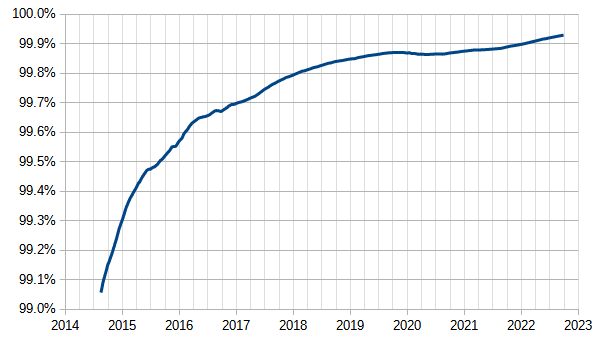
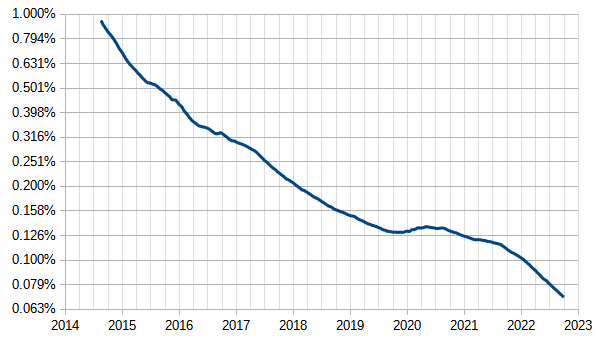
Efficiency of bitcoin The notion of efficiency Efficiency is measured as the ratio of useful output to total input, which can be expressed with the mathematical formula *r* = *P*/*C*, where *r* is the efficiency, *P* is the amount of useful output and *C* is the amount of resources consumed. The standard efficiency of a value transfer In case of a value transfer we define the amount of useful output *P* as the total output of the transaction made available to its recipient (or recipients, if the transaction happens to have several recipients). The amount of resources consumed *C* we define as the total amount related to the transfer, including the amount transferred, related transaction processing fees and rewards. The efficiency of a value transfer - discussion In case of bitcoin, there are attempts to define the efficiency of a value transfer using the total processing expenses per transaction. So, let's try to compare the total processing expenses per transaction to the standard efficiency notion. The first example is a transfer of $1,000,000,000 in cash. The standard efficiency formula would give us that a transfer using an armoured car and a group of security guards may be efficient, since the useful transaction output is big. In contrast to that, the standard efficiency formula gives us that using an armoured car and a group of security guards to transfer an amount of $0.50 would be inefficient. What happens if we use the total processing expenses per transaction? Using an armoured car and a group of security guards to transfer the amount of $0.50 would have the same total processing expenses per transaction as using an armoured car and a group of security guards to transfer $1,000,000,000! Another real-life example is an attempt to lower the transaction fees in the bitcoin network by merging several transactions into one with several outputs. This is a widely recognized way how to increase the efficiency of the transactions. Using the standard efficiency formula merging the transactions makes sense, because the total useful output does not change, while the total processing expenses decrease, leading to a greater standard efficiency of the transfer. On the other hand, the processing expenses per transaction will increase, because the merged transaction will be more expensive than any of the original transactions! The above examples demonstrate that the total processing expenses per transaction are unrelated to the efficiency of the transfer. Visa credit card network efficiency In the Visa credit card network, the processing fees are characterized as a percentage of the payment sent. The values that can be found on the Internet are in the range of 1.43% to 2.4%. Supposing that one intends to send an amount *C* to a merchant and using the lower bound of the payment processing percentage found on the Internet equal to 1.43%, one obtains that *P=(100% - 1.43%) C=98.57% C*, which means that the efficiency of the Visa credit card network in the given example is *r=98.57% C/C=98.57%*. Mean efficiency of the bitcoin network For the bitcoin network, we define *P* as the total output value, and *C* as the total output value plus the total mining rewards including the transaction fees. When calculating the efficiency of the network, we are more interested in trend than in seasonal fluctuations. That is why, instead of using the daily total output and daily total mining rewards, we use running four-year geometric means of those values. For example, on 31 August 2021, the running four-year geometric mean of the daily output value in the bitcoin network is $14,210,628,488 while the four-year geometric mean of the daily total mining rewards is $16,278,056, giving us the four-year mean efficiency of the bitcoin network of 99.8856%. Note that there is a clear trend observable in the efficiency plot: the mean efficiency of BTC is increasing. Similarly as in case of the Visa credit card network, we can define the mean payment processing percentage of the bitcoin network. For the reasons obvious from the Visa credit card example, we define it as *p = 100% - r*, where *r* is the mean efficiency of the network. Conclusion The efficiency of the BTC network is greater than the efficiency of the Visa credit card network. When compared to BCH (see Selected Bitcoin Cash statistics), which has got the 31 August 2021 running four-year mean efficiency of 99.9203%, we see that BTC is not the most efficient commodity book entry coin. https://read.cash/@lmecir/selected-bitcoin-cash-statistics-aae46980 https://read.cash/@lmecir/what-is-bitcoin-0bb5a7da Moreover, we used the total rewards for our BTC efficiency calculations above. These include, as its main constituent, also the supply increase of BTC. In contrast to that, the Visa network efficiency calculation does not include the supply increase of the fiat money and uses the smallest payment processing percentage found on the Internet. A more realistic Visa network efficiency calculation would shift the balance in favour of BTC even further. On the other hand, in bitcoin network, all input UTXO (unspent transaction outputs) entering the transaction as its inputs, must be spent completely. That is why common transactions also have so-called change outputs, returning the value exceeding the intended transfer value plus transaction fees, back to the sender. It is quite complicated to find out which outputs are just change outputs, not contributing to the transferred value. The Can Bitcoin be Trusted? Quantifying the economic value of blockchain transactions article discusses this, finding out that the transferred value is about 8 times smaller than the sum of all transaction outputs. Dividing the sum of transaction outputs by 8 to estimate the transferred value, we obtain a smaller efficiency, equal to 99.09%, which is still greater than the calculated efficiency of the Visa credit card network. https://papers.ssrn.com/sol3/papers.cfm?abstract_id=3452391
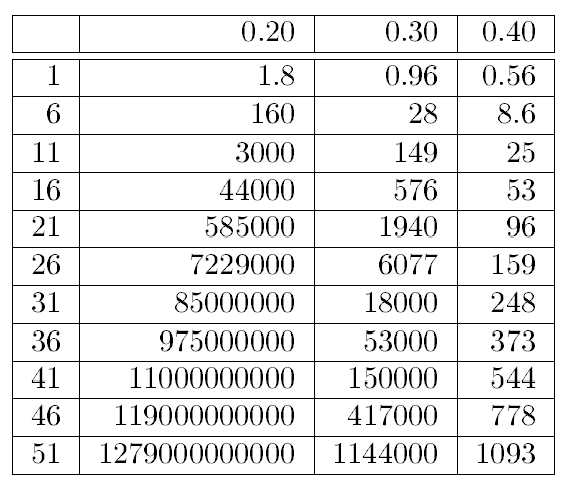
Amendment to the Calculation section of the Bitcoin white paper Finding out that there are some missing aspects in the Calculation section of the Bitcoin white paper, I wrote an article on it. The article contains several formulae, which forced me to write it in TeX and put online in a PDF format. https://drive.google.com/file/d/1oyyjOIBJ03zxV5sNi6Iq5ZZCZa9AIU6C/view
What is bitcoin? Introduction Publicly introduced in 2008 and existing since 2009, bitcoin is still quite new. While many articles and books on bitcoin exist, the characterizations of bitcoin their authors offer are usually controversial, misleading, inadequate and poorly justified. We set out to make a serious analysis to reveal the true nature of bitcoin. Book entry form We start with the notion of a *book entry form*. It was originally used to describe the form of securities that are not given as certificates to investors. In contrast to paper certificates, the ownership of book entry securities is tracked in a (usually electronic) book. Similarly, the ownership of bitcoin is tracked in the *blockchain*, which is a public ledger recording the ownership of bitcoins. As designed by the inventor of bitcoin, bitcoins do not need any physical form. This allows us to conclude that bitcoins have a *book entry form*. Coin The idea of a *book entry coin* was proposed by inventors such as David Chaum and others earlier than Satoshi Nakamoto, the inventor of bitcoin, made it a reality. What are the properties an object must have to be called a *coin*? We consult the Wikipedia, which states that a *coin* shall be a small object Not having a physical form, there is no problem with considering *book entry objects* such as bitcoin small. usually round The word "usually" suggests that round shape is not necessary for an object to be called a *coin*. Importantly, round-shaped small objects can be put into a pouch and transported. This suggests that the important property an object should have to be classifiable as a *coin* is *portability*. Book entry objects are *portable*. In contrast to physical coins, book entry objects such as bitcoin are *portable* through Internet book entry objects such as bitcoin are *portable* across great distances book entry objects such as bitcoin are *portable* across state borders usually flat Similarly as with the round shape, the flat shape is not necessary for an object to be called a *coin*. Importantly, flat shape allows coins to have numerals, images or text on them. These make coins *recognizable*. Book entry objects are generally *recognizable*, because their ownership ledger contains complete information on them. made of precious metal, base metal, alloy, porcelain or other human-made materials Having seen the above list of materials, we conclude that the material used to form an object is not what determines whether an object is a *coin*. The important property is, that the material used to form a coin makes the coin *durable*. *Book entry* objects can be *durable*, if there are many copies of the ownership book at many different physical locations, ensuring the *durability*. This is the case of bitcoin. Bitcoin as a coin As we observed above, bitcoin has got the properties that are sufficient for an object to be classified as a *coin*. The designer of bitcoin, Satoshi Nakamoto, mentions that bitcoin is a *coin* in (Nakamoto 2008, 2, 4). This is the final reason why we classify bitcoin as a *coin*; more precisely, as a *book entry coin*. Numismatic value Since bitcoin is a *coin*, we can examine its *numismatic value*. **Note** (relation to von Mises' Regression theorem) To have a *numismatic value,* it suffices that bitcoin is a *coin*, it is scarce and of interest. There is no need for bitcoin to have a monetary use. The factors influencing the *numismatic value* of bitcoin are Intest in bitcoin The interest in bitcoin has got a historical dimension. The efforts to create a *book entry coin* predate bitcoin. For example, David Chaum designed a *book entry coin* earlier than Satoshi Nakamoto designed bitcoin. Bitcoin is the oldest *book entry coin* that still exists. Bitcoin is the *first book entry coin that is also a commodity.* We demonstrate this property below. The interest in bitcoin is confirmed by the existence of numerous books and articles on bitcoin. The interest in bitcoin is confirmed by the number of searches for information on bitcoin. Bitcoin is exhibited in museums as a new, significant item in coinage history. The interest in bitcoin is confirmed by the existence of a demand for bitcoin. The interest in bitcoin is confirmed by the existence of numerous bussinesses offering exchanges between bitcoin and other items. *Scarcity* in relation to the demand, meaning that a human effort is required to obtain a bitcoin. Bitcoin is *scarce*, since Everybody wanting to create new bitcoins must produce a proof of work. Some authors claim that bitcoin is not scarce, since there can be an infinite quantity of bitcoin look-alikes called *altcoins* based on free availability of bitcoin source code, but Due to bitcoin's *recognizability*, it is easy to discern bitcoin from the look-alikes. The existence and development of bitcoin look-alikes is a factor *confirming* the *numismatic value* of bitcoin. Some authors claim that bitcoin is not scarce, since it can split infinitely many times. Bitcoin splits, however, do not decrease the total value of bitcoins owned by a person similarly as share splits do not decrease the total value of shares owned by a person. The above points demonstrate that bitcoin has got a nontrivial *numismatic value*. Bitcoin has got splits such as BTC, BCH or BSV. Our observation that bitcoin has got a nontrivial numismatic value applies to all of them, but there are significant differences in interest between the splits, causing significant differences in their numismatic values. Economic good Having established that bitcoin is a *book entry coin* that has a nontrivial *numismatic value*, we established that bitcoin is an *economic good*. Production A definition states *Production* is the process of combining various inputs, both material (such as metal, wood, glass, or plastics) and immaterial (such as plans, or knowledge) in order to create output. Production of bitcoin can be described by the total reward equation *t = r + f* where *t* is the total reward *r* is the block reward that consists of newly created bitcoins and goes to the miner *f* are the mining fees that go to the miner For the production to be viable, the input costs (which consist mainly of electricity costs) must not exceed the total rewards obtained by the miner. The most important finding is, that bitcoins are *produced* in a process combining various inputs (the main component being the electricity costs) in order to get the output that consists of newly produced bitcoins and bitcoins obtained by the miner as the mining fees. Moreover, there are many miners *producing* bitcoins. Commodity We use the definition stating that A *commodity* is an economic good such that the market treats instances of the good as equivalent or nearly so *with no regard to who produced them*. Note the word *produced* in the definition. This suggests that commodities must be *produced*. This finding is confirmed by another *commodity* characterization stating that *Commodities* were things of value, of uniform quality, that were *produced* in large quantities *by many different producers*; the items from each different producer were considered equivalent. This characterization specifies not just that *commodities* must be *produced*, but adds a clause that they must be *produced by many different producers*. USDT In contrast to *economic goods* that are *produced*, USDT is not a result of a production process. It is just *issued*. There was a situation when somebody else than Tether *issued* some USDT. As soon as this fact became known, the USDT in question were eliminated from the market as invalid. This is not compatible with the "no regard to who..." clause. Neither it is compatible with the clause that commodities must be produced by many different producers. Summing up, USDT is not a *commodity*. Premined coins Premined coins are not *produced*. They are just issued. Similarly as for USDT, the "no regard to who..." clause does not hold. Summing up, premined coins are not *commodities*. Note that, e.g. XRP is a premined coin. Proof of stake coins The problem with proof of stake coins is, that they are not *produced*. Summing up, proof of stake coins are not *commodities*. Bitcoin As we demonstrated above Bitcoin is an *economic good*. Bitcoin is *produced* by many different producers. In relation to the "the market treats instances of the good as equivalent or nearly so *with no regard to who produced them*." clause The rules of bitcoin do not prescribe that a miner has to reveal his identity. (Nakamoto, 2008, 8) Thus, one reason why the value of bitcoin cannot depend on the identity of its producer is the fact, that the identity of the producer of a coin may be unknown. When a bitcoin transaction is performed, the coins entering the transaction (*transaction inputs*) are replaced by the coins exiting the transaction (*transaction outputs*). If the transaction inputs had different producers or unknown producers, there is no single miner one can identify as the producer of the transaction outputs. Thus, another reason why the value of bitcoin cannot depend on the identity of its producer is the fact, that bitcoin transaction outputs commonly do not have an identifiable single producer. Summing up, bitcoin is a *commodity*. Since its start in 2009, bitcoin has split several times and bitcoin splits such as BTC, BCH and BSV exist. Our above findings apply to all of these. XEC XEC is also a bitcoin split, but, due to change of mining rules, the status of XEC is different. The main difference is, that the reward equation for XEC can be described as *t = s + f + q* where *t* is the total reward *s* is the part of the block reward that goes to the miner *f* are the mining fees that go to the miner *q* is the part of the reward that goes to the group of XEC developers Now for the process to be viable, the sum of input costs paid by the miner must not exceed *s + f*, the part of the total reward that goes to the miner. Since *f* represents previously existing coins, this establishes that economically, the output of the production process is only the part of the block reward denoted by *s*. Unlike the part of the total reward denoted by *s*, the part of the total reward that goes to the group of XEC developers denoted by *q* economically cannot be considered an output of the production process. Instead of being produced, the part of the total reward denoted by *q* is just *issued* to the group of XEC developers. As a consequence, and as opposed to the other above mentioned bitcoin splits, XEC is not a *commodity*. A security? An object having a book entry form may be a *security*. As we discussed above, such an object may also be a *coin*. As explained above, to determine whether an object having a book entry form is a coin, it suffices to examine its *portability*, *recognizability* and *durability*. As a supporting argument, we can also take into account the intent of its designer. The question whether a specific object is a security is significantly more complicated, since it is a legal matter. The answer may differ from legislation to legislation. We try to apply the Howey test and discuss possible differences in other legislations. Commodity As an investment of money Some investors buy commodities on the market as an investment. In a common enterprise Producers of the commodity compete when producing the commodity. As competitors, producers do not constitute a common enterprise. When obtaining money for their production, the producers must cover their input costs. The necessity to cover the input costs does not allow the producers to pool the money obtained on the market. With a reasonable expectation of profit While commodity owners can profit from commodity market price changes, there is no guarantee or promise by anybody that market price changes would occur. Profit to be derived from the effort of others For a commodity, there is no entity who pooled the investor money and who could use the pooled money to influence the market price, pay dividends, make interest-like payments or otherwise generate profit for the investors. Summing up, in accordance with our expectations, the Howey test does not classify commodities as securities. As far as we know, this result is general in the sense, that there is no legislation classifying commodities as securities. This finding applies specifically to the above listed splits (BTC, BCH and BSV) of bitcoin. XEC While XEC is a bitcoin split too, due to a change of the mining rules, its status differs from the status of BTC, BCH or BSV. As an investment of money Some investors buy XEC on the market as an investment. In a common enterprise In case of XEC, the group of developers obtaining the issued XEC can be considered a common enterprise, since it can pool the money obtained for the XEC they sell. With a reasonable expectation of profit The group of XEC developers promised to develop the software of the XEC network. XEC owners expect the group of developers obtaining the issued XEC to improve the software in such a way that the price of XEC increases. Profit to be derived from the effort of others As mentioned above, the group of XEC developers promised to increase the price of XEC by their efforts. Thus, according to the Howey test, XEC is a security. A different result may be obtained in legislations not using the Howey test. USDT An investment of money Some investors buy USDT as an investment of money. In a common enterprise The issuer of USDT obtains money from the investors for the newly issued USDT. The issuer of USDT pools the money from investors, which can be classified as a common enterprise. With a reasonable expectation of profit The owners of USDT expect to buy USDT at the 1:1 rate to US dollar and sell it at the same rate. Thus, if USD is their legal tender, the owners of USDT do not expect profit from USDT's exchange rate changes. As far as we know, the owners of USDT do not expect other, interest or dividend-like payments coming from the USDT's issuer. Profit to be derived from the effort of others It appears that the only profit USDT owners using USD as their legal tender are able to earn is derived from their own efforts like taking advantage of high portability of USDT manifested by fast transactions low transaction fees Summing up, in our opinion, the Howey test does not classify USDT as securities when owners use USD as their legal tender. This is a result we obtained with a reservation that the issuer of USDT did not promise USDT owners some other profits. A different result may be obtained in legislations not using the Howey test or in legislations using the Howey test but not using US dollar as their legal tender. XRP As an investment of money Some instutional investors obtained XRP from Ripple by an investment contract. In a common enterprise The role of the common enterprise in the above contracts played Ripple, which pooled the money of the investors. With a reasonable expectation of profit The above mentioned institutional investors had the reason to expect profit from exchange rate changes caused by the advertising and infrastructure building efforts promised by Ripple. Profit to be derived from efforts of others Ripple promised to use the pooled money to build the XRP infrastructure and to advertise XRP in order to increase the value of XRP. Summing up, the Howey test classifies XRP as securities. A different result may be obtained in legislations not using the Howey test. Conclusion In this article we analysed the nature of bitcoin. According to our results, bitcoin, represented by its BTC, BCH and BSV splits, is a commodity and a book entry coin and per our Howey test results it is not a security. The status of another bitcoin split, XEC, is different: XEC is not a commodity and it is a security per the Howey test. We found that USDT is not a commodity. It does not look as security per our Howey test results, but the status of USDT in legislations not using the Howey test may differ. XRP is not a commodity. It is a coin that, at least when sold to institutional investors, was found to be a security. The status of XRP in other legislations may differ. The world of book entry coins is manifold, containing many coin varieties, some of them being commodities and others being classified as securities per the Howey test. References **Nakamoto, S** (2018) Bitcoin: A Peer-to-Peer Electronic Cash System.

The cost basis of split coins Introduction What really happened on 1 August 2017 and how to calculate the cost basis of coins coming from a split? Chain branching The original single chain of blocks grew two separate "chain branches" (continuations): There was a chain branch adhering to the ruleset called "BTC". Importantly, this chain branch did not adhere to the ruleset (was not valid when judged by the rules) called "BCH". Vice versa, there was a chain branch adhering to the ruleset called "BCH". Importantly, this chain branch did not adhere to the ruleset (was not valid when judged by the rules) called "BTC". Since the chain branches became separate, it was possible to manipulate them separately. What happened to the existing coins? After the chain branching, an existing single coin (unspent transaction output = UTXO) was recorded in both (now separate) chain branches, still having its original properties such as transaction ID, output number, address, public key and private key. Being separate and separately manipulable after the chain branching, each of the chain branches allows an owner of a coin (UTXO) existing before chain branching to manipulate the coin (UTXO) separately. Depending on the chain branch in which it is manipulated, the identity of the coin (UTXO) effectively split in two: When manipulated on the BTC branch, the single original coin (UTXO) can be manipulated as a BTC coin. When manipulated on the BCH branch, the single original coin (UTXO) can be manipulated as a BCH coin. Are the post-branching BTC identical with the pre-branching BTC? Some people fervently claim that the post-branching BTC are identical with the pre-branching BTC referring to a "majority opinion" as if the majority opinion could have been a criterium of the truth. However, the correct answer is "No." Here is the proof: The owner of a pre-branching BTC had some ownership rights. Only if the ownership rights of the post-branching BTC are the same as the ownership rights of the pre-branching BTC, we can say that the post-branching BTC are identical with the pre-branching BTC. However, as explained above, one of the factual ownership rights of the pre-branching BTC was the right that the owner of the pre-branching BTC would become an owner of both the corresponding post-branching BTC as well as the owner of the corresponding post-branching BCH. This specific right is not an ownership right of the post-branching BTC. What happened to the cost basis of the original coin? Principles: Due to the identity split, after the chain branching there were two distinct split coin identities: BTC and BCH. Therefore, the owner of the pre-branching BTC had to split the original cost basis of the coin between the post-branching BTC and BCH. Chain branching did not influence the original cost basis of the coin. Naturally, the sum of the cost bases of the post-branching BTC and BCH coin splits must be equal to the original cost basis of the coin. Since the coin effectively split in two, it was up to the owner to split the original cost basis of the coin between its BTC and BCH splits fairly. What does that mean? To determine the cost basis of the coin splits fairly, the owner must determine the ratio in which the coin split. The split ratio can be determined fairly as the ratio of closing exchange values of the respective splits on the branching day. Example calculation On 1 August 2017, 1 bitcoin split to 1 BTC and 1 BCH. On that date, the closing price of BTC was $256.17 and the closing price of BCH was $16.37. For the purpose of this example, we assume that the cost basis of the presplit bitcoin was $259.16. An owner having a different presplit cost basis should use his own value instead. To split the cost basis fairly, we use the ratios in which the coin split. This gives the cost basis of a post-split BTC equal to $259.16 * $256.17 / ($256.17 + $16.37) = $243.59 and the cost basis of a post-split BCH equal to $259.16 * $16.37 / ($256.17 + $16.37) = $15.57. Conclusion Our calculation describes the fair way how to split the cost basis after a coin split. While having a practical purpose, our calculation also has a theoretical importance, demonstrating that the coins coming from a split have a definite fair cost basis, i.e. that they are not "free money" as some commentators mistakenly believe.

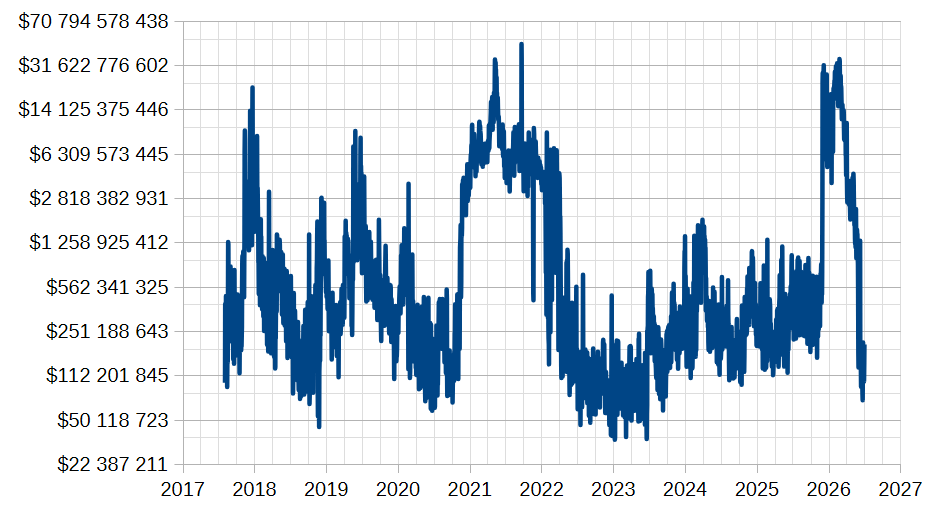
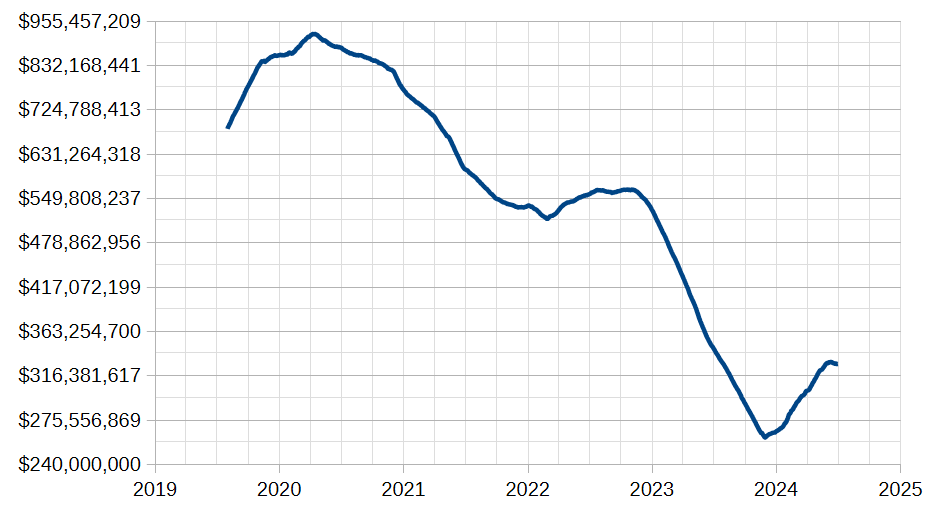
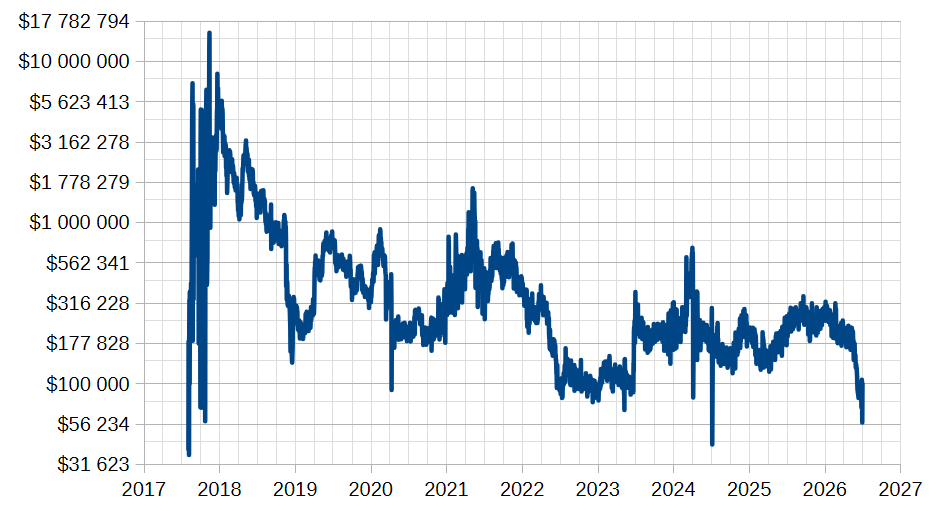
Selected Bitcoin Cash statistics The closing date of this article update is 30 June 2026. Daily volume *A plot of daily volume in US dollars.* In the plot, the maximal daily volume is $46,739,211,410. The minimal daily volume is $35,085,322. Running mean of the daily volume *A plot of running four-year geometric mean of the daily volume.* The formula to calculate it is `VOLMEAN(D) = GEOMEAN(VOL(D-730 days..D+730 days))` In the plot, the maximal value is $918,071,137, the minimal value is $260,995,232. Daily reward *A plot of daily reward including payment fees.* Running mean of the daily reward *A plot of running four-year geometric mean of the daily reward.* The formula to calculate it is `REWARDMEAN(D) = GEOMEAN(REWARD(D-730 days..D+730 days))` Efficiency The notion of efficiency is discussed in the efficiency of bitcoin article. Efficiency can be understood as an indicator of portability. https://read.cash/@lmecir/efficiency-of-bitcoin-27df3d6e As mentioned in the article, BCH surpassed BTC in this respect. *A plot of running four-year mean efficiency.* The formula to calculate it is `EFFICIENCY(D) = VOLMEAN(D) / (REWARDMEAN(D) + VOLMEAN(D))` On 1 August 2019 the four-year mean efficiency was 99.92%. On 30 June 2024, the four-year mean efficiency was 99.95%. Price *A plot of price in US dollars.* In the plot, the maximal price is $4,054.16. The minimal price is $76.76. Running mean of the price *A plot of running four-year geometric mean of the price.* The formula to calculate it is `PRICEMEAN(D) = GEOMEAN(PRICE(D-730 days..D+730 days))` In the plot, the maximal value is $418.53, the minimal value is $256.85. Return *A plot of annualized four-year logarithmic return.* The formula to calculate it is `RETURN(D) = LN(PRICE(D-730 days) / PRICE(D+730 days))/4` Volatility *A plot of annualized four-year volatility.* The formula to calculate it is `VOLATILITY(D) = SQRT(DEVSQ(DAILYRETURN(D-729 days..D+730 days))/4)` where `DAILYRETURN(D) = LN(PRICE(D) / PRICE(D-1 day))` On 1 August 2019, the annualized four-year volatility was 144%. On 30 June 2024, it was 80%.
+6 more