11 Lessons from Building a Company
*Paperback on* *Amazon* *is $12.99, but I'm sharing it here for free. Enjoy!* https://www.amazon.com/11-Lessons-Bootstrapping-Non-Tech-Startup-ebook/dp/B0774VH73W/ref=sr_1_sc_1?ie=UTF8&qid=1511563082&sr=8-1-spell&keywords=11+lessons+startuo
**Introduction**
Launching a company is more like having a baby than anything else I can compare it to.
When I had the idea, it was like being pregnant. A weird mix of inevitability and scary hard work. You know this thing is going to – must – come into the world. You also know you’ve got a lot of really tough work to do to ensure you properly nurture and birth it.
These eleven lessons are sort of like a, “What to Expect When You’re Expecting” for startups. These are some of the things I learned from the day the idea for **Praxis** was conceived, through the newborn and early toddler years. http://discoverpraxis.com/
Today, we’re somewhere in the awkward early teen phase. The lessons I’m learning now are very different, and I don’t yet see them clearly enough to describe them. Babies and teens are alike only in genetic material. Everything else changes.
I don’t share these lessons as a guide to success. I’ve got no idea what you’ll need to do to succeed. Nor do I share them as a retrospective on my own success. We haven’t had a billion dollar exit, or raised tens of millions from celebrity investors, or become a household name. We’re a young, growing company, but we’re still striving every day to become a cliche and Change The World.
This is a look at the founding of the company and the key lessons I learned. I don’t even know if they’re the right takeaways, but they’re the ones that stuck with me.
I can’t tell you what it takes to get to the mountaintop because we haven’t gotten there yet. But I can tell you what it took me to get from idea to where we are now.*
**January, 2020 update: After three consecutive years of profitable, 100% YoY growth, I sold the majority of my ownership in Praxis to new leadership who are taking it to new levels. I have since started another startup called* *Crash**.*
*“Can’t change the world unless we change ourselves”* – Notorious B.I.G. (probably not)
My colleague TK Coleman and I like to joke about this quote from the **trailer** of what looks like a badly made movie about one of the greatest rappers of all time. It doesn’t seem like Biggy would’ve uttered such an empty cliche, so we use it in situations that get too close to cheesy inspiration as a way to playfully mock self-seriousness and pretension. Never fails. https://www.youtube.com/watch?v=kDDv6pAbN_U
But like all fluffy cliches, it’s true. That’s the first lesson for getting a company from idea to reality.
**Lesson 1: You can’t build a company unless you build yourself**
TK was busy building a career in Hollywood, hustling to act, produce, write, and launch a entertainment tech startup. He decided to do something that had nothing to do with his career goals and was not required for any job. He started blogging every single day.
TK prioritizes personal growth over everything. He’s a voracious reader, and he decided he needed to push himself to do more than consume ideas. He needed to create, and ship them out to the world. I watched him transform from an irresponsibly curious guy to a disciplined, creative machine. Then he turned it on me.
He challenged me to blog every day for 6 months. I committed, and that was the first step in the launch of **Praxis**. http://discoverpraxis.com/
The blogging had nothing to do with startups or Praxis. It had to do with pushing myself to become a better version every day, even if I didn’t have to. I had a great job and daily blogging added nothing to it. But it worked wonders for my personal growth. I became a creative machine.
More ideas came, more energy, more confidence, and more clarity. Finally, an idea a decade in the making came into focus. An alternative to college. It seemed so simple, and I’d been sniffing around the edges of something like it since my own underwhelming university experience. Praxis was born because TK continued to build himself when he didn’t have to, and pushed me to do the same.
We built the company around this culture. Every member of the team is inspiring. They are each committed to relentless personal growth. That’s why it works. A person who knows how to grow themselves and add value to their own life can grow an idea and add value to a company.
I had a lot of entrepreneurial ideas prior to Praxis. Most were pretty weak, some were good. But it didn’t matter. I didn’t have what it takes to execute on any of them until I pushed myself much, much harder on personal growth. Monthly challenges, daily blogging, and a commitment to doing one thing each day to add value to myself were prerequisites to launching a company.
The idea matters. But ideas come and go and are unpredictable. You can’t wait around for a great idea. Get busy building yourself so that if and when a great idea comes, you’ll be ready and able to act.
*“In some attempts, it is glorious even to fail.”* – Longinus
Everyone is too scared of failure. But also everyone glorifies failure too much. ‘Failure porn’ is a real genre of Medium articles and trendy startup swag. It’s pretty stupid.
Failure sucks. It’s awful. It should be avoided. You shouldn’t feel weird for not liking failure. You should want to win.
But some things are worth failing for. When you find one, you need to act and fast.
**Lesson 2: It’s gotta pass the willing to fail test**
I had a lot of business ideas prior to **Praxis**. All of them shared a common trait. They all required several things I didn’t have if I were to pursue them. http://discoverpraxis.com/
“If I knew for sure about X, I could try this.”
“If I had X amount of money, I’d try this.”
“If I could find person X, I’d try this.”
I liked the ideas, but I needed less risk in order to take a step. In other words, I was willing to launch any number of them, but only if I knew there was very little chance of failure.
That’s a sign that I’m not the right person to launch that company. If you’re in it because you think it’s a sure thing, you will quit when it gets really, really hard. And it will.
Praxis, on the other hand, was so all-consuming and captivating that none of those objections mattered. I didn’t have money and I didn’t know how to get it. I didn’t have the team, expertise, market knowledge, or any assurance demand was real. I didn’t care though.
I was so obsessed with the question, “Is my theory about a better way to build a career correct?” that **I needed an answer more than I needed the answer to be ‘yes’**.
This was the first business idea I was willing to fail for. When I thought about trying Praxis and failing, it felt ten times better than the thought of not trying it at all. That was the test. That was how I knew this was the one.
That’s when I cashed in all my chips. I don’t want to fail, but I want my answer more than I want to not fail.
*“I would go 0 for 30 before I would go 0 for 9.”* — Kobe Bryant
Launching a startup takes some big, scary leaps. You can’t leap tentatively. You can’t go in with an escape plan. You need to burn the ships behind you when you reach the shore in order to have the tenacity necessary for the attack.
**Lesson 3: Go all the way or don’t even try**
When I knew I wanted nothing more than to get **Praxis** off the ground, there was one more hurdle before I got started. My most important partner in every endeavor needed to be on board. My wife. http://discoverpraxis.com/
I’m pretty persuasive and she’s pretty trusting of me, so many times in our marriage I talk her into something. She’s not an easy sell, but if I persist enough, I can usually get at least a tepid ‘OK’. The problem with anything less than full-hearted agreement is that if things go south I’ve got to pay later for pushing her further than she really wanted to go.
Even if unspoken, the feeling that I dragged her into something that turned out badly is awful, and a wedge in the family. It puts me in a defensive position, irrationally trying to justify the decision while she goes on the offense and uses her original hesitancy as leverage against me.
I knew that a startup was unlikely to succeed under these conditions, and my family certainly wouldn’t. That wasn’t an option. I needed her in on this 100% if I was going to be able to go in 100%.
So I made a pitch. It might have been the weakest pitch I’ve ever made to her.
I said, “I believe in this idea. I love it. It feels different than other ideas. I am willing to commit to launching this thing whatever it takes, win or lose. But I’m only willing to do that if you are in too. I don’t want you to go along with it just to make me happy and then later regret it. I don’t want you to use it against me later if doing this means we have to suffer. I can’t promise you anything. We might end up living in my mom’s basement. I might be working all night. I might be emotionally drained all the time. We might get clobbered in the market. We might have haters. We might succeed and get rich and have a lot of friends and family resent us for it. I have no idea. All I know is that I’m willing to go for it and live with the consequences, but only if you are too. Take all the time you need to decide if you’re all in. I won’t mention it again. Think really realistically about what it might mean, and whether you will be bitter down the road if it’s tough. If you say no, I will not pursue it.” And I meant it.
She said nothing but, “OK, I’ll think about it.”
I was chomping at the bit. I could not wait to get started, but I also prepared myself for the possible pain of her saying no. There’s only one thing in the world that could keep me from launching this thing, and that was my family. That’s the one thing I couldn’t force and cajole. It had to be real, genuine agreement.
I waited.
I waited some more.
OK, now it’s just getting ridiculous. Did she forget? Is she trying to torture me? Is she waiting for me to sweeten the deal somehow? Maybe I should remind her? No. I told her to take as long as she needed and I told her I’d say nothing more.
So I waited.
We usually make decisions very fast. A few minutes is normal. A few hours an exception. Days? Never.
Two weeks. The longest two weeks of my life.
After two weeks of silence, one day as I was grabbing a snack and she was standing in the kitchen she looked up and said, “OK. Let’s do this. I’m ready.”
That was one of the best moments of our marriage. Probably because it’s one of the few times where I didn’t do any talking. I knew she meant it. I knew it was her saying yes to Praxis, not her saying yes to me. That meant everything. I needed her on my side to go full throttle. She gave me a blank check to pursue this thing come what may. That was by far the most valuable investment in the company. She was the first investor. The first person to believe in the idea so strongly they were willing to put tremendous personal resources at risk to make it a reality.
We’ve had hellish moments. Many. She’s never once held it against me or asked me to stop or complained that Praxis takes a toll. She gave me the go-ahead to keep shooting the ball, even if I went 0-30.
If I had partially pursued it while hoping to win her over just enough to let me pursue it a little more I would have gotten crushed by the first big setback. I could always use the excuse, “Well, I guess I have to stop for my wife’s sake.” Destroying any excuse to retreat or any way to pin it on someone else put me in a position of win or die. Best thing I could have done.
*“The most powerful force in the universe is compound interest”* — Albert Einstein (unverified)
Ever heard that riddle about whether you should take a million dollars or a penny, doubled each day for a month? Take the penny. You’ll end up with $1.3M if it’s a 28-day month, and as much as $10.7M if it’s a 31-day month.
Doubling is extreme, but even growth of a fraction of a percent compounded every single day can achieve mind-boggling results. When you’re trying to go from idea to inception, progress each day is crucial. You can’t get stuck waiting for one big leap. You need to take at least one step every single day.
**Lesson 4: Do one thing every day to make your company more valuable**
I was in way over my head when I decided to make the idea for **Praxis** a reality. How to file for incorporation? Do I need to do that before I build a website? How to build a website? Do I need money? Where to get it? Do I get businesses lined up first, or start selling customers first? What price-point makes the most sense? How to describe the company? Do I need brochures? Do I need a formal business plan? Do I need to build the curriculum first, or get some market interest first? Do I need to setup a business bank account? Who could help me navigate all this? http://discoverpraxis.com/
My brother, a seasoned entrepreneur already, told me to chill out. He said none of that matters right now. “Just do one thing to take the idea closer to reality. Just one thing. Then after that do one more thing. If you run out of things and hit a wall that requires some kind of outside assistance, get it. Until then, don’t worry about it.”
I was mentally trying to solve problems from the future. I had a list of hurdles I imagined stopping me tomorrow, and it was crippling my today.
His advice was freeing. I was still working full-time and wasn’t able to devote all my time to Praxis anyway, so I made a commitment. I would do at least one thing every single day to make the company more valuable. That’s it. Just one thing. No other deadlines or goals of having this or that done by this or that date. Just every day, I had to answer ‘yes’ to the question, “Is Praxis more valuable now than it was yesterday?”
Some days I couldn’t do anything but search the web for ten minutes looking for similar programs in the market, or buying a domain. Not massively valuable, but one thing done.
Other days I spent hours on end feverishly writing marketing copy, contacting business owners, talking with college students about whether they’d consider alternatives, building spreadsheets to play with the business model, talking with web designers, outlining the curriculum content, and more.
I did as much as I could whenever possible, but what really mattered was hitting my minimum of one thing done. What really mattered was not letting a single day go by where this thing didn’t make progress. Time is the enemy with a startup. A day without action means you’re going backwards, losing value.
This approach worked wonders. The idea never lost momentum. There wasn’t enough time to talk myself out of it. Some days I was on fire with enthusiasm and faith in the idea, other days I did my one thing with little excitement and lots of doubt. But I committed to doing one thing every day, so I had to act regardless of inspiration. It moved me from the vulnerable sand of emotion to the unsexy concrete of action.
And it did compound. I made it so much farther than I ever imagined before I even needed to think about things like raising money or addressing big huge hurdles I imagined.
*“Do not neglect to show hospitality to strangers, for by this some have entertained angels without knowing it.”* — Hebrews 13:2
I had a lot to do, much of it outside my ability, much of it costly, and I had a few grand I could put on my personal credit card and that was it. The idea for Praxis wasn’t fundable yet, and I didn’t even know what the letters “VC” meant anyway, let alone how to go raise.
But I didn’t need any of that, because I had something far more valuable. I had dozens of accounts with positive balances of social capital, and it was time to cash them in.
**Lesson 5: Social is the most valuable kind of capital**
The first decade of my “professional” life was full of meaningful connections. I went out of my way to meet people, follow up with people, respond same-day to every email, look for excuses to write thank you notes (physical ones!), generously offer help without asking anything in return, and connect people to each other whenever possible.
Part of this is my personality. I’m a connector and a people person. But part of it was a choice and it took a lot of practice. I am not sentimental, I move on to the next thing quickly, and I’m forgetful. That made the practice of writing thank you notes the furthest thing from natural. A leader I respected wrote me a thank you note for something small. I asked him why, and he passed on advice someone had given to him, “Look for excuses to write thank you notes.” It stuck with me. I bought a stack and carried them with me everywhere, stamps and envelopes too. I used them generously.
It’s not so much about thank you notes specifically, but the mindset necessary to write lots of them. It requires/develops an abundance mindset. You begin to see win-wins everywhere. You become more grateful and happy. You begin to see subtle ways people just doing their job is helpful to you. This in turn makes you more able and willing to help more people out.
Instead of a social spender, you become an investor in your network. When you meet new people, instead of handing them a business card and asking them to help you, you default to genuine interest in them, a real connection, and seeking any way in which their interests could be served by something or someone you know. Every person you meet has an invisible account with your name on it. Every interaction is a deposit or a withdrawal.
I made deposits. Tons of them. For years and years with no clear payoff at the end. I enjoyed it and it seemed like a good idea. I didn’t have a clear and compelling reason to spend any social capital, so why not keep investing and saving unless and until I did?
When I went all-in on Praxis, I knew this was the time to empty my accounts and even go into social capital debt.
I turned to friends, colleagues, acquaintances, and acquaintances of acquaintances. I cashed in every ounce of social capital I had and got some lines of credit. I asked for introductions, advice, lists of leads, design help, tech help, legal help, strategic help, research help, product development help, and most of all help spreading the word. I traded some phantom stock and paid some cash, but I mostly traded on goodwill and positive social capital I’d built from helping lots of people, being kind and open appreciative, and having a reputation as a guy who helps lots of people.
Had I seen my professional life as a zero-sum game, where I must exploit and best every threat and carve the biggest slice of a fixed pie, Praxis never would have left the launchpad. The fact that I chose to see it as a positive-sum game, where helping as many people win as possible would grow the size of the pie, meant that I had access to a lot more of it when the time came.
The social capital I cashed in to get started was priceless. I’m not being cute. There is no amount of money I could have raised that could have accomplished what a deep, wide, and rich social network did.
I’m so glad I had the patience and self-control to not get spendy early in my career and trade tiny bits of social capital for tiny promotions, pay raises, or prestige. I needed a huge balance to build a company, and my long-cultivated habit of generously depositing social capital everywhere possible was the only way.
*“The brick walls are there to stop the people who don’t want it badly enough.”* – Randy Pausch
There’s a fatal flaw in your plan. Your business model, or market, or pricing, or something about your crazy idea is going to stop you dead in your tracks. Of course. That’s probably why no one else has done it yet.
Or maybe that’s why you’re going to succeed where they failed.
**Lesson 6: Obstacles are for others**
I was thrilled. Things were really happening!
Every day, **Praxis** got closer to public launch. The curriculum modules were under construction, a designer was working on the logo, website, and collateral. I was writing website copy, building relationships with business partners, and building a list of students, events, blogs, and other outlets to push at launch. http://discoverpraxis.com/
Then I revisited my brilliant business model for some tweaks, stumbled upon a paragraph hidden on the Department of Labor website, and damn-near lost it.
My goal from day one was a program that took one year or less and cost $0 to participants who got accepted. They would get awesome coaching, community, and curriculum resources and experience as a startup apprentice, and get hired right out of the program. No debt, no lost time, no boring BS make-work or memorization.
Business partners would get highly vetted raw talent to work and learn under them. They took a chance on younger, less experienced people, but on the flipside they got low-cost talent with great attitude, upside, and ongoing support and training from Praxis.
It was a win-win-win.
My model was simple. The program was free to participants and the apprenticeship was unpaid. Business partners would pay Praxis to find, filter, train, match, and support the participants through the apprenticeship.
Everything I had built so far was around this simple structure. I’d written tons of different copy for FAQ’s, social media, blogs, and the Praxis website and program guides. It was all focused on a zero cost program.
Then I ran smack into the heinous outcome of idiot bureaucrats and corrupt special interests. Public Choice Theory predicts and explains just this kind of thing perfectly.
My model was maybe sorta kinda illegal.
Like most government policies, this one was full of weird exemptions, and impossible to determine with certainty whether I’d run afoul of the law, but it didn’t look good. In typically absurd fashion, a young person could only work for free if they created no value for the company. In fact, the DOL policy read,
*The employer…derives no immediate advantage from the activities of the intern and on occasion its operations may actually be impeded.*
Yes. Imagine that great pitch to a growing company. “Hey, I’ll provide you an apprentice, but I promise they will not help your business at all, and they may actually impede your progress. Whaddaya say?”
Like all comfy sounding labor laws, this was created at the behest of older, better off workers as a **deliberate attempt to shut out younger, lower skilled workers**. Vested interests don’t like free market competition. https://fee.org/articles/keep-them-down-keep-them-dependent/
I was irate and felt defeated by Leviathan. I’ve got no love for government intervention already, so the economist and political philosopher in me spent plenty of energy being incensed.
To think, millions of young people are goaded and pressured into going five figures in debt and staying out of the market for half a decade in college, where they learn near nothing and it’s considered normal. Yet if one of these young people says, “Screw that. I’ll spend no money and go learn by offering to work for free under someone who’s already doing what I want to do!” Illegal. Because, of course, being trained for free is exploitation, while paying fifty grand to learn nothing is education.
I called my brother. I told him they did it. They killed my dream with the dead hand of policy. I was despondent. I began to realize that I had been naive all along. Of course there’s some big obvious reason no one else is doing this. C’mon Isaac, you really think you’re that special? That no one else had an idea like this?
My brother laughed.
At a time like this, he laughed.
I said, “How is this funny?!” He said, “Look, there’s always some obstacle like this. That’s what keeps away everyone who doesn’t want it as bad as you. Stop getting mad and get creative. There’s always a way around it. Don’t give up. Find it.”
That’s it. He was utterly unconcerned. To him, it was a given that I could navigate around this law. He seemed to think it’d be fun. That change of mindset changed everything. I smiled and realized he was right. This was going to be one more reason I would succeed, because it’d be easy to stop now, and I wouldn’t.
Something amazing happened almost immediately after I switched my mind from helpless victim of state oppression to clever entrepreneur excited by a challenge. I found a way around it. It was actually rather easy and obvious, but I was too blinded by anger and defeat to see it at first.
Participants would pay tuition. Then they’d get paid by the business during their apprenticeship. What they earned would equal or exceed what they paid. The end result (though a little less sexy marketing-wise) was the same. Participants got all the same benefits and an apprenticeship in less than a year for $0. Praxis earned the same revenue, and business partners paid the same for talent.
I felt dumb for missing such a simple fix. But I can’t overstate the extent to which I thought my dream was dead. Mindset is everything. If you’re willing to take no for an answer, you’ll get it. If you’re not, you’ll navigate a sea of no’s until you find a yes.
*“Maybe I destroyed the game. Or maybe you’re just making excuses.”* — Michael Jordan
They can do it because they got funding. You’re stuck because you need money to do all the big things necessary to grow your startup idea into a real company. If only you had the advantages they do! Of course they have traction, because some VC took a chance on them. You can’t get customers without money!
Lies.
All lies. I had to learn and relearn this. I thought I needed money. Nope, not yet. Maybe now? Nope. Still more I can do. Now? Still no.
**Lesson 7: Don’t look for money until you’ve tapped out everything else**
It takes a lot longer to exhaust all possible bootstrap growth activities than you think. When money is not an option, you get way, way more creative. Every time you think you’ve reach a true stopping point, where nothing more can be done without money, you discover a new batch of things you can do to move forward.
I’m not for or against raising money. What I’m against is closing off your greatest asset – your work ethic and imagination – because you’ve bought the, “I can only do X with money” narrative. I’m wary of this narrative because I had to fight it. It’s a tough opponent.
My brother bootstrapped a company for seven years with no outside funding. When he went to throw gas on an already growing fire, he was able to raise $10.2M in less than a year on great terms. It was his sound advice that tied me to the mast to resist the Siren song of fast funding.
I’m good at selling a vision. Raising money seemed an easier task than grinding out some traction. I kept thinking I’d better go raise so I could build the product the way I really wanted to, market the way I really wanted to, etc. My brother’s advice reeled me back in.
I’ll never forget it. We were sitting in my 2002 Saturn in an Isle of Palms parking lot outside a hotel where he was spending the weekend while visiting us. He said, “What are you stressed about? You have an ideal situation. You have a great job that allows you to build this thing on the side for the time being. Just keep doing that. Do every single thing you can before you even worry about the need to quit your job, raise money, etc. Not only will everything you do now improve terms for any future funding, but if you had a million dollars right now, how would you use it? You’d probably waste it. You can try stuff cheap now, experiment at low risk, and figure out what efforts are worth more money.”
I knew he was right. I didn’t want him to be right, because the, “Imagine all we could do with money” narrative is exciting and intoxicating. But I knew I could do a lot more before I actually ran into walls that couldn’t be climbed without money. I also knew he was right about wasting it. If I had a million dollars to start Praxis, I shudder now to think of all the ways I would have misused it. I needed small victories under my belt before I took any big swings.
Not only does bootstrapping as long as possible mean you get more creative, figure out what gets traction, and improve future terms, it also means you have more skin in the game. This is an important incentive structure. The more you are playing with your own resources, the sharper your decisions. Milton Friedman famously described the four ways to spend money, and the level of care with which you’ll act in each case. You’re the most prudential spending your own money on yourself, less spending your own money on someone else, less spending someone else’s money on yourself, and least of all spending someone else’s money on someone else. The longer you can incentivize the wisest form of spending, the better.
Outside funding isn’t evil. It’s wonderful and can be necessary. I ended up raising an Angel investment just nine months after deciding to build the company. Paradoxically, it was only after I firmly committed to build the company without funding that people began to take notice. I didn’t seek the Angel investor, he sought me. Why? Because I had a bit of buzz and traction. Buzz and traction I wouldn’t have if I’d spent those months chasing funding instead of trying to get my first customer. I was building the company, with or without money, which made the prospect of investing attractive. People want to invest in momentum, not just ideas. I wasn’t bluffing. Praxis was going to keep moving, money or not. That commitment was necessary.
Every time I thought I was out of steps and needed money, I refused to let myself give in to the narrative that money was my only move. I’d ask myself, “If money wasn’t an option and would never be an option, what would I do?” There was always something.
Maybe well-funded startups destroyed the game. Or maybe you’re just making excuses.
*“Everything I do, I do it for you.”* – Bryan Adams
You’ve got a dynamite idea and a great product. There are so many angles to market it, and so many verticals to sell. You see a future where your customer base is massive, and you don’t want to exclude anyone in your early efforts. You struggle to define your target market, because you want it so big. You struggle to define your pitch, because it can alleviate so many pain points for different people.
I feel you. But if your market includes everyone, it includes no one. I knew I’d do better with a tighter market. Ideally, as Peter Thiel describes in *Zero to One*, a tiny niche I could monopolize.
But even this was broad enough for me to lose focus. The real break-through for choosing actions to get traction came when I got down to the smallest unit possible.
**Lesson 8: Focus on a single customer**
No company serves “society”, or, “consumers”, or, “Millennials”. These aggregate abstractions are useful in a pitch deck to describe the macro landscape, but when the rubber meets the road, a company can only serve real, individual human beings.
When I was bootstrapping **Praxis** and trying to exploit every low-cost marketing and PR opportunity possible, I realized the message was only potent when highly targeted. “Hey, ambitious young people, check this out!” is pretty weak compared to, “Hey Jane Doe, let me show you how this can help you achieve your specific goals.” http://discoverpraxis.com/
Whether targeting Jane Doe is scalable doesn’t matter. Common (and very good) advice about startups is to do things that don’t scale at first. Worry about scale after you have traction. But I think a target market of one is more scalable than it seems.
In marketing, it’s sometimes called a customer Persona or Avatar. You create a fictional person with a background and bio, and you tailor your message and medium to them. It’s often more effective than tailoring it to a big lump like, “18-25 year olds interested in business and entrepreneurship.” When you market to a collective, it feels that way to your market. No one likes to feel like an interchangeable member of a homogeneous blob.
I didn’t know the marketing mumbo-jumbo or research it. I just realized that a thousand fans or ten potential customers were worth nothing compared to one actual, paying customer. Especially when doing something totally new, where social proof is key.
I created a hypothetical customer in my head. I asked myself, “What kind of person would love Praxis, and what kind of person would Praxis love?” I defined this person in detail.
I pictured a guy who had a few semesters of college he paid for himself and hated it. He’d attend a specific conference where I was speaking, and have specific intellectual interests and life experiences. I wanted a raging individualist from the Midwest who mixes practical, not-to-good for anything work ethic with wild Silicon Valley dreaming and lots of swagger. When I wrote and spoke about Praxis, I spoke to that person directly. It was a certain type of individual within a small niche of young people I already knew well.
Then I met him.
I was speaking at a conference in Michigan when a guy came up to me brimming with confidence and restlessness and asked several direct questions about Praxis. I decided then and there this would be my first customer. I didn’t care about anything as much as getting him into the program. He was the customer I needed to prove the model. If it couldn’t work for him, it was doomed anyway. If it could, it opened up the possibility of so many more customers in so many more niches.
He started his application on the spot. But it took several weeks and lots of emails and calls before he decided to make the leap, quit his job, drop his schooling for good, move away from loved ones, and go all-in. His name was Mitchell Broderick, and he turned out to be a smashing success story that has helped pave the way for many more customers. He proved what’s possible for a Praxis participant.
I never would have sold Mitch had I tried to sell his entire demographic. I never have sold him had I tried to do it in a scalable way. My choice to channel all my efforts to one specific, imagined customer led me to one specific, real customer for whom I targeted everything.
Lots of people will tell you they like your company or would buy your product. This means absolutely nothing until you get one to pay for it. Forget about tweaking and optimizing your approach to fit some conglomerate of opinion from people with no skin in the game. Instead, define down to the last detail your ideal first customer. Target one single person, real or imagined, until you make a sale. Get someone to pay you. Only then is your idea real, and market-proven.
Then do it again. Then again.
*“I sold some stuff.”* – Lloyd Christmas
Alright, the company is real now. But your product requires some resources that only come when you have commitments from customers…and customers require a product before they’ll commit to anything.
It might be time to sell something you don’t yet have so you can get the resources necessary to build it.
**Lesson 9: Sell stone soup**
There’s a children’s story about three hungry soldiers who wander into a small village. They go around asking for food, but the villagers say they don’t have any to spare. Undaunted, the soldiers decide to capture the imagination of the villagers. They announce they will make stone soup.
Everyone’s curious. They bring a pot and water and some stones. As it begins to boil, the soldiers describe how delicious stone soup is, and how they’ve made it for very important people. The villagers are excited to see how they can possibly make soup from stones. The soldiers comment that it’d be better with a few carrots, and an excited villager brings them some. Same for potatoes, barley, cream, meat…you get the idea. Soon the whole village has a great feast with soup, bread, beer, and dancing. Everyone loves it. All from three stones!
The take-away from the story me helped get **Praxis** off the ground. http://discoverpraxis.com/
The soldiers knew if they had the resources, they could feed themselves and deliver an end product the entire village would love. Just asking for ingredients wouldn’t do. They had to sell the end product before they were capable of delivering it. They needed to paint a picture of the possible as if it already existed. They took a gamble on themselves. They knew if they could sell the vision, they’d be able to deliver in the end. Had they produced a bad soup, or kept it all for themselves, they’d be run out of town on a rail.
Whether a pre-sale, KickStarter campaign, or straight-up commitment to deliver what you don’t yet have, some early stage businesses needs to solve the customer-product catch-22.
I needed good businesses who would host apprentices. I needed good apprentices who would create value for businesses. I had to sell stone soup.
I went to my personal network of business owners, and asked them to introduce me to other business owners, and presented a theoretical proposition: If we had great young people who were highly vetted and trained by Praxis, would you host them in your company for a paid apprenticeship? I described the customers I hoped to attract, even though I didn’t yet have them. I got about 20-30 businesses to say, “Yeah, probably.” Good enough. Those were our first business partners.
I listed them on the website and used them as examples of the BP’s in our network when recruiting applicants. I knew if I had good people, I could place them at these and other businesses, even though no company had given me a firm commitment to host.
We got applications and accepted our first 6 participants into the first class of the program. Now the real work began of delivering on the promise. Participants in hand, I went back to the theoretical business partners and made it real. “Take a look at this person. You up for bringing them on as an apprentice? We’ll provide X, Y, and Z, and you just need to provide a great experience with Z, B, and C.” It took a lot of shopping to find the right fit. But I did, and now we were real. We had real business partners and real customers.
The business partner network today is dramatically different than it was then. In fact, of those first 20-30 BP’s, probably only 4-5 of them even meet our criteria anymore. We got a lot tighter, more clear, and more demanding in what we expect. With a track record of quality talent, we can afford to. Now when we say we have businesses in nearly every major city, we have actual businesses who have explicitly agreed to host apprentices or are doing so now. When we started, we just had belief in the ability to make it happen.
Selling stone soup is scary. If you can get all the resources and build the full product before selling, do. But often you can’t, and you have to decide if you’re going to let it stop you, or if you’re going to bet on your ability to deliver and sell a product that doesn’t yet exist.
*“It ain’t about how hard you hit, it’s about how hard you can get hit and keep moving forward.”* – Rocky Balboa
When your company is a newborn, all you can think about is throwing that knock-out uppercut on the status quo. You’re here to disrupt. You’re here to claim the belt. You’re here to posterize the stale old industry with a down-for-the-count sledgehammer.
You’re one punch away from hoisting the heavyweight title.
Problem is, you don’t have enough time to throw that big punch because you’re taking jab after jab after jab before you can gather yourself.
That’s when you realize that staying on your feet to go the distance might be more important than that one big blow.
**Lesson 10: Taking a beating beats throwing the big punch**
About a year in to **Praxis** we started to get pounded. The excitement of launch faded, so too the excitement of getting the first customers, launching the first class, and seeing them graduate with success. The big firsts were over. Now we had to do it all again, but more, bigger, and better. And we had to generate our own buzz because we weren’t inherently cool for being brand new anymore. http://discoverpraxis.com/
Not only that, there were all kinds of problems revealing themselves. Our application process was in need of improvement. Our business partner on-boarding process too. Our website was getting stale. Our spreadsheet “CRM” was pushed to capacity. We had no real marketing funnel, and though we produced tons of excellent content, we weren’t effectively using it to capture leads. We knew how to broadcast our message, but not to connect and engage those intrigued by it.
It got worse. We had a few bad experiences with participants flaking at their business partners, burning bridges and costing us revenue. Year two growth was slowing. Then the worst of all imaginable things happened. **We lost one of our participants**. Nothing grinds you to a halt like the death of someone close to you. Nothing. https://discoverpraxis.com/in-loving-memory-of-kj-herr/
I was overwhelmed. It felt like a flurry of punches from nowhere.
On the long car ride home from a Future Business Leaders of America conference in Nashville, I turned on one of my favorite podcasts, EconTalk, to hear a **conversation between host Russ Roberts and WSJ’s Gregory Zuckerman about the energy boom in the middle United States**. http://www.econtalk.org/archives/2014/06/gregory_zuckerm.html
One of the things that struck me from the stories of wildly successful oil and natural gas “frackers” and investors was how often, how big, and how long they failed. The ones who succeeded in the end owed (at least) as much to persistence and outlasting the competition as they did to special insight or entrepreneurial genius.
Some of these people just kept taking failures the way Rocky took head-shots and body blows, and staggered back up to attempt another wild punch. At times it seems almost sad. Rocky evoked pity in round after round, face bloodied. Yet he became a champion.
What made him great was not his powerful knockout punches, quick footwork, graceful dodges, or lightning jabs. What made Rocky great was his ridiculous ability to absorb punch after grueling punch, in body and in spirit. He just kept getting back up. At some point, the punches slowed a bit and his opponent ran out of steam or made a mistake.
The more I studied entrepreneurs, the more I realized the big closers or lucky long-shots are the rarest of exceptions. The real winners are the persistent ones, not necessarily those with the best ideas, salesmanship, funding, or operations. All these things matter. A lot. Yet no matter how good you are at them, you are going to take some big hits.
At all stages in the process, major disappointment or surprise will blindside you like a mouthguard-flinging left hook. Not just one at a time. Several in succession. And just when you think you’ve steadied yourself, one more. The great ones keep going. They take the hits and fight on.
I felt like crap. But I realized something. We were still standing. We were still standing. We weathered the shitstorm, and we weren’t done yet. Every day that we kept going increased the odds that’d we’d pull out a win. I started whispering to myself regularly, “Just keep standing. Just keep standing.”
We did. We made it through a really, really rough six months or so. It felt like an eternity. We made changes to every aspect of the business. Things began to pick up, and we started to land more punches than we took. A year later, we hit an incredible groove and started stacking wins fast (followed, of course, but another series of gut-busters).
I take tremendous pride in our resilience. A lot of teams can rock it when the world’s complying. Few can stay glued when the haymakers come.
Others advise that big hits are the market’s way of telling you to throw the towel before you drop for good at the hands of an unstoppable force, **Apollo Creed style**. But I don’t think most of us are in danger of staying in the ring too long, and in this country, it’s pretty hard to hit unrecoverable rock-bottom as an entrepreneur. I say stand. https://www.youtube.com/watch?v=_NTUmrOfyUA
For me the lesson on that long car ride was simple and uplifting: When it comes to long-term success, it’s more important to take punches than to throw the big one.
Someone else can always hit bigger than your best. Not many can survive the full twelve rounds.
*“There is no silver bullet that’s going to fix that. No, we are going to have to use a lot of lead bullets.”* – Bill Turpin (quoted by Ben Horowitz)
There’s always that one hurdle that won’t give. It’s the bottleneck slowing growth. There’s got to be some big, clever tactic that vaults you over in one swift motion.
You start banging your head against the wall, hoping to have a eureka moment that solves it. I did. Then I picked up *The Hard Thing About Hard Things* by Ben Horowitz and confirmed a depressing, freeing suspicion.
You probably won’t find a silver bullet. You probably have to destroy that hurdle with thousands of lead bullets.
**Lesson 11: Stop looking for a silver bullet and start spraying lead**
In the first year of **Praxis**, there were several desperate-for-a-silver-bullet moments. Bewildering circumstances where the gum in the works couldn’t be pinpointed. Just a tough slog. Every step forward took Herculean effort. http://discoverpraxis.com/
This can’t continue if we’re going to grow like we want to!
The temptation to find a silver bullet crept in. I’d lay awake at night wonder what the one breakthrough was that would free us from the relentless grind. I’d fantasize about a big PR hit out of nowhere, a new vertical that would sell itself, an investment that would magically grow everything, or a new employee who had all the secrets.
Silver bullets are rare, and probably can’t be found on purpose. For me, even the desire for one was (and is) dangerous.
The desire for a silver bullet shifts energy and attention away from what’s in my control to a series of delightful hypotheticals about what might happen if lightning struck. It slowly dragged me into a passive, victim mindset, away from an ownership, action bias.
This happened many times and I had to fight it every time. Whenever I caught myself saying, “If only we had…” I administered a figurative slap on the wrist.
Consistent firing of lead bullets isn’t glorious. It’s ugly. Even when stuff starts to hit the target, you’ve got so much ballistic material flying everywhere it’s hard to isolate the accurate shots and repeat them.
This is not an argument in favor of wild inefficiency. The more you can narrow it down to the most effective and repeatable tactics, the better. But continuing the salvo is more important early on than putting the action on hold while you try to guess the perfect attack.
Every time I think we’ve finally outgrown the chaotic lead bullet phase and become deadly silver bullet snipers, I’m wrong. There are areas of the business that mature into tighter tactics for sure, but there is always some frontier somewhere with no silver bullet that demands a pistol-packed posse to recklessly drain lead.
A lot of people go down in search of a silver bullet. I decided that wouldn’t be me, and if I went down, I’d go down firing whatever I had, silver or lead.
*You can purchase this and other books by Isaac Morehouse on* *Amazon**.* https://www.amazon.com/Isaac-M.-Morehouse/e/B00QLR969M%3Fref=dbs_a_mng_rwt_scns_share
Say BCH Moons. Are You Prepared to be Wealthy?
*Probably not. And it's not as easy as we imagine.*
It's kind of funny that most curricula are focused on kids and young adults learning things before they need to know them.
They learn about and memorize facts and ideas that are completely unnecessary to solving actual problems they face. The idea is so that they'll be prepared and know things in case they ever become important or useful to know in the future. It's odd for several reasons, not least of which is that this kind of learning has almost no retention, but especially because most of the students won't end up ever facing most of the problems even if they did retain the knowledge. (I have used Pythagorean theorem once in my entire life, and even then I didn't remember its name or the specific formula, but had a vague idea that there was a way to find out one length of a triangle if I had the other two. Google did the rest.)
It should be taken as a given then that I am not pushing for "just in case" learning, or any kind of compulsory education period.
But if one were to agree with the standard approach of learning a bunch of things that might possibly be useful to some sliver of the class at some point in the future, you would think there might be a good bit of material on wealth management. After all, there are 12 million millionaires in the US - more than 3% of the population - which is probably higher than the percent of students who will ever need to know how to label a mitochondria. If you believe in preparatory learning, preparing to manage wealth would seem at least as logical as preparing to be a medical doctor. (There are roughly 900,000 doctors in the US, or less than 0.3% of the population).
We tend to think about wealth as only a benefit, not a problem to be dealt with. "Oh yeah, sure would be nice if my biggest challenge was learning how to manage a million bucks!" Maybe. But probably not as nice as we imagine.
What's the opportunity cost of paying off a mortgage vs putting the money to work in the market? How liquid do you need to be? Where to keep cash since banks are only insured or $250,000 in deposits? How to deal with requests and demands from friends and family? How much to hedge against exogenous economic shocks? How to do so? How to not get taken advantage of by financial planners, lawyers, accountants, and managers of family offices and trusts? What's the best way to handle inheritances so you give your kids a leg up but don't cripple them and rob their ability to gain strength by solving their own problems?
Most people have trouble with financial management at the paycheck to paycheck level. More money doesn't magically solve that. The problems just get bigger and the stakes higher.
While the idea of compulsory public schools teaching wealth management is not desirable, there might be something to the idea of individuals who desire to achieve wealth learning how to manage it a few steps ahead of time. If nothing else, the mindset alone is a form of subconscious confidence building. Investing in wealth management is a kind of bet on yourself that you will put it to use.
*Adapted from my daily blog post at* *isaacmorehouse.com**.* https://isaacmorehouse.com/2020/02/10/preemptive-wealth-management/

Discussion: Scaling, Funding, and Patents in BCH and BSV
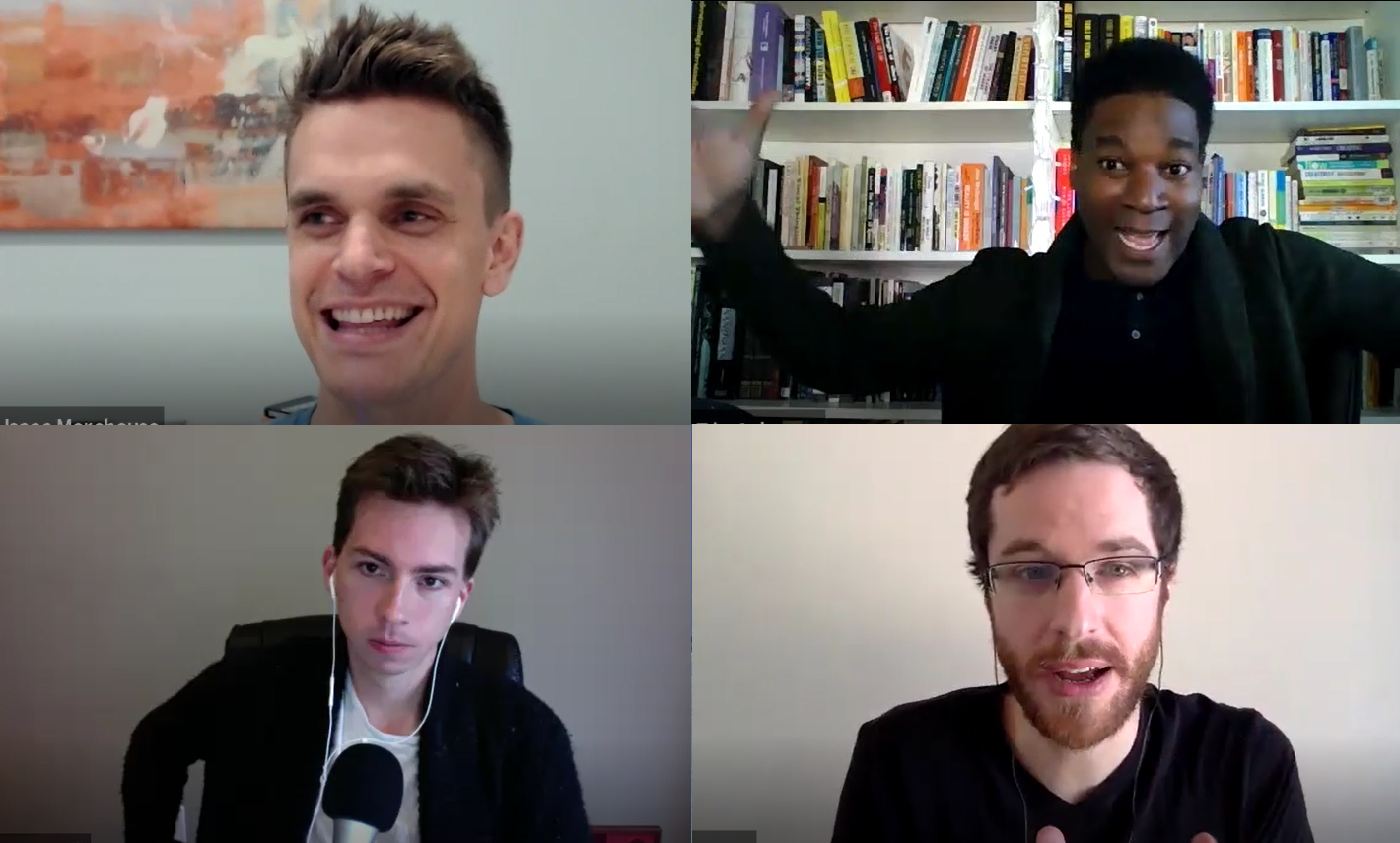
**Apologies I screwed up the recording settings and it only shows the person speaking instead of all of us. It's better when you can see reactions and facial expressions throughout. My bad!*
Steve Patterson, Deryk Makgill, and TK Coleman join me for another rousing discussion.
This one went a bit longer than intended, but I assure you, it only gained momentum and by the end we were yelling at each other about patents.
It was fun!
To re-iterate: All four of us share a desire to see bitcoin become global free market money and so much more. We love big blocks, low fees, speed, innovation, and rapid adoption with as many use cases as possible.
We debate, discuss, and sometimes disagree on the best strategies and which approaches have the highest probability of success.
We all believe that both BCH and BSV approaches have merit, and to religiously dismiss one out of hand is a mental and strategic mistake. We hold no malice for any of the players involved and welcome thoughtful discussion (hell, I even get a kick out of thoughtless trolling!)
I hope you enjoy it as much as we did!
https://youtu.be/dr6TbQ7yhiA
Four Visions of the World
*What do different bitcoiners see?*
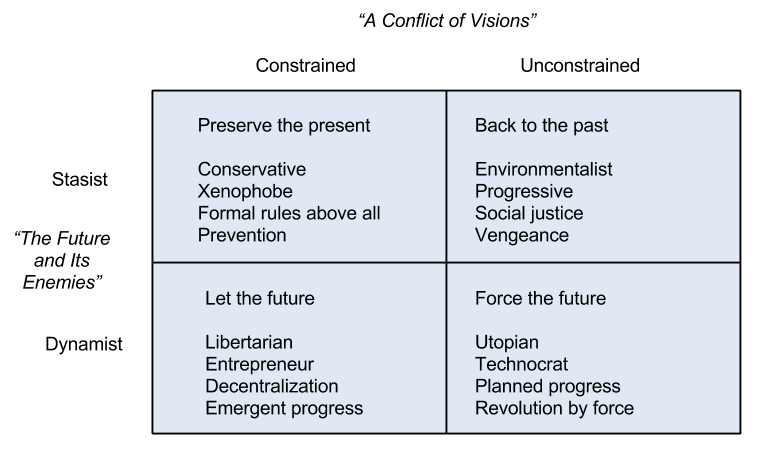
About a decade ago, I read two books in succession that I did not expect to have much to do with each other. They both proposed intriguing dichotomies. These dichotomies cut up the world differently, but I began to see interesting ways they could be layered on top of each other.
The books were ***The Future and Its Enemies****,* by Virginia Postrel, and ***A Conflict of Visions***, by Thomas Sowell. https://www.amazon.com/Future-Its-Enemies-Creativity-Enterprise-ebook/dp/B004U7GX0U?ie=UTF8&btkr=1&ref_=dp-kindle-redirect http://www.amazon.com/Conflict-Visions-Ideological-Political-Struggles/dp/0465002056
Both books are phenomenal and I highly recommend them. Let me briefly describe the central dichotomy presented in each.
**Stasists vs. Dynamists**
Postrel defines two outlooks on human life and society, static and dynamic.
The stasist fears and resists change. They wish to preserve things as they are, or possibly even return to an imagined glorious past. Every change, whether social, technological, or environmental, is bemoaned as the harbinger of all manner of moral and civil decay.
It’s an obvious mindset to spot in many conservatives, exemplified in William F. Buckley’s mission statement for National Review, to “[S]tand athwart history, yelling Stop”, but it doesn’t just describe conservatives. A great many modern liberals fall into this category as well. Environmentalists who fear invasive species or believe any changes to any ecosystems are always bad, unionists who want to set work arrangements and productions methods in stone, or social justice advocates who wish to maintain certain ratios in material wealth between people.
The dynamist embraces change and does not fear it. This includes fans of free markets, free speech, and economic growth, techno optimists and pioneers. Dynamists are, by nature, less organized but also more prone to have a big impact on the world individually. Again, it cuts through simplistic left/right political paradigms and includes some liberals who want mores to evolve and some conservatives who want industry to do the same.
**Constrained vs. Unconstrained**
Sowell has a different dichotomy. It’s a bit more subtle, but like Postrel’s, it does not fit into left/right political rhetoric neatly. He defines two visions of the world and humanity, constrained and unconstrained.
Those with a constrained vision see certain physical, moral, or spiritual realities as unchangeable. Scarcity, self-interest, human fallibility, and evil. This doesn’t make the constrained vision a pessimistic one, but simply, to quote the great economist Peter Boettke, “Puts parameters on utopias.” You can improve the world only by first understanding the fundamental laws of both material and human nature. You can’t achieve flight by wishing away gravity or achieve human harmony by wishing away greed. The constrained visionary realizes these parameters and innovates in ways consistent with them. Smith’s Invisible Hand and Hayek’s Spontaneous Order are fundamentally constrained concepts, as they accept human avarice and limits to knowledge and describe social orders that turn all that imperfection into progress.
Those with an unconstrained vision see everything as perfectible. We can eliminate scarcity (this is very different than simply “have an abundance of stuff”, as it assumes time and choice can also be eliminated), we can remake man into a perfect version, we can stop playing by old stuffy rules and simply rebuild a society without greed. If humans are flawed we can remake humans, instead of forming social orders that work around the flaws. We don’t need institutions that channel bad desires to good outcomes, we simply need to remove bad desires.
Both conservatives and liberals alike throughout history have had both visions. Individualists and collectivists are not neatly plotted into one or the other. Jefferson had a more unconstrained vision, along with the French Revolutionaries and many early anarchist and socialist revolutionaries. Modern anarcho-capitalists and Burkean conservatives alike share a constrained vision.
**Let’s add them together and see what we get…**
Yay, time for a 2×2 matrix! Don’t take this too seriously. It’s been a while since I read these books and I’m playing around with this ideas rather loosely and humbly, so don’t get caught up on specific verbiage. Instead, see if you can gain anything from the intersection of these two dichotomies.
In each quadrant I include a single phrase that I think defines the dominant desire, then list a few ideologies, groups, and types of action and orientation that I think fit it.
**Why now?**
I got to thinking a lot about this recently when reading the phenomenal series, ***Breaking Smart****,* by Venkatesh Rao. (If you read nothing else this year, read this!) http://breakingsmart.com/season-1/
Rao describes the implications of the fact that ‘software is eating the world’. Part of the analysis involves the inevitable backlash against software-enabled progress and disruption. Rao calls the resistors Pastoralists, and provides a very compelling look at the two apparently opposite ways pastoralism manifests.
One is a resistance to all change. The other is driven by agents of change themselves who adopt a single vision of change and wish to force it on the rest. You can see how the first might fit into Postrel’s stasist category, but the second doesn’t quite. That’s where combining Postrel and Sowell becomes so powerful.
I think the three great threats to human freedom and flourishing today are constrained stasists (resist all change), unconstrained stasists (remake the world in the image of the imagined past), and unconstrained dynamists (force the *right* kind of progress on all these hapless idiots).
I think all the promise and joy comes from the outlook of constrained dynamism. One that understands failings in human knowledge and virtue and the physical reality of scarcity and wishes to allow change to emerge and evolve organically within unplanned orders to address them in ways no one can imagine ahead of time.
See if you can map yourself or others on the matrix!
What about BCH supporters vs BSV supporters vs BTC supporters?

A Moral Case for Completely Free Markets
*Free markets aren't in conflict with moral behavior, they embody and bolster it.*
It is a common belief that capitalism “delivers the goods” and creates prosperity, but does so only at the cost of our souls, our dignity and our humanity. Many people doubt capitalism not because they fail to see its wealth-generating capacity, but because they believe it to be immoral. I wish to contest the idea that capitalism is immoral and present evidence to the contrary. Not only do I believe capitalism passes the minimum test by failing to violate basic moral standards; I believe it actively promotes a robust sense of morality in a way far superior to any other system.
Before I present my arguments, I would like to define what I mean by the word “capitalism.” I mean only a system where individuals are free to keep, trade, use or give away property that was peacefully acquired. This is merely a negation of the use of force in the use and exchange of goods. I do not mean a system that is pro-capitalist, or pro-business or pro anything but freedom for the individual.
In matter of fact, capitalists and established businesspeople have always been the most active enemies of capitalism. That is because capitalism is decidedly *not* pro-business. It allows for human creativity, competition and ceaseless challenges to vested interests as people continually innovate in order to better serve customers. It is a system that does not allow one to rest on their laurels long, and as such, those who have been successful frequently try to slow capitalism down and look to the state to find shelter from its dynamism.
If the word capitalism is distracting, I encourage you to substitute “free trade,” “free markets,” “voluntary exchange” or simply “freedom.” It will not change the meaning of my arguments in the least. I have chosen to use the term capitalism because it creates a more provocative title and because the term has been embraced by many intelligent classical liberals. There are good arguments both for and against the use of the term capitalism by advocates of free markets, but I wish to avoid this debate at present.
The titles of the next seven sections in this essay provide a clue as to where I am going:
**Capitalism is Honest**
**Capitalism is Peaceful**
**Capitalism is Humble**
**Capitalism is Responsible**
**Capitalism is Not…**
**Capitalism or What?**
**Capitalism is Beautiful**
Through these sections I will attempt to briefly explain why a system of free enterprise is the best possible way to promote these virtues.
I don’t think we should merely accept or “put up with” capitalism, but we ought to embrace it as the key to unlocking human potential—moral, mental, spiritual and physical. There is much more to be said on the morality of capitalism than I will say in this essay, and I mean only to present some of the most basic arguments. Behind the paywall you will find the complete essay with seven arguments for the morality of capitalism.
It's a lot of material, so you may want to bookmark it and come back to each section when you have time.
Capitalism is Honest
Capitalism is honest because it accepts reality as it is.
Economist Thomas Sowell describes two ways of looking at the world, or two “visions:” constrained and unconstrained. Sowell’s book, “A Conflict of Visions,” is an application of many themes in the work of economist F.A. Hayek; especially Hayek’s views on the dispersed nature of information, the limits to what humans can know about each other, and the problems with attempts to replace organic and decentralized markets with top-down rational planning. http://en.wikipedia.org/wiki/Thomas_Sowell http://www.amazon.com/Conflict-Visions-Ideological-Political-Struggles/dp/0465081428 http://www.econlib.org/library/Enc/bios/Hayek.html
A constrained vision of the world recognizes some things as more or less unchangeable—scarcity and elements of human nature like the desire to better oneself and even frequent greed and nastiness. The best bet is to deal with these realities as best we can, rather than to wish them away. An unconstrained vision sees these as problems to be solved. Humans and our social systems are perfectible, if only we plan and direct our activities in a more rational way.
Regardless of the merits of each respective vision, it is to the great benefit of us all that a capitalist economic system is based on a more or less constrained vision. Even if it is possible that someday people may be better or scarcity may be gone, it’s here, and capitalism doesn’t need it to go away in order to work.
**Honest about interest**
Greed and self-interest are different. Self-interest is unavoidable. All people are self-interested, even when acting altruistically, because they believe the action will get them closer to where they want to be than inaction. Greed is unknowable to anyone but the greedy person. As Milton Friedman reminded Phil Donahue, greed can’t be prohibited by any system. Capitalism realizes this, and rather than wishing greed away, it provides an incentive structure that channels self-interest, whether greedy or not, to produce the least harm and the most good. http://www.youtube.com/watch?v=RWsx1X8PV_A
This is the fundamental insight of Adam Smith, that the butcher doesn’t provide meat out of love for his customers, but out of regard for his own self-interest. It’s not good if the butcher is greedy, but even if he is, good can result if he’s in a capitalist system. Capitalism is not harmed if he is a selfless person, nor is it harmed if he’s greedy. In fact, if he is a greedy jerk, it is likely to hurt his business because customers may not like buying from him. Bigots, jerks, scoundrels and greedy people won’t ruin capitalism, but capitalism might ruin them. http://www.econlib.org/library/Enc/bios/Smith.html
Contrast this to government, where officials and bureaucrats are supposed to do not what is good for them, but what is good for society. For government programs to achieve their goals, it would require people—voters, politicians, employees—to be always selfless. Voters don’t bear the cost of casting selfish votes; politicians can spread the costs of pork across millions of taxpayers and concentrate the benefits to a few; and the workers at the DMV or TSA don’t fear losing your business if they treat you poorly. Governmental solutions are not honest about human greed, and they cannot channel it to create benefits for all like the market can.
**Honest about scarcity**
Capitalism also recognizes scarcity and is honest about it. Love to save trees? Love to save children?
Say there is a forest that is highly valued by the environmental community. It is also the site on which some philanthropist wants to construct a children’s hospital. What’s more important? In government-run or managed economies, this becomes a bitter political question, and everyone is forced into the unenviable position of deciding whether they care more for trees and animals or sick children. In a market system, the property owner can accept offers for the land and a price will emerge. Those who truly value it most will place a higher bid and proceed with their plans for the forest.
To many people, this seems cold and calculating. It feels as though markets reduce children and trees to dollars and cents. In reality, it is an honest way to deal with scarcity, and it allows for the most valuable actions, as judged by the people involved, to be completed. What is the alternative? A system of price caps, regulations or government decisions about land use will not result in the best use of the land, but the one that is most beneficial to political interests. It prohibits caring people who might be willing to sacrifice great amounts of their own resources from doing so, in order to please other people who may only mildly care and aren’t willing to put any of their own resources behind their desires. “Price gouging” is another excellent example of the good that results from capitalism’s ability to deal honestly with scarcity. http://www.learnliberty.org/videos/price-gouging-immoral-should-it-be-illegal
**Promotion of personal honesty**
Capitalism is not merely a system that honestly recognizes and deals with scarcity and greed, it also encourages and breeds trust among individuals. When I go to the store to buy fish, I don’t really consider the possibility that the store may sell me rotten or poisoned fish. No conscious process takes place in which I analyze the incentives facing the store owners and employees and asses my probability of risk. And these are people I’ve never met, people who don’t care about me, and people who I may dislike if I did meet them. Yet the very anonymity and impersonal nature of markets require a tremendous amount of trust from all parties. And we do trust each other! I needn’t trust anyone’s motives or knowledge personally, but the market itself has proven to be so trustworthy that I don’t feel any suspicion.
Capitalist economies produce trusting people. Contrast that to dictatorships or heavily planned economies. If you’ve ever spent time in a country with a heavily controlled economy, you’ve probably experienced things like vendors holding your money up to the light to check if it’s fraudulent.
**Dream of the real world**
Dreams of a world without scarcity or greed are wonderful. But an economic system that is honest about the scarce nature of resources and people of less-than-stellar character, is an unheralded blessing for humanity. It helps us make better choices with what we have, it channels the otherwise destructive behavior of others for our good, and it makes us more trusting people which creates a more vibrant civil society.
Capitalism is Peaceful
Free markets are probably the greatest force for peace in history. There are three distinct ways in which capitalism promotes peace.
**A negative system**
The simplest way in which capitalism is peaceful is by its abstention from direct acts of violence. Free markets offer no positive prescription for what market participants must do. A genuine capitalist system is one of free trade and voluntary association. People are free to do, in the words of Leonard Read, “Anything that’s peaceful.” There are no “do’s,” and the only real “don’t” at bottom is, “don’t use force.” All else is permitted, but there is no guarantee the market will sustain or reward it. http://www.thefreemanonline.org/features/leonard-e-read-a-portrait/
Capitalism is not a master plan or a system created ahead of time by planners. It is really just the result of peaceful interactions. It is what emerges if force is only used in defense against force. The absence of violence results in secure property rights, contracts and all of the other institutional trappings that are commonly associated with capitalism.
Every other economic system requires a direct application of violence. Any regulation, fee, tax, trade barrier, licensing regime or mandate offered in any kind of “mixed” or corporatist or socialist or fascist regime is backed by the threat of violence.
**Raising the cost of violence**
Beyond the absence of force in individual actions, capitalism promotes a much broader peace between people groups from different regions and of different cultures and backgrounds. Self-interest begets trade; trade begets specialization; specialization begets cooperation. Ricardo’s law of association demonstrates how much more productive we are when we specialize and trade, which means that over time we come to rely on a vast network of trading partners for our own well-being. Some people find this state of affairs troubling and you hear things like, “What if X country decides to withhold good Y from us? We rely too heavily on imports!” There are plenty of natural and man-made things to fear in the world if you wish to worry, but the cutting off of trade in a truly free market ought not to be one of them. If a person genuinely wants to avoid all reliance on other people (not sure how this would work for a newborn), they are free to live as long as they can only eat what they can find or grow on their own. It’s not hard to see that that kind of “independence” is far more risky than being part of an interdependent trade network. http://en.wikipedia.org/wiki/Comparative_advantage
The more people rely on trade with others, the greater the cost to all parties of a conflict. If I grow apples and trade them to you for chickens, the last thing I want to do is tick you off and lose my chicken supply and vice versa. On the flip side, if you have a lot of chickens and I have none, and there is no trade between us, I will be tempted to try stealing some. Lack of trade builds enmity. There is a famous saying, attributed to Frederic Bastiat, “If goods don’t cross borders, armies will.” http://en.wikipedia.org/wiki/Fr%C3%A9d%C3%A9ric_Bastiat
In a free market, the cost of belligerence is very high. When governments come in and restrict trade or subsidize violence by building up large militaries, the cost of belligerence is lowered, and the benefits of peace are reduced. It is the state, not trade, which creates conflict.
**Friends, not enemies**
Pretend you live in a free-market economy. You are friends with your neighbor, who works at a small grocer in town. You find the selection to be limited and the prices high. A new supermarket chain is coming in to town, and you’re excited about it because the lower prices and better selection mean you’ll have better meals and money left over for leisure activities with your family. Your neighbor is unhappy about the new store because it may cost him his job. The store comes in. You shop there and save while also expressing your heartfelt empathy to your neighbor whose store may soon shut down. You maintain your friendship, even though in the economic sphere you cease to be trading partners.
Now pretend you live in a heavily regulated economic system much like ours today. You and your neighbor the grocer are still friends. This time the chain store is not free to sell in your town without a government permission slip. It goes up for a vote. Your neighbor actively campaigns to restrain the store from opening up, which will prevent you from buying better products for less money. He urges you to join his efforts and put a “No chain stores!” sign in your yard. You tell him that you won’t because you wouldn’t mind the chain store. It turns in to a bitter, possibly friendship-ending disagreement.
Politics makes enemies out of friends. In a market, you are free to express your varied preferences with your own actions and the expenditure of your own resources. If someone sells something you don’t like, you don’t have to buy. But the very anonymity and absence of compulsion in markets allows you to form community bonds quite separate from your trading choices. You can maintain friendships with all kinds of people whose goods and services you do not necessarily value. You can befriend an orchestral violinist without being a patron of the symphony. But when resources are allocated politically rather than in a free market, that friendship is hard to maintain when you would vote against a tax to fund the symphony hall, which she supports.
Capitalism allows our diverse tastes to be explored and expressed in a way that doesn’t restrict choices to zero-sum contests of your preferences over others. A cornucopia of choice exists in the market, and this not only means better products, but also the removal of artificially created conflict between choices A and B, such as those that inevitably spring from government management.
**Three kinds of peace**
Capitalism relies on voluntarism rather than violence in individual interactions. It also creates cooperative networks that dramatically increase the incentive to get along and raise the cost of conflict, while government intervention does just the opposite. Finally, capitalism allows us to live in harmony despite our different tastes and sometimes conflicting demands for limited resources, while political allocation always forces us to take sides and go to battle against each other. If you want a more peaceful world, promote capitalism.
Capitalism is Humble
In the previous section I talked about the honesty of capitalism; people are not angels. A capitalist economy recognizes this fact, and our greed doesn’t ruin the system. Closely related to the honesty about people’s motives is capitalism’s humility about people’s limits. Humans are not all-knowing, and if force is absent, a free-market is what emerges to deal with this fact and spread valuable and coordinating information the best way possible. Markets are a result of our lack of individual knowledge, and a constant reminder of how fallible we are.
**Models vs. reality**
It has been well documented, especially during the Socialist Calculation Debate that absent a free-market, there is no way to allocate resources effectively. If we believe that people (or at least some group of elite experts) have near perfect knowledge of what resources and finished goods are valued to what extent by whom at what time in what location, then certainly a centrally planned economy would be superior to the messy market with all its profit and loss. Every time an entrepreneur starts a new venture that ends up failing, resources are wasted. His incorrect knowledge about how much people would value his products cause losses. A ruthlessly efficient economy wouldn’t suffer any such waste. http://en.wikipedia.org/wiki/Economic_calculation_problem
Indeed, the classical (and still standard in most economics textbooks) model of the ideal economy is one in which “perfect competition” is reached. The condition exists when everyone has perfect knowledge of the availability and cost of all resources and the value to consumers of all goods. There is no profit, no loss, no shortages, no surpluses and no speculation in this idealized economy. Everything is in equilibrium.
Seduced by this economic model, many an economist, statesman, do-gooder, social-reformer and power-hungry despot has attempted to achieve it in practice, and with disastrous results as evidenced in places like the former Soviet Union. The model may be a useful tool for testing some economic theories, but only an ill-informed or incredibly arrogant person would see it as a desirable or possible end-state for the real world economy. No one has perfect knowledge. It is impossible to even imagine a world in which they could. Since economic value is subjective and changing all the time, how can anyone know how much another person will value one good compared to another at any given time, let alone millions of people in a constantly changing world? http://www.the-dissident.com/Boettke_CR.pdf
**A process, not an end-state**
Capitalism is humble enough to realize our limited knowledge. It relies on the price system—a spontaneous, organic result of billions of free choices—to convey information. It relies on consumers, producers, entrepreneurs and capitalists to act on that information. When they get it right, value is created, and it generates new price signals that encourage more of the same. When they get it wrong, loss results and puts a quick end to the waste of resources and sends a signal telling others not to do the same.
The price system conveys so much information in such a small bundle that I can scarce think of an analogy to show just how valuable it is. It is the most sophisticated communication system the world has ever known. Leonard Read’s famous, “I, Pencil” details the way in which the price system coordinates the actions of thousands of individuals who don’t know each other and might not even speak the same language, to bring an item as simple as a pencil to the market. http://www.econlib.org/library/Essays/rdPncl1.html
**Self-knowledge**
Beyond merely helping us know the preferences of others, the market system can actually help us discover our own assets and abilities. A professor once told me of a Canadian man who played the bagpipes and made small metal replacement parts for other bagpipe enthusiasts as a hobby. One day he saw an ad in the classifieds for someone who could make small metal parts for an airplane manufacturer. He could use some extra cash, and it sounded similar to his handcrafted bagpipe fittings so he gave it a shot. He ended up making good money producing airplane components—an industry he knew nothing about and never fancied himself skilled enough to enter.
If a central planner was trying to make the best use of all the labor and resources in Canada, he might conduct a survey of the skills possessed by the people there. This man could not have made known his skill in airplane manufacture, because he didn’t even know he had it! The discovery process of the market revealed to him knowledge about a value he could create for others that was previously hidden. If we don’t even know our own economic value, how can we know the values of others?
**Greater than the sum**
We can’t produce what the capitalist system produces. It is greater than the sum of its parts. It conveys coordinating information that lets us each go about our business and produce end results that are beyond our own abilities and comprehension.
Capitalism’s features—the price system, failure and success, profit and loss, trade, specialization, even the hated speculator, middle man and advertiser—are the result of and cure for our ignorance. We need them to help us choose actions that are valuable to ourselves and others.
A capitalism system does not require perfect knowledge. Through it, we can produce what no planner ever could. This humble, dynamic, trial-and-error approach produces wealth and innovation like no other system. It also keeps us humble on an individual level. When you contemplate the production of a simple pencil, and how far beyond your own skill level it is, it certainly puts things in perspective. It reveals how much we need our fellow man, and how much more we can accomplish when we allow this organic market process to coordinate our activities.
Capitalism is Responsible
*“All things are subject to the law of cause and effect.”*
The opening sentence in Carl Menger’s 1871 “Principles of Economics“ seems at first glance little more than a truism, but it is an idea so foundational and so often ignored that it deserves great attention. It applies not only to economic activities, but to all human endeavors. If we seek to live moral lives and promote what is morally good, we ought to heed these words. http://mises.org/etexts/menger/one.asp
What often passes for praiseworthy is any action, or *cause,* whatsoever that is taken with a sincere desire to achieve a noble *effect*. The relationship between cause and effect is wholly ignored. But is it moral to take uninformed action that has no causal relationship to the ends sought?
**To whom much is given**
If I told you that one sick child would get well for every window you smashed, would you be a person of high moral character if you spent the night naively smashing windows with a sincere belief you were doing good? While your heart may be pure as the driven snow, doing good requires at least a genuine effort to understand the world and the likely effects of your actions. As C.S. Lewis said of moral busybodies, “They may be more likely to go to Heaven yet at the same time likelier to make a Hell of earth.”
None of us has perfect knowledge, but to the extent that we are able, we are responsible for using sound judgment. In the age of the Internet it would be hard to claim you didn’t know better for taking actions that hinder rather than help the target of your good deeds. A valiant self-education effort is possible in almost every field. To whom much is given, much is required.
**Capitalism works**
Once we accept the fact that genuine moral good requires more than intentions, it becomes immediately apparent that capitalism has a leg up on every other economic system when it comes to the noble goals of poverty alleviation, peace and health.
The desire to help the poor is nearly universal. But when it comes to actual efforts to do so, there is a spectrum of outcomes ranging from absolute oppression to life-changing relief. We need to consider the outcome before we advocate a course of action. Capitalism is the most powerful force for the material betterment of humanity in the world. State interventions like minimum wages, price caps, foreign aid, immigration restrictions, and professional licensing and regulations do unspeakable harm to those of limited means. http://bleedingheartlibertarians.com/2012/06/factual-free-market-fairness/
Economic theory predicts better outcomes from markets than governments. Observation backs the prediction. The evidence is abundantly clear that economic freedom does more than government interventions (and private charity) for improving living conditions by every measure. This video gives a brief overview of some of the data. http://www.valuesandcapitalism.com/dialogue/society/private-charity-isn%E2%80%99t-enough http://youtu.be/v1U1Jzdghjk
Many people base their arguments for economic freedom entirely on the fact that it produces better material outcomes. But don’t let that fool you into thinking capitalism “delivers the goods” and ignores morality. I’ve addressed just a few of the ways in which capitalism promotes moral values in previous sections, but let’s not overlook the moral component of an improved quality of life for the least of these. If helping the poor is good, and if good intentions must be coupled with results, a free economy is in excellent moral standing.
**Individual responsibility**
In addition to achieving the ends of poverty reduction, capitalism also promotes responsibility in individuals. Since it is a negative system in which we can’t force people to do what we want, we must learn patience and peaceful persuasion. We have to be ready to accept the consequences of our decisions and learn to act prudently. Freedom allows us to become responsible. http://valuesandcapitalism.com/dialogue/economics/capitalism-peaceful
Poet and theologian John Milton famously argued for free speech by saying that without it, the ability to become a morally responsible individual would cease. Milton said that without the freedom to choose *wrongly* what books to read or doctrines to believe, there would be no concept of choosing *rightly*. People would not become moral, but would be of a weaker character and less able to resist evil when they encountered it. There is no righteousness in not making bad choices that are not available to you. A truly free market leaves open the possibility of bad decisions, but any system that does not allow these decisions makes us less, not more, morally responsible. http://libertarianpapers.org/articles/2009/lp-1-38.pdf
Capitalism is NOT...
Capitalism gets saddled with a lot of baggage that doesn’t properly belong to it. Some of this is the result of ignorance of basic economics, some of it a poor reading of history, but most of it is due to a bad definition of capitalism. In the first section, I defined what I mean by the term:
*[A] system where individuals are free to keep, trade, use, or give away property that was peacefully acquired. This is merely a negation of the use of force in the use and exchange of goods. I do not mean a system that is pro-capitalist, or pro-business, or pro anything but freedom for the individual.*
This definition does away with many of the accusations made against capitalism. They may be true of our current system, but not of a genuinely free market. Still, there are a number of claims about capitalism that remain, and I wish to clear up at least a few of the common errors.
**Capitalism is not a zero-sum game.** For someone to win, it does not require someone else to lose. It is easy to observe a person who has done well and assume that there must be persons elsewhere who had to lose something in order for this person to have gained. That is true of every political system and many simulated scenarios like sporting events, but nothing could be further from the truth in a market.
When exchange takes place in a free market, both parties trade something they want less for something they want more. Of course, either may change their mind later and regret the decision, but at the time of the trade both parties valued what they got more than what they gave, otherwise they would not have traded. It is easy to see how value is created on both sides (because economic value is subjective), and how there was no “loser.” Beyond this simple illustration, over the long run the wealth generation of capitalist trade grows the overall pool of valuable resources and increases choice for all involved. This means the potential for more and bigger “wins” as time goes on and specialization and trade increase. Wealth is created, not distributed.
**Capitalism is not for the rich.** If there’s any class or group that benefits more from capitalism than any other, it’s not the rich, but the consumer. Of course all of us, rich and poor alike, play the part of the consumer at various times. But it is an inescapable fact that in order to succeed in a market, you must create value for consumers. Ludwig von Mises sums this up nicely: http://mises.org/etexts/mises/anticap.asp
*“The riches of the rich are not the cause of the poverty of anybody; the process that makes some people rich is, on the contrary, the corollary of the process that improves many peoples want satisfaction. The entrepreneurs, the capitalists and the technologists prosper as far as they succeed in best supplying the consumers.”*
The rich do not live at the expense of the poor, nor do the rich feel particularly secure in a free market; they often seek government intervention to protect them from competition. But any gains to the rich not only are the result of creating value for the consuming public, they often lead to direct benefits for the poor over time by way of lower prices and access to new technologies.
Even the most selfish, peasant-hating rich person wants to buy fancy new luxuries. Whether they like it or not, being early adopters of such goods helps fund the continual production, research and development of new technology and can bring the cost of production down over time. There is not a modern convenience in existence that did not begin as a plaything of the super-wealthy. TVs, cars, washing machines, cell phones, etc., *ad nauseam.* If there were no wealthy customers around to purchase these impractical items, it would have been nearly impossible for producers to continue to refine them and lower the cost of production. Rich and poor can certainly dislike each other in a free market, but they cannot avoid helping each other.
**Capitalism doesn’t concentrate power.** Capitalism disperses power. If you look at the list of Fortune 500 companies 50 years ago vs. today’s list, you’ll notice some familiar names. You’ll also notice that the majority of top players 50 years ago don’t make the list today, and a great many of them don’t even exist. There was a time when Sears threatened to dominate the entire retail industry through its innovative catalog approach. The previous big players in the retail scene, themselves viewed by some as invincible, were put under by Sears. Is Sears a retail hegemon today? Neither will Wal-Mart be tomorrow.
Capitalism is relentless, and consumers want value. They may have brand loyalties, but those only go so far. At the end of the day, the dynamic process of creation, imitation and destruction constantly wreak havoc on the best predictions of who will control the market into the future. Were it not for massive government interventions—including things like anti-trust, which is purported to break-up vested interests but typically does the opposite—we would see even more dynamism and less concentrated power.
It may be a bit disconcerting to realize how dynamic the free market is. The good news is while corporations and products and methods of production are created and destroyed all the time, the human and material resources in the economy are redeployed. It may cause temporary dislocation, but the transition from buggies to Fords was very good for market participants, even though it killed some buggy companies.
**Capitalism isn’t about taking advantage of people.** In fact, it’s about people taking advantage of the opportunity it provides. I used the example earlier of price gouging. Higher prices after a disaster are sometimes seen as an example of people being fleeced by the market when they are the most vulnerable. But when we understand what’s actually happening when prices rise—those less desperate are encouraged to conserve so those who need resources most can get them; suppliers are signaled to deliver more goods to the affected area, etc.—we see that the market is doing more than any other system could to provide for those who need it most.
I’ve heard people talk about the way that businesses take advantage of employees and force them into subpar working conditions. Of course we all have to make choices, and we all wish our options were better than they are (which is why we work to improve them). But is it true that capitalism allows companies to take advantage of people’s needs? Possibly, but no more than people take advantage of companies’ needs.
If you’ve ever shopped at Wal-Mart, supposedly one of the worst offenders when it comes to taking advantage of employees, you’ve noticed that most of the employees are not very helpful. I once waited for 30 minutes to pick up something ordered online. The store was not busy and four or five employees saw me there and did nothing. A few said they were going on break and someone else would help me soon. Some said nothing and just walked past, even when I tried to get their attention. When someone did arrive she was discourteous and messed up the check-out several times. I am far less likely to order from Wal-Mart after this experience.
If Wal-Mart is so good at exploiting employees, why were they unable to make them shorten their break to help me, or treat me with basic kindness, or master the proper checkout procedure? The answer is that Wal-Mart is not any better at getting what they want out of employees than employees are getting what they want out of Wal-Mart. The ease and regularity with which employees quit in the retail business is staggering, and employers often have to tolerate a lot of behavior that is detrimental to their profits to keep needed workers.
I don’t like to moralize about who’s exploiting who, but if we’re going to play that game we ought to consider the many ways in which employees, consumers and shareholders take advantage of managers, investors and corporations. It happens in both directions, but in a free market both are difficult to sustain in the long run. You have to serve other market participants, not cheat or exploit them. It’s not perfect, but capitalism does a better job of generating cooperation and limiting exploitation than any other system.
**Capitalism doesn’t corrode our souls.** Sure, free markets give us more choice and make us wealthier, but don’t they also make us crude, materialistic and shallow? It is true; in a more abundant market with lower costs, a person can more easily indulge their materialistic impulses. It is also true that countries where few go hungry also have more obesity. The cure is not to restrict the food supply.
A free market forces us to become people of character or suffer the consequences. We have more choices, which means the option of choosing things that are bad for us. But being deprived of choice altogether does not make us better people, just weaker people. http://valuesandcapitalism.com/dialogue/economics/capitalism-responsible
A person who has never lied because their tongue is cut out is not what we hope to become when we strive for honesty. Capitalism cannot corrode your soul, but it can provide you more modes of cultivating and expressing what’s in your soul—good or bad. You can’t escape ultimate responsibility for your choices under any system. Capitalism is up front about that.
Capitalism or What?
When analyzing any social or economic system, the three most important words are:
“*Compared to what?*”
Capitalism has its shortcomings. It has shortcomings because life has shortcomings in our own subjective evaluations. That is, we can always imagine a state of affairs better than the one we experience. It is exactly this kind of imagination that has been the driver of human progress. However, when progress has been made it has been by a combination of imagination and an understanding of causal relationships that are unchangeable. The desire to fly, coupled with an understanding of physics, motivated people to create amazing contraptions from airplanes to rockets to parachutes. The desire to fly coupled with a denial of the force of gravity would lead to a much different experience.
When we feel frustrated with the morality of the free market, we should always ask what a better alternative might be. When you get down to it, there are few options. As previously explained, all government intervention is backed by the threat of violence. This is important to keep in mind when considering alternatives to capitalism.
If you think the price of a good is immoral, for example, ask yourself what you would do to address the problem. Price controls mean threatening violence to anyone who wants to sell above a certain price. Imagine storming to your neighbor’s garage sale with an armed thug and yelling, “Lower your prices or else!” Does that seem more moral than your neighbor peacefully putting an asking price on her old bowling shoes?
From a moral standpoint, since the alternatives to free markets mean coercion (whether partial intervention or complete control), it’s hard to imagine addressing the imperfections that can occur under capitalism with government action. Not to mention the fact that the interventions don’t work at achieving the desired results. http://youtu.be/kJeuoMh46JY
Most of the alternatives imagined by critics of capitalism either overlook the coercive nature of the state or rely on a superhuman, all-knowing, all-good state. But if people aren’t good enough to act justly in a market, how could they be good enough to wield government power over others? Sound social theory and historical evidence confirm that indeed, power tends to corrupt and absolute power corrupts absolutely. The difference between the power of a business tycoon in the market (assuming it’s a truly free market and he’s not in bed with government regulators) and the power of a government agent or politician is that the former can only woo while the latter can compel. Much as you mightn’t like the perceived power that people can get in the market, state power is far more dangerous. Businesspeople don’t conscript customers into war or kicked-down doors, except when in cahoots with the state.
There is a philosophical term for the tendency to compare one system to an imagined utopia, rather than to other possible alternatives. It’s called the Nirvana Fallacy. This is a prevalent form of argument against markets. A common example is, “Capitalism hurts the poor.” But compared to what? Look at the evidence of free economies vs. less free economies. http://en.wikipedia.org/wiki/Nirvana_fallacy http://valuesandcapitalism.com/dialogue/economics/capitalism-responsible
Minimum wage is example of how this fallacy can lead to bad outcomes for the intended beneficiaries. It is a result of the notion that some people don’t make enough money. But compared to what? What alternative is there to free-market wages that can improve the lot of the poor? Minimum wage laws only price the poor out of the labor market.
If we’re honest and use some economic thinking, it becomes clear that even the things we don’t like in a market system are better than the alternatives. (Of course, this is not true for the elites who have mastered the art of gaining political power and favors. For them, markets are worse than corporatism. But aren’t these just the kind of people we would like to see face the rigors of competition and put in an honest day’s work?)
It’s not a very fun argument nor is it the most compelling, but the worst that can be said of capitalism is that it is the “least bad” economic system.
Many accusations against capitalism turn out to be accusations against reality itself. We want to eat our cake and have it, too. We don’t like scarcity, which means trade-offs and choices. We don’t like that some people have no taste for high art (which is why Creed sold more records than Jimi Hendrix!), or that sometimes we enjoy cheap imported goods, or that fossil fuel allows us to do things that we find fulfilling. Capitalism is the wrong target in these cases; we’re frustrated at other people for being different, or ourselves for not being the way we wish we were, or at nature for the materials it yields. We’re upset at cause and effect. Certainly we are justified in feeling unease at failings of those around us or the difficulties nature presents, but we need to look for solutions in reality, not fantasy. http://www.buzzfeed.com/daves4/12-extremely-disappointing-facts-about-popular-mus http://valuesandcapitalism.com/dialogue/economics/capitalism-honest
It might seem great if everyone in the world could have twice as much of everything right now. But that’s not possible, and capitalism shouldn’t take the blame for that any more than cement should take the blame for the fact that falling on cement can produce a skinned knee. We should continue to envision a better world and strive to create it, but we shouldn’t pursue a world that’s not possible. Let’s make progress through the peaceful coordination of the market, not the false hopes of a “new man” or the eradication of economic laws created by state centralization and coercion.
*(I should add that it is extremely difficult in this country to know whether it is a fact of life or some government policy behind many of the problems we confront. This should make us especially cautious of blaming capitalism, since so often it is a lack of capitalism that makes reality seem harsher than it is. There are innumerable difficulties, both big and small, that entrepreneurs have solved but regulators have perpetuated.)*
Capitalism is Beautiful
Beauty is not often on lists with virtues like peace, honesty and humility. But true beauty is a virtue—it is awe-inspiring, praise-evoking and brings the kind of joy that humans seek for fulfillment. When I think of life’s best moments, beauty is involved; a sunset over Lake Michigan, my wife’s smile, a moving piece of music, my kids laughing, a good cigar. These experiences are sensory, emotional and, each in a different way, beautiful.
Odd as it may sound, I also feel a sense of awe when I walk in to a retail store and ponder the myriad products in front of me. Perhaps I’m a little crazy, but the more I think about it, the more beautiful capitalism is. There are times when I actually get choked up at the operations of the free market!
Consider, as Leonard Read famously did, the production of a simple pencil: http://www.econlib.org/library/Essays/rdPncl1.html
*I, Pencil, am a complex combination of miracles: a tree, zinc, copper, graphite, and so on. But to these miracles which manifest themselves in Nature an even more extraordinary miracle has been added: the configuration of creative human energies—millions of tiny know-hows configurating naturally and spontaneously in response to human necessity and desire and in the absence of any human master-minding! Since only God can make a tree, I insist that only God could make me. Man can no more direct these millions of know-hows to bring me into being than he can put molecules together to create a tree.*
The wonder only grows as technology progresses. Consider, “I, Smartphone.” http://youtu.be/V1Ze_wpS_o0
The products we consume for our survival and enjoyment are not produced by you, me or any of us. Yet they are produced by all of us. How does this happen? How can the provision of the most basic necessities of life be beyond the ability and comprehension of any of the individuals who need those necessities? There is profound beauty in this mystery of human cooperation.
If you’ve ever been moved by the observance of a stranger coming to the aid of another, nothing should move you more than the operations of the market. A group of volunteers cleaning up and rebuilding homes after a disaster is beautiful. But consider that the same disaster, if markets are allowed to operate, will cause millions of people living thousands of miles away to reduce their consumption of needed water, plywood, generators and flashlights so that those in the affected areas can get enough. It will induce complete strangers, some of whom don’t even know of the disaster, to channel their energies toward the production and distribution of goods to the victims of the storm. The market is so powerful, in fact, that it will induce even those who dislike the victims and would wish ill upon them to alter their behavior in ways that alleviate the sufferers.
There is daily innovation in a capitalist economy. Entrepreneurs are in relentless pursuit of ways to make their fellow man happier and better off. The cornucopia of products from around the world available to us in a moment’s notice is truly a miraculous exception to the experience of humans throughout history, and it is human creativity unleashed by free-market capitalism that has made it possible. Free and open exchange is one of the most awe-inspiring, community-enhancing, peace-loving, relationship-building, cooperative and coordinating things humans can engage in. http://lfb.org/today/the-miracle-at-mon-ami-gabi/
The fact that the prosperity of a capitalist economy is the result of the laws of nature and facts of human nature, rather than anyone’s conscious design, makes it all the more inspiring. Consider the unlikely way in which bees are the keepers of flowers; as they seek only their own survival they pollinate the flowers and produce a dazzling garden.
Likewise, it is utterly amazing that billions of individuals seeking to better their condition do more to promote the welfare of their fellow man than any direct effort to do so ever could. I don’t want to confuse by saying that capitalism *does* this, because capitalism, or markets, can’t *do* anything; they represent the interrelated actions of individuals. It is the action of individuals that make this complex mosaic of harmonious interests and outcomes. But make no mistake; capitalism is the only canvas on which such a work of art can be created.
That, to me, is enough to stand in awe of a genius creator who put things in place to allow for this; or, for the non-religious, a spellbinding universe that is like a benevolent conspiracy of good. Capitalism is what occurs absent the use of coercion in human relationships, where spontaneous order emerges. Capitalism is beautiful.
Enjoy it!
*Originally published as a series on* *isaacmorehouse.com**.*

Intellectual Property is Childish
*I'm republishing here because IP is a recurring topic in bitcoin discussion right now. BSV fans in particular seem to believe, despite that fact that bitcoin and everything on top of it was built without patents, it requires strict patent enforcement to proceed.
I'm not making a detailed argument about bitcoin patents here. I'm presenting a wider perspective on the concept in general.
*"He knocked down my Lego tower!”*
*“Only because she built it to look exactly like the one I made, and that’s not fair. I made mine first!”*
All the parents I know handle this situation by pointing out to the aggressor that it is perfectly acceptable for other kids to build things that mimic his own creations; in fact, he should feel honored!
**But let’s visit a household wherein the parents are strict advocates and respecters of intellectual property.**
In this house, children are punished for copying their siblings.
Any new Lego ideas, whether actually built or not, are immediately filed with the parent, and every time Lego building takes place, the children must first check the files to make sure they aren’t about to build something that someone else had already thought of and filed. No imitation is allowed in this household.
This is, of course, an absurd environment.
The main source of learning for children, imitation, is being crushed while some of the most beastly childlike tendencies — spite and anger at others’ success and an overwhelmingly selfish desire for all the attention — are nurtured.
This is also the environment faced by all inventors, entrepreneurs, creators and businesses in any legal structure that enforces IP laws.
**Let’s fast-forward a few decades.**
The IP-conscious parent gets a call from their grown-up child complaining about how he designed and built a beautiful garden, but the neighbor loved it so much he put in an identical twin next door.
The good parent would immediately sympathize with the victimized child and come over with some shovels and firearms and help his son destroy the thieving neighbors’ copycat garden, and demand some payment from the neighbor at gunpoint, to boot.
This is only fair, of course, because this gardening son built the garden for profit, not just pleasure. It was so grand that he planned to sell tickets to people who wished to walk through and enjoy its splendor. How could he do so when the neighbor’s identical garden could be walked through for free?
It seems easy to spot the ridiculous and childish nature of anti-copying arguments in these examples, but there is no significant difference in the real world of IP law.
**Ideas, unlike physical goods, are not scarce.**
The neighbor can build his garden without so much as a single fern being removed from the other.
Garden design is an idea. Some argue that it’s not the idea of garden itself that’s being stolen, but the value it could produce. Even in the case of physical goods, no one has a right to a certain market value. If I steal your car, your property rights are violated. If a manufacturer designs a slew of new cars that make yours far less valued in the market, your rights are not violated, because you never had a right to a given resale value.
Many people argue that the real need for IP law arises when we’re talking about companies making multi-billion dollar investments in R&D, not merely five-figure gardens. What incentive is there to pursue such costly innovations with no promise of reward for the effort?
There are several problems with this analysis. First, even with current IP laws, there is no guarantee of profit. How many billions of R&D dollars are spent on projects that end up yielding no return? Consumers are fickle, and IP doesn’t guarantee they’ll like your product, no matter how much you spend on research.
Second, the massive R&D sticker price is somewhat deceiving. Drug companies, for example, are not spending billions of dollars of the CEO’s money. Instead, they are spending billions of dollars of shareholder money. Most shareholders have shares amounting to thousands, and they have portfolios with money spread across many companies and industries. Even if a $1 billion R&D project is fruitless, the losses are actually not that acute.
But let’s say they are. Let’s pretend a single individual had a great idea and they could devote their entire life and livelihood to developing it. Surely, without the security of IP law, they would have no incentive to do so, right?
How do you explain a fashion designer whose every energy goes into designs that can be immediately copied in the IP-free fashion industry? How do you explain football coaches who spend years developing and perfecting new schemes and plays only to have the best of them immediately adopted by inferior coaches across the league?
Do you think the NFL would be more dynamic and innovative if coaches could copyright their plays? What if no one were allowed to use the cover 2 defense except its creator? The spread offense? The I formation?
Thankfully, no such IP laws exist in football. Do you think we’re suffering a lack of innovation for it? Are there innovative coaches sitting on the sidelines with amazingly innovative plays, failing to use them for fear they won’t reap enough reward in a copycat league?
IP law is not necessary to incentivize innovation. https://read.cash/@isaacmorehouse/do-you-need-patents-to-incentivize-innovation-84170955
There are no guarantees of success or uniqueness in the market, yet entrepreneurs and investors put significant resources into innovation every day, apparently willing to hazard the risk. IP law stifles, rather than encourages, innovation.
Not only is IP unnecessary, it is a holdover from our nursery days before we learned that it’s not OK to be possessive little tyrants who demand no one copy their babbling noises, Lego towers and Crayon scribbles.
IP laws are childish and bring out the kind of nasty and immature backbiting that parents work so hard to correct in their kids. Let’s grow up and quit trying to hold back the beauty and dynamism of a world where ideas are free.
*Originally published* *here**.* https://lfb.org/intellectual-property-is-childish/

Do You Need Patents to Incentivize Innovation?
The standard theory behind support for creating a legal monopoly for certain ideas, processes, and inventions is that absent such promise of monopoly there would be far less innovation.
It has a surface level logic to it. People respond to incentives. Legal monopoly means more money for the one who has it. People tend to like the money incentive. Therefore, more people will innovate because they have the incentive to capture greater rewards by securing a monopoly on the production or sale of their invention.
The weird thing is it doesn’t play out like this in the real world. Something is missing.
Inventions typically spring from technicians and masters at a craft. These are the types who are driven by a passion for what they do. They want to solve problems, discover things, build things, and create things. So they do. If they seek a legal monopoly on their invention this happens after the fact. It is hard to imagine many innovators saying, “Oh wow! Think of possibility of solving this chemistry problem and discovering an entirely new way to do X! Wait…get a lawyer in the lab before I go any further. I refuse to make any discoveries without proof that I’ll be protected from competition once I do.”
And innovation doesn’t look like that. You can see this by observing areas without the ability to get legal monopolies on their inventions. Fashion, food, and football are a few of my favorites. You can copy, borrow, and imitate fashion designs, recipes, and defensive schemes with abandon. Many people do. Yet each of these fields is as dynamic as any industry, constantly evolving and introducing new things. Apparently the innovative offensive coordinator, cook, and designer don’t require the promise of monopoly to entice them to innovate.
People do respond to incentives. This is a fact of life and one that need not be overturned to overturn the belief that IP laws are required for innovation. Any good economist will tell you that incentives are many, and value is subjective. The innovators are certainly responsive to money incentives, but 1) legal monopoly is not the only or best way to earn money for inventions and, 2) money isn’t the only incentive driving invention.
As for number one, consider how many people are typically working on a similar innovation simultaneously. With the current IP regime, only one can get the monopoly. If we want to take incentives seriously, what kind of incentive does this create for all the others? Furthermore, the one most likely to get the monopoly is the one with all the lawyers and accountants and resources and willingness to take others to court, not the one with the greatest contribution to the discovery. This would seem to drive upstart innovators away from the task for fear of being sued by the big guys as much or more than it would drive them to innovate for the possible promise of securing a patent.
As for number two, while the promise of monopoly may be the dominant incentive for lawyers and R&D departments, it’s not the dominant incentive for inventors. They innovate first, driven by a passion for the task, the desire to solve a problem, create their dream, help a colleague, or improve their own daily life with some small innovation. Yes, they want and seek money for the invention once successful, but the absence of a promise of monopoly does not stop them from creating.
Understanding incentives is crucial to really understanding how the world works and how to change it. But an elementary look at incentives that examines only dollars and cents and only their *intended*, not actual, beneficiaries will not get you very far.
For more on the problems with intellectual property laws, check out “Against Intellectual Monopoly“. It’s excellent. http://www.amazon.com/gp/product/B001E9731A/ref=dp-kindle-redirect?ie=UTF8&btkr=1
*Originally published* *here**.* https://isaacmorehouse.com/2016/04/01/intellectual-property-and-incentives/

How I Changed My Mind on Intellectual Property
I'd been solidly libertarian for many years the first time I gave thought to "intellectual property" (copyrights and patents) at all. Someone mentioned the protection of property, including intellectual property, as the root of prosperity and freedom. I agreed without hesitation.
It just seemed to make sense. Now and then I would read or hear someone reiterate this position and it always seemed right to me. I had spent a lot of time working through the arguments in favor of private property – both philosophical and economic – and I didn’t think IP required any special arguments to augment what I already believed about other forms of property.
Then a quote by Thomas Jefferson caught my eye:
“If nature has made any one thing less susceptible than all others of exclusive property, it is the action of the thinking power called an idea, which an individual may exclusively possess as long as he keeps it to himself; but the moment it is divulged, it forces itself into the possession of every one, and the receiver cannot dispossess himself of it. Its peculiar character, too, is that no one possesses the less, because every other possesses the whole of it. He who receives an idea from me, receives instruction himself without lessening mine; as he who lights his taper at mine, receives light without darkening me.”
This bothered me. It kept rattling around in my brain and the more I thought about it, the more it seemed that IP was not just like any other form of property. Indeed, it became clear that IP rights required a new set of arguments; arguments for physical property rights were insufficient in defense of IP. So I started to poke around.
**Rethinking Everything**
My instincts were so strongly in favor of IP that I began by looking primarily for arguments that would bolster my bias. After all, the people who criticized IP in my experience were the same people who hated markets and businesses and all individual property, or else people who just wanted to get movies and music without paying for them because they didn’t work and had no money. They seemed to be complainers and looters, not thinkers, producers and achievers. They had to be wrong.
Once I began looking for theoretical arguments in favor of IP, I realized that a great many people who were not market-hating hippies or Marxists or welfare queens did not find a credible case for IP. This was a disturbing discovery. The more I looked and read and thought, the more problematic the idea of IP became. It was a philosophical problem.
For starters, how was IP to be defined? Any mental exercise I tried presented insurmountable problems with even defining it reliably. If someone writes a certain combination of words on a page in a certain order, do they own it? What if they never show anyone else? What if someone else with no knowledge of the first person has the same combination of words in mind or on paper? What about simultaneous discovery, which is not infrequent in the history of great ideas?
These puzzles and many others forced me to acknowledge the strange characteristics of IP which made any consistent definition or enforcement impossible. Ideas are non-scarce. They could hardly be defined as property at all. What kind of law makes someone a criminal by adding a chemical to another chemical and selling it, even if they had no idea someone else had done the same and gotten government approval? It began to seem more like a violation of property rights than a protection. Why should my use of my property be confined to things other people have never done before?
**The Slow Change**
I read many more articles and had many late night discussions on the theory of IP over the course of about a year. I came to the unhappy conclusion that ideas were not property, IP was impossible to define, and therefore enforcement was a game of favoritism fraught with all the rent-seeking problems that any regulatory hurdle presents. I didn’t like IP because it was not a coherent concept. But I still believed it was necessary.
I maintained a philosophical disbelief in IP and a pro-IP policy position for some time. Even though it seemed an incoherent concept, I could not wrap my head around how innovation would occur absent patents. I didn’t care much for copyrights, and I thought trademark issues could be handled via fraud protection, market pressure and contractually without recourse to special IP laws.
But patents seemed an absolute must. It was the production of prescription drugs that got me. I failed to see any possible way in which advanced pharmaceuticals could be produced in a world without IP. Though I was not a pure consequentialist, this concern was enough for me to resist a strict anti-IP position even though I couldn’t justify it philosophically.
The IP issue was never (and is still not today) the most interesting issue to me, so I let it be. It only occasionally came up, and I was content to somewhat awkwardly debunk it in theory but support it in practice. My quest for IP consistency was shelved as my intellectual journey took me elsewhere.
The more I learned about economics and political philosophy, the more ridiculous and far-fetched the state became – even a minimal state – and my ideas grew more radical. When I ran out of arguments for the existence of the state – both moral and practical – IP reared its head again. Someone asked me if I thought any form of IP could survive without the state’s initiation of force. I could not conceive of any way in which it could.
**How Would It Work in Practice**
This left me in a weird place. I had been dragged, again kicking and screaming, to a disbelief in the state as an ethical or practical form of social organization, yet I had always believed that without state created patents, major innovations would cease. Then I came across Boldrin and Levine’s, “**Against Intellectual Monopoly**.” I read it and my eyes were opened. I wondered how I could have been so dull and lacking in imagination and a grasp of history! http://levine.sscnet.ucla.edu/general/intellectual/againstfinal.htm
They argued not from a philosophical standpoint, but from a practical and historical standpoint that, far from spurring innovation, IP was one of the greatest stranglers of progress. In fact, the entire purpose of IP laws has been from the beginning to restrict innovation and experimentation and ensure the benefits of good ideas are concentrated on privileged groups, not according to how much they help consumers, but by how well they navigate the bureaucracy.
It was all so simple and obvious; I wondered how I could have missed it. I marveled at how I got by for so long with a worldview so full of the inconsistent and unexplainable. How could I see so clearly that occupational licensing didn’t protect consumers but instead protected the big industry players who lobbied for it while failing to see the same about IP?
Upon reflection, it seems the reason my belief in IP was so strong was because it was planted in intellectual soil that had been cultivated since childhood to see the world as on the brink of chaos and disaster, only held together and kept sane by the force of law. Life on this planet was the Hobbesian jungle, and in every facet – from basic survival to usable language to a medium of exchange to innovation and common decency – we needed the strong arm of Leviathan to keep us on track.
When I began to realize how utopian this view of the state was, and how complex the real world was with all its intersecting norms and institutions, it became possible at last to see what should have been rather obvious; that ideas needn’t be held hostage in order to be put to use and that the incentive to innovate needs no special nudge from the state.
This is how I came full circle on the issue of IP. I don’t want or expect you to read this and be convinced I’m right. I haven’t even really presented any arguments. I do hope, however, that you may be inspired to keep an open and inquiring mind and the topic and keep poking around.
If you do, check out Boldrin and Levine’s book on the practical case against IP, and Stephan Kinsella’s on the theoretical **case**. Think about your instinctual position on the issue and ask yourself what worldview it comes from. https://fee.org/articles/how-intellectual-property-hampers-the-free-market/
Don’t assume anyone who doesn’t favor IP is a property-hating socialist. And for goodness sake, enjoy the process!
*Originally published for* *FEE.org**.* https://fee.org/articles/how-i-changed-my-mind-on-intellectual-property/

Ridiculous, Irreverent Nicknames for Bitcoin Forks
If you can’t laugh at yourself, you’re gonna have a bad time.
Deryk Makgill and I had a little fun playing around with labels for the different forks of bitcoin, based on all the various rumors and storylines and accusations and inside baseball. I won’t tell you who came up with what, that way if something is particularly offensive we both have plausible deniability. ;-)
*These are just for fun, and don’t represent our opinions or beliefs about these coins, just some of the common narratives!*
Each bitcoin fork nickname trio follows this format:
BTC
BCH
BSV
Here goes…
Doomsday bitcoin
Payday bitcoin
Judgement day bitcoin
Prepper bitcoin
Prosper bitcoin
Proper bitcoin
Bunker bitcoin
Buster bitcoin
Bluster bitcoin
B-Bank
B-Tax
B-Sue
Flaw bitcoin
Raw bitcoin
Law bitcoin
Snood bitcoin
Dude bitcoin
Rude bitcoin
Lightning
Rightening
Frightening
It’s-a-Ponz
J-Assange
Q-Anon
Bad intents
Good intents
Mad patents
Bad shit
Bash it
Batshit
Wrong
Right
Wright
Nein coin
Crime coin
Mine coin
Off chain
On chain
nChain
Greg coin
Beg coin
Craig coin
Proof of sherk
Proof of work
Proof of jerk
Layer
Dare
Ayre
Jekyll
Paris
D.C.
Sauron
Somalia
Sidney
Lusitania
Ruritania
Entertainia
Cthulhu
Sacre bleu
Sue you
Furries
Worries
Flurries
Corrupt
Fedupt
I WILL MAKE ALL OF YOU BANKRUPT
Der
Ver
Her
(As in the movie about a sentient AI)
Make a bet
Roger’s pet
Metanet
Core
Poor
War
Fear game
Ver game
Peergame
Chlorophyl
Borophyl
Made-by-Phil
Has no plan
Big in Japan
Pumpkin man
Irritation
Cash salvation
Litigation
Government mole
Ambitious goal
Patent troll
Chain die
Nice try
Mean guy
Fee market
Free market
Can't market
Very sketch
On the edge
Frogs and Twetch
High fee
Anarchy
Fake degree
I must admit we spent entirely too much time with these, and there seems to be no end.
Try it, it’s fun!

How to Ask for Money for your Bitcoin Project
There are a lot of conversations around funding development on the bitcoin network. It’s an important topic with big implications for the future of cryptocurrency. I’m not going to weigh in on the best funding mechanisms right now, but I will offer a few thoughts on fundraising in general.
I am a big fan of bitcoin and have been following, using, and discussing it since 2012. More broadly, I am passionate about human freedom and the promise bitcoin holds to enhance it. I’m not technical and have no standing as an expert on cryptography or code.
But I'm pretty good at raising money!
I’ve made quite a few pitch decks and proposals, had hundreds of donor and investor meetings, and raised several million for both nonprofits and startups.
**Here are some of the basic tips that make it more successful.**
**Have a why**
Why does your project exist? What motivates you? What are you trying to bring about in the world?
Investors are humans. They have limited time and attention. If you can’t connect your passion with something they care about, no amount of technical know-how or necessity can win them over.
**Describe the problem**
A lot of technical people start right in describing the product, activity, or tech. It’s better to begin describing a vision of the world without your project. What’s the pain point people are feeling?
**Make it human, not technical**
I’ve seen problem statements like, “The throughput is insufficient for 60% of use cases”. Yikes.
That is a technical problem. But technical problems are everywhere and most aren’t worth fixing. Investors want to know what the human problem is. What pain is this causing to whom? What’s being missed out on?
Rephrasing to something like, “People have to wait hours if they want to use it for X, and this can mean missing crucial appointments” has a dramatic impact.
**What do you do to solve it?**
After describing the real, human pain felt by the problem you’re trying to solve, explain as simply as possible what you do to solve it.
You’d be amazed how many pitch decks and proposals leave the listener or reader wondering, “But what to you *do*?”
Make it clear. Problem in the world causing a particular pain, we do a specific thing to remove it. Boom.
**Tell the outcome of your solution, not the inputs**
Then share the vision of the world after you solve the problem. Don’t focus on the activities you engage in, but how the world in general and specific individuals live a better life.
**Why you?**
OK, so you’ve clearly explained the why behind your project. You’ve painted a picture of the problem and the pain it causes. You’ve plainly stated what you do to solve it and shared a vision of the improved world after you do.
Now is the time to explain what makes you the team to do it. What have you done in the past? Do you have proof of doing similar things? Do you have a unique skill or insight?
You’ve convinced them this is an important race. Now let them know why you’re the right horse to run it.
**What is the roadmap?**
They’ve followed so far. They’re interested. But they still want to know your game plan for executing this solution. How long will it take? What’s the sequence? What steps need to occur?
Lay out a basic, high level plan for 3-6 month increments over the next 24 months. Explain the likely outcome by the target date. Have a few benchmarks along the way.
**How will you use the money?**
Now break the roadmap into a few components and put dollar amounts on them. What does $X result in? $XX? $XXX?
Tons of detail isn’t necessary, just reasonable targets you are confident make sense. Don’t bluff. Answer honestly, what could you do with the next unit of money and what positive outcome would that produce?
**Engame**
If you have a for-profit company someone is investing in for equity, let them know how and when they’ll get paid. Do you plan to achieve profitability and spin off dividends? Get acquired? IPO?
If it’s a non-profit, what’s the big giant world changing long-term goal they are helping to advance?
In crypto, perhaps it’s a project that benefits the ecosystem but doesn’t necessarily directly return money to the investor. Show them how your long-term success translates into the success of the network and a corresponding return for them in terms they care about. Whether increased adoption, customers for their business, added value to other companies they invest in, or coin price increases.
They want to know if all goes well how does it end?
**Pitfalls to avoid**
**Sounding needy or desperate**
People like investing in momentum. A weak pitch leads with, “Without money, we won’t be able to do anything.”
A strong pitch leads with, “This will happen with or without you. We’re moving forward. Your investment means we can do it even faster and better!”
**Sounding like extortion**
There’s a famous National Lampoons magazine cover that shows a dog with a revolver to its head and the words, “Buy this issue or the dog gets it.”
It’s funny as parody, but not when it’s a real fundraising pitch!
Technical people are often frustrated with how non-technical people fail to appreciate the important complex stuff they do. This tends to make them resort to extortion style funding pitches.
“Go ahead and see what happens when you stop funding us and the whole network crashes!” is not a winning pitch.
**Guilt tripping**
Even if you’re raising for a charity, guilt is a weaker emotion to appeal to than greatness. Talk about the great outcomes they can help create, not how bad they should feel if they refuse to fund.
This takes many forms, including weak asks like, “Here’s all my life and heart I’ve poured in, so if you care about what I’m doing it’d be nice if you helped out a bit.”
(For some reason, Redditors seem partial to this kind of pitch. It might work for karma, but in the world of business it’s not the best way to secure funding.)
Make them feel awesome for investing, not bad for abstaining. Make it an opportunity they don’t want to miss out on; an entrepreneur they can’t wait to bet on, not an annoying beggar they want to make go away.
**Forgetting the ask**
Weird as it sounds, the most common pitfall of all pitches is forgetting to make an ask!
I’ve seen so many great pitch decks and proposals that make the problem and solution real and tangible and get me excited. Then they just end. Without ever making a clear ask! No call to action! I've been guilty of it myself.
I remember some of my early fundraising meetings when I worked for a nonprofit. I’d share exciting new initiatives and then wait for the donor to say something like, “Great, I’ll cut you check.” It didn't happen.
I was nervous. It felt tawdry to follow up the pitch with a dollar amount. In reality, anything else is worse. To not make the ask is to waste time and expect the prospective funder to do all the mental work of putting something on the table.
Ask.
If in writing, make clear how to support. If in person, bring it home with a clear spoken ask. “We’re seeking $1M for this next phase, and I’d like to ask you to invest $250k.”
(Oh, and after the dollar amount leaves your lips, wait. Be silent. Let them be the next to speak. Otherwise you'll end up blabbing and walking back your pitch before they have a chance to bite.)
**Nuts and Bolts**
**Create a pitch deck**
Trust me. You think you don’t need a pitch deck for your project. But you do.
Not because you can’t raise without it, or because every investor will demand one. But because the mere act of building it will ensure you get your pitch right!
It is a powerful exercise in tightening your narrative and bringing clarity. It will help pull you out of the weeds for a bit. I build a new one every year or so for my companies, even if I’m not raising a funding round.
**I recommend creating a deck that is 80% images, 20% text, and has slides that follow the points I listed above in that basic order.**
There are many ways to make a great deck, but many more to make a bad one. One thing the world of venture-backed startups have done well is share info on what makes a good deck. Do some Googling.
I recommend the book ***Get Backed*** as an excellent guide as you build a deck. https://www.amazon.com/Get-Backed-Perfect-Launch-Venture/dp/1633690725?SubscriptionId=AKIAILSHYYTFIVPWUY6Q&tag=duckduckgo-brave-20&linkCode=xm2&camp=2025&creative=165953&creativeASIN=1633690725
**Decide a strategy**
There are a lot of different ways to raise money. While I have run successful Kickstarter and Indiegogo campaigns, I tend to prefer individual and institutional investment to crowdfunding. Primarily because of leverage. A targeted sales process for a few dozen investors can yield more money quicker than a massive campaign to thousands of smaller donors.
But crowdfunding can be powerful, especially in a strong community like crypto. You can’t just slap something up though. Crowdfunding requires better marketing skill, while large individual and institutional investors require better sales skill.
Whether you’re raising equity, nonprofit donations, or pre-selling a product or revenue stream; whether crowd, individual, institutional, or a combo; decide where to put your focus and really try to win at that one strategy rather than half-assing several.
**Prospect and research**
If you’re going after larger investors, create a simple prospect spreadsheet. Start with anyone that comes to mind. Then start looking up investors on similar projects. Ask around.
Use Crunchbase or SignalVC or any other tools to help you find potential investors. Find contact info, research and take notes, rank them in three tiers by your most to least ideal investors.
**Start**
Start sending cold emails!
Take the time to customize to each prospect. Track who you’ve sent to. Send followups.
It’s best to begin with your lowest tier investors, so that if you get calls or meetings you can work out the kinks on those, then dial in your pitch for your higher ranked investors later.
Keep the process moving, a little bit every day.
**Don’t fear**
It sounds awful to most people. It’s not.
You care about your vision. You’ve already invested in it yourself, with your time and energy.
If you can learn to translate your own passion and vision into something others can get excited by, you will unlock a super power. For yourself, and for crypto as a whole.
Good luck!
*PS - If you’ve got a pitch and you want me to look at it, I’m happy to provide honest feedback.* ***isaacmorehouse@gmail.com****.*

Why Bitcoiners Should Be More Selfish
In overriding your self-interest for a sense of group identity, you are weakening bitcoin.
**The floppy man**
I’ll never forget during the block size debate when the always eccentric Daniel Krawisz referred to BTC maximalist Jameson Lopp as a “floppy man”, modeled on the character LeFou from Disney’s Beauty and the Beast. It was entertaining, cutting, poignant, and a little sad.
Lopp had tweeted about how he was ready to double down on small block BTC, divest all his BCH, and if it meant he lost everything he would be proud of his sacrifice for The Cause. Like LeFou, his own personal interest and identity were utterly subsumed in a Great Idea he aspired to, even to his own demise. In fact, the more he suffered, the more pride he felt. He was not alone. An entire sub-genre of crypto Twitter one-downsmanship emerged.
Perhaps this kind of denial of self is admirable in some contexts. Bitcoin is not one of them.
**Falling on your fork**
Honor societies have thinking and scaling problems.
If the success of an idea or innovation requires each individual involved to be unsuccessful, it won’t break out of cult status. If to be a part of bitcoin (or a particular fork) means to fall on your sword, suffer inconvenience and loss, publicly display acts of devotion, dissociation from alternatives, purge and shame dissenters, and play the ever escalating proof-of-loyalty arms race, then only self-destructive people will be a part of bitcoin.
It is a strange thing to see litmus tests in the bitcoin community. Reddit bots that report how faithful a user is to the Correct Subs and grades their purity. Requests for proof of personal skin in the game as a precondition to engaging an idea. Demands that anyone discussing one fork first deny all others. Belief that criticism is dangerous. Calls to not listen to anyone who has entertained other coins or roadmaps.
These are limiting beliefs. They are collectivist, not individualist. They are not selfish enough, and it’s not just the individual adherents who suffer, but bitcoin.
**Be demanding, not defending**
Bitcoin holds the promise of global money and much more. To achieve that, it must be exceptional in every way. To be exceptional, it must be forged by feedback from early users. They must demand excellence if they want an excellent result.
The system works best when you demand it works best.
Blind brand loyalty feels like a competitive moat. It feels safe. But it hides the seeds of destruction. It creates a hedge that slows the feedback loop for improvement and begins a cycle of ceding ground to upstart competitors.
The larger the number of people who will never stop buying a Ford no matter how inferior it may be may prolong the short-term position, but they hasten the decline of Ford in the end. The greater the number of people loyal to the death to the Democratic or Republican Party, the greater the follies both parties commit.
Early advocates need to be the most demanding. The harshest critics. The most objective. That ensures the most robust system emerges.
Bitcoin is a long game. It won’t be won by sweeping problems under the rug or making fun of fiat defenders or other chains. It will be won by demanding the most from your own.
**“But I notice”**
I used to clean bathrooms at a golf course. The manager was a hard-ass. She’d inspect with a fine tooth comb. In fact, she once literally unfolded a paper clip to scrape nearly-invisible gunk around the place where the drain meets the porcelain. She said, holding the tiny speck up to the light, “You missed this”.
I said, “No one is going to notice that!”
She replied, “But I notice.”
That kind of ownership, pride, and perfection is what made her golf course great. She didn’t defend it to her customers. She didn’t do the minimum they’d put up with. She was harder on it than anyone else, because she cared about it more. She was selfish. Not a cheerleader for her golf-course, but a drill-sergeant. She wanted it to serve her desires and demands.
The early users and tinkerers and commenters who bounce between coins with little loyalty, experiment with everything, ask questions, poke holes, and wonder why the experience isn’t better; you may call them Enemies of The Faith, but they are friends of bitcoin.
**Demand knowledge, not loyalty; show curiosity, not conformity**
Being selfish means you refuse to walk away from any content, individual, or idea without gaining some value.
If you put the collective interest first, the right response to a Peter Schiff critique of bitcoin is to mock or denounce him and rally your friends to pile on. If you put your own self-interest first, the right response is to seek to know more. Why does he feel this way? Where is he right? What can you gain from this insight? How can you learn? How might you help?
A selfish person demands value, even from adversaries. A loyal conformist offers sacrifice.
**The discontent optimist**
This may sound pessimistic to you. You may think by warning against too much cheerleading I’m advocating perpetual naysaying and armchair criticism instead of optimism and exuberance.
I am not. Quite the opposite.
This confusion comes from the unfortunate conflation of contentment and optimism. The force that forges ahead is the combination of discontentment and optimism.
I wrote **elsewhere**: https://isaacmorehouse.com/2016/01/02/the-discontent-optimist/
I’m an optimist and a big believer in consciously adopting an optimistic outlook. I’m also a huge fan of discontentment. I see these attitudes as complimentary, not contradictory. https://isaacmorehouse.com/2013/05/25/in-praise-of-discontentment/
Optimism is a belief in the possibility for a better future. It’s about seeing opportunity in every situation. A chance to improve the present condition. It’s an eye trained to see the way in which the most good can be extracted from everything.
Discontentment is a restlessness with the *status quo.* It’s a refusal to leave well enough alone or make peace with, “that’s just the way things are.” Ludwig von Mises describes discontentment with present circumstances as one of the three preconditions to any purposeful human action.
Discontentment coupled with pessimism can make you depressed. Discontentment coupled with optimism leads you to create the world you want.
It’s not all roses. Which means there is an amazing opportunity to plant some.
**Power to the unthreatened**
You can tell who’s powerful by looking at who you’re allowed to openly mock without pushback. A lot of people think it’s the opposite. They think whatever groups or ideas result in the most pushback for criticizing are those with the most power. That is incorrect.
They may have some kind of temporary political power, but the mere act of enforcement and pushback reveals a deep insecurity and lack of real power. The more threatened you are, the less powerful.
A weak person or cause needs to call on mass campaigns, shouting, shame, or coercion to support their claim. A strong person can ignore or laugh right along with the haters.
A powerful bitcoin is an unthreatened bitcoin. A selfish person isn’t interested in shutting down threats, but ignoring them or selfishly extracting any information or feedback from them.
Bitcoin needs to create value for every individual if it is to succeed in the long term. If you subvert your own interests to the cause of protecting bitcoin from heretics, you don’t strengthen it, you make it weaker.
Don’t fall on your sword. Keep it sharp, but for your own efforts to clear away the brush and forge a path. Go boldly into the wild seeking your own interests and demanding the most of the things you care about. Don’t demand conformity, but curiously seek dissent.
Oh, and one more thing. Have fun.
If the process of advancing a freer money is making you a less free person - a slave to the news, Tweets, or bad ideas of others - you’re missing the point.
The great paradox at the heart of my argument is the same one at the heart of Adam Smith’s *Wealth of Nations*. It’s not by seeking the protection and well-being of The True Bitcoin, but by seeking your own self-interest you best advance the interests of bitcoin.
Be more selfish.
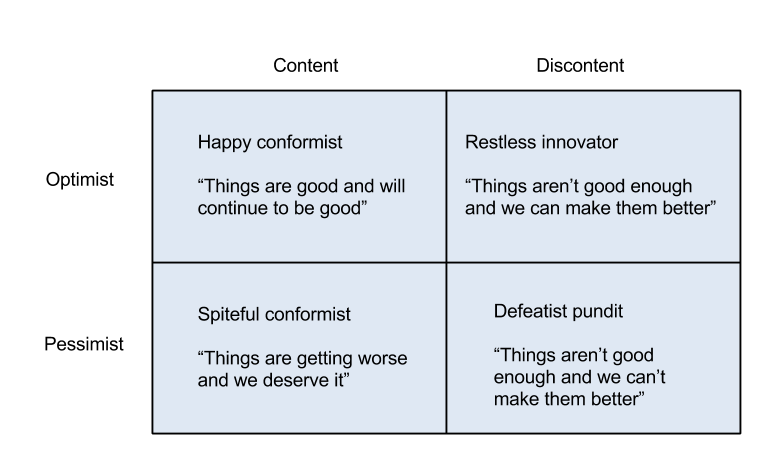

When to Critique and When to Shut Up and Create
Criticize by creating.
That’s one of my favorite sayings, attributed to Michelangelo.
It’s a useful mantra that acts as a reminder to put energy into additive acts, instead of nitpicking. It requires risk and humility to create. You might fail. The critic sits back in the safety of inaction, poking holes in stuff he’d not have the courage to create.
Most of the time, it’s pretty easy to know when you’re criticizing and when you’re creating. But not always. And you can’t always tell from the outside what constitutes an act of creation for another person.
My son loves the art of film-making and storytelling. He can spend hours telling me all his (very strong) opinions on what movies got wrong and right (even those he’s never seen!). I think most of it is interesting conversation, but not always. Sometimes it slips over into that realm of criticism that distances him from the kind of work the creators put in. But it’s not the act of critiquing a film by itself that’s anti-creative. It’s hard to describe when it is and isn’t, but I can vaguely sense the line.
I keep telling him to start a blog or YouTube channel where he does movie criticisms. Even though he’d still be critiquing someone else’s creation, his critique would move from a low-risk, low-effort offhand commentary to his dad, to a higher-risk, higher-effort act of creative criticism. He’d have to make a channel, risk his reputation publicly, open himself to counter-criticisms, and feel the pressure to make thoughtful, valuable critiques.
I know plenty of creators whose main creations are critiques. Painters and writers and musicians and even startup founders are critiquing the world by creating an alternative to it, or a parody of it. Sometimes the critique is implied by the creation, sometimes it’s explicitly stated. Writing a criticism isn’t inherently non-creative. The person who writes it has to be honest with themselves, and know deep down with their knower whether they are indulging in avoidant critique or real creation.
Social media adds more murkiness. Is a Tweet about something you don’t like an act of criticism or creation? I don’t think there’s a bright line, but for me, the lower the effort and risk, the more likely I’m being indulgent, ingrown, and critical. The higher the effort and risk, the liklier I’m creating. The real test is how I feel afterwards, and how much I care what others do in response. Genuine acts of creation are real and self-fulfilling. I don’t care whether others like or share them. Critiques, on the other hand, tend to make me more anxious to see who will support my claims.
So a funny, clever, interesting, or heartfelt Tweet or thread can be an act of creation. I’ve seen many that are, and made a few myself. But a responsive, reactive, gotta-get-my-say-on-x-in Tweet, or comment on someone else’s Tweet tend to be critical and non-creative. Especially if the thing you’re responding to is someone else’s creation or creative Tweet that got a lot more attention than you wish it did. If there’s envy in the mix, the odds are high you’re not creating but critiquing.
That’s why daily blogging is so good for me.
I have several Voxer threads with friends where we share barbs and jokes about various topics and news of the day. Those are sometimes deep and enlightening, but mostly an outlet for witty criticisms. I enjoy them, but if that was the only medium through which I was sharing ideas, I think I’d warp into a holier-than-thou critic. Facing the blank page every morning and posting something that might be seen (or ignored) by anyone forces me into creator mode. It makes me better.
The bottom line is this: only you can really know whether you’re engaged in creative or critical acts. Only you know if you’re leveling up and bringing your ideas into the world to improve it, or lowering others and shooting their ideas down. Be ruthless with self-knowledge, and be honest about what you find.
And go create something you’re proud of today.
*From* *isaacmorehouse.com* *where I blog daily.*
A Short List of Non-Tech Takes on Bitcoin
*My first read.cash post! I'm excited. I was a heavy user of Yours.org for a while, and love testing out new platforms.*
I've been fascinated by Bitcoin since 2012 when I finally bought some (after refusing for some months to setup a wallet for Jeffrey Tucker to send me "a few bitcoins").
I'm an entrepreneur (not in the world of crypto, but in education and careers), and though I lead a technical team, I'm not technical. I do a lot of writing, speaking, and podcasting, mostly on entrepreneurship, education, economics, careers, personal freedom, markets, startups, and the like. I follow bitcoin closely and have read pretty deeply across the space.
But I only occasionally jump in with my own thoughts and questions. I've begun doing it a bit more lately in a few videos with friends of mine who are also big block bitcoiners. (Steve Patterson, Deryk Makgill, and TK Coleman). https://www.youtube.com/user/isaacmorehouse
I am unabashedly excited about global free trade, non-government money, and massively on-chain scalable bitcoin. I don't care which ticker symbol or personalities "win", I care about freedom, prosperity, and functional free-market money.
I'm here to learn and enjoy. I have enough stress with my family and startups, so bitcoin is a fun escape for me. I've got a little skin in the game and a lot of belief, but ultimately it's a passion, not a necessity so I try to stay objective and make sure I'm having fun.
Anyway, here's a handful of articles, videos, and podcasts I've done over the years (mostly starting with the original debate that led to the BCH fork) on Bitcoin. It's primarily basic, timeless stuff rather than current crypto gossip. Hopefully some other non-techies will find some value in it!
Here are ~30 or so posts, from podcast interviews with Roger Ver and Ryan X. Charles, to video discussions with CoinSpice and the aforementioned crew, to articles I've written as I've explored the space.
Check them out. https://isaacmorehouse.com/?s=bitcoin
Thanks, and keep fighting the good fight! (But remember to keep it fun. You can't make the world more free if you're a slave to the news and opinions of others).
 @isaacmorehouse