How I Earned Almost 5% in One Month by Hedging on BCH Bull
BCH Bull is a platform built on top of the AnyHedge protocol. Anyone can use BCH Bull to do one of two things: https://bchbull.com/ https://anyhedge.com/
Go long, with leverage, on Bitcoin Cash against other currencies or metals.
Hedge the value of your Bitcoin Cash in terms of other currencies or metals.
When you go long on Bitcoin Cash, you assume the risk of the price of BCH going down against the other currency or metal defined in the contract. And, since it's leveraged, that risk is multiplied. But on the other hand, if the price of BCH appreciates against the other currency or metal, your benefit is multiplied.
When you hedge the value of Bitcoin Cash against another currency or metal, at the end of the contract you will receive the same exact value you started with. If the price of BCH goes up against the other asset in the meantime, you will receive less BCH. If the price of BCH goes down against the other asset in the meantime, you will receive more BCH. But in either case, the value of your BCH, denominated in the other currency or metal, will be retained. It's essentially risk free, if you're only interested in preserving that value denominated in the non-BCH asset.
The user decides the amount, duration of the contract, and the leverage/protection. The BCH Bull website has good explanations. Also, feel free to read the AnyHedge whitepaper for details on how it works. The key is that it all works non-custodially, so nobody is at risk of losing their funds. https://bchbull.com/index.html#about https://anyhedge.com/whitepaper/introduction/
There are always two parties in each BCH Bull contract. If you go long, someone else is hedging. If you hedge, someone else is going long.
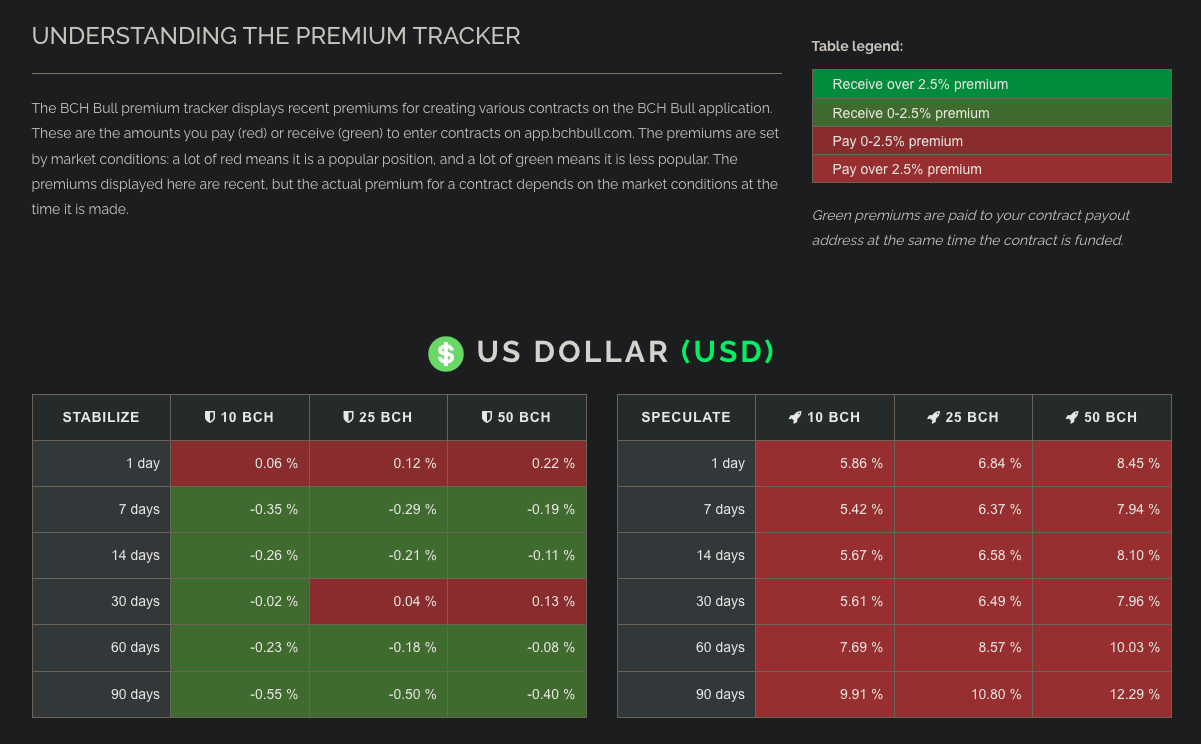
In most cases, the counterparty is the BCH Bull liquidity provider (LP). The LP does not want to be a market player. Instead, the goal of the LP is to earn fees for the use of their capital in BCH Bull contracts. Therefore the LP tries to balance out the longs and the shorts. As a result, depending on where the market demand is for contracts, the LP either charges or pays out premiums to BCH Bull users.
When I was taking a close look at all this, I noticed that typically, but not always, those who hedged were paid premiums (presumably because long contracts are usually in very high demand). I noticed that, if one had USD not currently tied up in anything, one could earn interest on it by simply putting it into BCH Bull hedge contracts. And then one could, optionally, keep those premiums as BCH. And there you have it: "Free" BCH for the taking with basically no risk.
It turns out I did have some USD sitting around. I decided to experiment with it on BCH Bull to see if I could consistently earn premiums and understand firsthand how well such an investment could do.
The Long and Short of It
After investing a maximum of $3000 for 29 days, I extracted $144.76 worth of BCH in premiums. Without considering other factors, that is a 4.83% return in just a month.
(Note: That $144.76 represents the combined USD value of BCH premiums I earned at the time I received them. It ended up being ~0.64 BCH all told.)
That is a phenomenal return for a very low-risk investment, if I do say so myself. And that is without compound interest as I kept the premiums as BCH and did not reinvest them.
If one could repeat that same ROI every month, that would be an annual interest rate of 57.9% earned through hedge premiums. Not too shabby.
Of course, that is not the entire story. There were indeed other factors at play. And I'm not currently hedging anymore. So what happened? Let's dive in.
Amounts
To start off, I earmarked $1000 for the experiment but I did not put it all in at once. Instead I put in $100 every day for 10 days.
One big reason for that is that the premiums offered change regularly. Sometimes they are fantastic, sometimes they seem more meager, and other times the premiums basically dry up (more on that later). Due to these facts, I wanted to spread out my hedges to get the best average return.
Once I got to $1000, I saw no reason to not go in with more. So I put in another $1000, but this time all in one day. However, I entered in three different contracts for three different lengths of time.
After another few days (9 days into the experiment), I dumped in another $1000 for a grand total of $3000 invested. I did not put any more in after that.
Approach
How did I decide on the duration of each contract? The contract duration will change the premiums offered (or charged), depending on market conditions within BCH Bull. Often, but not always, the longer the duration of the hedge, the bigger the premium offered.
But it's not a matter of simply getting the largest premium. If you always go for the largest premium and hedge for a lengthy amount of time, you will pay the opportunity cost of not being able to hedge and earn premiums in the meantime. The goal was to find the most *efficient* hedge duration, depending on the premiums offered.
I kept a spreadsheet to help me figure out what duration to choose each time I made a hedge. Column A was static and had the possible days of contract duration (1-90). In column B I entered the current interest rate offered for each contract duration. Column C had formulae to calculate the APY of each offered premium (assuming it could be repeated endlessly).
It was fairly easy to zero in on the optimal period so I never got anywhere close to entering 90 different premium rates. I could usually get away with entering just a few different days of premiums. Also, offered premiums will change depending on hours and minutes, not just days, so calculate accordingly.
The results from the formulae helped me choose the most effective contract duration whenever it was time to hedge.
But I didn't necessarily simply choose the highest APY each time. Remember, I wanted to spread out my hedges and have a regular turnover so that I could, on average, get the best premiums. If I put the entire investment on the best possible premium one day, I might miss out on even better premiums before the contract matured.
Therefore, sometimes I would choose the second-best APY, if it helped to spread out the hedges, especially if it was almost as good as the best option. It was a balancing act and sometimes it required on-the-spot judgment calls that could have gone either way. I typically had my investment spread out into 5 or 6 chunks and the best possible premiums were almost always for contract durations between one and seven days.
Platform
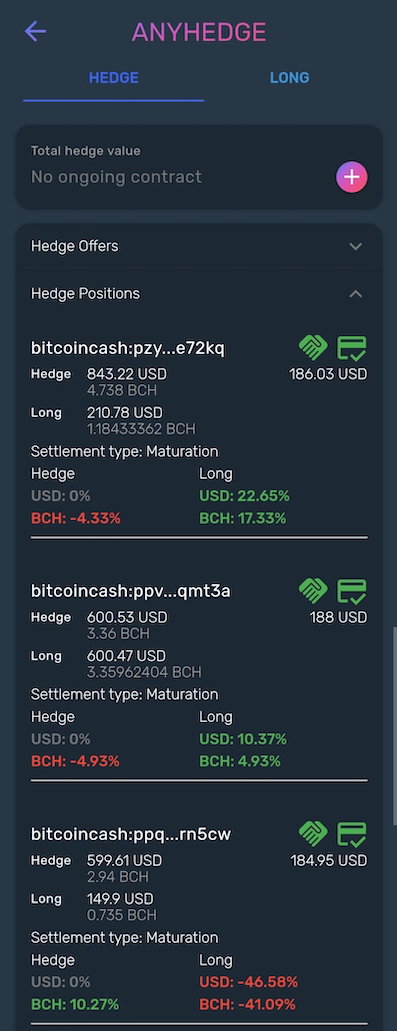
My platform of choice to enter BCH Bull contracts was the Paytaca wallet. The Paytaca dev team has seamlessly integrated BCH Bull directly into the app for a high-quality longing or hedging experience. It's the same service as BCH Bull, just without using the BCH Bull front end. The Paytaca app keeps a record of all your current and previous positions. https://www.paytaca.com/
There were a few times I used the BCH Bull app itself. Once it was because I kept running into errors on the Paytaca wallet. All the other times it was because I wanted to hedge in a currency other than USD and Paytaca has so far only enabled USD positions.
Complications
Lack of Premiums
There were a few times where one or more of my hedges would mature but there were no good premiums offered at that moment. And I didn't want to hold my investment as BCH. The point of the experiment was to make sure I could keep my investment of $3000 intact, send my BCH premiums to a separate wallet, and see how well the investment could do overall. Holding my investment as BCH outside of a hedge contract, waiting for good premiums, would risk diminishing my investment.
The first time this happened, I looked at the non-USD national currencies offered on BCH Bull (not available in the Paytaca wallet). Out of the other currencies, the Indian Rupee (INR) had been tracking very closely with USD in recent years. So, with no possible premiums to earn for hedging in USD, and premiums offered for hedging in INR, I treated INR as a USD proxy. Any time there weren't any good premiums offered to hedge in USD, I simply hedged in INR.
Fees
Another complication was the fact that losing some of the original investment was unavoidable through BCH Bull settlement fees. Paytaca also charges a very small wallet fee (a few pennies) on top of that when hedging through their wallet.
Up until the very last day of the experiment, I had lost approximately $15 to these fees. That's only 0.5%. When you account for those fees, my updated ROI was closer to 4.32%. Still very good.
To counter the fees and prevent the slow but constant dwindling of my $3000, I was planning to keep a small portion of my earned premiums in my hedging wallet on a monthly basis. That way, every month, I would be back up to an even $3000 at a cost of a small hit to my earned premiums.
Time
The biggest complication to this entire process, in my opinion, was the time commitment. Whenever I had a hedge scheduled for maturation, I had to make sure I was ready for a quick turnaround to get that money hedged again. Any delay risked exposure to BCH price fluctuations. My strategy resulted in near-daily contract maturations, so you can imagine it was a bit stressful to anticipate times I could consistently commit my attention to.
Fortunately, on the BCH Bull app and on Paytaca, you can fully customize the durations of the contracts. But still, it wasn't very forgiving if anything else came up at the time the contract matured.
It was precisely this complication that ended up convincing me to end the experiment. On day 29 of the experiment, August 17, something did come up to delay my next hedge. Do you remember what happened on that day? This may remind you:
Of course, of all days for something to come up to delay my reentry into a hedge, it had to be that day. Fortunately it wasn't as bad as it could have been, but a 30-minute delay cost me about $50.
That one mistake brought down my actual ROI for the 29 days down to 2.66%. Ouch. Maybe I should have rearranged the words of the title of this article to read "How I Almost Earned 5% in One Month by Hedging on BCH Bull".
All things considered, I was still sitting pretty overall. Even that lower ROI, repeated over a year, would amount to a 31% return. Who wouldn't want that?
I was going to add another couple of thousand dollars to the investment that day. But the realization of my mistake weighed on me. Could I be sure I could avoid similar mistakes in the future? On top of that, the stress of constantly trying to maximize premium earnings and staying on top of it all gave me pause.
After some thought on what my priorities should be going forward, I ended the experiment entirely. Overall I believe it was a successful experiment, and yet a cautionary tale at the same time.
Final Thoughts
*This is not financial advice!*
Risks
Even though BCH Bull is non-custodial, that doesn't mean there is no risk. The greatest risk is the reliance on General Protocols' oracles. The oracles are entities that regularly send out signed messages on-chain that AnyHedge contracts can use. They are what allow for the execution of the contracts at the proper times and using the proper prices. https://oracles.cash/
If an oracle ever got corrupted somehow, it could trigger incorrect contract resolutions. Also, if an oracle ever went offline, that could threaten the proper execution of a contract. Of course, General Protocols has a vested interest in making sure their oracles are always working correctly. But it's important to understand this particular risk.
Greater Duration
One could earn BCH Bull premiums more passively by entering hedge contracts in fewer chunks with longer durations and not have to worry so much about maximizing premiums every day. Of course, that convenience would mean a smaller ROI overall.
Compound Interest
One could have improved upon my results by reinvesting all or some of the premiums. That would be taking advantage of the magic of compound interest. The difficult thing there is that premiums are sent to the hedger immediately *after* making the hedge. That made it convenient for me to keep those premiums as BCH and send them to another wallet. One would need to figure out a strategy for exactly how to reinvest the premiums.
Automation
A clever technical person could probably automate the entire process to maximize premiums without having to commit to being available at specific times. I am not that person, but I'm sure they're out there.
The Future
Overall I am extremely impressed with the BCH Bull service and the Paytaca integration. I have also done a few long contracts just to see exactly what they entail and how they work. I have very high hopes of the future of Bitcoin Cash financial products and services. Let's keep building!
Thank you for taking the time to read about my success and failure in this endeavor. I hope some wisdom can be gleaned from my experience and others can improve upon it for their own purposes. Let me know if you have any questions in the comments.
I Held $1000 of flexUSD for 90 Days and the Results Are In!
Late last year I started hearing about flexUSD, a new stablecoin on SLP that would actually pay you interest every day! Honestly I was intrigued and the people talking about it had good reputations, so my scam detector was only at yellow alert instead of red. I really wanted to learn more about it and get firsthand experience. So I did the only sensible thing: I got some and observed. So if you've been curious about flexUSD (or if this is the first time you're hearing about it) and haven't yet taken the plunge, hopefully you'll gain some useful insights from this article.
What is flexUSD?
FlexUSD is a stablecoin that lives on the Simple Ledger Protocol of Bitcoin Cash. It is backed by USDC deposits at CoinFLEX, a cryptocurrency exchange. CoinFLEX uses USDC deposits for repo auctions (essentially very short-term lending) and CoinFLEX shares the interest gained through flexUSD interest payments, sent out to current flexUSD holders, three times per day. Whether you actually deposited USDC on CoinFLEX to mint flexUSD or you obtained flexUSD some other way, you receive the interest payments regardless. I think that's pretty amazing! Take note, though, that a minimum of $10 flexUSD is required to qualify for interest payments. https://flexusd.com/ https://simpleledger.info/token/dd21be4532d93661e8ffe16db6535af0fb8ee1344d1fef81a193e2b4cfa9fbc9 https://coinflex.com/ https://www.investopedia.com/terms/r/repurchaseagreement.asp
The Experiment
Okay, I might have lied a little in the title. I didn't actually start with $1000 of flexUSD. I started with an amount between $10 and $10,000 of flexUSD. Why did I lie? And why am I being super vague? To maintain financial privacy, of course. I don't need you people finding my SLP address and digging around in my transaction history!
Once I had my indefinite initial amount of flexUSD, I let it sit in my SLP address for 90 days. I meticulously recorded each interest payment so I could analyze the results. I am pleased to present those results to you in this article. So if you love numbers and money, keep reading!
While I won't reveal the true amount of flexUSD I started with, I multiplied the actual amounts by a certain number to simulate a starting amount of $1000 flexUSD and to proportionally simulate all the interest payments. I assure you everything presented here is based on very real numbers. So if you had started with $1000 flexUSD at the same time I started my experiment, my data shows exactly what would have happened to you (assuming all flexUSD balances are treated the same).
The Data
All my data and some basic analysis can be found in a Google spreadsheet here. I'll briefly explain everything on the spreadsheet. I should warn you that I don't specialize in finances so it's very possible I'm not using precisely the right jargon with the things I discuss here. https://docs.google.com/spreadsheets/d/1zRRoDfF4zuRqPlPIdFUfCvWY3hmJoTvTBVC977F3jF8/edit?usp=sharing
Column A tracks the sequence of payments. The first entry is my initial purchase or minting (I'll never tell which) of flexUSD. Interest payments happen three times per day. Because the experiment ran for 90 days, there are 270 interest payments.
Column B tracks the amounts of the flexUSD transactions that went into my SLP address. The first amount of $1000 flexUSD is what I started with (or did I?).
Column C records the APR for each individual interest payment. It is simply the interest amount multiplied by 1095 (365 * 3) divided by the prior flexUSD balance. So if an individual interest payment were applied to the entire year, that would be the rate of return, not taking compounding into account.
Column D shows the total amount of flexUSD at the end of the experiment. I ended up with $1034.103888 after the 90-day experiment. So I made a profit of just over $34. Not bad!
Column E shows the cumulative APR for the duration of the experiment, which was 13.83%. It is calculated by multiplying the sum of all the interest payments by the quotient of 1095 and 270 and then dividing the result by 1000 (if that didn't make sense just keep reading). If the cumulative results of the experiment were somehow proportionally applicable to all 1095 interest payments over a year, that would be my annual rate of return.
Column F shows the mean APR, which was 13.6%. It is simply the average of all the individual APR's for the interest payments.
Column G shows the median APR, which was 10.3%. Same as above, but the median instead of the mean.
Column H shows the highest APR of all the interest payments, which was 143.82%. That single interest payment was over $1 flexUSD while no other payment came close to that! CoinFLEX must have been raking it in that day!
Column I shows the lowest non-zero APR of all the interest payments, which was 0.03%. I'll cherish that milli-quarter forever.
Column J shows the expected flexUSD balance after one year, which is $1,138.310212. That's the result of multiplying my starting amount by the cumulative APR. Who wants an extra $138 in a year for simply saving $1,000? I know I do!
Column K shows the number of interest payments that simply didn't happen, either because there was no interest to share or CoinFLEX somehow failed to execute a payment. All payments that didn't happen are assumed to be a payment of $0 flexUSD in column B. Over the course of the 270 payment periods, seven interest payments (2.6% of all the payments) never showed up. Oh, what could have been!
Columns L, M, and N are the same as columns E, F, and G except they exclude the zeros. They are 14.2% (cumulative), 13.96% (mean), and 10.7% (median), respectively.
Column O is the estimated total if there had been no gaps in payments, which is $1035.011596 flexUSD. It assumes that the missing payments were supposed to come through but CoinFLEX failed to send them for whatever reason. It also assumes that the missing interest payments would be comparable to the existent payments. I could have been about $1 richer!
Column P is the expected flexUSD balance after 1 year without any gaps in payments, which is $1,141.991473. It makes similar assumptions as those in the above paragraph. $142 is nothing to sneeze at!
Surely many of you are smarter than me when it comes to stuff like this. The data is now available to you, so feel free to discover more insights and share them in the comments!
So, what did I learn after this fun experiment with flexUSD?
Drawbacks and Inconsistencies
The main drawback is that flexUSD completely depends upon CoinFLEX. Of course it didn't take this experiment for me to understand this. It's just part of the nature of this type of scheme. If CoinFLEX were to disappear, I can't imagine that $1 flexUSD would continue to equal $1 USD. If that were the case, my guess is that flexUSD would quickly approach a value of 0. That's always the danger of centralized exchanges, even if a fantastic decentralized tool is being utilized. I should say that I don't expect CoinFLEX to disappear any time soon.
CoinFLEX sometimes had a difficult time staying consistent with the expected interest payment schedule. Most of the time the payments arrived in a predictable manner. Other times, though, there would be no payments for a few days and then a surge of payments close together or even all at once. I believe all the payments that failed to materialize were during these stutters. Because of these anomalies, it was impossible to exactly reconstruct the order of payments you see in the spreadsheet, though the result is mostly accurate and good enough for the purposes of the experiment.
While the interruptions in payments are a bit of a concern, I suspect that flexUSD interest payments will see fewer stutters or failures after the May 15, 2021 Bitcoin Cash upgrade. The upgrade will eliminate the 50 unconfirmed transaction chain limit. It is my understanding that this limit has been getting in the way of efficient distribution of flexUSD interest payments since the genesis of flexUSD. Therefore flexUSD might get even better very soon!
Benefits
Overall flexUSD is a fantastic financial product! I love how the interest payments simply follow flexUSD balances wherever they are and no matter who owns them or how they were obtained. The stablecoin is backed by USDC deposits and the profits from loans are distributed to the minted flexUSD balances, no matter how far removed they are from the users who actually did the initial deposit and minting.
The interest rate is really great overall. The average consumer would have a hard time finding something better to invest in. Of course, cryptocurrency users are not average consumers. Lots of people have made incredible gains just holding cryptocurrencies. Additionally, the DeFi space is growing rapidly. I myself am not well-versed in the DeFi space so it's very possible there are other DeFi products out there that do much better than flexUSD.
But the sheer simplicity of flexUSD cannot be beat! Even if there are other DeFi products that beat it on yield, I can't imagine anything simpler than flexUSD. You simply obtain it and the interest payments come three times per day. No action is needed on the user's part. There is no need to keep track of any accounts outside of your own wallet. You can just set it and forget it.
Additionally, you cannot lose your principal or any of your flexUSD once it is paid to you. Let me rephrase that to try to make it clear: It is impossible to have a negative day when using flexUSD! That's because no one can deduct from your balance once flexUSD is sent to you. A very high yield combined with the complete inability to lose is monumental!
Final Thoughts
I strongly support what CoinFLEX is doing with flexUSD. It certainly seems to be the stablecoin with the most utility. In my experience most other stablecoins cost an arm and a leg just to send anywhere. Thank goodness for cheap Bitcoin Cash transactions! Transaction fees are so cheap that CoinFLEX can send interest payments that are less than 1/1000 of $1 flexUSD! Anyone who is interested in trying out flexUSD should obtain some, store it in an SLP-aware wallet (e.g. bitcoin.com wallet, Electron Cash SLP edition), and enjoy seeing the interest payments pour in. https://wallet.bitcoin.com/ https://simpleledger.cash/project/electron-cash-slp-edition/
Where Can You Get flexUSD?
You can mint flexUSD directly by having an account with CoinFLEX and depositing USDC (I imagine you can buy the required USDC from CoinFLEX's own exchange). You can also get flexUSD through sideshift.ai. It is technically possible to buy flexUSD on memo.cash, but that depends upon memo users offering it for sale. If you know any more ways to get flexUSD, let us know in the comments! https://flexusd.com/ https://coinflex.com/ https://sideshift.ai https://memo.cash/
Of course, none of this is financial advice.
Happy FLEXing!

Seven Reasons You Should Be Excited for Moeing Chain
[Note: Since this article was published, Moeing has rebranded to "Smart Bitcoin Cash", or "SmartBCH" for short]
You’ve probably seen tweets, rumors, or vague announcements about the upcoming Moeing Chain. Something about a sidechain that has something to do with Ethereum compatibility on Bitcoin Cash, right?
It all sounds kind of exciting, but also very mysterious, especially with no official whitepaper to look at yet. What is it all really about?
I’m here to clear up any misunderstandings, help people grasp what Moeing Chain is all about, and let people know why it’s great news for Bitcoin Cash. Without further ado, here are...
**Seven Reasons You Should Be Excited for Moeing Chain**
Moeing Chain Depends on and Builds Up Bitcoin Cash
Moeing Chain is a sidechain for Bitcoin Cash. Did I lose you already? Okay, let’s talk about sidechains.
A sidechain is an independent blockchain that has a special relationship with the main chain because of a two-way peg between the two. A two-way peg between Bitcoin Cash and Moeing Chain means that it will be possible to send an amount of BCH to a special locking script which will unlock the same amount of BCH on the Moeing sidechain and vice-versa.
When Moeing Chain launches it is expected that the first gateway between the Bitcoin Cash and Moeing blockchains will be a federated two-way peg. Such a system is not quite trustless, but it will probably be good enough to get things started.
Moeing developers are already getting input from Bitcoin Cash developers on how to create a completely trustless two-way peg between the two chains. Karol Trzeszczkowski and Tobias Ruck are confident that Bitcoin Cash scripting is sufficiently powerful to create such a gateway and Moeing developers are eager to have it built and implemented as soon as possible.
If Moeing is a separate blockchain, why does it need Bitcoin Cash at all? Can’t it just be its own thing like all the other blockchains that are cropping up all the time?
With so many crypto projects out there and only so many people interested in cryptocurrencies, every new project seems to dilute the power that blockchain technology has to help people.
Instead of spreading crypto influence even thinner, Moeing Chain is going to leverage the existing power and potential of Bitcoin Cash. Moeing Chain is essentially bootstrapping itself into full functionality by being a sidechain to Bitcoin Cash. This crypto-symbiotic relationship between two impressive technologies will augment each of the two components and make the whole system extremely powerful.
Moeing Chain’s dependence on Bitcoin Cash will be manifested in multiple ways. Moeing’s blockchain will be secured by Moeing validators. Those validators will be chosen by Bitcoin Cash miners. The Bitcoin Cash miners will use the coinbase transactions in the blocks they mine to cast their votes for Moeing validators. One block mined on BCH will be equal to one vote. Bitcoin Cash miner voting will decide on Moeing validation nodes every “epoch” which is 2016 BCH blocks (about two weeks). Thus the Moeing Chain will be based on proof-of-work, but the work itself is offloaded onto (or perhaps borrowed from) the Bitcoin Cash blockchain.
Miners will not be doing this out of the goodness of their hearts. We expect miners to act selfishly. It’s part of the brilliance of blockchain technology. Miners will most likely set up their own Moeing validation nodes and vote for themselves so they can earn more transaction fees. At the very least we would expect miners to vote for validators friendly to them to share the profits. Either way, we can be sure that voting for Moeing validators will not be any sort of burden on Bitcoin Cash miners.
Moeing plans to diversify the voting process in a future hard fork. Eventually BCH holders will be able to stake their coins to vote for Moeing validators. Up to 50% of the voting could be done by BCH stakers. This would make the Moeing Chain a proof-of-work/proof-of-stake hybrid blockchain when that change gets implemented.
One of the most exciting things is that Moeing Chain will not have its own native token. Remember the idea is to not spread the crypto ecosystem even thinner than it already is. Just like Ethereum uses its own native token ETH for gas fees, Moeing Chain will use BCH for its gas fees. I would prefer to (and will in the rest of this article) call the BCH moved over to the Moeing Chain “MBCH” to make a distinction between the two.
Some of you who aren’t familiar with Ethereum might be wondering what gas fees are. On Ethereum gas fees are simply the transaction fees. No matter what tokens are being sent on Ethereum, all gas fees are paid in ETH. On Moeing Chain all gas fees will be paid in MBCH (more on that later). Moeing is leveraging the already-existing value of Bitcoin Cash. It won’t be necessary to pump some brand-new token. The only thing that will be pumped is Bitcoin Cash.
Moeing Chain Brings Smart Contracts and DeFi to Bitcoin Cash
I’m not saying Bitcoin Cash doesn’t already have smart contracts and DeFi. It does. However, at this point those applications on Bitcoin Cash are very fresh and just starting to bloom.
The earliest Bitcoin Cash could have miner-validated tokens (important for many smart contract applications) is May 2022. And then Bitcoin Cash may not get additional opcodes (to make smart contract and DeFi applications easy) for another year after that!
Can Bitcoin Cash wait that long to start attracting the kind of attention Ethereum and other DeFi protocols have been getting for a while now? That ship might sail before Bitcoin Cash can get all its ducks in a row. Smart contracts and DeFi on Ethereum have been going strong for quite a while and they are starting to go strong on other blockchains as well. Wouldn’t it be nice to get some of that action on Bitcoin Cash now instead of in a few years? Moeing Chain can make that happen.
You’ve probably heard that Moeing Chain is EVM and Web3 compatible. But what does that mean? EVM stands for “Ethereum Virtual Machine” and that’s what runs the Ethereum network. Moeing Chain will run what basically amounts to another instance of EVM with all of Ethereum’s abilities. Think about that. A sidechain of Bitcoin Cash that can do what Ethereum does. Are you getting excited yet?
Web3 is one of the most popular ways applications interact with the Ethereum blockchain. Developers will be able to use Web3 to interact with Moeing Chain as well. Think about this some more. A Bitcoin Cash sidechain will have all the familiar tools DeFi developers have come to expect. What new possibilities will be opened up?
With all the compatibility with these important tools, Moeing Chain will have the same capabilities and advantages Ethereum has, with all of its robust and complex smart contracting abilities, including everything needed for DeFi applications.
It’s important to recognize the significance of what this means for Bitcoin Cash and the crypto economy as a whole, which brings us to the next reason to be excited…
It's Trivial to Port Popular dApps Over to Moeing Chain
Ethereum, for all its capabilities, is drowning in fees these days. It is a victim of its own success. Due to the extremely high fees, many smart contract use cases are effectively impossible. And the ones that are thriving, like Uniswap, are prohibitively expensive for most people.
The market demand for those types of things doesn’t simply go away. Other projects lure that demand to their blockchains. The alarming possibility is that popular dApps could go to centralized or semi-centralized projects like Binance Smart Chain (BSC), which could hamper growth of true peer-to-peer blockchains.
That’s where Moeing Chain comes in. Moeing Chain has the potential to absorb much of the demand for decentralized smart contract applications that are not being met on Ethereum or other blockchains. That means a whole host of users and use cases could be coming to a Bitcoin Cash sidechain in the near future!
Because Moeing is EVM and Web3 compatible, basically every application or wallet that runs on Ethereum can be tweaked slightly to run on Moeing Chain. Do you like Uniswap? Make a clone of it on Moeing Chain. Did you miss out on cheap Cryptokitties? Make some modifications and put it on Moeing Chain. Are you using the MetaMask wallet? Use that on Moeing Chain as well.
All Ethereum-based dApps, wallets, and other use cases will be easy to run on Moeing Chain. Ethereum is known to be very developer-friendly and that would also certainly be the case for Moeing Chain. That means a lot of talent and potential that isn’t being fully utilized on Ethereum due to high fees; or on BSC due to worries of centralization; could be coming to a sidechain of Bitcoin Cash. That’s fantastic news for global peer-to-peer digital cash!
You may be wondering why all these DeFi apps would come to Moeing when there are already other EVM-based competitors out there. You’re right to wonder, which leads into Moeing Chain’s specific niche and what may be the best reason of all to get excited about it.
Moeing Chain's EVM Will Be Fully Optimized from Top to Bottom
Have you ever driven a really nice car? I’m betting some of you have. Have you ever tried to repair or improve a really nice car while you’re driving it? My guess is the answer is no. Once a machine is up and running - especially a very complex multi-billion dollar machine - it is extremely difficult to work on. You would most likely have to shut it down first, then work on repairs, and finally activate it again.
In this case Ethereum is the really fancy car. It drives pretty fast and it does amazing things. Many things can be improved on the go. There have been many improvements on Ethereum since it has started and many more improvements are planned. However other aspects of the design are so low-level in the architecture that Ethereum is stuck with those design choices for the long haul. You can’t just shut it off and park it for a time while you fix it.
Moeing Chain, however, is still on the factory floor. It can benefit from experimentation and the latest innovations at the lowest levels of its architecture since it’s not up and running yet. Other chains that are clones of Ethereum have simply forked what’s already out there, perhaps adjusting a thing or two, but nothing substantial.
Moeing developers were not about to do the same ol’ thing again. They have something much more grand in mind. It turns out there are a number of low-level optimizations that can be done to to take scaling to the absolute limit and make the EVM really fly.
One of the major improvements in the world of hardware in the last decade is the addition of more and more cores in a CPU. But that doesn’t mean that everything the machine is running automatically benefits from the presence of multiple cores. Software has to be specifically tweaked to take advantage of hardware advances.
Ethereum’s EVM has always been single-threaded, only able to process one command at a time. It doesn’t appear that that is ever going to change. But hardware these days can handle so much more. Imagine a grocery store that has dozens of checkout registers but only one line that’s ever actually open. That’s Ethereum’s EVM running on modern hardware.
Moeing Chain innovates by specifically optimizing the EVM for multi-core CPUs. Moeing leverages the inherent parallelism of modern hardware while keeping things the same for smart contract developers. The result is called "MoeingEVM" and it uses multi-threaded execution semantics. It’s essentially Ethereum on steroids.
MoeingEVM leverages two types of parallelism: the parallelism between consensus engine and transaction execution engine; and the parallelism among different transactions. This effectively utilizes the inherent parallelization in modern hardware. Going back to our grocery store analogy, it’s like finally hiring enough staff (or adding enough automation equipment) to open up all the checkout lines! Every customer can get through very promptly.
In addition to parallelization, there are certain speed-up methods used in some VM’s called ahead-of-time compilers or just-in-time compilers. Ethereum’s EVM, despite being the de facto smart contract standard, doesn’t have any of these compilers.
To rectify that, Moeing Chain uses “MoeingAOT”, an ahead-of-time compiler that compiles EVM bytecode into native code and saves it into a library. Whenever a smart contract is run, the library file can be found and the native code can be executed very quickly. This will be especially important for the most popular smart contracts that are run very frequently.
Moeing developers also have their eyes on possible scaling solutions in the future if they ever reach the upper limits of hardware capabilities. You may have heard of the concepts of rollups and sharding. These are solutions being discussed for Ethereum and other chains and are starting to be implemented. Moeing has important optimizations for these scaling solutions, should they be necessary.
Rollups are basically what they sound like: many transactions rolled into one and executed together. The idea is that using them intelligently can significantly boost overall throughput.
Unfortunately the way rollups are implemented on Ethereum requires a lot of resources to prove state transition. “MoeingRollup” can improve efficiency by making it possible to run those tasks natively. The result is that state can be proven easily.
Sharding is a way to split up a blockchain into multiple “shards” to increase overall throughput. It’s like having multiple blockchains, but they’re all working together one one cryptocurrency to boost transaction capacity.
The main drawback of sharding - as it’s implemented on Ethereum, Polkadot, and others - is that it requires an intermediate chain for each shard to prove state to all the other shards. If all the shards have to communicate via an intermediate chain, the intermediate chain can quickly get bogged down. To get around this requirement, Moeing Chain can implement “MoeingLink” which allows shards to prove state to other shards without going through an intermediate chain.
Database design is a key area in which Moeing makes huge improvements. Ethereum uses a two-layer architecture for storage. To make things much more efficient, “MoeingADS” is a single-layer database architecture. MoeingADS is thus able to read and write to storage extremely quickly and is especially friendly to SSD.
Moeing developers did a **benchmark test** to see how many transactions per second MoeingADS could support. MoeingADS puts an upper bound on TPS because, no matter how fast everything else can go, the ultimate limitation is how fast the VM can read and write data to storage. https://github.com/moeing-chain/MoeingADS/blob/main/docs/Benchmark-real-case.md
The benchmark used a three-year-old MacBook Pro, with a 2.6GHz six-core i7 processor. The results were staggering.
MoeingADS handled over 26,000 transactions per second! If a standard transaction, like on Ethereum, costs 21,000 gas, then this benchmark would mean Moeing Chain could potentially consume over 8 billion gas in a 15-second block! Right now Ethereum can do approximately 30 transactions per second and consume 12.5 million gas per block. That’s a difference of multiple orders of magnitude!
It needs to be said that this particular benchmark test wasn’t running smart contracts, which are more costly to execute. But with the data above from a test run on three-year-old equipment, and data from a separate test on an eight-core machine that reached 40,000 transactions per second, Moeing developers are confident (and are advertising) that they can achieve 1 billion gas every 15 seconds.
Let's think about the implications of these intense optimizations Moeing has done on its EVM.
Those of us in the Bitcoin Cash community can get easily frustrated by those who, for whatever reason, cannot recognize the importance of large on-chain capacity for digital cash. The difference between Bitcoin Cash and other cryptos trying (or pretending) to be digital currency is stunning. That’s why we are confident that when digital peer-to-peer cash becomes extremely important for the average person, Bitcoin Cash will really be the only choice.
Now think of Moeing Chain, the blockchain that hopes to be the smart contract/DeFi counterpart and sidechain to Bitcoin Cash. Moeing Chain will have an absurd amount of on-chain capacity compared to the rest of the competition. And we already know that there is a huge demand for smart contract and DeFi applications!
Do you realize what this means? Those that are hungry for these types of blockchain applications and those that want to expand the accessibility and affordability of DeFi are going to have basically one option: Moeing Chain. Every dApp and use case on Ethereum or other chains suffering from high fees can be implemented on Moeing Chain for extremely low fees. Get your popcorn ready because it’s going to be quite a show!
Moeing Chain Will Lock Up a Lot of BCH
The utility Moeing Chain will bring to Bitcoin Cash is amazing just by itself. But it’s incredible to think about the effect Moeing Chain will have on BCH supply. The existence and usage of Moeing Chain will require a lot of locked-up BCH.
Remember how Moeing Chain won’t have it’s own new token, but will use MBCH (BCH moved to the Moeing sidechain) as its native token and to pay gas fees? Think about all the usage Moeing Chain could possibly get due to the intense demand for smart contracts and DeFi that’s causing all the high fees on other blockchains. Think about all the use cases that would be possible on Moeing Chain due to the incredible gas limit of 1 billion and the low fees that would facilitate.
Now think about how much BCH will need to be locked up on the Bitcoin Cash blockchain and transferred over as MBCH on the Moeing Chain. We’re talking about A LOT of BCH, all taken out of the available supply.
Half of the gas fees on Moeing Chain will be paid to the Moeing validators. What about the other half, you ask? The other half of the gas fees will be burned. You read that right. Every single transaction and smart contract executed on Moeing Chain will permanently remove some amount of MBCH (and thus also BCH) from circulation.
Think of the ramifications of this fact. Even if Moeing Chain reaches a point where it is no longer growing and its usage is basically static, it would still require a constant infusion of BCH (turned into MBCH) for Moeing users to use for gas fees. This will put deflationary pressure on Bitcoin Cash.
Besides its use as a token to pay for gas fees, MBCH will also be the native token of Moeing Chain, just like how ETH is the native token for Ethereum. ETH has its uses outside of its utility as the gas token. It can be staked for different purposes, it can be used as a settlement token for contracts, and it can be used for many other things besides. Think of all the ETH on Ethereum being used for things other than gas fees on Ethereum. If MBCH has even a fraction of that utility on Moeing Chain, we should expect a great deal of BCH to be locked-up and used as MBCH, diminishing the available supply of BCH.
Moeing validators will need to stake MBCH as collateral. If any validator misbehaves while carrying out its duty, that collateral will be slashed as punishment. So that’s one other thing that will take BCH out of the available supply in the market.
Remember that it’s expected that a future hard fork of Moeing Chain will have BCH stakers voting for Moeing validators? At some point it will surely be possible for any average Bitcoin Cash user to be able to stake their BCH in pools to vote for profit-sharing Moeing Chain validators and earn gas fees. When these earning tools are available to anyone, that will be a huge Moeing-focused use of BCH that will diminish the available supply significantly.
With Moeing Chain’s massive capacity and all the ways it will result in taking BCH out of the available supply and all the deflationary pressure on Bitcoin Cash, what do you think the result will be? How will Bitcoin Cash be affected? I think you know what happens to price when supply gets low. And it’s only a matter of time. Get ready for liftoff.
Moeing Chain Will Attract Additional Hashpower to Bitcoin Cash
We’ve all heard the complaints against Bitcoin Cash with people claiming that it’s “not secure”. Even though it is secure, it’s obvious that Bitcoin Cash is a minority chain with much less hashpower than BTC. And we all know it’s simply because hashpower follows price, not the other way around.
Well, Moeing might change that, at least slightly. Remember that Bitcoin Cash miners will vote for Moeing validators. And remember that BCH miners will probably run their own Moeing validation nodes and vote for themselves. That’s because it will be an opportunity for them to earn more in fees. They can continue to earn their BCH mining fees as they have been doing. And they can secure an extra revenue stream on Moeing Chain with a very modest investment.
As Moeing Chain matures and gains users and applications, we should expect the Moeing gas fees to become more and more attractive. As the gas fees become more attractive, we should expect more BCH miners to set up Moeing validation nodes so they can vote for themselves as Moeing validators. This could have the interesting effect of attracting more hashpower to Bitcoin Cash than the BCH price by itself warrants (compared to other SHA-256 coins).
It’s impossible to know exactly how much additional hashpower Moeing Chain will attract to Bitcoin Cash, but it will be interesting to see what the long-term effects will be.
Moeing Chain is Led by People Who Know the Importance of On-Chain Scaling
Who is behind this Moeing Chain anyway? Who’s funding this? It’s important to know who is backing such an ambitious endeavor.
Moeing is sponsored by **Matrixport**, which is a crypto financial services company founded by none other than Jihan Wu, a long-time supporter of large blocks and peer-to-peer cash. Wu co-founded Bitmain, the world’s most successful chipmaker for crypto mining hardware. In 2019 he founded Matrixport, which is aimed at professional cryptocurrency traders, miners, and mining pools. Additionally, Matrixport launched Bit.com, a crypto derivatives exchange. Bit.com started offering BCH options earlier this year. https://www.matrixport.com/home https://www.youtube.com/watch?v=OvKyqN8jtfI&ab_channel=BitcoinBCH https://www.bit.com/
But who exactly is the brains behind the development of Moeing Chain? The lead developer of Moeing Chain is Kui Wang. Wang has worked with Jihan Wu for years. Wang joined Bitmain in 2016 and then started working at Matrixport when it was launched in 2019.
You’ve probably noticed by now that Moeing Chain requires coordination with Bitcoin Cash miners and that is rarely an easy thing. Thankfully Jihan Wu and Kui Wang have strong connections with the miners due to their work at Bitmain and Matrixport. I’ve been assured the coordination with miners concerning Moeing Chain is moving forward.
But why did Moeing ultimately choose Bitcoin Cash upon which to establish a sidechain for smart contract and DeFi applications? Surely there were several other cryptocurrencies to choose from that don’t carry the weight of all the drama and FUD that has been heaped upon Bitcoin Cash. So what’s the deal?
Moeing chose Bitcoin Cash as the base chain for their project because of the shared ethos of on-chain scaling and incredibly high throughput. The people behind Moeing Chain didn’t want to simply clone Ethereum as BSC (Binance) and Heco (Huobi) have done. Forking Ethereum as is would certainly be the easy route, but doing so would mean inheriting the false assumptions that blockchains can’t or shouldn’t scale and that it’s futile to strive to put every transaction on-chain.
The people behind Moeing understand the necessity of on-chain scaling. They want to make breakthroughs in blockchain capability! They know that it can be done while keeping the network decentralized and secure. Basically every other blockchain and cryptocurrency project out there believes the opposite. Moeing Chain didn’t want to settle for less than massive scaling and throughput. Thus, Bitcoin Cash was the obvious choice. The synergy that Bitcoin Cash and Moeing Chain can have together will create limitless potential!
Conclusion
You’ve probably heard that Vitalik Buterin was originally going to build Ethereum on top of BTC. But once he saw how development of that coin was crippled he wisely decided against his original plans and went his own way.
Now I think it’s quite poetic that Moeing Chain - a wonderfully-optimized version of Ethereum - is going to be built on Bitcoin Cash. It’s like Vitalik’s original idea is finally coming home where it belongs.
As Moeing Chain gains adoption and users, Bitcoin Cash will become an essential coin in the DeFi space. The price is sure to be affected, interest in Bitcoin Cash will rise, and it is inevitable that multitudes of people will discover the amazing properties of the world's best peer-to-peer digital cash. Therefore, adoption of Bitcoin Cash, outside of Moeing Chain, is sure to rise.
Moeing is planning to launch by June of this year and it’s going to be a game-changer for Bitcoin Cash and the DeFi space. Moeing is sponsored by Matrixport but that doesn’t mean it already has all the resources it needs. The people behind Moeing will probably run a Bitcoin Cash Flipstarter soon and they will need your support in the coming days!
If you weren’t excited before, I hope you are now because good things are coming. Reserve your seats on the Bitcoin Cash/Moeing Chain rocket while you can and remember to buckle up!

Two Reasons Why BTC's Scaling Plan is Doomed
As you may know, Bitcoin (BTC) has a scaling issue. Transaction fees are up to around $10 these days. The problem is obviously known by the people who work on BTC, so what is being done about it? Well, it turns out not much, at least not on the base layer.
On the BTC network there is a "block" of transactions every 10 minutes (on average). These blocks are limited to 1 MB and there is absolutely no plan to change this. So the people that work on and want to scale BTC are 100% invested in second-layer solutions that keep the 1 MB block base layer unchanged. I will give two reasons why I seriously doubt the feasibility of second-layer solutions on BTC.
Off-Chain Transactions
For the first reason, the entire point of Bitcoin is to be able to store and send value to anyone without intermediaries or censorship and in an extremely secure manner due to digital signatures and the proof-of-work done by miners. It's basically a distributed time-stamp server that logs messages (transactions) and those messages can never be "unlogged". If you're careful with your private keys, as long as miners keep mining this decentralized server remains completely and utterly unhackable and immutable.
This technological breakthrough achieved by Satoshi Nakamoto 12 years ago is potentially the best form of money there has ever been. It's an extremely elegant solution to a problem that mankind has faced for millennia. It is possible humanity won't see another monetary quantum leap like this for hundreds or thousands of years.
Obviously there is great market demand for messages confirmed on the blockchain. Full blocks and fees up to $10 or more on BTC are evidence of that. For whatever reason, there is no plan to increase the throughput of the base layer of the time-stamp server, the BTC blockchain. So, by default, second layer solutions are the key to solving Bitcoin congestion and helping adoption take off.
Second-layer solutions are, by definition, *not* on the base layer. The goal is to perform as many BTC functions as possible outside of the blockchain itself.
Right now exchanges are by far the most widely-used second-layer solution. Few people would put it in such terms and that's probably not the underlying motivation for most or any exchanges, but they indeed comprise the most adopted second-layer solution. Inside of exchange ecosystems (Coinbase, Uphold, PayPal, etc.) users can do all sorts of stuff with their BTC without interacting with the blockchain itself. And when the time comes for the user to remove BTC from that ecosystem, there is a transaction that finalizes it on the blockchain. That means that the user can make all sorts of "transactions" in sort of a bubble, away from the blockchain, and the exchange keeps track of those "transactions" on their internal database. The result is that hundreds of thousands of BTC "transactions" can occur without involving the blockchain at all, which conserves space on the blockchain, keeping it mostly available for all the settlement transactions when people are done having a portion of their BTC in a particular exchange ecosystem.
The Lightning Network (LN) and solutions like it make up another sought-after second layer. The extreme basic idea is that it creates something like a tab between two people. Under optimal conditions, an arbitrary number of back-and-forth "transactions" can happen between two users outside of the blockchain. When they've reached some agreed-upon limit or one of them is drained of liquidity, then they can settle the end-result of their interactions on the blockchain. That simple tab between two people can be expanded upon to creates a series of interconnected routes of liquidity channels. The hope is that, with enough connections, any LN user can find a route to any other LN user. Then, depending on liquidity, any two users can make as many "transactions" as they want outside of the blockchain before making a real blockchain transaction to finalize everything. Again, this conserves the limited space on the blockchain so that people can use it when needed.
What is the common requirement for second-layer solutions? We can see that the goal is always to allow users to make an arbitrary number of "transactions" that are specifically not recorded on the blockchain until the parties want it finalized. What is the problem with this?
The problem is that such "transactions" before they are finalized, no matter how or where they are implemented, specifically do not and cannot benefit from the elegant, unhackable, irreversible Bitcoin time-stamp server that solves the original problem of storing and sending value without intermediaries or censorship. Such "transactions" are not part of Bitcoin and are not recognized by the Bitcoin network. Thus, they are hackable, reversible, and subject to intermediaries and censorship. They are therefore weak and susceptible to attack by malicious actors (from the public and private sectors) in various and unpredictable ways (and many predictable ways as well). "Transactions" outside of the blockchain completely bypass everything that makes Bitcoin beautiful. Obviously the goal is to eventually finalize the "transactions" on the blockchain, but before that final transaction message is broadcast to Bitcoin nodes and put into a block, they are not part of Bitcoin at all, but only pretend to be.
Inevitable Congestion
Now for the second reason I have for doubting second-layer solutions can solve Bitcoin congestion. 1 MB blocks can accommodate, at most, seven transactions per second (assuming 238-byte transactions). In an ideal BTC scaling world, the vast majority of those transactions would be settlement transactions. Whenever the demand for blockspace is higher than that, congestion sets in and fees start going up quite a bit (It's interesting what people consider a "high fee" these days. When I first got into BTC anything more than a few cents was considered absurd. Now a few of $1 or even more is considered acceptable by the BTC community).
Most of the time, the congestion and fees are not a HUGE problem if people are willing to wait for nights and weekends for the network usage to calm down (still completely unacceptable and unseemly from a UX standpoint, but we'll ignore that for now). But if demand ever consistently goes above seven transactions per second (even assuming 100% settlement transactions for exchanges and LN or whatever) and that demand is sustained over a long period of time, then there is technically no limit to how high fees can go. We're talking about a mempool that **continually** grows over time and never stops. Miner transaction prioritization is set up as a blind auction as no one knows what everyone else is going to bid for block inclusion with their transaction fees. In a continual high-demand environment (7+ transactions per second), those bids will go higher and higher and there is no upper limit besides the point at which users utterly refuse to use the network due to those high fees. Such a network is self-defeating and loses utility as demand increases.
Just to give an example to illustrate BTC's limitations, let us imagine that every adult in the United States (approximately 200 million people) wanted to use the Lightning Network. Even allowing for ideal conditions and only one on-chain transaction each year for each US adult (extremely unlikely), BTC's blockchain could theoretically handle that, but literally nothing more. Just blocks 100% filled with LN settlement transactions from each of those 200 million users each year, all day, every day. There would be no more room for any other transactions. Any more demand that that would quickly make the network almost completely unusable by all except the most wealthy.
If BTC cannot handle more than 200 million users (less than 3% of the world's population), even under completely ideal (i.e. unbelievable) scaling conditions, how can it handle worldwide adoption and usage? How can it facilitate a worldwide payment system? How can it change the world?
Unfortunately it cannot.
Reasonable Doubt
I believe these two reasons demonstrate why a reasonable person can and should be extremely suspicious of the traditionally-accepted BTC scaling plan. There is a better way and that way is actually scaling the blockchain for use by however many users desire to transact on the base layer.

Bitcoin Cash and its True Competition
Bitcoin Cash is not competing with Bitcoin (BTC). Bitcoin Cash is not competing with Ether or any of its tokens. Bitcoin Cash is not competing with ANY cryptocurrency for that matter. Bitcoin Cash isn't even competing with Venmo, Zelle, or any fast fiat payment system or any other banking solution.
So what is the point? What else is there to compete with? Why does Bitcoin Cash exist? The true competition is more fundamental than anything mentioned so far. Bitcoin Cash is competing with the base layer of money itself (or rather what people think of as money). Bitcon Cash is competing with US dollars, euros, British pounds, and every other fiat monetary system out there.
Ignorance Reigns...For Now
Most people in crypto really have no idea that this is the level of competition that it's all about. I think there was a time when most people in the space knew, but not anymore. Most people simply have dollar signs in their heads as they dream of "cashing out" their crypto investments for huge gains in the fiat world. By all appearances, the cryptocurrency space has become a speculative wasteland with nothing more than a decent ROI to offer. But the real gains to be made are so much more grand and revolutionary that it takes courage to actually recognize it.
Anyone who has ever taken a critical look at the modern central banking system and its massive fiat money-printing machine can see the inescapable future. One day fiat money, with all its power and prestige and seemingly total control over states and the masses, will utterly fail (and depending on your definition of failure, it already has). Trillions of dollars' worth of "wealth" will vanish basically overnight and, sadly, the average Joe will have no idea why such a thing is happening or how it's even possible. It will be as if the very ground beneath our feet, so stable until now, will have been removed.
[To learn a little about why this will happen, I recommend watching Mike Maloney's YouTube series, "The Hidden Secrets of Money"]
https://www.youtube.com/playlist?list=PLE88E9ICdiphYjJkeeLL2O09eJoC8r7Dc
No doubt the powers-that-be have a backup plan for when their monetary system descends into chaos, whether it's simply a redo for fiat, some crypto-fiat hybrid monstrosity, or something completely different. Make no mistake, Bitcoin (BTC) has already been co-opted to be part of that backup plan, to either play a major role or to be an irrelevant sideshow. And every other coin and crypto fanboy that claims big blocks can't scale and blockchains can't serve as money for the world have similarly been co-opted to serve the next phase of fiat garbage that's surely in the works.
A Light Shining in the Darkness
Despite the mess we find ourselves in, there is hope. Bitcoin Cash is the backstop for a total monetary breakdown. It's meant as a completely superior drop-in replacement for the global monetary system. Its purpose is to serve as a decentralized and neutral system that will perform the basic functions of money for the entire world better than anything in history.
All this is why people just don't seem to get Bitcoin Cash or the people who love it! Bitcoin Cash fans and fans of other cryptos have completely different metrics for success. Each side talks past each other because each side has completely different visions and goals than the other. Most people in crypto simply want "number go up". Bitcoin Cash fans want to change the entire world through its money. That's not to say that Bitcoin Cash users don't care about things like market capitalization. Market cap will surely come into play at some point. But in a world where fiat can seemingly do the impossible and print trillions of dollars in a few months and apparently retain its value, the market is just not begging for a completely different monetary system yet. And so we wait and we prepare. Nobody knows how long the market can go before an alternative form of money seems reasonable to the masses, but rest assured, it will seem reasonable at some point.
Faith, Hope, and Peer-to-Peer Cash
So if people want to claim that fans of Bitcoin Cash are more like a religion than a cryptocurrency community, then so be it! If it is faith, then it is faith in market forces and a recognition that the market will soon demand something better. If it is devotion, then it is devotion to a liberated currency subject to consumer demands rather than the whims of the state and the elite. If it is hope, then it is hope that people all over the world can engage in commerce without being censored or subject to the tyranny of wealth-destroying fiat money.
So bring on the jokes and insults. Call it "bcash" and laugh at the current prices. But you won't find a community so dedicated to scaling to serve as global money or solving monetary problems the world doesn't even know it has. We know who we are, what we are doing, and what the true competition actually is. That's Bitcoin Cash.

 @fixthetracking