Noise.Cash the best platform for Microblogging
Hello friends
Welcome
If you don't know Noise.cash, today I'll explain briefly what this platform is about. To put it in a friendly and somewhat jocular way we can say that Noise.cash is the little brother of Read.Cash.
If you are on Read.cash you know the dynamics of the platform in which you can show the world your content, run a blog and you can also receive money as a reward. But here at Read we talk about posts with a certain structure and length, on the other hand, when talking about Noise.cash the question is somewhat different.
But...
How different?
Substantially, and in essence they are the same, a platform in which we express ourselves and propose a certain content. But the form is very different, when we talk about Noise.cash we talk about microblogging.
Do you know what microblogging is?
Microblogging could be defined as the task of running a blog on a certain platform, in which the content is short, brief and not very extensive. It is a matter of pure form, but brevity does not mean that quality is null and void.
In a post here on Read.cash you can read an article in 2, 3, 5, 10 minutes. They are longer texts, than the ones we can find in Noise.cash that at most a post will take you 1 minute to read.
But as I said before, the brevity does not mean that the quality is null, there are very skilled content creators who can express themselves in a very short way and transmit real gems.
Now, there may be hundreds of platforms where to write, but here at Read.cash and Noise.Cash our content is rewarded in BCH.
Thanks to ***@MarcdeMesel*** who gives every day about **4,000.00 USD in Bitcoin Cash (BCH)**, which are distributed through the bot or algorithm, (or whatever you want to call it) among its users.
This is a plus, something that is simply fantastic. And if you don't know much about cryptocurrencies or if you don't know what you can or can't do in Noise, don't go away I will continue telling you about this microblogging platform.
As in any place there are rules and criteria that allow the healthy coexistence among its users. Here is the general list of rules.
After you have registered you will find some channels, but before I tell you about the channels, let me mention that the registration process is very easy to do, you just need to provide an email address, choose a username, and enter the password.
The next thing you need to do is to open a wallet where you will receive the rewards, the platform suggests using Bitcoin.com, I also recommend it, but you can use the wallet of your choice.
Once the bill is ready, you must copy your BCH deposit address in Noise.Cash, where? Very easy... Right next to the notification bell on the top right side, when you press the person icon, it will display a menu, press where it says wallet and it will show you where you must copy your BCH deposit address.
As you could notice, in my case I already have a deposit address, and below in the next box you can configure the amount you want to transfer to your wallet.
How does this work?
In the platform you will be receiving small rewards, they will be added to your Noise wallet, when the amount you have indicated is accumulated, in my case $1 will be automatically transferred from Noise.Cash to your wallet.
Then what you do with that money is your decision, I advise you to be grateful and a part of what you receive, give it to content creators that you think deserve it. I give between $0.05 every day two or three times a day, in one occasion I gave $0.5 because the post was something incredible. But I leave that up to you.
Don't think that Noise.cash is a work place, where you earn money for posting or commenting. It's a social network where you can share content with a lot of people, and you can get some extra money for it. The main thing is not the reward, the main thing is to have fun, to share what you like in the best possible way. It's having a good time.
Thanks for reading and visiting my blog
Goodbye
A Phenomenological Approach to Feeling Part 3
This is the third and last installment of my essay, in which I have been pointing phenomenologically to the question of feeling and without further ado, I wish to continue with my ideas.
**Art and poetry, a return to "things themselves" through the voice of silence.**
The intention of this section is to approach phenomenologically the question of feeling as the genesis of art and poetry. We have sketched the context before, but it would seem strange, even paradoxical, to approach the return to things themselves as a phenomenological maxim, taking art and poetry as the axis and starting point.
To build a philosophical thread from the edges is not a simple task, something that María Zambrano and Merleau-Ponty did. This essay attempts to follow the strides of these philosophers, albeit at a crawl. Art and poetry seem not to be bearers of philosophical logos, but it is not about following the paradigm of modernity, but about doing philosophy from the non-philosophical, it is there, where art and poetry as artistic action configure the purest truth. The feeling as a stop in the superfluous teaches us to see the world differently as if we were listening to the voice of the absent. To see more than what is seen.
Following Friedrich Copleston in his section on Merleau-Ponty in his volume XVIII of the History of Philosophy where he states that the poet does not first have his poem "in his mind" in its state of inexpression and then expresses it. The poem emerges from the hidden, from inexpression. In any case, art and poetry are not mere deviations, but alternatives to the conception of thought.
-Getting to the heart of things
Phenomenology as a criterion for reflection, without forgetting that it is by taking feeling as a starting point in its unreflective reality, through which it is the genesis of logos, and thus breaking with the common procedure of modernity. It is evident that we must start from the examples that Zambrano and Merleau-Ponty can offer, but, first of all, we should explain what can be conceived as the search for the heart of things.
Every search and every question is born of ignorance, even if it is affirmed that there is "a heart" in things, it is to reveal that they have a center that does not belong to the sphere of logos. If logos is light, these dwell in darkness. "My dark side is that which shines the brightest, to darken the darkest." It is the ignorance of which nothing can be said and which says nothing that serves as a threshold for the logos, which in its questioning of the unknown seeks to bring to clarity that which lies in darkness. In the epistemological sense, not everything is in the dark, although the question is born of ignorance, I must have some light for what I ask, because, if ignorance says nothing and nothing can be said about it, the question "How do I ask," and we glimpse the paradox of knowledge. From ignorance is born the question to reach knowledge, but if I ignore, how is the question born, ergo, I cannot ignore everything. In a more poetic tone, we could unveil it in the following way: the heart of things lies in the dark, but they must have some clarity, perhaps a kind of battered shadow, which allows the chiaroscuros to ask in that fleeting moment of small lucidity, and bring to light, what lived in the darkness.
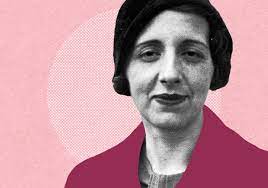
Now, we are in debt, because we have not approached the examples that at the beginning of this section have been promised. It is considered that this kind of finding the heart of things, has been the attempt of Zambrano and Merleau-Ponty. In the case of Ponty, his whole philosophy is an analysis of bodily intentionality that exposes the figuration of the invisible in the visible. To the point of being remembered as the philosopher who sees the invisible. In the case of María Zambrano, and as I mentioned before, more than a philosopher, which she evidently was, and also a poet, I like to treat her as a pythoness. Because Zambrano in her philosophizing action understands poiesis as an activity that accompanies things in their genesis and as a knowledge from the very root of being. Since the human being has a need to express himself by creating and this he achieves with philosophy united to poetry. Now, as a preamble to the following section, trying to advance in our navigation through these contemporary currents that wander between philosophy, poetry, art, feeling, and body, where there seem to be no borders, it bursts with the common proceeding. In these aspects, I relate both thinkers, they did philosophy from the edges of it, and I dare to say, that both had jumped to the other side, but because of the impossibility of narrating the unspeakable, they had no choice but to return to the border side of the words.
Source: **https://ethic.es/2021/02/el-exilio-de-maria-zambrano/**
**- Art as a human creation, search for knowledge, and abolition of dualisms.**
With what has been said, to speak of art is not a random task, but framed in Zambrano and Merleau-Ponty, in their conception of art as a human creation that allows the search for knowledge and that breaks with modernity, that is to say, the dualisms founded in Descartes, are abolished from the poietic conceptions.
For Merleau-Ponty, art is a creation that opens possible worlds. It is not a closed discourse, but allows openness, in other words, art becomes a model of understanding the world, and together with philosophy, it intends to see the common from the multiplicities of phenomena. Art as a discourse, and like all discourse, has two characteristics: first, it has a voice. And the second, it speaks to us. But we should ask ourselves how it speaks to us because it does not seem to do so in the same way as a scientific procedure, which is framed from the subject and the object. Merleau-Ponty affirms that the human body is a material and spiritual reality at the same time, we are embodied logos. Thus revealing his conception of "body-subject" as an overcoming of dualism and against any materialistic reductionism. Thus, perception as a mode of existence at a preconscious level responds to our concern about how art speaks to us. The world as a reality that can be perceived becomes the basis of all rationality and all existence. Art in its creative sphere, figures, as we said before, the invisible of the visible. This art means a metaphysical turn because man is not pure consciousness, there is a preconscious being. The being makes itself visible in and through man. Being is, more than something that can be preached, it is the dimension of the invisible of the visible. It is clear that, although it may lend itself to a religious interpretation, it does not represent the God of theism. It does not represent the God of theism.
In the case of Maria Zambrano with respect to art, one could, first of all, make a distinction between knowledge and knowledge. Knowledge is linked to the method. While Zambrano, and also Merleau-Ponty subordinate it to the "things themselves" that manifest themselves to us in the historical becoming. A path that traverses and travels through experience. Art and poetry have helped philosophy to see the world with other eyes. This "return to things themselves" that has been inherited from Husserl, what Zambrano would call the "heart" of things, is nothing more than paying attention and listening to the voice of silence. And thus, it differs from the method that stops the vital becoming, encapsulating it in a certain system. Zambrano is a thinker outside the system and does not conceptualize any, the closest, perhaps, her "poetic reason" but it is nothing more than a mediation between philosophy and poetry.
Art, as the name given to human creation, not only points to a search for knowledge but becomes an existence without splits, to return to the original state. Artistic expression in its abolition of dualisms is nothing more than de-authorization. Poiesis is the action of the soul, and this is that which links body and consciousness. To which Merleau-Ponty will say that the soul is the superior level of self-organization.
-The dream as immobility of a movement
This penultimate aspect of the essay on a joint phenomenology between Maurice Merleau-Ponty and Maria Zambrano will be nothing more than to point to the dream, as one of the aspects of life where feeling flourishes, although by my own criteria, I consider that the dream at first glance does not seem to be a subject that can be philosophically deepened, however, philosophy has been one of the places where the dream has been most thought of, even though, immersed in it, no questions can be asked.
Before our thinkers of feeling to call them somehow, perhaps with affection, there have been other philosophers who have said something about the dream, as it was: Husserl, Sartre and Gasset. And although while we are dreaming it is not possible for us to ask ourselves questions, it is not an impediment that from the dream it is not possible to do philosophy. Perhaps, the most praiseworthy thing when trying to expand the logos with poiesis, is to build a ground from phenomenology, where the dream can be taken out of its darkness. To bring it to the light. With what has been said, phenomenology is understood as a method, but in this case, it is not completely adhered to Husserl's phenomenology. And one could begin with the following definition of sleep: First of all, it is a passivity where the sleeping subject is delivered to a reality that makes all action impossible. Secondly, it is necessary to affirm that the dream lacks its own time, there is a sensation of being cloistered in the cosmos. Thirdly, there is a predominance of matter and the integration of physis; fourthly and lastly, the dreaming subject lacks space.
The parameters of the conception of the dream have already been pointed out. For Zambrano, the dream will show that the subject who is immersed in the dream is not an active subject, since he cannot express his will. He does not make the dream, he only inhabits it by suffering it, but in that suffering, there is a sensation. In my dream, I am not a mere spectator. Thus, we are opening paths in the understanding of the dream as the immobility of a movement, even if it is premature. The dream not only possesses passivity, but it is passivity in its essential reality, and from that background of shadows the action emerges, not as a philosophical question but as a sensitive relation from its preconscious reality. The understanding of the dream, by its occult nature, can help us to develop knowledge about the soul, a soul supported by the overcoming of the Cartesian dualisms that we have already mentioned above. And in the dream, we see the abolition in the dualistic sense, because the dream from its psyche is not separated from the body nor from consciousness. For Merleau-Ponty, the dream is the landscape without geography that we contemplate from our embodied reality. An embodied reality where passivity and activity intersect but not as juxtaposition. As Dastur says: "Experience is the singular inversion of activity into passivity." From Zambrano, we can contemplate how the "I" there is a double contemplation but they are not reversible the dreaming I have a passive knowledge because the dreaming I do not think. "It could be said that the oneiric space performs a spontaneous reduction of the geographical space until it reaches the subjective sources of our existence and manifests an original spatiality centered in the body itself."
And as one more aspect to highlight with respect to that spatiality of the dream in which the self is passively involved, because it knows by its perceptions not only of the dream but in the dream since it somehow suffers and feels them, for Merleau-Ponty the space of the dream is a depth and that thanks to it, the most secret act by which we elaborate our medium is staged. Therefore, it is affirmed that space is enjoyed by virtue of its depth. Which comes from the intimacy of the heart. And we enter the meadows of Zambrano, who defines the dream as the immobility of a movement. For this reason, we have named this section of this essay in such a way because in human life there is nothing immobile. And as a Greek philosopher would say, "Everything flows".
But to speak of Maria Zambrano with respect to the dream, it would be necessary to know that her conception of the dream is the creative dream. This comes to be accepted by the consciousness and by the soul and is the germ of creation. Because in the time of the creative dream it becomes like the model of the restitution of phenomenology of memory. By Zambrano, we affirm that thanks to a concentration of time. As it happens in the creative dream in the images that preserve the feeling. With what has been said, it can be said that this vision with respect to memory and the images that are concentrated in the time of the dream feed a possible experience, not as a cumulus of things living, but as things that we have reflected. Zambrano reveals a concern for the memory of a feeling. Ponty, for his part, is concerned with discerning how passivity, which is not opposed to activity, comes to establish from the phenomena of the dream how they illuminate passivity. With what has been said, we point to the common point of our philosophers. Both try to discover the pre-reflective level in which all reflection has its origin. That is, passivity is the other side of activity, not as its counterpart, but as its genesis. As Ponty describes it: the dream is the experience of the universal, but at the same time, an experience that is lived alone. And just, with what has been said, a pre-compression of the following section has been made.
-Dreaming, autopoietic passivity as part of lived life.
"In reality, all dreaming is already a certain awakening, because if it were not, dreams would go unnoticed." We have begun this section with the quote presented because with it we want to glimpse and unveil two aspects that are essential. The first is that the dream is not pure passivity and the second is that the dream transmits a recondite experience and can increase knowledge so that it can be acted upon by awakening from lethargy. This is the basis of Zambrano's creative dream because it is the most awakened and allows us to recover the hiddenness that is determinant for the attentive life. Now, there is a key point to be mentioned from Zambrano's point of view, because she conceives the creative dream as a priority when it is a monoeidetic dream, that is to say, it does not transmit history but intuits essences. And since the monoeidetic dreams were given light, it could be said of them that they are Hieroglyphics, enigmas to be deciphered. But they are not decipherable by means of analytical reason, this would be a mistake. But they are the extended reason because they are the poetic reasons. In these dreams, there is transcendence and there is the sign of the specifically human.
But in every dream, there is a temporal flow, although, without passivity, sense, and presence, there is no activity, time, nor temporal knowledge. Approaching this aspect from phenomenology, it can be truly affirmed that the human not only suffers his transcendence but also suffers his immanence. This makes his present (Here and Now) bodily. Not only does he suffer from passivity in dreams, but dreams, more than self-absorbed passivity, are manifestations and conditions of possibility. Dreams come to mean openness to the other. Activity in the awakening from lethargy. That is to say, everything we suffer from is affected by us.
With what has been said we have been pointing to the center of what could be called a Zambranian philosophy because it conceives the creative dream as the source of all thought and action. Merleau-Ponty describes it this way: "to see is always to see more than what is seen" and Zambrano would describe it this way: in order to see, one must forget oneself. Abandoning oneself to dreaming. In both, looking is the process in which something becomes visible to me. To look is to bring out of the darkness, to make the invisible visible, but not to lose its invisibility, although it may seem a paradox. It can be shown in the following way. Dreaming is both something universal in itself, as well as an individual experience. To abandon oneself to the dream, to the creative dream as the source of all thought, is to affirm that passivity is a step prior to activity, and that these are not opposed to each other. Passivity is given as a previous step, which in its suffering opens through feeling to expanded reason. So the apparent play on words, to see the invisible without it losing its property of invisibility, is to put in ink the process in some way of the creative dream. In the words of Pablo Picasso "I do not paint things as I see them but as I think them", here we would go a little further, perhaps Picasso could have pointed it out, but here we would affirm that to paint is to trace things as one dreams them. Action is preceded by passivity. "Art and poetry always helped philosophy to see differently, to "return to things themselves" (Husserl), to the heart (Zambrano), listening to the voice of their silence to grasp their mute reality, but as real as existence."
That mute logos cannot be expressed by the discursive mind, and yet it is indispensable for communication to take place. We enter the terrain of blank spaces, in the midst of word and word, there is a mute reality. The word is not born from anything, it is born from silence. In such a way the dream. For Maria Zambrano as well as for Merleau-Ponty, man is the being that transcends his mere being there of the initial dream. Because in the dream all frontiers disappear, that is to say, the dualistic frontiers such as body and world, person and body, among others. "The self is still present in dreams, albeit passively, a sleeping self that cloaks a dreaming self." With this statement, we unveil on the one hand that the creative passivity recreates that passive life that becomes part of the lived life, and on the other hand, that the dream only makes sense in relation to wakefulness, and that there is a continuity between the sleeping and the waking self. because it is remembering the dream, albeit in a clouded way.
Husserl would say: the dream self does not imagine, that is, it does not think, it only perceives, since it sees the dreamed things with vivacity. Only to the subject already awake the dreamed world is revealed to him as not perceived. But as an introspective reflection. Very different from Sartre who would call the dream as the consciousness of sleep. But to paraphrase López Sáenz, What dreams in us is neither the conscience nor the body but our existence that withdraws from the world of common life and allows itself imaginative variations on it. "To dream is not, then, to abandon the world, but to listen to its native secret." The dream comes to be one of the passivities that happen to us, the passivities that also question us but we can only give answers to their questions from a passionate reason for all the dimensions of life, even if they dwell in darkness. That is why it is important to reflect on these passive dimensions of our being, which, because they are passive, does not mean that they do not constitute us. To understand them as openness to the other which, from its unreflective constitutions, nourishes our reason. But Zambrano knew well the error of the separation between dream and wakefulness. She understood that there is a dream that can be lucid and also an awakening without ceasing to dream. The vital thing is that in the dream we do not ask ourselves questions, but the dream interrogates us from the native passivity of its phenomenon.
Thank you for reading and joining me in this essay
Greetings!!!
A Phenomenological Approach to Feeling Part 2
**Hello friends**
I continue with this essay and although I mentioned that I would do it in two parts, I think I extended a little more than planned and I will take a third and maybe a fourth part to expose my phenomenological approach to feeling, after reading and thinking about the conceptions on this subject from Maria Zambrano and Merleau Ponty.
Today I bring you three sections of equal importance, continuing the ideas exposed in my previous post ( https://read. cash/@cesarandresdp/a-phenomenological-approach-to-feeling-part-1-f542117c#feeling-not-as-a-faculty-but-as-a-mode-of-being ) today I will talk about how I perceive feeling, thinking it as a middle point between the sensitive and the sentient, then how our reason gains space or ground when it incorporates feeling and does not exclude it as it has been so often done, and finally in this second installment I expose an idea that is deeply influenced by Maria Zambrano, since it is about conceiving thought as a heartbeat.
Source: **https://ethic.es/2021/02/el-exilio-de-maria-zambrano/**
-Feeling is a conjunction between the sensitive and the sentient:
The sensible and the sentient seem to establish a dichotomy, but in truth, both are affirmed in a simultaneous exchange. This conception inherited from Edmund Husserl since he understood the body as sensitive in a double modality (sense and sentient). And Zambrano wants to bring reason closer to experience, a vital experience. Perhaps it is understood what our philosopher meant when at some point in her life she spoke about the experience and expressed that this, came to be not the compendium of things lived, but the cumulus of things reflected. The feeling comes to respond to the force of things. To speak of thinking is to want to decipher what one feels, intentionality is evidenced in feeling as conjunction.
Life possesses as a condition to see itself by seeing itself in another. With what has been said, accepting feeling as a link, conjunction of the sensible and the sentient allows transcending any duality, although one could interpret this aspect of feeling, following Hegel's dialectic of the master and the slave. There is, then, a beyond any dualism or a bipolar consideration where both parts are juxtaposed. From Merleau-Ponty the midpoint or the focus of feeling as the feeling is nothing other than "being-in-the-world", feeling as a mode of being. As a way of facing reality and of facing the irrational (the other). Under the philosophical umbrella, we seek to bring feeling out of its obscurity, the irrational as a pre-reflexive sphere immersed in the rational, however, before continuing in this pre-reflexive aspect we should pause. This approach leads us to a reason that seeks to enlarge its frontiers, to reach what until now had been outside its walls.
- Reason is expanded when it incorporates feeling:
Merleau-Ponty and Zambrano in their philosophical work as a phenomenological existential philosophy of feeling, expressed by María del Carmen López Sáenz. It is nothing more than a vital discourse with the intention of deepening in a non-Cartesian reason. The modern paradigm had to be left aside. The reason will be expanded when philosophically trying to delve into the dark dimensions of life. To bring feeling out of its obscurity and to broaden the logos become maxims for our thinkers.
It is impossible not to link the feeling to its affective situation, although this does not exhaust it. "The affective situation of man is to suffer and to transcend, and not only to suffer but to suffer himself; to bear the burden of passivity "* It is not inactive suffering because the subject of suffering realizes and feels what he suffers. Paraphrasing Zambrano in one of his passages of Philosophy and Poetry, one does not find the whole man in philosophy, nor the totality of the human in poetry, philosophy is a search by means of a method, poetry is a discovery. I believe that Zambrano's subtlety is interested in evidencing the shortcomings of dichotomies, I do not know how conscious María was of the classical maxim "divide and conquer", but this seemed to be a question that she wanted to abolish in the conception of the human condition. Philosophy and poetry, reason and myth, body and soul, or any question that prevented a broader worldview. Maria knows that knowledge goes through a sensory stage and reaches the intellect, but that both processes are one, to put it epistemically.
Returning to the view of philosophy and poetry, Zambrano at the midpoint locates a metaphysics of creation. Because, from every poetic consciousness emanates an act. This means, that from the metaphysics of creation the artistic action that configures and reveals the purest truth. And that as art, the process of human creation is known, and this does not start from the search for knowledge as does philosophy or science, but has the intention to exist without splits to return to the original state that preceded the dualisms. And that art teaches us to see the world, to see beyond the visible things. To unveil invisibility. To look requires time and it is necessary to leave a garment, María Zambrano would tell us. But about art, we will expand the horizon later, with what has been said, it opens the way to the impulse that gives art as a look at the world with eyes that look from a pre-reflective point of view.
-Thought as a heartbeat:
The heartbeat could be diminished by saying that it is the action of the heart by which the blood is pumped, and perhaps add hundreds of physiological terms that are beside the point. Besides, by diminishing the heartbeat, we would also limit the action of the heart to something fundamentally physical and corporeal from the traditional and dualistic conception, because nothing brings me to the soul the systole and diastole in perpetual movement, until the imminent tunic of death veils my eyelids. But nevertheless, from our living, there are irrationalities that found us. The heartbeat, not as a nervous impulse that keeps us alive, but as an irrationality that gives us a breath, arouses our emotions. Merleau-Ponty asserts that it is necessary to be able to expand reason so that it may contain even those irrationalities, those that have been condemned to silence. The power of feeling comes from the logos, a living in reason in order to seek the reason for living. Zambrano, for his part, expresses that poetic reason welcomes feeling because it is intuitive and is nourished by metaphors that serve to unveil the mystery, in order to point to a knowledge about the soul.
Thought as a heartbeat unveils a submerged, tacit, hidden logos. Because it is thought that wonders about the common origin of thinking and beating, reducing them to their birth. An original horizon that is founded on reason and from which it can never detach itself, not even to be founded. A feeling feeling from the pre-thematic of the human condition. This pre-thematic condition opens a reflection that is not yet intellectualized, by feeling feeling feeling. Exemplified by the two hands that shake, putting an end to the dichotomy of subject and object. Founding a pre-linguistic level.
That pre-linguistic state for Zambrano is the clamor from within, that which is known as a submerged logos gives reason from the darkness in which it dwells. And he uses an indirect and symbolic language, he realizes that the origin of all reflection is precisely what comes before, what was called the pre-reflexive sphere and that passively determines us. Zambrano had Ortega y Gasset as his teacher and from him he somehow inherited the maxim: "I am I and my circumstance", this condition of possibility of the human known as "circumstance" in a broad sense, for Zambrano comes to mean the tacit, the hidden, the penumbra. And the beat, as that circumstance that makes it possible for me to feel, and to feel myself as a self-absorbed reflection, as Merleau-Ponty would say, and which we will return to later, "...a landscape without geography... "***.
Thus I end this section number two of my phenomenological essay, thank you for joining me in this essay.
* Zambrano, M., Los sueños y el tiempo, (1992) Siruela, Madrid, pag. 12
** López Sáenz, M. (2013) Merleau-Ponty y Zambrano: el “logos” sensible y sintiente Aurora. Departamento de filosofía. UNED
*** López Sáenz, M. (2007) Los sueños, el tiempo y la pasividad. M. Zambrano y la fenomenología. La lámpara de Diógenes. Revista de filosofía. Números 14 y 15; pp. 59-77
Thank you for reading
A Phenomenological Approach to Feeling Part 1
Hello read.cash friends
Welcome
These last few days I have been quite busy and I haven't had much free time to post something with a minimum of value and that you might find interesting. As I have already expressed in my presentation I studied philosophy and that has motivated me to write an essay that has phenomenology as its center, which is one of the topics and ways of approaching knowledge that most attracts my attention, and with phenomenology, I have approached the thought of Maria Zambrano (my favorite Spanish philosopher) and also to relate it to the thought of Merleau Ponty about feeling.
So I divided the essay into two parts, today I want to leave you the first part.
*"And poetry, suffering the martyrdom of lucidity, approaches reason."*
*ZAMBRANO, MARIA Filosofía y poesía Fondo de Cultura Económica. Mexico, 2006.*
Source: https://ethic.es/2021/02/el-exilio-de-maria-zambrano/
- Feeling as a reflection of sensibility on itself.
María Zambrano and Merleau-Ponty have devoted a great deal of effort to elaborate a philosophy of feeling and the search for the original. Life is the compendium of what can be expressed and on the other hand that for which there are no words. In the words of Cortázar "Words are not enough to express that which overflows the soul". In the feeling dwells a hidden logos. But the efforts to unveil feeling like the home of a tacit logos cannot be aimed only at our two leading thinkers. Throughout history, there have been people interested in these vital issues. Perhaps, a traditional view of philosophical genesis has been to separate myth from logos. As if from their rupture and split, the attempt to give a reason for the world and life has risen to a higher level. But in Greek antiquity itself, Plato shows that knowledge is not a matter of pure reason. One example that can be mentioned although particularly a path of which there are seas of ink, it is not a matter of which it has been said in its entirety what can be detached from it. In the dialogue the Banquet*, Plato speaks using as a resource the voice of a sorceress of Mantinea named Diotima. For her, pain constitutes certain steps by which we can arrive at contemplation. And our first concern about feeling, in this case, about "the painful must be rethought.
It is known that thanks to Gadamer, each epoch can make its own reading of the classics, and although we can delve deeper into hermeneutics, it is not a subject that needs to be addressed now. But turning to Plato's Banquet, we see how there can be a difference between the logos and the body in matters of the realm of contemplation. By the senses, we grasp beautiful things, which the bodies of Beauty share are what can be felt of it, but Beauty as a non-corporeal reality, there is no eye that sees it or scent that manifests it for what it is. The contemplation of Beauty corresponds to the soul, to the logos, to the incorporeal that we have submerged in our corporeality. That is to say, feeling, in this case, pain, is presented as a propaedeutic, as a path to be traveled. The transit in the corporeal opens the way to a contemplation of the soul. The duality of body/soul is not a duality that prevents communication. That is to say, the corporeal is presented as a threshold between the sensible and the intelligible. "... beauty, as seen in the Phaedrus, is a threshold, a sort of frontier between the sensible and the intelligible that is able to "enter through the eyes" thanks to its brilliance that, in a mysterious way, expands between the human and the divine. "***
This sort of corporeal threshold in which poets dwell without fear has served to bring a sort of light to those things that seem to dwell in darkness. But neither poetry, which has been rejected for wandering in the corporeal, nor philosophy, which has sought Truth from the split logos, can only be accessed through the mystical rapture. But, there is no way to reach this kind of mystical gift. It has been wrong to proceed by dissociating philosophy and poetry, body and soul. In Merleau-Ponty, feeling is not a passive passivity, but the feeling is feeling like an object and subject at the same time. Aristotelian logic here does not fulfill its task. And Zambrano manifests it from another point of view, to feel is to probe things from another side, in the dark dimensions of life is where philosophy must delve. "All knowledge is installed in the horizons opened by perception. "**** Feeling is imposed on conscious thought, in short, the feeling is thinking from the feeling, feeling is reflection turned in itself. And for both our Spanish Pythoness and her French contemporary, the feeling is affection and action of the subject.
**- Feeling not as a faculty, but as a mode of being.**
An indication of the way of being of feeling has already been shown, affirming its denial of being a faculty, we will then start from its way of being, which is none other than an active passivity that allows openness. An opening to the other, relating to the absent. Feeling (Aisthesis) becomes not a state of consciousness, but an original experience. Here we could locate an outline of what María Zambrano conceives as the poetic reason. To recover philosophy as logos not separated from life. To make of feeling a force that in its inhabiting interiorities of the sensible, seeks and has a purpose to be the action of the soul that unifies the body and the conscience. Capacity to be affected by the nonmeaning, a vital strangeness, the mysteriousness of a feeling that perhaps causes a lump in the throat. Making unspeakable something dark in the interiority, but, that tries to come to light. For this reason, the feeling is affirmed as a feeling interpreting. Life turned in itself trying to say itself without words, the dream. Poetry tries to say without concepts, art to express as corporeity what at first is only affection and logos tries to give a reason for what is around it.
As an example, we can mention the origin of philosophizing. As a discipline, philosophy is born when metaphysical problems (Beauty, Order, God, Time) leave the temple. To make faith secular without abandoning the gods altogether, something like when Socrates seeks through Maieutics to make logos, to give light to that which in the interior inhabits the dark. Merleau-Ponty becomes the thinker of the unthinkable, seer of the invisible, he tries in another way, to make maieutics from Husserl's phenomenology, to return to the things themselves. And Zambrano, with his poetic reason, becomes the mediator between philosophy and poetry, both try to navigate the flow that lies in the middle of dichotomies.
So far this first part, there is still the second part that I intend to share with you very soon. I hope you found it interesting, I really enjoyed the reflective process, reading, writing down ideas, and then expressing my thoughts in these lines, I do not plan to write a kind of conclusion because we are halfway through.
Goodbye, dear friends.
Education and Venezuelan Society
Hello friends of read.cash
Welcome
I wrote this essay with the purpose of generating an approximation of the educational system in Venezuela. It is true that we can speak about a global conception of education because the world in which we live and the old barriers have been forgotten in the face of the globalized world, although this would remain only a vision or theory of education. Pointing out what really circumscribes us in a geographic-political way, or in other words "the Venezuelan culture" has particularities that make it different and determine it, so that certain aspects of the educational system can be approached, being able to identify the limits and parameters of such system.
Source: Pixabay.com
Now, in Venezuela it is said that education must be democratic. This statement is somewhat ambiguous, since as a principle we can handle that all education must be neutral to the political orientation of a state. But at the same time it is affirmed that Venezuelan education is democratic, and this orientation, if it is so, already includes a political tendency, since it is a democratic sign.
According to Dewey, the idea of an educational or pedagogical doctrine is that it has the task of socializing the child, this comes to represent the school as a form of community life and education as a social process. This pedagogical doctrine is known as Dewey's "Pedagogical Creed". However, education, rather than a mere preparation for later life, must be a process of living. Another aspect which has influenced Dewey is that the educational institution has been losing its individualistic character of competition, in order to become a community where work unifies and unites. "Common effort creates bonds. On the one hand, this is productive for the child or young person who learns, because he creates links with his peers, with his teachers. And he understands that his effort has the same value as that of his classmates. Thus establishing values of solidarity for an integrated social life. On the other hand, this method makes that the character of competition, which is not a negative value at all, is losing importance. Since all competition generates quality in the projects that are proposed.
"The school will not be able to provide preparation for social life unless it reproduces within itself the conditions that characterize social life. The only way to prepare for social life is through participation in social life." This quote from Dewey summarizes in some way what has been exposed, and proposes a new section in this work.
Dewey highlights the importance of praxis; it is within social life that man becomes a social being. And quoting J. Locke "All men are born equal and with equal aptitudes, only education makes the differences" In the Venezuelan education throughout its national historical process has not been far away, so to speak, from the educational vanguards, although in the last decades, the educational process has been somehow degrading. It is important to emphasize that Dewey's system has been copied, although like any other project, if it is imposed as absolute, it will break down. Since it is utopian to think that whatever the social or educational approach that is not subjected to criticism or interpretative values from other positions, values cannot be integrated to the circumstances to which they are subjected. That is to say, education as a project should be seen as a rhetorical science, not as a mathematical-logical science. All educational systems maintain the same values, only that societies change and must adapt. For example, for a long time it has been maintained the position that the teacher is the connoisseur and must pass on his knowledge to his students. Now, it is not quite seen that way. It is the teacher, together with the students, who builds the knowledge. They are a team in which knowledge is given as production. And not as an inheritance.
Throughout history, many conceptions of man and nature have been handled and all of them have had their repercussion in the educational and pedagogical field. And it is pedagogy that has a project of man and society. Now, it is valid to ask what is the relationship between pedagogy and society? It is important to highlight the four answers proposed in the text:
***1. The educational system is an entity independent of the social system.***
***2. The social system is a product of the educational system.***
***3. The educational system is determined by the social system.***
***4. The educational system and the social system are different but structurally independent.***
It is important to evaluate and consider each of the answers separately, but since we are dealing with Venezuelan education, we should point out which of them has been adopted by the Venezuelan system, although, perhaps it has not been chosen voluntarily, but rather, it has been established by a will, as a kind of major force that has been implanted in the system. And it is somehow current to say that it is the third response that we can appreciate today in the Venezuelan model of education. It is the educational system influenced by the social and even political system of the country, in order to provide an education that in some cases is even partisan. Knowing that education is "democratic" as expressed at the beginning of this essay.
By way of conclusion, it is essential to point out, remembering Darwin in his famous theory, how he establishes that there is no essential difference between man and animals since we are basically governed by the same rules. The difference that exists is a difference of degrees. And it has been enough to create everything we call culture, thanks to language as the greatest achievement of mankind. That is to say, we are an animal of signs, and thanks to existentialism as a philosophical current we have rescued the value of freedom in the search of being authentic, that must be the task of all pedagogy. To look for the man to be a free and authentic man. That he can think for himself, rescuing the crucial value of the Enlightenment movement of the eighteenth century. And in the words of Kant. Education is the only means by which man can become man, that mankind can come of age, must be the purpose of all pedagogy.
Thank you for reading
Goodbye
Let's talk about Adela Cortina's Applied Ethics[ENG-ESP]
Hello Friends of Read.cash
One of the topics that most attracts my attention in my career is Ethics, so I wanted to write this post as a small essay addressing the work of Adela Cortina on applied ethics. She tries to summarize the conception of applied ethics. Making a tour of the areas where ethics tries to be a focus of light, for different societies and their citizens in different fields where it is necessary to have principles that somehow govern our reflections within the framework of local legality.
***Source:*** ***https://smoda.elpais.com/placeres/adela-cortina-hemos-sustituido-la-etica-por-la-cosmetica/***
Thus a thought must be moral, in other words, ethics not as a knowledge confronted to science, but ethical rationality moves today in the field of dialogue and interdisciplinarity.
In order to undertake the body of this work, which pretends to be intellectual, it will be necessary to start from the attempt to define what applied ethics consists of, which is the application of ethical discoveries to the different fields of social life. Such as: politics, education, business and economics, genetics, ecology, among others. Applied ethics, besides being interdisciplinary, arises as a redemption for the inadequacy of individual ethics. Because this individual ethics, which is based on goodwill, can have bad consequences for the collective.
Now, applied ethics must have its own method with which it relates to ethical principles within the framework of civic values that value proper to each activity. This ethics has some possible models, but these, in turn, are insufficient. These are the deductive ideal and an inductive proposal. The deductive model is based on the philosophers Plato and Aristotle and consists in applying any type of moral principles at hand to concrete cases, it is stated as unfeasible because concrete cases are not a particularization of universal principles. The inductive method replaces principles by maxims, this rhetorical method is not valid because it has been contemplated that there is no universal ethical principle.
It can be glimpsed how ethics has as its vision certain concrete virtues. These virtues lead the individual within the state to achieve ultimate ends and goods. Now, there are steps to be able to design an applied ethics.
These steps are:
**1. Determine the specific end and this makes sense within social legitimacy.**
**2. Discovering which means are appropriate to the particular modern society.**
**3. To find out what virtues must be incorporated to achieve the ultimate end.**
**4. To discover what are the values of civic morality and what rights such a society recognizes for individuals.**
**5. To find out which values of justice require the realization in this field of the principle of ethics, proper to a universal critical morality that allows questioning the current rules.**
**6. To leave the decision-making to the citizens who are affected and who can be an instrument of advice.**
After having named a series of steps for the construction of an applied ethics, it is fair to mention which are the areas where the construction of an applied ethics takes place. Bioethics, which can be interpreted as macroethics, is "a way of approaching all ethics from the perspective of threatened life." In other words, bioethics is about health and biotechnologies. Gene-ethics has the task of not leaving decisions about the ultimate ends of genetic manipulation in the hands of rulers, nations or institutions, and has the duty to educate morally. The ethics of economics, based on the conception of society as a space of cooperation, has as its duty a shared theory of distributive justice. Ecological ethics has as its task that in each society, there may be a real solution to the problem of the deterioration of the ecosphere.
By way of reflection, I would like to emphasize that ethics has the necessary intellectual resources to address issues that merit reflection on themselves, it is an exercise of introspection that seeks fair solutions in the different areas where ethics can be applied, as well as in bioethics, where one of the cases that have caused more problems is the change in the genetic load because science has discovered that it can make changes in it.
Finally, I would like to emphasize the importance of the vitality of the philosophical concept of person, which is understood as a valid interlocutor, can lead to the development of people as critical and responsible individuals, making decisions from what Kant calls "goodwill". In addition, ethics should foster a moral education that can encourage people to self-realization. In other words, it is in charge of the pursuit of happiness, feeling oneself an active member of a concrete community.
I feel that rethinking ethics is always one of the resources that move us towards a better social life, and that was my motivation at the time of expressing this little writing.
**Thank you for reading, and giving me your attention.**
_________________________________________________
**Versión en Español**
**Hablemos sobre la Ética aplicada de Adela Cortina**
**Hola Amigos de de Read.cash**
Uno de los temas que más me llama la atención de mi carrera es la Ética, de modo que quise escribir este post a modo de pequeño ensayo abordando el trabajo de Adela Cortina sobre la ética aplicada. Ella intenta a modo de resumen recoger la concepción de la ética aplicada. Haciendo un recorrido por los ámbitos donde la ética intenta ser un foco de luz, para las diferentes sociedades y sus ciudadanos en los diferentes campos donde es necesario tener principios que rijan de alguna manera nuestras reflexiones dentro del marco de la legalidad local.
Así un pensamiento que debe ser moral, en otras palabras, la ética no como un saber enfrentado a la ciencia, sino que la racionalidad ética se mueve hoy en el terreno del dialogo y la interdisciplinaridad.
Para emprender el cuerpo de este trabajo que pretende ser intelectual, habrá que partir del intento por definir en qué consiste una ética aplicada, esta viene a ser la aplicación de los descubrimientos éticos a los distintos ámbitos de la vida social. Como lo son: la política, la educación, la empresa y la economía, la genética, la ecología, entre otros. La ética aplicada además de ser interdisciplinar, surge como redención ante la insuficiencia de la ética individual. Porque esta ética individual, que se basa en la buena voluntad puede tener malas consecuencias para la colectividad.
Ahora bien, la ética aplicada debe tener un método propio con el cual se relaciona con los principios éticos en el marco de valores cívicos que son valores propios de cada actividad. Esta ética posee unos modelos posibles, pero, estos a su vez son insuficientes. Estos son el ideal deductivo y una propuesta inductiva. El deductivo se funda en los filósofos Platón y Aristóteles y consiste en aplicar cualquier tipo de principios morales que se tenga a la mano a los casos concretos, se afirma como inviable porque los casos concretos no son particularización de principios universales. El inductivo sustituye los principios por máximas este método retorico no es válido porque se ha contemplado que no hay un principio ético universal.
Se puede vislumbrar como la ética tiene como visión ciertas virtudes concretas. Estas virtudes conducen al individuo dentro del estado a alcanzar fines y bienes últimos. Ahora bien, existen pasos para poder diseñar una ética aplicada.
Estos pasos son:
**1. Determinar el fin específico y este cobra sentido dentro de la legitimidad social.**
**2. Descubrir cuáles son los medios adecuados a la sociedad moderna particular.**
**3. Indagar que virtudes hay que incorporar para alcanzar el fin último.**
**4. Descubrir cuáles son los valores de la moral cívica y que derechos le reconoce tal sociedad a las personas.**
**5. Averiguar qué valores de justicia exige realizar en ese ámbito el principio de la ética, propio de una moral critica universal que permite poner en cuestión las normas vigentes.**
**6. Dejar la toma de decisiones a los ciudadanos que son los afectados y que pueden ser instrumento de asesoría.**
Después de haber nombrado una serie de pasos para la construcción de una ética aplicada, es justo mencionar cuales son los ámbitos propios donde se da la construcción de una ética aplicada. La Bioética que puede ser interpretada como macroética, es “una manera de enfocar toda la ética desde la perspectiva de la vida amenazada.” Es decir, la bioética es de la salud y biotecnologías. La Gen-ética tiene como tarea no dejar las decisiones sobre los fines últimos de la manipulación genética en manos de gobernantes, naciones o instituciones, y tiene como deber educar moralmente. La ética de la economía basada en la concepción de la sociedad como un espacio de cooperación, tiene como deber una teoría compartida de la justicia distributiva. La ética ecológica tiene como tarea que en cada sociedad, pueda haber una solución verdadera al problema del deterioro de la ecosfera.
A manera de reflexión me gustaría resaltar que la ética posee los recursos intelectuales necesarios, para poder abordar las cuestiones que ameriten un reflexionar sobre si mismas, es un ejercicio de introspección que busca soluciones justas, en los diferentes ámbitos donde se pueda aplicar la ética, así como en la bioética, donde uno de los casos que ha causado más problematicidad es el cambio en la carga genética, debido a que la ciencia a descubierto que puede hacer cambios en ella.
Para finalizar me gustaria resaltar por su importancia la vitalidad del concepto filosófico de persona, que viene a ser entendida como un interlocutor válido, puede dar lugar al desarrollo de las personas como individuos críticos y responsables, tomando decisiones desde lo que Kant llama “buena voluntad”. Además, la ética debe propiciar una educación moral, que pueda fomentar a las personas a la autorrealización. Es decir, se encarga de la búsqueda de la felicidad, sintiéndose miembro activo de una comunidad concreta.
Siento que repensar la ética siempre es uno de los recursos que mas nos mueven hacia una mejor vida social, y ese fue mi motivación al momento de expresar este pequeño escrito.
Gracias por leer, y darme de tu atencion.

Heraclitus as seen by later philosophers
**Hello Dear friends**
As you have seen I am a fan of the thought of Heraclitus and I try to be a curious knower of his thought and for that reason, in this post, I express what two philosophers later than him have contributed, or that have taken the idea and have included him in their thoughts and reflections, and I try here to expose in a simple but substantial way, the interpretation that these later philosophers have made to his thought. Among the philosophers that we will mention we have Plato in his dialogue "Cratilo" and Nietzsche in his book entitled "the pre-Platonic thinkers".
**1. Heraclitean Philosophy as interpreted by Plato**
In the work of interpretation carried out by Liliana C. Sanchez makes it clear that her paper is not an exhaustive analysis of the Platonic dialogue The Cratilo, but it tries to build a sketch on the Platonic interpretation of Heraclitus, it seeks to point out how Plato makes use of the doctrine of the perpetual flow.
This paper is divided into three sections, which I will comment on and explain as I go along. The first one, entitled "Heraclitus in the Cractylos". In this section, Hermogenes and Cratilo try to give an answer to the question about the accuracy of the name, but in this attempt, they develop a link between the name and what is named. The virtue of the name will thus be in its relation to the thing named". In the dialogue two currents are presented, one taken by Hermogenes and the other by Cratilius, these positions are the conventionalist and the naturalist respectively. But, it is appropriate to specify each one. The naturalist supports the non-arbitrary link between both elements, i.e. the name and the named, and on the other hand, the conventionalist supports the relationship between the name and the named, by means of agreements, uses, customs and norms.
What Cratilo says about Heraclitus in the dialogue according to the author, certain regularities can be established, for example the mentions of Heraclitus appear in etymological explorations that explain the interest of the dialogue in the accuracy of the name and its relationship with a vocabulary related to the movement. These elements, together with the doctrine of perpetual flux configure the appearance of the vocabulary relative to motion that emerges from the Socratic discourse in the refutation of the two theses (conventionalist and naturalist) on the exactness of the name.
The second section is entitled "Heraclitus and the examination of conventionalism", the first mention they make about Heraclitus is with a textual quotation while the conversation between Hermogenes and Socrates takes place in the dialogue between 383rd and 428th, which was given the name of "refutation of conventionalism". The textual quotation is: "everything flows and nothing remains", a phrase that tries to summarize the thought of Heraclitus.
Now, Socrates tries to clarify during this first conversation that the accuracy of the name should not be by "agreement", "consensus", "convention" and "norm" as it is not very satisfactory, because Socrates does not admit the convention to name things. This happens because if we were to name things by convention, in each polis we would have different names for the same things. Then, there would be a problem because the relation between name and named would be somehow arbitrary.
Then, in order to be able to somehow speak of "agreement" or "consensus" when speaking, there must be a criterion valid for all when imposing and using names: "this criterion could be the existence of some kind of conscious being that underlies things and is reflected in the names" and by this way, the concept of the philosopher Ephesius on the perpetual flow is introduced. With what has been said so far, we could say that for "naming" there is an instrument: "the name" and if this name is correct it will reflect the being of the thing it names. This will reflect its accuracy and at the same time the difference with other things since in naming we could speak of "truth". Although there are true and false speeches, the true ones will tell us about things as they really are.
In conclusion, the nature of the name should not be something arbitrary or "capriciously artificial", since it would not be fair to call it "exact" or "correct". There must then be a criterion that assures us of the name as a name. This will allow the teaching of such a thing, i.e. what we designate correctly is open to be taught and transmitted. This will be teachable since the name will be similar to the thing named. That is why the convention is not for Socrates unsatisfactory. Thus the use of the theory "everything flows", that is to say, this perpetual flowing refutes conventionalism in a forceful way since it allows the demonstration that there is something that essentially underlies things. And this is a guarantee that the names must point as closely as possible to the essence of the thing they name and not to individual seeming, that is to say, conventional seeming.
And finally, the third section "Heraclitus and the examination of naturalism". Then in the dialogue, there is another moment, and that is that after the end of the conversation between Socrates and Hermogenes, there is the dialogue between Cratilus and Socrates, the part that begins in 428th and ends with the end of the dialogue if the first part was called "refutation of conventionalism", this one is known as "refutation of naturalism". Before we begin to explain in some way what L. Sanchez's text expresses from this third moment onwards. It must be said that Cratilus and Socrates share the idea that the name must express the essence of the thing named. And if this were so, names would help us enormously in knowing, distinguishing, and teaching the things of the world.
"Cractilus argues that (i) only correct naming is possible and since naming is a necessary part of speaking, he concludes that the correctness of names is inevitable because one cannot say what is not; and (ii) correct assignment is inevitable so that names can be spoken of."
Socrates tries to show Cratilus how difficult it is to accept such a theory, and makes a detour, to primary and secondary names. Well, of the primary ones he says that they are the closest manifestation to things, this will bring as a consequence that they would be very similar to what is named or that they are simply a product of convention. Which Cratilo defends himself by saying that this is so since the letters and their sounds are similar to things. But it is obvious that different sounds represent the same thing. That is to say that they manifest the same essence. Then Socrates' refutation is: "the only thing he has to do is to disrupt the etymologies he already offered and make them mean the opposite" and yet Cratilius is more inclined to rely on the abundance of examples that pointed to the perpetual flow, which would be an absurdity; since the accuracy between the name and the named cannot remain a matter of majorities.
In Platonic philosophy we know the affirmation of things in themselves, that is to say, the beautiful in themselves, the good in themselves, the true realities, and that the things of the world are appearance and the manifestation of those. In this dialogue, by admitting their existence, we would be affirming stability that identifies them. Socrates is skeptical of everything that is in constant movement and that knowledge is impossible. And that to this, Cratilius argues that his research leads him more and more towards the thought of Heraclitus. Now then, the attitude that Socrates takes before this affirmation and inclination on the part of Cractilus is extremely interesting, since he does not really try to refute the naturalistic theory, but that it proves a conception of the world that appeals to its essences.
What Socrates refutes here is that the task of naming should not be left to someone's opinion and even less so when he tells us that the relation between the name and the thing named is necessary, even though one makes use of those names out of habit and not precisely because they reflect the essence of the thing named but because they correspond to the first impression with the thing.
By way of conclusion, the reason we can appreciate is that the naturalism expressed by Cratilius has as its basis the theory of perpetual flux, and endangers the possibility of teaching. Well, there are no stable essences, and there is no possibility for things to be reflected in the name. But according to the author, Plato does not want to commit himself to such a thesis, but neither does he reject it altogether, and it is most appropriate to say that he uses it. And if the interpretation is somehow correct, it can be said that the doctrine of the perpetual flux of Heraclitus is partially accepted by Plato who used this attractive theory in his argumentation and that by means of this theory he links the naturalistic and the conventionalist thesis. But he does not adhere to either of them in particular.
**2. Philosophy of Heraclius according to Nietzsche**
Frederick Nietzsche, in his text The Pre-Platonic Philosophers, published posthumously in 1995, characterizes thinkers before Plato and the thinker that concerns us now: Heraclitus of Ephesus, from the validity of his thought today. We will approach this section not in a direct way with the text but from an article entitled "Heraclitus in Nietzsche's gaze. Validity and limits from a current reading" elaborated by Marta De la Vega.
She synthesizes in three sections that we will comment on as we advance in the text, exposing in a summarized way what Nietzsche understood about the person and the thought of Heraclitus.
**1. "The attitude of the philosopher versus other men according to Heraclitus":** What we try to expose here is how the search for true knowledge is a way or a way of life, and that Aristotle expresses it as bios theoretikos, which implies a laborious effort to think, "where nothing is evident, an inquiring into the truth away from the way of common men" and that can be seen in fragment 1, quoted in this article: "Of this truth (Logos), however real it may be, always lacking in understanding let men show themselves, both before they have heard it and once they have heard it."
Heraclitus emphasizes the personal character of this laborious search of the wise, for knowledge for the sake of knowledge, and that this search always occurs from a philosopher: "I". In contrast to the tradition, it is guided by the "logos". And that with the "logos", it is a matter of discovering a law that not only governs the processes of nature but also shapes the horizon of the "ethos" understood as the character of that entity, that is to say, the sage who is the bearer of that universal logos. Nietzsche's interpretation is that "logos" and "Sophos" are inseparable: "Only one thing is wise: to know that logos which guides everything through everything".
**2. "The permanent presence of the becoming of Heraclitus as a face of Being":** In this second section, Heraclitus, according to Nietzsche, had two fascinating intuitions: a) the eternal movement and the negation of permanence in the world and b) the internal regularity of this movement. Which can be summarized by saying: "Everything is becoming". And that according to Nietzsche absolute permanence does not exist. And that man needs a certain type of stability, that gives, as a result, the predicates of Being in general, and that I point it out in the fragments of one of his posthumous works entitled: "The Will to Power" and that he expresses it in "The pre-Splatonic philosophers": "In the end, even all the forms that today seem permanent to us would volatilize in an unbridled rhythm of things and would be engulfed by the wild storm of becoming" to that Nietzsche will say later, that the non-flowing presents itself as a fraud of our human intelligence.
**3. "The innovative interpretation of the logos as ontological foundation according to Heraclitus"**: In this last section, which for being the shortest should not be considered less important, but it is as or more important as the previous ones. It is expressed that the "Logos" "is not only universal because it embraces everything and is its law, which governs everything there is, but because it gathers and shelters everything in its light". This irradiation that characterizes the "Logos" is the horizon of Being, from which everything happens. And this in Nietzsche when he identifies nihilism and metaphysics, from its origin with Plato, and holds ingrained that: "there is no other being but becoming.
To conclude we can say that Heraclitus has a distance, in the culture and limitations that we have today for the interpretation of his thought, but Heraclitus brings important approaches of current resonance as logos as the horizon of Being and also the doctrine of "Everything flows".
Thank you for reading and giving me of your valuable attention.
**References:**
*LILIANA CAROLINA SÁNCHEZ CASTRO. National University of Colombia.*
*Herakleitos (D-K) 1968 (1903), 150. Heraclitus (Marcovich) 1967-19698, ed.ma, 2; ed.mi, 21-22.*
*Herakleitos(D-K) 1968 (1903), 159. Heraclitus (Marcovich) 1967-19698, ed.ma, 536 and 537; ed.mi, 125.*
*Nietzsche 2003 (1995), 78.*
Heraclitus his life and work
**Hello dear friends of read.cash**
As I mentioned in my previous post I wanted to dedicate a few posts to my favorite ancient philosopher, Heraclitus of Ephesus, in the last post I told you about the historical and philosophical context in which the thought of this philosopher arises, and the purpose of this post is to present a summary of the concepts that found and shape the thought of Heraclitus, the concepts that found and shape the thought of Heraclitus, I will use many of the phrases of Heraclitus himself to argue and give basis to my words, without further ado let's start with a small biographical reference of our philosopher.
1. Biographical reference of Heraclitus
Of Heraclitus of Ephesus we know little of his life, it is said that he was born approximately "between the second half of the sixth century BC and the first third of the fifth century," in the polis of Ephesus, located north of Miletus in present-day Turkey. We also know that he belonged to an aristocratic family.
It is said that he wrote a work with the title "On Nature" which was lost. Such a loss is regrettable, we know that his way of expressing his thought was not like that of the philosophers before him since he wrote in the form of fragments, as if the oracle were speaking. Because of this form of aphoristic writing with a difficulty at the time of interpretation, he was called "the Obscure". According to Diogenes Laertius, "He was not a disciple of anyone, but he said that he had investigated himself and that he had learned everything from himself" From his thought we can say that he departs from the thought that he brought to Milesia tradition. And the opposite of what Parmenides thought, although like Parmenides he was a philosopher of being and unity.
We must say that the thought of Heraclitus consisted in affirming the becoming or the change of reality, the opposition of opposites, a universal law which he calls Logos, the identification of the cosmos with an eternal fire.
2 Heraclitus' thought
In order to approach the thought of Heraclitus it is necessary and convenient to analyze his key elements, that is, those concepts that structure and order the preserved fragments of his work. Namely: physis, war, becoming and opposites, logos and soul.
2.1 Physis for Heraclitus
For Heraclitus the physis was Fire, but a Fire/Logos. Like his Milesian predecessors, the Arché was the absolute reality of all that exists, from everlasting to everlasting. Fire for Heraclitus is the least corporeal and the most suitable to become all bodies. It also lacks stability and is the one that imprints movement and is the principle of becoming in the Cosmos, therefore nothing is stable, but everything becomes according to Heraclitus. But it is not a random becoming, but rather an ordered becoming governed by the logos, which accompanies this fire.
The physis as first principle, or we could also call it as "the divine" and its relationship with the Cosmos, is one of unity-plurality. The "one" necessarily has to pluralize itself and in turn the multiple has to return to the one. In the following fragment Heraclitus explains what he understands by physis: "This order of the world, the same for all, was not made by God nor by any man, but was always, is and will be; fire always alive, lit according to measures and extinguished according to measures". This fragment could be interpreted in the following way: that the Cosmos is ordered and at the same time is one and multiple, it was not created by a god or a man, it refers to the fact that there is no creator figure, but that it is the origin of the fire endowed with divinity. Regarding the part that tells us that the fire is lit and extinguished according to measure, it means that the physis likes to veil and unveil itself; that is to say, to show and hide itself. One could also say what Aetius said of Heraclitus "all (things) arise from the fire and in the fire they end". That is to say that when the fire is lit it returns to unity and when it is extinguished according to measure "all things are formed in orderly fashion". That is why it is said to be an ever-living fire.
In conclusion for Heraclitus, this is the physis, which governs everything, from it everything comes and everything goes, but it is wrong to believe that to be determined is to be outside of it, but in its eternal, cyclical movement, it allows at some point the determination, and consequently the Cosmos, beautiful and ordered as it is, that is, the Physis as "god", has endowed everything with divinity, in the words of Thales: "everything is full of gods".
2.2 War
In his fragment 51 Heraclitus expresses: "They do not understand how the divergent nevertheless converges towards the same: connection based on opposite tendencies, as in the case of the bow or the lyre". We ask ourselves, who does not understand? We answer that men, but not all men are those who do not understand, only those who do not live in wakefulness, that is, who are not awake, who are not attentive to their daily happenings. Well, for Heraclitus one must be awake to see the common. Returning to the previous fragment, another question arises: What is it that men do not understand? And as an answer we will say that what men do not understand is the connection that really exists in the opposite issues, such as that which exists in the lyre or the bow, as well as in everything real.
But this "war-discord" tension is what allows the order of the cosmos, but we must be careful not to confuse this reality of war with physis. For Heraclitus physis, like the other Hellenic thinkers, is One but manifests itself in the cosmos as multiplicity. This is due to the fact that unity and the manifestation of unity are the same.
Well, the One is necessarily Multiple and the Multiple naturally goes to the One. War (Pólemos), as a reality of tension, allows harmony. War is peace, discord is concord. In conclusion of what has been said so far, war is necessity and justice as Heraclitus expresses it in his fragment 80: "It is necessary to know: that war is common, that discord is justice, and that everything happens by discord and necessity."
In his fragment 53 Heraclitus says: "War is father of all and king of all, so that it makes some into gods, others into men, some into slaves, others into free." "Without war there would be no distinction between free citizens and slaves, between heroes and mortal men, etc; and without such differentiation there is no Polis (city-state)." This is what we can gather from the fragment quoted above, it is the duty of war to differentiate, even if this differentiation is not entirely logical.
So we know that war is the reason for the unity of opposites. We will now present a series of fragments that we will comment on according to each case. But first we should remember that we should not be too rigorous with the idea, although archaic, of the opposites of Heraclitus: because it is not a doctrine, but allows free interpretation. The first is that our thinker does not only operate with true logical opposites but also with a sort of extremes, or poles, so to speak; that is to say, two notions that can be opposed according to what we associate. For example: gold and straw, pure water and mud, bitter peas and honey. And a second question would be that identification in the sense of the coincidence of opposites is not absolute or logical, but that both opposites belong to the same continuum.
*(59) "The straight path and the curved path of the fuller's roller are one and the same."*
*(60) "The upward path and the downward path are one and the same."*
*(103) "In the circle, the beginning and the end coincide."*
We see in these three fragments something in particular and common that unites them, and that is that they are one, since in each of them the opposites are found: "The way upward and the way downward is one and the same", of course it is the same way, but what determines that it is upward or downward? Here enters the "it depends", a depends that starts from man, that is to say that it is man who will determine whether the way is upward or not, because thanks to his experience with the world he will give criteria to the Physis. The same will happen with the other two fragments cited. "The straight and curved path of the fuller's roller is one and the same" in this fragment we see how in the same object there are two paths or movements at the same time, the straight and the curved, contrary to each other but twinned in the roller. And finally "In the circle, the beginning and the end coincide" in the circle, it does not happen as a straight line that at first sight is appreciable it's beginning and its end, although in the straight line also coexist the opposites, now that is not the case, but in the circle are the same the beginning and the end, since, in any part of the circumference that we want to call beginning, the same will be the end. It is a man who designates which will be the beginning and then its end, which will always be the same.
In the fragments that we will quote below, the sense of relativity on the part of man, who is the one who has the experience with the real, with the world, is more appreciable.
(36) *"Pigs delight more in mud than in pure water"* In this fragment 36 we see two opposites, water and mud, although they are not entirely logical. Surely Heraclitus saw in both opposites cause of delight, for pigs the mud, for men the pure water. Therefore, although both opposites are the cause of delight, they belong to one and the same continuum.
So it is with the fragment *(37) "Asses would prefer straw to gold"*. Gold and straw, contrary but belonging to one and the same continuum, have something in common. For asses, straw is more profitable, for men gold. And the last fragment that we will quote and the freest of interpretation is (39) "The bow has life for its name, and death for its work". Life and death essentially opposed, but they belong to one and are the same in the bow.
Man submits to judgment and bestows of criteria all that is real. Just as life and death occur in the arch, so does man. But according to Heraclitus life and death are a constant becoming, it is man who designates being born as life, and perishing as death. But both are one and the same because they come out of man and man coexist harmoniously thanks to the peace produced by war, tension, discord.
In conclusion war "makes each thing what it is, but, in reality, it makes each thing "manifest" or "show itself" as such a thing, which suggests that there is unique and common "something" that is what manifests or shows itself. This something, evident, is nothing but physis, i.e. the ever-living fire."
**2.3 Becoming and the contraries**
For Heraclitus, the reality of Nature is that it is established, as we have already seen, by means of harmony thanks to war, but that this war is the means of the relation of the opposites as we commented in the previous section. For him the healthy and the sick, night and day, father and son, mortal and immortal, and many other such questions are opposed. For Heraclitus, things are only known through their opposite, for example: I know the day because there is its opposite, I know light because there is darkness. I know nothing if not for its opposite, so this dialectic between opposites is necessary. Now then the becoming as expressed by A. Cappeletti expresses it:
"...it is about the change and becoming of the One, which becomes multiple, although it remains at the bottom of multiple things and beyond all of them, always One; Being, which manifests the richness of its essence in beings, without ceasing to be, in them and beyond them, Being."
Heraclitus, as we have seen that he is a philosopher and thinker of Being, of the One, but that this manifests itself in the world that becomes. All reality changes, it is in a constant becoming, that is why he said in a more refined way that even if we bathe twice in the same river, both the river and we will have changed since the last time we were immersed. This phrase can also be interpreted by saying that the reality or what Heraclitus will call the common to all (50) "Not listening to me, but to reason, it is wise to recognize that all things are one", is that nature is changing as well as us as a human species.
Also to the becoming we know it since Heraclitus as the cosmic flow, well for him, "παντα ρει"(everything flows). According to Nietzsche "Absolute permanence does not exist anywhere, because, finally, it concerns forces whose effect contains in itself a loss of energy." Well, in becoming the opposites are manifested, we have already said that we only know things through their opposite, but for Heraclitus it is wise to recognize that among the plurality of things, they are always one. "Sickness makes health a pleasant and good thing; hunger, to fullness; weariness, to rest." Well, what we can say from this fragment, is that we know that sickness, hunger and weariness are opposites of health, satiety or satiety and rest respectively. But that they all dwell harmoniously in man, that is, each pair of opposites are one, that they are related by means of tension, which we have already defined above. And they are one and the same thing, since they are manifestations of the god, of the physis that is the unitary, "God: day-night, winter-summer, war-peace, famine-famine. But it becomes another each time, just as fire, when mixed with incense, is called according to the taste of each one".
But although there are a multitude of opposites in the world, many are not entirely logical, for example, straw-gold, others yes, Day and night. The interesting thing about Heraclitean thought, is that for the physis, that is to say for the divine there are no criteria of goodness or badness in things, for it is the same death as life, but it is man, through his contact with nature who establishes the criteria, and gives name of good or bad, of just or unjust, to the things of the world and in this same fragment, Heraclitus leaves us in a much more beautiful way, that which I just said, "If everything became smoke, it would be our noses that would discern it".
To conclude this section, it only remains to say it in a summarized way, the one manifests itself in the multiple, the physis is becoming while it is ceasing to be, that is to say everything that is real changes. There is nothing static, since it would be incorruptible and that term will be reserved for the physis, the rest is corruptible. Everything changes, nothing remains. That is to say, everything real accepts the opposites.
2.4. The logos
Before explaining what logos is for this philosopher, it is worth asking, what does λογος mean? Etymologically it means, word, speech. But as the word translates a thought, thanks to the language we communicate a content in our thought. In this sense the logos represents reality as it is presented to us, well in an ontological sense, "Truth is not separate from reality".
For Heraclitus, this logos is the common but most people live asleep, without perceiving or knowing it. We said before that physis is fire, because this is always accompanied by logos, they are not the same, but they go hand in hand, that is to say, logos is like a universal law. Which is the universal law, it is apprehensible in the world, therefore logos has the faculty of being omnipresent. Well, this logos represents for the Ephesian one, or rather represents the cosmic reason, that is to say an objective and universal truth. That is to say, fire as physis is necessarily endowed with reason, with an order. Therefore, we would be right in saying that "Fire generates the cosmos according to a Reason." That is to say that as it generates the cosmos as we know it, it develops its discourse. All this is common, for the awakened man Heraclitus himself tells us, "For those who are awake, the order of the world is one and common, while each one of those who sleep turns to his own", then we can quote, "Not listening to me, but to reason, it is wise to recognize that all things are one".
Consequently, it is reason that tells us that all is common. "This order of the world, the same for all, was not made by god or man, but was always, is and will be; fire that is always alive, lit according to measures and extinguished according to measures" But it will not tell us in a speech or with elaborate words, but will give us signs, as well as the oracle of Delphi.
Returning a little to the fragments quoted above, physis comes up again. In the last fragment when he speaks to us about the world, or the cosmos, it is always fire, that is, it has always been as it is, and will continue to be so in the future. For the Physis there is no such temporality, as there is for us. It is eternal, for us who are finite beings, time is a condition of possibility, as Kant said. But we conceive that infinity of the physis thanks to reason, which is common to all. "Of this reason, which always exists, men are ignorant, both before they hear it and after they have heard it at first, because, although everything happens according to this reason, they seem inexperienced, having as they have experience of sayings and facts; of these I am describing, decomposing each according to its nature and explaining how it is found. But to other men it passes unnoticed how much they do while awake, just as they forget how much they do while asleep".
**2.5. The Soul**
Of Heraclitus' conception of the soul we can say what Macrobius said: "The physicist Heraclitus (believes that the soul is) a spark of the astral essence". That is, the unity of Being, the Fire is transformed into all things and gives rise to the whole cosmos, that is, the plurality of Being, of the One. This means that all beings that compose this world are transformations of fire. The same can be said of the soul, it is a transformation of Fire. For Heraclitus there is no duality in man, since there is no difference between the material and the spiritual, all there is is transformation of the physis, that is, everything contains, although small, some kind of materiality. Even the soul. Although this may seem strange to all modern thought.
Now, although everything is shaped by Fire and everything possesses materiality, there are different degrees in the purity of this fire, that is, there are hierarchies. In the first place the soul is purer the less presence of the moist it has, i.e., "Dry soul: the wisest and most excellent". Therefore, the corruption of the soul is in getting wet. But before speaking about that, let us clarify in some way what I understand by hierarchy from Heraclitus. When speaking from him about hierarchies we cannot conceive them as something stable, or static, and it can be seen in the following fragment: "Man looks like a child before the genius, just as the child before the man" The hierarchy in this fragment is not stable at all, since the child is destined to be a man and the man to be a genius, that is to say, a god.
For the Ephesian, the relationship between the soul and the body is dynamic. The soul is born from the body, i.e. from water, in order to become water again, i.e. when it is corrupted. Then, as for the corruption of the soul, having already said that it was purer the drier it is, this means that the wetter it is, the less pure it is and eventually it will be corrupted. "For souls it is death to become water, in turn, for water it is death to become earth; and yet water becomes of the earth, and the soul, of the water."
As a final reflection of this post we can note that the thought of Heraclitus, although it seems very varied, is actually structured in a unifying concept: becoming. Along with this concept march in parallel the other key concepts, previously exposed, such as war and opposites.
To you who read me, thank you for giving me your valuable attention.
Until next time
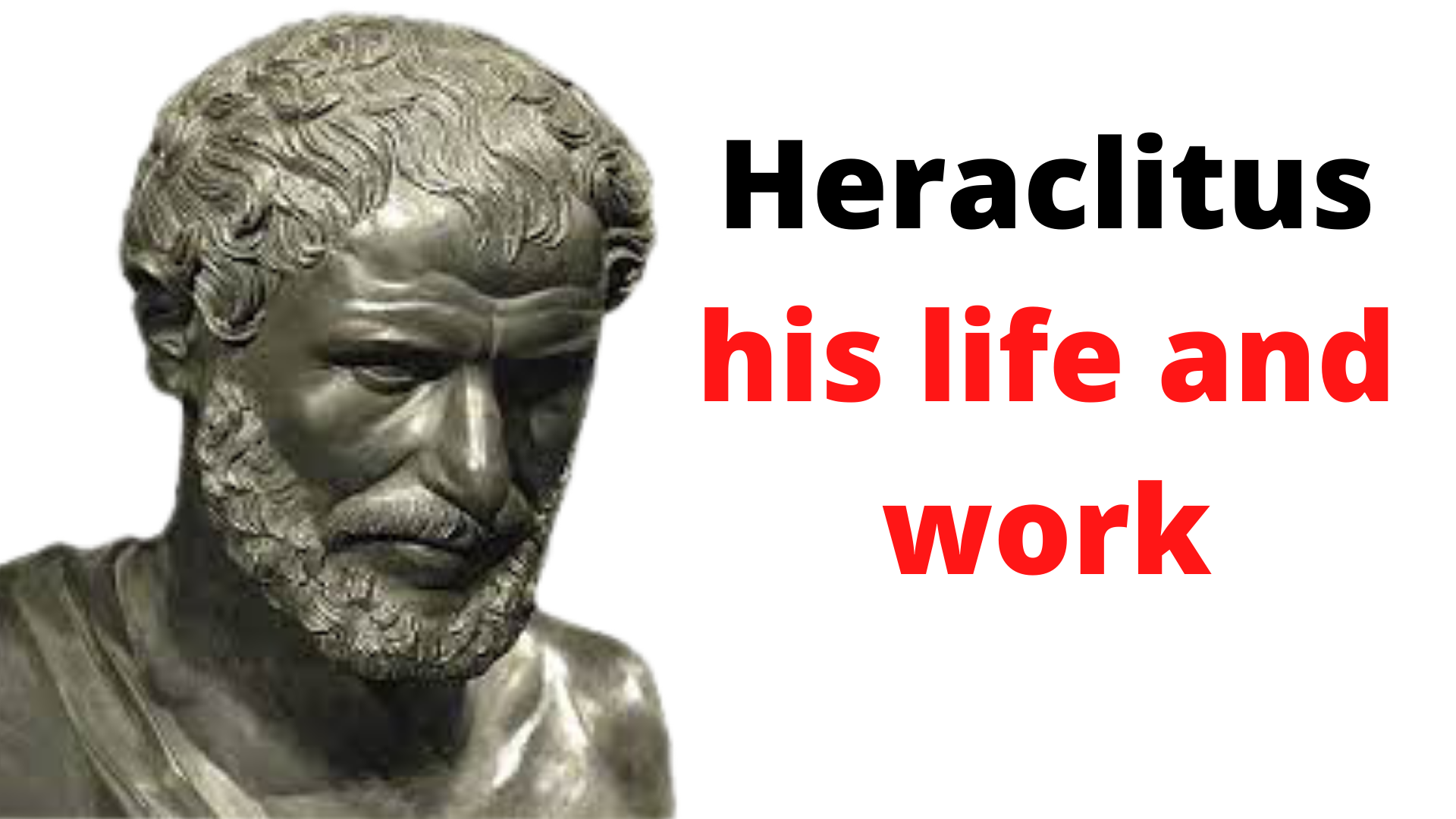
HERACLITUS and the ideas of his time
**Hello friends of read.cash**
I want to dedicate a series of articles to the philosopher who has most caught my attention in the history of thought, and as you have already seen in the title, I am talking about Heraclitus of Ephesus. I intend to tell you about him in three parts, today I want to tell you about what preceded Heraclitus, and to answer the question why Heraclitus thought as he thought. So I will name this first part:
"HERACLITUS AND THE IDEAS OF HIS TIME"
The purpose of this section is to offer a reflection on the three philosophers prior to Heraclitus, who proposed that what determines the physis, that is, the order of the cosmos, are "natural" elements in order to highlight mythical thought and its difference with rational thought. This allows to give context and importance to the contribution of Heraclitus.
**Mythical Thought**
To give context to Heraclitus' thought it is necessary to comment on the world in which he was immersed. It must be pointed out that Heraclitus' thought is a thought directed by the logos, that is to say, a rational thought that departs from the other type of thought called, mythical thought. A myth (μῦθος) is defined as "A marvelous narrative situated outside of historical time and starring characters of divine or heroic character. It often interprets the origin of the world or the great events of humanity. "1 From this definition of myth we could say that it is a style of thought that is not entirely unreal, because although it uses fictitious characters and environments, it does so with the intention of representing reality. At the beginning of Greek philosophy, myth was an important element to recreate the origin of the world and great events in the Hellenic world. Now, this first type of thought is modified with the arrival of the first philosophers, called physical thinkers because they saw in the world of nature the origin of the real and existing. Among these philosophers also called pre-Socratics are: Thales, Anaximander, and Anaximenes, who sought to answer the origin of the cosmos.
By way of summary, the following table allows us to compare the contrast between the mythical vision and the rational vision of ancient thought, which are comparable to each other. The picture of the mythical vision expresses that the man who wonders about the most essential thing, in this case the origin of the cosmos, does not know the answer to such question, that is why he elaborates symbolic representations that become present in images or allegories, seeking to give an answer to what he does not know. While the picture of rational vision illustrates that man seeks to answer the same questions, but in a more elaborate way, that is, through a concept of the real. He tries to give an explanatory order by means of the logos, reason, to explain the ordering of nature.
**Philosophers before Heraclitus**
Before the emergence of Heraclitus in Ephesus, three thinkers emerged on the Ionian coast (what is now Turkey) in the 6th century BC: Thales of Miletus, Anaximander, and Anaximenes. These thinkers integrate the well-known school of Miletus, who was concerned with the problem of the origin of reality and the surrounding world. Each one was surpassing his master in the elaboration of a theory that explained the idea of physis (Φυσις). Physis was defined as:
*"A single, eternal, infinite and active reality which is at once matter, life and spirit, from which all things arise and to which all things return all things, of which all things are made and thanks to which all things become what they are is the crux of the worldview. "2*
Of Thales of Miletus we do not know much about his life, it is said that he may have been born around VII B.C. and later died in the middle of VI B.C. and that he made trips to Egypt. Other than this there is not much that, with certainty, we can say about him, the rest are just anecdotes that we do not know how real or not they may be. Thales considered that the first principle of the cosmos is water, a thought in accordance with the ancient man who did not make discoveries but dedicated himself to contemplate. For him water was the first principle; he observed in water the characteristics of physis, as the constitutive principle of all that was, is, and will always be. He attributed to water infinity and eternity. Thales was also remembered by the Western world for his two theorems. Although, undoubtedly, the aspect that interests us now is the philosophical one.
Thales of Miletus specified water as the first principle since the Homeric tradition expresses: "All beings arise from Ocean and Thetis "3. There is an undoubted influence of Homeric thought in the philosophy of Thales, both thoughts are not excluded. It must be kept in mind that this rational thought, which is made in the Ionian region, will move further and further away from the myth, in its search for the *Arché.4*
Thales had a disciple, Anaximander of Miletus, born around 610 B.C. He is known to have written a book entitled On Nature.5 This thinker considered that Thales' water cannot be the first principle, since he saw that physis cannot be the origin and cause of all entities since these are determined by opposites. He considered rather that physis must necessarily lack contraries. Therefore, for him the indeterminate (to apeiron) was the principle of motion and life. This ordering principle (to apeiron) being indeterminate lacks limits. *"...it embraces everything and governs everything "6.*
Anaximander considered that from this principle, by the difference between opposites: cold-hot, light-heavy, dry-wet, is where things emerge. What Anaximander agrees with his teacher Thales is that "everything is full of gods" since both consider that everything is present in the first principle. We have some news about this thinker, who died in 528 B.C., thanks to Aristotle, who states that; "This (the indeterminate) seems to be the principle of the other beings "which embraces everything and governs everything"... and also a divine being, since it is "immortal and indestructible", as Anaximander and most of the naturalists say "7.
Another thinker of the school of Miletus is Anaximenes. He was born in the year 585 and died in 528 B.C. approximately, considered the last representative of this school of Miletus. For this thinker, the principle is the air (aér) understood as mist or vapor or a perceptible air as it moved or felt hot or cold. In this principle, Anaximenes manages to find all the characteristics of the idea of "apeiron" proposed by Anaximander as well as in water as a natural element proposed by Thales. Also of Anaximenes we have a reference in the writings of Aristotle:
"Anaximenes says that the earth cracks when it becomes wet and dries up, and that it trembles on account of these cracked heaps falling on it. That is why tremors occur in droughts and in torrential rains. For in droughts, as has been said, it cracks when it dries out, but when it gets too wet by the waters, it falls to pieces "8.
**The problem of the Physis**
In order to address the problem of physis, we must begin by pointing out the context in which this notion arises. In ancient Greece, the beliefs and certainties of that civilization were based on Myth. In one of the polis that comprised the great Helade, called Miletus, a series of characters emerged who discovered another way of contemplating the world through the logos.9 Broadly speaking, we could appreciate an attempt to move from myth to reason. These Milesian philosophers were characterized because their thought was the determination of physis.
At that time, physis was erroneously considered to be only "nature". No. What they understood by physis is much more beautiful and complex: in the first place, we can say that it was the primary of everything that exists, that is, a kind of soul of everything since it moves everything, and also that it shapes everything. But the soul should not be understood as that which is distant from the material; because for mythical thought there is no distinction as we perceive it today, between the material and the non-material 10; there is no duality. In a second place, we can say that physis is the primary of all that exists in the "Cosmos". Consequently, it is prior to and subsists in, it.11
These first philosophers, called the philosophers of nature or physical philosophers, dedicated themselves to explain, as far as possible, the Arché, that is, the first principle or, as we have called it before, "the physis". The first author we have a record of is Thales of Miletus, who states that the first principle of the Cosmos is water, or we could say the humid. We think that he said this because of the influence of the environment and the tradition where he had developed. Since he lived on the coast, and the Homeric tradition alludes that the Ocean and Thetis, were the progenitors of all things. Consequently, Thales would make the following statement: "everything is full of gods". He considered that the characteristics that can be attributed to physis, i.e., infinity and eternity, are attributed to water, according to Thales.
The next philosopher on whom we will stop to appreciate what he understood as first principle is Anaximander of Miletus. Anaximander, like Thales, sees in the thought of his teacher a kind of weakness; for he thinks that "water" could not be the first principle because things, insofar as they are determined, have opposites and physis cannot have opposites. Therefore, the Arché of the Cosmos is the apeiron, since everything insofar as it exists is determined apeiron, everything comes from the Apeiron and returns to the Apeiron. Consequently, therefore, the "non-appeiron" cannot exist.
But to understand more accurately the physis according to this thinker, it is necessary to ask: What is the apeiron? For Anaximander, this first principle, called "to Apeiron", the indeterminate, that which lacks limits, does not resemble anything we know in the cosmos. Moreover, as the first substance of the whole cosmos, it indicates that it is prior to it. For the mythical thought of ancient Greece, time, unlike how it is now conceived, is like a straight line, Anaximander conceives time in a cyclical way and consequently attributes it to the Apeiron. So the Apeiron becomes of a certain divinity. And being divine, it is also eternal; and in its eternity and indeterminacy, it allows that at some point it determines all that exists, that is, the cosmos. Consequently, for Anaximander, the whole universe is eternal insofar as its first nature.
If everything comes from the apeiron, which is determined, it necessarily returns to its first state, which is indeterminacy, i.e. it returns to the apeiron. We have already said that time is cyclical and therefore the movement of the Apeiron is also cyclical, that is to say, that what we call being born, is only to limit oneself; and what we call dying, is only to lose the limit. It could be said that there is neither birth nor death since everything is a cyclical movement. What exists is determination and when it ceases to exist it goes nowhere else but to the Apeiron, from which it has never left. This relation of opposites in Heraclitus is one of war, in Anaximander it is revenge. This is understood from the cyclic movement. We will explain it from the birth or death that we have already mentioned. When I am born, life predominates, but death will take revenge and the moment will come when I die, or in other words, we could speak of determination and indetermination. To synthesize, with the words of Anaximander, in one of his fragments he affirms: "The principle of beings is indefinite...and the things that appear in the same thing that gave them being, according to necessity. And it is that they give each other just retribution for their injustice, according to the disposition of time "13.
Now, everything in the universe, or cosmos, i.e. everything real, has a limit within the indeterminate. Everything is one, this is the physis, the Apeiron for Anaximander. From the physis everything arises and is the cause of everything, it governs everything, it moves in itself and does not need another to be what it is, because it is the first substance of everything that existed, exists, and will exist. Its motion, like its time, is cyclical and the beginning and the end are but one and the same point within the circumference.
The third philosopher we will mention for the understanding of physis is Anaximenes of Miletus, follower of Anaximander. He postulates as first principle something that his teacher would call determinate. For Anaximenes the Arché lacks determination both in space and time: the "Air". For more terminological precision, what this philosopher refers to when speaking of physis is not the air as we now know it, but what he refers to is the "aér", i.e. it can be known as mist or vapor, insofar as it is perceptible in its movement or feels cold or hot. Anaximenes takes a great step in the thought and conception of the Arché, since he finds in the air all the qualities or characteristics of the apeiron.
The "aér", insofar as it is indefinite and therefore has no limits, governs everything, since it extends throughout the cosmos and it is he who gives movement to this world. How does he give movement to the cosmos? To answer this question, Anaximenes says that the changes that occur are the product of rarefaction and condensation. It is here that Anaximenes displaces Anaximander's opposites (hot/cold; dry/wet) by other very different opposites such as lax/dense.
The latter is equivalent to saying that the lax is hot and the dense is cold. All this refers to the fact that the "aér", as the first principle or original matter, can move and change at will.
By way of conclusion, we can affirm that the analysis of mythical thought based on the three philosophers mentioned above, allows us to understand how myth gives way to the rational. The philosopher Heraclitus plays a determining role in this transition.
REFERENCES
*1. Dictionary of the Royal Spanish Academy*
*2 Mythology and philosophy: the pre-Socratics. Ángel Cappeletti. Editorial Cincel. P. 59*
*3 Iliad, VIX, 201*
*4 First Principle*
*5 Peri physeos*
*6 From Thales to Democritus. Pre-Socratic fragments. Fragment 6. P. 54*
*7 Aristotle, Physics 203b10 (A 15)*
*8 Aristotle, Meteorology 365b6 (A 21)*
*9 Thales, Anaximander and Anaximenes.*
*10 Platonic Dualism: Body and Soul.*
*11 The Universe (Cosmos)*
*12 The indefinite, indeterminate.*
*13 Fragment 1. From Thales to Democritus. Pre-Socratic fragments.*
**THANK YOU FOR READING**

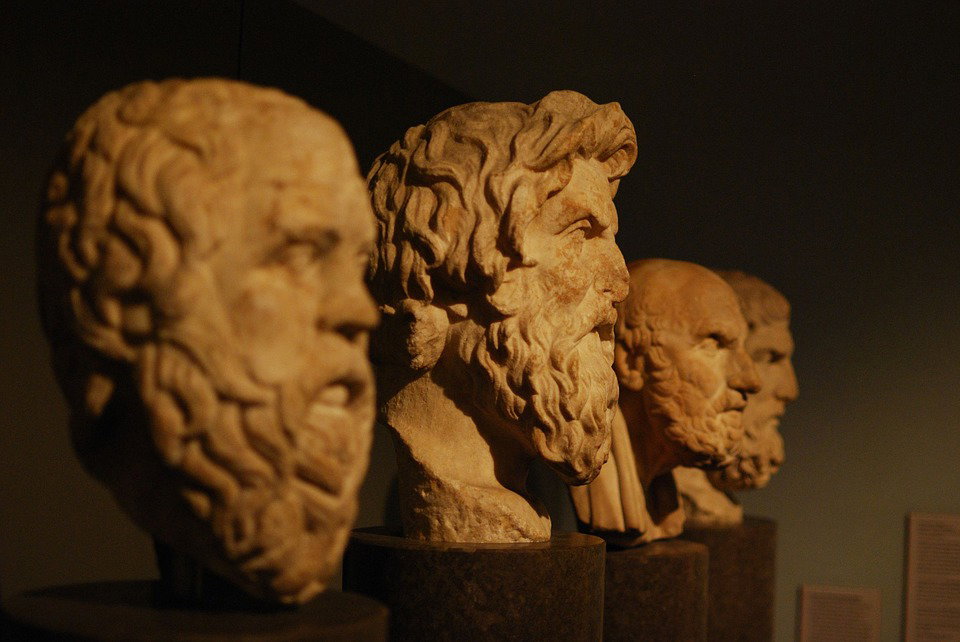
Arriving at Read.Cash I am César
**Greetings to all Read.cash friends**
This is my first post on this platform, it would be boring to write an introduction in the usual way, just saying who I am, and what I do with my life. It would be not only boring, but it would also be soulless, and that's not the idea.
Before I talk about me, I want to tell you why I came to Read.cash.
It's not the first time I've tried to start a personal blog, but in the past on other platforms, my content is not appreciated or read the way I think it should be read. Maybe that's one of my constant mistakes, setting my expectations too high, a mistake I don't intend to make this time. I asked myself: What's wrong with my content, is it bad, is it uninteresting, but I received good comments from a few people and that calmed my anxiety a bit, I knew it couldn't be all bad. I tried to start my digital literary venture on various digital platforms but without much results. It would not be fair to speak ill of those platforms because there is nothing wrong with them, what I noticed is that my content does not go at all with its users, and not because of its content but because of its form. I said to myself the same words that Zarathustra said to himself in Nietzsche's "Thus Spake Zarathustra":
**"These lips are not for these ears."**
Actually I have not done too badly on some platforms, but, actually because I have devoted my attention to create other content, fortunately I have discovered new talents and personal approaches. But actually what I want to say, what I want to write is still kept in my spirit. After this little preamble, I will tell you a little about myself.
I am César Andrés Díaz Piña, I was born in the city of Barquisimeto, capital of the State of Lara, geographically located in the center-west of Venezuela.
Between tears and worry, I saw the light of this world for the first time on June 19, 1993, that is, I will soon be 28 years old. Due to health problems, my mother could not make it through the 9 months of gestation, so she had me when I was only 6 months old, then I spent almost a month in the central hospital of the city of Barquisimeto, but fortunately, we both survived such a difficult delivery.
I grew up like any other child, when I was 5 years old my brother came into the world who I can say is my best friend, and our childhood was like any other Venezuelan child of the '90s of the middle class. I have never had luxuries, but I have never lacked anything, I lived with my parents until I was 17 years old, at that stage of my life I left home to enter a seminary, I wanted to be a priest, which thinking about it was a somewhat strange decision because my family was never very devout, although I can not say that my mother and my grandmothers taught me the things of faith.
That religious life that occupied almost 5 years of my life was very broad in learning, not only in a spiritual sense but also in a human, historical and personal sense. But, at the age of 21, after 4 and a half years in the religious community, I decided to take another path. In my heart of hearts, I did not like to feel alone concerning love and I longed for a family, so I left the community. Incredibly grateful to the priests who were my teachers and my guides, to the professors and to my companions. There in the seminary I met one of my best friends, I also met my best friend thanks to the catholic church and I must confess that I also experienced love, I fell in love although I never had a relationship as such, consequently I also experienced what it is to fall out of love. In addition, I discovered my ability with poetry, something that I value very much.
Years of unspeakable emotional intensity I must say, I also met in that time one of my greatest passions: "Philosophy" when I retired from the seminary, I began to study a degree in philosophy, 6 years have passed since I started college and I still can not finish my degree, not because of laziness or bad student, but because I study in a private university, and in Venezuela, university tuition has increased its value, and that coupled with the continued devaluation of the currency has made it very difficult to finish my degree, but I will not give up. I know I will get my degree.
And it is precisely about the philosophy that I want to write here on read.cash, since as I mentioned before, on other platforms my essay-like writing does not attract many readers. So now, I will start here to expose my ideas and thoughts respecting my style and my way of writing, being faithful to my essence.
At this moment in my life, I make a living online and doing deliveries by bicycle within my city, due to the pandemic I lost my old way of making a living so I have had to experience other directions. Now, I want to tell you about one of the happiest moments of my life, at the end of 2019, a few months before the pandemic, I married my then-girlfriend (excuse my obviousness), and I started a new stage in my life, now with a family as I told you a few lines ago, it was one of my dreams, well it has come true. My wife is the most beautiful woman in the world, we have plans together, projects and ventures together, and that and more I will share with you here. But what will you find in my blog?
**What will you find in my blog?**
I already answered this question halfway, I mainly want to write about philosophy in its wide range of dimensions, topics, and problems, also about my ideas and reflections, and from time to time some personal stuff, but very occasionally. I wish and intend to a blog more academic than anything else, to be able to express myself with my essay style. I also wish to share with you some research I have done and have never shown or shared.
As I am just getting there if you would like to leave me any suggestions I would appreciate it very much.
**Thanks for reading and giving me some of your valuable attention.**
____________________________________
Versión en Español
**Saludos a todos amigos de Read.cash**
Esta es mi primera publicación en esta plataforma, sería aburrido escribir una presentación del modo habitual,
solo diciendo quien soy, y que hago con mi vida. Sería ademas de aburrido, sería algo sin alma, y no es la idea.
Antes de hablares de mí, quiero mencionarles el por qué llegué a Read.cash.
No es la primera vez que intento comenzar a llevar un blog personal, pero en pasadas oportunidades en otras plataformas mi contenido no es apreciado o leído como pienso que debe ser leído. Quizá ese es uno de mis herrores constantes, el de plantarme espectativas muy altas, error que no pienso cometer en esta oportunidad. Me llegué a preguntar ¿Qué tiene mi contenido? ¿Es malo? ¿Poco interesante? pero recibia buenos comentarios de algunos pocos y eso calmaba un poco mi ansiedad, sabía que no podía estar todo mal. Intente comenzar mi empresa literaria digital en variadas plataformas digitales pero sin muchos resultados. No sería justo hablar mal de esas plataformas porque no tienen nada de malo, lo que noté es que mi contenido no va del todo con sus usuarios, y no por su contenido sino por su forma. Me dije a mi mismo las mismas palabras que Zaratustra se dijo a sí mismo en la obra de Nietzsche "Así habló Zaratustra":
**"Estos labios no son para estos oidos"**
En realidad me ha ido tan mal en algunas plataformas, pero, en realidad porque he dedicado mi atención a crear otro contenido, afortunadamente he decubierto nuevos talentos y enfoques personales. Pero en realidad lo que deseo decir, lo que deseo escribir sigue guardado en mi espíritu. Después de este pequeño preambulo, les hablaré un poco de mí.
Soy César Andrés Díaz Piña, nací en la ciudad de Barquisimeto, capital del Estado Lara, geográficamente ubicada al centro-occidente de Venezueala.
Entre llanto y preocupación, ví por primera vez la luz de este mundo un 19 de Junio de 1993, es decir, pronto cumpliré 28 años de edad. Por problemas de salud, mi madre no pudo con los 9 meses de gestación así que me tuvo cuando apenas tenía 6 meses, luego pasé casí un mes en el hospital central de la ciudad de Barquisimeto, pero afortunadamente ambos sobrevivimos a tan aparatoso parto.
Crecí como cualquier otro niño, a los 5 años vino al mundo mi hermano quien puedo decir es mi mejor amigo, y nuestra niñez fue como cualquier niño venezolano de los años 90 de clase media. Nunca he tenido lujos, pero jamás me ha faltado nada, viví con mis padrés hasta los 17 años de edad, en esa etapa de mi vida me fuí de casa para ingresar a un seminario, deseaba ser sacerdote, cosa que pensandola bien fue una descición un tanto rara ya que mi familia jamás fue una familia muy devota que se diga, aunque no puedo decir que mi madre y mis abuelas me enseñaron las cosas de la fe.
Esa vida religiosa que ocupó casí 5 años de mi vida fue muy amplia en aprendizajes, no solo en sentido espiritual, sino en sentido humano, histórico y personal. Pero, a la edad de 21 años, después de 4 años y medio dentro de la comunidad religiosa, decidí emprender otro camino. En el fondo de mi corazón, no me gustaba sentirme solo con respecto al amor y anhelaba una familia, me marché de la comunidad. Increiblemente agradecido con los sacerdotes que fueron mis maestros y mis guías, con los profesores y con mis compañeros. Allí en el seminario conocí a uno de mis mejores amigos, también conocí gracias a la iglesia católica a mi mejor amiga y también debo confesar que experimente el amor, me enamoré aunque jamás se llego a dar una relación como tal, en consecuencia también experimente lo que es el desamor. Además, descubrí mi habilidad con la poesía, cosa que valoro mucho.
Años de una indecible intensidad emocional debo decir, también conocí en ese tiempo a una de mis más grandes pasiones: "La filosofía" al retirarme del seminario, comence a estudiar licenciatura en filosofía, han pasado 6 años desde que comencé la universidad y aun no consigo terminar la licenciatura, no por flojera o mal estudiante, sino porque estudio en una universidad privada, y en venezuela las matriculas universitarias han incrementado su valor, y eso unido a la continua devaluación de la moneda se ha hecho muy cuesta arriba terminar mi licienciatura, pero no me rendiré. Sé que conseguiré mi titulo.
Y es de la filosofía lo que precisamente quiero escribir acá en read.cash, ya que como les mencioné antes, en otras plataformas mi escritura tipo ensayo no atrae a muchos lectores. De modo que ahora, comenzaré por aquí a exponer mis ideas y pensamientos respetando mi estilo y mi forma de escribir, siendo fiel a mi esencia.
En este momento de mi vida, me gano la vida por internet, y haciendo deliveries en bicicleta dentro de mi ciudad, debido a la pandemía perdí mi antiguo modo de ganarme la vida así que me ha tocado experimentar otros rumbos. Ahora bien, deseo contarles sobre uno de los momentos más felices de mi vida, a finales del 2019, unos meses antes de la pandemía, me casé con quien en ese entonces era mi novia (disculpa mi obviedad), y comencé una nueva etapa en mi vida, ahora con familia como les cometé alguna lineas atrás, era uno de mis sueños, pues ya se ha hecho realidad. Mi esposa es la mujer mas hermosa del mundo, tenemos planes juntos, proyectos y emprendimientos juntos, y de eso y más les compartiré por acá. Pero,
**¿Qué encontrarás en mi blog?**
Ya esta pregunta la respondí a medias, principalmente deseo escribir sobre filosofía en su ampla gama de dimensiones, temas y problemas, también sobre mis ideas y reflexiones personales y de vez en cuanto algun tema de indole personal, pero de manera muy ocasional. Deseo y prentendo un blog más académico que otra cosa, poder expresarme con mi estilo tipo ensayo. También deseo compartir con ustedes algunas investigaciones que he realizado y que jamás las he mostrado o compartido.
Como apenas estoy llegando, si deseas dejarme alguna sugerencia lo agradecería mucho.
Gracias por leer y darme un poco de tu valiosa atención.
 @cesarandresdp