A rich refreshing drink that looks like blood!!! Get to know it and say goodbye to some disorders.
*Hello friends!!! My love to you. Do you know the plant called Sangria, Sangrinaria or Chinchamochina? Do you know what it is used for? Well if the answer is no, this is the opportunity to know a little about it.*
I begin by telling you that this is a valuable shrub type plant of tropical climate and perennial, that is to say, its permanence in the environment is all year round. Depending on the region or country it receives other names. Here in Venezuela we know it as Sangrinaria or Chinchamochina. It is found mostly in the states of Monagas, Sucre and Anzoátegui. It should be noted that there are other similar varieties that do not belong to the family of this shrub.
The Chinchamochina is a wild plant of an intense green color with brightness, of smooth texture and its grouped flowers are small and pink. It is characterized by inhabiting partially sunny places and its branches are distributed in the form of bushes. For its growth it requires a little humidity in its habitat and it is not demanding in the acceptance of the soil. This wonderful plant offers our organism important benefits for our health. Having a Chinchamochina plant in our garden or patio is important because, in addition to being medicinal, it is ornamental, if kept pruned.
It belongs to the Acanthaceae family and its scientific name is Justicia Secunda Vahl. The proliferation of this shrub is somewhat invasive. It has a wide variety of chemical content that gives it a high potential for medicinal use, such as ash, moisture, alkaloids, coumarins, phenolic glycosides, tannins, triterpenes and steroids. Also, essential oils, vitamins, fatty acids and salicylic acid.
The use is mainly medicinal due to its excellent healing properties. It has anti-inflammatory, antiseptic, antipyretic, antioxidant, healing, anesthetic, antimycotic, expectorant, antibiotic properties, but it is more recommended as a depurative and restorative of the blood since it stimulates the increase of hemoglobin, preventing diseases such as anemia. It is also an excellent diuretic. It is popularly recognized for its benefits in the treatment of lechina, measles or rubella.
***The benefits of Chinchamochina or sangrinaria, as it is commonly known, are diverse, although few toxicological and pharmacological studies have been carried out. The benefits obtained from this prodigious plant are extraordinary, since it provides relief alternatives to different health conditions, among which we can mention:***
-Improves digestion and eliminates intestinal parasites.
-The antibiotic presence helps the disposition of acetylsalicylic acid.
-Because of its diuretic properties it favors the proper functioning of the urinary tract and liver.
-It fights migraine and is a good sedative.
-It cures bronchial affections such as asthma, bronchitis and throat problems.
-Relieves menstrual cramps.
-Stops dental plaque.
-It eliminates toxins from the blood and benefits the increase of hemoglobin.
-It contributes to the hydration of the body and to the recovery after having fever.
-Soothes itching caused by insects.
I always knew about the topical use in baths to cure lechina but recently I tried it as a refreshing drink. This shrub can be consumed in tea or infusions. It is also made into a paste for use as a poultice on skin lesions such as warts.
Well, I do not invade you with more information; now I tell you how to use it.
-In the preparation of baths there are two ways to make the concentration: You take a good part of branches and break their leaves and stems to put in the sun with water, until it turns red. The other way is by boiling the branches; the same for both ways you have to strain.
- For infusions: You can use the leaves and flowers separately or together; place a small amount in a cup of hot water, sweeten and consume. You can also boil for approximately 10 minutes. Take two or three times a day for two weeks to raise hemoglobin and for anemia, fasting for 15 days. It is also used as a depurative. The infusion prepared with three or four large leaves in a liter of water is used to treat kidney ailments, drinking a glass twice a day until you feel improvement.
Now, here is the promised drink (finally).
*To prepare this drink boil 10 leaves, if they are small, for 10 minutes. Let it cool, strain it and add the juice of a lemon, sugar to taste and drink it cold. It couldn't be easier! Seriously, it is a drink you can not miss, it is very refreshing and tasty.*
*Tell me if the Chinchamochina or Sangrinaria is a plant with many blessings. Personally I am in love with this drink, I recommend it, it is preferable to a glass of soda.*
**It is not recommended for pregnant or lactating women but they can take baths. Keep in mind that any excessive use is risky. However, it is best to consult a doctor to avoid any toxic process although, according to, it has low levels of toxicity.**.
References for reading:
**Translated with www.DeepL.com/Translator (free version)**
**Cartoon is from Bitmoji**
https://www.recetavenezolana.com/chinchamochina/
https://primicia.com.ve/especiales/yerberito/dile-adios-al-estrenimiento-y-los-calculos-renales-con-la-chinchamochina/
https://www.ecured.cu/Chinchamochina
https://movidatuy.com/propiedades-beneficios-y-usos-medicinales-de-la-chincha-mochina/
https://es.scribd.com/document/477347216/Beneficios-de-la-Sangria-planta-medicinal-que-ayuda-a-subir-los-niveles-de-hemoglobina
https://cosasdejardineria.info/sangria-beneficios-para-la-saludla-piel-infusion/
http://scielo.sld.cu/scielo.php?script=sci_arttext&pid=S1028-47962017000100016
https://pesquisa.bvsalud.org/portal/resource/pt/biblio-1042942
Halloween candy box
Hello friends, Halloween is coming! Here in Venezuela we do not celebrate this holiday but we commemorate the Day of the Dead and All Saints Day. On the Day of the Dead we go to the cemetery to light candles, pray for the souls of the deceased and place flowers.
On November 2nd we commemorate the Day of the Dead or Fieles Difuntos as it is also called. This celebration is done with the purpose of honoring our loved ones who have departed from the earthly plane. So, visits are made to the cemetery to clean the graves, light candles, decorate with flowers and offer prayers for the repose of the souls.
I am on other platforms and they are already doing contests alluding to the theme of Halloween; for that reason I wanted to bring for those who celebrate this date, a decorative and functional craft. This is the main purpose of this publication, to show how to make a decorative object for Halloween with waste material.
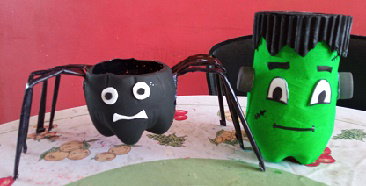
Decorative object for Halloween: Frankenstein
Materials used: a plastic bottle, two bottle caps, permanent marker, green paint, black paint, hot and cold silicone, scissors, cardboard, paintbrush and sponge.
**Step 1:** Cut out a strip of cardboard and a circle from which we remove the first layer to use the part with channels. Glue with hot silicone to form a lid for the container.
**Step 2:** Paint the cardboard lid with hot silicone.Paint the cardboard lid black, which is the hair of the doll and the two bottle caps we paint them gray. While it dries we continue with the next step.
**Step 3:** Trim the bottle to where we want it to be.Cut the bottle up to where we want to see the container. Apply a coat of green paint that serves as a base for the neon green tone. Apply the neon paint to the bottle.
**Step 4:** Once the paint is dry, make the eyes.Once the paint is dry, make the eyes with foami and glue them to the bottle with cold silicone. Then paint the eyebrows and other details and the Frankenstein is ready to be filled with candy.
Apart from the Frankenstein, I made a spider but for another platform it was amazing, it was almost the same procedure but for the legs I used construction wire so it could hold weight. Below I leave the link so you can see the elaboration of that project, if you are interested.
I was saying that here in Venezuela, we don't celebrate Halloween but with the transculturation, some people make thematic parties about that day. This popular tradition varies from country to country.
"The origin of the holiday dates back to the year 980 when the abbot of the Monastery of Cluny, called Saint Odilon or Odilo suggested the idea of the creation of a day in which to honor the dead. His idea was well accepted by other congregations being the first of them to accept it the Diocese of Liege in the year 1000, until it was accepted as the date on which the Church celebrates it." `"https://www.ecured.cu/D%C3%ADa_de_los_fieles_difuntos`
Before the conquest, our indigenous people celebrated the Day of the Dead, but with the arrival of the Spaniards, both cultures were syncretized, adding elements of one and the other. However, in each region or country this custom varies.
In Mexico, for example, in some places, they worship the dead by placing altars with objects of loved ones who departed to the spiritual plane, food, drinks, flowers, skulls and other offerings. It is said that the dead come to visit the world of the living.
"The "Mexican fiesta" was declared Intangible Cultural Heritage of Humanity by the United Nations Educational, Scientific and Cultural Organization (Unesco), considering it as "one of the most relevant representations of the living heritage of Mexico and the world, and as one of the oldest and strongest cultural expressions among the country's indigenous groups." `http://www.correodelorinoco.gob.ve/venezuela-conmemora-dia-fieles-difuntos/`
I remember that in my family, they would go to the cemetery to bring flowers but the wake was at home. With time, this tradition has lost a little bit of custom due to the insecurity that reigns in the cemeteries; also because the generational interests have changed. In addition to this, the country's crisis, since moving from one state to another is costly and problematic due to the scarcity of gasoline for transportation; it usually happens when the deceased have been buried in another city. But in spite of everything, there are still many faithful to this tradition.
Currently, it is common to see plays or television programs related to the occasion of the celebration of the dead that take place in Mexico and with the theme of Halloween, the latter known as "Witch Night"; it is the one that is having more influence in our culture.
`Translated with www.DeepL.com/Translator (free version)`
Hive: https://peakd.com/hive-130560/@antoniarhuiz/una-arana-gigante-ay-que-horror---desafio-de-reciclaje-15
`I took the photos with a Redmi 9 phone and edited them in Power Point.`
Wild fruits that you may not know
Memories of my childhood bloom every day in my mind. Longings that come from yesterday, to dedicate this publication to all the friends who visit this blog. Today I want to talk to you about the wild fruits that evoke walks through my past; as a child I knew and tasted many of those fruits that we find in the bush, such as the guamache, the maya, the corozo and others that I knew today and not exactly in the bush or in the countryside, such as the neem, the foreign uvero or pesgua.
When I was just a little girl, the oldest of my cousins lived at my paternal grandmother's house, and he loved to go to the bush to look for maya and corozo. We would take the almonds out of the corozo and with the maya my aunt would make mazamorra. This was at my father's mother's house.
On the other hand, my maternal grandmother lived in the countryside; she had a conuco in the bush and along the way there were several wild fruits that were totally unknown to me. On that road I ate semeruco, guamache, pichigüey, and other fruits.
Well, I will mention several of these wild fruits that, it is possible that in other places, have a different name and for that reason I have not found much information about it, nor many photos. However, the intention is to offer you some content that I keep in my mind to share with you. Some of these fruits are hardly available today; in this case I had to resort to the web.
Paují (Mouriri pseudo - geminata)
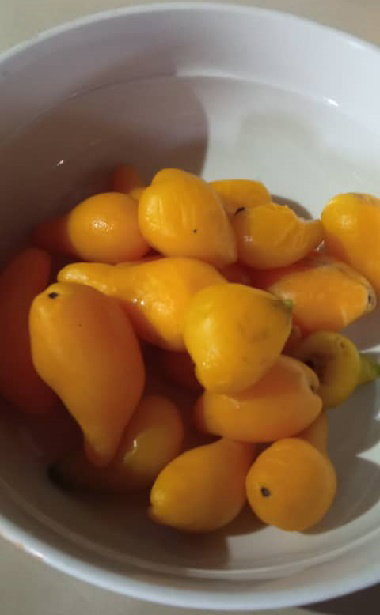
I recently found this fruit in Margarita, Nueva Esparta Venezuela. It is a leafy and wild tree. I could not find the species to which it belongs but I am almost sure that by its appearance, flavor and shape it is related to the jobito (spondia mombin). Although the flavor is a little different, it has a sweet semi-acidic flavor, a little cloying that I did not like very much. The fruit is yellow, quite similar to the jobito, but the seed is pear-shaped and hard.
Pesgua or extrajera grape (Syzygium cumini)
The foreign pesgua is native to India but is also cultivated in Venezuela. Its fruits are purple in color, acidic in taste, and somewhat astringent. It is called grape for its organization in small segments and for its purple color, although when they are not ripe they go through a process of green and red coloring until the color that characterizes it. These grapes are used to make juices and wine.
Corozo (Acrocomia aculeata (Arecaceae)
The corozo is a fruit like a miniature coconut that to extract the almond, I remember that we used to hit the fruit with a blunt object. My cousin always brought a big bunch whenever he went up the mountain. The corzo palm is thorny; so I have no idea how my cousin used to get the bunches down.
Reading about this fruit I found that there are several edible species and that one of these families is used to prepare the liquor called Ron de Píritu which is made by macerating the fruit in liquor; I remembered that an uncle used to prepare this drink, which you had to be careful of because it produced a good rasca. The fruit for this drink is small and red in color.
Pichigüey (Melocactus curvispinus)
The fruit of this prickly cactus is very intense fuchsia or pink in color with abundant black seeds. It is a little slimy or sticky in texture but has a pleasant flavor. The cactus is round, not tall and before flowering, it forms a small bed of white fluff for the flowers and later for the fruits. It is also called melon de cerro. I used to eat these fruits when I went with my grandmother to her conuco; she used the tip of her machete to pick them.
GUAMACHE (Pereskia guamacho)
It is a tree-like cactus. Until now I know that it is not a tree because I remember it as a medium sized tree, my grandmother would reach for the fruits and if they were too high she would pull them down with a stick. The fruit is small and round with leaves around it, green and yellow in color, and with small seeds.
CAJUA (Sicana Odorifera)
I have never seen this plant but I did get to taste the fruit but it is a long time ago. It is a large and elongated fruit of red color and a very peculiar sweet flavor. It can be eaten naturally and sweet. It is said that the plant is a vine but it can climb very high; it is also known by the name of calabaza de olor.
TIGUI TIGUI (passiflora foetida)
The tigüi tigüi fruit is also known as maracuyá silvestre or parcha silvestre, it is a kind of climbing vine with edible fruit that owes its name to its resemblance to the parchita. This small fruit, I know it from my childhood, is round, covered by a kind of vegetable mesh; it is yellow and very fragile, with a sweet flavor and black seeds similar to passion fruit.
MAYA (bromelia chrysantha)
This species is native to Venezuela, pineapple family. The maya is a tropical, wild plant that requires little care for its development and the fruit is used in the elaboration of sweets, mazamorras and infusions. Its pulp is juicy and sweet and sour and has many seeds. When eating it, be careful because it peels the lips, my aunt said it was because of the shell. It has an intense yellow color, with orange tones. It is very tasty.
Mandarina lemon (Citrus mellerii)
I got to know this fruit recently, just this year (2021), I was given several as lemons. It has a tangerine flavor, the least it tastes is lemon. The juice is very refreshing. It is a small, juicy fruit. It seems to be a hybrid between lemon and tangerine.
***So far this information that I hope is important for everyone and allows you to know a little of our wild fruits of which we do not have much knowledge. If you know them, what name do they receive in your locality?***
**References of the images**
`The photos of the fruits of paují, pesgua and mandarin lemon are my own, taken with a telephone Redmi 9.`
`https://hablemosdeflores.com/corozo/`
`https://www.venezuelatuya.com/fotos/unafoto.htm?foto=/902/img/8941369737.JPG&titulo=melon%20espinoso`
`http://santamartaysuflora.blogspot.com/p/guamacho-pereskia.html`
`http://guamachito1.blogspot.com/2014/10/un-poco-de-historia.html`
`https://www.flickr.com/photos/andrebenedito/with/2332347242/`
`https://hablemosdeflores.com/passiflora-foetida/`
`http://southeastgarden.com/bromelia.html`
**References consulted**
`https://es.wikipedia.org/wiki/Citrus_%C3%97_limonia`
`https://www.argentinat.org/taxa/244459-Acrocomia-aculeata`
`http://profpedrorios.blogspot.com/2016/10/cultivos-de-venezuela.html`
`https://edukavital.blogspot.com/2020/10/frutas-cultivadas-en-los-paises-del.html`
`https://commons.wikimedia.org/wiki/File:Fruto_pauj%C3%AD_(Mouriri_pseudo-geminata)_010.JPG`
`https://laregaderaverde.com/maya/`
`https://hablemosdeflores.com/jambolan/`
**Translated with www.DeepL.com/Translator (free version)**
Free your body!!!! Benefits of the liberator plant
It is of public and international knowledge the economic crisis and its consequences that my country Venezuela is going through. This situation has generated a serious deterioration of the purchasing power of the family and even worse a deep crisis in the health services where you get sick and you leave sicker or you leave dead for lack of medical supplies or medicines; which translates into buying anything from an injector to anything else that doctors need such as gloves, just to mention a few.
But well, this publication is not to refer to the problems of my country; however, it serves as a preamble to express that for this reason we have had to bring to the present the recipes of grandmothers. The high cost of medicines has made us resort to the use of plants as an alternative medicine that allows us to face health problems.
However, I can affirm that the use of medicinal plants is done in an empirical way and by experimentation; many times not knowing the toxic content and the adequate dosage of these plants. Particularly I have consumed beverages on the advice of people who have already ingested it or by experimentation to see how it goes.
About a month ago I got a pretty bad flu, asthma type; I bought a syrup and nothing happened. I was like that for several weeks, then my husband brought me some libertarian leaves to make an infusion to counteract the flu. And guess what! It was quite beneficial for me because I had a significant improvement just by taking it at night for a week.
Liberator tea
Boil water and put 3 large libertarian leaves in it for 5 minutes. Sweeten with honey or sugar.
Knowing the libertarian plant
This plant has other meanings; it is known by the name of Colombian, yerba de bruja, siempreviva or mala madre but in Venezuela it is known by the name of "libertadora". It is a succulent plant belonging to the family of crassulaceae of the genus kalanchoe that is characterized by storing a greater amount of water compared to other plants. It is said to be native to Madagascar but is common in Central and South America. This species has its buds attached to the edge of the leaves that when touching the ground there are planted to develop which makes it invasive.
It is a very resistant plant to the sun but in rainy periods it is better to protect it because it can rot.
Properties of Kalanchoe
This species has important applications for therapeutic or curative purposes that favor natural medicine. Its components give it antihistamine, analgesic, antitussive, antibacterial, antifungal, diuretic, viral, antibiotic, astringent properties and strengthens the immune system. It also has active minerals such as calcium, magnesium, iron, vitamin C and copper. It is an excellent anti-inflammatory that provides quick relief from pain and inflammation. According, it has antioxidant properties that reduce aging.
It should be noted that prolonged consumption can be toxic, so they recommend consuming 350ml or 30 grams of the plant. In general, it is contraindicated in pregnant women and children during lactation. Despite all this information, it is best to consult a doctor.
In traditional medicine, the libertadora leaf can be used in infusions and poultices for skin conditions. The leaves are ground or crushed and the poultice is applied to the affected area, such as burns or wounds, once a day. To combat fungus, soak the feet in warm water with the leaves of libertadora for about half an hour. The infusion is used to improve respiratory conditions. It notably reduces persistent coughs and congestion caused by allergies.
In case of inflammation due to blows, a hot leaf is placed on the affected part. The oil has anti-inflammatory properties and works perfect in insect bites. It is extracted by crushing, grinding or liquefying the leaves and mixing the preparation with olive oil.
This plant is very useful for health because it also improves digestion, cleanses the urine and attacks insomnia. It reduces eye inflammation due to stye, by placing a warm leaf.
Another way to obtain the benefits of the libertarian is to place the leaves in cold water, rest and consume after a few hours, in grass water as grandmothers used to call it.
The crushed leaves are placed on the forehead if you have a headache or migraine. It is a natural sedative and muscle relaxant, very appropriate in case of spasms.
This is almost an informative summary of the benefits of this plant that for its resistance decorates gardens and interiors of houses. It is said that you can eat the leaves in salads and drink in green smoothies but I have to try it to know how it tastes; I guess it tastes good, because the tea does not taste bad. Liberator is a plant with many properties and uses providing multiple medicinal benefits. I love to drink the tea but not for long. This succulent can be planted in pots or directly in the ground.
**I hope this information is valuable to you. Thank you for reading.**
Suggested references
https://primicia.com.ve/especiales/yerberito/conoce-bondades-medicinales-de-la-libertadora/
https://es.wikipedia.org/wiki/Kalanchoe_pinnata
https://unisima.com/salud/kalanchoe/
http://plantasmorenal.blogspot.com/2011/05/kalanchoe-pinnata-yerba-bruja-hoja-del.html
https://unisima.com/salud/kalanchoe/
https://www.prensalibre.com/vida/salud-y-familia/planta-kalanchoe-propiedades-y-riesgos-de-consumo/
*Translated with www.DeepL.com/Translator (free version)*
Worms in my house! Don't go barefoot but they are earthworms.
Receive a greeting full of the best energy for you to have an excellent day. I have been on a forced vacation but here I am again, to offer you information about the earthworm.
My mom used to tell us not to walk barefoot in the ground because the worms would crawl in through our feet but reading here and there I found out that the earthworm is not related to the intestinal worm. The first is an oligochaete annelid and lives in the soil; the other is a nematode that lives in the human body and is harmful to health.
The photos illustrating this publication were taken in the house where I live in Margarita, Venezuela. I was shocked to see a baby worm in the living room of the house, so I immediately remembered my mom's words. Now that I am at home in Cumaná, Venezuela. I started reading about these little animals that look disgusting but are very important for the earth. I'll tell you why.
Earthworm: characteristics and structure
This annelid is an invertebrate animal that lives in gardens, fields or any space with soil. Its body is cylindrical, humid and segmented, and its rings or metameres are used to dig in the soil making galleries or tunnels while feeding on organic remains and defecating at the same time. It also has the ability to regenerate when it loses part of its segments, as long as it is the section containing the head, because metamerization originates from the head to the tip, leaving the older segments towards the rear. Although it can be said that from the mouth to the anus.
The digestive tract covers the whole body and is adapted to consume vegetable matter. This group of animals fulfills a function according to the location they have on the ground. They can move in both directions without any problem.
Lumbricidae breathe through the skin, that is, they have cutaneous respiration. They are hermaphrodites, which means that they have both sexes, male and female, but they do not fertilize by themselves and come to the surface at night to mate. About twenty eggs are buried and the small worms emerge to the surface at about two to four weeks. For this reason I found the little worms inside the house, as we are in rainy weather. Now I remember that when I went to the yard there were several in the water, as it had rained a lot that day.Hatching may take a while if the humidity conditions decrease.
Humus and earthworm. Are they related?
It seems unbelievable but there is a link called vermiculture, this refers to the breeding of earthworms in a bed of organic matter that can then be used as compost to optimize soil nutrients. This natural fertilizer made by the annelids is called humus which is necessary to improve the production of any soil.
The earthworms by digging in the soil and with their fecal matter fulfill vital functions of:
-Oxygenation.
-Transport of nutrients and minerals.
-They contribute to fertilization by providing phosphorus, potassium and nitrogen.
Vermicompost
One way to raise worms is to "sow" them directly in the soil, I like this process better and the other way is with the construction of a vermicompost. With any of the two ways you are collaborating with the environment, you protect your plants and you save money, because you do not have to buy fertilizer, for these reasons it is more valuable to obtain your own humus.
Basically, it consists of creating a bed for the animals and feeding them with a little out of organic waste; obviously not all the waste is usable, for example, waste with fat, flour. At this point, I find the explanation for the visit of the worms in the house; you know that in the yard I threw all the vegetable waste, then the worms that were already there multiplied by obtaining food from what they found in the place. They had everything to live in the soil of the patio.
If you want to build a worm farm, I recommend you to visit the web and there you will find several models to make the one that suits you best. It is very important to keep the soil moist and to use red worms called Californian worms.
Therefore, earthworms provide us with a natural service of modifying the soil, either to improve the soil structure or to create new and fertile soils, suitable for planting and biodiversity. This means that where there are earthworms the soil is healthy and balanced; in this sense they are very important for the ecosystems. Additionally, they provide sustenance for other animals such as birds and insects, for example. To conclude, I would like to say that the color of the soil rich in humus is black and has a fresh earthy smell, thanks to the work of these generous animals.
***I hope this information is useful and thank you all for reading this publication. I welcome any comments that will help to nurture this information.***
The photos were taken with a Redmi 9. The worm was quite small. I think the size of a little finger.
Reading references
https://www.naturalista.mx/taxa/69758
https://atlasanimal.com/lombriz-tierra/
https://www.animales.website/lombriz/
https://www.nationalgeographic.es/animales/lombriz-de-tierra
https://es.wikipedia.org/wiki/Lumbricidae
https://www.healthychildren.org/Spanish/health-issues/conditions/skin/Paginas/Pinworms.aspx
https://theconversation.com/por-que-la-lombriz-de-tierra-es-uno-de-los-animales-mas-importantes-del-planeta-127389
https://www.youtube.com/watch?v=QnjIZp-FudU
**Translated with www.DeepL.com/Translator (free version)**
Critters that live in your house, garden and yard Know Them!
A few days ago I commented that here in Margarita, Nueva Esparta, Venezuela I have seen a certain number of animals. Well, some of them are bugs, which are technically called insects.
Animals are classified into vertebrates and invertebrates. Insects belong to the arthropod family. Here in Venezuela we call any small animal bugs, it is a derogatory and colloquial way of calling insects.
Insects are quite a numerous group, it is said to be the largest in the world. We find them inside and outside our homes, especially in gardens and yards. All of the above is just a prelude to talk about insects.
Structure or morphology
These invertebrates have an exoskeleton which is a covering that protects and supports the body of these animals. The body consists of three parts: head, thorax and abdomen. These segments are called tagmas. Have one pair of antennae, three pairs of legs and almost always two pairs of wings; some do not have them.
On the head are the antennae, the eyes called ocelli and the mandibles that depend on the feeding habit of each species of insect; chewing or sucking, maxilla and proboscis respectively.
The thorax is the intermediate part of the body; it is constituted by segments called prothorax (anterior), mesothorax (middle part) and metathorax (posterior); in each segment a leg and wings are inserted between mesothorax and metathorax.
The abdomen has few perceptible features in most insects. It appears as a series of segments. The abdomen contains the digestive, circulatory and reproductive apparatus.
Feeding
There are insects that feed on plants, especially those in the caterpillar stage; others feed on flower nectar; others on waste and decaying organic matter, some species devour other insects and those that suck blood.
Some insects
Now I show you some of the insects that I have been able to photograph.
****Praying Mantis****
It is a predatory insect that belongs to the family Mantidae; it owes its name to the fact that its front legs maintain a prayer position.
They are green or brown in color and have the power of camouflage, that is, they mimic the color of plant foliage to stalk their prey and hide from other predators.
On their front legs they have a kind of spines that serve to hunt and immobilize their prey.
The female eats the male, during or after mating, tearing off his head and is not a risk for humans, so it is easy to catch them.
****Ladybug****
It belongs to the Coleoptera and its common name is Ladybug, in reality it is a beetle. They are rounded in shape and have characteristic black dots on a red background which makes them look very beautiful and harmless. They feed on other insects.
They are said to come in a variety of colors but I have seen only the red ones. This colorfulness is a warning to their predators.
These friendly beetles are beneficial to plants, they are good cleaners, as they eat insects that are harmful to crops.
**Water scorpion**
I found this insect in the bathroom and I was very scared, I mistook it for a chipo and killed it but first I took a picture of it. Then to make this material, I downloaded an application on the phone to find out the type of insect and then to expand the information I visited the web. The downloaded app was Insect Paint.
The water bug or nepa cinerea, as it is also called belongs to the order Hemiptera and the family Nepidae. It has a flat and oval body; however, it should be noted that the features vary according to the species; there are others that are thin and slender. It owes its name to some of the characteristics it has in common with the scorpions belonging to the arachnids.
This aquatic heteropterous insect lives in stagnant waters, still streams and muddy soils. It has the ability to breathe underwater, thanks to two abdominal appendages that form the respiratory tube that connects to the trachea, which is similar to the scorpion's tail.
Although it is an aquatic animal, it does not move by swimming but by walking slowly, which is why it does not reach the depths. It feeds on insects, mosquito larvae, tadpoles and small fish.
Saliva inoculation is the way it uses to paralyze its prey, after trapping it with its prey. They do not represent any danger to humans, but if they attack, they leave a very painful sting, which is quickly rendered ineffective, since they are not poisonous.
Flies and mosquitoes
Now it is the turn of these annoying insects, they belong to the Diptera.
Flies are essential in organic decomposition and serve as food for other insects. They are transmitters of diseases that cause diarrhea and fever. Generally, the contagion is generated when these insects regurgitate or defecate on food and also leave the infectious focus with their legs.
Mosquitoes have slender bodies and long, thin legs. They are fluid suckers. They transmit diseases such as dengue fever and malaria, for example.
***As you can see, there are insects that are beneficial to the environment and there are others that are harmful to humans from a health point of view, but they are all part of the ecological balance.***
**References consulted**
https://www.nationalgeographic.com.es/animales/insectos
https://askabiologist.asu.edu/explore/bichos-verdaderos
https://www.ecologiaverde.com/clasificacion-de-los-insectos-2240.html
https://www.google.com/amp/s/www.expertoanimal.com/tipos-de-insectos-caracteristicas-y-nombres-24737.html%3famp=1
https://futurcrop.com/es/blog/post/taxonomia-de-las-plagas#:~:text=Conforme%20a%20la%20clasificaci%C3%B3n%20taxon%C3%B3mica,)%2C%20y%20a%20la%20clase%20Insecta.
https://www.caracteristicas.co/insectos/#ixzz70AbEWM8z
**Translated with www.DeepL.com/Translator (free version)**
The messenger of the Gods has come!!! The hummingbird
Best regards dear friends of. Read Cash. I have had internet problems which has not allowed me to open the page. This post was made several days ago but I have only now been able to bring it to you.
*I want to tell you about a very small bird that goes by several names, some of them are: tucusitos, colibri, picaflor, pájaro mosca. A few days ago I was lucky enough to hold in my hands a tucusito that came into the house, I grabbed it because in its desperation to get out, it crashed against the ceiling. It was not easy to rescue him. I was able to catch it because it got into a place from which it could not get out.*
This is a small bird with beautiful iridescent wings, that is how they look when it flies, due to the plates of air that are sheltered in its feathers and that when in contact with the sun they look that way; when the sun does not hit them their wings look dark.
Before continuing I want to make a parenthesis here, to mention that some men are called "hummingbirds" when they court several women; compared to the tucusito because it flies from flower to flower to feed, in this case each woman is a flower.
Having said that, hummingbirds or tucusitos belong to the trochilid family (Trochilidae). The variety of this species is very extensive. These birds are native to the Americas and are considered the smallest birds in the world. They are scattered everywhere, here in Venezuela they are found in greater numbers in the State of Sucre, Monagas and Caracas.
**Structure**
These restless birds are characterized by being tiny, measuring up to 5 cms and weighing between 1.5 and 12 grams. This size allows them to get into flowers. Their legs are short and fragile because they spend more time flying. Their beak is sharp and their tongue is tubular, which facilitates the extraction of nectar from the flowers.
The hummingbird's wings are incredible as they can maneuver with great ease, helicopter style. They are true pilots, they have the ability to hover, as if floating in the air; they fly sideways, up and down, forward and backward. They move their wings with spectacular speed, which is why they are able to hover in the air. The movement of the wings is almost imperceptible to the human eye, it is difficult to distinguish the flight. This characteristic is what really makes them fascinating and extraordinary beings, endowed by Nature with a special gift.
****Feeding****
These fascinating birds feed on the nectar of flowers and have the important mission of pollination every time they visit a flower. They manage to drink the nectar, by flying in a stationary way. They require a large amount of sugar due to the physical activity they perform, since they visit around 2000 flowers. They also supplement their food with the consumption of some insects and at night to retain energy they enter a kind of lethargy or hibernation, lowering their body temperature from almost 40 degrees to 17 or 20 degrees. They cannot afford to run out of energy, otherwise how would they fly the next day.Reproduction
Basically, the male courts the female and leaves her after copulation to go after other females. He does a kind of dance that reflects the beautiful colors with which he dazzles the female.
After fertilization, the females are left alone and build the nest with branches, feathers and spider webs. There they lay two tiny eggs that are hatched for approximately 12 to 16 days. When the hatchlings are born, they are fed regurgitated nectar for 4 weeks. They leave the nest to provide their own food but return to the nest and at 8 weeks leave the nest for good.
*****A legend*****
*Some legends are woven around this dazzling bird but the best known is that of the Mayan world, it is a very beautiful story. The legend tells that when the Mayan gods created the world, they gave a mission to each being; animal, vegetable or stone but when they finished they noticed that no one was assigned the task of carrying the desires and thoughts from one place to another.*
*Then, as they no longer had mud or corn; they took a jade stone and carved a very small arrow that when it was ready, they blew and it flew away, resulting in a delicate and fast bird that reflected beautiful colors when the sunlight hit it. Thus they created the hummingbird or x ts'unu'um, messenger of thoughts and desires.*
*Men were so impressed by the beauty of this bird that they wanted to catch it to take its plumage as an ornament. The gods were very angry and threatened with the punishment of death. That is why a hummingbird has never been seen in a cage; it was created to be free.*
*Legend has it that if a tucusito flies over your head it is because someone is sending you good wishes but it could also be that it is warning you of something. On the other hand, they are believed to be messages from the afterlife.*
Well, I hope you liked this post as much as I did.
The photos were taken with a phone.
Translated with www.DeepL.com/Translator (free version)
A Pearl in the Orient: Margarita a beautiful island in Venezuela- Photo Gallery
Enjoying family is one of the most beautiful pleasures in life. Words cannot describe the feeling of being with family.
I have been living alone in my house for some time now, not because I have no family, but because my husband and my oldest son live in another city and my other son studies in another city. But I had the opportunity to come to Margarita, Nueva Esparta State, Venezuela to visit those who are here. It is also called the Island of Pearls.
However, this moment is to share some photos of this beautiful island whose capital is La Asuncion. Here, I don't go out because my husband is always working and I don't dare to go out alone, besides I don't have cash to do it and everything is far away.
Since I arrived I had not gone out, but one day my brothers-in-law arrived to go to a place called El Maco, to move a goat and a pig to that place. So I took advantage of the little trip to take some captures. First we had to go to the house where the animals were to mount them on the truck.
In that house there are several goats and the pig that we moved to El Maco, in fact there was a goat with its kids. How beautiful!!! 😍🐐🐐🐐
The road to El Maco is really beautiful, between plain and mountains. We arrive at a house where the owner is dedicated to agriculture. As it is a mountain climate, the vegetation is green and with beautiful flowers. There are from medicinal plants to fruit trees; lemon balm, basil, tangerine, tamarind. What a nice visit it was 😎!
Well, on our way back, my brothers-in-law who were in a car went to another place and we who were in the truck accompanied by a friend of the family, went to JuanGriego. This place is a bay, there were several people bathing on the beach and others fishing.
We spent a long time watching the sea and the people fishing. I was curious and asked them questions, several of them were children, one of them answered that he fished for entertainment because he didn't eat the fish but his family did.
We returned home but first we left our friend with her family.
*It was a nice day!!!*
Margarita is an island where before the crisis the country was visited by many people; some were vacationers and others merchants who took advantage of the free market to buy merchandise that they would later sell in their cities.
I had not been here for a year, but I could see on that trip that the economy has changed. Now people are dedicated, besides fishing to survive 🐟🐟, to sell edible products and beyond that to raising goats and cattle 🐐🐃; it seems that they returned to their ancestral activities. The prevailing or most circulating currency is the dollar 🤑🤑.
The island is characterized by its excellent beaches and tourism but this activity has declined a lot. Margarita has to its credit many streets that preserve a colonial style such as bahareque houses, in contrast to the large shopping malls, avenues and hotels.
The urbanization where I am is called Las Villarroeles, towards the road to San Juan, sometimes I think I'm in the countryside. The best thing is that the transport passes in front of me but without money I can't do much but I don't feel so bad either, for me the most important thing is that I am with my family. I take advantage of the time to write, do some basic handicrafts because I don't have my tools here and I exercise on a stationary bike.
Here in the house I have found moth larvae, butterflies, toads, there are too many mosquitoes, and some centipedes that are too big. 😨😨 I have some cat friends, a cat and two female cats.
I hope you enjoy the photos. Until the next installment.
Translated with www.DeepL.com/Translator (free version). The photos are my own and were taken with a Redmi 9 cell phone.
Catch it, if you can!!!! The grasshopper
Have you ever tried to catch a grasshopper or held one in your hand? It is difficult to catch one because they are quick to jump. These days my husband caught one, so I could take pictures of it; he knows I write on monetized platforms. So, he brought me a beautiful green grasshopper from San Francisco de la Isla de Margarita, Nueva Esparta State, Venezuela.
Grasshoppers are invertebrate animals belonging to the orthoptera of the insect class. There are several species that exist, let's know a little about these cute little animals.
Structure
The body of grasshoppers is divided into head, thorax or trunk and abdomen.
In the head are the eyes and antennae, which are quite long and with which they receive information from their environment. On the trunk are the legs and two pairs of wings. They have 3 pairs of legs and the hind legs allow them to make large and fast jumps. The abdomen houses the sexual organs and is used for respiration.
Habitat
They inhabit preferably warm areas although they adapt to any environment as long as it is warm because they are not able to regulate the temperature, that is why they are more active during the day because they receive sunlight. Generally, they migrate to other environments as long as they find a place where they can feed; this condition makes them concentrate in spaces where there is a lot of grass or bushes.
Feeding
Grasshoppers are herbivores by nature, feeding on grasses, leaves or weeds; however, there are some species that eat small insects.
Reproduction
Grasshoppers begin mating with a courtship phase in which the male demonstrates his best song, emitting sounds called stridulations to attract the attention of the female and warn other males that the territory is occupied, in which case they rub their legs or wings on their abdomen. These insects are oviparous, that is, they reproduce through eggs that are deposited in the soil. The female protects her eggs with a foamy substance.
Longevity
If we count from the egg, they last approximately one year; if the count is made as adults, the life expectancy is only for a few weeks, ranging from 7 to 16 weeks.
Their main predators are said to be mantids and beetles, but also spiders and birds. The eggs are food for flies. The grasshopper is harmless when it is an isolated individual and is an important element in the food chain as it is food for other insects and other animal species.
In addition to the aforementioned characteristics, these insects, when grouped in large masses, become pests that devastate agricultural extensions. On the other hand, in some countries they are consumed for their high nutritional value, as they provide an important protein content for humans whose consumption is beneficial to health, especially in the regeneration of tissues.
Grasshoppers tend to be confused with crickets but they have some differences, one of which is that their antennae are shorter.
Here are some references.
https://entomology.ca.uky.edu/content/%C2%BFes-peligroso-este-insecto-o-no
https://www.google.com/amp/s/www.muyinteresante.es/naturaleza/articulo/el-estres-de-los-saltamontes-altera-los-ecosistemas/amp
http://www.juntadeandalucia.es/averroes/centros-tic/18601059/helvia/aula/archivos/repositorio/250/316/html/Plan%201-6-09/Llano%20de%20la%20Perdiz/Saltamontes.htm
Translated with www.DeepL.com/Translator (free version)
Some benefits of ginger
A few days ago I felt a little sick with the flu, I remembered that I had ginger and I immediately prepared a tea.
The next day I ate a little bit but I had to put up with the spiciness of this tuber, even though I like its flavor. This root is also used in food as a condiment.
There are multiple uses and benefits of ginger. Ginger is a plant that has an aromatic tuber or root with a spicy flavor, considered an important element in the field of health and in the culinary art.
The scientific name of ginger is zengiber officianale and it is native to Southeast Asia. The main cultivars are found in India and China. Its shape is irregular, it is covered by a thin shell and inside it is a little yellowish.
**#Components**
This root is a blessing because its properties are varied. It provides us with a high content of vitamins and minerals; such as vitamin C, phosphorus, calcium and oils. The oil that characterizes it with the spicy flavor is gingerol.
Let's see the contributions that benefit our body with the intake of ginger through the various existing forms. There are several benefits.
**#Benefits**
Generally speaking, its natural properties help digestion, increase body heat, it is an excellent anti-inflammatory and very important, it significantly fights respiratory diseases.
-It is a natural antiemetic beneficial to control nausea.
-It is recommended in case of flatulence and digestive problems or diarrhea and reduces the symptoms of colic.
Its anti-inflammatory properties make it 100% effective in arthrosis diseases and throat affections.
-It increases libido because it is considered a natural aphrodisiac.
-It helps in the control of heart rhythm and regulates the heart pumping. In other words, it prevents cardiovascular accidents.
- It combats circulation problems and headaches, such as migraine.
- It is an effective relaxant, in case of stress and after subjecting the muscles to high pressure in sports. The relaxing effects allow to fall asleep.
- Strengthens the immune system.
-It is an effective pain reliever, reduces menstrual cramps.
-It relieves minor burns, even by sunstroke by putting a poultice of the tuber on the affected part.
-It has antioxidant effect that slows the aging process.
- According to studies prevents the growth of colon cancer cells.
- The high magnesium content helps in the prevention of muscle contractions or cramps.
**#Other uses**
Ginger is used in cookies, food seasoning, candies, beverages and preserves.
**#Consumption**
Consuming ginger tea with lemon helps to control coughs and eliminate mucus which is due to its expectorant, antibiotic and anti-inflammatory properties; to which are added the vitamins it contains.
For throat affections you can consume the tea or simply chew a small piece of the root.
Taking this infusion on a regular basis is very beneficial but it is always good to control the time of consumption of any natural product.
For body pains, ginger is crushed or crushed and placed on the part of the ailment.
Regarding the contraindications of ginger root for excessive consumption can be harmful because it causes stomach upset, drowsiness and by making the blood more liquid produces bleeding, especially in people taking anticoagulants, in this sense it is not advisable to associate it with drugs with such effect.
Although the use of ginger has been subjected to scientific studies that report the good use in different presentations, it is always advisable to consult a doctor.
This article has an informative function to increase the knowledge about ginger. I hope it will be useful, particularly I will continue to take tea at night controlling excessive consumption.
#References
https://cuidateplus.marca.com/alimentacion/diccionario/jengibre.html
https://www.healthline.com/health/es/beneficios-del-jengibre
https://www.bbc.com/mundo/noticias/2014/10/141002_bondades_jengibre_finde_dv.amp
https://www.dieti-natura.es/plantas-y-activos/jengibre.html
Translated with www.DeepL.com/Translator (free version)
Photos of my authorship, taken with Redmi 9 phone.
RECYCLING: Mirror with cardboard frame
Greetings to my manual friends and to all the users of this platform.
I am currently in Margarita, Nueva Esparta State, Venezuela, visiting my husband and my son. The house we live in is on loan, the owner has been out of the country for years but she left a neighbor to take care of the house.
So out of friendship, she asked the owner for permission for my husband to live in the house and thus minimize some of the negative aspects that could cause deterioration to that residence, such as: insecurity, erosion, disuse, among many other things.
All this story is to tell you that my husband has a small mirror without frame that he brought from the street because he needed it. So I got to work putting a support that would give him a better view of the mirror.
**How did I do it?**
I immediately thought of cardboard but it had no glue, so for the moment I didn't know what to do, plus I didn't have anything to paint with either. My God, what could I do with so little material.
I found cardboard, masking tape, markers and crayons; with that material I began to work. I took the flaps off a cardboard box and cut them out a little bigger than the size of the mirror.
Then I drew and cut out the shape of the mirror in the center of one of the flaps, but smaller so that it would be framed.
With the frame ready, I set about creating a design to paint with the crayons and markers. The idea that came to my mind was to do something with a neutral style, both in terms of design and colors.
Once the colors were set and to protect it from water I lined it with masking tape; since it is a mirror for men to shave. There is a mirror in the house and it is a big one.
I loved the way this project turned out. The model is my daughter-in-law's daughter and she volunteered for the photo with her mom's permission.
It may not be a great craft but it is a recycling job with little material that provides an aesthetic and organizational solution, because now it can be hung and it doesn't look bad anywhere.
Recycling and creativity go hand in hand, they walk together through the paths of imagination. The inventiveness appears to meet certain needs, just take a look at the resources we have in our home.
In this case of the mirror, I could have made a paste with wheat flour or cornstarch to glue the cardboard but I preferred to use adhesive tape to protect the cardboard and give it a little shine; besides fusing the parts in a direct way.
I like simple things that don't generate so many complications, that's why the minimalist style is perfect for me because I use basic elements. When making a craft I take into account first the function and then the aesthetics; for me it is important the utility of the craft project, that is to say, what it is for.
The photos were taken with a Redmi 9 phone.
The translation was done with the Deepl Translator application
Recycling and Crafts: Plastic bottle flower pots
**Greetings to all the friends of the Read.cash community!!!!**
I bring you a simple craft project about recycling. This is a decorative and useful object.
Recycling is important and we can make endless things that only our imagination can lead us to create.
This material must spend many years to degrade but in the meantime we can give it another use; you can turn it into a decorative object or make it serve another function.
I made a decorative container that has multiple functions. It all depends on what it was created for. This simple container serves as a small flower pot and as an organizer for combs and brushes.
Crafts may seem a bit complicated but you can start with small projects that are easy to make, such as recycling for example. In this way, we help the environment in a way; it also allows us to relax and practice patience.
On the other hand, **recycling** is an option to minimize pollution and give another use to garbage before being discarded, which is an important contribution to the conservation of the environment.
**Handicrafts** favor the transformation of waste materials, but of course it is not the only resource. In this process plays the creativity to transform products into new ones.
Perhaps reducing, reusing and recycling are not a definitive solution due to the large amounts of daily waste, but any contribution, no matter how small, is significant to preserve the environment.
Combining handicrafts with recycling is of vital importance to teach children to contribute to the conservation of the environment and help them understand the importance of being in balance with nature. At the same time, arts and crafts enhance children's motor skills and abilities along with the development of thinking. For children, these types of activities are fun. I think it is a good alternative to entertain them in these times of confinement.
We should make the most of the opportunity that recycling and handicrafts offer us to strengthen family relationships. Doing these activities as a family can be therapeutic for the family in these times when we all spend more time at home.
There are infinite activities that can be done by applying craft techniques in recycling to turn a waste into something useful and beautiful, from toilet paper rolls to a soda bottle.
The materials are diverse, apart from those mentioned above we can also find in our home, cans, plastic containers, glass jars, cardboard and many other resources.
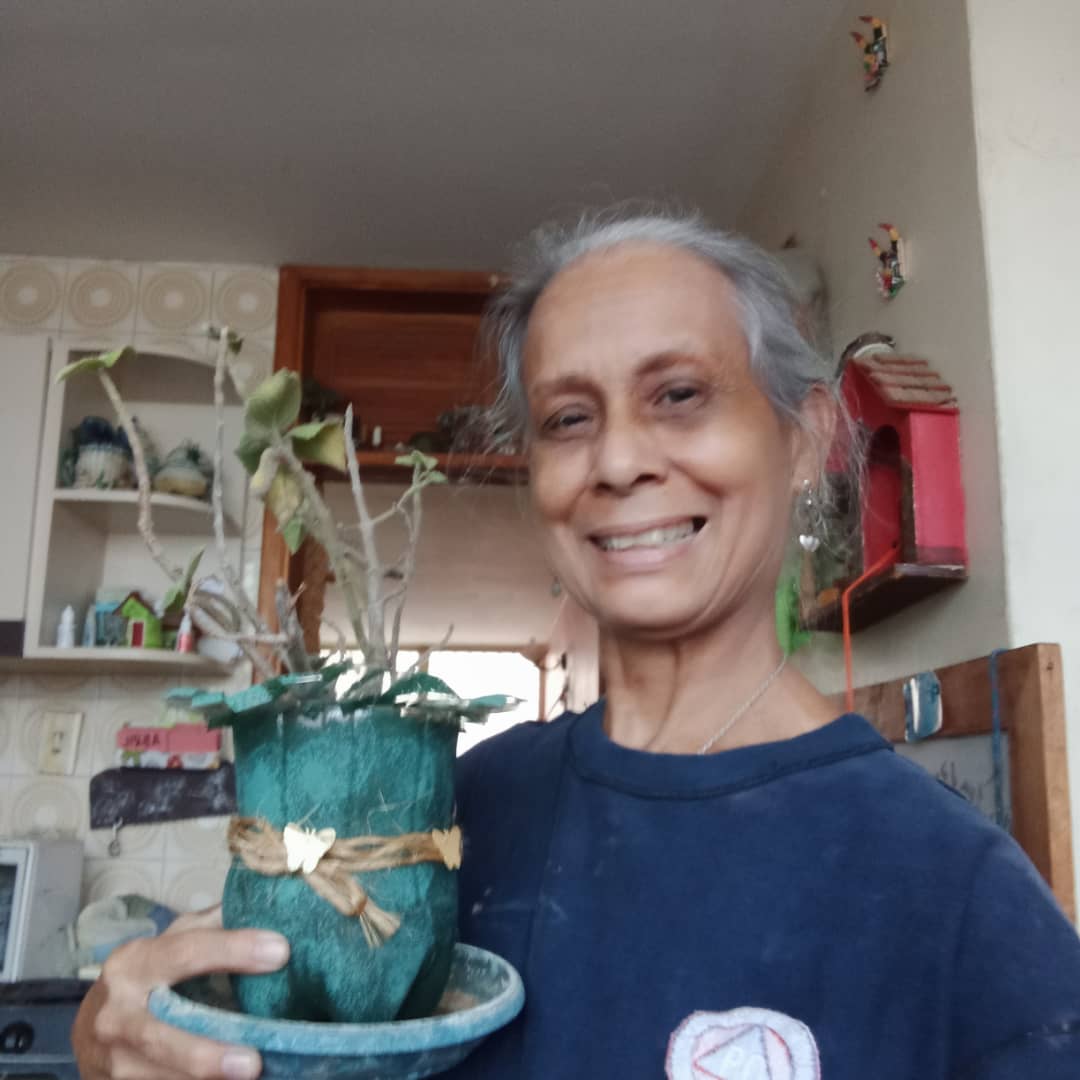
Well, as I said, I brought an idea of a decorated container whose usefulness depends on the purpose of each one. The final object was to leave it as a pot to place a plant that I had in a can that was already very discarded. The plant is a bush of oregano orejón, as we call it here in Venezuela. Oregano oregano orejon is useful for respiratory tract diseases, such as allergies, bronchitis, cough, flu.
Decorated plastic container
**Materials**
The materials used in the elaboration of this simple decorative and at the same time useful object are: a soda bottle, a scissors, acrylic paints of the color of your preference, a sponge and some details to decorate, also from recycling.
**Process**
*-Cut the bottle where it has the first mark and cut strips up to the next mark.*
*-Weave the strips, one on top of the other, in an intertwined way and paint by applying the mottling technique, which is giving touches of paint with the sponge*.
*-Decorate to taste and thus we have the final product, a nice and useful decorative container that depends on the use you want to give it. In this case a pot for my oregano plant.*
***I hope this publication will be useful.***
Translated in Deepl.
Eucalyptus utilities
Eucalyptus is a 100% aromatic plant with medicinal properties, antiseptic and other commercial uses such as repellents, cleaning products, stationery including the production of oil and perfumes, although there are insufficient scientific studies that determine the effectiveness of the use of this plant in the medicinal aspect.
However, the major use is exploited by the pharmaceutical industry thanks to its menthol component and also for home use. This is a plant especially for medicinal use, but its properties allow other uses and other benefits, besides curing and preventing diseases related to the respiratory tract.
**Benefits**
There are many benefits offered by this plant. Among those that count:
-It is common to combat colds, flus and allergies due to rhinitis or any other respiratory condition due to the expectorant and decongestant power of the bronchi and lungs.
-It has anti-inflammatory and antiseptic properties, i.e. it is used to reduce inflammation and clean wounds. It is also used in the disinflammation of the joints to relieve pain.
-It is hypoglycemic to reduce sugar levels in diabetics.
-The oil works has relaxing action with massages.
-It combats the formation of fungus because it has a fungicidal function.
-It is used by the wood and paper production industry.
**How to use it?**
There are several ways to use this plant. Inhalations are the most common form of use; at this point is where I confirm its effectiveness, because I suffer from allergic rhinitis and these days I had a stuffy nose. I did the inhalations and additionally I applied nasal wash with the infusion and the result was immediate. Totally decongested, I had about a month without breathing normally, for its fluidizing and expectorant effect the reaction was the explosion of nasal secretions. The way to prepare this inhalation is to boil the leaves to extract the juice, adding a little salt, with the same water to make nasal washes.
The infusion is prepared with less leaves than the inhalation but let it stand for 15 or 20 minutes before drinking, it is also used for gargling. If you wish, you can sweeten it with honey and add lemon to ingest.
The oil is used for massages, aromatherapy, for rheumatic pains. Eucalyptus is used in commercial products such as disinfectants, shampoo, candies and even antibacterial gel.
**Origin of eucalyptus**
Eucalyptus originates from Australia. The scientific name is Eucalyptus globulus labill of the Myrtaceae family and there are more than 400 species. This plant is the official food of koalas; marsupial mammal that climbs these trees. The propagation of this species has spread to other parts of the world because it adapts to any terrain and its growth is fast.
**Propagation of the eucalyptus**
Reproduction is by cuttings or seeds but it is not recommended to have it as a domestic plant because its deep roots tend to be aggressive and can damage pipes, buildings and pavements. According to, these plants have a negative allelopathy that is characterized by inhibiting the growth of plants of other species in the place where it is found. Allelochemicals are chemical compounds released by a plant to suppress the spread of other plants around it. Allelopathy is a biological reaction of some plants such as eucalyptus.
*Remember to consult your doctor before starting any treatment with medicinal plants.*
`Translated with www.DeepL.com/Translator (free version)`


International Women's Day: March 8
Women's Day is celebrated on March 8 and was institutionalized in 1975 by the UN (United Nations). It is an international day to commemorate women's rights.
But let's go back a little further in history...
Everything indicates that the prelude begins in New York in 1909, when there was a fire in a textile factory where 146 women were burned to death. The following year, there was a movement in which many women demonstrated for the right to vote, for fewer working hours and better wages.
Then, in another context, on March 8, 1917, women in Russia made a demonstration demanding "Bread and Peace" for some soldiers killed in the war; achieving that the Czar abdicated and the government of the day gave the right to vote to women. This event was conclusive, in addition to other important events, for the UN to promulgate International Women's Day.
Since then, women have entered a stage of empowerment in all aspects of society and in decision-making inside and outside the home. At the international level, there are institutions, such as the UN and UNESCO, that promote actions in favor of gender equality and women's rights.
Women today
In Venezuela, these influences were progressively filling the spaces and in 1946 women are protagonists of the vote to be elected to positions in a Constituent Assembly. Likewise, laws against discrimination, violence and the inclusion of women in the structures of the social process have been enacted.
In this historical framework, many actions have been carried out for the protection of women; however, at present, abuses are still notorious, especially in women who for unstable reasons that our country suffers, have had to join the diaspora in search of a better quality of life.
Some have been raped and murdered because of xenophobia, and others have been abused and subjected to other types of violence; they have even been exploited for labor exploitation because they are illegal.
Parallel to all the above, today I can observe that women run after social networks to show themselves as sexual objects, showing themselves almost naked and in provocative positions to flaunt their attributes; for that there is no age, of course, it is more noticeable in very young women. Older women do not accept that time is inclement and we desperately seek to look forever young, regardless of the fact that our body deforms or changes its characteristics.
I must clarify that this is not a criticism but an observation because although I do not understand this attitude, I do not criticize it either. I believe that regardless of our physique, we are beautiful women because we do things that men do not do or feel. For example; when we get sick, we get up and we usually carry a child or make our own food.
What is it to be a woman?
A woman is a friend, a wife or partner, a sister, an aunt; in short, she fulfills many roles, but the role of mother is the most important. For a mother, even if she is aware that her children are growing up and leaving, she will always take care of her children as if they were small.
Being a woman is a substantive construction of feelings. A woman is warrior and empowered, capable of resolving any situation with decision, constancy and strength. She may not be a mother, aunt, sister, wife or whatever, but she never stops being a woman.
Women who value themselves recognize the qualities that strengthen them and do not accept impositions. We know that self-esteem allows us to raise our faces and walk proudly as women.
Translated with Deepl Translator

Pets are best friends
When pets come into our lives they become family, they are part of us; that's why we must provide them with the necessary care. My dog is a poodle named Susy. She is 11 human years old, she is all grown up; however sometimes she plays trying to bite me to make me run.
"Mascot" is a term that comes from the French "mascotte" and is used to name a companion animal. These animals, therefore, accompany humans in their daily lives, so they are not destined for work nor are they slaughtered to become food" Fuente:https://definicion.de/mascota/.
Susy turns out to be a very good companion because wherever I am, she is at my feet; sometimes I forget that she might be nearby and when I am about to get up from my chair, I bump into her.
Having a pet when we are alone is very important because they keep us company, hence the word pet. As I was saying, these are our furry children to whom we must offer care, such as: cut their hair and nails, clean their ears, deworm them from time to time and vaccinate them. Besides bathing them and keeping them clean of ticks and fleas. I also brush their teeth to avoid future dental diseases caused by bacteria.
When I leave the house, my Susy waits at the door and is happy to see me back. It is important to emphasize the importance of the veterinarian in the care of our pets.
in the care of our pets. The veterinarian ensures the healthy growth and development of these little animals. It is necessary to take them periodically to the veterinarian's office for a check-up and vaccination.
There are different pets; dogs, cats, turtles, among others. Some are purchased and others are adopted. These animals, generally dogs, are mated to sell their offspring but there are others that are rescued from the street and are given up for adoption. Having a pet is a great responsibility.
Behavior depends on discipline and habits as part of education and training. We must teach them to do their needs outside the house and when going out for a walk, we must make them walk by our side, with or without the leash on. Educating or training them is basic and of utmost importance, that is why we must be patient.
Another aspect to take into account are fireworks and thunder when it rains; they are very afraid of them and get nervous. In this type of situation my dog gets under the kitchen and stays there until the event passes. When the pet is very anxious, the best thing to do is to take it to the veterinarian so he can give it some medicine to calm it down.
Animals in street situations, when they are our protégés, become neighborhood pets. Here where I live, people have learned to value these animals. We have 4 dogs and a lot of cats, but the canines are the ones spoiled by young and old. They accompany us wherever we go.
We have 2 female dogs, Blanca and Negra; and 2 dogs, Chocolate and Bandido, who were sterilized. The females are the ones who are always alert. They are the ones who warn us at night when there is a strange situation. Currently in Venezuela, it is worrisome the condition of many pets that have been abandoned because their owners left with the diaspora, looking for a better future.
Keeping pets is quite difficult due to the high cost of food and if they get sick it is worse because it involves consultation with the veterinarian and buy medicines; which some are scarce and others are expensive. It is very sad to see a pet in a situation of abandonment: sick and malnourished.
You may wonder why I mention dogs and cats the most, but these animals are the most common in families, although the dog is undoubtedly the king of pets. I particularly think that having a pet at home should be adjusted to the space; I think that in apartments it is better to have small pets.
Other preferred pets, besides dogs and cats, are birds such as parrots. However, preferences and tastes in families vary; there are those who have fish, hamsters, rabbits and even snakes. I don't think I would ever adopt a snake as I am afraid of them.
Pets are the family we choose. They are the ones that don't speak but speak volumes. They love us unconditionally. They are our furry, feathered children, however feathered or featherless we must protect them in gratitude for so much love.
Translated in Deepl translator.
The photos were taken with Redmi 9 phone camera and edited in CANVA.
Recreation in time of pandemic.
Greetings friends!!!
Life is sometimes capricious and takes us to roads not traveled and sometimes to the same ones we have traveled. We may have to repeat the lesson because there is something left to learn. It is also likely that old friendships return to our lives because they bring new lessons. In short, life is complicated but we have to live it with all the situations it offers us.
Until recently I was an isolated woman, being a sociable person. I was and always have been cordial and friendly with neighbors but never went beyond a greeting. Nowadays I share some recreational activities with the neighbors.
In December, we created a group of parrandas and aguinaldos; in January we closed singing in the church for the "Paradura del niño". We were planning activities for Carnival but we were in mourning for a neighbor who passed away and we dedicated ourselves to pray to him during a rosary novena.
In order not to stay cold, the men built a "bolas criollas" court which is not yet finished but we have already started to practice and play short games in groups.
Two days ago I made my debut in these practices and it turns out that I did not imagine that I would be good at this game even though I still do not know part of the rules; however during the small games we play we are learning as we go along. Some of the rules are that you must not sit down during the game or leave the court. There are two sets of balls: green and red, with which each team is designated.
Basically the game consists of getting as close as possible to the mingo with balls of the same color. The mingo is a small ball, similar to a golf ball. There are moves called "Arrimes", others called "Boches". The "Arrime" is soft and is done trying to be close to the mingo and the "Boche" is thrown with force with the intention of removing the opponent's ball that is very close to the mingo. The team with the most balls close to the mingo wins.
When they boche the mingo, the structure of the game changes because then the ball where the mingo stops wins.the court is rectangular and the floor must be flat. There are eight balls for each team, divided into two for each team member, at least that's how we are playing it. The place where the foot is placed to throw the ball is called a "v" or "u" shaped object. When the mingo is taken out of the court it is declared a null shot.
The game of bolas criollas dates back many years and is played by both men and women, including youngsters. This popular game gave origin to the expression "A pata e¨mingo" which means that it came close.
This sport, so popular in Venezuela, favors physical activity in the open air and is fundamentally an alternative for recreation.
In the urbanization where I live, the pandemic forced us to join together for recreation. In the afternoon at approximately 4:30 pm to 5:00 pm we are concentrating to practice Bolas Criollas and once night falls and after we all go home, we go down to play dominoes; which is another popular and traditional game but I don't particularly know how to play.
It is clear that the games turn out to be very therapeutic.
Greetings and see you for the next installment.
`Translated with www.DeepL.com/Translator (free version)`
`The photos are my own, taken with Redmi 9 phone camera`
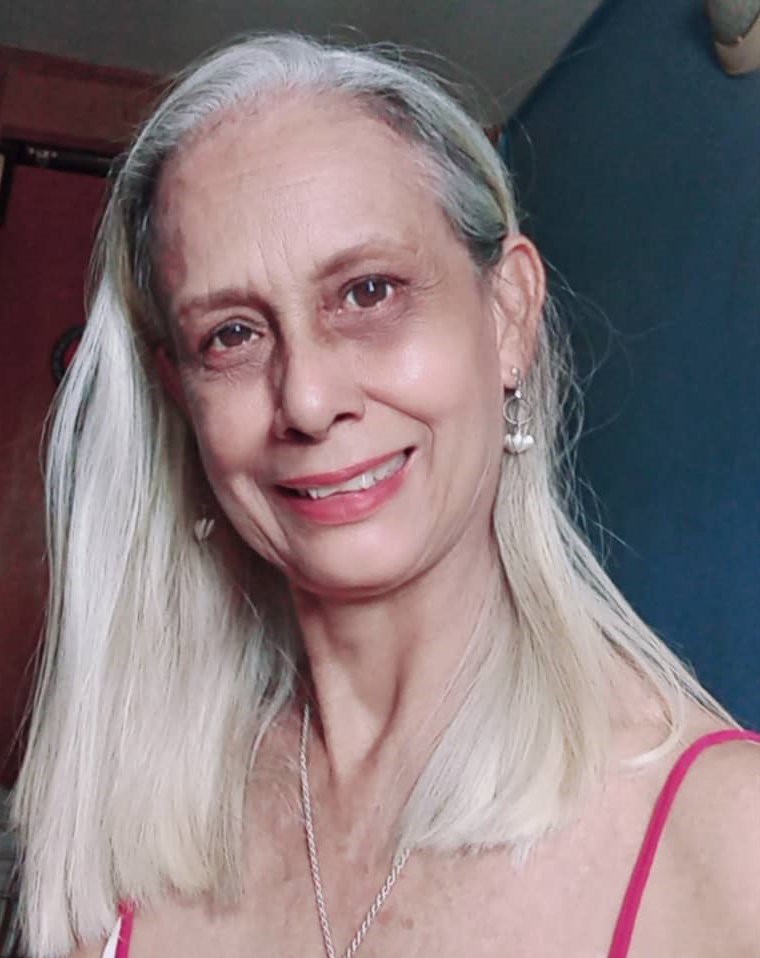
Arriving at Read.cash My presentation: Antoniarhuiz
¡¡¡Hello!!!
Receive a big hug! I'm antoniarhuiz from Venezuela and I bring nice things to share. I am here thanks to Microreylatos, to him I owe my entrance to Read.cash.
I am delighted to be on this platform. I don't speak English but I will use a translator. I hope my stay here will be productive and enjoyable. I like to write about family issues, reflections and poems. I am a craft enthusiast.
At the moment I am determined to learn about the world of cryptography, I consider that I still have a lot to learn because that road is long and complicated, as I see it.
However, I am not going to write about cryptocurrencies because I am a novice in that subject, for now, I have the fixed idea of using this medium to write, and show some recycling crafts.
I am also fond of photography so I like to accompany my writings with photos of my own, I rarely use free images from the web.
My first name is Arelis and my middle name is Antonia, the latter is the reason for my user name. I live in Sucre, Venezuela. I am a retired teacher and I have 3 years on the blockchain. There are many aspects that I still don't know but there I am learning little by little and sharing what I learn.
I have been in 4 or 5 platforms, I have learned from all of them because some are different in the conditions. It seems to me that read.cash is a generous platform. I already have some acquaintances and will follow them soon. I hope to find the topics and communities that are common to my preferences.
I wish all my new friends a good journey on read.cash. We are reading each other
See you next tim!!!
`-The photos are my own, taken with a Redmi 9 phone camera, edited in Canva.`
`-Translated with www.DeepL.com/Translator (free version)`
 @antoniarhuiz