The bizarre case of money in your pocket
Who controls all your money- you may think it is you but you are sadly mistaken. You don’t control, the company that you work for doesn’t, and not even the govt. The system is so opaque and crazy that you will be surprised.
Most of our lives we are running after money, all our efforts are somehow connected with money. We go to school and colleges to gain knowledge and we then use that knowledge to get a job and trade our knowledge with money.
In 1694 England had just gone through the 50 year war. The govt needed money. The Scottish banker William Paterson proposed the idea of a private bank that would issue money to the govt. Where would that money come from – out of thin air. This was the first central bank.
In 1910 a group of richest people of America wanted to make a central bank. A Senator called 6 of the richest bankers of America to a secret meeting and after a deliberation of 9 days they came up with the proposal of a Federal reserve system. To get an idea about the richness of these 6 people, well they controlled a quarter of the world’s worth. If this proposal was accepted by the Congress then it would give this small group to create money out of nothing. Then they would loan it to the American govt for interest. This powerful lobby succeeded in passing the bill in the Congress in Dec 1913 when maximum members were on holiday. Today it is the most powerful entity of USA. This model followed by England and America is now followed by most countries except a few like Cuba and North Korea.
Since the end of the Second World War the USD has become the reserve currency of the world economy. It means all countries hold USD as reserves which also mean that all other currencies are backed by the USD. After the Second World War all US currency was backed by gold and so currencies were quite stable in relation to each other. But in 1971 Nixon removed this USD from the gold standard. So, practically now, the USD is backed by nothing, and so the reserves of other countries are also backed by nothing. It is only the trust now on the USD. This is what fiat currency is- money backed by nothing. The govt says it is money therefore it is money, nothing else.
When the Federal Reserve creates money it means it is diluting the currency supply of the world. When more money is created it means that the value of the currency is worth less. The Federal Reserve created trillions of dollars in the last few years. For this reason other countries keep buying USD to counter this value erosion. Some bigger countries like China and Russia also sell USD to buy gold instead.
You may ask if my money is worth nothing then how am I using it. It is just because of faith on the govt that told you that it is money. That’s why you are able to exchange it for goods and services.
So how does the central bank works? When to govt is in need of more money, it asks the treasury department. The govt gives an IOU to the treasury department. The treasury department gives it to the Central bank. The central bank issues a check to that amount and so money is created. When you give a check it has to be based on the money you have in bank, but when the Central bank issues a check it doesn’t need any backing. It creates out of thin air. It means more money comes into circulation. So from thin air it becomes real money when it reaches your pocket. With more money in circulation the value of that money decreases and that is what we call inflation.
Even commercial banks can invent money. Depending on the country’s law commercial banks can give 10 times more loan that it has as reserves. This also adds to inflation. Then in 2008 came the Lehman’s banking crisis. They were giving housing loan and when people failed to pay back the bank failed causing a global banking crisis.
Things get even bizarre. When we take a loan then for the bank it is a debt. It is also called as debt based economy. The debt should always grow that means more loans for the person or industry or the govt. The more the debt, the more money is in circulation. Debt is a form of money. If people and industry and the govts stopped borrowing money then the money supply will shrink and the system will fail. So it is the central bank in conjunction with the commercial banks control all the money. The central banks have the power to create the boom and the bust just by tweaking the interest rate at which it offers the invisible money.
All the wars and the revolutions of the world are somewhere linked to the control of this money. So now there is a slow and silent movement to come out of this by rejecting the debt based economy. Things like gold, silver and crypto currency have the power to come out of this system of the unholy nexus of the central banks and commercial banks and the government. But will the govt be ready to lose its power over money?

Understanding existentialism
What is the purpose of a flower? Think for a minute.
The primary question is what is the meaning of your life? We will get different answers ranging from god or money or love or success and many more. We create our own sense of purpose of our life depending upon our own understanding. For the majority it is we believe or made to believe that we have been created by the god and assigned a particular purpose or essence as a human being. No one can wrong you if you decide to assign a meaning and a purpose of your life. It is in our nature to find a meaning in everything; it is as if we need those meanings in everything that is happening around us. We devote a lot of our time in finding the meaning and pursuing it otherwise we would feel a vacuum in us. That meaning can come from the religion you follow or by educating others or fighting for a cause or creating art or the meaning could be to raise the children well.
Existentialism says that all these can give meaning but it also says that none of them can.
Coming back to the flower, some might say the purpose of flower is to give color to nature or to give out the sweet smell or give nectar to the bees or to make us happy. I would say the purpose of the flower is to be a flower. For the rest, it is up to them whatever reason it may assign to the existence of the flower.
Aristotle and Plato believed that everything had an essence which can be defined as a certain set of core principles without which it would have no meaning. If those core principles are missing then it would lose its purpose and will be a different thing. For example a knife may have a wooden handle or an ivory handle but if it doesn’t have a sharp blade then it would not be a knife and would not be useful for the purpose it has been made. They went even further and said that our essence exists even before we are born.
We may or may not know what our purpose is and frankly speaking most of us don’t know about it and even less interested to do anything about it. But still it gives a purpose to you because we are made to believe it. These believe of a purpose flourished till the nineteenth century when certain philosophers started questioning it.
The said that it can the other way around, we come to exist and then we decide on a purpose. The purpose is not hardwired before we are born and only after we are born do we search for that purpose. This was quite a radical idea at that time as it challenged the existing belief that we did not have to find our purpose but god did that job for us. But existentialism is not same as atheism. Theistic existentialists do not belief in teleology – it means they do not believe that god made this universe for any reason or with a particular purpose. For them god may exist but it is not in his job description to assign any reason or purpose for you. Our life lacks any real inherent importance.
They call it the absurd. For you and me absurd has a different meaning. For the existentialist is means our effort to search for a meaning when there is none. We always need a meaning but actually we are just living in this meaningless universe. When there is no reason for everything then there are no absolute rules to abide to. There is no cosmic justice or fairness or unfairness or rules or order or chaos. Everything is just as it is.
During the World War 2 this concept of existentialism gained traction. The horrors of the war made many people lose hope in the ordered world and pulled towards this philosophy. The time was such then that if Nazi was possible then finding meaning became futile. The lack of meaning has another connotation; it is the abundance of freedom. Though freedom is what we crave for but it also means that we are free to design our own moral code to live by. We have been programmed by the society to look up to an authority for answers but all such authorities are fake and false. We look up to our parents or religion or political leaders but they are just people like us only. They themselves are unsure and are looking for answers.
So what can we do? They say that what we can do is to live authentically. By this they mean that we take the full responsibility of our freedom within the absurd and any meaning to life has to be given by you only. If you decide to follow a path decided by others then you have bad faith, a refusal to accept the absurd. It means that you are pretending to have found a meaning which you did not give.
A situation will make it clear. If you have to choose between your sick mother where you are required to stay with her and go to the war which is which your country is fighting- which one will you choose? There are no right and wrong answer to it until the one which he chooses to be authentic as per him.
The bottom line is that there is no inherent god or society given purpose to our life and it is for us to decide to give a purpose by choosing authentically. No one can dictate you anything. This is applicable both at the individual level and world level.

Morality and religion
For most of us these two concepts are highly interrelated, one exists because of the other. Within this inter relation there are some who believe that religion led to morality and for some others morality was incorporated into religion. And for the minority like me both of them are separate and can exist without each other.
Maximum people who are followers of any religion believe that morality is a supernatural intervention to guide mankind. Every religion has claimed that it came from a divine source and its codes are embedded in the Ten Commandments, the Eight fold path, the five pillars of Islam or the Vedas. Each of these claims to lead to the path that guarantees a meaningful life and a happy afterlife and salvation and the only path endorsed by the god. Faithful followers just not willing to accept that the good and the bad cannot arise without God. Now let us investigate the relationship between religion and morality:-
At the dawn of civilization man were amazed by the power of nature and the obvious outcome of it was who was behind it. It was those mystical entities behind the scene that influenced every act of nature and also influencing mankind. Then man tried to find out ways to make peace with them, this led to the concept of morality- a way to make peace with nature and live in peace. Slowly these groups of people formed communities with similar views and these views then got codified in the form of religion. In present time children learn morality through instructions and that leads to a level of reverence for the originator of those moral codes.
Groups sharing similar moral code are more likely to live in cohesion and cooperate with each other. This will then automatically lead to conflict with groups not adhering to their moral and religious code. However, for example we all have cheated sometime in our life, but we stop repeating them when we believe that someone is watching us, it may be god or our dead ancestors or a spirit. This behaviour then creates a common social behaviour which leads to cohesion in society. This belief of we are being watched and will be dealt with has created a pro social behaviour.
Morality codified by religion has given us a feeling of perfection. Be believe we are the perfect creation of god and this desire for superiority has led us to believe that we are the masters of all life forms on earth and all other life forms are inferior to us. Our morality surpasses all other forms of life leading us to believe that it has a supernatural origin.
Within a religious framework the person showing more morality is considered revered and given more prestige. He is considered as more trustable. This relationship between morality and religion often leads to its misuse by taking advantage of it by showing only external examples of a moral life.
Individuals who demonstrated higher knowledge of the divine rules were treated as prophets. A person who set a higher example of morality and divineness often generated more power within the community and all had more support of the clergy and the ruler. This led to more control over the people. Morality coming out of divine intervention has more power over the masses. The one person who seems to have the power to give eternal damnation has more power to enforce rules on the masses.
What we see from the above is that religious morality can bring cohesiveness in society, give power and control and prestige and also give domination over all other forms of life. Is religious morality the only truth or is it that both have the ability to shine independent of each other.
Organized religion has two parts- one that deals with ways and rituals to attain god realization and two, an ideal way to lead a life, in other terms a moral life . In our daily life most of us try to follow the second one. This first one is for those who are religiously inclined. For pursuing the first one the second one is mandatory. But for those who follow the second one, the first one is optional. I can give lip service to my religious life and still lead a moral life, but I cannot give lip service to my moral life and lead a religious life. A moral living has a higher stature than a religious living. But if it so happens, then all religion will crumble.
Now the point comes which one came first – religion or morality. Any organized religion as we see today needs an organized society to survive and flourish. Humans were living thousands of years before any organized religion and various tribes co existed and flourished and also fought with each other. It is hard to believe that they did not have a concept of good and bad. The nature of behavior hasn’t changed even after organized religion came. Have we changed our behavior on the basis of few carved scriptures on stone? Religion may have codified the tenets of morality but it cannot be claimed that it is the origin of morality.
It can be said that religion used morality and not morality used religion to further its cause. Morality doesn’t require an organized society and it can be a standalone pillar on its own without any religious backup. But if we deduct morality from religion then the whole purpose of religion will falter. Morality is the raw material that binds the fabric of like minded religious people. Without that binding it is but obvious that religion as we see today will be in tatters.
The moral codes in each religion is similar but still though it can bring cohesiveness within the group, it will always fail to bring intergroup cohesiveness. However if we look at the moral code without the adulteration of religion, it has the potential to bind the whole mankind.
Regrets in life
I have attended quite a few funerals in my life, that of both my grandparents of both maternal and paternal side, my father and some others. All of them died above 70 so I can say that they had lived there full quota of life. Sometimes this makes me think as to whether they had a life they wanted. The grandparents died long time ago so I was not matured enough then to ask these questions to them. My father was bed ridden for about 4 months and was an Alzheimer’s patient. So in the end stages he was not in the position to talk about these things.
I am quickly approaching 50, so two third of life is already behind me. The one third that is left is also subject to no major sudden crash landing. So now sometimes I delve into this topic- have I lived a fulfilling life, any regrets? Some of you might say that you don’t have any regret in life, but I guess that will be a false statement. Everyone has, it’s just that you may have taken it in a stride, accepted it and put it in the back burner.
For me there has been some. In my young age I was in love with mountaineering. This was before I landed in my job. After joining my job I did not make out time to follow my passion. If you notice I have used ‘did not’ instead of ‘could not’, that’s because I could have but somehow job became the first priority for me and I stopped thinking about mountaineering. I could have done it because I had 60 days of leave each year and was unmarried then. So I could have easily devoted 15 days for my passion which I did not. Now I regret that. To make up some of it now I go for trekking in the Himalayas once every year, but I don’t do pure peak climbing now.
In my young age with my job I neglected financial planning. So in the initial years of the job I did not bother about saving much. It was only in the mid thirties that the realization dawned that I should be serious about it and then only I went for aggressive saving. But with a full-fledged family and supporting parents also, the amount of saving is not as per my desired level. Thanks to the pension which saved the day for me. Now at least I know at the end of the month the pension amount will get credited into my account. If the pension was not there then I would have been in thick soup to survive comfortably just on the basis of my savings. That’s one of the reason I am slogging here in read cash.
I love to travel but could not do it to the heart’s content. I know to satisfy the heart is difficult but still I could have seen many more places with my family if I had planned properly. Also I had the desire to visit the West at least once in my lifetime but that too remained unfulfilled. I made my passport 5 years back but it is still blank. But I want to do it once. This passport will expire in another 5 years. May be after renewing it I will give it a shot, otherwise it only serves as an identity proof for me.
Next in the list will be studying. In my school and college days I was least bothered about studies- for two reasons- first I was not good at it, always a back bencher and second, I was more into mischief and playing. Now when I see my school friends who studied hard are in high positions that tad feeling of sadness sometimes crops in my mind. I remember my parents telling me about the importance of studying but I somehow just studied only enough to jump from one class to the next.
Another one is that I did not keep a close association with my close school friends during the mid twenties till the mid forties. I got busy with my job, then marriage and child, in other words went with the flow of a family life. But now after my retirement I have again connected with them. Though those days won’t come back but still it is a satisfaction now that I am again connected to them.
Other than these I have a few trivia ones like not able to do skydiving as it is not available in India, wanted to do a 100 km run, wanted to do a trans Himalayan trek from one corner to the other, still continuing to smoke and not quitting it, not able to make a full-fledged work from home income after retirement instead of the passive income I make here, not saying sorry and thank you to many and may be a few others....
If I hade done all those things I have mentioned, would I have been happier, well I think so but cant say for sure.
There is a book by Bronnie Ware who was a nurse in a hospital looking after critical care last stage patients. She compiled her experiences in that book. The main points of regret in the last stage were mostly the following-
1. I wish I’d had the courage to live a
life true to myself, not the life
others expected of me.
2. I wish I hadn’t worked so much.
3. I wish I’d had the courage to express
my feelings.
4. I wish I had stayed in touch with
my friends.
5. I wish that I had let myself be
happier.
An unusual alliance
Microbes are everywhere in this planets and outnumbers us by vast numbers. Closer to us it is on everything we touch and it is still there when we have washed our hands. Still closer millions of them are crawling on our body even as you read this. You can do absolutely nothing to get rid of them. So millions of years ago evolution created a pact between us. It decided that we will give them food and shelter and in turn they have to work for us. But this partnership is like a cold war.
The child when inside the mother’s womb is sterile but when it starts its journey from the womb to the birth canal the child is covered by millions of mother’s bacteria. This is an important part of its health. Children born via caesarean operation have higher chances of asthma and immune diseases. There is no other option but to accept the invasion of microbes. During the millions of years of evolution we have evolved to co habit and to get the best out of this relationship. The mother’s milk contains special type of sugars which meant for certain group of microbes and also boost the immune system. In a child it can take up to two years for microbes to form a healthy community. Every human has its combination of bacteria, fungi and other minute organisms.
It can be categorized into three categories. First are the ones who keep to themselves and are ignored by the body. But they too have their utility; they take up space and keep away aggressive intruder microbes. Second are the ones which can harm us but we have learnt to live with them. One example is bacteria that can literally melt our teeth if we stop brushing and taking oral care. Third are the friendly ones which we benefit from. This group counts up to about 400,000 billion bacteria and about 5000 different species in our stomach only. They help in digestion of food and also extract the additional calories from things which we cannot digest ourselves. But the stomach is also a primary target for the bad bacteria so it is guarded by our immune system.
To survive in the stomach the good bacteria had to communicate with our body so that the immune system does not kill them. So some of them engineered a communication line to interact with the immune system and the rest worked to stimulate the gut cells to regenerate faster. But recent research found that this relation may go much deeper and may have the ability to talk with our brain. 90 percent of serotonin which the main messenger system of the body is produced in the gut. Some scientists are of the opinion that the microbes use this channel to communicate with the vagus nerve which is the body’s information highway. Some bacteria’s help in building the immune system and act as an early warning to the brain.
Scientists are slowly starting to understand the complex inter relationship between the bacteria and the internal functioning of the body. One experiment showed that when microbes from depressed rats were fed to healthy rats, they also started showing signs of anxiety. In fruit flies it showed that microbes influenced the types of food they craved for. It could mean that the microbes are communicating with the brain on which type of food it should eat.
The organisms in our stomach have different appetite, some like leafy green vegetables, some like sugars and some love the greasy fried food. If we eat healthy food then more healthy bacteria are formed, if we eat more of fast food then such type of bacteria gets preference. When we eat more of a particular type of food then we give preference to a particular type of bacteria and therefore they multiply faster and take over space of other bacteria. They also send signal to the brain to send more of such type of food. This increases the craving for a particular type of food in us.
If the body is over run by bad bacteria then there is only one solution, we need an army of the good bacteria. This can be done medically and now even drinks with healthy bacteria are available in the market. Whatever is the case, now we cannot do without each other and in this process we have got a powerful ally if we can live in peace with them.

Negativity is not all about negative
I am quite a stoic person and stoicism is about 2000 years old. This word is not used quite often. It means a person who is calm and almost without any expression of emotions and acceptance of whatever is happening. That does not mean I follow stoicism, it was just to put things in context.
Ancient stoic philosophers like Marcus Aurelius regularly conducted an exercise called ‘premeditatio malorum’ which means premeditation in evils. The purpose of this exercise was to imagine the negative things that could happen in life. They would think what it would be like to lose a job, to get severely injured and sick or about loss of reputation in society and things like that. The logic was that when we imagine these things before hand then we are better prepared to face them if it happens in our life- sounds quite logical.
Most of us are focused on getting success and happiness and whatever that is good in life. We generally don’t like a negative person and even don’t like to discuss negative things. Many might not agree to it due to preconceived notion but for this reason we are not good enough to manage failure in life. We don’t want to think about what if things went wrong tomorrow. A glaring example is the pandemic. Life was going smooth for us and suddenly the lock down, loss of jobs and a total change is lifestyle which we were not prepared to handle. We never expected such a situation so we were not prepared to deal with it.
This is a way of thinking where you consider the opposite of what you desire and want. It is a crucial skill that is not to be underestimated. This inversion of thought can be a powerful tool where we focus on the problems and roadblocks. It is like asking what not to do than asking what to do. Here in read cash I have seen many writing on how to write an article. One of the points would be the title should be catchy. So instead of writing a title as ‘Motivation’ if we write ‘motivation is overvalued’, it will catch the attention of the reader. This is an example of what I am saying here.
If you ask the question ‘what type of people you like’ and ‘what type of people you don’t like’? The answers will be antonyms but the purpose will be solved in understanding what your requirement is.
In our work place this can be used. Suppose your business is about innovating then you can ask ‘How to make the company less innovative’? The answer will throw up a set of answers which you will focus on avoiding. In a marketing business you can ask ‘how to alienate a customer’? The different point of views will give you a road map of pitfalls to avoid. The purpose and the outcome remains the same only the approach is changed. The focus is on finding what doesn’t work for you.
Imagine you have an important project which will take 1 year to complete. Now imagine you are at the end of that 1 year and you have to explain to your boss why the project failed or why it could not be completed in time? The answer will tell you the reason why you failed in the project even before you start that project.
If you are shifting from one house to another then you can use this in a different way. Instead of asking what items you want to get rid of, you can ask what items you want to keep.
In our personal finance also we can use this. Overspending is a common problem we face each month. This creeps in the form of unchecked shopping and spending habits. When we want something we should ask can I do without it now, rather than trying to justify why I need it now. We focus more on how to earn more money rather than how not to lose or waste money.
The best thing is that it can hit at your most deep rooted belief. Most of the world believes in God but what if there is no God. If you are the judge and you have to hear the argument about its existence and non existence for you only. It can be a good mental exercise. What if you are a believer and you own argument disproves it. This way you can question whatever you cherish the most.
Negativity has its utility too.


The revelations of pea pods
In the late 18th century a man named Pareto was going around his pea garden and noticed something odd. He noticed that only a small number of pea pods produced the maximum peas. He was an economist and a mathematics lover. This observation of his led him to think whether this unequal distribution happens in other fields also.
As he was from Italy so he started with his country. He studied the wealth distribution of his country and to his surprise he found that 80 percent of the land of Italy was in the hand of 20 percent people. He studied the wealth distribution of Britain and found that 30 percent of the people held 70 percent of the British wealth. He studied about other countries and a pattern started to emerge. Like the pea pods of his garden, the resources are concentrated in the hand of the few. He found that though the numbers varied a bit but the pattern was same everywhere- a minority portion held the majority of rewards. This came to be known as the Pareto principle, what today we popularly call the **80/20 principle**.
His idea has now become a gospel for economists. This idea opened up the world’s eye. Now an example of this is found in all spheres of life.
80 percent of the defects in products are caused by 20 percent of the machinery. So if that 20 percent of defect is rectified then the overall quality of the product would increase.
In business it was found that 80 percent of the sales came from 20 percent of the customers. Also 20 percent of the employees gave 80 percent of the output for a company. 20 percent of the efforts give 80 percent of the project results. So if business owners or managers give 80 percent of their time on that important 20 percent then it would yield better result.
In investing also it is that 20 percent of the portfolio that gives 80 percent of the returns. On the opposite, 20 percent of investment can ruin to returns generated by 80 percent of the portfolio. In the stock market it is the 20 percent of stocks that boost the index.
In our life also that 20 percent of time gave 80 percent of the productive output of the day.
In your life you are lucky if you are devoting 20 percent of the time to things that give you 80 percent happiness. Or are you giving 80 percent of the time on things which give you only 20 percent happiness.
Out of your friends and acquaintances out of the 80 percent only 20 percent are those with whom you will feel close.
Out of all 80 percent of your clothes you will find 20 percent are you favorite ones.
In sports also 80 percent world cups are won by 20 percent of the countries.
10 percent of the world population hold 80 percent of the wealth.
In every aspect this rule applies though the proportion may vary a bit.
**Another aspect**
The Amazon rain forest has about 16000 varieties of trees recorded. But scientists have noticed that only 227 varieties cover 50 percent of the rain forest. That makes 1.4 percent of the tree species dominating 50 percent of the forest. But why it is so?
Imagine 2 different varieties of trees are planted in a jungle; both will try to get the most of sunlight. The one which will get a little more sunlight will grow faster and subsequently it will be taller and healthier than the other tree. The healthier tree will be in a better position to spread its seeds and reproduce faster. This process through generations of growth will ultimately dominate the majority of the forest. Scientists have named it the **accumulative advantage**. A small advantage at an early stage becomes bigger and bigger and the gap increases.
Similar is in our life. We are fighting for the limited resources. A large number of unemployed people are fighting for the same jobs. Politicians are fighting for the same votes, authors are competing for a spot in the top seller list, and sportsmen are competing for the podium. Television channels are fighting to get your prime time attention. All this is happening because the reward is immensely outsized.
The swimmer who wins the world championship by 1/100 th of a second will get the gold medal and later on the most lucrative endorsements. If 50 candidates are applying for a single job then the one who will do slightly better than the other will take it all.
In our life we will face both the situations – the winner take all and the competition for limited resources. If you are 1 percent or 2 second or 1 dollar better then you will get 100 percent of the victory.
This winner take all in individual life lead to winners take most in the broader life. With your win in one competition or one political election, now you will be in a better position for the next competition or next election. This slowly converts into the 80/20 principle in broader life.
If you can get one book in the best seller list then more people will like to read your next book. Publishers will also do better marketing for your next book. This way it will be easier for you to hit that bestseller list again. For this reason you will see only few authors are able to sell millions of copies and the rest struggle for selling even a few thousand.
A slight edge in a completion can give compounding returns in future. So in life and its challenges try to be slightly better than the others, a slight edge today, tomorrow and the next day will slowly give you better results and those small advantages will put you ahead in life.
Absolute and relative success
**First example**
Warren Buffett (no introduction needed) once proposed a thought experiment in 1997. He said that suppose a genie comes 24 hours before you are to be born and gives you the boon to fix the rules of the society, the governmental rules and the economic rules you are about to be born into and you are free to make any rules. The rules will be applicable to you, your children as well as your grand children.
But it has a catch. You don’t know whether you will be born a male or female, rich or poor, able bodied or disabled and also you don’t know which country you will be born, USA or Afghanistan. You will be just one out of the 5.8 billion.
He called it a lottery and it is going to be the most important thing in your life. In his 2014 annual letter he wrote that it was pure luck that he and his business partner were born in America in the right time, and he was forever grateful that this accident of birth gave an immense advantage to both of them.
Buffett gives credit to his **luck**. Reading this it seems that luck, good fortune plays an important part in our lives.
**Second example**
In 1969 during the Vietnam War a Chinese scientist was detailed to make an anti malarial medicine as lot of soldiers were dying due to malaria. The scientist named Tu read hundreds of ancient texts and travelled to many places and collected 600 plants and 2000 possible remedies to experiment with. She then narrowed it down to 380 potential medications and tested them on mice one by one. It was a tedious job with one after the other failures. After months of testing one plant named qinghao showed some promise. But the problem was it only occasionally produced the anti malarial medication and won’t work all the time.
It was already two years and she decided to start from the beginning again. She again read all the ancient texts to see if she missed something. At last in a 1500 years old text, a single sentence gave her the clue. The problem was the heat. If the extract was extracted in high temperature then the medication would not work. So she again ran experiments by lowering the boiling temperature during extraction and ultimately found the extract that would work 100 percent times.
As it was a secret project so the clinical trials could not be conducted. So she and her assistant decided to test on themselves. They infected themselves with malaria and then tried the new drug. The medicine worked. In spite of the humongous effort and risking their lives, she was not allowed to publish her work to the outside world. It was only in 1978 that they were allowed to publish the work and it was in the year 2000 the WHO recommended her treatment. She was ultimately the first female Chinese to receive the Nobel Prize. **Hard work** pays off.
Whereas Warren Buffett’s story is all about luck, Tu’s story shows the power of hard work. There is no denying in the power of luck but most of us believe that hard work make the difference.
When you are climbing Everest, your hard work will take you to the top unless weather and health plays foul play.
**ABSULUTE SUCCESS AND RELATIVE SUCCESS**
In one way we can say that absolute luck matters in the absolute sense and hard work matters in relative sense.
Absolute success makes one the best in the world in a particular domain. It is a combination of many things like right genes, right contacts, right timing, right opportunity, right hard work etc. All these things have to fall in place perfectly to make someone the best in the world. While many try for it in each domain but only one reaches there.
Relative success is what one achieves compared to many similar like him. There are millions in the world with the same education, talent and perusing the same field but here level of success is different. Here hard work comes into play.
When one moves towards absolute success then the proportion of luck in that success increases. The absolute success is global in nature. Relative success is more localized. Consider your school friends, many of you may be studied in the same school, same college, and same stream but after a decade some are more successful than the other. Here hard work becomes decisive.
Both the stories give their own insight about success, it depends on you which one you believe more, or a combination of both.
We can look at it in another way. Suppose in the graph of success, X axis measures time and Y axis measures success. Those who are born in difficult circumstances will start at a lower position than those who are born lucky. Your degree of success right now doesn’t matter. What matters is your choice of habits, whether it is putting you in the path of success. You trajectory in the graph is important. If you are in the right trajectory then with time and effort you may make up the lost ground due to bad luck. One study found that is wealth was a measurement of success then more than 50 percent had moderate talent but very good luck.
In any case both these factors cannot work in isolation. Both have their dominant role in success. Bill Gates was lucky to start his business in the right point of time, but the immense hard work he put before that cannot be ignored also.
Fortunately or unfortunately there is no formula to be lucky. It can only be said that the more you try the more are your chances of stumbling into the door of luck.

The past present tense
As parents we have seen our children making hand stencils on a piece of paper. When my son was 3 or 4 years old he used to make them also, spreading his fingers on a piece of paper and drawing the outline of it. This is normally the first art the children make. This amazes the children seeing the replica of their hand that piece of paper. And then every few years we made him do it just as a remembrance and record of his growing up. Now he is gully grown up and reached his final size. Those stencils remind me that he is both growing up and also growing away from me, towards their own life.
This reminds me of a real story I read long time back.
Many years back in a place in India, 3 tribal villagers and their dog were roaming in the jungle looking for wild fruits. At a place the dog entered a narrow place within the rocks just like a cave. On shouting the dog came out, but they were curious as to what was inside. So the next day they returned to that place to explore and entered through the narrow entrance to what was a cave. And in that cave they saw walls covered with paintings of animals like deer, bison, elephants and tigers and some which are extinct now. These paintings were in great detail using red, yellow and black color made from some leaves and flowers. Also they found drawings of hand just like the one I mentioned earlier. These hand paintings were made in reverse stencil that is after placing the hand, color was sprayed over it to make an imprint. As the news spread, researchers came and established that these art works were at least 15000 years old.
I visited that cave once. I started thinking who these people were and why would they paint such animals and 'hand' paints. Also there were very few paintings of human forms. There were pictures on the ceilings and those could only be made if they had a scaffolding to reach to the top. Were these painting made for spiritual purpose as they were the primary source of food or were they just paintings what they saw outside or of animals which could harm them.
Such paintings have been found all over the world. With no communication in those times, it proves that humans wherever they evolved and survived created art. It is like a common link between humans living isolated all around the world. It is as if art made them one and connected them. As if art is in the intrinsic nature of humans even in those hard times.
There is no doubt that life was tough those days. Food needed to be arranged by risking the life daily, and then there was constant threat of becoming food for the animals around. Communities must have been extremely small size and loss of able bodied men who could arrange for food daily must have been extremely important and loss of these men must have threatened the existence of that community. Also at least 25 percent of the females died during child birth and the 50 percent children survived till teen age. With so much hardship and improbabilities they still took out time and effort to make those paintings.
All the hand paints had their fingers spread just like what my son drew. It made me think that those children and adults were not any different from us today. The way of thinking is the same even after thousands of years. It is as if I was here then and I am here now, the same person. It is as if history is not what happened in the past but history is happening now and I will also be a part of the unknown history.
Are we really different from what they were? They also loved, feared, cared, lived and died. The emotions they experienced are the same that we experience now. But I think our emotions have got adulterated now, they had a purer form of emotions. If we were to live the life they lived then we would also do the same sort of things. That is what life demands from us. Those painting may not survive the next 15000 years may be due to natural reasons, but the future generations of those people who lived in those caves did not destroy those paintings. But what we as mankind are doing now, we are in the process of self destruction; we ourselves will destroy what we created.
We have a lot to learn from them.
Know your curves
We expect our life to grow in a linear fashion; the trajectory should a straight line going up with time. It is like if you are putting a certain amount of work then you should get a certain amount of reward. In the west where work is counted in hours then if you are making 20 dollars an hour then if you work 4 hours then you will get 80 dollars, and it will increase in the same proportion for more hours worked. We are most used to this type of routine and we are mostly satisfied with it. But all things in life don’t follow the linear fashion.
Instead our life grows in these types of curves. Let’s see them:-
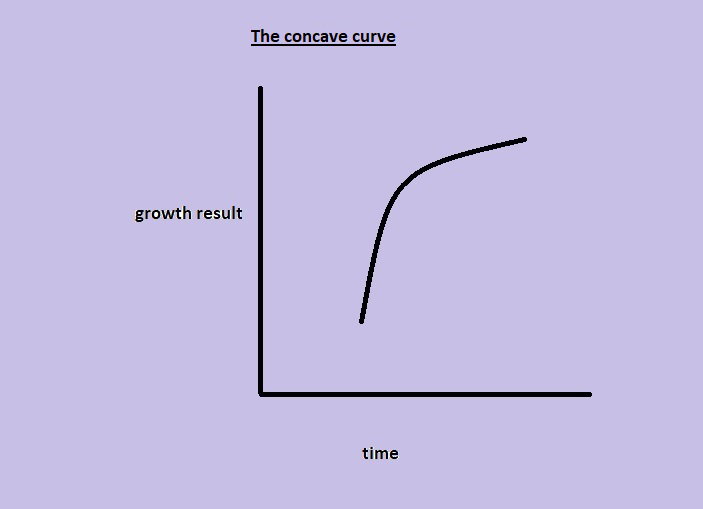
**The concave curve**
In this type of curve the initial growth is much higher but with time the growth becomes slower and more difficult with time.
Now let us see where we find this in our life:
Fitness- In fitness and strength training the beginners gain comes quickly but as your fitness increases, then to get incremental gain in fitness becomes more difficult. One of my friend was a sprinter in young age. He told me that for a 100 meter race, if you have talent then you will find many runners doing it in 11 or 11.5 seconds. But to bring that to 10 seconds is the most difficult accomplishment and takes a lot of time and hard work. To close your time from 15 seconds to 13 seconds is done lot easier. He gave the perfect example of concave growth curve.
Education- When children start learning, they pick up things quite easily but as they go to higher classes things get more difficult and the learning gets slower. Now more efforts are required to understand things. Similarly in college things get tougher and those going for PHD have the toughest time in education. That’s why very few have the inclination to go for very high education and would rather take up jobs. Similar is with learning a new language. It is easy to pick up few words and sentences but to master a new language with its grammar is difficult.
Dieting and weight loss – Here also it is easy to shed the initial few pounds or kilograms, but to shed the last 5 kilograms to reach the ideal weight is very difficult. I personally have experienced it and now it seems impossible for me to reach the ideal weight as per BMI.
This curve affects mostly those fields which are skill based like writing, programming, music, carpentry etc.
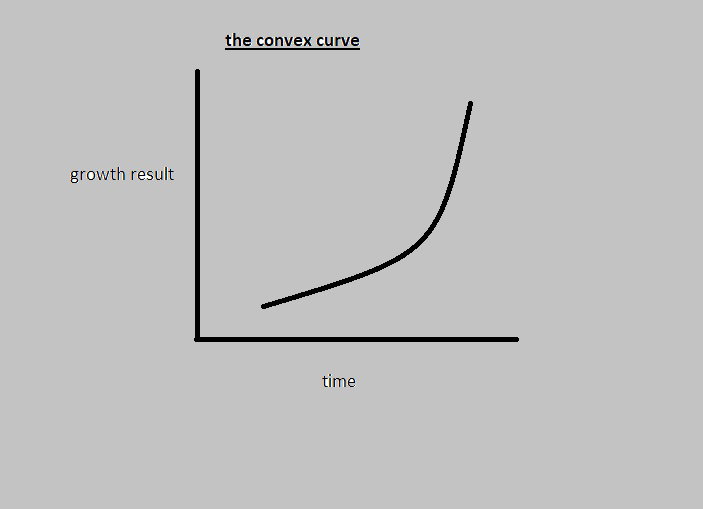
**The convex curve**
Here the initial growth is slow but with time the rate of growth increases quickly.
In our daily life we can find some example of this:-
Wealth creation- Here when you start your retirement savings with small amounts in the twenties or thirties, the initial growth is slow but after a decade or two you build up a sizable amount and if you are taking the benefit of compounding then the growth is further magnified with time.
Website traffic- If you build your website then in the beginning there will be few visitors but if your content is good and what others are looking for then within a year you will have high traffic. Here in read cash also initially you had very few subscribers but with time your subscribers increase in a greater rate. Same thing happens in social media also, initially you have fewer followers.
Business – In business and entrepreneurship also the initial phase is the most difficult when you try to make a place for your product. But then slowly you increase your business and when your product is well known then your business flourishes.
It is not that one curve is good and one curve is bad. It is just that when you take up a work then you should know how it will grow, otherwise it will de-motivate you and cause frustration. The growth pattern will depend on the type of task you are perusing. Don’t expect that you will have quick gain when you are dealing with the convex curve. Don’t expect convex growth when you are dealing with concave curve. You are bound to have tough time then.
When you are dealing with concave curve you will enjoy the beginning phase, but you need to brace up for the next phase. To survive the next phase you will require mental toughness. With time things will get tough and you may seem that you have reached a plateau which you are not able to overcome. Here your mental toughness will come into play to overcome these difficulties.
When you are dealing with the convex curve, in the initial phase you will feel that your efforts are not showing the desired results. This will sap you motivation. You will require patience and perseverance and a sustained effort to overcome the initial phase. In some big cases the wait for success can be as long as 10 years.
It is important for you understand what type of curve you are dealing with and set your expectations according to it. Very few things will be linear in life.
Stand of some major exchanges on BCH fork
I will provide information about some of the major crypto exchanges - **how they propose to handle the BCH fork.**
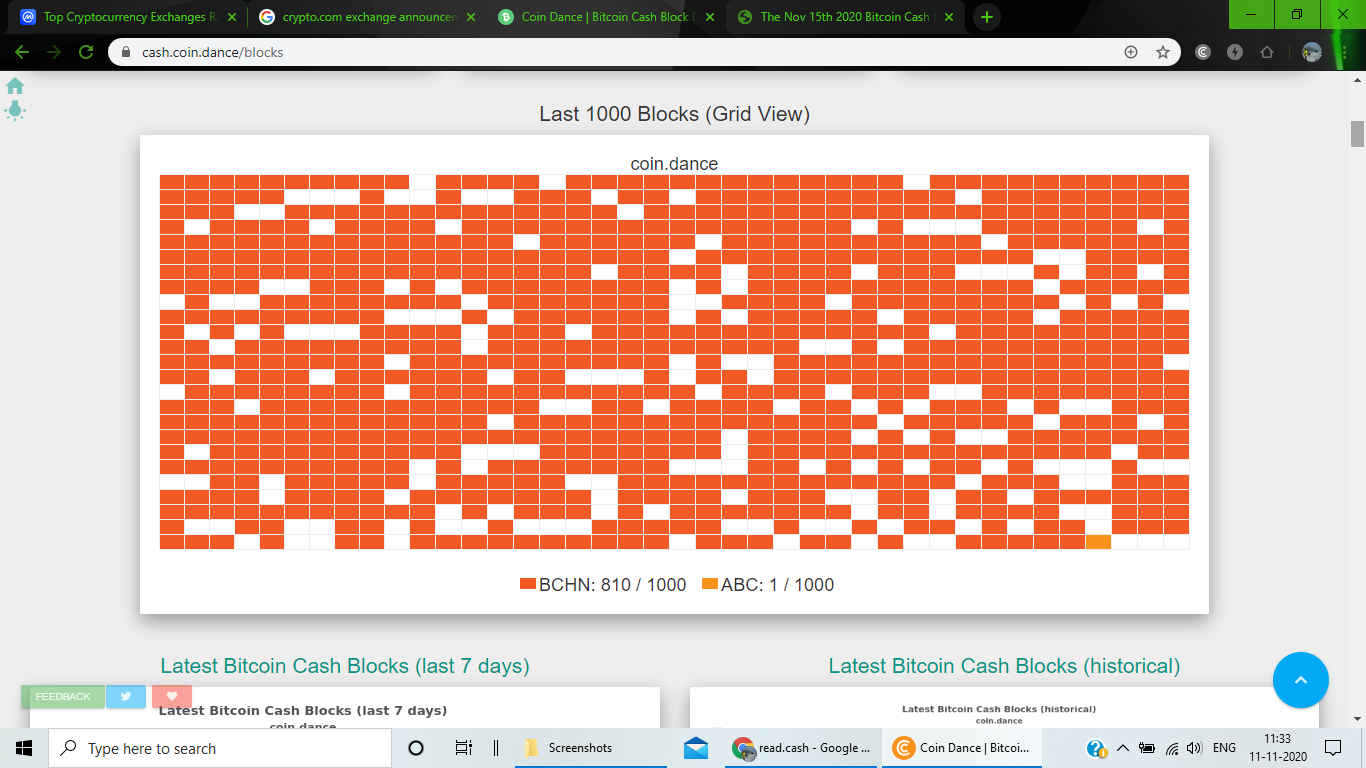
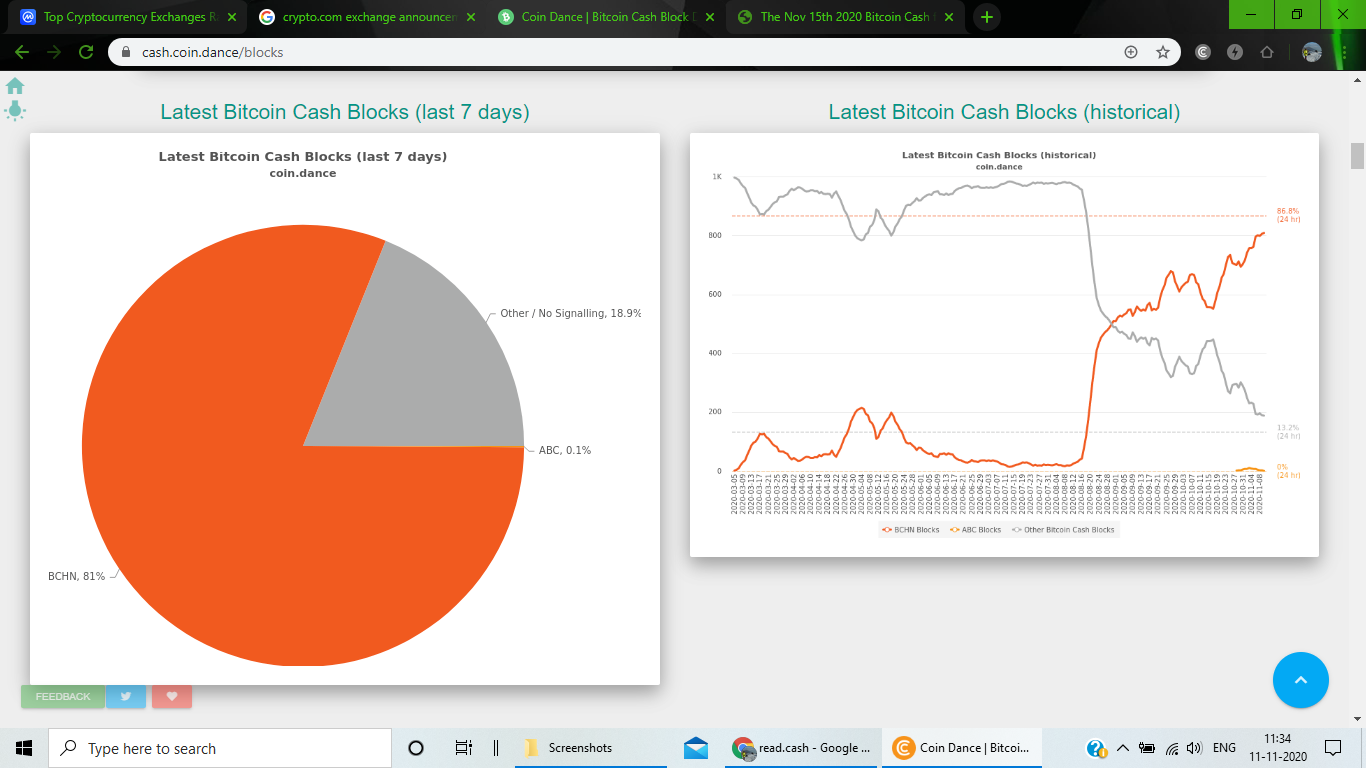
First the good news for BCH lovers, BCH ABC is getting decisively defeated:-
At the time of this screen shot today BCHN is getting 810/1000 blocks and BCH ABC only 1/1000.
MXC exchange will be supporting both the BCH coins for claiming in 1:1 ratio, if such a thing happens. here is a link to that website. https://www.mxc.com/
In fact they have enabled claiming from 31 Oct but it is as IOU. If you have BCH or BCH ABC with them then you can claim the equal proportion of the other coin. But it is only virtually as the real second coin is not launched yet. After the fork you will get the real other coin automatically if it comes into existence.
The screenshot of the announcement is here.
Here is the link to the screenshot page. https://support.mxc-exchange.com/hc/en-001/articles/360051740791
Now as per their exchange the rates of the coins after the split is given ( at the time of taking the screenshot). Here is the screenshot of it.
Here you can see that BCH has been divided into BCHN and BCHA. At the time of the screenshot the price of BCHN is showing as 229.1 USDT and the price of BCHA is showing as 22.81 USDT and the rate of BCH is 258.46 USDT. I think these rates are as per the trading going on in their exchange as they have enabled it since 31 Oct.
The link to this screenshot page is here. https://www.mxc.ai/activity/fork-conversion
Please do your own research if you want to use this exchange during the fork.
Now about Coinex
Here is what coinex is saying:
Since the Bitcoin ABC full node implementation is widely
used and recognized, it is very likely that BCH will be
split into two chains during the upgrade. One of which
will inherit the name of BCH and the other will adopt a
brand new name. If a fork occurs, all BCH holders can get
two cryptocurrencies at a 1:1 ratio.
Unlike previous forks, this potential fork may be unable
to continue due to lack of hashrate for a certain chain,
or it possibly bring about two chains but not knowing
which chain will use the name of BCH. More complexly,
this fork lacks a transaction replay protection mechanism,
which may result in considerable chaos
and users’ asset loss.
. Before the official fork on November 15, users can convert
BCH into BCHA and BCHN at a 1:1 ratio. BCHA represents the
Bitcoin ABC chain after the fork while BCHN represents the
Bitcoin Cash Node chain. Also, users can re-convert these
two forked coins into BCH at the same ratio before the fork.
We will support BCHA/BCH and BCHN/BCH markets soon, and more
markets later if needed.
2. If BCH forks into two chains on November 15, we will appoint
the chain with the highest price at the last moment before the
fork as BCH. Users who hold the forked coin of that chain can
obtain BCH at a 1:1 ratio, and BCH holders can get two different
coins at the same ratio. In the future, we will re-adjust the
naming rules based on the community consensus.
3. If Bitcoin Cash does not fork on November 15, then whichever
chain wins will inherit BCH. At the same time, we will delist
the forked coin of the other chain. Therefore, please be aware
of investment risks.
Or you can read it here. https://announcement.coinex.com/hc/en-us/articles/360050054871-Announcement-on-Preparations-of-Coming-BCH-Fork-Launch-of-Forked-Coins-Futures-Markets-
In Binance also you will get both the coins. Here is the link to its announcement.
https://www.binance.com/en/support/announcement/ade106fd65974a9982fc5a32e063d0b0
Houbi will support the fork . https://huobiglobal.zendesk.com/hc/en-us/articles/900003334546-Huobi-Global-Will-Support-The-Planned-Hard-Fork-OF-BCH-Bitcoin-Cash-
OKex notification regarding the fork. Here also you can get both the coins after fork. https://www.okex.com/support/hc/en-us/articles/360051688771-OKEx-announcement-regarding-the-BCH-fork-event#:~:text=The%20Bitcoin%20Cash%20(BCH)%20network,15%2C%202020.&text=In%20the%20event%20of%20a,assets%2C%20BCH%20ABC%20and%20BCHN.
Atomic wallet will not support both the coins. In fact BCH ABC is not listed there.
Coinbase will not support the fork and BCH ABC will not be available after the fork. Here is the link to its twitter. https://twitter.com/CoinbaseSupport/status/1324156279489622017
Upbit notice on BCH fork. https://sg.upbit.com/service_center/notice?id=2453
Kraken will support BCHN. It will only support BCH ABC if it gets at least 10 percent of the hash power of BCHN network.https://blog.kraken.com/post/6795/bitcoin-cash-hard-fork-on-november-15-what-kraken-clients-need-to-know/
Bitstamp will support BCHN. If two viable coins are created then only it will think about BCHA. https://www.bitstamp.net/article/upcoming-bitcoin-cash-hard-fork-november-15/
In Bitfinex also you can get both the coins after the fork. https://www.bitfinex.com/posts#:~:text=Bitfinex%20is%20pleased%20to%20announce,UTC%20(UNIX%20time%201605441600).&text=For%20each%20account%2C%20Bitfinex%20will,UTC%20(the%20Snapshot%20Event).
Kucoin stand on the fork. https://www.kucoin.com/news/en-announcement-regarding-the-upcoming-bitcoin-cash-hard-fork
In Gate.io also you will get both the coins after the fork. https://www.gate.io/tr/article/18258#:~:text=Duyurular%2DGate.io-,Gate.io%20Will%20Support%20Bitcoin%20Cash%20Hard%20Fork%20%26%20Take,Snapshot%20For%20Possible%20Forked%20Tokens&text=Gate.io%20will%20support%20the,algorithm%20and%20block%20reward%20adjustment.
Bittrex will support the chain with majority mining pool which at present is BCHN. It will evaluate BCHA only after the fork. https://bittrex.zendesk.com/hc/en-us/articles/360052363311-Announcement-Regarding-the-Upcoming-Bitcoin-Cash-BCH-Hard-Fork
In Liquid.com also you can get the new coin if it comes into existence. https://help.liquid.com/en/articles/4601240-bch-hard-fork
FTX exchange. It will support the minority chain only if has more than 10 percent hash power. https://help.ftx.com/hc/en-us/articles/360051906031-Announcement-for-Upcoming-BCH-Fork
Hope it helps. **DYOR**. **Also remember in exchanges you will not hold the private key**.
In this regard Telesfor sir also posted an article on Exodus wallet.https://read.cash/@Telesfor/how-to-claim-bitcoin-abc-after-the-fork-probably-the-easiest-way-c6e41ead
I would like to give an update on this, with the expectation of permission from Telesfor sir.
I got this reply from exodus on my email.
Hi Aniruddha,
Thank you for reaching out to Exodus support about the BCH fork! I'll be happy to answer your question today.
Aniruddha, it is looking likely that we will not be supporting two BCH assets in the wallet. This means that although you will still be able to claim your forked coins, you may not see the forked BCH asset in your Exodus wallet. However, at any time, you are always free to access the forked coins in a different wallet that supports it because you own your BCH private keys in Exodus.
That is the way things are looking for us right now, but if there are any changes to this, I'll be happy to send a follow up email for you to let you know.
Please also bear in mind that BCH will likely not be able to be exchanged within the wallet during the duration of the fork. There is also a risk of losing funds when you are sending/receiving BCH during that time. My personal advice is to either leave your BCH funds in your Exodus wallet until the dominant network is stable again before transacting funds, or, if you want to be transacting funds during that time, to move your funds out of the Exodus wallet beforehand.
I hope this helps to shine some light on your question. Please let me know if there is anything else that we can clarify for you.
All my best,
Nick
-I emailed atomic wallet and got this reply.
Hi there,
Thank you for your message.
In Atomic wallet, one of the BCH chains will be chosen for the further support of the coin. This decision will be made after the fork occurs. If you will have a preference for another chain, you can always import your BCH private key to the official BCH wallet and manage your coins from there. We will inform you accordingly on our plans.
I almost explained consciousness
Consciousness is a something which is perhaps the most debated topic in philosophy and now after the theory of quantum mechanics it is being debated in the scientific community also. It has been interpreted and explained in different ways in different cultures. So it is understandable that there is a lot of confusion and conflict about it. So here I will try in my own way to explain it to you. Understanding it will open up the mind to newer queries.
Suppose we take the color red as in a rose. If I ask you what color it is then you way say it is red. If I ask you why it is red then you will say it is a color of the light. A science fan will say it is an electromagnetic wave in the range of visible light frequencies; it has a frequency of around 450 terra hertz.
But is it so?
According to prevailing scientific knowledge an electromagnetic field is an electrical field and a magnetic field moving together in the space, while the strength of the fields oscillates in a certain frequency. Light is just a field exerting magnetic and electric force. By the way we do not see the light exerting force on magnets or electrical charges because the field is changing the direction of the force it exerts so rapidly that it practically cancels itself for objects on a large scale. However it certainly exerts force on the objects in the atomic level. But since light is essentially just forces of attraction and repulsion, where is the red. And if we slightly change the frequency of the wave then it will turn to blue which is a completely different experience from red.
Here some will say that the red and blue are not in the electro- magnetic waves but in the brain. The electro-magnetic wave is simply the trigger that activates through the mechanism of vision the experience of red or blue in the brain. So we can deduce from the above discussion that the experience is not the quality of the external world but rather it is inside the brain.
So now let us look for the experience in the brain. Let us take the example of a computer. It has a webcam, a CPU, a memory and a monitor. When the electromagnetic wave hits the camera, it sends analog electrical signals to the processing mechanism. The CPU transforms the signal to a digital code which is then stored in the memory. Later the processing mechanism retrieves the code from the memory and converts it in to electrical signals that reach the screen and are converted to electromagnetic waves. Can we say that the computer is experiencing red? Probably not.
The brain is not much different only it doesn’t have a monitor. The light hitting the eye turns it into electrical signals and sends it to the brain. There they are converted into other electrical or chemical signals which are actually various molecules of protein used for transferring the information in the neural channel. So where is the experience of the red or blue? Where is the taste, the pain, the love?
I hope you understand that there is nothing in this physical world that can explain the existence of experience. When we take a picture and save it in a computer it is stored in the memory, right? No, there is no image in the memory of the computer but a binary code consisting of a combination of zeroes and ones. All data whether it is picture or text is stored this way. Then how can we claim that a particular combination is a picture or text or music. That combination of numbers is neither a text or image or music, but just a code. A decoding mechanism is required to take the numbers and convert it into something else, in this case a picture. Without a decoding mechanism this combination of number is meaningless.
Similarly everything in brain, the electrical signals, the cells and neurons are serving as carrier of a code that will trigger an experience. But where is the decoding mechanism of the brain. Now the consciousness comes into play. Consciousness is like the decoding mechanism that makes the experience possible. The consciousness is the experiencer itself because there cannot be an experience without someone experiencing it. However the experiencer and the experience are different.
The consciousness is like a blank screen, and on it we project films with the projector that is the brain. The films are experiences like cold, hot, pain, love and even a picture. The viewer is the screen itself, anything projected on the screen is experienced by the viewer. The consciousness is decoding the code that is the film and experiencing whatever is projected.
Now let us look at some of the features of consciousness which can be found by self observation and logical thinking.
We cannot observe our consciousness because the consciousness is in itself the observer. It cannot observe itself as you cannot see your eyes. It can be said that the consciousness needs the mind in order to know itself.
Consciousness is constant and unchanging. As the consciousness is just like a blank screen therefore no matter what we project on the screen, the screen will not change. That means whatever we experience in life; our consciousness remains unchanged or not affected by it. The consciousness has no content of its own.
Consciousness is nothing that can become everything. When do we don’t have any consciousness – when we are in deep sleep. It is not that the consciousness is gone but just that no experience is being projected on the screen. It can be said that consciousness is nothing but a void. But it can become everything because here is nothing in this reality that is not an experience.
The human mind limits the experience of the consciousness. Our experience comes from three things- the five senses, the emotions and the thoughts. There can be other types of experiences but we don’t experience them because of the limitation of the mind. Some animals can see and hear beyond the frequency limits of humans, if we could do that then we could hear new sounds or see ultraviolet lights. Also we can only experience our inner world and not of others.
Everyone’s consciousness is the same. As consciousness is just like a blank screen so it is same for every human being and in fact for all living beings whether it is animals or birds. What distinguishes humans and other sentient beings is the structure of the mind and its content.
We are all the same. As the ‘I’ or the self is consciousness and all consciousness is the same for every sentient being of this universe so we are all identical. It is only the experiences that differ from one another. This causes the differentiation between me and you.
This was my small attempt to understand as well as explain consciousness to you.
What makes us intelligent
We have come a long way and have done a lot of things like building the particle accelerator, the rockets, to poetry and creating the Simpsons. This all have been possible by humans because we have extremely valuable thing- intelligence. It is not like our height or strength and if we try to define it then it becomes more complex. In short it can be said that intelligence is the ability to solve problems especially relating to finding food and shelter or identifying a threat and reacting to it, in all basically solving the problems of life. It is the ability to learn and gather knowledge, to have a critical thinking, be creative and plan.
It can manifest in various way, from the ones which are hardwired within us as instinct like reactions to different levels of learning to having some sort of awareness. But there is difference in opinion among scientists as to where it begins and what should be counted as intelligence. Also it becomes more complex as it is connected to consciousness, as awareness is helpful in understanding and solving problems.
So intelligence is more of a flexible set of skills. It is like intelligence tool box in which the basic tools are the **ability to gather information** from surrounding, save them and learn from it and use them later. We gather information through our five senses which helps us to navigate and react to the surrounding environment in the best possible way. It has to monitor itself also for signs of hunger and fatigue. This information collection is the basic requirement for all living things otherwise we are at the mercy of our surrounding, as we will not be able to react properly.
Information can be better utilized if it can be saved, so the second tool will be the **memory**. Memory saves us from starting to learn everything all over again. We can pull out information as and when required. Memories can be in the form of remembering events, associations and skills. Some skills have to be repeated over and over until we master it. This is called **learning**. These three traits can make dumb looking animal do things which may seem impossible for them, that is do intelligent things.
The single celled slime mold when put in a maze with food at one end and a barrier in between, it can explore its surrounding and mark the path with invisible trails. It will avoid using the same marked trail until it finds its way to the food. So instead of hitting the barrier every time, it can now use its memory to avoid repeating the same path. This is hardwired in it but scientists can’t agree whether it is intelligence or not, but it surely gives it an advantage in saving time and energy.
Bees have more adoptive behavior. Scientists experimented with bumblebees by giving them colored balls to be put in a goal post in exchange for sugar. Though this behavior was not natural to them but with practice they became more efficient in doing it. When several balls were placed then the bees chose the one which was closest to the goal post even if that ball was not of the color they were trained with.
Now take the racoons, there food is human food. They have mastered how to handle the theoretical and practical problems. In an experiment they were given boxes to open which had different types of locks like the latches, bolts, push bars etc. Within 10 attempts they figured out how to open them. They even figured out increasingly difficult combinations. Even after a year they remembered how to do it.
The most important tool is the **creativity**. It means to produce something new and valuable from unrelated things. In addition to the memories and skills it is the ability to give additional input to solve a problem. It can be like applying a new resource to complete the task. Primates’ use sticks to take out termite from narrow holes in trees or octopuses can arrange coconut shells around it as armor to protect or hide itself from predators.
Something more advanced is the ability to collect things to be used later. **Planning** means to analyze the activities that will be required to complete a particular task or solve a problem. When faced with new possibilities and unforeseen circumstances, it is the ability to assess whether it matches its plan or not. An example of this is to hoard food for later consumption. Squirrels are a master in it.
Though it may seem to be an instinctive behavior but what they do is that they examine every nut and weigh the pros and cons of the effort required to hide them. Damaged nuts are eaten right then and the nuts which are not ripe yet go to the stockpile. They also pretend as if burying nuts when being observed. This helps to deceive the other as to the location of the real treasure.
Sheep’s don’t have such tricks because they are grazers and live in flocks. Social skills are more relevant to them. They remember their fellow sheep and the master and evolving complex skills which they don’t require is a waste of resources for them.
Next is **culture** that is working together in a group for a purpose. We all know of wolves hunting in a pack. Humans are the most advanced in this field. No single person can built a rocket or a sky scraper. But our ability to share knowledge across generations and work together makes all these things possible. This way we also have the ability to create new problems like the string theory, Sudoku and tax forms on one end and antibiotic resistance and climate change on the other.
Humans through there **awareness** can look beyond the short term goals but at the distant future of the race. This puts us in the top of the pyramid.
Loneliness
We all at some point of time in our lives felt lonely. Even the most extrovert and talkative person will have a phase of loneliness in his life. When we move to a new city or a new part of a city or even a new job we may have the feeling of loneliness. In the last few decades it has become even more aggravated among us and millions are having this feeling of chronic occasional loneliness.
In a survey in UK it was found that between the age group of 18-34 about 60 percent felt the occasional loneliness; in America about 46 percent of the population have regular bouts of loneliness.
Even though we are now the most connected than any other time of history but still an increasing number of people are feeling lonely. We can feel comfortable being alone and hate being surrounded by others. If you feel lonely then you are lonely, it is a pure subjective and personal experience. The stereotype belief is that loneliness happens to introverts and those who don’t know how to talk to others. You may have social skills but still you may lack social connections. Your money, fame, power cannot protect you from loneliness because it is ingrained in your biology.
**So what is this loneliness?**
Loneliness is a bodily function just like your hunger. When you are hungry you will pay attention to it. Similarly loneliness makes you more aware of your social needs. Your social needs are the outcome of millions of years of evolution as it decided whether you will survive or not. The process of natural selection favored those ancestors who formed connection with each other. Our brains grew with each passing generation to recognize how others felt and thought and form social bonds. This way being social became a part of our biology.
The prehistoric you were born into groups of people usually between 50 to 150 and they generally stayed together for whole life. It was basically impossible to stay alone and stay safe from predators, get enough calories and care for offspring. Staying together meant survival, so it became crucial to be able to get along with others. Being eaten by a lion was not as big a threat as being excluded from a group for not being able to get social. So the body created the social pain of exclusion and rejection. It was like an early warning to change your behavior and adapt to a group. That’s why loneliness is painful. This system was working well until the new modern era came.
**The modern era**
The modern loneliness era started in the 18th century. Now the western culture started shifting towards individualism from the collectivism of the middle ages. In the industrial revolution people shifted from farming to work as workers in factories. The focus shifted from communities which had evolved for thousands of years to city life. As we got more modern with time this trend also became stronger. Today we move across cities and countries and even continents for job, education and better prospects and leave behind our social bonds.
Now we meet fewer known people face to face. The number of close friends has dropped. Now we are busy with our jobs, education, kids and entertainment that we don’t have much time to interact. And then one day we start feeling isolated, but the yearning is there. But like you others have also moved on and you wind hard to find close connections. While we feel great with our modern lifestyle bur our minds are fundamentally still thousands of years old.
**How loneliness affects us?**
The stress that comes with loneliness is an unhealthy thing. It makes us age faster, the immune system weaker; it makes the cancer deadlier and the Alzheimer’s advance faster. The troubling thing about loneliness is that once it becomes chronic then it can be a self sustaining thing. Physical pain and social pain behave the same way in our brain- it feels like a threat. So social pain triggers a defensive mechanism and goes in a self preservation mode. It will perceive everything as a threat and danger. Thought the brain gets more alert to social signals but it fails to interpret it correctly. The part of the brain that analyses others gives wrong signals. It makes you assume that others have the worst intention towards you. So you become more self-centered to protect yourself.
**What to do?**
If you think that you are feeling loneliness then the first thing to do would be to understand the vicious cycle you are in. The chronology is usually like this; the initial feeling of isolation will lead you to a feeling of sadness and tension. This will make you focus your attention to only negative interactions with other people. Now your thoughts about yourself and others turn negative. You will start avoiding social interaction which will only increase your isolation. With time it will only get more severe. You will start sitting away from others, be silent, stop or delay answering calls from your friends, avoid going to places where you are invited. Words about your behavior spreads and more people start avoiding you.
Accept you have a problem of loneliness and it is normal for everyone to feel lonely. Check what you are focusing on and identify if you are concentrating on the negative ones. Think impartially whether the interaction was actually negative or you are giving it a negative color. Assume that the world is not against you. If you are not able to decide then do take professional help. It surely deserves more attention.
Humans have created an amazing world but this is not a substitute to the biological needs of connection which have evolved through thousands of years.
Size matters in life
Imagine we take mice, a cat and an elephant and throw them from the top of a skyscraper on a stack of mattresses. The mice will fall, feel stunned and then shake the body and walk away. The cat will break all his bones and die. The elephant will explode and spray out all its guts and blood on the unlucky few pedestrians.
So how did the mice live while it killed the other two? Size matters. Big is not always better.
Size determines a lot for us, how we are built, how we live and experience the world and also how we die. This is because the physical laws apply differently for different sized animals. Life as we see around and also the ones we don’t see comes in different sizes. It ranges from the invisible bacteria to ant to mice to dog to humans, tigers, elephants, sharks and the blue whale. Each size has its own unique place, its upside and downside.
Now let’s see how the mice survived. That is because how scaling size affects everything. Very small size is practically immune to falling from heights because you won’t have to care much about the gravity. Imagine an imaginary animal which is spherical and is of the size of a marble. It has three features – its surface area which is the skin, the length and the volume with all the organs inside it.
Now imagine if we make it the size of a basketball, that doesn’t mean all its features grew 10 times. The skin will grow a hundred times and its volume will grow a thousand times. This volume is actually the mass of the animal. The more the mass the higher will be the kinetic energy while falling and stronger will be the impact. The more surface area you have in proportion to your volume, the better your chances of survival as your impact gets distributed and softened. The air resistance will also slow you down more.
The elephant has less surface area compared to its volume therefore a lot of kinetic energy is concentrated a small space resulting in such an explosive death. Now comparing it with insect’s, they have a high surface area and very less volume.
But there are other forces which can be harmful to the tiny world but normal for us. I am talking about surface tension. It is a deadly threat to insects. Water tends to stick to itself as its molecules attract each other – it’s called cohesion. It creates tension on the surface just as an invisible skin. For humans this invisible skin is weak and we hardly notice it. When we are wet about 1 percent of our body weight in the form of water sticks to us, but for a wet mouse about 10 percent of its body weight sticks to it. So imagine as if 10 full water bottles are sticking to you when you are coming out of swimming pool. For insect’s, the surface tension is so great that it becomes a question of life and death.
If you are shrunk to the size of an insect then the water will seem to you as glue and will quickly engulf you and you will drown. So nature made them water repellent, some insects have developed a thin layer on wax on the surface to make it partially water repellent. Many insects have developed hairs which increase their surface area. This prevents the water droplets from touching there exoskeleton and therefore makes it easier to get rid of water. Some insects have developed very short and dense layer of water repelling hair/fur, which can be as dense as a million hairs per square millimeter. When they get into water, the water cannot cross the hair barrier. Something amazing happens next, as the oxygen between the hairs run out, the carbon dioxide defuses out and new oxygen defuses in. The insect carries an outside lung so it can swim underwater.
The smaller you get, at some point even air feels like solid. Let’s get down to the level of the fairy fly which is only 0.15 millimeter long. It’s a weird world at that scale. The air seems like a thin jelly or like syrup like soup always surrounding them. Flying is not easy for them, they have to grab onto the air with their wings and literally swim in the air. Evolution had to work through billions of years to come to the optimal solution.
So why don’t we find ants of the size of horses or elephants of the size of amoeba.
Let us imagine we shrink an elephant to the size of a mouse and enlarge a mouse to the size of an elephant. The tiny elephant will be dead in minutes. The giant mouse will also die. Our body is optimized to function at a particular size range otherwise it is sure death. But why?
Life if dependent on cells and are actually pretty similar across all life forms. The blue whale and the crow have the same cell size, the only difference being the number of cells. Cells have to work hard and therefore need a lot of energy. This energy is sourced from the food we eat and oxygen to make it to usable chemical energy. This process happens in the mitochondria which is the powerhouse of the cell. They are like little power stations spitting out small batteries that can be used by the cell to do everything it needs to do. The mitochondria get hot while working and the skin cells of humans can get up to fifty degree Celsius. Some cells have up to 2000 mitochondria so you can imagine how much heat it produces. So all life forms produce a lot of heat to stay alive and with more number of cells, more will be the heat. The body has to look for ways to let out this heat or it will be cooked from inside. This is the problem of bigger animals.
In this context animals have three properties – the length, the skin and the internal organs and what is inside. When things grow, the insides grow faster than the outside. This is the problem of bigger animals because the heat can only be released through the surface. The giant mouse will have 3600 times more surface to lose heat but has 216,000 times more volume. This means a lot more on the inside and less on the outside so the giant mouse will die quickly( more heat produced inside and less surface to get rid of it). Then how do big animals lose heat. The elephant has big ears to increase the surface area for heat to escape. But it is not sufficient, and nature found a way out. Elephant cells work much slower than the mouse cells. In bigger animals the cells work just enough to function properly so the metabolism is slow.
The small animals work just the opposite. The Etruscan shrew is the smallest mammal. It has a length of 4 cms and weighs just 108 grams so it would cool off very fast so its cells run in hyper mode to stay warm. It has a heartbeat of 1200 times per minute and breathes 800 times a minute. So it has to eat a lot to keep the cells working and therefore has a high metabolic rate. So if an elephant works on the principle of shrew then so much heat will be produced that the fluids inside will start boiling and the elephant will explode.
The baby in the womb is more a part of the body’s organ than an individual and has the similar speed of life that of the mother. But when it comes out a switch is flipped by nature and all its internal processes speed up to function independently. 36 hours after birth a baby’s cells work in the same speed as that of any mammal of its size.
But in one thing the big and the small are similar, that is heart beat. All mammals have almost similar number of heart beats that is about one billion. So though these two mammals function completely differently but they are also similar in one way.
Our evolutionary journey
So what is evolution?
Evolution is the process of development of life on earth. The process which started billions of years ago is still continuing till today. Evolution tells us how this process of such diversification of life developed. It is because of evolution that the primitive protozoa became so many different species we see today and also the ones that are already extinct. It is the answer to why we see the cat and the dog together in our neighborhood.
But how is it possible that from the same ancestors we as the descendants look so different? We will focus on the animals and exclude the fungi and plants. The first question that arises is how it is possible for one animal to develop into a new species of animal.
**But first let us see what a species is?**
It is a group of similar animals that has the capability to produce offspring’s by mating and to continue this process one generation to the next. The **uniqueness** of a creature can only be guaranteed by excess production of offspring’s and **heredity** and the process of **selection**.
**Uniqueness.** Every creature is unique and this is important for evolution. The members of a particular species will have almost similar appearances but the traits and characteristics will differ slightly. One may be bigger, the other may be smaller, and another may be fatter than their fellow animals. What is the reason for these differences? Every creature on this earth is made up of cells and each cell has a nucleus which in turn hold the chromosomes and which in turn hold the DNA. DNA has the genes which are the information carriers of life as it carries all the instructions for the cells which in overall determine the characteristics and traits of that particular animal. Everyone has its unique DNA that’s why each of us is slightly different.
This amounts to an enormous range or variety of DNA’s. When humans were 1 billion in population then there were so many different range of unique DNA and now with more than 7 billion, the range of DNA is also increasing. One key factor is the excess production of offspring’s. More the offspring, more the variety of DNA. In nature we notice that every animal produces more offspring than required for the survival of its species and many of these offspring’s die in young age. With more offspring there are more little differences from one to another. This is what nature demands – many offspring’s with as many small differences as possible.
**Heredity.** It means the passing of DNA to the offspring. This process involves *recombination* and *mutation*. When two creatures mate they recombine their genes two times. The first time it happens in the individual body in the sperm and end cells. The sperm and egg cells take half of their genes and shuffle them that is each sperm and egg is carrying 50 percent of the traits of its host. The second time it happens in the process of mating when the male inseminate the female. In mating when the sperm and egg meets it completes the 100 percent and thereby producing a unique offspring. So now the new offspring has a random mix of DNA giving it its unique characteristics and traits taken from the parents. This increases the diversity within the species.
Mutation is also important that makes random changes in the DNA. It can be due to radiation or harmful chemicals. So in a life time the mutation of DNA can occur and its effect is mostly harmful like causing diseases. It can also have other neutral effects like the blue eyes.
All these processes are random.
**Selection.** Environmental factors like predators, toxins, habitat, climate and parasites have effect on living creatures. Every individual creature is subjected to the selection process. The uniqueness of individual creature decides its surviving the environment or not surviving it. Anyone with an unsuitable mix will be weeded out. The right mix will help them survive and give the opportunity to pass on their genes. This is the reason diversity of creature is important and for this reason creatures produce more offspring as possible. This increases the chance of at least one offspring pass on the nature’s selection process. The chances of survival of that species are maximized.
The following real story will make things clearer as to how this whole process works:-
A few centuries ago a group of finches (a particular kind of bird) were most probably blown by a storm from their original habitat to a group of island in Galapagos in the Pacific Ocean. Now they were in a new environment where they had enough food source and no predators to be afraid of. So they reproduced rapidly but it also resulted in the food supply getting scarce. This is where selection process intervened. Their uniqueness were in there beaks. Some had beaks which were suitable for digging worms out of the earth and some were suitable for breaking seeds. Soon they started to mate with their own specialty type. Over many generations these different characteristics got enhanced and led to the evolution a new species of finches. Now there are 14 different species, all descendants of the first group of stranded finches.
Why is it important? Because it tell us how so many varieties of species developed that are adopted to their environment. Every species including you have gone through 3.5 billion years of evolution. Our ancestors fought and adopted to survive, but it was an extremely uncertain thing. You are the part of the success story considering that about 99 percent of all the species are extinct.
The dinosaurs are extinct but you are alive reading this boring article because you are super special- just like all other creatures you see around you. We are unique in the universe until we get weeded out by any of the process mentioned above.
A conversation with God
The meeting in the office as usual ran late into the night. It was 9 PM already and I was clearing my desk as I had to rush to home. It is a 1 hour drive. The weather was particularly bad and was snowing for the last 2 hours. Anyway I rushed to the car park and was on my way home. The snow did not make things easy and I was driving slower than usual. Meanwhile my wife called me and I said I am on my way and will be back in another 40 minutes. I hung up and again concentrated on my journey, but my mind was still thinking about the meeting. It went good and my presentation was appreciated by all. With the yearly appraisals coming I was expecting a promotion. I was feeling happy.
Suddenly I saw a truck coming from opposite direction and it was skidding on the snow. With its light on high beam I was almost getting blinded. I parked my car on the road side to let it pass but it seemed to be out of control and hit my car. My car was pushed down the gorge and I killed in the accident.
Me: what happened, where am I, what place is this?
God: You died
Me: there was a truck coming at me and it was skidding...
God: Yes, it killed you. But don’t feel bad about it, everyone dies someday.
I looked around but it was all like nothingness, only me and it. It was dark but at the same time bright also.
Me: Where am I now and is this the afterlife?
God: You mat say so.
Me: Are you the god?
God: Yes I am what you call on earth as God.
Me: What about my wife and kids, will they be alright?
God: You just died and your main concern is your family. That is nice. Don’t worry, they will be fine, everyone left behind ultimately manages to move forward. Your son will remember you as a perfect father; he didn’t have time to be contemptuous of you. Your wife will cry but will be secretly relieved as your marriage was already falling apart.
Me: So what happens now? Where will you send me – to heaven or hell?
God: No heaven or hell, you will be going back for a new life.
Me: So I will be reincarnated, what the religions say is correct.
God: All religions have their own way of saying this.
Me: what is the point if I get reincarnated as a baby; all my past experiences and memories are gone and won’t matter anymore.
God: not so, all the experiences and knowledge of your past lives will always be within you. It’s just that you don’t remember them. Your soul is so magnificent and gigantic, but your mind can only contain a tiny part of it. It’s like testing if the water is hot or cold by putting a finger into it. You put a small part of you into the consciousness and when you come out, you have all the experiences gained by that small part of you. You lived for 50 years so you haven’t fully experienced your full consciousness. If you hang on to your consciousness for a long time then you will remember all your past lives and experiences.
Me: Then how many births did I have?
God: lots and lots of times and this time you will go back as a Japanese peasant girl in 600AD.
Me: what!! You will be sending me back in time?
God: Technically yes as per you understand time. But it is different from where I come from.
Me: wait, where do you come from?
God: I come from somewhere else, and there are others like me too. You must be curious about what it is like there from where I come, but you will not understand it.
Me: If you are sending me back in time then at some point of time I would have interacted with me also.
God: Yes and it happens all the time, but you won’t know it as you have only your current lives memory.
Me: then why do you do it?
God: the reason I made you and the meaning of this universe is for you to mature.
Me: by you, you mean mankind?
God: no, just you. With each life you grow your intellect and mature a some more.
Me: why only me, what about others?
God: There is no one else but you in this universe, well just you and me.
Me: That means I am everyone in different reincarnations.
God: yes, you are every human being who ever lived and will ever live. You are George Washington, you are Hitler and you are Jesus and you are Buddha. You are the one who did the best and the worst for mankind. You gave sermons as Buddha and it was you who listened to those sermons as the follower. Every time you fought with someone, you fought with yourself. Every time you helped someone, you were helping yourself. It is only you and no one else
Me: why do you do all this, which we don’t understand?
God: That’s because someday you are also destined to be something like me, because we are my kind.
Me: you mean I am god?
God: You have a long way to go before you become me. Once you have lived all the lives through all the time then you will be grown enough to be born. Now you are just like a fetus.
Me: So the whole universe is just like an egg and we are still the unborn.
God: Now it’s time for you to move on for you next life, we will meet again but you won’t remember this meeting. We have been having this conversation every time and will have it again so many times.
Me: but wait, I have so much to ask, the people down there are so much confused.
God: In time you will have all the answers. It will come from within you.


The art of giving and receiving
We are better givers than receivers. When we give something to our children or spouse or even strangers we feel good. It gives us a feeling of doing something good, making someone happy. On the road junction if we help an old person cross it, it gives us a strange happiness of helping someone in need. More often than not it gives a feeling of being strong, capable, proud and empowered.
But when it comes to receive then we are hesitant. We feel that we are weak. It is normal because we have been brought up that way. But when we receive a complement for a nice dress we have put on, we enjoy that complement. And if that same old person thanks you for helping him cross the road, your most likely answer would be ‘oh, it was nothing’. Asking for help is not a sign of weakness, but when we receive it with gratitude then we are giving something back to the giver also.
Receiving is difficult because we have to accept in you that we need help. We are not used to it. It can make us uncomfortable especially in young age. To be a good receiver you have to allow another person in your life and space even if that is for a moment only. It is a pleasure to be with a good receiver because then you see how they appreciate and reciprocate by honoring the giver. It is a thing to learn. We should not deprive the receiver from showing his gratitude.
Many relations suffer not because they are not giving each other enough but because they are not receiving it. It should not be taken for granted. But once we acknowledge the love, help and complements we receive then it creates a strong sense of bonding. We have to master the art of receiving and not behave as if we are busy or preoccupied with something else.
It is not that we do not like receiving. We also like receiving gifts, joy, pleasure and surprises and we do appreciate the giver. If we think that it is better to give than to receive that means we are not thinking it correctly. It reflects our insecurity of showing our self weak and needy. But giving more does not mean that we should receive more also. As for you receiving something may be difficult so can be with others also. Don’t let your ego come in between. If you are giving it with the expectation of receiving something back then the whole purpose of your act of giving is wasted. Then it would be more of a deal than an act of love, kindness and compassion.
There is a difference between giving and receiving, and doing and taking. When we feel that we are only giving and not getting back anything that means we are actually doing it and not giving it. It can be either you are expecting to receive something or you are not allowing yourself to receive something. In both cases your purpose of giving is wrong. If you are expecting something in return that means you are in the ‘give and take’ mode. If you are not allowing yourself to receive something then you are in the ‘pride’ of giving mode. Both the case is wrong. A good giver has to learn to be a good receiver also otherwise you are depriving the receiver.
The world is functioning on giving and receiving. When we breathe in we are receiving the oxygen and when we exhale we are giving out carbon dioxide. The plants are receiving the carbon dioxide and using it with sunlight to grow and give us crops and fruits. In return it gives oxygen which we again receive. Now think can you just take in the oxygen and hold your breath for eternity. You cannot or else you will die. You will have to give something against what you have received.
Similarly you have to be a giver and a receiver. Always be a god receiver also and let the gratitude and blessings nourish you. Receive generously and show your appreciation on every occasion. This is the alchemy of the art of giving and receiving.
The only time I wrote an article in two parts- Balancing life -and both the articles have been bypassed by random rewarder. Its more than a week but no reward of any kind. Lesson learnt for me - random rewarder has difficulty understanding articles in parts so don't write article as part 1 and part 2....
What is good and what is bad?
We often say that a certain person is good and another person is bad, or a certain thing that is happening to us is good or bad, it is a form of judging. But how do we determine how a person or thing is bad or good and is there anything at all that is absolutely good or bad? What is the essence of good and bad and what determines them?
We can easily see that when something happens to us which serves our goals or desires, we call it a good thing. When we earn money we say it is good as it is a part of our goal. When something happens that goes against our goals or desires we call it a bad thing. If someone calls me an idiot I will feel bad and offended. Like everyone I have an interest in feeling good and avoid suffering. Goal is not just the conscious goal but any need or desire or interest, whether conscious or unconscious.
When we call a certain person bad that means he does something or behaves in a way that goes against our own interest. We say a thief in our neighborhood as bad because he may steal our property, but what about a thief in another part of the world. We will also call him bad. So does our sense of good and bad transcends our personal interest? Not really. We may feel compassion for poor people in general as we do not want anyone to suffer. In this case our interest or goal is to prevent suffering and anyone who does something against this cause that is creates suffering as in the case of stealing is bad for us. Or we may have a moral belief that one should not steal and we want all people to behave that way. So we have an interest that all people should behave according to our belief. If we did not care about stealing then we would not call a thief a bad man.
Now think of the leader of your country, you might think he is bad because he has raised taxes which shrinks your income. Or he has invested the states resources in industry whereas you think he should have invested in education. From the leader’s point of view and the people who follow him, he is good leader because the raised taxes will balance the state’s budget and the industry will create more jobs. So is he a good leader or bad leader? We will see that whether a person is good or bad is based on our personal perspective.
This means there isn’t such a thing as absolute good or bad. It is always relative.
But isn’t killing absolutely bad? In that case all humans and animals are bad because we kill plants and animals to feed ourselves. Is killing as an act of self defence is bad or euthanasia or abortions are always bad no matter what the circumstances? There is nothing absolutely bad. Likewise there is nothing as absolute good.
Imagine country which has a perfect leader who will only do good things. Can he do a thing which everybody will say a good thing? There will always be someone or a group of people who will find something wrong in it, fully or partially. I haven’t found anything. My conclusion is that the good and the bad, they themselves do not exist. It only exists in relation to a goal or interest.
But if interest decides what is good or bad then how can we explain things that are both good and bad at the same time. A simple example would be eating ice cream. Few things are better than it but at the same time it is bad because it is unhealthy and makes us fat. To understand it we have to examine the thing which we call ‘I’. We consider ourselves as a single entity because we have one name, one body and one brain. But this brain holds many numbers of different mental entities, holding different views and interests which sometimes can be contradictory.
Do you think that the part of us that wants to eat ice cream and the part of us that wants to lose weight are the same? In fact when we do something it means that the part of me that perceives this thing as good is stronger than the part that perceives it as bad at that moment. The interest to do something must be stronger than the interest not to do it, otherwise we won’t do it. The conclusion comes that we actually cannot do anything bad.
But what about criminal who kill and steal? Don’t they think they are doing a bad thing? Speaking relatively they don’t. They may think that this society is corrupt because of it my life is hell so I will do whatever I want. Or he may be jobless and have a family to feed. He will have a full justification for killing or stealing. He may say that he was unaware of it or he had no choice of it or it was an involuntary act. For him the part of him that thought it was good outweighed the part that though it was bad. Think of the most cruel men in the world, do you think they were intentionally doing bad things? No, they were thinking they were doing some higher good to the world or their country. So were Hitler and Bin Laden bad, yes for me and most of the people but still you will find people now who think they did good.
Now, what about people who intentionally do bad things. Such people are confused. They think what is bad to be good because it makes them the feel brave and strong. It is as per their understanding. Nobody ever does something bad on purpose. Everybody do a thing which they consider it as good from their point of view.
So should be love people who are bad for us like thieves and murderers. The answer is within the words – for us. What is your goal, what is good for you or all in general? Do you want to keep your property safe from stealing or do you want a society free of crime and killing. Catch the criminals and put them in jail if that is what is good for you. The more the level of awareness grows the more you will understand the interdependence of people in a society. Your concept of personal good will take into account others people as well. It is not that you or a group of people are good and the rest are bad, it is based on own goals and interest.
There is so much conflict in this world, fighting between countries, within the society and at individual level. We believe what we are doing is good and whoever is doing differently is bad. When we make such artificial distinction between two we end up fighting to destroy what we consider as bad. Once you stop defining the other people as bad you will stop hating them. That doesn’t mean you will support them but you will find other ways to convince them what you feel is good.
So if there are no absolute good and bad and all is from our personal interest then doesn’t it make our interest to make the society and the world a better place meaningless? This doesn’t mean that most people in the world have no common personal interests. Most people want to live in freedom, security, love etc and for this reason we have made laws which is as per the common interest of most of us.
Being average is not a bad thing
This man is what every average man including me would envy. He is a inventor, innovator, entrepreneur and obviously a billionaire. He is athletic and super fit and handsome to the extreme. He has a fleet of extreme cars, yacht and lives in a palatial mansion. HE can change super model girlfriends like changing his shirt. He is a philanthropist and when he is not saving the poor and downtrodden, he is then helping charities with millions in donation. The man is Bruce Wayne, your friendly Batman.
Such fictional characters are created because of the need of a hero who is the embodiment of perfection, everything we desire to have and be. Every human culture has such type of figures, the gallant knight killing dragons, and great warriors defeating the enemy singlehandedly and rescuing the princess. Such fictional characters are always doing what is right, no matter what. We conjured up these fictional characters to cope up with the feeling of powerlessness within ourselves. These things have come up in our comic strips and the whole commercial movie industry is cashing on it for around a hundred years.
But wait, then does being and average mediocre person sucks. If there are 7.2 billion people on earth and at any point of time only about a 1000 people enjoy some sort of worldwide influence. That means to rest has to be satisfied with the limited scope of their life and whatever we may do will not affect any significant majority. Our life and death will go unnoticed.
Around 65 percent of the population have average qualities be it intelligence, memory, happiness, creativity and leadership potential to name a few. But most will rate them above average, because if we tell someone that he is average then most likely he will take it as an insult. The need to be unique is steadily rising among the people in the last 50-70 years. It is a type of narcissist symptom. A study has shown that in the 1950s 12 percent students considered themselves to be important, this increased to 80 percent in the 1980s. And now people will prefer to be unique in a bad way than normal in a good way.
But being average is not a bad thing. You can avoid major physical and psychological illness by being average. Desirable qualities like ambition, confidence and sociability can be problematic when taken to the extreme. You can see cases where ambition becomes greed, sociability turns to show-off and confidence turns to arrogance. These can lead to self centric thinking and selfishness. Your average qualities are far better than the overconfident delusion.
At a more basic level of genetics, life experiences and social upbringing we are all unique in our own way but the self help industry will try to sell this same uniqueness to you, ‘to be yourself’ which is quite comic. The consumerist society now glorifies this nonconformist and unconventionality, but it is all a decoy to nudge people into doing things, thinking and buying things. They try to exploit this hidden desire for being special in all of us.
We need to understand that other than fictional characters, everyone is pretty average. Those who excel are excellent in one or two fields only. Some may be good in math, some may be a great athlete or a businessman, but in all other aspects they as much average as the majority are. We have to dedicate time and energy in a particular field to excel and as we have limited time and energy so we can excel in only a limited number of field, mostly one. Then there is genetics and what we call in born ability which is random. So there will be still a difference between those achieving greater heights because of their inborn quality than those slogging hard in that field.
Brilliant athletes may be a total jerk in real life, extraordinary businessman may have serious family issues and celebrity whom people follow in every step may be clueless about life. The world is actually optimized for mediocrity. The exceptional 1 percent may be defining things but it is the rest 99 percent who are actually making them exceptional. If the 1 percent invents and innovates then it is the 99 percent who bring it to the masses through their hard work and effort. A bulb invented by Edison reaches our house because of the 99 percent, so their role cannot be undermined.
But mediocrity can be a result but not the goal. When we make effort to be someone special and unique and fail, it is acceptable, but that does not mean we should not try. When we stop trying then we make it our goal to be mediocre. Few accept this. There is only place for few in the top slot. For a Messi, a million kids are slogging in the parks with football- for a Tolstoy an million like me are scribbling our thoughts.
This generation of internet and social media focuses only on the top slot. That’s what drives the rest of us to have a pie of it. We are busy viewing the best of the best, the worst of the worst, the greatest feats and the scariest threats. It is a form of social tyranny which is pushing people to the edge, as if other than that life would be a failure. That’s why now people are using the good and the bad side of it to be that someone exceptional. We look for shortcuts to reach there, and forget that a 30 second video of a mountaineer standing on top of Everest has taken years of training and hard work.
Once we disconnect the word failure and mediocrity and seek fulfilment and appreciation in small things in life – then the feeling of anxiety and inadequacy will evaporate. This will free you from the feeling of a mundane existence and can push you to do something extraordinary without the baggage of judgement and lofty expectation.
Who am I?
At some point of time we all wonder who we really are. Today I will try to tackle this eternal question in my way. We think that it is a philosophical question and is really not answerable as ‘I’ is an abstract question. It is not a real thing but a product of our mind. As a matter of fact ‘I’ is not a made up concept but the most real thing in our life if not the only real thing in our life.
If I ask you who are you then you will say I am John or Peter or whatever is your **name**. But if I say that no you are Tom then also you will remain the same you. You would certainly reply that off course I will be the same as my name is only a reference, I am a human being. You will be right is saying that because we are human being, in other words a biological organism, I am my body.
But why do we limit ourselves to the **body**. Suppose I am going in a car, then why will I not say that I am the car? That’s because when I get out of the car I am still what I am. If the car ceases to exist then also I exist. That means the thing which is me must be constant wherever I am. I am where my body is.
Or is it?
Say suppose I cut my nails and hair, am I losing some part of me? Or suppose I take something bigger, I lose my legs and arms and have a transplant of all possible organs that can be transplanted like kidney, liver, heart etc. Am I then still what I am. If you ask me then I will say I am still what I was. It would mean that those organs were mine but I was not me. That would mean that the ‘I’ is not my body as I am still there without most of it.
So if I am not the body then I must be my **mind**. The mind is composed of three things or we can say impulses that come to us either from the memory or our present perceptions. First is the sensation that come from our 5 senses, and then are the emotions like anger, fear, happiness, love etc and then are the thoughts which is basically blah blah blah. These three mix to form our personality.
We can consider ourselves as our mind. But these three impulses keep on changing all the time. Now I am feeling a sensation of pain because I pricked my finger with a needle, but when I stop pricking then the feeling of pain is gone. So is with the other senses. My girl friend loves me so I am feeling happy but if the next moment she leaves me then I will immediately feel sad or angry. And what to say about our thoughts, they are changing every moment. Remember we concluded that that I must be constant to be me. If I am changing as per the sensations or emotions or thoughts then how can it be me? A combination of all these three which makes our personality but it also changes with time from a baby to teenager to adult to old age. So these impulses are happening to me but I am not these impulses.
Now let me make 3 statements which we very routinely make.
I am feeling hot
I experience joy
I hear my thoughts
What is happening is that the ‘I’ is separate from the thought or emotion or the sensation. The ‘I’ is experiencing this impulse that is, ‘I’ is the observer or witness or the experiencer to these impulses. So I am neither the body nor the mind. So now we have to look somewhere else. Let’s go deeper.
Behind the mind there is another layer which we call the layer of awareness or experience. Now let us do a small thought experience. Imagine a car in your mind, it doesn’t matter if you can imagine a clear image or a blurred image, but surely you will form an image of a car. Now ask yourself these two questions:
Who sees the image?
What is the thing that sees the image?
Take a few moments and think the answer.
If I ask you who sees the image, your answer will be very simple -I see the image.
What is the thing that sees the image?- it is surely not an emotion or a sensation, nor is it a thought. The car is a thought, but what is the thing that sees the car – it is an observer or an experiencer that is experiencing the thought of a car. So the mind that is projecting the thought of a car and the thing that is experiencing that thought are not the same. The word that is commonly used for this observer or the experiencer or this awareness is **consciousness**. So the consciousness is the capacity to experience or the capacity to be aware of something.
Now I will touch upon the tricky part, am I my **brain**?
Suppose I and you physically interchange our brains. So now I am having my body but your brain, and you are having your body and my brain. Your body is experiencing my memories, experience and personality, and my body is experiencing yours. If I was given the choice who am I, then I would surely say that I am where my brain is. If both of us are put in a torture chamber then I would surely say and so would you that, torture what used to be my body that is you and not where my brain is now. The sensations will be felt by my body and your brain but not my brain and your body. So the ‘I’ resides where my brain resides.
Let’s take it a further. Suppose we don’t interchange the brain physically but only the data in the brain is interchanged. The data in the brain is just swapped between you and me. So now it is my body, my brain but your data. For you it is your body, your brain and my data. In the same torture chamber I would say and so would you that, torture my body, my brain but your data. It is the data which will be experiencing the pain and not the brain and body in itself.
Remember what we concluded before, I am constant wherever I am. As per this I am where my brain data is. So I am where my impulses and experiences are.
Let’s go a further. Now my brain data is copied in two other brains. So I am now having the same memories and experiences in 3 places, my original me and two other copies of me. Now, all three are indistinguishable, except for the physical appearances. Now all of them will say torture the other two. Though the brain data is same but the experience will be coming from the body. Or will I also experience the pain when the other two are being tortured, most likely not. As it is in the realms of science fiction till now so nothing can be said for sure.
This does not make the ‘I’ is the brain data.
Let us look at it in a different way. It can be that the ‘I’ is the product of the brain or it is carried within the brain. It is just like the body is yours but it is not you, likewise the brain is yours but you are not the brain. It is like the difference between the hardware and the software. The software cannot be the brain data because the software only processes the input data. The data must be somewhere else. The ‘I’ can be separate from the brain and the brain is only the device through which the ‘I’ manifests itself. It can be like a radio signal; the brain captures the signal and produces the output. If the brain is destroyed that does not mean that the signal is destroyed.
There are many parts of the brain that doesn’t have to do with anything consciousness, like the parts that control the digestion, heart, muscles, feeling, thinking etc. If we remove all the parts of the brain that are not necessary for the consciousness then only a small part of the brain or a small group of cells may be left that deals with it. But are those small groups of cells what we call consciousness or does it help in manifesting consciousness.
We may never know the answer as to whether consciousness is just a function of our neural structures or they are just an antenna that allows the body to connect to the consciousness.
(I am not connecting it with anything spiritual, or religious or philosophical or scientific but a logical discussion and conclusion.)
The lemonade stand and the American dream
Imagine that you are a young boy in fairy land. One day you decide to sell lemonade. So you take out a table from your home and place it by the road, you buy some lemons and sugar, get water, ice and glasses from home. On a card board you write Lemonade 50 cents.
Your shop is ready and on the first day you get 3 customer, the next day you get 5 and your customers keep in increasing. Within a month your business is going on very well with lots of customers every day. To top it all the cost of lemons has come down, now you get 5 lemons to a dollar instead of 3. Now you are a making a lot of money out of lemons.
Seeing you other kids of your neighborhood start their own lemonade shop. You don’t mind as business is flourishing and there is space for more shops. As a magic new people keep showing up for lemonade and the price of lemons keep dropping. The kids realize that it is impossible not to make money here. Only the lazy and incompetent types won’t take this opportunity. Slowly a culture develops in the community. Many are selling lemonades 12 hours a day and the others one cannot able to sell even for 6 hours. The people create narratives about the successful ones and the not so successful ones.
The kids get the message- you get what you deserve or you deserve what you get. If they want to get something then they will have to work harder or smarter.
As time goes by the word spreads of this magical lemonade neighborhood and customers keep coming from far off places. Kids from other neighborhood come and set up shops here. The kids believe that this place is something special, the neighborhood of opportunities.
But slowly things start to change. Some Japanese kids have developed something that gives double the lemon juice from each lemon. Some poor Chinese immigrant kids are undercutting the price to get more customers. Now the successful vendors are buying the less successful ones. So now there are a few dozen rich owners instead of hundreds of independent owners. These rich owners now, to cut cost are paying lesser wages to the workers.
Slowly it becomes obvious that they are earning lesser money than before though they are working harder. The law of diminishing marginal return sets it. The economic reality sets it but the beliefs and culture developed so far stays the same. So now the blame game starts as belief overshadows the reality. The bigger kid owners blamed the small owners for the misfortune. The hardworking small owners blamed the rich kid owners for high jacking the business. So this way the battle lines were drawn between factions. The assumptions remained, though the world had changed.
The above story sums up the dream of the lemonade land of opportunity- American dream.
**The land of exceptional**
For long the Americans thought themselves as exceptional. For 300 years people magically reached the dreamland. Whereas other parts of the world went through various ups and downs during the period, America with its well educated and industrious people, vast land and natural resources and being bound by two oceans, were protected from the consequences of what was happening outside of it.
By virtue of the fortunes of this unlimited land, cheap labor, unlimited innovation and geographic isolation, the American dream was created. The American dream is simple to explain. Anyone can be successful with hard work, determination and ingenuity- and only success matters.
The stagnation of that dream has been silently undercutting the dream but was not recognized. Most statistical analysis points out that the present generation is worse off than the previous generations. The older generations blame the new ones for being too self centric, but that is not the full truth. The present generation the most educated and productive but they are also the most underemployed or unemployed because there are very less jobs for the middle class. Now about 25 percent of young people with a college degree are without jobs or are not looking for any.
What was the strength earlier is now becoming its weakness.
No more land. As America started to run out of land it started attacking other countries like Philippines, Cuba, and Guam. After the world wars it realized that there is no need to conquer other lands. During the cold war era, it just lends its money to poor countries and bought stuffs real cheap. It was a type of extortion- you open up trade for us, let our corporations work from there and use your resources and cheap manpower or get shut out form the world and stay poor. This worked for many years as many countries accepted it and in return America promised to protect them from communism. But slowly these economies also developed and now are no more willing to be exploited easily.
As education and living standards improved, America was not a land of cheap labor. The big corporations shifted their base outside America and took advantage of the cheap resources and labor there. The American niche is now limited to defense, aviation and IT.
With innovation, automation, AI and information technology, lesser jobs are being created. Millions of jobs have been lost to it which will not come back. Not only the service industry but the manufacturing industry has also become less human centric and more machine centric. Though the US manufacturing sector may have doubled in last 30 years but the employment generated is 75 percent of what it used to be. These jobs have not been stolen by the immigrants but by the improved technology.
The lemonade party is almost over now. The markets are contracting. In fact now millions of educated Americans are living from pay day to pay day and they are not happy about it. Now less people are going ahead because of hard work and more people are going ahead because of family connections.
This is the antithesis of the American dream.
Remember the beliefs of the lemonade stand kids. The American dream of
You get what you deserve
People are worth what they achieve
encouraging people to feel justified in exploiting others
These beliefs will now haunt the younger generation of Americans.
Managing emotions
Emotions are a thought process that tells you how you are feeling. They are an incredibly important part of our life because it affects us the most and we spend a lot of time dealing with it. It is the brains way of telling that something is happening in you life- good or bad. It’s a feedback system. But what you do with that emotion or how you handle it is far more important than that emotion in itself.
Emotions are not the goals themselves but a means to the end. Most people commit a mistake here thinking that emotions define us. Emotions coma and go and change continuously in our lives. If our life is based on emotions then there is constant up and down, contradiction, and running around in circles in our life.
**Where does emotion come from**
The brain works on two mechanisms – one is that of an emotional book keeper and that of an emotional tax collector.
The emotional book keeper keeps record of all gains and losses. It is like a gain loss account of your life. You get a good pay hike it is a gain to you, you fight with your wife it is a loss to you. Similarly a cool beer on a hot day is a gain to you and your favorite football team loses is a loss to you. This internal account maintains how much you are winning or losing in life. When the emotional book keeper gives good news then you get excited and when it delivers a bad new then you are afraid. It works on the biological instinctive level where everything is either excitement or fear.
The emotional tax collector studies your gains and losses and then decides whether you need to be rewarded or reprimanded. If it decides that if you deserve the gain then you will be rewarded with happiness. If it decides that you deserve the loss then it gives you sadness. If it decides that you don’t deserve your gain then it can give you guilt and if it decides that you did not deserve the loss then it will give you anger.
So the first level is the incident in itself that sets the ball rolling and in the second level is the emotional outcome of it. The reptilian and mammalian behavior is converted to emotions in humans. These are not the only emotions but in every field of emotions the system is the same. Love is the feeling that you deserve to gain something. Hatred is the feeling when others deserve to lose something.
**Managing emotions**
Managing emotions does not mean that we can get rid of bad emotions and only keep the good ones. This will never happen and if we try then it will backfire. There is a reason why there are so many emotions and all have its purpose. Therefore it is all about managing the emotions without trying to subdue some and stick to the others.
Let’s take a few emotions now.
***Happiness***. It is the default state. When there are no negative emotions or we can say no other emotions then we are automatically happy. So when we are chasing for happiness then we are chasing an illusion. Rather we should work on how to chase away the other emotions specially the negative ones. Once we can do it then automatically we will reach the emotional state of happiness.
***Sadness***. Sadness is taken as emotional equivalent to failure. We get sad when we have a relationship breakup or a friend leaves us or we lose a job. Sadness is a time of self inquiry as to what is at the root of your sadness. Suppose you loved a girl with broke up with you. We consider the going of the girl as the cause of sadness. But actually it is the quality of that girl which you are missing now not the girl in itself. That’s why when we find another girl friend with similar qualities then we get over the previous girl friend. The girl was just an object but what attracted you to that girl was something much deeper and different. Similar is the case with friendship.
***Anger***. It happens when we feel threatened or we are not able to control something. Suppose you get slapped then you will be angry and would like to fight. But if you get slapped by some hefty body builder then you will think twice before engaging him because you are afraid of being getting beaten. So anger happens when we have no fear of losing. Similarly we may get angry when we are not able to control an aspect of life and we feel helpless about it. But anger can lead you to the path of self improvement. You can decide to join a gym to make yourself stronger or you can take steps to make yourself empowered so that you can handle situations which now seem to be beyond your control. So for anger it is important to interpret you r anger and channelize it in the right direction of self improvement.
***Shame***. Shame is something which prevents us from doing horrible and unpleasant things or the emotion that comes after doing these things. Shame is more of a social stigma for us. We may feel ashamed if we steal money from father’s wallet, or eve tease some girl on the road irrespective of the fact if we get caught in the act or not. It creates a feeling that you are a terrible person. Shame can make you narcissist and create a distorted view of yourself. The best thing to do in such case is to focus on helping others who are facing such issues. This will not only create a support group but also helping in normalizing your experiences as well as theirs.
I have touched upon mostly the negative ones as they are the most difficult to handle in life.
Qualities of a Good adviser
In this age of internet and its overload of information everyone thinks he is an expert in some field, so even go to the extent of being having the misconception that he is jack of all and master of all. To make matters worse they also think that they need to have an opinion on everything and will try to voice them in every occasion, every time. And again to top that they think that there opinion is the correct one. With such a situation it becomes difficult to judge whether whom to approach for advice. A prudent person will however avoid these traits of advising others at the drop of the hat.
So what is that prudence which is to be kept in mind?
• **Does he want your advice**? This is the worst thing you can do- giving unsolicited advice, and many have this chronic disease. It is derived from some form of superiority complex; it can be due to age or doing a better job or considering oneself an internet expert. A matured and prudent person, who has been taught by life, will never do it. As you will not like being advised unnecessarily so is with the other person also, but more often than not we fail to put ourselves in their shoes.
• **Are you qualified to advice**? Are you qualified or do you have some personal experience in that field that makes you eligible to advice someone. Mostly it is not. The person you are advising may or may not notice depending on their state of mind but others who have experience will surely notice it. Anyone will ultimately be able to make out that you are beating around the bush rather than talking to the point. If you don’t have personal experience but have observed someone else in a situation then it is better to say that you don’t have the personal experience of handling it but you have seen someone in that situation and how he overcame it.
• **Speak from the others perspective**. When giving advice it is important to put ourselves in their shoes, understand their mental state and then say something. Do not behave like a snob and project your views and opinions and success on the other. Understand their situation and advice from their point of view, not yours.
• **No psychoanalysis**. This can aggravate the problem when you are trying to put forward his limitations and weakness. It is analyzing his personality rather than offering solution. If someone is an over negative thinker and always thinks that the world is always conspiring against him- if you tell that person that he is negative then he will not accept it and think that you are judging his character. This will make him more insecure. It is like saying to someone that you had a screwed up childhood and that’s why you have low self esteem therefore you are having such problems. Do you think it will help someone? Don’t judge anyone’s character
• **Leave it to them**. Once you have given your advice now leave it to them to accept it or not. If they find it useful and it resonates with them they will use your advice. If they don’t use your advice then don’t get upset about it as it is their life. Some people get upset when their advice is not taken and take it on their ego. They owe you nothing. You consider it as a gift given to someone and don’t expect anything in return. Also don’t make promises that your solution will solve the problems. Rather make him aware of the possibilities within the realms of uncertainties so that he understands that the advice may or may not work depending on the situation.
• **Be a good listener**. The person with problem will have a lot of pent up emotions inside which needs to be taken out. So whenever he is opening up, you should be a good listener. Some may be directly related to his problem and something’s may be totally unrelated to his problem, but still let him speak his heart out. When his emotional baggage will be out then he will be relaxed and will be more in a position to listen to you and understand.
It will be a good idea to make him aware that you are available whenever required and this is not just a one off session. Try to make him feel that you are genuinely concerned and want to help. This will boost his morale and give him confidence.
STEALING CONTENT.
This is my article from 1 month ago- https://read.cash/@aniruddhasen/life-in-a-day-76e6001b
this is a similar article from 1 day ago- https://read.cash/@Ixmaeel/life-in-a-day-a89c8501
Next case-
this is my article from 2 weeks ago-https://read.cash/@aniruddhasen/some-common-mistakes-we-make-unknowingly-4ee7537a
This is a similar article article from 17 hours ago -https://read.cash/@Ixmaeel/some-regular-errors-we-make-unknowingly-ce34d303
I think he has re phrased it with a bot and posting it.
Next case-
my article from 2 month ago-https://read.cash/@aniruddhasen/meditation-for-busy-people-cb2d4647
Similar article from 6 hours ago-https://read.cash/@Ixmaeel/reflection-for-occupied-people-1d16939e
The same person is doing this.
A brief history of globalization
Globalization seems to be a new concept but its roots go deep when explorers and traders opened up routes between Asia and the Middle East and Europe. In those early days, regional agricultural products and natural resources were the main trade. Geographically every region was suited for a particular type or set of agricultural production which created an abundant supply of it without a proportionate market for it. This was solved by the traders who took it to far off country to trade off against the products that were climatically suited for production there. Both were at a benefit as both tool advantage of the specialty of respective areas. It was basically interplay of market, technology and the state. It was a mutually beneficial way of distributing the surpluses of one region and make up the deficiency of that region.
However the pre modern era was all about localization. Migration took place only by way of conquest or natural calamity or some local demographic pressure. Most people spend their whole life in their birth place unless forced by the above mentioned reasons. Voluntary movement beyond the local limit would be limited to pilgrimages to certain places. Even conquests were hardly intercontinental and state power was mostly a coalition of local monarchs with limited centralized control. Trading was limited to neighborhood villages and only the elites had some regional trades, mostly in precious and semi precious commodities. Demand was limited due to the almost near universal poverty of common masses.
There were four distinct globalization phase after the pre modern era.
The **first phase** started in the 16th century when there was improvement in the sea navigation and maritime technology. This led to opening up of new areas to be exploited by merchants. The power was now centralized in absolute monarchy and the state controlled everything. The European and the American renaissance changed the outlook of people and opened up avenues which were previously thought impossible. This phase made a series of sea and land explorers who went around the world and also served the monarchy by establishing trade and commerce. The focus started shifting from physical conquest to economic conquest.
The **second phase** started with the industrial revolution in the late Eighteenth century. The transport system changed from animal driven to mechanical driven and the wide scale use of machines led to increased productivity and demand. Now time for intercontinental travel was reduced and this led to increased sourcing of raw material from far off places. This led to more cross border integration and bulk trade. The colonial investment flow and plunder meant the flag followed where the trade was lucrative. The Asian and African countries became the primary target of colonialism as the natural resources and human resources were abundant here. This increased the economic gap between the Europeans and Americans, and the rest of the world.
The two world wars put a brake to it and international trade came to a halt almost and the people of Africa and Asia revolted against the colonial imperialism.
The **third phase** started after the world wars and now most countries got their independence. The thrust of the second phase was to export mass produced goods to the colonies. Now after the liberation of the countries, these countries took up the export dynamism of the erstwhile colonialists, as the raw material was abundantly available with them. They only required the machinery and the technology to mass produce finished goods and export them to the erstwhile colonialists. This led to a huge growth in the GDP and international trade of these countries.
The **fourth phase** started in the second half of the twentieth century, with developing countries becoming equal partner in trade and investment. New power centers like China and India are starting to dominate the market. The focus has now shifted to regions which have the most consumers rather than from more producers. Now the focus has shifted from merchandise trade to trade of services led by information technology and capital flow. The focus is increasingly shifting from state owned enterprises to private owned enterprises with the state playing the role of facilitator. Now the world is more inclined towards solving the energy-security and food security through foreign policy rather than physical conquest. Now diplomacy uses macroeconomic fiscal and monetary policies of manage external shock.
Now it is to be seen whether this universal globalization, civilization and cultural entropy will abate a clash of civilizations.
Life as a video game
The game of life is often difficult and frustrating, except if you are born in some rich family. Even for them, they have their own difficulties and frustrations. Life treats us like a video game and each level has to be played till we level up. Each level throws up new challenge we get busy tackling it. The age till teens is the formative years where our life is guided by our parents. After that when we start developing our cognitive thinking capability to take on the world, the game starts. There are 4 levels in this video game of life.
Level 1 – the basic needs of work, food and shelter. It means that you are not starving and homeless and have a decent income to sustain.
Level 2 – identifying your people. You have to find and identify the people whom you can love and who will also love you. It is an emotional jungle where you pick up your own marker points.
Level 3- reinforcing your security. Once your basic needs are secured, now is the time to upgrade your skills and knowledge which will add value to your life as well as a small part of the world. Your success directly or indirectly affects a small part of your surroundings.
Level 4- create a legacy. This is to make sure that your life mattered even after you are gone.
This video game has to be played by all of us. We are randomly thrown in this game in the laps of some random pair whom we call our parents therefore we get a tailor made set of environment with its set of advantages and disadvantages. For this reason it seems to us that we have no control over the game. But there are some simple principles to play the game.
Life will keep on posing problems it random and unexpected time and situation. We have to keep on solving them. When life will give a break from its problems then we will ourselves create some for us. We feel that this problem gives us meaning to life, so we can both curse the problems but cannot live without those.
We can respond to these problems by a solution or a distraction. Whenever a new problem is thrown to us we will have to react to it, even our non reaction to it is also type of reaction. We will first try to find a solution to it by actively engaging it. When we fail then we might resort to distraction. Distraction is when we decide to ignore the problem and accept it as a part of our life. We train our mind to live with it thereby dulling the pain and irritation of that problem.
We have to use this technique of solution or distraction repeatedly so that it becomes a habit. A series of solutions will take us to the next level and a series of distractions will keep us in that level.
The formula for winning the game of life is quite simple.
Identify and assess the problems
plan your solution or distraction
level up
success and profit - win
Suppose I have a problem with my boss in office and he hates me. I can try for a solution like confront him about the issues, work hard, and take a transfer to new place. I can go for distraction like drowning myself in beer and smoke pot. Whatever we choose we are likely to use it in future also. If we choose solutions to every problem then we will make it a habit and therefore level up fast. If we choose distractions and make it a habit then we will keep struggling in the same level.
Levelling up doesn’t mean that we can forget the previous levels. It means managing the previous levels as well as striving to reach the next level. It’s like juggling knives, you start with juggling one knife( level 1) but as you level up you are juggling 2 or 3 knives (level 2 or 3). So it becomes more difficult.
There are some codes of conduct which will help you in this game.
Take responsibility and go for solutions. If you think that life is out of control and problems are insurmountable then you are playing yourself in to the hands of distraction. You may feel that distraction is working for you but it will only be for short term and slowly the problems will start piling up and then things will actually be out of your control.
Be true about your solutions and distractions. Separating your solutions and distractions can be a problem because as a human nature you will try to cloak your distractions as a solution. We can tell ourselves that distraction is the solution or we need these distractions. Don’t try to camouflage your distractions but accept it. If you are not in a position to find a solution to it then keep it open for the appropriate time when you can tackle it.
Stop complaining. It will only prolong the problem. It is most easy to think that you are playing the toughest match and others are having a gala time. Complaining will not solve problems but aggravate it. It will shut your mind from trying to find a solution and will push you towards looking for distraction.
Don’t be ashamed. When we have a problem and create a distraction we have a tendency to hide them by creating a bigger distraction. This way we propel ourselves more in the downward spiral of problem and distractions and shame. Everyone is floating in the same rough sea of life and you are not the only one. Don’t be ashamed of yourself that you are not able to navigate the game properly. Try yourself and if required take help also. If you keep yourself in the dark then the sunlight will never disinfect you.
The last level that is level 4 is an optional level and you may try to reach that level, but if you fail then also you are a winner. For most of us the game ends at level 3.
Balancing life
Continued from my previous article https://read.cash/@aniruddhasen/balancing-life-part-1-the-thermostat-8374fe14
**Paradox 1- change and stability**
The hallmark of a good movie is that the build up to the climax has to be intriguing and unpredictable. That’s what keeps the audience engaged and thinking. In a horror movie the climax where the demon taking the soul of the young girl is not that horrifying but the squeaking of stairs in darkness, the opening of the door in itself, the reflection of the ghost in the mirror and other paranormal activities are more horrifying.
The possibility of a disaster keeps us on our emotional toes than the actual disaster. The core human need is stability and a predictability of events. The main cause of anxiety is whether and when that bad thing will happen. We hope and even lie to ourselves to get a feeling that we are controlling the fate. We stick to our time tested routine and build habits that keep us within the small circle of repetitive and easily achievable goals.
This obsessive control of things makes life boring- this is one of the biggest side effects of it. The same routine, the same tasks, the same repetition in itself starts challenging us. We start questioning ourselves that life is something more than this. Suddenly the stability starts suffocating us. You feel like breaking free of it and do something wild like bungee jumping or waterskiing or climbing a mountain or going for a hike.
Why? Because we need a change.
The new excitement gives you an adrenaline rush which you missed for so long. It invigorates you and you feel like you have a new sense of purpose in life. You feel as if this jump from certainty to uncertainty was necessary in your life.
Then again that creepy feeling comes back that you need to find the certainty and stability back. You feel that you have pushed your limit for long and now you yearn to go back to your earlier life again. Now you feel that going back to the routine like will be satisfying, and you are done with this detour to the unknown – until you feel the next pull of change.
As control can cause anxiety and boredom so change can also cause anxiety and despair as we destabilize our environment. So we need to make incremental and conscious change in setting our goals and purpose. This way your movement between the thermostat of stability and change will be as per your choice.
**Paradox-2 – freedom and commitment**
How do we create a meaning for ourselves? Freedom gives us the opportunity to do what we want, believe what we want to believe and think what we want to think. It opens up immense opportunities to choose how to give meaning to our lives. But this freedom can overwhelm us also with the list of bigger and bigger opportunities that after a certain point of time it can discourage commitment within us. Commitment to something would entail we are ready to give up something. Without commitment life seems to be pointless just a butterfly sitting on one flower to another without any purpose and just enjoying the freedom.
From all the alternatives that freedom throws at us, when we pick and choose some and make it our commitment do we give a meaning and purpose to our lives. When you choose one life partner from all the other possibilities then you are committing, when you choose a career over others then you are committing. Freedom is all about giving up something consciously and commitment is about choosing something consciously.
But both freedom and over commitment can stifle us. Over commitment can make us feel trapped and caged and make us feel as if we have lost the freedom of choice. At some point of time we again feel like we need the options of freedom as we have our choice of commitments. We want to break free of the commitment and enjoy the freedom again.
To get out of this paradox we need to commit to those choices which will multiply our freedom. When we are committing to education then we are expanding our knowledge freedom. When you commit to a relation that will increase your emotional maturity then you are expanding your emotional freedom.
But we should be cautious about stagnation in growth. When we make a commitment out of fear and insecurity we will shrink ourselves. So it is important that we understand when it is time to leave a commitment and explore other options of freedom. This way your movement between the thermostat of freedom and commitment will be an enriching one.
**Paradox-3 – conformity and individuality**
Connecting with others is one of our basic needs because we are a social animal. We all want to be a part of group or social circle. For this we often tend to compromise our individuality with conformity. Here we think that conformity will give us more access to the group and more acceptances. In offices it is quite common to accept the views and opinions of the boss, irrespective of your actual opinions – because you want to be in his good books, the boss has a lot of power to put brakes to your career.
But when we conform too much then we start losing our individuality. What we once did to gain acceptance now seems like causing an identity crisis. You surrendered your individuality and now due to that lack of individuality you will find the relationship meaningless. The desire for individuality comes from the same thing as the desire for conformity. The desire for conformity comes from the desire to be accepted as a part of the group and the desire for individuality comes from the desire to be accepted as someone unique on the group.
To be a contrarian you risk of being left alone and branded as a non-conformist. Your individuality then becomes the weakest link of the chain. A healthy relationship requires a balance between the ability to identify with someone as well as the ability to identify without someone. You need to be accepted as you are by the others.
So it is important that you get acceptance as you are as well as acceptance of others view you. It is the ability to get recognized both as an individual and also as one who conforms to the group. That way your movement between the thermostat of individuality and conformity will be an acceptable one.
(This ends the two part article on Balancing life)
Balancing life- part 1- the thermostat
We are impossible characters, so difficult to please. When we are alone, we dream of having someone special in life and when we have someone special we look for some 'me' time. When we have too many drinks and a terrible hangover, we curse ourselves and decide not to drink again but then again we do it in a few days. We will find many such examples in our life. We oscillate between our conflicting needs and desires. Even in the best and worst of situations we are in a constant state of dissatisfaction.
We make our life an endless series of problems and one solution leads to the next problem. It is futile to think of a life without problem but what we should look for is good problems. A classic case is that we all want to make money and be successful and once we reach there, we live in an anxiety of losing them.
With all this confusion, is it possible to be content in life? It is but for that we have to understand some psychological principles.
**Thermostat**
Thermostat is an amazing little invention but we seldom take notice of it. Only when your partner sets the AC in too hot or cold, that you notice its function. It is meant to keep the temperature within the range we set it. If it is too hot, it starts the AC and vice versa. It creates equilibrium by self correcting itself to a specified range. It’s similar to things that are happening in our mind and body.
It is called homeostasis. When we feel hot, the body sweats to keep us cool. When we feel cold, we shiver to create heat inside body. It is also applicable to regulate our food intake, sleep, pain, etc. When we break out of the comfortable range then it self- regulates to bring it within the comfortable range, otherwise there is a chance of system breakdown.
**The personality thermostat.**
Suppose we take the simple case of extroversion. The brain says you need more social time, and then it will say that you need to be alone. The normal range varies for each individual. Once you reach an extreme, the internal thermostat will signal you that it’s time to spend some time alone. Maybe your wife can party out 7 days a week continuously with friends but for you 3 days may be the limit when you want the opposite of it. Your extroversion thermostat is set at a lower level, that’s why you reach your limit earlier.
This personality thermostat is applicable for other aspects also like cleanliness, adventure spirit, fear, happiness, satisfaction etc. The settings for this personality thermostat are different for different people therefore we react differently to different environments. It is like a psychological homeostasis. But there is no perfect number or amount for this thermostat. It is a range within which we feel comfortable and acceptable and return to it.
Slowly by the time we grow up we understand the limit within ourselves. We understand when we should push forward and when to back off. We understand our ‘content’ zone. But still we suffer from discontentment. That is because we give meaning to our desires which forces us to overstep in one direction or the other.
**Our philosophical thermostat.**
Just as we have a biological homeostasis to keep us in a comfortable range, so we have a psychological one which keeps us from hating or loving everyone. This helps us manage our belief systems which are tuned to give us satisfaction and meaning in life. If we can keep our philosophical thermostat in balance then we can think of a persistent state of satisfaction and happiness. In a nutshell, we can be content.
Next I will touch upon three conflicting pair of paradoxes which we experience in life. These are like irresolvable contradictions within which we feel impossible to win. We oscillate between these, sacrificing one for the other. These paradoxes are universal but play out differently for each of us as our thermostats are set in our personalized setting.
(The article will get too long, so I will complete it in the next part. Please bear with me.)
 @aniruddhasen