Are you sure you are splitting your Founder’s pie fairly enough?
I have been working on a new business idea these days with my colleague and a potential investor. We are making market research, business plans, and financial projections.
One of the things that we need to still agree on is the distribution of the shares. Normally, when you are a new entrepreneur (like we were some time ago), you go with a 50-50 distribution, and that’s it. In the past, this worked for me because my partner and I just put equal amounts of effort and money into our previous company.
Now it’s pretty much the same, but we want to onboard a new member. What to do? Go 33-33-33? Makes sense to keep things simple, but we know now it will not work. We are not complaining about each other’s commitment. It is that we are mature entrepreneurs now, and business is business. So I have been struggling to clearly and fairly distribute the initial shares, and I found something very insightful: **The Founder’s Pie Calculator.** https://www.cmu.edu/swartz-center-for-entrepreneurship/assets/Connect%20Spring%202017/Frank%20Demmler%20-%20Equity%20Pie/Founders_Pie_Final.pdf
The Founder’s Pie Calculator was created by Frank Demmler, who is an Adjunct Teaching Professor of Entrepreneurship at **Carnegie Mellon University**. https://en.wikipedia.org/wiki/Carnegie_Mellon_University
It aims to distribute the initial shares stakes between founders in a better and more fair way. The method uses a table for calculating the stakes according to the weight that each founder “deserves” concerning: idea, business plan, domain expertise, commitment & risk, and responsibilities.
I found it very useful for my use case, so I decided to create my own **Google sheet** to play with the idea and present it to my colleagues. I think this is a powerful tool and can be improved, but for sure, it offers a better approach than the typical 50-50. https://docs.google.com/spreadsheets/d/1YaCxQQKEkzTddhmwUS9HsB560yeiaXAd3qR2UcxhI6w/edit#gid=0
Feel free to review **The Founder’s Pie Calculator**, make a copy, and play with it. https://docs.google.com/spreadsheets/d/1YaCxQQKEkzTddhmwUS9HsB560yeiaXAd3qR2UcxhI6w/edit#gid=0
I will be happy to hear feedback about how it works for you!

A way to use checklists in your daily life to improve how you reach your goals
*How to use and acquire the habit of using a checklist in your daily life to improve your effectiveness achieving goals*
Does it happen to you that you have an important task to accomplish, and you need to have in advance some preparations, things to get done before accomplishing your task? Has happened to you to forget about those necessary preconditions? Then maybe you will need to use a checklist to validate that you have everything you need before start.
I have been using checklists for a while, mainly in relation to my profession. For example, I am working currently on a project, as Project Manager and, every time the team is about to deliver a new product release to the customer, this is my checklist:
Review the promised list of features versus what was really possible to do.
Create a release document divided into these sections: Done, In Progress, Pending, Known issues.
Fill the correspondent sections.
Deploy the mobile app to an online platform.
Notify the customer about the new release, using the release notes.
We use Trello, so I go and update the cards and to-dos to match the current status of the app.
How I get to have this easy checklist for this specific activity? Because, frankly, before that, sometimes I forgot to update Trello for example (Alright I still forget from time to time one step) and this makes the customer upset.
In daily life works the same.
Let’s not confuse this with having to check a sticky note every time you need to accomplish something important. The goal is to acquire the habit of thinking in terms of the checklist, so you really think about what is needed
We are talking here about reaching goals. I have the goal this year of being very productive in the mornings, which is my preferred time for being productive. Here there is a snipped of my daily morning routine, which I converted into a checklist.
One glass of water.
10 minutes of warm-up workout and strengths
10 minutes of meditation
15 minutes of daily English study (currently seeing this series by The Free Dictionary)
Find in my Pocket app one article that I consider useful to be shared with my colleagues and mark it to be shared in other moment.
Share (at the moment) one of the articles previously market as interesting.
Write during 15 minutes (complete a non-finished article, create new titles, etc.)
Every morning, whenever is possible, I execute this routine, following this checklist, and this help me to move forward, each day a bit, my goals (learn English, train my focus, engage with followers through share content or produce it)
What is important also is to not convert your checklists in a robotic task that you execute all the time without deviate. Your checklist should evolve as you learn what works and what not and if it helps you to reach your goals.
**Conclusions**
A checklist is a useful tool that you can evolve and keep in your mind (or other support), to validate that everything is set up is one of the most useful and potent tools you can add to your skill-set. With the right set of items, it can help you to accomplish more, without applying too much effort.

App review: Pocket
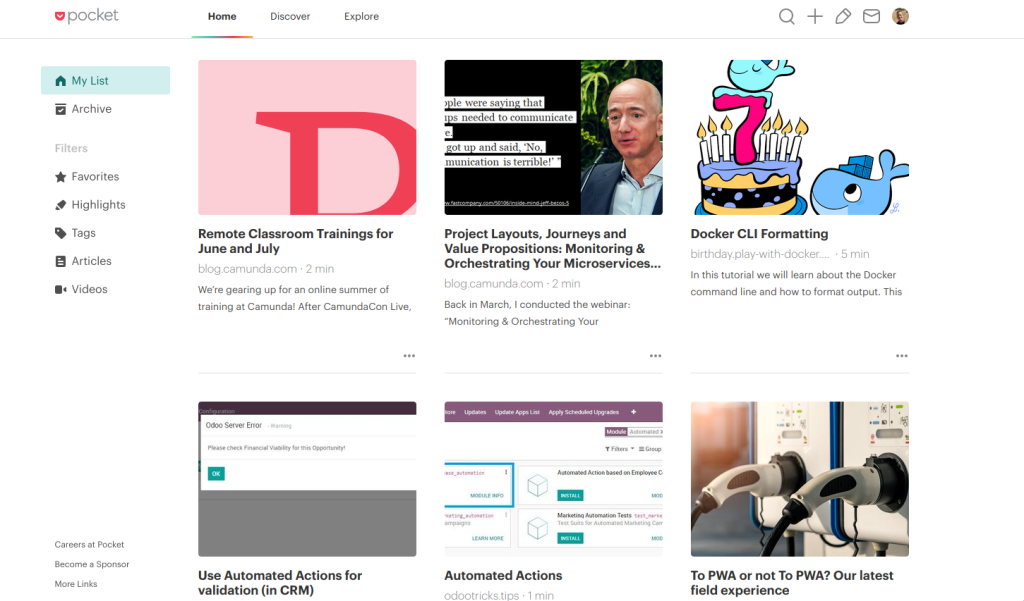
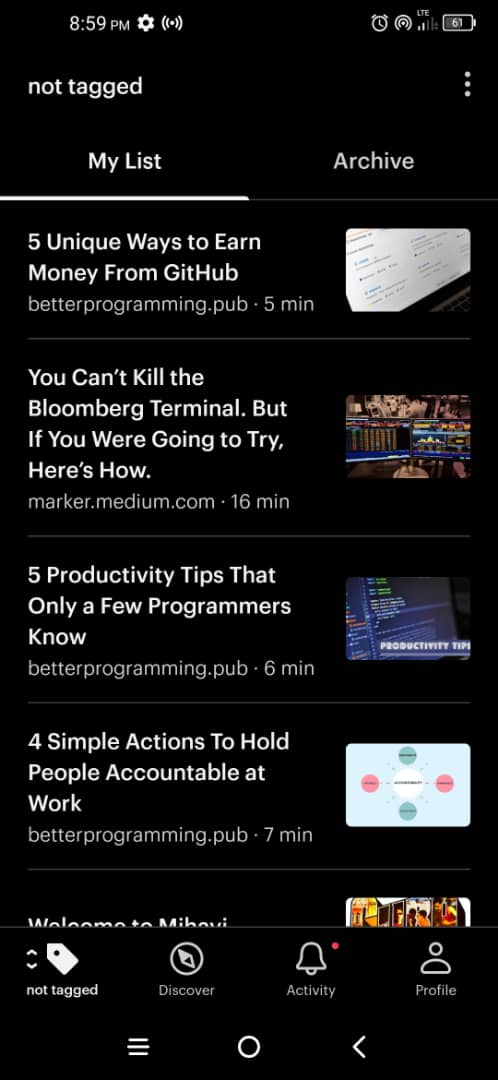
There are many good things to say about Pocket, and if you are an eager reader (of that kind who read in the bus station, like me :) ), then this application is for you. https://play.google.com/store/apps/details?id=com.ideashower.readitlater.pro&hl=en&gl=US
I have been using Pocket for four years approximately. I engaged so much with Pocket that in 2016 I earned a badge for being among the 1% top readers in Pocket. Since that moment, I have received the same badge every year :).
But let's stop talking about how much I read, and let's talk about Pocket.
There is too much content that virtually you can not be up to date on so many topics. Just in the information technology field, it is overwhelming. Probably, you do not have the time to read every single article you want just at the moment you find it. Here is where Pocket comes and offers the opportunity to save that article for a later read. There is a browser extension that allows you to save to Pocket https://chrome.google.com/webstore/detail/save-to-pocket/niloccemoadcdkdjlinkgdfekeahmflj?hl=en
I'm using Pocket to boost my productivity:
When I found an article that was good material to share with my friends, I tagged it *for share.* In the article, I highlight the content that attracts my attention more.
Later (another day probably), I review my articles tagged as *for-share* and decide which one to share on Twitter, LinkedIn, and recommend it on Pocket.
When I want to have a quick overview of new technology but have little time for follow-up, I search on Google some relevant articles and send them to my Pocket. Then when I cannot work because I'm traveling or so, I read those articles.
I always read the recommendations on friends' Pockets I follow, who always recommend technology and lifestyle articles.
Pocket recommendations and tags *Trending* and *Best of* are usually worth reading. I do not know how their algorithm works to select those articles, but in general match my interests, mainly regarding lifestyle.
Pocket opens an article in the same place where you left it last time :)
From time to time, something that does not work for me is the synchronization between the desktop and the mobile app. Some articles do not load, and you need to refresh them manually in the app. But to be fair, this happens to less than 1% of them.
Other excellent features that it has included:
Dark mode
Listening to articles
You can access a few handy features with the Pro version, like highlighting more than three quotes per article and more advanced search features.
If you are a person who wants to keep up to date on many topics, but you have not so much time, I highly recommend giving it a try to Pocket.
Last but not least, Pocket allows you to have a public URL with your recommended articles so that you can share them with your friends. Here you can see my list. https://getpocket.com/@55dA9g61d7832T550Gp22f2p21T8d57fuU4h10T9bsa8b8nc30567C11Z03Bb672
I hope this article has been helpful for you; share if you like it and let others know about Pocket.
The power of 1 minute a day
I always remember that in 2018, during the whole year, I was able to do workouts every day, with one day of rest in the week. In my routine for warm-up, I included one step that takes me only 2 mins. Stretch my legs. The process was like this: I put my leg over a small wall of around 70 cms height, and then I started trying to touch my knees with my head. **Only 2 mins**, in fact, **1 min** with each leg, during the whole year. After a year, I was able to touch my knee with my head. Not a significant accomplishment, you would say. Maybe nothing too relevant. It was just part of a workout routine that keeps me healthy, but the critical insight I got from that particular leg-stretch exercise was that I did it dedicating just 1 minute per day.
How many things do we try to accomplish, and do we think we have time or are not in the right life moment? How many things do you delay because you think you have so many others things to do?
I have been practicing this 1-mins approach in different ways. It could also be 1 X or Y a day: 1 push-up or 1 new foreign word a day.
**The focus is to start small and start now.**
If you do not start now, 1 minute a day, it will never happen. Convert this 1-minute-a-day into **a daily habit**, and it will become one of your most powerful tools to accomplish your goals.
I would say almost everyone has 1 minute free on their agendas, minimum. If you start short, it will be easier to succeed. Do you want to start running? Start by trot in the place, and just 1 min. After finishing your 1-minute session, you will feel that you accomplished your tiny goal!! **Tomorrow do it** again until you do it every day. If you do not have time, then **start short**. Don't you have 30 mins? Then start with 15. Don't you have 15? Then start with 5. You get it.
I have deeply introduced this practice in my daily life. These are the things that I do daily and started with a 1-min day routine:
10 daily minutes of meditation.
10 mins of English study.
Short workout session in the early morning (+ I do workout in the afternoon)
Daily journaling (just 5 minutes)
1 daily burpee
I am not saying it's easy. Often, you will delay your daily routine, or you will be stuck in real-life situations where you simply will fail to commit to your 1-minute routine. The point is to build a habit as soon as possible, so it carves deeply into your mind and does not vanish when things go hard.
It's also essential to chain some routines, so you find them easier to attain. You can start your day, and as soon as you wake up, do your 1 daily burpee, or pick your 1 daily new foreign word. And then chain another habit right away and do it (again, short)
Start now, and after a year, come here and tell me how it was :)
 @alian_rignack