Support Your Local Sheriff
Just a short one today.
Max Keiser and Stacy Herbert gave me food for thought in today's Orange Pill podcast. They made a very telling analogy between Bitcoin and the movie industry. Bitcoin is Charles Bronson in the movie 'Deathwish', who comes to realize there is no justice to be had in the hopelessly corrupt system, so takes matters into his own hands, and goes around killing bad guys (the financial system). Bitcoin is the sheriff who rides into town in countless westerns, organizes a posse, and goes after the bad guys (the financial system). Bitcoin has the financial system running scared. That's why the backlash is so vicious. When you take flak, you know you're on target.
Here's the Orange Pill podcast: Microdosing 40 TONS OF BABY FORMULA https://www.youtube.com/watch?v=hRQwYN5owkE
Does the NSA Control Bitcoin?
I was watching an excellent video by Matthew Kratter (of Trader University) analyzing developments in the crypto world. He was talking about SHA-256, the main Bitcoin proof of work algorithm. There is so much disinformation being spread about Bitcoin. Some of it is intentional and malicious, most of it is probably just ignorance - people repeating what they heard others say without understanding the issues. Some people claim that because SHA-256 was developed by the NSA, the NSA holds the master-key to Bitcoin and can take control and crash it any time they see fit.
SHA-256
NSA is the National Security Agency, one of America's intelligence agencies, part of the Department of Defense. SHA-256 is one variant of SHA-2 which was created by the NSA in 2001. SHA stands for Secure Hash Algorithm.
How SHA-256 works is beyond the scope of this article. Put simply, it's a method for encrypting data. You provide a piece of information as input, the SHA-256 algorithm changes it and produces output. (The output is the 'hash'.) It's a one-way process. The input can be of any length. The output will always be the same length - a 256-bit number (a combination of 256 ones and zeroes). The same input will always produce the same output. It's impossible to figure out the input from looking at the output. You can take the input and test it to see if it produces the same output. This is the basis of Bitcoin mining.
Double SHA-256
Bitcoin uses double SHA-256. You're given an input, an output is produced. You use that output as the new input and run it a second time. If it produces exactly the same output, you have successfully mined the next block on the chain (provided you did it faster than anyone else...). The miner submits the block to the blockchain, the user nodes check it, if it complies with the rules and requirements, they confirm it, the block is added to the chain, and the miner is rewarded with bitcoin (currently 6.25 bitcoin per block) plus transaction fees on all the transactions included on the block. This happens approximately once every ten minutes.
It's theoretically possible to mine bitcoin using pencil and paper, but it would take years to complete the calculations, and with a new block being mined every ten minutes that wouldn't be too competitive. That's why miners need massive computing power and use special circuit boards custom-built to solve the double SHA-256 hash puzzle. That's why there is so much fear and misunderstanding about electricity consumption - that will be the subject of another article. (All I will say for now is, the fear is unfounded. The oceans are not going to boil.)
Bitcoin Mining
Bitcoin mining is highly competitive. Today's successful miner may not be tomorrow's successful miner. New hardware comes on the market...the cost of power goes up...etc. That's why I'm a huge advocate of Bitcoin's proof of work model. The miners have to work for their rewards. Proof of stake rewards those who have the most money to stake. The rich get richer...
So - yes. SHA-256 was created by the NSA. It was released to the world. It isn't a secret. To claim that gives the NSA control over Bitcoin is ludicrous. It's like saying Islam controls algebra because they gave it to the world hundreds of years ago.
Matthew Kratter explains all this much better than I can: Does the NSA Control Bitcoin? https://www.youtube.com/watch?v=pwdV38Ix39E
What is an NFT when it's at Home?
I would like to tell you that NFT stands for Non-Functional Terminology. We have an entity that defines itself in terms of what it is not. Great. I swear, some people have a vested interest in keeping things complicated. If most people can't understand something, those who do understand it have an edge.
NFT stands for Non-Fungible Token. It is an entry on a digital ledger. The ledger is decentralized, meaning it is spread out over many user nodes in different locations, as opposed to being stored on a single server in one location. This decentralized ledger is called a blockchain.
The ledger is permanent and unchangeable. Transactions are recorded in 'blocks' of computer code which are linked together and time-stamped.
The code records the history of a digital asset, where it originated, who purchased it, any transference of ownership etc. The token can be assigned specific properties and uses in the digital world. For instance, the ledger could record ownership of a cryptocurrency like ETH. Or, it could record the minting of an asset into a token. This asset could be a card in a blockchain game such as Splinterlands, or a weapon, or a skin, in a game like Lost Relics. Or a resource (gold, lumber, corn or stone) in a game like League of Kingdoms. Or it could record title of ownership of a virtual property, in a game like Upland.me. Or it could be a graphic, a work of art. Some people are minting videos into NFTs. There are many potential uses.
Of the above examples, the first, cryptocurrency, is an example of a 'fungible' asset. The rest are examples of 'non-fungible' assets.
Cryptocurrency is 'fungible' because the assets are interchangeable with other iterations of the same asset. One bitcoin is exactly identical to the next bitcoin, in terms of usability. The same is true of the dollar bills in your wallet. One ten-dollar bill can be used just as well as any other to purchase goods or services. That's what defines these assets as 'fungible'.
The same is not true of the other digital assets listed above. A League of Kingdoms resource token cannot be exchanged for a Splinterlands card. You would have to sell your non-fungible asset for a fungible token (cryptocurrency) which could then potentially purchase your desired non-fungible asset. In practice the process is often quite convoluted. Blockchain games don't always reside on the same blockchain, and bridging between platforms can be costly and complicated. The industry is in its infancy, and there are still many usability issues to be ironed out. The Bitcoin Core blockchain does not natively support NFTs. There are projects in development which may extend Bitcoin's functionality by adding other 'layers' on top of Bitcoin Core. For the time being the major blockchains to support NFTs are Ethereum and Solana. There are others.
To sum up. Digital blockchain assets can be classified as 'fungible' or 'non-fungible'. They may both reside on the same blockchain, but they have different use cases. The fungible assets function as a medium of exchange and (hopefully) a store of value. Without the fungibility, they could not function as a medium of exchange. The non-fungible assets have quite specific uses, and can not be used as a medium of exchange. Put simply, you use the fungible assets to purchase the non-fungible assets.
Given time, the usability issues alluded to above will be resolved. Now is a great time to get into this field.
Why are Crypto Influencers so Down on Bitcoin?
'It's a big club, and you ain't in it!' (George Carlin)
In March 2022 Ripple co-founder Chris Larsen got together with Greenpeace and attacked Bitcoin over its proof of work consensus mechanism. Claiming bitcoin mining consumes too much electricity and will boil the oceans and all the other nonsense these people spout.
Recently Sam Bankman-Fried, Founder and CEO of FTX, one of the biggest crypto exchanges, jumped on the band wagon, criticizing bitcoin's proof of work and promoting proof of stake as a more environmentally-friendly alternative. Coinbase's Brian Armstrong has voiced similar sentiments.
On March 1, FTX announced they would be listing $LUNA. One entrepreneur issues a scam coin. Another gets rich by encouraging retail investors to buy it. A couple of months later, the coin implodes. Investors lose everything. The entrepreneurs present a united front, defending each other. It's a big club...
Why are all these influential people, who made their fabulous wealth encouraging day-traders to lose their shirts trading in altcoins, so critical of Bitcoin? Your guess is as good as mine.
It can't be because they don't understand how it works. These people are smart.
Could it be they are down on Bitcoin because they are afraid of it? Are they afraid of it because they can't control it? Nobody can control Bitcoin. That's the beauty of proof of work. That's why they promote proof of stake. That's the old corrupt financial paradigm they are comfortable with. It ensures the rich get richer and the poor get poorer. Under proof of stake those with the most money to stake can stake the most money and have the most control. It maintains the status quo. Keeps the useless eaters in their place. The rich man in his castle, the poor man at his gate.
So, to discredit proof of work they pull out the environmental card. It's complete nonsense, but that would be a topic for another article. Suffice it to say - these people do NOT care about the environment. And bitcoin mining is no threat to the environment. Elon Musk doesn't care about the environment. He doesn't make a profit selling TESLA cars. He makes his money selling Carbon Credits. It's all just another scam.
These people don't like competition. They are comfortable operating under monopoly conditions. Free market competition is anathema to them. They are afraid of it. They are afraid of Bitcoin. They should be.

What Makes Bitcoin 'Hard' Money?
What is Hard Money?
You hear people talking about 'hard' money. What does it mean exactly? How is the 'hardness' of currency evaluated? It doesn't refer to the physical density of the money. Gold is actually extremely 'hard' money. And it's extremely physically hard. (Would you rather be coshed on the head with a dollar bill or a bar of gold...?) No, 'hard' in the context of money refers to the relative ease or difficulty of increasing the supply of that money.
Gold
Mining gold is expensive, difficult and resource-intensive. Every year, approximately 2% more gold is extracted from the ground. So, the gold supply increases by roughly 2% per year. This means gold has a built-in inflation rate of around 2%. That is high on the 'hardness' scale.
Paper Money
Is the US Dollar 'hard'? No! The US Dollar is extremely 'easy'. The same applies to all paper money. The pound, the euro etc. The central banks and governments print trillions more banknotes at whim. With trillions more banknotes entering the market, the purchasing power of all the banknotes already in circulation is reduced. This leads to inflation, which I hope nobody will deny is a real and present danger for us all right now.
Bitcoin to the Rescue
Up until recently, gold was the hardest money the world has ever known. But now there is a usurper. Bitcoin. In the digital age, bitcoin has displaced gold as the hardest money. It is inflation-proof. It has a limited supply. There will never be more than 21 million bitcoin in circulation. Every ten minutes or so a new block is added to the chain. Each block contains a certain number of bitcoin (which go to the miner who successfully submitted the block). Every 210,000 blocks (approximately every four years) the number of bitcoin minted on each new block is cut in half. This is the bitcoin 'halving' people talk about.
Decentralized Ledger
Bitcoin is a decentralized ledger. Each bitcoin user node (there are thousands spread out across the entire world) maintains a copy of the entire ledger. The ledger is stored on the distributed blockchain (as opposed to being stored on a central computer belonging to a corporation, or government, or agency, or individual, or group of people). A block is a list of transactions. Every time someone buys, or sells, or transfers bitcoin, that's a 'transaction' on the ledger. The blocks increment in number. The genesis block was number one. Ten minutes later, block number 2 was minted. Ten minutes later, block number 3. This is why it's called a 'blockchain'. It's literally a chain of blocks.
Immutable
The blockchain is immutable. Everybody in the world can see the entire history of every transaction that happened on the ledger. All the way back to the genesis block. (That's why it's laughable when people claim bitcoin is used by terrorists, gun-runners, drug dealers etc. to launder money.)
Halving
In 2009, the first block (the 'genesis' block) minted 50 bitcoin. And with every new block (approximately every ten minutes) 50 new bitcoin were released into circulation. In 2012 it halved to 25 bitcoin. In 2016 it halved to 12.5. In 2020 it halved to 6.25. In 2024 it will halve to 3.125. Bitcoin is deflationary. The supply is increasingly diminished, and the total supply is capped at 21 million.
Bitcoin is the hardest money the world has ever seen. It has all the advantages of gold, and none of gold's disadvantages. (But that is perhaps a topic for another article.)

The Mystery that is Chess
Chess is a very popular game, throughout the entire world. Where did it originate? It actually came out of Persia. It was introduced to Europe by the Knights Templar, who brought it back from the crusades. It's a war game. The pieces represent the components of an army.
Pawns
The pawns are the foot soldiers. They move forwards, one square at a time. Apart from on their first move, when they can advance two squares. That was a Persian military tactic. The foot soldiers would move ahead of the rest of the army and form a line of defense with their spears. And they can move diagonally to kill an opponent piece.
Rooks
The rooks - also known as castles - were originally elephants. There are medieval paintings depicting elephants with castles on their backs. Elephant and Castle is a famous area in South East London. The rooks can stampede the entire length of the board, straight ahead or to the side. And woe betide anything that gets in their way.
Knights
The knights are the heavy cavalry. Their stallions canter. Hence the knights move in a cantering fashion - one square to the side and two ahead, or two ahead and one to the side.
Bishops
The bishops were originally ships. Ships pitch their sales into the wind and move in a yawing motion. Hence the bishops move diagonally. When the game became popular throughout Europe, the Pope complained that there was no ecclesiastical presence on the board. He insisted on the church having a presence, and it had to be next to the king. So the ships became bishops.
The King
The king is encumbered by his treasure. He has to take it into battle with him - if he leaves it at home, there is no-one to protect it. His army is tied up fighting this battle...So, the king can only move one square at a time, in any direction.
The Queen
The queen has no such encumbrance. Protected by her light cavalry, she can move the entire length of the board in any direction.
I used to play chess, but I don't any more. It forces you to concentrate hard, and my brain isn't equipped to do that very well these days. I knew players who could calculate three or four moves ahead. I don't even want to think about that. What do you think. Are there any chess lovers out there?

Bitcoin Genesis
Satoshi Nakamoto
November 1 2008 - a computer programmer going by the name of Satoshi Nakamoto, sends an email to a cryptography mailing list, announcing he has created a new electronic cash system that is fully peer-to-peer, dependent on no trusted third-party. Bitcoin is born. Bitcoin offers the world a payment network with its own native currency, using a sophisticated method to verify all transactions, without the need to trust any single member of the network. The members spend their processing power verifying the transactions, and are rewarded with currency issued at a pre-determined rate. There have been many failed attempts at creating digital cash before, but Bitcoin is different. Bitcoin actually works!
Slow Start
Bitcoin adoption gets off to a slow start. It captures the interest of a few cryptography enthusiasts, but doesn't gain much traction in the wider world. So, there are a few dozen users spread around the world, mining bitcoin and sending each other tokens, as a kind of hobby.
Market Good
October 2009 - an Internet exchange sells 5,050 bitcoin for $5.02. 1,006 bitcoin are offered for one dollar. This is the first purchase of bitcoin with money. The price is based on the cost of electricity required to produce a bitcoin. Bitcoin is no longer a plaything for the amusement of a fringe community of programmers. It has become a market good with a price.
Medium of Exchange
May 22 2010 - Someone uses 10,000 bitcoin to buy two pizzas with a value of $25. (Wow! I hope those pizzas tasted good!) This is the first use of bitcoin as a medium of exchange. It has taken seven months for bitcoin to transition from being a market good to a medium of exchange. And the rest is history. Since that moment, the number of users worldwide has increased substantially and the value of bitcoin has risen rapidly. By November 2017 bitcoin was selling for more than $7,000.
Maintaining Perspective
By 2022, bitcoin has established itself as a technology that has passed the market test and withstood the passage of time. It is distributed software that allows the transfer of value, using a currency which is inflation-proof, without the need for trusted third-parties. The code is decentralized across thousands of user nodes, and no user can alter the code without the consent of the other users.
In these volatile times, with markets crashing across the board, it's worth reviewing the early days to keep things in perspective. 12 years ago, 10,000 bitcoin bought two pizzas. Now one bitcoin sells for more than $30,000. And people complain that the price is low!
(Inspired by 'The Bitcoin Standard', by Saifedean Ammous)

Is Paul Dead?
If you love the Beatles, if you believe they were an amazing group of young men who blossomed into brilliant song-writers and instrumentalists - and want to continue believing that - DO NOT READ ANY FURTHER
This article could disillusion you. You would hate me for evermore.
If, on the other hand, you want to gain an insight into how the music industry is a huge social-engineering exercise, and has been mind-controlling us all since the very beginning, read on. Warning - there is no going back. The information I plan to reveal may turn your belief system on its head. It might throw you into cognitive dissonance. It's an uncomfortable place to be. I know, I've been there.
If you're still with me, let's cut to the chase. The Beatles were an entirely manufactured band. Created by the Tavistock Institute. The Mop Tops didn't play the instrumentals on their own albums. The accompanying tracks were laid down ahead of time by top session musicians. The boys were brought in late in the day to lay the vocals on top of the instrumentals.
The Beatles didn't write (most of) their own songs. Most of the songs attributed to Lennon and McCartney were written by their producer, George Martin, Theodor Adorno, and a Tavistock team of professional ghost song-writers.
Biological Paul McCartney died in 1966 and was replaced by someone who went under many names - Billy Shears, Billy Campbell, Billy Shepherd. This guy is possibly the son of Aleister Crowley. He was also Vivian Stanshall of the Bonzo Dog Doo-Dah Band. He is taller than McCartney, with a thinner face. He is right-handed and McCartney was left-handed. Billy had to learn to play left-handed bass. He underwent plastic surgery to make him look more like Paul. Before 1966 The Beatles were a touring band. After 1966 they never appeared in public again. (Apart from one rooftop concert.) People would have noticed that Paul suddenly got taller. They became a studio band.
The song lyrics and album cover art are full of hints to the death of McCartney.
It wasn't only the Beatles. The Rolling Stones were also manufactured. The Beatles were the 'good' boys, the Stones were the 'bad' boys. Both propagating the same social-engineering agenda. The Tavistock Institute had all bases covered. If you didn't like the Beatles, or the Stones, there were the Kinks. And so on and so on.
This is all meticulously documented in the Youtube 'Paul is Dead' channel, by the wonderful musician and researcher, Mike Williams. Here it is: Paul is Dead. Proceed under advisement. https://www.youtube.com/c/MikeWilliamsPaulIsDeadChannel

A Propos of Nothing in Particular
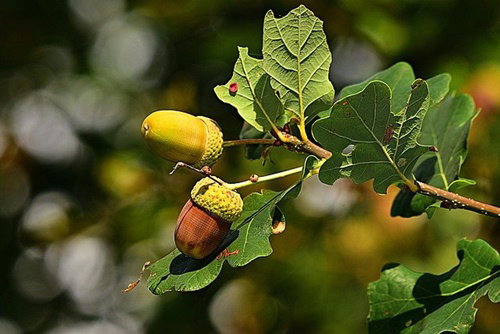
Yay! My first modest success. Two days after starting, with six articles under my belt, Read.Cash's TheRandomRewarder Bot graced one of my articles with an 8 cent tip. Don't laugh! From tiny acorns, mighty oaks grow. Will I be able to turn this into a modest income? I don't know. Possibly. But I'm sure having fun. I enjoy writing. There are websites that will pay 200, 300, 400 dollars for an article. But they want you to regurgitate the official narrative on controversial topics. I refuse to do that. There is quite enough bullshit in the world without me adding more. By following the path I've chosen, I can write about anything I want.
Still, I avoid controversial topics. I know a lot of things about all kind of things, but I've learned the hard way, most people don't want to hear the truth. They prefer to bury their head in the sand and continue consuming bullshit. So be it. It's too late, anyway. If people aren't by now at least partially aware of what's really going on in the world, well, put it this way - I fear many people are in for a very rude awakening. I can look back at the last two and a half years of global insanity and honestly say, I stood my ground. I didn't concede an inch.
I've been trying to make a little money playing blockchain games. League of Kingdoms. Splinterlands. I'm pretty disillusioned with the whole space. As soon as a game gains any traction, and it becomes possible to earn from it, the inevitable takes over. You know. Greed. Corruption. People figure out ways to take advantage of loopholes in the economy and create bots to milk the exploits around the clock and suck all the rewards out of the game, leaving a few crumbs for the real players. I don't hold any great hopes for blockchain gaming in its current state. Unless you just play the game for fun, of course.
So, what's the topic of this article? No topic, really. I'm just taking my keyboard for a walk. Random thoughts of an old man in a dry season. Writing is a good activity for me. It's therapeutic. 'Nuff said. Hope you all are well. Take care.
A Frog in a Coconut Shell
It Came Out of the Blue
Idioms. Hmmm... What is an 'idiom'? An idiom is a saying or phrase, where you can't figure out the meaning of the phrase from knowing what the individual words mean. Example: It came out of the blue. What does that mean? It was unexpected. It fell from the sky (also an idiom...) It was sudden. How is a foreign student of English supposed to know what 'it came out of the blue' means, without having it explained? Idioms are a difficult aspect of a language for students to learn. At the end of the day, you just have to know what they mean. If you have a very strong instinct for it, you can sometimes figure the meaning out.
Idioms
Idioms are wonderful. Idioms are metaphors. Idioms are poetry. Idiom is where language stops being 'rules of grammar' and begins to come alive.
So, backtrack 10 years. I'm teaching English to English Majors in a university in North Thailand. The Thai education system is very traditional. Typically the teacher stands at the front of the class with a microphone and talks for an hour, or an hour and a half, while the students take notes. That's what they're used to. That's what they expect. That's what the parents who pay their school fees expect.
Communicative Techniques
When you train to become an English teacher you learn all kinds of communicative techniques, which are actually quite effective, but I found it completely impossible to apply them in Thailand. I tried hard. I elaborately set up, for instance, games, where the students had a problem to solve, and each had a piece of information, and had to ask each other questions to figure out the solution. Fell completely flat. Every time.
A Needle in a Haystack
One day, I have a flash of inspiration. I write on the whiteboard: 'It's like looking for a needle in a haystack.' I let them think about it for a couple of minutes. I explain 'needle', I explain 'haystack'. (Everything has to be carefully set up.) I ask them: 'What does that mean?'. They start talking amongst themselves, trying to figure out the meaning. They talk in Thai. According to TEFL dogma that's a complete no no (Teaching English as a Foreign Language). Only English should ever be used in the classroom! Well I don't give a fig for TEFL dogma. I'm a pragmatist. I do whatever works in the context to get a point across and help students to an understanding. And, actually, having them discuss amongst themselves is a huge breakthrough. They are becoming engaged in the language learning process. For the first time in my experience. After a couple of minutes they come back with: 'We don't know. We don't understand.' So I explain. It's like looking for something that is very difficult to find. What are the chances of finding a needle in a haystack? Then I ask: 'Do people in Thailand look for needles in haystacks?' They discuss amongst themselves.
The Penny Drops
The penny drops (another idiom!) for one student. 'The sea! We look for a needle in the sea!' The student explains it to the rest of the class. They're all beginning to understand. They're becoming increasingly engaged. It's classroom magic. It's the beginning of a magical journey where in following lessons we discuss idioms and meanings and language.
The students loved it. I was quite heavily criticized for it, by colleagues. I don't give a fig about that, either. If it works, I do it.
A Frog in a Coconut Shell
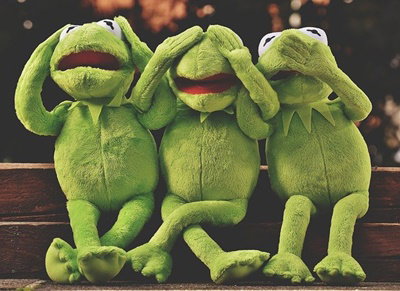
Now, my bio line is: 'Your friendly neighborhood Frog in a Coconut Shell.' That's a Thai idiom my students taught me. I didn't understand. They had to explain it in English - more discussion, more practice for them, more engagement. Finally I understood. It has a meaning.
What do you think the meaning is? What is a frog in a coconut shell? Can anybody guess? Please leave your guesses as comments. Or any other insights or observations or criticisms you may have. Sawatdee krap! (So long! in Thai)
What Skill does a Child Deploy to Learn to Speak its Native Tongue?
Does it study rules of grammar? Does it get a text book and work its way through the exercises? Does it learn to read and write before it can speak?
None of the above! A child learns to speak its native tongue by LISTENING. It listens to everything everybody is saying around it. After a while it begins to discern speech patterns. After a while it begins to associate meanings to the speech patterns. After a while it starts imitating the speech patterns. Eventually, after - what? three, four years? - it can speak the language. At least on a basic level. Maybe not perfectly. It continues developing its language skills as it grows older.
Does that child know an Accusative Case from a Past Participle? Does it care? HELL NO! But it can use its native language to communicate its basic needs in life.
Listening. It's the one skill that every school, every university, every language school in the world neglects.
Okay. This post is inspired by the amazing work of A. J. Hoge. He has a unique technique for teaching English by asking stories. That's right. Not 'telling' stories. 'Asking' stories. More on that later.
He has basic rules for learning English. I can't remember them all in order.
Rules for Teaching/Learning Languages
Rule number 1: Don't learn individual words. Learn phrases or whole sentences. Many students get a vocabulary book and write 'table' on the left side and the word for table in their own language on the right side. Learning these words is very difficult. They are words in isolation. There are no 'hooks' for the memory to latch on to. Instead of writing 'table', write 'There is a brown table in the corner of the room.' That way, you can visualize a brown table in the corner of a room. And if you memorize that phrase, you get 'there is', the adjective 'brown', the prepositions 'in' and 'of' and the nouns 'table' 'corner' and 'room'. And correct word order. Without studying any rules of grammar. Over time you will gradually acquire the rules of grammar without even realizing it.
Rule number 2: (These are not in Hogue's order, by the way.) Collect up any grammar books you can find. Make a pile in the garden. Douse with paraffin. Throw some shrimps on the barbie, make a bonfire and let off some fireworks. NEVER study rules of grammar.
Rule number 3: Repeat rule number 2 with textbooks. NEVER use textbooks. Textbooks are fake. They are boring. Use only authentic materials.
And so on. I can't remember all his rules. I'll provide a link where you can find his information, if you're with me so far, and interested. (I guess you must be interested, or you wouldn't still be with me...)
Asking Stories
Imagine you are teaching a class of students. You say: 'There is a boy in the street. Is there a boy or a girl in the street?' Student: 'A boy!' You: 'The boy has brown hair. Does the boy have brown hair or black hair?' Student: 'Brown!' You: 'The boy goes into a shop. Does the boy go into a shop or a house?' Student: 'A shop!' (You want short answers.) And so on and so on. You get the idea. You have to teach the vocabulary first. The beauty of this technique is it forces the students to listen, and to think in English. They don't have time to translate to their own language, figure out the grammar, translate back to English...) And you can make this as simple or as complicated as you like. It's a wonderful teaching technique, and it works very well.
I've taught English in Cambodia and Thailand. It was very frustrating for me, because I couldn't employ these techniques. Schools are sadly completely exam-driven, and, as a teacher, you spend all your time steering students from one exam to the next. And the exams focus on grammar, so you have to teach grammar.
Listening is so important. I remember, as a small child, hearing a song on the radio. I enjoyed the music. At the end the DJ announced: 'That was "Fly me to the Moon" by Frank Sinatra'. I thought wow! Who are these wonderful people the Franks? And where is this strange place 'Atra' they live in? That's what our students hear. A stream of sounds. It's very difficult for them to discern where one word ends and the next begins.
If anyone wants to look further into this, Mr. Hoge explains his techniques much better than I can. Very interesting material for anyone in the teaching business.
You can find his website here: 7 Rules for Speaking English https://effortlessenglishclub.com/7rules

Tamwell Narrowly Escapes his Encounter with Grum Flameblade
(Unofficial Splinterlands Lore)
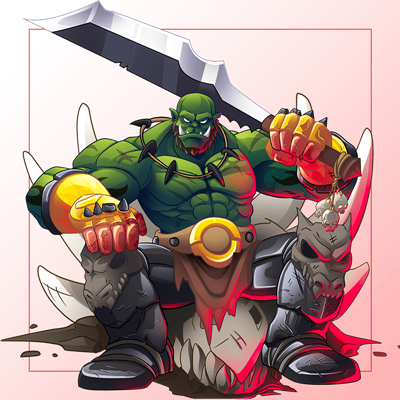
Tamwell had narrowly escaped the destruction. His classmates and teachers were dead or dying, his school utterly destroyed. He had slipped out at the last moment. The Chaos Legion had attacked unexpectedly, raining fire, death and destruction, razing the town in a matter of minutes. Luckily, Tamwell's school was close to the edge of town. His only chance was to reach the river and follow its path into the forest. He staggered the short distance to the edge of town, in utter disbelief at the destruction and carnage all around him. Ashes were falling all around. A piece of burning lumber fell from a building and struck him on the shoulder. He grunted with pain and tried to ignore the intense dull ache in his shoulder. Soon he reached the river and followed it into the forest. He paused and turned back for a moment. The whole town was in flames, the air filled with screams and cries of despair. He thought of his family and friends. There would be time for grieving later. Right now, he had to focus on survival.
Grum Flameblade
There was thick vegetation close by the river, leaving just enough room to walk. After about 15 minutes he emerged into a clearing and froze. A cold shiver ran down his spine. Propped against a tree in the middle of the clearing sat Grum Flameblade.
Grum Flameblade! The most formidable Orc warrior in the kingdom. Since he had turned sides and joined the Chaos Legion the mention of his name struck fear in the heart of every man, woman and child. Grum's eyes were closed. He was snoring heavily. There was no turning back. Tamwell had to keep moving further up river. His only chance was to sneak past the Orc and hope he didn't wake up. He crept slowly past, and some way up river he thought he was safe. Then disaster struck. A twig snapped loudly under his foot. The Orc snorted, wrenched his eyes open and sniffed the air. He yawned, then turned his head and glared at Tamwell. He licked his lips. Normally, such a puny opponent would be beneath his dignity. However, he was in just the mood for a nice mid-morning snack. He slowly lumbered to his feet, shaking the sleep out of his limbs.
River Nymph
Tamwell was frozen to the spot in abject terror. He knew his only chance was to run as fast as possible. Speed was his only advantage: Grum was notoriously slow. But his legs would simply not obey. Grum was now on his feet, lumbering towards him. Tamwell had just about given up hope when a figure emerged from the river beside him.
It was a beautiful woman, with pointed ears, wavy blue-black hair and silky-smooth blue-green skin. She spoke quickly: "You must go, now, quickly. A mile up river is a log cabin. My friend the Goblin Psychic lives there. He will heal your shoulder and take care of you until we can get you away to safety." "B..but, he will kill you..." stammered Tamwell. "Don't worry, I'm too fast for him. But I can't hold him off for long. Go!" Tamwell muttered his thanks and turned and ran as fast as he could along the river. He heard Grum bellow in rage as the River Nymph's magic bolts stung into his thick, green scaly skin, over and over again.
Goblin Psychic
After what seemed an eternity, Tamwell emerged into another clearing. In the centre was a log cabin.
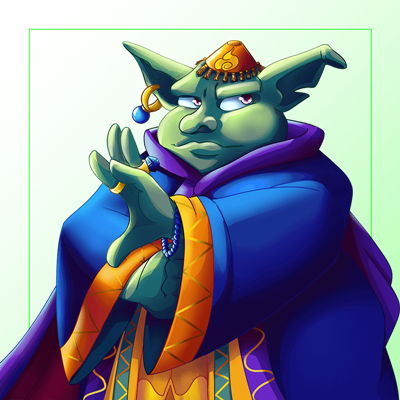
The Goblin Psychic chose to live in solitude in the forest, where he could practice and develop his psychic abilities without distraction. Just now he was trying to make music on a lute, using only the power of his mind. He could produce individual tones, but he couldn't yet shape them into a melody. He sensed a presence outside. There was no sense of threat or danger. He opened the door and saw Tamwell standing there, nursing his throbbing shoulder. "Well, well, well, what have we here? You'd better come inside, young man, and we'll fix that shoulder of yours and get you something to eat..."
Originally posted on Splintertalk.io https://www.splintertalk.io/@alberich/tamwell-narrowly-escapes-his-encounter-with-grum-flameblade-unofficial-splinterlands-lore
Graphics courtesy of Splinterlands.com https://splinterlands.com?ref=alberich
Think Short Stories, not Novels...
I once heard a recording of a lecture given by the great science fiction writer, Ray Bradbury, to creative writing students at an American university. He said something like this: the big mistake aspiring writers make is that they all want to write the novel of the century. They lock themselves in their garret and grind and grind and write and write, and, after a year, their first novel is finished. And....it's crap. Let's be honest, your first five or six novels are most likely going to be crap. So, after five or six years, you have gotten nowhere. Who can persevere through that much failure and rejection?
So, put the novel of the century on the back burner. Start more modestly. Write short stories. You can turn out a short story in a week. If you write a short story every week for a year, you have 52 short stories in your portfolio. It's impossible for anybody to write 52 short stories without there being at least one halfway decent story among them, worthy of publication. So now, after a year, you have a success under your belt. The following year, you will get five short stories published. The following year, 20...Then you can try your hand at the novel of the century. And...it will still be crap. But, at least you are working from a position of success. You have established yourself as a writer worthy of publication. A much stronger position to persevere from - and you will eventually produce a novel worthy of publication.
Enter Read.Cash
How about extending Bradbury's idea from short stories to Read.Cash articles? The thing about writing is, the more you do it, the better you become at it. Imagine if you write an article a day for a year. 365 articles. Is it possible to publish 365 articles on Read.Cash without gaining some kind of traction on the platform? Watch this space...

I Sing the Body Electric
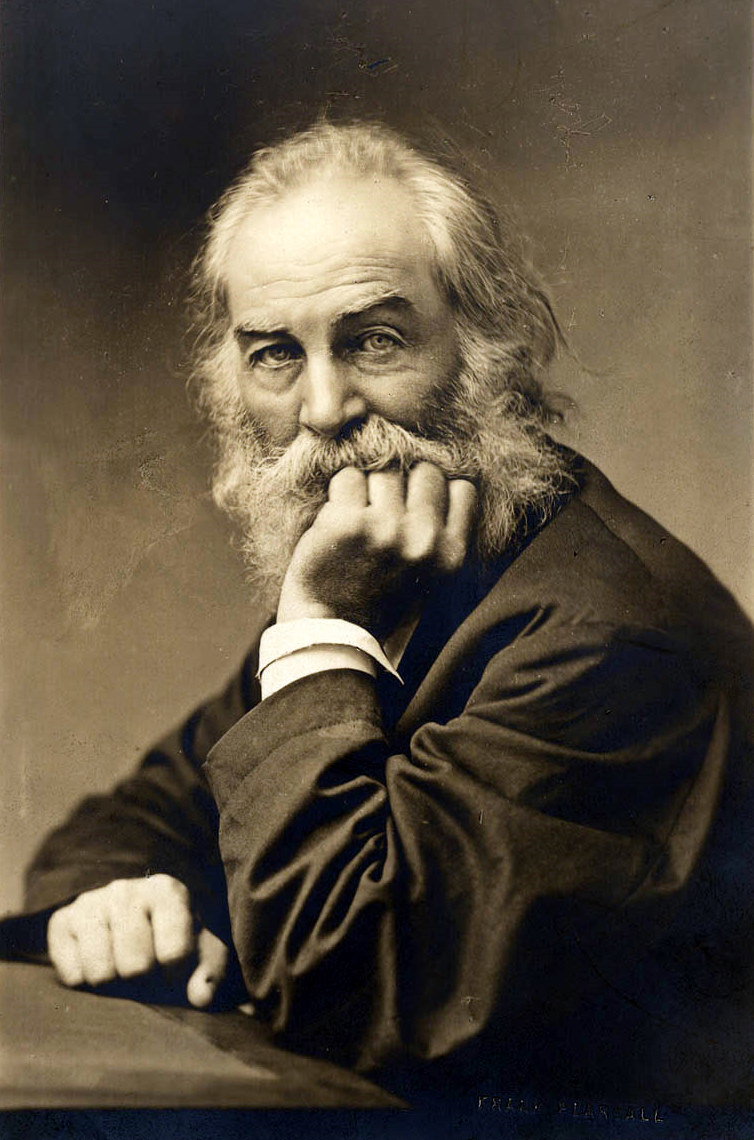
Yesterday I watched a documentary video, in two parts, about the life of Walt Whitman. I didn't really know much about him. I had a vague idea he was one of the most important American poets of the 19th century. I knew he was a deeply spiritual man who felt a close affinity to nature. The closest I came to reading any of his works was the title of a Ray Bradbury short story - 'I Sing the Body Electric' - borrowed from one of Whitman's most famous poems.
What I didn't know was his depth of compassion and empathy for his fellow human beings. At the end of the American Civil War there was a huge make-shift hospital for wounded soldiers in Washington DC. Many of the patients were 15 or 16-year-old lads. They were alone, scared, most of them penniless, facing painful convalescence or death. Whitman visited the hospital every day. He sat with them for hours, talking to them, helping those who were convalescing, consoling those who were dying. He took small gifts of cash, an apple or a pear, writing paper and stamped envelopes. Many of them were illiterate, and Whitman wrote letters to their families.
It's a very interesting documentary, available on Youtube: In Search of Walt Whitman. It's produced by East Rock Films. In the video description you can find links to part 2, and a site where educators can download discussion guides. The documentary made quite a profound impression on me. I'm still mulling over my thoughts and feelings about it. Recommended. https://www.youtube.com/watch?v=RHgfTd9zbJ8
How I Came to Join Splinterlands at Exactly the Wrong Time...
I had pretty much made up my mind it was worth investing 10 bucks in a spellbook. I watched a few videos. I was inspired by a video by an established player where he talked about starting small three years ago and slowly building assets to his current impressive level. (Nothing against that player - when he made the video it was still possible to do that...) So I took the plunge and bought a spellbook just in time for the dev team to completely nerf bronze rewards.
The new user experience was devastated. Ground zero. It was very, very, very annoying. To this day, there is zero incentive for new players to join the game (unless they know the score and have thousands of dollars to invest).
I did what many other people did, I whinged, I made snide comments on Discord. I think we had (have) a valid grievance, and I don't think it has ever been properly acknowledged by the devs/established players. They may have had compelling reasons to do it. Sure, they had a problem with bots playing multiple accounts using starter cards, eating up the reward pool without contributing anything to the economy. And I know rank reward changes are in the pipeline. We shall have to see how they pan out. I can't imagine how rewarding people for playing longer is supposed to disincentivize bots...But we just have to wait for now.
I know the dev team are keeping 17 zillion plates spinning at the same time and I know their job is far from easy. Anyway - I stuck around. I invested. In the bubble. Bought cards. Staked SPS. I don't really enjoy battles very much, and, to be honest, I'm not especially good at it. It's fun to play every now and then, but I quickly get bored with it. And, right now, battle rewards are pitiful. At lower levels, at least. I'm focused on renting out cards. I'll cover that in another post. The DEC I earn from renting go towards buying and maxing out more cards to rent. I also play other games which bring in a few tokens. By convoluted routes I can convert them into credits to buy more SL cards. That's about where I am at the moment. Hope everyone is well. If you agree or disagree, or have anything to add, please leave a comment.
Originally posted on Splintertalk.io **here** https://www.splintertalk.io/@alberich/how-i-came-to-join-splinterlands-at-exactly-the-wrong-time

 @alberich