I lost almost all my funds + got into a big debt.
Due to some circumstances and bad money management I lost more than I could afford, and one of the reasons for that cause was the euphoria. And I also have to pay back a debt to three persons.
A debt 35 BCH.
B debt 20 BCH.
C debt 0,65 BTC.
Credit card debt 2000$.
Recover my own balance 40+ BCH.
I was managing all that funds, and I have started a new job after going through financial losses and aim to recover all of it. I take it as a lesson to improve my risk management and other financial skills, and in the end I hope I will be in much better position than I was before.
What I did wrong?
I bought a house and needed money to make a renovation. I didn't want to spend my own money and borrowed instead with crypto collateral, and because I wanted to recover my spendings later, I borrowed more and bought crypto with leverage. And as deceptive the crypto market is, I ended up losing most of my collateral deposits.
It's totally my fault and I could have prevented such a loss. But I have learned a lesson and now have a plan to recover all my lost funds and multiply them.
I have gone through all steps of desperation, frustration, and have decided not to give up. You can always do better. Let's go.
5 reasons Lightning Network is not sustainable.
Fundamental vulnerabilities you should know about LN.
**1.) Network structure - nodes.**
Lightning Network nodes are not as flexible as Bitcoin nodes, each LN node requires **manual** connection setup, each one of them becomes an intermediary, if one intermediary is closed, transactions may not process. That means each node is a single point of failure, especially if it is a well connected node, if it goes offline, a lot of participants will lose the ability to transact with each other, and will require new manual connection setups. Probably that's the reason why some LN transactions fail to process.
**2.) Node crash - lost funds.**
If you run a LN node, it's not like Bitcoin node, where you can connect and disconnect at will, synchronising with other active nodes. On the lightning network there is no single shared global database. You have to rely on your own data, so if your node for some reason crashes due to HDD problem or operating system issues, you may lose access to your account. That's why you may need to make backups constantly.
**3.) Watchtowers - funds can be lost.**
If we have such an issue where a network participant can steal funds, that means a critical trust vulnerability, and bringing a trusted third party to watch for your connection transactions is just a reinvention of the old financial system.
**4.) Second Layer - a financial instrument whose value derives from the underlying asset.**
If it sounds like a derivative, most likely it is. The problem is that when BTC mainnet reaches peak activity it becomes difficult to open and close channels on LN, if this issue raises constantly, removing the peg might make sense.
The requirement to lock BTC and generate Lightning BTC can be modified, or completely removed. The Lightning Network is not built on top of Bitcoin, it's completely seperate Network that can operate independently, even if Bitcoin totally switches off.
5.) Depended on 1 layer, limited scalability.
With limited blocksize on a worldwide scale Bitcoin can be used as a reserve currency for large banks, governments and financial institutions, but can't serve as a payment system for everyday commerce, which leads to second layer solutions necessity, LN is one of the 2L implementation solutions, which is dependent by the first layer. Here is a problem, if we remove the dependence we risk having fractional reserve, supply inflation, if we don't remove the peg, we still can have the same, low risk, but we will be also limited with network scalability.
Bitcoin Cash & Wörgl Experiment
Opinion Post about **how Bitcoin Cash can succeed** without being affected by the market volatility, in a round-abound way entering the local markets as an accounting system.
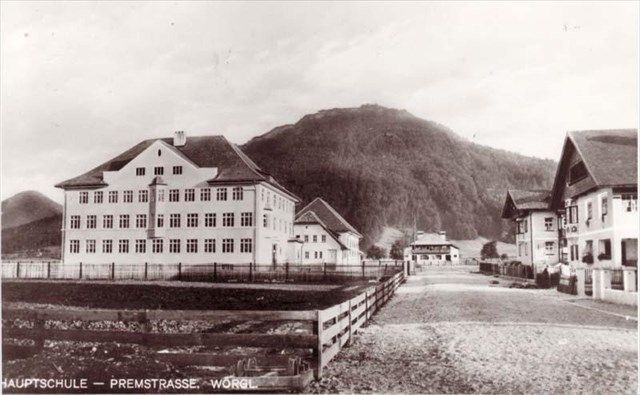
If you don't know it yet... few words about The *Wörgl Experiment*: (1932-1933)
... In 1932, in the midst of the Great Depression, the small town of Wörgl in Austria started a money experiment on July 31, 1932, issuing "Certified Compensation Bills", a form of **local currency** commonly known as Stamp Scrip, or Freigeld. This was an application of the monetary theories of the economist Silvio Gesell by the town's then-mayor, Michael Unterguggenberger. https://en.wikipedia.org/wiki/Scriphttps://en.wikipedia.org/wiki/Freigeldhttps://en.wikipedia.org/wiki/Silvio_Gesellhttps://en.wikipedia.org/w/index.php?title=Michael_Unterguggenberger&action=edit&redlink=1
The experiment resulted in a growth in employment and meant that local government projects such as new houses, a reservoir, a ski jump and a bridge could all be completed, seeming to defy the depression in the rest of the country. **Inflation** and **deflation** are also reputed to have been non-existent for the duration of the experiment.
Despite attracting great interest at the time, including from French Premier Edouard Daladier and the economist Irving Fisher, the "experiment" was **terminated** by Austria's central bank Oesterreichische Nationalbank on September 1, 1933. https://en.wikipedia.org/wiki/Edouard_Daladierhttps://en.wikipedia.org/wiki/Irving_Fisherhttps://en.wikipedia.org/wiki/Oesterreichische_Nationalbank
In 2006 milestones were placed, beginning from the railroad station through the downtown, to show this history. In all means this was a great experiment, that demonstrates how useful a debt-free money can be.
Now back to the point, **how Bitcoin Cash can succeed?**
Bitcoin is a great tool and is still very young, many people don't understand it and the sad part is that a lot of people misunderstand its purpose, they think it is a speculative store of value, dismissing its functionality as money.
Stability is what market needs.
In a highly speculative market, Bitcoin usefulness for payments becomes questionable. We need to void the market volatility and represent Bitcoin as a stable currency for payments, Bitcoin decimals can be a solution, adjustment of Bitcoin into local economy can be made by issuing "**Certified Compensation Bills**", but in this case the "Compensation Bills" will be nominated in Bitcoin decimal units.
The local entities will need to obtain Bitcoin Cash by depositing / converting their local currency. Afterwards, they will need an app that demonstrates Bitcoin Cash decimal units as their local currency, and can be named as they wish. All users will be able to transact and make payments, onchain without even knowing they are using Bitcoin, their wallet apps can be configured to indicate only the small units as their own local currency. In this case, Bitcoin Cash can be a global protocol for money exchange and payments.
The process will be similar to redenomination* but in reverse, instead of cutting zeros, depositors will get more money.
For 1 EUR, deposit they can get more EUR units each valued at 0.00000100 BCH, but their wallet will indicate it as 1.00 EUR currency, which will no longer be affected by Bitcoin Cash price on speculative exchanges, a deposit to enter the local market, like the "Certified Compensation Bills" in Worgl. If the rate of 1 EUR is 0.0039 BCH, with 1 EUR, the depositor can get 39 EUR, or 390 EUR, depends on where you set the decimal place.
The more people will want to enter the local market, the more deposits will be required creating demand for Bitcoin Cash. The process is **similar** to "fractional reserve system". When by X amount deposit (fiat), you can get 10X for spending. But without creating a debt. There are trillions of Bitcoin decimal units, all of them can be used to denominate
In the beginning I thought, but, in this case, some rich people can buy everything locally and probably damage local economy. Additional measures may be required to prevent this, conversion rate can be adjusted to avoid imbalanced trades, local state can also set limits, the wallet will be non-custodial, with several regulatory rules to support a smooth economic transition. Wörgl Experiment
This is an incomplete idea, and sure needs addressing more details to make this experiment possible and stable, also to avoid any market manipulation.
*Redenomination is the process of changing the face value of banknotes and coins in circulation. It may be done because inflation has made the currency unit so small that only large denominations of the currency are in circulation.
Accelerating Bitcoin Cash adoption.
There is one thing that can possibly attract a lot of people to work and build Bitcoin Cash economy. Here is the idea.
**Bitcoin Cash advanced commercial app & website.**
**Solutions for both online and offline commerce. A self funding system without necessary investments to reward new users. All rewards are coming from payments that users make.**
What it requires:
affiliate system.
payment split.
cashbacks.
1.) Affiliate System.
The only place that I have seen **affiliate system** implementation with Bitcoin Cash is ****Noise.Cash**** **social network**. I am not sure how exactly it works, would like to learn more, but I think this is exactly what a commercial app needs, a lot of payment apps and internet banking apps offer rewards for inviting people to sign up, Bitcoin Cash needs something similar.
A referral system where each user would be able to earn income by promoting Bitcoin Cash commercial app - platform. Let's say Bob has a shop, Mike invites Bob to use Bitcoin Cash commercial app, Bob would benefit by using Bitcoin Cash and attracting more buyers, Mike would benefit by getting a referral income for each item Bob is selling on Bitcoin Cash platform. The reward e.g could be 0.01% for each payment Bob receives via Bitcoin Cash marketplace.
Such a system would attract both merchants, and bloggers who want to earn extra money by promoting the platform.
2.) Payment Split.
**Split Payments** is required to facilitate **cashbacks**, I have learned about splitting payments by watching Roger Ver video where he is explaining how Uber could benefit using Bitcoin Cash
https://twitter.com/rogerkver/status/1300084285383245824
and I thought, that's great, not only Uber but many other merchants can benefit from it. How? A lot of merchants might need to boost their sales, by creating a cashback for certain products, which they choose, and the amount of cashback, for example 1% or 30%, they can attract new buyers, especially if there is an online marketplace, where they could promote their products.
3.) Cashback.
How **Cashbacks** could work? Sellers can use CashTags https://tags.infra.cash/ to set prices for each product, and insert a script where they choose the amount of CashBack. Online BCH marketplace (something like Amazon or Ebay) with all cashback offers available for buyers could be a big deal.
Of course all of this needs to be implemented on a single app, so it would be convenient for users. I am not a developer, but I think this is achievable. I have been talking with some devs and as far as I understand it is possible, affiliate system already exists, payment splits can be implemented on the app too.
Satoshi rejected second layer solutions, Soft Forks and was clear about scaling Bitcoin on-chain.
Bitcoin P2P e-cash paper. `Oct 31, 2008`
Bitcoin Whitepaper release. https://www.metzdowd.com/pipermail/cryptography/2008-October/014810.htmlhttps://www.metzdowd.com/pipermail/cryptography/2008-October/014810.html
When Satoshi published the Bitcoin whitepaper in 2008, he got the first reply by **James A. Donald** saying `"We very, very much need such a system, but the way I understand your proposal, it does not seem to scale to the required size."` https://satoshi.nakamotoinstitute.org/emails/cryptography/threads/1/https://www.metzdowd.com/pipermail/cryptography/2008-November/014814.html
**Satoshi** in reply gave an explanation on how Bitcoin is designed to work. https://www.metzdowd.com/pipermail/cryptography/2008-November/014815.html
with'
Long before the network gets anywhere
near as large as that, it would be
safe for users to use Simplified
Payment Verification (section 8)
to check for double spending, which
only requires having the chain of
block headers, or about 12KB per
day. Only people trying to create new
coins would need to run network nodes.
At first, most users would run network
nodes, but as the network grows beyond
a certain point, it would be left more
and more to specialists with server
farms of specialized hardware.
A server farm would only need to have
one node on the network and the rest
of the LAN connects with that one node.
The bandwidth might not be as
prohibitive as you think. A typical
transaction would be about 400 bytes
(ECC is nicely compact). Each
transaction has to be broadcast
twice, so lets say 1KB per transaction.
Visa processed 37 billion transactions
in FY2008, or an average of 100 million
transactions per day. That many
transactions would take 100GB of
bandwidth, or the size of 12 DVD
or 2 HD quality movies, or about $18
worth of bandwidth at current prices.
If the network were to get that big,
it would take several years, and by then,
sending 2 HD movies over the Internet
would probably not seem like a big deal.
Satoshi Nakamoto
**First proposal to scale with side chains (Bink).**
**James A. Donald** then proposed a second layer solution to scale Bitcoin.
`The trouble is, you are comparing with the Bankcard network. But a new currency cannot compete directly with an old, because network effects favor the old. You have to go where Bankcard does not go.`
`At present, file sharing works by barter for bits. This, however requires the double coincidence of wants. People only upload files they are downloading, and once the download is complete, stop seeding. So only active files, files that quite a lot of people want at the same time, are available.`
`File sharing requires extremely cheap transactions, several transactions per second per client, day in and day out, with monthly transaction costs being very small per client, so to support file sharing on bitcoins, we will need a layer of account money on top of the bitcoins, supporting transactions of a hundred thousandth the size of the smallest coin, and to support anonymity, chaumian money on top of the account money.`
`Let us call a bitcoin bank a bink. The bitcoins stand in the same relation to account money as gold stood in the days of the gold standard. The binks, not trusting each other to be liquid when liquidity is most needed, settle out any net discrepancies with each other by moving bit coins around once every hundred thousand seconds or so, so bitcoins do not change owners that often, Most transactions cancel out at the account level. The binks demand bitcoins of each other only because they don't want to hold account money for too long. So a relatively small amount of bitcoins infrequently transacted can support a somewhat larger amount of account money frequently transacted.` https://www.metzdowd.com/pipermail/cryptography/2008-November/014834.html
***James A. Donald***
Later on **James A. Donald's** historical first commentaries with Satoshi Nakamoto were considered to argumentatively presage and posit the BTC lightning network, as well as suggest data compression. https://en.wikipedia.org/wiki/Talk%3ACypherpunk
Bitcoin v0.1 released `Jan 8, 2009` https://www.metzdowd.com/pipermail/cryptography/2009-January/014994.html
The first release of Bitcoin client. https://www.metzdowd.com/pipermail/cryptography/2009-January/014994.html
Announcing the first release of Bitcoin, a new electronic cash
system that uses a peer-to-peer network to prevent double-spending.
It's completely decentralized with no server or central authority.
Total circulation will be 21,000,000 coins. It'll be distributed
to network nodes when they make blocks, with the amount cut in half
every 4 years.
first 4 years: 10,500,000 coins
next 4 years: 5,250,000 coins
next 4 years: 2,625,000 coins
next 4 years: 1,312,500 coins
etc...
When that runs out, the system can support transaction fees if
needed. It's based on open market competition, and there will
probably always be nodes willing to process transactions for free.
Satoshi Nakamoto
**Second compatible implementation. SoftFork.** `June 17, 2010`
**Gavin Andresen** makes a question about a second, compatible implementation. https://bitcointalk.org/index.php?action=profile;u=224https://bitcointalk.org/index.php?topic=195
`I see that the outputs of transactions have a value (number of bitcoins) and a bunch of bytes that are run through the little Forth-like scripting language built in to bitcoin. E.g.: ['TxOut: value: 100.00 Script: DUP HASH160 6fad...ab90 EQUALVERIFY CHECKSIG']`
`First: it make me a little nervous that bitcoin has a scripting language in it, even though it is a really simple scripting language (no loops, no pointers, nothing but math and crypto). It makes me nervous because it is more complicated, and complication is the enemy of security. It also makes it harder to create a second, compatible implementation. But I think I can get over that.`**Gavin Anersen**
Satoshi responds with':
The nature of Bitcoin is such that once version 0.1 was released, the core
design was set in stone for the rest of its lifetime. Because of that, I wanted
to design it to support every possible transaction type I could think of.
The problem was, each thing required special support code and data fields
whether it was used or not, and only covered one special case at a time.
It would have been an explosion of special cases. The solution was script,
which generalizes the problem so transacting parties can describe their
transaction as a predicate that the node network evaluates.
The nodes only need to understand the transaction to the extent
of evaluating whether the sender's conditions are met.
The script is actually a predicate. It's just an equation that evaluates
to true or false. Predicate is a long and unfamiliar word so I called it script.
The receiver of a payment does a template match on the script. Currently,
receivers only accept two templates: direct payment and bitcoin address.
Future versions can add templates for more transaction types and nodes running
that version or higher will be able to receive them. All versions of nodes
in the network can verify and process any new transactions into blocks, even
though they may not know how to read them.The design supports a tremendous
variety of possible transaction types that I designed years ago. Escrow
transactions, bonded contracts, third party arbitration, multi-party signature,
etc. If Bitcoin catches on in a big way, these are things we will want to explore
in the future, but they all had to be designed at the beginning to make sure
they would be possible later.
I do not believe a second, compatible implementation of Bitcoin will ever
be a good idea. So much of the design depends on all nodes getting exactly
identical results in lockstep that a second implementation would be a menace
to the network. The MIT license is compatible with all other licenses and
commercial uses, so there is no need to rewrite it from a licensing standpoint.
Satoshi Nakamoto
**Second proposal to scale with side chains (Bit-Banks).** `July 28, 2010`
**James A. Donald** was not the only one that proposed a second layer scaling solution for Bitcoin. Later in 2010 a user "**Bytemaster**" on BitcoinTalk forum suggested a side chain model as a solution to scale Bitcoin. https://bitcointalk.org/index.php?topic=532.msg6269#msg6269
`I am convinced that bandwidth, disk space, and computation time necessary to distribute and "finalize" a transaction will be prohibitively expensive for micro-payments. Consider for a second that the current banking industry is unable to provide a reasonable micropayment solution that does not involve depositing a reasonable sum and only allowing a withdraw after a reasonable sum has been accumulated.`
`Besides, 10 minutes is too long to verify that payment is good. It needs to be as fast as swiping a credit card is today.`
`Thus we need bit-banks that allow instant transfers among members and peer banks. Anyone can open a bit-bank but the system would, by necessity operate on some level of trust. Transfers in and out of the banks and peer-to-peer would still be possible but will be more costly. Thus, a bit bank could make money by enabling transfers cheaper and faster than the swarm with the added risk of trusting the bank. A bank has to maintain trust to make money.`**Dan Larimer**
**Satoshi however was very clear on how Bitcoin is designed to scale.**
'
The current system where every user is a network node is not the intended
configuration for large scale. That would be like every Usenet user runs
their own NNTP server. The design supports letting users just be users.
The more burden it is to run a node, the fewer nodes there will be.
Those few nodes will be big server farms. The rest will be client nodes
that only do transactions and don't generate.
*Quote from: bytemaster on July 28, 2010, 08:59:42 PM* https://bitcointalk.org/index.php?topic=532.msg6269#msg6269
**Besides, 10 minutes is too long to verify that payment is good. It needs to be as fast as swiping a credit card is today.**
'
See the snack machine thread, I outline how a payment processor could verify
payments well enough, actually really well (much lower fraud rate than credit
cards), in something like 10 seconds or less. If you don't believe me or don't
get it, I don't have time to try to convince you, sorry.
Satoshi Nakamoto
http://bitcointalk.org/index.php?topic=423.msg3819#msg3819
The first attempt to increase the Block Size `October 03, 2010`
Jeff Garzik suggested to at least match Paypal's average transaction rate and proposed a patch for the Bitcoin code. https://bitcointalk.org/index.php?topic=1347.0
Satoshi warned that it's **not yet** necessary, and the code upgrade would make it incompatible with other versions.
'
Don't use this patch, it'll make you incompatible with the network, to your own
detriment. We can phase in a change later if we get closer to needing it.
Satoshi Nakamoto
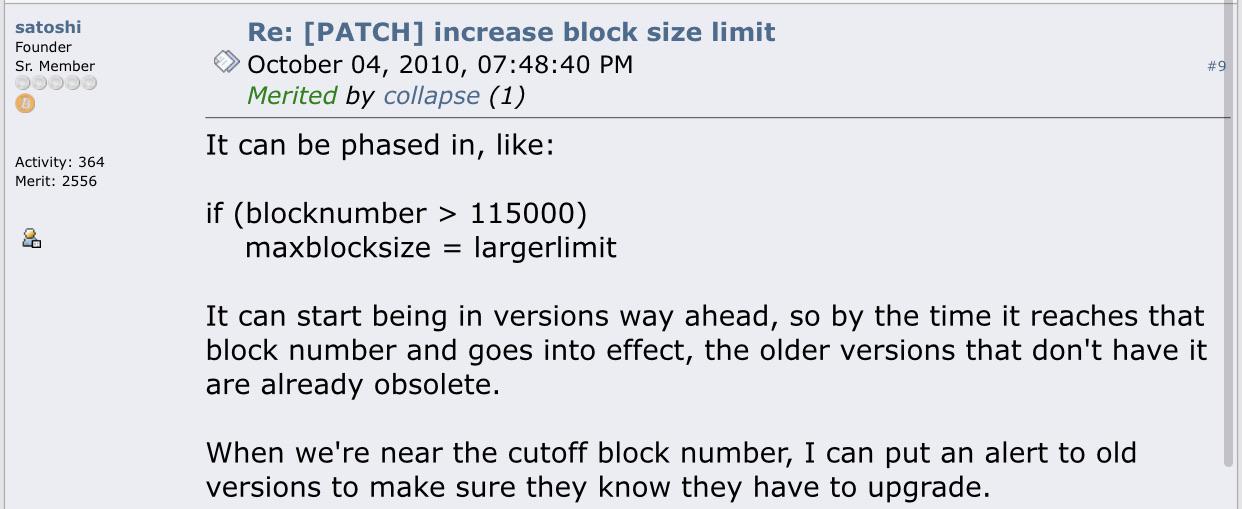
However Satoshi explained how the upgrade could be done in future. https://bitcointalk.org/index.php?topic=1347.msg15366#msg15366
'
It can be phased in, like:
if (blocknumber > 115000)
maxblocksize = largerlimit
It can start being in versions way ahead, so by the time it reaches that
block number and goes into effect, the older versions that don't have it
are already obsolete.
When we're near the cutoff block number, I can put an alert to old
versions to make sure they know they have to upgrade.
Satoshi Nakamoto
The origin of the 1MB block limit `February 07, 2015`
**Ray Dillinger (****Cryddit****),** who reviewed Satoshi Nakamoto's Bitcoin code with Hal Finney before it was released, posted on BitcoinTalk forum.
`I'm the guy who went over the blockchain stuff in Satoshi's first cut of the bitcoin code. Satoshi didn't have a 1MB limit in it. The limit was originally Hal Finney's idea. Both Satoshi and I objected that it wouldn't scale at 1MB. Hal was concerned about a potential DoS attack though, and after discussion, Satoshi agreed. The 1MB limit was there by the time Bitcoin launched. But all 3 of us agreed that 1MB had to be temporary because it would never scale.` https://bitcointalk.org/index.php?action=profile;u=146383http://diswww.mit.edu/bloom-picayune/crypto/137796https://bitcointalk.org/index.php?topic=946236.msg10388435#msg10388435
***Ray Dillinger*** (The origin of the 1MB block limit) https://www.reddit.com/r/btc/comments/5dtny2/the_origin_of_the_1mb_block_limit_cryddit_ray/
**Mike Hearn**: **Questions about BitCoin**
There is another evidence where Satoshi explains how Bitcoin would scale on-chain in e-mail replying to Mike Hearn. https://plan99.net/~mike/satoshi-emails/thread1.html
`If there is only one chain recording "the story of the economy" so to speak, how does this scale? In an imaginary planet-wide deployment there would be millions of even billions of transactions per hour being hashed into the chain. I realize that each PoW can wrap many transactions in one block, nonetheless, that's a large amount of data to hash.` **Mike Hearn**
Satoshi responds and clarifies how Bitcoin scales.
Hi Mike,
I'm glad to answer any questions you have.
There is only one global chain.
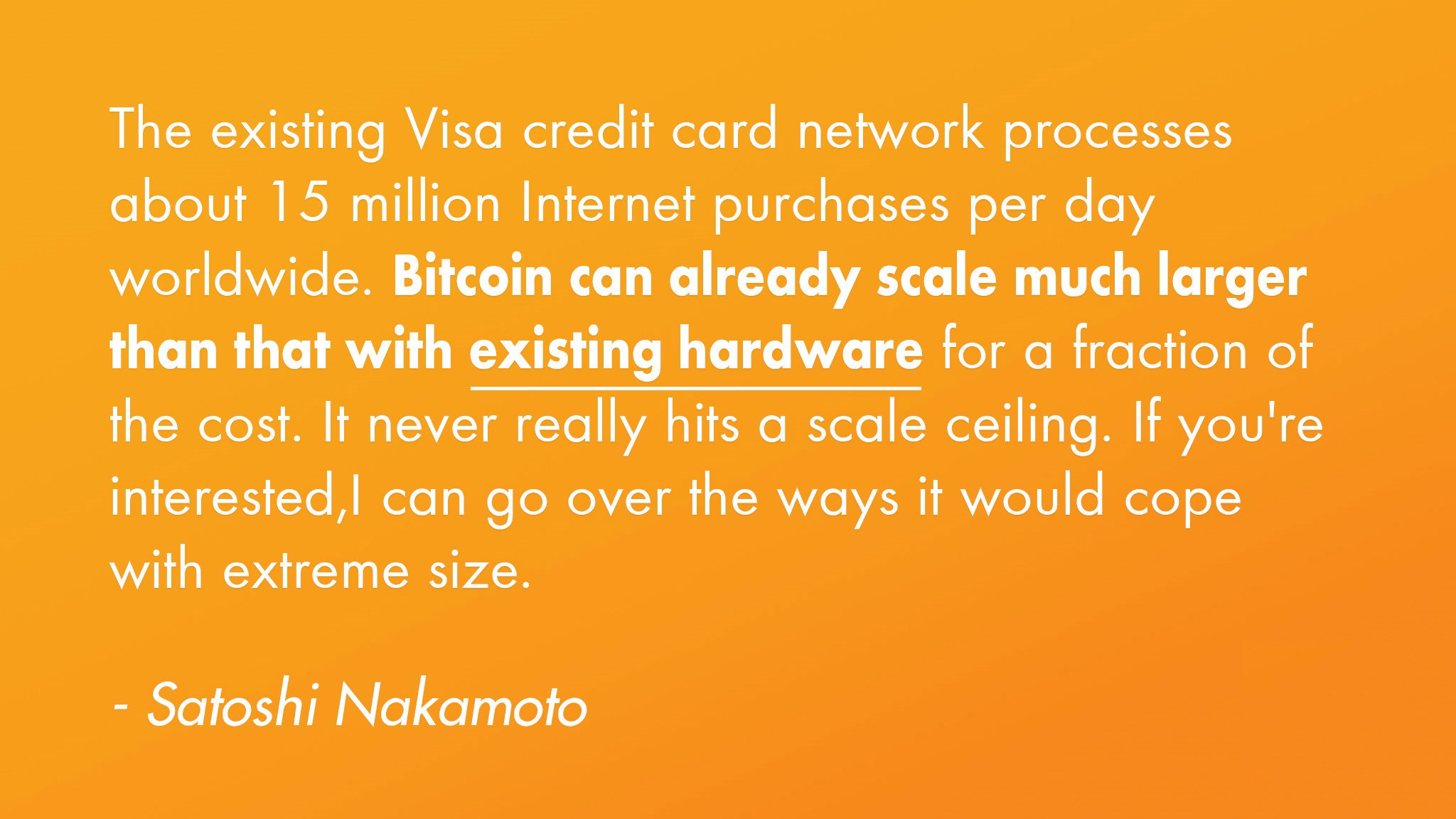
With'The existing Visa credit card network processes about 15 million Internet
purchases per day worldwide. Bitcoin can already scale much larger than that with
existing hardware for a fraction of the cost. It never really hits a scale ceiling.
If you're interested, I can go over the ways it would cope with extreme size.
By Moore's Law, we can expect hardware speed to be 10 times faster in 5 years
and 100 times faster in 10. Even if Bitcoin grows at crazy adoption rates,
I think computer speeds will stay ahead of the number of transactions.
Satoshi Nakamoto
Bitcoin Cash is Great.
Keep up the Great work, I started investing in crypto in August 2017, right after the Bitcoin Fork. Back at that time I didn't understand nothing, about the fork reasons, quite difficult for a newbie new comer, you struggle to understand Bitcoin, can't get straight there into why the fork happens, in the beginning I was thinking that BTC is the real Bitcoin and BCH supporters try to mislead people. How wrong I was, after reading WhitePaper again and again many times, after reading Satoshi Nakamoto quotes and his early messages on BitcoinTalk forum and on other forums, after making a lot of research and reading many articles I started understanding why Bitcoin Cash is the real Bitcoin that follows the whitepaper design basic fundamentals.
It took me a long time to understand Bitcoin, now I fully support on Bitcoin Cash. Keep up the great work, people will start seeing the truth eventually.
I want to tell that people are watching, they might not understand yet, but they will eventually do.
 @Val
@Val