The past of your Bitcoins may be darker than what you think.
Thank to NFTs explosion happened a few months ago now we all know the difference between fungible and non fungible.
For who have been in a bubble in the past months:
Fungible: units that are indistinguishable from the others, as coins;
Non fungible: units that are distinguishable from the others, as nfts.
**Are bitcoins really fungible?**
If the answer were yes i wouldn't be making this post XD.
As a matter of fact, each Bitcoin has a clearly viewable history on the blockchain.
It is complicated, but not impossible, to find all the previous owners of the bitcoins that you are handling right now.
**Would you give the same value to a Bitcoin that, let's imagine, has been used to pay for drugs?**
This is not just an hypothesis, this can really happen and it has happened for sure.
Police breaking into "Cooks" houses and examinating computers till finding Bitcoin addresses, hence all the ins and outs of a wallet.
Of course you would value it less. If you wouldn't, well any centralized society to who you would like to pay for something surely would.
When you pay for your groceries, the cashier will surely check large denomination banknotes, so would any centralized company with cryptos when they will accept them.
**How to solve this?**
Well with bitcoin which is a junk of a coin, is really hard. The only way i really found to "delete" the past of a coin is through using COINJOIN.
Coinjoin simply means to create a transaction where all the ins and all the outs are identical (Fungible XD) so that noone can really tell which address is sending to which address.
It has some limits. As far as i know only wasabi wallet implements this feature, but with a minimum of 0.1btc, which seen the high value of Btc makes it hard for normal transactions.
**What's the solution then?**
Not using any crypto who has a public blockchain.
You may not have anything to hide, but the past of your bitcoins may be darker than what you think.
Many so called "Privacy Coins" do exist, i bet you heard of Monero.
WIthin the Monero assed, there is no public information shared.
The blockchain is encrypted and let's say that each transacion is "shuffled" with other potential transactions.
**Why is everyone using Bitcoin then?**
Mainly because it is a trend, not different than flared pants.
It is even true that noone wants to interrupt this trend because a lot of people is gaining money with this.
If, back then, they could trade on flared pants, you would probably still see them around.
**In conclusion**, being able to freely manage your money is a part of the financial freedom that everyone wants, but if anyone can potentially find out how much cash you have, you are more in danger now than with banks.
Robberies would no more happen in banks but in citizens house and wouldn't take just grandma's ring, but whole life savings.
**Keep an eye open, or maybe both XD**
How to earn through stacking? (TRX Guide)
In this article we will take a look at:
-Tron basic features
-Stacking tron, earning percentages and SR comparison
-Tronwallets and which one i use.
-Tron basic features:
The tron asset is often compared to ethereum, but it has some positive sides.
First of all tron is a POS asset and not POW as the Ethereum network.
Associated to Tron there are 2 resources, bandwidth and energy.
-Bandwidth allows you to make transactions, a sort of gas (from the ethereum asset) but you get it for free.
Each address gets daily 5000 bandwidth (which is the maximum amount that each address can have).
In case you don't have enough BW (bandwidth) to broadcast a transaction, then an amount of tron will be burnt (deducted from your balance) to compensate the lack of BW.
Does this mean that transactions on the Tron asset are free?
Well yeh you can do a dozen of free transactions daily, but this doesn't mean that moving Tron is free.
Just imagine how much Tron an exchange as Binance moves.
They would instantly use all the bandwidth, hence to broadcast all the transactions they do burn Tron.
To increase the amount of BW that you get daily you need to freeze (we will soon see how) your balance as long as you want this increase (at least 72h)
-Energy is the second resource associated to your Tron account.
Unlike from bandwidth, energy is only obtainable through freezing your balance. It will fill daily and the maximum that you can get, depends from your frozen balance too.
-Stacking Tron
-Freezing Tron (and then voting, we will see what it is) is an operation that i suggest that you do if you don't plan to use your time in the future.
The freezing operation is done through the "Get votes" button.
Once you press it you will be able to choose if to raise your BW limit or Energy limit (which for new addresses is of course 0).
From this picture you can see that per 10 TRX you will gain 15 BW or 300 Energy.
This choice depends on what you wanna do, if you just wanna earn interests on your balance this choice is worthless.
Once you sign the freezing transaction, which will consume BW, you will have "Tron Power" or "Voting Power".
VP (voting power) is literally the amount of that you have frozen and you have not used yet to vote.
You can access the list of the Super Representative by clicking the button "votes".
You can now press "Voting" and manage your votes.
Once you choose how to divide your votes, press again on the button "Voting" and confirm the transaction.
From now on you will be earning every 6 hours a reward for voting that SR.
All this is the process of stacking Tron.
-Earning percentages
The yearly gain over 1000 TRX is about 70-80 TRX which means 7-8%.
Don't forget to consider that it all depends on whether your SR is paying you and how much of the reward the SR is paying to the voters.
I find it a good method for earning passively, completely different from lending which has highs and lows.
In my experience the yearly gain from lending goes from 2% to 15% on average with peaks of even 100% or more.
If you consider that lending even requires the payment of fees, it makes small investors not able to use the services.
Furthermore lending protocols (like compound and others) are centralized and susceptible to hacking, or just you have to send your money in exchange of a secondary token.
**Instead Tron lets you freeze (and so earn) from 1 TRX, there is basically no fee for withdrawing your reward and you may even earn extras from voting for long time or from tokens that SR send you. Your coin never leaves your wallet and after at least 3 days of freezing, if you need liquidity, you can unfreeze and dispose of your coins as you need.**
**No account approbation for lending, once you activated an address, (which 0.1 Tron) you are good to go.**
-SR Comparison
Some SR give their own token to the voters, so if some token interests you, check if the token owner is a SR and if they giveaway their tokens thisway.
To choose better the SR that fits you the best, you should have a look at
https://www.tokengoodies.com/voterrewards .
Here you can calculate how much you would earn daily and you can discover which SR gives you extra tokens.
-TronWallets
The screenshot that you saw came from tronscan.org, accessing with my ledger devide.
You can even register or connect a Tronlink wallet.
If you can't use a ledger device then i suggest that you to use a Tronlink account.
There are dozens of services which can give you a wallet.
I tried Tronwalletme (which recently rebranted to klever.io) but i found the desktop interface slow... very slow... (they didn't even pay me the shares for voting them for long time, but this is another story)
Even ledger live has its own interface to handle Tron and all its features, but it often takes time to sync with the chain so i prefer to use the interface on the tronscan.org.
Full review of Freebitco.in
In this article i wanna talk to you about freebitco.in
In this article we will talk about
-Reliability
-Inner gambling system (with a simulation i made)
-Where does the website takes its money
-Interests gain
-The stats i achived after almost 5 years of usage.
-**Reliability**
What gives a website/service reliability?
A number to call?
A support email?
A VAT number?
An address?
Well, many websites have this information shown to prove to the users that they are not a scam but they are a real working service.
The website we are considering **doesn't have any** of those (just a twitter account).
I find it important to talk about reliability when talking about this website because it is one of the **few websites** who "**built trust**" in years of "**legit**" work.
As i just report information i would lie if i told you that noone has ever claimed to have been scammed from this website (later we will see how), but since i have used this website (more than 5 years) i never had any problems and all the people that i know in real life, who i know that use this website, have never been scammed.
We will review each single game/opportunity that this website gives in order to give a full overview of the website for the people not registered.
-**FREE BTC**
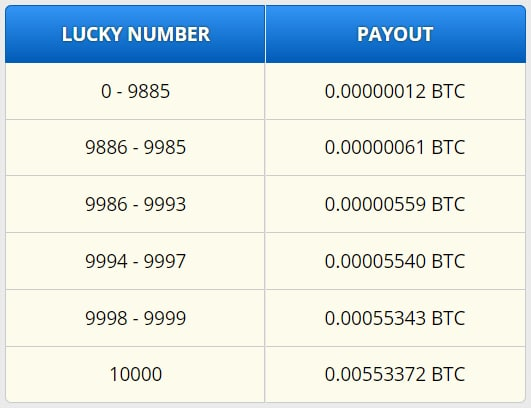
The first tab of the website is **FREE BTC**, it has a table in which are shown the possible rewards for a roll.
As you can see the rewards can go from very small to very big.
You have 1/10000 chance of winning 200$ instantly (in btc of course).
This page is very intuitive, there is just a roll button, each time you click it will roll a number and you will receive the reward corresponding to the number.
You can roll for free every hour.
There is a google captcha which will be taken off if your balance reaches above 100$.
It doesn't matter how you reach 100$, you can **earn** all on the website or you can **deposit**. (personally i didn't deposit)
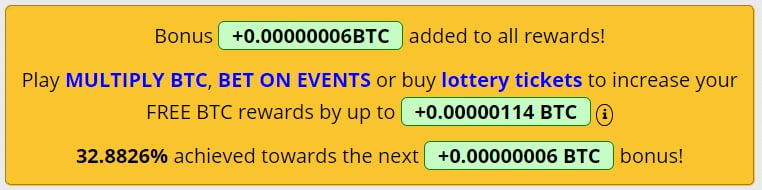
Still in this page you will see an orange box explaining you how to increase your Free roll reward amount.
Basically, you will see a percentage, each time that the percentage reaches 100%, your reward will increase (only the lowest reward, not all the rewards)
You can stack up this bonus 19 times reaching 20 times the value of the base reward.
So if you reach 3 times 100% and the base reward at the moment is 100 satoshi, you will get 100+100+100+100 for each roll winning the lowest reward.
How to increase the percentage? Mainly playing the **multiply btc** "game", which leads us to the next tab!
-**MULTIPLY BTC**
In this paragraph we will actually discuss about the **probability** and i will show a **simulation** to prove that what happens in the website is not fake.
In the first place i have to say that i played this game and i came to some conclusions that may seem obvious, i will share them with you soon.
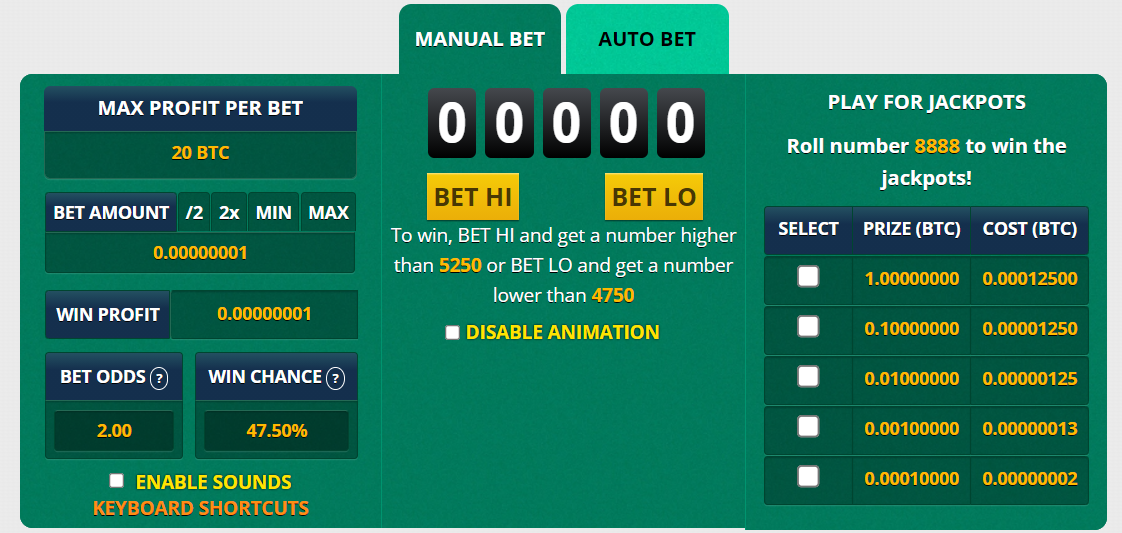
In this tab you will see a basic interface for betting your balance and an history of your recent win/loss.
**How the game works**?
Is a sort of dice game with 10000 numbers and a variable house edge.
For each bet that you make you will choose bet odd (which means how much you "multiply" your win) and if you bet on "**High**" or "**Low**", then the website will randomly generate a number.
In the base of your bet odd you will have a fixed chance of winning.
If you use a bet odd of 2 the winning chance is 47.5% both for high and low and 5% sure lose (also called house edge)
-A few examples:
Your bet:
Amount: **10 satoshi**
Bet odd: **2**
Winning chance: **47.5%**
Bet on: **Low**
This set up means that you only win if the rolled number is **below 4750**.
Remember that there are 10000 numbers and only 9500 are possibly winning (depending if you bet on high or low) and 500 numbers are **sure lose**.
Your bet:
Amount: **50 satoshi**
Bet odd: **50**
Winning chance: **1.9%**
Bet on: **High**
This set up means that you only win if the rolled number is **above 9810**.
With this bet odd the house edge must be bigger or they would lose too much money so there are only 380 possibly winning numbers and 9620 losing numbers.
You can see by yourself that how the game is build, **they don't need to cheat**, is **literally written** that you will slowly lose all your money if you use it.
On this game i past long time testing all sort of strategies, all work in a short term but on a long term they end up failing because the law that 5% is for the house is sure.
**PAY ATTENTION!!!!!!!!!!**
**Don't belive anyone who told you that they found a way to cheat the game, it is impossible, and i don't say that for lack of knowledge, i can assure you.**
**I found many persons claiming that they have the "winning code" (an external application to install and make run) that will make bets for you and win for you, all for the price of... your registration with their referral.**
**They may even tell you to put in 500$ or more or the code wouldn't work.**
**Let me tell you, they wrote a code, yeh, but not for winning, for loosing at the slowest rate possible, thisway they will gain the most from the referral commission.**
**Some of them even livestream their code "working" but after a deep look you too can realize that their code is not making them win anything with the multiply game and that all they are gaining is from their referrals wasting their money.**
Some people may want to try the **Martingale strategy** but that doesn't work too, it seems the safest way but is actually the worse.
This strategy just means to bet, each time that you lose, the double of your lost amount. This way you would always cover your losses.
**This may work with large bet amounts and only betting 3-4 times at max**.
In this case where you are more willing to bet very little amounts, many times, i can assure you that you can find streaks of 20 or more losing numbers (confirmed both by simulations and real game).
A streak of 20 losing numbers played the martingale style means, betting 1 satoshi, losing undreds of dollars.
This is what you will lose when you try the Martingale strategy and you find a streak of 20 losing numbers starting betting from 1 satoshi:
1 million satoshi = 350$ or more
You don't belive that 20 losts or more in a row are possible in a fair game?
Then let's make the simulation i told you before:
I will be using python and i will try to explain each operation i used to count how many consequential losses are possible.
Of course we did 50000 operations because you will want to bet small amounts and to stack up money you are willing to do a lot of bets.
The result of the simulation basically can be any from 10 to 30, so don't use Martingale or any variant.
**THIS GAME IS BUILD TO MAKE YOU LOSE!**
-How to cheat the game?
Basically what you have to do is to play more random than the random function that they use, don't follow any scheme, all the schemes will always be a variant of the Martingale method, which with microbets will fail 100% of the times.
-**BETTING**
In this tab you will be able to bet on
-Sport events
-Political events
-Crypto prices
Personally i don't recommend betting on sport events on this website because the win amounts are very low compared to sporty bets websites.
The outcome odds are never higher than 2, most of times for "safe bets" the outcome odd is 1.1, not worth at all
-**PREMIUM**
This is a pretty new tab that they introduced in march this year.
Here it is basically allowed to only trade on the **FunFair Token**.
The more **FunFair** token you own, the more bonuses you will receive.
The **longer** you own it, the **higher** the bonuses will be.
-**WIN A LAMBO**
This is the tab where the website gets most of its money.
Buying a ticket on this page will make you eligible for winning a Lamborghini or **200000$ in BTC**.
They pick a winner once every 6 months and each ticket costs 25k satoshi.
Till now they sold 235k tickets, which means **58.75 BTC**.
If you consider that **200000$ = 5.7 BTC**, **they gained 10 times the cost of the car**.
This is not a scam, there are persons who claim to have won the contest, but the law of big numbers is against you this time. So i just suggest you to ignore this tab.
-**REWARDS**
Last but not least of the tabs (hidden in the "MORE" tab) is the **rewards** tab.
Do not make the mistake of undervaluing this tab.
The main thing that you want to do on this page is to **redeem** the highest **reward points bonus** that you can get for each free roll (on the Free BTC tab) because reward points are actual satoshis.
If you consider this website running 24/7 (which i assure you it can be done) with always the highest reward points bonus active, you are able to gain 1200 satoshi daily, which will be added to the basic amount that you earn from the freeroll.
Let's say you earn 30 satoshi for each freeroll and 100 reward points per freeroll, in the long term you will be gaining 57k satoshi monthly (20$) which is something that i bet you are not willing to lose.
Once you reach 100000 reward points (which a lot of people have done in the past so don't think that it is impossible) you can convert them for **100000 satoshis.**
-**LOTTERY & CONTEST**
This is a fraudulent side of this website, it has been proven in the past that the **winning users are always the same**.
**So for not losing possible gains i suggest that you go to your profile (tab hidden in "MORE") and disable the lottery because instead of tickets you are gonna get reward points, which are actual satoshis**.
-**MY STATS**
After more than 5 years of using this website i rolled more than 20000 Free rolls and no, i didn't receive the 200$ prize. Yes it is probably fair.
I made more than 800000 rolls at the multiply game and i won a lot many times and i lost all a few times, but yes, i am still in gain and not in loss.
I don't wanna share my aged stats because someone may use the picture of my stats to convince other people to trust him.
**If this explanation helped you, consider using my referral**
https://freebitco.in/
https://freebitco.in/?r=3994804
Choosing mining hardware is not easy!
In this article we will see how to use whattomine.com.
It is a very useful website for people who still didn't chose their new mining hardware.
After long time running your 1080Ti you want to upgrade them but you don't know if to pick a 3060, 3080 or a 3090?
You always heard about mining but you never jumped into it and now you are searching for the best hardware for you to start?
This is the article that you were looking for, or whattomine.com is the website that you want to use!
This is how the mainpage looks like, a row of graphic cards both from Nvidia and AMD and many different algorithms.
Right below that will be shown the most profitable algorithms from the most to the least profitable.
Let's assume that we wanna buy 3 3060 (any amount of the graphic cards shown before), we will want to find for the 3060 box and write on its side the amount "3" and then click the "3060" so that the box lights green, like this:
Right after that we will see numbers changing below in the algorithms section.
Now we can click on "calculate" which is located right below
You may even want to change your power cost and sorting order.
After you click, the page will quickly reload and you can now scroll down to see which is the most profitable algorithm for your selected cards.
You can see that at the moment (15-May) the best coin to mine with a 3060 is CFX.
You can even calculate for hybrid builds, let's say you wanna keep those old 1080Ti and you wanna add some brand new 6800. What you want to do should look like this:
(Of course unclick your previous choices or the other cards will be considered in your calculation)
With this setup you can see that the best choice is to mine ethereum.
In the same way that you select and deselect cards, you can even select and deselect algorithms, let's say we want to exclude the ethash algorithm for this calculation, we want our algorithms section to look like this:
After calculating we will see that the most profitable coin to mine is XEQ.
As you can see in the algorithm section, you can even edit the hashrate that your cards make and power that they consume to get a more accurate calculation.
If your favourite mining hardware are not graphic cards but Asics, then you can click on the Asic tab.
You will find yourself in a similar page where you can straight input the hashrate of your asic device and its consumption to get an estimation of the gains.
In conclusion let's talk about the last 2 tabs.
Here you can see which, Asic by Asic / Card by Card, gives the highest revenue.
Let's say you wanna compare a 2080 with a 2080Ti.
You can see that the 2080Ti gives more profits.
Comment if this article was useful.
Any suggestion or criticism is welcome.
Cloud mining vs hardware mining
Before starting with the main topic i want to introduce some fundamental "definitions" such as:
-What is a transaction;
-What is a mempool;
-What is a block;
-What is a fake block;
-What is a confirmation;
-What is mining.
**What is a transaction?**
Each of us now and then makes a transaction to move our funds for a reason or another, but **what actually happens**?
When a transaction is broadcasted, there is a process occuring, which is the "**sign**" of the transaction.
A **sign** is a string of characters which walk along the other details of the transaction, which are **sender address, receiver address, amount to move and fees**.
The presence of the **sign is needed** **to prove** that the sender address really wants to send the money, how?
As we know, each public key is associated with a private key. The private key is the generator of the public address and it can sign transactions through cryptography.
This is, of course, needed because otherwise anyone knowing your public key would be able to send your Coins, which basically doesn't make any sense.
Once a transaction has been signed goes into a "place" called mempool.
**What is a mempool?**
The mempool **is a buffer** where the transactions are **temporarily stored** and are waiting for a miner to choose them and verify the sign.
It can be compared to a waiting line.
Of course miners will be willing to choose a transaction with higher fees than one with lower fees.
**What is a block?**
A block is a group of **transactions** that have been **verified** by the miners and have been **written on the BlockChain**.
It may be made from 1 to thousands of transactions depending on the asset.
Once a block is written it is **immutable**.
**What is a fake block?**
A fake block would be a block written on each Node of xCoin which **contains fake information**.
If a Node has a different BlockChain from the other Nodes, it means it has been manipulated.
In a theoretical way, if you could manipulate 50% + 1 of the Nodes of a BlockChain , the other Nodes would adapt to the majority of the Nodes, considering the fake block a real block.
This problem is nowadays **no more** considered as a **problem** but once a BlockChain starts you may imagine that could be a real problem.
(This reasoning works of course only for decentralized protocols)
**What is a confirmation?**
A confirmation is basically the **amount** of **blocks** that have been written on the BlockChain **after** the one you are considering.
The more blocks are written on the BlockChain, the more confirmations an old transaction has.
An example: If you consider the 1000th block of an imaginary chain and the last block of the same chain is the 1042th, this means that the 1000th block has 42 confirmations.
**What is mining?**
Mining is a process where a **calculator verifies** each broadcasted **transaction**.
A calculator will "look" into the mempool, seeking for the transaction with the highest fees and will start its operation of verifing.
For a calculator, it is possible, through cryptography, to **authenticate** a transaction by verifying that the **sender address** and the **sign** have been **generated** by the **same private key**, without actually knowing the private key.
In this article we will of course not look into how the operation of validating is mathematically executed, but be aware that **transactions in different assets** are verified through **different algorithms**.
Each calculator executes a very high number of calculations to verify that the sign and sender address have been created by the same private key.
Once multiple transactions have been confirmed and some criteria have been fulfilled, like reaching the **maximum size** of the data that can be **written in a block**, or reaching the **maximum time** that a miner can operate, the **block is written** onto the BlockChain.
**Hardware mining!**
Hardware mining is the classical way of doing mining which, if done only for the purpose of gaining money, **needs making some calculations** and obtaining some **knowledge**, in order to be profitable.
To start mining a user needs 2 things:
◼️Hardware to operate the mining process;
◼️Knowledge on how to optimize the gains.
◼️**Hardware to operate the mining process**
It is not a secret that nowadays it is very hard to find some good hardware to start mining at a reasonable price, both because the global pandemic slowed down world economy and because "money making machines" don't stay unsold on the market for a long time.
If we wanna take a look at the hardware we can split the whole sea of components in 2 parts:
♦️Antminers;
♦️Graphic cards.
♦️**Antminers** are devices built only for the purpose of mining, they don't even have a video interface to be set up, all the setting up occurs by accessing to them via their ip address (which can be **hard** to do **for a novice miner**).
Antminers are not even very versatile, because they work on a **restricted** amount of **algorithms** and after some time they even become useless, why?
Because they **slowly become less efficient**, consuming always the same amount of power but decreasing the amount of blocks that they can mine in the same amount of time due to the **increasing mining difficulty** (factor that we are not gonna discuss in this article).
This leads to their **obsolescence** and they end up being just **e-waste** because no one is willing to buy a "money making machine" that slowly "burns" your money.
♦️**Graphic cards** instead are much more **versatile** on many aspects. They can operate on **different algorithms**, users can **undervolt** their equipment to increase their life, they can be **overclocked** to increase their performance, they are far **more quiet** than any antminer and most importantly on the **ecological side**, they rarely become e-waste because the market of **used** graphic cards is **thriving**.
◼️**Knowledge on how to optimize the gains**
As a new user i want to suggest that you don't mine through some "**plug and play**" softwares such as nicehash/minergate and any similar group.
Instead it is **much better** to subscribe to any **mining pool** and mine directly with the **best algorithm** and not let someone else make these **choices for you**.
After choosing the best algorithm for your device and the best pool, you have to pay attention to:
♦️**Good ventilation** of your device because if it overheats it will be less and less productive;
♦️Energy cost, since it is almost a **static "fee"** that you have to consider, you may want to find some solutions like switching to a cheaper electricity provider or even better to produce your own energy.
(we are not goin to discuss how to generate energy and i don't want to give advices to someone who is probably not an electrician)
A fundamental topic that you have to consider is the **power** that you are giving to your devices.
You may **undervalue this aspect** if you are willing to or you are mining with an **antminer** (which works the best with their own power adapter), but when mining with **graphic cards** it is as **essential as the mining device** itself.
You will need a **good quality power supply** for your cards or you literally **risk to blow** them.
Since the **price gap** between a **trash** supply and a **quality** supply may be around **40$**, i suggest that you **spend them** if you don't wanna risk to blow thousands of dollars worth of graphic cards only because you bought a 30$ power supply.
If you are searching for a **good quality power supply**, you can search for a **certificate of efficiency 80 + silver/gold**.
As a graphic card miner you will even have to **face** the aspects of **overclock** and **undervolt**.
You want to **overclock** the card to **gain more** calculating power out of your card, but you even want to **undervolt** the card to **lower its consumption** and to **prevent** it from **blowing up**.
This process of **finding optimal undervolt and overclock** is called "**Tuning**" and it can be done through the **manager** of the **graphic card**.
It depends on the card you have, for example **MSI cards** have a software called "**AfterBurner**" to set overclock and undervolt.
(Should even work with non MIS cards)
**Cloud mining**
Cloud mining is a new way of doing mining which is often told to be very easy and profitable, but most of the times it is not!
Choosing to do cloud mining instead of hardware mining provides a **lower initial cost** for a user who wants to invest money but, sometimes, it offers even a **lower chance to get back the investment** in a long term of time or at all.
**Cloud mining** is a way to mine **outside of your house walls**, **not** needing to **worry** about where to put the **hardware** to mine, the **heat** production from the devices, the **noise** produced by the devices and the **power cost**.
As many people say "you will just need to provide an address to receive the payments".
Well, to be honest it **sounds bewitching**, but most of times you are going to get back only a **part** of the sum that you invested because these services can't tell you **what** will **happen** in the **future**.
If a cloud mining contract lasts 1 year and the plan, at the time of the beginning of the contract, claims to **pay back** the investment in **8-9 months**, you are **not** gonna end up with **gains** due to "**mining difficulty increase**" and due to any problem that may occur.
The provider of the contract can say that the **price of energy** is increasing so you are **gaining less** and you can't do anything about it.
Or they can have **internet problems** and the time that the devices are **not mining** will still be **deducted** from your contract.
Most of times it is even hard to start cloud mining with any company because their **new hardware** often **sell out very quickly**, not allowing the new users to join the service.
**In conclusion** i would say that **hardware mining** is much **harder** than cloud mining because you **have to know so many things** and need a lot of **precautions** in order to **mine properly** and make it a **profitable activity**, but i will never recommend that anyone signs a cloud mining contract.
After 1 year a mining contract (ended or not) may or may not give you gains, even trusted services can't be trusted.
If you spend 1000$ on a **mining contract**, in 1 year **you may end up negative**.
Instead if you spend 1000$ on **mining hardware**, after 1 year **you still may end up without gaining back the spent sum**, but at least **you have the devices** left.
If you took all the precautions, the hardware will still be in a good condition after 1 year.
If something stops being profitable, you can change algorithm and if you want to quit (or upgrade), you can still sell your devices for a reasonable price.
Please **don't comment** something like "graphic cards are **spoiled** during the **mining** process", no it is **not true**, what is true instead is that the process that spoils the card is the "**heat hop**" .
If a card mined for a week and it has been at 55° for the whole week it will be in a better condition than a card used for gaming that has been, for the same amount of time, turned on and off various times.
Fake news influence novice crypto users!
I want to introduce you to an aspect that many of the users of the crypto community on the internet undervalue, it is the **trust** that people have towards the cryptos.
It is not a secret that **every day new scams are born and die** on the internet fueled up by cryptos because they are thought to be **anonym**, but another factor is taking place, **fake news**!
As we know, the price of cryptos is unclear, it is hard to guess what the future price will be, but one thing that we can say is that it gets its value from the "trust" that people have in it.
We all know that fake news are pieces of information that are distorted or completely invented to make the reader do something or believe in something.
**Misleading words** are not written only by **unofficial journals** on the internet, but they are even used by big journals, mostly just in the title of each article, **to attract** **attention** of the customers.
Known journals are used to put a little lie in titles but **on the internet** the **lie** can be constructed in a **more complicated** way.
Some of the tools that **malevolent** users of the internet use to spread fake news are: ➖**Videos**: edited in such a way to transform the actual information, or just **decontextualized**;
➖**Pictures/Memes**: representing **improbable** or decontextualized **situations**;
➖**Actual articles**, long texts that fool the user with a **long text** that gives them **authoritativeness**.
We started talking about **trust**, because that is what drives people into **discovering** and eventually **using** any Crypto, may it be Bitcoin or Bitcoin-Cash or any other that you can imagine.
It came to my attention, recently, that a lot of **fake news** as well as **fake journals** with absolutely **fake articles** are **claiming** the more **various things**.
Most commonly i saw the type "Elon Musk told to buy xxx", but even worse.
The Elon type tries to convince people that Elon is "**pumping**" another crypto, even using **fake proofs** as **fake tweets** and **fake accounts**, to pump a particular coin and of course **taking advantage** of this fake news to **gain** from the **pump** of the coin.
The second type in my opinion is much worse. They build a webpage with a **fake journal** name, **invented** or **stolen** from a **trusted header**, and then they pick a **random celebrity** and they claim that the celebrity **said something**.
Famous chefs, singers, politicians, actors, anyone popular is subjected to this phenomenon.
The one that got me, was an article about a famous chef, that i'm not gonna mention, interviewed by a famous interviewer as well. In the **fake interview** he spoke about how he found this "**fantastic trading app**" that lead him to double his patrimony in just a **few clicks** on the app.
Of course any daily user of the internet will notice that **the article stinks**, but if people who fall in these **traps** didn't exist, these **fake news wouldn't exist**.
Eventually i digged into the webpage, eventually finding the app which was a downloadable .apk file that, i guess, you are supposed to install.
We all know that installing unverified apps could end up in various bad situations in which the harmful software could steal your data from your mobile or, in a more elaborated situations, ask a deposit on a fake trading app and snatch the deposited sum.
This **phenomenon** happens on **daily basis** and it spoils the image of the cryptos to the new users approaching this world.
If you are reading this, you are probably not a person who is **easy to trick** with such methods, but i admit it, for one second i believed in the fake news of **Elon pumping another coin**, but as a good user of the world wide web i explored the topic more and i found out that it was a "**joke**" (if you allow me to call it like so).

Why to choose Bitcoin-Cash?
In this article i wanna **compare** with you the **BlockChains** of Bitcoin, Ethereum, Litecoin, Dogecoin, Dash and last but not least Bitcoin-Cash.
Before going into data, let's make a little premise, the data i watched are a **little part** of the BlockChains, they are **not fully representative** of the BlockChains behaviour, but the data i'm gonna show you seems to be **concordant with the usual trends**.
The data that I submitted to examinations are **15 blocks** of the per mentioned asset. I picked the **latest** blocks at the moment of the **data collection**.
(The tabs with the data will be available at the end of the article)
One of the main vaunt of Cryptos is the speed of the transactions, that compared to the time needed to send any fiat across the world, is much faster.
Let's see who owns the record!
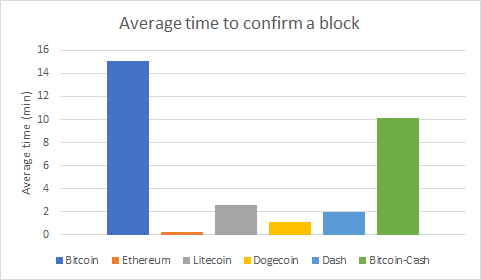
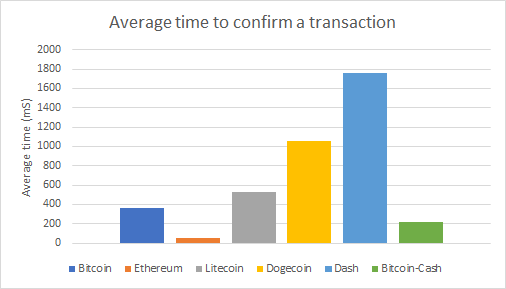
(**Lower - Better**)
In this graph you can see that of course chains like **Ethereum** and **Dogecoin** have a super low confirmation time due to the recent use of the chains (low confirmation time means high speed).
**Bitcoin** keeps being the **slowest** chain in the one represented followed by Bitcoin-Cash, Litecoin and then Dash.
Of course this graph is very **approximative** because these are average times to confirm a blocks and a block may contain multiple **transactions**!
Let's see what happens if we compare a **hypothetical time** to confirm a single transaction in each BlockChain.
(**Lower - Better**)
In this graph we can literally see which is the most efficient BlockChain in terms of time.
Of course the Ethereum BlockChain is the most efficient in confirming transactions (and also the fastest at creating blocks), but that is of course driven from the recent **vogue of DeFi and SmartContracts** that are taking place on that specific BlockChain.
On the second place we see, of course, the **Bitcoin-Cash BlockChain** and then after it in this order Bitcoin, Litecoin and then the latest trend launched by our friendly **Elon**, the Dogecoin.
The scale on the left represents the **milli-seconds** needed to **confirm a transaction.**
In the case of Bitcoin-Cash, an average of 2823 transactions in an average time of 10.1 minutes makes a confirmation time for each transaction of **215 milli second**s!
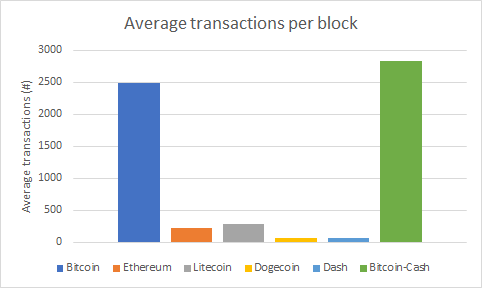
Another factor, that we should consider in the examination of the **BlockChains**, is **the number of transactions that can be located into a single block**.
(**Higher - Better**)
In this graph you see again that the **Bitcoin-Cash BlockChain is on the first place**, followed by Bitcoin and all the others are far away below the **record** **average** amount of Bitcoin-Cash of **2823** transactions.
Last but not least let's consider the **amount of cash** that we are gonna spend on average **for each transaction** that we broadcast.
(**Lower - Better**)
You may be wondering where are Bitcoin and Dogecoin in this graph. I had to exclude them cause they **way too big** numbers to put into the graph, their presence would have lowered so much the value referred to the other BlockChains that we couldn't have comment on them.
As lowest in the graph we find **Bitcoin-Cash** with an average cost of **half a cent** of a dollar of fee on average, then Dash with 0.9 cents.
At the first place we find Bitcoin with 4.9k cents **(49$)** and at the second place Dogecoin with **126 cents** on average.
As conclusion, if we try not to consider trends coming out cause of memes or cause of vogues, the **best coin** on all the aspects inspected in this article is **Bitcoin-Cash**.
You don't have to believe me or anyone, do your own research and you will find that **Bitcoin-Cash** is the **cheapest** asset to use, **fastest** and the **most efficient**.
When you seek for a bank to open a bank account, you seek for the one who **fits the best your needs**, why don't you do the same for **Cryptos**?
What other proofs do you need before starting to use it?
It is way better than any bank and better than other Cryptos!
Bitcoin-cash is waiting for you, but you have to integrate into your daily finances, because **you need it more than you think**.
Data that i collected from the BlockChains:
(TTM stands for time to mine)
(The numbers below each coin name are the corrispective blocks numbers)
What is the coin pump mechanism, what are its results?
The coin pump mechanism is a way to force any crypto coin to rise, it is a real "**Market manipulation**".
It promises high rewards but it can fail dramatically in some cases.
The mechanism is pretty simple and obvious, a large crowd of people (1000 persons or more) agree on buying a large amount of a specific coin from a specific exchange.
The result of this stream of buys of a single coin in a relatively short time frame, is that the price **spikes up** and the more it keeps happening the more high the spike is gonna be.
Then the crowd agree on **selling** the amount of coins and the coin price **peaks down** again.
This method usually **targets coins that worth very little** so that large amounts can be bought and the manipulation is more **effective**.
No, if you are wondering, **it can't happen on bitcoincash** (actually it can but who has so much money?.
The results of this are that a large crowd of people played with a coin and a specific exchange, ending in most of cases, to **spoil the exchange finances**.
If a lot of people buys Xcoin at 5 cents and sells it back at 50 cents, right before that it settles down again, the only result will be that the **exchange** service would have **lost funds** and the Xcoin price will be unchanged or overall will not resent of the experience.
Don't think you can do it freely with your friends on any exchange, remember that an exchange can deny you any operation and they can even ban your account, not even letting you take your "legit" money (the one that you had before you tried to scam them).
These **crowds meet** and make **decisions** on places like **telegram channels** or **subreddits**, where, i assure you, most of the gains will go to the owners of the channels/subreddits because they will sell the Xcoins before you. In this way they have their sure income and you may end up selling too late or you will have your conversion denied due to a momentary flood of the platform.
Recently everybody saw this similar mechanism happening on **Dogecoin** or **GameStop stocks**.
Dogecoin pump didn't finish yet because the phenomena is driven from a meme (that is still spreading) and not from an agreement happened in a crowd of people.
If you observe the gamestop stocks, you will see the clear spike up and then the settle down.
If you found this article interesting and you learnt something useful, make sure to follow me.
Feel free to like and comment your opinion.
Suggestions and criticisms are welcome!
Cardano, the coin who wants to solve the problems of cryptos!
Cardano is the world's first **peer-reviewed blockchain**. This means that the Cardano team made sure that experts from all around the world, check their papers and approve them. This is why the cardano asset took more than 2 years to be created.
The cardano **blockchain** is made up of 2 layers:
➖Cardano Settlement Layer, where the **transactions** of ADA occurs
➖The Control Layer, which will be used for the **smart contracts**.
Cardano aims to solve the **problems** of cryptocurrencies:
◼️**Scalability**:
➖The system of PoW is known for being slow and inefficient, both for wasting computer power and electricity. Cardano, instead, adpots the PoS. The network elects a few nodes to mine the blocks.
Cardano (actually its algorithm) divided time into **epochs**, and then epochs into **slots**. To each slot (which represents a fixed period of time) is assigned a **slot leader** which has the duty to **verify** the transactions and write them in the block in the specific time frame.
If a slot leader fails to verify all the transactions in time, it is no more allowed to produce blocks and has to wait to be **elected** again from the network.
This whole method (which is called **Ouroboros**) is much better than PoW because it allows to split epochs in more slots and lets run multiple epochs in parallel to face the increasing number of transactions.
➖With the old sistem of PoW, each node in the network receives a copy of the transacion that needs to be verified. Thousands of transactions per second * thousands of miners make the **PoW unsustainable** on the bandwidth side.
Cardano instead **splits** the network into **subnetworks**, reducing the amount of bandwith needed. This splitting tecnique called **RINA**. It allows the different networks to **communicate with each** other if needed but letting them still to be split and **operating individually**.
➖The **storage** of the blockchain is also a problem of scalability. For now the problem isn't still tackled, but the cardano team will use methods of **Partitioning** , **Compression** and **Pruning** to reduce the "weight" of the blockchain.
◼️**Interoperability**:
➖The cardano team aims to make a blockchain that "**talks**" to other blockchains. This would result in moving assets **across** multiple chains.
➖Cardano wants even to be trusted by banks, allowing users to "name" their transactions, setting a **sender/receiver** name plus a **reason** for the movement of coins. This still remains a **choice of the users** whether to put this information or not.
◼️**Sustainability**:
Many cryptocurrencies born recently launched a ICO (initial coin offer) to obtain a **capital** to develope the asset. Have you ever wondered what happens if those money isn't enough for the whole existence of the asset?
Cardano team did and they came to a solution! Each transaction will pay a "**tribute**" to a treasury who will store a **capital** for the **developers**.
The treasury itself is basically a **smart contract** which will hold the coins that will release part of the funds to **improve** the cardano **protocol**.
Developers will submit a proposal of improvement to the community. The **community** will vote for the **best** of the **ideas** proposed and after some time the **treasury** will give enough money to **develope** the **improvement**.
If you found this article interesting and you learnt something useful, make sure to follow me.
Feel free to like and comment your opinion.
Suggestions and criticisms are welcome!
Everybody would like to see bitcoin-cash (or even other cryptos) to be used in common places, but...
Most of the places don't accept them for 2 easy reasons:
◼️ the "exchange" of those coins is not **regulated**.
I don't know if only in my country it is like so but every shop has to pay taxes on the money that they get, which means that if shops started to use them, they would be considered as tax evaders because for the shop owner it would be very easy to just get a secondary address and receive payments on that address and not pay taxes from the money gained on the second address******
◼️people in general doesn't want to end up having many coins in a crypto that for any weird reason, **can lose** a lot of its **worth** in short period of time.
I think that each of us has experienced that at least once. We buy some coins and the next day... oh no... -8%
We all got shocked listening to the news that "**Tesla now accepts bitcoins**":
who can say that he didn't think that this would be a sign, a sort of step forward the dream of **using our cryptos** to pay our **daily commissions**.
The actual fact is that **nothing changed**. The world is full of places where a millionaire says that they **accept bitcoins**, that's for only the reason that it doesn't **affect** their **balance** at all. Millionares will stay millionares if they sell 10 cars or not, if they rent their super luxurious hotel for a week or not, if they rent an apartment or not.
The **real step** will happen when a company will **not care about taxes** or anything, they will go towards their customers and they will **accept** their **coins**, whatever they are.
I think that everybody should make a step towards each other, big companies and crypto community, starting to accept **stable coins** as wager/payment both for workers and shop owners.
Actually the stable coins i know work on **Ether blockchain** or **Tron blockchain**, none of them has a transaction fee that is considerably low...
Imagine giving :
◼️ stability for the people who don't wanna "risk" (and even allow them to lend their stable coins at a very low risk)
◼️ malleability for the people who wants cryptos, starting from a stable coin instead of starting from fiat, in order to get the crypto that they want, is a step forward.
******of course it shouldn't be regulated, everything should be free without anyone watching over everything that you do, but you can't, of course, destroy the old system and switch to new one. We all just need to slowly stop using banks and we all will be our own bank.
Gambling, the most common games and strategies to earn some easy crypto.
As in the real world there are casinos, where people can consensually lose most of their money knowing that just one lucky person will win them, in the crypto world there are a bunch of online casinos.
There are literally a ton of online casinos out there accepting any kind of cryptos and letting most of the users lose their coins.
⚫️***House edge***
The **house edge** is an amount (a percentage) present in any game, who represents **how much the "dealer" will win inevitably**.
It is easy to see this house edge in most of the gambling websites that lets you play a "**DICE**" or a "**HIGH - LOW**". (In dice there are only 6-12 numbers, in high-low there are as many as you want)
Imagine you have a list of numbers from 1 to 100, the winning number is randomly chosen, you can bet on "high", in that case you will win if the winning number is above 55, or "low" if is below 45.
You can see already that there is a gap where **you will never be able to win**, that gap is what causes the house edge. In this particular example the house edge is 10%
Of course there is not only the dice game.
In other games the house edge is created in other ways.
➖In the **BLACKJACK**, the house edge is created from a **rule**; if both the dealer and the player "bust" (lose), money won't go back to the owner, but it will go in the dealer's hands.
➖In the **POKER** game, there is not really a house edge because players play against each other, but a sort of house edge is created when **a player is the dealer**/house.
➖In the **ROULETTE** game we can split the house edge in 2 different situations depending on how a player wants to play:
◼️ In the case where a player wants to bet on colours, red or black, there will be a **1/37 or 2/38 chance** that the player will **always loose**, which is the case that the ball lands on the **0** or **00**, this generates about **5% house edge**;
◼️In the case where a player wants to bet on a single number, then the player will have only 1/37 or 2/38 change of winning, meaning that the house edge will be **36/37 or 36/38 , or about 95% house edge.**
With this simple fact it is clear that the sentence "the house always wins" is inevitably true.
⚫️***Strategies***
➖In games as dice and roulette, a strategy came out long time ago, it is called "**Martingale**", which is to play always the same and if you are losing, double the bet so you cover all the looses.
Of course this can't work for 2 reasons, you **can't double** so many times and the **house edge** that we previously introduced.
➖In games as **DICE** or **High-Low**, after long experience as a player, i came out with the following revelation, do not follow any scheme, **play completely random** and you will see that in some cases you will follow the wins streak.
➖In the game of **POKER** there are really no strategies, it is all up to the cards. I don't recommend playing poker, unless you like it that much.
➖The **ROULETTE** game is overall similar to dice because betting High or low is not so different from betting red or black, so if you wanna try it, don't follow any scheme, play random.
In case you wanna play the roulette betting on single numbers, well, only the blindfolded goddess can help you.
➖In the **BLACKJACK** as well you have to count on the blindfolded goddess, but if you are not an expert in the game, there is something i can show you.
Maybe you know that people used to "count the cards" which is no more useful since they introduced the "cutting card" which doesn't allow anymore to know what cards are left in the deck.
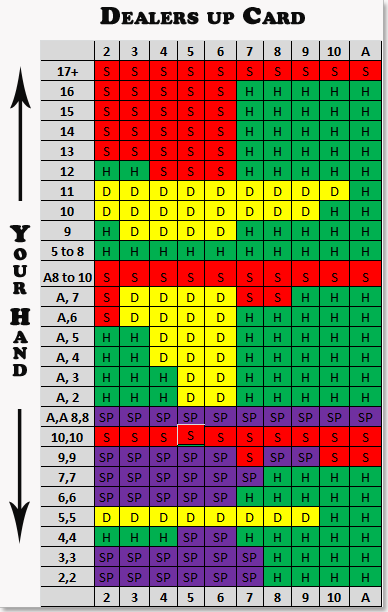
The actual suggestion that i wanna give you is that, since blackjack has a very low house edge (of course it depends on rules, when the player is gonna lose and when not), the best thing you can do about this game is to make always the "**BEST CHOICE**".
Someone decided to create a **scheme** to follow in order to always know what's the best choice.
https://www.blackjack.com.au/wp-content/uploads/2014/12/Simple_Blackjack_Strategy.png
Brief look at the past pandemics
Maybe this out of my topics but i wanted to reply to https://noise.cash/u/Cryptonator in his post https://noise.cash/post/1zj3677j and since the reply comment is more like a little research i wanted to put it here too.
I'm not here to spread hate or support "asian hate" (movement that didn't arrive here where i live), but if there is one thing that i'll always do, it is to defend the truth
In this case:
it is undeniable that "Covid-19" has spread all over the world, but is it really the "chinese virus"?
I always like to dig into the past, let's see a few events:
1918 - 1919:
The H1N1 (spanish influenza) exploded in Kansas, its source is unclear but an hypothesis is that it originated in China, then migrants going to the USA delivered the virus there where it started mutating
1957 - 1960:
The H1N2 (asian influenza) first case was reported in Guizhou, China. In June 1957 it reached the USA
1968 - 1969:
The H3N2 (hong kong influenza) was born in Hong Kong and spread in the USA
1977 - 1979:
The H1N1 (russian influenza), it originated in Liaoning, Jilin and Tianjin, China. Then it spread in Siberia and Russia
2002 - 2003:
The SARS was identified by the doctor Carlo Urbani in Italy (he died because of it)
Its source has been identified in Guangdong China
These are not all the pandemic events that occured since the beginning of the times.
I picked all the last and i skipped the swine flu because it originated multiple times in different years and i couldn't really put it in one single spot of the list so i kept it out
https://en.wikipedia.org/wiki/Pandemic
https://en.wikipedia.org/wiki/Spanish_flu
https://en.wikipedia.org/wiki/1957%E2%80%931958_influenza_pandemic
https://en.wikipedia.org/wiki/Hong_Kong_flu
https://en.wikipedia.org/wiki/1977_Russian_flu
https://en.wikipedia.org/wiki/2002%E2%80%932004_SARS_outbreak
Brief explanation of pyramid schemes and the most common crypto scams.
Let's start from the beginning, do you know what is a Ponzi scheme?
It is a pyramidal scheme where it is promised that every user gains money if they spend money in the pyramid and if they invite someone else who spends money, and then this other person will have to invite another person who spend money in the scheme and so on.
It is easy to understand that this pyramid sooner or later will be unsustainable.
The scam is in the fact that the last users who joined the piramyd who didn't invite another person in the scheme, will loose all the moeny that they invested.
So yeh actually you can gain from this schemes... If you have no fear of tricking other people into the scam and basically getting their money.
These schemes are so common because:
-They are very easy to make;
-They are viral.
This kind of scams have always existed but after that people started thinking that cryptos are a good tool not to be trackable (which is not true) they exploded on the internet.
Do you wanna find one?
Search on any search engine that you use "Dogecoin Cloud Mining".
You will probably find a webside who:
-Gives you free "mining power"
-Invite you to invite more users in the website to get more "mining power"
-Gives you the more "mining power" the more you spend in the website
-Has a growing number, you will always find a number that once you open the page will start growing, seems like dumbs like to see growing numbers.
Of course if a website has all this features it is a scam.
Does it mean that all the cloud mining is a scam? Of course not, but it is a good "mask" for these kind of pyramids.
As long as new people keep coming they keep receiving and sending payments so that people can give a proof that the website is "real".
Then, when the amount of people joining the scheme daily decreases, they close the website and leave with your money.
Another mask that they can use is the doubler.
They send double the amount of coins to anyone who send them funds, for a short period of time, then they leave with the money.
Another kind of scam, which is not a scheme, are the cryptocoins generators.
They will often be a website who claims to generate large amounts of coins in a short time.
They will ask you to pay a "miners fee" to get the coins, but of course you will not get anything.
Lately all these scams moved from the internet to Telegram.
There are dozens of telegram bots who use these schemes.
Be aware of your money and their worth.
Brief Explanation of what are Smart Contracts
A smart contract is a code which is stored and executed on a blockchain (and its nodes).
It can receive, store and send funds. (In some cases is even needed an interaction with "secondary" smart contracts)
It's main feature, which makes it reliable and secure, is that there is no human interaction, or better, there is no human decision involved in the application of a smart contract.
An example, that will help us to understand better how the smart contract is, is the "vending machine" example.
A vending machine is programmed to obey to determined inputs, which means that if you wanna get something which is inside, the vending machine will give it to you only if you respect the condition imposed by its code, which is just the payment of the price.
This is the base structure of each smart contract: if something happens, then something else is gonna happen.
This cuts off every possible human error. SC are reliable because they work (as every code) in a deterministic way.
If the input by the user is X the machine will give only equal amount of worth, which can be Y item or Z item + change.
SC are immutable (on ETH blockchain), which means that once a contract is released on the blockchain, it will no more be possible to modify it.
SC may even be decentralized, which means that there is not a single computer running the code for every user using it, but every node of the blockchain store and execute the contract in the exact same way.
Smart contracts are trustless, which means that to do an operation, you don't need to have any trust towards the users involved in the operation.
To make things clear let's make another example:
When a person wants to "swap" something for something else (money for goods or money for money or even goods for goods) 2 cases may occur:
-Person A trusts person B and reverse, this way both of them can have no fear of losing what they are involving in the exchange;
-Person A doesn't trust person B, which means that the exchange is not gonna happen peer-to-peer. Instead, there will be "someone" involved in the exchange which will hold for both users the goods/money and will swap them giving to each person what they wanted.
Still in this case, both person A and person B need to trust the "someone" who is holding the 2 goods/money before the exchange. This someone usually is a Bank or a third party trusted service.
These operations anyway have a critical issue, the human factor.
Smart contracts instead don't need any user to trust any other user because it will be the smart contract to make both parts "respect" the operation. Users can trust the smart contract because the code is decentralized and is open source.
Smart contracts are fast compared to ordinary swaps (which can take days) because the single transactions rely on the speed of the blockchain (meant as the time needed to confirm a transaction).

Privacy aspects of the crypto world
A lot of people say that Cryptos are anonym coins, but are they really anonym?🤫
The answer is no, something to be called anonym need to be "without name", which is not the case of most of cryptos.
Most of cryptos are actually pseudonym, which means that they have a "fictional name".🤔
To make things more easy to understand, any transaction made with fiat has, or is possible to find out, the name of the sender and the name of the receiver.👁
With cryptos instead, you don't send coins to a "name" with its banking coordinates, but straight to the coordinates, which are the crypto addresses (public keys).😎
It is easy to understand that in some cases, is easy to find out the name of the person behind a crypto address, but some other times it can be a real challenge to solve this "mystery".🕵️♂️
To solve this mystery, a few years ago started to born "secret agencies" with the scope of analyzing the block chain.🔎
If you don't know already, most of cryptos have a public blockchain, which means that all the transactions are easy to see with the blockchain explorer.🔍
Simply, in the blockchain explorer, anyone can search in the whole blockchain, informations about an address or about a specific transaction, which may involve multiple addresses.🤔
This is why cryptos are not considerable anonym, but only pseudonym, because any government with appropriate tools can explore the blockchain and fiat transactions to find out who moved sums of money.💰
It is up to each user not to do some evident movements in order not to be "recognized".🤭
You may be wondering why you don't want to be "recognized".🤨
There are multiple reasons and anyone can have its own reason.🤷♂
In my opinion, it is because users want to keep their own privacy and don't want that someone else know their businesses (whether they be legal or not).😡
-MIXERS
If you are a user who explored the privacy side of the cryptos, you surely have found someone who told you to use particular tools called "mixers" to hide your steps to whoever tries to analyze the chain.😨
Mixers are tools (basically a website) where users send their coins and they receive back the same amount (-fee) of coins, coming from someone else not "connected" to them. 🔁
I warn you and I discourage you from using any mixer because most of the mixers are used for money laundering.⚠️
Most of times the owner of a mixer is a person with a lot of "dirty" cryptos who wants to "clean" them by simply giving them away and keeping the "clean" coins that people who "fall" in this kind of trap send.🚫
Everyone wants to keep their privacy but noone wants to end up handling dirty coins that have been used to buy drugs (or even something worse in worse scenarios).😅
Now you may be wondering if there is another way to anonymize any transaction.🤔The answer is yes, there is a method to join in a single transaction, multiple inputs and multiple outputs.🤨
Most of the common users end up doing single transactions with one input and one output.➡️⬅️ Mixers aim to keep doing this 1:1 transactions but between strangers.🙁
This new method called "CoinJoin" allows multiple users to make a single transactions with various inputs and outputs, making it very hard to find who send what to who.😄
Of course everyone sends different amounts of coins, but if they all agree to send the exact same amount of coins, the transaction will be completely indecipherable.😎
To do this kind of transactions you need a particular wallet called "Wasabi".👀
**wasabiwallet.io/**
So far wasabi supports only BTC but I bet that in future they will support other coins too, or someone will build an equivalent for other coins.👏
https://wasabiwallet.io/
Brief introduction on wallets(what they are and how to safely have one)
Everybody uses online wallets but are they safe?🧐
Online services giving you a wallet to deposit your coins are not as safe as you think.😨
Wallets are "composed" by 2 keys (a serie of characters):🤔
➖The first one is called PrivateKey, it is used to generate the public keys (as many as wanted) and sign outgoing transactions for the public keys;📝
➖The second one is called PublicKey, as said it is generated by the PrivateKey, and its only role is to receive the coins.📥
They look like this:
➖PrivKey "5JduDPmHCauhCgqysDru3nhnArAg93cq82Dswr9bHeNEPke8BPc";
➖PubKey "1JxSiCA8qMjgkc11WDDDF7Y6YK1k16ryxi".
(don't use them as personal wallet 😂)
All the online wallets give you only the public key and they keep secret the private one.😈
This simply means that you never really own any coins, you just display a number on your wallet account.😥
Instead there are some devices called "Cold wallets" which commonly are Ledger or Trezor, who let you handle directly the Private Key.🤲
Those are devices who are 100% of time offline and they are only connected to a computer to create a new public key and sign transactions for the public keys.👮♀️
The security level is very high since the only data goin in and out the devices are transactions requests/signed transactions and public keys generation requests/generated public keys.👀
Depending on the device the Private key may even not be accessible to the user itself for an higher security.🔓
The online wallets are called "custodials" because they keep custody of your coins since you don't really handle them.😢
They can be compared to a bank holding your coins. Instead having a cold wallet can be compared to having cash.💵
Some online wallets lets you add the private key to your account so that they can handle them too for you. (But i personall don't recommend it)🙄
If we wanna compare risks, having online wallets is more risky because they are continuously studied by hackers wanting to attack them and steal sensitive data such as personal data and private keys.👎
On the other side the only risk on cold wallets comes when someone manually tampers the devices and resells them. (which is easy to avoid).👍
You may have heard online of paper wallets, those are considered the safest, but of course they need higher knowledge to be created and used.🤓
Briefly, there are websites who casually generate a private key from there. Users can print them on a piece of paper and use the private key with advanced tools to sign transactions and create public keys.💻
 @Treater98