The Push To End Cash
Ligitization has been a boom for society. Anything that got digitized ended up serving society to a much greater degree. The process ultimately makes things more available (abundant) while also being less expensive.
Over the last few decades, the form of money we use has changed. While the currency, in many parts of the world, remained the same, how we transact is different.
Going back 4 decades or so, most transactions were in cash. That is what people knew. Checks were also commonly used, mostly to pay bills. At the same time, if one went on vacation, traveler's checks were purchased, to pay for things such as hotels
This all changed in the 1980s. Credit cards became popular. Companies like Visa and Mastercard become powerful by setting up millions of merchant accounts. It allowed people to transact, for a fee, with absolute confidence. Buyers and sellers were ultimately united with those companies being the verification agents.
For this reason, we saw an entire generation, GenX, that grew up with credit and debit cards. As these took over the majority of transactions, cash dwindled.
Next came digital payment system. The most notable is PayPal which became "Visa for the Internet". Anyone who did a lot of online transacting most likely had a PayPal account. Here again, merchants and buyers were facilitated, for a fee of course.
With the implementation of smartphones, this idea was taken a step further. In China, for example, payment systems were integrated into messenger applications. This truly saw the advent of digital money.
Here again, we see an entire generation, Millennials, who saw their form of money change. To many, debit cards make little sense let alone cash.
Throughout this entire process, governments kept running ever increasing deficits. The hole that governments are in is growing at an accelerating pace. Thus, politicians are looking for money. They are in dire need of raising as much capital as they can to keep paying for their insane vote buying.
Therefore, the hunt for taxes is on.
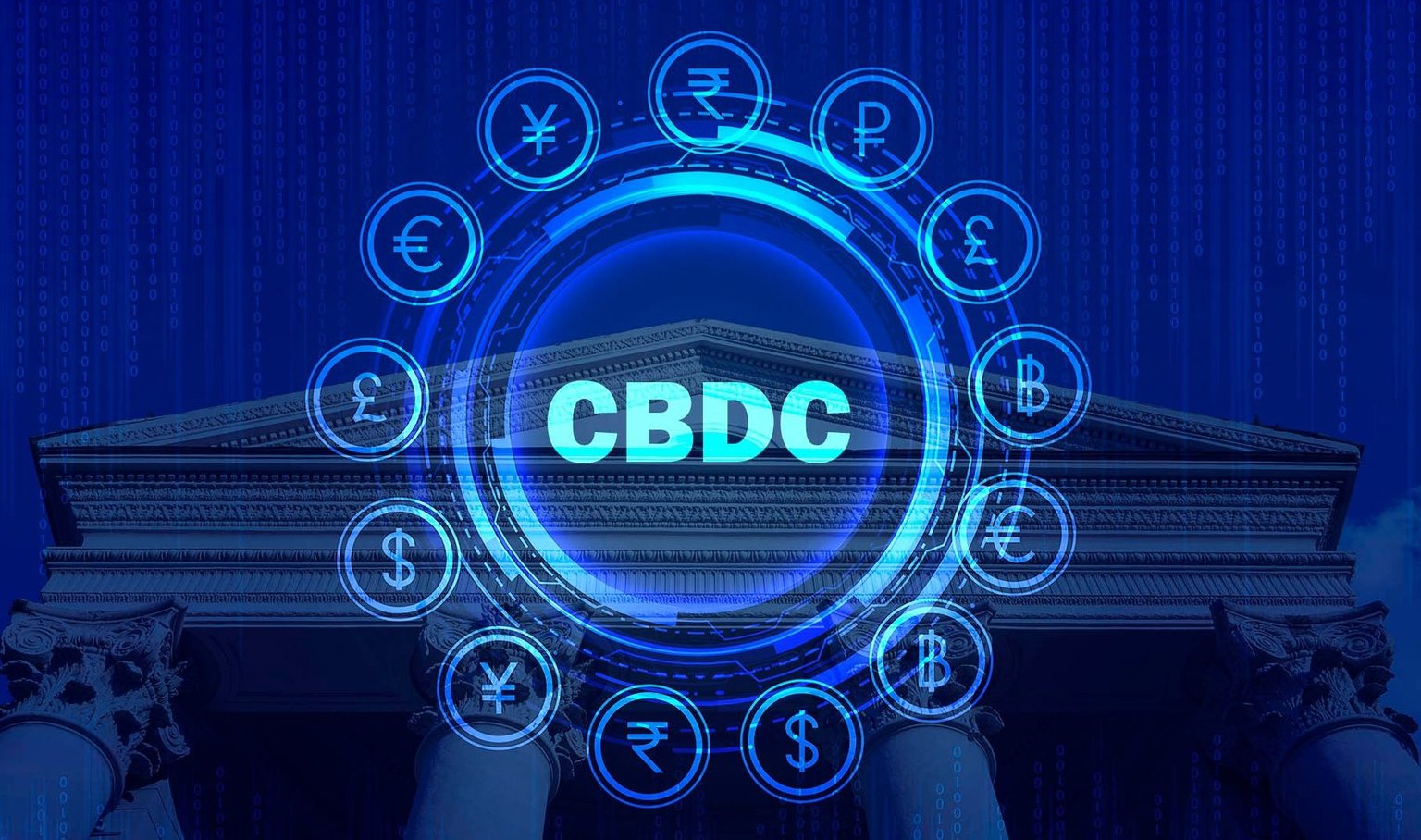
Make no mistake, the push for CBDCs has nothing to do with creating a more efficient system. Nor is the focus upon getting people their money quicker. This is all about control and trying to suck as much money as they can from the system.
Isn't it ironic that CBDCs are not being pushed by Central Banks but, rather, by governments? It isn't the bankers promoting this as a good idea. Instead, it is politicians who realize they can assume more control.
We see Janet Yellen, now a Biden government hack, espousing how cryptocurrency is used by criminals and thus needs to be regulated to a much greater degree. Of course, any fairly sane person knows that the USD is the most commonly used currency when it comes to criminal activity. Perhaps the USG should look into banning that?
Using cash is a privacy feature that the government cannot allow. They do not want to continue to provide people with the opportunity to engage in commerce that they cannot see. For this reason, permissionless cryptocurrency is not the best answer either. Having fully transparent transactions will provide them with the information needed to pursue anyone. However, this is not good enough for them.
As we know, seeing what takes place in a wallet and accessing it are two different things. Private crypto networks do not give the government the ability to drain an account. Instead, they need the keys handed to them.
Here is where CBDCs enter the picture. Once that network is set up, the government can simply access any wallet it wants. If it determines that people need to pay more, it can simply institute a negative interest rate. We already are mired in a world where the Keynesians approach is being shown to be an abysmal failure. Of course, rather than admitting it was their policies, they blame the people for "not spending" and thus crushing the velocity of money.
The solution: politicians instill a negative interest rate which drains a couple percent from each account every year. Isn't that just lovely?
Of course, politicians do not seem to realize that their actions only create a larger black market. It is estimated that the US economy is 11%-12% underground. That is a couple trillion dollars that is not on their radar. Certainly there is a lot of illegal activity (well from the government's perspective, it is all illegal). However, even paying the baby sitter in cash is something that is frowned upon by the government.
The United States proved a number of times that prohibition does not work. During the 1930s, alcohol was banned, creating an enormous black market that made the likes of Joseph Kennedy very wealthy. In more recent times, we see the same approach regarding cannabis.
If they take the same step with cryptocurrency, especially privacy coins, they will likely encounter the same result. To start, the fact that cryptocurrency operates on a global basis, in the digital world, created a challenge they cannot solve. Couple that with the fact that people will understand that the technology will outpace what the government will do means that many more will gravitate towards it.
Thus, the government's best chance is to keep pushing to end cash. Many countries are already doing this like Canada. If they can protect their currency yet get it all in digital form, then all transactions are aboveboard.
We can likely expect privacy features added to many crypto networks. Litecoin is already working on a system that will tie in MimbleWimble. This will operate essentially as a sidechain. However, it will offer people the option of transacting in privacy.
As we see the industry expand and more transactions available in crypto, the need to interact with fiat is lessened. This is where the major weakness still resides. Entities that facilitate fiat to crypto exchanges are under scrutiny. They have to adhere to what is being set out there.
Ultimately, the digital world will offer a variety of networks that will enable people to operate without the prying eyes of others. Certainly, there will be large portions where full transparency exists. However, with simple online swaps, people can "hide for a while".
This is an example of how governments simply are not designed to operate in the digital world. They are going to spend the next few decades staying as relevant as they can. Perhaps implementing a UBI will keep them going for another decade or two. Nevertheless, we will likely see the need for governments, as we know them now, pretty much gone by 2060.
In its place will be a network governance system that operates based upon cryptocurrency and other digital assets. The nation-state will be replaced with by networks that people join and leave throughout the day. It will be a radical new way to structure society.
Meanwhile, governments are going to do all they can to maintain power. The present challenge is to get rid of cash and tax all transactions so they can raise more money.
The battle continues, something which everyone needs to be aware of. Without this knowledge, people are going to fall victim to the idea that what the government is proposing is beneficial.
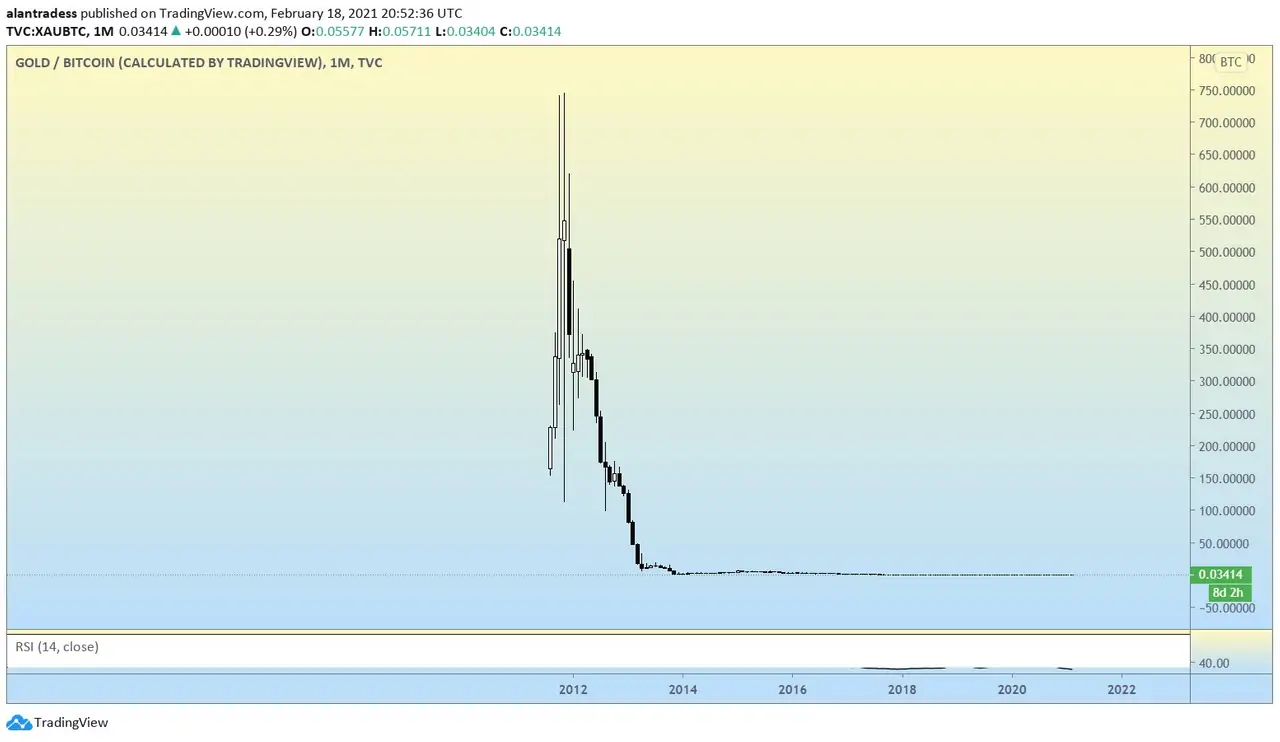
2017 Shitcoin? Nope that's gold against Bitcoin
We've all seen charts just like this one, but this one is not the one you thought it was
If you were around back in 2017 you saw all sorts of moon shots, it was the norm in altcoin land.
You could have thrown a dart at coinmarketcap and hit an altcoin that went up like 100x.
Well maybe not 100x, but certainly 20x-30x.
This chart though, it's not a shitcoin from 2017, it's something else:
That's gold in terms of bitcoin.
It once did well, and then it completely died. That's right, it's ded.
In terms of bitcoin gold has already flat-lined.
Sure it's trading around $2k an ounce, but in terms of bitcoin, which is what everything is going to be priced in eventually, it's already died.
We've already had the funeral, the eulogy has been read, and the heirs have inherited what's left.
This isn't a back from the dead story either, it's bitcoin came, bitcoin conquered, gold died.
I had a suspicion that the chart looked something like this, but even I didn't expect it to be this tragic.
Even with the big rally gold had back in 2020, it doesn't even register on that chart due to bitcoin blowing it out of the water.
Even when gold does well, bitcoin does better.
Poor Petey, at least it makes for a good paper weight!
What Does “Publish or Perish” Have to Do with You? More than You Think
Most people hate to write. Even more people hate to write things other people read. And then there's a group of people, who seem normal in most respects, but who spend their lives trying to convince people to let others read what they've written. Believe it or not, you're part of what keeps them going.
"Publish or perish" is one of those witty little phrases people usually hear in college. I remember hearing it for the first time. My college professor described a process in which people earned temporary employment at a college or University, tried to publish papers, and, if successful, they were allowed to stay. If they failed, they were kicked to the curb.
At that moment, shivers raced down my spine. In my mind's eye, I imagined trying to write (something I hated, at that time), having no success, and ending up eating leaves in the forest because I couldn't get anyone to read anything I had written. Like most fears, mine was no more than a ghost---after all, you're reading this and I haven't eaten a leaf yet.
Why would people sign up for this sort of job? And more important, what does this have to do with you? The answer to the first question is simple: people like to do work that they find rewarding. Just why they find it rewarding is where you come in---you, the reader, can give writers the acceptance that is so fundamental to human psychology. Whether this involves clicking on a blog title (most bloggers can see how many people click on their stuff), posting a comment on a blog entry (most bloggers read the comments), or just taking the information with you and passing it on to others (the best of all rewards), readers have the power to give writers the best medicine the world has ever known---a sense of social connection.
Acceptance isn't always easy to earn. Most of the papers I submit get rejected. Eventually, most of them find a home. Sometimes this is a struggle, other times it's a breeze. Last week, for example, I received an acceptance letter for a paper at my field's top journal. It took exactly 3 years between the initial submission to final acceptance dates. At several points during the process, I wanted to give up. My colleagues kept me going, giving me motivation to trudge on. I knew the paper was going to die a slow, painful death. But it didn't. At some level, I wanted to earn acceptance.
So, I've gained a better understanding of the phrase "publish or perish." It doesn't mean what I thought it did. It isn't meant to scare anyone. It doesn't mean that if you receive rejection letters that you're on your way to eating leaves in your local park (if that were true, I would be part koala bear by now). It simply illustrates a very simple, yet profound, point: by getting others to read your work, you experience some feeling of belonging.
To be sure, people experience acceptance in many different ways. And the lengths that people go to gain this acceptance are incredible, sometimes involving pain and humiliation. Don't believe me? Ask your friends and family about the most extreme things they've ever done to gain acceptance. You'll find that writing doesn't have the market cornered on the odd things people do to feel like they belong---or the satisfaction they experience after experiencing acceptance.


Does a spoon full of sugar make aggression go down?
The potential for conflict pervades modern life. Drivers pound their horns, co-workers criticize, and close relationship partners snub attempts for closeness. Yet, most confrontations do not result in aggression. Why? Sugar may be a sweet substitute for aggression. Lemonade
Ever wondered why people talk about aggression so much? Sure, aggression and violence might sell your video game, record, or movie. But most people spend most of their days in peace and, when confrontation occurs, in reconciliation.
This isn't true of everyone. In fact, most, if not all, people have been in a fight. Yes, you've been in a fight. It's okay, so have all of the other people you know. The main catch, however, is that the fight occurred when you were around two years old. The eminent psychologist Richard Tremblay has shown that the most aggressive people on this planet are toddlers. Yes, toddlers are more aggressive than prison inmates and gang members. They just don't cause as much physical damage with their aggressive blows.
What keeps our aggressive urges at bay? Self-control. As we mature, we learn to control our aggressive impulses. And the costs of aggression are immense. Kids who behave aggressively are rejected by their peers. Adults who behave aggressively are rejected by society through imprisonment. Brain development plays a role, and so does metabolic energy. Energy is needed to control one's impulses. Hence, giving people a boost of energy should reduce their aggression. And people who have problems breaking down glucose into energy (i.e., amino acids) should be at risk for behaving aggressively.
In a paper that is "in press" at the journal Aggressive Behavior, my colleagues and I decided to put this idea to the test. In one study, we brought men and women to a laboratory and had them drink a glass of lemonade. By the flip of a coin, half of the participants drank lemonade sweetened with sugar. Yummy. The other half drank lemonade sweetened with a sugar substitute. After that, participants played a game where they could behave aggressively toward a stranger by blasting the stranger with intense noise.
What do you think happened? Yep, people who drank the sugary lemonade behaved less aggressively compared to people who drank the lemonade with fake sugar. So, we had some promising results. But we wanted to do more.
Next, we wanted to see whether people who had metabolic problems were also at risk for behaving aggressively. My student, Tim Deckman, had people report their diabetic symptoms, their self-control, and their aggressive personality. The more diabetic symptoms people had, the worse self-control they had. Diabetic symptoms also related to having a more aggressive personality.
It doesn't stop there. In a third study, we harvested information about how many people in each U.S. state had diabetes and correlated that with the murder rate in each state. The higher number of people with diabetes, the higher the murder rate.
Finally, we went global. We obtained information about the number of people in over 100 countries had a glucose deficiency disorder-glucose-6-phosphate dehydrogenase deficiency-and the number of killings in each country. Like the U.S. data, the more people in country who had this metabolic disorder, the more killings there were in that country.
To be sure, a lot of these data are correlational, which means that we can't be sure what causes what. But this work makes a consistent point: metabolic energy plays a role in predicting aggressive behavior. Although having a box of Hot Tamales certainly won't cure the world of aggression and violence, think carefully about the next time you let your blood sugar drop.

 @ThePsycology