Riding the Ether Wave: Valkyrie's Groundbreaking Ethereum Futures ETF
In the ever-evolving landscape of cryptocurrency, investors are constantly on the lookout for fresh avenues to diversify their portfolios. Stepping into the spotlight, Valkyrie Funds has unveiled a novel route that marries the stability of traditional finance with the dynamic realm of digital assets. The asset management firm has recently caught the eye of the crypto community with its pioneering move to introduce an Ethereum futures exchange-traded fund (ETF), a first of its kind. This leap is not merely a milestone for Valkyrie but also a stride towards mainstream acceptance of digital assets.
The narrative commenced on September 28, 2023, when Valkyrie Funds unveiled its plan to add Ethereum futures to its existing Bitcoin futures exchange-traded fund, following a nod from the U.S. Securities and Exchange Commission (SEC). This endeavor will birth a new ETF, intriguingly named the Valkyrie Bitcoin and Ether Strategy ETF, set to launch on the following Monday.
Taking a closer peek at the mechanics, Valkyrie's foray into Ethereum futures isn't an isolated venture. Instead, it's an extension of its existing Bitcoin Strategy ETF, now rebranded to encompass Ethereum futures under the same umbrella, thereby offering investors a dual exposure to both Bitcoin and Ethereum futures. This hybrid ETF is a trailblazer, being the first to provide futures based on Ethereum or "ether" contracts to investors via an exchange-traded fund, carving a new niche in the crypto market.
Amidst a landscape where rival asset managers are on their heels to offer pure ether futures ETFs, Valkyrie's hybrid offering stands apart. Unlike the pure ether futures ETFs envisaged by the likes of VanEck and ProShares, Valkyrie’s ETF is a medley of Bitcoin and Ethereum futures, presenting a unique proposition to the investors.
The SEC's green light is not merely a victory for Valkyrie but a broader nod towards the integration of digital assets into traditional financial frameworks. This decision is a windfall for the crypto industry, which has been lobbying for a broader spectrum of crypto ETFs. Moreover, the buzz around this approval seemed to have a ripple effect on Ethereum's price, which witnessed a notable uptick in the days following the announcement.
As the Valkyrie Bitcoin and Ether Strategy ETF gears up for its debut, the eyes of investors and crypto enthusiasts alike are fixed on how this innovative financial product will fare in the market. Will it pave the way for a new era of crypto-based investment products? Only time will tell. Meanwhile, the crypto community is riding the wave of anticipation, eager to witness the ripple effects of this groundbreaking venture.
Bitcoin is officially legal tender in El Salvador
Today is a historic day. As you all know my preference is for BCH and I strongly believe that BTC is a less than optimal choice for a currency, but that doesn't make this bad news. Today the law has passed in El Salvador that will officially recognize BTC as legal tender throughout the country.
This is great news for cryptocurrency in general as it is a massive step towards global adoption. It's not limited to El Salvador either as this makes Bitcoin a foreign currency regardless of where you live in the world which mean lawmakers will be scrambling for how to react to it. While some may choose to try to lock it down, other will accept the fact that Bitcoin is now a currency, not an asset, complete with all relevant tax laws (which should mean, much less tax).
How it will work in the country is not yet known, but the assumption is that prices will continue to be expressed in USD with the price being translated to BTC immediately prior to payment. The Lightning Network twill then be used to facilitate the payment to reduce fees to near zero (which BCH does on-chain, because BCH is baller).
Below is a translation of the full law. Article 7 is particularly interesting as it mandates that merchants must accept Bitcoin if they can under the rules of Article 12. Entry requirements are low as all you need is a computer or smartphone, so possession of either of those means you must accept bitcoin as payment.
GENERAL DISPOSITIONS
Article 1: The purpose of this law is to regulate bitcoin as unrestricted legal tender with liberating power, unlimited in any transaction, and to any title that public or private natural or legal persons require carrying out.
What is mentioned in the previous paragraph does not hinder the application of the Monetary Integration law.
Article 2: The exchange rate between bitcoin and the United States dollar, subsequently USD, will be freely established by the market.
Article 3: Prices may be expressed in bitcoin.
Article 4: Tax contributions can be paid in bitcoin.
Article 5: Exchanges in bitcoin will not be subject to capital gains tax, just like any legal tender.
Article 6: For accounting purposes, the USD will be used as the reference currency.
Article 7: Every economic agent must accept bitcoin as payment when offered to him by whoever acquires a good or service.
Article 8: Without prejudice to the actions of the private sector, the State shall provide alternatives that allow the user to carry out transactions in bitcoin and have automatic and instant convertibility from bitcoin to USD if they wish. Furthermore, the State will promote the necessary training and mechanisms so that the population can access bitcoin transactions.
Article 9: The limitations and operations of the alternatives of automatic and instantaneous conversion from bitcoin to USD provided by the State will be specified in the Regulations issued for this purpose.
Article 10: The Executive Branch will create the necessary institutional structure to apply this law. FINAL AND TRANSITIONAL PROVISIONS
Article 11: The Central Reserve Bank and the Superintendency of the Financial System shall issue the corresponding regulations within the period mentioned in Article 16 of this law.
Article 12: Those who, by evident and notorious fact, do not have access to the technologies that allow them to carry out transactions in bitcoin are excluded from the obligation expressed in Article 7 of this law. The State will promote the necessary training and mechanisms so that the population can access bitcoin transactions.
Article 13: All obligations in money expressed in USD, existing before the effective date of this law, may be paid in bitcoin.
Article 14: Before the entry into force of this law, the State will guarantee, through the creation of a trust at the Banco de Desarrollo de El Salvador (BANDESAL), the automatic and instantaneous convertibility of bitcoin to USD necessary for the alternatives provided by the State mentioned in Article 8.
Article 15: This law will have a special character in its application concerning other laws that regulate the matter, repealing any provision that contradicts it.
Article 16: This decree will take affect ninety days after its publication in the Official Gazette.
As you can see from the above the law officially comes into effect 90 days from publication, so we won't necessarily see massive changes until September, but it will definitely be one to keep an eye on.
The hope is that adoption on this scale will create a snowball effect where other cryptocurrencies start to be adopted in nations around the world, and as we all know when the crypto snowball starts rolling and continues to grow, it will be unstoppable.
Let's all of us, BTC supporters, BCH support and supporters of weird coins all put aside our differences and celebrate this day for what it is. This is the day that cryptocurrencies officially began to challenge fiat currencies and the corrupt, broken systems that support them. Victory is within our grasp!
Crypto accounts on Weibo shut down by China in latest crackdown
In the latest crackdown on Cryptocurrencies, multiple leading crypto accounts on Weibo have been shut down with the reason "this account violates laws and rules". Weibo is a microblogging social media site similar to Twitter but under complete legal authority of the Chinese government.
Recently, China has been taking steps towards cracking down on cryptocurrencies, first targeting business use, then trading, then mining and now high-level crypto influencers. This has caused large drops across the crypto markets and the beginning of an exodus for Chinese bitcoin miners. Rumors abound that further action will be taken soon in Chinese courts, possibly linking crypto activities directly with Chinese law. This shutdown on Weibo appears to be a pre-emptive strike on that front.
Woman Dr. bitcoin mini, a key opinion leader (KOL) on Weibo has declared "It’s a Judgment Day for crypto KOL" as her account was also shut down. Another user posting under a new account call Professor Hash seems to be accepting of it, saying "The account I’ve been using for years is suddenly gone, but I’m OK with it. The day was going to come sooner or later.” It's unknown at this time if any further action is being taken against account holders directly, or if there's any action being taken to prevent recreation of accounts. At the time of publication Weibo's media relations officer has declined to comment.
The response to this latest move on bitcoin prices seems to be somewhat limited with the price of BTC dropping from a peak of $36,800 on Sunday to $36,150 today and the price of BCH barely moving from $669 on Sunday to $663 today, a tiny fraction of recent price moves. Jonathan Cheesman of crypto derivatives exchange FTX has pointed to a floor of $33,400 saying "The key level for the bulls to hold is $33,400 as it keeps the pattern of higher lows intact".
The moves from China to shut down bitcoin is arguably the greatest stress test that cryptocurrencies can be given. Should they survive a complete shutdown in China (and all signs point to clear survival of crypto) then arguments around the risk of crypto being completely destroyed should be rendered moot.
I'll do you one better: Why is Bitcoin Cash?
The aim of this article is to give a simple overview of why Bitcoin Cash exists. I’ll be talking about Bitcoin (BTC) and Bitcoin Cash (BCH) which are two distinct cryptocurrencies that often get confused and why they both exist.
Before BCH
Once upon a time there was Bitcoin. Bitcoin was originally invented to be a decentralized peer-to-peer electronic cash system. Whenever a Bitcoin transaction takes place the transaction is queued to be written to the blockchain, a decentralized ledger of all transactions. The transaction gets bundled up with other transactions into a block and added to the chain by miners, with the miners getting paid a set amount of new Bitcoins plus the fees paid for the transactions in the block.
Transaction blocks are added on average once every ten minutes and are 1MB in size. This means that every transaction to be written to the blockchain needs to fit within that block. In the early days this was no problem as there were few transactions, but as the popularity of Bitcoin grew, so did the number of transactions. When the number of transactions exceeds the block size miners are able to pick the transactions with the highest fees, leaving lower fee transactions behind. This results in higher transaction costs for the end users. This hinders the ability of Bitcoin to act as a low-fee cash system, and so a solution was needed.
The Solution and The Split
Multiple solutions were proposed to fix this problem. As various solutions were discussed people gravitated towards one of two schools of thought and this is where the arguments that led to the creation of Bitcoin Cash began.
One view was that bitcoin should remain as it is and transactions themselves should be moved off of the blockchain into settlement layers which would then batch transactions together and add them to the blockchain in groups. This solves this issue but at the cost of removing the Bitcoin blockchain as the sole transaction ledger. Problems like preventing double spending become much more of a concern.
The other view was that the block size should simply be increased. The blockchain would continue to operate as it does but would be able to handle more transactions. One of the core arguments here was that internet connectivity had improved and that maintaining a 1MB block size was no longer required to ensure the smooth operation of mining operations.
The battle between these two ideas raged on, until it was realized that there was never going to be a consensus. Luckily there is still a solution when two distinct development directions for a cryptocurrency arise, a hard fork. This is where the existing blockchain is split into two (or potentially more) different chains, and on 1st August 2017 this is exactly what happened. The Bitcoin chain split in two, with Bitcoin continuing with 1MB block size and Bitcoin Cash being born with an 8MB block size. It should be noted that in 2018 this was again increased to 32MB.
Bitcoin Cash - The Real Bitcoin
As Bitcoin Cash was making a change it was decided that the original Bitcoin name would remain with the original fork. This is much debated as in reality Bitcoin Cash adheres much more to the original vision for Bitcoin, as a decentralized, accessible and low fee transaction platform allowing individuals to send a receive money without the need for banks. As it stands Bitcoin is unable to offer this as transaction fees are still far too high for most normal day to day transactions.
Hopefully this gives you an easy to follow summary of why Bitcoin Cash exists and how it differs from Bitcoin. If you feel I missed anything or could improve anywhere, please comment below or drop me a message on Reddit. https://www.reddit.com/user/TheBCHKing
Bitcoin Cash: The smoothest cryptocurrency for transactions.
One of the things people underestimate when comparing various types of cryptocurrency is smooth and reliable transaction rates. Too many people focus purely on transaction volumes and cost. Of course transaction volumes matter and keeping transaction costs low is absolutely crucial to ensure people continue to use it, but for any cryptocurrency to realistically compete with mainstream payments systems it needs to be able to handle continuous streams of transactions without getting blocked up.
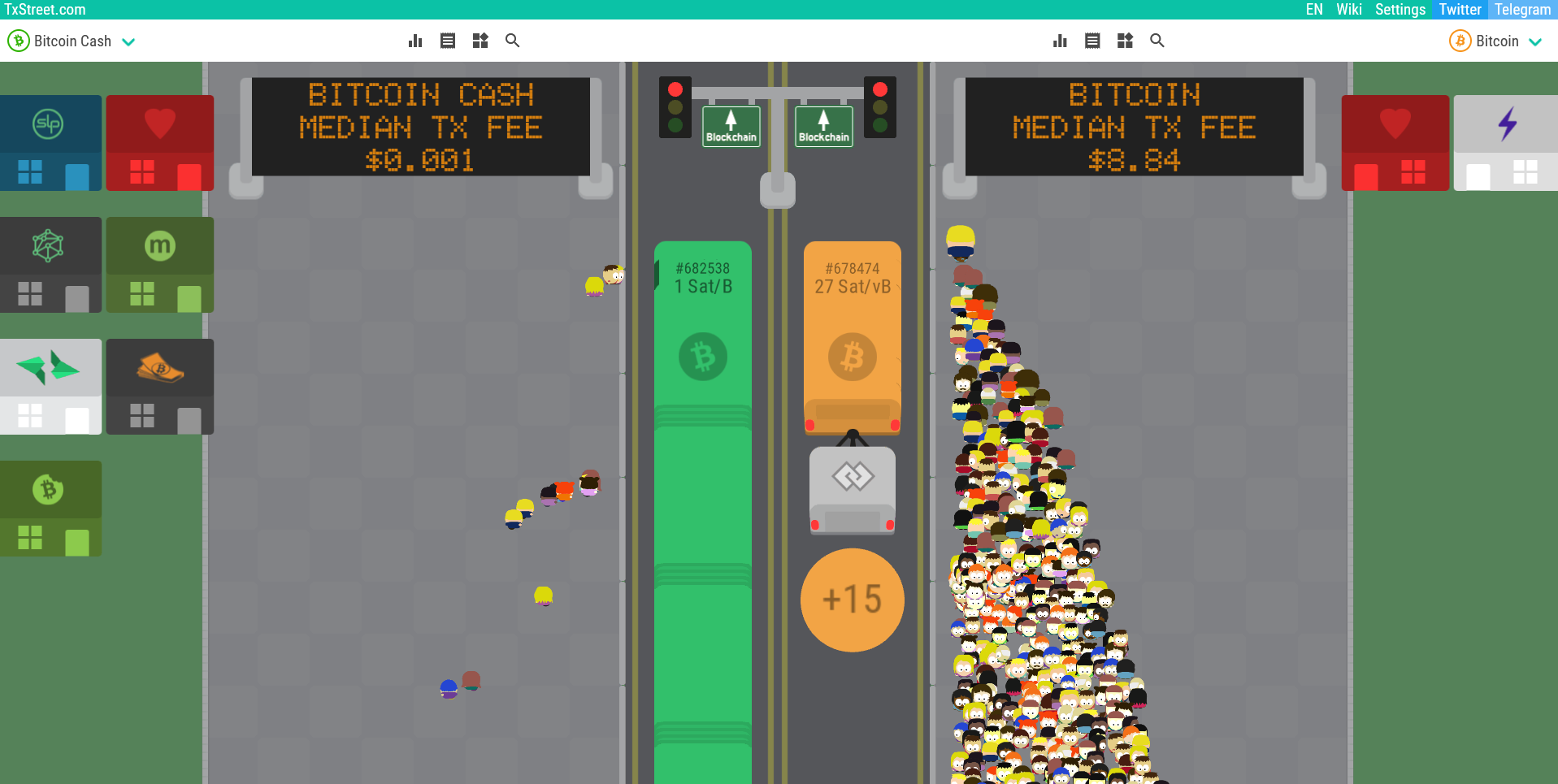
Bitcoin Cash success in this regard when bitcoin has historically failed. Sometimes it can be hard to look at the raw stats and clearly see this, but luckily for us there's a great way to visualize this data. TxStreet. https://txstreet.com/v/bch-btc
As you can see from the image above this shows the flow of transactions, with the transactions being the little people, the current block being the bus which then drives off to the blockchain. This is all being shown in real time. While the people boarding the BCH bus are able to walk straight on, the people queuing for the BTC bus are having to wait.
What's worse is that it's not first-come, first-serve. As miners prefer transactions with higher fees, customers board the bus faster if they are willing to pay higher fees. This not only showcases the scalability to BCH for existing supporters, the continuous smooth operation of BCH transactions ensures that potential new users of Bitcoin Cash can be confident it will continue to support their needs.
This is the state that it is in now, with only 30 million of so active BTC wallets. Imagine how unsustainable this would be once there's more than a billion people with wallets using them constantly for day to day transactions. It simply wouldn't work, and this is exactly why Bitcoin Cash was born.
To this day people to continue to argue over which is the better currency, BCH or BTC. I say this argument is moot. Each has its own use case. If all you're looking to do is store money and wait, BTC can work. If you're looking for a currency to replace the outdated transaction systems forced on us today then there's no competition, BCH wins every day.
Peruvian craft market embraces Bitcoin Cash
Adoption, adoption, adoption.
It's what every cryptocurrency wants. It's what every cryptocurrency needs. To be successful in any meaningful way adoption as a native trading currency is crucial in creating a currency that is more than a mere investment, that instead creates a globally accepted token that is no longer controlled by a monopoly of ultra-rich individuals.
In many cases adoption has been ill conceived, with transactions requiring a conversion from cryptocurrency to a national currency at point of sale. While this is useful for merchants as they don't have to consider the logistics of accepting crypto, it's ultimately damaging to the goal of replacing archaic financial systems, instead creating a monstrous amalgamation of cryptocurrencies and the rapidly failing financial system our societies are bound to.
Few currencies have managed to break free of this cycle. But one stands out. One is brought to our attention time and time again with regular news of native adoption all over the world. What is that currency? Well of course, it's Bitcoin Cash ($BCH).
Bitcoin Cash
Bitcoin Cash is the result of a split in the original Bitcoin blockchain. When two distinct ideas about the future of bitcoin could not be reconciled the currency split and into two distinct currencies.
Bitcoin continued as a store of value, dominated by the rich with tremendously high transaction fees which prevent use for day to day transactions. Conversely, Bitcoin Cash is primarily a medium of exchange for commerce. This choice to focus on utility as a transaction currency is why it leads the way in native adoption, be it in your local bar, a taxi service in Venezuela or a hostel in India. It's simple and frictionless to adopt and so there is no limit to where it can be used.
This adoption has now continued with an independent Craft Market in Peru now accepting Bitcoin Cash. Situated just outside Lima this market has struggled in recent times and was in need of change. A decision among stall owners was that a move to accept Bitcoin Cash across the entire market could bring in more sales and make it easier, more secure and cheaper to operate.
Once again this adoption is another win for cryptocurrencies and another win for Bitcoin Cash. We can only hope this rapidly growing trend continues until everyone in the world is free from the shackles of nationally manipulated currencies.