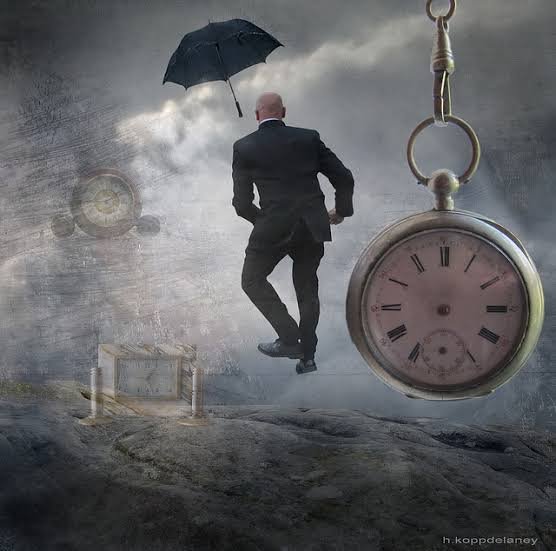
Own Timeline!
It's important to remember that everyone's journey is different, and there's no set timeline for achieving certain goals or milestones. It's easy to compare ourselves to others and feel like we're behind or not where we should be, but that kind of thinking can be harmful and unproductive.
Instead, it's helpful to focus on our own progress and growth, and to set realistic goals for ourselves based on our own individual circumstances and abilities. It's also important to remember that setbacks and failures are a normal part of any journey, and they don't mean that we're off track or not making progress.
Ultimately, it's up to each of us to define what success means to us, and to create our own timelines based on that definition. By focusing on our own journey and trusting that we'll get where we're meant to go in our own time, we can find peace and fulfillment in the present moment, rather than constantly feeling like we're playing catch-up.
Here's an
article that expands on this idea:
"Stop Comparing Your Journey to Others and Trust Your Own Path" by Kyle Benson, published on The Gottman Institute website.
Link: https://www.gottman.com/blog/stop-comparing-your-journey-to-others-and-trust-your-own-path/
In this article, the author discusses the dangers of comparing ourselves to others and feeling like we're not measuring up. He argues that this kind of thinking is not only unproductive but can also be damaging to our mental health and wellbeing.
Instead, the author suggests that we should focus on our own journey and trust that we're on the right path, even if it doesn't look like anyone else's. He provides several practical tips for cultivating this mindset, including:
- Defining success on our own terms
- Embracing setbacks and failures as opportunities for growth
- Celebrating our progress and accomplishments, no matter how small
The author also discusses the importance of setting realistic goals for ourselves and not getting too caught up in what others are doing. By doing so, we can cultivate a sense of inner peace and contentment, rather than constantly feeling like we're falling behind.
Overall, this article is a great reminder that our journey is our own, and that we should trust ourselves and our own path, rather than constantly comparing ourselves to others.

Childhood Memories
In fields of green and endless skies,
Where days were long and full of surprise,
My childhood province life began,
With freedom to explore all that I can.
The morning sun would wake me up,
And I'd leap out of bed without a hiccup,
To breathe in the fresh countryside air,
And let my feet take me anywhere.
I'd run through the fields, and climb the trees,
With grass and leaves brushing against my knees,
I'd chase the butterflies, and catch the bees,
And all around me, I'd feel a gentle breeze.
The afternoons were lazy and slow,
With nothing to do, and nowhere to go,
Except to swim in the nearby creek,
Or lay in the shade and take a peaceful nap.
As the evening approached, the sky turned red,
And the stars came out, shining overhead,
The crickets chirped, and the fireflies glowed,
And I knew I was in a special abode.
My childhood province life was simple and sweet,
With memories that I'll forever keep,
Of days spent under the open sky,
Where freedom and happiness would never die.

What Have We Become?
We have become much different than what we were considered before by history. By “we” I mean humankind, and by “today” I mean the year 2184. I am writing this for the descendants; I am not an idealist and do not build shiny illusions for myself, but perhaps they will find another way of development and evolution than we had. Perhaps they will manage to regain the essence of being human.
What is life like in the 22nd century? Well, it is unquestionably different than even a hundred years ago. The main driving force of the present time is technology; technological wonders have become so diverse and incredible that some people already treat them the same way as our ancestors treated magic. They even worship technologies. Every major city of the most advanced countries, such as China and Saudi Arabia, now have a temple where adepts can unite with the Machine Soul. But let me get back to the subject. Three phenomenons define our lives today: space flights, cybernetics, and immortality.
One of the most significant issues—the overpopulation of Earth—was solved when space flights became a common practice. I do not know the technicalities, but when scientists finally discovered anti-matter in 2067 and learned to use it for practical purposes, it took governments much less money and effort to initiate space programs and launch spacecrafts to the Moon and Mars. Today, the Moon is almost as overpopulated as Earth was in the beginning of the previous century; as for Mars, a 23rd colony was settled on its surface a couple of months ago.
Cybernetics is an another pillar of modern civilization. Since the first cybernetic implants were released on the global market in 2098, it has become a great help for disabled people, as well as for those who want to enhance their natural capabilities with special implants. Terminal diseases are no longer a threat; only mental disorders remain a serious problem. Today, you cannot imagine a cop without cybernatically-strengthened limbs, or a stockbroker without brain implants helping him or her process complex calculations in no time. And though in the middle of the 21st century, there were prognoses about the development of robotics, today, as people have become much more efficient, no one thinks about robots.
In addition, cybernetics gave people a possibility to resurrect after death. Yes, humanity has completely overcome death. It occurred in 2131, when academician Kurt Liebknecht, who is now considered a saint, had discovered a way to store human minds on hard disks. Each human being today literally works for their immortality throughout their lifetimes. If you manage to save enough money, you can transfer your mind onto the Internet, and exist online in the form of pure information. IT specialists and scientists have invented special, secure Necropolises for such people—virtual places where the Immortals reside. Those who would like to resurrect in their physical bodies once again can “work”: do system administering, manage databases, provide online security (IP, Internet Police), and so on. For their job, they earn virtual money—the virtual economy has become as developed and significant as the real one—and buy themselves cybernetic bodies, in which their minds are transplanted back from online. Well, Immortals are not truly immortal; we all remember the horrible tragedy in 2152, when three of the largest servers containing Necropolises were hacked and reformatted by the terrorists from Humanity-1—at least, it was the official version. Hundreds of thousands of Immortals back then had vanished forever—my brother was among them.
The invention of an online afterlife has also solved the problem of prisons: criminal minds are now being locked in special virtual storage, and their physical bodies are used for organ transplants for the living, or utilized in other ways. Though, a new problem had arisen: escaped convicts pose a threat both for the Immortals in the virtual world and for systems and people in real life. When a living criminal connects to the Internet through a brain chip, such criminals, usually called Incubuses, can possess them, capturing their bodies and expelling, or even destroying their minds. And though a large number of security programs are now available for Internet users, and though the IP constantly hunts and deciphers (or destroys, simply saying) loose criminals, Incubuses remain a serious threat.
Technological wonders we take for granted today are much more diverse and numerous than I have described so far. The Epoch of the Machine Soul is an exciting time to live in. The only question that worries or even scares me and many other conscious and intelligent people today, is: “Are we still human? What are we now?”
 @RoseLetter