Common misconceptions about Bitcoin
Below I wrote a small list of common misconceptions many people have about Bitcoin. This is mostly focused on the BTC version, but many points apply to the BCH version as well
1. Bitcoin is anonymous. No, Bitcoin’s blockchain is transparent and constantly analyzed by specialist companies which track your coins. This data will be used by regulators to tax individuals, combat money laundering and fraud. If you purchased your Bitcoins via a regulated exchange, the coins you buy can and will be traced back to you.
2. Bitcoin transfers are instant and free. Bitcoin transfers have never been instant. Yes, they get added to the mempool almost instantly, but it takes on average 10 minutes to mine a block and it is only when it is included in a block that you can be sure the transfer went through. As for transaction cost is around $15 USD, which makes it unusable for most transaction (the average transaction for online purchases is around $50).
3. Bitcoin is a store of value. Let’s first define the term “store of value”. A store of value is a thing that maintains it purchasing power from day to day in almost all circumstances. In other words, there is no state of the world (save nuclear war), where the holder wake up and be able to purchase less than he could the day before. Bitcoin clearly does not satisfy this definition as it can easily drop in excess of 10% (e.g. on a Musk tweet).
4. Bitcoin is a hedge against inflation. Inflation can have many and multiple causes. One is money printing yes, but inflation can also come from higher energy prices caused by some shock in the oil supply chain e.g. from instability in the Middle-East. Higher energy prices cause all prices to rise as a large part of the economy is dependent on cheap oil. Take for example food. The production, processing and distribution of food all requires energy or plastics. Rising oil prices directly result in higher food prices. Inflation caused by higher energy costs results in higher monthly bills for most people, which also leaves less money to be spent on crypto. People may even have to liquidate part of their crypto holdings to make ends meet.
5. There’s a hard physical limit on the the number of bitcoin that can be mined. Unlike gold, which is formed in a supernova explosion and is therefore naturally limited, Bitcoin is made by humans. If a majority of the ecosystem decide to increase the supply cap from 21 million to 210 million for example, the only thing that would be needed is to change one number in the code. Of course, reaching this level of consensus is hard and previous disagreements on the protocol have lead to splits (BTC-BCH-BSV).
6. Bitcoin is money. For something to be money, it has to be a unit of account. That is, something which is used to measure value (you’re probably measuring the value of your crypto portfolio in USD right now). Most people also have a strong intuition of the value of 1 USD. For example you would know roughly how much one apple would cost you. Now try to do that with Bitcoin without having to think of the price of Bitcoin in USD.

Tesla’s Bitcoin play
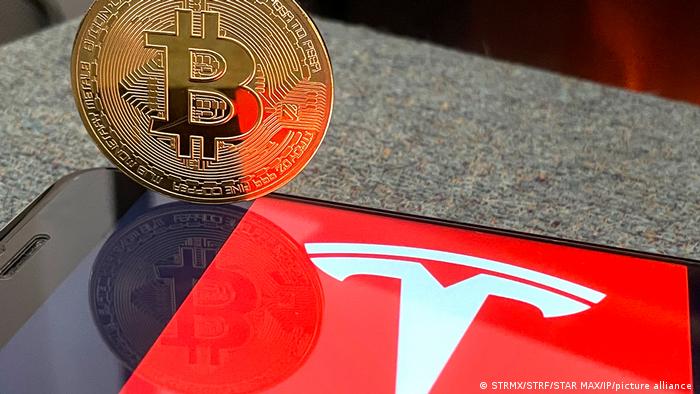
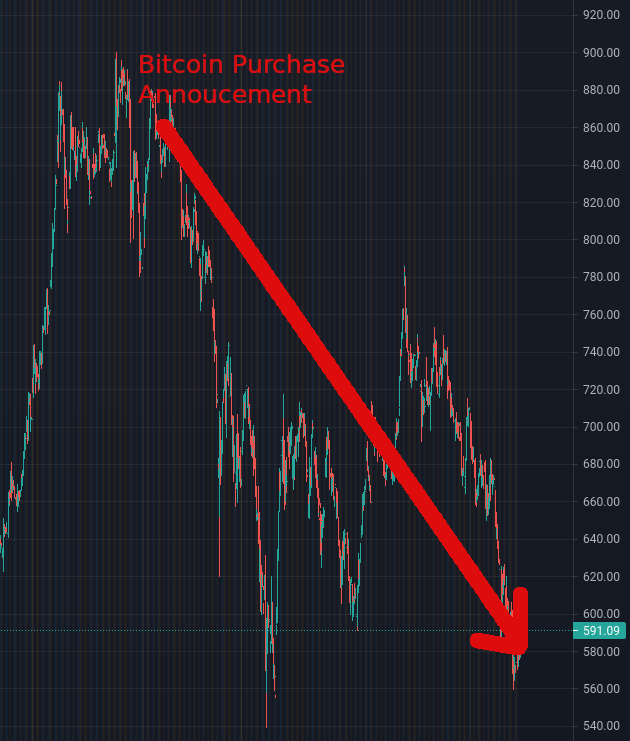
On Monday February the 8th, 2021 Elon Musk’s Tesla announced in SEC filings that it had purchased $1.5 billion in Bitcoin BTC. Furthermore, the automaker announced it would accept BTC as payment for its electric cars. This move follows Michael Saylor’s Microstrategy purchases, which has leveraged all available cash (and even raised new cash through debt financing) to buy up BTC. Michael Saylor, who was until recently a Bitcoin skeptic, saw an opportunity to turn his increasingly unsuccessful business intelligence firm around by capitalizing on the crypto hype. Equally, Musk saw an opportunity to both profit from the crypto hype and tie the Tesla brand to this hype to massively increase his social media following.
At the time of writing, Tesla stock is down a whopping 31% since the announcement, wiping out nearly $260 billion in market capitalization and greatly under performing the market which is up more than 5% since February. This may seem odd at first since total profits (combining realized and unrealized) on their crypto holdings has been more than they have ever made selling cars and carbon offsets.
However, repeating these returns simply by speculating on the crypto markets is probably unsustainable since for each time they buy, they will need to find buyers who will want to take the coins off them at a higher price, in other words, the inflow of new money needs to keep increasing. Most money entering the crypto markets nowadays is purely speculative in nature. People are seeing people around them making money and fear the will be missing out if they don’t get in. As seen in early 2020, manias can easily reverse and since there is very little non-speculative demand for crypto liquidity can dry up almost instantly sending prices crashing down (Bitcoin went down 50% on one day in March).
Moreover, selling their Bitcoin position may result in bad publicity from the crypto community. When Tesla announced they sold 10% of their crypto position under the cover of “proving liquidity” (probably in order to boost Q1 earnings numbers) they got tons on flack on social media platforms such as twitter and reddit. There’s a lot of overlap between the people who are into crypto and the people who buy Tesla stock and products. Obviously, Tesla doesn’t want to alienate this part of the fan base, which is why they have to be careful when it comes to handling the Bitcoin position. On the other hand Tesla has to mind its shareholders, who need return on capital. In particular, Musk is dependent on Tesla’s stock price as he has taken massive loans against his shares to fund his lifestyle. In this contest, the wills of the shareholders will likely win and Tesla will use any excuse to dump their holdings at a profit. This can be seen by them dropping the option of buying a Tesla car using Bitcoin, because it is supposedly “bad for the environment”, something which even it is true, they would have known when they first announced the option.
Another thing to consider is the size of the Bitcoin purchase relative to the Research & Development (R&D) budget. This may be a surprise to some readers, but their BTC purchase was actually larger than their entire annual budget for R&D. This may well have been the reason for the large selloff, as this is a clear signal that they have run out of ideas. Surely, with all their supposed ‘tech talent’, they could find a way to improve their cars, manufacturing processes or even create a completely new product or service (where are the robo-taxis Musk promised would arrive in 2020?) that would earn a greater discounted return on capital than speculating on the latest fad?
As for the future for bitcoin price, given that more companies could potentially enter hoping to easily boost their earnings numbers by speculating on crypto, it seems it could go up by quite an amount since the free float is low and it therefore requires relatively modest sums to pump it higher. The risk Bitcoin (BTC) poses for the economy at large however, would then increase since the economy would increasingly depend on the prices of a fundamentally purely speculative asset.
Looking at the past, a similar phenomenon was also observed in the Nikkei bubble, where large Japanese firms were “earning” more money on real estate speculation than operating their businesses. And as we know, this bubble ended in a 80% decline in the Japanese stock market and a 30 year recession for the country.
Bitcoin, a fundamental analysis of the largest pyramid scheme in human history
At time of writing, the total value of all outstanding cryptocurrencies is nearly $2.4 trillion US dollars, according to coinmarketcap (CMC), which makes it larger than the CDOs of the housing bubble and the infamous South Seas Company bubble. Trading in the coins in also at record high with daily trading volume surpassing $200 billion USD, according to CMC.
What has been driving up price?
Firstly to blame is most certainly the excessive amounts of money printing by central banks around the world coupled with unprecedented amounts of fiscal stimulus to fight the “pandemic”, which have propped up all assets classes. In the recent past, similar fiscal and monetary policies to fight “crises” have been the trigger for the previous bubbles: the Dotcom bubble was triggered by money printing to save the world from “Y2K” and equally the housing bubble was triggered by money printing to pay for the wars following the terrorist attacks.
What’s more, crypto’s own “central bank” Tether has been printing huge amounts of fractionally backed tether-dollars as well.
Now, couple rising prices with everyone being at home, following “finance gurus” (e.g. the Technoking of Tesla) on social media and having easy access to the markets via apps like Robinhood and the perfect conditions are created for a bubble of epic proportions.
Why will it crash?
Proponents of Bitcoin will claim that it is the ‘new money’, a hedge against inflation or that DApps and DeFi will take over the financial systems. Let’s break down these arguments.
First of all, Bitcoin is **not** money. This is easily observed by the fact that it is not a unit of account (the thing you use to measure value); everyone is looking at dollar prices. Similar to gold, Bitcoin is a value transfer system, but can never be money. Money, since the dawn of humanity, is a meta-physical concept representing value and is therefore not necessarily tied to anything physical. IOUs denominated in a certain value system (e.g. the USD) are valuable because they are contractually enforced by courts, police or military. In other words, money is established as such by government regulation. In practice this is seen in times of crisis, where people flock to the credit of the government with the strongest military.
Secondly, Bitcoin is not a hedge against inflation. Inflation can be caused by many different events (one being money printing). However, prices can also go up because of higher energy costs following tensions in the Middle-East. Higher prices caused by an energy crisis will lead to lower disposable income for almost everyone, which means people will also have less to spend on “investments” or will even be forced to sell their assets to pay for higher cost of living.
Thirdly, Dapps will **never** provide an efficiency over current state of the art systems. This is easily observed by the fact that dapps have so far failed to gain traction within high performance firms, where performance really counts such as market makers, manufacturing firms or global logistics services. The reason is that dapps are many orders of magnitudes more expensive and slow (fees for ETH have gone up above $50/tx) and the decentralization provides no benefit. As pointed earlier in the money discussion, contracts are no good unless they can be enforced (by the use of force if necessary). For example, you can’t use a ‘smart-contract’ to track home ownership, since people can just violate the entries in the blockchain.
This is not to say that dapps haven’t been heavily used, though mostly to speculate and gamble, however these use cases have no attachment to reality, it is no different than buying assets in a video game.
Finally and most importantly, Bitcoin right now is a pyramid scheme. The only way to make money on Bitcoin is by selling it to someone else at a price higher than you bought it, but then that person will have the problem. This is unlike income producing stocks and real estate which have capital returns in the form of rents, have dividends or buy-backs, which means the person holding the asset can make money without having to sell it. Eventually you will run out of greater fools and it will be at a time when it will be most inconvenient.
Triggers for the crash
The exact trigger for the crash will come unexpected and will be hard to predict. High amounts of leverage in the system however makes it that the decline is abrupt and it is especially speculative assets that get killed. The most recent panic in 2020 was caused by a virus scare (Bitcoin dropped nearly 50% in one day in March of 2020), the housing bubble deflated because of skyrocketing energy prices, the terrorist attacks were the nail in the coffin on the dotcom bubble and an agricultural recession combined with higher interest rates caused the 1929 decline.
Looking forward, there are many known risks: e.g. large-scale cyber attacks, religious uprisings, peak oil but of course there also many unknown risks (e.g. that could come from emergent technologies).
Hope for cryptocurrency
Now while this has been a quite negative article on crypto, I do think crypto will have an important role to play in the future. As governments have increasingly started limiting freedoms in light of the pandemic, demand for a private and uncensorable means of value exchange will continue to go up (it was the stringent drug laws in the USA that pushed Bitcoin into mainstream in 2011 with the Silk Road). Bitcoin (BTC), however no longer fits this use case as transactions have become prohibitively expensive and slow and each Bitcoin is tracked by specialist data analysis firms, for example people have had their Coinbase account shut down because they sent coins to a darknet market. Given this, it seems likely coins like Monero or Zcash will take over the top spot, but probably only after a massive crash in the crypto market.
How to trade this
While the price of Bitcoin could definitely go higher, if you still hold some, taking profit is a prudent move; certainly you will want to at least get your initial amount back.
As for shorting, with $MSTR and $TSLA buying large amounts of bitcoin, there are now safe (limited and defined risk) ways to short Bitcoin indirectly by buying puts in these companies. To reduce risk a put position can be hedged with a $QQQ long.

 @ReturnOfKa