SISU Network Testnet Airdrop Opportunity
Sometimes I see opportunities to earn from airdrops by taking part in testnet activities for new dApps or chains, but on the few occasions I’ve investigated these the tasks required have either been too time consuming, complex or beyond my technical capabilities. But yesterday I found an opportunity that is both simple to follow and requires no technical skills. Great news!
What is SISU Network?
What is this opportunity, I hear you ask. Well, it’s with SISU Network. SISU is a trustless protocol that supports cross-chain transactions for any layer 1, layer 2 or side-chain and caters for both token swaps and smart contract interactions.
Testnet Activities and Rewards
During the current testnet phase you can earn rewards from the subsequent airdrop by undertaking a range of activities. These include simple cross-chain swaps, tweeting or posting about the project, finding bugs etc. Many of these are very easy to do. For each of these you earn points and the more points you earn the greater the rewards you get come airdrop time.
To get full details of what activities you can take part in to earn rewards and a full guide on how to go about each of these check out the project’s guide on their website. Open up the website https://sisu.network/ and click on the Testnet menu item to see a list of guides that will explain to you what ways you can earn points and how to go about each of these.
There is also a Discord channel you can join at https://discord.gg/DT7xAKCQJD
I’ve been pleasantly surprised at how simple it has been to take part in this testnet activity and will continue doing this until the test phase comes to an end. At the same time I will be on the look-out for other straightforward testnet opportunities.
Until next time…
**Renaissance Man**
Presearch – Earn free PRE crypto when you search. https://presearch.org/signup?rid=2609069
**The Usual Disclaimer**
Please don’t take any of the above as financial or investment advice. It is intended to be nothing other than a little entertainment and information sharing. Always, but always, do your own research before committing your money to anything.

Titano Seeks Utility
Since I wrote my last article about the need for utility in DeFi projects, I’ve been monitoring developments at several of these, as they seem to have woken up to the crucial role that utility plays in the success or failure of their efforts. Today, I’m going to provide a summary of recent events at Titano, which seems to be making a concerted push in developing utility. https://www.titanofinance.com/index.html
**TITANO Re-cap**
As a quick re-cap, Titano is a DeFi protocol paying out a fixed APY of 102,483%. In order to secure this alluring payout, you need to buy and hold the TITANO token, with the resulting rewards being paid out in further TITANO tokens. The protocol earns its income in the form of fees, which it levies on both the purchase and sale of tokens. It resides on the Binance Smart Chain.
Having launched in November 2021, Titano experienced a period of dramatic growth in both token holders and market cap. It still has a lot of token holders (75,000+) but it sadly no longer enjoys such a stellar market cap, having dropped substantially in the past couple of months, and is currently hovering around the $30million mark.
**Problems, Problems**
As I’ve discussed previously, I believe the underlying problem a protocol like Titano faces, and the reason for its fall from grace is a lack of utility in the token. You buy some, you make some profits and then what? Er, not a lot really, except you can sell them. And that’s exactly what people started doing. The result, despite regular token burns by the team, was a falling price.
Well, you might ask, can’t this problem be addressed by bringing in more buyers? Well, yes, it could, for a time. But sooner or later the same problem would emerge. Buyers would once again start outstripping sellers and down would go the price.
No, the only real solution here is to give people some other reason to hold or use their tokens. In other words, they need utility. All the better still if, in the process of doing this, you also generate more income for the protocol (increases profits and, potentially, liquidity) and create room for more token burns (reduces selling pressure).
Utility Heading this Way
Now, to be fair to the project team, they did try to offer some limited utility earlier in the year in the shape of their PLAY protocol. Unfortunately, the first attempt suffered at the hands of some bad actors, who hacked PLAY and ran off with some of the loot. Having addressed this, the team relaunched PLAY, which offers token holders the chance to win in a regular prize draw in return for accepting a lower rate of interest on their tokens.
A step up from this, in terms of the token holder’s commitment, is the more recently launched Titano Lottery. With this, you buy a ticket with some of your TITANO for a chance to win big in a regular lottery. In other words, you are spending your tokens, unlike with PLAY, where you keep them but accept a lower interest rate.
Titano has also now partnered with BetSwirl to give TITANO token holders the chance to try their luck at two games, Dice and Coin Toss, where they might win two or three times their stake or lose it altogether.
The eagle-eyed amongst you might have noticed there’s something of a theme emerging here in the form of betting-related activities. I’m not opposed to this sort of thing in principle, but I do hope this isn’t all the team are going to do as they seek to offer token-holders utility, not least of all because it won’t appeal one jot to a good many people.
I will add that the team have also launched their own DEX, Swych, which is a notable development in itself and all the more so as it should drive more income into the treasury by avoiding the need to hand over part of the buy and sell fees to Pancake Swap.
**Onwards and Upwards?**
This brings us to the question, will all this be enough to revive a project that has been struggling for the last couple of months? It’s definitely a shift in the right direction since these moves do provide some sort of utility for Titano tokens. Likewise, the push to increase the rate of burn should help to reduce selling pressure on the token and the additional income should help with liquidity provision. However, until we can see a solid track record from the new initiatives, which will take time to build up, I will remain sceptical about the impact these moves will have.
Remember too, that every minute the protocol is operating new tokens are being created, so it’s not as if we’re in a situation where the number of tokens is stable. This in itself drives up the need for real utility, otherwise, we face a growing stream of tokens being sold into the market.
So, credit to the team for acknowledging the need for utility and for getting out there and doing something about this. However, we need to see more of this sort of thing being added to the ecosystem and we also need to see a solid and sustainable track record emerge from these new initiatives before we can say they have this one sorted.
Until next time…
**Renaissance Man**
Presearch – Earn free PRE crypto when you search. https://presearch.org/signup?rid=2609069
**The Usual Disclaimer**
Please don’t take any of the above as financial or investment advice. It is intended to be nothing other than a little entertainment and information sharing. Always, but always, do your own research before committing your money to anything.
DeFi, No Utility = No Future
Have you ever made a bundle in crypto and then asked yourself what to do next? Perhaps you could spend some of that profit on a nice little treat. What about splashing out on a new phone or taking the family on holiday? Sound good? But wait, how are you going to pay for that treat? Er, well, not with the tokens you’re holding, that’s pretty much for certain. No, it’s time to do some selling.
In the world of DeFi there are a growing number of projects offering big and, in some cases, even huge payouts and all you usually need to do is simply buy and hold. Titano, Vapor, Strong, Olympus, Wonderland, the list goes on and on. Whether they are styled as DAOs, nodes or whatever else, the underlying arrangements are essentially the same: you buy, hold and watch the profits mount up. However, there is one other thing they (almost) all share and that is a spectacular fall from the vast, lofty heights of apparent success.
Now, I’m not going to go into the debate about the ponziomics some of these projects are said to incorporate, other than to note that some of these have admitted to there being an element of this involved. I will also only briefly note that the volume*fee based approach to profit generation some projects use does, surprisingly, appear to hold water when you crunch the numbers (so long as the volume is maintained). These things are important, but they risk steering us away from the argument I am putting forward in this post, so I won’t linger on them. So, what is the argument I’m putting forward?
**Liquidity, Liquidity, My Kingdom for some Liquidity**
Well, before we get to that, let’s take a look at another perfectly good argument made by some people to explain why these types of project fail.
The argument goes something like this. New project starts up, offering a very attractive rate of return. All you need to do is buy some of the project’s tokens then sit back and watch the profits roll in. Note, however, that these profits are invariably paid out in more of the same tokens.
Now, people might do some digging in an effort to work out whether or not the project and the team behind it are reliable, but that juicy pay out is eventually too tempting and so an ever-growing number of profit-hungry folk start to pile in. Happily, the project is good to its word and the promised pay-outs are steadily made. People start making profits, then those profits get big, maybe very big. And then? Ah, well, goes this line of thought, that is precisely the point at which things go pear-shaped.
You see, some people decide it’s time to take some of those easily-won profits and promptly start selling. Then more people make the same decision. There’s more selling and more and more, all of this given added momentum by the inevitable downward trend of the token price, which then starts to fall dramatically. And it is only now, as hordes of people head for the door marked exit that they realise there is no where near enough liquidity available to cope with the volume of selling. At this point the project is doomed, consigned to the graveyard, along with all the funds that token holders couldn’t get shot of quickly enough. Thus, it is a lack of liquidity that leads to the inevitable demise of these sorts of projects.
This argument makes perfect sense and I have no real problem with it, other than to note that some of these projects have been struggling back on to their feet (more on this later). Except, that is, that I don’t believe it is the lack of liquidity that is the underlying problem here. The liquidity issue is, in fact, a symptom of something else more fundamental.
Utility is All
So, just what am I going on about? Let me explain.
The important thing here is to ask why it is that people are choosing to sell their tokens. The obvious answer is to say it’s because they want to cash out on a profit, which is fair enough. But in that case why not simply move the tokens out of the investment pot and put them somewhere else? After all, that’s what you would do with fiat. And this is the crux of the matter. People sell their tokens because there is nothing else they can do with them. In effect, they either remain invested or they sell, the result of which is a guaranteed endless run of sales orders which, sooner or later, are not going to be balanced by matching buy orders. Hence, liquidity becomes a big problem. It is this lack of utility that is the underlying cause of the problem and why so many of these projects are doomed to failure.
There seems to have been some recognition of this underlying issue across the DeFi space and we have seen some of these projects taking steps to introduce some sort of utility to their tokens. Typical examples thus far include lotteries, games and investing in start-ups. Whether or not these will prove adequate, only time will tell, though I suspect they are unlikely to be enough. Perhaps these projects can address this issue by offering people an exit route that keeps them within the overall ecosystem, maybe by swapping one token for another (those projects developing stable coins may have a potential solution here).
One final thought I will add, is that I am convinced what won’t address the current issues are the steps some projects are taking to lock in token holders through the use of ever higher fees or very long staking periods (some of which are several years in length). All these measures will do is simply put off the inevitable day of judgement.
Would steps to introduce utility be enough to persuade you to keep hold of your tokens in one of these projects? If not, then what, if anything, would or are they doomed from the start?
Until next time…
**Renaissance Man**
Earnathon – get paid to learn about crypto https://earnathon.com/signup?ref=lovelygarden
**The Usual Disclaimer**
Please don’t take any of the above as financial or investment advice. It is intended to be nothing other than a little entertainment and information sharing. Always, but always, do your own research before committing your money to anything.
Images courtesy of www.freepik.com. http://www.freepik.com/
Polkadot/Kusama Common Good Parachains
If you’ve read some of my earlier posts, you will know by now that I am a fan of the combined Polkadot and Kusama ecosystem (otherwise known as Dotsama), just as I am also a fan of the Cosmos ecosystem. One aspect of these that I particularly like is the underlying concept of providing for the development of specialised blockchains or parachains, that can focus on doing one thing as well as possible, within an overall framework that allows them to interact with one another with minimal effort.
We have now reached the stage with Polkadot where projects are starting to deploy their parachains, allowing us to begin taking a closer look at what they have to offer. For those of us who have taken part in the parachain crowd-funded auctions, it is also time for projects to start handing over their rewards.
Whilst most of these projects are commercially focused ventures there is another, smaller set, of parachains that fall into an entirely different category and are less well known by the wider community. These are the Common Good Parachains.
What is a Common Good Parachain?
The Polkadot team has realised that some parachains will bring real benefit to the ecosystem as a whole but which are unlikely to win a slot in the open auctions due to what it refers to as the free-rider problem. In other words, who wants to chip in scarce resources for the development of something they could let others develop and then use for free?
To get around this issue, Polkadot has set aside a bunch of parachain slots which will be allocated via the on-chain governance system rather than by the auction process.
These common good parachains are grouped into two categories, namely system-level chains and public utility chains.
System level chains shift functionality off the Relay Chain and onto a parachain, which frees up capacity on the former, allowing it to focus more fully on the central business of validating the parachains, which is to everyone’s benefit. As an example, a governance parachain could be used for governance processes.
Public utility parachains add new functionality that will benefit the entire network. Bridges and a DOT or KSM denominated smart contract platform are two examples mentioned as potential candidates for public utility parachains.
Given the nature of these particular parachains, there is a recognition that there is an element of perceived benefit involved. The community needs to believe that it is really in the interests of everyone to proceed. But that’s what the on-chain governance process is for.
Common Good Parachains to Date
So, now we know what a common good parachain is, let’s take a quick look at which ones have been approved to date.
*Statemint*
Statemint (and its Kusama twin Statemine) was the first common good parachain to be approved and it falls into the public utility category, adding functionality not included in the Relay Chain, the creation and management of assets. These assets can be either fungible or non-fungible, via the deployment and use of interfaces similar to ERC-20 and ERC-721. Not only does this deliver new functionality, but it’s also recognised that a specialist parachain will levy much lower fees than would be the case with the Relay Chain.
*Encointer*
Encointer will become the second common good parachain on Kusama and is very different in nature to Statemint in that it aims to bring more financial inclusivity to Web3, whilst also limiting Sybil attacks through the use of what is referred to as a Proof of Personhood (PoP) system for identifying people.
It is hoped that Encointer will see money being issued in such a way that every individual gets some form of basic universal income by allowing any group of people to create, issue and use their own digital community tokens.
Summary
It’s good to see the project team has identified some potential issues in the ecosystem and that it has taken steps to address these. However, it is also interesting to consider the reason these common good parachains are needed in the first place. This is down to the structure of Polkadot/Kusama itself, with one central Relay Chain and a limited number of parachains, plus the auction-based mechanism used to decide which projects get to use these scarce slots. This automatically disadvantages the type of common good or less commercially-focused projects that now need a leg-up via the Common Good mechanism.
By comparison, you have no such problem on Cosmos, where anyone can come along and launch a blockchain with a focus on the common good or public benefit without the need to compete for scarce blockchain slots.
All the same, I like the fact the project team have taken steps to address this issue on Polkadot/Kusama and I wait to see what other common good parachains follow in the footsteps of Statemint and Encointer.
Until next time…
**Renaissance Man**
Earnathon – get paid to learn about crypto https://earnathon.com/signup?ref=lovelygarden
**The Usual Disclaimer**
Please don’t take any of the above as financial or investment advice. It is intended to be nothing other than a little entertainment and information sharing. Always, but always, do your own research before committing your money to anything.
Composable Finance – Taking DeFi Somewhere New?
Last year, I spent a few of my hard-earned pounds backing projects taking part in the Kusama crowdfunding auctions. However, I was careful to hold back some of my funds in order to buy DOT to support projects looking for a parachain slot on Kusama’s housemate, Polkadot, through their ongoing series of auctions. One of the projects that I’ve backed on Polkadot is Composable Finance and in this post, I’m going to share what it is about the project that so appeals to me.
Composable Finance in Summary
Composable sees its top-level objective as being to take DeFi to a much wider range of people by simplifying and unifying the vast sprawl of DeFi related offerings that are out there. It’s looking to achieve this by providing developers with the tools needed to build and deploy applications that not only operate across more than one blockchain but also across multiple layer 2 solutions.
There are two core elements to this offering. The first is a single developer access point to all these blockchains and layer 2 solutions that the team is building on its Kusama/Polkadot parachain, which it calls the Innovation Availability Layer (IAL). The second, which links to the IAL, is a single developer-friendly interface called the Composable Cross-Chain VM (XCVM). Whilst there is more to Composable than this, these are the two core building blocks.
To encourage the development of offerings on their parachain the project team has built Apollo, an MEV-resistant oracle, Cubic, a vaults pallet, and Angular, a lending protocol built in collaboration with HydraDX, another DOTSuma project. They are also offering grants, building out a knowledge base and running an incubation arm, Composable Labs.
Layer 2, What’s That?
A quick word on layer 2 solutions, in case you’re not familiar with them. If you have even the merest interest in the world of the blockchain then you will no doubt be familiar with the capacity and fee-related issues being experienced on the leading smart contract-based blockchain, Ethereum. Indeed, things have become so bad that those with smaller wallets are effectively being priced out of the market.
In response, enterprising projects have sprung up that adopt a variety of approaches aimed at addressing these issues and these are referred to as layer 2 solutions. Examples include Arbitrum, Loopring and ZKSwap. I’m not going to go into detail here as to how these operate, other than to give a simple example. Some of these solutions carry out a large part of the processing required for a transaction on their own chain then send on the minimum required data to the underlying blockchain. The important thing is, whatever the specifics, these solutions speed up processing, increase capacity and reduce costs.
To use these layer 2 solutions, you transfer your ETH from your wallet to the selected platform, then off you go, free to use whatever dApps are on offer there.
Arbitrum, a Layer 2 Hero with Limitations
I have been using Arbitrum for the past few months and have been very happy with it. Fees are significantly lower than on the native Ethereum blockchain and I have found there is a surprisingly large range of dApps to choose from, a list that seems to be always growing. The extent and nature of the services available are important because no matter how good the transaction handling is, if there is little I can do with my ETH once I’ve transferred it then I might as well not have bothered in the first place.
There are, however, two issues I’ve noticed. The first is that you still have to pay those appallingly expensive Ethereum gas fees when you transfer your ETH in and out of the selected layer 2 platform and that alone is enough to make you cry.
The other issue is that, unless I’ve missed something, there appears to be no way to transfer my assets directly between one layer 2 solution and another. This means if I want to do this I have to transfer my assets back into my wallet and from there out on to the next platform, which means paying at least two lots of those massive gas fees. Not attractive and also inconvenient.
What’s Different about Composable?
And this is where Composable comes in. With its focus on providing not only cross-chain interoperability but also interoperability across layer 2 solutions, it is looking to address these issues of complexity and expense when moving your funds from one platform to another, usually in order to access different services. This is already a significant impediment to the growth of DeFi since it inhibits people’s ability to use the full range of services on offer, and it is only likely to become more so in future. So, definitely, an issue that needs addressing.
What I also like about Composable’s approach is that rather than try to solve everything themselves, they have chosen a route that looks to equip others with the tools they need to develop and deploy their own solutions. With a fair wind, this should result in a flowering of creativity and an array of solutions from which users can select. Indeed, the mind boggles as to the opportunities this could throw up.
A Winner on Our Hands?
There is no doubt in my mind that if Composable is able to successfully deliver interoperability across layer 2 solutions alongside cross-chain interoperability and do so effectively, reliably and at low cost, then it is on to a winner. I know I for one would love to be able to move my funds from one layer 2 solution to another more simply and cheaply than I can do right now. I’m also intrigued to see just how creative project teams can be in putting this new functionality to use and what new services they can come up with since the options appear almost limitless.
What have your own experiences been like using layer 2 solutions such as Arbitrum and Loopring? Would you like to be able to move your funds from one layer 2 to another more simply and cheaply than you can do now?
Until next time…
**Renaissance Man**
Skillshare – learn new skills and up your game https://skl.sh/3lkNnRd
**The Usual Disclaimer**
Please don’t take any of the above as financial or investment advice. It is intended to be nothing other than a little entertainment and information sharing. Always, but always, do your own research before committing your money to anything.
DAOs in Action – Are They a Hopeless Case?
A few weeks back I posted an article (Return of the Levellers) sharing some of my thoughts on the possibilities that DAOs bring to the table for new ways of doing things. In particular, I drew attention to the fact there is no single model all DAOs have to adhere to; they can be set up to operate in any way their members like. However, my own recent experience with two particular and, in some ways, very different DAOs has given me more food for thought, which I share in today’s post.
Previously, I mentioned some of the various different ways in which any DAO can be set up to operate, including options for voting. I also provided some examples of the different purposes for which DAOs have been set up, such as money making ventures, collectors clubs etc. I also noted how new this all is (just like everything else in blockchain land) and how much potential there is that has yet to be explored. Overall, I took a very upbeat view of the possibilities DAOs present us with.
However, purely by coincidence, I have had some direct experience recently with two DAOs that has added more colour to this picture and added to my owning thinking on the subject. Some of it has been positive and some of it less so. The two DAOs in question are Wonderland and Clandestina.
**Case One - Wonderland**
Wonderland is DEFI focused, equipped with a huge treasury and looking to create a reserve currency for all to use. It is part of the wider Frog Nation movement, which includes Abracadabra, Popsicle and, more recently, Sushiswap. In recent weeks Wonderland has been navigating its way through some very choppy waters and there are two aspects of this I want to look at here.
**Size Matters**
Wonderland is huge, not only in terms of its treasury but also its six figure membership and having so many fingers in the pie seems to have brought both benefits and drawbacks. Not the least of the drawbacks (or perhaps a better way of putting that is to say challenges)is that it can make reaching a consensus a real challenge. As I’ve found out myself recently, simply getting through the number of posts in the forum can often be overwhelming, even for just one motion. Apart from anything else, this risks some extremely valuable comments and great ideas getting missed, lost in the endless ocean.
**One Vote per Member**
There is quite the push across the DAO landscape for a move away from the traditional world of one vote per token to one vote per member (or wallet), part of the drive to move on from traditional finance to a more equal world. This might not matter so much in a settled environment where everyone is in sync but where Wonderland is concerned this is an issue that has taken on huge significance and looks like it will continue to do so for some time to come.
A look at the voting figures for one of the several proposals to wind up Wonderland shows a quite startling disparity between the percentage of votes in support of yes and no, on the one hand, and the number of people supporting each side, on the other. In this case approximately sixteen thousand members voted No, whilst around three thousand voted Yes. But when you compare that in terms of voting percentages you find 55% for No and 45% for Yes, which is much closer. This, you won’t be surprised to hear, is down to the activities of a small number of whales.
The question here is whether or not this is really a healthy position for a DAO to be in, with such an overwhelming majority of its members in support of one outcome whilst the eventual outcome of a vote is as close as it was. This is certainly something that has created a lot of, often heated, debate online and has the potential to substantially undermine the whole transition to a DO based world, at least in its current nascent form.
By way of completeness, I will add that the biggest worry expressed by most people in the Wonderland forum is that a small number of parties are seeking to game the situation by buying large amounts of MEMO at less than asset value, then using their newly obtained votes to push through a winding up motion so they can get refunded at asset value, whilst leaving other, longer-term holders out of pocket.
**It’s Not All Bad**
However, in spite of the problems that size has brought to Wonderland it has been notable how the community has been able to pull itself together and react as a group in order to fend off the gamers seeking a quick wind up of the DAO (so far). This sense of community spirit saw the votes in favour of wind up, at one point over 80%, swing to less than 50% by the time the vote was over. Surely an immensely impressive example of the way in which DAOs, even at huge scale, can work together effectively.
This isn’t to say that everything in Wonderland’s garden is rosy because it most definitely is not, but it has been an interesting learning experience seeing how these stresses and strains have played out thus far and I wait in fascinated anticipation to see what comes next.
**Case Two - Clandestina**
In some ways it is hardly fair of me to be writing anything at all about Clandestina. It’s so new it hasn’t yet quite fully launched, but my experience here has been an interesting contrast to Wonderland and its timing was spot on for this post.
**Who Said Size Matters?**
The biggest single difference that jumps right out at you when comparing Clandestina to Wonderland is their respective sizes. The latter has around 420 members, with membership coming with ownership of one of the DAO’s NFTs. Quite different to the behemoth that is Wonderland.
Already this smaller size has made discussions on Discord so much more straightforward and practical than with Wonderland. People can actually engage in a conversation rather than posting once then seeing their comment buried under a welter of other comments on different issues.
So far this small size has also contributed to the development of a very friendly and cohesive atmosphere. There is already a real sense that we are all in this together. There’s a great buzz about the place.
It’s true to say that the small size of the DAO might present a problem in that, with fewer folks involved, it might be harder to find people with the right skills for specific jobs that needing taking on, but so far that hasn’t been an issue as the group has contained all that has been asked for. Whether or not this continues going forward, of course, only time will tell.
**Flexible Purpose**
Clandestina currently has quite a flexible and relaxed view of what it should do, beyond a general desire to support the Secret Network ecosystem and the development of other, similar, DAOs, whilst making a little money for its members. This broader and more flexible approach could become an issue in future, especially if strongly held and clashing opinions come to the fore, but only time will tell if that’s so.
**Voting Structure**
With membership being based on ownership of a DAO NFT it does mean that, at present, any individual could increase their voting power by purchasing more than one NFT. This has, in fact, already happened as some people are so delighted with the NFTs they have happily snapped up two or more. However, this has in turn already kicked off some discussions about limiting people to one vote, irrespective of how many NFTs they hold. I think it is a good thing this has been brought to the fore so soon in the life of the DAO as it means there is a chance to address it before it becomes an issue.
**DOAs, A Bright Future?**
So, what does this all mean for the future of DAOs? Well, it might mean nothing at all. Who is to say that my recent experiences with these two very contrasting DAOs will turn out to be in any way typical of what happens with DAOs in general. I note, for example, that in the few short weeks since DAO.DAO launched it has been used to created several hundred DAO! That is remarkable and speaks volumes for the appetite that’s out there for this type of organisation. I also go back to where I started with this post and repeat that DAOs are new, along with everything else blockchain related, so we have thus far seen only the tip of the proverbial iceberg. Experience, lessons learned and people’s creativity will continue to see them adapt and shape-shift.
However, I do think my recent experiences have highlighted both some of the challenges and short-comings as well as some of the strengths and benefits that DAOs possess. The issue of size is one I will continue to observe, in particular, as is the approach to voting and the extent to which one-member-one-vote impacts on both the operation of DAOs and their long-term viability.
What have your own experiences been with DAOs? If you are a member of one or more do you take an active part? What do you see as their strengths and weaknesses? Let’s keep the conversation going so we can all learn and help steer this ship in the right direction.
Until next time…
**Renaissance Man**
Earnathon – get paid to learn about crypto https://earnathon.com/signup?ref=lovelygarden
**The Usual Disclaimer**
Please don’t take any of the above as financial or investment advice. It is intended to be nothing other than a little entertainment and information sharing. Always, but always, do your own research before committing your money to anything.
Motivation for Crypto Education
I’m fortunate enough to be the father of two sons, both of them teenagers. You might think that as the old bloke in the house it would be me that’s in need of a blockchain and crypto education but it turns out I’m way ahead of the game by comparison with my two boys and this got me to thinking about the options I have for getting them more interested. After all, this is the future and the better informed they are of the opportunities the blockchain is bringing to us all then the better equipped they will be to benefit from these.
The trouble was, how the hell was I going to get them to take an interest? After all, as far as they are concerned pretty much anything that I take an interest in is, by default, mega untrendy and not, under any circumstances, to be touched with the proverbial barge-pole. Was I taking on mission impossible? Perhaps. But there again, perhaps not. It was time to get creative and to work out ways of linking things to their existing interests.
It’s early days yet, but I thought it worthwhile sharing with you an update on how things have gone so far and what further steps I’ve got lined up for the future, especially if you’ve got children of your own and are looking for ways to encourage them to take an interest in all things blockchain and crypto related.
Horses for Courses
My boys get on very well together but they are very different to each other, be that in terms of temperament, interests and hobbies, favourite foods, indeed pretty much anything you care to name. This presented me with an initial problem because it quickly became clear I wouldn’t be able to adopt the same approach with the two of them. No, I was going to need to come up with something different for each of them; something tailored to their own particular interests. Twice the work, of course, but unavoidable. So, off I went, thinking hat on, to come up with some ideas. Time passed…
Money, Money, Money
My eldest son has been entrepreneurial from a very young age and has already tried numerous little ventures to help him obtain some of this favourite commodity, money. Along with several other valuable lessons he’s learned, he has already reached two important conclusions. Firstly, as so many of us have found, there never seems to be enough money to go round. Secondly, for most people most of the time the only way to get more money is to give more of their time, which is not an ideal solution because it leaves you little bandwidth for doing those things you’d rather be doing.
This was, I decided, the perfect opportunity to introduce my eldest son to the wonders of DEFI, which is exactly what I did one rainy Sunday afternoon, in between football matched on the TV. I didn’t beat about the bush here, jumping straight in with some numbers from my own rewarding experience, showing him what coins I’d bought, what I’d done with them to help make them multiply and, the best part from his point of view, how much I’d made as a result. The outcome? His eyes lit up as I chatted away and it wasn’t long before he was asking how he could get involved.
We’ve already come a fair old way since that first conversation. My son now has a crypto wallet and a small though growing portfolio of coins. He’s also started to learn about the joys of staking, claiming rewards and, with a little more encouragement from me, why it’s worth taking the trouble to vote on protocol proposals. Little by little he’s getting more and more involved.
I even ventured to bring up the subject of NFTs again the other day. There was still an initial lack of interest but once I started to explain that these can be about much, much more than just images, he started to open up to the possibilities, especially when I mentioned it is possible to drop interest-bearing assets into an NFT.
All in all, I’m really pleased with the progress I’ve made with my eldest son. I’d even go so far as to say I could leave him to it and he’d continue exploring and taking an active part, though I won’t actually do that just yet. This progress has also had another benefit. It means there’s now someone else in the house who will happily talk to me about the blockchain and crypto. I am no longer alone.
But what about son number two?
I’d Rather Eat Vegetables
Buoyed by my success with son number one, I turned my attentions to son number two and promptly fell flat on my face. I tried everything I could think of, but he has been so unimpressed he would rather watch paint dry or, horror of horrors, he’d rather eat vegetables than have anything to do with the blockchain and crypto. Even an offer of a bribe in the form of pizza didn’t work.
If you have kids of your own, you will know that there comes a point in these sorts of situations where if you continue to push then it becomes counter-productive and, sensing we were approaching that point, I decided to make a tactical withdrawal and leave son number two to his Xbox while I regrouped.
And then I came across Craft Economy, a blockchain enabled Minecraft server owned by the Craft DAO. My eyes lit up because one of the games my youngest son plays on his Xbox is Minecraft. Could this, I wondered, be the means by which I get him to show an interest in blockchain? It might be but as this project is still very new and yet to launch I can’t be certain. I will need to continue monitoring for further developments and information, then see if there’s some way I can present this in an enticing way to my son. But perhaps my mission is still achievable.
The World in Microcosm
This has been an interesting learning experience for me and all-in-all I’m pleased with how things have gone, since a 50% success rate isn’t too bad. I suppose there is a part of me that’s been surprised my two boys weren’t already more blockchain literate and had some sort of understanding of the opportunities it is bringing, but then again this is still a very new space and one that is changing at a remarkable speed.
My experience has, in it’s own way, also been a very small example of the challenges ahead when it comes to spreading the word more widely amongst the world’s population. It’s going to impact everyone sooner or later and it seems reasonable to expect that not all are going to be receptive, which will leave them poorly positioned to partake in the benefits. Creative and flexibility are going to be the order of the day when it comes to reaching out to the many.
Have you had a go at bringing a family member or friend up to speed with the emerging possibilities open to them in the world of the blockchain? If you have it would be great to hear how you got on and especially any tips you have to aid my own efforts.
Until next time…
**Renaissance Man**
**The Usual Disclaimer**
Please don’t take any of the above as financial or investment advice. It is intended to be nothing other than a little entertainment and information sharing. Always, but always, do your own research before committing your money to anything.


DAOs – the Levellers Reborn?
The English Civil Wars of the seventeenth century saw a great flourishing of new ideas about how society should be structured and the world governed. Even aside from the small matter of King Charles I getting his head chopped off, a whole raft of new and radical ideas were fashioned, debated and, in some cases, implemented. One of the groups that rose to prominence and, for a time, had considerable influence was the Levellers.
Governance for the People by the People
The Levellers sought more religious freedom and a wide range of social and economic changes. However, they are perhaps best remembered for their demands for a radically new political order which sought to make government truly accountable to the people, with many more citizens getting the right to vote, annual elections, a written constitution with basic human rights for all and decentralisation.
One of the ways in which they sought to get their agenda implemented was by building a huge level of support amongst the rank and file of Oliver Cromwell’s New Model Army. Whilst this support was eventually undermined and the Levellers faded into history, many of their ideas went on to shape the westernised world in which many of us live today.
What, you might ask, has this got to do with Autonomous Decentralised Organisations (DAO)? Well, let’s take a look.
Decentralised Autonomous Organisations
It seems as if DAOs have been popping out of the woodwork left, right and centre of late, or perhaps I’m just noticing them more. I’ve also been taking more notice of outfits like SubDAO, whose purpose in life is to provide the building blocks for the creation and operation of DAOs. But whether or not I am simply imagining that more and more DAO are appearing all the time, there’s no arguing there’s lots of them around.
DAOs offer a decentralised, token-based, autonomous and transparent means for setting up and operating a community of like-minded people, usually based around a specific topic. As with so much about the world of the blockchain, the basic idea is to get away from a centralised model where control is tightly exercised by a tiny clique that operates in an opaque and far from open way.
There are already DAOs covering many different topics or specialisms. For example, DuckDAO is an investment fund and SongCamp a social DAO, whilst other DAOs such as JennyDAO have been set up for collectors or those such as MolochDAO set up to offer grants. Already this allows us to see how widespread the use of the DAO model has become and, remember, it’s still early days for the world of the blockchain. https://duckdao.io/ https://songcamp.mirror.xyz/ https://jennynft.io/ https://www.molochdao.com/
One Size Does Not Fit All
For me, one of the most interesting things about DAO is that it is not a case of one size fits all, as in they do not have to be set up to operate in exactly the same way. Even if the underlying concepts, such as decentralisation and transparency, are common to all, the precise nature of how a DAO works can be varied to suit its own needs.
A good example of this would be the approach to voting and rewards distribution. Where voting is concerned, in some cases DAO operate based on one vote per token. That’s a model that is familiar enough and comes straight out of the existing world, for example, most companies work on the basis of one vote per share. However, in the eyes of some, this is a flawed model since it gives power to the few i.e. those with the most shares or tokens, which means a DAO isn’t, in fact, very much of a community at all.
However, there is nothing to stop a DAO from deciding to operate its voting arrangements in some other way, for example, each member gets one vote irrespective of the number of tokens they hold. Alternatively, the right to vote or the weight that a vote carries could be determined by how active a part an individual has played in the community.
Similarly, if a DAO issues rewards then it might choose to do so based simply on how many tokens an individual holds or, again, it might instead decide to base rewards on the extent of an individual’s participation in the community.
To my mind, it is this ability to flex the way a DAO is set up and operates so that it best suits a group’s needs, that provides so much potential for DAO going forward. Whatever the need, so long as the underlying concepts are accepted there is almost endless scope to structure the organisation so that it best meets the needs of a given group.
Changing Times
I should add here that I am not seeking to push any particular political or social agenda. For one thing, I have absolutely no idea what DAOs will look like and how they will operate in the future. The whole world of the blockchain is too new to do anything other than make considered guesses about such things. The DAO concept might go on to be a fabulous success or it could sink without trace.
No, one of the things that interest me about the rise of the blockchain is the opportunities it brings for wider change, across all areas of society. I believe we have entered a period of major change, not just technological but one that impacts all areas of our lives. Some of this will turn out to be for the better and some of it, sadly, will not.
DAOs present an interesting opportunity as we enter this period of major change in our lives. Whether or not they end up playing a significant part in what is to come remains to be seen but right now the opportunity is there for them to do just that. Perhaps a new group of Levellers from across the globe are, even now, marshalling their forces, ready to launch themselves onto the stage as they seek to secure a leading role in the unfolding events of these times.
Are you a member of a DAO? Do you take an active part in its operation? What are your thoughts on how DAO currently work and how they might work in future? It would be great to hear what you think in the comments section.
Until next time…
**Renaissance Man**
Earnathon – get paid to learn about crypto https://earnathon.com/signup?ref=lovelygarden
**The Usual Disclaimer**
Please don’t take any of the above as financial or investment advice. It is intended to be nothing other than a little entertainment and information sharing. Always, but always, do your own research before committing your money to anything.
Comdex – bringing greater democracy to the world of finance?
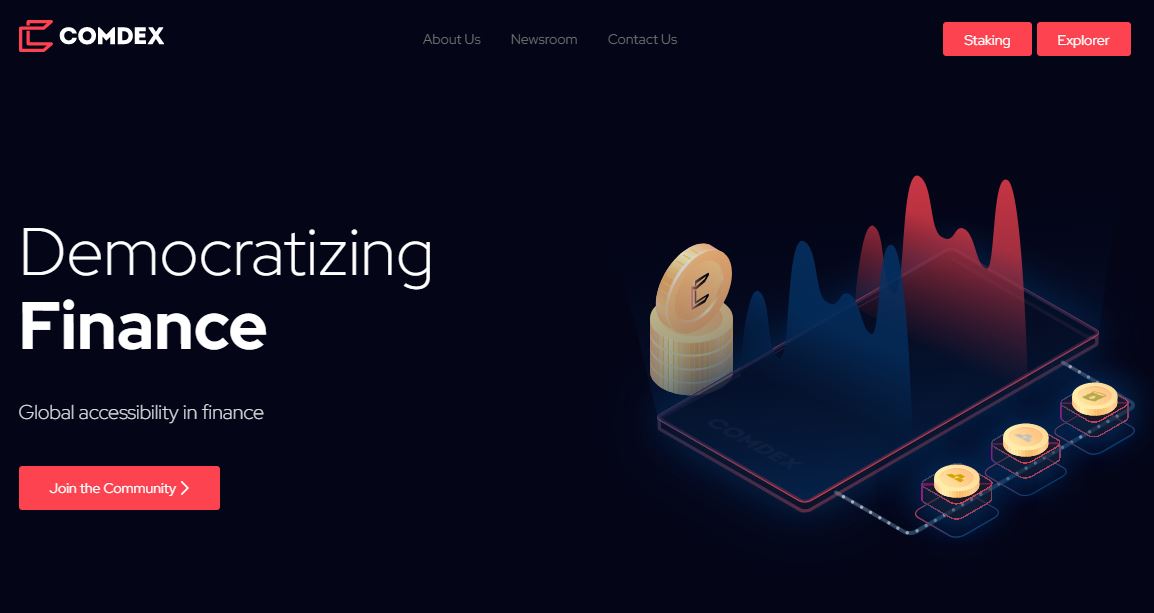
Is this something new we see striding into the world of DeFi? I’m not sure right now, so let’s take a little look at today’s project from the world of blockchain, Comdex.
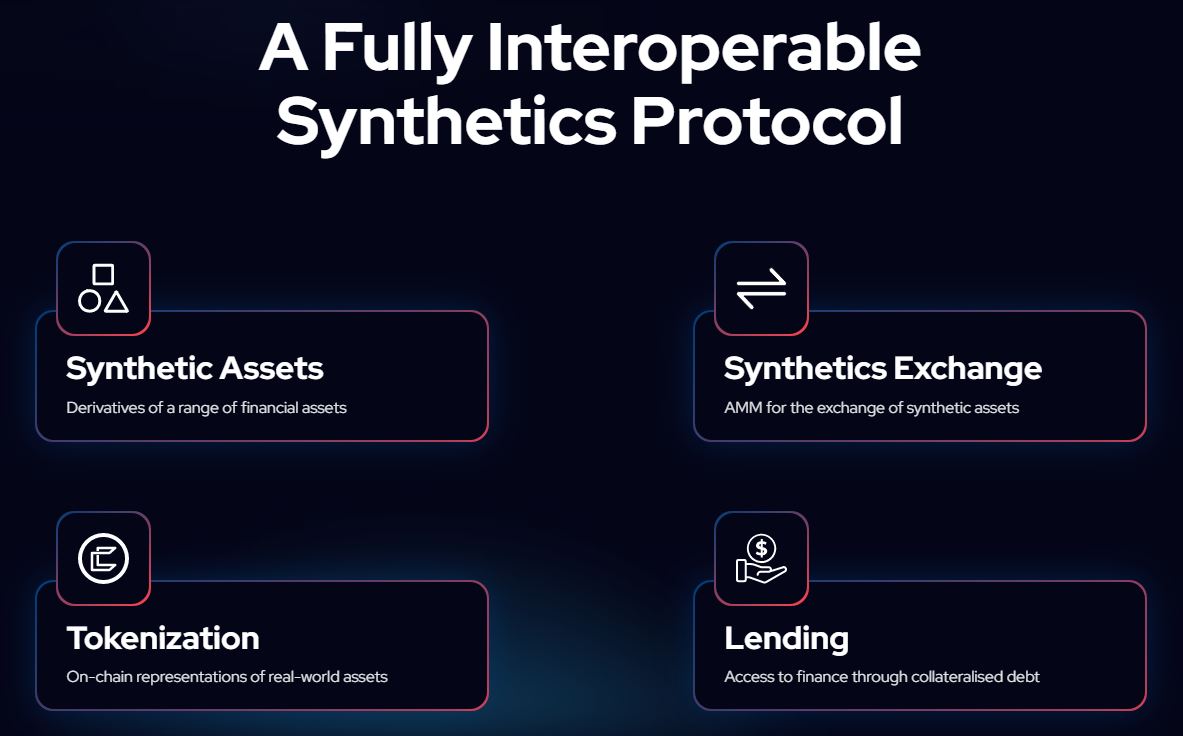
Comdex is part of the Cosmos ecosystem and styles itself as “A Fully Interoperable Synthetics Protocol.” Er, do what, you might reply. I know I did just that. Probably means something to some folks, but that doesn’t include me. Therefore, let’s start at the beginning, putting that description into some more easily understood language, before moving on to take a look at what Comdex does.
Comdex launched its mainnet in November 2021, joining the rapidly growing list of dApps in the Cosmos ecosystem, one of my favourites. Comdex’s overall mission is to provide all of us with access to a wide range of investment opportunities that have, until now, only been able to a few through the traditional derivatives markets. This is its mission to ‘democratise finance’.
It offers several core features.
**Mint Synthetic Assets**
You can mint a range of synthetic assets based on real-world assets, using prices obtained from a reputable oracle. Offering one of a number of crypto coins, such as ATOM or Comdex’s own CMDX, as collateral, you can mint a synthetic asset for a real-world asset such as gold, oil or soybeans. This allows you to gain exposure to movements in the price of each of these real-world assets, though you need to be aware that since this represents a collateralised debt position you could find it being liquidated should the price of the asset move against you sufficiently strongly.
**Bridge to other chains**
Since Comdex bridges to a number of other ecosystems, it also allows asset holders from these other chains to connect to Comdex and put these assets to work.
**AMM for swapping**
There’s also an automated market maker (AMM) that allows you to trade your minted assets for other minted assets, thereby avoiding the need to burn a synthetic asset you have created in order to move into a new one.
**Trading**
The exchange will also allow traders to take on long or short positions on the movement in the price of these synthetic assets, depending on whether they see the price going up or down.
**Liquidity provision**
It will also allow users to earn trading fees and CMDX rewards by operating as liquidity providers.
**A Huge Potential Market**
One of the interesting features of Comdex and one that could see it become highly successful is that the services it provides are potentially attractive not just to individuals but also to trading companies and other corporate entities with an interest in the price of real-world assets. These have the potential to bring vast volumes of business to the platform, which would generate correspondingly high levels of fees. Indeed, Comdex first started providing its services to professional traders, and the overall market here is worth trillions of dollars. The latter group could, for example, include farmers concerned about the movement in the price of wheat, any one of whom could take a position that protects the price they obtain for their growing crops when the time comes to harvest and sell it.
**LBP Launch**
One final point I want to mention about Comdex is its use of the Liquidity Bootstrapping Pool model for its launch. This involves the price of a token finding its own price point through the user of a reverse Dutch auction. I won’t go into detail here about how these work, but the key point is that they are seen as being a fairer way for a new token to be launched onto the market place by undermining the ability of large buyers to corner the market early on and then dump their tokens later once the price has become inflated. This model was used as part of the team’s desire to ‘democratise finance’. Extra points to them, I say.
Comdex is a really interesting project that has the potential to grow substantially. By making a wide range of synthetic assets more readily available it will open up a raft of potential investment opportunities to the many that were previously only available to the few. I think it is fair to say from this point of view that it looks like making a success of its mission to ‘bring greater democracy to the world of finance’. One to watch, I feel.
Until next time…
**Renaissance Man**
Earnathon – get paid to learn about crypto https://earnathon.com/signup?ref=lovelygarden
**The Usual Disclaimer**
Please don’t take any of the above as financial or investment advice. It is intended to be nothing other than a little entertainment and information sharing. Always, but always, do your own research before committing your money to anything.
The Electronic Frontier Foundation - the future of digital privacy, free speech, and the open web
A really short post today, one that encourages you to support the Electronic Frontier Foundation in its on-going effort to help us all secure a future of digital privacy, free speech, and the open web. It’s currently looking to meet its year-end challenge which will help it unlock grant funding. More information can be found here. https://supporters.eff.org/donate/year-end-challenge--SBD
Thanks for reading this and here’s to a great 2022.
Until next time…
**Renaissance Man**
Earnathon – get paid to learn about crypto https://earnathon.com/signup?ref=lovelygarden
**The Usual Disclaimer**
Please don’t take any of the above as financial or investment advice. It is intended to be nothing other than a little entertainment and information sharing. Always, but always, do your own research before committing your money to anything.
Incredible Returns on Time Wonderland – But For How Long?
I’ve recently been exploring the opportunities available with the emergence of platforms such as Olympus DAO and its growing army of clones, all of which offer some quite remarkable returns. Or, at least, they do for now. One that especially caught my attention was Time Wonderland and in this post, I’m going to take a run through what it is, how it works and share my thoughts as to why it might, or might not, be a good investment.
**What Is Time Wonderland?**
Time Wonderland is a clone of Ethereum based Olympus DAO, which has itself only been up and running since earlier this year and has already spawned a handful of clones. Time, which runs on the Avalanche blockchain with its own token called TIME, went live in September 2021, so it’s very new.
As with Olympus, Time has created its own, decentralised, reserve currency, the asset backing for which comes from bonds that it sells for a variety of other crypto assets. This provides an asset value per TIME token which, the theory goes, acts as a floor for the price of TIME. In the long term, Time aims to see their token operate as a global unit-of-account and currency, whilst in the shorter term the emphasis is on growth and wealth creation.
Time hasn’t yet offered anything notably different to what is available via Olympus, appearing to have stuck to the same model, based on the same code; though it is worth pointing out the gas fees on Avalanche are a tiny fraction of those on Ethereum.
**Why All the Fuss?**
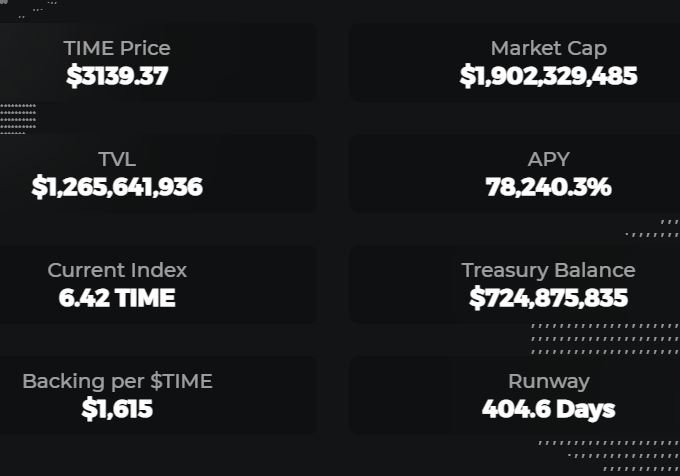
The reason Time and Olympus etc. are attracting so much noise is easy to see, it’s the jaw-dropping APYs they are currently offering. At the time of writing, Time is offering 78,393.7% APY. Yes, you read that right, 78,393.7%.
**How to Use the dApp**
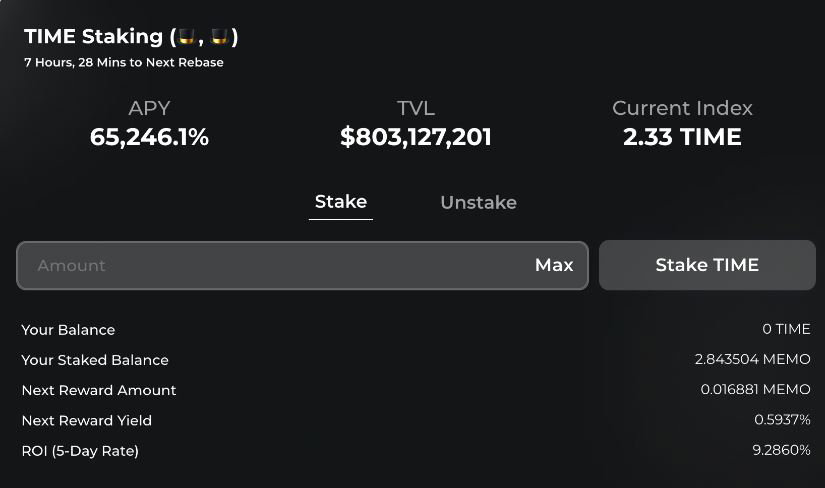
It’s really easy to stake to get a piece of that huge APY. Just connect your wallet (Metamask works), enter the number of TIME you want to stake and hit approve. You now get MEMO tokens allocated to your account in return, which you swap back for TIME when you want to unstake.
There’s a dashboard you can access which includes the current size of the treasury and the backing this provides per TIME, as well as the current APY.
The dApp also has a calculator that lets you test out scenarios for your investment, including the future price of TIME and the duration in days of your investment. So, for example, if you wanted to take a more conservative view, you could use a future TIME price equivalent to the treasury’s asset-backed value and see how that impacts your potential profits. I played around with this a lot, even setting the future price of TIME to just $10.
**How Does it Make a Living?**
As mentioned above, Time builds its treasury by issuing bonds in return for other crypto assets. It does this by offering people the chance to buy TIME at a discount on the price in place at the time of issue. This process of minting TIME is seen as offering an active, short-term investment strategy to those who prefer such an approach when looking to grow their funds.
**What About that Huge APY?**
From the staker’s perspective, the magic behind that huge APY is the power of compounding. By rebasing, or paying out, every 8 hours and auto adding your interest to your pot each time this happens, Wonderland ensure your committed stake is bigger each time and, therefore, you are earning against an ever-growing pot. Compounding makes a vast difference to any investment and this one is no different in that respect and it is this that allows the likes of Time Wonderland to offer such massive APYs, even if only for a while.
Time provides an example themselves, showing that if the protocol targets an APY of 100,000%, this would translate to a rebase rate of about 0.6328% or a daily growth rate of about 2%.
If you want to see the maths behind the way Time work things out then take a look at the Wonderland documentation. https://docs.wonderland.money/
**Modern Day Alchemists?**
OK, now we’ve seen what it’s all about and how it works, let’s consider the pros and cons and try to decide whether or not these people are modern-day alchemists, trying to create gold from base metals.
Let’s start with that APY. To be fair to the project team, they do point out themselves that such a huge APY is not sustainable. They see the project as being in a more volatile growth-focused phase right now that will eventually be swapped for lower returns and more stability.
Going back to the example they give in their documentation. An APY of 100,000% would equate to a rebase rate of about 0.6328% or a daily rate of about 2%. If there were 100,000 TIME tokens staked, the protocol would need to mint an additional 2000 TIME daily from bond sales to achieve this daily APY.
This also shows why such growth can’t go on forever because eventually there wouldn’t be enough new money to mint the required level of new TIME.
It is this need to bring in new money that tends to have some people viewing this as a Ponzi scheme. The retort to this is that the typical Ponzi scheme hides what it is up to and is constantly paying out incoming funds so there is nothing left when it collapses. Time Wonderland and others are open about the way things work, share their numbers and have a treasury with real value. That assumes, of course, that what we see is true.
So, are these people modern-day alchemists, trying to create gold from base metals? Is it a Ponzi scheme certain to collapse in on itself as soon as there are no more mugs to suck into the trap? There are certainly those who believe this to be the case, but on the other hand, there are those who point out that the established monetary system has its fair share of flaws and relies for its survival on the public’s willingness to believe it works. Perhaps the differences between the two aren’t so great. Perhaps. Depends on your point of view. Personally, I’m not even sure the creators of these DAO know what the outcome will be for their creations; after all, everything is new and experimental right now.
A couple of other things to note here. At present, Time Wonderland is run by the project team itself. Though the stated intention is to move to a DAO model there is no timeline given for this to happen. The platform is also currently unaudited, though the team say they are in the middle of being audited.
**Dipping a Toe in the Sea of Plenty**
Let’s get straight to the point here, I have invested in Time Wonderland. It’s only a very modest sum, but it’s an investment. Why have I done this? Well, for one thing, I believe the biggest returns will come from getting in early, in line with what the team say themselves. It will also give me a chance to see how things go and encourage me to track progress closely.
I’ll not shy away from the fact that the current enormous APY has a big, big pull on me. I’ve felt the usual tug of war going on inside me at such times, with greed facing off against fear, and it’s been tricky trying to take a dispassionate view. Maybe I am dipping a toe in the Sea of Plenty before the tide goes out.
As a means of keeping a lid on the risk, I am going to adopt an approach I often do in such situations. Assuming my initial stake grows, then once my holding gets to a decent size I will withdraw my initial stake and leave the rest to run, with no predetermined view as to when to sell out altogether. It could go to zero, but it could go a whole lot higher.
However, there’s another factor at play here. I don’t want to simply sit on the sidelines, watching as the world passes me by. These are new times; exciting times; never to be repeated times. And I want to take an active part, even if it means I’m going to get a bloody nose every once in a while. So, I’m in for the ride, wherever that might take me.
So, there we have it, an overview of Time Wonderland and some thoughts of my own on this recent arrival into the crypto space. But what do you think? Scam? Opportunity? Pointer to the future? It would be great to hear what you think in the comments below.
In the meantime, where’s the next Olympus DAO clone?
Until next time…
**Renaissance Man**
Earnathon – get paid to learn about crypto https://earnathon.com/signup?ref=lovelygarden
**The Usual Disclaimer**
Please don’t take any of the above as financial or investment advice. It is intended to be nothing other than a little entertainment and information sharing. Always, but always, do your own research before committing your money to anything.
Benqi DeFi dApp on Avalanche
I mentioned Benqi in a previous post, where I referred to earning its QI token through the Binance Launchpool, and promised to come back with a fuller update on this DeFi dApp, which is precisely what I’m doing today. Although I will summarise how it works, this post isn’t intended to be a how-to guide, rather it’s a summary of what the dApp is and my thoughts on it.
**What is Benqi?**
Benqi is a DeFi dApp running on the Avalanche blockchain that allows users to lend or stake their existing digital assets to earn income or borrow against these in an over-collateralised manner. Benqi aims to provide an easy-to-use and highly scalable liquidity market with low fees for users, which is hardly new but worth stating, all the same. All funds deposited or borrowed are administered through the use of smart contracts.
As with a lot of new DeFi dApps, Benqi sees a big opportunity in the on-going congestion and sky-high gas fees on Ethereum, which hosts by far the largest number of DeFi dApps, along with the largest user base, which presents a major impediment to those with relatively small sums to trade or invest. Since I currently avoid using Ethereum based dApps myself for this very reason, I can do nothing other than agree with this view.
Initial liquidity pools available cover AVAX, WETH, WBTC, LINK, USDT and DAI. These will be added to over time and, as governance transitions to a DAO, these additions will be decided upon by the community through the use of proposals and votes, utilising Benqi’s QI token.
**How it Works**
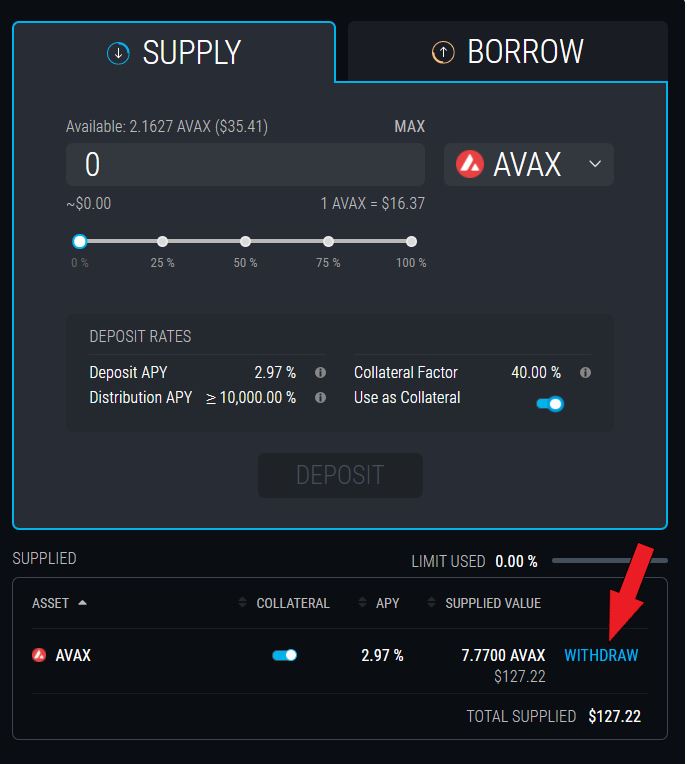
It works in much the same way as any other similar dApp. Connect your wallet (several options, including Metamask and Coinbase), deposit your chosen asset(s), then stake or lend if you are looking to earn. When you are ready to withdraw, just go back into the dApp and hit the withdrawal button for the relevant asset.
When you make a deposit you are issued with matching QiTokens, for example QiDAI, which are deposited into your wallet. At the time of writing, I couldn’t find any way of earning from these but since they are liquid digital assets in their own right I would expect over time there will be opportunities to earn from them. Bear in mind thought you will need them to reclaim your original deposit in Benqi.
When you want to borrow, off you go to the relevant screen, select the asset(s) to borrow against and how much, then hit that button. Interest rates vary depending on the collateral and repayment periods are open-ended. If you’ve deposited several different types of assets then you have the option to borrow against a mix of these.
It’s worth noting that where a user engages in both earning and borrowing, any interest earned by depositing funds is offset against the interest charged for borrowing, which is a nice touch.
**Tokenomics and DAO**
The protocol will initially be governed by the founding team, and will eventually transition to a Decentralized Autonomous Organization (DAO). As part of the DAO, holders of the QI token will be able to initiate proposals and vote on issues that will steer the direction of the protocol.
The total supply of QI will be 7,200,000,000 tokens.
45% of the tokens will be distributed through the Liquidity Mining program.
25% allocated to a token sale.
15% to the treasury.
10% to the team. fully unlocked over four years, with quarterly unlocks, and a 12 month cliff after public listing
5% for exchange liquidity.
I find it good to see the slow release of the team’s stake as this ensures they have skin the game for the longer term and provides a good degree of confidence they aren’t going to disappear overnight with our hard-earned cash.
**Avalanche**
Part of the appeal with Benqi lies in the Avalanche blockchain on which it is built. Avalanche pitches itself as the fastest smart contracts platform in the blockchain industry and sees DeFi as a key market that its fast, high throughput and low-cost platform is well suited to. Some of the other dApps built on Avalanche include ChainLink, TheGraph and Copper.
As a platform of platforms that allows others to build their own blockchain using its underlying consensus, Avalanche is much like both Cosmos and Polkadot/Kusama. Given the warm, comfy glow that I feel towards Cosmos and Polkadot, this is bound to ensure that Avalanche attracts my attention and I will be taking a closer look at it in the future.
Avalanche is growing very quickly and attracting an ever larger community, the significance of which for Benqi is obvious; it means a growing prospective user base, which is very good for business.
**An Opportunity for My Portfolio?**
This looks to me like a good quality project built on a blockchain that has the potential to grow its user base hugely. I like the fact the team behind Benqi are tied in longer-term and that there is no huge allocation of tokens to a massive and ongoing marketing campaign, something that eats up tokens on many other projects.
Whether or not Benqi will win out against the growing ranks of competition in the DeFi space, I think is impossible to say at present, not least of all because this is such a dynamic environment with new entrants appearing almost daily. However, since the overall market is growing it should make it pretty straightforward for them to earn a living in the shorter term.
Things I will be looking for from Benqi in the future include:
How well they grow their user base
How effectively they develop their offering, with the addition of new liquidity pools and user features
Their ability to avoid being hacked
The growth of their community and its levels of engagement
The growth of Avalanche
In the meantime, I’ve been happy to acquire a small holding of QI tokens for my more speculative portfolio.
Until next time…
**Renaissance Man**
Earnathon – get paid to learn about crypto https://earnathon.com/signup?ref=lovelygarden
**The Usual Disclaimer**
Please don’t take any of the above as financial or investment advice. It is intended to be nothing other than a little entertainment and information sharing. Always, but always, do your own research before committing your money to anything.
Building a Crypto Portfolio for Free
Because the world of the blockchain is so staggeringly dynamic (and aren’t we fortunate to be able to experience this all first-hand) it means there are an extraordinarily large number of opportunities available to us at any given moment of the day or night. Any serious attempt at trying to keep up with the sheer volume and diversity of opportunities would surely require a team of people to be employed on a full-time basis, not only spotting what’s new but also keeping up with developments on what is already up and running.
**Managing the Opportunity**
As a sole operator, I have tried to deal with this challenge in two primary ways, by focusing the bulk of my attention on:
blockchains and ecosystems that look to me like long-term winners
those projects that build out and improve the underlying infrastructure of the blockchain and Web3.0
This approach still provides a generous flow of new opportunities, whilst helping me to bring focus and keep things manageable. It also helps keep me sane and not get overwhelmed.
**Speculation and Fun**
Whilst maintaining discipline in the way you approach your blockchain related investments is very definitely a good thing, you do also need to leave yourself some room to have fun and to engage in some more speculative investments. All work and no play would make Renaissance Man a very dull beast indeed.
With this in mind, I have, for some time, been looking at options for building a portfolio of largely speculative holdings in mainly smaller projects, whilst adding little or no risk to my overall portfolio. That may sound wishful thinking, but remember this is a time and place of extraordinary opportunity and it turns out there are ways to do this. Here I am going to share the techniques I have started using to achieve just this.
**Launch Pools**
One handy way of building up a holding in a project is to use launch pools run by the likes of Binance. These seem to be growing in popularity, appearing on an increasing number of websites. It’s really just a form of staking, which involves you staking tokens of a specified type against a project for a set period of time, during which you are able to claim your reward in the form of tokens in the project you’re backing. It’s a useful way for a project to expand its user base and profile.
I am doing this at the moment on Binance, staking BNB in order to build a holding in Benqi, a decentralized non-custodial liquidity market protocol. Benqi’s offering looks good, it’s current market cap is modest and so has plenty of room to grow significantly and it resides on Avalanche, a rapidly growing blockchain with relatively little in the way of DeFi offerings at present.
(I will be looking into Benqi in more detail in a later post).
**Reallocating Earnings from Staking**
I often use earnings from ‘normal’ staking to build a position in another project. For example, I love the Cosmos ecosystem and already have holdings in several of the outstanding projects there, but I am adding to these by taking earnings from staking tokens for the likes of Osmosis and Persistence and using them to buy holdings in Juno and Secret Network. I do this by swapping one set of tokens for another on the excellent Osmosis platform.
**Crowd Funding Auctions**
Over in the Polkadot/Kusama ecosystem you can currently earn tokens at no additional cost by backing projects seeking to secure a parachain slot in the crowdfund auctions. There are a limited number of parachain slots available, which are being awarded via a public auction to those projects that secure the most backing in the form of allocated DOT/KSM.
Projects encourage people to back them by offering free tokens from their own project treasuries. Winning project are planning to hand these out to their supporters over the life of the parachain (up to two years), when you also get back your staked DOT/KSM.
Without going on endlessly here, you can get further rewards by committing your DOT/KSM via one of a few DeFi dApps in the Polkadot/Kusama space, which are encouraging people to use their services by handing out token rewards from their own treasuries. So it’s a case of double-bubble!
It’s worth adding that these are quality projects we’re talking about, so it’s not as if you’re pledging your DOT/KSM against no-hopers. Because of this, I plan to keep hold of the tokens I pick up through this route in the expectation that some of the projects will turn out to be very successful indeed.
**Airdrops**
Airdrops can often seem to be falling thicker than confetti and it’s quite likely that some of what is on offer will turn out to be winners, however I am not talking here about your run-of-the-mill airdrops.
It seems to be increasingly common for projects launching into wider ecosystems, such as Cosmos, to offer free tokens to those people who hold tokens in some of the projects already live there. It’s good for the new projects because, if done well, it can bring them some great publicity and help grow their user base early on.
The new project normally takes a snap-shot of qualifying token holders at a specified date and you can often check your own status via the project’s website. Those qualifying then need to take some sort of action to claim their tokens during a specified window.
This is a new approach for me when building stakes in projects and I’m currently going through the process with two projects on Cosmos. As with the Polkadot projects mentioned above, these are good quality projects and I will be holding these long-term.
**Pound Cost Averaging and Risk Reduction**
For those projects where you are building a holding in a number of smaller bites, rather than in one big bite, there is one particular advantage that you enjoy, which is pound cost averaging. In simple terms this means you buy more tokens when the price is low and less when it is high, whilst avoiding the risk of buying at a peak should you buy your entire holding in one go. This is not to be sniffed at, especially in an environment as unpredictable as the blockchain is.
**Opportunity Cost**
Although the methods I’ve run through here involve no direct cost to acquiring your new holdings, there is one cost of sorts that you might want to consider, namely the opportunity cost. Even where I haven’t actually spent any money to obtain the new tokens, it may be that tokens staked in a launch pool or committed to the Polkadot auctions could in fact have obtained a greater reward elsewhere.
I think it is a good thing to be aware of this and in my own case I have chosen to accept this because I have a specific objective in mind and I see acquiring these new holdings as part of building a diversified portfolio, something that to me is essential in such a high risk space.
**Profit and Pleasure**
I won’t shy away from the fact that I expect some of these projects I’m building stakes in to turn out to be duds, but I only need a very few of them to grow hugely in order to make a significant overall gain. In any case, there is also a part of me that is happy to back some projects just for the pleasure of it because it’s always a pleasure to encourage talented people and to be a part of something new and successful
Until next time…
**Renaissance Man**
Earnathon – get paid to learn about crypto https://earnathon.com/signup?ref=lovelygarden
**The Usual Disclaimer**
Please don’t take any of the above as financial or investment advice. It is intended to be nothing other than a little entertainment and information sharing. Always, but always, do your own research before committing your money to anything.

Diary of a Blockchain Fan – November 30th 2021
**November’s End. How Did it Go?**
Well, here we are, it’s the last day of the month. The bad news is, that doesn’t leave many days for me to work out what I am going to buy my wife for Christmas, but I’m setting that particular challenge aside for now. It will need some serious focus.
I decided to write a daily post about my journey through the world of the blockchain during the month of November for two reasons. Firstly, I wanted to share the results of some of my researches. I’ve benefited greatly from the sharing of others, so it felt right to give a little something back in return. Secondly, I thought it would be interesting and maybe even amusing to be able to look back at what I’d written, the projects I’d spoken positively about and those I’d turned my nose up at, as well as the shear variety and volume of projects that have and continue to launch in what is, let’s be clear, an incredibly vibrant space.
Hopefully, some of my posts have been of interest to you. Maybe even one or two have amused you. I’m assuming I must have done something right because where I have received feedback it’s been positive. I won’t pretend that it’s been easy writing a daily post, especially as I really have tried to produce quality content that’s accurate and well-written. I’ve also tried to reflect my own personal thoughts and feelings in these posts, rather than rolling out a bland repetition of information already available elsewhere.
All of this, of course, takes time, perhaps the most precious commodity that we each possess, and I suppose it goes without saying that we never seem to have enough of that. Disappointingly, I haven’t yet been able to find a project in the DeFi space that allows me to trade some of my coins for time; perhaps there’s a big opportunity there for an enterprising team!
One positive of this daily posting that I hadn’t expected at the outset is that I’ve started making some new acquaintances in the world of the blockchain, people who’ve been good enough to exchange a comment or two off the back of a post. Then there have been the people who have helped me get to grips with the platforms I’ve been posting on, two of which were entirely new to me and not especially easy to learn. To you all, I say a big thank you.
So, now the end of the month is here, what happens next? The first part of my answer to that question is to say I won’t posting daily from now on, though I knew that from the outset. For one thing, it has diverted too much time away from my fiction writing, which has languished forlornly in a corner, feeling unloved and abandoned. Deadlines are deadlines and my readers won’t be amused if the next book is late in arriving.
However, I will now be posting on a weekly basis. The topics will be the same, reflecting my voyage of discovery through all things blockchain related, and I hope to maintain the personal spin I bring to my posts. It’s an utterly fascinating world out there right now and it’s a pleasure to have the chance to be a part of it, to be right in there, experiencing things first-hand. Where it will all end up, who knows? But I do intend to fully enjoy the ride while I have the chance to do so.
Until next time…
**Renaissance Man**
**Why this Diary?**
I thought it might be an interesting exercise, as much for myself as anyone else, to keep a diary of my interests and activities in the land of the blockchain and all things crypto, so I’m going to give it a go at writing a short diary entry each day for the current month, November 2021. It will give me something to look back on and assess and it might offer up some entertainment and topics of interest to anyone who happens to read it.
**The Usual Disclaimer**
Please don’t take any of the above as financial or investment advice. It is intended to be nothing other than a little entertainment and information sharing. Always, but always, do your own research before committing your money to anything.

Diary of a Blockchain Fan – November 29th 2021
**Darwinia Network**
As I’ve mentioned in several of my previous posts this month, I am enthusiastically supporting the Polkadot crowdloan auctions, with a raft of great projects bidding for a parachain slot. Most of my DOT has now been committed, but I have enough left to support one more project. The problem is, which one should I go for?
I have looked at several candidates for my DOT in recent weeks and pretty much any one of them would make a great choice because the standard of the projects bidding for a slot is so high. There’s also a pretty wide range of choice in terms of the utility the projects are looking to bring to the Polkadot party, even if there is a majority from the world of DeFi.
My decision making has been further complicated by the fact some projects have announced their participation long after I have already committed most of my funds and I suspect there are more that have yet to confirm their launch. And one final factor for me to bear in mind is that I doubt all the projects I back will be successful, at least in the current phase of bidding, so I will likely get some DOT released back to me. Where this does happen, I will need to decide if I am going to support any fresh bid by such a project or look to allocate my DOT elsewhere.
Anyway, as I mull things over, I continue assessing projects I haven’t yet taken a proper look at. One such project is Darwinia.
Darwinia pitches itself as a decentralized cross-chain bridge network, built on Substrate, that provides a safe and standardised bridging solution connecting different blockchains, including Polkadot, Ethereum and TRON. It specifically calls out its support for DeFi, NFT and Gamefi applications and sees itself as building part of the foundational layer for the Web3.0 metaverse.
Its native token is RING but it also offers KTON, which is an interesting addition, since you can earn this, as well as RING, by committing your staked RING for the long-term. Long-term means 3 to 36 months.
This makes Darwinia a building-block type project, something that aims to make the world of the blockchain better, as opposed to something that looks to deliver functionality to the end-user in the way that a DeFi app does. There’s nothing wrong with the latter (I use DeFi apps all the time) but I do have a preference for projects that are helping to provide the buckets and spades that others make use of.
So, Darwinia ticks the box when it comes to utility. It has also implemented a considerable amount of the items on its white paper, so has shown it can deliver on its promises, which is another box ticked. Finally, it has a very healthy and active community, which also puts a tick in a box.
Oh dear, it seems I’ve found another attractive candidate for my few remaining DOT. It would have been so much easier if it had turned out to be a load of rubbish. Well, I have Darwinia to my growing list of candidates and also noted that if I contribute via Bifrost, I get the benefit of liquid DOT. At this rate, I might never make a decision. Perhaps I should stop looking now. At least then my list won’t get any bigger.
If you want to find out more then check out their website here. https://darwinia.network/
Until tomorrow…
**Renaissance Man**
**Why this Diary?**
I thought it might be an interesting exercise, as much for myself as anyone else, to keep a diary of my interests and activities in the land of the blockchain and all things crypto, so I’m going to give it a go at writing a short diary entry each day for the current month, November 2021. It will give me something to look back on and assess and it might offer up some entertainment and topics of interest to anyone who happens to read it.
**The Usual Disclaimer**
Please don’t take any of the above as financial or investment advice. It is intended to be nothing other than a little entertainment and information sharing. Always, but always, do your own research before committing your money to anything.
Diary of a Blockchain Fan – November 28th 2021
**LikeCoin**
I mentioned LikeCoin briefly a few days ago and promised to come back with a fuller update after I’d had time to do some more digging. Well, the digging has been done, so here’s my run through what the project offers.
Likecoin is built on its own blockchain, based on Cosmos SDK, so it’s part of the Cosmos ecosystem (which, as you ought to know by now, I think is a very good thing). It provides the infrastructure required to support decentralised publishing. It does this by acting as a depository for digital content metadata, allowing content creators to assign an ISCN (International Standard Content Number) to each piece of their content. Data recorded includes timestamp, author, title and publisher. The type of content for which an ISCN can be assigned includes articles, photos, videos and music. Their own coin, Likecoin, is used to pay for any and all fees incurred, for example when assigning an ISCN to a piece of content.
In addition, Likecoin provides plug-ins that can be used to deliver content to publishing platforms, including news media, social media and blogs, and there’s also a plug-in that can be used to allow consumers to reward the content owners.
Consumers can access content through Likecoin’s Liker Land app, which runs on Android and iOS. This includes the option of becoming a Content Jockey, identifying and recommending content for others to read.
From the content creator’s perspective, there are a number of attractions. For starters, your content is being stored in a decentralised environment, with all the usual advantages that brings. Assigning an ISCN to your content also allows you to exercise greater control over your content; indeed, the system allows anyone to verify ownership of a piece of content, thereby helping to address the issue of piracy.
I also particularly like the fact you can use plug-ins pretty much anywhere you like, such as on your own website or with your YouTube videos, to allow consumers to tip or sponsor you. This sort of thing is something I am especially keen to explore because I would love to be able to offer my readers, of both fiction and non-fiction, a simple, consistent means for them to tip or sponsor me, without relying on someone else’s platform. Patreon lets you do this but you are, of course, using their platform, not one you control.
Whether or not this project would make a good investment, I wouldn’t like to say. It’s a bit of a tiddler right now, with a market cap around the $35m mark. Whilst clearly having lots of scope to grow, you would also expect to see a good deal of volatility in the price of the coin, as relatively small changes in sentiment tend to have a large impact on price when turnover is pretty low.
But I haven’t approached Likecoin from this perspective. What has interested me is the potential it has to be of practical benefit to me as an author, both for my fiction and non-fiction content. Whilst I’ve spent a couple of hours today and a little time earlier in the week checking it out, I think I need to explore it more before I can be convinced it is worth adding to my life. The idea is excellent, but I want to know how well it works in practice because sometimes even the best of ideas fall short when they are implemented.
I suppose the only way I can really find that out is by giving it a go, which is precisely what I am minded to do. For now, I’m adding it to my watch list, with a note to identify some content I can use to give it a go and when, in the fullness of time, I’ve done that I will be back here to let you know how I got on.
Until tomorrow…
**Renaissance Man**
**Why this Diary?**
I thought it might be an interesting exercise, as much for myself as anyone else, to keep a diary of my interests and activities in the land of the blockchain and all things crypto, so I’m going to give it a go at writing a short diary entry each day for the current month, November 2021. It will give me something to look back on and assess and it might offer up some entertainment and topics of interest to anyone who happens to read it.
**The Usual Disclaimer**
Please don’t take any of the above as financial or investment advice. It is intended to be nothing other than a little entertainment and information sharing. Always, but always, do your own research before committing your money to anything.

Diary of a Blockchain Fan – November 27th 2021
**Everybody’s Gotta Have Some Fun**
There is, sad to say, little for me to report on today because I’ve been busy doing other things. Every once in a while I get together with some old school friends of mine so we can nurture those relationships and catch up on what we’ve all been up to since we last met. Today has been one such day. In fact, we’re a bit rubbish at sorting out these get-togethers and today was the first one in a couple of years, though it is fair to say that Covid has played its part there. Anyway, all this meant I did other exciting things, like Segwaying for the first time, rather than surfing the web reading up on new projects and progress with ones I’m already invested in.
I did, however, quickly check the latest on the issues being experienced with claiming DSM coins as part of the Desmos airdrop and, unfortunately, the team’s latest attempt to get this working seems to have resulted in some further issues being experienced by those making claims. As I said in a previous post, this is very unfortunate for a team that has been working hard to take its project live and looking to share the joy with fellow blockchain fans. I suspect it will take some time for the reputational damage to be repaired.
Until tomorrow…
**Renaissance Man**
**Why this Diary?**
I thought it might be an interesting exercise, as much for myself as anyone else, to keep a diary of my interests and activities in the land of the blockchain and all things crypto, so I’m going to give it a go at writing a short diary entry each day for the current month, November 2021. It will give me something to look back on and assess and it might offer up some entertainment and topics of interest to anyone who happens to read it.
**The Usual Disclaimer**
Please don’t take any of the above as financial or investment advice. It is intended to be nothing other than a little entertainment and information sharing. Always, but always, do your own research before committing your money to anything.
Diary of a Blockchain Fan – November 26th 2021
**Binance Launchpool**
Binance is one of the biggest centralised crypto exchanges out there and it offers an impressively wide range of features for its users. One of these is its Launchpool, something I started using for the first time earlier this month, and I thought it worthwhile making this the subject of today’s post, as it offers a simple and handy way to build up a portfolio of projects at zero cost.
The Launchpool on Binance gives you the chance to earn coins in projects by staking. The process is very simple. You click your way through to the Launchpool page, check out the projects on offer, the APR available and the coins you can stake, then stake your preferred coins against the chosen project. The farming pool normally runs for 30 days and you can claim your rewards whenever you like, even daily if the mood takes you. In most cases you get a choice of 3 coins you can stake in order to farm, one of these always being BNB, and there are always at least two options. The APR varies for each of these options, so you do need to consider this when deciding which coin to stake with.
At the time of writing there are three projects you can farm:
Benqi Finance (QI), a decentralised non-custodial liquidity market protocol that runs on Avalanche.
Manchester City FC fan token (CITY), the Premier League football club, built on the Chiliz Chain.
Mines of Dalarnia (DAR), a play-to-earn adventure game that runs on the Binance Smart Chain.
The APR available across the three of these varies between 3.73% and 10.66%. Looking at some of the projects that have finished recently, the APR varies between 1.00% and 56.43%.
It’s also worth noting that sometimes Binance provides an opportunity to then stake the new coins you’ve farmed, which is a nice way of adding further to your portfolio. For example, as part of their locked staking option, you can currently earn 43.82% for locking up your DAR for 10 days.
Personally, I will be using the Launchpool as a way to build a portfolio of coins that I’ll hold long-term, in the hope that some of them turn into big, big winners. This only needs to happen with one or two to make the whole exercise worthwhile and, in the meantime, I get to learn about some new projects I might not otherwise have bumped into.
Until tomorrow…
**Renaissance Man**
**Why this Diary?**
I thought it might be an interesting exercise, as much for myself as anyone else, to keep a diary of my interests and activities in the land of the blockchain and all things crypto, so I’m going to give it a go at writing a short diary entry each day for the current month, November 2021. It will give me something to look back on and assess and it might offer up some entertainment and topics of interest to anyone who happens to read it.
**The Usual Disclaimer**
Please don’t take any of the above as financial or investment advice. It is intended to be nothing other than a little entertainment and information sharing. Always, but always, do your own research before committing your money to anything.
Diary of a Blockchain Fan – November 25th 2021
I have been ploughing through the old Twitter feed today, keen to keep an eye on a couple of airdrops I am lined up for and anything else of interest, of which there always seems to be much. One project I bumped into for the first time and will be looking into more deeply is Likecoin, a provider of decentralised publishing infrastructure. I’ve only had time for a cursory glance so far but as someone who writes and publishes both fiction and non-fiction across an array of platforms I am definitely interested in finding out more. Expect a fuller update from me on this one at a later date.
**An Airdrop with a Bumpy Landing**
I’ve mentioned a few times in this series of posts that one of my favourite ecosystems is Cosmos and that one of the benefits of holding ATOM and related coins is the occasional free airdrop from new projects launching over there. One such is Desmos, which has been building up to its big day very nicely for a while now, only to encounter issues with the claim process. Ugh! They have reacted quickly to roll out an alternative claim method but, all the same, they’ve left a bad taste in the mouth of some followers, especially with their initial request for a claimer’s seed phrase. Oh dear, not really the thing to do.
Fortunately, they seem to have a decent size pool of good will to call on, which has seen some community members rallying to their side, but it just goes to show how easily things can go wrong and the reputational damage that can result.
I wish them the best and will be leaving it a day or several before I look to claim my free DSM coins in the hope that the gremlins will have been evicted by then.
**Moonbeam**
Hot off the press, the second Polkadot parachain slot has been won by Moonbeam. Not really a big surprise given the level of support it has enjoyed since the auctions started, which saw it run Acala close for the first slot award. A fine project this one that has been attracting a lot of attention. Pleased to say it was one of those I backed.
Until tomorrow…
**Renaissance Man**
**Why this Diary?**
I thought it might be an interesting exercise, as much for myself as anyone else, to keep a diary of my interests and activities in the land of the blockchain and all things crypto, so I’m going to give it a go at writing a short diary entry each day for the current month, November 2021. It will give me something to look back on and assess and it might offer up some entertainment and topics of interest to anyone who happens to read it.
**The Usual Disclaimer**
Please don’t take any of the above as financial or investment advice. It is intended to be nothing other than a little entertainment and information sharing. Always, but always, do your own research before committing your money to anything.

Diary of a Blockchain Fan – November 24th 2021
**Thorstarter**
Yesterday I took a run through Moonstarter and today I’m taking a look at a second new launchpad, Thorstarter. I very much liked what I saw over at Moonstarter, so how is this alternative going to measure up?
As with Moonstarter, Thorstarter has been launched with a view to addressing the problem of existing launchpads being blockchain specific, which limits the options for both projects looking to raise funds and for investors looking to participate. A highly commendable objective, to my mind.
More than this, however, Thorstarter has set out to use the cross-chain liquidity available on ThorChain to ensure new projects have access to good levels of liquidity for their tokens, something that is often a problem with IDOs, especially for small ones. It does this by using XRUNE as a stepping stone between the big liquidity pools available for the likes of BTC and ETH and the smaller pool of coins issued by the new projects.
Projects applying to use the IDO facility go through a vetting process to help ensure the quality of offerings is high. This is done by a DAO, which not only votes on proposals but also shares in the project’s proceeds from each IDO.
Projects making use of the IDO facility have a variety of options when it comes to the way they distribute their coins, including fixed price, dynamic price auction and several others. That offers a nice element of flexibility to project teams.
To gain access to IDOs you have to stake Thorstarter’s own XRUNE coins. This is done on a tiered basis, starting with 2,500 XRUNE for Tier 1 and goes all the way up to 150,000 for tier 5. The higher the tier you buy into, the greater your allocation multiplier for whatever IDOs you take part in. After that, when a new project takes your fancy, you rock up on the date of the IDO to make your bid for a piece of the action.
With XRUNE at around 40c that makes it roughly $1,000 to buy into this launchpad. It’s a fair sized commitment but not as substantial an amount as many other launchpads ask you to cough up.
By the way, you can stay in the ThorChain ecosystem to obtain your XRUNE by using ThorSwap.
I knew nothing about ThorChain prior to taking a look at Thorstarter, so the whole ecosystem was new to me and I’d like to take a closer look before I commit time and money there. However, I like some of the features offered by Thorstarter very much. As well as offering projects from a variety of blockchains and currently having a ealtively affordable entry price point, its focus on bringing liquidity to the table for each new project is highly commendable.
Take a look here if you would like to know more. https://thorstarter.org/
Until tomorrow…
**Renaissance Man**
**Why this Diary?**
I thought it might be an interesting exercise, as much for myself as anyone else, to keep a diary of my interests and activities in the land of the blockchain and all things crypto, so I’m going to give it a go at writing a short diary entry each day for the current month, November 2021. It will give me something to look back on and assess and it might offer up some entertainment and topics of interest to anyone who happens to read it.
**The Usual Disclaimer**
Please don’t take any of the above as financial or investment advice. It is intended to be nothing other than a little entertainment and information sharing. Always, but always, do your own research before committing your money to anything.
Diary of a Blockchain Fan – November 23rd 2021
**Launchpads**
A wonderful tale to be told today. I’m such a happy chappy.
I mentioned briefly in an earlier post how frustrating it has been to find one IDO launchpad after another living and operating on Ethereum. Not that I have anything against Ethereum as a whole, since it’s done wonders for the blockchain world, but those gas fees are just appalling. I simply don’t do business there at present.
Having been an investor for several decades and having focused on small and start-up companies for the last few years, I’m a natural for launchpads in blockchain land. This means it has been horribly frustrating for me to find myself hemmed in by ETH gas fees.
This problem has come about both because of Ethereum’s leading position, which gives it such scale, and its use of smart contracts, which underpin these IDOs. There has been little choice for all concerned other than to use Ethereum.
That is, until recently. I am delighted to say that in the last few days I have bumped into not one, but two launchpads that don’t rely entirely on Ethereum, Huge cheer! Today I’m going to say something about Moonstarter and tomorrow Thorstarter.
**MoonStarter**
Moonstarter has been launched with a view to addressing the problem of existing launchpads being blockchain specific, which limits the options for both projects looking to raise funds and for investors looking to participate.
Built on the Binance Smart Chain, they initially supported the BSC and Ethereum blockchains, but have already started extending this to include Cardano, Solana and Polkadot, with Cosmos and Tron following later on. (Since I’m a fan of both Polkadot and Cosmos this is especially good news. It’s also worth noting, given my updates in previous posts about the ongoing Polkadot auctions, that they see Moonbeam as central to their future growth).
Participants need to hold a minimum of 1,000 of Moonstarter’s MNST coins to participate in IDOs on a lottery basis or 10,000 to get a guaranteed allocation. The project being new and the price of MNST relatively low makes it a more affordable entry price point than for many other launch platforms.
Proposed IDO launches are vetted and help offered by the Moonstarter team for those projects that want it. Moonstarter will also control the liquidity lock built into each IDO, so the project teams do not have control of this themselves, a nice safety feature to reduce the chances of a rug pull.
Of course, any launchpad is only as good as the projects it helps launch and, being new, Moonstarter needs to build up a track record, but there are IDOs already available, including interesting looking ones from Mine Network and Blockpad, so they’ve not been tardy in getting things moving.
Moonstarter looks ideal for me. Covering multiple blockchains, with an affordable entry price point and what looks like a well thought out approach, I’m up for this one and will be mopping up some MNST soon.
Take a look here if you would like to know more. https://moonstarter.net/#chains
Until tomorrow…
**Renaissance Man**
Presearch – Earn free PRE crypto when you search. https://presearch.org/signup?rid=2609069
**Why this Diary?**
I thought it might be an interesting exercise, as much for myself as anyone else, to keep a diary of my interests and activities in the land of the blockchain and all things crypto, so I’m going to give it a go at writing a short diary entry each day for the current month, November 2021. It will give me something to look back on and assess and it might offer up some entertainment and topics of interest to anyone who happens to read it.
**The Usual Disclaimer**
Please don’t take any of the above as financial or investment advice. It is intended to be nothing other than a little entertainment and information sharing. Always, but always, do your own research before committing your money to anything.
Diary of a Blockchain Fan – November 22nd 2021
**Phala and the Zero Sum Staking Game**
Plans don’t always come to fruition, I suppose it goes without saying, but it’s good to remind oneself of this from time-to-time because I find it helps stay cool, calm and relaxed when things don’t turn out as you would like.
One of my own plans ran aground today. A little reminder for me how readily real-life can blow a raspberry in your face. I backed the Khala project in its successful bid for a slot on Kusama (Polkadot’s more adventurous sibling) earlier this year and was rewarded with some of their PHA coins (more follow over the life of the parachain lease period).
Because I first engaged in the Kusama auctions via the Kraken exchange it meant my PHA were paid out into my account there, so, some weeks having since elapsed, I finally got my finger out and shifted them to my Polkadot JS wallet. It was, I had decided, time to put them to work and to earn me a modest income via some staking, or so I thought.
The transfer went fine and off I then toddled to the Khala app (Phala and Khala being essentially the same thing, with the latter being the test-bed for the project on Kusama). And that’s where my plans came a cropper. Yes, I could stake my PHA, that much was true, but the sole APR on offer was, er, zero. Rats! So, now those coins are, as actors like to say, resting. It’s just they are resting in my wallet doing not a lot and certainly not earning their keep.
I know, it’s a minor inconvenience in the great scheme of things, but I do like plenty of order in my life and I much prefer to see one carefully thought out plan come to fruition so that I can move on to the next. Now I’m going to have to add an item to my to-do list to keep an eye on the payout rate for staking PHA, until such time as it moves above zero and I can tuck it safely in a delegated bed, where it can dream happily as it earns me a little income.
In the meantime, I will continue to watch the project with interest, since it was always a part of my plan to hold the coins for the long-term and at least that part of my plan should be fine, for now.
**Moonbeam**
I see Moonbeam have today announced they have closed their Polkadot crowdloan to new supporters in order to ‘preserve the rewards of those who have already contributed’. In other words, they are full-up! Looks like they will win the second parachain slot, seeing how they remain way out ahead of the chasing pack. But there’s another six slots up for grabs, so plenty for the remaining projects to aim at yet.
Until tomorrow…
**Renaissance Man**
**Why this Diary?**
I thought it might be an interesting exercise, as much for myself as anyone else, to keep a diary of my interests and activities in the land of the blockchain and all things crypto, so I’m going to give it a go at writing a short diary entry each day for the current month, November 2021. It will give me something to look back on and assess and it might offer up some entertainment and topics of interest to anyone who happens to read it.
**The Usual Disclaimer**
Please don’t take any of the above as financial or investment advice. It is intended to be nothing other than a little entertainment and information sharing. Always, but always, do your own research before committing your money to anything.

Diary of a Blockchain Fan – November 21st 2021
**The Great Mystery of Time**
A quiet day in the land of the blockchain for me. You’d think weekends would allow me more time for exploring new projects and getting up-to-date on ones I’m already invested in, but the reverse actually seems to be true; I get less time. It’s one of life’s great mysteries.
**Comdex**
That said, I have been keeping an eye on Comdex, which resides in the Cosmos ecosystem, one of my favourite places in the world of the blockchain. Comdex, which has only just gone live on its mainnet, allows for the creation of synthetic assets based on an array of real world assets, which can then be traded or swapped for other synthetic assets on their AMM. Aimed at institutions, though open to anyone, it aims to remove the complexities and unnecessary restrictions found in traditional systems, as well as opening up accessibility to a wider audience. It’s a commodity trading platform.
Interestingly, it will operate across multiple blockchains and plans to roll out a stable coin of its own, which it hopes will become the default for the whole Cosmos ecosystem, which is something of major interest to me.
Happily, the project team decided to launch to world via a free airdrop to holders of several of the coins in the Cosmos sphere, including a couple I hold. A typically democratic and inclusive approach found with a lot of projects in the Cosmos world, it’s also a great way of raising a project’s profile as it launches. So it’s a win-win. However, it does mean I am having to pay even more attention than usual to my twitter feed to ensure I follow the steps required to claim my share of the drop, which I plan to stake for the long-term.
I’m not sure I’ve seen another project quite like Comdex and I will be continuing to monitor it as the team work their way through their roadmap.
Until tomorrow…
**Renaissance Man**
**Why this Diary?**
I thought it might be an interesting exercise, as much for myself as anyone else, to keep a diary of my interests and activities in the land of the blockchain and all things crypto, so I’m going to give it a go at writing a short diary entry each day for the current month, November 2021. It will give me something to look back on and assess and it might offer up some entertainment and topics of interest to anyone who happens to read it.
**The Usual Disclaimer**
Please don’t take any of the above as financial or investment advice. It is intended to be nothing other than a little entertainment and information sharing. Always, but always, do your own research before committing your money to anything.

Diary of a Blockchain Fan – November 20th 2021
**Polkadot Parachain Auctions**
I was going to include this update in yesterday’s post but got carried away with writing about Streamr, but it’s big news and still worth including here. The winner of the first Polkadot parachain auction has been announced and it is… Acala. Over 80,000 fans chipped in with more than 32.5 million DOT to support this project, which is quite some achievement, so well done to the project team. They get on-boarded along with the other five winners, once they are announced in the coming weeks, on December 18th.
As well as their liquid Dot produce, Acala will be rolling out a stable coin for the Polkadot ecosystem, which is something I am very interested in as it will be another alternative to the usual stable coins based on Ethereum and we know all about the impact of high gas fees over there.
Acala were run very close by Moonbeam, with this project currently having over 34.5 million DOT backing their campaign. They are so far out ahead of third-placed Astar that’s it’s hard to see them being caught now. It’s also looking good for the two DeFi offerings from Astar and Parallel, both of these being a few million DOT ahead of the chasing pack. That would mean three of the first four winners coming from DeFi land, which I find a bit disappointing, though it does show where the main action is in blockchain land at the moment.
**Nodle and the Parachain**
Well, what do you know, two of the topics I’ve mentioned the most this month have now come together. Nodle is launching a bid to win one of the coveted Polkadot parachain slots. I’m not sure about the wisdom of launching a bid so relatively late in the day, especially when you see just how many DOT the leading half-a-dozen projects have already amassed, but, there again, I imagine they do have a large community already in place so perhaps that will be enough to see them through. Anyway, I’ve joined the wait-list and will consider it for the one remaining project I will be committing DOT to during these auctions.
Until tomorrow…
**Renaissance Man**
**Why this Diary?**
I thought it might be an interesting exercise, as much for myself as anyone else, to keep a diary of my interests and activities in the land of the blockchain and all things crypto, so I’m going to give it a go at writing a short diary entry each day for the current month, November 2021. It will give me something to look back on and assess and it might offer up some entertainment and topics of interest to anyone who happens to read it.
**The Usual Disclaimer**
Please don’t take any of the above as financial or investment advice. It is intended to be nothing other than a little entertainment and information sharing. Always, but always, do your own research before committing your money to anything.

Diary of a Blockchain Fan – November 19th 2021
**Streamr**
Today it is time to cast an eye over another potential investment, Streamr.
Streamr was set up in the belief that the existing traditional and centralised infrastructure for managing data flows worldwide are simply not up to meeting the needs of the data-rich world we are entering, where the Internet of Things grows every day. The project team’s response has been to build a new, decentralised infrastructure that takes advantage of Web3.0, which offers anyone who wants to use it an open-source and vendor-neutral means of transmitting real-time data. By building this service on a peer-to-peer network it offers almost limitless scalability.
It’s worth pointing out that the Streamr network isn’t itself built on a blockchain but does, instead, run in parallel with Ethereum and xDai, which it uses for certain key features.
With users of the service paying for the pleasure, this provides funds to incentivise people to run nodes and the more of these there are the greater the network capacity. These fees and payments are made in Streamr’s own DATA coin.
There is also a marketplace that brings data owners together with prospective buyers and one particularly interesting feature of this is the ability for any group of people with a common source of data to get together and offer their data for sale. There must be almost limitless opportunities there, so long as there are parties wanting to purchase the data on offer.
Streamr has been going for a few years now and they are a long way through their current roadmap, so we’re looking at an established player here, not something that should be expected to disappear overnight. Full rollout is planned for 2022. But is it worth my money?
For now, I am going to ignore the fact that DATA is an ERC-20 token, which means it comes with the usual high gas fees whenever you want to do anything with them, and focus on other points of interest.
Having recently written a couple of pieces about Nodle, it is easy to see they are in the same space and have some similarities. I also know of but, as yet, know little about IOTA. But that’s fine because this is a rapidly growing market and so offers plenty of business for multiple suppliers.
I noticed that one of the services already up and running on Streamr is Swash, which lets anyone install a browser extension that is used to monetize their data as they surf the web. By happy coincidence, I started trialling this a few weeks back, so have some sort of acquaintance with the sorts of services that will be running on Streamr, although it is too soon yet to pass comment.
If you’ve been reading my other posts in this monthly series, you will know by now that when assessing a project I look for utility, an active community, a quality team and clear signs of delivery. This is one ticks all those boxes and I can’t ignore the fact they are operating in a market that is growing at a blistering pace.
Does all this make it one to add to my little portfolio of investments? Maybe. I like it but I’m not going to rush in. For one thing, I usually prefer to let these things ‘brew’ in my head for a while (it gives the little grey cells time to quietly do their thing) and that’s what I’m going to do with this one. For now, I’ve added it to my watch list.
Until tomorrow…
**Renaissance Man**
**Why this Diary?**
I thought it might be an interesting exercise, as much for myself as anyone else, to keep a diary of my interests and activities in the land of the blockchain and all things crypto, so I’m going to give it a go at writing a short diary entry each day for the current month, November 2021. It will give me something to look back on and assess and it might offer up some entertainment and topics of interest to anyone who happens to read it.
**The Usual Disclaimer**
Please don’t take any of the above as financial or investment advice. It is intended to be nothing other than a little entertainment and information sharing. Always, but always, do your own research before committing your money to anything.

Diary of a Blockchain Fan – November 18th 2021
**Running on Empty and THETA**
It’s been tough going today. I’ve felt all day as though I got barely any sleep last night (though I’m sure I did pretty well) and that has left me without the mental energy to go looking for new excitement in the land of the blockchain. I’m glad tomorrow brings the end of the working week for me, so I can look forward to a nice, long snooze on Saturday morning.
That said, I did spot a potential issue this morning with my Theta mining. If you’re not familiar with Theta, then I suggest it is something worth looking at, both as a potential project to invest in and as a means of mining some coins with minimal fuss.
Theta has been busy building a global, decentralised network to support its video streaming platform. Those people or organisations wanting to make use of this platform to deliver their content pay a fee to do so and some of this goes to those who provide the supporting infrastructure.
What’s more, anyone with spare computer processing capacity and an internet connection can take part in this arrangement and get paid in Tfuel coins. All you need to do is download and install their Theta Edge Node app, then sit back and watch the jobs being processed on the dashboard. It really is that easy to set up. You won’t get rich doing this but you will earn a few coins each month and, at least for a while, its fun watching the jobs roll in and get processed. You can also watch Theta.tv and get paid coins for doing this, though I’ve not yet done that myself.
The system with the nodes is set up so that once per month your displayed earnings are processed and paid into your wallet. Nice and simple. But this is where I may have encountered a problem. Those nice people at Microsoft do, of course, insist on pushing their operating system updates on to us whether we are ready for them or not. Personally, I don’t appreciate this approach at all. Not only does it smack of treating people like idiots, it can also cause problems. More than once I’ve arrived at my desk in the morning to find my PC has been trashed overnight by an auto update from Microsoft that I hadn’t noticed was sitting there. It always takes me around two hours to recover the mess I’m left with, but that’s another story.
I’ve now noticed one of those dreaded Microsoft update messages sitting quietly in the corner of the screen of the laptop on which I run my Edge Node. There’s a nice little pile of coins showing on the dashboard and I’m worried that if I allow the Microsoft update to be applied, when I re-open the Edge Node, I’m going to find those coins have gone. For now, I am fending off the update by re-setting the start and end times in the Windows settings for active hours each morning and evening. The trouble is, it’s pretty likely that sooner or later I’m going to forget to do this one time and then?
If I lose those coins I won’t be happy, but, more to the point, you can only schedule the Microsoft updates as far out as one month, so does this mean I will keep running into this problem? I’ve not been running my Edge Node for long but if you have then how do you overcome this problem? Or isn’t it a problem and will I find the coins still there when I re-start the Node? Help appreciated.
**Non-Fungible Tokens (again)**
It seems my list in yesterday’s post of potential uses an author might be able to make of NFTs was not complete because I’ve already encountered another one. A perennial issue that artists encounter is their not benefiting from the, often rapidly, appreciating value of their works after they’ve sold them. Paintings and the like can end up selling for millions, when all the artist got at initial sale was a few grand.
Well, it might be hard to do anything about this where physical items are concerned, but that’s not the case with digital ones. The solution to this problem? How about building a re-sale royalty clause into your NFT, one that automatically ensures you get a cut of any subsequent sales after the painting or, of more interest to me, the book has left your hands? And why not dream big, picturing your limited edition master-piece going for millions somewhere down the line, from which you get a tasty little (or maybe not so little) cut? Where will all this end? I’ve no idea.
Until tomorrow…
**Renaissance Man**
**Why this Diary?**
I thought it might be an interesting exercise, as much for myself as anyone else, to keep a diary of my interests and activities in the land of the blockchain and all things crypto, so I’m going to give it a go at writing a short diary entry each day for the current month, November 2021. It will give me something to look back on and assess and it might offer up some entertainment and topics of interest to anyone who happens to read it.
**The Usual Disclaimer**
Please don’t take any of the above as financial or investment advice. It is intended to be nothing other than a little entertainment and information sharing. Always, but always, do your own research before committing your money to anything.

Diary of a Blockchain Fan – November 17th 2021
**Non-Fungible Tokens**
It seems to me it was inevitable that at some point during the course of my daily postings this month I would write something about NFTs. After all, how could I not when they’re all the rage. Pretty much everywhere you look there’s someone saying something about them. And that’s not just in those places where the blockchain is the normal subject of conversation. All areas of the internet are aglow with chat-chat about NFTs. So, here we are, it’s my turn to add something to the mix.
However, I’ve got a particular line of interest in NFTs. I wear another hat as an indie writer of crime fiction, with sixteen books in my back catalogue, something I am always looking to make the most of. If there is another way I can reach new readers with this back catalogue then I’m interested and the more I’ve looked into the possibilities that NFTs bring to the party, the more ways I’ve seen for them to help me engage with my readers.
(An NFT is not an item in itself, rather it is the tag, a piece of code, that attaches to an item, be it a picture, song or anything else that has been digitised. Here, however, I am going to stick to the convention now in common use everywhere, which sees the item itself referred to as being the NFT).
Pulling together everything I have seen to date, I have come up with the following lengthy list of possibilities (and there are additional subtle variations on some of these that I’ve left out in order to keep things this short).
*The printed word:*
Simple prints of short stories.
Full-length novels.
Different versions of stories.
Tailored versions of stories where a character’s name is replaced with that of the buyer.
Limited edition numbered versions of stories.
One-off stories not available anywhere else.
*Artwork:*
Cover prints
Limited edition cover prints
Connected material from my book series, such as maps, character interviews and sketches
*Audio:*
Book readings (by the author or guest narrators)
One-off audio stories not available anywhere else
*Access to real-life events:*
Ticket for dinner with the author
Exclusive access at events e.g. book fairs or readings
*Time capsules:*
A completed story is released in time-triggered chunks.
A story that is written and released over time in parts.
Added to either of the above could be a bonus that sees premium purchasers getting these releases ahead of others.
A branching story that responds to some action(s) taken by the holder of the NFT
*Royalty share with the purchaser*
I can imagine that something new has appeared in the NFT arena in the relatively short time it’s taken me to write this post, so fast are things moving. Only today, I bumped into Wakatta, a Substrate based blockchain set up with a specific focus on the NFT related needs of the entertainment industry, which is something I will be following up on in more detail later.
In fact, just the process of writing all this down has underlined to me how great the opportunities are for me to use NFTs to reach new readers and to expand my engagement with existing readers. In truth, the options are so numerous, I hardly know where to start and I also have a feeling that we’ve so far only seen the very beginnings of what is going to be possible with NFTs.
Until tomorrow…
**Renaissance Man**
**Why this Diary?**
I thought it might be an interesting exercise, as much for myself as anyone else, to keep a diary of my interests and activities in the land of the blockchain and all things crypto, so I’m going to give it a go at writing a short diary entry each day for the current month, November 2021. It will give me something to look back on and assess and it might offer up some entertainment and topics of interest to anyone who happens to read it.
**The Usual Disclaimer**
Please don’t take any of the above as financial or investment advice. It is intended to be nothing other than a little entertainment and information sharing. Always, but always, do your own research before committing your money to anything.
Diary of a Blockchain Fan – November 16th 2021
**Tracking my Portfolio**
I bought my first crypto coins about three years ago. I’d originally looked into this new thing people were referring to as crypto currency about four or maybe five years back, but given up when I simply couldn’t work out how you actually managed to buy any coins. I suppose if I’d been interested enough then I would have persisted and eventually worked out how to buy some coins, but I wasn’t, so I didn’t.
Even then, when I did buy twenty pounds worth of Ethereum, I soon moved on, still not yet sufficiently interested to explore much further. A couple of years later I returned to the land of the blockchain to find my Ethereum coins had gone up in value very nicely indeed. But, more importantly, I also found things had moved on and there was a great deal more to explore, which is what I’ve been doing ever since. As my knowledge grew so I started buying a wider range of coins and tokens and my portfolio grew.
However, I never bothered to give any thought to tracking what I’d bought and for how much, let alone keeping numbers that allowed me to see how well I was doing from a financial perspective. In large part this was because I was more interested in the projects than anything else and things seemed to be moving faster and faster every day. I also didn’t need to think about tax implications because my investments were so tiny even a ten-fold gain wasn’t going to end up with me having a tax liability.
The trouble was, I soon found myself wanting a single place to go to know what coins I’d bought and to know how I was doing financially. Never mind, I told myself, I’ll backtrack, check my purchase records on the exchanges I use and start putting the numbers together. Surely that would be a simple task.
Well, how wrong could I have been? For starters, the exchanges don’t give me anyway of knowing what I paid per coin in fiat terms and, in some cases, what I paid overall for my coins. All they show me is how many coins I bought. Then I realised that in some cases I’ve swapped one coin for another, invariably outside of any centralised exchange. But wait, there was more to take into account because I’ve also staked some coins and earned a few more coins in the process. I’ve also used coins on many projects for what they’re there for in the first place, to spend.
So, what I thought would be a simple task has turned out to be all but impossible. I do now have a spreadsheet with some numbers on it but, to be honest, it is nothing more than a rough indicator of what I hold. I have started keeping a note of how much fiat I’ve paid out but still face the same problems with swapping and spending coins and earning through staking. These things I simply haven’t been able to work out how to track accurately in fiat terms.
Being a neat and tidy person this state of affairs is a tad frustrating, but I’ve had to tell myself to relax. It also occurred to me that my thinking might be all wrong. Surely the whole idea here is to move away from fiat currencies to a new, more credible, decentralised world. If that is the case, then trying to convert things back to the world of fiat currencies is always going to be a near impossible thing to do. If that’s the case then no wonder tracking my portfolio has been so difficult to do.
What do you do to keep track of these things? Are there solutions out there I just haven’t encountered yet? Tip top recommendations would be much appreciated.
Until tomorrow…
**Renaissance Man**
**Why this Diary?**
I thought it might be an interesting exercise, as much for myself as anyone else, to keep a diary of my interests and activities in the land of the blockchain and all things crypto, so I’m going to give it a go at writing a short diary entry each day for the current month, November 2021. It will give me something to look back on and assess and it might offer up some entertainment and topics of interest to anyone who happens to read it.
**The Usual Disclaimer**
Please don’t take any of the above as financial or investment advice. It is intended to be nothing other than a little entertainment and information sharing. Always, but always, do your own research before committing your money to anything.

Diary of a Blockchain Fan – November 15th 2021
**Polkadot Crowdloan Auctions**
Blimey, I hadn’t checked the state of play with the Polkadot auctions for a few days. Seeing how there is the best part of a month still to go before they end, I had decided to limit myself to checking on progress to once a week, which seemed reasonable, especially when there are always plenty of other developments I could be exploring in the land of the blockchain.
Things have, it is safe to say, moved on somewhat. A huge $3.4billion has been staked so far by people eager to back their favourite projects. And there is now a fierce scrap going on for the number one spot between Acala and Moonbeam, both of which have secured close to 30 million DOT. There’s a big gap to Astar in third with 6.5 million DOT.
It’s quite interesting looking at the level of support projects have judged is necessary in order to win a parachain slot. Whereas Acala have now reached 60% of their cap, Moonbeam have only reached 30% of theirs, which means the latter are targetting a much larger number. Perhaps a sign of their determination to win out.
Some of the projects, such as Efinity and Darwinia, have been a little slower getting out of the blocks and there remains plenty of time for them to start accumulating pledges. It’s certainly not time yet for those out front to start counting any chickens.
I do still have DOT set aside to support one more project but I’m dithering at the moment. I shall continue to dither while I check out in more detail some of the projects I haven’t yet backed and will let you know which one I opt for, assuming I can ever make a decision.
**Musical Interlude**
I mentioned the other day that my wife was watching a TV show about the best hits of 1972 (or was it 1973?) and this evening my TV based musical accompaniment has been music of the 1980s, which is my favourite musical decade. There was a brief appearance from good old John Peel (indie supporting radio DJ), sadly now long gone from this world. There was also an appearance by the Cocteau Twins. Did you know they made up their own language to use with their songs? Fabulous, eh? I’m old enough to remember listening to them in the 1980s and they still sound great to me now.
I’m getting well off piste here, but I shall close by saying the Pixies have just come on screen and my wife informs me that when she co-ran the student radio programme for BBC Radio Manchester in the mid-eighties, the Pixies did a live set on the show one week. I wonder what they are doing now?
Until tomorrow…
**Renaissance Man**
**Why this Diary?**
I thought it might be an interesting exercise, as much for myself as anyone else, to keep a diary of my interests and activities in the land of the blockchain and all things crypto, so I’m going to give it a go at writing a short diary entry each day for the current month, November 2021. It will give me something to look back on and assess and it might offer up some entertainment and topics of interest to anyone who happens to read it.
**The Usual Disclaimer**
Please don’t take any of the above as financial or investment advice. It is intended to be nothing other than a little entertainment and information sharing. Always, but always, do your own research before committing your money to anything.
Diary of a Blockchain Fan – November 14th 2021
**Nodle – Where’s the Money?**
So, I’ve been running the Nodle app on my spare mobile for a little over three weeks now and I have earned the grand sum of… diddly squat. Yep, that’s a big fat zero that has rolled into my wallet. Now, while I wasn’t expecting to earn enough to buy a shiny new Porsche, I was thinking I’d earn a few coins here and there. Enough for a drink up the pub, perhaps, or maybe a chocolate treat from the supermarket. But zero? Well, no, that wasn’t something I had seriously considered.
To be fair, I do live in a rural area and I had thought that I might not pick up much, if any, traffic with my mobile simply sitting in the house. Indeed, with this in mind I even went so far as to try leaving the mobile in different rooms around the house, including upstairs, to see if that would make any difference. When it didn’t and the income dial remained set at zero, I took it on the chin and decided I would just have to make sure I took the mobile with me whenever I went out and about.
Seeing how I still mainly work from home these days, following the impact of the funny virus business, and I don’t do a huge amount of shopping, either online or in the flesh, I had to exercise some patience. In the meantime, I started taking the mobile with me when I went out for walks, often around the village, as there are several businesses here and I thought they might have kit that wanted to hook up to the IoT. But, alas, the dial continued to remain at zero.
Then, two weekends back, I found it necessary to make a trip into the local town. Now Banbury isn’t huge, but the population is around 50,000 and there are oodles of businesses there, so I considered my chances of the Nodle picking up some business to be high. So, off I went, the mobile in my backpack. I was there for around two hours and covered a fair bit of ground, mainly in the town centre but it also included a trip to a unit on a retail park.
By the time I got back home, I was feeling certain the Nodle dial would finally have moved on from zero and eagerly retrieved the mobile from my backpack. The dial said… zero. Sad face time. I was genuinely surprised by this and re-checked the app was set up correctly and Bluetooth switched on. The answer in both cases was yes. What was going on? I thought there were paying punters here, there and everywhere, except where I live.
But, I didn’t give up nor stamp my feet because I already knew at that stage that I was due to make a trip into the office the following Wednesday. Now then, the office is in Oxford and that’s a city, with lots of people, businesses and educational facilities. What’s more, the office is located on a science park. How could it get any better, I asked myself.
So, just as with the trip to the shops on the Saturday, off I set on the Wednesday, filled with hopes of seeing that damn dial shift off zero. On arrival, I once more checked the app was set up properly and Bluetooth was on, then popped the mobile back in my bag and got on with my day.
It was a very pleasant day, as it happens, not least of all because I got to meet some of the people I work with but only rarely see face-to-face and they’re nice people, so it was a pleasant experience. But all good things come to an end and eventually, I set off home, where, having fended off the kids’ demands to be instantly fed, I whipped out the spare mobile, wondering how much I’d earned. Imagine my surprise when I found the dial showing… yes, you’ve guessed it, zero.
Now then, allow me to remind you that I never expected to become a millionaire using this app. No unreasonable expectations here. But that’s two trips to some properly busy urban centres and I’ve still not picked up any traffic. So, I’ve a couple of questions for you. Do you use the Nodle app? If you do, then do you earn anything from it? I’d love to hear what experience other people have when using this app so I can work out whether or not I have simply been unlucky. Maybe I went to Oxford on the wrong day of the week; perhaps all the Nodle traffic is processed on Mondays and Fridays. Or maybe Banbury is a wasteland in the world of Nodle. Ironically, data is what I need and I’d be delighted if you’d share some of yours.
Until tomorrow…
**Renaissance Man**
**Why this Diary?**
I thought it might be an interesting exercise, as much for myself as anyone else, to keep a diary of my interests and activities in the land of the blockchain and all things crypto, so I’m going to give it a go at writing a short diary entry each day for the current month, November 2021. It will give me something to look back on and assess and it might offer up some entertainment and topics of interest to anyone who happens to read it.
**The Usual Disclaimer**
Please don’t take any of the above as financial or investment advice. It is intended to be nothing other than a little entertainment and information sharing. Always, but always, do your own research before committing your money to anything.
 @RenaissanceMan