 @ProfLiu
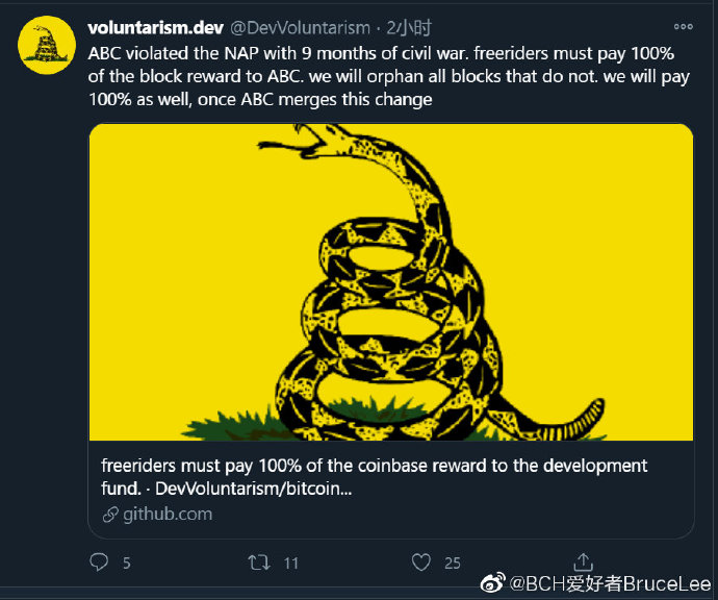
The Third Hard Fork War: The Onslaught on BCHA **Author:** Prof. Liu Chang-yong **Translator:** rymd Edward Sy Li **Published**: December 03, 2020 **Chinese version:**https://www.8btc.com/article/676377 From November 20, 2020 to December 02, 2020, BCHA suffered continuous hash rate attack from an attacker suspected to be a BCHN supporter, mainly in the form of empty block attack. Both the offensive and defensive sides have carried out multiple stages of adjustments in their strategies. Currently, it is still unsure whether the attack has ended. Regardless of the outcome of the attack, the BCHA offensive and defensive battles provide a good example for us to understand the PoW (Proof of Work) system and the problems in the development of decentralized cryptocurrency, which are worth studying and considering. **1. Three hard forks of BCH** On November 15, 2020, BCH has carried out another important hard fork. This was the third hard fork since the birth of BCH on August 01, 2017 and the BSV hard fork on November 15, 2018. The hark forks of BCH happened fundamentally due to the reason that different exploration directions would occur along the evolution of the decentralized crypto economy, just like the biological evolution. But hard fork has happened more frequently in BCH because decentralized cryptocurrency has yet to form an effective governance mechanism and BCH has a relatively higher degree of decentralization, more diversified development teams and key opinion leaders. In this case, it is relatively easier to fork when major differences appear. Compare to BCH, there are other public chains which have stronger ecological center such as ETH and TRX. There are also some other which have become more centralized such as BTC with Core as its central team and BSV with CSW’s team as its central team. Some even do not have development community, thus there is no hard fork in such public chains such as Doge and LTC. In 2017, BCH was forked from BTC as the result of the scaling debate (https://medium.com/21st-century-economist/the-bitcoin-scaling-debate-1a6b466c53f). In 2018, the BSV hard fork was caused by the failure of CSW’s team to seize power intentionally (**https://www.8btc.com/article/287572**). Both hard forks have been a protracted and fierce war. The hostilities and attacks even continue to this day. Compare to previous hard fork, the cause of the recent BCH hard fork was quite unexpected, the war was not as fierce as previous ones, and the impact was relatively small. However, the internal logics of decentralized crypto economy practiced and demonstrated during the hard fork are still very valuable. **2. The Reasons for The BCHA Hard Fork** The occurrence of BCHA hard fork was fundamentally due to the lack of an effective decentralized governance mechanism. The direct reason was that the original core development team of BCH, Bitcoin ABC, has used the code management rights to write the IFP (8% of the newly mined coins to be redistributed to an address controlled by ABC) code into the node software upgrade and announced that the upgrade will take place on November 15, regardless of the community disagreement and differences. The problem behind this was that BCH, which does not have a mature governance mechanism would cause ABC team to possess greater power while it is not good at governance and politics. And after leading the development for three years, the team has an arrogant mentality and no longer paying attention to the opinions of other developers, related companies, and other influential members. Besides, ABC team even has many complains. At the same time, after been through three years of bear market, ABC’s funding pressure was relatively high and the opportunity cost of focusing on BCH development and maintenance was very high. Due to some complaints and frictions, the relationship between ABC and the donors has deteriorated, which has led to the decrease of the donated funds. ABC originally had huge support in the ecosystem. The IFP opponents have also been trying to resolve this crisis through better communications to avoid split or division. Some proponents of IFP also advocated to implement the IFP on the premise of having a consensus in the community. But ABC severely lacks political experiences and capabilities, naively took the wrong step to push forward the IFP. This has not only caused the relationship with IFP opponents to break but also caused some IFP proponents to firmly oppose ABC and turn to support BCHN, including Jiang Zhuoer and myself. It is not totally wrong to say that the immature behavior of ABC directly led to the fork. After ABC wrote the immature IFP code into the node software and announced that the upgrade would take place on November 15, the hard fork became irretrievable because this IFP version was unacceptable to most people and it was irrevocable once the announcement has published. **3. Suggestions for A Harmonious Fork** With the awareness that the fork was inevitable, I published an article on August 27, *The Suggestion for Rational and Harmonious Fork of BCH* (**https://read.cash/@ProfLiu/the-suggestion-for-the-rational-and-harmonious-fork-of-bch-cca9fb96**) I thought that since the hard fork was inevitable, it should at least be carried out smoothly and the hard fork details should be decided as soon as possible to reduce the uncertainties and the consumption of mutual attacks. The hard fork of the decentralized ecosystem is inevitable, but the harmonious fork mechanism built through this hard fork is more important for an orderly evolution in the future. This is almost the same meaning as a peaceful presidential election is favorable instead of the bloodshed during the change of a government. I suggested that BCHN and ABC to put aside the most acute naming rights dispute, to first reach a consensus on carrying out a harmonious fork. Then, both could sit down and negotiate together to resolve the naming rights dispute. Once this has resolved, other following problems could be solved easily, the stability of the ecosystem and user rights protection could also be achieved. Some important members of the ecosystem agreed on this suggestion, but the two main parties involved in the dispute, BCHN and ABC firmly disagreed. They both think that each other is bad and should be removed from the community. Both parties have firm convictions which are unable to shake. Since a harmonious fork could not be achieved, the key then lied on the matter of resolving the naming rights properly to reduce the uncertainty and intensity of the dispute as well as to reduce the damages caused to the BCH ecosystem. So I suggested to Haipo Yang to list the trading of BCHN and BCHA futures and the one with higher price will get the ticker symbol “BCH”. At the end of September, CoinEx listed two futures trading pairs and announced the strategy of naming the higher bidder as “BCH”. At that time, the BCHA/ BCHN trading pair was about 0.17. As the trading started and other exchanges started to follow this strategy, the situation gradually became clear. The BCHA/BCHN trading pair reduced from 0.17 to 0.05, the ownership of the “BCH” ticker basically has resolved. Early of November, ABC announced that they would support and release the BCHN version. They were also willing to hand over the management right of the BCH official website, bitcoincash.org and rename the ABC chain as BCHA. The naming dispute was generally resolved before the hard fork took place. Now, the question is, could BCHA survive after the fork? **4. The Birth of BCHA** On November 15, the hard fork took place at block height 661648. BCHN has the higher price and with its higher supporting hash rate, the block 661647 was produced in 3 minutes. But the price of BCHA was only about one-tenth of BCHN’s price and the difficulty of both chains were the same when the fork happened. Therefore, mining BCHA would face 90% of losses. If no one would bear the losses to start mining the first few dozens of BCHA blocks, the difficulty would never be adjusted to normal level and BCHA chain would die if it could not produce any blocks. After 1 hour and 40 minutes, the very first block on the height of 661648 was produced on BCHA chain. The miner left message on coinbase “Very Good Mining Pool/ABC/”. Seemingly a foreign miner expressed thanks to Chinese mining pool. Haipo Yang’s ViaBTC mining pool has announced to support mining on BCHA chain, the thanks might be given to him. BCHA took about 6 days before it went back to normal block time. Normally, 100 blocks from block 661647 to block 661747 would take about 17 hours but BCHA took more than 5 days to readjust the difficulty. The founding miner has mined the most difficult and most loss-making 22 blocks from 661648 to 661670, it was a big expanse. From block 661671 onwards, the anonymous founding miner stopped mining and another miner with the coinbase text “/ViaBTC/Mined by bucher/_” continued to start mining. **5. Suggestions for Peaceful Development** From the early of August to November 20, due to the uncertainty of the hard fork and the community friction, the price of BCH continued to drop, and the BCH/BTC trading pair continued to break new lows. From 0.0282 on August 02 dropped to the new lowest of 0.0135 on November 18, half of its earlier price. Along with the ability of BCHA to produce blocks normally, the dust seems to be settled. After eliminating mutual interference, both parties should start to build on their respective chain as soon as possible. For this reason, I published *Suggestions After the Fork of BCH* (**https://read.cash/@ProfLiu/suggestions-after-the-fork-of-bch-bch-a2a853a6**) on November 19. The suggestions include: i. Both sides should stop any further hostilities and start to develop independently. ii. After completing the matters that have reached consensus in the next upgrade, BCH can change the hard fork period from six months to three years to maintain the stability of the ecosystem. iii. The market cap of BCHA is relatively small, it can continue with its 6 months hard fork period to experiment governance mechanisms and other improvements. iv. As for the successful improvement of the experiments run on BCHA chain, BCH can consider introducing them in the hard fork upgrade 3 years later. These suggestions did not receive any response from both parties. In fact, an attack was brewing. **6. Empty Block Attack and Dust Attack** Soon after the BCHA started to have more stable mining process and block time, the attack against BCHA began on November 20. The attacker mined an empty block 661684 at 22:45, which only contains coinbase reward without any other transactions in the block. At the meantime time, the attacker tried to load up the memory pool by sending a large amount of spam transactions of around 0.002 BCHA. The attacker did not use the PoW common 51% attack to reorganize the BCHA chain because BCH has started to adopt the reorganization protection strategy since the defensive battle against BSV. The reorganization of more than 10 blocks will not be accepted by nodes. Thus, if exchanges require more than 10 confirmations, the double-spending attack will not succeed. At that time, this strategy directly repelled the 51% attack from CA and CSW. The attacker adopted empty block attack + dust attack. By continuously mining empty blocks, normal transactions can never be packed into blocks, this would destroy the normal transaction function of BCHA. While the dust transactions continued to congest the node’s memory pool and further hinder normal fund transfers and block productions. The attacker left a coinbase text message, “Nov 25th 2020/”, which then changed to “Nov 25th 2020: bcha dump | voluntarism.dev”. This attack appeared to be based on voluntarism and it threatened the market that a big BCHA dump would happen on November 25. After 15 consecutive empty blocks were mined, a defensive measure started. At 03:31 on November 21, block 661700 managed to include 18228 transactions. It has a block size of 8M and total mining fee of 0.3 BCHA with coinbase text message “/ViaBTC/Mined by goatpharmer/”. **7. Suggestions to Stop the Attack** From the November 20 to 24, both offensive and defensive sides were deadlocked. The attacking side mined most of the blocks, but the defensive side also try to keep up. Each block mined by the defensive side was 8M with nearly 20,000 transactions were included. In my opinion, empty block attack and dust attack are unprofitable irrational behaviors, and they are difficult to succeed. On November 24, I published suggestions, *Stop Attacking BCHA* on read.cash. The main points are: i. The attacking side consumes more resources than the defending side, the defending side only needs to produce a block once every two hours. ii. The dust attack on each block would help the defending side to earn a transaction fee of about 20 yuan. iii. Currently, there is no fierce community confrontation like the BSV fork, so there is no need to launch an attack. iv. In the absence of community confrontation, many people decided to hold the coins from both sides. The attack will cause everyone to loss, this is an unpopular action. v. As long as there is supporting hash rate to mine and produce blocks on the BCHA chain every two hours, BCHA will not be destroyed and the attack will be futile. vi. ABC team to continue developing BCHA would act as a reference to BCH. In this case, it is better than forcing them to abandon the development or make them switch to a closed development environment such as BSV. vii. If BCHA can really be destroyed, it is indirectly telling supporters of Core and BSV that BCH can also be destroyed in the same way. After the suggestions was published, the empty block attack was stopped from block 662116 onwards on November 25 at 04:36. The 4M blocks mined by the attacker and 8M blocks mined by ViaBTC were clearing the spam transactions in the memory pool. Other mining pools such as Mining-Dutch also joined the normal mining operation. I once thought that the attacker regained his rationality, but on November 25 at 21:23, from block 662135 onwards, empty block attack and dust attack were launched once again, with the coinbase text “Nov 27th 2020: run the numbers | voluntarism.dev”. It revealed an identity “voluntarism.dev”. The attacker then changed the coinbase text to Chinese “不管黑哈希白哈希,能维护矿工利益的就是好哈希” which literally means “Regardless of black hash or white hash, it is a good hash as long as it can protect the interests of miners”. This is a twist of the cat theory that Jiang Zhuoer usually mentioned. But this behavior does not conform to Jiang Zhuoer’s rational habits. Jiang Zhuoer himself has stated clearly that he supports a harmonious fork. Therefore, this coinbase message seems to be a bit intentional. **8. Orphaned Block Attack** An orphaned block attack is an attack where when the attacker receives a block with normally packed transactions, he then uses higher hash rate to immediately produce 2 consecutive empty blocks to isolate the normal block. This is a smaller reorganization attack or 51% attack which is not aimed to double spend but to obstruct the normal process of packing the transactions. After the attack resumed, ViaBTC continued to produce blocks and normal transactions were managed to be packed within 3 to 4 hours. On November 27, the attacker “voluntarism.dev” tweeted a threatening message saying that BCHA blocks mined by everyone would be orphaned unless they pay 100% of the block reward to the ABC IFP address. He also provided the code and taught miners how to increase the block reward ratio from 8% to 100%. A Weibo blogger, Bruce lee reposted this threat message and believed that when facing this kind of orphaned block threat, it is impossible that miners with more powerful hash rate would sacrifice the profit to protect BCHA. ABC might need to change its algorithm or even change to PoS. On November 28, the orphaned block attack occurred. After ViaBTC mined block 662397, voluntarism.dev mined block 662397, 662398 and 662399 rapidly and voided block 662397 produced by ViaBTC. However, the defending side has prepared for this. An anonymous miner then deployed higher hash rate to mine 12 consecutive blocks following the block 662397 previously mined by ViaBTC. This has isolated the 3 blocks mined by the attacker and at the same time activated the reorganization protection since more than 10 blocks was mined. The anonymous defensive miner left the coinbase text ““/voluntarism.dev, aka asicseer.com and u/ugtarmas, is a bully/”, calling the attacker a “bully”. This offensive and defensive battle ended with the defeat of the attacker voluntarism.dev. Some people from the BCH community think that asicseer.com mining pool is the one who behind voluntarism.dev. The CEO of asicseer.com is Alexander Levin Jr. and his reddit id is u/ugtarmas. **9. The Defensive Team** After the orphaned block attack failed to bring obvious result, voluntarism.dev temporarily gave up this high-cost attack and continued to use empty block attack and dust attack instead. The non-stop attack especially orphaned block attack has evoked antipathy of some people in the mining industry. On November 28 and 29, at least 5 mining pools or independent miners including anonymous defensive miners, ViaBTC and Mining-Dutch participated in the defense of BCHA. Anonymous defensive miners only packed normal transactions except dust attack transactions. The normal block size was within 100K with coinbase message calling voluntarism.dev a “bully”, such as block 662406. ViaBTC mining pool packed 8M blocks, about 20,000 transactions which were mined by different miners. For example, block 662453 was produced by miner mminer55. Mining-Dutch mining pool packed 2M blocks such as block 662454. BCHA.pro mining pool packed 1M blocks such as block 662464. Another anonymous mining pool packed 32M blocks, each block containing more than 75,000 transactions with network fee as high as 1.5 BCHA. It is the main force to eliminate dust transactions, such as block 662450. On November 29 at 11:00, the empty block attack has stopped, and blocks were mined normally starting from block height 662447. At 18:00, dust transactions in the memory pool were all cleared at block height 662462. The battle has come to an end once again. **10. The “Price” of Freedom** At 07:57 on November 30, block height 662589, empty block attack and dust attack started again. This time with coinbase message “e_voluntarism.dev:6174 x/x | the price of freedom”. This message indicates that: i. The attacker wants to totally destroy BCHA. ii. The attacker has paid a great price for the continuous attack. iii. The motivation of the attacker is based on the belief in liberalism or anarchism and he opposes to draw governance fund from block reward. In fact, the PoW ecosystem has long established the practice of drawing funds from the block reward. DASH and ZEC have been running on this model for many years and no one has launched any hash war. The attacker who attacked BCHA was basically due to the hatred generated in the process of ABC firmly pushes for IFP implementation. At this point, the attack has shown obvious irrational characteristics and it became an action of belief and hatred, more of hatred. This kind of attack itself violates the spirit of liberalism as it uses violence to force consistency and kill the forked chain. With the belief of “The Price of Freedom”, the attacker once again adjusted attacking strategy and implemented larger hash rate of “empty block attack + dust attack + orphaned block attack”: i. The attacker first attacked with larger hash rate and high-cost empty blocks to keep the difficulty at high level to drive away normal miners. For example, from block 662721 to block 662740, 20 blocks were mined in 34 minutes. The average block time interval was only 1:47 minutes. ii. After the difficulty has increased, the attacker stopped mining and wait for 2 to 3 hours, then started to mine with large hash rate again and adjusted the difficulty. iii. If there is a normal packed block, larger hash rate would be used to launch the 51% attack to orphan the block. On December 01 afternoon, 6 blocks produced by ViaBTC were orphaned. Besides, voluntarism.dev also bought large volume of FCH on CoinEx to increase the price of FCH. The purpose was to attract Mining-Dutch mining pool which mines FCH and BCHA simultaneously to switch from BCHA to FCH. The price of FCH increased by 80% that day. The attacker did not hesitate to attack even with great losses, how should the defender respond? **11. Hash Rate Vs Consensus** On December 01, due to the powerful hash rate attack from the attacker, the BCHA block on each blockchain explorer remained at block height 662658 which mined by the attacker. On December 02, ABC urgently released software version 0.22.8, set a checkpoint, and discarded the attacker’s empty block 662687. Then, the defensive hash rate produced a new block 662687 and formed a defensive blockchain based on this block. But at the time, blockchair.com, Viawallet and other main blockchain explorers which supporting BCHA were all stuck at block height 662658 mined by the attacker. Exchanges that listed BCHA also did not switch to the defensive blockchain. CoinEx announced that the deposit and withdraw services would be temporary suspended. Seems like the attacker was about to succeed. On December 02, e_voluntarism.dev tweeted the harsh truce conditions on Twitter that ABC must not use: i. the SHA256 algorithm. ii. the string “bitcoin” in the coin name. iii. the string “bch” in the ticker symbol Except for the third condition which is still understandable, the first two are very excessive. In fact, there are dozens, or hundreds of coins named using “bitcoin” and using the SHA256 algorithm in the market. In the case that ABC decided to give up the BCH ticker before the hard fork and handed over the management of the official website, this request was completely a gesture of surrender. However, it does not matter whether the attacker’s chain is longer, or it appears earlier, the attacker is after all an attacker. Even if ABC lost most of its supporters in the BCH community, it still has its own supporters. If ABC and its supporters do not give up, blockchain explorers, exchanges and mining pools would believe that the future of this coin lies in the hand of ABC and its supporters, not attackers. On December 02 afternoon, blockchair.com, Viawallet and other main blockchain explorers which supporting BCHA have successfully updated their nodes, from the attacker’s block 662687 updated to the defensive blockchain. The BCHA normal nodes can invalidate the first block of the abandoned attack chain through invalidateblock or parkblock commands and then synchronize to the defensive chain to resume normal operations. The hash of the invalid block is 00000000000000000709b858a6a0c8610e604e77072ef4407763afb0780ce712. At the time of publishing this article, the empty block from the attacker did not reappear. Many steadfast supporters of PoW think that BCHA does not abide by the longest chain rule and the development is centralized, they mocked it as “Prove of Developer”. But if there is someone developing and maintaining BCHA, it has supporting hash rate, supporters, blockchain explorers, exchanges and other infrastructures, hash rate can hardly destroy or kill a decentralized cryptocurrency. Hash rate cannot destroy consensus. **12. The Outlook of The Offensive and Defensive Warfare** Overall, this warfare is unnecessary because the naming dispute has been resolved before the fork. ABC gave up the BCH ticker, even handed over the management of the official website. This is totally different from the fierce competition happened between both sides during the BSV fork in 2018. The overall loss of this offensive and defensive warfare was also not so great, this was determined by the nature of the attack. The BSV fork in 2018 was due to CSW threatened to launch 51% reorganization attack on BCH. Both offensive and defensive sides have accumulated a large amount of hash rate which far exceeded the income produced, the total consumption daily was more than one million yuan. This has become a heavy blow to the entire market in the cold winter of 2018. In this battle, both sides generally maintained their normal hash rate to produce blocks, large amount of hash rate were only used when the orphaned block attack was launched and the price of BCHA did not drop significantly. Therefore, there was no great loss in terms of mining revenue. This was also the reason why the battle could continue. The offensive and defensive model in this warfare determined that the attacker was at a significant disadvantage in terms of economic benefits. This is the huge difference compared to the 2018 fork. In 2018, to prevent BCH from 51% reorganization attack, the defensive side needed to maintain large amount of hash rate and continued to wear out. While the attacker did not need to attack all the time, but they could launch attack any time. It was like the defender was in a passive position while the attacker had the initiative advantage. In this warfare, the reorganization protection eliminates the threat of 51% reorganization attack, the attacker could only adopt the empty block attack, dust attack and orphaned block attack. The situation has changed, the attacker must pack empty blocks and maintain dust transactions in the memory pool at the same time whereas the defender only needed to pack a big block once in few hours to include large volume of transactions and at the same time earned the transaction fees. Therefore, this time the attacker was in the passive position and the defender had the initiative advantage. To prevent the defenders from producing blocks, the attacker must also increase the hash rate which would result in mining with great loss. This was a method of self-damaging while trying to hurt people. This kind of asymmetric warfare was not favorable to the attacker and would continue to consume the attacker’s resources. Even though the attacker irrationally did not hesitate to attack at a great expense due to hatred, the defenders could still discard the attacker’s chain based on consensus or they could adopt some other temporary measures to resist hash rate attack. After December 02, the attacker stopped the hash rate attack but continued to dump BCHA in exchanges and threatened publicly on twitter that the dumping would happen continuously. Under the circumstances where the price of BCH/ BCHA was close to 20:1, this was a low-cost defense advantage for the defensive side, so it was not a serious threat. Because BCHA has a core development team, firm supporters, and its own consensus community, furthermore, it was listed on many popular exchanges, which has huge potential market. If the price is low enough, there will be large amount of buying orders and miners can make profit from it which in turn will attract more honest miners to mine this chain. Hence, as long as ABC does not give up, its supporters do not give up, BCHA cannot be destroyed by hash rate. This is the huge difference between the information world and the physical world. In the physical economy, one can completely kill the enemy through physical elimination while in the information world one cannot kill the opponent through hash rate. A true victory is to create value in the market to obtain greater consensus. **13. The Hard Fork War and The Evolution of Cryptocurrency** The decentralized cryptocurrency can be considered as an innovative experiment that is constantly evolving. From the scaling hard fork in 2017 to the BSV fork in 2018 then to the recent warfare, all three forks have revealed the important issues of decentralized cryptocurrencies. The scaling hard fork in 2017 exposed a main issue which is the governance issue of the decentralized ecosystem. This issue has not been solved and it keeps appearing in a new form. While the 2018 fork showed that it is difficult for the decentralized community to resist organized centralized attacks. This time, the fork was directly caused by the exploration of a new governance model (IFP). The fork in 2018 also showed another important issue, which is, does decentralized cryptocurrency need to evolve constantly or should it return to the classic to maintain stability? Most supporters of CSW, especially developers, are attracted by CSW’s idea of returning to the classic. The recent warfare also showed a deeper question, which is, should the minority survive? I mentioned this in both wars in 2016 and 2018. I think that since it is an innovative field, it is difficult to determine the exact path to success. The major and irreconcilable differences should be resolved by forking. Minorities after the fork should survive to retain more possibilities of success. Regrettably, all three forks were full of shouts and actions to destroy the minority. Before this, it was BTC supporters and BSV who wanted to kill BCH, this time it is BCH supporters who wanted to kill BCHA. During and after the BSV fork, the BCH community generally maintained a tolerant attitude, it has been on the defensive position and never launched any hash rate attack on the BSV chain. It is confusing why is it so harsh on BCHA this time. **14. The Value and Inspiration of The Offensive and Defensive Warfare** When studying the two hard forks in the past, the governance issue and the survival of minority issue have become my focus. In the long run, I think this is the key to the success of the decentralized cryptocurrency. If we cannot have an effective governance mechanism while maintaining decentralization, there will be a long way to go. For this reason, I started to look for solutions in 2017 and got the verifications and inspirations from the evolution of BCH. In the Freecash (FCH) system which launched on January 01, 2020, the successful experiences verified in BTC, BCH and other cryptocurrencies were inherited. Some modifications and new designs were also made. In terms of governance mechanism, we learned lessons from the prisoner’s dilemma of ABC and donors and divided the governance into two levels. At the first level, the governance funds must be generated publicly rather than relying on donations. The second level is to explore a decentralized governance fund operation model to prevent public funds from causing the centralization of the ecosystem. The experiment has achieved initial success. In terms of consensus differences and minority survival issue, we established the principle of forking freely. The DAA difficulty adjustment mechanism and reorganization protection of BCH also have been inherited so the minority can survive after the fork. As a new public chain that adopted SHA256 algorithm, FCH is definitely a minority since its inception. For this reason, FCH has made more modifications to the Bitcoin framework. Interestingly, these modifications and related deductions were rehearsed and verified in the recent BCHA warfare. For example, shorten the block time to 1 minute. It makes the difficulty adjustment speed of FCH ten times faster than BCH. Thus: i. The difficulty adjustment of BCHA needs 5 days after the fork to become normal again, while FCH only needs about half a day to do so in the same situation. ii. When facing an empty block attack or difficulty bomb attack, the time required for normal block generation and difficulty recovery as well as the defensive hash rate requirement will reduce to one-tenth. Another example is to extend the mining output maturity time. In the recent warfare, the attacker has the option of dumping all the BCHA mined to the market. However, FCH has designed a 10-days mining output maturity period and a 100-days governance fund maturity period. This will cause: i. the attacker’s risk and attrition to increase greatly. ii. the cost of killing the minority by the majority at the time of forking to increase greatly. This warfare has rehearsed the situations considered at the time of designing FCH such as empty block attack, dust attack, orphaned block attack and others. The attack is still not over, it is possible that there are other attacking and defending strategies that were not thought of before. Besides, in the information world, the success of a decentralized ecosystem ultimately depends on a group of people who are having the same dream and willing to work hard towards it. As long as this kind of consensus does not perish, the ecosystem will continue to live on. Building a consensus that can create value, share value, and benefit society is the source of power for survival and development. Our perception should rise from world currency to free consensus.