Elephant In the Classroom
`Hi, I'm Michael from the Philippines 15 years-old, username Parallel . This is my first formal article, after three days of researching, thinking, and writing in a scratch paper finally I finished it. 😄 I hope you will like it.`
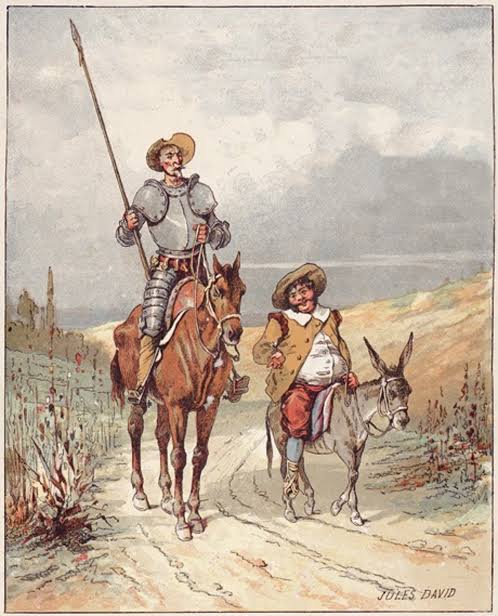
**I**n the medieval age, chivalric codes have put society into peaceful harmony. However, as time passes and the code of conduct is forgotten, that is the day when Alonso Quixano left his village, under the name of "Don Quixote de la Mancha," to set on an adventure of bringing justice, undoing the wrongs, and reviving chivalry in the world.
Living in a contemporary world, the code of respect is no longer the privilege of many, rather a demand of any domi- nance to put everything under subordination. Policies. nowadays, are being imposed like fear of getting punished.
**Case**:
On August 17 Last year, Bicol Central Academy(BCA), a private school at Libmanan, Camarines Sur, had an event that required the senior high students to be in their business attire. As per instructed of the 'no-bag policy,' there were still belongings from students which were then confiscated and worst, torched down in the school quadrangle.
As seen on a viral video on social media, BCA school administrator Alexander James Jaucian was the one who initiated the bag burning. He even called out the students "stupid" for not following instructions.
This sparked an outrage from the netizens. Some Bicol youth groups even denounced the administration of the private school with a signature campaign of Manifesto of Unity.
Moreover, the case of BCA is just one of the manifestations of unkind culture in the education system of our country. It just shows that there's a poor observance of the Republic Act No. 7610 or "Special Protection of Child Against Abuse Exploitation and Discrimination Act."
Regardless of the Child Protection Policy, according to a study on violence against children in the Philippines conducted by the Council for the Welfare of Children (CWC) and the United Nations Children's Emergency Fund (UNICEF), 14.3 per cent of physical violence usually happened at school, while eight in 10 children and young people have experienced some form
***"The truth is, young people may sometimes act as irrational. But what matters the most is that adults and authorities do not turn to irrational means when correcting their manners.***
of violence in their lifetime at home.
Corporal punishment has become a method of discipline throughout generations. In contrast to Pavlov's Classical Conditioning, it signals to the child that a way to correct misbehavior is to inflict physical and non- physical forms of punishment.
According to UNICEF, corporal punishment is a common phenomenon in the daily life of South Asian children, for it is necessary to their upbringing to facilitate learning, and to instill the discipline.
However for what's deemed to be the purpose might be the root source of certain abuse. According to Dr. Donald Greydanus a Michigan State University professor of Pediatrics and Human Development, corporal punishment may lead to cases of mental illness. Such punishment also affects the academic performance of a child. increasing the tendency of school avoidance. school drop-out, and other evidence of negative high risk adolescent behavior.
As Dr. Greydanus stated, it encourages children to resort to violence, as they see their authority figures doing it. Thus, it just creates a vicious cycle of abuse.
Indeed, there's always a consequence in every choice we make. The students of Bicol Central Academy clearly violated a school policy, but then again, the incident could have ended calmly, if the school officials just evoked rationalization over pride.
If only the private school provided the students the right due process, for one of the stu- dents explained that many of them needed to bring bags as they did not live near the cam- pus, had classes in the afternoon, and also needed a wardrobe change.
No-bag policy is not really a new practice after all. In fact, the University of Arizona has re- instituted this policy since January 2018 as a safety measure that prevents theft and reduces the risk of accidental or intentional harm to students and visitors of the campus.
For safety measures, it is a must to uphold protocols inside a campus. But to prohibit com- mon tools for necessities, a policy shouldn't disrupt any law that protects the rights of the people. Hence, there are still alternatives to maintain the safekeeping like maximizing the civil security or simply by bag checking.
Besides, any kind of corporal punishment is violence against children. As human beings, children should also be respected, as they also deserve the right to dignity and bodily integrity.
Instead of punishing their behavior, why don't we show them the right way? By teaching them how to think, instead of what to think.
The truth is, young people may sometimes act as irrational. But what matters the most is that adults and authorities do not turn to irrational means when correcting their manners.
***When everything is going wrong and corrupted, the hope lies on the youth as future change agents like Don Quixote. For that, it's the role of the school to nurture and equip them with the most powerful weapon o change the world: education.***
*If you like it please subscribe and hit the like button. 😇 Thank You*!
Expressing
Express the idea when you want someone to do something in the present or future: I don't want you to to meet him anymore.
I'd rather you hadn't met him anymore.
I'd rather you didn't meet him anymore.
I wish you met him anymore.
I wish you hadn't met him anymore.
When we need to express the idea when you want someone to do something in the present or future we usually use the construction [would rather + subject + Past Simple]. Other answers do not relate to the meaning.
If Sandra ___ **(to take) a painkiller, she** __ (to feel) better soon.
takes/feels
will take/will feel
will take/feels
takes/will feel
When we speak about probable situations in the present or future we use Conditional 1: If-clause (if + Present Simple) - Main Clause (future/modal + present without 'to')
If I _________ **(to be) Fred I** _______ (to think) several times before making such a tattoo.
were/would think
would be/thought
would be/would think
were/thought
When we speak about imaginary situations which differ from real facts in the present we use Conditional 2: If-clause (if + Past Simple) - Main Clause (would/could + present without 'to'). The meaning of this sentence: in reality Fred made a very strange tattoo.
If I __ **(to find) this book, I** __(to buy) it for you.
find/buy
will find/will buy
find/will buy
will find/buy
When we speak about probable situations in the present or future we use Conditional 1: If-clause (if + Present Simple) - Main Clause (future/modal + present without 'to')
Express disappointment with the present situation: Sarah has to work 6 days a week. She doesn't like it.
Sarah would work 6 days a week if she liked it.
Sarah wishes she didn't have to work 6 days a week.
If only Sarah had to work 6 days a week.
Sarah would work 6 days a week if she had to.
To express disappointment with the present situation we usually use the construction [ I + wish + Past Simple]. Other answers do not relate to the meaning.

Kabanata 3:Grammar Test
Pronouns....
I'm so sorry, but I can do _______ in this situation.
everything
something
anything
nothing
All the given in the test pronouns - everything, something, anything, nothing are indefinite pronouns that refer to things.They all can be used in affirmative sentences: (1) the indefinite pronouns with every- are used to describe a complete quantity, (2) the indefinite pronouns with some- are used to describe an indefinite quantity; (3) the indefinite pronouns with no- are used to describe an absence and they are often used in affirmative sentences with a negative meaning, but these are nevertheless not negative sentences because they are lacking the word not; (4) ‘any’ and the indefinite pronouns formed with it can also be used in affirmative sentences with a meaning that is close to every-: whichever person, whichever place, which everything, etc.The test sentence is affirmative with a negative meaning: I'm so sorry, but I can do _______ in this situation. We understand it from the given context ‘I’m sorry, but… in this situation.’ The adjective ‘sorry’means ‘feeling sadness, sympathy, or disappointment, especially because something unpleasant has happened or been done; feeling sad or distressed through sympathy with someone else’s misfortune’: I’m sorry you’re ill – I hope you get well soon.; I’m sorry to have heard that news about your husband. So, in the test sentence the speaker feels sad or distressed through sympathy with someone’s misfortune in that situation because he or she realizes that nothing can be done - he or she cannot do anything to help or save somebody. He or she is helpless – unable to do anything to help yourself or anyone else. We use ‘nothing’ to refer to an absence of things in affirmative sentences: There is nothing to eat.; I know nothing about it. Thus, we choose ANSWER 4: nothing.

Grammar Test: Part 2-Ft. PRONOUNS
The classroom is empty. I can see ______ here.
somebody
anybody
everybody
**nobody**
Somebody, anyone, everybody, everything, etc. are indefinite pronouns. All the given in the test ANSWERS refer to people, because they have the ending –body. In the first sentence of the test we are informed that ‘The classroom is empty.’. And we understand that there is nobody in the classroom. But the next test sentence, where we should fill the gap, has no negative particle ‘not’: ‘I can see ____ **here.’ Therefore,we choose ANSWER 4 – to use ‘nobody’ to refer to an absence of people. We do not use another negative in a clause with ‘nobody’: Nobody came.; Nothing happened.If the second sentence had the negative particle ‘not’: I cannot see** ____ here.’, we would choose ANSWER 2 (anybody). We should know that ‘nobody’ is stronger and more definite than ‘not … anybody’: ‘I can see nobody.’ is stronger than ‘I cannot see anybody.).
Grammar Test: Pronouns
**Jerry didn't do _________ wrong.**
something
nothing
anything
everything
`Something, anybody, everyone, etc. are indefinite pronouns. We use -body, -one, -thing, -where to refer to people, places and things in a general way without saying exactly who or what they are. All the indefinite pronouns that are given in the test ANSWERS end in –thing (something, nothing, anything, everything), thus, they all refer to things.Indefinite pronouns using some are used in affirmative sentences to describe an indefinite quantity, the indefinite pronouns with every are used in affirmative sentences to describe a complete quantity. And the pronouns with no are used affirmative sentences to describe an absence. Indefinite pronouns with no are often used in affirmative sentences with a negative meaning, but these are nevertheless not negative sentences because they are lacking the word not. Any and the indefinite pronouns formed with it can also be used in affirmative sentences with a meaning that is close to every: whichever person, whichever place, whichever thing, etc.Negative sentences can only be formed with the indefinite pronouns that include any. The test sentence is a negative one: Jerry didn't do….. wrong. Thus, we can choose only ANSWER 3: anything.`
Future Tense Part IV
This time next month Elizabeth ________ (still / to work) in Spain.
will still have worked
will still work
still works
will still be working
We use the Future Continuous to talk about unfinished actions which will be in progress in the future.
_______ (you / to stay) here until we come?
Do you stay
Are you going to stay
Will you have stayed
Will you be staying
We use 'be going to' for intentions and plans. This expression refers to the present situation: we know the circumstances and according to them we make the intention.
I don't care what it means to you but you ______ (to throw) this old table away now.
throw
are going to throw
will throw
are to throw
We use 'be to' to express strong obligation in the future. This construction is very similar to the meaning of 'must'.
Future Tense: Part 3
_____ **(you / to come) to us to celebrate the date? We** ______ (to be married) for 5 years on April 3rd.
Do you come / will have been married
Will you come / will be married
Will you come / will have been married
Will you come / are going to be married
1. When we make predictions or simple statements about the future we use the Future Simple. 2. We use the Future Perfect to talk about actions which will be completed in the future up to the certain time point: when the 3rd of April comes it would mean that 5 years have passed since their wedding.
_____ **(you / to finish) working when I** ____ (to come) to pick you up?
Will you have finished / come
Will you finish / come
Will you have finished / will come
Have you finished / will come
1. We use the Future Perfect to talk about actions which will be completed in the future up to the certain time point. 2. When we make predictions or simple statements about the future we use the Future Simple.
Future Tense Part 2
Future Tense: This time tomorrow I ______ **(to cook) while Jim** ______ (to clean) the car.
will be cooking / will be cleaning
will cook / will clean
will be cooking / will clean
will cook / will be cleaning
We use the Future Continuous to emphasize that the action will be in progress in the future. Here the Future Continuous shows 2 simultaneous actions.
Future Tense: According to the schedule, we _____ **(to depart) from London at 10 o'clock in the morning and** __ **(to arrive) in Oslo at 3 p.m.** _____ (you / to meet) us?
will depart / will arrive / Are you meeting
depart / arrive / Do you meet
will depart / will arrive / Will you meet
depart / arrive / Will you meet
1,2. When we talk about scheduled events (planes, trains, etc.) we use the Present Simple. 3. When we make predictions or simple statements about the future we use the Future Simple.
Future Tense-Grammar Test
I'm hungry. - Well, I ____(to order) a pizza for you.
will order
am ordering
order
am going to order
We use the Future Simple Tense when we have no plan or decision before we speak. We make it at the time of speaking.
I suppose that Mary _______ (to quit) the project soon.
is going to quit
is to quit
is quitting
quits
We use 'be going' and 'will' for guesses and predictions.
By the time Chris ______ **(to arrive) we** ______ (to finish) watching the film.
arrives / will have finished
arrives / will finish
will have arrived / finish
will arrive / finish
We use the Future Perfect to express the idea that one action will be completed before the second one in the future. Here: first we will stop watching the film and after that he will arrive.
Grammar Exam: Ft. Modal Verbs
**You are sometimes totally unbearable! You _____________ be more tolerant.**
may
might
should
have to
***We use the modal verb 'should' when we give advice or recommend something.***
**Pupils __________ wear a school uniform in some countries.**
can
may
have to
might
***We use the modal verb 'have to' when it is not our idea to do something, when we are forced to do something by somebody or by circumstances.***
**I'm very busy today. I ____________________ stay at work till night.**
have to
may
might
can
***We use the modal verb 'have to' when it is not our idea to do something, when we are forced to do something by somebody or by circumstances.***
 @Parallel