Secondary Transport Process
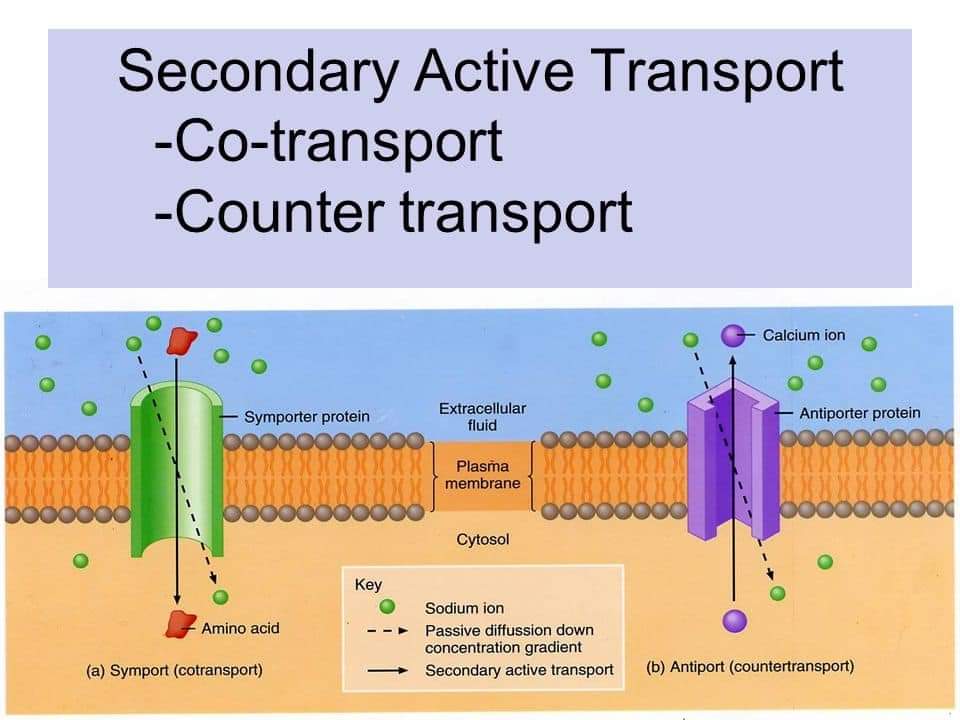
Secondary Active Transport আমরা Primary active transport সম্পর্কে জানি যে এটা movement of substances across the cell membrane against chemical/electrical gradient with the active expenditure of energy deriving from ATP, by the help of carrier protein. কিন্তু secondary active transport এ এনার্জি derived করে primary active transport এর concentration or electrical gradient থেকে। So, ▶️Definition: The movement of substances across the cell membrane ✅ against chemical or electrical gradient ✅ with the energy which is ✅ derived secondarily from concentration or electrical gradient produced by primary active transport, ✅ by the help of carrier protein is called secondary active transport. ▶️Types/subdivision: Two types- 1️⃣ Co-transport 2️⃣ Counter-transport ▶️ Movement occurs: Against concentration or electrical gradient ▶️ Energy requirement: Required ▶️ Presence of membrane: May or may not be present ▶️ Direction of movement: Can operate bi-directionally ▶️ Role of electrochemical gradient: Depends on them ▶️ Role of carrier protein: Doesn't give energy 1️⃣Co-transport: Secondary active transport of two substances in the same direction is called secondary active co-transport. 🌟Example: 🔘 Na+-Glucose co-transport: It is important in transporting glucose across renal and intestinal epithelial cells. 🔘 Na+-Amino acid co-transport: It also occurs through renal and intestinal epithelial cells to promote the absorption of these substances into the blood. 2️⃣Counter-transport: Secondary active transport of two substances in the opposite direction is called the secondary active counter-transport. 🌟Example: 🔘Na+-Ca2+ counter-transport: It occurs through almost all cell membranes where Na+ ions move interiorly and Ca2+ ions move exteriorly. 🔘Na+-H+ counter-transport: It occurs in several tissues where Na+ ions move interiorly and H+ ions move exteriorly. ⁉️ Co-transport and counter-transport are also called Symport and Antiport respectively. Thank you.
No comments yet