 @Mrcosmic
more from that month
@Mrcosmic
more from that month
What STON.fi Revealed in Hong Kong — And Why It Matters
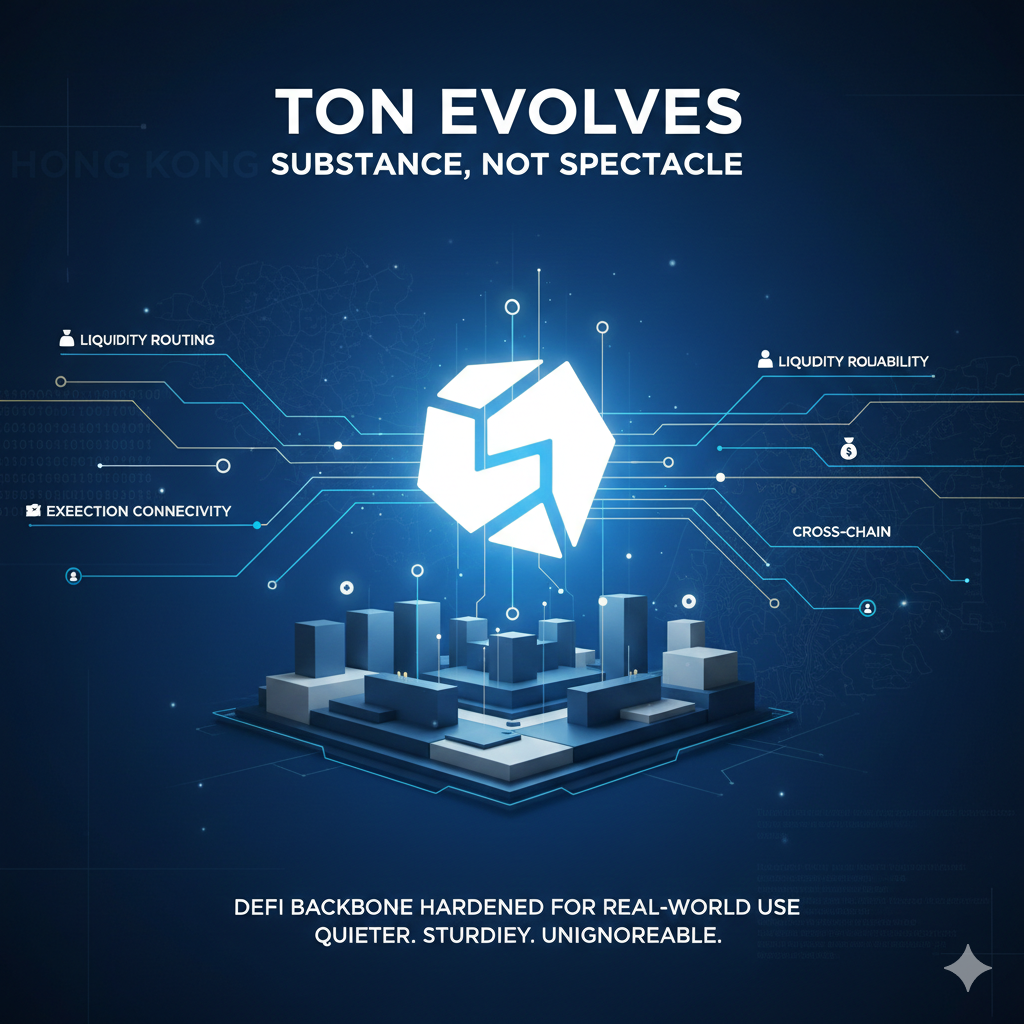
While many crypto teams arrived in Hong Kong focused on announcements and visibility, STON.fi took a different approach. At Consensus and Hack Seasons, Andrey Fedorov, Chief Marketing and Business Development Officer at STON.fi, sat down with CoinEdition to discuss something far more substantial than partnerships or projections. The conversation centered on infrastructure specifically, how TON’s DeFi foundation is being strengthened for large-scale, real-world usage. The takeaway was not promotional. It was strategic. Why Hong Kong — and Why Now Hong Kong has re-emerged as one of the most important hubs for digital asset infrastructure discussions. Capital allocators, protocol designers, and application builders converge there not for spectacle, but for substance. Critical decisions about the next phase of Web3 are increasingly shaped in rooms like these. Consensus gathered long-term thinkers mapping the future of blockchain infrastructure. Hack Seasons brought together developers working through implementation challenges in real time. The contrast is important: vision meets execution. What becomes clear when listening to both groups is that TON is not attempting to replicate Ethereum’s trajectory. Its starting position is fundamentally different. Most blockchains are still competing for user adoption. TON already benefits from Telegram’s distribution, with access to hundreds of millions of users. The question is no longer how to attract users, but it is whether the infrastructure can support them when they arrive. That is the strategic challenge STON.fi is addressing. From TON-Only to TON-Connected STON.fi is evolving beyond being a DEX optimized solely for internal TON liquidity. The protocol is now focused on building robust cross-chain connectivity that enables capital to move efficiently between TON and other ecosystems. This is not about superficial bridging solutions. It is about production-grade infrastructure that allows liquidity to flow in both directions with minimal friction. TON holds significant user activity and capital within its ecosystem. Other networks hold distinct assets and liquidity opportunities. Today, these ecosystems remain relatively siloed. STON.fi’s objective is to make interaction between them seamless. The long-term goal is simple: users should not need to think about networks, switching chains, or executing multiple approval steps. Access should feel native and unified. The philosophy underpinning this strategy is pragmatic. TON does not need to absorb every ecosystem. It needs to connect to them intelligently and reliably. External liquidity should be able to enter TON efficiently. TON-native liquidity should be able to access external opportunities when appropriate. The infrastructure enabling this must be stable, secure, and capable of handling meaningful volume. Execution quality matters more than speed to market. Partnerships with Operational Value In an industry where “partnership” often signals marketing alignment, STON.fi’s approach is more utilitarian: does the integration solve a current operational need? Teams integrating with STON.fi are typically seeking reliable swap execution, efficient routing, and liquidity management that can be embedded directly into their products. Infrastructure that fails under load or introduces complexity is not acceptable at scale. The integration with Privy illustrates this model. Applications using embedded wallets can now enable TON swaps with minimal implementation overhead. No custom swap engine needs to be built from scratch. STON.fi becomes a foundational component within the application stack, visible only in performance, not branding. That is infrastructure functioning as intended. Grants as Applied Research STON.fi’s grant activity within the TON ecosystem is often viewed as community support. Internally, it serves a broader purpose. Every new application built on top of the protocol exposes edge cases, performance limits, and scaling bottlenecks. Real-world usage is the most effective form of testing. By accelerating application development, STON.fi increases transaction volume and usage diversity. This, in turn, improves routing algorithms, liquidity efficiency, and overall execution quality. Stronger execution attracts additional builders and liquidity providers, reinforcing the cycle. The result is a feedback loop where ecosystem growth directly strengthens the underlying infrastructure. Product Developments in Progress Beyond strategic positioning, tangible upgrades are being implemented. Concentrated liquidity is being introduced, allowing liquidity providers to allocate capital within specific price ranges. This increases capital efficiency and improves pricing without requiring an expansion in total liquidity. For advanced market participants, this materially improves risk-adjusted returns. A new API is being rolled out to streamline integrations. Reduced technical friction lowers the barrier for wallets, aggregators, and applications to integrate swap functionality directly. Cross-chain functionality is also advancing, beginning with TON–TRON integrations. The objective remains consistent: cross-ecosystem access without user-facing complexity. If users are unaware of the infrastructure, it is operating effectively. 2026: Prioritizing Usage Over Expansion STON.fi’s near-term focus is not expansion for its own sake. The priorities are deliberate: • Deepening integrations with wallets and applications inside and outside TON • Establishing cross-chain partnerships capable of sustaining production-level volume through Omniston routing • Attracting professional liquidity providers to tighten spreads and enhance execution quality Each objective ties directly to measurable usage. Distribution is not treated as a goal in isolation. It is expected to follow once infrastructure proves dependable and efficient. Sustainable growth is built on reliability. The Broader Implication for TON Across events, product updates, and ecosystem initiatives, a consistent theme emerges: STON.fi is positioning itself as a durable infrastructure layer within TON’s DeFi stack. For users, this translates to faster swaps and improved pricing without additional complexity. For builders, it reduces the need to recreate core financial primitives, allowing greater focus on differentiated features. For liquidity providers, it signals an environment increasingly prepared for professional capital. As TON continues expanding beyond its Telegram-native base, the resilience and scalability of its financial infrastructure will determine how far that growth can extend. Infrastructure rarely commands headlines. But over time, it determines which ecosystems endure. STON.fi may not be the most vocal participant in the room. Yet if long-term value is defined by reliability and execution rather than noise, its current trajectory warrants close attention.
No comments yet