Kryptowaluty w kontekście wojny Rosyjsko-Ukraińskiej.
Po rozpoczęciu wojny, na Rosję zostało nałożonych wiele sankcji. O słuszności ich, tego czy działają itd., można debatować. W całej tej sytuacji zapomina się o części zwykłych obywateli, którzy nie są oligarchami i nie popierają wojny. To oni teraz mają trudności w codziennym funkcjonowaniu przez odcięcie SWIFT od całej Rosji.
👉 Właśnie tu wchodzą kryptowaluty. Bitcoin, Ethereum i inne kryptowaluty to realne alternatywy, których ocenzurować się nie da na poziomie sieci.
👉 Jedyne co jest potrzebne do używania tego alternatywnego środka płatności to połączenie internetowe, które w obojętnie jakiej formie jest powszechne w Rosji.
👉 Nie potrzeba także weryfikować się w samej sieci, aby móc ich używać, coś co jest bardzo ważne w tych czasach, gdzie Rosjanie są odcinani od zcentralizowanych giełd z powodu pochodzenia. Wystarczy ściągnąć portfel do danej sieci i już można dostawać, i wysyłać daną monetę. Oznacza to, że każdy chętny jest gotów do dołączenia największej rewolucji finansowej od czasów wynalezienia kart płatniczych.
◾️ Jednak nie tylko obywatele Rosji mogą z kryptowalut korzystać. Tak samo mogą obywatele Ukrainy, lub nawet sam rząd, co zrobili już poprzez zbiórkę środków za pomocą kryptowalut[1]. Wiele fundacji także poszło w ślad za nimi i udostępniło adresy BTC czy ETH na które można przelewać krypto aby wspomóc ich działania, jak np. comebackalive[2].
🇺🇦 Obywatele Ukrainy już wcześniej przed wojną używali kryptowalut w celu wykonywania międzynarodowych transferów przez brak dostępu do serwisów takich jak paypal. W czasie wojny, gdzie nie zawsze człowiek może mieć dostęp do bankomatów czy nawet gwarancji, że bank w którym ma się gotówkę będzie cały czas działać, choćby przez ataki rosyjskiej armii, używanie kryptowalut jest świetną opcją. Może być to też swego rodzaju ucieczka dla obywateli, jeżeli uważa się, że hrywna nie będzie stabilna. Projekty typu DAI istnieją właśnie dla takich zadań, będąc zdecentralizowaną monetą, ustabilizowaną do dolara amerykańskiego.
✔️ Ta powszechna dostępność i brak wymagań aby móc używać dane sieci po za posiadaniem "natywnej" monety sprawiają, że każdy może ich używać, nie ważne w jakich warunkach.
[1]
Ukraine / Україна on Twitter https://twitter.com/ukraine/status/1497594592438497282
[2]
Donate | comebackalive https://www.comebackalive.in.ua/donate
Korro's Collectibles - Brand new Music NFTs from a musician on SmartBCH!
**Welcome to Korro's Collectibles.**
**Created by Korro (me), they're the latest artisan NFT collection!**
**What is it exactly?**
*It's a collection of Music NFTs I created that represent my own music that I created.* Each song release consists of 10 NFTs total, with either all of them being the same type (STANDARD) or 1 of them being a special "GENESIS" mint.
They're the first Music NFTs to be released through oasis.cash and the first ones to use Arweave via ArDrive for storage, ensuring superior data reliability! https://oasis.cash
**What do they do?**
*They grant holders of the NFTs special rights in my Discord server which allow them to participate much closer in my artistic adventure!*
Be it exclusive previews, alternative versions of my tracks and more!
Genesis holders get even more beyond that!
**Where can you listen to the first release?** Listen to it here:
Audius: https://audius.co/MrKorrupto/korro-night-drive
Soundcloud: https://soundcloud.com/korr_o/korro-night-drive
**What's the price?**
0.35 BCH for STANDARD
1 BCH opening bid for GENESIS
You can buy them here: https://oasis.cash/collection/0x271c2fFf28dFFa8aBe423293326Fc2D57844a4cd
**Interested? Learn more here:**
https://korro.co/collectibles
https://t.me/korrosworld
https://discord.gg/cVSTfRpBtP
Thanks for reading! Korro

My first track under the new alias has been released!
Listen to Night Drive here:
Audius: audius.co/MrKorrupto/korro-night-drive
Soundcloud: soundcloud.com/korr_o/korro-night-drive
Buy the Collectibles here: oasis.cash/collection/0x271c2fFf28dFFa8aBe423293326Fc2D57844a4cd
0.35 BCH for standard & 1 BCH starting bid for Genesis!
Securely stored on Arweave using ArDrive!
Learn more about the project and collectibles here: discord.gg/cVSTfRpBtP
t.me/korrosworld
My Music NFTs collection (Korro's Collectibles) is launching tomorrow at 6 pm UTC!
A pioneering launch in multiple ways, being the first Music NFT collection to launch via Oasis and the first NFT collection in general to use Arweave and ArDrive for secure, blockchain-based storage! (also the first Music NFT launch at all on SmartBCH depending on how you count that)
The first track to be released by me in this way will be Night Drive, which you can listen to a clip of here: https://audius.co/MrKorrupto/korro-night-drive-clip
Learn more today @
korro.co/collectibles
t.me/korrosworld
https://twitter.com/korr_o/status/1495004349289930752
Gm
Made a channel on my discord with more info about my upcoming collectibles on SmartBCH
Join today!
https://discord.gg/jcjEjAp7P9
Hey, I'm expanding my music efforts.
https://twitter.com/korr_o/status/1493977141939212291
Preparing to launch my own Music NFTs on SmartBCH.
Come and check my site and discord out!
Zdecentralizowane finanse. [Mr.Korrupto for Młodzi Mogą!]
Od czasu powstania sieci Ethereum, kryptowaluty dostały "supermoc", która otworzyła ogromną ilość nowych drzwi i możliwości.
Są nią zdecentralizowane finanse, czyli DeFi.
Działają one dzięki kontraktom, czyli samoczynnych programach które egzekwują różne instrukcje dostępne w wirtualnej maszynie danej sieci aby uzyskać różną funkjonalność. Działają one na różnych sieciach, gdzie może być to Ethereum, Binance Smart Chain czy też węzły dodatkowe do już istniejących sieci, tak jak Rootstock (RSK) w przypadku BTC czy SmartBCH w przypadku BCH.
Pomimo młodego wieku samego konceptu jak i usług zbudowanych które realizują ten koncept, to już teraz platformy takie jak Aave czy Compound, gdzie na samym Aave łącznie wypożyczono 8 miliardów dollarów! (Dane na podstawie https://v2.aavewatch.com/)
Efekty te też widać w przypadku ruchów na rynku, gdzie po spadku cen ETH i BSC 14-15 maja 2021, nastąpił ogromny ruch w świecie DeFi i ponad 600$ millionów (!) w krypto zostało upłynnione z powodu spadku cen kapitału zestawionego na pożyczkach. (Dane na podstawie https://debank.com/ranking/lending?date=MAX&select=liquidate)
Jednak świat DeFi to nie tylko pożyczki. Najbardziej znanym przykładem zdecentralizowanych finansów są zdecentralizowane giełdy, czyli DEXy. Najpopularniejszym i najbardziej używanym z nich wszystkich jest uniswap, który regularnie ma obrót na poziomie 1 milliarda dolarów. (Dane z https://info.uniswap.org/#/)
Oprócz wymienionych wyżej typów, są także inne przykłady. Jednym z nich jest Synthetix, który oferuje syntetyczne aktywa, które podążają za cenami istniejących aktywów, np. rynków forexowych czy indeksów.
Jednak nie wszystko jest owiane kwiatkami i tęczą.
Tylko niedawno było głośno o luce w kontraktach sieci Poly Network (ogólnego protokołu DeFi na sieci Polygon), dzięki której wykradł ponad 600 millionów z kontraktów. Jednak na całe szczęście dla użytkowników, została ta suma w całości zwrócona. Oprócz tego, były inne luki które były wykorzystywane na przestrzeni lat. Całą listę można znaleźć tutaj: https://www.rekt.news/leaderboard/
Wiele razy także wydarzały się tak zwane "rug pulle", gdzie to założyciele protokołu sprzedają swoją pulę tokenów do danego protokołu (można je równać z akcjami w świecie krypto, bo do tego zwykle się one sprowadzają) na raz, co prowadzi do załamania cen a sporego zysku dla sprzedającego.
Inną formą "rug pulla" jest wzięcie wszystkich kryptowalut, które są w balansie kontraktu poprzez zostawioną furtkę w kontrakcie.
I taka jest natura zdecentralizowanych finansów. Czasami na wozie, czasami pod wozem. Mimo wszystko, jest to technologia we wczesnym stadium istnienia i wszystko może się jeszcze zmienić.
[Post na FB Młodzi Mogą: https://www.facebook.com/mlodzimoga/posts/175000284736239]

A bit on user experience and the importance of it. [Mr.Korrupto on UX #1]
So. This is mostly an opinion/observation thing. I want to touch on a few topics in it, in preparation for a big project I'm working on. Think of it as a "primer". As such, let's get started.
If there's one, most common point of failure among great ideas, it's a bad user experience. What do I mean by that? An experience in which the user gets annoyed, dissatisfied or downright frustrated by the product. If a product leaves the user/customer in a such state, they may never return to it. This is why it's so important to have a coherent, easy to use at the top user experience.
Using BCH as an example, loads of people here are just more experienced with crypto in general.
**But, we must remember that adoption of fresh, new users is as important.** As such, those users should have an easy to use and clean gateway to the ecosystem. So far, that gateway has been the bitcoin.com wallet. It isn't an ideal gateway, it's far from that, but some of it's qualities make it the best for a newbie to use out of the available options.
User experience, in terms of cryptocurrency, would relate to multiple things, such as: how easy it is to send it, what can you do with it, how secure/safe it is, and how can you interact with it (wallets etc). *A bad user experience, be it due to high fees, long confirmation times/non-secure 0-conf, a lack of good wallets or a generally lack of features will definitely make users unhappy, and thus not interested in a project.*
This is why user experience is so important. If UX is bad at a moment where a potential user tests it, they won't usually look back. They will instead use something else, usually a competitor.
But, in a more general sense, *user experience relies on a fair number of things*. A good user interface for x product/project is very much one of them, among others like a good lifespan (so updates and such), stable operation (no bugs etc). All of those factors add up, and while some might be 100% pristine in a product, one major flaw might decide it's "life". As such it's very important to make sure that everything works well, and not focus on one thing only. **A good technical specification and inner workings WON'T replace a good user interface.** Because sure, your x thing might be the most powerful of it's kind, but making it only for Command Line Interface will make 90% of users disinterested, unless you target a specific niche that can accept CLI. Within cryptocurrency in general, the biggest issue is usually a lack of a good UI, but some ecosystems like Ethereum have mostly managed to create quite good solutions. But let's not get ourselves ahead here. https://en.wikipedia.org/wiki/Command-line_interface
And that's all for this one.
See you till next one.
BSV - The fork that had to happen.
Editorial note: Holy *#^&! Thank you a lot Marc for the tip! It means a lot to me to see that as I woke up.
In my short time within the BCH community, I've noticed a certain sentiment within some: that the BCH/BSV fork took a lot of great developers with it, and that it had done a lot of damage by doing so.
And I, want to disagree.
Some consider that part of history to be "behind" and I agree. But I want to take an outsider look, and explain why BSV ultimately is the opposite of the BCH vision, and how this fork would have happened later either way. So, let's get started.
Of course, hindsight is key.
But, even looking as an outsider at the stories, screenshots from the "war", it can be seen that Craig "Faketoshi" Wright was offering a wildly different vision to BCH development. A more... immediate vision, without much thinking. And this is what split the entire community. Craig, and his followers, wanted "big block bitcoin" that has enormous blocks without consideration about how the network will handle it. Or how it could affect miners. https://twitter.com/nikzh/status/1118868891231555584
Further more: BSV has done... stupid to say the least decisions, such as removing P2SH or allowing pretty much unlimited OP_RETURNs. The entire supposed reason why BSV split in the first place was a disagreement between Amaury and Craig over... CTOR (Canonical Transaction Ordering) and OP_CHECKDATASIG/OP_CHECKDATASIGVERIFY. 2 things which were really useful in the mission of BCH (with the latter allowing for oracles to exist on BCH). And why the disagreement even happened? Craig was spewing bullshit that it's bad. Why? Because he's supposedly Satoshi (while never showing concrete proof of that) and it was against his "vision" for Bitcoin. And his followers within BCH bought that.
But that was only an excuse.
Craig wanted full control over development of the protocol, and of the products on it. For example, BSV node (the only node software available for BSV) is licensed under the "Open BSV license", a non-open source license. nChain (Technically not Craig's but practically his corporation) also has patents related to BSV. Yes, patents. https://github.com/bitcoin-sv/bitcoin-sv/blob/master/LICENSE
Now that he had control, he has done stupid decisions within development of BSV.
Some of the key decisions were: not implementing CTOR and OP_CDS/CDSV, removal of P2SH (which has caused issues due to having to do multi-sig in different ways, one of them causing a loss of funds), removal of BIP39 (Mnemonics), Unbounding OP_RETURN to be pretty much infinite... https://twitter.com/dailyzhou/status/1325284207103410176
So, why did I list and talk about all of that?
I want to make a single point: BSV development is an anti-thesis to BCH development. And the split would have happened either way. The vision Craig wanted to impose upon BCH development was simply too different compared to what Amaury and other devs wanted. If Craig got his way, more disagreements would have came up and the split would have happened later.
And it's good that the fork happened the first time Craig disagreed and got his followers to disagree with him.
Because BCH has no masters. BSV has a master, and that is Craig.

Kryptowaluty - ekonomiczne uwolnienie się od rządu. [Mr.Korrupto for Młodzi Mogą!]
Od czasu papieru akademickiego Bitcoina, który stanowi jeden z najważniejszych filarów kryptowalut, idea zastąpienia rządu i banków walutą zdecentralizowaną która istnieje na sieci niepodległej od rządów, banków czy korporacji była zawsze. Stanowi ona podstawowy filar samego papieru akademickiego. https://bitcoin.org/bitcoin.pdf
Spora część, jak nie większość, władzy nad ekonomią pochodzi z pieniądza fiduarnego który jest emitowany przez bank centralny, który jest podległy rządowi. Pieniądz ten nie ma żadnego pokrycia jakimś metalem (jak złoto czy srebro), czy czymkolwiek innym niż obietnica, że pieniądz ten będzie nadal respektowany przez władze danego kraju i że nie upadnie on. Dzięki temu, może on być cały czas drukowany, bez większego myślenia poza próbą uniknięcia hiperinflacji¹.
Bitcoin czy inne kryptowaluty unikają tego problemu, gdyż żadna grupa osób nie kontroluje ilości która jest wytwarzana każdego dnia. Protokół pilnuje tego sam za pomocą różnych zasad sieci, które są sprawdzane przez każdy węzeł² uczestniczący w sieci. Jeżeli istnieje maksymalna ilość monet które mogą być wytworzone przez żywot sieci, tylko ta ilość zostanie wykopana i nic więcej. Inflacja¹ w takim przypadku jest stała, przewidywalna i istnieje tylko do danego momentu. Ilość tych monet jest także dzielona co jakiś czas po wykopaniu danej ilości bloków w niektórych sieciach, jak np. BTC, BCH czy DASH. Sprawia to, że inflacja zmniejsza się o te same stopnie (zwykle 50%) z czasem.
Kryptowaluty eliminują także potrzebę banków, gdyż wysyłać można samemu jeżeli ma się dostęp do sieci i jakąkolwiek ilość danej kryptowaluty. Najlepiej to wysyłanie jednak wychodzi na kilku sieciach, a dokładniej BCH, DASH czy Nano. Niestety sieci takie jak BTC czy Ethereum mają duże opłaty spowodowane brakiem przepustowości, podczas gdy BCH robi liczby transakcji takie same jak BTC już od dłuższego czasu i opłaty te są pod poziomem jednego centa amerykańskiego.
Pożyczki także można wykonywać w pełni używając samej sieci, co udowodnione zostało w sieci Ethereum. Jednak to wszystko opiera się na właściwościach kryptowalut, więc pożyczki są udzielane nie na podstawie ładnej twarzy i dobrej pracy, a na podstawie zamknięcia części środków jako zabezpieczenia. Pożyczamy więc x ilość, spłacamy i potem odzyskujemy nasze zabezpieczenie. Dzieje się to w pełni autonomicznie, bez potrzeby różnych dodatkowych zabezpieczeń trzecich itp. Banki także zwykle są używane do trzymania środków na koncie oszczędnościowym, co także da się osiągnąć w kryptowalutach poprzez użycie tak zwanych "yield farms", czyli nic innego jak serwisy które działają jak konta oszczędnościowe. Wpłaca się do automatycznego kontraktu fundusze, a wewnątrz niego są one używane do pożyczek oferowanych przez inne serwisy i zyskujemy na nich, zwykle 4-5%.
Kolejnym ważnym punktem jest możliwość osiągnięcia bardzo wysokiej prywatności w porównaniu do używania banków poprzez używanie specjalnych sieci stworzonych pod prywatność (Monero) czy używania narzędzi na sieciach bez wbudowanej prywatności, jak np. CashFusion czy Tornado.cash. Ulepsza to bezpieczeństwo w płatnościach dla kupującego i sprzedawcy (ciężej jest połączyć osobę z dotacją do kontrowersyjnej osoby/organizacji, można kupować przedmioty które są nieszkodliwe dla innych lecz nadal zakazane, jak np. konopie).
Jedyny problem kryptowalut na ten moment to ich niska stabilność, gdzie w ciągu dnia cena może się zmienić o 50% w górę lub dół. Jeżeli będziemy my, jako wolnościowcy, libertarianie czy ogólnie wolno rynkowcy pracować aby były one bardziej rozpowszechnione jako środek do płatności, cena ta się ustabilizuje, gdyż będzie mniejsza potrzeba wchodzenia w pieniądz fiduarny lub wychodzenia z niego. Używając samych kryptowalut możemy także pomniejszyć moc państwa nad osobnikiem, gdyż dużo ciężej się kontroluje wtedy co dana osoba kupuję czy jego fundusze (brak możliwości ich zamrożenia).
Ogólnie mówiąc, dzięki kryptowalutom człowiek ma dużo większą wolność finansową.
Notka: Tekst oryginalnie napisany dla Młodzi Mogą!
Post na FB MM: **https://www.facebook.com/mlodzimoga/posts/255349709628562**
Twitter MM: **https://twitter.com/Mlodzimoga**
Definicje:
¹Inflacja - tu w znaczeniu wzrostu jednostek, czyli np. wzrostu całej ilości Polskiego złotego która istnieje na świecie.
²Węzeł - jednostka sprzętowa uczestnicząca w sieci która ma w sobie pełny zapis łańcucha bloków od początku istnienia czasu (tryb "archiwalny), lub ma go część (tak zwany tryb "pruned"). Może być to węzeł weryfikujący, czyli taki który uczestniczy w procesie weryfikacji transakcji poprzez "kopanie bloków" lub węzeł "podający" (relay node), który zwykle jest serwerem dla portfeli lekkich, biznesów lub użytkownik używający węzła jako w bezpieczna forma wysyłania transakcji (porfel pełny) bez używania serwerów trzecich tak jak w przypadku portfeli lekkich.

Bitcoin Cash - Libertariańska forma BTC? [Mr.Korrupto for Młodzi Mogą!]
BCH. Bitcoin Cash.
◾️ Rozwidlenie sieci/protokołu Bitcoin, powstałe w wyniku zwiększenia rozmiaru bloku do 8 mb (potem zwiększone do 32 mb w planowym uaktualnieniu zasad sieci wraz z wieloma innymi zmianami na przestrzeni lat). Jednak jest to bardzo powierzchowne pojęcie BCH.
◾️ Historia jednak tego niby mało znaczącego rozmiaru bloku (w rzeczywistości znaczy dużo więcej niż się wydaje) odsłania wiele problemów i różnic pomiędzy wizją deweloperów referencyjnego oprogramowania do sieci Bitcoin, Bitcoin Core, a sporą częścią użytkowników, innych deweloperów, a także górników. Aby zapoznać czytelników tego posta z BCH, zaprezentujemy kilka głównych różnic pomiędzy BCH a BTC.
👉 Jako pierwszą możemy w 100% przedstawić brak referencyjnego oprogramowania. O ile tak, są duże klienty/node'y takie jak Bitcoin Unlimited czy BCHN, to jednak żadna z nich nie jest wytyczną dla tego jak mają funkcjonować wszystkie inne. Zmiany w protokole jak i zasadach, które są egzekwowane w sieci BCH są ustalane poprzez dyskusje deweloperów i społeczności. W porównaniu do BTC, jest to dużo bardziej zdecentralizowane podejście do rozwoju protokołu, co dla osób które są zainteresowane decentralizacją, jednym z kluczowych aspektów kryptowalut, powinno być znaczącym plusem.
👉 Idąc dalej, wróćmy do rozmiaru bloku i jego znaczenia w całej sieci. Od tego zależy ile transakcji może się zmieścić w bloku. Jeżeli mamy dużą ilość miejsca na nie, może ona pokryć dużo większą ilość zapotrzebowania stworzoną użytkowaniem BCH przez ludzi i różne serwisy. Sprawia to, że w odróżnieniu do Bitcoina BTC przy podobnym zużyciu opłata za wykonane transakcji (miners fee) jest dużo niższa, bo można pokryć dużo większą ilość danych w jednym bloku. Praktycznym efektem tego są opłaty na poziomie 0.001$ po stronie BCH i nawet 15$ po stronie BTC! Tak duże opłaty u BTC sprawiają, że nie może on być praktycznie używany jako sieć do codziennych transakcji, albowiem równało by to się z bardzo wysokimi kosztami. Niskie koszty transakcji w BCH są ważne dla tych, którzy chcą się uniezależnić od pieniądza fiduarnego i scentralizowanych usług takich jak banki.
👉 Kolejną zmianą w porównaniu do BTC są dużo większe możliwości wbudowanej maszyny wirtualnej - BCHVM. Umożliwiają one prawdziwe smart contracty, które zwykle są domeną sieci Ethereum na Bitcoin Cash. Stało się tak dzięki cyklicznym aktualizacjom sieci i aktywacji/dodaniu/zmianie operatorów, które wcześniej były niedostępne (nie było ich lub były dezaktywowane) albo mocno ograniczone. Wynikało to z wcześniej wspomnianej filozofii deweloperów Bitcoin Core. Jednak, gdy odszedł problem ich dużej kontroli, czyli jak sieć operuje i jak będzie operować w przyszłości, Bitcoin Cash mógł spokojnie to zmienić. Efektem tego jest np. AnyHedge - w pełni zdecentralizowany system do spekulacji lub zamrożenia wartości BCH w USD, który w 100% znajduje się na blockchainie. Jeżeli można mieć takie systemy w pełni zdecentralizowanej formie, oznacza to, że nie musimy polegać na żadnym centralnym obiekcie do wykonania takowej spekulacji, co jest kolejnym plusem pod względem libertarianizmu i dążenia do decentralizacji.
◾️ Są to właśnie główne, lecz jakże ważne różnice pomiędzy BTC a BCH, szczególnie z libertariańskiej perspektywy. Gdzie BTC zostało zepchnięte do roli instrumentu spekulacyjnego i systemu do trzymania swoich oszczędności, BCH kontynuuje wizję wyznaczoną przez Satoshiego Nakamoto w oryginalnym papierze Bitcoina, jako system płatności peer 2 peer.
Notka: Tekst oryginalnie napisany dla Młodzi Mogą!
Post na FB MM: https://www.facebook.com/mlodzimoga/posts/255349709628562
Twitter MM: https://twitter.com/Mlodzimoga

Audius VIP Levels: Just a hat or a P2W advantage?
Recently, Audius has relased a new feature: VIP levels.
So. What was their effect so far? What do they grant exactly? What are the plans of the Audius team for them? And most importantly, how can locking up $AUDIO that is in the hands of actual users/artists for cosmetic features affect governance in the long term?
As a quick TL;DR for those new to the Audius level system:
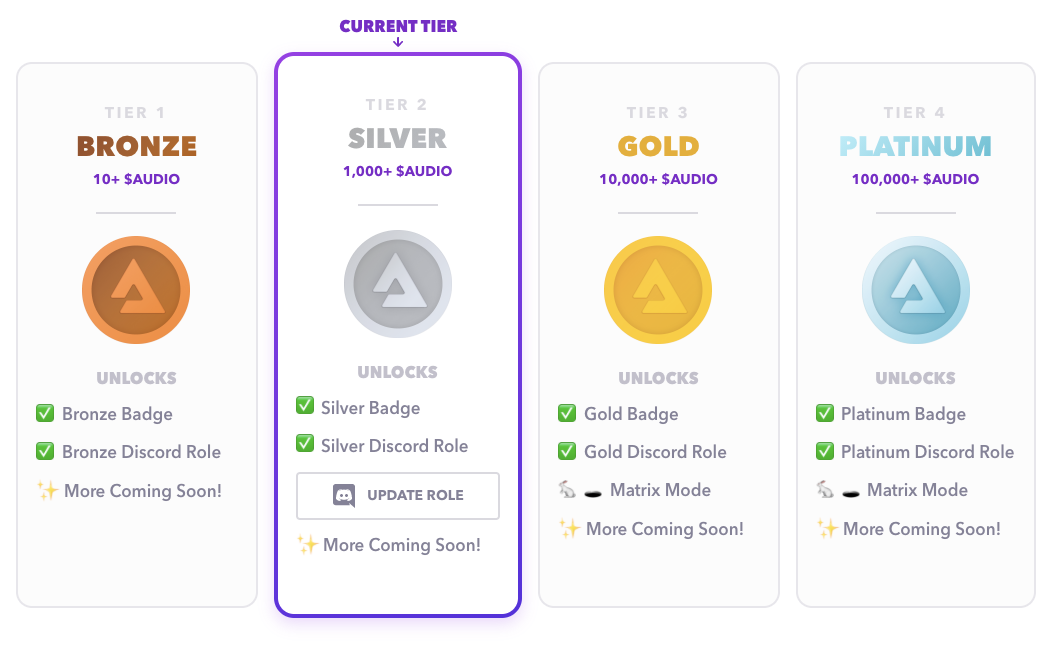
Levels are tiers you get for owning X amount of $AUDIO in your Audius wallet, and said levels grant you various features, currently (mostly) cosmetics, such as badges
With the current price of 3.15$ at the time of writing, $AUDIO has definitely risen beyond it's starting price of 0.2$ on average. But, with those gains comes something else: the higher cost to do everything with $AUDIO. And VIP Levels might be the one of the best examples of that. Because as it stands currently, the levels start at 10 $AUDIO and end at 100k (!), meaning that there's a big price disparity between them.
With 4 levels in that incredibly broad range, surely there's some balance to it?
As you can see below, that isn't the case. With current pricing, the bronze badge requires an investment of 31$. Silver? 3150$. Gold? 31k$. And, the last, platinum, requires a whopping 315k$ just to have it. And as a note: no one was airdropped 100k $AUDIO. The TOP 3 users got an average of 60k, meaning that if they haven't sold off their tokens at the start, but haven't purchased any, they would need to now buy 40k $AUDIO for the top badge. An investment of 124k$. You've read that right. https://archive.is/6joWq https://archive.is/ShPsk
And what do these badges offer as of now? Cosmetic features. Honestly, as they stand, being simple cosmetic additions in form of the badge in your profile and "matrix mode" in higher tiers (3 & 4), there's absolutely nothing wrong with that. Aside from the very high price, of course, and how the badges lock up tokens from being staked by users to participate in governance. But let's go over the features first.
Bronze/Silver/Gold/Platinum badges - not bad. Purely cosmetic. Doesn't affect the user experience in any way other than giving the user a way to show off that they, indeed, own enough $AUDIO to have one of the badges.
Bronze/Silver/Gold/Platinum Discord server (communication platform) roles - again, not bad. Purely cosmetic once again, and as far as I'm aware they don't give access to any special channels or priority list on discord requests for help etc.
Matrix Mode for Gold and Platinum - not bad, but not worth getting gold or platinum just for it, given that it again is purely cosmetic. Quite a cool effect though.
So, what's the issue? The text below. "More coming soon!". And what can be coming soon? Consider this article. Especially this line: "VIP Tiers unlock upgrades and enhanced product experiences." To me, as an user, it sounds like VIP Tiers (as they're officially called) might unlock more crucial features than purely cosmetic additions in the future. What would it be? https://archive.ph/2dHK5
Whatever Soundcloud Pro offers.
So, what can it be? Planned uploading. Much more advanced statistics. Being on official Audius playlists. The list goes on, and the wording used leaves the gate open for such additions. Will it happens? I'm not sure. Do I hope it will happen? Absolutely not. With how high the price requirements are at the moment, it won't be cheap. And I sure as hell bet some of the features will be reserved for higher tiers in a such case.
But, those are just the features. Now, let's go to something much more important, something that affects the entire platform and how it functions.
Incentivising holding tokens in your Audius account.
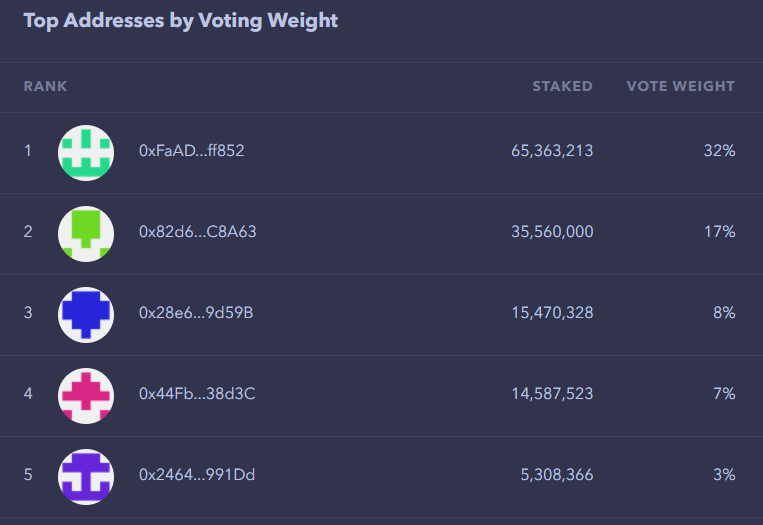
By doing so, the Audius team willingly removes possible tokens from being staked, because as it stands currently, you CANNOT stake and have a badge at once, due to how staking works. So, what that means? A user must either spend much more to both have a badge at a tier above bronze AND stake. At the extremes in the form of tiers 3 and 4, it is a lockout of 10k $AUDIO and 100k $AUDIO respectively from the governance system. And the more users do it, the less tokens there are for governance. With the current centralisation of the vote where the top 3 addresses by voting weight hold 57%(!!!) of the vote, you'd think that getting more tokens into the governance system by incentivising staking more would be important to the team. Even more, with the current $AUDIO price, reaching any decent levels on your own is much harder than before, so anyone who wishes to have atleast 1% of the vote, must spend millions on $AUDIO. https://archive.ph/otvsl
But, as it seems, that is not the case. Because what else can I call getting users to just hold $AUDIO in their Audius accounts? In terms of pure platform benefit, you can get more by getting a badge rather than staking, considering that staking has additional costs of Ethereum Smart Contract fees which are stupidly high. With this info, you can get a picture of where an user seems staking (and thus the core aspect of governance aka voting) as less desirable than a badge.
Furthermore, the big stakes are from investors. Not from actual users, as those equate to around 1.5% of the vote IN TOTAL. What does it mean?
Using the governance system, the actual users (artists and listeners alike) are at a huge disadvantage, and the badge system isn't helping it.
So, in the end, as of 03.04.2021 I don't think that the badges offer any P2W functions. They can, in the future, but they also don't need to.
My biggest issue with them as it stands is how they disincentivise staking furthermore, as there are issues already with Ethereum fees or the high $AUDIO price.
That's all from me for today.
Quick tutorial: How to access your Audius ethereum wallet.
Hello! Today I come with a quick neat tutorial on how to use your audius wallet outside of Audius:
Enter https://iancoleman.io/bip39/
Scroll down to "offline usage" and go as the tutorial says, to guarantee safety.
Afterwards, open the downloaded file
Go to coin field and choose Ethereum
Above the mnemonic language should be an option called "Show entropy details"
Click it.
Enter the entropy you have from audius. If you don't know how to find it, follow these steps:
a1. go to audius.co
a2. Open up developer tools in the browser of your choice
a3. Go to Application field
a4. Look for "https://audius.co" in Local Storage field
a5. Click on it
a6. Search for hedgehog-entropy-key
a7. Copy the key from the "value" field
Make sure that Hex is chosen as the valid entropy value.
Paste in the entropy to the "Entropy" field
You now should have the mnemonic available to you.
If you want to import directly to metamask and not any other wallet:
Do the steps above before doing those.
Scroll down to "Derived Addresses"
Make sure that you're using BIP44 Derivation Path
Find an address that matches the one you're presented with when clicking "Receive" on dashboard in Audius
Copy the Private Key that belongs to it
Go to Metamask
Click on the account circle in upper right corner
Click "Import account"
Paste in the private key
I have figured out this myself after some fighting, so I'm sharing the knowledge with others.
Feel free to tip me if this helped you!
edit: hey, if you can afford to tip me after I possibly saved you and your funds with this tutorial, please do. it does make a difference.
ETH: 0xe200fe1caa09ec38f5dc3c8b7b298a2e99e9268d
BCH: Just tip thru read.cash

How BCH and it's community made me deeply invested in crypto.
So, hello. I'm Mr.Korrupto.
Few of you may recognise my name from writing about Audius, a decentralised competitor to Soundcloud or Spotify, built on IPFS, Ethereum and POA Network (which is slowly getting switched from to Solana). While yes, this is my only "topic", and will possibly stay as the main topic of articles by me, it's part of the crypto puzzle to me.
Because nothing did it for me quite like BCH and the community around it.
Platforms like read.cash, memo.cash or now noise.cash made me explore what the community has to offer, and even participate in them. R/btc made me learn about what people are building on BCH, and how BTC lost it's original purpose due to corrupt developers, the drama around Sechet and the split has given me a few good laughs, mostly from the block invalidation "protection" Sechet implemented, creating BCHA Chain 1 and Chain 2. This made me confident in BCH, using what I've gotten from the original $AUDIO drop to go into BCH, and with time gaining more BCH here, on read.cash from articles, which the bot generously likes to reward, I guess it's because mostly people outside of read.cash visit them. But, it's working out for me. I've used BCH to pay, tip others succesfully so far, and I have no intentions of stopping.
What's next for me?
As time goes on, I've been thinking about diversifying. But into what? ETH has giant fees, BTC also does. The moment I want to actually spend ANY of those, I'm in a dead spot of paying upwards of 2-3$ in case of normal ETH, 6-7$ in case of tokens, and 10$ on BTC. Would I have doubled my money if I went into BTC? Yes. Would I have a worse experience? Absolutely. Fractional spending wouldn't have been possible due to fees, so I would be stuck doing one thing only: holding.
I want to see Crypto as an alternative to actual fiat money, that I could use in the same ways as I do currently. And BCH does just that, because no other crypto is currently capable of doing so.
No matter it's price, I will continue to use BCH, because of the people behind it, the development being all alive and well, and the sheer diversity of tools available on BCH, such as SLP.
Because BCH is what crypto should be.
EDIT: Holy sh*t! Thank you so much Marc for the 10$ tip! I did not except that in any capacity haha. Thank you so much again!
If you wanna help me exist in the crypto world, donate ETH and tokens here: 0xe200fe1caa09ec38f5dc3c8b7b298a2e99e9268d,
donate to me with BCH using my CashAccount tag: MrdotKorrupto#104798
or become a sponsor here on read.cash!

Audius Improvement Proposal 1: A solution to the bot problem
With the increasing problem of 10 second tracks being botted to the top of lists on Audius, and users uploading tracks that they didn't make, the Audius team is suprisingly unhelpful sadly, with the task of weeding bad actors left to the community. The issue is, we don't quite have the tools to do so.
As it stands right now, Audius has a huge problem, and the team hasn't resolved it yet. With accounts that straight up infringe copyright by posting tracks they didnt make en masse (example 1 ; example 2 ; example 3 ; example 4) or stolen tracks getting into trending (example 1 ; example 2 ; example 3), and 10 second tracks that got botted to hell also being right here in trending (example 1 ; example 2 ; example 3 ; example 4 ; example 5 at 50% site scaling ; example 6 ; example 7 mind you, the examples have tracks from three different profiles) what can we even do as a community? We don't quite have the tools to do anything for that matter. Technically, Audius mods exist, but we don't quite feel their presence, otherwise we would see things being actually done. https://audius.co/onyxhd https://cdn.discordapp.com/attachments/785219771741765665/793554403378200641/Screenshot_20201229-190051_Audius_Music.jpg https://audius.co/frizman https://audius.co/hiphop247 https://imgur.com/10yDzwx https://imgur.com/j5U8JLH https://imgur.com/O72rFMc https://imgur.com/TqmQofq https://imgur.com/ijEWAYz https://imgur.com/nudRLcI https://imgur.com/GltqgHv https://imgur.com/2uRvciz https://imgur.com/nCjzsmz https://imgur.com/aU68upI
So, in the name of the Audius community (especially those who have shown support for this proposal) I'd like to propose a few changes, and solutions to fix this issue.
**1 - Getting more mods on the board. With the current number of mods, as we see things aren't being done, atleast in a visible way. An easy fix would be to get more mods on board, so there's a solid team that reacts to reports of such profiles or offending tracks. However...**
1.A - If mods currently DO NOT have the power to remove tracks, giving them such power would be critical to have them help with the problem. Without it, we have to rely on the Audius team to actively remove bad actors.
1.B - Offering a monthly divident of 100 or 200 AUDIO tokens to the mods, as a sign of appreciation, if they aren't "paid" at the moment.
**2 - Allowing for democratic "elections" of mods, once every quarter or half a year. This would ensure a set rotation of moderators, just so no one gets burned out. A number of Super Mods/Elder Mods would be chosen, from the pre-elections mod set that would always be mods, teaching those who just got elected how to moderate properly and they would supervise deletions, bans and such.**
**3 - Delegating a community contact from the Audius team, one whose job would be to basically listen to the issues or ideas the community has with/about Audius. This would ensure a smooth ride, where there's a person that is dedicated to helping and listening to the community, instead of devs having to both actually develop Audius and listen to the community.**
3.A - A such contact would do a monthly report, where the topics that were talked about with the developers would get listed, and the result of such talks, to ensure that there's actual work done, and in turn, the community can feel that someone up there actually listens to them.
And this is the full proposal. Comment on it on whatever platform you've seen it shared, or here in the comments on the article itself. I want this to be a call to action, as the problem is real, and it could damage the reputation Audius has, and possibly create a lot of legal trouble for the Audius team.
#SaveAudiusFromBots
(image created by Sweeppah using copyright-free assets and the Audius logo) https://audius.co/sweeppah
If you wanna show support for this proposal, make sure to tweet about it with the tag above! Tweets in support will get included in the signatures section.
Instead of "signatures", I just want to thank for the support on reddit, discord and such. I do hope that we can all together push for meaningful change!
If you've liked this proposal and would want to support my work about Audius I accept ETH (and token) donations here: 0xe200fe1caa09ec38f5dc3c8b7b298a2e99e9268d
and BCH either here thru the platform or to: bitcoincash:qrw6973g4ynx2c8qqpfy8ljr3rfjup8gkym3e3slrd

Understanding Audius: An introduction and a few words about Content Nodes and AudSP.
As time progressed, Blockchains found more use over the years, ever since the original creation of Bitcoin. One of the most recent uses for it was the distribution of data, using IPFS (InterPlanetary File System). Audius is one of them, using it to create a competitor for both Soundcloud and Spotify. Welcome to Audius. https://github.com/ipfs/ipfs
As Audius launched, I never quite understood originally how it works. But, recently I took it to myself to actually go out and learn about it. With the "Understanding Audius"series I intent to share the knowledge I learned to you, the reader, in a far more easily digestible form. But, as a start, let's summarize Audius.
Audius, both in web and app forms, is a front-end GUI for its decentralized system of Content Nodes and Discovery Nodes that work together to bring the content others uploaded to the user, using data streaming. With it, Audius has a custom framework that is based around IPFS, a decentralized protocol for data storage on a P2P basis, and AudSP, a custom extension created by the Audius team for IPFS.
Using a such decentralized system, Audius can provide a superior service that doesnt have a single weakpoint, and could possibly allow for custom Audius clients or plugins to existing music players (*wink wink Winamp*) in order to provide decentralized music streaming for the masses, available for everyone.
And that is Audius for the most part.
Now, let's talk about how it exactly works, deep down. Let's talk Content Distribution.
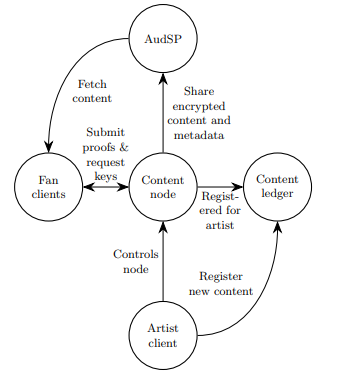
Using the above picture, taken straight from the Audius whitepaper, we can visualize exactly how it works, while getting deeper into it. The start of it is at the Artist Client, or rather just the musician. As they upload audio, 2 things happen. It gets uploaded onto the Content Node, and they also register the appearance of new audio files on the Content ledger. In turn, Content Nodes also communicate with AudSP at the same time to save metadata. But, let's talk about Content Ledgers first, as they're responsible for handling the token system.
Citing the Audius whitepaper directly, a Content ledger is **"the amalgamation of smart contracts on Ethereum, POA network, and other future L1 or L2 blockchain networks that host pieces of the Audius ecosystem. Different parts of the Audius protocol will continue to run on different blockchain-based platforms, or utilize off-chain scalability solutions, where scalability trilemma tradeoffs can be made on a module and subprotocol-specific basis."** What does this mean exactly? Well, it means that a Content ledger is a collection of metadata assigned to the track, that keeps track of things like track content, revenue splits and content ownership structure, a registry of all Audius reachable nodes. In short, a Content Node holds only the raw audio data, while the Content ledger holds information revelant to the token and blockchain system of Audius.
Now that Content ledgers have been explained, we can talk about Content Nodes. The key to understanding them lies within IPFS, the InterPlanetary File System. It's the backbone of the Content Nodes, as it provides a protocol to handle decentralized, P2P filesharing. The data itself is stored in 6 seconds chunks on the Content nodes, allowing for a much smoother experience while listening, meaning that the listening device has to only cache 6s chunks at a time and not, for example, a whole 1h podcast. Using IPFS communication, a listener can request a track to be streamed to him in said chunks, which then get "located" within the decentralized network using the AudSP protocol.
And this seems like an ideal time to explain what AudSP does.
AudSP by design is a metadata, location and fault detection protocol, that complements IPFS within the Audius ecosystem. When someone requests a track, IPFS first handles the request by locating the chunks on nodes, gets metadata for it and sends the said information to the listener and, at the same time, handles the data transmission. But, at the same time AudSP makes sure that the data is there, and in case of a possible fault, it makes sure that data can be quickly fetched from an another node to keep the listening experience smooth, without any bumps. AudSP metadata boils down to: listening patterns, genre, mood, etc. How the said metadata gets handled later down the line and how it gets processed will be for an another article.
And, that's all for now.
Thanks for reading, if you want to support my work feel free to tip me here or send me ETH (and tokens) over to this address: 0xe200fe1caa09ec38f5dc3c8b7b298a2e99e9268d
Sources:
Audius whitepaper
IPFS documents
https://whitepaper.audius.co/AudiusWhitepaper.pdf https://docs.ipfs.io/concepts/how-ipfs-works/

$AUDIO - The gateway to crypto for the creative side?
It's been nearly a month ever since $AUDIO, an ERC20-based token by Audius launched. With a now-steady price of 0.13-0.14$ per token, its safe to say, the launch was succesful.
The story behind $AUDIO, and it's future.
With the initial drop of 50 mil. tokens to it's top 10k active users, I was one of them. While I was interested in crypto before, and have even participated in faucets trying to get some of the digital gold, Audius kickstarted it. Now, I own over 100$ in BCH, an amazing feat to me, that wouldn't have been possible without the help of Audius. And, I'm not alone in that. With many producers and DJ's cashing out far more, with some even apperantely getting 50k$, it's safe to say that people got a positive first exposure to the concept of crypto, as a whole.
With artists like Skrillex joining the platform after the launch, and Deadmau5 himself DJ'ing on the Mainnet celebration livestream over at Twitch.tv, Audius has essentialy spread the message of fair compensation being possible. By using a crypto token to do it, all of the people that wanted to get on the Audius train had to participate, even partially, in the crypto world. Going from a simple curiosity, to an object of interest, cryptocurrencies within the musician's world are here to stay forever.
But, none of this would have been possible without the help of one of the biggest exchanges in the world, Binance. On it's launch, Binance, using Binance Labs, has made a 1.25 mil$ strategic investment into $AUDIO, giving the token it's much needed exposure and trust. If Binance invests in it, everyone else wont be afraid to do so. https://medium.com/audius/welcome-audio-to-mainnet-409009bc130c https://www.twitch.tv/audius/clip/ThankfulLuckyClipzFunRun https://www.binance.com/en/blog/421499824684901135/Binance-Labs-Leads-$125-Million-Extension-Round-for-Audius
With it's current next step being setting up a cycle for distribution of tokens to its users, people await the results. If Audius plays it right, the momentum they have post-launch will only grow, and more producers will join onboard, possibly getting people outside of the electronic scene, particulary rappers.
Audius as a streaming platform itself.
As far I'm aware, Audius is a first-of-its-kind project for music. It's core is, and always will be a blockchain-based network. Using "Content" nodes and "Discovery" nodes, as described in the original launch white paper, to decentralize the core structure of the platform, it's doing things that weren't tried before. "Content" nodes handle the distribution of data, storage and streaming of the music to users, using their custom protocol, AudSP. So far, it has been working well, and no big issues arose post-mainnet launch and the giant migration of artists to the platform. "Discovery" nodes handle the actual metadata for songs, and use the said metadata for its discovery side of the platform, being represented by the "Feed", "Trending" and "Explore" pages, with the last one being particulary interesting for anyone interested in discovering music other from than the artists they usually follow, on the platform. With a decentralized aproach, Audius is definitely more failproof than any other centralized platform, which is also a good bonus to the overall experience. https://medium.com/audius/the-audius-white-paper-a-decentralized-community-owned-music-sharing-protocol-52fa8d1818c1 https://audius.co/feed https://audius.co/trending https://audius.co/explore
The biggest key for the platforms success would be definitely promotion. If they can get well-known people outside of the electronic scene to promote it, their userbase will grow to much bigger levels, but if Audius does that is an another thing. All we can do is await for their moves, and their choices.
It's decentralization also allows other developers to build upon the tools Audius has created, but if this will ever get traction, to possibly support Audio NFTs (The example beign DAOrecords, which does so for a 10$ fee) straight from the platform and create other opportunities/options within the blockchain world, is so far only speculation. But, we can hope for it, and support Audius in it's mission of liberating the musician from the giant corporations which pay practically nothing if you aren't a complete, established giant. As a concept, Audius addresses the grievances musicians had for a long time, as a grassroots movement to finally bring change, using crypto as a means of doing so. https://www.daorecords.org/distro/
With artistic people now being aware of crypto beyond Bitcoin, if they were aware of it at all, I expect more platforms like Audius to launch. Specficially for not music, something to compete with Deviantart using cryptocurrencies. It's time that the whole creative scene gets a revolution like Audius created for musicians.
The future is crypto.
If you'd like to tip me with ETH feel free to send any ETH and tokens over to this address: 0xe200fe1caa09ec38f5dc3c8b7b298a2e99e9268d
Thanks for reading~!

 @Mr.Korrupto