A seat at the table
CZ (CEO of Binance) has been on the move lately. His enthusiasm for crypto and savvy business tactics make him a powerful force both in the emerging tech space and in traditional finance. Besides being worth more than an estimated $100 Billion, which makes him among the top 20 richest people on the planet, he seems to be as hungry as ever. Which makes you wonder- what is he after?
He's clearly free to do what he wants in the free market, but considering how hectic the macro landscape has been in the past few years (politically, economically, scientifically, inter-personally), it's good to take a step back and breathe once in a while. And naturally the question arises, where is crypto headed?
A few things that recently caught my eye:
****BUSD****
CZ claims BUSD, or Binance USD, actually has very little to do with his company. All reporting, issuance, compliance etc. is entirely at the discretion of
Paxos. Binance simply supplies the branding in the partnership. The interview is quite revealing in showing how little CZ seems to be monitoring the stablecoin he is in partnership with which, again, is named after his company. Tether? A black box.
Binance USD? He wouldn't be able to tell you anything other than "you can trust it." For more information you'll have to speak to Paxos if you hope to get any answer...
Binance on stablecoins https://twitter.com/dee_bosa/status/1491869674820227075?s=20&t=-D8fWWYhLUK4PzqGF2eFcg
****Forbes****
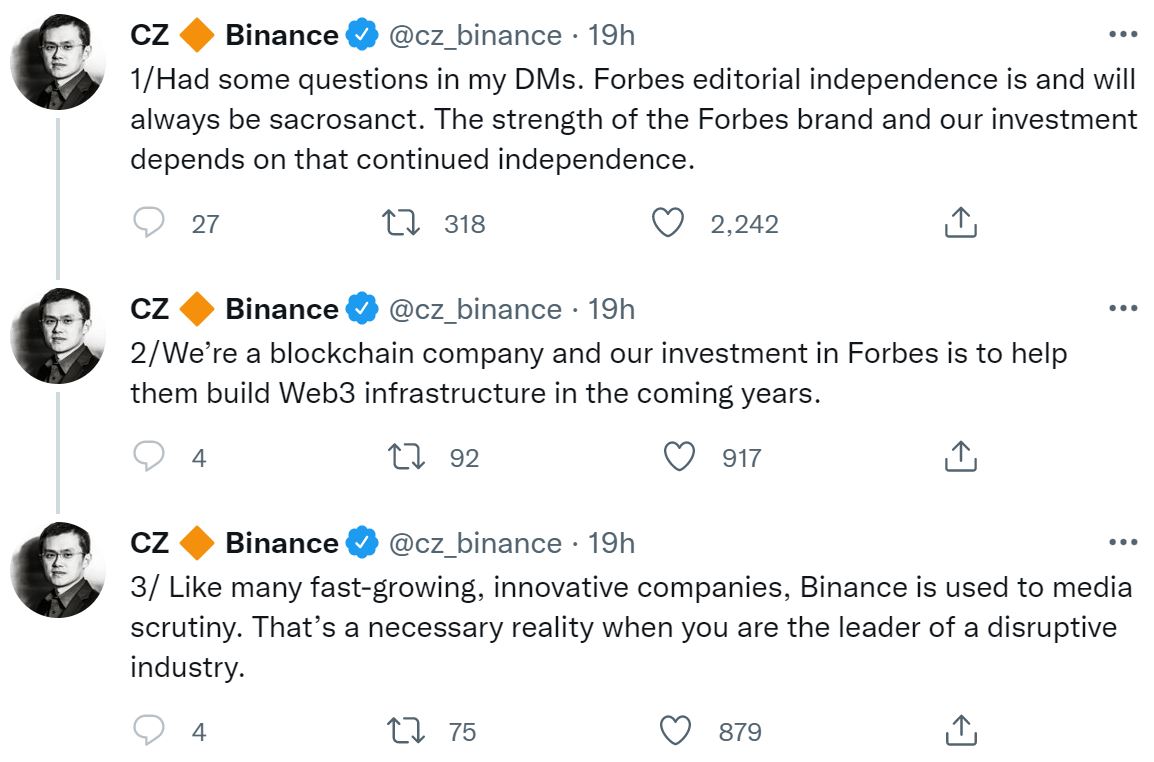
Binance has invested $200 Million in Forbes before their planned SPAC to become publicly listed. This would make Binance one of the top 2 holders of the platform, along with Integrated Whale Media (from Hong-Kong), who bought roughly 95% of the company in 2014. CZ also tweeted to clarify that part of the investment "is to help them build Web3 infrastructure in the coming years."
Maybe I'm old school, but experience tells me that if you provide a service then **you** should be getting paid, not be the one paying. This would only make sense if Binance can see see clear long term advantage of being both an investor and service provider for a century old US publishing company.
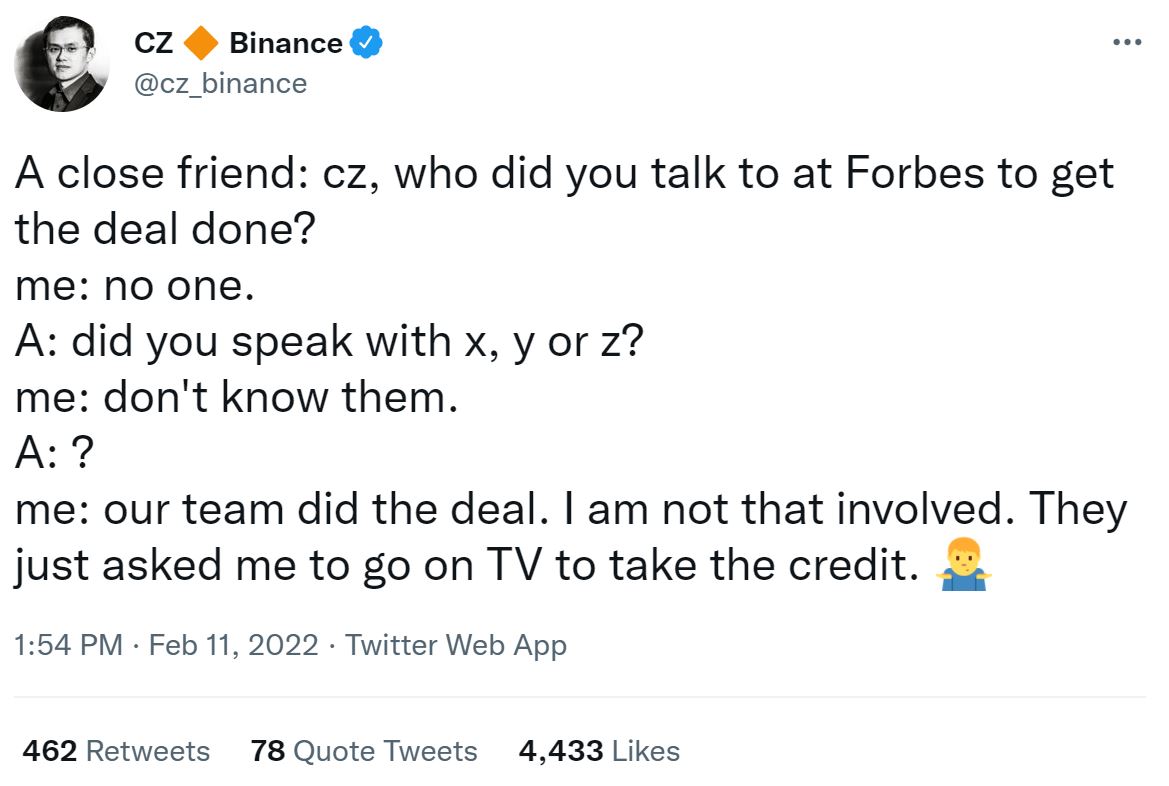
And despite this impressive feat, CZ claims he was totally hands-off, that his team was totally in charge of the partnership.
****Promotion****
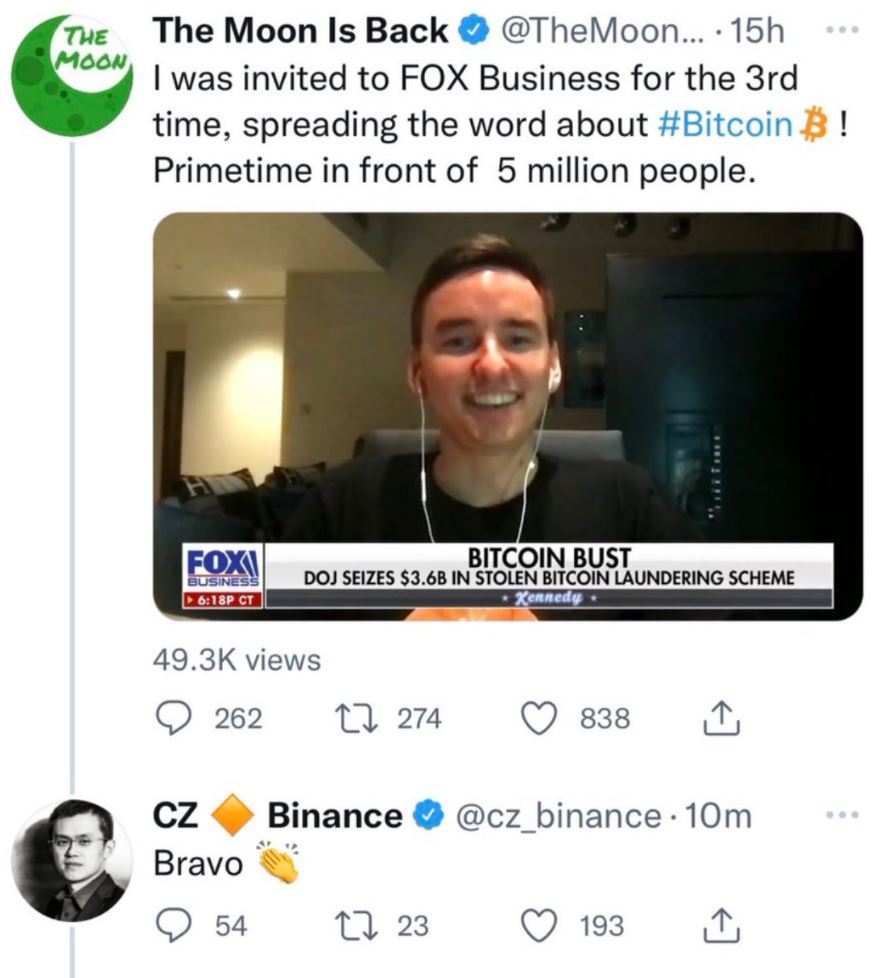
Here he's congratulating TheMoonCarl for his appearance on FOX business, discussing #BTC and other crypto related news. I don't like to label explicitly, but TheMoonCarl's "investments" have been questionable at best. He seems to be among the ever growing group of social media influencers who make money through undisclosed marketing deals, private-sales, referrals, closed door negotiations etc. ZachXBT has documented information on these types of influencers and TheMoonCarl made the Top 10 list!
Top 10 list https://twitter.com/zachxbt/status/1467918962365288457
What does CZ have to do with this? Not much. But the CEO of one of the largest CEX's and among the most influential crypto personalities today sending a congratulatory tweet isn't exactly insignificant. CZ has power, and giving even more credibility to influencers who promote crypto in any way they can isn't a great look. Carl claims he's invested in over 350 projects over 24 months, that's nearly **one every two days.** I doubt he's doing the proper due diligence on those projects, but you can be sure he'll be telling his followers about them. It's probably not a coincidence that many of these coins are relatively new and low cap, with Binance being among the biggest exchanges offering access to these coins and leverage to speculate on them.
_________________________________________________
CZ and his company have **a lot** of influence over crypto. This article is just the tip of the iceberg, but already it can give you an idea of how the lines between things like crypto, modern finance, social influence and governance continue to blur as the prospect of making so much money and being a part of this new digital age continues to draw people in.
When CZ says that he trusts a stablecoin issuer that he lends his branding to, or that his company closes deals worth $100's of millions of dollars without his direct oversight, is he just being humble? How much influence does he have? How much influence do people who are at the company have? How much influence do people who are *not* at the company have?
In a space dominant by buzzwords like "decentralisation" and "permissionlessness", there are certain players with a great amount of power and control. You may trust them, but should you?
The title of this article is "a seat at the table." I think that here, as is often the case throughout history, people are looking to get their seat at the table. There is an unspoken understanding that certain people/groups command much more leverage than others (politicians, business moguls, famous personalities, etc.) and many in crypto are looking to capitalize on that opportunity. When a shift like this occurs, new money tries to replace old money. Getting a seat at the table is lucrative; it means more money, more connections, more access, more power.
I urge everyone to stay safe. We should be asking tough questions. We should be properly weighing our options and maybe missing an opportunity or two so that we make good decisions. Crypto isn't just about finance. Our actions now will have long term effects, for our future and for those that will come after us.
What’s NEXT(chain)? – The allure of constantly seeking the next best thing
I’ll keep this one short and try and point out the elephant in the room head on:
**BCH is too vanilla.**
It is in the middle, which can be seen as both good or bad. It has a lot going for it technically – but there are always things that can make it “just that much better”:
- Better leadership
- Better governance
- Better code review
- Better stability
- Better implementation
- Better usecases
etc.
It’s at a sweet spot in that it is conservative, but constantly looking to improve. But sprinkle in a bit more ego, excitement, and self interest and you have a coin that is primed to be “made even better.”
**The death of BTC will be reversion to the mean** – Such a slow and pseudo-progressive march toward adoption that it will be a novelty asset for rich people and institutions.
**The death of BCH will be “death by a thousand cuts”** – dwindling as each team/group seeks to pull big blocks to their edge case.
- **For BSV** it’s IP capture led by a false prophet.
Not much needs to be said here.
- **For e-cash** it’s uncompromising technical direction by a benevolent dictator.
“it’s decentralized, as long as you listen to us regarding the right chain to be mined”.
- **For NEXTchain** it’s “friendly” competition.
It cannot be mutual benefit if you’re trying to grow value for a mineable coin wholly detached from BCH. It is to BU’s benefit to leverage the BCH ecosystem and pitch NEXTchain as a good testing ground for user needs. Effectively, going ABC’s route of opting for specialized development, but by trying to warm an already existing community to accept it.
**BCH is too vanilla.**
That could be a great thing, but big blockers have chosen to spit in the well they drink from. It is in anyone and everyone’s power to pursue their own interests, but ask yourselves – at what cost? You think 99.9% of coins will die, but within the PoW big block community you’re sure yours will “be the one”? I have yet to see a compelling argument as to why BU couldn’t create a mineable token or help smartBCH in their efforts and then build within that; this would incentivise usage in BCH, smartBCH, and get less contentious consensus around a development blockchain.
Yes, BTC is a cult. Yes, they’ve totally lost sight of what they’re actually trying to accomplish. But they’re scaling mind share. For any money to be money, you need mind share. The worst outcome is that BTC “wins” for all the wrong reasons. As it stands, that’s what is happening. PoW is losing the fight – BTC is the wrong product, but it is delivering. BCH (and all its forks, inspired projects, etc.) may have the right product, but it isn’t delivering. If this keeps up, ETH really is growing stronger as the only practical competition.
Unfortunately, the age of memes has taken over public discourse. It’s unsustainable and will cause more problems than it solves, but that’s another discussion. The point is that splitting, forking, recreating, etc. creates pauses and unpredictability. The last thing a meme does is slow down and confuse. It is simple, compact, and easily deliverable. We’re weakening BCH in the public markets.
I wish BU well in their project, but something tells me the homepage for it will not stay this way for long…
(The rationale will be something like “with time, we’ve seen that NEXTchain has grown to take on unique characteristics that have made it different enough and special in it’s own right”)
I’ll keep this up for the sake of accountability.
I recommend the BU team really ask themselves "What possible ends will this achieve? What are the chances of each one happening?" BCH is a force to be reckoned with...but leaders have time and time again preferred to experiment over organize. This is not getting us where we want to go.
Cheers,
Mono

BTC is killing Bitcoin
...and the dream of the crypto space more generally.
This has nothing to do with tribalism. These are the facts of our reality.
Why? The most concise answer is because **the reach of crypto's longterm success is time dependent.**
It's really that simple.
Look at the macro. What was so revolutionary about Bitcoin's whitepaper? It was the fact that it was the first outline of a system that had a real world usecase, with practical verification that was "self contained." It didn't need third parties. It was backed by financial incentive and elegant math.
It was also a threat to our default assumptions of what money is and what money could be. A threat to the way things are. It offered the chance to level the playing field in a game that puts certain players/teams at a clear advantage. **Bitcoin was an option for individual autonomy.** Something near impossible to accomplish before the digital age.
There were high hopes for what Bitcoin would turn into. By 2015 fairly big companies were warming up to accepting Bitcoin, whatever it was, as a form of payment. A value of some kind you could give and receive. The idea of transacting freely and openly on your terms was novel and exciting. This piqued the interest of governments and institutions, but they were far behind. Very far behind.
So Bitcoin, along with up and coming altcoins (of varying quality), had a huge headstart. Bitcoin (represented today by BTC) was the clear first mover, setting the tone for what crypto is and will be.
And then...like a slow bleed...it started deteriorating. No one could really say what BTC could **do**, only what it **should be perceived as**.
"Its a monetary network." - Who's using it as money?
"It's a store of value." - With that kind of volatility?
"Its unbanking people." - Is it really?
"It allows less fortunate people to become economic participants." - How are they getting their Bitcoin? How much does it cost them to use it?
*"Lightning is the answer." - It could be, but its been **years** since that alternative was first proposed and has been doing a terrible job of actually onboarding people (more on this later)
"If you were smart you wouldn't want to spend it anyway. There's no point." - Then what IS the point? To HODL? To paper-gain against the dollar?
"No, it's a store of value" - Refer to #2
"But it keeps going up!" - That doesn't make it a *good* SoV...
"What are you trying to do, shill some scamcoin?" - If a scamcoin means anything that has utility, then yes. I don't even care which one it is. Any crypto worth its weight would be able to stand on its merits and compete in the market in an honest way.
When BTC people say "you lost, get over it", that's instead of saying "The chips landed where they did. We don't want to reconsider things because that might turn against us."
*To put it simply: if you're up against an objectively better football player you'd prefer to penalty kick against them because there's more chance for luck to be involved. The longer you play, the less luck factors into the game and the higher the chances of them beating you are. This is as true for a sport as it is for a cryptocurrency.*
There are some who legitimately disagree on certain technical points and the weight of their importance, but the vast majority don't even understand or care about those details. They have an investment to defend. A narrative in their head to keep in tact. And **that** is the debate.
If we were discussing something more trivial, maybe it wouldn't matter as much. But **time to market matters.** And if we're talking about a monetary network that battles with legacy finance and government backed fiat, it matters a lot more.
*Lightning is the answer. **NO**. It isn't now and it hasn't been for years. And if it doesn't gain traction soon it'll be too late. Crypto is moving on without BTC because it has no choice. It's looking to make things better by innovation. BTC got too comfortable riding on the success of a narrative built in peoples' heads. And it is that narrative that will make BTC useless by any real metric. By the time lightning *might* be functional and widespread, the narrative will be too entrenched and the timing too late. Who would be stupid enough to give away an ever increasing status symbol? It'll be signalling for the rich who can afford it, but have no use for the common person caught between waiting for it to go up even more or trade it in (reluctantly) for something they need. Even if people did become more accustomed to sending it, government involvment will pidgeon-hole it into a peculiar asset class. CBDCs will be the real means of exchange and unit used. BTC will be this novelty virtual token to be discussed at parties every so often. Maybe given as a gift to be unique.
So after nearly 12 years, what have we accomplished? We've had the market leader enlighten users, adopters, developers, companies, institutions and even governments of its potential while it treaded water. It allowed for centralized actors to skim the cream of all that is so powerful about Bitcoin and provide us with more of the same, repackaged. **It gave away its edge to systems with more power and they'll use the innovation to keep things the way things are (under a new cover).**
That "best store of value in the world" will lose its main appeal, devolving to just a base unit for which you will still need KYC, third parties, and regulation complying in order to do anything of actual value.
At that point, what did it really change?
Will it mint some new millionaires? Sure. Maybe offer some people an extra couple of thousands during its formative years? Definitely. But is that the change we were looking for with Bitcoin? I guess it is for those controlling the narrative. To everyone else, we may have won the battle, but we're definitely losing the war.
To all those BTC maximalists who use fake arguments like "it'll be a trojan horse for money!" or "once everyone adopts BTC, the rules of the game will change!" - you are wrong. The best case is that you're just unrealistic, the worst case is you're deluding yourself and others to keep pumping your bags. **It is a fantasy.** Every day that crypto isn't USED, it isn't making any social impact. A tree without strong roots will topple at the slightest breeze. Similarly, a narrative that doesn't provide utility can change when sentiment boils over. With countries getting ready to roll out CBDCs and governments mulling over and refining their crypto laws, that breeze is growing stronger and coming quicker than most expect.
As a final nail in the coffin, consider some of the biggest crypto influencers on Twitter. Without using names, nearly all of them have "newsletters" or other types of marketing materials. Some of them even bring on well known wall street elite or play to corporate interests to prove that "adoption of BTC is real". WHAT ARE YOU DOING? Never could I have imagined a more ironic twist in the evolving history of crypto.
Actually, talking points have gotten so crazy that every issue has had both sides of it used as good for BTC:
Volatility is healthy and strengthening its legitimacy. Bullish.
Consolidation is healthy and strengthening its legitimacy. Bullish.
China bans are good for decentralization and prove its resilience. Bullish.
China being pro crypto is good for its citizens and the world. Bullish.
You're never supposed to spend BTC. Number go up. Bullish.
Oh you want to spend? There's lightning! Bullish.
*(Sidenote: I'm willing to argue 8 out of every 10 people that bring up lightning as a rebuttal to "altcoiners" have never had to depend on lightning, let alone use it more than once)*
Bitcoin is about the little guy, buy Bitcoin! Bullish.
Bitcoin is being adopted by wall street and all these fancy products standing in the way of you and your coins are just more options. Bullish.
Over-use of energy is good, it consumes excess energy. Bullish.
Over-use of energy is good, when it's not excess it forces miners to find clean energy sources. Bullish.
Look at how fast you can send Bitcoin anywhere in the world! Bullish.
Slow? You should be thankful. Convinces you to stay the course and HODL. Bullish.
Look at how cheap it is to send! Bullish.
Expensive? You should be thankful. Convinces you to stay the course and HODL. Bullish.
.
.
.
and the list goes on.
I've seen these conflicting "arguments" and many others so often it's become hard to discuss. I've even seen conflicting arguments used **in the same discussion.**
The more BTCers claim they're helping the more they're screwing over themselves and everyone else in the long run. People who really care about Bitcoin as satoshi intended it to be - the concept and the mission, not the ticker - should be working hard to change BTCs narrative. Either within it or around it. There are a few BTC maximalists left who still have the mission in sight, but I wonder when they will realize that they are digging their own grave. If not by competition between cryptos, then by competition by governments and companies that are about to flood the market.
Wake up Bitcoiners. "Normies" don't care. They want to make money. They like the signalling. They'll also fold quicker than a piece of paper in a Japanese man's hands when regulations start being enforced and new standards get put in place. At that point the **real** narrative will be in play and this "Number Go Up/HFSP" hopium will be as fickle as a weak tree against a hurricane. I'm calling you out. Your tribalism is what will kill efficient progress to a decentralized future. You're causing the mess that's coming.
Cheers,
Mono

I'm on twitter!
First thread:
https://twitter.com/Monomonomono13/status/1374793097050226694?s=20
Now that noise.cash is normalizing the transactional efficiency of BCH, does anyone have any thoughts of how we can incentivize people to keep using their BCH, on and off noise.cash?
I was thinking of a slick plugin that wallets can add as a "drop in" and that has good UX to expose users to merchants accepting BCH quickly and easily. Maybe a list of like 8-10 reputable brands accepting BCH for services/products and a link at the bottom for a longer list of all merchants accepting BCH? Getting those merchants to provide a small discount for direct payment with BCH would be icing on the cake. Does this seem practical? Is it worth pursuing?
BCH needs to convince Amaury to come back.
Alright, this was a bit of clickbait. But it is and it isn't...
What do you mean we need to convince him to come back? *We finally got rid of him!* You're insane.
Hold on. Read the title in a new light:
My point is that by convincing Amaury to come back, I mean BCH should be **such a good implementation of p2p cash that incentives should compel him to come back and build on BCH.** The convincing should be passive, not active. And it's the best kind of convincing that can be done.
I don't want this to become a debate about Amaury, ABC, funding, roadmaps, governance etc. This is not that type of article. But *it is* the type of article which will touch on these topics, because they're definitely important. They're important because they rest at the heart of the big question: **Where will BCH be in the future?**
I think the fate of BCH can be assessed by how firmly it stands on 5 important pillars:
Community/network effect
Culture
Technical implementation
Convenience/Usage
Stability
You can have a great community, but bad culture (like a cult).
You can have great technical implementation, but without stability and no real usage (like a project that is only research-based and without much practical value or a proper network effect)
I won't give any more examples, but you can put together some of these, save for one or two, and quickly see how lacking one of the pillars can cause a project to fail long term.
I want you to think about BCH and ask yourselves: "what can we learn from people like Amaury, Tobias, Shammah, Vin, etc. losing hope in the way the project is?"
If your immediate reaction is "good! less psychopaths in our community!" Then you're not thinking clearly. It is impossible to truly, rationally believe that ABC and some of its main supporters are **only** bad news for BCH. I can also say from experience that a project can be taken over or influenced from people with personalities much, **much**, worse than Amaury's. I urge you to instead think "what were their main criticisms?" And, just as important, "how can we become better from those criticisms?"
I would like to highlight two main criticisms, mainly those of funding and incentivizing builders.
I think flipstarter is a great idea. Genuinely. But I also believe it should complement, and not take the place of, a more robust, free-market approach to allowing good ideas to be monetized and flourish. Relying **too heavily** on a donations based model could cause prioritization that may not be best for BCH. I can imagine a situation where someone who is greatly talented does not market his idea well. And even if he did manage to get the funding, if things came up that delayed the project or had things implemented differently, the outcry of donors could greatly hinder the creator's reputation and ability to raise funds again, causing him to feel like he needs to beg to be given another chance to create value.
I do not have all the answers, but I do not think relying on flipstarter as the backbone for value creation in BCH is best long term. Again, I think flipstarter campaigns should continue, and it a great model for many projects, but not all. Not too long ago I saw someone mention Jonathan Toomim was working on a BCH related project, to which Jonathan politely reminded the OP that his funding was for work "until November 15th", and that he may reraise funds for continued work in the future. I have no problem with Jonathan deciding to invest his time and efforts in other things (and he's clearly contributed greatly already) but this was a small exchange that really struck me. It highlighted that many people are invested in BCH development, but not totally. And flipstarter as a long term revenue source can be problematic. I have to concede that sometimes development is about doing the boring and doing the boring well. The importance of maintenance cannot be conveyed in a flipstarter.
This also brings me to the second criticism we have seen. One about incentivizing building. I will not take credit away from those who have been working hard to bring BCH to where it is and to take it further. You have my sincerest gratitude. But lately, some have been skeptical of where BCH is headed. Certain developers have already left while others have a foot out the door, and still others are starting to be more receptive to the allure of other projects/companies. This is the network effect in reverse. Maybe you hated one specific developer- but if they are friends with another and they manage to convince them that "the grass really is greener on the other side", we may start to lose contributors who have been working hard behind the scenes. In some of his tweets Justin Bons has implied that while he "reduced his allocation to BCH" pre-fork, he hasn't exactly raised them, definitely not back to where it was. He seems to be sitting on the sidelines until there is a clearer picture of what happens with BCH. That's not exactly bullish.
So am I fearful of BCH's future? **Definitely not.** But we can't stick our fingers in our ears and believe that everything will just turn out okay. I, along with many others, are on the ground trying to spread adoption of BCH as a real p2p cash solution. I have acquiantances, friends, and family that are slowly warming up to this idea of a digital "ard monnaie" and we are risking our reputation for BCH, despite market sentiment being against us. This is why it is so crucial that we don't take any of the 5 pillars for granted and keep them at the forefront of our vision for BCH.
I'll circle back to the beginning. Incentives matter. Was Amaury too stubborn and obtuse in his thinking? Yes. Should he have done many things differently? Absolutely. Did he go rogue? Maybe, in a certain sense.
But was he some psychopath trying to ruin BCH and pocket all the profits? I'm not convinced. Again, there are many people with personalities and incentives **much worse** than Amaury that we should watch out for. And there are also people of varying abilities and contributions that have been affected by everything that has gone on. We should be receptive to criticism. We should embrace it. And we should work to have BCH become a project that will be magnetic. **A project so good that Amaury and ABC will want to come back.** The road to adoption has to include having people on board that we won't agree with all the time.
Let's make sure to provide the best foundation for BCH. This means:
A healthy and diverse community (with good network effect).
An inviting, yet goal oriented culture. One that rewards building and creating, that has utility and provides growth for BCH to expand.
Technical implementation needs to be excellent. It needs to be thorough, it needs to be constantly vetted, it needs to incentivize users and incentivize developers. Good isn't good enough.
Convenience/usage. What is p2p cash if it isn't accessible? If it doesn't have usecases?
Lastly, stability. Your money can't work nearly all the time "except for that one time...". It needs to be there for you, always. Developers doing the boring should have room to continue doing the boring, excellently. Upkeep and research should not be threatened with "but maybe it won't be funded this time around..."
There are a lot of people in BCH that are doing great things. Unfortunately, some of them are starting to feel as though maybe the incentives aren't there anymore. And if they are, BCH might not feel "the same" to them as it once did. These people and attitudes are small in numbers, but we don't want a snowball effect. Let's go back to championing a BCH that is aggressive in its mission to provide a better future for the world.
Lastly, I'll mention that Shammah and Tobias have some great ideas in the works. They are an asset to BCH's endgoal. They know that. Let's put the hostility aside and focus on the mission. I believe that after letting some of the dust settle and refocusing on what's important, some things will change for the better.
There is a long road ahead to reach our vision, but we can get there.
Cheers,
Mono

The Third Option
I believe that in due time there will be a window of opportunity that I call "the third option." It will appear only momentarily, only to be realized if key players allow it to flourish. And this third option could be one of the greatest things that can ever happen to BCH.
It could solve the problems of the split. It could be the path to better governance. It could retain infrastructure, developers and miners. It can bring back antifragile stability to the BCH ecosystem and kick Bitcoin Cash's scalability to high gear before a finalized split tears through projects, developers and user morale. So what is the third option?
_____________
**TL;DR**
The third option could take place over the period of only a few weeks after November 15th, at which point things are still very unclear about BCH's future. It is the point at which BitcoinABC realizes they have a lot to lose in terms of network effect- the tainting of their name, the BCH brand, and the loss of businesses, projects and people who feel like they've had enough. It is the point at which BCHN will realize that given their "longest chain" philosophy and underdog standing, that they may not be in the best position to carry out the future of p2p money (roadmap or not). That the market of ideas for who should decide what and how under a totally decentralized community project will quickly rear its ugly head, causing only greater problems in the future.
Whereas BitcoinABC may crash and burn spectacularly, BCHN will cause a slow death of confusion and tamed-chaos. Put succinctly, after November 15th both sides will have a moment of clarity amidst the ensuing ecosystem disorder, potentially understanding that a no-split, better terms for everyone situation may actually be the best path forward.
_____________
I'll make my stance very clear:
I think BitcoinABC was, is and will be a net positive for BCH. They *can still be* critical for BCH's long term success by helping it scale faster and better (which will undoubtedly be very important in the next few years). They have always been invested in BCH as a viable, real world solution since day 0. They have toiled along holding the shit end of the stick and kept the lights on. But they need to improve their reputation and Amaury needs to work on himself as a cooperator and "provider of value" within an ecosystem. Their reputation as amicable market participants is abysmal and I have a hard time believing that the merit of the product will "win out in the end." It sounds nice when reading it in a book about economics, but hardly describes the messiness of the real world. If businesses and builders find their incentives aren't taken seriously and good people get burnt out by a prevailing narrative of hostility, the network will limp along until an almost-good-enough alternative zooms past it. ABC's "we know best and we do best" mentality is Usain Bolt with blisters on his feet. If that's hard for you to agree with your problem is one of either ego, politics, or improper development foresight. **You may stop reading now. Your judgement is cloudy.**
I also think that BCHN and other players within the ecosystem have many good points. Their concerns about ABC "capture" of the BCH ecosystem are valid (whether nefarious or not, intended or unintended is frankly irrelevant). Their critique of a one-sided IFP implementation and more reserved attitude to adoption of protocol changes/incorporation of technologies are important as BCH wrestles the merits of different components to what will pave the way to future p2p money for the world. There are also talented individuals involved. But they're riding on hopes of a better future without any sort of proper structure like having all the materials to build a house without the blue print. "Well we know what a house looks like, we have what we need and we know how to build, so there's no problem." That statement could be true...except for the last part. Problems arise, oftentimes, exactly from those places where issues seem trivial or seem to be "figured out" prematurely. The ball is already rolling- even if BCHN succeeds in having the ticker and most of the "community" on their side, it may already be too late. A huge weight of responsibility and power will fall on their shoulders and even if a roadmap comes out, many internal issues will spring up, quickly. If that's hard for you to agree with your problem is one of either ego, politics, or improper development foresight. **You may stop reading now. Your judgement is cloudy.**
I'll get to the third option, I promise. But first, some housekeeping:
You don't have to agree with me on the outcome or best path forward, but both sides have been more concerned with disgust for their rival then actually providing good solutions.
a) What started as ABC saying "we've been trying to cooperate for years, but we have not been financially compensated and so are taking this approach as a last ditch effort" has somehow turned into "this is for the best. We're getting rid of dead weight and can finally take BCH to where it needs to be for future p2p money."
Uh, then what have you been doing the past 3 years? I'm not discrediting the roadblocks and hardships of the past 3 years, but there was unspoken agreement of the status quo. You were the reference client. If you couldn't bring enough value to BCH to make ABC profitable enough until now, this pivot to saying "money will solve our problems" is really a partial admittance that translates to this: "1. we haven't been able to do it alone and 2. we have successfully alienated others from collaborating with us effectively to pick up some of the heavy lifting. So instead, our plan is to strong arm money from the coinbase and use it as an IOU-value proposition to developers enticed by the prospective future value of BCH."
Can it work? Maybe. But it's a pretty unfortunate strategy to use and builds a shaky foundation for the future building of the BCH ecosystem. Aligned economic incentives are good. Aligned economic incentives along with healthy collaborative spirit and genuine enthusiasm for positive outcomes in the space are much better. Do not assume you can't achieve the latter. If you go full steam ahead with the IFP and the vicious gatekeeping of BCH, you are only further deteriorating the chances of a healthier, more inviting ecosystem which equals better chances for increasing network effect and value.
b) What started as BCHN saying "we're a grassroots effort to provide a viable **alternative** to ABC and bring more decentralization" has turned into "we are the **answer** to the problems ABC has created. We are the future of BCH, come along for the ride." The answer to culture is counter-culture. But counter-culture's main utility is to shine a light on the problem and provide first steps to workable solutions, not destroy the culture and take up the space of the void. It just becomes its own culture (one that was essentially built on a flurry of ideas and attitudes that stem from a philosophy of "but not *that*.")
What are your solutions? As time goes on, the BCHN team is only providing hollow solutions. "we're open to changes, but need enough time and familiarity to decide what those changes will be." That's fine, but how will you decide them? And what if you don't? Will keeping BCH purity stall the progress of p2p cash? What if it becomes uneconomic for miners? The more one considers the potential points of failure, the more one can imagine the life of BCH leaving the network because of too much action that breeds inaction. The enemy of a good plan is a perfect plan.
Okay okay, we get it. Things don't look so great. So whats the third option and can it really help?
Do not be discouraged! BCH still has a lot going for it.
The third option comes after the first two, which are:
1. A majority of hashrate staying with ABC
2. A majority of hashrate going to BCHN
There are more options (like a near 50/50 split), but I do not believe them to be particularly strong long term solutions.
The third option is one that is uncomfortable for both sides as it requires them to admit their own faults and make concessions. It is not easy, but it is necessary.
The only way to make the third option an actual possibility is to **prepare for it.** When the third option presents itself, both sides will need to have actionable steps. For ABC, this may mean outlining that they want a return to the status quo where they are viewed as the reference client with greater weight in the decision making process. However, they will have to concede to not make unilateral decisions without some sort of collaborative first proposal. They should also be more involved in the developments of other projects and individual contributors. These concessions can be mediated by some key people that Amaury respects, even if he disagrees with them. They're probably the best litmus test for ABC's nearsightedness.
For BCHN, this could mean demanding IFP changes that will drastically change the imbalance they feel it brought to BCH. They can also outline what sort of transparency they expect from ABC to better plan for the future of BCH. However, they will have to concede to some sort of return to the status quo. The counter-culture hostility needs to be channeled to a place of checks-and-balances, not revolution. They will need to create *better* cooperation, not worse.
But i'm still not sure how this helps? And why should either side be incentivized to collaborate if they'll have majority hashrate/the ticker already?
These are both basically the same question. The truth is, regardless of who "comes out on top," it is in the best interest of EVERYONE to keep the network whole. Even if one side has majority hashrate, they'll present a lopsided view of what BCH actually is and other crypto projects will just keep laughing at us, turning "BCH irrelevance" into a reality. No side will come out unscathed and each project will still be left to deal with all of the work that is maintaining, onboarding, etc.
I'll say it again here. If BCH can accomplish even half of its stated goal in the next 3-5 years, there will be enough free market participants that nodes, businesses, developers and essentially everyone else will have more than enough room to decide who they want to associate with and who they don't want to deal with. Worst case scenario, if there is another schism in a few years years (assuming everything else panned out more or less as planned), BCH market share will be so large that even if did split to two different projects, they'd both have enough reputation and standing in the market to not dilute themselves out of valuable utility (which can very easily happen now).
Even after all this time, I **still** have not found **any** objective reasons why ABC and BCHN can't satisfy their demands, or at least most of them. They are both to blame.
This was very long and I skimmed most of it. What's the summary?
Here it is:
"where we are":
ABC is good, but lacking.
BCHN is good, but lacking.
IFP is a band aid on a gunshot wound.
Both teams have faults and both teams can help each other find actionable solutions.
Pragmatic solutions? **We should SPLIT**!:
No.
ABC loses network effect, has to work 5x as hard to bring BCH ecosystem to where it is **now** while also somehow attracting talent, value and actual usage to the project (something that will be very difficult even with the added monetary incentive). Also becomes THE FACE of BCH, for better and for worse.
BCHN remains a band of opposition leaders who will have to find a way of reliably paving the way for BCH, even though their rise to power came from asking questions and not providing answers. The road to efficient progress will be chaotic and turbulent, if even successful.
Majority hashrate and longest chain for either side is about as exciting as farting and finding out you shit your pants.
**The third option** means that both sides have prepared for the initial standoff and reassess their options before finalizing a split. Taking advantage of the third option means envisioning what a no-split situation looks like and creating a list of demands to see it bear fruit. Even if their isn't a standoff and one side comes out a winner after only a few weeks, **I still believe** the smartest path forward would be to negotiate for a healthier, whole BCH. If the majority group does this, I promise to stroke their ego and glorify them for their impressive feat of victory and even more impressive humility of finding common ground with "the enemy." It's patently absurd it has come to this...
Conclusion
That's about it. I'd be happy if someone can lay out reasoning for why this doesn't seem like the best solution. I just warn you that your arguments should be well thought out- ad hominems, red herrings, and straw-man arguments will be properly eviscerated.
"But BCHN aren't serious or competent enough"
Great, that should make your ability to thrive in a free market even easier. Splitting just means you're a kiddie in a sandbox. For all of the attacks of BCHN being "hobbyist", if a reference node implementation can't find better ways of monetizing and thriving other than using a clean slate for their work every time, who becomes the hobby project then?
"Amaury is toxic and needs to go"
Ah yes, the guy who has trudged along despite all the attacks- financial, social, etc. And allowed BCH to be anything at all is the "only problem" of BCH. He's definitely the cause of **some** of the problems, but that doesn't come close to making him the villian in this story. You can't manage to work with him in BCH? How do you expect to solve future real world problems even if he's gone? His stubbornness is misplaced sometimes, but not malicious. You will quickly find that other people who provide less value than Amaury will creep into positions of power- people who can be just as stubborn as him, or worse, more malicious. If these people are more effective at masquerading their intentions you'll be in for a bad time. Better to convince him and his peers of the value you provide then fork your way to a better tomorrow. It won't come.
I can go on...
I just hope BitcoinABC and BCHN read this and take it to heart. Make a plan of demands and concessions and leave it in the drawer as a plan B. That's all i'm asking.
Cheers,
Mono

This split is a bad idea.
I can't believe it.
I'm surprised that such smart people have become so infatuated with the idea of applying game theory to what's been going on. Not because game theory is "wrong", but because thinking you can implement game theory so effectively, especially given the nuanced standing of a project as ambitious as BCH, is a recipe for disaster. The "theory" part is kind of a big deal. It may seem to raise chances for a better outcome, but it also elevates the effects of something else with theory in its title- chaos. The more you fine tune your tactics and "bet on it", the greater likelihood that smaller, black swan type people or incidents will cause wildly different outcomes then what's been accounted for.
You expect that people play to win. That seems so obvious but...
That's not always true.
Sometimes people start playing in order to win, but realize their chances get worse, or don't like the rules, and decide to go rogue. They mess things up simply to throw people off from "everything going according to plan."
Sometimes people just don't even have the same game in mind when playing.
It's sad, but I think people are really forgetting the point. They'll cloak their ego in quasi-philosophical tangents, in gotcha type tweets or memes, in rallies around a "cause" they don't fully understand and more. I've seen it from both sides, in spades.
Some are doing it on purpose, some out of ignorance or naivety. At this point I can't tell you which is worse.
But the point is that both sides believe they are fighting to keep BCH in tact for "what it should be", when in fact neither are doing it.
What good is a technically superior product if it's been split off so many times that people don't want to touch it with a barge pole? "Oh but the markets always decide and value mean reverts." Don't give me this crap. The markets may also decide they've had enough with this instability and that they'll settle for a smart contract with slightly higher fees that's reliable over a super-duper-chad contract with slightly lower fees that is built on a project that changes names, tickers, people, etc. every couple of years.
BCH is in an amazing position. The technology is moving forward intelligently. Really good ideas are getting discussed and (eventually) implemented. Good minds and good people are trying to spread the adoption and allow BCH to achieve its utility.
Splitting is just signaling that the project isn't sure it "knows what it is or what it wants". If you think i'm wrong, I challenge anyone to explain to me what so all-important factor is causing BCH to split and divide people, energy, money, infrustructure, and stability. I'll wait...
Note: Oh you want to bring up governance? Things have been swimming along fairly well for a while now. There have been hiccups and annoyances, but for the most part things have been solid. In fact, I can some it up in a few sentences:
Amaury, stop thinking you always know the best decision to make and start listening and applying feedback from others. Certain other devs/people, put your frustrations with the french man aside and work with him instead of against him. Everyone else, keep building and spreading adoption.
-
Note 2: You want to talk about financing? Both sides have flipped flopped so much while ironically claiming that the other side is guilty of not being firm on their position that it's comical.
ABC gang: didn't have IFP, then wanted it in different revisions, then hard coded IFP, is now creating keys to allow a different type of financial governance. Just not BMP though.
BCHN&Friends: Against IFP in all its forms, but wait money IS important but we'll figure it out later, okay maybe *some* type of IFP could potentially work but probably not. Just not BMP though.
Javier: Why don't people just listen to me?!
(you're a great guy, don't take this personally)
And this is the reality: with the macro environment we are in and the ever increasing integration of tech into our daily lives, BCH is poised to make its big break. These next three years will be critical.
We may miss our chance with this split.
We also may not, but considering where things stand I see no reason to take the risk.
**Is there anyone out there who's still willing to find a solution to bridge the gap? I'm looking for pragmatic solutions.**
Maybe we can do a "future coin gains lock-up fund" (effective for only a finite salary) that gives ABC the needed incentive to hire and continue doing what they do short term. This will give the different sides more time to come together and find a more appropriate governance/funding solution that serves their own needs in a cooperative way.
It will also be a good time to work on interpersonal relationships. You don't have to work with these people directly. You don't even have to like them. You just need to tolerate and respect them long enough to allow each person to pursue their interests freely while allowing BCH to flourish. Besides, if things go as planned, in 3-5 years the network effect and adoption of BCH will be far reaching enough that you won't even have to associate with them. Everyone wins.
_________________________________________________
If you've made it this far...congratulations! You know how to read.
Feast on the knowledge and insight you've been given and if this article wasn't enough for you... (BCHN people, read option 1. ABC people, read option 2.)
**Option 1:** **Too bad.** If you expected to get something of value out of a free article, that's what makes you a stupid #Bitshevik! You'll never understand incentives, the markets, economics, or the real world...
**Option 2:** You're clearly an immoral thief. Maybe you'd have been able to usurp BCH if you weren't too busy kissing Amaury's feet! Take your shitty memes and misguided vision for BCH somewhere else.
Anti-fragility is key. Constant splitting is not a progression of BCH's evolution if so much energy and resources are carved from it with every new iteration. It will not compete. It still has a chance and we can do better.
Hopefully we'll be able to find an honest (wo)man...
Cheers,
Mono
Is this the beginning of the end or the end of the beginning?
Right now, the social aspect of BCH is a hot dumpster fire. The situation looks terrible. How can you have a project so dedicated to a common goal, yet with so many people in it ****sure**** that *the other side* is stalling progress, if not outright ruining its chances of success?
Call me crazy, but if handled correctly, this is a great thing for Bitcoin Cash.
To me, it means Bitcoin Cash is reaching "money time"; a stage where its evolution is starting to reach a stage of maturity that will either allow it to flourish (from a market perspective: value realization) or trudge along, always being "almost, but not quite" (from a market perspective: a sort of "value trap").
In order to have Bitcoin Cash excel at what it strives to do- be p2p cash for the world safely, reliably, and efficiently- it needs two things:
Proper leadership
Proper implementation
Everything else is secondary. I know that lately the conversation has shifted to "who should decide? How should it be decided?" **That's fine. But the moment that discussion becomes more of a talking point to virtue signal your personal preference for handling the issues that have come up, without looking for real solutions, is the moment we regress.** It does not even leave us in place. At minimum, there is a very real opportunity cost where you don't move forward. The more worrisome situation is that it causes unnecessary fractures that will become harder and harder to fix. The longer this drags on, the better the chances of this happening. At a certain point, people may lift their hands up in surrender from fatigue or frustration with **problems that never really should have been problems to begin with.**
This article is not the place to provide solutions. But I think, especially since there aren't critical disagreements (I argue that governance, while an unbelievably important topic, is almost entirely a "people" issue and not a "project" issue and hence is not a clear reason to split without exhausting all possibilities.)
I propose that a group should meet to "get it all out", with some people "in the middle" to keep the conversation relevant and nuanced. None of this meta game theory BS.
If, for instance, BCHN people (or anyone else) say "no matter what, Amaury has no place in BCH, at all", then they are part of the problem and probably don't care about BCH as much as they want to pretend they do.
If, for instance, BitcoinABC people (or anyone else) say "these no name developers are just trying to revolt as a means for power. They're worthless and cannot sustain the project", then they are part of the problem and probably don't care about BCH as much as they want to pretend they do.
**A RECOMMENDATION**
I think it would be proactive to have Amaury Sechet, Chris Troutner, Antony Zegers, Karol Trzeszczkowski, BCHcain, Tobias Ruck, Jonathan Toomim, George Donnelly, Imaginary_Username, and Chris Pacia in a meeting, moderated by David R. Allen. Obviously not a perfect list, but I think it strikes a balance between **not having too many people while still representing the diverse set of opinions of people who are influential in the space**- **without turning the conversation into a hot mess**.
[Note: There's a good chance the first meeting will be quite turbulent. It'll need at least one follow up to find common ground...]
There are probably a few names there that are thinking "don't get me more involved in this then I need/want to be." **GOOD.** It is exactly these people who probably have the soundest perspective of the situation. I obviously cannot force you to do it nor do I want to try, but your voices are especially important in this time.
Think that a lot of the r/btc users don't know anything about tech innovation/basic economics? Say what you think will remedy the situation to avoid ("common folk") mindless groupthink.
Think certain twitter personalities have gone too far too fast in turning this reasonable discussion into a circus, trying to signal how undeniably right they are? Say what you think will remedy the situation to avoid ("overly elitist") mindless groupthink.
To those who think that individualism means "I think of myself and voluntary exchange will handle the rest" - Here's a quick example:
**The US constitution started with this preamble for a reason**
"**We the People** of the United States, in Order **to form a more perfect** ****Union****, establish **Justice**, **ensure domestic Tranquility**, provide for the common defence, **promote the general Welfare**, and **secure the Blessings of Liberty to ourselves** ****and our Posterity**** [...]"
*emphasis mine*
That's not communism. You know it isn't. Please stop turning your valid criticism into a cesspool of superficial discussion. Amaury, you are not a worse visionary/developer for conceding (sometimes) if it makes BCH better. You're better and smarter than that. You know that many of these issues aren't make or break for BCH, though it might be more comfortable to pretend they are.
To those who want a better balance of "power". Fight the right fight. With all due respect, no one really cares about your previous disagreements/personal issues with Amaury/ABC.
To deny the ABC team of their unparalleled contribution to BCH is a disservice to the project and those following it. You want to help make better, more informed decisions? Neat! You don't have to do that by playing a game of social consensus. Lay out your plans. **Show, don't tell.** And honestly, Amaury is an asset. He deserves to be concerned about money and to question from where and when it will come. You can steer BCH in a more balanced way without trying to oust him. There's no need for it. This is even before I consider the damaging chaos of a split and its ripple effect. If you care about the project and seeing it reach its potential, try to find good solutions **with** him, **not against** him. Sooner rather than later and in an eery, almost mocking fashion, his problems will creep up and become your problems...
I urge people who are more in the middle to voice their opinions about being in the middle. Extremes have a tendency to shout loudest...
Let's do better. I'm open to any and all suggestions.
Cheers,
Mono.

We can still win. And we will.
Who is we? We is the BCH community. ALL of the BCH community. That includes BitcoinABC, Amaury, and all the people within their close circle who seem to be touting a "different narrative".
You can imagine Amaury as that uncle who feels a little too entitled to say what he wants, whenever he wants. Oftentimes it's annoying, sometimes even really aggravating (will he ever realize that maybe he isn't *always* right?). But he's family. In fact, even though you don't want to admit it, you remember that time when this same uncle came to defend you on something when others wouldn't take you seriously and that meant a lot to you. Now that you're more mature you may feel like you don't really need his support or his brash tactics, but deep down you know that's just the way he is and that he does mean well. And again, he's family.
There's a lot of speculation going on regarding the "true intentions" of ABC implementing aserti3-2d (ASERT) while also slipping in another version of infrastructure funding. I admit I am also cautious of the motives, but let's give the benefit of the doubt and have things discussed openly and honestly. Enough of this game theory and 4D chess bullcrap. Either both sides want p2p cash that will improve the lives of millions of people or they don't. Will some get slightly more or less recognition for their work? Seems likely, which sucks, but at least when things are discussed openly there is more clarity to what decisions are being made, by who/when, and what work they do to put it to action. Open source is a tool to communicate work more fairly and effectively.
I want ABC to get proper funding. They deserve it and I understand their insistence on this issue. We should be working, as a large family, to help this uncle. By coming towards him (with proper boundaries), we can help him in a way that will be productive to his own individual needs and that of the family. DO NOT PUSH HIM AWAY.
To this uncle, I would like to say that you can be a bit of an asshole. You probably know this, but stop downplaying it. I get a little tired of this "let the markets decide", "free markets are the only thing that matter" narrative. Obviously, this is important philosophically and a view that has a lot of merit. But i've seen people imply that this is all that matters. For starters, it's well known that humans are notoriously bad at making short terms decisions and even worse at making long term decisions. So, by definition, letting everyone simply decide what they want to do means they can only be as good as their (often faulty) judgement is. **Even very smart people are prone to this.** Second, the aversion to groupthink is healthy, but to insist that all groupthink is always stupid, misguided and toxic is missing the point. Coming together on issues is what lets us move forward with impact. Can it take a bad turn and lead people astray? Sure, but so can anything else. It's our job to evaluate and reevaluate as necessary.
Amaury, some of us want to see you get the financial/social recognition you deserve, but for a while now you've found yourself in a hole while holding a shovel, and your instinct is to keep digging. We want to help you out. We are extending our hand. Please take it.
BCHN and anyone else that's on this "we're not against ABC, but we kind of are" trend: try and bring the discussion back to a healthier place. You see that you have a lot of community support, please stick to your ideals as you presented them. If they have changed, be respectful enough to the community to make them known so that we aren't wandering around for nothing. I believe that you are right in saying this:
BCHN's general approach is, though, to make sure the need and impact are both reasonable, and doing proper research on things - so that problems in between "roadmap items" may be uncovered, and potential new useful things can be done with proper community understanding.
Source: https://www.reddit.com/r/btc/comments/i4rtd2/what_is_bchns_roadmap_is_it_the_same_as/g0k7i13?utm_source=share&utm_medium=web2x
That also means listening and evaluating ABC's technical ideas/work. We know there are some personal differences, but honestly, it shouldn't matter so long as we are all heading to the same destination of p2p cash. You guys are better than that, please rise to the occasion.
****Actionable steps:****
No one knows me, I have no affiliation to anyone, I have no agendas and I'm largely irrelevant (I hope it stays this way). That being said, I do care about interpersonal interaction, ethics and values, and seeing BCH reach it's full potential. As far as BCH reaching its potential, we are still on that track., but there is work to be done on all issues. Here are some ideas:
Working on better, more official, channels of discussions for things that might have serious consequences (*ahem* softforking and hardforking changes)
Having a recognized place that allows a "brainstorming" of ideas, proposals and things people intend to work on and potentially implement in the future. If there's going to be differences in opinion, they should come up ahead of time and be discussed on their merits. These should also be accompanied with small **notes** on **why** they may be important and **given a weight** to how strongly you feel about them.
More interpersonal interaction.
Monthly check ins?
Small hobby projects and initiatives done collaboratively?
Meme competitions?
“In my career I've found few people are truly evil, most are just too far disconnected from the effects of their actions,” he wrote. “Until someone reconnects them.”
Source: https://www.wired.com/story/confessions-marcus-hutchins-hacker-who-saved-the-internet/
This is not just wishful thinking. We're in a good place. The development is strong (it needs to be stronger and more forward moving, but this is not insurmountable and we can make up the deficit). The community and the BCH vision is there.
But we've taken a detour. Let's get back on track.
Cheers,
Mono

MEME
https://www.youtube.com/watch?v=L-l6tHeseDY
Cheers,
Mono
The Tower of Progress: A Short Story
Once upon a time, there was a fiscal policy that had good intentions, but did not follow good economic principles because it wrongly believed that the only way to keep the economy afloat was with... "helicopter money." So this fiat rained over the lands, causing a flood of money that covered the earth. Stimulus after stimulus was brought unto the people under the guise of providing financial safety, but the people were disillusioned by this promise of "appropriate fiscal policy" which really only incentivized bad practices and was beneficial to the few and not the many.
Fortunately, when the worst was behind them, the people were able to rally around a better approach to capital exchange. They all spoke one language: sound money.
With the words and beliefs of a better, freer future on the tips of their tongue, the people decided to build from a clean slate. They moved away from the old ideas submerged under the heavy weight of inflated, centralized fiat and settled on a roadmap constructed of stronger fundamentals.
They said to one another, "Come, let us build a consensus protocol that has reliable infrastructure and provides scalability with real world usage" - the technology served them as bricks, the community served them as mortar.
And they said, "Come, let us build a better society, where the financial system is decentralized and uninhibited by people or practices- where, economically, the sky is the limit; else we shall be once again restricted in our ability to freely exchange in a permissionless way. Let us build a tower of progress: an enormous economic pursuit that would provide the network necessary for a truly sound peer-to-peer electronic cash system."
The LORD* came down to look at the community and the financial system these men had built, and the LORD said, "If, as one people with one language for all, this is how they have begun to act, then nothing that they may propose to do will be out of their reach. Let us, then, go down and confound their speech there, so that they shall not understand one another's speech."
The infrastructure was still there and still progressing. The people were still committed to the goal. **But their universal language dissolved.** People began to talk *at eachother* and not *to eachother.* The man who asked his friend to reconsider a certain implementation of code was now unintelligible. His friend was sure he was hearing incorrectly, but when he tried to respond to the man, it fell on deaf ears.
**And thus, the collective enthusiasm of the people devolved into petty arguments.**
Those working on outreach and PR believed those working on infrastructure where laying the blocks sloppily.
Those working on infrastructure believed those working on upkeep and stress testing were being overly pedantic and obstructing progress.
Those doing upkeep scolded the "raw material" gatherers for attempting to seek better materials when construction had already begun.
Those gathering the materials felt those in charge of interior design and new projects were diverting their efforts, and energy, to the wrong type of assignments.
Those implementing the design and projects felt the outreach/PR people were just lazy, preferring to talk instead of "doing real work" for the tower.
**Most dishearteningly, even within their own areas of competence, communication between people had become an unbearable part of the process instead of a beneficial element of group effort, one that could provide better outcomes for the end goal.**
Thus the LORD scattered them from their mission over the face of the whole earth; **and they stopped building their improved economic society- the tower of progress had been left uncompleted.** In fact, it was no longer even considered a tower, but rather a monument that stood as a reminder of the right vision being abandoned for the wrong reasons.
Even when some tirelessly toiled on, too committed to their labor of love and determined to see the tower become "something", they knew deep down that it would never become the great tower of progress that it should have, and could have, been.
*"That is why it was called Babel, because there the LORD confounded the speech of the whole earth; and from there the LORD scattered them over the face of the whole earth." -*Genesis 11:9
*"History never repeats itself, but the Kaleidoscopic combinations of the pictured present often seem to be constructed out of the broken fragments of antique legends."* - Mark Twain
*LORD = **L**eaders **O**f **R**etrogressive **D**estruction (a literary concept that could reflect: other crypto projects trying to sabotage, maliciously incentivized companies/groups, or even the egos of the people themselves...)
Cheers,
Mono
The source that this story was shamelessly stolen from:
`Genesis 7:10,12`
`10 And on the seventh day the waters of the Flood came upon the earth.`
`12 The rain fell on the earth forty days and forty nights.`
`Genesis 11:1-9`
`1 Everyone on earth had the same language and the same words.`
`2 And as they migrated from the east, they came upon a valley in the land of Shinar and settled there.`
`3 They said to one another, “Come, let us make bricks and burn them hard.”—Brick served them as stone, and bitumen served them as mortar.—`
`4 And they said, “Come, let us build us a city, and a tower with its top in the sky, to make a name for ourselves; else we shall be scattered all over the world.”`
`5 The LORD came down to look at the city and tower that man had built,`
`6 and the LORD said, “If, as one people with one language for all, this is how they have begun to act, then nothing that they may propose to do will be out of their reach.`
`7 Let us, then, go down and confound their speech there, so that they shall not understand one another’s speech.”`
`8 Thus the LORD scattered them from there over the face of the whole earth; and they stopped building the city.`
`9 That is why it was called Babel, because there the LORD confounded the speech of the whole earth; and from there the LORD scattered them over the face of the whole earth.`

A better future needs a strong BCH (Bitcoin Cash). Does everyone really want it though?
*Note from the writer: The article is exaggerated intentionally. The article writer respects and admires all people mentioned, but wrote the article from a "take no prisoners" approach.*
**TL;DR**
I get it, there's some disagreement. But it's not actually that bad and **it could definitely be a lot worse**. YOU, that's right, you. Put your ego aside and focus on what really matters. What you're here for. We'll look back at this whole thing and laugh, reminiscing about another chapter of the Bitcoin saga as we clink glasses and drink our beers (which will be paid for in the undivided Bitcoin Cash, of course). Cheers.
It needs to be said... WHAT. IS. GOING. ON?!?!
I, along with probably many other people who believe in "crypto" generally and Bitcoin Cash specifically, are in a weird spot. Why? It's quite simple and comes down to this: We're smart enough to understand the general fundamentals and share the genuine enthusiasm of the more technical people, but not smart enough to fully comprehend the nuance and feel stake in what the "in group" knows about. The "in group" is of course the group of people who have been getting more attention lately. Node developers, miners, startup initiators, cryptography enthusiasts, fringe developers, etc. Even wealthy HODLers are trying to exert influence on poor BCH.
To be fair, maybe not everyone in the "in group" is so technically knowledgeable and there are probably a lot of "outsiders" who are pretty competent, but for whatever reason have decided to not be as involved with the politics.
And that's exactly how a lot of us see it. As politics. Here is a crude summation of everything that's been going on (not actual quotes, obviously):
Amaury: "I am the benevolent dictator after all. No one wants to admit it, but I'm at least half the reason BCH is where it is right now. Accept my views on everything. Understand I'm the ship's captain, steering wheel, and the current of the ocean moving it. Provide the financial compensation accordingly. Something seems off? You don't agree? I don't care. That's the price when the mantra is 'innovate or die.'"
George Donnelly: "Exactly! Innovate or die. If you're not building, you're not helping. Never mind that my financial (and ideological*) incentives and work were aligned with a completely different ecosystem mere months ago. But i'm good at what I do. And now i'm doing this. So keep up or miss out. ~~#BuildDASH~~ #BuildBCH"
*[This still isn't so clear]
Tobias Ruck: "Uh...I just have some really cool ideas for BCH. I agree with Amaury and Vin. They're my rolemodels. So like them, I have things to say and i'll say them. Since I'm a pretty nice guy I'll just imply you're wrong with a smile and a compassionate discussion ending remark or open ended question. LET ME JUST GET MY STUFF MARKET READY AND ALL OF THIS FIGHTING WILL BE IRRELEVANT. And wait until you hear about Mitra..."
VIN: "**[waxes poetic]** ...and that's why I'm predicting it now, like i did in 2018, there will be a split. I don't want one, but logically, philosophically, siapanically, it's gonna happen. And I'll keep making covert and overt references that flat out embellish and prepare for the split, but continue to pretend like i'd prefer it didn't happen."
BCHN and its immediate supporters: "We have some technical disagreements, but mainly authoritarian disagreements, with everything Bitcoin ABC, under Amaury's rule, is doing. We're not sure what our direction actually is or how we're really going to sustain ourselves and avoid fizzling out, but right now THIS MATTERS TO US. There are also enough people agreeing with us to give us enough power to stand in opposition to Bitcoin ABC. We're pretty happy about that, but honestly have no idea where we're heading with all this..."
Bitcoin Unlimited: "...WTH?"
Bitcoin Verde: "...WTH?"
Bunch of others that will make this too long if I name: "...WTH?"
Justin Bons: "I really like BCH, but i'm a portfolio manager, so i'll cheer from the side and hope for the best (making tweaks to my allocations as necessary)."
Roger Ver: "Yeah, so i'm just gonna lay low for a bit while I try and get my head around what's going on. At first I was supportive of the IFP, then I wasn't, then I realized maybe there are other issues I should work out because honestly...WTH?"
Marc De Mesel: "You say you don't support Amaury? **[Donates hundreds of $$$*]** We can't let him destroy BCH!"
*[Feel free to do this here too]
The more people try and "rationalize their position", the more absurd things seem to get. Are there politics involved? Sure. There always are. But that should be the last thing we're worrying about, not the first.
Bitcoin Cash has a strong, though fairly silent community. Even if this article seems pessimistic, it's actually the opposite. It's meant to highlight how many of the problems are so artificial, so surface level. And the truth is that all cryptocurrencies actually worth something are starting to have problems like this in one form or another, **a result of development that has reached a new stage of maturity**. Luckily (or rather, intelligently), Bitcoin Cash has much less technical/adoption challenges then other "cryptos". That doesn't mean we should slow down, but it does mean being smart about identifying the theoretical destination we're headed to is not wasted time. If one step back means two steps forward, so be it.
Failure on both sides to internalize this **with good intent** could be disastrous. And i'm not worried, but the next 6-12 months are pretty important.
So "in group", what really matters to you? Put it all on the table. There are considerations for money, power, self pride, commitment, empathy, sacrifice and a lot more. Even with all that, i'd like to believe that Bitcoin Cash as a community, and as an idea, is important enough to let the people on all sides pull through. Maybe i'm just naive.
I don't have so much money on the line, but I also don't mind selling at a loss (though I don't want to and I don't plan on selling much regardless). I do mind seeing BCH being split yet again to rough, broken pieces of the whole that made it so compelling in the first place. Some splits really are unavoidable. This one isn't unavoidable. And I think deep down both "sides" know that it won't be good. Amicable? Maybe. But that doesn't make it healthy. **Everyone will lose.** I don't know how much, but i'm willing to bet enough to considerably ruin Bitcoin Cash's chances of being THE p2p cash of the world (without even mentioning all the other good stuff it has going for it in the future).
At the end of the day, there are two main ways of repairing something that's starting to show cracks. Assuming you can never stop the cracks entirely, you can either slow down their formation, or repair them as they appear. Ideally you do both. Bitcoin Cash has put more emphasis on slowing the formation of the cracking for a while now, but it's time to repair. Together.
Sincerely,
Mono