 @Meyzee
edited
more from that month
@Meyzee
edited
more from that month
Learn the basic of Compounding interest.
**UNDERSTANDING COMPOUND INTEREST!** Let me bore you guys in my mathematical analysis of compounding interest. If you want to invest in any wallet or in any bank. Compounding is the most recommended and I think the smartest way to put your money with. So how do we earn money by compounding? Before we go to the compounding interest I want to discuss first the basic example of Simple Interest because it is the basic foundation of compounding interest and to discuss as well the difference between the two. Supposed P= Principal, I=Interest and r=the interest rate and n=number of years Determining the Simple Interest Simple interest simply is the Principal multiplied by the interest rate at a given time. **Interest = I=Pr eq.1** Determining the Future Value of your Capital; Supposed Future Value = FV The future value of your capital will be the principal plus the interest rate. FV= P + I or, **FV =P +Pr or simply FV = P(1+r) eq.2** For example, you invest your 1000$ in a simple interest of 10% in a year how much is your money after a year? By using eq.1, FV = 1000$(1+.10) = 1100$ so your money after a year will be 1100$. How about if you left your 1000$ in the bank for 5 years with a simple interest of 10%? Let FV = P + I(n) , FV = P + Prn FV = P (1 +rn) FV = 1000$ (1+.1(5))= 1500$ so your money will be 1500$ only after 5 years, meanwhile if you invested it on compounding it will grow more than that in 5 years! Let me discuss further, **Compounding** typically refers to the increased in asset by the interest earned from the interest from both the principal and accumulated interest. Let me elaborate this in an equation; If we will determine the future value of your principal compounding annually, we will have; FV = P(1+r)n which was derived like this, Future Value for the first year, FV1st year= P(1+r) FV for the second year, FV2=Fv1(1+r) FV2= P (1+r) x (1+r) where algebraically if we simplify this form will be, P(1+rn)^2 or if we want to this at the third year it will appear as P(1+r)^3 or if you still want to know for whatever year you want we can put this as nth year so simplifying this into **FV= P(1+r)^n eq.3** For example, you want to determine the future value of your 1000$ with a compounding interest of 10% annually after 5 years. FV = 1000((1+.1)^5) = 1610.51$ If you are still confused, let me put it like this,
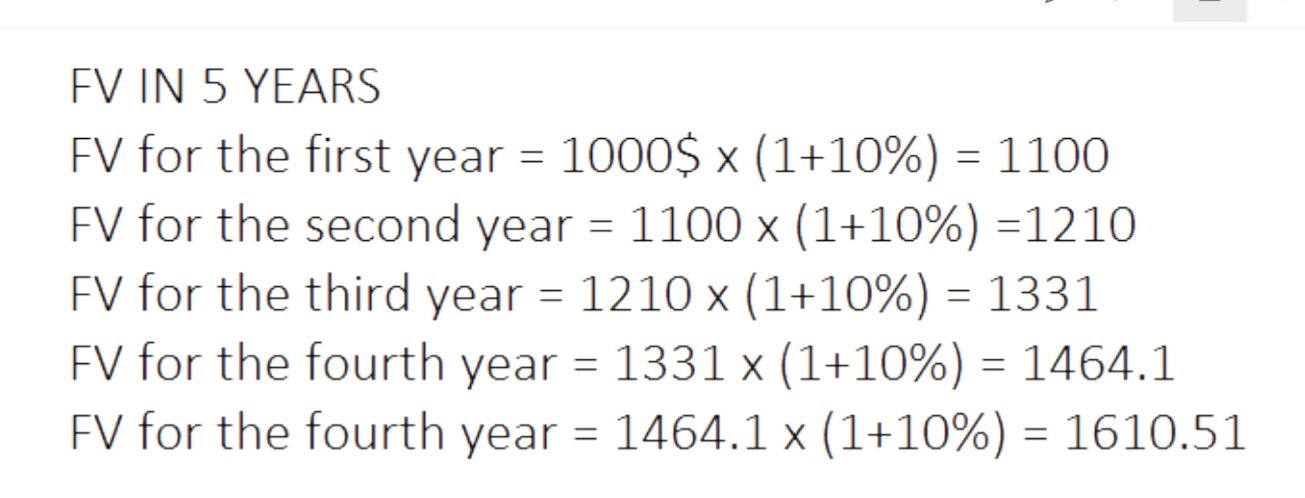
Notes if the interest rate is compounding monthly n is equivalent to monthly! if the interest rate is compounding annually and you want to determine the future value daily or monthly that is a different topic and we can discuss it next if you want! Do you want anyway? Thank you for reading. Ps. This is based from what I have remembered during my college days! :) I decided to share this because, I am computing the the interest that I will get from Nexo daily or yearly! Using apy I'll soon show you how it is computed! ;)



29 comments
Welcome to Nexo Sis. I am already using it as wallet. Daily NC tips go there directly for daily compounding interest.
Hehe do you want to take the chance in the mini quiz? And btw I have deposited there at nexo. Hehe I still don't have a clue, what will happen next hehe.
😂😂😂😂... This is real mathematics.... My eyes dimmed as it saw those equations. 😂
Hehehe yes math i hope it does not hurt the eyes 💚 you want to take a chance with the mini quiz? Hehe ;)
😂😂.. Not sure... Don't wanna embarrass myself..
Hehe 😅 I can correct and you can edit :)
Lolzz... Ok
Sumakit ulo ko sa mga formula, yoko na hahaha 😂
Hehe 😅 hala pangit ata explanation ko hehe
Hahaha di nmn. Yung utak ko lang pangit di na maintindihan yung mga formula.
Wahahaha oi same, nakatakot nga sila ahahaha.
Financial mathematics. Thanks for refreshing the very useful concepts when you get involved in the crypto market.
Thank you! I hope I deliver it as easy as possible.
Hirap naman naka relate bat nakakahilo yan 😵, nakakatakot uny mga formula ba yan yang mga number na yan. Parang manghahabol sila hanggang ss panaginip oi 😵
Hehe pag alam mo na kase yan hindi ka madadaya ng uutangan mo ako papautangin mo. Pede mo sabihin mars, oy yung interest niyan 10% compounded annually! Haha xD😅
Ay wag mo akong kausapin, nag aalien language ka 😵, chorrr ahahaha. Sabagay nga pero kasi, basta may listahan at calcu okie na yon wag na yang mga formula ahaha masakiy talaga sa banga haha.
Hahaha para alam mo din kung ilan iinvest mo sa nexo ;)
$10 lang un ee ahaha diko na minomonitor bahala na un sya ahaha
Oh! Ano yung credit line? Haha xD
Huh? Ah eh, uri ng pagkain?
Yun daw yata yung pwede mong utangin sa nexo😆 not sure hahaha
Oh depends sa funds na nilagay mo? Okieee
Opo
Good explanation and mathematical analysis. I agree wirt you. People say that compound interest is the 8th wonder of the world.
Thank you sir! 😃
My pleasure. :)
Hahaha basta simple interest yung triangle pattern ang sinusunod ko hahaha tapos natutuwa ako mag compute ng compound interest hanggang 10 years😂🤣🤧🤧🤧🤧🤧🤧 Iyan lang ata nagustuhan ko sa math jajaja chararat
Hehe di ko alam yang triangle haha
I went here to read this later. I heard that SM scholarship's exam has a topic like this. I will read your articles about Math😆