Is economical prosperity hurting you and your causes?
Does economical prosperity benefit you, or society as a whole?
It sounds like a really silly question, to which most people would reply *"of course it does!"*. Well, why wouldn't it? If something is good for your country's economy - or even global economy - it must be good for your country's society, and by an extension, you as well, right?
Tough it seems to intuitive, the reality is possibly the opposite. Economical prosperity might actually be hurting you. Why? How? Let's dissect it!
*"The economy is doing better than ever! Our nation's gross domestic product is rising! Unemployment is down! More job opportunities than ever!"*
*"The economy is doing better than ever!"* - What does that even mean? Better than what? Better by what standards or whose standards? Better in comparison to its past state? Better in comparison to another nation's economy? What does it even mean for an economy to be *"good"* or *"bad"*? What are we comparing here? GDP, national debt, unemployment, citizens' spending, or what? The statements *"the economy is doing good"* and *"the economy is doing badly"* are meaningless without any further elaboration on what are a supposedly good and bad state of an economy supposed to entail.
**GDP**. It's a cute little number, but it doesn't tell us much. High GDP per capita doesn't necessarily mean that a country has high standards of living or a happy population - it's literally a country's GDP divided by the amount of people who live in it. In a hypothetical extreme scenario, you could have a tyrannical state mega-rich in precious resources, making a ton of money by selling said resources *(which means high GDP)*, but the citizens might still be starving. Unless we are given some insight into the degree of wealth disparity and social stratification within a country, GDP *(whether per capita or not)* serves as a very poor indicator of the happiness or standards of living of a country's citizens. My Hungary has a GDP per capita roughly equivalent to that Uruguay, and is higher than that of Mexico, but the average Hungarian is depressed, while the average Uruguayan and Mexican are, at the very least, not depressed. GDP per capita doesn't even account for costs of living, inflation, etc.
*"Unemployment is down! More job opportunities than ever!"* - Yay, more diverse flavours of wageslavery available to the masses, yaaayy.....
Now, I don't make a secret out of the fact, that I don't like working. If I had a million dollars, I would retire immediately, because less than half a million dollars - 398 508 US Dollars to be exact - would be equivalent to earning my monthly wage for 50 years. Belle Delphine made 10 million pounds by selling her bathwater - roughly 13.781 million USD. If she retired right now, and rationed her money wisely, she would never have to spend another day of her life working - at least in Hungary.... where was I going again? https://read.cash/@Metalhead33/is-labour-saving-technology-inherently-statist-6999b3f4#all-the-things-i-love-and-hate https://www.telegraph.co.uk/technology/2020/12/05/meet-21-year-old-londoner-made-10-million-selling-bathwater/
Oh yeah, so I really, really hate work, and am actively looking for viable alternatives to having a day job. What does that mean in this context? It means that the whole *"Unemployment is down! More job opportunities than ever!"* means ****nothing**** to me. If you are unemployed and desperate, sure, it may be good news that fills you with hope *(not really, and I'll get into that in the next paragraph)*, but if you already have a job you're semi-satisfied with, or are a lazy and spoiled potato like me who doesn't even want to work *(or rather, wouldn't work if it wasn't de facto mandated by the current economical system)*, this isn't really news of interest for you, let alone good news.
As a matter of fact, I dare to say that *"good"* news like this are secretly more hurtful to those who are down, than bad news. Statements like *"The economy is doing great!"*, *"Unemployment is down!"* and *"Job opportunities in all-time high supply!"* blind ordinary people with euphoria, blinding them to the very real suffering of those, who don't get to enjoy any of the benefits of the supposedly good state of the economy. If the economy is doing *"great"* - whatever that's supposed to mean - it means that people get complacent, and at best, they'll acknowledge the existence of the economically disadvantaged as tragedies, and at worst they will outright ignore them. The economy doing *"great"* means there being no incentive, no desire for reform, no matter how necessary reform is in reality.
If the economy is doing so great, why am I still forced to trade eight hours of all my weekdays to survive? If the economy is doing so great, why do I still hate my job? Yeah, plenty of job opportunities, and every single one of them involve you giving up the lion's share of your day to earn your daily bread. Yes, I know, that's what a job is supposed to be, but I think all readers are seeing where I'm getting with this.
Damned if you do, damned if you don't
The economy is like the banks. If banks are doing great, you're not going to feel any advantages of it, unless you're a multi-billionaire hedge fund manager. But if the banks are doing badly, you're definitely going to feel it, potentially losing your job, your house, etc. The economy is the same. If the economy is doing badly, a large number of people get unemployed, lose their houses, lose their livelihoods, lose their life savings, etc. - but if the economy is doing *"good"*.... the effects for ordinary people are... meh? Or not even meh, because I just wrote like ten paragraphs about why the economy doing *"good"* is actually secretly bad for you.
Human suffering as a catalyst for positive change
When people are blinded by euphoria caused by buzzwords and meaningless statements like *"the economy is doing awesome!"*, no one cares about those who are down. If you are homeless, unemployed or just poor during a time of supposed economical prosperity, your existence might be acknowledged as a tragedy at best, if not outright ignored. People only start paying attention, when things are going downhill as a whole. When - quite ironically - you become a statistic. A million may be a statistic, but it definitely does a better job at convincing those in charge that reforms are needed, than a single person's or family's sob story.
https://commons.wikimedia.org/wiki/File:Joseph_Stalin_and_Georgi_Dimitrov,_1936.jpg
For my beloved Universal Basic Income to become a reality, a large enough number of people - a critical mass - needs to be rendered unemployable, to convince society as a whole that this whole work-or-die system is outdated. But even if UBI is not your thing, and you want the opposite - a small government with no more red tape - you still need a critical mass of people to be negatively affected by the current system and its policies. https://read.cash/@Metalhead33/is-labour-saving-technology-inherently-statist-6999b3f4#on-the-inevitability-of-ubi
As harsh as it sounds, **mass human suffering is the best catalyst for positive change**. In this war of attrition against an exploitative system that leaves half of the population knee-deep in the debt, and the other half dissatisfied with their jobs and lives as a whole, the only way to win is to increase the number of people screaming.
I am a vocal critic of Socialism, so normally I am against wealth redistribution of any kind *(unless it's Universal Basic Income, which is totally awesome)*, so I am just going to play the Devil's Advocate for Socialists: if you want the state to give you housing for free, you need to **increase** the number of homeless people to a critical mass, to the point where everyone is demanding the state's intervention. It doesn't matter what kind of changes do you wish to achieve: **human suffering is the best catalyst for reforms and change.**
**The goal is to render the current system unmaintainable, to the point where the powers that be give up on trying to maintain it at all costs. Either the ones in power will get up to fix their system, or their system will crumble, and from its ashes a new, better system will be built.** ****It's a war of attrition.****
Is copyright maintainable?
Is copyright maintainable? This might seem like a terribly silly question to many, but it is a serious question. As most of us browse the Internet and watch Youtube videos on a daily basis, copyright is part of our everyday reality, whether we like it or not. However, most people are completely ignorant about what is legal under copyright, and pretty much everyone unintentionally violates copyrights on a daily basis. Is this maintainable?
To put things into context
To put things into proper historical context, we need to define what is copyright, and when did it come to be.
**Copyright** is a legal monopoly someone has over a work - scientific invention, written text, image, composed music, audio recording, motion-picture, source code or computer program - and its distribution. It is very closely linked to the idea of **intellectual property**, which is the idea that just like tangible things, ideas too can be produced, stolen and are worth money. To have something as your intellectual property means that you get to decide how it is distributed, who can distribute it, and who has permission to create derivative works - typically, to derive from someone else's intellectual property *(or use someone else's intellectual property within your own work)*, you need to **license** their work, or else you are guilty of **copyright violation**.
Neither of these two concepts - copyright and intellectual property - are new, as both date back to ancient times, with intellectual property as we know it first being discussed in early-medieval Ireland, and early forms of copyright taking shape in the 16th and 17th centuries as a consequence of the invention of the printing press. However, the first truly modern copyright law was made in 1710: the Statute of Anne. Over time, during the late 18th century and early 19th century, copyright laws were established in France and Germany too, and were finally internationalized during the 20th century with the Berne Convention. https://en.wikipedia.org/wiki/Statute_of_Anne https://en.wikipedia.org/wiki/Berne_Convention
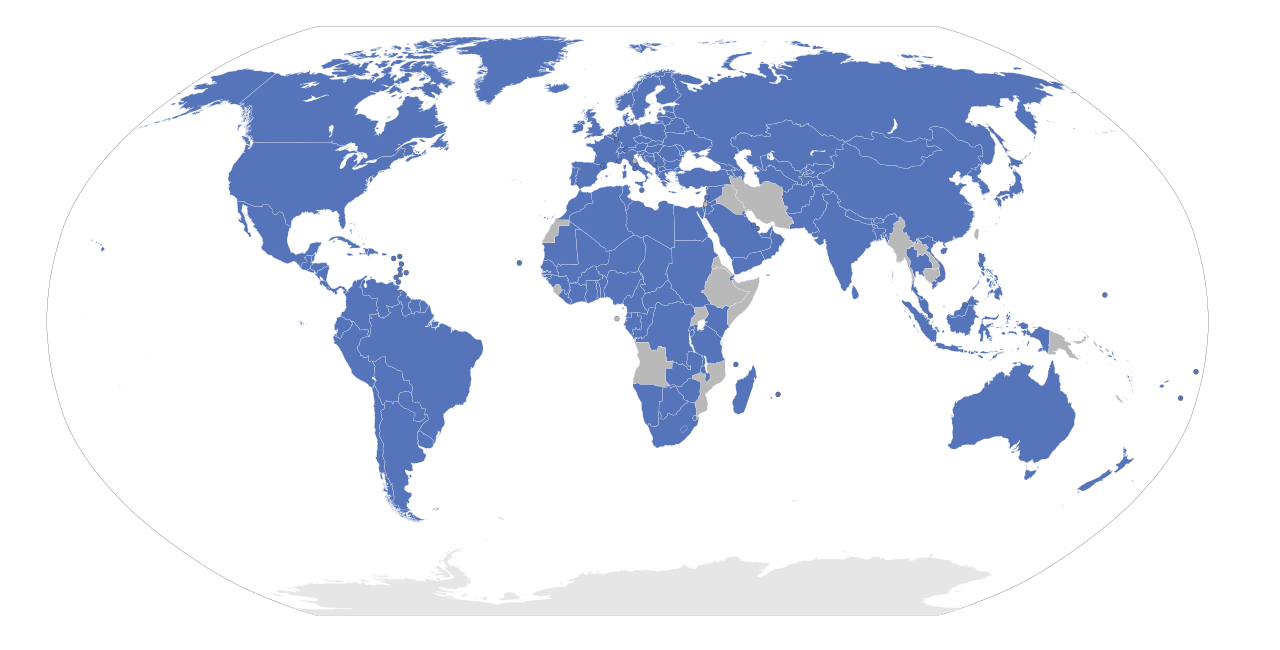
https://en.wikipedia.org/wiki/File:Berne_Convention_signatories.svg
As of 2021, pretty much all countries on Earth - save for a few African, West Asian and South East Asian countries - have signed and ratified the Berne Convention.
Copyright and the copied media
https://commons.wikimedia.org/wiki/File:Unitra_ZK-147.jpg
Copyright was rather easy to enforce until the 1970s. It was rather difficult to press vinyl records or shoot movies, pretty much only recording studios could afford to have reel-to-reel tape recorders. Most musicians were signed under major record companies that had lawyers at hand, most cases of plagiarism were either settled out-of-court, or were straight-up ignored, as *"imitation is the highest form of flattery"* was what musicians believed at the time.
We saw the first cracks in the enforceability of copyright appear in the 1970s, when both audio casettes and video tapes made an appearence, allowing people to straight-up record music and movies from radio and television respectively. Naturally, both the movie industry and the music industry - namely, the Recording Industry Association of America - were majorly irate, but in the end, the *"pirates"* won-ish...
https://www.clipsafari.com/clips/o166903-when-you-pirate-mp3s-you-are-downloading-communism
In the end, people retained their ability to record to their tapes and VHS, albeit quite obviously, they still went after bootleggers, who decided to sell said tapes for money. Recording music and movies from radio and television had one major disadvantage over buying them legally: quality. The quality of a consumer-grade casette tape storing audio recorded from the radio could never compete with the quality of a professionally-mastered tape, let alone a vinyl record or CD - the difference in quality was less noticeable on VHS, albeit it still had a higher-quality alternative for a time: laserdisc. Another fact that I neglected to mention is, that all of these tapes suffered from generation loss, which was one more reason to buy the real deal legally instead of illegally copying from a friend's copy. https://youtu.be/dUQ8ZkLVXBs
Further cracks appeared in the enforceability of copyright law, as generation loss was eliminated by the widespread adoption fully digital storage for audio and video alike: CD in the 1980s and DVD in the late 1990s. At first, they came in read-only formats that you had to buy - eventually, the rewriteable variants entered the scene as well, allowing people to make copies of copies of copies without any fear of generation loss.
Then the Internet appeared
I reckon that the final nail in the coffin for copyright as we know it was the Internet. Not only you could copy pictures, movies and songs from one disk to another - whether compact disk or hard disk - without any generation loss, but now you could also copy from and to the world wide web. As Internet speeds improved, compressed audio formats like MP3 made made it viable to share music on the Internet illegally.
You may not realize it, but when you download any random picture from Google, there is a high chance that you are violating someone's copyright. Yes, it's very silly, because your computer has to download the image into the RAM to even allow you to view the picture, but some people straight-up don't want you to download their images. Why put them on the Internet then? https://www.deviantart.com/morbidiamorthel/art/I-Won-t-Cry-for-You-99774789
Eventually, YouTube made its appearance, and copyright as we know it straight-up became obsolete. At this point, copyright-holders aren't even attempting to enforce their copyrights. They simply settled down with YouTube to create a content ID system, which allows copyright holders to harvest some of the ad revenue of any videos that contain their intellectual property.
Most Internet memes violate copyright law one way or another, but knowing how much backlash would there be from actually enforcing copyright law, copyright holders don't even bother to go after the memes.
So, what then?
**Public opinions on copyright have clearly evolved.**
Before the age of the printing press, writing wasn't really a full-time day-job that you could make a living out of. Most writers were writers secondarily, and primarily something else: monks, priests, bureaucrats, merchants, etc. But in the Western World, primarily monks and priests. Then came the printing press, which allowed the fast spread - and as a result, profiting off - of books, which necessitated the development of copyright.
However, as I said, starting from the 1970s, copyrights became increasingly harder and harder to enforce, and copyright holders have been fighting an uphill battle ever since. Despite that, attempts to enforce copyrights have become increasingly draconian, except when fear of public backlash is a concern.
The way I see it, copyright was originally invented to prevent **fraud**: to prevent people from passing someone else's work as their own and profiting as a result. However, as of 2021, copyright has evolved into a desperate attempt - mostly by big companies rather than individuals, especially ones that didn't even contribute to the production of the copyrighted material, merely happen to own the rights to them - to lock behind a paywall what cannot be locked behind a paywall.
As it stands today, copyright laws only apply, if you are wealthy enough to have them enforced. Small people can't afford to sue big companies, and can't afford to hire lawyers to defend themselves against copyright claims by big companies either.
So is it maybe time to abolish them?
The way I see it, as long as one credits the original authors, and doesn't intend to profit from their copyright-violating works *(big difference)*, they should be free to do whatever they want. The more we enforce copyright, the more we devolve into a statist world where you require a loicense for everything. In fact, if you ask me, the very existence of copyright and intellectual property negate our Freedom of Speech and Freedom of Expression, and every copyrighted statue limits your right to use your own private property by adding one more thing to the list of things you are not allowed to sculpt out of your stone with your own chisels. https://read.cash/@Metalhead33/is-labour-saving-technology-inherently-statist-6999b3f4
A world before and after copyright
So, if we got rid of copyright, how would authors financially benefit from their works?
Well, the answer to that is in the past... and the future, which is the present.
https://commons.wikimedia.org/wiki/File:Maecenas_Coole_Park.JPG
The answer to that is **patronage**. Until the appearence and widespread enforcement of copyright, works of art were **commissioned** by wealthy patrons. In fact, this system continued to coexist with the modern idea of copyright and licensing, and is making, or rather, has already made a comeback, in the form of Patreon, in the form of people commissioning art on DeviantArt and Pixiv, and even OnlyFans. These things are nothing new, but more like a return to an older state of things.
But this puts artists at the mercy of their audiences, right? Well.... doesn't the current system too? In fact, the current system is worse, because the record label has to like your songs before they sign you on, only to find out that the people have voted with their wallets, and they didn't vote for you.
But really, just like all problems, the problem of copyright and intellectual property would be solved with Universal Basic Income, which would allow artists to keep producing art and live comfortably even when it's not financially viable. https://en.wikipedia.org/wiki/Universal_basic_income
Review of the Rapeman franchise
This article is about a franchise of manga, anime and movies created in the late 1980s and early 1990s Japan.
**All images used in this article are protected under Fair Use, as this article is criticizing and reviewing the source material. Additionally, this article covers sensitive topics, such as sexual violence and crime. Reader discretion is advised.**
Premise
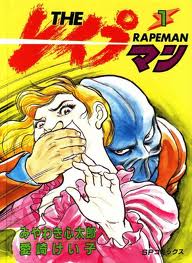
Rapeman is a series of manga, anime and movies revolving around a man named Iwasaki Keisuke and his uncle Tadao Haraoka. Keisuke is a *rapist-for-hire*, and Haraoka is basically his aide, the guy who handles all the administrative work and deals with the clients. That's right, your eyes are not deceiving you: Keisuke is a rapist for hire. Or more precisely, a twisted *"superhero"* of sorts, who is a handsome PE-teacher by the day, and a rapist-for-hire by the night, *"righting wrongs through penetration"* - not so much in the anime adaptation though, where his main objective seems to be to give his victims PTSD, driving them into the arms of more patriarchal authorities.
While the whole premise might sound like some incel's fantasy, in truth, the original manga was written by a woman named Aisaki Keiko. Running from 1985 to 1992, the original manga - which, much to my shame, I have never read - manga spawned a two-episode anime adaptation in 1994, and nine live-action film adaptations from 1993 to 1996, of which sadly I could only get my hands on five, and only managed to get English subtitles for four. Hey, these are obscure movies even by Japanese standards.
So, without further ado, let's get into it, shall we?
The Anime
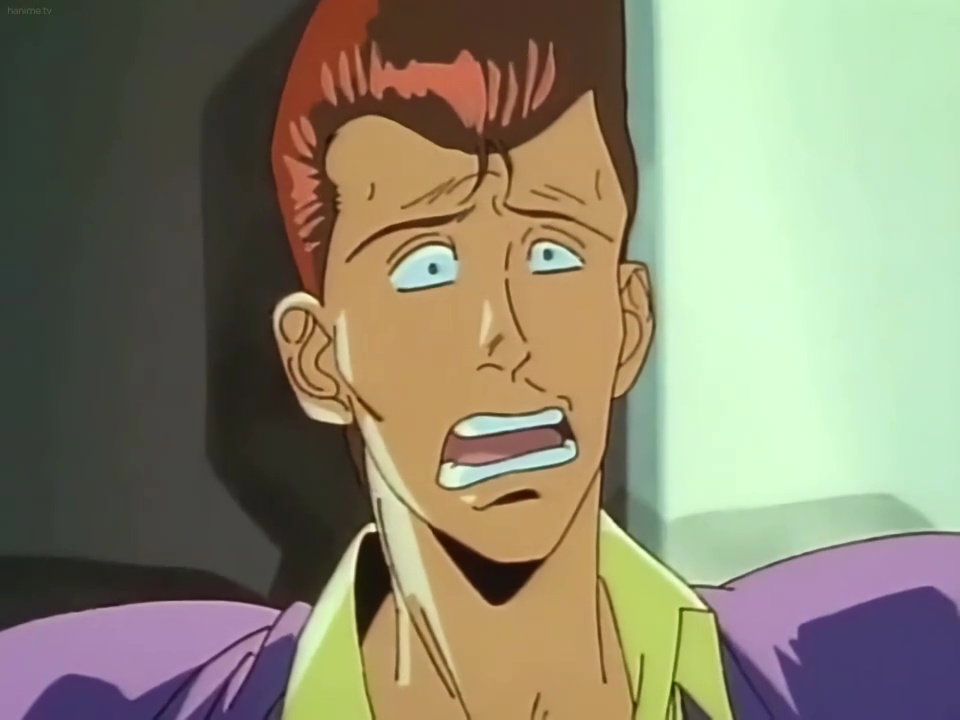
In 1994, the manga received a two-episode OVA adaptation, which features the Rapeman the way I just described him: a handsome if somewhat perverted and socially awkward *(but in the cute and attractive-for-women kind of way)* PE-teacher by the day, sleepy and moaning about wanting a raise, and a rapist-for-hire dressed in ninja garb by the night. His client is a man whose gold-digging girlfriend is cheating on him or something, and his first victim is said girlfriend. Afterwards, we see him doing his day-job by the day, only to receive the shocking news from his uncle Haraoka, that his next target is going to be one of his students - the superficial daughter of a yakuza family, whose parents are shipping her with their rough bodyguard, but the girl claims to like *"only handsome boys"*, and is dating some Kuwabara-lookalike.
Rapeman is hired by the girl's stepmom to rape the girl to make the Kuwabara-looking dude seem lame, and the bodyguard guy seem awesome. The plan works exactly as intended, the Kuwabara-looking guy pisses himself when Rapeman throws a katana next to him, while the bodyguard-dude gets wounded in the process of trying to fight off Rapeman, while the girl was already raped. The next day, we see the girl having broken up with the coward, and visiting the bodyguard in the hospital, putting flowers into his vase.
The next episode, Rapeman is hired by a burglar girl's father to rape her to dissuade her from criminal life. Not much else to say. After she becomes the third onscreen victim of Rapeman, she gives up the criminal life and starts to care for her father... and I guess they live happily ever after.
Despite the theme - nonconsensual sex - the anime is surprisingly... tame? We never see any male genitalia, the only NSFW parts of the anime are the female nudity and the moans, and even the rape itself is presented in an unrealistic way that makes it seem more like consensual BDSM than actual rape.
The anime has a clear anti-feminist message: all of Rapeman's victims are rebellious women who reject patriarchal authority and society's standards of how a woman should live and how a woman ought to choose her mate, and they get punished for it by Rapeman, who indirectly convinces all of them to accept patriarchal authority and *"know their place"* in society.
The anime also spawned an English-language parody, which I will cover after the movies.
The Movies
While the anime is not much to look at, the movies are arguably far more interesting. They definitely cover a much wider range of emotions than the anime: they simultaneously get to be funnier and darker at the same time, as they venture into different themes. On the funnier side, characters are constantly cracking jokes, and most of the time, Rapeman's victims actually end up enjoying *>>>it<<<* - but on the darker side, the movies also feature character deaths, even the deaths of plot-relevant children and teenagers *(albeit killed offscreen)*, and a few victims of Rapeman clearly shown being what they are: victims of rape, traumatized by the event. Despite the main theme, the Rapeman movies get to tackle serious topics, such as political corruption, dangerous cults, *(child)* sex trafficking and organ harvesting.
Between 1993 and 1996, a total of nine Rapeman live action movies were produced, six of which were set in modern-day Japan, and three of which were spinoffs set in Edo-period Japan. Out of these, I only got my hands on five of the main modern-day movies, and only got my hands on English subtitles for four, so out of nine movies, I only got to see four. These four, however, have a clearly established pattern.
The first four Rapeman movies all follow basically the same pattern with minor modifications:
1. Rapeman is hired to rape a woman who is not relevant to the plot at all. Once he does that, we never hear of her again.
2. Rapeman is then hired to rape a woman who serves as an important character to the plot, a catalyst to the plot.
3. Rapeman bites off more than he can chew, and gets involved in some nasty stuff.
4. Rapeman and his uncle Haraoka do detective work, expose the villains to the police, save some innocent people and rape some female villains in the process
5. Justice is served, everyone lives happily ever after - at least, everyone who didn't die
Oh, and I neglected to mention - in the movies, Rapeman gets a somewhat heroic streak, because he and Haraoka put almost all of the money they earn into charity, and are running an orphanage... meaning that they are basically sheltering and feeding needy orphans on the tears of rape victims.
Now, if you were expecting the movies to depict rape realistically or in graphic detail, you’ll be disappointed: just like the anime - the most family-friendly hentai ever - it doesn’t really show much. It doesn’t show male genitalia at all. It doesn’t even show female genitalia. Only uncovered female breasts, basically. And save for one victim, the women at one point seem to all start enjoying it. This is more like semi-consensual BDSM than rape.
The first Rapeman movie involves Rapeman having to rape a politician's wife, paid to do so by a woman pretending to be the politician's grieving girlfriend. Rapeman does the deed, but the woman almost commits suicide, which puts a strain on the politician's reputation. Then it turns out, that the woman who hired him is connected to a rival political party, which in turn is connected to the Yakuza. So, Rapeman does his thing, and together with his uncle Haraoka, they bring justice to the elections, and expose the corrupt party, which causes his first victim's husband to win the election.
The second Rapeman movie involves a criminal connection between a hospital and the Chinese triads, which results in the first character death in the movies: the death of a little girl *(killed by the corrupt hospital staff to harvest her organs)*, who was in Haraoka's orphanage. As the formula dictates, Rapeman and Haraoka play detective, uncover some ugly truths, and then right wrongs through penetration, before finally calling the police and making sure that all of the villains are arrested.
The third Rapeman movie involves a connection between drug dealers, sex traffickers, corrupt cops and school staff. This is the one in which the second character death occurs: the offscreen death of a teenage girl in drug overdose, a bullied outcast that was comforted by Rapeman the day before her death. The authorities declare her death to be from suicide, but Rapeman refuses to believe it, so as the formula demands, he goes on a detective quest, and uncovers an unholy alliance of greedy teachers, sex traffickers and corrupt police officers, who intentionally killed the girl, and are trafficking schoolgirls into prostitution. As usual, Rapeman rights wrongs through penetration, and manages to ensure that justice is served.
The fourth Rapeman movie involves a connection between a creepy sex cult, and some corrupt politicians. Basically, Rapeman gets to expose the cult for what it is, and makes sure that everyone gets to know the truth. It's interesting to note, that the fourth Rapeman movie was made in 1994, just one year before the Tokyo subway sarin attack in 1995 by Aum Shinrikyo, a notorious cult in Japan. https://en.wikipedia.org/wiki/Tokyo_subway_sarin_attack https://en.wikipedia.org/wiki/Aleph_(Japanese_cult)
Sadly, I couldn't get to see the fifth and sixth Rapeman movies, as I could not even get my hands on the sixth on in the first place, and while I do have the fifth on my computer, I don't have English subtitles for it. But, knowing how much the first four stick to the pattern, I'm probably not missing out on much.
In addition to six Rapeman movies set in modern-day - or rather, 1990s - Japan, three Rapeman movies were produced that were set in Edo-period Japan, or during the existence of the Tokugawa Shogunate *(1603–1868)*. I doubt that Japanese women had the political power necessary to be arch-villains at the time, but hey... Maybe one day, when I get my hands on those three, I'll get to see how does the Rapeman-formula look when mixed with samurai drama.
Nevertheless, I genuinely enjoyed the movies I got to watch. On a more tragic closing note, the actor playing Rapeman, Hiroyuki Okita commited suicide in 1999. I guess he could right all sorts of wrongs through penetration, just not the ones who were haunting his soul, The actor playing Haroaka, Sakae Umezu died in 2016.
Despite their deaths, Rapeman’s journey did not end there...
The English-langauge parody
Some time before 2012, a bunch of people - whoever was running the Youtube channel WeeklyTubeshow2 - thought it was a good idea to make a parody of the Rapeman anime by re-dubbing it in English, cutting off some scenes, changing the story completely.
All mentions of Rapeman and his dayjob are completely removed. He is dubbed by someone with an African-American accent. None of his victims have names anymore, but all of them seem to enjoy being raped by him. No excuse is given for hiring him anyway.
In the second episode, he seems to just rape the thief for no reason. Still, the parody is littered with awesome lines such as, *"***** you ain't slick, you gonna **** this ****!"*, *"When I cut you off the path, you gonna take it in the ***!"* and *"Boom shaka-laka, it's dang-alang time!"*.
Definitely, 100% recommended.
In conclusion
I personally liked the Rapeman movies I got to see. They consist of a healthy mix of black comedy and social commentary, even if the central theme will alienate most people. I definitely recommend watching them.
But is there a moral to Rapeman? What can Rapeman teach us? I think he can teach us several things, such as...
**Looks can be deceiving.** Behind the charming smile and a friendly demeanor, a rapist can hide.
**Humans are multi-faceted, complex and three-dimensional.** We like to reduce people to singular traits - whether positive or negative - or to their occupation, or to a single crime they commited, or to a type of crime they habitually commit, etc. But Rapeman shows us, that in reality, people are complex. Iwasaki Keisuke is not just a rapist - he is also a philanthropist *(most of his income goes to charity to fund an orphanage)*, has a soft spot for the kids, an unofficial part-time detective solving crimes, and is rather selective about his targets, as he hates going after those who don't deserve it according to him. Rapeman may be a rapist-for-hire, but he clearly has a softer side, and is contrasted by villains who commit crimes much much worse than rape.
**There are crimes worse than rape.** In this day and age, we like to think as rape - that is, the act of forcing yourself on someone and penetrating them without their consent - as the worst crime one can possibly commit, as it tends to leave a traumatized victim prone to suicide. But the Rapeman movies depict villains who commit far worse crimes, people who deserve punishment for worse than Rapeman. Rapeman gets to fight against villains involved in child sex trafficking, illegal organ harvesting, the murder of a little girl and a teen-aged schoolgirl, political corruption, brainwashing people into a creepy sex cult, etc. Compared to these people, even the rapist Rapeman is a hero.
Work ethics and the "virtues of honest work" are a cope rooted in jealousy
This article of mine was originally a Youtube video, which you can still watch here. https://youtu.be/G5mvItZUuhc
They're all connected!
Economics, politics and culture are interrelated. You can't alter the economical system meaningfully without there being a political will to alter it, and politics is downstream from culture. **So it stands to reason, that economics is ultimately downstream from culture as well.**
So with this in mind, whenever I talk about the future of automation and Universal Basic Income, I always say, that **this is primarily a cultural problem, not an economical problem**. https://read.cash/@Metalhead33/is-labour-saving-technology-inherently-statist-e69bf4f7
If we abandon the notion that work makes one noble and *"he who does not work shall not eat"*, then robots will build us a real utopia.
But if we insist that he who does not work shall not eat, then the robots will drag us into a real dystopia, kicking and screaming.
People often say that money is the root of all evil, but this statement couldn't be any further from the truth. Bill Gates is one of the most charitable people on the planet, Universal Basic Income counts amongst its supporters billionaire capitalists like Elon Musk, Jeff Bezos, Mark Zuckerberg, Jack Dorsey, Tim Draper and Götz Werner.
So why don't we have Universal Basic Income then? https://en.wikipedia.org/wiki/Universal_basic_income
The reason is simple: **culture**. Money doesn't make you greedy, but having had to suffer during the process of acquiring money does, at least to most people. Unless you are a super-resilient soul, torture makes you evil - most pedophiles and child abusers were abused as children themselves.
Misery is the true source of evil
Universal Basic Income is opposed by jealous proletarians, because they can't stand the idea of people in the future having a better life than them. When people experience something negative, a common coping mechanism is to wish it upon others. A common Hungarian saying is *„Ha megdöglött a tehenem, dögöljön meg a szomszédé is.”*, which literally translates to *"If my cow dies, the neighbour's cow must also die"*.
Bogged down in wageslavery and 8-hour workdays in a shitty factory? Wish it upon everyone, pretend it's part and parcel of adulthood, and resent the hell out of people who escaped such a fate, like PewDiePie and Belle Delphine.
Lost two years of your youth due to mandatory military service? Wish it upon everyone, pretend it's part and parcel of being a man, and complain about the current generation of men being effeminate, offering conscription as a *"cure"*.
I'm sure everyone reading the article can see a clear pattern here.
He who does not work.... shall not eat?
It is foolish to blame the rich, when the poor themselves have a mentality that only solidifies the current system. *"He who does not work shall not eat"* is the credo of the secretly resentful wageslave, not of the successful capitalist, who is most likely not as nearly as greedy as the stereotypes make him out to be.
Ultimately, deep down, the wageslave resents being a wageslave and wants to escape it. He's jealous. Why wouldn't he be? But he is ashamed of it, feels guilty about it, and hides it, out of fear. Because he grew up in a culture that glorifies work above all else.
The so-called *"virtues of hard work"* are nothing but a lie propagated as a coping mechanism, born out of jealousy for those with better living conditions.
The phrase *"He who does not work shall not eat"* originates in the Bible, but do you know what else originates in the Bible? **The idea that jealousy and envy are sins.**
The phrase *"He who does not work shall not eat"* originates in an era where food was scarce, while job opportunities were plentiful - today, our reality is the complete opposite: food is so plentiful that more than half of it is wasted, while job opportunities are getting more and more scarce. Christian work ethic has nothing to do with wageslavery, because Christian morality also includes the idea that sharing is caring - Christian work ethic is about working to better society and spending your energy helping people, not about being a wageslave for some company that produces goods ordinary people can't even afford, or don't even need.
Does work ennoble you?
This article of mine was originally a Youtube video, which you can still watch here. https://www.youtube.com/watch?v=DmL980XFK_M
*"A munka nemesít"*
In the Hungarian language, there is a phrase that goes *"A munka nemesít"*. What does it mean? Well, it depends on how do you translate the final word, because unbeknownst to most Hungarians, the verb *"nemesít"* has two meanings.
The first and most widely used meaning is *"to ennoble"*, *"to make noble"* - which is to say, that with that meaning, the whole phrase roughly translates to *"Work ennobles you"* or *"Work makes you noble"*. Does it though?
From my real-life experience, I noticed the complete opposite: the modern reality of work , wageslavery, turns formerly cheerful, idealistic and charitable children into depressed, miserable and apathetic adults.
It turns children whose reaction to seeing someone in distress is *"We need to help him!"* into adults whose reaction to the same thing is *"So? Who cares? I have bigger problems at hand!"* or *"If my cow dies, the neighbour's cow must also die!"*. No. Work as it is commonly understood in the 21th century - wageslavery - is anything but ennobling to the soul. Quite the opposite, it is corrupting to the soul.
So what about the second meaning of the verb *"nemesít"*?
Unbeknownst to many Hungarians, the verb *"nemesít"* also means to refine, to domesticate. From a human point of view, domestication IS refinement.
We refined the paleolithic man's worst enemy - the wolf - into man's best friend, the dog.
We refined the puny teosinte into the mighty maize. We refined melons from something the size of a fist, to something the size of an infant. https://en.wikipedia.org/wiki/Teosinte
So domestication must be good, right? Wrong.
Domestication may be good from a human point of view, but from the point of view of the animal or plant being domesticated, it is a big negative. Domestication turned formerly self-sufficient animals into animals that depend on humans for survival. Domestication took perfectly healthy plants and inflated their reproductive organs to a grotesque degree, while also making them dependent on humans.
Domestication turned the wild horse - symbol of freedom and independence - into a glorified pack mule. Domestication turned the mighty wolf into the pathetic pug. While the wolf is a symbol of freedom, liberty, strength and nobility, the dog is a symbol of loyalty and servility.
Are wageslaves not domestic animals? Completely dependent on a system which exploits them, deprives them of their free time, their connections, their families, their health? Fattening them up with unhealthy food, before they are too old and worn out to work, dying an early death from the unhealthy lifestyle.
Is labour-saving technology inherently statist?
****Warning!**** **This article was written by me a very long time ago, and no longer accurately reflects my views! Reader discretion is advised.**
All the things I love and hate...
I have an admission to make. I hate two things, and getting rid of one of them makes it impossible to get rid of the other. Or, more precisely, I have affinity towards two inherently contradicting ideologies that each respectively involve getting rid of one of those two things I hate. The things I hate are **Statism** and **work**, and the things I love are **Anarcho-Capitalism** and **Universal Basic Income**. We obviously can't have both.
Under Anarcho-Capitalism, even the air you breathe and the ground you walk on costs money - but at least there is no governmental red tape to prevent you from earning that money.
Since UBI is literally government handouts for everyone *(including those who don't need it, since it's Universal)*, it makes people depend on the government, and the more you depend on the government, the stronger it becomes, which exponentially increases the risk of it one day going full 1984 - if you depend on the government for survival, you cannot offer any resistance to government tyranny.
We can't really have both, because if we abolish the state, who will give the free money to the people? Maybe if the government is Minarchist, and is basically a Night Watchman State with the added job of giving citizens UBI, but that's another rabbit hole this article won't getting into. https://en.wikipedia.org/wiki/Night-watchman_state
The current system we have is a shitty in-between cursed middle-ground, where you have to have a job and work to make a living *(even though most people's jobs are useless and aren't really producing anything essential or even remotely useful to society)*, while at the same time, government regulations, taxes and red tape make it difficult for people to start their own businesses and compete honestly - making wageslavery the only viable option for most people.
Huh, that was quite a long segue.... Where was I going with this?
On the inevitability of UBI
When I talk about how Universal Basic Income is basically inevitable, and how robots taking all our jobs is inevitable - and that maybe it should be actually celebrated, rather than opposed - I always run into naysayers. https://www.youtube.com/watch?v=7Pq-S557XQU
These naysayers either get stuck up on little technical details - such as the questions of *"Who will finance it and how?"* -; or start moralizing about how everyone is ought to be a productive member of society, no matter what; or, they'll just be in straight-up denial about the progress of automation and the inevitable effects of technology.
So, I am just going to lay our cards on the table.
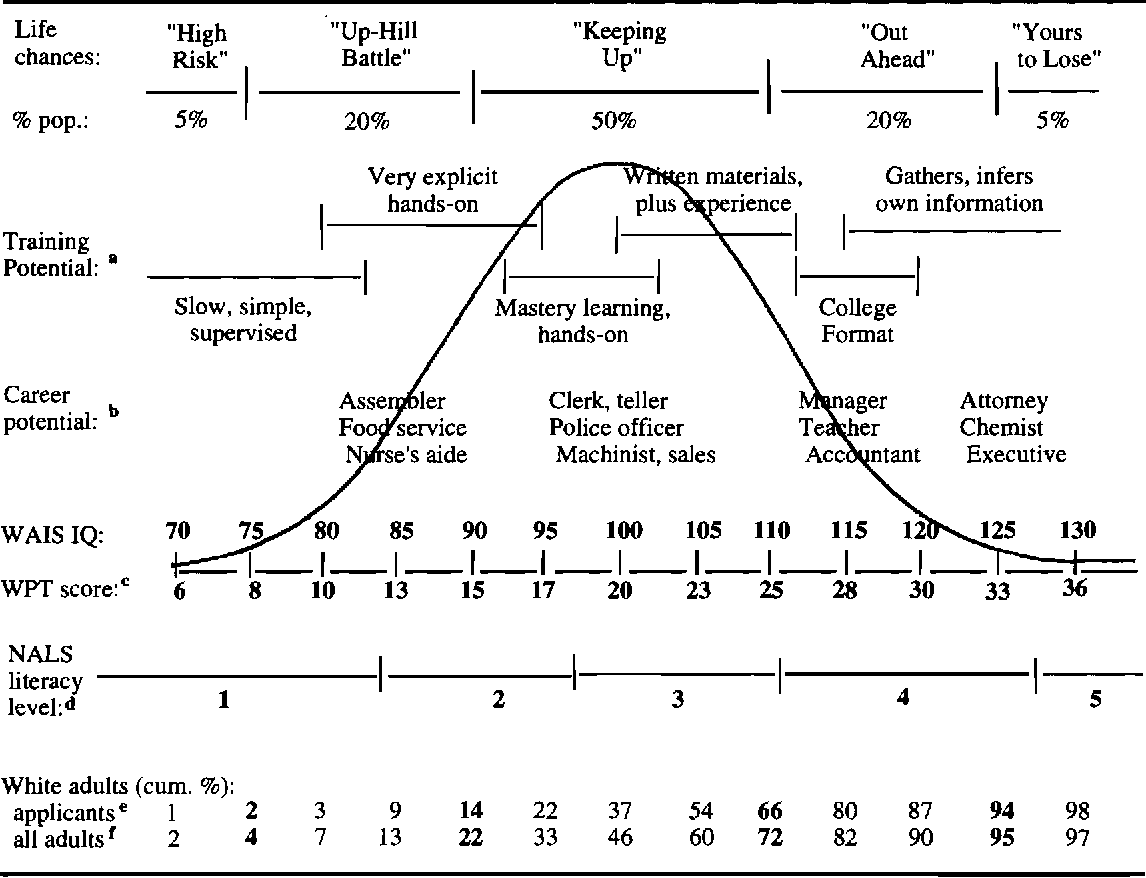
If your IQ is below 80, you are pretty much only fit for slow, simple and supervised work, at least according to this picture. If your IQ is above 80, but below 90, you are fit for very explicit hands-on work. You need to have an IQ above 100 to do hands-off work based on written materials.
What's the problem here? The problem is that these are the jobs that are getting automated. Explicit hands-on and simple supervised jobs are the ones at the highest risk of getting automated away, but even higher-class jobs aren't completely safe.
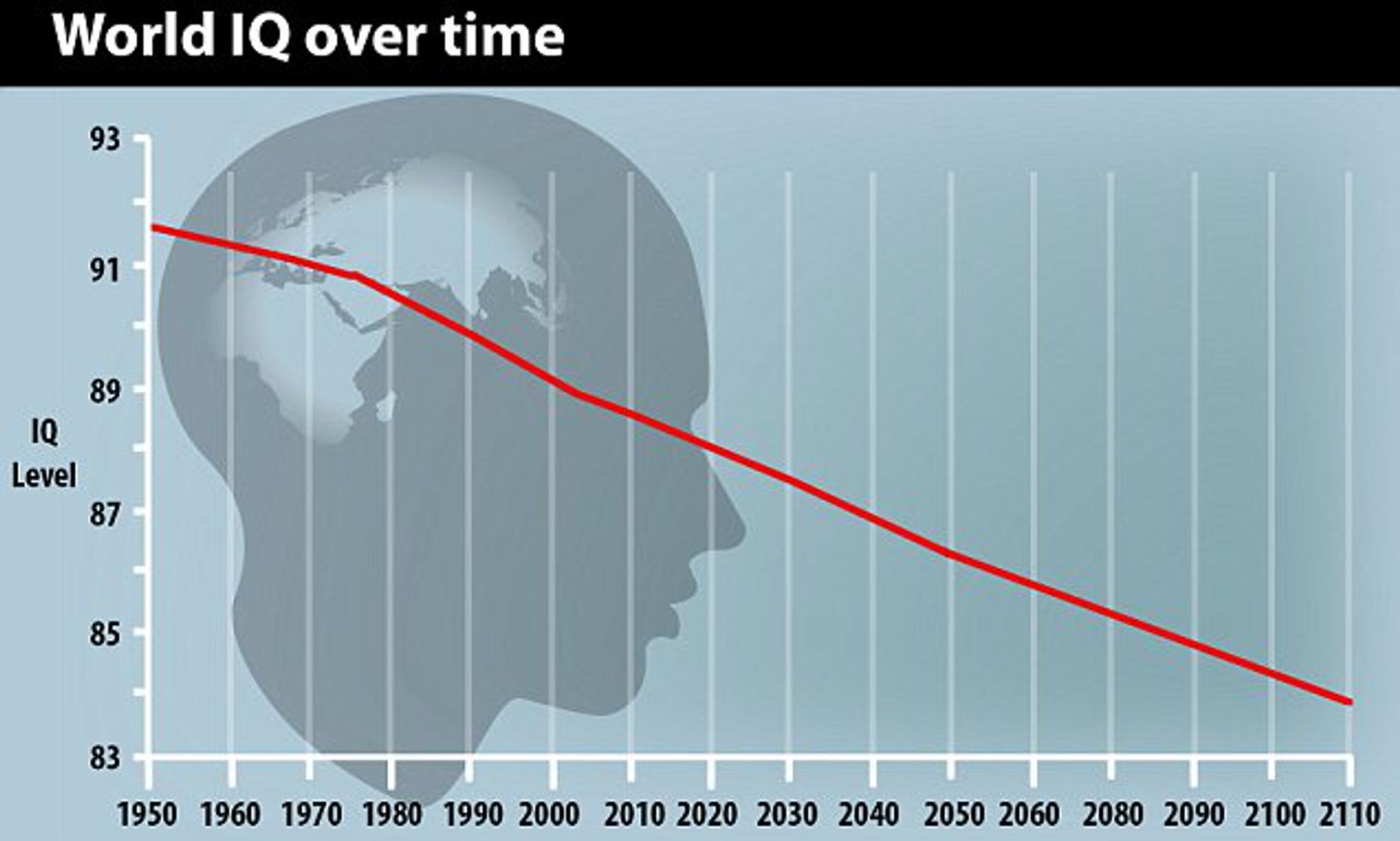
The point I am making here, is that labour-saving technology kinda increases the minimum required IQ to enter the workforce, it raises the bar.... while at the same time, global IQ levels are declining, not increasing.
Naysayers often say, that while it is true that every technological breakthrough initially creates mass unemployment, employment always comes back as new jobs are created. However, that is not exactly true.
When the internal combustion engine was invented, did horses get more jobs? No, they were gradually displaced, and are now mostly luxury pets for modern-day aristocrats. Humans have an easy time accepting the reality that trains and cars replaced horses, but somehow get confused when we apply the same logic to robots and humans.
Robots don't eat, don't sleep, never need to take a break, they only require electricity and occasional maintenance. On the long run, they are cheaper than human workers, and their abilities are growing by the day. One day, they will even replace software developers like me.
It doesn't matter if that day is going to come in a couple of years or a couple of centuries. It's coming, we can't stop it, and to be honest.... do we even want to?
When we arrive to the point, where robots can easily produce enough food, clothing, and even housing for just about every human being, and also do pretty much all jobs better than humans... Do we want all the displaced workers to starve to death, or will we re-think how our economy works, and make work optional, by implementing UBI? https://www.youtube.com/watch?v=Gc_nLK4ji_k
No matter how we look at it, the writing is on the wall - labour-saving technology makes the current work-or-die system unsustainable. More and more people will become **unemployable**, and will either starve to death or become welfare rats. The ones remaining in the workforce - mostly doing non-essential jobs, heavily divorced from the fruits of their labour - will have to pay more and more taxes to sustain the growing number of unemployable, while increasingly sophisticated automatons will produce more and more goods for people who can't afford to buy them.
In the Paleolithic, everyone was involved in food production. During the Neolithic, we went from everyone being involved in food production, to just the majority being involved in food production, with the rest of the population specializing in craftsmanship and artisanship. During the Industrial Revolution, farmers became the minority, and factory workers became the majority. During the 1960s, the developed world experienced unprecedented levels of automation, driving much of the workforce into the service sector. And now, both manufacturing and service are *"in danger"* of getting even more heavily automated than ever.
Methinks, that if current trends continue, we'll arrive into a future, where only a minority of people will need to work to maintain society. But we'll have to culturally adapt to that, and do away with the old scarcity mentality. And all the naysayers are making it obvious, that they are not ready for it yet.
Okay, we just implemented Fully-Automated Post-Scarcity Luxury Gay Space Communism, now what?
With Universal Basic Income implemented, no one has to worry about losing their jobs to robots anymore.... or more precisely, no one has to worry about starving or losing their home if they lose their job, because UBI ensures that they never fall below a certain level. And so, we'll keep approaching the point where literally every job is automated, but until then...
... the fancy suit-wearing baboons in the government will realize, that everyone has come to depend on government handouts. That means that the government can basically do whatever it wants, and people have no right to complain, because complaining and revolting would be biting the hand that feeds. That means that there is a clear road towards going full 1984.
If your livelihood depends on the government, the government can easily just take away your income for *"thoughtcrimes"*. The government can easily go full Orwell on you, and no one will step in for your defence, because that means they will lose their income too. At worst, it's going to be 1984. At best, it'll be like Demolition Man - and if you haven't seen that movie, go watch it now, it's really good... and also a really eerie prediction of our dystopian future.
And so, that means, that I just answered my own question: **labour-saving technology is inherently statist, because it reduces ordinary people's ability to be self-sufficient.**
So, what we do we do then?
Pick your poison:
**A) Anarcho-Capitalism:** Everything comes with a price tag attached, meaning that you have to purchase everything - even the air you breathe - with the sweat of your labour. Fine if you're a masochist who actually loves to work, a shit deal if you're as lazy as I am, or for some reason genuinely cannot work *(disability, etc.)*.
**B) Universal Basic Income, or Fully-Automated Post-Scarcity Luxury Gay Space Communism:** Work is optional, and you can have a comfortable life without having to work, but if you step out of line, Big Brother will punish you for your thoughtcrimes. Fine if you're an NPC, a shit deal if you're as independent-minded as I am.
**C)** The current system, the cursed middle-ground, which really is the worst of both worlds. Most things come with a price tag *(including food, water and electricity)*, but employment opportunities are scarce, the government taxes the **** out of everything and regulates the hell out of businesses. You're punished for not having ambition *(have to have a job to survive)*, but you're also punished for having ambition *(business regulations, income tax, etc.)*
Or, pick the fourth option: **return to monke**.
 @Metalhead33