Top 10 Magazines and Blogs to follow in VR/AR/XR Space [2023 List]
While browsing the web in search of VR and XR websites, I noticed how outdated most of the catalogs are. Some publications have grown bigger and more prominent over the years, while others have withered down or gone dormant. Most existing directories don’t reflect those changes.
The list below aims to rectify this. It includes some of the most prominent, useful and regularly updated virtual reality (VR) augmented reality (AR) and Extended Reality (XR) blogs, magazines and websites. The list is not made in any particular order, but I did consider factors like traffic and citation numbers. [Disclosure: I’m also a guest contributor at two of those publications.
**RoadtoVR** — Founded in 2011, RoadtoVR is the longest-running VR publication, and just like back in the day, it still serves fresh and relevant news on a regular basis. https://www.roadtovr.com/
**UploadVR** - Part of UVR Media Company, UploadVR is not just a publication but also hosts its own gaming showcase, weekly in-VR show, and more. https://www.uploadvr.com/
**Mixed-News** — A versatile outlet that features a lot of news from the VR gaming world, art, research, and XR and MR hardware. Updated daily. https://mixed-news.com/en/news/
**ARpost** — As the name suggests, ARpost focuses mostly on augmented reality articles, but doesn’t shy away from virtual reality, spatial computing, and other immersive-technology-related news. https://arpost.co/
**XRDailyNews** — A relatively new addition to the XR landscape. Offers regular news, reviews, and updates. https://xrdailynews.com/en/home/
**Immersive Wire** — Newsletter delivered to your mailbox every Monday containing a summary of whatever major VR, AR and Metaverse news and events happened that week. Its angle is professional and business oriented but it features a lot of interesting takes and scoops you might not find elsewhere. https://www.immersivewire.com/
**The Ghost Howls** — An XR publication that’s also a blog. Written by highly cherished Tony Vitillo “SkarredGhost” it combines insights and impressions with a blog-like personal approach that’s peppered with humor. Features regular articles as well as “The XR Week Peek” weekly newsletter. https://skarredghost.com/
**Lowpass** — Substack-styled blog that offers both free and paid versions. Aggregated by Janko Röttgers who writes both for the big tech venture-backed media (The Variety, Protocol) and independently so expect XR news mixed with traditional tech like smartphones, consoles, and such. The paid tier is $8 a month. https://www.lowpass.cc/
**VRscout** — Another older publication that continues to remain active. In VRscout’s own words their website “Shines a light on the advancements in VR & AR.” https://vrscout.com/
**6DOF Reviews** — A gaming magazine that also features hardware and accessory reviews as well as other VR-related news. https://6dofreviews.com/
Combined, the above publications provide an up-to-date, comprehensive, and diverse source of information on the ever-changing XR landscape. Subscribe to all and I guarantee you will know more about VR/AR than 99.9% percent of the population.
There are also plenty of mainstream media outlets that cover VR and AR news like The Verge, Venture Beat, Cnet, Engadget, and many more, but they are not XR exclusive and tend to have broader and often debatable takes that cater to a more general non-XR audience.
There are also a lot of valuable audio-first podcasts out there. The ones to start with would be Kent Bye’s VoicesOfVR and Between Realities. Kent is an experiential journalist, and Between Realities hosts AlexVR and Skeeva work closely with UploadVR. Both podcasts strongly focus on guests and are essential in amplifying various XR creators and personalities that inhabit the space. https://voicesofvr.com/ http://betweenrealities.tv/
Have a great day and keep on rocking in the XR world!

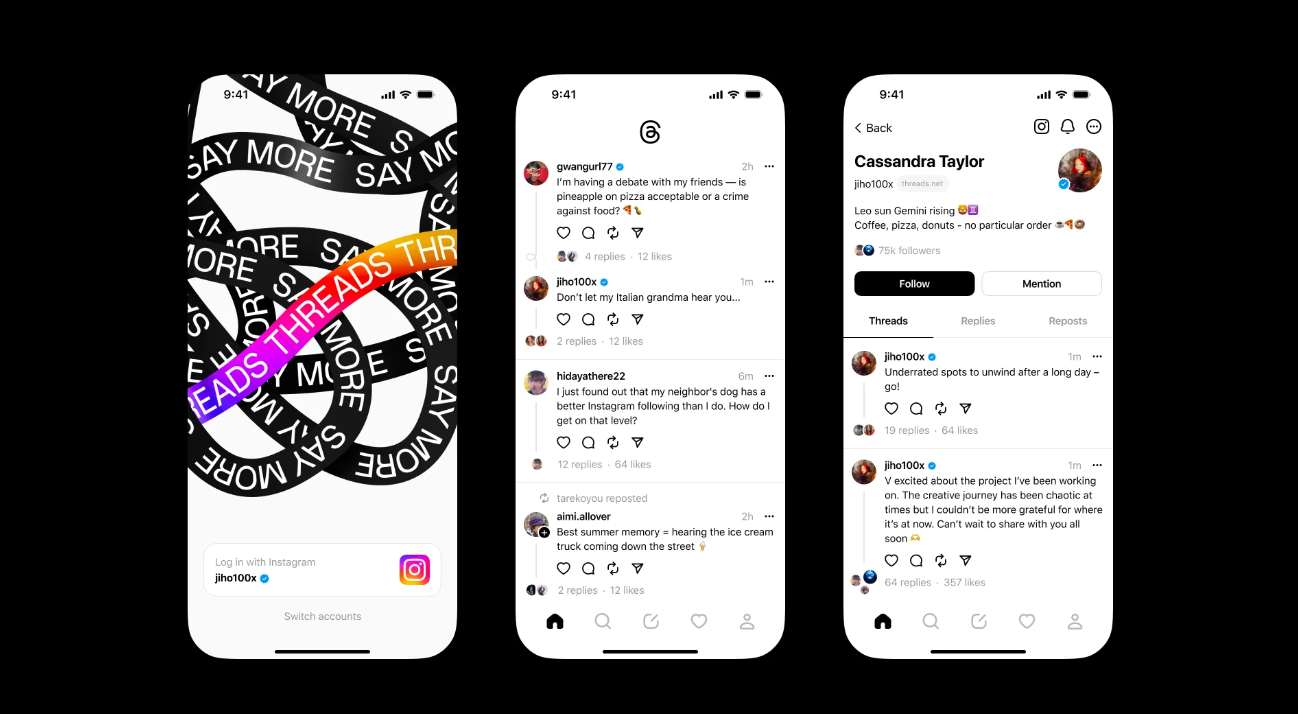
Threads Review: Observations, Opinions and Reflections
Over the past two weeks, I have been making a conscious decision to incorporate Threads into my daily social media routine. The goal was simple — to evaluate its features, scrutinize its user experience, and gauge it’s potential. Whether it managed to impress, disappoint, or a bit of both, this review will give you my firsthand experience navigating Threads.
**Instagram ancestry**
We are still in the app’s early days but for now, its Instagram heritage is clearly showing. For those who use Instagram daily, this can be a source of familiarity but personally I found the experience lacking.
The biggest letdown is that there is no search function, meaning there’s no path for content discovery. I would love to know what Threads’ users are saying about virtual reality but cannot access that information. There’s no search option on Instagram either, but Instagram is primarily image-based and network-oriented. Treads is not.
On Instagram, you scroll through posts by your friends, acquaintances and influencers and most users don’t feel the need to go beyond that. Instagram’s algorithm will recommend new people to follow but tends to keep users in their space. There’s no real need for a search function.
TwitterX, on the other hand, is quite generous in its understanding of what constitutes as your network. Users often wind up interacting with strangers and people outside of their direct reach simply because of how retweets work and how various people engage in (often divisive) group discussions. This is not everyone’s cup of tea. Those experiencing TwitterX burnout might welcome the less confrontational and more close-knit nature of Threads.
**Interactions & Posting**
Which brings me to the other point. It’s not just the layout and software that borrows heavily from Instagram. It’s also the entire culture. Even if millions of users came over from X, the vast majority of the 150 million users will be Instagram natives. As a result, the userbase crossover between Instagram and Threads is much bigger than between Threads and any other social platform. Instagram users have their habits and conventions, so Threads still exhibits a lot of characteristics of the Instagram culture.
Again, for some, this might be a source of familiarity but I found the interactions to be too superficial. A lot of posts (threads) will have plenty of likes but no comments, or just comments consisting of emojis. Accounts with a large following will be hesitant to engage with followers. Post exchanges between celebrities, retweets that either amplify or bash, all that is almost non-existent. Because Instagram is based on a mostly unidirectional creator-follower dynamic, Threads has inherited a similar feel by extension.
**Browsing and Scrolling**
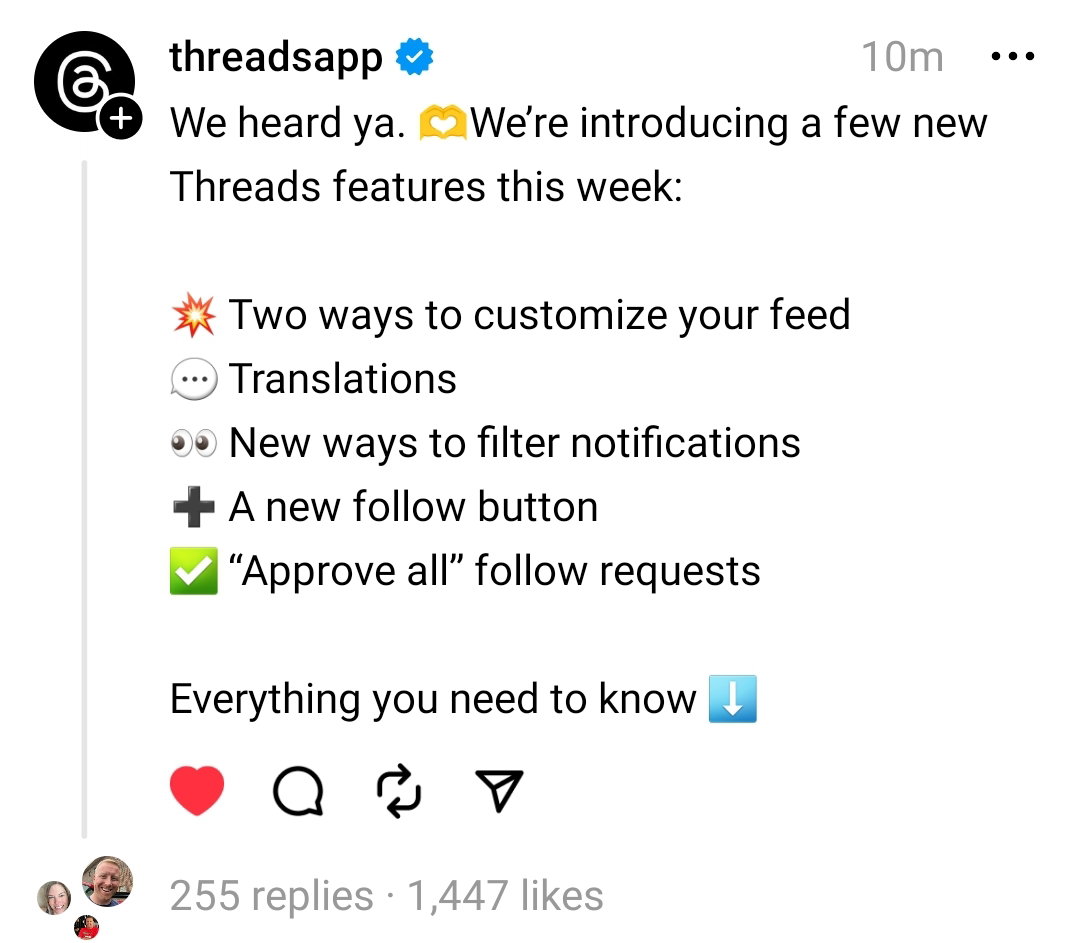
One thing that some users poined out was the lack of an option to switch the recommendation algorithm off — a feature that’s available not just on TwitterX but also on most of its alternatives. On Tuesday, the platform addressed this feedback by introducing a new tab. This tab enables users to view chronological posts from the accounts they follow and grants users more control over their content consumption. https://www.cnbc.com/2023/07/25/meta-threads-gets-chronological-feed-for-people-you-follow.html
In my case, I was happy with the selection, especially since I didn’t have a substantial Instagram network prior to joining Threads so a chronological feed would make little sense. Suggestions so far seem mostly geo-location based, but this might be different for everyone.
One issue that users currently bring up is a lack of direct messaging (DMs). Others mention no browser or desktop version and no way to embed posts into articles, which limits Threads’ appeal as an “announcement platform”.
A web version of Treads would perhaps incentivize people to post more and longer, especially since Threads offers users a canvas of 500 characters (TwitterX has 280-character limit for unverified users), but again, none of these really bothered me, especially since most of those features are apparently coming soon. Just like with the chronological feed, there’s little doubt that direct messaging, search function and the web version will also make their way into Threads.
There’s something inviting and appealing in the minimalistic approach that Meta has taken with Threads. The design seems barebones but pleasant. I found myself hopping back into the app with pleasure, but then again, I would not spend more than 20 minutes daily, so, for me, it served mostly as an enjoyable distraction rather than a place to find news or network.
**Final Thoughts: Is Threads going to make it?**
This is still a very fresh and dynamic field and the news keeps coming every day. Just a few days ago, Yahoo reported that Threads’ average daily usage dropped from twenty-one minutes to six but at the same time, new users continued pouring in, with India leading in downloads. Even with the active user drop-off, there are still plenty of people posting and the platform is not looking like it will fail or fade away, as some sceptics have predicted. Mastodon or Bluesky have much smaller engagement numbers than Threads yet people still post there despite having limited reach. There’s no reason to think those who made Threads their primary space would stop either, especially when numbers are much better than on any other X lookalike. https://finance.yahoo.com/news/threads-down-6-minutes-day-195253571.html https://www.republicworld.com/business-news/international-business/threads-becomes-first-app-to-cross-150-million-users-in-six-days-india-leads-in-downloads-articleshow.html
Equally exaggerated are rumours of TwitterX’s death. Its popularity will almost certainly remain substantial. In the coming months, we might see both apps compete for user attention, but ultimately X is too big of a platform to just fail instantly in a dramatic fashion. Should X falter, it’s unlikely to happen suddenly, but rather as a result of a steady decline in user engagement coupled with gravitation toward alternative platforms. If the trend continues, and one user migrates to Mastodon, another to BlueSky and another to Threads then it is possible that, eventually, TwitterX’s dominance might suffer death by a thousand cuts.
As for Threads — it’s not X, but it’s not Instagram either. It will need to create its own mode of operating and its own culture. It will be up to those who decide to remain on Threads to shape the values and the future of this new platform. Even though this review is complete, I’m not uninstalling Threads. The platform got me curious enough and I will continue to hop back in once in a while.
Meta’s Threads off to a good start. Metaverse swapped for the Fediverse.
It has been approximately two weeks since Meta announced Instagram Threads — a new platform linked to Instagram that is poised to compete with Twitter. The platform has already managed to **amass 150 million users** and it’s on track to reach an impressive milestone of 200 million. https://techcrunch.com/2023/07/16/instagram-threads-now-has-one-fifth-the-weekly-active-user-base-of-twitter/
“Way beyond our expectations,” Mark Zuckerberg reacted in a post.
His disbelief might be genuine. These numbers look very promising for Meta with millions of Twitter users jumping ship en masse and switching to Threads. Some are switching as a result of dissatisfaction with (among other issues) Twitter’s lacklustre performance in recent months, the decision to limit the number of Tweets users can see in a single session and putting Tweetdeck behind a paywall. Some are switching in search of a different atmosphere and mood that would be more reminiscent of how they perceived Twitter before its takeover in 2022. Sometimes it’s both.
Then there are large numbers of Instagram users that never used Twitter and are simply riding the momentum and joining out of curiosity, excitement, for exposure or because “why not?” After all, there’s almost no setup required — just download the app and sync it with your IG account. All your follows are immediately imported, and since a notable segment of Instagram users is already t̶w̶e̶e̶t̶i̶n̶g̶ threading, the algorithm has an easy time serving some highly compelling content right from the start. This immediately gives Threads the critical mass and familiarity that other alternatives lacked while preserving its distinct take on text-based social media.
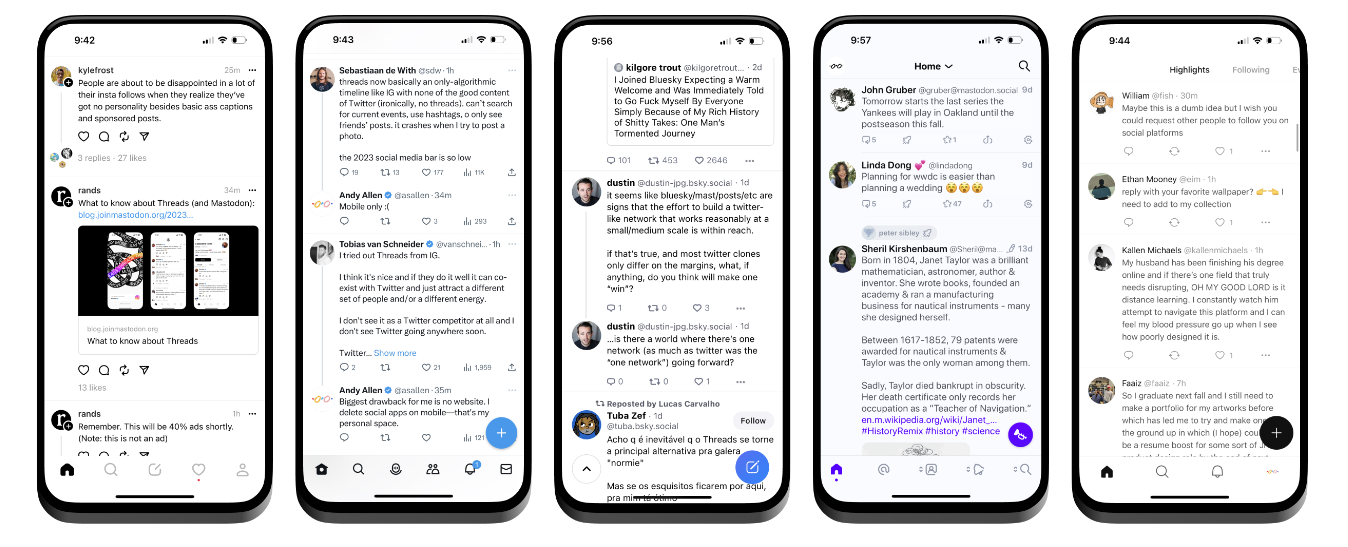
In terms of design, Threads appears to be a copy of Twitter, which is not surprising. All the other Twitter competitors, Bluesky, Mastodon, Substack Notes — look nearly identical as well.
*Twitter and its competitors [Source: Andy Allen]*
This is a conscious decision for all those developers. Design is supposed to be simple and mimic Twitter so that there is no learning curve or confusion.
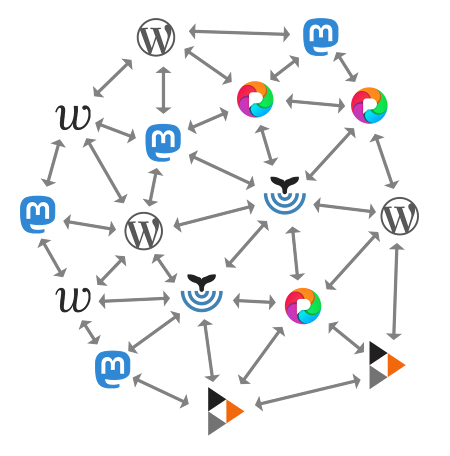
Hot on the heels of Threads’ success is Meta’s new buzzword and a new grand plan: the Fediverse. What exactly is the Fediverse? In short, it’s an ecosystem similar to the Metaverse — only instead of persistent VR and AR worlds, it’s a persistent, interconnected, interoperable collection of social networks. For that, Meta will use the ActivityPub protocol (the same used for Mastodon and WordPress).
*Artistic impression of the Fediverse*
This, in theory, should allow users to cross-post and cross-communicate, as well as avoid censorship or de-platforming. Your friends from Mastodon or Wordpress would be able to follow you on Threads without having to create a separate account and vice versa. Why a centralized giant such as Meta would put so much emphasis on services that, in principle, help undermine its power is not entirely clear yet. Perhaps it’s part of their Web3 strategy or a way to add value by crafting a bigger and more compelling vision than just being a “successful Twitter clone”. No timeline has been given in regards to ActivityPub integration, so we can only speculate.
It’s entirely possible that users who decide to join Threads will be bound to Meta’s instances, which can then be configured however the company pleases. Moderation could remain in Meta’s control, and if coupled with full ownership of users’ posts and their instance identity, the decision to make Threads part of the Fediverse might not be as risky as it seems.
For now, Metaverse and XR are being completely left out. There is no way to log into Threads using the **once-upon-a-time fanfared Meta accounts** (required for all Meta Quest and Quest Pro virtual reality headsets). If that ever changes, it will most likely be through some kind of VR app. Instagram is already available on the Quest so we might expect something similar for Threads. https://read.cash/@MatPawluczuk/oculus-meta-quest-mandatory-facebook-account-is-now-being-replaced-by-meta-login-8c2fc6c4
While this may seem worrying, it’s too early to predict how the success of Threads will impact Meta’s XR strategy. Right now, Meta’s priority is on capturing the growing momentum, making sure it doesn’t fizzle out, while at the same time presenting a kind of grander, long-haul vision for the product in the form of the Fediverse.
Just a few days ago, Yahoo reported that Threads’ average daily **usage dropped from twenty-one minutes to six** but at the same time, new users continued pouring in, with **India leading in downloads**. It’s also worth noting that Threads is not available in the European Union due to regulatory and privacy concerns. But even if it were to launch in Europe soon, rumors of Twitter’s death are greatly exaggerated. Its popularity will almost certainly remain substantial. https://finance.yahoo.com/news/threads-down-6-minutes-day-195253571.html https://www.republicworld.com/business-news/international-business/threads-becomes-first-app-to-cross-150-million-users-in-six-days-india-leads-in-downloads-articleshow.html
*[24 Jul: This article was originally published citing the figure of 70 million users joining within the first 48 hours. I have since updated the article to include additional data and information to provide a more up to date view of the platform’s rapid user growth during this initial period.]*
Purchasing an NFT ticket to Abu Dhabi Ultra (using Fellaz NFT)
**I decided to attend the** **Ultra Abu Dhabi** **music festival using NFT tickets. Here is my review and main takeaways.** https://www.publish0x.com/newpost/Ultra%20Abu%20Dhabi
Event tickets in the form of NFTs are the most direct implementation of a utility token. While many collections promise all sorts of rewards or benefits, these perks are often vague or uncertain, creating a whole spectrum of different levels of utility. On one hand, you have utility-free art like EtherRocks, and on the other, you have for example Fellaz NFT tickets. Sure, you can treat these tickets as art or souvenirs, but it’s clear that their value is almost entirely based on their utility — that is, on the guaranteed ability to access a particular event or venue at a particular time.
Ultra Abu Dhabi is a two-day EDM (electronic dance music) festival, part of the Ultra Worldwide festivals that take place all around the world. Recently, they’ve partnered with Fellaz and seem to be experimenting with the Web3 ticketing ecosystem. Not all Ultra festivals are going to have NFT tickets available, but it is assumed that the upcoming Ultra Singapore and Ultra Korea events will. Being in the UAE, I decided to give it a go and see how everything works in practice. The fact that I’m a big fan of large music events didn’t hurt. https://fellaz.io/
The idea is that you purchase an NFT ticket, show it at the gate and exchange it for a wristband along with some Fellaz-related perks. In practice, this can be a bit complicated, even for someone used to crypto.
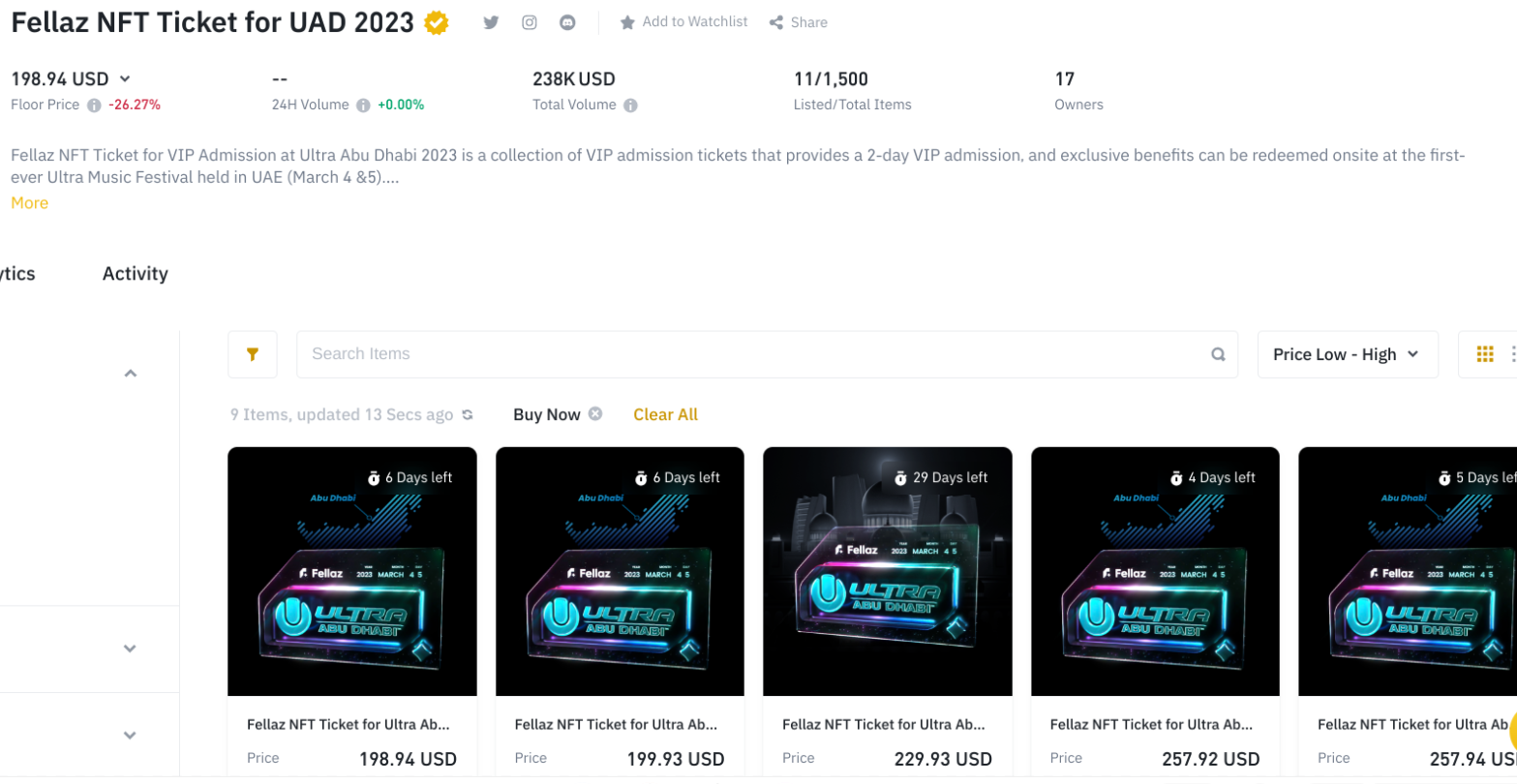
Tickets were sold on Binance, but Fellaz also partnered with Xclusive, where you could mint the ticket yourself. All tickets minted were considered VIP, and there was no option to mint General Admission or GA+ tickets. To put things into perspective, early bird GA tickets purchased online using a debit card cost $130, while pre-door tickets cost $150. Despite the higher price point, opting for a Fellaz NFT ticket came with several perks, including access to dedicated waiting lines, VIP sections and bathrooms, merch and drink coupons, and even a chance to win a meet and greet with the artists, so the price-to-value ratio was quite good. http://xclusive.market/en
The sale on Binance ended on the 3rd of March, but the mint on Xclusive continued for another 24 hours. On Binance, the floor would sometimes dip below the official price of $260. I’m guessing some people bought these tickets not realizing it’s not a collection but a utility token. Some perhaps could not attend. After a bit of waiting and scouting, I managed to nab a ticket for $188! Definitely pleased with that.
This presents a possible challenge. Assuming Web3 implementation becomes more popular and common, it will also make scalping much easier. It’s theoretically possible to buy out the entire pool of tickets and then resell them at inflated prices. Limiting the number of mints per wallet might not work as it’s fairly easy to create multiple wallets as well. The only real solution would be whitelisting and prioritizing users who have a history of participating in events they bought tickets for.
This is where things get a bit complicated. To use the NFT for admission, you must download the Favorlet wallet. The only issue is Binance doesn’t allow for withdrawals to Favorlet, so to get my NFT there, I had to first withdraw it to Metamask and then transfer it yet again to Favorlet using Metamask mobile. You also have to remember to use the BNB chain and you have to manually add your NFT in Metamask by entering the contract address and token ID. For a regular person who doesn’t know much about Web3, this literally is a showstopper. https://favorlet.io/
**Attending Ultra Abu Dhabi**
After jumping through the hoops, I finally had Favorlet installed on my mobile along with the corresponding NFT ticket. It was time to party!
To obtain my wristband, I had to go visit the Fellaz booth, which was actually a tent. There I had to validate my NFT via a timed QR code and collect my wristband plus goodies. It was all pretty straightforward and quick. The moment the NFT is validated, certain properties change (or at least should change). This is done to prevent multiple people from attempting to enter using the same NFT.
Ultra Abu Dhabi had only two stages. It wasn’t a massive event, but for someone longing for a good electronic thumper, this was good enough. I’m not going to review the festival itself, but it had two stages, the line-up was decent and the crowd was enthusiastic.
While waiting in line, I did see a bunch of other people using NFTs to claim their wristbands. However, when I got to the festival grounds, it was obvious we represented a tiny fraction of participants. Even at the Fellaz VIP section, which was meant to be open exclusively to NFT holders, I didn’t meet anyone interested in crypto. One person said he won a VIP upgrade, others simply bought it. Fellaz had their own tent at the festival next to the food trucks, so that’s where a lot of those non-crypto folks came from, but on the whole, the VIP viewing section was still embarrassingly empty.
Perhaps this is because NFT buyers are just like any other party-goer and prefer to be close to the stage and in the middle of the action. That makes sense, but if one was hoping to network or talk about crypto, they would be disappointed.
Perks also turned out to be a bit hit-and-miss. Rewards that were supposed to be handed out on-chain were instead given out in the form of scratch cards. Not a very transparent or verifiable way to dole out rewards, to be honest. I was told that supposed meet-and-greets with artists also didn’t materialize. A $20 merchandise coupon turned out to be worth 20 AED instead, which is just over $5. Considering the cheapest shirts were retailing for $32, this “perk” felt a bit insulting. All those things made the VIP pass feel less special and less valuable than it could have been.
**Conclusions**
After the event was over, all ticket holders were airdropped a special souvenir NFT to mark the occasion. I have to admit, it looks quite cool.
Unfortunately, I cannot send this NFT to Binance as this particular souvenir token hasn’t been whitelisted. I guess it’s just meant to sit in Favorlet’s wallet forever. I am, however, not planning on keeping Farvolet on my phone, so I transferred it to my Metamask instead. Also, to my surprise, I was able to sell my used ticket for $46. This lowered the overall cost to around $142, which is pretty amazing.
As somewhat of a crypto supporter, I found purchasing, transferring and validating the ticket much more fun than just buying it online at Ticketmaster. I understand this will not be the same for most. In fact, it will be the opposite. There’s still a lot of friction and too many obstacles for mass adoption. It also seems the interest is not there. Despite competitive pricing, most casual partygoers cannot be bothered with what still looks like a very exotic and convoluted way to purchase a ticket.
The foundation has been set, but it remains to be seen how the partnership between Fellaz and Ultra will evolve. I expect that the number of NFT ticket buyers will continue to grow with each successive festival, but only time will tell.
My trip to El Salvador: Bitcoin, Beachfronts, Burritos
**With organised crime down and Bitcoin adoption going surprisingly well, things are looking brighter than many might would think.**
It’s been over one year since the 7th of September 2021, the day Nayib Bukele introduced thea so-called “Bitcoin Law” a bill that which not only regulated Bitcoin but also turned Bitcoin into the country's official currency. This included a somewhat controversial article 10, which stipulated that all businesses are required by law to accept Bitcoin as a payment method.
Proponents of Bitcoin were elated, but opponents criticised the president for what they saw as a very risky investment, accusing him of turning El Salvador **into a massive casino**. The International Monetary Fund was also less than pleased, indicating the agreed $1.3 Billion loan will be in jeopardy if El Salvador keeps pursuing its Bitcoin ambitions. Bukele, however, persisted and with almost one year having passed, I decided to go and see first-hand if the Bitcoin Standard is a miracle or a mirage. https://www.economist.com/the-americas/2022/06/16/el-salvadors-government-is-gambling-on-bitcoin
To give readers a general idea, El Salvador is a Latin American country, so if you’ve ever been to one, you should feel right at home. Street vendors sell water and juices not in bottles, but in plastic bags, colourful “chicken buses” drive between cities without any regard for safety and all the guards and security carry big, menacing shotguns. El Salvador is not as wealthy as Panama, but at the same time, it’s faring better than neighbouring Nicaragua or Guatemala. In terms of GDP, it sits somewhere in the middle.
My first chance to experience El Salvador was at this year's Expo. Their pavilion emphasized Bitcoin as a futuristic, business-friendly endeavour. Full disclosure: they also offered free coffee made from local beans. which might be the reason why most people seemed happy to spend some time there.
Either way, a few months later, an opportunity presented itself to visit El Salvador in person, and without much hesitation, I jumped on it.
Right off the bat, I decided to avoid taxis and walk from the airport just to get a feel for what the country looks like. First impressions: it’s an evergreen land, lush with vegetation.
After maybe two hours of hiking, I end up at a roundabout with a couple of hostels. Rooms are simple but cheap and come with air conditioning. Life feels peachy again!
Throughout my travels, I got the chance to sleep in all kinds of motels from the most modest imaginable to ones that resemble Western hotels.
Here’s a very basic motel.
It was only $8. Unfortunately, it didn’t come with a wall socket, so to charge my phone, I had to leave it at reception. Still, it had a ceiling fan and for some reason, I felt very peaceful there. I would give it 5 stars, but obviously, bathroom standards were quite low. Basically cold water only and no mirror.
An upgrade from the previous room. This is what $15 might get you. I’m guessing you could try to haggle the price down to $12-13, but I didn’t bother.
Western-style hotels typically start around $35 but can go up to $100 or more.
It’s nice to have a receptionist always present, ready to sort a room for you. Cheaper hotels usually require having to find the person in charge, either by calling displayed numbers or by banging on the door.
The first thing I tried to do after checking in was install the official Bitcoin wallet called “Chivo”, which in Spanish means ‘cool’. However, I quickly realised only nationals and residents are allowed to use it. This could be because Nayib Bukele promised $30 in Bitcoin to every Salvadorian. Or maybe because Chivo positions itself as an official governmental app that provides financial services rather than just another Bitcoin wallet.
I shared my dismay with one of the boys working in the hotel. He proudly showed me his Chivo wallet as if to prove that everything works fine. While this wasn’t my intention, I also noticed large transaction — a transfer of about $900. I’m guessing it’s some kind of remittance money but could be something else.
El Salvador is known for having large numbers of its population rely on remittances. Some say it might constitute up to 50 per cent of its GDP. This makes Bitcoin a bet of two kinds. The media tends to fixate on Bitcoins price and draw conclusions that El Salvador has lost money on its crypto bet. The other goal, however, is to offer a new, cheaper way to send remittances. Estimates say this can yield up to $400 million in savings. If these numbers are to be trusted, they’re big enough to make any gains or losses from holding Bitcoin a secondary issue.
Throughout my travels, I noticed how people walked up to Chivo ATMs to withdraw some cool cash. My guess is most are there to pick up their remittances in dollars rather than to buy or sell Bitcoin.
In general, almost everyone with a smartphone will also have Chivo, but most ignore the Bitcoin aspect entirely and just use Chivo to transact in dollars, similarly to how CashApp or Venmo work in the West. You want to pay $15 for your meal or your room? The owner will give you their phone number, and that’s all you need to know to transact. I tried asking for a QR code or Bitcoin Lightning address, but most were clueless. And even if I could somehow persuade them to look into the settings and find what I was looking for, my wallet would still not allow the transaction to go through due to lack of compatibility (I was using “The Wallet of Satoshi”).
Onward with my travels. I decided to visit the now famous “Bitcoin Beach”, an area around El Zonte that kickstarted the country’s crypto adoption.
It’s a pleasurable seaside region, dotted with resorts and surfing schools. You can see Bitcoin being referenced in many places, but it’s clear we’re past the hype. Bitcoin is testing new lows, excitement is gone and El Zonte is back to its main business — tourism and surfing. Old Bitcoin Beach t-shirts lie forgotten and neglected, now losing colour. I even spotted two local villagers wearing them as they emerged from their work in the fields. It was clear neither of them had smartphones or any idea about crypto and just wore these shirts as their dirty clothes.
I stayed in El Zonte for two days and throughout that time noticed only one crypto-related group of people. They wore “stack sats” shirts, which is a known maxi motto. It means ignore the price and just focus on saving ("stacking") Bitcoin. The group walked around guarded by two shotgun-wearing officers dressed in blue uniforms. Not sure if they're real police or just security made to look like them, but having guards follow you everywhere you go certainly attracted extra attention, making the whole group look very conspicuous. No way I would feel safer that way, quite the opposite.
As for El Zonte, the whole area is very picturesque. Lots of small coffee shops and restaurants where the time goes by slowly. Some of those spots look very makeshift by Western standards, but these businesses are first and foremost a way of life, profitability comes second. They might not see customers for hours, there might be an odd customer like me who comes for a coffee, there might be a whole family that suddenly pops in and orders a full course meal. Whatever happens, owners will wait patiently and let the hours go by.
I stopped in one restaurant to buy an energy drink. The lady that worked there tried to persuade me to stay and get something more substantial, perhaps a pizza? Unfortunately, I didn’t have cash on me, only a card.
“We don’t accept cards”, she said. “You can pay with Bitcoin!”
She seemed excited at the prospect and I almost felt stupid for not having any crypto ready. Honestly, I didn’t expect such a situation to occur, but there you have it. Small businesses might not have access to banking and consequently to Visa and Mastercard readers, but they do have smartphones and therefore, can accept Chivo wallet transfers without issue. That’s what a lot of articles about El Salvador seem to miss. If you go around asking “do you accept Bitcoin?” people will say no, but if you ask them about Chivo, they'll often say yes. In general, I didn’t get that feeling described in the media that Bitcoin has been completely forgotten or even worse, that it’s a failed experiment.
After leaving El Zonte, I travelled towards Sonsonate. It’s a very run-of-the-mill city in the middle of El Salvador. There are no beaches, no volcanos and no international tourism. Locals glance at my bag and assume I might be doing some business or that I trade goods. Otherwise, there’s little reason for a gringo like me to be there. Still, I quickly develop a fondness for this city. It’s not perfect, but it’s raw, authentic and even cheaper than the other parts of El Salvador. You can get a glimpse of how it would feel to live as an expat here.
In Sosonate, just like everywhere else, you’ll see official Chivo ATMs. There’s one by the shopping mall, one on the main square and a few others dotted around the city. They usually have some kind of staff on location to help citizens set up their Chivo wallets, answer questions and generally make it look like those ATMs do indeed double as some sort of unofficial bank. Chivo ATMs are also guarded, which means you can withdraw or deposit money only during what amounts to essentially working hours. So again, something akin to how a bank would operate rather than just an ATM for your Bitcoin wallet.
After spending over a week in Sonsonate, I went further north to Santa Ana. It’s a well-known city, famous for its neighbouring volcano that goes by the same name. The city looks cleaner, neater and a bit more expensive. Beautiful churches adorn the streets.
It seems 2022 is the year of Little Caesars Pizza, and locals have fallen in love with this franchise. After dark, the city square is littered with empty pizza boxes, all with the Little Caesars logo. Seems the brand is pushing into the market aggressively, for example, by offering medium pizzas for $5. Until recently, having a pizza would set you back around 15 bucks, so it’s a newly discovered luxury that many could not afford before.
Unfortunately, queues at Little Caesars are never-ending. Instead, I went to a local pizza shop called “OMG Pizza”. They sell by the slice, prices starting from $1.
“Oh, You’ve been to U.S.?” asks the owner in fluent English. “I worked there for twenty years. Started in New York, then Vegas, Los Angeles.”
“I see you support Nayib Bukele?”
“Oh yes, I love this guy. I have his picture here”. He pointed to a picture of Nayib with his family hanging on the wall. “Before he came to power, we had so much trouble with the mafia. People would come to my restaurant, ask questions, is this my place, is this what I do and so, and so, and then come up with a number and tell me this is how much you have to pay us. And what could you do? You had to pay. But not anymore.”
“What about Bitcoin?”
“Before El Salvadore was only known for its crime rates, mafia and trafficking. Nobody really knew anything about us. Nowadays, if you say El Salvador, people think, oh, El Salvadore, you mean that Bitcoin country.”
His attitude is quite representative. Most Salvadorans I encountered held their president in very high regard and only spoke in positives. In its capital, San Salvador, I met a tattoo artist who was quite supportive despite his business being impacted by Bukele’s policies.
“Have you ever heard of MS-13?” he asks.
“Hm, no.”
“What? Really? I mean, well, it’s the most notorious gang in El Salvador, maybe in entire Latin America. Recently, Bukele banned certain symbols, tattoos that relate to gang membership.”
“Like what?”
“Well, mostly numbers, number 13, gang hand gestures, clowns.”
“Clowns? That sounds quite broad. Isn’t El Salvador committed to free speech, freedom of expression?”
“I mean, these are quite specific clown tattoos. Why would you get those if you’re not a gang member? I mean, tattooing was already quite taboo here, and now it’s even more so. Which is a shame, really. There’s so much great art and tattoo artists.”
“I saw how Bukele decided to starve gang members that are already in locked prisons, by giving them very little food.”
“Ha ha ha, yes I saw that as well, one tortilla a day, ha ha. I mean what can you do… country can’t move forward if it’s plagued by gangs and violence.”
As time went by, I became familiar and comfortable with what local street cuisine had to offer. There's a variety of foods that are fit for vegans and vegetarians. All sorts of fruits, either in plastic bags or cups, often mixed with spices and chillies, French fries for a dollar that you can eat with a toothpick and, of course, the nation's all-time favourite: pupusas. These are flatbread cakes with various fillings, meat, beans, potatoes, cheese and even loroco. Loroco is a flower, which sounds like an odd choice, but its chopped flower buds turned out to be a delicious filler.
In total, I spent three weeks in El Salvador. Once I realized I could use Chivo ATMs to withdraw Bitcoin directly, without the need for a Chivo-compatible wallet, I start doing that. It was cheaper than using my Visa and I also didn’t have to worry about any bank fees.
There’s also a bit of innovation coming from the commercial sector. For example, I saw Strike Wallet stickers and QR codes scattered across various restaurants. The way Strike positioned itself was as a competitor to Chivo, together with a sign-up bonus of its own (unfortunately, again, only for Salvadorians). I’m not sure how successful Strike was or is. I expect not very. With the recent slump in Bitcoin’s price, most people have abandoned all crypto-related prospects, but it was an interesting observation nonetheless.
Overall, the hype is gone, but things are far from terrible. People might not be using Bitcoin, but once they realized nobody was taking their dollars away, they stopped protesting as well. Nayib Bukele’s popularity remains unchallenged and everything points to a second term. As for Chivo, it allows for the use of dollars and with the government’s backing, there’s a good reason to suspect it will stick around.
Meanwhile, near El Zonte’s Bitcoin Beach, there’s a different project brewing. Excavators, loaders and dump trucks can be seen everywhere. It’s all part of a big push to create **Surf City** — a chain of modern, Western-style towns and cities catering to surfers and beach enthusiasts from all around the world. Nobody here talks about the volcano-powered Bitcoin bonds or the futuristic Bitcoin city. It’s all pie-in-the-sky speculation for now. Surf City, meanwhile, is already under construction and poised to be completed sooner rather than later. https://surfcityelsalvador.sv/
And that’s the takeaway. Bitcoin doesn’t need another Mecca: Dubai serves that purpose pretty well with its zero per cent tax. There are plenty of other crypto havens as well. What El Salvador needs is to leverage what it already has: spectacular views, magnificent mountains, thick forests, idyllic beaches, great waves, tasty street food and cheerful locals. And yes, you can also pay in Bitcoin if you want to. Muy bonito.
International Day of Action 8th Oct: On the ground reporting
Assange is a meta case, not just for freedom of the press, but for freedom of opinion, expression, assembly and all activism combined.
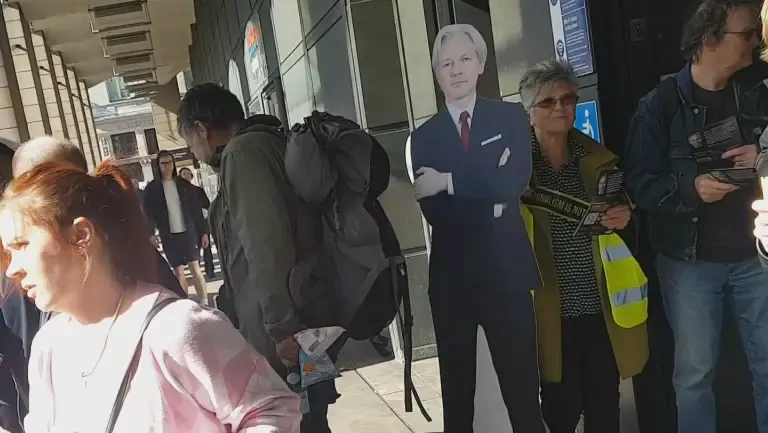
Saturday 8th of Oct is the International Day of Action for Julian Assange. To mark this date, a human chain was formed in London in an attempt to surround the UK parliament. Smaller protests were also held in cities in Australia, Germany, the United States and other countries.
It’s been over 3.5 years since Assange was stripped of his political asylum and thrown into the notorious Belmarsh prison. It’s a category-A maximum security prison similar to the American Supermaxes. In doing so, the UK government removed whatever thinly-veiled pretence of legitimacy was left. Since then, Assange has been held in Belmarsh on remand, first apparently for bail skipping and once the maximum allowed 50-week period had passed, without any additional reason, simply as a remand prisoner. In Belmarsh he’s being held indefinitely and in the worst, harshest, most punitive conditions available to UK courts. Cells are solitary. Inmates consist of the most dangerous serial criminals, such as the “Grindr Killer” or “Night Stalker”. Everyone is permanently handcuffed and locked up for 23 hours a day. Degrading strip searches are customary. It’s a peculiar place to put Time Magazine’s “Person of the Year”, Nobel Peace Prize nominee, and an award-winning journalist.
Obviously the court chose Belmarsh not because Assange is an extremely violent criminal who needs to be locked in handcuffs inside a solitary cell like a comic book villain. As Lauri Love (who himself had to fight extradition to the US) suggests, it’s a punitive measure that **many journalists and whistle-blowers will look at and take notes** on. Love coined the term punishment-by-trial to describe this coercive mechanism and claims this has already had a chilling effect on press freedoms and those who speak truth to power. https://www.aljazeera.com/news/2019/4/14/lauri-love-julian-assange-has-been-put-on-sacrificial-altar
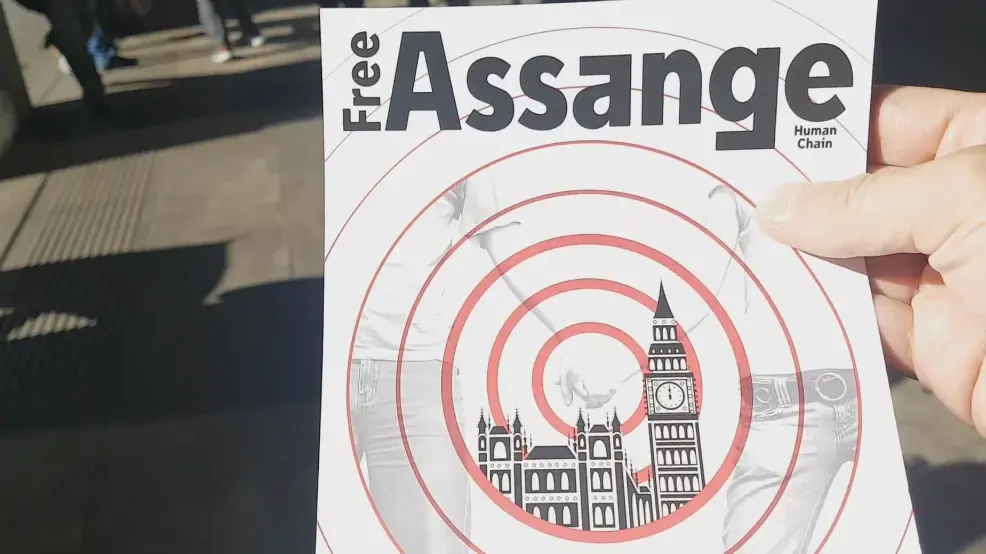
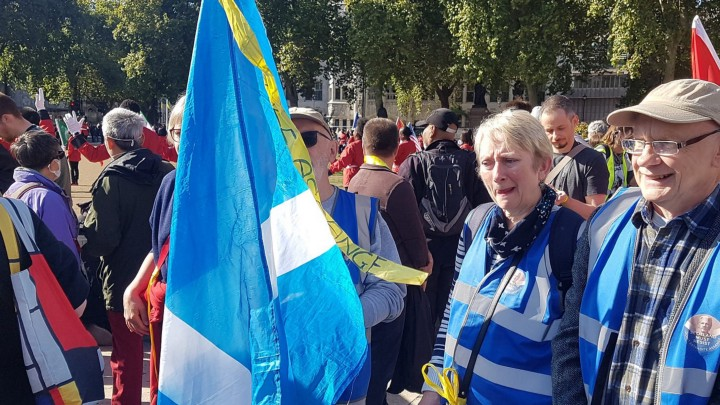
I arrive at Westminster Parliament Square sometime around 12:30 A.M. Protests are about to start in half an hour but it’s already very busy. The surrounding metro stations have greeters, whose job is to hand out flyers, give directions and explain the purpose of the event to some less informed commuters.
There are people from other British cities, from Scotland, from other countries, and even from as far as the US (for example, US comedian **Graham Elwood**). I’m quickly humbled by this level of commitment. https://www.youtube.com/c/GrahamElwoodOfficial/videos
It was as recently as 2017 that Assange still had his own opinion column in the Washington Post condemning **Mike Pompeo’s war on whistle-blowers**. At the time, his opponents focused mostly on character attacks, trying to portray him as an unlikable person with ulterior motives, such as fame or conceit rather than transparency or truth. Some of these attacks backfired because they were so farcical (for example, a New York Times article that claimed Assange didn’t flush was so grotesque **it had to be scrubbed** by the outlet). Later, it was revealed that Trump’s administration and CIA officials plotted to **literally assassinate or otherwise extrajudicially kidnap Assange.** https://www.washingtonpost.com/opinions/julian-assange-the-cia-director-is-waging-war-on-truth-tellers-like-wikileaks/2017/04/25/b8aa5cfc-29c7-11e7-a616-d7c8a68c1a66_story.html https://observer.com/2012/08/new-york-times-article-on-julian-assange-asylum-scrubs-its-toilet-reference/ https://www.theguardian.com/media/2021/sep/27/senior-cia-officials-trump-discussed-assassinating-julian-assange
Now that Assange is in Belmarsh, silenced and isolated, it’s easier for the American Department of Justice to go after not just his character but his entire legacy in an attempt to rewrite history. To question whether Assange was ever a writer or a publisher. To minimise his works and journalistic scoops, of which there have been many.
The most famous disclosure involved the now infamous “Collateral Murder” video showing American troops as they open fire on mostly unarmed civilians from an Apache helicopter, killing several civilians and two Reuters journalists. This video was a major scoop back in 2007, creating a huge media discussion, showing a clear breach of international war conventions and what was pretty much a war crime caught on camera. **Nothing happened to the perpetrators**. The military and the DOJ went after not the criminals and murderers, but those who exposed the crimes. In this case, whistle-blower Chelsea Manning and publisher Julian Assange. https://www.theguardian.com/us-news/2020/jun/15/all-lies-how-the-us-military-covered-up-gunning-down-two-journalists-in-iraq
Vault 7 leaks were another big story. They revealed the nearly limitless powers the CIA has when it comes to electronic surveillance and cyber warfare. Given the lack of any transparent accountability, these capabilities immediately raised red flags. Vault 7 also proved how entire privacy discussions (for example, how **Apple refused to unlock its iPhones** and how much of a hindrance that was to the security state) were in fact so moot that they verged on being disingenuous. Moreover, it was reported that this arsenal **circulated among contractors and government hackers** in an unauthorised manner before making its way to Wikileaks. Following the release, Samsung, Google and Apple immediately started patching their software to make their products safer. https://www.vox.com/recode/2020/5/18/21262731/fbi-apple-unlock-iphone-encryption-bill-barr-alshamrani https://www.nytimes.com/2017/03/07/world/europe/wikileaks-cia-hacking.html
And that’s just two of many, many publications. Wikileaks and Julian Assange can be credited for revealing the corruption of the president of Tunisia’s family, sparking what came to be known as the “Arab Spring”. There are too many to list, but it’s obvious that these are some of the most consequential releases of our time. For the Justice Department to come out and say with a straight face that Assange hasn’t published anything or hasn’t written anything is more proof of how far American power centres are willing to go if the stakes are high enough, including erosion of existing democratic pillars like an independent press, independent judicial system or human rights (Amnesty International repeatedly **called for the release of Assange**). https://www.amnesty.org/en/petition/julian-assange-usa-justice/
Sometime after 1 P.M., we’re asked to start forming the chain. I’m given Free Assange barrier tape that I wrap around myself as well as Free Assange wristbands. Yellow ribbons are widely used as a symbol for political prisoners.
I first join somewhere near the beginning, but as things get crowded, we are asked to move and help spread the chain out. This allows me to walk along the chain and see all the banners, signs and posters that people have made.
Again, I feel humbled seeing how much creativity and effort some people had put into those. Many participants wear topicical clothes. With all this creativity, it feels like a demonstration that’s also an event.
Julian Assange’s case has received so much attention because it’s the first of its kind. Even though Obama went after whistleblowers aggressively, **he decided he could not charge Wikileaks or Assange** as this would set a dangerous precedent, eroding press freedom guarantees of the First Amendment, leading to a slippery slope where any newspaper could be prosecuted, from The New York Times to The Sun. Things changed in 2018 with Mike Pompeo and Jeff Sessions calling Wikileaks a “non-state hostile intelligence service” and then prosecuting Assange under the Espionage Act. https://theintercept.com/2018/11/16/as-the-obama-doj-concluded-prosecution-of-julian-assange-for-publishing-documents-poses-grave-threats-to-press-freedom/
There’s a lot of absurdities and illegalities here. The court argues the US is perfectly neutral and guarantees a fair trial, when at the same time, this very country tries to assassinate Assange extrajudicially. The court argues that this isn’t a political or free speech issue, but all the charges relate to the 2010 publication of the “Collateral Murder” video, which is both political and won press awards. A witness in Assange’s case testified in early 2021 that **he fabricated his evidence and lied** in exchange for a promise of immunity from prosecution. It also turns out that Assage was **spied on and surveilled during the seven years** he spent in the Ecuadorian embassy. This means, among other things, that his attorney-client privilege was violated by having privileged conversations spied on. Any one of those things should immediately shoot the entire case down, and at the very minimum ensure a mistrial. That would be the outcome in any other case, including those of other Belmarsh inmates. Even the “Grindr Killer” would be given more rights than Julian. https://stundin.is/grein/13627/ https://english.elpais.com/elpais/2019/09/25/inenglish/1569384196_652151.html?rel=mas
Around 2 P.M., we’re asked to raise our hands in solidarity and create a human chain.
On the other side of the chain, Assange’s wife — Stella Morris took the stage. Short speeches were also given by British comedian Russel Brand, MP Jeremy Corbyn and a couple of other prominent figures.
After the main part was over, I decide to walk back to Parliament Square. There I spot Kristinn Hrafnsson, the current editor-in-chief of Wikileaks.
On 17th July, **Home Secretary Priti Patel approved the extradition order**. **Amnesty International** and **Reporters Without Borders** immediately raised alarm, urging the U.S. government yet again to release Assange. The British court system acts in a way that’s heavily instrumentalised, and with a case that’s so high profile, safeguards are not working. Separation of power, checks and balances, all these hallmarks of democracy are disregarded in the name of what John Bolton called “national interest”. Assange is not American, he’s Australian, another contentious element in the extradition process. Assange supporters might mention, for example, how happy Saudi Prince Mohammed bin Salman would have been if he could charge journalists with the Saudi version of the espionage act and then have, for example, Jamal Khashoggi extradited to Saudi Arabia to give him a “fair” trial. Or If China could force other countries to extradite journalists to Beijing. https://www.theguardian.com/media/2022/jun/17/julian-assange-extradition-to-us-approved-by-priti-patel https://www.amnesty.org/en/latest/news/2022/06/uk-us-home-secretarys-certification-of-assange-extradition-puts-him-at-risk/ https://rsf.org/en/uk-home-secretary-orders-us-extradition-wikileaks-publisher-julian-assange
America’s status means it can get away with what other countries can’t. But internally, things aren’t looking much better. Pulitzer prize winner Chris Hedges cautions that Assange’s case brings us closer and closer to **inverted totalitarianism**, a situation where outward symbols, institutions, iconography and the rhetoric of democracy remain, but internally, the system becomes consolidated and completely surrenders power to centralised interests. And this is what I mean by saying Assange is a meta case. It’s a prism that reveals a whole spectrum of dysfunctions that erode democratic systems. It threatens not just freedom of the press or freedom of speech, but other freedoms, especially activism-related freedoms like freedom of opinion, expression, assembly, peaceful association, information and more. https://therealnews.com/the-chris-hedges-report-julian-assanges-father-john-shipton-speaks-out
One last look at Parliament Square… After the rally, we are encouraged to gather in the neighbouring pubs and cafes and to use yellow “Free Assange” wristbands to identify each other. I, however, head back to the airport, as I have to leave from Stansted early morning.
Major news outlets like Reuters reported hundreds of protesters. The number was definitely higher than that. Just to form the chain there had to be around 5,000 people. Organisers mentioned around 10–12 thousand, which is also within the realm of possibility. Stella Morris mentioned her husband feeling energised and “profoundly moved” by the Saturday protests. Personally, this was one of the biggest Assange rallies I’ve been to, which is a promising trajectory.
Oculus Meta Quest: Mandatory Facebook account is now being replaced by Meta login
Meta’s first step towards creating a new unified ID system. So has anything actually changed and if so, what exactly?
**The tale of a broken promise**
When Oculus was acquired in 2014, its founder, Palmer Luckey, famously guaranteed that his company would not force its users to login with Facebook. At the time, it just didn’t make any sense to think so. Virtual reality headsets are hardware units, just like computer monitors or audio speakers. You do not need to use Facebook or any other social network to switch your computer screen on, people reasoned, so why would you need one to access a HMD? https://www.reddit.com/r/oculus/comments/21cy9n/comment/cgbz2vw/
Fast-forward to August 2020. Palmer Luckey is no longer part of Oculus nor has he been for some time now. Facebook makes a low-key announcement via a blog post titled “**A single way to log into Oculus and unlock social features**“. It states that come October 2020, all-new Quest users will have to use Facebook to access VR and if they don’t have an account, they’ll have to create one. This generated massive backlash, accusations of broken promises, requests for refunds and attempts at **class action lawsuits** followed. And even though the dust eventually settled, the FB login issue kept coming back, haunting Oculus each time their parent company suffered any kind of controversy, each time there was a new scandal or data leak, each time someone got banned on Facebook and lost access to their Quest because of it. https://www.oculus.com/blog/a-single-way-to-log-into-oculus-and-unlock-social-features/ https://www.reddit.com/r/oculus/comments/jht6kx/class_action_lawsuit_against_oculus_and_facebook/
Contrary to what many expected, the issue never quite seemed to go away. Time went by, users kept complaining. Even if the criticism’s edge wasn’t as sharp as before, the Facebook login requirement kept being brought up continuously in random VR discussions, tweets and so on. It never became fully normalized.
**Meet the new boss**
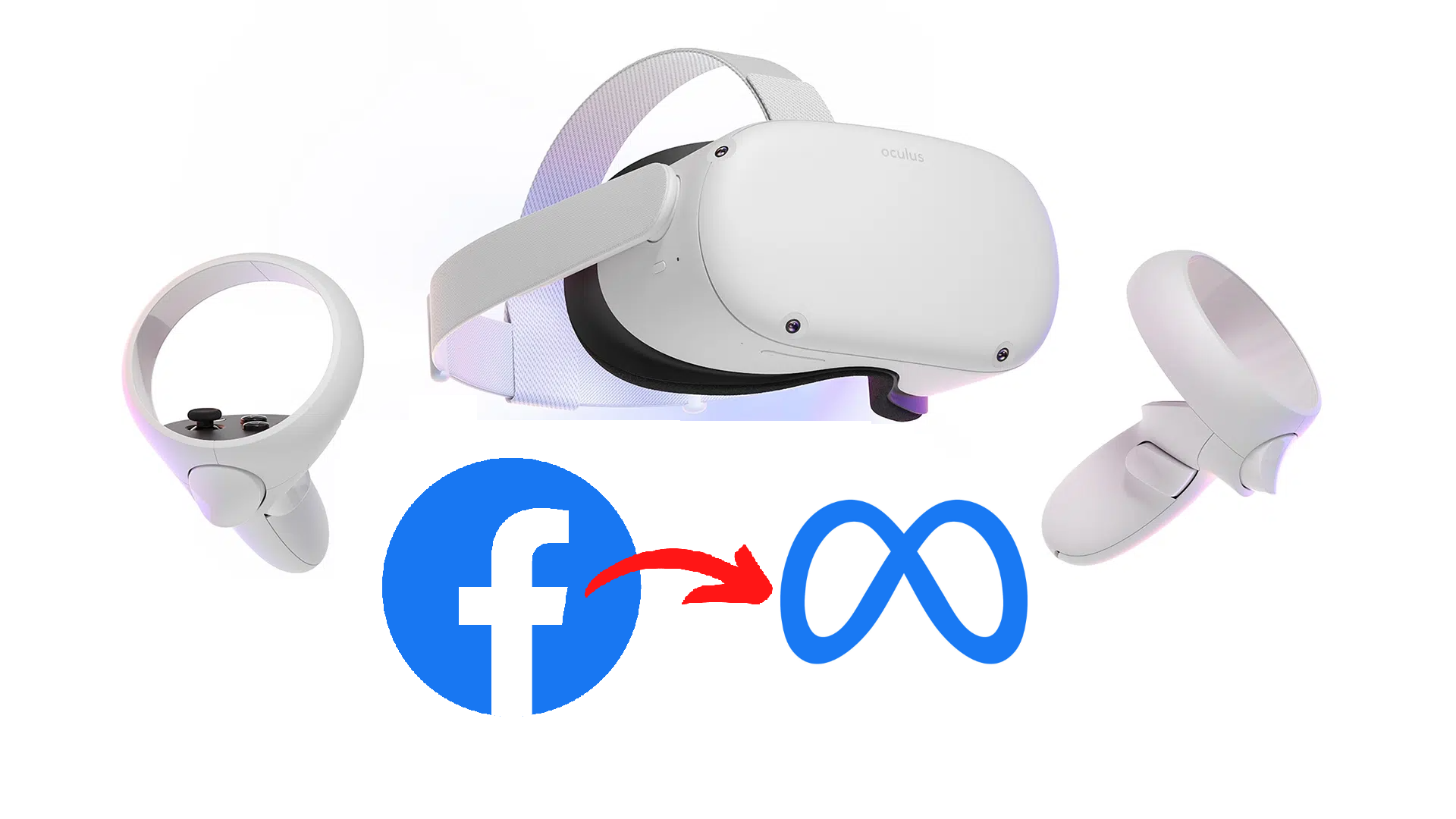
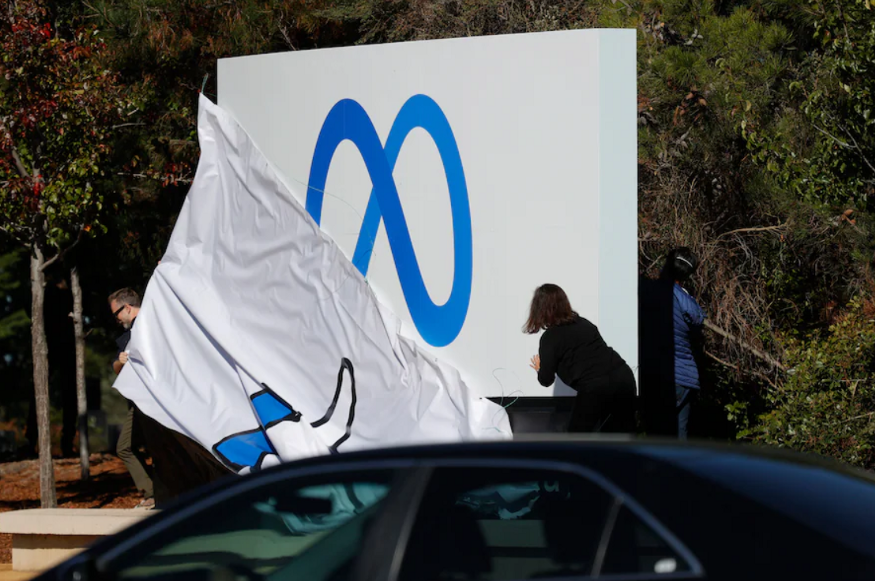
**In October 2021, Facebook reinvented itself as Meta** in an attempt to distance itself from its roots and paint a bigger picture for the things to come and for the company's future. It was a very bold pivot that puts a lot of emphasis on the hardware side of things. Visiting the official Meta site redirects users to a store where you can buy a Quest, but also a Portal (a tablet-like device) and Ray-Bay Stories (AR recording glasses). Facebook, Instagram and WhatsApp are barely visible. Meta also debuted its first retail store in Burlingame, California with a plan to further expand their physical presence. The foundation has also been laid for future expansions—we're talking beyond social networking or hardware and into the world of finance, metaverse and web3. https://about.fb.com/news/2021/10/facebook-company-is-now-meta/
With all of that, Meta also began retiring the Oculus brand, first by renaming their flagship device to Meta Quest and then subsequently by replacing all the logos, app names, websites and so on. The community reacted somberly but without uproar. **Oculus had been folded into Facebook Reality Labs in 2020**, so any separation of the two was purely superficial. For the Oculus brand, the writing was on the wall. The real question was, what will happen to the Facebook login requirement now that Oculus is no more? https://www.forbes.com/sites/joeparlock/2020/08/26/vr-industry-leader-oculus-has-been-renamed-to-facebook-reality-labs/?sh=660f80e810ea
Well, we finally know the answer. Yes, Facebook logins are indeed going away but they are being replaced with new Meta accounts. Unfortunately, this means that users that decided to unlink their Oculus accounts from Facebook after **Andrew Bozworth's announcement in October 2021** have not really done themselves any favors. The unlinking process was complicated, involved contacting customer support, meant losing access to popular social VR apps like Venus or Horizon and in the end didn't matter. Both, those who un-linked their accounts and who decided not to do anything and stick with Facebook, will be required to create a new Meta account by the end of this year. https://www.facebook.com/boz/posts/10114026973983491
While this isn't the best start, it has more to do with bad communication than with the product itself. So let's look a bit closer a what Meta accounts actually entail and how they're going to be structured.
**Non-social Meta ID**
According to the announcement, the easiest way to create a Meta account is through … Facebook or Instagram.
*“If you’re a new Meta VR user, you can choose to set up your Meta account using Facebook or Instagram.”*
This immediately highlights how tricky it might be to create a completely new identification system and leave Facebook aside. All accounts (including Quest, FB, Instagram and WhatsApp) will be managed using Accounts Center, a multi-app program that was introduced in 2020. Users can expect to be able to unlink, relink and configure everything quickly and on demand.
Accounts Centre, however, is not available as a standalone app. For most users of Meta products, it’s just part of Facebook settings and this is how most recognize it (mainly as a place to enable a “Single Sign On” feature that makes logins much faster).
For Quests users that are wary of Facebook or even Meta in general, having to go through a Facebook-first app to delink or relink doesn’t sound particularly appealing and there are plenty of skeptics for whom this is a purely cosmetic change. Sure, they say, your VR activity might not show up on your Facebook Wall and vice versa, but that’s about it. Under the hood, it’s all the same. Data’s being mined, cross-examined and linked to real-life identities. And they do have a point, but at the same time, the changes that Meta is introducing are more than just cosmetic.
Right from the outset, delinking a Meta VR account from socials means that, at least in theory, users will not have to worry about being banned for something they did on Facebook and losing their entire app library. This represents a major improvement as the number of people who have been banned this way is non-trivial. Some were banned for using fake names or throwaway accounts, and some were banned right after merging their legacy Oculus accounts due to security flags. Some became afraid to post on Facebook for fear of losing all their money spent on app purchases. In one example, content creator MacInVr had his account disabled for joking about **“selling a kidney” in relation to sports cars**. Facebook’s content moderation is increasingly AI-driven and being able to delink a Meta account from social activity gives many a peace of mind. https://www.youtube.com/watch?v=26zoJwBC7Ow
Also worth noting, it will actually be possible to create a Meta ID using an email address as a starting point. To register this way, users will have to enter their name, email address, phone number, payment information and date of birth. That’s still quite a lot of data, as original Oculus accounts required nothing but an email address and a password (and the same goes for Pico Neo 3), but at the same time, Meta isn’t really out of step here with what many websites or apps ask for these days. People that have never used Facebook and were not interested in creating an account just for VR now have a new venue to consider.
The new login system should also benefit businesses, artists, educators and many other sectors that own Quests for non-private use. Having to link someone’s personal Facebook profile to a headset that’s then used publicly was considered to be a major inconvenience and a form of liability. Recent changes should make it easier for such organizations to operate in comfort.
**Meta Horizon now mandatory**
Alongside changes and improvements, there’s also a lot of dubious elements that give credence to skeptics and those who claim it’s all the same thing, only repackaged.
For example, Meta Horizon will now become obligatory. Meta Horizon is being marketed as a replacement for the Oculus account, but that’s what Meta ID is supposed to do, offer simple way to login into Meta products. Horizon, on the other hand, is a strictly social account that’s used by apps such as Horizon Worlds and Horizon Venues. In February, Meta **reported 300,000 monthly active users for these applications**. This number might seem impressive, but pales in comparison with Rec Room, which reported **more than 1 million monthly VR users**. https://uploadvr.com/horizon-300000-monthly-active-users/ https://uploadvr.com/rec-room-launches-on-android/
Forcing users to create accounts for a specific Meta-aligned social platform sounds quite anti-competitive and draws comparisons to the browser wars that ultimately led to Microsoft having to pay $731 million in fines. It also means data mining will continue as long as users take advantage of their Horizon profiles, add friends, visit Horizon Worlds and its derivatives and so on. Which is pretty much guaranteed, given they have no choice.
As per Meta’s announcement, Friends will now become Followers, turning Meta Horizon into something more akin to Instagram. All of this will be VR-first, meaning user status, activity feed, achievements and privacy settings will revolve around virtual reality, and only then optionally posted ‘outside’ to Facebook, Instagram or any other linked app via Accounts Centre.
It’s also notable that you can have only one Meta Horizon profile per Meta ID, and since a Meta ID requires real name and identity, it makes the anonymity of Horizon Worlds a moot point as far as data mining is concerned. On a lower level, however, it does provide increased privacy, since it will not be possible for other Horizon World users to track people’s real names and vice versa find someone’s Meta Horizon profile based on their Facebook name. So users have less information about each other, but Meta as a parent company retains its full access, allowing it to collect data that can be linked only to a single person via their Meta ID.
This is a very dynamic, novel space where regulators are trying to play catch-up but the **Federal Trade Commission has already blocked Meta** once (from acquiring a VR fitness company Within) so the chances are, they might do again. https://www.theverge.com/2022/7/27/23281033/ftc-meta-within-complaint-block-acquisition-vr-fitness-beat-saber
**Future looks Meta**
Looking into the future, we can expect Meta ID to be incorporated into all existing Meta apps and eventually supersede legacy accounts. We can already see this trend with Instagram, which was recently revamped and now includes a “From Meta” affix that’s dressed in Instagram colors.
This is a familiar pattern that Meta has already used before, specifically when sunsetting the Oculus brand back in 2020.
These changes are meant to allow Meta to compete with the likes of Google and Apple, both in terms of hardware penetration, but also in terms of broader ecosystem interoperability. Just like a Google account allows for ready access to Drive, Docs and YouTube without the need to set up any additional accounts, Meta will have its own umbrella where all the apps are at the user’s disposal and on standby, activated by simply entering your Meta ID.
What distinguishes Meta from its competitors is its Metaverse and XR focus. We can expect some existing features, like Facebook Pay, to evolve and gain prominence, as well as entirely new additions to the Meta family that the competition might be hesitant to put their weight behind, most notably Web3 and blockchain. It remains to be seen how Meta will incorporate its moderation policies, how restrictive or liberal and how broad or limited their scope will be. Will it be possible for Meta to enforce a blanket Meta-ban on certain IDs and all the associated apps, effectively disenfranchising users from its payment system, its blockchain and its social and virtual Metaverse? If so, that would actually be an even more restrictive situation than that one we had before.
In summary, major changes are coming, but mostly in terms of user experience. The general focus is shifting towards immersive design and users can expect to have greater control over their identity and what data they choose to share with the world. At the same time, the overarching dominance that Facebook came to represent is not only not going away, but will likely only strengthen with Meta. Pundits and users are right to remain skeptical, but how much of what they’re worried about will actually come to pass remains to be seen.
Earning passive income: How to make a covered call option on Deribit — step by step tutorial
So you want to make a covered call option but don’t know how? Options not only look intimidating but can also be pretty unforgiving when it comes to mistakes. Fortunately this tutorial is here to help. It will guide through the whole process so even if you don’t understand all the mechanics behind calls and puts you’ll still be able to make a covered call option and earn passive income from it.
**INTRODUCTION**
Options are contracts regarding future price values. If the contract’s stipulated price is higher than current price we refer to those as “call” options, if it’s lower we call those “put” options. Similarly to how “longs” and “shorts” work on spot market.
So far, so good. But what’s this got to do with passive income? Seems like just another method for investing and trading. You make a prediction and hope it will come to fruition. Well yes, but not quite. Options operate under persistent bias, they’re not meant to be efficient . Investors make outlandish wagers sometimes without even believing these predictions will ever come to pass. What they hope for instead is to trade these options when their value changes — long before their expiry date.
As a result the options market can be pretty skewed and present good passive income opportunities for those who are actually willing to wait until aforementioned expiry date. The ideas is that we pick such an outlandish wager and without attempting to trade it, patiently wait until it expires. To further reduce risk we should make sure to only buy options for the amount that we actually have, a so called “covered” call (as opposed to a “naked” call)
Lets look at one example.
Here we have a call option with strike price 400000. Now I am quite bullish on crypto, but 400k seems pretty bold to say the least.
Return on this particular option is miniscule (around 1% annualized), so we should maybe looks for something that’s financially more attractive but still very unlikely to happen. If you have some familiarity with options, you will know this isn’t an all-or-nothing bet. If by any chance Bitcoin reaches its strike price on 31st of Dec, you do not lose your investment, you simply agree to sell your Bitcoin for 400k. This makes calls a bit easier to wrap your head around than puts. Selling some of your bitcoin after a hypothetical 400k run wouldn’t be a bad idea anyway, so if you’re planning to realize your gains at some point then call options can be a win — win situation. This is also why covered calls are safer than naked options. You always have full understanding of what the contract is and how much you’re investing.
Another use case which is not related to passive income but can still be an overall win is where you have to to sell your Bitcoin even though you don't want to. Basically for one reason or another you need liquidity and have to sell Bitcoin at whatever price it currently sits at. Well in this case, since you already made up your mind and are selling anyway, you might instead take a call option at a current price, and grab a nice premium on top.
Let’s look at example above. Currently Bitcoin is trading at 24000. Call options with a strike price of 24k currently sell for 0.1955 bitcoin — not bad. That’s almost 20% extra. The downside is, that in order to withdraw all of the money you have to wait until the option expires (in this case until the end of the year). What’s available to you is the amount you sold your options for which in the above example would be around $4725. Depending on one’s personal circumstances, expectations regarding price action and other factors this can be a good solution but it’s not a win-win scenario. Those who need flexibility, or strongly believe in a future uptrend, might be better off simply selling 0.2 bitcoin on the spot market and keeping the remaining amount in their wallets.
TUTORIAL [Step by Step]
Ok so let’s make a call option!
First we go to our Deribit account. I’m assuming it’s already funded with whatever amount we’re comfortable with.
Next we have to select expiration date. In general it’s best to select dates that are far away since these are less efficient and offer a sort of “premium for patience”. We’re looking for a wide range of less than realistic scenarios. In periods of prolonged greed we see call options getting extended and in times of prolonged fear it’s put options that become unbalanced. Regardless I would still recommend going with calls and not puts. However unlikely both 100k and 5k by the end of the year might seem, call options offers a peace of mind even as the price goes up, put option on the other hand are more like a double whammy.
Let’s try this option.
120k by the end of the year. We click on the option (anywhere is fine) to bring up the trading menu
Here’s the tricky part. We have to click “Sell”. That’s because we are selling options using bitcoin as liquidity. We can see there’s 2.7 contracts available @ 0.0025. We put in quantity “1” which means a covered call for one full bitcoin, and press the Sell button.
A confirmation pops up. It’s good idea to review everything before confirming. Mistakes can be costly.
That’s it. Notice -1.0 on the right, which indicates you know have exposure to a full bitcoin call option. All there is to do now is to wait for it to expire so that you can collect your crypto + premium!
RISKS
As with everything that gives income, there are risks involved.
First and foremost Deribit is a non-custodial centralized platform. Not your keys, not your crypto. It is however the biggest platform of this kind. For example this years quaterly expiry event on 24th of June 2022 caused around 103,000 Bitcoin contracts to expire with a total value of $2.1 billion (plus around $1.2 billion worth Ethereum contracts). If you're looking for an alternative, Singapore-owned Bit.com offers Options and Futures as well.
Secondly there’s behavioural risk factors. While Deribit doesn’t encourage risk taking (something a lot of trading platforms and exchanges unfortunately do) it also doesn’t have any mechanism that would prevent it. Instead of earning passive income investors can instead decide to pursue quick profit and buy risky options worth hundreds of bitcoin with a risk of losing all funds as soon as the price goes in the wrong direction. That’s because Deribit makes it possible to make naked option calls instead of covered ones as well as leverage your funds. Coupled with ultrashort timeframes in case of weekly or daily options this can very easily lead to bad decisions and loss of the entire stack.
That would be all. Happy earning!
Downloading data through radio, cassettes, newspapers A.K.A transmedium data encoding
These days we hear a lot about cryptography, encryption and data modulation. It all sounds very contemporary but in reality, experimenting with data encoding is as old as the idea of data itself. After all, data needs to be stored, it needs to be recovered, we might also decide to encrypt it for protection and so on. It’s all pretty straightforward. But there is one kind of data encoding that always seems to generate a bit more excitement than others and that’s transmedium.
As the name suggests, transmedium encoding allows us to convert data so that it can be stored on a totally different medium, usually one that was never purposed for such a task. Think of mapping colours as audio, for example. That’s one of the reasons why people find it exciting. It’s because it often seems to contravene our common sense. But it’s not just laypersons that find it interesting; experts also find this endeavour just as fun partly because of its hacker-maker vibe and partly because it provides an interesting challenge that often yields unexpected solutions.
Let’s discuss some of the most well-known examples that were conceived along with the rise of personal computers. We could go back thousands of years in time and say that invention of writing was the first real transmedium conception, as it allowed for oratory and spoken data to be saved on repurposed stone tablets and papyrus leaves. But let’s just focus on a modern understanding of data, that is, data in its electronic form.
**Downloading games and apps through radio**
Long before 5G and wireless networks, long before we had smartphones, there was already a neat and wireless way that let you download some of those latest games right from the comfort of your home. All you had to do was take your radio out and tune in for some late-night data broadcasting. Personal computers like Commodore and Apple II used cassettes to store data back then. A pretty impressive transmedium feat in itself, cassettes used sound modulations to discern zeros from ones and save electronic data in the form of audio. Far from being the most reliable, each modulation was usually saved twice so that decoder always had a backup stream it could fall back on in case of error. This meant each cassette allowed for up to 100kb of data and with speeds of up to 50 bytes per second. That might not sound like a lot, but with games often weighing less than 8kb, audio format turned out much cheaper and more convenient than expensive floppy drives (not to mention something as extravagant as hard drives).
At some point down the road, someone figured out that since we already have data stored as audio, why not convert it into AM waves and then broadcast over the radio. This had led to the creation of various tech-oriented radio shows where listeners would tune in with a tape recorder handy, eagerly waiting for modulated signals to start so that they could be played back on their personal computers as games or applications. One of the best well-known was The Chip Shop by BBC Radio 4. Four nights a week at around 00:30, while the main forecast was going out on FM wave, The Chip Shop broadcasted software to their listeners. Another one was Datarama on Radio West. Similar well-documented examples mention radio stations in Finland, Denmark, and former Yugoslavia. Apart from games, stations would also broadcast calculation tools, small dictionaries, educational programmes.
There’s not a lot of footage, but I found one recording here:
https://www.youtube.com/watch?v=S-z5nUEfbj4
Eventually, in the late 80s, cassettes were replaced with floppy discs, but the idea of transmitting data in the form of modulated audio didn’t completely die. Today, it’s still used in fax machines and dial-up modems that allow users to tap into the internet via a telephone landline (albeit at a snail pace of 56 kbps).
**Downloading games and apps through newspapers**
As mentioned earlier, written language can be seen as the first transmedium encoder in the history of mankind. However, this method took this premise to its extreme. Instead of copying games, why not just write down the entire code structure, print it, and then let others type in those games back into their personal computers. No coding or computer language skills are necessary!
If this sounds extremely crude, then that’s because it was. Just take a look at this page from 1995 Compute! magazine, and you’ll understand just how tedious this type of data transfer could be.
No way to copy-paste, no way to scan and translate, instead users had to painstakingly type in every single page manually, line after line, string after string, hoping they wouldn't make any errors in the process.
After everything was done, it was time to press the RUN button and compile the code. In the best-case scenario, the title screen would appear, and the application would load. More often than not, though, it would fail due to one or more typos. The only way to get those fixed was to check them against the code printed in the magazine, which made the whole process even more time-consuming. But for many, it was worth it. The idea of accessing new games and programs on the cheap seemed too tempting to pass. You could also argue that such type-in games were a forerunner to cover floppies and cover CDs that computer magazines often included later on. Type-in games and programmes proved that people are willing to buy a magazine not for its articles or reviews but because of the free games that come with it.
**Downloading games and apps through blockchain**
It’s important to note all the previous transmedium methods, whether it was radio, newspapers, or cassettes, were viable only because of how relatively small those games and programmes were in size. A page of plain text can contain up to 2kb of data, so a game that’s up to 8kb in size could technically fit on 4 pages, or in the case of radio modulations, it would take around 4 minutes of the broadcast. This bottleneck isn’t something that can be solved easily. In fact, modern games and applications often measure hundreds of gigabytes in size and for that reason they can only be saved, decoded or transferred in their native digital medium.
Blockchain doesn’t solve this issue, but it exhibits some interesting properties that I will delve into in a moment. Its most well-known implementation is in the crypto space, where it’s used as a payment ledger. Each transaction creates a cryptographic hash that is then incorporated into the next transaction hash and so on. Because of that, it’s impossible to change any single entry without having to change the entire blockchain structure. Its resilience to any tampering is one of the main reasons it can be applied to finances, tracing, and other areas like supply chain management.
As time went by, developers started to utilise this ledger for other creative purposes. Coded instructions known as smart contracts, links to websites, text, identification numbers. It was only a matter of time before the first apps and games started to get embedded into the chain. Technically these are still transactions that are stacked on top of each other, but with the additional information interwoven into it. Because transaction blocks are usually small in size, this means only small and simple games or programmes can be coded that way. Popular social network Hive has a block limit of 64kb that’s hardcoded into its chain. While this might not seem a lot, enthusiasts have used it to embed retro games, compressed images, and of course, text.
I created some examples of images embedded into the blockchain here and here. Encoding data bloats the blockchain, so instead of Hive I used a less popular platform Steemit to do that. https://steemit.com/base64/@przecinek/base64-image-example-1 https://steemit.com/base64/@przecinek/base64-image-file-example-2
Because blockchain is supposed to be transparent and decentralised, all other forms of data creatively encoded within also acquire the same property by default. In the case of text, this means any post or article automatically becomes censorship-resistant, images cannot be doctored or altered, games retain their original code, and so on. Of course, the same thing can be said about transmedium formats. Encoding data on a cassette made it acquire audio properties and allowed it to be sent over radio or telephone. Games stored inside newspapers acquired print attributes and could be xerocopied with ease. In the case of blockchain, its properties are security and immutability.
**Downloading games and apps through DNA?**
In 2017 a short movie was synthesised into a DNA strand and then successfully retrieved. Mind you, Eadweard Muybridge’s galloping horse is only 5 frames long, but it still made headlines for being the first of its kind. The animation was encoded into the DNA of a living bacteria, which then was left for a week so that the microbe could grow, divide and reproduce. It did all of that while still preserving data content stored inside its DNA.
Another creative example comes from the USENIX security conference. In this case, hackers encoded DNA with malicious information that would activate upon decoding. Data synthesised inside DNA contained malware that, if read by a computer system such as gene sequencer, would lead to so-called “buffer overflow” and, in turn, allow hackers to gain access to computer systems that operate the gene sequencer.
Currently, these are more experimental than practical. Costs of encoding data into the DNA of living organisms can be prohibitively expensive, and the amount of data that can be stored is limited. The entire galloping horse animation looks very lightweight; I would not expect it to be larger than 1kb. In the case of hacking experiments, it’s even less. Since gene sequencers splice DNA into chunks, malicious malware had to be only a few hundred bytes long. But these baby steps prove this type of data encoding is possible, and continued developments mean we will probably see more of it in the future.
The very idea of transmedium encoding is to find unexpected and creative ways to repurpose existing forms and methods; therefore, it’s tough to guess what might come next. Genetics and DNA encoding is just an example; another possibility would be quantum physics with elementary particles such as photons acting as vectors for data storage. Or perhaps something even more unconventional, who knows. One certain thing is that such attempts are inherently fun and challenging. Because of that, people will keep experimenting and trying out the most unusual concepts, even if only for the bragging rights.

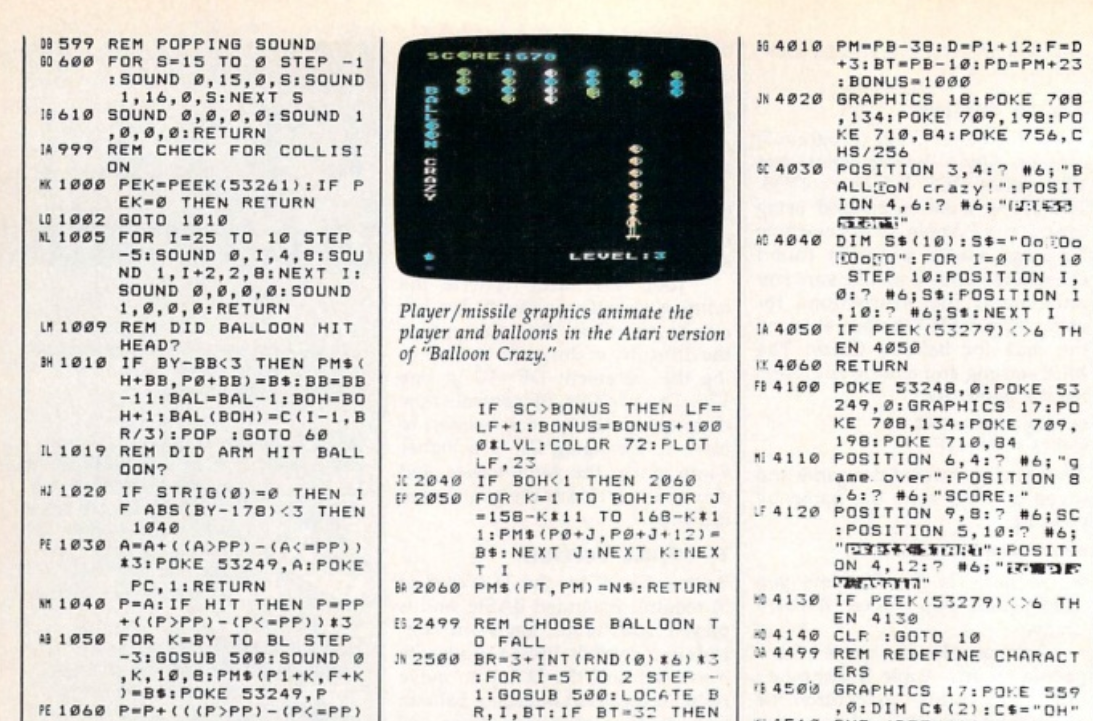
True story: How I managed to expose a scam and actually make a difference
In this quick case study I will describe my assistance in exposing a scam: namely how I managed to find out about it, what actions I took to warn others and what the results were. It was quite an interesting journey and it yielded results that are quite motivating so I hope you’ll enjoy this quick read.
I’ve never been involved in any type of crypto investigation so this situation I found myself in was totally new, unexpected and also kind of exciting. I’m aware of channels like Coffeezilla or Barnacules and they’re doing great work exposing some of those schemes but that’s about it as far as my scam hunting knowledge goes. I will also add that I am relatively familiar with Axie Infinity, own a couple of Axies, and I also dipped my toes into a couple of other less known titles. Therefore I do have a bit of familiarity with play to earn field, although by no means am I an expert.
The culprit in this story is a game called Thetan Arena. It debuted in October 2021 via Binance Launchpad and got off to a very good start. Its whitepaper described it as the 1st MOBA NFT game that’s easy to pick up and play. Launchpad participants were able to buy mystery boxes with one of 3 types of heroes Common, Epic or Legendary and then duke it out on PvP arenas in one of many competitive modes. Each hero had only a certain amount of games at its disposal which made tokenomics look strong and sustainable. Basically, those with consistent win rates could expect to make money, just like in a game of poker. Actually, the break-even point was somewhere around 45% so even players who would win exactly half of their games could still come out on top.
I did not participate in the launchpad nor did I have any prior knowledge of Thetan Arena but sure enough, I heard of it late November when Thetan went public. There was a lot of hype, simply because admittedly the game was quite fun to play and having money at stake made it more engaging. Investors were coming in large numbers, influencers predicted Thetan might as well be the next Axie Infinity and so on.
In early December, after seeing a bit of gameplay I convinced myself to purchase one of the cheaper “common” heroes and test the waters. And well, that’s when I noticed something was off.
I do have some background in doing Quality Assurance and video game QA testing which might explain why I quickly realized gameplay doesn’t seem natural. Both your teammates and opponents were acting weird, often would glitch out, or just act completely reckless. This was especially apparent when playing 4v4 where having clueless teammates that just run into your opponent could easily diminish any chances of making a profit regardless of how skilled the player individually is. Battle Royale mode was also totally off with some players looking for combat right of the bat instead of loot and generally being actively hostile which contradicts typical organic behaviour.
I started to play around putting my QA knowledge into practice and trying to spot any bugs or irregularities in regards to this odd player behaviour. I suspected that these are not human players but rather bots.
Lo and behold. After just a few games I managed to force supposedly “human” players to infinitely run after me, following the exact same path (that was most likely hardcoded into their pathfinding algorithm).
What’s worrying here is that these bots were not attacking each other (this is Battle Royale mode, you can see in the top right corner there are still 12 players left) but instead were dead set on killing a human player first (to the point where you could clown them into running in circles). To make it funnier both bots were using the same heroes although that was a coincidence.
Since there’s money at stake I didn’t expect players to immediately notice. After all, not many would be willing to risk their win rate just to test some hypothesis. But that discovery was no doubt a big red flag. It’s one thing to inflate player numbers and lead players into believing they are fighting human opponents when they’re fighting bots, it’s another to engineer these bots in a way that is disadvantageous to players altogether. Bots do not earn any coins, they do not withdraw their winnings. If an average bot win rate is above that of a human or just above 45% in general that could yield massive savings for developers at players cost.
I kept doing some more playtesting and things were looking worse and worse. Here you can see what looks like 6 players converging on me from all different directions.
It’s almost impossible to avoid defeat unless you manage to run into another human player, confuse all the bots that are chasing you and still somehow survive. The way rewards are distributed is such that the top 3 players get the biggest amount of gTHC. Those placed 4-6 also get some small awards but end up in an overall loss, and then places 7-12 don’t pay out anything. As a result, if bots place for example 1st, 3rd and 5th, their win rate might be 50% but their actual payout impact would be much worse as bots would collect a disproportionate amount of money from the pool, closer to 70%. And since every game costs players money, you can easily start to connect the dots here.
I did not want to jump the gun just yet because the evidence was quite circumstantial. Screenshots look mighty suspicious but could be easily discarded as photoshop, as a set-up (human players banding together to make Thetan Arena look bad on purpose) or simply as a very weird coincidence.
Fortunately, developers did not bother to cover their tracks very well and I quickly realized you can identify bots just by looking at their names! They all follow a similar naming pattern, possibly a result of some kind of generator.
Let’s look at this example. Here you’ll be playing against (or together with) these three gentlebots. Notice anything particular?
ProudCrab, SoufulFly, TestyRabbit, SnazzyAnt, GraveLizard and so on. Almost all of these variations follow a similar pattern, an adjective followed by an animal verb. Sometimes it can be food or some general item like a book. Both adjective and animal parts are always capitalized. This made identifying bots a whole lot easier and also made the case against Thetan a lot more solid. Anyone who plays Thetan Arena could now check my findings themselves and confirm it’s true, quickly identify who the bot players are and notice their artificial behaviour. Also, there was no way Thetan Team could argue that these are all coincidental names and that there’s no collusion going on.
Meanwhile, the game was generating more and more hype and people were piling in from every direction, so time was of the essence. Here we can see CagyJan, one of the biggest names in the play to earn space, placing second in Thetan Arena and not realizing he just lost to a bot!
CagyJan assumed (just like 99.99% of players) that he’s playing against another human, so it’s hard to blame him for having a good time or for featuring Thetan but seeing things like that only strengthened my conviction that I was onto something and that I had to act quick. Most people had no idea these shenanigans were taking place and were making flawed financial decisions that could cost them dearly. I’m talking here about the play to earn aspect but of course also about Thetan’s main token THG which people were pouring their money in, hoping for big returns when Thetan becomes big. It was important to blow a lid off this thing and to do it fast.
First I went to check Thetan Reddit. You could find there some tips for newcomers, players looking for teammates, feature requests, suggestions and so on. Most posts were well-intended. I spotted a bunch of complains where players grumbled about bizarre teammate behaviour and other weird glitches but in most cases this was simply explained as players playing the game wrong. There was no attempt draw any conclusions or any assumption that foul play might be involved.
I made a couple of posts outlining the discovery of bots and urging players to be careful, but the results were very meagre. Sure, I got a bunch of upvotes, but that was it. Thetan subreddit wasn’t particularly active and it was hard to expect any major reaction or resonance.
The next step was to look for someone with a bigger megaphone than me. I first tried to contact Coffeezilla and Barnacules but realized these guys are very busy and pretty much out of reach for a regular internet dweller. I tried Twitter, Instagram and even Bitclout but to no avail. Even if I could somehow reach Coffezzilla I'm not certain he would have time to make a video about Thetan. There are just so many scams happening every week. I had to look somewhere else.
My next best bet was to look at various influencers in play to earn space. Most seemed to hype up Thetan like crazy but there was one video that caught my eye that was a bit more critical than others. Champion NFT Gaming made a video that questioned Thetan Arena's claims about its player base. Around that time Thetan Arena officially boasted 6 million players and to Champion NFT Gaming this seemed like an extraordinary number. Axie Infinity had 3 million players at that time. Other numbers, like the number of members in Thetan Arena Discord or Reddit were also brought up and compared to those of Axie. Same with the number of NFTs: way below 6 million and in the range of 200 thousand.
All those things suggested the real number of players in Thetan is way smaller than 6 million. Since CNG (Champion NFT Gaming) team was quite sceptical of Thetan to begind with, it seemed very plausible they would find my bot discoveries interesting and useful. I checked for a website, Twitter or any other form of contact and eventually made it to their Discord where I asked to be put in touch with the main creator of content for their Youtube channel. I explained what was going on to one of the discord admins, presented evidence of bot play and waited.
Few hours later I was put in touch with the NGC founder who was made aware of my discoveries and was now looking into this case, verifying my findings and going through a large number of games to get a general idea of how bot play might impact players and their payouts. I was also told there’s another red flag relating to Thetan Arena, namely funds from sales of so-called ‘mystery boxes’ that were supposed to be burned were moved instead to a private Binance wallet.
The next day NGC was already out with their video.
Titled aptly “Theta Arena Scam?” it laid out both proof of bot presence and also implications of such manipulations. NGC video did a very good job in explaining even to laypeople why having AI bots pose as human players is such a big red flag.
In the screenshot above CNG shows two teams, one team with 3 players and 1 bot and the other team with 1 player and 3 bots! Obviously, the single lone player on the right (Jonathan) is at a massive disadvantage and almost guaranteed to lose in such a configuration. Same with teams that have to fight against legendary or epic bots. The way matchmaking worked was far from transparent or honest and anyone who watched NGC’s video could easily understand that.
Video also touched on other topics like inflated player numbers and funds from sales being transferred out of Binance Smart Chain and into an unknown private wallet. The video raked around 15 thousand views and in all honesty, I thought that was it. I did my part, spoke out, found a way to share my concerns and now there is a video on Youtube that explains everything better than I could. I went to bed knowing I did the right thing and was ready to move on.
To my surprise, however, this is when things actually started to take off. As other outlets and influencers started picking up NGC’s video, news began to circulate and when I woke up the next day Thetan Arena scam was discussed all over crypto Youtube.
Content creators picked this info up, broadcasted it to their own respective audiences, and collectively shifted the entire thing almost overnight. Suddenly bot play (as well as other malpractices Thetan team engaged in) were all common knowledge!
Some Youtubers like Crypto King acted very honorably. Crypto King not only cautioned his followers to avoid Thetan Play, but even apologized for helping publicize this game which wasn’t his fault at all, since almost every Play 2 Earn outlet covered Thetan Arena at that time, and many speculated it’s poised to become the biggest MOBA in crypto.
But others were not as honest with their viewers (and maybe also with themselves). Accusations of FUD followed, even accusations that this is some kind of well-orchestrated move by competition that wants Thetan to fail.
That was the suggestion made by Bulldog1205. That this is some kind of black PR stunt and that Thetan users shouldn’t stress as there is nothing to worry about. Inflated player numbers, coins being moved into Binance personal account instead of being burned and even bot play are nothing more than FUD (crypto slang for Fear, Uncertainty and Doubt).
For players afraid of getting cheated, Bulldog1205 suggested they should friend each other, and go into matches in groups of 4. So basically instead of fixing or even admitting the issue, players should try to find a workaround and carry on (at the expense of other less informed players I should add).
Other videos were even more jarring. Go Shiny Hunter concluded that “This is not a scam, it’s just unfair to the player who gets matched with bots” (sic) and downplayed what was a massive red flag. After listening to those influencers you could be led to believe that playing with AI opponents instead of humans isn’t all that bad. Sure it breaks one of the major promises of the game, but it’s just a bot, what’s the big deal. You’re probably going to lose regardless, so why not lose to a bot, have some fun, spend some money, pump the coin. I’m being sarcastic but it’s not hard to guess a lot of crypto influencers had their own money invested into THG and seeing their minds twist like a pretzel to avoid hurting the game and its sales was quite interesting if not depressing.
A couple of days later a surprisingly large number of users started commenting on the NCG Youtube channel, Crypto King as well as on other social media where bot play was discussed. Posts were usually quite aggressive in their format, things like ”you’re just a sore loser that blames bots for lack of skill” “I have never seen a bot” and so on.
Some replies were totally nonsensical:
There is no such thing as Epic Taekwon hero, no such things as “Fire” affinity or skin or whatever that was supposed to be, and also max level you can reach in Thetan Arena is 10. But that doesn’t matter. For those unfamiliar with the game that were browsing such channels, this created an impression as if there’s always some kind of sensible reply and that it’s not just a litany of disgruntled and discontent players in the comment section. Also worth noting, this reply was directed at someone asking how there may be players with 300 win streaks in the game - a good question that never got fully answered as it’s not possible to look into individual game logs. But it would be curious to see what opponents this 300-win streak player met on his way and how this record-breaking result came about.
Not that it mattered anyway. At that point, the THG coin was already down by half. From $9 on the 17th of Dec when CNG published their first video to $4.50 at the end of Dec when CNG published their last video on the subject.
No point in getting into the details of this last video. Suffice to say that all those problems reported earlier on still persisted. And now with the token in a freefall, lack of any confident roadmap or willingness to resolve all these issues was a major compounding factor.
It was already over for Thetan Arena. Players interested in this game would surely stumble upon all of those warning videos and with Token’s value dropping it was clear that Thetan isn’t going to be the next big thing. In fact, the lower THG coin was dropping the bigger risk that its team might simply forfeit their long term promises and instead just milk the project until exhaustion.
There was one more issue with Thetan Arena. A massive red flag and a final nail in the coffin that never even got properly exposed cause there was no need for a final nail. Thetan already collapsed before that. But if you’re interested what that final nail in the coffin would be, here it goes:
It turns out that Thetan Arena wasn’t even a real game. It’s actually an older mobile game from 2020 called Heroes Strike!
This unfortunately leaves a bit of distaste in an otherwise motivating story. Thetan Arena team didn’t even bother to create their own unique project, instead, they took an existing game of which there are loads, repurposed it for crypto and then made millions. Even with the project being exposed Thetan Team still made at least tens of millions from selling their Binance Launchpad mystery boxes.
The fact that all these red flags weren’t noticed, neither by Binance, nor by influencers, nor by anyone, is symptomatic of the entire P2E space which encourages crooked and unscrupulous grifting over honest devs work. Thetan Arena looked like a fun, engaging game that could have made its mark, and with its poker-inspired economics, its token could have reached some form of equilibrium but unfortunately, greed triumphed over everything else and now Thetan Arena will be remembered as just another money grab.
But there’s also a bright side. I’m positively shocked how much effect one can have by exposing such misdeeds and how much difference one person can make. I spotted something, explained, made noise, contacted Champion NFT gaming, and it all snowballed from there. And now people are talking about it, and now it’s having a real-world effect and so on. Seeing for example Youtuber discuss in German how you can spot bots by looking at adjective + name was quite powerful.
Armed with evidence of wrongdoing and with motivation to do something about it you can make your voice heard and make a difference. So let’s support good projects, expose the scams and make this world a better place.
Whistleblower to Tucker: You're Being Monitored; Reaction proves Snowden's lessons largely forgotten
Opponents amused; supporters outraged. Either way, it's as if 2013 never happened.
Recently Tucker Carlson made a pretty interesting claim. According to this claim, he was contacted by a whistleblower who could recite his emails, quote text messages and disclose data that seemed to have only been possible to obtain through hacking. Tucker was then warned that this data would soon be leaked to the public.
Shortly after, he decided to do a segment on Fox News where he accused the NSA of monitoring, surveilling and weaponizing his data. He also added some political flavor that seems to pander to his core audience: he connected everything to the Biden administration and added that “Spying on opposition journalists is incompatible with democracy.”
While Tucker’s claims made it into the mainstream news cycle, they were quickly put through standard partisan optics that allow anyone watching to promptly make up their mind on where they stand without really absorbing the underlying issue. One side approached this as an attack on American liberties often bundled with a not-so-subtle innuendo that the Biden administration is abusing their powers. The other side explained this as an attempt to erode public trust in national institutions, suggesting that Tucker might have something to hide or ridiculing him by comparing him to Alex Jones.
Both optics don’t really touch the main issue, that is the NSA and its mandate to conduct operations outside of any democratic process or oversight. Snowden’s leaks, even though explosive at the time, have now faded into memory and it feels as if we’re truly back to a pre-Snowden era where any notion of data monitoring invites media ridicule and where Fox News viewers act in shock as if Tucker’s the first journalist ever to have his data collected.
So, let’s start by bringing those old memories back to the forefront and make certain things clear. What Snowden revealed is mass surveillance purported by NSA. In 2013 Guardian reported that NSA **requires Verizon on an ongoing, daily basis to provide them information on all domestic and international telephone calls in its systems**. It doesn’t matter if the individual was suspected of any wrongdoing or not, if it was Tucker Carlson or regular John Smith - information was collected indiscriminately in bulk and then classed as metadata rather than communication to avoid legal implications like warrants and such. https://www.theguardian.com/world/interactive/2013/jun/06/verizon-telephone-data-court-order
The second big revelation that came out of Snowden leaks was that **NSA engages in a total worldwide data gathering under a project known as PRISM** which seeks to incorporate every major service provider into its surveillance network. Combining Prism with Upstream collection (raw intercept of all data passing through underwater fibre cables) gave NSA ubiquitous spying powers to monitor nearly entire Internet communication all around the world (except for perhaps China and few others). Again both ordinary John Smith and Tucker Carlson do fall well under “all internet communication.” https://www.theguardian.com/world/interactive/2013/nov/01/prism-slides-nsa-document
One of Prism onboarding slides (source: **The Guardian**) https://www.theguardian.com/world/interactive/2013/nov/01/prism-slides-nsa-document
According to Snowden what makes Prism so scary so that its evaluation is based on growth and engineered towards it. According to internal slides what NSA sees as success is first and foremost an increase in the number of signals and amount of data collected (not the quality of data i.e., the number oumber of criminals stopped of anything of that kind). The project is a success if each year the number of signals is higher than the year before, if there are new methods to gather fresh signals, if previous chokepoints and obstacles were removed and so on. Snowden correctly assessed that this is a very perilous optic. The hypothetical end game for such a vast, constantly expanding project would not eradicate all threats but eradicate all privacy with an ever-growing bureaucratic drive to collect increasingly more significant and finer amounts of data.
Given all of that, the current discussion and arguments around Tucker Carlson seem so far off the mark it’s almost laughable. How dare they monitor Tucker - says one side, Tucker is a conspiracist, nobody is monitoring him - says the other. Both sides fail to realize what they are debating is old news, old and irrelevant. Considering Snowden leaks were often quoted and referred to by the media it’s quite disheartening to see this regressive shift with anchors and news hosts now going back to pre-Snowden tropes. Same with public awareness which seems much lower than in the years past together with comments on social media that appear way more ignorant than even just a few years ago.
At the very least the debate should center around whether Tucker's communications were indeed leaked or not, whether his identity was inferred or unmasked, what was the protocol and had it been breached. Instead, all we’re hearing is a lot of noise.
It’s true that Tucker is generally quite despised by a lot of media folks and that his often-divisive segments created plenty of negative sentiment that might make it harder for casual observers to look past personal biases but generally the odds are overwhelmingly in favour of this story being true. NSA has a history of transgressions and violations so big and long that’s it’s would be simply impossible for this short article to list it all. And it’s not some old pre-Snowden disclosures that we’re talking about but fresh and relevant news of today.
Just in the last few years, we had **AP journalists being spied on** for revealing that a supposed-would-be-bomber in Yemen was actually a planted US agent, **congress lawmakers being spied on** for opposing the Iranian nuclear deal (data collected “incidentally” of course since NSA is a foreign focused operation and would never). There have also been instances of **spying on officials, unmasking their identity and then somehow leaking the contents to the media** , precisely what Tucker Carlson is suspicious about. https://www.huffpost.com/entry/ap-phone-records-doj-leaks_n_3268932 https://www.wsj.com/articles/u-s-spy-net-on-israel-snares-congress-1451425210 https://edition.cnn.com/2017/09/13/politics/susan-rice-house-investigators-unmasked-trump-officials/index.html
The list is long, spying on journalists, spying on congress members but the most egregious and dangerous contravention has to be the one where intelligence **got caught spying on the very members of the Senate Intelligence Committee**! Why this transgression is particularly concerning seems obvious. If those who are supposed to preside and be charged with overseeing intelligence power centres are considered targets by those very power centres then it undermines whatever democratic pretence these agencies might still have had. Instead of accountability, separation of power, checks and balances we see a construct that’s closer to what sociologist Luhmann described as an autopoietic social system, that is, a self-referencing system that can function on the basis of its own elements. https://www.theatlantic.com/politics/archive/2014/12/a-brief-history-of-the-cias-unpunished-spying-on-the-senate/384003/
In the past, we saw such systems evolve and it was never for the good of the whole. One good example would be Spanish Inquisition, which grew so large it quickly became more powerful than the Church from which it was born. Only in the case of Inquisition, anyone trying to curb its power was investigated for witchcraft (after all why would anyone not want Inquisition to eradicate evil, surely they must be in cahoots themselves) and in the case of NSA, it’s national security. However, the premise stays the same, why would anyone want to curb NSA powers and allow the risk of foreign threats, surely they are a national risk too, maybe in cahoots, and need to be investigated.
Even though the Senate Intelligence Committee uncovered unlawful behaviour, they weren't able to hold anyone accountable. CIA Director John Brennan reportedly enraged Senate Intelligence Committee when he refused to answer who at CIA authorized the operation, but unsurprisingly, he wasn't punished for his refusal. John Brennan also committed aperjury, lied under oath and few weeks prior vehemently denied any involvement, going as far as declaring allegations to be so absurd that they are simply "beyond the scope of reason". None of this landed him in any type of trouble. Intelligence Agencies know that their spot is very high up the food chain and so allow themselves to operate with total disregard for the rule of law.
If there were no consequences for spying on Intelligence Committee why would anyone worry about Tucker? Well for one, Tucker is a public persona with his own prime-time news show and 5 million followers on Twitter. Even though there’s absolutely nothing in Tuckers revelations that NSA hasn’t done or breached in the past it immediately captured more media attention than any of the transgressions I mentioned earlier. It’s also not as complicated or administrative and easier to relate to. So much so, that in a rather unusual move NSA decided to weigh in and issue a denial.
Even though NSA blocked replies, this attempt at damage control only opened NSA to even more criticism from journalists, watchdogs and whistle-blowers alike. The part about being a foreign mission strikes as funnily naive given what we know about PRISM and other NSA efforts. Secondly, Snowden pointed out people don’t have to be targets to have their data intercepted years ago. It can be collected incidentally or in bulk. However, being a target does mean there’s has to be a corresponding FISA court order so there’s a chance this statement looks very formal and legalese on purpose, not to genuinely address any of the criticism but to shield the NSA from any legal action.
While there’s a considerable distrust towards intelligence power structures on all sides of the political spectrum historically it was usually left that voiced their concerns, for example in response to COINTELPRO. Nowadays with the liberal mainstream media sector being increasingly subservient, we can see an interesting shift in dynamic. Independent journalists are now the ones doing the heavy lifting but there’s also a growing amount of adversarial voices coming from the traditionally conservative base. From this perspective having older Fox News viewers exposed to negative NSA and CIA coverage is rather atypical and something NSA would definitely like to avoid.
Even though the general debate around Tucker Carlson's claims proves our understanding of Snowden leaks not only hasn't deepened but has actually regressed - it did force NSA and partially CIA into the spotlight. It reminded many why NSA is not our friend, brought many of their past wrongdoings back into the news cycle. Both political sides fine-tuned their arguments. Tucker isn't compared to Alex Jones or ridiculed anymore (**though this was replaced with him being called un-American**) and at the same time, Fox viewers also seem to have a better grasp at why this isn't just about Tucker but also about other hosts, journalists and generally the entire population. Even Tucker displayed a bit of modesty: "I've learned the last week that in Washington, the fact that federal government is reading your emails is no big deal (...) there's no expectations of privacy whatsoever" before adding "well, we have to push back". I guess we can call that a silver lining. https://taibbi.substack.com/p/spying-and-smearing-is-un-american-6d5
Metaverse ads are coming. And you won't be able to look away.
Virtual Reality users remember what happened after 2007 when FB introduced ads to its social platform and don't want any of that in the metaverse.
If you follow what's happening at CES this year you'll see it reached the point of absurdity. Everything has to be meta. In most cases these are blatant and obvious attempts to cash in on current trends but there are a lot of genuine use cases, mostly in the space of Virtual Reality. And that's where Facebook (now conveniently rebranding itself as "Meta") is hoping to cash in big. https://about.fb.com/news/2021/10/facebook-company-is-now-meta/
Ever since Facebook’s acquisition in 2014 VR community keeps bringing up various grievances and fears and this latest move with Facebook changing its name is similarly looked upon with suspicion. To make long story short Oculus is already operating an ecosystem where Facebook logins are mandatory, terms and conditions allow for data surveillance, and a walled garden approach means all apps have to go through a stringent curation process before they are accepted into the store.
Given all of that, no wonder that the recent announcement from Andrew Bozworth that Oculus will now start putting ads inside VR was supposed to be as low key as possible. https://www.oculus.com/blog/testing-in-headset-vr-ads/
Well that didn't work. In a now deleted Tweet Bozworth mentioned "We want to help developers generate revenue" and that they are "starting a small test of in-headset ads with a few developers" in the coming weeks. As restrained as this tweet sounds it immediately got picked up by users, retweeted, ratio'ed and amplified causing a lot of negative sentiment.
For many, allowing a centralized ad system foreshadows Facebook’s direction with its social media giant, where ads served as a gateway to more aggressive data-driven solutions down the road. Namely, targeted advertisement (so that ads generate more revenue) and attention economy ( so that users are incentivised to spend as much time connected as possible).
Bozworth’s initial tweet got ridiculed, social media quickly filled with memes and discussion boards were full of people venting their discontent. Angry gamers also took it to Oculus Store and review-bombed Blaston — one of the games that were supposed to be included in the initial ad rollout (as a result, Blaston since changed their mind and pulled out of the pilot, arguing ads may be a better fit for their other game Bait which is free to play).
But this growing backlash is not just limited to tweets and memes. Recent months have spawned a surprisingly large number of workarounds designed to countermeasure Facebook’s growing control over the VR ecosystem. Some are more symbolic than factual, but some actually work, allowing gamers to bypass the need to have a FB account. Bastian is one of such pioneers. Also known as Basti564, he is the author of an app called Oculess. His app allows users to disable telemetry: a protocol responsible for collecting and sending all the data to Facebook servers.
Another solution that came up a while ago is based on the idea of downgrading the companion app to one of the earlier versions (one that precedes mandatory FB logins). There was no Quest 2 at that time, but if users select Quest 1 instead, the headset will get unlocked anyway. It’s a good workaround for those that still have access to their original Oculus accounts (and didn’t merge it with Facebook). It allows them to buy games, play the ones they already owned and generally do anything you could do on Quest 1 with an unmerged account. Obviously less and fewer people have access to original Oculus accounts, and those who still do should be aware these accounts are set to expire on the 1st of January 2023, as per Facebook’s announcement.
Then there are developer accounts or test accounts as they’re called. By definition, these accounts are meant to aid developers in their work but can also be used by casual users without any problems. Test accounts retain core functionalities like Oculus TV, Oculus Browser, Air Link, and so on; however, they do not allow for any downloads or purchases from the Main Store. It’s an interesting workaround that’s quite flexible and easy to set up, but there’s no guarantee it will stay that way. Just like with original Oculus accounts, these test accounts can at some point be either phased out or require some sort of lengthy verification process.
Even with all this ingenuity, there are still many VR enthusiasts that are not happy with where this entire Metaverse things is going. That’s because these various workarounds are mostly meant to constrain Facebook in what it’s allowed to do with its users data, how much of that data they can collect, and so on, rather than preventing Facebook from identifying who the user is. They offer various degrees of increased privacy, not anonymity which cannot really be attained on Quest 2 unless maybe with a full root — something that’s not very likely to happen given the complexities of Oculus OS and the fact that a full root would turn Quest into a barebones hardware device with no initial functionalities.
So, for the time being, it seems we will continue to see this type of adversarial back and forth between the VR community and Meta Facebook, where we have certain announcements or implementations that seem to forward Facebook’s XR vision but go against the wishes of the community, and then a corresponding backlash as a result. Facebook is a dominant player in the VR space, so they have the last word, but it creates a sort of interesting dynamic where they have to thread a little bit more lightly and balance out their strategic objectives so that they don’t hurt Quest sales and VR adoption.
Mat Pawluczuk - Who am I and why I'm on Read.cash! [Introduction]
Greetings everyone! It's customary for the first post to be an introduction and I intend to follow suit. It's a good way to say hello, connect with the community and also have a nice first post in case someone decides to look at my profile and scroll all the way down to the bottom.
So what can you expect from my posts? First of all technology related topics. I'm a big enthusiast of Virtual Reality (but not the metaverse hype). I'm also interested in BCI, blockchain and generally anything that's potentially disruptive or disturbing.
On the other hand I'm big on travelling and backpacking. It's a bit of my own Yin and Yang. I've been travelling since 2008, visited a lot of places and met a lot of great people.
Our planet is so beautiful in its diversity. From northern glaciers to Sahara with all the different cultures and various customs. When you travel you also get to interact with the better side of humanity, at least on average. It's such a shame to see all of it dissolve. I'm talking about climate change but not only.. which is why I also have great admiration for all sorts of activism that disrupts the status quo and challenges existing power centers. You can expect some articles in that regard as well.
There's a lot of reasons why I see blockchain technology as a way to help preserve information or at least give us a shot at attempting to preserve some of it for longer. From book burning, to destruction of the Mosul Museum to something as mundane as Joe Rogan deleting his podcasts from Youtube we're constantly reminded none of this is forever. As power changes hands and changes its form - information gets erased, gets edited or gets corrupted. If blockchain and decentralization can be seen as a countermeasures then what's not to like. Obviously other aspects like creator economy, tokenomics etc these are great as well.
If any of this sounds interesting, give me a follow and let's roll!
Thanks and Cheers!
Mat
Links to other platforms:
Twitter: Mat Pawluczuk (VR related) https://twitter.com/przecin83
Youtube: Przecinek and Zero Money Project (Travel related) https://www.youtube.com/user/przecinek https://www.youtube.com/channel/UC0fY8O8tKGfOPV3zT4JK8SA
Substack: Mat Pawluczuk (Activism related) https://matpawluczuk.substack.com/
Medium: Mateusz Pawluczuk https://medium.com/@przecinek
Google: Mateusz Pawluczuk https://www.youtube.com/channel/UC98_Hft_6c4xLmvPVf9GPgQ
Hive: https://ecency.com/@przecinek


 @MatPawluczuk