La Adopción Cripto Debe Ser Voluntaria
Criptoanarquía
Un sistema de dinero electrónico entre pares, es así como Satoshi Nakamoto concibió a Bitcoin , el 31 de Octubre de 2008.
Muchos festejan cuando Bitcoin es regulado en algunos países como moneda de uso legal, o aceptado como medio de pago, en El Salvador, por ejemplo, como la gran noticia.
**Yo lo detesto**.
No necesitamos el permiso de los gobiernos para elegir nuestro dinero. Les estamos dando el poder que Satoshi Nakamoto les quiso quitar para dárnoslo a nosotros.
La gran mayoría de las personas está educada en las escuelas con programas oficiales de instrucción de los gobiernos, y por supuesto aceptan que el dinero debe ser emitido y controlado por el Estado, o mejor dicho, por los políticos de turno que administran temporalmente el gobierno.
Esta gestión monetaria afecta a toda la población, y le da un poder enorme al gobierno.
Según los entusiastas de Bitcoin, el lanzamiento de Bitcoin se hizo para crear un sistema monetario equitativo. Pero, para los críticos, Bitcoin juega un papel importante en el financiamiento de diferentes actividades delictivas, que es la excusa perfecta para los reguladores.
Un Estado sin dinero no tiene poder, desaparece.
El dinero es el bien más demandado en la economía, y para ello debe ser aceptado por todos. La diferencia radica en que si es voluntario o es impuesto por ley, a punta de pistola.
¿Confiamos en Bitcoin Como Dinero?
El fundamento de Bitcoin no es conocido por todos. Bitcoin no surgió de la nada.
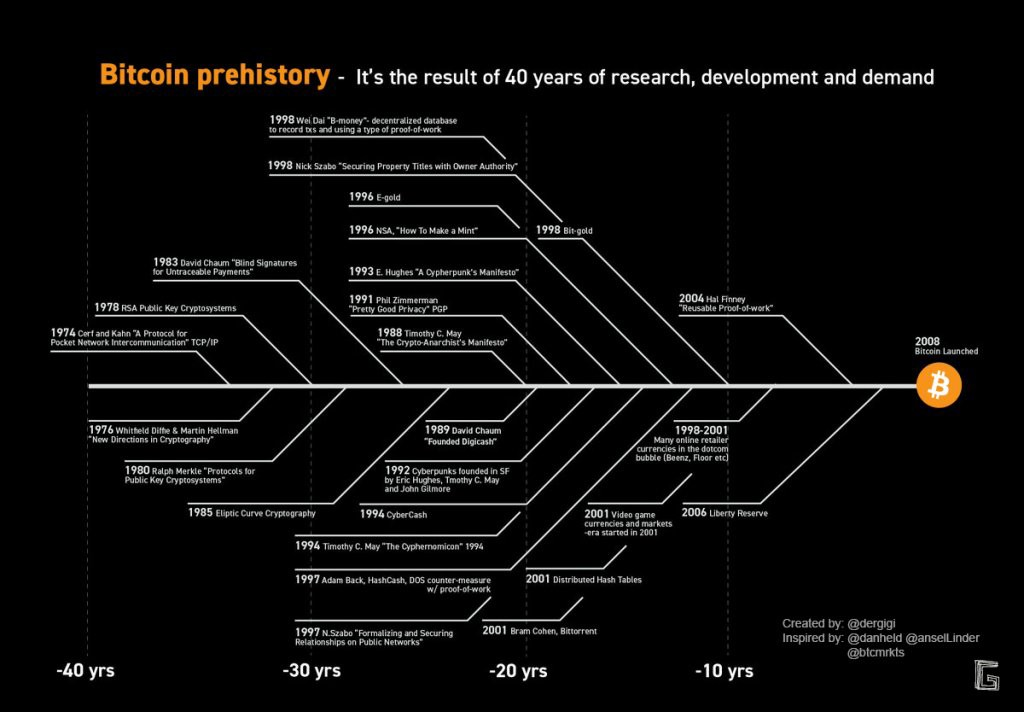
La idea del dinero digital tiene una larga historia. En particular, un colectivo conocido como los cypherpunks escribió largo y tendido sobre el dinero digital, su uso de forma anónima, la forma en que estos sistemas podrían realizarse y las implicaciones sociales de la criptografía en general.
La criptografía permite que dos personas pueden intercambiar mensajes, y negociar contratos electrónicos, sin saber nunca el nombre auténtico, o la identidad legal, de la otra.
Las criptomonedas tienen variadas cualidades positivas para convertirse en moneda. Es más, poseen muchísimas mejores cualidades que el dinero fiduciario, el dinero estatal emitido en base a deuda.
Las criptomonedas son privadas y las personas las eligen voluntariamente, el dinero fiduciario se impone obligatoriamente.
Todo dinero privado ha surgido como resultado del proceso de la acción humana, cuyo proceso de aprendizaje social indefectiblemente necesita tiempo. Todos los bienes que llegaron a ser dinero (ganado, pieles, lana, sal, tabaco, oro, plata, etc.) lo lograron luego de que millones de personas, interactuando espontáneamente en libre mercado.
Las criptomonedas basadas en blockchain serán dinero solo si son masivamente elegidas como tal por todo el público. Es decir, si se convierten en el bien más demandado espontáneamente por el público.
Las interacciones sobre las redes serán cada vez menos trazables, gracias al uso extendido de re-enrutado de paquetes encriptados que implementan protocolos criptográficos.
`“…la privacidad en una sociedad abierta requiere sistemas de transacciones anónimas. Hasta ahora, el efectivo ha sido el principal sistema de este tipo. Un sistema de transacciones anónimas no es un sistema de transacciones secretas. Un sistema anónimo permite a los individuos revelar su identidad cuando lo desean, y sólo cuando lo desean; ésta es la esencia de la privacidad…” (The Crypto Anarchist Manifesto).`
Las reputaciones tendrán una importancia crucial, mucho más importante en los tratos que las calificaciones crediticias de hoy en día. Estos progresos alterarán completamente la naturaleza de la regulación del gobierno, la capacidad de gravar y de controlar las interacciones económicas, la capacidad de mantener la información secreta, e incluso alterarán la naturaleza de la confianza y de la reputación.
Y las criptomonedas encuadran perfectamente en este esquema de Criptoanarquía.
`La anarquía no es caos, tal como nos han enseñado en la instrucción estatal, sino que es la falta de una autoridad central para imponer leyes. La anarquía es la relación, y asociación, con contratos voluntarios entre pares.`
El Banco Central de un país, es el brazo financiero del Estado y es quién diseña las políticas monetarias, ya que tienen la autoridad absoluta para regular el uso del dinero. Con la ayuda de la intermediación de los bancos comerciales, el gobierno regula todo el flujo de dinero en una economía.
En la mayoría de los casos, los gobiernos tienen controles para el capital. Por lo tanto, utilizan diferentes formas y métodos para evitar la salida de las monedas, y esta es otra forma de control que tienen los gobiernos si manejan la emisión y regulación del dinero.
Uno de esos controles está en el mercado de capitales de cotización pública, la bolsa de valores donde cotizan las acciones de las empresas más importantes de gestión privada.
Crear instrumentos financieros tradicionales, como ETF y Futuros de Bitcoin, implica debilitar la idea de Satoshi Nakamoto, ya que manipula el precio, imprime volatilidad, y destruye las propiedades de unidad de medida, que necesita un bien para convertirse en dinero. Es una acción deliberada del establishment que se siente amenazado por Bitcoin.
Palabras Finales
Depende de nosotros el éxito de Bitcoin y en general, del ecosistema de la criptoeconomía.
Es importante entender que Bitcoin transfiere poder, desde poder político al poder social, el de las personas, y así socavar la autoridad del gobierno.
Separar el dinero del Estado tiene el mismo impacto como lo tuvo en las democracias modernas, separar a la Iglesia del Estado.
Un Estado sin el manejo del dinero pierde uno de los tres pilares del poder, los otros dos son los impuestos y el endeudamiento público.
Los poderes cambian, y tal vez el Nuevo Orden Mundial, del que tanto hablan los elitistas, en algún tiempo futuro sea anarquista.
. . .
**liberlion.com** http://liberlion.com/
Not Surprisingly, Tail Emission is Inflationary
Monetary policy is one of the pillars of any economic system, where money is a merchandise that is used as a means of exchange of goods and services.
Its origin has a lot to do with the development of bartering. The difficulties of trade through bartering caused the peoples to seek a faster change system, and that also gave a more precise value to their merchandise.
Some consider that money has an intrinsic value, but I believe that the value is given by its acceptance as a means of exchange within an economic system. Let’s take the example of countries with high inflation where fiduciary money issued by governments is not accepted as a means of savings, due to its great loss of value over time. Its intrinsic value does not exist, but its value depends on supply and demand, and as citizens do not accept it, it loses more and more value.
Lebanon or Venezuela, are the countries with the greatest devaluation of the currency, at the time of writing this article. You can see the data in inflation rate for each country (if you click on the titles, you can order the values).
Thus, the money must be a half of change, unit of measure, and value deposit, and for this it must have 7 theoretical properties to fulfill that “ideal”:
Divisibility: money must be able to subdivide into small parts with ease without losing its value.
Fungibility: All units have the same value (they are indistinguishable from each other)
Durability: circular in the economy in an acceptable state for a reasonable time.
Portability: holders must easily transport money with substantial value.
Controlled emission: maintain its value, but without stopping the economy by insufficient supply, or accelerating it by surplus offer.
Recognition and security: It is easy to identify, easy to hide and difficult to confiscate or falsify.
Universal acceptance
Tail Emission
Tail Emission is being executed in the **Monero** Blockchain since June 2022, which consists of a fixed and perpetual reward per block, justified based on the fact that miners need an incentive to undermine, and due to the dynamic size of the blocks, the competition between miners will make the rates decrease. https://www.getmonero.org/resources/moneropedia/tail-emission.html
If mining is not profitable due to the high cost and low reward, miners would lose their incentive and stop undermining, reducing network safety.
Dogecoin also has a fixed reward system, which he refers to as a “abundant” supply.
The proponent of this idea for Bitcoin (BTC) is **Peter Todd**, a Bitcoin Core Developerand, details it in its article ‘**Surprisingly, Tail Emission Is Not Inflationary**’. https://www.linkedin.com/in/petertodd/ https://petertodd.org/2022/surprisingly-tail-emission-is-not-inflationary
Todd says that coins are constantly lost due to deaths, forgotten passwords, navigation accidents, etc. He also says that paying the miners perpetually with newly created bitcoins, will not make the amount of bitcoins in circulation increase forever. Instead, he believes that some bitcoins will be lost every year and, eventually, the speed at which they will be converged with the speed at which new bitcoins occur, which will result in a more or less stable amount of coins in circulation.
Todd says that at present, all the best known coins with Proof of Work protocol reward miners with emission and transaction rates. No blockchain have transaction fees consistently more than 5% to 10% of total mining, with the exception of Ethereum, from June 2020 to August 2021.
Todd argues that to date, no proof of work block has only operated with fees of transactions, and academic analysis has found that in this condition the network is unstable: **On the Instability of Bitcoin Without the Block Reward**. https://www.cs.princeton.edu/~arvindn/publications/mining_CCS.pdf
To implement Tail Emission, an adequate emission rate must be chosen on the maximum amount of inflation that is willing to have, in the worst case, and monetary inflation will be lower on zero day due to the loss of coins and , in the long run, it will converge towards zero, and also economic volatility dwarfs the effect of small amounts of inflation. Even an inflation rate of 0.5% for 50 years only leads to a 22% drop.
Todd considers to add Bitcoin Tail Emission would be through a hard fork. While Monero was able to obtain a sufficiently wide consensus in the community to implement the Tail Emission, it is not clear if it would ever be possible to achieve that for the much larger Bitcoin. In addition, Monero has a frequent hard forks culture that does not exist in Bitcoin.
Many people responded to his publication in **BitcoinTalk**, and I will present the most notable quotes. https://bitcointalk.org/index.php?topic=5405755.0
The debate
*Hard bifurcation is not required*: Videu **suggests** that a soft bifurcation can create new bitcoins imbueting transactions outputs that pay zero satiShis with a special meaning. For example, when a node that Opt for bifurcation sees an output of zero SAT, look for the transaction otherwise the transaction. This creates two kinds of bitcoins, but presumably soft bifurcation would provide a mechanism to convert bitcoins inherited into modified bitcoins. https://lists.linuxfoundation.org/pipermail/bitcoin-dev/2022-July/020684.html
*There is no reason to believe that perpetual broadcast is sufficient*: Anthony Towns **posted** on the mail list, and Gregory Maxwell **posted** in Bitcointalk, that there is no reason to believe that paying the miners a number of currencies equal to the average rate of coins losses will provide sufficient Pow security. If a perpetual emission cannot guarantee security, and if it has a significant probability of producing additional problems, it seems preferable to stick to a finite subsidy that, although it cannot guarantee security, at least it does not generate additional problems. Maxwell also points out that, on average, Bitcoin miners obtain significantly higher value through transaction rates than many Altcoins pay to their miners through the combination of subsidies, rates and other incentives. These Altcoins are not suffering fundamental power attacks, which implies that it could be the case that sufficient value is paid only through transaction rates to maintain Bitcoin’s security. In summary, it is possible that Bitcoin has already passed the point where he needs its subsidy to obtain enough Pow security. Maxwell describes how the loss of coins could be eliminated almost completely by allowing anyone to automatically opt for using a script that would donate any of its coins that have not moved during, say, 120 years, far beyond the expected useful life of the owner of the owner original and its heirs. https://lists.linuxfoundation.org/pipermail/bitcoin-dev/2022-July/020693.html https://bitcointalk.org/index.php?topic=5405755.0
*Censorship resistance*: the developer ZMNSCPXJ **expanded** an **argument** of Eric Voskuil that the transaction fees improve the resistance to censorship of Bitcoin. For example, if 90% of the block reward comes from the issuance and 10% of the transaction rates, then the largest amount of income than a miner that censures directly is 10%. But if 90 % come from rates and 10 % of subsidies, the miner could lose directly to 90 %, a much stronger incentive to avoid censorship. Peter Todd **responded** with the opinion that a perpetual broadcast would raise more money for Pow’s security than “insignificant transaction rates”, and that a higher block reward would increase the cost that an attacker would have to pay to the miners to censor transactions. https://lists.linuxfoundation.org/pipermail/bitcoin-dev/2022-July/020678.html https://lists.linuxfoundation.org/pipermail/bitcoin-dev/2022-July/020676.html https://lists.linuxfoundation.org/pipermail/bitcoin-dev/2022-July/020688.html
*Fee Sniping*: **Bram Cohen** published about the problem of **Fee Sniping** and suggests keeping transaction rates in approximately 10% of the total rewards of the block (the rest is a subsidy) as a possible solution. He briefly mentions some other possible solutions, but others provided additional suggestions in more detail. https://lists.linuxfoundation.org/pipermail/bitcoin-dev/2022-July/020702.html https://bitcoinops.org/en/topics/fee-sniping/
*Anticipated Rate Payment*: Russell O’Connor **presented** an old idea that miners could calculate the maximum amount of rates they could collect from the main transactions in their group of members without encouraging the reduction of rates. Then, they could offer any additional fee that charged the next mining to build the next block in a cooperative way instead of competitive. The participants of the discussion went through **several** iterations of **this** idea, but Peter Todd **pointed out** that a fundamental concern with this technique is that smaller miners would have to pay further bribes than the largest miners, creating economies of scale that could still centralize plus Bitcoin mining. https://lists.linuxfoundation.org/pipermail/bitcoin-dev/2022-July/020704.html https://lists.linuxfoundation.org/pipermail/bitcoin-dev/2022-July/020719.html https://lists.linuxfoundation.org/pipermail/bitcoin-dev/2022-July/020735.html https://lists.linuxfoundation.org/pipermail/bitcoin-dev/2022-July/020705.html
*Improving market design*: Anthony Towns **suggests** that improvements in Bitcoin software, and user processes could significantly level rates, which would make the rates less likely. https://lists.linuxfoundation.org/pipermail/bitcoin-dev/2022-July/020716.html
My criticisms
The Tail Emission contradicts the essence of Bitcoin, with respect to the shortage of its cryptocurrency, with its deterministic monterary policy.
While Whitpaper “**Bitcoin: A Peer-to Peer Electronic Cash System**” by Satoshi Nakamoto, published on October 31, 2008 does not explain that the amount of Bitcoin has a maximum of 21 million, is implicit in its algorithm. The technical explanation is as follows: https://nakamotoinstitute.org/bitcoin/
The number of satoshis is maintained within the limits of the double floating numbers, 64 bits, with a small margin for multiplication / division rounding. The 64 -bit flotation provides 52 bits of explicit storage. Interestingly, 2 elevated to 51 are 2,251,799,813,685,248 units. This is just enough to store 21 million coins 10 times 8 divisions.
Mathematical explanation
The number of blocks per 4 -year cycle: 6 blocks per hour x 24hs x 365 days x 4 years halving = 210.240 ~ 210,000
Adding all block reward sizes = 50 + 25 +12.5 + 6.25 + 3,125… = 100
Multiplying both 210,000 x 100 = Btc 21,000,000
On the other hand, the new monetary policy Tail Emission aims to solve a problem of loss of bitcoins, which, although it is true, it is not possible losses. What does “lost” mean? Should the owner report the loss of keys? How would it know if he is the true owner, if the only way is to demonstrate it with the movement of the funds with the keys?
The fact that they are lost and out of circulation does not mean that they did not exist, because they were undermined, and were part of the reward charged by the miners.
The proposal to develop Tail Emission in Bitcoin has another covert issue, and it is clear to me. Because the philosophy that is encouraged for Bitcoin is ‘Hodl’, and use is not promised as P2P cash, transactions would not increase enough to replace the mining of new BTC, this for deflationary policy through halvings.
We see that in 2032, 0.78125 bitcoins will be issued each block, and if the amount of transactions do not increase, mining in Bitcoin will not be profitable.
Solve this problem, saying that it is intended to provide security to the blockchain, to keep the incentive to the most emission miners, using Tail Emission, is to want to solve a problem of lack of scalability, and inability to generate volume of transactions into blocks of 1 MB.
Bitcoins’ shortage is something that is repeated as a prayer in the community, as a desirable virtue. It would not exist with Tail Emission.
Tail Emission would probably generate inflationary problems, since the balance between demand and supply is dynamic, and only free market can establish it.
If Bitcoin relies on perpetual issuance to incentivize mining, it means it will have no number of transactions, because it will not be ‘A Peer-to-Peer Electronic Cash System’. In that case, Bitcoin will not be worthwhile.
. . .
**liberlion.com** http://liberlion.com/

No es Sorprendente, Tail Emission es Inflacionaria
La política monetaria es uno de los pilares de cualquier sistema económico, donde el dinero es una mercancía que se utiliza como medio de intercambio de bienes y servicios.
Su origen tiene mucho que ver con el desarrollo del trueque. Las dificultades del comercio a través del trueque hicieron que los pueblos buscaran un sistema de cambio más rápido, y que además diera un valor más preciso a sus mercancías.
Algunos consideran que el dinero tiene un valor intrínseco, pero yo creo que el valor está dado por su aceptación como medio de intercambio dentro de un sistema económico. Tomemos el ejemplo de países con alta inflación donde el dinero fiduciario emitido por los gobiernos no es aceptado como medio de ahorro, debido a su gran pérdida de valor con el tiempo. Su valor intrínseco no existe, sino que su valor depende de la oferta y la demanda, y como los ciudadanos no lo aceptan, pierde cada vez más valor.
Líbano o Venezuela, son los países con mayor devaluación de la moneda, al momento de escribir este artículo. Puede ver los datos en **Tasa de inflación** por cada país (si hace clic en los títulos, puede ordenar los valores). https://tradingeconomics.com/country-list/inflation-rate-
Así, el dinero debe ser medio de cambio, unidad de medida, y depósito de valor, y para ello debe tener 7 propiedades teóricas para cumplir ese “ideal”:
Divisibilidad: el dinero debe poder subdividirse en pequeñas partes con facilidad sin que pierda su valor.
Fungibilidad: todas las unidades tienen el mismo valor (son indistinguibles unas de otras)
Durabilidad: circular en la economía en un estado aceptable por un tiempo razonable.
Portabilidad: los tenedores deben poder transportar con facilidad dinero con valor sustancial.
Emisión controlada: mantener su valor, pero sin detener la economía por oferta insuficiente, ni acelerarla por oferta excedente.
Reconocimiento y seguridad: es fácil de identificar, fácil de ocultar y difícil de confiscar o falsificar.
Aceptación universal.
Tail Emission
Tail Emission (o emisión de cola) está siendo ejecutada en la blockchain **Monero** desde Junio de 2022, que consiste en una recompensa fija y perpetua por bloque, justificada en base a que los mineros necesitan un incentivo para minar, y debido al tamaño dinámico de los bloques, la competencia entre mineros hará que las tarifas disminuyan. https://www.getmonero.org/resources/moneropedia/tail-emission.html
Si la minería no es rentable por el alto coste y la baja recompensa, los mineros perderían su incentivo y dejarían de minar, reduciendo la seguridad de la red.
Dogecoin también tiene un sistema fijo de recompensa, a la que se refiere como suministro “abundante”.
El proponente de esta idea para Bitcoin (BTC) es **Peter Todd**, un desarrollador de Bitcoin Core, la detalla en su artículo ‘**Surprisingly, Tail Emission Is Not Inflationary**’. https://www.linkedin.com/in/petertodd/ https://petertodd.org/2022/surprisingly-tail-emission-is-not-inflationary
Todd dice que las monedas se pierden constantemente debido a muertes, contraseñas olvidadas, accidentes de navegación, etc. También dice que pagar perpetuamente a los mineros con bitcoins recién creados, no hará que la cantidad de bitcoins en circulación aumente para siempre. En cambio, él cree que algunos bitcoins se perderán cada año y, eventualmente, la velocidad a la que se pierden convergerá con la velocidad a la que se producen nuevos bitcoins, lo que resultará en una cantidad más o menos estable de monedas en circulación.
Todd dice que en la actualidad, todas las monedas más conocidas con protocolo de Proof of Work recompensan a los mineros con emisión y tarifas de transacción. Ninguna blockchain tienen fees de transacción consistentemente más del 5% al 10% de la minería total, con la excepción de Ethereum, desde junio de 2020 hasta agosto de 2021.
Todd argumenta que hasta la fecha, ninguna blockchain Proof of Work ha operado únicamente con fees de transacciones, y el análisis académico ha encontrado que en esta condición la red es inestable: **On the Instability of Bitcoin Without the Block Reward**. https://www.cs.princeton.edu/~arvindn/publications/mining_CCS.pdf
Para implementar Tail Emission se debe elegir una tasa de emisión adecuada sobre la cantidad máxima de inflación que se está dispuesto a tener, en el peor de los casos, y la inflación monetaria será aún menor en el día cero debido a la pérdida de monedas y, a la larga, convergerá hacia cero, y además la volatilidad económica empequeñece el efecto de pequeñas cantidades de inflación. Incluso una tasa de inflación del 0,5% durante 50 años solo conduce a una caída del 22%.
Todd considera que agregar Tail Emission a Bitcoin sería mediante un Hard Fork. Mientras Monero era capaz de obtener un consenso lo suficientemente amplio en la comunidad para implementar la Tail Emission, no está claro si alguna vez sería posible lograr eso para el mucho más grande Bitcoin. Además, Monero tiene una cultura de Hard Forks frecuentes que no existe en Bitcoin.
Bastantes personas respondieron a su publicación en **BitcoinTalk**, y presentaré las citas más notables. https://bitcointalk.org/index.php?topic=5405755.0
El Debate
*No se requiere bifurcación dura:* Vjudeu **sugiere** que una bifurcación suave puede crear nuevos bitcoins imbuyendo salidas de transacciones que pagan cero satoshis con un significado especial. Por ejemplo, cuando un nodo que opta por la bifurcación ve una salida de cero sat, busca en otra parte de la transacción el valor real transferido. Esto crea dos clases de bitcoins, pero presumiblemente la bifurcación suave proporcionaría un mecanismo para convertir bitcoins heredados en bitcoins modificados. https://lists.linuxfoundation.org/pipermail/bitcoin-dev/2022-July/020684.html
*No hay razón para creer que la emisión perpetua es suficiente* : Anthony Towns **publicó** en la lista de correo, y Gregory Maxwell **publicó** en BitcoinTalk, que no hay razón para creer que pagar a los mineros una cantidad de monedas igual a la tasa promedio de monedas perdidas proporcionará suficiente seguridad PoW. Si una emisión perpetua no puede garantizar la seguridad, y si tiene una probabilidad significativa de producir problemas adicionales, parece preferible ceñirse a un subsidio finito que, si bien tampoco puede garantizar la seguridad, al menos no genera problemas adicionales. Maxwell señala además que, en promedio, los mineros de Bitcoin obtienen un valor significativamente mayor a través de tarifas de transacción que muchas altcoins pagan a sus mineros a través de la combinación de subsidios, tarifas y otros incentivos. Esas altcoins no están sufriendo ataques PoW fundamentales, lo que implica que podría darse el caso de que se pague suficiente valor solo a través de las tarifas de transacción para mantener la seguridad de Bitcoin. En resumen, es posible que Bitcoin ya haya pasado el punto en el que necesita su subsidio para obtener suficiente seguridad PoW. Maxwell describe cómo la pérdida de monedas podría eliminarse casi por completo al permitir que cualquiera opte automáticamente por usar un script que donaría cualquiera de sus monedas que no se hayan movido durante, digamos, 120 años, mucho más allá de la vida útil esperada del propietario original y sus herederos. https://lists.linuxfoundation.org/pipermail/bitcoin-dev/2022-July/020693.html https://bitcointalk.org/index.php?topic=5405755.0
*Resistencia a la censura:* el desarrollador ZmnSCPxj **amplió** un **argumento** de Eric Voskuil de que las fees de transacción mejoran la resistencia a la censura de Bitcoin. Por ejemplo, si el 90% de la recompensa del bloque proviene de la emisión y el 10% de las tarifas de transacción, entonces la mayor cantidad de ingresos que un minero que censura puede perder directamente es el 10%. Pero si el 90 % proviene de las tarifas y el 10 % de los subsidios, el minero podría perder directamente hasta el 90 %, un incentivo mucho más fuerte para evitar la censura. Peter Todd **respondió** con la opinión de que una emisión perpetua recaudaría más dinero para la seguridad de PoW que las “tarifas de transacción insignificantes”, y que una recompensa de bloque más alta aumentaría el costo que un atacante tendría que pagar a los mineros para censurar las transacciones. https://lists.linuxfoundation.org/pipermail/bitcoin-dev/2022-July/020678.html https://lists.linuxfoundation.org/pipermail/bitcoin-dev/2022-July/020676.html https://lists.linuxfoundation.org/pipermail/bitcoin-dev/2022-July/020688.html
*Fee sniping*: **Bram Cohen** publicó sobre el problema de **los Fee Sniping** y sugiere mantener las tarifas de transacción en aproximadamente el 10% de las recompensas totales del bloque (el resto es un subsidio) como una posible solución. Menciona brevemente algunas otras soluciones posibles, pero otros proporcionaron sugerencias adicionales con más detalle. https://lists.linuxfoundation.org/pipermail/bitcoin-dev/2022-July/020702.html https://bitcoinops.org/en/topics/fee-sniping/
*Pago anticipado de tarifas:* Russell O’Connor **presentó** una vieja idea de que los mineros podrían calcular la cantidad máxima de tarifas que podrían cobrar de las principales transacciones en su grupo de miembros sin incentivar la reducción de tarifas. Luego, podrían ofrecer cualquier tarifa adicional que cobraron como soborno al próximo minero por construir el siguiente bloque de manera cooperativa en lugar de competitiva. Los participantes de la discusión pasaron por **varias** iteraciones de **esta** idea, pero Peter Todd **señaló** que una preocupación fundamental con esta técnica es que los mineros más pequeños tendrían que pagar sobornos más altos que los mineros más grandes, creando economías de escala que podrían centralizar aún más la minería de Bitcoin. https://lists.linuxfoundation.org/pipermail/bitcoin-dev/2022-July/020704.html https://lists.linuxfoundation.org/pipermail/bitcoin-dev/2022-July/020719.html https://lists.linuxfoundation.org/pipermail/bitcoin-dev/2022-July/020735.html https://lists.linuxfoundation.org/pipermail/bitcoin-dev/2022-July/020705.html
*Mejorar el diseño del mercado:* Anthony Towns **sugiere** que las mejoras en el software de Bitcoin, y los procesos de los usuarios, podrían nivelar significativamente las tarifas, lo que haría que las tarifas fueran menos probables. https://lists.linuxfoundation.org/pipermail/bitcoin-dev/2022-July/020716.html
Mis Críticas
La Tail Emission contradice a la esencia de Bitcoin, respecto de la escasez de su criptomoneda, con su política monteraria determinista.
Si bien el Whitpaper “**Bitcoin: A Peer-to Peer Electronic Cash System**” de Satoshi Nakamoto, publicado el 31 de Octubre de 2008, no explica que la cantidad de bitcoin tien un máximo de 21 millones, está implícito en su algoritmo. La explicación técnica es la siguiente: https://nakamotoinstitute.org/bitcoin/
El número de satoshis se mantiene dentro de los límites de los números flotantes dobles, de 64 bits, con un pequeño margen para el redondeo de multiplicación / división. La flotación de 64 bits proporciona 52 bits de almacenamiento explícito. Curiosamente, 2 elevado a 51 son 2.251.799.813.685.248 unidades. Esto es justo lo suficiente para almacenar 21 millones de monedas 10 veces 8 divisiones.
Explicación matemática
El número de bloques por ciclo de 4 años: 6 bloques por hora x 24hs x 365 días x 4 años halving =210.240 ~ 210.000
Sumando todos los tamaños de recompensa por bloque = 50 + 25 +12.5 + 6.25 + 3,125…= 100
Multiplicando ambos 210.000 x 100 = BTC 21.000.000
Por otra parte, la nueva política monetaria Tail Emission pretende solucionar un problema de pérdida de bitcoins, que si bien es cierto, no es posible prever la cantidad extraviada o inutilizada en el circulante con un modelo matemático, sino que solo se sabe cuando ya fueron perdidas. Además ¿que significa “perdidas”? ¿El tenedor debe denunciar la pérdida de las llaves? ¿Cómo se sabría si es el verdadero dueño, si la única forma es demostrarlo con el movimiento de los fondos con las llaves?
El hecho que se pierdan y salgan de circulación, no significa que no existieron, porque fueron minadas, y formaron parte de la recompensa cobrada por los mineros.
La propuesta para desarrollar Tail Emission en Bitcoin tiene otra cuestión encubierta, y me resulta clara. Debido a que la filosofía que se fomenta para Bitcoin es ‘hodl’, y no se promeve el uso como cash p2p, las transacciones no aumentarían lo suficiente para reemplazar el minado de nuevos BTC, ello por la política deflacionaria a través de los halvings.
Vemos que en el año 2032 se estarán emitiendo 0,78125 bitcoins en cada bloque, y si la cantidad de transacciones no aumentan, no será rentable la minería en Bitcoin.
Solucionar este problema, diciendo que se pretende brindar seguridad a la blockchain, para mantener el incentivo a los mineros con mayor emisión, usando Tail Emission, es querer solucionar un problema de falta de escalabilidad, e incapacidad de generar volumen de transacciones en bloques de 1 MB.
La escasez de bitcoins es algo que se repite como un rezo en la comunidad, como una virtud deseable. No existiría con Tail Emission.
Tail Emission probablemente generaría problemas inflacionarios, ya que el equilibrio entre demanda y oferta es dinámico, y solo el libre mercado lo puede establecer.
Si Bitcoin depende de una emisión perpetua para incentivar la minería, significa que no tendrá cantidad de transacciones, porque no será ‘A Peer-to-Peer Electronic Cash System’. En ese caso, Bitcoin no valdrá la pena.
. . .
**liberlion.com** http://liberlion.com/

The Crypto-Time Bomb
The popularity of Tether (USD₮) as an intermediary currency, between fiat money and cryptocurrencies, makes more sense in trading, not so much for “Hodl”. It is the stablecoin with the highest daily volume of crypto transactions.
USD₮ is a token accepted on several exchanges such as Bitfinex, Binance, Huobi Global, Kraken, Coinbase, Kukoin, Poloniex, among others, but also built on different blockchains, including Algorand, Bitcoin Cash’s Simple Ledger Protocol (SLP), Ethereum, EOS, Liquid Network, Omni, Tron and Solana, which act as transport protocols, consisting of open source software that interacts with blockchains to enable the issuance and redemption of Tether tokens.
The network effect that could cause a collapse of USD₮, that is to say the loss of parity with the dollar, its main function, would be enormous, since in addition to being the main trading instrument in the crypto market, it has its protocol running on different blockchains, as I explained.
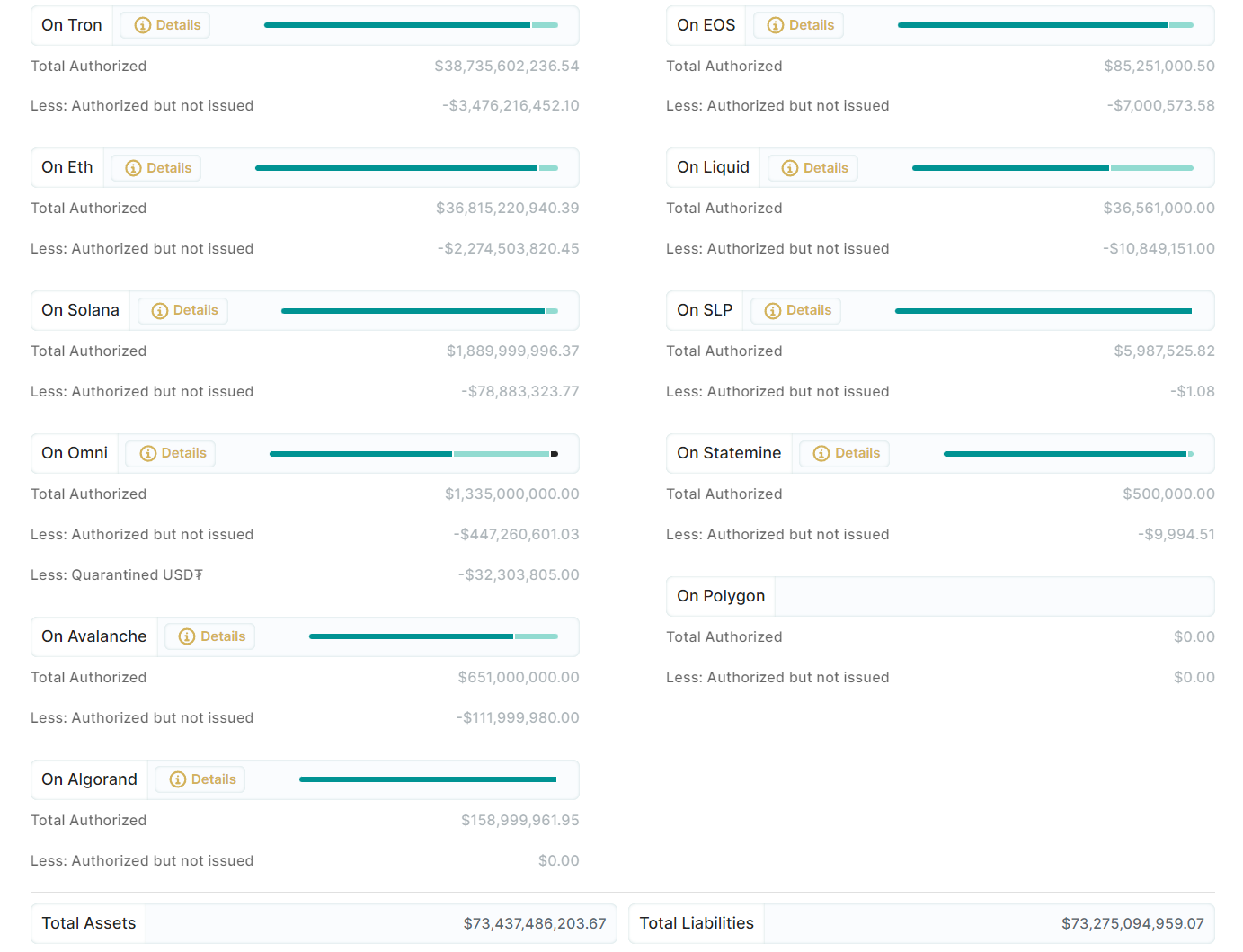
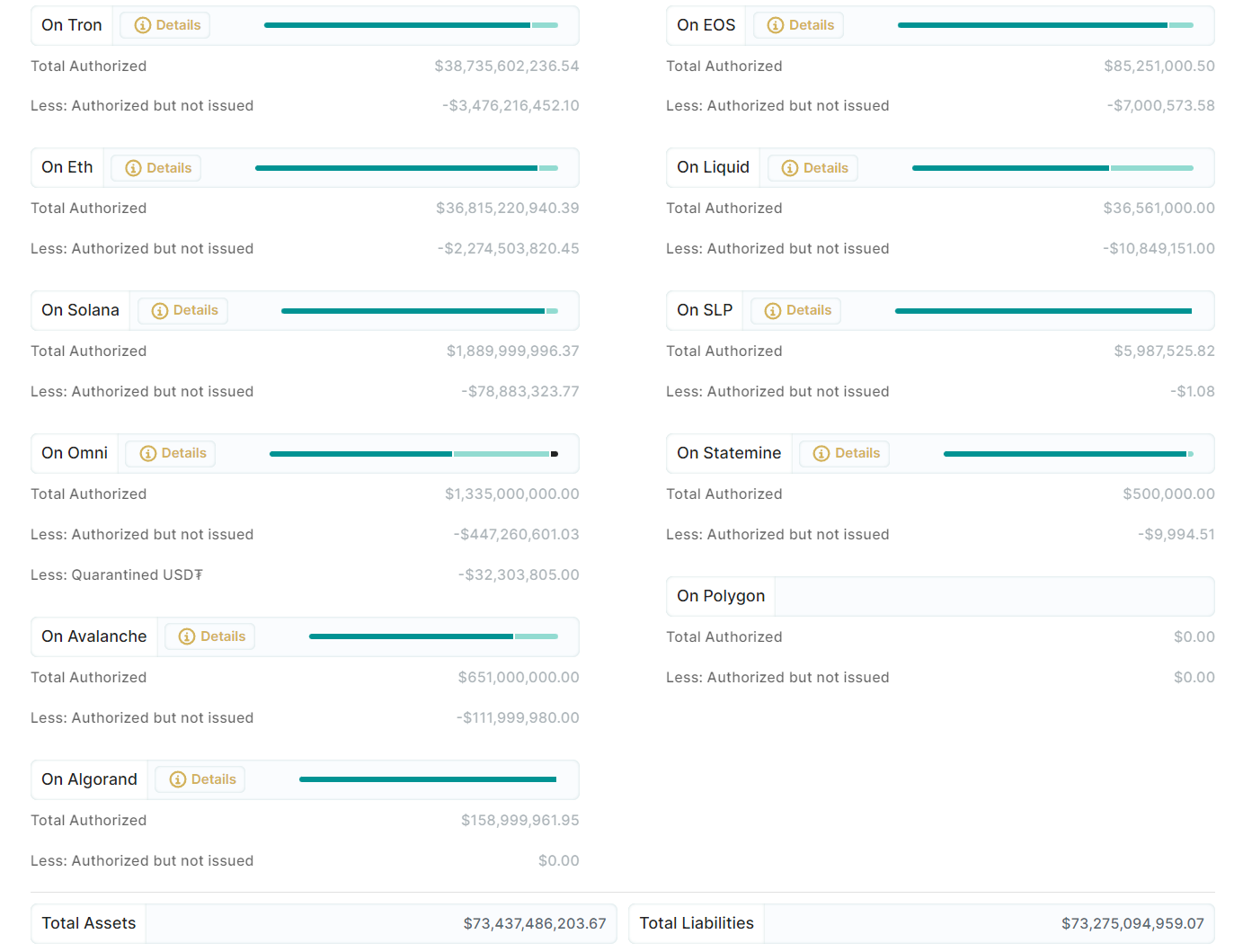
You can see in the following detail, as of May 2022, its distribution between assets and liabilities in the different blockchains, with a notable concentration of assets in Tron and Ethereum and liabilities in Eos:
Tether has a shady origin story. You can read my article on the subject, which I leave at the end *(1)*.
All the information that accumulates about Tether has clear indications that the entire system, both its structure, its purpose, and its monetary policy may be a scam.
The **Attorney General James** for the District of New York in 2019 investigated Tether Holdings Limited, ending in 2021. The result? Clearly fraud. That is, it is confirmed that the funds are not properly supported. https://ag.ny.gov/press-release/2021/attorney-general-james-ends-virtual-currency-trading-platform-bitfinexs-illegal
In a **post on Hacker News**, he says: “*…Much like the Fed who cannot stop monetizing US deficits for fear of letting yields explode, the Tetheral Reserve must continue to print USD₮ in order to support prices. Exchanges cannot let this fail since the vast majority do not have access to the bonafide banking system and thus scrappy users must devise “fiat onramps*”. https://news.ycombinator.com/item?id=25683586
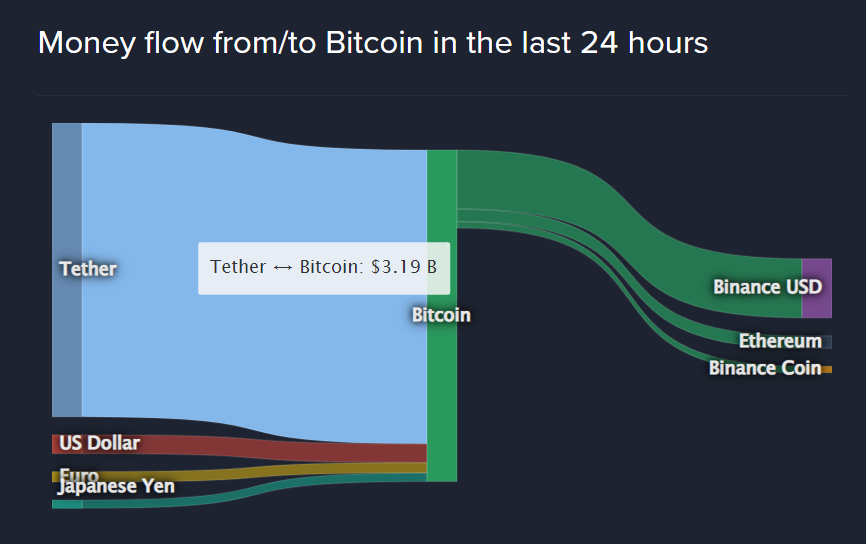
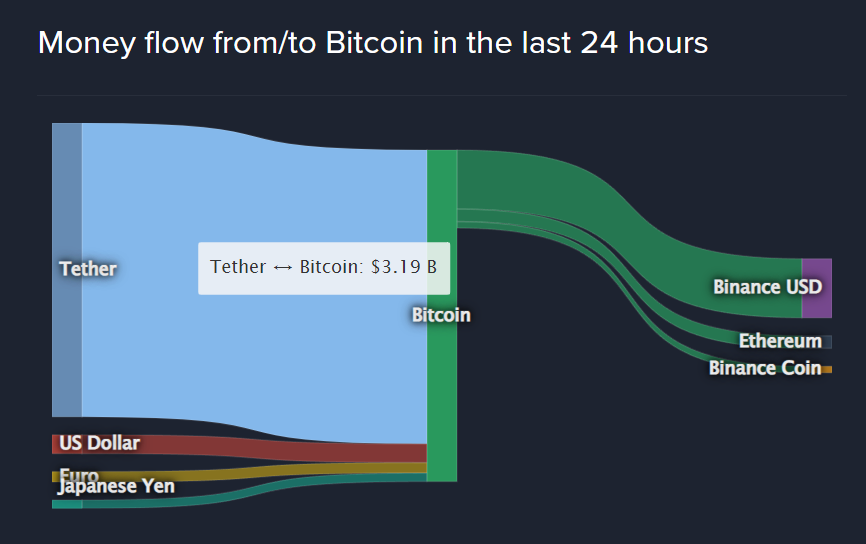
And this issuance manipulation directly impacts the market, since mainly Bitcoin is bought, with an impact on its price.
Most cryptocurrencies are purchased using Tether. In May 2022, 89% of all bitcoins traded were through Tether.
In the case of Cardano, 78% of the ADAs were traded with USD₮.
The most regulated exchanges, which do not use Tether but real fiat currency, trade higher volumes with dollars. However, in other less regulated exchanges, it is Tether. Coinbase and Bitstamp, two of the most regulated exchanges do not allow trading with Tether in some jurisdictions, which would mean a loss of business. However, in others such as Binance, Bit-Z and HitBTC, which are less regulated exchanges, in most jurisdictions, they have a much higher volume. And it is for this reason that regulators are concerned.
The more Tether issued, the more Bitcoin price. A Tether trading maneuver that promotes that relationship goes like this:
Bob, a crypto investor, puts 100 real dollars into Coinbase.
Bob then uses those dollars to buy $100 worth of Bitcoin on Coinbase.
Bob transfers his $100 worth of Bitcoin to a non-bank exchange, like Bybit.
Bob starts trading cryptocurrencies on Bybit, using leverage and receiving promotional gifts, all called Tether.
Tether Ltd. buys Bob his Bitcoins on the exchange, almost certainly through a deniable proxy trading account. Bob receives the payment in Tethers.
Tether Ltd. takes Bob’s Bitcoins and moves them to a banking exchange like Coinbase.
Finally, Tether Ltd. sells Bob’s Bitcoins on Coinbase in exchange for dollars, thereby exiting the cryptocurrency markets.
The **Central Bank of the Bahamas** reports how much foreign currency is stored in the domestic banks of the Bahamas, where Tether Holdings Limited is headquartered, confirming that in a period in which Tether went from USD 4.6 Billion to USD 10 Billion, the foreign currency in the domestic banks of the Bahamas only rose USD 600 million. https://www.centralbankbahamas.com/publications/qsd/quarterly-statistical-digest-november-2020-1?N=C
This economic model is not healthy for the ecosystem, where emissions are generated from nothing and Bitcoin (or other cryptocurrencies, with value) are acquired.
How long can this model last? And if it collapses, what can be the triggers for a crash in the crypto market?
You can deepen this analysis in **The Bit Short: Inside Crypto’s Doomsday Machine**. Always DYOR. https://crypto-anonymous-2021.medium.com/the-bit-short-inside-cryptos-doomsday-machine-f8dcf78a64d3
...
*(1)* The Obscurantism of Tether *(coming soon)*
La Cripto-Bomba de Tiempo
La popularidad de Tether (USD₮) como moneda intermediaria, entre el dinero fiat y las criptomonedas, tiene mayor sentido en el trading, no tanto para “Hodl”. Es la stablecoin con el mayor volumen diario de transacciones cripto.
USD₮ es un token aceptado en varios exchanges como Bitfinex, Binance, Huobi Global, Kraken, Coinbase, Kukoin, Poloniex, entre otros, pero también construido en distintas blockchains, incluyendo Algorand, Simple Ledger Protocol (SLP) de Bitcoin Cash, Ethereum, EOS, Liquid Network, Omni, Tron y Solana, que actúan como protocolos de transporte, que consiste en un software de código abierto que interactúa con las cadenas de bloques para permitir la emisión y el reembolso de los tokens Tether.
El efecto de red que podría causar un colapso de USD₮, vale decir la pérdida de paridad con el dólar, su principal función, sería enorme, ya que además de ser el principal instrumento de trading en el mercado cripto, tiene su protocolo ejecutándose en distintas blockchains, como expliqué.
Puedes ver en el siguiente detalle, a Mayo de 2022, su distribución entre activos y pasivos en las distintas blockchains, con una notable concentración de activos en Tron y Ethereum y de pasivos en Eos:
Tether tiene una historia de origen sombrío. Puedes leer mi artículo sobre el tema, que lo dejo al final *(1)*.
Toda la información que se acumula sobre Tether tiene claros indicios de que el sistema completo, tanto su estructura, su finalidad, como su política monetaria puede ser un scam.
El Fiscal General del Distrito de Nueva York en 2019 investigó a Tether Holdings Limited, **acabando en 2021**. ¿El resultado? Claramente, fraude. Es decir, está confirmado que los fondos no están debidamente respaldados. https://www.eleconomista.es/divisas/noticias/11066852/02/21/La-Fiscalia-de-Nueva-York-confirma-que-la-criptomoneda-tether-manipulo-el-mercado-de-bitcoins-en-2017-con-dinero-falso.html
En un **post en Hacker News**, dice: “…*Al igual que la Reserva Federal, que no puede dejar de monetizar los déficits de EE.UU. por miedo a que los rendimientos exploten, la Reserva Tetheral debe seguir imprimiendo USD₮ para apoyar los precios. Los intercambios no pueden dejar que esto fracase, ya que la gran mayoría no tiene acceso al sistema bancario bonafide y, por tanto, los usuarios rastreros deben idear “onramps fiat*”. https://news.ycombinator.com/item?id=25683586
Y esta manipulación de emisión impacta directamente en el mercado, ya que se compra principalmente Bitcoin, con incidencia en su precio.
La mayor parte de las criptomonedas se compran usando Tether. En Mayo de 2022, el 89% de todos los bitcoins negociados fueron mediante Tether.
En el caso de Cardano, el 78% de las ADAs fueron negociadas con USD₮.
Los exchanges más regulados, que no usan Tether sino moneda fiduciaria real, negocian mayor volumen con dólares. Sin embargo en otros menos regulados, es Tether. Coinbase y Bitstamp, dos de los exchanges más regulados no permiten tradear con Tether en algunas jurisdicciones, lo que les supondría una perdida de negocio. Sin embargo en otros como Binance, Bit-Z y HitBTC, que son exchanges menos regulados, en la mayoría de las jurisdicciones, tienen un volumen ampliamente superior. Y es por este motivo que se preocupan los reguladores.
A más Tether emitido, más precio de Bitcoin. Una maniobra de trading con Tether que promueve esa relación es así:
Bob, un cripto-inversor, pone 100 dólares reales en Coinbase.
A continuación, Bob utiliza esos dólares para comprar 100 dólares en Bitcoin en Coinbase.
Bob transfiere sus 100 dólares en Bitcoin a un intercambio no bancario, como Bybit.
Bob empieza a comerciar con criptomonedas en Bybit, utilizando el apalancamiento y recibiendo regalos promocionales, todos ellos denominados Tether.
Tether Ltd. le compra a Bob sus Bitcoins en la bolsa, casi con toda seguridad a través de una cuenta de trading proxy negable. Bob recibe el pago en Tethers.
Tether Ltd. toma los Bitcoins de Bob y los traslada a un intercambio bancario como Coinbase.
Finalmente, Tether Ltd. vende los Bitcoins de Bob en Coinbase a cambio de dólares, y así sale de los mercados de criptomonedas.
Un informe del **Banco Central de Bahamas** reporta cuánta moneda extranjera está almacenada en los bancos domésticos de Bahamas, donde Tether Holdings Limited tiene su sede, comprueba que en un periodo en el que Tether pasó de USD 4,6 Billones a USD 10 billones, la moneda extranjera en los bancos domésticos de Bahamas solo subió USD 600 millones. https://www.centralbankbahamas.com/publications/qsd/quarterly-statistical-digest-november-2020-1?N=C
No es sano para el ecosistema este modelo económico, donde se genera emisión de la nada y se adquieren Bitcoin (u otras criptomonedas, con valor).
¿Cuánto puede durar este modelo?, y de colapsar ¿Cuáles pueden ser los detonantes para un crash en el mercado cripto?
Puedes profundizar este análisis en **The Bit Short: Inside Crypto’s Doomsday Machine**. Siempre DYOR. https://crypto-anonymous-2021.medium.com/the-bit-short-inside-cryptos-doomsday-machine-f8dcf78a64d3
...
*(1)* El Oscurantismo de Tether *(próximamente)*
The Blockchain as Sovereignty of the Individual
The philosophy of the crypto ecosystem is decentralization. The pillar on which the blockchain technology was built is the transmission of information between peer nodes, in a structure without a central server, producing the information chain in a consensual way between strangers, trustless (P2P), from of a cryptographic protocol that provides that trust, with open public participation, and permissionless from a central power.
The **CYPHERPUNK MANIFESTO** published in 1993, by Eric Hughes, proposes the sovereignty of the individual based on privacy. https://nakamotoinstitute.org/cypherpunk-manifesto/
*“Privacy is necessary for an open society in the electronic age. Privacy is not secrecy. A private matter is something one doesn’t want the whole world to know, but a secret matter is something one doesn’t want anybody to know. Privacy is the power to selectively reveal oneself to the world. “*
The privacy contains decentralization because it is the power of each individual, their data and acts independently to dispose of a sovereign.
This privacy does not imply an anonymity intended to commit criminal acts, as much of the mass media of (mis)information disseminates, but, in a responsibility of a responsible and respectful society, we can allow ourselves that individual right. Something that the central power, the establishment, does not like, because that implies a loss of power.
Having people’s private information is the most valuable weapon for a central entity.
By now, and after 12 years since Bitcoin made its novel appearance, generating a whole P2P ecosystem, bankers have understood the enormous power that blockchain technology has for people, but as such, it also has it to maintain the status quo Since the speed of data transmission, low costs and traceability, it is ideal for the control, of course, if they co-opt the technology and revert it to a subordinate, centralized structure.
This concept of personal sovereignty can best be explained, dear reader, by antagonism, that is, by antithesis.
Furthermore, to demonstrate how this privacy and decentralization as pillars of sovereignty annoys the establishment, I will quote an article from one of the most widely read mass media in the crypto industry. Of course, in my opinion, the intention of the media in a clear lobbyist attitude.
The title only speaks for itself in its intent: “ **Why do we need custodial services?”**. *This article was published only in Spanish, and here I present it in translation*. https://es.cointelegraph.com/news/why-do-we-need-custodial-services?utm_source=Telegram&utm_medium=social
Without making an exhaustive analysis of the note, since I do not intend to make a journalistic criticism, I will only refer some notable fragments to the idea that I want to raise, and that of course you can read in full to verify what I propose.
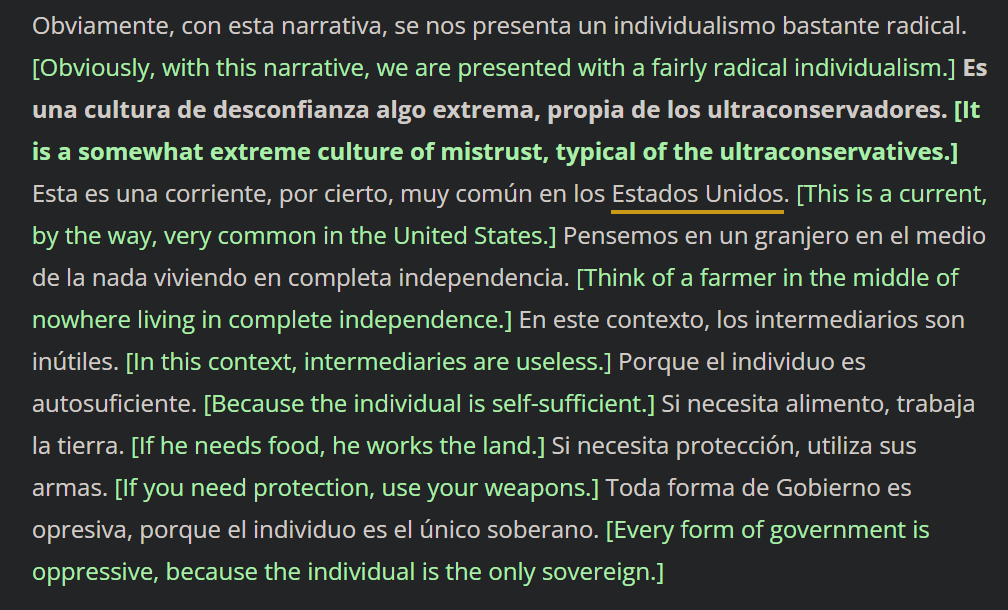
The radical individualism that it presents, in an exaggerated form, is not typical of the ultraconservatives, but in such a case, of the libertarians or even more, of the anarchists. No human society in history has progressed in isolation. He accuses the blockchain ecosystem of extreme individuality, something so far from reality, such as P2P, the relationship of two pairs, interacting in a personal way. Here, the key is the relationship, which the writer seems to ignore, arguing a hermit individualism.
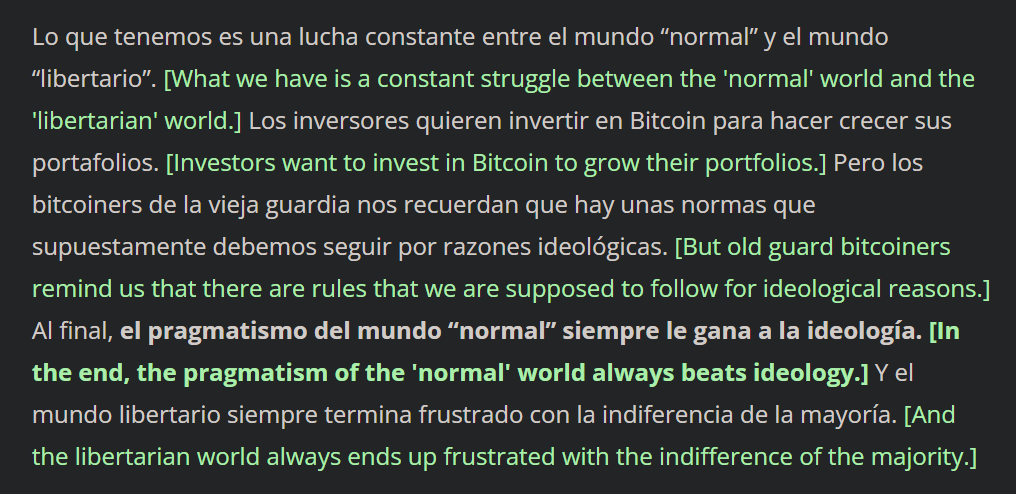
In the first place, and although it uses quotation marks to lower the tone of criticism, it proposes the “libertarian” world, as an opposition to the “normal” world. For the writer, “normality” is unique, and a “libertarian” world cannot coexist with its “normality.” The pragmatism of the “normal” world that he refers to is the status quo, the one that has historically imposed its power. It shows that ideology as unfeasible, outside of pragmatism. Of course, that individual freedom is unfeasible for the interests of the establishment.
Agree, there is demand for custody services, as there is also for traditional banks with fiat currency deposits, and also complex financial products that only serve as speculation and manipulation for the financial elite. The custody service is proposed as the security need that people need, because individuals alone cannot manage their funds, they need the protection of a centralized scheme. Thus, acting as a protective father, they have always “sold” us the convenience of their actions. Their business is “taking care of us.”
“Not your keys, not your cryptos” is not a definition that fits (or likes) centralism. For them individual responsibility is wrong, better is trust in a third party, according to the writer, for their “normal” world. According to him, the masses operate according to customary practices, thus arguing that capitals need custodial services. Now it is more than clear, that “normal” world for him is the banks and large financial institutions (cryptocurrency exchanges are, or will be, crypto-banks).
The second reading in this message, and no less important, is the lack of privacy, since these custodians know all the movements of their customers.
The usual practices of central power clear that do not coincide with libertarian aspirations, since individual sovereignty is a threat to the centralization of power. Designing financial instruments by the global elite, such as an ETF to engulf Bitcoin, is an example of their manipulation, to devour that decentralization from an unproductive tool, which only replicates a quote, in this case that of a cryptocurrency that It aims to establish itself as a means of payment or a refuge of value.
Then, the closing of the article is very clear with the propaganda objective that the writer wanted to spread, qualifying self-custody as a sign of immaturity, allowing to infer that the custody of funds by third parties is maturity. Are you financially mature someone who cannot take care of your funds and needs the protection of unknown third parties?
Anyway, as I said, it was not my intention to criticize the article, I only used it to clarify certain concepts such as decentralization, privacy and individual autonomy, for the sovereignty of people, something that blockchain technology allows us, and which is clear, that the establishment does not want.
Cryptoanarchy: Libertarianism and Voluntarism in the Blockchain
Anarchy is not chaos or violence. Just as the word “monarchy” means “government of a person”, the word “anarchy” means “nobody’s government”.
Anarchy means that nobody has the right to govern over others. Without a centralized government, there is no State.
The idea of a society without government, makes some imagine a kind of primitive and wild existence, full of violent and non-compassion or organization conflicts. But it is also a completely inaccurate image of what anarchism means.
Anarchism is sustained in respect for life, private property and freedom, and considers natural rights for the individual.
Blockchain technology allows a decentralized ecosystem (without central authority), permissionless to participate, and trustless, then it is presented as well as the ideal tool to structure an anarchist society. In a previous article I have published: **DAO, the Social Structure of Cryptoanarchism**. https://medium.com/coinmonks/dao-the-social-structure-of-cryptoanarchism-618d700aa66
An erroneous concept of anarchy is that it means “every man for himself” or “survival of the more apt”, where everyone has to be selfish and self-sufficient, where there is no cooperation or real organization, and where people behave violently , like selfish animals.
This comes from the false assumption that there can be no order or structure in society without government, which without some type of governance political agency, people could not even find ways to get along, cooperate and organize.
This assumption is distorted by the thousands of ecosystems that are developed in Blockchain for 10 years, where people traded (trading) make payments (using different platforms that process payments) or practice financial activities (DEFI), where the computer code developed by people, it organizes people, with voluntary participation.
The fundamental principle of voluntarism, a more specific term for anarchism, is very simple, and maintains that it is incorrect to start strength or impose an action against any other person, and the only time when the use of force is justified is for Defend against an aggression.
The vast majority of people already understand this at a personal level, but they have been taught that this basic rule of social life does not apply when it comes to the game of politics and the government.
Any central government never deals with a true cooperation, be it a democracy, a dictatorship or some other way, the government always constitutes a dominant class that gives orders called “laws” and uses some kind of punishment to anyone who disobey. That is not cooperation, but domination of a group that imposes his will to all others and forces them to obey.
Millions of people tolerate the confiscation of a large part of their profits by other views as an authority.
*The oppressors would not have power but there were collaborators among the oppressed.*
In contrast, true cooperation is about people who voluntarily decide the assistance relationship.
Authoritarianism and government power can be used to force people to the organization, but that does not mean that people are unable to organize without being forced.
The State from its education programs has molded this type of beliefs for its benefit. Today we have the opportunity to understand that it is a fiction created with an end, since cryptoeconomy shows us another reality, in which human, social and economic relationships are developed from computer codes that establish decentralized standards, voluntarily accepted. If you do not like an ecosystem you can choose another one. There are no borders or permits required.
We are social beings, and leadership arises in groups of people, but it is a consensual and accepted role voluntarily by the majority, useful to simplify the organization. However, that does not imply that if that leader makes mistakes or it becomes tyrant, he can remain in the role, since most rejects his leadership.
Each time a centralized government acts, a very small group of people, politicians, force all others to accept it. Anyone who does not comply is punished in some way. This is how any central government format does things.
And Security and Justice?
Another common but incorrect assumption is that, if there was no government, people would not have a way to defend themselves from criminals or foreign invaders. But one does not need a special insignia or “authority” to have the right to defend himself against attackers and thieves. We have the right to self-defense, alone or with others for mutual protection.
Another concern that some people have is that, if there were no government, they would emerge smaller private bands to steal, oppress and enslave people. There are a couple of reasons why this fear is erroneous.
Private street gangs and organized crime exist today, mainly thanks to the government, not despite it. Observe how many gangs today obtain their trade funds in illegal “black markets, drugs, gambling, prostitution, weapons, etc.) that were created by” government laws “. In a free society, the thugs and thieves — individually or in gangs — would not have any “black market” to seize, there would be market competition among several participants.
In other words, it is much more likely that a population is oppressed by a gang that is believed that it has the right to govern, that by a gang that is considered harmful, and that everyone would feel perfectly justified to disobey and resist, even forcefully.
Organized defense can be very effective without anyone claiming any special “authority” to be a government. A structured DAO for this purpose of protection for a community can clearly be an option for decision making and defense management, automating certain tasks.
The same goes for the execution of justice, since the need for it in a society is always necessary, by more educated and respectful it may be. Independent Courts, elected by the litigants, or voted by the Community when there is no agreement of parties, to ensure compliance with the rules of coexistence and trade, also established by common agreement.
The Rulers are Created Illuminated
Another objection common to the idea of a non-state society is the notion that, if it were not for a group of “legislators” who tell us the rest of us how to behave, we would all behave as stupid, irresponsible and violent animals.
Argument that only the government can cause people to behave civilized way is contradictory in a society where politicians are elected by vote. If the people themselves have no moral code or conscience and are simply stupid and violent animals, why almost everyone wants the government to maintain peace and protect the innocent?
Would a population of perverse, ruthless and evil people dealing with choosing good to keep the evil at bay? Obviously not. Human goodness and the desire for order and peace already come from the people, not of the “legislators” they vote.
Organized collective intelligence is totally viable today, the Internet makes it possible. Online communication, discussion forums, social networks among other virtual platforms make it possible “the mind of the community” with the interaction of ideas.
Argue that the government is necessary to keep the society organized and in peace, it is to affirm that most people have a lower cognitive and cultural level, and just want to do evil, and must be controlled by a caste of people who are they believe illuminated.
Final words
This article is not intended to be a legal treaty to design an anarchist society, precisely because design as a social engineering is not admitted by anarchism. A society arises and evolves in the free game of wills that interact.
The anarchists know that human society will never be perfect, but that will be much better if the bad actions were committed by identified sociopaths, and without a consent authority to dictate taxes, apply laws and administer the defense.
Most people know how to get along and want a peaceful and fair society. Our ability to organize and cooperate does not come from any ruling class.
Are you better the world with politicians taking your money and telling you how to live your life? Or would it be better if you allowed you to spend your own money, taking your own decisions?
If this second option sounds better, maybe you should read more about anarchism and voluntarism.
In short, the anarchists propose total control over life decisions and ownership of people. While you do not use strength or fraud to cause harm to others, you have absolute freedom.
We have a huge opportunity in Blockchain technology, with only 12 years of history since its implementation, and a whole way to go for global, voluntary and free societies, but without a globalistic central government.
...
**Liberlion.com** http://liberlion.com/

DAO, the Social Structure of Cryptoanarchism
Anarchy is not chaos. Anarchism is not what they have been taught at school.
The word “anarchy” derives from the Greek “ἀναρχία” which means “without”, “power” or “mandate”, that is, “absence of authority”, understanding by authority to an entity or central person, or concentrated power in a few.
Anarchy promotes the free market between people, with voluntary agreements, without the imposition of a central authority that controls everything. Anarchism promotes the abolition of the State.
Anarchy is the government of all, and from each one for himself. It requires personal maturity and autonomy without expecting anything from a “benefactory state” that “protect” some plundering the production of others. The State is considered immoral in its violent actions, which takes over the private property of people.
Cryptoanarchism is a stream of anarchist thought that focuses on the protection of privacy, political and economic freedom, whose adherents are shown in favor of the use of cryptography to achieve social change.
The Movement was founded by the US engineer Timothy C. May in 1988 with the publication of the “**Manifesto Cryptoanarchist**”. https://www.activism.net/cypherpunk/crypto-anarchy.html
In the **Cyphernomicon**, May pointed that: https://www.wikiwand.com/es/Cyphernomicon
*What emerges from all this is not clear, but I think it will be a form of an anarchcapitalist market system that I call “cryptoanarchy”. Cyphernomicon, section 2.3.4.*
The cryptoanarchists point to the goal of creating cryptographic software that is used to avoid persecution and state invasion. Cryptoanarchism is described by **Vernor Vinge** as the cyberspace realization of anarcocapitalism, although it is not a consensual vision. https://www.wikiwand.com/es/Vernor_Vinge
The world in which we live today, has the Internet as part of our habitat. We spent connected most of our time and we do part of our work on the Internet. People trade, socialize, relax, and sometimes, even, get married online.
Thus, disruption is around the corner, so that people can be organized by computer code, and make electronically instrumented decisions, with very low cost and online speed.
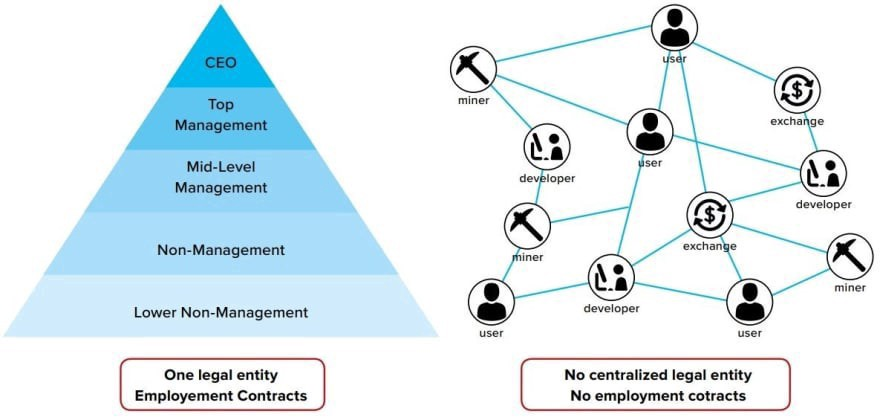
A traditional organization is structured in the form of hierarchies. The Board of Directors, Management and Employees. Each of these people has a different level of power, where employees are those who have little or no level of power.
A DAO (Decentralized Autonomous Organization) is an organization that is governed by intelligent contracts in the block chain, automatically executing pre-established conditions, imitating any real-world contract.
As a result, the government structures of a DAO is totally transparent and auditable, compared to the government of the traditional company. Nor do we talk about public corruption in state governments.
The difference of a DAO, with a traditional company, is that its structure is decentralized and does not have the figure of central authority. Daos are democratic, because they are prepared for broad participation in decision-making. The tenure of governing tokens enables that participation.
With the use of these computer structures, the identity of a participant in an organization can be instrumented from the pseudonymy, and this is useful for a large number of participants, when it is necessary to maintain privacy without vulnerating property.
It is difficult to say what national laws would be ignored, since even the location of a given user would be unknown. In a certain sense, the encryption of anonymous networks (the “cypherspace”, “encrypted space”) can be considered as an independent territory, without a public law of a given jurisdiction. It is a study issue, for jurists and it is not the idea to treat it in this article. In fact, a DAO, for being a global organization without a physical headquarters, is a non-explored legal structure.
In July 2021, Wyoming became the first state to recognize the DAO as a legal entity, after **Wyoming’s DAO** bill will enter into force. This means that the DAOs that are recorded in the State of Wyoming are legally recognized as commercial entities in the United States and, therefore, would receive the same legal protections as a limited liability company. https://sos.wyo.gov/Business/Docs/DAOs_FAQs.pdf
In the recent Russian invasion of Ukraine a **DAO** was formed to raise funds for Ukrainian soldiers who face the Russian army, and was named **Ukraine Dao**. https://www.coindesk.com/business/2022/03/09/ukraine-has-received-close-to-100-million-in-crypto-donations/ https://www.ukrainedao.love/
Participants can voluntarily create private laws in the working status, using intelligent contracts, where personal identity depends on online reputation. Here the DID (decentralized identity) takes importance, and is an even in growth institution, where DAO can choose to choose, within the crypt offer.
The concept of decentralization has fostered the idea of trust and, with the damage the fraud is minimized in the actions of the people who form the organization, where each transaction is registered immutable in the block chain.
A long and arduous process is not required to accept innovations without a central authority. With the DAO, innovations do not need to go through different hierarchies before reaching those who have the authority to make decisions.
The damage could be vulnerable to errors, and if they are pirated, the economic consequences can be catastrophic, and this is a weak point that must be careful.
There are no commercial secrets. Since all in the intelligent contract is encoded in the block chain and it is transparent, it can be copied.
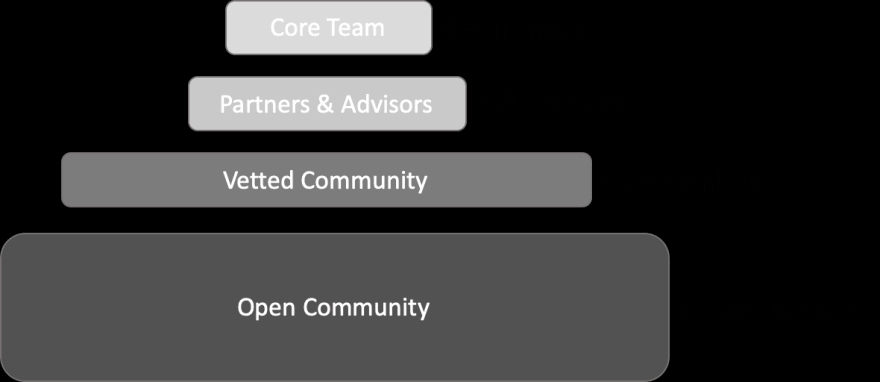
The structure of a DAO can be varied, in form and number of participants. A classic structure can be presented like this:
Final words
The traditional organization makes sense in hierarchical structures, ideal for centralized government that promotes statists.
If we want to evolve from political power towards social power, where individuals have direct participation, without being considered mere numbers of a power structure, the damage provides the proper tool in the Blockchain.
The damage allows the direct and individual vote of its participants, and that is its strength.
The enclosures that the authorities have imposed on the declared Pandemic of the COVID-19 has left us a damaged economy and many employers and workers who feel used and without voice.
It is not clear if traditional systems will change or how soon they will do it, but DAOs have shown a clear path to better working conditions and staff management.
I must be honest and admit that not all kinds of structure should be decentralized, and a DAO does not solve any governance problem, but it can provide a solution for many systems both public and private, where at least, part of them can be decentralized.
For these reasons it is necessary to take decentralization to private and public governance.
In a previous article I explained the DAOS: “**Decentralized Autonomous Organization (DAO): The Brief History, Challenges, and Lessons Learned**”, And in a next one about governance: **Defining Decentralized Governance and the Multitude of Different Models**”. https://adapulse.io/decentralized-autonomous-organization-dao-the-brief-history-challenges-and-lessons-learned/ https://adapulse.io/defining-decentralized-governance-and-the-multitude-of-different-models/
...
**Liberlion.com** http://liberlion.com/
Regulations Will Attack Bitcoin Decentralization
Governments are eager to regulate the crypto industry. It is nothing new, since the rules to control trade are the main occupation of the Statists, and even more so, when trying to implement an electronic money that is outside their orbit of power.
The US government has clear intentions to **regulate the crypto industry and Bitcoin in particular** . https://www.financemagnates.com/cryptocurrency/regulation/us-white-house-plans-to-issue-an-executive-order-on-crypto/
The US and its allies can influence the decentralization of Bitcoin, to control it with regulation. Thus, the US began to coordinate regulatory policy **with its Western allies** . https://chaintimes.com/g20-financial-stability-board-says-regulators-need-to-prepare-a-global-response-to-crypto-risks/
Banning Bitcoin is no longer a desirable option for governments as it has become intertwined with the global financial system. On the other hand, it is better for them to regulate it, to (surely) control all transactions in a complete and global way.
How could they control all Bitcoin transactions globally?
They would do this by controlling the majority of the computational (hashing) power of the several million computers that the Bitcoin network uses to **confirm transactions** . https://www.bitcoin.com/get-started/what-is-bitcoin-mining/
To do this, it would need to regulate the majority of the Bitcoin hash rate, which is known as **the 51% attack** . https://99bitcoins.com/51-percent-attack/
The regulation should be global, so that it can regulate the companies that control the majority of the Bitcoin mining hash rate. However, it does not take that many countries to achieve that control over the hash.
As of February 2022, the US has **35.5% of the global Bitcoin hash rate** , Canada has another 9.5%, and Germany and Ireland have 4.5% each. Just four Western nations contain more than half (54%) of the global Bitcoin hash rate. And those nations are allies of the United States. By adding a few more nations to apply uniform regulation, it will be possible to impose global norms on the majority of the hash rate. https://www.taylordailypress.net/bitcoin-hash-rate-hits-record-high-in-us-crypto-insiders/
While Bitcoin miners can move jurisdiction, as they did with the ban in China, (although it took a few months to recover the safe hash rate it had), large Bitcoin mining companies (farms) await regulation, otherwise it was ban, and focus on profit, unlike people, who often focus more on the principles underlying the philosophy of Bitcoin, thought of by Satoshi Nakamoto, p2p money, scarce, fungible, immutable, pseudonym unseizable, without trust, without permission.
Bitcoin Mining Regulation is a “Divide and Conquer” Tactic.
Mining corporations will uniformly comply with the regulations. Corporate boards have a fiduciary duty to put investors’ earnings before personal values. We have already seen a case of censorship in the US, when Marathon, one of the largest bitcoin mining companies in the United States and Canada, has mined the first bitcoin block that complies with the OFAC ( **Office of Foreign Assets Control** ): **Marathon Mines First OFAC Compliant Bitcoin Blockde** . https://en.wikipedia.org/wiki/Office_of_Foreign_Assets_Control https://news.bitcoin.com/marathon-mines-first-ofac-compliant-bitcoin-block/
Since the large corporate mining pools control most of the hash rate ( **5 mining farms own 51% of the hash rate** ), and are primarily motivated by profit, most of the hash rate is likely to remain. where it is legal (regulated), and more profitable to mine Bitcoin. https://www.blockchain.com/charts/pools
Institutions control most of the Bitcoin mining hash rate, and institutions actively seek regulation.
The management teams of large Bitcoin farms will not be able to justify the downtime, lost revenue, expense, and delay of moving to a foreign nation simply to avoid regulation. Its competitors would continue to exploit profitably in accordance with “reasonable” regulations.
Independent miners can move their equipment mainly based on their principles. Unfortunately, Bitcoin mining has become too **centralized** . Independent miners are the minority in control of the hash rate, and will remain willing to confirm transactions from unregulated sources, considering they can move more easily than big farms. https://mybitbiz.com/2021/12/bitcoin-hash-rate-in-2022/
If the division between those who are willing to comply with the regulation and those who are not is very narrow, since 51% of the hash rate complies with the government regulation and 49% does not, then the minority of Non-compliant miners would still be confirming 49% of transactions. That 2% downside may seem insignificant, however, it is unsustainable in the long run.
Regulatory governments have no need to break the Bitcoin hash algorithm. They will simply coordinate the regulation of Bitcoin miners to require them to only confirm transactions from regulated exchanges. Limiting confirmation to only those transactions from approved exchanges does not require any changes to the core Bitcoin code. Bitcoin’s core code allows miners to choose which transactions to include in each block. Limiting transaction confirmations also does not require breaking Bitcoin’s cryptographic hash.
Delays in confirming unregulated transactions would be aggravated. Confirmation of non-compliant transactions would be sporadic. The fees required to confirm prohibited transactions would grow higher and higher.
The status quo of Bitcoin has gone from being mainly a chain of blocks of true believers of the free money market philosophy for people, to being an investment tool of institutions, and unfortunately many of the bitcoiners celebrate it.
Bitcoiners who understand and claim the principles of honest money, p2p, uncensorable and without the permission of a central authority, are already in the minority.
KYC is the Ultimate Goal
After Western governments regulate Bitcoin mining, it will be much easier for Bitcoin to be traded mostly through regulated exchanges, and KYC (Know Your Customer) will be the norm.
Exchanges will identify all users, capture taxes owed on Bitcoin earnings, and seize user accounts when directed by the government.
Bitcoin will retain its store of value status, limited by the extent to which governments tax it. However, Bitcoin will lose the essential quality of unconfiscability.
The regulatory battle raging over Bitcoin this decade will influence the outcome of the war for personal and monetary freedom.
Satoshi Nakamoto’s idea, that money can exist outside the control of the state, will come up again and again, looking for possible alternatives.
The struggle for personal freedom is continuous from generation to generation.
...**libelion.com** http://liberlion.com/

The Crypto Adoption Must be Voluntary
APeer-to-Peer Electronic Cash System , is thus Satoshi Nakamoto conceived Bitcoin, on October 31, 2008.
Many celebrate when Bitcoin is regulated in some countries as a legal purpose, or accepted as a means of payment, in El Salvador, for example, as the Great News.
**I detest it.**
We do not need the leave of governments to choose our money. We are giving you the power that Satoshi Nakamoto wanted to remove them to give it to us.
The vast majority of people are educated in schools with official government instruction programs, and of course they accept that money must be issued and controlled by the State, or rather, by the Turn Politicians who temporarily administer the Government .
This monetary management affects the entire population, and gives it a huge power to the government.
According to Bitcoin’s enthusiasts, Bitcoin’s launch was made to create an equitable monetary system. But, for critics, Bitcoin plays an important role in financing different criminal activities, which is the perfect excuse for regulators.
A state without money has no power, disappears.
The money is the best most demanded in the economy, and for this it must be accepted by all. The difference is that if it is voluntary or is imposed by law, at pistol tip.
Do We Trust Bitcoin as Money?
Bitcoin’s foundation is not known by all. Bitcoin did not come out of nowhere.
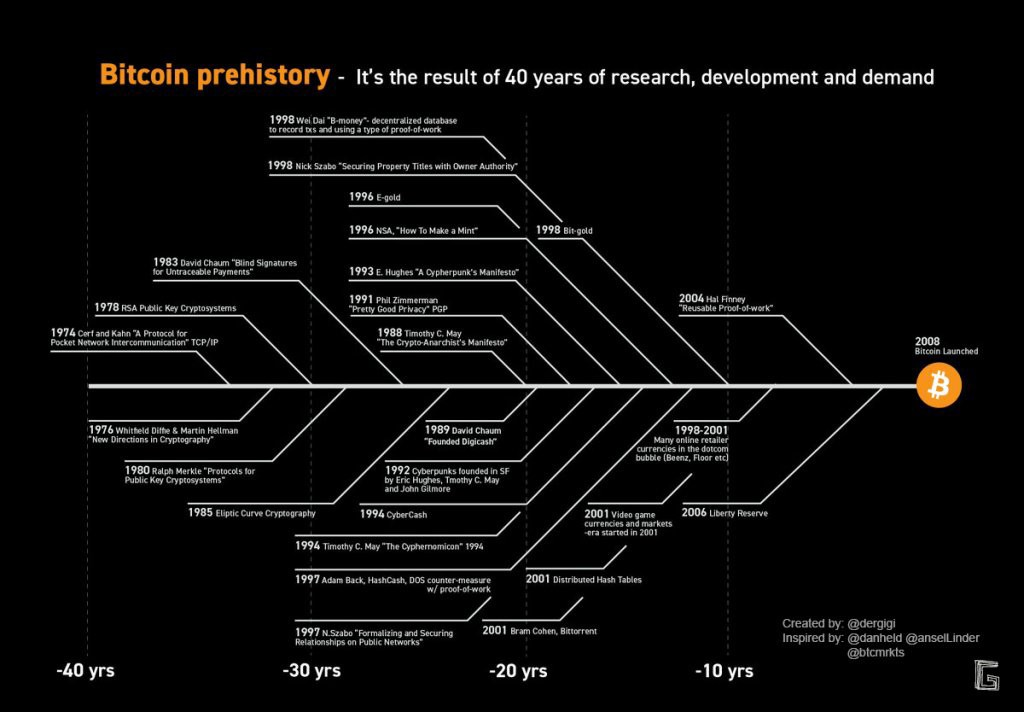
The idea of digital money has a long history. In particular, a collective known as the cypherpunks wrote long and laying on digital money, its use anonymously, the way these systems could be carried out and the social implications of cryptography in general.
Cryptography allows two people to exchange messages, and negotiate electronic contracts, never knowing the authentic name, or legal identity, of the other.
Cryptocurrencies have varied positive qualities to become currency. Moreover, they have many better qualities than fiduciary money, state money issued based on debt.
Cryptocurrencies are private and people voluntarily choose them, fiduciary money is obligatory.
All private money has arisen as a result of the process of human action, whose social learning process inevitably needs time. All the goods that became money (cattle, skins, wool, salt, tobacco, gold, silver, etc.) achieved it after millions of people, spontaneously interacting in free market.
Blockchain-based cryptocurrencies will only be if they are massively chosen as such by all public. That is, if they become the well most demanded spontaneously by the public.
Interactions on networks will be less and less traceable, thanks to the extended use of re-routing encrypted packets that implement cryptographic protocols.
*“… Privacy in an open society requires anonymous transaction systems. So far, cash has been the main system of this type. A system of anonymous transactions is not a system of secret transactions. An anonymous system allows individuals to reveal their identity when they wish, and only when they wish; This is the essence of privacy …” (The Crypto Anarchist manifest).*
Reputations will have a crucial, much more important importance in dealings than today’s credit ratings. These progress will completely alter the nature of government regulation, the ability to tax and control economic interactions, the ability to maintain secret information, and even alter the nature of trust and reputation.
And the cryptocurrencies fit perfectly in this scheme of **cryptanarchy**.
*Anarchy is not chaos, as taught us in state instruction, but it is the lack of a central authority to impose laws. Anarchy is the relationship, and association, with voluntary contracts between peers.*
The central bank of a country is the financial arm of the State and is who designs monetary policies, since they have the absolute authority to regulate the use of money. With the help of the intermediation of commercial banks, the government regulates all the flow of money in an economy.
In most cases, governments have controls for capital. Therefore, they use different forms and methods to avoid the output of coins, and this is another form of control that governments have if they handle the emission and regulation of money.
One of these controls is in the capital market market, the stock exchange where the actions of the most important private management companies are traded.
Creating traditional financial instruments, such as ETF and Bitcoin futures, implies weakening the idea of Satoshi Nakamoto, as it manipulates the price, prints volatility, and destroys the properties of unit of measurement, which needs good to become money. It is an action delivered by the establishment that feels threatened by Bitcoin.
Final words
It depends on us the success of Bitcoin and in general, the ecosystem of the cryptoeconomy.
It is important to understand that Bitcoin transfers power, from political power to social power, that of people, and thus undermine government authority.
Separating the money from the State has the same impact as it had it in modern democracies, separate the church from the State.
A state without the handling of money loses one of the three pillars of power, the other two are taxes and public indebtedness.
The powers change, and perhaps the New World Order, of which the elitists speak so much, in some future anarchist.
...
**liberlion.com** http://liberlion.com/
SocialFi is the First Step Towards the Metaverse
SocialFi refers to the combination of social networks and blockchain finance. SocialFi is Social Finance.
The SocialFi space allows users to earn income from creating content, participating in DAO governance, minting NFTs, communicating with other users, entertainment, and gaming.
As the SocialFi space gains more momentum, more and more social media giants are expanding their exploration of integrating NFT into their platform. Facebook/Meta, Instagram, Twitter, Reddit, YouTube are the social platforms that are actively integrating, or exploring, the NFT space.
Currently, NFTs are not manufactured, or traded, on any social media platform. The success of an NFT project depends on how well the creator markets their work on social media.
Most NFT owners believe that displaying the NFTs they have purchased on social media adds value to their holdings. In this way, cryptocurrency-friendly social media companies have an opportunity to reach and retain new NFT-oriented customers.
The data is still the business, obtained from the exhibitionism of many people. Thus, the most influential social media companies in the NFT space can influence the development of Web 3.0, as this iteration of the web revolves around the concept of storing user data on blockchains.
When it comes to content creation, the creator tends to do most of the work, while platforms just provide a place where they can showcase their work, and of course, get the big data for their own benefit.
SocialFi will allow creators to monetize their social media reach with relative ease, ensuring that those who do the work are the ones who see most of the profits.
Think of web 2.0 and a company like Facebook. Facebook is free to use. But there are no free lunches. Data is the product, and Facebook (now Meta) has benefited greatly from our personal information. **Mark Zuckerberg is still worth nearly $70 billion** , even after the recent stock plunge. Users have done most of the work, creating the content on Facebook with their posts. https://www.wsj.com/articles/mark-zuckerbergs-net-worth-drops-by-31-billion-after-facebook-parent-metas-stock-decline-11643987488
The central point of interest is identity and its relationship with tastes.
Will SocialFi Be Decentralized Identity?
I don’t think so, at least not in the giants of social networks, since information is their business.
Unlike the Web 2.0 social networks we know, SocialFi projects will provide higher levels of identity for users’ personal data, fairly distribute advertising revenue, and deliver a more valuable user experience.
Avatars have long been used in the social media space to represent a user’s identity online. In SocialFi spaces, an NFT avatar will be able to represent the identity of the owner both in the crypto world and in the futuristic metaverse.
Although still in its early stages, SocialFi can have a significant impact on the cryptocurrency, blockchain, and NFT space, and how we operate socially around the world.
I believe, my dear reader, that SocialFi will become an integral part of the Metaverse ecosystem in the near future.
...
You can read my previous article, to understand the framework of importance: **Metaverse is Centralized Technocracy** https://liberlion.medium.com/metaverse-is-centralized-technocracy-2f507fe5e019
**libelion.com** http://liberlion.com/

Lightning Network: el Caballo de Troya de la Industria Cripto
El **Caballo de Troya** fue una estrategia de guerra.
Un enorme artilugio con forma de caballo de madera, y que según cuenta el relato, fue usado por los aqueos para introducirse en la ciudad fortificada de Troya. Los troyanos tomaron el enorme caballo como un signo de su victoria, y fue llevado dentro de los gigantescos muros, sin saber que en su interior se ocultaban varios soldados enemigos. Durante la noche, los guerreros salieron del caballo, mataron a los centinelas y abrieron las puertas de la ciudad para permitir la entrada del ejército aqueo, lo que provocó la caída definitiva de Troya.
La historia no se repite pero rima. Los banqueros usan la misma estrategia contra la tecnología disruptiva que puede ganarles la batalla del dinero, la blockchain de Bitcoin.
El Escalado de Transacciones Permite que Bitcoin sea Dinero P2P
Lo último que la élite quiere es que la gente asocie las criptomonedas con “dinero para la gente” o “el dinero de Internet” o “independencia financiera de los bancos”.
Los banqueros entendieron la tecnología blockchain como disruptiva, y están pretendiendo tomar el control. Cuando WikiLeaks anunció la adopción de Bitcoin, alertó a la élite de la estabilidad financiera para el sistema bancario.
En los años siguientes, Bitcoin siguió expandiéndose rápidamente y fue aceptado como método de pago incluso por Microsoft, Steam y Twitch.
Bitcoin es actualmente un enemigo del establishment financiero y una forma para que los bancos y la élite sigan siendo relevantes en el juego.
Así, el establishmente banquero está saboteando activamente las criptomonedas, y debido a que Bitcoin sigue siendo el buque insignia, se han centrado principalmente en él, con la expectativa de desprestigiar a toda la industria, y cuando otras criptomonedas tengan buenos resultados de uso las atacarán.
*Satoshi: Los gobiernos son buenos para cortar las cabezas de redes controladas centralmente como Napster, pero las redes P2P puras como Gnutella y Tor parecen estar resistiendo.*
Todos deberían darse cuenta de que las criptomonedas están al frente de una lucha global por más poder y libertad para el individuo, pero también pueden usarse igualmente para esclavizar y quitar el poder.
Bitcoin tiene limitación para escalar transacciones, como toda blockchain, en su L1.
El Trilema Blockchain fue propuesto por Vitalik Buterin, y sugiere que una cadena de bloques operar sacrificando una de tres características esenciales, la Descentralización, o la Seguridad o la Escalabilidad, en pos de las otras dos.
Muchos se preguntan por qué existen los maximalistas de BTC y por qué apoyan la idea de que otras criptomonedas no valen nada, mensaje claro a los principiantes, y especialmente contra Bitcoin Cash, la reacción siempre es bastante extrema.
*Bitcoin Cash ha mitigado el Trilema, logrando escalar sin sacrificar su descentralización o seguridad, aumentando el tamaño del bloque. Una simple mejora que le dio gran impulso.*
En general, una segunda capa es una solución de escalado para cualquier blockchain, pero la seguridad se aborda mejor en su L1, más que en una sidechain (L2) para escalar.
Bitcoin también es resistente a la censura. Por supuesto, solo en su L1.
Cualquier otra solución en la que estén trabajando los desarrolladores no serán mejores opciones para evitar la censura de transacciones.
La empresa detrás de esta estrategia es Blockstream, y no esperaba esta resistencia de parte de la comunidad de Bitcoin y la bifurcación de Bitcoin Cash.
Lightning Network es una Herramienta Centralizada
Lightning Network está desarrollada por Blockstream, y algunos de los programadores son también parte del team de Bitcoin Core.
LN es una red sidechain, que valida transacciones en la blockchain de Bitcoin sólo cuando el usuario cierra el canal de estado, mientras tanto, las transacciones en ese canal permanencen en una nebulosa, en un borrador contable.
Los usuarios que no corren su propio nodo, se ven obligados a utilizar los Lightning hubs que aumentan las probabilidades de censura.
Los Lightning hubs se pueden apoderar de la red, y los usuarios de Lightning que abre y cierran canales en cualquier momento que lo deseen, pueden ser censurados en sus transacciones.
*LN supuestamente se trata de microtransacciones (es decir, para comprar un café o un refresco), pero la apertura y cierre de un canal LN requiere el pago de (dos) tarifas mineras de L1. Con tarifas de BTC de $50, ¿pagarías $100 por un refresco o un café?*
Blockstream fue creado y financiado por los bancos con el único propósito de retrasar el progreso, en lo que parecía una posible transferencia del poder financiero de los cárteles bancarios hacia las redes financieras de criptomonedas.
Blockstream
Los poderes detrás de Blockstream es evitar que las criptomonedas se conviertan en una herramienta monetaria que trate a todas las personas del mundo por igual, porque ese sería el mejor producto y dejaría obsoletos a los bancos. Simplemente muestran a Bitcoin como “otra herramienta para los ricos”.
Blockstream efectivamente paralizó Bitcoin. Y este cuadro que contiene hechos innegables, explica hasta dónde llegaron los bancos para detener el aumento de la adopción de Bitcoin.
Blockchain posee en sus filas varios desarrolladores (actuales y antiguos) del Bitcoin Core Team.
Podemos ver que entre los inversores de Blockstream hay banqueros. Este gráfico explica las conexiones de BTC y el grupo Bilderberg. Mastercard, AXA y Grayscale, y cómo están vinculados y financiados Blockstream:
AXA Strategic Ventures: **https://axa.com/en/magazine/axa-strategic-ventures-blockchain**
Mastercard: **https://coingeek.com/the-mastercard-bitcoin-conspiracy/**
Además, la injerencia del establishment queda clara ya que Lightning Network está nombrado en el Foro Económico Mundial: https://www.weforum.org/organizations/lightning-labs
En 2015, MasterCard invirtió en Digital Currency Group (DCG), que fue uno de los principales inversores en Blockstream, la empresa que contrató a prácticamente todos los desarrolladores de Bitcoin en ese momento.
Desarrolladores adicionales fueron pagados por compañías que incluyen MIT Media Lab Digital Currency Initiative , financiada por Jeffrey Epstein, y también la subsidiaria de capital de riesgo de AXA, la compañía de seguros europea de más de 100 mil millones de euros , cuyo CEO en ese momento también era el presidente del Grupo Bilderberg. .
Después de estas inversiones, prácticamente se suprimió toda conversación sobre escalado en cadena en todos los medios y las personas que intentaron impulsar la conversación se vieron afectadas por ingeniería social y ataques DDoS .
Digital Currency Group crea el brazo de fondos de inversión de su negocio, Grayscale Investments; Grayscale gira la marca Bitcoin como “oro digital” y lo anuncia como una inversión en lugar de dinero digital. El fondo “GBTC” tiene un AUM de $ 35 mil millones y ha contribuido significativamente a que los inversores institucionales piensen que Bitcoin fue diseñado para ser oro digital, lo cual es una completa falsedad.
Digital Currency Group invierte en varios competidores para suplir lo que Bitcoin era originalmente capaz de hacer antes de los cambios y eliminaciones del protocolo:
*• Lightning Network para transacciones “instantáneas” de segunda capa fuera de la cadena en lugar de transacciones instantáneas en la cadena,*
*• RSK para contratos inteligentes en BTC en lugar de usar el script de Bitcoin incorporado ahora en desuso,*
*• Ripple para transacciones instantáneas en su propia cadena de bloques,*
*• Parity, quien creó la cadena de bloques Polkadot, haciendo contratos inteligentes,*
…y más.
En lugar de consolidar todas estas aplicaciones en la cadena Bitcoin, ahora todas tienen sus soluciones privadas separadas, así como tokens especulativos.
**Digital Currency Group** posee (en parte) y dirige **Blockstream**. http://dcg.co/who-we-are/ http://dcg.co/portfolio/
Quién dirige Digital Currency Group:
Glenn Hutchins: exasesor del presidente Clinton. Hutchins forma parte de la junta del Banco de la Reserva Federal de Nueva York , donde fue reelegido como director Clase B por un período de tres años que finaliza el 31 de diciembre de 2018.
Barry Silbert: CEO de Digital Currency Group, (financiado por Mastercard) y también es ex banquero de inversiones en Houlihan Lokey. Este es el tipo que pensó que SW2x era una buena idea.
Lawrence H. Summers: Economista Jefe del Banco Mundial de 1991 a 1993. En 1993, Summers fue nombrado Subsecretario de Asuntos Internacionales del Departamento del Tesoro de los Estados Unidos bajo la Administración Clinton . En 1995, fue ascendido a subsecretario del Tesoro bajo su antiguo mentor político Robert Rubin. En 1999, sucedió a Rubin como secretario del Tesoro . Mientras trabajaba para la administración Clinton, Summers desempeñó un papel destacado en la respuesta estadounidense a la crisis económica de 1994 en México. , la crisis financiera asiática de 1997 y la crisis financiera rusa.
Blythe Masters: “Ex ejecutiva de JPMorgan Chase. Actualmente es directora ejecutiva de Digital Asset Holdings, una firma de tecnología financiera que desarrolla tecnología de contabilidad distribuida para servicios financieros mayoristas. Masters es ampliamente reconocida como la creadora de el swap de incumplimiento crediticio como instrumento financiero.
DCG también es inversor en BitGo, que pretende convertirse en un “servicio” que evite el doble gasto. Si bien Bitcoin tiene incorporado esa seguridad en su protocolo, este servicio solo es útil si las transacciones no se confirman en la cadena de bloques, y se confirman, por ejemplo, en una cadena lateral, como Lightning Network, la tecnología de desarrollo de Blockstream.
...
👇 Agradeceré su reconocimiento para animar mis artículos
BCH qra30tqfcc4x267jpkyaufpa3u9qysywncax2evd69
**liberlion.com** http://liberlion.com/
Lightning Network: The Trojan Horse of the Crypto industry
Troy’s horse was a war strategy.
A huge wooden horse-shaped gadget, and that according to the story, was used by the Acaos to enter the fortified city of Trojan. The Trojans took the huge horse as a sign of his victory, and was taken inside the gigantic walls, not knowing that several enemy soldiers were hidden inside him. During the night, the warriors came out of the horse, killed the sentinels and opened the doors of the city to allow the entrance of the army, which caused the final fall of Troy.
The story is not repeated but rhyme. Bankers use the same strategy against disruptive technology that can earn the battle of money, Bitcoin Blockchain.
The Climbing of Transactions Allows Bitcoin to be Money P2P
The last thing that the elite wants is that people associate cryptomones with “money for people” or “Internet money” or “financial independence from banks”.
Bankers understood Blockchain technology as disruptive, and are pretending to take control. When WikiLeaks announced the adoption of Bitcoin, alerted the elite of financial stability for the banking system.
In the following years, Bitcoin continued to expand quickly and was accepted as a payment method even by Microsoft, Steam and Twitch.
Bitcoin is currently an enemy of financial establishment and a way for banks and elite to remain relevant in the game.
Thus, the establishment is actively saboting the cryptomoneds, and because Bitcoin remains the flagship, they have focused mainly on it, with the expectation of discrediting the entire industry, and when other cryptomoneds have good use of use.
*Satoshi: Governments are good for cutting the networking heads centrally controlled like Napster, but pure P2P networks such as Gnutella and Tor seem to be resisting.*
Everyone should realize that cryptomones are at the head of a global fight for more power and freedom for the individual, but they can also be used to enslave and remove power.
Bitcoin has limitation to scale transactions, like all Blockchain, in its L1.
The Blockchain Trilemma was proposed by Vitalik Buterin, and suggests that a chain of blocks operate sacrificing one of three essential characteristics, decentralization, or security or scalability, after the other two.
Many wonder why there are BTC maximalists and why they support the idea that other cryptomones are not worth anything, a clear message to beginners, and especially against Bitcoin Cash, the reaction is always quite extreme.
*Bitcoin Cash has mitigated the trilemma, achieving climbing without sacrificing decentralization or security, increasing the block size. A simple improvement that gave him great impulse.*
In general, a second layer is a climbing solution for any Blockchain, but safety is better addressed in its L1, rather than in a sidchain (L2) to scale.
Bitcoin is also resistant to censorship. Of course, only in his L1.
Any other solution in which developers are working will not be better options to avoid censorship of transactions.
The company behind this strategy is Blockstream, and did not expect this resistance from the Bitcoin community and Bitcoin Cash’s fork.
Lightning Network is a Centralized Tool
Lightning Network is developed by Blockstream, and some of the programmers are also part of Bitcoin Core Team.
LN is a Sidchain network, which validates transactions in the Bitcoin Blockchain only when the user closes the status channel, meanwhile, the transactions in that channel remain in a nebula, in an accounting draft.
Users who do not run their own node, are forced to use Lightning Hubs that increase censorship odds.
Lightning Hubs can be seized by the network, and Lightning users who opens and close channels at any time they wish, can be censored in their transactions.
*LN is supposedly about microtransractions (that is, to buy a coffee or a soda), but the opening and closing of a LN channel requires the payment of (two) mining rates of L1. With BTC rates of $ 50, would you pay $ 100 for a refresh or a coffee?*
Blockstream was created and funded by the banks with the sole purpose of delaying progress, as it seemed a possible transfer of the financial power of bank cartels to the financial networks of cryptomoneds.
Blockstream
The powers behind Blockstream is to prevent cryptomones from becoming a monetary tool that treats all the people of the world alike, because that would be the best product and would leave banks obsolete. They simply show Bitcoin as “another tool for the rich”.
Blockstream effectively paralyzed Bitcoin. And this box containing undeniable facts, explains how far the banks arrived to stop the increase in the adoption of Bitcoin.
Blockchain has several developers (current and ancient) of Bitcoin Core Team in its ranks.
We can see that among Blockstream investors there are bankers. This graph explains the BTC connections and the Bilderberg group. Mastercard, AXA and Grayscale, and how BlockStream is linked and financed:
AXA Strategic Ventures: **https://axa.com/en/magazine/axa-strategic-ventures-blockchain**
Mastercard: **https://coingeek.com/the-mastercard-bitcoin-conspiracy/**
In addition, the interference of the establishment is clear since Lightning Network is appointed in the World Economic Forum: **https://www.weforum.org/organizations/ligning-labs**
In 2015, MasterCard invested in Digital Currency Group (DCG), which was one of the main investors in Blockstream, the company that hired practically all Bitcoin developers at that time.
Additional developers were paid by companies that include MIT Media Lab Digital Currency Initiative, financed by Jeffrey Epstein, and also the risky capital subsidiary of AXA, the European insurance company of more than 100 billion euros, whose CEO at that time He was also the president of the Bilderberg group. .
After these investments, every conversation on chain escalation was practically suppressed in all means and people who tried to boost the conversation were affected by social engineering and DDoS attacks.
Digital Currency Group creates the arm of investment funds of your business, Grayscale Investments; Grayscale turns the Bitcoin brand as “Digital Gold” and advertises it as an investment instead of digital money. The “GBTC” fund has an Aum of $ 35 billion and has contributed significantly for institutional investors to think that Bitcoin was designed to be digital gold, which is a complete falsehood.
Digital Currency Group invests in several competitors to supply what Bitcoin was originally able to do before the changes and eliminations of the Protocol:
• Lightning Network for second-layer “snapshot” transactions in the chain instead of instant transactions in the chain,
• RSK for intelligent contracts in BTC instead of using the Bitcoin script incorporated now in disuse,
• Ripple for instant transactions in its own block chain,
• Parity, who created the Polkadot block chain, making intelligent contracts,
…and more.
Instead of consolidating all these applications in the Bitcoin chain, now all have their separate private solutions, as well as speculative tokens.
Digital Currency Group has (in part) and directs Blockstream.
Who Directs Digital Currency Group:
Glenn Hutchins: Exaser by President Clinton. Hutchins is part of the Bank Board of the Federal Reserve of New York, where he was re-elected as Class B director for a period of three years that ends on December 31, 2018.
Barry Silbert: CEO of Digital Currency Group, (funded by MasterCard) and is also former investment banker in Houlihan Lokey. This is the guy who thought SW2X was a good idea.
Lawrence H. Summers: Chief Economist of the World Bank from 1991 to 1993. In 1993, Summers was appointed Undersecretary of International Affairs of the United States Department of Treasury under the Clinton Administration. In 1995, he was promoted to Undersecretary of the Treasury under the former political mentor of him Robert Rubin. In 1999, he succeeded Rubin as secretary of the Treasury. While working for the Clinton administration, Summers played a prominent role in the US response to the 1994 economic crisis in Mexico. , the Asian financial crisis of 1997 and the Russian financial crisis.
Blythe Masters: “Former executive of JPMorgan Chase. She currently is Executive Director of Digital Asset Holdings, a financial technology firm that develops distributed accounting technology for wholesale financial services. Masters is widely recognized as the creator of the SWAP of credit non-compliance as a financial instrument.
DCG is also an investor in Bitgo, which aims to become a “service” that avoids double spending. Although Bitcoin has this security incorporated into its protocol, this service is only useful if the transactions are not confirmed in the block chain, and confirmed, for example, in a side chain, such as Lightning Network, Blockstream development technology .
...
👇 I will appreciate your recognition to encourage my articles
BCH qra30tqfcc4x267jpkyaufpa3u9qysywncax2evd69
...
**liberlion.com** http://liberlion.com/
Accounting Models in Blockchain: UTxO, eUTxO and Account Models
The blockchain is basically a distributed ledger, in which transactions are recorded.
Bitcoin and Ethereum host the two currently most valuable and popular cryptocurrencies. They use two quite different ledger models, known as the UTxO model and the Accounts model, respectively.
Cardano’s team of developers has evolved the UTxO model.
The UTxO Model
The UTxO model is the unspent balance of a previous transaction, which can be spent in the future.
UTxO chains do not have accounts; instead, coins are stored as a list of UTxOs, and transactions are created by consuming existing UTxOs and producing new ones in their place.
The balance is the sum of UTxOs controlled by a wallet. UTxOs are similar to cash in that they use “change”, and are indivisible (UTxOs are used in full), i.e. if you have to pay $50 and you have a $100 bill (UTxO), you must hand it over in full and receive change in a $50 bill (new UTxO).
The Account Model
Ethereum chose the Accounts model explicitly to facilitate more expressive smart contracts. On the other hand, Bitcoin chose UTxO also for good reasons, including that its semantic model remains simple in a complex concurrent and distributed computing environment.
Ethereum is based on the global state of the blockchain, (Ethereum Virtual Machine, EVM), with a distinct transaction accounting model, the Accounts model.
The Accounts model resembles the way a bank works. Users have accounts that store their coin balance. It is possible to spend partial balances. The concept of “change” does not apply.
While Ethereum’s implementation is simpler, the complications inherent in global state management (EVM) result in greater possibility of failed transactions, or wasted resources, among other problems.
Cardano’s eUTxO model
Cardano developed the extended UTXO (eUTxO) model, an evolution of the Bitcoin UTxO model that supports a substantially more expressive form of validation scripts, which enable the scheduling of your transactions.
Cardano bases its transactions in a local environment, with the eUTxO (extended Unspent Transaction Output) model with the ability to interact with smart contracts running on the blockchain.
Cardano’s model circumvents the problems of the Account Model, by allowing resource determinism and indivisible individual transactions by limiting the scope of smart contract transactions to their immediate local environment. However these advantages are not without cost, as transaction construction is an upfront burden, having to be included individually in every development run on Cardano. Unlike Ethereum it is a build that must be faced by each developer.
Transactions consume unspent outputs from previous transactions and produce new outputs that can be used as inputs for future transactions.
**Understanding the Extended UTXO model** https://docs.cardano.org/plutus/eutxo-explainer#gatsby-focus-wrapper
The eUTxO model extends the UTxO model in two ways:
It generalizes the concept of ‘address’ using the lock and key analogy. Instead of restricting locks to public keys and keys to signatures, addresses in the eUTxO model can contain arbitrary logic in the form of scripts. For example, when a node validates a transaction, the node determines whether or not the transaction can use a given output as input. The transaction will look for the script provided by the address of the output and execute the script if the transaction can use the output as input.
The second difference between UTxO and eUTxO is that outputs can carry (almost) arbitrary data in addition to an address and a value. This makes the scripts much more powerful by allowing them to carry state information.
Advantages of the eUTxO model
This model offers better scalability and privacy, as well as more simplified transaction logic, since each UTxO can only be consumed once and in aggregate, which makes transaction verification much simpler.
It also offers greater security, predictability of smart contract execution costs (no unpleasant surprises) and more powerful parallelization.
The success or failure of transaction validation depends only on the transaction itself and its inputs, and not on anything else on the blockchain. As a result, the validity of a transaction can be verified off-chain, before the transaction is sent to the blockchain. A transaction can still fail if some other transaction simultaneously consumes an input that the transaction expects, but if all inputs are still present, the transaction is guaranteed to succeed.
This contrasts with an account-based model (such as the one Ethereum uses), where a transaction can fail to execute the script halfway through. This can never happen in eUTxO.
Disadvantages of the eUTxO model
The eUTxO model is more complex to program for developers, as they must code the integrity of the transaction model in development itself, prior to transaction validation on the network.
Document: **The Extended UTxO Model** https://api.zotero.org/groups/478201/items/T24L95MI/file/view?key=Qcjdk4erSuUZ8jvAah59Asef
**Liberlion.com** http://liberlion.com/
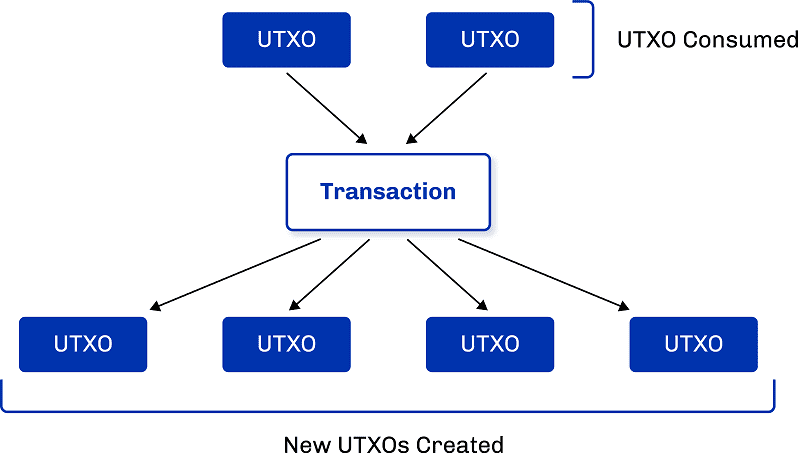
KYC, un Instrumento de Vigilancia Masiva
KYC o ‘Conozca a su cliente’ es una regulación que cualquier empresa, con una relación bancaria o financiera, debe cumplir.
Estas reglas se imponen en todo el mundo, y están orientadas a garantizar que una empresa, que actúa como cambio y/o transmisor de dinero, tenga información ‘adecuada’ sobre cada cliente al que atiende.
El fundamento que los reguladores utilizan, es que KYC está creado para combatir el lavado de dinero y el financiamiento al terrorismo, pero sabemos, y está demostrado que a lo largo del tiempo y desde su implementación en los años 1970, no es eficaz, y los bancos son los primeros lavadores de fondos ilícitos, que no cumplen con su propio KYC, sino que cumplen con el tuyo.
El ‘KYC progresivo’ es una enfermedad que se está propagando lentamente, pero con fines oscuros, que exceden su propósito inicial.
Si compras a través de una de estas entidades reguladas, esencialmente etiquetan las direcciones de tus fondos con tu identidad personal. Esto facilita el trabajo de las empresas de vigilancia en blockchain contratadas por los gobiernos, como **Chainalysis**, la consultora forense más grande) https://www.chainalysis.com/
Objetivos:
Seguimiento de tus hábitos de gasto
Impedir que utilices otros servicios no regulados
Confiscar tus fondos, cuando lo consideren necesario
Imponerte obligaciones fiscales
Generalmente saben más sobre ti de lo que deberían saber
¿Qué Información Tendrás que Proporcionar?
Para comprar criptomonedas en un intercambio KYC, los usuarios deberán proporcionar información personal. La cantidad que necesita proporcionar varía de uno a otro, algunos pueden requerir un nombre simple para cantidades pequeñas (puedes proporcionar fácilmente un alias) y otros pueden requerir toda la información. La mayoría pedirá cualquier combinación de lo siguientes datos:
Nombre y Apellido
Número de teléfono
Correo electrónico
País de residencia
Licencia de conducir
Documento de Identificación
Una selfie sosteniendo un papel con el nombre del intercambio y la fecha
Una videollamada con el intercambio.
¿Por qué es un Riesgo Proporcionar esta Información?
Fugas de Datos
La información KYC vincula tu identidad personal con cualquier criptomoneda que compres. El intercambio sabe:
quién eres
cuánto compraste
cuándo lo compraste
tu información bancaria
a dónde transfieres tus fondos
Debido a prácticas de seguridad incompetentes en algunas de estas empresas. ¿Cómo te sentirías si tu nombre, dirección, foto y exactamente cuántos fondos posees, fuera robado de un intercambio y vendido al mejor postor en un mercado de darknet? Esto suena a alarmismo, ¡pero las filtraciones de datos ocurren con demasiada frecuencia!
Censura
La mayoría de estos intercambios funcionan, de alguna forma, directamente con empresas de vigilancia en cadena (¡y algunos, directamente con agencias gubernamentales!) para cumplir con la jurisdicción elegida. La naturaleza completamente transparente de la mayoría de blockchains significa que cualquier persona con el conjunto de herramientas adecuado puede seguir tu actividad. Si retiras o depositas en una entidad que no le gusta a los reguladores, pueden congelar tus fondos, o incluso cerrar tu cuenta. Esto no encaja exactamente con las propiedades resistentes a la censura por las que la tecnología blockchain fue creada.
Tienes Otras Opciones
Afortunadamente, existen algunas opciones para comprar criptomonedas sin fuentes KYC y es el intercambio P2P (peer to peer), en los que estarás negociando directamente con otra persona y no con un tercero centralizado.
**Exchanges P2P**
****hodl hodl**** https://hodlhodl.com/
****Bisq**** https://bisq.network/
****LocalCryptos**** https://localcryptos.com/
****LocalCoinSwap**** https://localcoinswap.com/
Cajeros Automáticos
Los cajeros automáticos son otra excelente opción, pero utilízalos con precaución, ya que algunos aún requieren diferentes niveles de identificación según la cantidad que se compre. Muchos solo requerirán un número de teléfono, así que asegúrate de usar uno que no esté etiquetado con tu identidad personal. Consulte **Coin ATM Radar** para obtener una excelente descripción general de lo que está disponible en tu área local. https://coinatmradar.com/
¿Comprar Criptomonedas sin KYC Viene con una Prima Considerable?
Es absolutamente cierto que verás algunas ofertas para comprar criptomonedas en intercambios P2P por algunas primas muy altas sobre el precio al contado**.** Sin embargo, si eres lo suficientemente paciente, puedes recoger algunos en el lugar o solo marginalmente (1–4%) arriba. Tanto Bisq como Hodl Hodl te permiten crear una ‘oferta de compra’ que es esencialmente decirle al mercado que desea comprar una cantidad ‘X’ de bitcoin al ‘X%’ en relación con el precio al contado. Todo lo que necesitas hacer entonces es esperar a que un vendedor acepte su oferta y complete el intercambio.
Qué Hacer si ya Compraste Criptomonedas con KYC
Una vez que hayas comprado de una fuente KYC, **nunca** podrás deshacerlo. Ni siquiera con técnicas avanzadas como Coinjoin que crean privacidad con visión de futuro. Tienes tres opciones principales:
Vende tus Fondos en el Mismo Exchange
Vende tus monedas compradas por KYC en el intercambio donde las compraste. Dependiendo de la jurisdicción, esto probablemente creará un hecho imponible con el que deberá lidiar, pero luego tendrás un registro en papel para demostrar que ya no posees esas monedas. Este proceso te brinda un ‘comienzo limpio’ desde el cual puede comenzar a través de una fuente que no sea KYC, con la certeza de que ya no eres vulnerable a los riesgos descritos anteriormente.
Separa las Compras
Deja de comprar a través de fuentes KYC, segrega y etiqueta completamente esos fondos. Luego, comienza a comprar a través de una fuente que no sea KYC, asegurándote de mantener una segregación completa. Esta opción aún te deja vulnerable a algunos de los riesgos descritos anteriormente, pero puede seleccionar aquellos montos más pequeños para KYC o aquellos que no deseas vender y lidiar con eventos de impuestos.
Mover Jurisdicciones
Esto es más extremo, pero podría ser una opción para liberarte de futuras obligaciones. Por supuesto, esto no es una garantía del 100% ya que ciertas jurisdicciones pueden tener acuerdos para compartir información.
KYC es una invasión a tu privacidad, peligroso e ineficaz, que te pone en riesgo
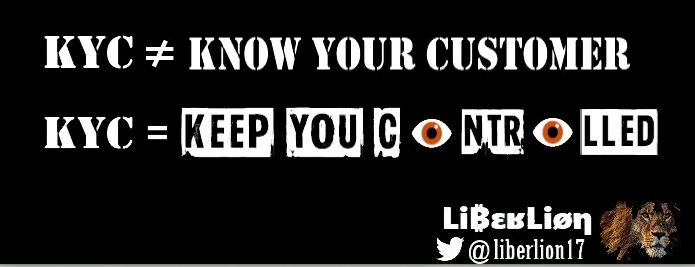
KYC, a Mass Surveillance Instrument
KYC or ‘Know Your Customer’ is a regulation that any company, with a banking or financial relationship, must comply with.
These rules are enforced all over the world, and are aimed at ensuring that a business, acting as an exchange and/or money transmitter, has ‘adequate’ information about each customer it serves.
The rationale that regulators use is that KYC is created to combat money laundering and terrorist financing, but we know, and it has been shown that over time and since its implementation in the 1970s, it is not effective, and banks are the first launderers of illicit funds, not complying with their own KYC, but complying with yours.
The ‘progressive KYC’ is a disease that is spreading slowly, but with dark ends, which exceed its initial purpose.
If you buy through one of these regulated entities, they essentially tag your fund addresses with your personal identity. This makes it easier for government-contracted blockchain surveillance companies like **Chainalysis** , the largest forensic consultancy) https://www.chainalysis.com/
Objectives:
Track your spending habits
Prevent you from using other unregulated services
Confiscate your funds, when deemed necessary
Impose tax obligations
They usually know more about you than they should
What Information Will You Have to Provide?
In order to buy cryptocurrencies on a KYC exchange, users will need to provide personal information. The amount you need to provide varies from one to another, some may require a simple name for small amounts (you can easily provide an alias) and others may require all the information. Most will ask for any combination of the following data:
Name and surname
Phone number
Email
country of residence
Driver’s license
Identification document
A selfie holding a piece of paper with the name of the exchange and the date
A video call with the exchange.
Why is it a Risk to Provide this Information?
Data Leaks
KYC information links your personal identity to any cryptocurrency you purchase. The exchange knows:
who are you
how much did you buy
when did you buy it
your bank information
where do you transfer your funds
Due to incompetent security practices at some of these companies. How would you feel if your name, address, photo, and exactly how much funds you have, were stolen from an exchange and sold to the highest bidder on a darknet market? This sounds like alarmism, but data breaches happen far too often!
Censorship
Most of these exchanges work in some way directly with chain surveillance companies (and some directly with government agencies!) to comply with their chosen jurisdiction. The completely transparent nature of most blockchains means that anyone with the right set of tools can follow your activity. If you withdraw or deposit with an entity that regulators don’t like, they can freeze your funds, or even close your account. This doesn’t exactly fit with the censorship-resistant properties that blockchain technology was created for.
You Have Other Options
Fortunately, there are some options to buy cryptocurrencies without KYC sources and it is the P2P (peer to peer) exchange, in which you will be negotiating directly with another person and not with a centralized third party.
Exchanges P2P
****hodl hodl**** https://hodlhodl.com/
****Bisq**** https://bisq.network/
****LocalCryptos**** https://localcryptos.com/
****LocalCoinSwap**** https://localcoinswap.com/
ATMs
ATMs are another great option, but use them with caution as some still require different levels of identification depending on the amount being purchased. Many will only require a phone number, so be sure to use one that isn’t tagged with your personal identity. Check **out Coin ATM Radar** for a great overview of what’s available in your local area. https://coinatmradar.com/
Does Buying Crypto without KYC come with a Hefty Premium?
It is absolutely true that you will see some offers to buy cryptocurrencies on P2P exchanges for some very high premiums over the spot price **.** However, if you’re patient enough, you can pick some up on the spot or just marginally (1–4%) above. Both Bisq and Hodl Hodl allow you to create a ‘buy offer’ which is essentially telling the market that you want to buy ‘X’ amount of bitcoin at ‘X%’ relative to the spot price. All you need to do then is wait for a seller to accept your offer and complete the trade.
What to do if you have already bought cryptocurrencies with KYC
Once you’ve bought from a KYC source, you can **never** go back. Not even with advanced techniques like Coinjoin that create forward thinking privacy. You have three main options:
Sell your funds on the same exchange
Sell your KYC-purchased coins on the exchange you bought them from. Depending on the jurisdiction, this will likely create a taxable event for you to deal with, but then you’ll have a paper record to prove you no longer own those coins. This process gives you a ‘clean start’ from which you can start through a non-KYC source, safe in the knowledge that you are no longer vulnerable to the risks outlined above.
Separate purchases
Stop buying through KYC sources, fully segregate and label those funds. Then, start shopping through a non-KYC source, making sure to maintain complete segregation. This option still leaves you vulnerable to some of the risks outlined above, but you can select those smaller amounts for KYC or those you don’t want to sell and deal with tax events.
Move jurisdictions
This is more extreme, but could be an option to free you from future obligations. Of course, this is not a 100% guarantee as certain jurisdictions may have information sharing agreements.
KYC is an invasion of your privacy, dangerous and ineffective, which puts you at risk
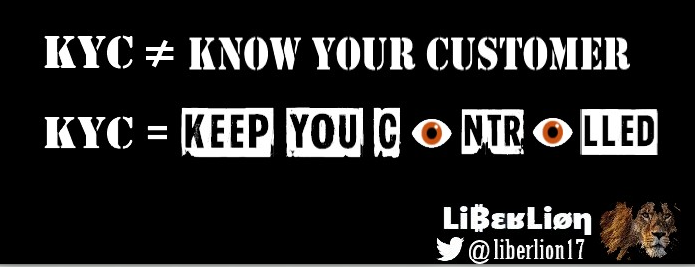
 @LiberLion