Can you learn japanese
"IMPOSSIBLE" you say? Not necessarily. If you think about it, you might already know a few Japanese words like kimono and sake (rice wine). Did you know that when you pronounce the English pronoun "I", it sounds like you say "love" (ai) in Japanese? Or when you say "cow" in English, has the same pronunciation to mean "buy" in Japanese (kau)?
Some claim that a person can learn Japanese at night just by looking for a "How to Learn" book. Although it is not that easy, you can master Japanese quickly enough to visit Japan as a tourist.
***Where is it?***
The different ideas about its origin are even more complicated than the Japanese language. Recently, Leptcha, a language spoken in a Himalayan valley, has been found to be closely related to Japanese. Others argue that Japanese has a greater connection to Korean than any other language.
What is the relationship between Japanese and Chinese? Due to the use of Chinese ideographic characters which we call "Kanji", the Japanese are often considered to have a close connection with the Chinese. But the differences are huge. Chinese is a "monosyllabic" language that contains words with a single syllable. However, Japanese is "polysyllabic", in many words with two or more syllables. In Chinese, the meaning of the word is conveyed by the tone and order of the words, while in Japanese, the meaning is conveyed by the words themselves and the endings of the words.
Nearly 2,500 years ago, the Japanese language had essentially the same grammar as it does today. But at the end of the 9th and 10th centuries, changes began. To do this, you had to know a certain number of words to read and another to speak. The result was that by the end of World War II, 3,000 to 5,000 Chinese characters and two sets of programs of 50 characters each had to be known in order to be able to read important documents.
However, since 1945, the essential kanji have been simplified somewhat, reaching almost 2000. The language has also taken on many English words. In addition to these kanji characters, students today learn two types of Romanization. It takes hours of memorization and writing until kids learn 881 kanji by the end of high school and 1,850 kanji by the end of high school. However, reading school books requires knowledge of around 3,000 kanji.
***Let's say something in japanese***
You can test your knowledge of Japanese. The pronunciations are fairly straightforward, because basically only 50 different sounds are possible. The biggest problem is grammar. But now we stick to simpler questions.
First, there are five vowels, all pronounced as in Italian: La long, io come and me, E as in the nest, O as in old, U as uppercase when U is a short vowel; if U is long, so on. It is very important to learn the sounds of short and long vowels. A very common mistake by missionaries is to confuse så shi ki (organization) with sō shi ki (funeral). Quite a few viewers were surprised to hear about the great heavenly burial of God instead of the great heavenly organization of God. Another simple mistake is to call a girl Shō jō (orangutan) instead of Shō jo (girl). It is obvious that the Japanese teacher and the listener benefit from a sense of humor.
Often the same vowel or phonetic tone is used one after the other as in ta (head), ko ko ro (heart) or ko ro (place). Sometimes a phonetic sound is lost due to the contraction when you say certain words. For example, if you say kō fu ku (happy), cut the middle u and mix f and k. This leads to the pronunciation kō f’ku. If you repeat it a few times you will see how easily the Japanese come out of your mouth! Another key word is the pronoun "eu", which is wa ta ku shi in Japanese. It is correctly pronounced wa ta k'shi, with the loss of u and the transfer of k into the sound of shi. In recent years, “I” has even been abbreviated to ta ta shi.
Consonants can also be complicated. For example, the single consonant "k" of the word kō ka gives us "school music" while the double consonant of the word kok ka makes it a "national anthem".
Are there any rules for emphasizing the syllable? Authorities differ, but some agree that it is better not to highlight a syllable than to point out mistakes. For example, the city of Numazu is also pronounced nu ma, with each syllable also being stressed.
In particular, since the 17th century, Japanese has borrowed many words from European languages. For example, the Portuguese word "pao" (bread) becomes frying pan in Japanese. Dutch blik is bu ri ki. The "butter" in English gets low. Another English word, "strike", develops into five syllables with two different meanings. It's his to ra i ku in baseball lingo, but when some people want better wages or better working conditions, the word su to ra i ki becomes.
***Other cool stuff***
Please note that the word order in Japanese is different from that of most other languages. When you visit Japan, you can say in English "I want to visit Fuji". In Japanese, we would say: "Watak'shi wa Fuji San or hōmon shitai desu". The literal phrase is: "I want to visit Mount Fuji." In Japanese, the verb is always at the end of the sentence. As mentioned earlier, verb endings are also very important. To know if a sentence is present or past, or if it is a positive or negative answer to a previous question or statement, it is necessary to listen to the last syllable of a sentence.
An unusual feature of the Japanese language is the payment system or keigo. There are three things to keep in mind in all conversations: the speaker you are speaking to and the speaker you are speaking to. In addition, the speaker must take into account the positions, ages, resources, families, friends and social groups that were accepted in the conversation. These factors influence, to name a few, the vocabulary, suffixes, prefixes, and verb endings used in conversation. For example, the pronoun "you" is represented by many different Japanese words, depending on the state of the person to whom it is addressed. Often the polite way is to use the person's name or omit "you" altogether. Those residing in Japan must be determined to learn the various forms of skills. However, the visitor is temporarily forgiven for such mistakes. In general, the Japanese are satisfied with people's efforts to speak their difficult language.
***Some reasons to learn Japanese***
There are many reasons why people want to learn Japanese. For some people, it may simply be a hobby that helps them broaden their perspective on people of another culture and background. Others will want to learn Japanese for professional reasons. Tourists will enjoy their visit to Japan even more if they have a basic knowledge of the Japanese language. But to have a good command of Japanese, you must live in this country for a few years.
The nearly 80 Witness missionaries currently living in Japan have a very important reason to improve their Japanese. This is how they can share biblical truths with the locals. The first missionaries went with a dictionary in one hand and a Bible in the other. Although it was not easy, it was worth it.
If you want to learn Japanese, you can. Our advice is: "Ganbatte Kudasai!" Which means "stick to it!"

The Sling:An old but effective weapon
"And David took hold of the sackcloth, and took a stone from thence, and cast it; and he smote the Philistine in the forehead, and the stone digged in his forehead, and he fell on his face. (1 Sam. 17:49) This famous feat, one of the most dramatic events in the Bible, shows the harness. With a stone, the young David defeated the giant Goliath, the mighty master of the Philistines.
The outcome of this famous battle was not due to superiority or skill with weapons, but to Jehovah God, who supported young David. Before the meeting, David said: “I am coming to you in the army of Jehovah. . . You laughed. . . And this whole church will know that neither the sword nor the spear will save Jehovah, for Jehovah is the battlefield. Surely God held the stone of David's sling and gave it unusual strength. He dug into Goliath's forehead and found the giant. David then "killed" him with the same Goliath sword.
Although David had God's help in this conflict, the band really played a role. Why was it so effective? What is a scarf and how is it used?
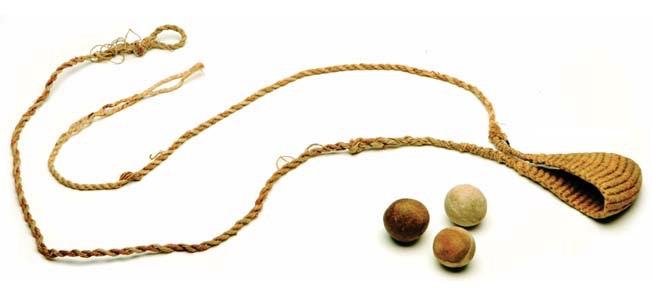
The sling was a competitive sport among the early settlers in southern Africa. Selenium was also used for small game animals in the Transvaal and Rhodesia. It was a simple and easy weapon to make. The central section (or "knot hole" [1 Sam. 25:29]) consisted of a piece of leather that was about 23 centimeters long and 7.5 to 3.5 centimeters long and 23 centimeters wide in the middle. , glued at both ends. Leather strips are attached to each end of the middle part. Or you can cut the whole ribbon from the same piece of leather.
How was a sling used? A right-handed person wrapped the end of one of the handles around a finger on his right hand or tied it around his right wrist and inserted the handle into the palm. The end of the second strip would be bent and held with the same hand.
The harness would place a stone in the center of the harness. He held the stone in his outstretched left hand. Then he released his left hand and turned right counterclockwise. When the sling reached her level, she swung it horizontally forward, even counterclockwise, in a full circle over her head. At the right moment, he dropped the trap and threw the stone forward. Some harnesses usually do not swing over the head but simply release with a steady downward movement of the arm.
**Great strength and range**
With the thrower's arm length and belts that give speed, the stone can be thrown with enormous force. In fact, a stone thrown in this way can pass through a car door. But it takes a lot of practice and perfect timing to use the sling properly.
Smooth rocks are commonly used as rockets. David chose this boy when he met Goliath. (1 Sam. 17:40) Stones about 6.3 centimeters in diameter are best. However, the leaves can vary in size.
Given that it is such a simple weapon with ready-made ammunition, it is no wonder that the harness continued to be used from a very early age. The Encyclopædia Britannica (Eleventh Edition, Vol. 25, p. 242) states: “The sling as a weapon is probably the oldest form of equipment known to mankind that gave the human body more power and reach. Arm of a rocket launcher. . ""
For example, in an October 1973 issue of Scientific American, the author stated: “I asked young people in eastern Turkey to throw ordinary stones at me. In five of the eleven attempts, the stones exceeded 200 meters, and the first three hits were between 230 and 240 meters [755 and 787 feet]. None of the boys seemed to be a skilled sniper; At least no one had a sling at that time. In addition, the rockets were randomly selected pebbles, rather than carefully modeled rock, clay or lead rockets fired with hose shots during Greek and Roman times. Based on Xenophon's comment alone, it is likely that a lead rocket fired from a slingshot could reach a distance of more than 400 meters.”
Because the noose was a weapon of such reach and power, it was used in warfare by the ancient Egyptians, Assyrians, Babylonians, Persians, Greeks, Romans, and others. The founders also occupied a place in the armies of Israel and Judah. In the case of a company of seven hundred left-handed Benjaminites, the Bible says, "Each of them was a row of stones the width of a hair and could not be lost." According to the Jewish historian Josephus, the complexities of the Jewish armies fought against Rome until the first century of our common age.
Today, of course, humans have infinitely more powerful and devastating missiles. But how heartwarming it is to know that under the reign of the Prince of Peace all weapons, be they slingshots or military missiles, will soon be a thing of the past, and the inhabitants of the earth will never learn. no more war!
Have you ever said, "Who do you think you are?"
Many Britons were surprised not so long ago the diaries of the late Lord Reith, founder of the British Broadcasting Corporation (BBC), were published. "I have brilliance, intellect and all sorts of things," he writes. . . I hate ordinary people and rarely acknowledge the size of others.
Do you also find that you "rarely acknowledge the greatness of others"? It is a simple omission. In the extreme case of Lord Ritch, his pale view of others often led to bitterness and frustration. For example, he wrote about his grief at being reduced to the level of "ordinary man" when Churchill removed him from the British government. He complained that his successor took his old government car and put it on the bus line like everyone else. "I had a big fight with myself," he said. "I often have tears in my eyes.
Fortunately, most people do not see other people as extremists. But isn't brilliance and self-confidence common in people you know or live with? Many people see aggression and self-confidence as the only way to "move on". A recently popular book called "Winning Through Bullying" promotes the idea that the way to do business is to intimidate - to intimidate, deceive, manipulate and manipulate for your own benefit - in short. Consider yourself inferior.
Often these higher melodies are translated into words or deeds that suggest, "Why should I tolerate your ignorance?" or "Who do you think you are?" Now you can think back to the times when you faced this ghost, when you faced a pompous bureaucrat, an arrogant employee or an abusive spouse.
The point is that this has been the human attitude for centuries. When the ancient Greek language was asked to express a new Christian thought - "with humility to see others as superior" - it was so foreign to most Greek expressions that the author of the Bible had to invent a new word. "The Humility of the Spirit". In a comment, he says: “The idea I wanted to express was an idea that previously had no place in Greek thought or in the Greek language. Everyone would be confident and that no one but an idiot or a coward would give in to a rival on their own. "- The interpreter's bible.
But is it stupid or cowardly to "consider yourself superior to others"? Never. "It is easy to despise others," wrote the English Lord Peterborough; "To despise yourself is the difficulty." Yes, feelings of self-worth come easily to most of us, but humility requires much more of a person, especially a gifted one.
How easy it is to think, "I worked hard to get where I am" and see how worse those who do not do so well are. But if you were born with disabilities or disabilities, would you be where you are now? Where did you get the talent and initiative or the education and knowledge you have? The Bible asks important questions about this: “Who makes you so important, my friend? What do you have that has not got you? If you really have everything as a gift, why dare you?
A person who believes that others are superior to himself or herself is not necessarily a retired supporter. You may have the ability to show great leadership skills. Of all the qualities that a person in a position of responsibility can have, it is the humility that she enjoys the most with those she leads or directs.
When some of Christ's apostles discussed which was greatest, he quickly shattered his great illusions by telling them what made them great. He noted that it is customary that those who are allowed to "dominate" him. But "that shouldn't happen to you," he replied. The taller of you has to pretend that you are the youngest, the leader, as you serve.
The wisdom of this principle is clear when you remember the last time someone treated you like you were inferior. Did you want to work with this person? Or it caused some irritation and irritation, maybe the reaction, "Who do you think you are?" Remember, the next time you're tempted to give that first push, take to the air in front of someone who may not be as competent as you near you. It is true that he can be superior in these things, but is he superior in other things? He can be good at areas of life that are far more important. Therefore, the Bible urges a person not to exaggerate its true meaning. Each of you should judge yourself soberly.
In light of these principles, take another look at the people around you, this time “with other superiors in mind”. Would it be better to do good to family, friends, colleagues or the public? Remember the apostle Paul's wise counsel: take care of each other and yourself. Don't be proud, go with humble people. Don't think about how wise you are.
For example, a man can provide money to keep a house. But your wife may be better at shopping for groceries or other household needs. It can also stand out in the organization of the home and provide more warmth and softness that children need. The man shouldn't really feel that his authority is threatened when he realizes that his wife can be superior in this way and maybe others. This will undoubtedly increase your respect for him and strengthen the love between them.
Children can also make a greater contribution. His spontaneous and unbridled way of expressing joy and affection, his honest and indescribable little remarks about things can teach even "demanding" adults.
In particular, Christians should understand that their fellow believers have certain qualities which are superior to them. Some have more knowledge and intuition, others more zeal and enthusiasm, others more warmth and sympathy. Who can say that if God chose the most favored from his point of view, he wouldn't be someone we humbly consider? This is why the Bible says, "They must cover each other with cloaks of humility, because God turns his face to arrogant, but prefers the humble."

Why the increase in suicides?
WHY? WHY?WHY? - The young widow has wondered this a thousand times since her husband hanged himself. He seemed to have a lot to go through: a new baby, a beautiful wife, a lot of good friends, a good job. Everyone knew he could captivate audiences with his musical prowess, and although he was relatively young, he was highly regarded in society.
He didn't know he was going to kill himself. But he did. And now the living, especially the wife, must bear an enormous burden, not only the loss of their husbands, but also the social stigma often associated with the word suicide.
Maybe the pain you saw in this young woman never got past you. But the issue of suicide still deserves your attention because it is on the rise. The World Health Organization reports that 1,000 people around the world kill themselves every day. it's one every 86 seconds. But these numbers are only beginning to tell the story.
It is estimated that only one in ten Americans who attempt suicide will succeed; In other words, there could be 250,000 attempts. Suicide rates are low. “Heart attack” rather than suicide usually appears on death certificates because of religious or other feelings, or to obtain life insurance benefits. Of course, many drownings and traffic accidents are suicides.
**Where's the climb? Why there?**
Suicide is nothing new. But it's especially common in some groups now. Because?
It is said that older people, often very lonely, are more likely to commit suicide. It is twice as common in black men between the ages of 20 and 35 as it is in whites in the same age group. This is due to "the frustration and anger of the black ghetto". Frustration is also attributed to the emergence of the problem among working women. Suicide has reached "epidemic proportions" among young people. Experts blame ratings, parents and the opposite sex for their concerns.
But is this the real or the only reason? It is true that many elderly people are alone, but this is not entirely new. Many women are torn between career and home; but few commit suicide. Haven't children always had problems at school, with parents and children? While each of these factors contributes in one way or another to the current problem of suicide, they also leave a lot to be said. There must be other factors.
It's here. Cities have alienated the elderly like never before. Contemporary social movements urge women and blacks to "conquer" at all costs, otherwise they will be rejected. Young people today use alcohol and drugs with a little discipline. Modern movies and television also glorify violence and make life seem cheap. The nuclear holocaust is widespread around the world. On all fronts, the world now appears to be in trouble. Most importantly, people feel that there is nowhere to find help.
Churches are no longer reliable; For a long time, people were told that the Bible is a book of myths. Most religions are rapidly losing their influence. He was unable to incorporate the qualities necessary to withstand modern pressures into his life.
When personal crises are stacked on top of each other and viewed in the context of the biggest faces of humanity, many are desperate. You have no protection.
Obviously, each case is different. Experts disagree on the particular combination of circumstances that ultimately leads to a person dying on their own. Is there any idea that suicide is imminent? Doctors are looking for a model, but it's hard to find. Some people carefully plan to kill themselves, others act on impulse. Some people become unpredictable before they kill themselves, but the calm suddenly dissolves in others.
However, most suicides do not have a history of mental disorder. As for the young man mentioned at the beginning of this article, his death surprises everyone.
**Dealing with suicide**
The affected person may be particularly concerned about why they “knew best”. Yes, probably yes; But a lot of "normal" people go through irrational times. A National Observer article said: “The suicide crisis is not a permanent feature. It is often just a matter of minutes or hours. “While inclination affects some people, the opportunity to implement it is unfortunately also cheap.
Family and friends often feel responsible for what happened. "I should have been more loving and caring," you might say. Of course, such thinking can not revive the dead. But in retrospect, one thing strikes us: the need to be more attuned to emotional needs that others often do not express.
Of course, the suicide bomber must finally take responsibility for his actions before the one who gives his life. Although observers do not understand the reasons, the suicide bomber was wrong. Some people have a hard time understanding this.
But the living can be fully convinced that he is also compassionate and understanding. Only he knows all the complex personal and social factors that can make a healthy person believe that he must commit suicide.
The living would do well to strengthen themselves so as not to make the mistake of believing that suicide is the best way out of life's problems. Develop a true love for God, a respect for life. Learn your holy word; This will show that it can withstand the pressures of our time. Do not increase the pressure from those who have committed suicide. Help them too, trust those who know the thoughts and intentions of the heart.

How Animals Train their Young...part-2
*Click here if you haven’t seen part 1* https://read.cash/@James_writer/how-animals-train-their-young-c09150e9
**Teaching To survive**
To eat, ones living by the sea must learn to fish. Seals, sea lions and polar bears dive into the water and find a fish. Then they let go in front of their hungry children. This encourages them to catch their prey before it escapes. It does not take long for these animals to become fully skilled at fishing.
How important it is that these young creatures learn everything they can to feed themselves! When they are old enough to take care of themselves, the parents' interest in feeding them instinctively disappears. And they will be alone.
Survival also means avoiding dangers. How do pet parents warn their children about this? A mother deer teaches her deer to fear people for themselves and shows that fear when she sees or smells people.
When a wolf approaches a trap with its young for the first time, it shows great fear. The young ones see the reaction and learn to avoid traps.
The animals' defense response to danger seems to be acquired primarily through learning. Giant rats born in captivity in Paris, France, did not react to a large python. They even approached calmly and fluffed his nose. But his parents violently attacked the snake, apparently after finding it in its native Africa. The same was true of young chimpanzees. Relatively speaking, they were also indifferent to a snake, although adults of their species showed great fear of it.
**Make them obey**
Sometimes the game prevents young animals from taking classes seriously. But animal parents do not seem to tolerate this absurdity. The mother cat, which teaches its kittens to catch mice, closes its ears if they are slow or distracted.
Scottish mountain goats send their children over the cliffs. If a boy takes a step in the wrong direction, warns his mother's cuckold.
Sometimes a young deer needs to learn to be quiet to escape detection. If it insist on being restless, the mother will kick it hard. And that stabilizes it in general.
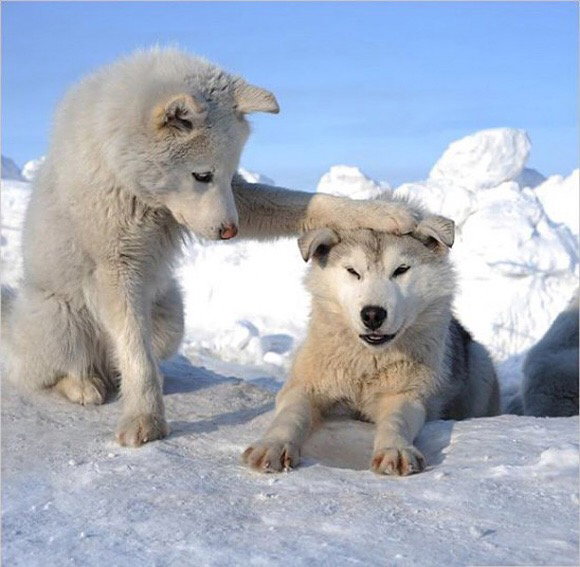
Even lions, bears, squirrels and other animals do not send out the stick to their disobedient little ones. They suppress the madness with a sharp fist.It is of interest to young ones. Discipline from parents helps them stay alive.
Are there any lessons learned from this for human parents? Perhaps. Young people must also learn to obey, they must learn what type of food to eat and how to avoid dangerous situations.


How animals train their young
DO ANIMALS train their young? Use discipline? Rquire obedience? Right! Things like that play an important role in their lives,survival is involved.
God-given instinct is the driving force. A limited amount of intelligence also comes into play: to survive, young ones must learn to eat; they must also learn to recognize and deal with danger. Pet parents do not give their offspring reasons or explain why and how to do things. But they lead by example and can inflict pain to help young ones stay on track.
**Spending Time**
Parents of animals spend a lot of time training their young. It can take up to two years for a bear to teach its cubs. Show them where they can find food by teaching them how to dig up spicy root vegetables. And it is the parent who makes them discover the acrid sweetness of wild honey, a delicacy that they will taste for the rest of their lives.
Young raccoons are fully trained in the art of being independent. The mother spends the time returning frogs and shrimp to them, using the game to teach them. She also teaches self defense, hunting and fishing. Over time, their young learn to follow mice, catch frogs, and dig up insect larvae. And it tells them where they can find wild grapes and the best corn.
Some young animals are trained to do exactly the things that we think are instinctive. Think of otters who love water. Did you know that the mother otter has to teach her young to swim? In fact, she teaches them to love the water, because they will not enter it alone. How does she do it? By dragging them into the water, pulling them by the skin of the neck. Or it can roll,splash, in the water she goes! For a while he swims with the stretcher attached to his waist. Suddenly submerges! Otters are now forced to sink or swim. And they are trying to swim! They are clumsy at first, but they learn gradually.
The mother seal also takes time to teach her youngster to swim. When in the water, she plead, persuade, and encourage her pup to try swimming. She usually ends up leaving her adrift. But her work doesn't stop there.She sometimes help by swimming under her. If the one been trained appears distressed, she will put her head under the young one’s forehead and lift it out of the water. After a while, the baby seal can swim on its own.
How does a young flying squirrel learn to float? Her mother just pushes her off a tree branch. And the young seems to instinctively know what to do to avoid his downfall. It spreads its little feet and the thin membrane on each side that connects its front and back legs forms a kind of parachute that allows it to slide safely to the ground. Instinct tells the flying squirrel's mother when her baby is ready to learn this feat. If mother push her out of a tree at a very young age, it could be fatal.
As the time comes for young winged birds to learn to fly, they begin to exercise to develop their flight muscles. They twist their necks, they twist their wings, they twist and they twist. But it is the mother bird that convinces them to leave the nest and try to fly. It will stand a few steps away, offering tempting bits of food to encourage the young to go out and try its wings. In cases where the nest is in a very high position, it is essential to be successful on the first attempt. Surprisingly, many young adults can travel up to 100 meters during the initial flight.

Did you know February had 30 days
February had thirty days until the time of Julius Caesar. Cesare took a day off to add it to the month that bears his name, July. Emperor Augustus also took another day off to add to August, the month that took his name.
How camels beat the heat
In the scorching heat of the desert, a lifeless object, such as a rock, can reach a temperature of over 50 degrees Celsius. A camel in this environment, like a man, maintains a tolerable body temperature.But where the human temperature remains almost constant as the day warms up, the camel's temperature rises slowly to about 105 degrees. When the temperature of the camel increases, the animal sweats very little; It is only when the temperature reaches 105 degrees that it sweats freely. The high temperature of the camel also reduces its heat absorption, which of course is due to the difference between body temperature and room temperature.
The camel further reduces the heat load on the body, which means that the temperature can drop below normal during the cold desert. At dawn, the temperature may have dropped to 93 degrees. Therefore, most of the day will pass before the animal's body heats up to 105 degrees and must sweat. Due to its flexible body temperature, camels sweat a little except during the hottest hours of the day, when a man in the same environment sweats almost from sunrise to sunset. . . .
The camel uses comb hair insulation to further reduce the heat load. Even in summer, when the camel loses most of its wool, it has a layer that is several inches thick on its back where the sun goes down.If we sheared the wool from one of the camels, we found that the hairless animal produce 60% more sweat than a skinless animal!
The camel's hump also indirectly contributes to reducing the animal's heat load. Almost all mammals have a food supply in the form of fat, but in most of them the fat is distributed fairly evenly throughout the body. under the skin. By concentrating the fat in a position, the camel lacks insulation between the body and the skin, where evaporation cooling takes place. The absence of insulation facilitates the circulation of heat, just as wool insulation slows down the heat flow.