Why I'm Switching From BCH to Monero
I first got into Bitcoin in late 2016, back when transactions were cheap and the community was united. One day I made a resolution to use Bitcoin as money, bought a Bitpay card with Bitcoin, and there was a transaction fee so large it ate my entire payment and I got no card. This started my journey into looking into alternatives. I tried other coins like Ethereum and BCH (Bitcoin Cash), and eventually decided to go with the latter. I tried many different cryptocurrencies but BCH is the one I kept coming back to, as being most aligned with my values and principles. Price-wise this did me little favor though.
After three plus years of seeing the fork play out, I can say with confidence I have zero interest in ever participating with BTC, but I'm not so satisfied with BCH either. I like BCH but I don't feel the same energy as what I did in the early days, and the increase of crypto competition, branding wars, and the corruption of the crypto scene is probably why.
After much research and critical thinking however, I think I've come to the conclusion that its actually Monero that most aligns with my values and principles, and why it may actually have the best chance at being a legitimate peer to peer cash system for planet Earth. My case here isn't to trash or disown BCH, but state my preference for Monero above it. I would say BCH is my second choice, in the same way I formerly would have said Monero would be my second choice. I will list my reasons in greatest importance to least.
### Reason #1: The Privacy Is Not Comparable
Back before I had actually used Cashfusion for myself, I assumed BCH "solved" privacy using Cashfusion, and Monero was simply made obselete by it. What I didn't understand was, well, a lot. Theres actually a list of things that make cashfusion inferior, and not just inferior, but unsuitable for all the same privacy usecases.
**1) Cashfusion partially runs on a central server (still non-custodial), as is standard for many third-party coinmixing protocols**: Many people do not realize this. But the ability for Cashfusion to scale with its current liquidity is dependent on some arbitrary person's server. And there have already been examples of small bugs in the server that passes down to those implementing it, which can disrupt usage. This is also a single point of failure that could be attacked by entities such as a government. Monero privacy is fundamentally better in this area because the privacy is managed by the blockchain itself, which has no single point of failure.
**2) Cashfusion can be slow and unreliable**: This kind of thing varies greatly on liquidity and whose fusing, and can vary between a successful mix in minutes to waiting hours to days with or without a successful mix. My first experience cashfusioning actually resulted in failure; I let it run all day and nothing was fused. Turns out I had too many coins, and that prevented a successful fuse. Rather than break my coins up and spend a lot of time getting everything mixed once, I just gave up. This is another area where Monero's privacy shines: Mixes are fast and reliable, it doesnt matter how many coins you have, and it requires no extra effort from the end-user.
**3) The scope of Cashfusion's privacy is one-time, rather than every-time**: If the purpose of the privacy is just to break a link between your wallet and a KYC checkpoint, then Cashfusion might be good enough for your usecase. However if you fail to use good OPSEC or you buy from merchants who want to track you or sell your data, then they can perform chain analysis on your future transactions and possibly deanonymize you. If you for example buy from a merchant who knows or can guess your identity, who may see your face on camera in the store, or who may require metadata when you make a purchase (a name, email address, home address, etc...), then they can deanonymize you, sell your data, and your future transactions can be tracked. The only way to prevent this is to mix your coins every time you send or receive them, which is usually thought of as unduly burdensome. Monero has the clear advantage in this area as well, because every act sending or receiving is anonymous and distinct from one another.
With these reasons combined, I simply cannot recommend Cashfusion or any coinmixing protocol as a solution to privacy, except as an obfuscation technique for skilled and professional users, and not the end-user.
### Reason #2: The Automatic Blocksize Limit Is A Necessity
The whole reason Bitcoin Cash broke off Bitcoin was because of the arbitrary blocksize limit, which the developer community decided not to raise. Yet the Bitcoin Cash resolution wasn't to get rid of it, it was just to raise it a little bit. Many in the BCH community called the blocksize limit an example of central planning, yet BCH has a static blocksize limit. The problem with this is theres no way to fundamentally prevent the community from deciding not to raise it again, because raising it requires consensus, which requires positive action and expenditure of energy.
Its easy to imagine a situation where BCH might not raise the blocksize limit again. After seeing BSV take it to the extreme quickly, as an effort to differentiate and disassociate themselves from BSV, many in BCH decided to think of themselves more as "medium blockers" rather than "large blockers" and may even support a decision to suppress blocksizes at some point if it was thought that things are scaling too fast or if its hurting nodes too much. Former rhetoric on removing the blocksize limit entirely or replacing it with some kind of automatic limit has also quieted since then. And if agreement is not met on blocksize, history may repeat where theres a contentious fork over it.
Regardless, I simply do not think it should be the role of developers to make economic central planning decisions on the blockchain. The economic properties of a blockchain should be stable, and its management should be autonomous and decentralized. Economic policy, which is to say, changes to the economic properties of a blockchain, brings corruption, contention, and centralization. Relying on the promise of developers to raise the limit, or on the prowess of loud redditors complaining about it, is a strategy thats already failed once.
Monero fixes these problems by having an automatic blocksize limit. It gives us the best of both worlds, by preventing "spam" (or unnatural spikes in usage), without putting a potentially permanent upper limit on onchain capacity, which would threaten the chain. Monero achieves this, in part thanks to its tail emission, where miners are docked some reward if they increase the blocksize, incentivizing them not to unless transaction volume is sustained.
I see the automatic blocksize limit as absolutely necessary, and honestly I was tired of waiting for it in BCH. Decentralization is important, and this is maintained by developers not centrally planning economics onchain and by keeping the blocksize at an appropriate level where transactions are not pushed to custodial/L2 solutions and spikes in usage don't exclude access to the smaller nodes who haven't had time to upgrade.
### Reason #3: Mining Is Decentralized On Monero, And This Gives Us The Economic Properties Of Early-Day Bitcoin
I see two things going in the way of decentralized mining on Monero. This would be 1) The Asic-Resistant hashing algorithm Random-X which decentralizes hardware, and the more recent utilization of 2) P2Pool which can help with pool distribution (I heard that its technical redesign was very recent and Monero is already at 3% adoption).
BCH as a coin is still run by Asics and big miners, probably because the perception is that if they change that then they lose bitcoinness. Also another argument I see is that Asics are more efficient for scaling, due to the effect on centralizing nodes. Personally id rather not accept a small scaling tradeoff that accepts blatant centralization, and also not accept a small branding tradeoff for it either.
I would argue adoption of P2Pool is being made easier by the Asic-Resistant algorithm, because more enthusiasts will be able to fire
it up when they are able to mine in general and dont need to buy expensive Asics to do it. Barrier to entry is a centralizing factor, and it also consolidates to a finer point of failure.
Decentralization of mining is important, because mining is at the center of governance and more decentralization actually means more security. Its also important not to use the same hashing algorithm as a coin bigger than you, which BCH is pretty much doing, and this is a security risk.
### Reason #4: Monero Is Winning Black Market Adoption And Anarchist Mindshare
In terms of adoption, Monero dominates the deep web underground and is displacing BTC as the go-to black market currency. I thought BCH would take a slice of this pie with the advent and eventual adoption of Cashfusion, but as far as I know, it's never really happened. This is probably because Monero remains the option which is both easier and has stronger privacy, and with the power of network effects it may be very hard to replace it.
Anarchist minds still seem to rely primarily on Monero for their acts of rebellion, and of polls I've run they all largely still prefer Monero. If discussion of BTC or BCH is brought up, it usually devolves into price for the former, and branding wars for the latter.
Being a tool for free markets was the whole original purpose of cryptocurrency, so seeing the role get taken by Monero suggests to me this is where most of the grassroots energy and press for change resides.
If I have to choose between darknet and clearnet adoption, but it would be the same number of merchants either way, I'd choose the darknet ones, because those tend to underpin strong usecases with strong demand, which means they are economically more valuable. You've got to be able to do both, and its easier to convince a clearnet merchant to use a private coin than to convince a darknet merchant to use a not-very-private coin.
### Reason #5: Branding, Community Relations, Track Record, Price History, And More
This one will probably seem like the most superficial of all the reasons I give, which is why Im listing it last. And this is multifaceted, so bear with me.
**1) Branding**: "Bitcoin Cash" is a terrible name. It rings with many enthusiasts, but when another person hears it, it confuses them because Bitcoin is in the name. And then many enthusiasts claim it's the "real" Bitcoin. Im not saying that its not, but this does confuse people, and it loses them too. Trying to argue with yourself/the other person or explain a bunch of history to someone, ***just*** to explain the name, is just a pointless level of effort. And then this causes a lot more effort to be spent in bickering with others.
Monero's branding is straightforward. Its a single word, it saves us a syllable, it doesnt sound like another cryptocurrency or related topic, but it is a play on the word "money" which makes it a name that sticks with people. And its a pretty appropriate name too.
**2) Community Relations**: Its hard to deny this one needs some work. BTC, litecoin, forks like BSV and XEC, and just scores of other coins have badly burnt bridges with BCH. Ethereum is a more recent one too, arguably. What causes this, though? People feel negative about BCH, probably because their communities have good relations with BTC. BCH constantly attacking BTC may be the reason why others feel affronted by BCH. It might also be the overly antagonistic atttitude a lot of BCHers have too, just due to the constant fighting.
Contrast this with Monero. How many people will shill you their favorite coin, and then say Monero is also good? Or how many people say Monero is their second-favorite coin, or their favorite privacy coin? Its a lot of people. The reason for this is probably because Monero provides a useful service to all these other communities: Strong privacy; And because Monero isn't in the same state of constant fighting and trying to fight BTC in particular. People in Monero do poke fun at BTC and other coins, but theres a difference between stating the fact that BTC lacks privacy (which lots of people can and do accept), with fighting them for their entire name and legitimacy head-on.
**3) Track Record:** BCH has a bad track record with products being abandoned or being misleading. I really don't know why BCH in particular has such a bad problem with this. Maybe BCH is trying to do too many things at once, or maybe its a leadership thing, or a culture thing, I'm not sure. But let's go over some examples:
- The Memo Protocol: This one's fresh on my mind because i tried desperately to use it this entire last month. Memo.cash wouldn't let me post and wouldn't let others deposit, and the developer refused to help anyone figure out what's wrong, he simply denied that the problem exists. Memo also changed their key format, so i couldn't put my keys into Member, the other interface for Memo. I finally found my keys, and then one day after using Member i couldn't post there either, something about the UTXO server was corrupted and I couldnt fix it. Couldnt contact the developer, waited a week for it to be fixed, then i simply gave up. I would consider the Memo Protocol essentially abandoned, that's how its been treated.
- Bitcoin.com and Roger Ver: The Bitcoin.com wallet went closed source, and deprecated tons of features. Also tons of really awesome Bitcoin.com tools, were either abandoned or sold. Local.bitcoin.com was sold to a third party multicoin company, exchange.bitcoin.com sold, and dozens if not hundreds of other features, they just come and go. Roger Ver promised a 500m ecosystem fund, made it sound big and important, and years later he's barely a few percent of the way into doing anything with it, with no updates.
- SLP tokens: Im afraid this one is on its way out. With SmartBCH, not many want to use SLP anymore. Some of the best SLP minting and distributing tools also died with the Memo protocol. And not all wallets have adopted it either, i remember an occasion where i accidentally burned all my SLP coins by loading my seed into a wallet that doesnt support SLP.
Those who have been in BCH a long time know what I mean by things being abandoned in the long run. It seems like its a recurring problem.
**4) Price History**: I used to think this one was just a meme, but after the recent drop from $1500 to $280 i changed my mind. That was painful, and it all happened in the last few months. For the record, the price drop here was almost 2x as steep as what Monero and BTC dropped, just in the last few months. For some reason, BCH has a bad volatility problem.
BCH is one of the only coins with a price history that slides straight down at practically a 45° angle. BTC maxis make fun of BCH every other week for hitting new lows. Im not sure how this price is even possible, unless people are exiting BCH?
Monero is more attractive to me due to its greater stability, which is what ive seen so far.
## Possible Problems With Monero, And My Rationalization For Them
Nothing is perfect, so theres some things that may be lacking here. But some of these things also have an arguably good side.
### 1) No Op Return, No Tokens, Lacks Smart Contracts (On Base Layer)
Let me just start by saying that all three of these things have disappointed me. The Op Return doesnt have any useful data in it, tokens aren't tokenizing anything meaningful and long-term valuable, and smart contracts if used at all are just creating things to gamble with. Most of these applications have been diluting the value of the ecosystem with money pits.
Although, Monero doesnt fundamentally lack the ability to do these things, its just harder. Theres no op return, but its well known that you can encode data in the inputs of a transaction. Which means you could probably create something like an SLP token if you really wanted to (not that id think it would be valuable, I strongly think this should be done on a sidechain, where the usecase is sandboxed for safety, optimized, and doesn't bloat L1). As for smart contracts its limited on the base layer, but sidechains can expand on them. Sidechains are possible on Monero like BCH just usually more difficult to create AFAIK.
### 2) Regulatory Scrutiny, Exchange Delisting, Less Clearnet Adoption
Its a definite disadvantage how little Monero is adopted on exchanges. But this isn't a dealbreaker to me, because small exchanges that support it and decentralized swapping services still exist. At the end of the day, if government can kill crypto by banning it, then no crypto is fundamentally safe. For this reason i'm not going to worry about the government banning Monero, they ban everything.
But Monero also has less clearnet adoption than BCH. I don't think this is an unchangeable fact about the relationship between the two currencies though, as theres a lot of merchants yet to adopt either, and many would be willing to adopt multiple coins. BCH also kinda lives in its own bubble, as far more people as far as im aware accept BTC and possibly even ETH. I also cannot directly compare other coins like Dash, Litecoin, and Dogecoin, but these could very well all rival BCH. As important as I think clearnet adoption is, i think it comes second to darknet/anarchist adoption, and i think even that comes after being a sound protocol and money system. So I plan to just tolerate this fact for now.
### 3) Pending Balances
The way Monero works, as far as I understand, is your input is locked for 10 blocks (~20 minutes) after sending a transaction, which means you can't send a subsequent transaction from the same input and your balance might be reported to disappear on the UI side of your wallet. This is obviously a fairly large disadvantage to the usability of Monero, but it can be easily circumvented by spending coins to yourself to break it up, and I heard there was discussion of finding ways to alleviate this issue in the future. Monero is an evolving protocol, and I bet some better solution to this will eventually exist.
Another solution would be a L2 network that specializes in fast and secure transactions. The issue here would be making absolutely sure the L2 network is private too, otherwise its working towards one bad tradeoff for another.
This tradeoff exists on BCH too: Even if you could configure Cashfusion to mix your coins every send/receive (this is not implemented anywhere afaik and could be prohibitively slow and expensive), and even if liquidity is good, theres still going to be waiting times preventing you from sending transactions back to back using the same inputs.
It seems that privacy may be at odds with quick access to funds from the same inputs. But if you just break your coins up into multiple inputs with self-sends, or use multiple wallets/addresses, its a quick and easy way to avoid the problem. Even just having a couple backup wallets would do the trick.
Ultimately I think this is an issue that could be fixed with better UI. Don't tell a user their balance disappeared just because its getting confirmed on the blockchain, theres a 0% chance they wont have those coins. And maybe some automated self-spends could help, breaking funds into 50%, 25%, 10%, etc... chunks to start with could help with this problem, kind of like breaking a large bill into a variety of smaller change. Ultimately a small problem long-term in my view.
### 4) Less Prunable Than Bitcoin
As far as I know, less can be pruned on Monero than on Bitcoin and Bitcoin Cash. On Bitcoin you can get rid of most of the data (just not UTXOs i think, and thats a few percent of the size of the chain at most), but on Monero each node needs at least 1/8th of the chain. Either way, new nodes will need the non-pruned version in many circumstances such as during certain upgrades, so the non-pruned nodes need to exist somewhere.
Pruning is useful for saving data, but comes at the consequence that if you need to rescan the blockchain you'd need to download the full unpruned version of it again. Honestly it might make more sense to prune but store that data regardless somewhere, or just not prune at all and get bigger hard drives.
Monero's system of everyone having 1/8th of the chain helps prevent a disaster in case everyone prunes at once (if i understand this correctly) but like with everything else, its a tradeoff. Personally I think pruning is weird, because all of that data is important at some level, and i think it makes more sense to just have spam-protection and keep the chain as small as possible without sacrificing scaling, and to have strong hardware.
### 5) Single Development Team, Which I Believe Is Bad For Decentralization
Bitcoin Cash is well known for its multi-team development ecosystem and how it's so decentralized it even kicked out its lead implementation (Bitcoin ABC) when it went astray and tried to add taxes to the chain. Monero however only has one team, and thats the Core team.
The rationale I've heard for this is its highly risky, hard, and expensive to have multiple teams, and this is made worse on Monero with all the privacy and extra cryptographic technology. And because there's still plenty to do in its roadmap, the Monero community needs to be able to move fast and respond to deeply embedded vulnerabilities quickly, without stopping to collaborate.
Although for Monero, theres less to fight over than in Bitcoin Cash, in my honest opinion. For instance, the blocksize is automatic in Monero, while that's still centrally planned in BCH. And AFAIK Monero doesnt have a centrally planned dust limit like BCH. And there's lots of facets to the protocol constrained by the privacy architecture preventing spontaneous change. Monero is also not meant for smart contracts, so that is another thing the Monero community wont fight over, unlike in BCH where complex changes with strong tradeoffs are introduced and fought over all the time. A
lack of contention means less a core group could theoretically exert control over.
All in all, Id love to see multiple development teams on Monero, but its not something that I feel worried about, and I couldn't imagine what could possibly be fought over. Monero is a sound protocol, and as few aspects of it are as centrally planned as possible. I would say its privacy mechanisms are dynamic and changing, but its economic properties are locked into place. I genuinely think that BCH has more central planning going on in their adjustments to the protocol, and their multiple development teams is the only thing remotely offsetting that.
So I think we have a tradeoff here, which results in similar decentralization on both sides. Monero has a single team but doesn't centrally plan economic properties of the chain (at least post-RandomX), and BCH has multiple teams collaborating that will routinely engage in what I would call central planning. I would consider things like the blocksize limit, dust limit, all the other limits, etc... economic properties of the chain just as much as the distribution schedule, and I believe these things should be set in stone and not changed on a whim, but rather I think they should be designed right the first time then left alone.
I do want to see a second and/or third implementation on Monero though, its just not a pressing issue. I think more has been done to secure their decentralization however through the inclusion of RandomX and the recent uptick in P2Pool adoption, and this is an undeniable huge selling point of decentralization that sets Monero apart from Bitcoin and Bitcoin Cash.
## Why I Feel Like I Should Switch To Monero
I've talked about my logical reasons in depth... But humans are emotional creatures, and feelings tend to play a larger role in decision-making than cold hard logic. So what feelings do I have that are driving me?
### My Recent Negative Feelings About Bitcoin Cash
Well the first thing that comes to mind, is the price action. BCH has been weirdly volatile, almost twice as volatile as Monero. And ive lost a lot of money holding it. After four years of existence, at some point its price should stop bleeding. But its still bleeding. I don't completely understand why, but honestly I'm getting to the point where I feel like its destroying its reputation. I took it as a contrarian indicator before, but recently I feel like its taken it too far. Im starting to wonder if people are leaving BCH en masse, or if money is being burnt being speculated on stuff like SmartBCH, or if the users and believers of BCH stopped holding and buying it and follow a "use only" or "spend and replace only" policy.
Which brings me to another problem. The recent uptick in people who are espousing a pure "spend and replace" policy, and demonize holding the currency. Without holders, the price will surely die. Saving and spending cannot and should not be divorced from each other. I tried spending BCH instead of fiat, and between conversion fees and the nasty price drops all i did was lose a stupid amount of money trying to do something good. I also hate feeling like a movement is grounded in altruism, like i need to spend and replace even if it means losing money, otherwise im part of the problem. I truly hate this idea, and i think people should be properly incentivized to use a product instead. Also most of BCHs avenues for spend and replace involve KYC, and its hard to be excited about decentralized money if im constantly using centralized intermediaries.
Then theres my recent experience in neither Memo nor Member working, and being slow as hell regardless. I was so excited for this idea, but for how bugged and abandoned it is, I basically have to force myself to conclude its a dead idea, and maybe using the op return for this isn't a good idea. This got me down a path of wondering whether any usecase on the Op Return *ever* is a good idea, and the only other good usecase I can think of is SLP tokens, which seem mostly abandoned and being replaced by SmartBCH tokens.
Theres also i feel like a lot of degeneracy in the community. Not in the political sense, but in the Etherean/NFT-bro sense. Everything from the BCH community embracing a blatant ponzi scheme (Satoshi Pyramid) to NFT collections, to copying and pasting Ethereum smart contract code to make copycat gambling apps, to the new influx of moonboi amateurs shilling SmartBCH and generating noise... Ive yet to see something truly innovative come from SmartBCH. So far all ive seen is run of the mill gambling garbage that's eating peoples mindshare and diluting signal. And theres not enough leaders speaking out against it. Im seeing everyone buy lazy NFTs and perform degen yield farming on copycat dexes. Roger Ver, who I'd think of as the glue that helps hold the community together, is also mostly absent.
Im also concerned about possible lies proliferating in the BCH space. For instance it was said that the evil Core devs added Replace-By-Fee as a way to undermine Bitcoin, but it was demonstrated to me that this was originally added by Satoshi in the early days, and simply deactivated to address some technical problems it had. Lies like this are pretty big in my view, it gets people like me angry about things that doesn't necessarily make sense to be angry about. And its a similar story for Segwit, which is so heavily demonized, but i dont actually see where the objective harm is after doing my own research, and parts of Segwit were ported to BCH. They also said Segwit removes digital signatures and that could cause consensus problems, but in reality they were just moved. Also, another big lie was that Gavin was somehow forcibly removed from Bitcoin Core in some massive conspiracy, when I see no evidence for that, and evidence seems to suggest he simply became inactive and the rest of the community moved on to Github without him, and he pretty much passively removed himself from his role. I don't like this half-truthy hyperbolic nonsense, I like cold hard facts. And BCH and some of its big proponents have disappointed me here.
All in all, every day I feel like BCH drifts farther and farther away from being a successful p2p cash system that is adopted. I want it to work but adoption rates are negligible. St Kitts is interesting but honestly it feels like a PR campaign spearheaded by Roger, probably in reaction to El Salvador. That doesn't necessarily make it any less real, but being a reactionary measure doesn't bode well for the health of the grassroots energy in the community and its leadership, in my view. A lot of adoption can occur if you have a billionaire working his money magic on a concentrated area. But will the adoption last? This is unknown to me. I don't want to see an Island Roger paid off (or whatever he did) to adopt BCH, i want to see people who need BCH naturally want to adopt it and do it autonomously. No offense to Roger, and I wish there were more people like him.
### My Recent Positive Feelings About Monero
The last time I took a serious look into Monero years ago, i dont think it had any good mobile wallets. I tried to sync my own node to have a wallet and failed miserably. Since then, it seems its infrastructure has been really built out, polished, and I'm seeing cutting edge tech being released all the time. And its got three really awesome mobile wallets for Android. Im also seeing Monero more strongly cement itself in the mindshare of privacy enthusiasts, and I'm starting to really see its resilience to chainanalysis surveillance technology. I didn't understand before that coinmixing was such a weak privacy measure, and relied on the end user using it repeatedly or massively control their spending habits to use it in a way thats actually private. I also didnt realize coinmixers were pretty much completely centralized.
The argument that people deserve privacy by default is starting to make more sense to me. After seeing myself give up aftet trying to use cashfusion and failing, I thought "geeze, if me, a nerd and hobbyist programmer doesnt want to deal with this crap, then no normie will either, and Bitcoin is just going to be a massively surveiled nightmare". And seeing the ramping up of surveillance and totalitarianism is starting to alert me as well. Also fears of Monero being banned and brought harm in this way is starting to dissipate now that I see statist's primary hatred of crypto is the POW and its environmental externalities, as well as the ignorant feeling its scary in abstract, rather than fundamentally hating privacy in particular. I want to see every normie on Earth fully anonymous, using a digital cash as private as physical cash, otherwise the totalitarians will take advantage of this and the future will be very dark.
My vexation about perceived central planning on BCH seems solved with Monero's automatic blocksize approach. I thought BCH could just add an automatic blocksize, but i didnt understand how critical of a role the tail emission played. I also used to be scared of the tail emission, but after thinking about it, not having a tail emission could be a supply problem. You can't just use smaller and smaller units of money forever in a system with a fixed decimal place, youd have to fork the system to support smaller units which could be extremely complex or issue problems, more than one might naively think. Or perform a redenomination, which could be economically disasterous. A tail emission combined with natural deflation will result in a supply equilibrium (lots of deflation will probably happen first) that ensures the money system will be viable in its current form long-term. Why be greedy about the scarcity? Monero is already twice as deflationary as gold and it has linear inflation so it will tend to 0% (until theres natural equilibrium). Plus we shouldn't want to gamble on security, if tx volumes are too low or too erattic this could make Bitcoin insecure or have wildly swinging block times.
Im also starting to like the Monero story more than Bitcoin's. Bitcoin feels like something that started good and ended in tragedy and failure, while Monero was the literal opposite, forking off essentially a scam, the founder both equally respected and infamous, then the community took over and made something amazing out of it, which has only gotten better and better, rather than devolving. I really like the strong grassroots energy in Monero, and to me it feels even stronger than what I've felt in BCH.
When I sit back, and imagine myself trying to convince people to adopt crypto, I feel so cringey tryjng to sell them on BCH and get
them entangled in the history and drama, or telling them "it just works" like no sh** sherlock every crypto does, versus trying to sell them on Monero, which honestly has so many better talking points and is just a so much stronger and less confusing brand. I could tell them Monero is private, decentralized, and secure digital cash, i can tell them no other crypto is private like monero, i can tell them its the defacto crypto standard of people p2p trading goods and services with each other (outside of Bitcoin), and I can tell them its what's most cherished by the liberty community, if they are liberty minded. I can also tell them "it just works" if i want to, all the same, because normal 0-conf exists on it and its cheap. The best part is there's no chance I have to tell someone some mentally and emotionally taxing history lesson.
Finally, I'd honestly rather see the world adopt Monero than BCH. Ive always doubted this as a serious possibility, but anything is possible if enough time and effort is intelligently invested. And id much rather see a world of mandatory privacy on a stable blockchain than a world of mandatory transparency on a shifty blockchain with weaker security and decentralization. Monero is more defiant to Government and tyranny than Bitcoin Cash.
## Closing Thoughts
Again, this article is not meant to attack BCH. I have made arguments both for and against both BCH and Monero in this article. Rather, its me expressing my raw thoughts, feelings, and stating my new preference for Monero over BCH. BCH would be my second favorite blockchain, in the same way many in BCH view Monero as their second favorite.
I think Monero is the only soldier in the crypto-fiat war packing enough heat to actually win. All the other cryptos are basically running down the street naked, while Monero is a stealth machine working strategically in the shadows. Isn't it ironic how many people from every crypto circle will call Monero their "second favorite coin" or "a very respectable one" and don't really feel that way about anything else in particular? I think this is because people partially realize the importance of the privacy and other features, but maybe do not fully realize it, or are prioritizing something else like Smart Contracts above it.
Monero provides a sound digital cash layer, which is scalable, secure, and designed intelligently with pragmatic and strategic considerations in mind, and any of these overhyped technologies like "Smart Contracts" (which have known scaling problems and detriments) can be built on top using sidechains, which Monero is working towards having sidechains, just no EVM on the horizon yet. And Monero is also making its sidechains private too, and exposing other chains false and misleading claims to privacy. I could see a future of sidechains playing a huge role on both Monero and Bitcoin Cash.
I want sound, digital cash, because I care about freedom. Objectively speaking, Monero seems to be the strongest in this area. I still have emotional ties to Bitcoin Cash and feeling like we can make the Bitcoin experiment work, but I know deep down emotion must be shunned and a perspective that takes reality for how it really is, is necessary.
There is no aspect of crypto I *don't* care about, and I do want a cryptocurrency that can do everything. This is why Ive been so involved with BCH, because its basically like a Jack-of-All-Trades. But Monero is not excluded from any usecase so much as certain ones, which are far less important, are marginally harder to build and nobody's done it because they just aren't necessary or they get lured into the cryptos that make them easy. Monero being a fairly focused community seems to me to be a positive thing, and being a sound digital cash layer with no extra bloat could be a positive thing in the long run too. This is why I'm far more excited about sidechains.
**TLDR:** Coinmixers are centralized and not useful for persistent privacy but Monero is perfect for this, the automatic blocksize is necessary, monero mining is the most decentralized, monero has become the staple crypto of privacy enthusiasts and anarchists, the brand is stronger, and lately ive felt like infrastructure and grassroots energy on Monero is getting better while the opposite is mostly true for BCH. Also, for some reason Monero seems to have a much more stable price, and im not sure why. Finally, I think practically mandatory privacy will do more good in the world than practically mandatory transparency, and with the expansion of the surveillance state this is becoming increasingly obviously necessary.
Why Avalanche (AVAX) is a Centralized and Fraudulent Scam.
Im going to say right now it hurts to write this article, and I don't do it with pleasure. I do it because it needs to be done. And it sucks. But its time to sever all ties emotionally and otherwise with this project, and warn all newcomers about it.
For more context this is my previous article on the subject, when my faith in AVAX first began to waver. It hurts to write all of this because I was so excited about this project when it first came out, I worked so hard to build it up and spread the good word about it, and its dreamcrushing to come to the conclusion that ethically and morally I can no longer be a part of it. https://read.cash/@J-Stodd/my-opinion-of-avalanche-avax-in-2021-successes-shortcomings-and-concerns-a78964cd
To summarize what Im going to cover in this article:
Avax Validators not receiving their Avax rewards
Censorship on the official Avalanche Hub forum
Lies from the AvaLabs team about building a trustless bridge
Lies on the subject of burning fees
More lies and misleading claims from the AvaLabs team on transaction fees
Emin Gun Sirer wasnt even a Bitcoin believer in the early days
Another look at the centralized coin distribution with the advantage of both good retrospect and having had enough time to see things play out
I hope you make it to the end of the article. I know most probably wont. But if you are on the fence about AVAX, I think this is important information. At least hear me out on my side of the story.
Avax Validators Not Receiving Their Rightfully Earned Staking Rewards
It all started with this tweet by Collin Cusce, ex-member of AvaLabs and techie. Im imagining this thread was inspired by a wave of validators complaining they never received their rewards, because the very next day I too ran into the same problem. https://archive.md/hQ4VI
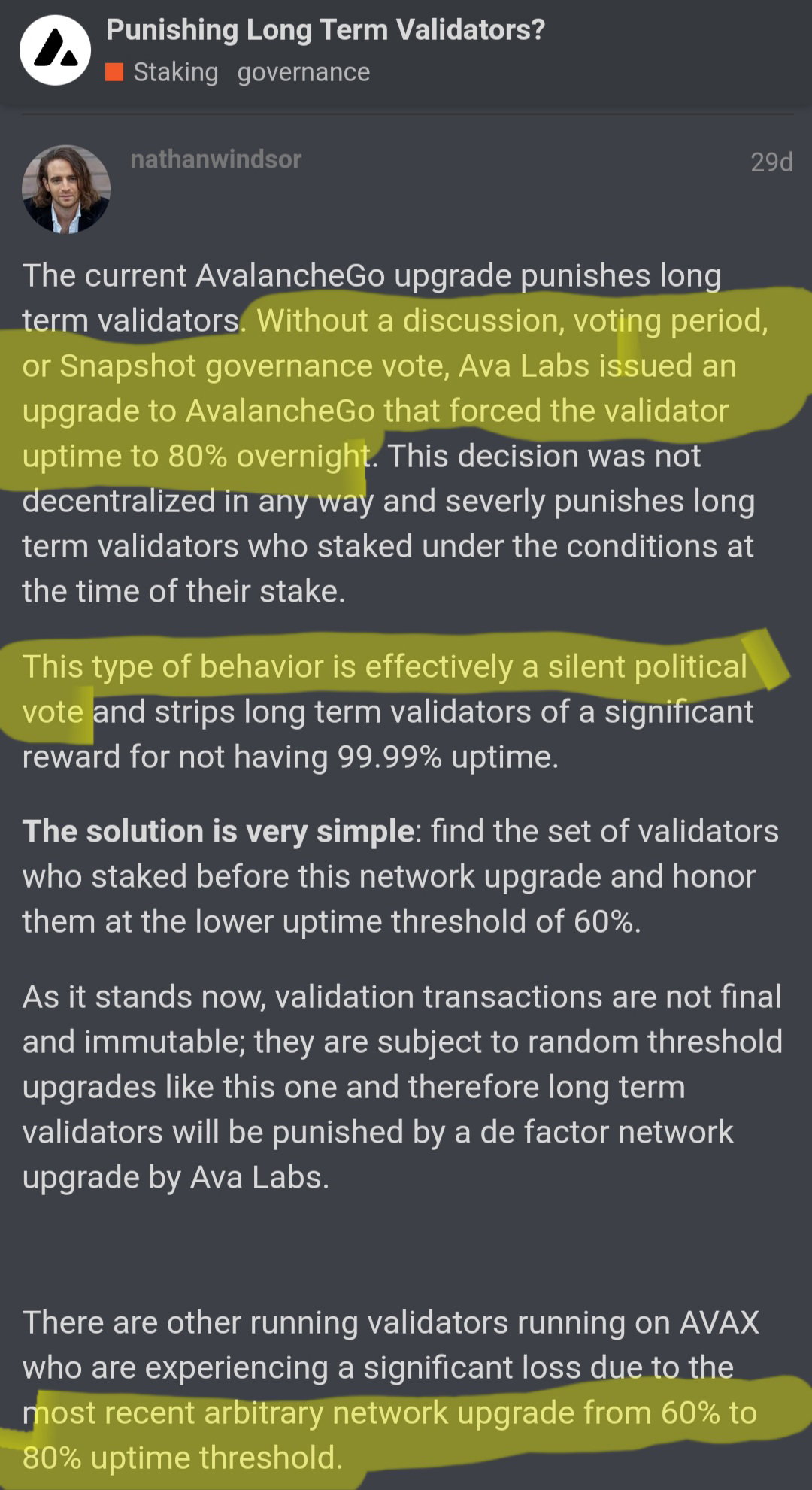
As you see people in Avalanche are now making the claim that you shouldn't be able to expect to receive your validator rewards unless you have "100% uptime". But this isnt really possible to achieve on a practical level, and its **not** what was advertised whatsoever. Whats currently being advertised is that you need at least 80% uptime.
But this isn't the end of the story. This time last year, it wasnt "at least 80%" uptime that was required. It was 60%. They changed it, increased it by a whole 20%. This massively increased the risk of monetary loss for all of the validators who already staked and ran into technical hurdles. 80% uptime is **not** what I and other OG validators agreed and consented to, it was changed after we staked, which is **fraud**. You can see upset validators commenting on this issue here: https://archive.md/h2J7G
Proof of these contrasting requirements: https://archive.md/wip/NwbuP https://archive.md/wip/FUPlC
Aside from fraudulently changing the 60% uptime requirements to 80% without discussion, a governance proposal, a vote, or even so much as a forewarning on all those who were locked into the system and **did not consent** to it, I personally lost all of my validator rewards **despite** having over 85% uptime. This is also despite using a script provided by an official AvaLabs member, so my node should have had no problems to begin with unless *their* script was bugged.
*****Thats thousands I've lost for no good reason*****. Sweat, blood, and tears went into that. The opportunity cost incurred by having to wait a whole year, the countless hours I poured into researching, troubleshooting, and updating my node, the monetary risk i took in buying Avax to stake it, the money I paid my cloud service provider, the literal work I did for the Avalanche network... All for absolutely nothing. Words don't describe the devastation here.
The short story here is that even IF you have enough uptime, you can still lose 100% of your Avalanche rewards, and AvaLabs centrally and willy-nilly changes the requirements for that without warning or explanation, spontaneously, and therefore you cannot properly assess the risks of long-term staking. These are serious concerns to take very seriously if you ever decide to stake Avalanche.
Censorship on the Avalanche Hub Forum
I ranked in the top five of participants in the Avalanche Hub website (formerly known as AvaHub). I wrote dozens of articles, infographics, and onboarded a ton of new people. I even gave away thousands of dollars in AVAX.
Over night I saw I was locked out of my account. It required a Google 2FA but I never set up a Google 2FA. I assumed someone would fix it so I reached out to AvaLabs then I waited. But 4 months or so go by and Im still locked out. So I create a new account so I can go back in and see whats going on, and to my shock and dismay, all my reputation was wiped to zero.
I thought this act of censorship deserved to be on this list because its a huge slap in the face to all the work ive done, my amicability and willingness to peacefully go our separate ways, and its a huge slap in the face to fairness and the reliability of AvaLabs' promises.
If you decide to ever invest your time and energy into Avalanche Hub, keep in mind that everything you worked for can be ripped away from you at any moment.
Lies From The Avalanche Team About Building A Trustless Bridge
This incident in particular struck a bitter chord with me, because i was so extremely enthusiastic and excited for it. Kevin Sekniqi on Twitter showcased, on the official Avalanche Wallet, moving "trustless" BTC and ETH on and off the wallet. He said this technology was being tested and would soon be deployed on Avalanche.
Later on when AvaLabs released its "new and improved" bridge, Kevin was talking about how it was trustless: https://archive.md/7pgN7 https://archive.md/wip/7pgN7
According to the officially released article, this bridge uses a "consortium of trusted partners" which requires "agreement from 3 out of 4 wardens". Does that sound trustless to you? Yeah, me neither.
Lies On The Subject of Burning Fees
In section 5.1 of the Avalanche *token* whitepaper, the role of fee burning is as follows:
*"Staker Fees. Unlike other protocols that pay all fees to the elected leader, such as in Bitcoin, in Avalanche fees are simply burned. Therefore, payment is global and for the good of the entire ecosystem. Fee burning increases scarcity of tokens in the system.* ***The minting process offsets the transaction fee burning****, therefore* ***there is no danger of the system grinding to a long term halt due to gradual destruction of coins****."*
This was confirmed here: https://archive.md/wip/2VzSX
But Emin Gun Sirer is telling us a different story.
This seems to be a classic case of *"Having Your Cake and Eating it Too"*. Fees on Avalanche are simultaneously "burned forever" and will likely be "reminted to pay validators". If any of this is to be believed, then the conclusion to be drawn is that Avalanche has centrally planned monetary policy by AvaLabs, and is therefore not fundamentally decentralized on the monetary level.
These kind of lies from Emin Gun Sirer are not a first either. Here he claims that Avalanche "invented" fee burning: https://archive.md/Wnx6k
More Lies and Misleading Claims From the AvaLabs Team on Transaction Fees
Avalanche has been advertised as a "low-fee" chain since it's inception, which really is simply not true. But aside from this, the people in AvaLabs including Emin Gun Sirer have gone as far to make these lies way more obvious. See here as he claims that Avax is the cheapest chain: https://archive.md/OmW7N
In reality, X-Chain transfers cost 0.001 avax or about $0.07, and C-Chain transfers cost about 0.015 AVAX or $0.60, making the X-Chain almost 100x more expensive to use than Bitcoin Cash, and the C-Chain between 10x-50x more expensive to use than SmartBCH. The only thing that Avax is cheaper than is BTC and ETH, and thats not hard to achieve. I compare AVAX with Bitcoin Cash because Bitcoin Cash has both a UTXO chain and an EVM sidechain like AVAX, and it is a good representation of Nakamoto Consensus in action compared to Avalanche consensus in action.
And while on the topic of transaction fees, we may as well go over where Emin Gun Sirer lied and said that the plan was to reduce fees by two at approximately each step, but then in the next phase fees weren't reduced at all:
Phase 1: https://archive.md/9VW4A
The Promise: https://archive.md/kfHtT
Phase 2: https://archive.md/6NX2v
This lie matters because its context was it was answering a question I asked about fees not being reduced enough. After price rose well over 10x Avalabs didnt want to decrease the fees to 1/10th of what it was, and instead only wanted to reduce the fees on one of the chains by half (the C-Chain) and then leave the P and X chains the same. This promise was supposed to be an assurance that they were not done correcting the fees, but apparently the promise was worthless because it wasn't kept. Even after Phase 3, fees on the X and P chains still were not lowered.
Emin Gun Sirer Wasn't Even A Bitcoin Believer In The Early Days
Emin Gun Sirer (he prefers to go by Gun rather than Emin) makes himself out to be the biggest Bitcoin and Crypto OG on the block. He makes references how it was him, not Satoshi Nakamoto, that invented the first cryptocurrency (with his now dead and abandoned project, known as *Karma*).
Remind you of anyone? Emin Gun Sirer is arguably the second most self-centered and self-embellishing fraud in the crypto space, right next to Craig Wright.
In reality, Gun has been a skeptic and critic of Bitcoin since day 1. Here you can see him mocking those who bought Bitcoin at sub-$100:
Emin Gun Sirer is also infamous in some circles for his article titled *"Bitcoin is Broken"*, where he says that the entire Bitcoin system can be taken over by "attackers" who "selfish-mine" (which is to wait to publish blocks until after competitors waste their time trying to solve them), with as little as 25% of the hashrate. He goes on to imply that this would spell the end for Bitcoin and that somehow it would stop functioning, saying it's a "fundamental flaw" in Bitcoin's architecture. https://archive.md/AX7TI
The entire paper attacking Bitcoin seems to hinge on the fallacy that this little advantage one group of miners could have over the other would somehow be asymmetrically in favor of attackers. A more sensible conclusion would be that if this becomes the winning strategy, then everyone would just do it and then no miners would have advantage over each other anymore. Either way, Bitcoin has been running for a long time, almost eight whole years since this paper was released, and theres no evidence of attacker miners ruling the chain like he fearmongered. And its clearly fearmomgering. Heres some more context:
Avax Centralization
Its no secret that the people in AvaLabs constantly boast about Avalanche's "decentralization", as if it had any. Here's just Emin Gun Sirer and his constant shilling of it:
But is Avax really decentralized? Id argue not in the slightest. Decentralization is not determined by the number of nodes in a system, but by how much power each node has. And I can prove to you mathematically, that **AvaLabs has over 51% of the voting power over the Avalanche network**.
The genesis coin distribution for AVAX can no longer be found on info.avax.network because it has been removed to avoid further bad publicity, but I have an archive of it here. The allocation is as follows: https://archive.md/rKHB6
18M: Seed Sale
24.9M: Private Sale
7.2M: Public Sale Option A1
60M: Public Sale Option A2
4.8M: Public Sale Option B
18M: Airdrop
2M: Denali Incentive Airdrop
72M: Team
66.7M: Foundation
36M: Strategic Partners
50.4M Community and Dev Endowment
360M Staking Rewards
Looking back on their original coin distribution chart, with the benefit of hindsight giving us better context, we can see clearly three categories: AvaLabs-Controlled Allocation, Non-AvaLabs Insiders-Controlled Allocation, and Public Allocation. (*For the sake of the argument im excluding staking rewards which represent 50% of the coin distribution, because they are by definition not initial distribution, they are locked, not affecting overall voting power, and in theory would be received by all participating coinholders equally).*
The Team tokens, Foundation tokens, and Airdrop tokens all fall under **AvaLabs-Controlled Allocation**, and sits at **156.7M tokens, or 43.5%** of the token distribution. The Airdrop sits in this category because its never been distributed and there seems to be no plan to do so, and the Foundation tokens fall under this category because the Team admittedly controls the Foundation.
The Seed Sale, Private Sale, Strategic Partners, and Community and Dev Endowment all fall under the **Non-AvaLabs Insiders Allocation** category, and sits at **129.3M tokens, or 35.9%** of the token distribution. Previously I may have steelmanned Avalanche and said community and dev endowment falls under public, but the vast majority of those tokens were given to close friends of AvaLabs (an example being Avascan, who both received funding and also became a Warden on the Avalanche Bridge), and what little went to Avalanche Hub for example, is on a censored and curated forum.
The three public sale options and denali testnet rewards would be what falls under the **Public Allocation** category, and represent **74M tokens, or 20.5%** of the token distribution. I consider Denali a public allocation because everyone was allowed to participate and I saw this from firsthand experience.
With ~44% of all tokens controlled by AvaLabs, ~36% controlled by other Insiders, and ~20% controlled by the Public, your first thought may be that "technically, this isnt 51% control". But you'd be incorrect. ***Because not everybody is staking, but AvaLabs sure is****.* By their own admission the team and foundation tokens are all routinely staked, despite only 63% of all tokens being staked. So if you divide 44% of all tokens staked by 63% of all stake online, you'd have an **effective voting power of 69.8%**.
An effective voting power of almost 70% is well over the target 51% I promised you that AvaLabs had over the network. Its not possible, in reality or in theory, to have "decentralized" governance when one party has 7/10ths of the vote. AvaLabs will always be doing whatever it wants, whenever it wants, and no amount of community action could ever dispute them.
Conclusion
Avalanche (Avax) is not a decentralized cryptocurrency. AvaLabs control roughly 44% of the active token supply and about 70% of all voting power on the network. AvaLabs is also notorious for its constant lying, dishonest shilling, and bait-and-switch schemes. Most notoriously was the millions of dollars in honest staker revenue lost when AvaLabs unilaterally and arbitrarily changed the node uptime requirements from 60% to 80% overnight, fraudulently ripping off hundreds of long-term honest validators and further centralizing the network and lining their own pockets.
AvaLabs engages in censorship against any detractors, and tries to bury the truth to preserve their reputation instead of confront it honestly. Anyone still involved in AvaLabs at this point is surely complicit in the dishonesty and lies. I've barely scratched the surface when it comes to lies, misleading statements, and false promises produced by AvaLabs. I could probably write an article 10x longer covering all those details, im just constrained by time, willingness, and the fact nobody would read something that long anyways.
My urgent message to all those still involved in Avalanche at this point, is to get out. Avalanche has already over 100x'd from its ICO sale of $0.50 to its current price of over $50. The pyramid scheme has most likely already done most of the ponzi gains it will do in its lifetime. And its ponzi'd so far its already overcome the market capitalization of Bitcoin Cash, which does everything Avax does but 100x cheaper and with 100x more adoption on an actually decentralized blockchain with a real community. Leaving Avax for Bitcoin Cash (and SmartBCH) which has stronger fundamentals would give you more price upside anyways.
I'll let you do what you will with this information. And you're free to amicably disagree with me. But when the rug is pulled out from under you by these scammers, don't say I didn't warn you.
My Opinion of Avalanche (AVAX) in 2021: Successes, Shortcomings, and Concerns
I would like to start this article by saying that I do like Avalanche (AVAX), and the community has been loads of fun and inspiration. A little about myself, I am a peer to peer electronic cash enthusiast, occasional critic, and voluntaryist. I was a well known participant in AvalancheHub and even hold 1st place in reputation, I've done three community airdrops including a 250 AVAX airdrop, a 100 AVAX airdrop, and a 25 AVAX airdrop. I also created and maintain the second most popular Avalanche subreddit on reddit, r/Avalanche_. In the time I've been involved with Avalanche, I went from having under 150 followers on Twitter to having over 850, most of them being Avalanche fans, and this has been massively beneficial to my self-image and mental health. I value Avalanche both as a technology and a platform, and envision a future in which it earns a spot in the top 10 or even top 5 of all cryptocurrencies. https://community.avax.network/profile/ https://www.reddit.com/r/Avalanche_/comments/j7h4gi/the_avax_giveaway_has_concluded_here_are_the/?utm_medium=android_app&utm_source=share https://www.reddit.com/r/Avalanche_/comments/j9s2ie/meme_competition_giving_away_25_avax/?utm_medium=android_app&utm_source=share https://www.reddit.com/r/Avalanche_?utm_medium=android_app&utm_source=share
All that being said, there have been a few small shortcomings and disappointments in the platform for me, and they are sizable enough that I've reconsidered my place as being an Avalanche-only supporter, and now prioritize my time with Bitcoin Cash. I will discuss what I think these shortcomings are, and what would be necessary to change my mind. This isn't a goodbye to Avalanche, I still love Avalanche and plan on building on it (along with Bitcoin Cash), but it is me returning the majority of my efforts and energy to my home cryptocurrency, Bitcoin Cash. My mind can be changed, but there are objective requirements I perceive to be necessary in a cryptocurrency that I decided I will not compromise on. I hope that this post signals for the things that would be needed to improve Avalanche and make it something I could fully have faith in again, including having significantly lower fees, better decentralization, and more transparency on certain things.
What I Like About Avalanche
Avalanche is hands-down the best blockchain 3.0 platform, and is best fit as a competitor and/or a successor to Ethereum, being a robust DEFI platform. I don't think any of the other attempts at a robust blockchain 3.0 cryptocurrency come anywhere close. In my opinion it's better than Cardano, EOS, Polkadot, Cosmos, Solana, Near, and just about everything else. Its even a better design than Ethereum.
My favorite features would probably include subsecond finality as fast as 400 milliseconds, subnetworking capabilities with custom blockchains and virtual machines, and its ability to scale node count to what seems near-infinite levels. Its transactional throughput is also good. And of course its DEFI adoption is accelerating rapidly and making huge strides.
If I ever wanted to launch my own blockchain, it would probably be easiest to do on Avalanche as a subnetwork. In the unlikely event that I do, there's also tooling on Avalanche that allows for bridges to be created between two networks, opening many different possibilities.
I will briefly go over the different things I am excited for on Avalanche and why I joined in the first place.
**A New Consensus Algorithm That Can Power Both High Scaling and High Decentralization**
Avalanche consensus is a very creative solution to the double spend problem. It manages high efficiency by leveraging locally random subsampling, instead of every node trying to communicate directly with every node, or instead of nodes individually producing and broadcasting giant blocks. At 4500 tps per second and with almost 1000 validators, Avalanche is highly impressive from a technological point of view.
Avalanche is efficient enough that there is no technical ceiling as to how many fully-validating nodes there can be, and as long as the transaction figures aren't surpassed then small scale hardware like raspberry pies can participate in consensus. The former is a significant improvement upon the decentralization that can exist within a classical consensus protocol, and the latter appears to be a significant improvement on the scalability that can exist on a nakamoto consensus protocol.
**Scaling and Innovation Through Subnets**
Subnetworks are a novel concept that have been partially emulated on other platforms, but are only being brought fully to life on Avalanche. They essentially allow anyone to launch their own blockchain, with customizable features such as custom virtual machines, and utilize either the AVAX token, a custom token, or both.
Subnets offer an interesting solution to scalability, as there is no hard limit as to how many subnetworks there can be. Anyone can launch their own subnet for relatively cheap and without asking permission first, and this can easily offload transactional throughput. Its hard to say AVAX will ever have a true scaling ceiling if you can just always launch another subnet, which shares the characteristics of the parent chain. My only concern is these subnetworks struggling to achieve adoption fast enough to be useful for scaling, and not introduce too much complexity into the system that could cause bugs or problems.
Finally, its worth noting that subnetworks allow for a new precedent of interoperable experimentation and idea competition. For example, there can be multiple subnets implementing different and competing forms of sharding, or different privacy protocols, or different types of turing complete virtual machines. You don't have to own multiple coins with differing experimental values if you can have one coin that is usable across many different experimental chains.
**Onboarding Mainstream Finance and Creating Better DEFI**
Due to the high customizability of subnetworks, industry leaders with different kinds of usecases are able to launch both permissioned and partially federated subnetworks. This allows for regulatory-compliance as well as retaining control over a chain where your control is needed. This allows for many different kinds of assets in the mainstream finance universe to be onboarded to Avalanche.
Avalanche has also taken a strong approach to creating and onboarding decentralized finance protocols, such as decentralized exchanges with automated market makers, prediction markets, and other things utilizing Ethereum smart contracts natively on the Avalanche C-Chain.
Both onboarding mainstream finance and DEFI protocols in my view can act as a catalyst for adoption. However I will iterate that without some kind of a focus on usage of Avalanche as peer to peer electronic cash, there isn't really anything to *adopt*, aside from a speculative asset that can just easily decrease in price as it can increase. So while these are amazing catalysts, I do think there needs to be more of a shift into usage of peer to peer cash in order to retain the adoption it achieves.
**What I Have Mixed Feelings About On Avalanche**
There are some things that I will not claim to wholly like or dislike, because there's advantages and disadvantages to each one. But they are worth noting since they do feed into my overall thought process and interact with other points to be made.
**Details Surrounding the Double Mint**
The first thing that comes to mind is the unusual double-mint incident that occured. On one hand its really bad this occured because it means that in the event of another bug-triggered double mint, a much larger and potentially catastrophic one might be able to occur. It also makes a philosophically unsettling statement about how cryptographic verification works on Avalanche, which is to say that its a lot more subjective than it is objective, which has theoretical negative side effects. On the other hand however, it is interesting to note how Avalanche is a truly immutable platform, so much so that not even bugged mints can be reversed, which gives pretty much perfect confidence to all sent transactions.
**Possibly Too Much Staking and Not Enough Liquidity**
Another thing I have mixed feelings about is how the Proof of Stake economics are playing out. Originally I had thought it would greatly democratize control of the blockchain, but I am not so confident about that anymore. Avalanche, from inception to now, has had a ratio of about 70%-80% of all coins being staked. This means that earlycomers have a very strong hold on the project, and its at the expense of liquidity and chain-democracy. Without proof of work to distribute any coins, I fear that we will have a stagnant and deeply-seated pool of wealth enriching earlycomers at the expense of the retail market. I did not expect this number would be this high, and honestly thought it would flatten out, not get more extreme. On the other hand, this could also mean greater blockchain security and a greater deflation of the supply if it keeps it up. I am undecided how I feel about this in particular.
**AvaLabs Creating New Tokens**
Something else I have mixed feelings on is the focus on launching "official" new tokens on Avalanche, both for DEFI speculation and as a security model for subnets. The first instance of this that I criticised was the planned launch of Athereum, which I feared would either compete with AVAX or leak value from AVAX holders to Etherean holders. Then PNG was launched, without governance live or any plans for real usecases, which resulted in a bunch of AVAX holders buying it and losing 90% of their AVAX to Uniswap holders who got PNG airdropped on them. Now there is a plan to fork Bitcoin and Bitcoin Cash, further diluting AVAX and creating things AVAX holders might buy and lose value on. From what I can see, having a token seems to be the planned security model of almost all new subnets, which is a model that may work security-wise, but would result in more speculation at the expense of safer decentralized finance, and of course dilutes value. Those are the reasons that I think I dislike the rapid creation of new cryptocurrencies by AvaLabs, but I am open-minded to the possibility that the increase of speculation may increase adoption, and that the security benefits of using these tokens might be significant. I personally would never invest in any of these though.
Things That I Dislike About Avalanche
There are a couple of things that I strongly and distinctly dislike about Avalanche, which did not concern me in the beginning when I originally joined Avalanche, but now are a source of significant concern to me. I will go through them in detail one-by-one.
**Relatively High and Unpredictable Transaction Fees**
The first thing that really bothered me about Avalanche in 2021, was the significant increase in transaction fees. In the beginning, the transaction fees were very cheap, and were less than a tenth of a penny in parity with other cheap cryptocurrencies like Bitcoin Cash. But as of recently, price has increased over 10x (30x if you start at the ICO price) and the fees have been not reduced down to match the increase in price. In the recent phase-one Apricot upgrade, they decided to only decrease the C-Chain transaction fees by 50%, and they decided not to decrease the X-Chain or P-Chain transaction fees at all. They say they want to lower fees incrementally, but it begs the questions of why they are only decreasing fees on one of the three primary chains, why it is seen by AvaLabs as necessary to do it incrementally, and at what point did AvaLabs decide that its their role to centrally manage fee levels using a corporate top-down approach based on their arbitrary and subjective beliefs about what they ought to be?
It was my understanding that it is not the role of AvaLabs to centrally decide governance parameters, and that was exclusively the role of validators. I was also under the impression that lower fees would be wrapped up with an upgrade in how fees are calculated (going from flat to based on size) as opposed to just hard forking the chain multiple times and changing parameters whenever they want, which has a completely different image and creates different social precedents.
The way I think the Apricot upgrade should have been released, and the way I honestly thought it would be released, was to decrease the fees of all three chains by approximately a factor of 10, and simultaneously release a new standard that calculates fees based on size. That should have been phase 1 of Apricot. Then phase 2 could be pruning and dynamic fees, and phase 3 could have been onchain governance and anything else. There is nothing arbitrary about decreasing fees by a clean factor proportional to how price approximately increased, but there is something disturbingly arbitrary about changing fees around every upgrade, keeping fees high and neglecting a opportunity to reduce them meaningfully, changing their relative cost ratios, and doing it in such a way that is disconnected from how expensive they have become.
Fees on the X-Chain are approximately 3 cents, and peaked out at about 6 cents on the run-up to $60/AVAX. And this is by far the cheapest transaction fees that Avalanche has to offer. The C-Chain currently have transaction fees upward of $2, will be reduced to upward of $1 after phase one is released, and I expect them to still be at least $0.25-$0.50 by the time Apricot is fully rolled out. Many in the Avalanche community have also shifted their focus away from "having the cheapest fees" or even "having cheap fees" at all, and many now defend the more expensive transaction fees, pushing fear of onchain spam and "abusive" or "pointless" low-value transactions. It is my fear that greed for burned transactions and the value it creates for holders and stakers is driving a desire not to decrease transaction fees as much as they should be.
**Miscommunication and Failure To Keep Up To Date With Various Promises**
There are many things in this category that I can think of where something was promised or expected, and theres either been no word about it since or the thoughts behind it has quietly changed. AvaLabs very well may follow through on every single one of these things, but my concerns stem from the things people say changing or them not providing information to keep us up to date with them.
The first thing that comes to mind was the discussion around the foundation burning its staking rewards to help preserve decentralization. It was a popular proposal that was reverberated by AvaLabs people, but as far as I know there's been no updates as to whether it will actually happen or not. Without discussion of it, the idea is probably dead in the water, which is bad for decentralization in this case. Theres also other things from AvaLabs that I thought would get discussed again, such as a more in-depth explanation of the double mint incident.
The second biggest thing I can think of is the mention of feeless transactions using micro-POW, detailed in their whitepaper. I had assumed this would be experimented with before governance came online, but governance is about to come online and not only has there been zero mention of this, but from what I can personally see there are many people who actively oppose it. I had wrote an article a few months back detailing these feeless transactions alluding to them coming soon, but its been a while and now I am unsure if it will even happen at all. There was also talk of using micro-POW as a supplementary measure to transactions in order to allow reduced fees. https://link.medium.com/SQvpJNkN3eb
Another thing I heard about was integration of Avalanche into point-of-sale systems, and maybe funding this with some of AvaLabs coins. I don't remember where I heard this, but I havent heard of it since, and Avalanche-X didn't do a grant to anything like this (to my knowledge). I also had thought the foundation was connected to Avalanche-X and that the coins in the foundation would be used to continously fund Avalanche projects, but it seems to me that this is not the case and that most of Avalanche-X was completed last year using exclusively coins from the community and developer endowment pool.
One thing that has annoyed me in this area is poor communication around how Avalanche fee burning really works. Avalanche fee burning is advertised as a one-and-done deal where all fees are burned and the value is therefore distributed equally to tokenholders. However, this is not actually how it works. Theres also a reminting mechanism where validators will earn from fees in the future, contradicting a claim that "100% of all coins are burned". If intentional this is false advertising, if unintentional its poor communication. The way I understand it, is that fees are burned for now, but get reminted after the staking rewards end. What I dont understand is whether or not reminting has a limit on how fast it could go (allowing deflation from rate of change), or if any fees will be intentionally permanently burned in the process.
All in all, I wish AvaLabs would be clearer on a lot of these things, and not commit to things they aren't able to follow through with or keep us up to date with. I believe in announcing results, not announcing announcements. Disappointment from things not happening or getting fit into a schedule is inevitable if they promise too much at once.
**Fears of Centralization**
When Avalanche mainnet was first announced and the details of the public sale were finalized, there was a lot of controversy about the coin distribution. Initially, I defended it, and steelmanned it as having purpose, desirability, and gave it the benefit of the doubt as to not causing centralization. However upon further examination, pondering new possible situations, hearing updates from AvaLabs employees, and fearing worst case scenarios, I think I've found that I've been a lot too graceful in my previous analysis. I am going to re-examine it, compare my past and present thought process, and explain why I think it's too centralized. https://twitter.com/stodd_j/status/1322919356708388864?s=20
The main things that I used as arguments to defend Avalanche distribution was that 1) Staking Rewards will probably be burned, 2) the foundation will be distributing its coins to fund projects, 3) The foundation was located in Singapore and is not unilaterally controlled by AvaLabs, 4) the endowment and airdrop would begin to be distributed fairly and quickly, and 5) team coins would be divided amongst the team members. It seems that it very well may be the case that none of these will turn out to be true, and instead will die as hopeful assumptions. There is no evidence AvaLabs plans to burn staking rewards, no evidence the foundation is going to distribute all the coins its allotted to projects every year, no evidence that control of the foundation is decentralized enough not to give unilateral power to AvaLabs, no evidence that the endowment or airdrop will be close to finished any time soon, and no evidence that control over team coins are decentralized or already split up. This implies that AvaLabs may have control over all of those coins, and may be staking with it.
Furthermore based on a reddit comment by an AvaLabs employee, it seems that there is evidence that AvaLabs is in fact staking both the team coins as well as the foundation coins themselves. The way this was described, it seems the staking is a corporate top-down centrally controlled processed, and not in any way well distributed like I had previously hoped.
The crux of my previous argument was that because of the 80% (now changed to 60%) safety threshold, Avalabs would have to own almost all the coins to attack it or unilaterally control it, which I proved that they didn't have that much. However, I did not explore other possibilities, such as what if AvaLabs manipulated the liveness threshold (40%) to do things such as block governance proposals they don't like? I tried to ask someone from AvaLabs about this, but got no response. https://twitter.com/stodd_j/status/1375865731695398919?s=20
If AvaLabs even had 40% of the supply under their control, I would argue that's too much because then they essentially could have veto power over all future governance proposals, where if they don't like something, they can block it onchain from happening. Anything more than 20% of the supply is way too much to be decentralized in my opinion, it doesn't matter if you have 900 full validating nodes when AvaLabs controls half the online stake.
However the problem is, I dont think AvaLabs has 40% of the online stake. I think they might have *a lot more* than that. Based on data from Avascan, it seems to me that they could potentially have up to 57.7% of online stake, which is only 2.3% away from being able to perform a safety attack on the chain. I compiled this data directly into a pie graph, and separated it into all the individual components, and also into how I interpret the data in terms of whether or not AvaLabs most likely has control of a share of coins (those allocations include team, foundation, endowment, and airdrop). I inputted the coins listed on Avascan and the percentages and images were auto-generated by the pie graph algorithm. https://avascan.info/stats/genesis
This of course would be a refutation that Avalanche is decentralized if AvaLabs really did control this many of the coins. And as far as what the evidence says, it looks like it very well may be the case. Cross-examining it with the graph that AvaLabs publicly posted, this version is definitely a lot less appealing, but all the same information is there, as you can see: https://info.avax.network/
This is not good in terms of decentralization. It may not be obvious to the casual reader just how bad this is, so let me reframe it. If I am correct that the staking rewards will not be burned, then I can just remove that from the graph because everyone receives that equally and proportionally. If I do that, then this is what the graph now looks like:
I would be disappointed to hear from AvaLabs that they control over half of the online stake and have been essentially lying about Avalanche being decentralized and onchain governance be something other than them arbitrarily changing random parameters whenever they want, so I hope they clear this up. And let me be perfectly clear, the answer should not be "trust us" or "have faith in the team". In cryptocurrency we are supposed to Not Trust, and Verify. Therefore there needs to be proof that Avalanche can't be centralized, not a promise that they won't *act* centralized.
Unless theres something I'm missing, or there is some logically sound reason as to how this doesnt equate to them having a centralized and enormous control over the online staking power, I'd say the only real way to fix this would be to burn 80-90% of these coins permanently. Use and donate some of them, sure, but they need to be burned because a supply of coins this large released suddenly would crash the price of Avalanche violently.
Conclusion
I don't feel comfortable with the direction Avalanche is taking, which is why I plan on diversifying away. How much I diversify away and whether or not I keep any AVAX at all depends entirely on what happens over the next few months, as I am waiting for September for my staking period to end. If nothing changes, then I may not leave a foot in the project at all. But as it stands, I have confidence that Avalanche will most likely make some improvements in some of these areas, in which I will stay involved. Either way, my current plans are to build on both Bitcoin Cash and Avalanche, because I still like the community and some of the usecases that can be powered by the platform, even if I don't fully agree on the direction of the project.
In order to improve Avalanche, fees need to be lowered a lot. I think that fees on the X-Chain should be lowered to about one tenth of a penny, as this is how expensive other UTXO chains loke Bitcoin Cash are. The C-Chain is fine to be more expensive since the EVM is less scalable, but I am not going to take it seriously as a "low fee solution" unless its less than five cents, since that's the amount that the inventor of the EVM, Vitalik Buterin, thinks is too expensive.
As an absolute necessity, decentralization needs to be improved. Its not acceptable for AvaLabs to have 40% of the online stake, as this gives them veto power over governance proposals, making governance centralized. Much less 58% online stake, which is the actual figure my surface-level research came up with. Having half of all the staking power or more is essentially a federated network no less centralized than something like Binance Smart Chain. If its not the case that AvaLabs has anywhere near this voting power, then that needs some explanation and transparency. Otherwise, there needs to be a massive supply burn. **Edit**: Alternatively, instead of a massive supply burn, some of those funds could be secured in a DAO where validators can then vote on what to do with them, and ensuring AvaLabs doesn't have too much power.
Between high and unpredictable fees, uncertainty surrounding promises made, and centralization, I think Avalanche has some real work to do. I dont think these concerns should be framed or dismissed as "noise," as was done in the last clubhouse developer meeting. They also shouldn't be ignored.
As for my personal plans, I will spend more time in Bitcoin Cash. It may not be perfect, its far from it. But its got low fees, a proven track record, transaction throughput that rivals Bitcoin, robust adoption as peer to peer cash, and the best promise for intelligent onchain scaling in the industry. The combined power of 100s (or maybe eventually 1000s) of tps via onchain scaling, as well as the relatively new niche-oriented sidechains such as SmartBCH, along with market-driven and determined transaction fees that keep them low (and not hardcoded fees or a parameter thats bureaucratically voted on), I think BCH has a powerful and practical scaling recipe. I also have my hopes high that Avalanche will straighten some of these issues and create utility for itself as a platform.
 @J-Stodd