A simple way to make money by means of friendly arbitrage
Friendly arbitrage is a set of two deals among three friends on an outcome of an event, that guaranties a person, who made the two deals, a profit regardless of an outcome of the event.
In this post we consider two examples of such arbitrage.
Example 1. Friendly arbitrage on the bitcoin price movements
Suppose, that one of your friends believes that the price of bitcoin will go up on 10% or more on the next week. Let’s call this friend the optimist. The second friend believes that the price of bitcoin will go down on 4% or more on the next week. Let’s call this friend the pessimist. We have a situation in which two parties have different and opposite opinions about a direction of the bitcoin price movement. In such situation, you can offer each party a good deal (based on the party’s opinion), which guaranties to you some profit regardless of an outcome.
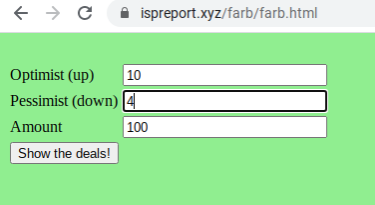
Firstly, we go to the URL: https://ispreport.xyz/farb/farb.html and enter our data into the fields on this page. We enter 10 into the field with the caption “Optimist” and 4 into the field with the caption “Pessimist”. Let us assume that an amount for each deal is $100. (If not, then we should change this value in the field with caption “Amount”.)
Fig. 1
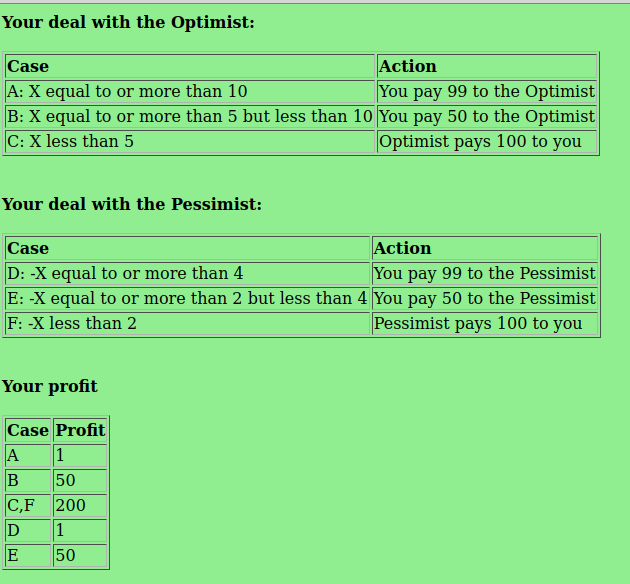
Secondly, we click on the button “Show the deals!”. On the result page will be shown your two deals and your profit for each possible outcome.
Fig. 2
Before we consider the proposed deals, let us consider the classical deal. In the classical deal the optimist wins $100 from you if she/he is right (bitcoin is up 10% or more) and pays $100 to you if she/he is wrong (bitcoin does not reach 10% increase in price).
Now, let us consider the new deal with the optimist in more details.
In the proposed deal you give to the optimist $50 in the case B, if bitcoin goes up 5% or more but less than 10%. In the classical deal the optimist will pay to you $100, therefore the total value of your gift to the optimist in this case is $150.
In the case C, if bitcoin goes down or goes up below 5%, the optimist pays to you $100 as in the classical deal.
In the case A, if bitcoin goes up 10% or more you pay to the optimist $99. It is $1 less than $100 in the classical deal, because you need a small compensation for the $150 gift you give to the optimist in the case B. Even a greedy person would consider a payment of $1 for a gift valued at $150 as a nice deal. Therefore, your friends will accept these deals if they have strong opinions on the bitcoin price movement.
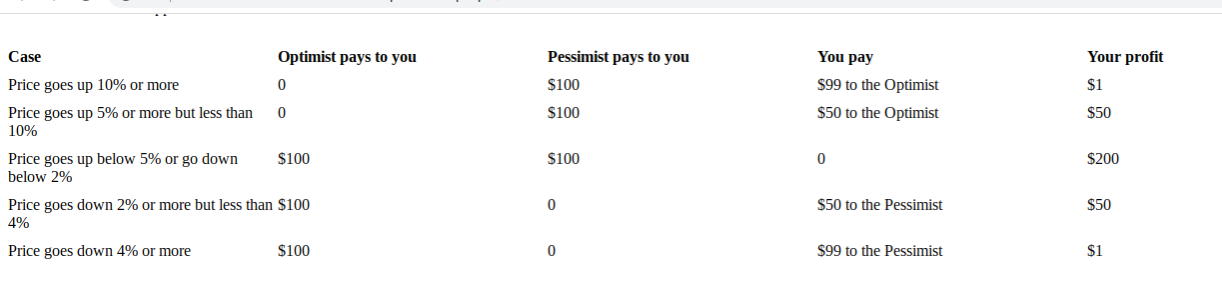
Table 1
As we can see from Table 1, in all cases you have some profit. The maximal profit is in the case when both parties are wrong in their forecasts. It should be noted that you have a ***risk-free profit*** after execution of the two deals with your friends. Only in a case when one party breaks the deal you may have a loss. For the reason that you make these deals with your friends or/and relatives, a probability of such event (a broken deal) is close to zero. Take into account the fact that you have positive profits on zero investments in all cases.
Example 2. Friendly arbitrage on an outcome of a basketball game
Suppose next Sunday will be a game: Boston Celtics vs Atlanta Hawks. One of your friends is a fun of Boston Celtics, who believes that Boston Celtics scores 10 points or more than Atlanta Hawks. Let us call this friend the optimist. The second your friend is a fun of Atlanta Hawks, who believes that Atlanta Hawks scores 4 points or more than Boston Celtics. Let us call this friend the pessimist. This situation is similar to the situation in example 1, where instead of percents in the bitcoin price there are points in the final score of the game. Therefore, if you offer similar deals to you friends you will be able to receive a risk free profit from this friendly arbitrage, as shown in Table 1.
P.S. 1. The service on **https://ispreport.xyz/farb/farb.html** is not free. You need to buy a license to use this service.
2. By means of smart contracts it is possible to extend this method on different sets of players.
3. You can use the friendly arbitrage on any other type of events (political, economical, financial, cultural, environmental, etc.).
In the next post we consider a simple way to prevent spreading of harmful pathogens in public and private places.
A simple way to defend yourself against multiple viruses (including Covid-19)
A simple way to defend yourself against multiple viruses (including Covid-19) is to increase the concentration of vitamin D in your blood.
It is well known fact that the most efficient way to reduce chances of being infected and die from viruses, bacteria, or other pathogens is to increase efficiency of immune system to fight these harmful viruses, bacteria, and pathogens (see [1-4]).
Multiple studies had determined that a concentration level of vitamin D in blood of patients is a factor that affect efficiency of immune system to fight harmful pathogens, viruses, and bacteria. In particularly, it was determined that low levels of vitamin D increase chances to be infected and die and high levels of vitamin D decrease these chances (see [5]).
Recent studies on efficiency of vitamin D in reducing chances of been infected and die from Covid-19 confirmed vitamin D efficiency in reducing chances to be infected and die from Covid-19 (see [6,9]).
Vitamin D is produced by our bodies under influence of solar radiation. Therefore, the more our bodies are exposed to solar radiation the higher levels of vitamin D are in our blood and the less is a probability to be infected and die from viruses.
Let us test this statement and try to quantify it on Covid-19 data, by comparing two groups of people. The first group consists from people with high exposure to solar radiation and the second group consists from people with lower exposure to solar radiation.
In the first group we include residents of countries with the following criteria:
a) a country must be within +-10 degrees from the equator;
b) a country must not be close to oceans or seas;
c) a country must not have many mountains.
There are only two countries that satisfy all three criteria: South Sudan and Central African Republic. The average temperature in these countries is about 30 degree of Celsius and people in these countries have the maximal exposure to solar radiation on the planet.
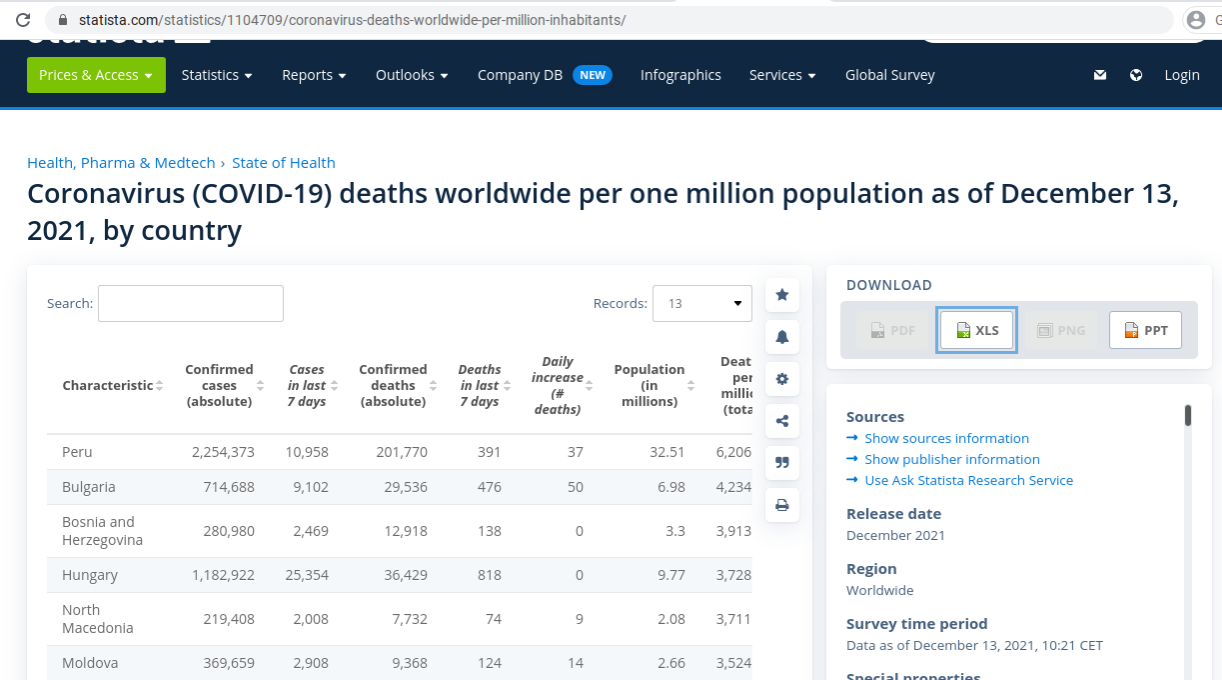
We use official data about deaths from Covid-19 by country, available from the URL:
https://www.statista.com/statistics/1104709/coronavirus-deaths-worldwide-per-million-inhabitants/
Fig. 1
The average death rates per million persons over 156 countries from the data is 975.66.
The table bellow represents the data for the selected countries with the highest exposure to solar radiation. In the last row the averages are shown.
Table 1
If we compare the average from this group (16.65) with the average from all countries (975.66), we see that solar radiation is a very significant factor, that is responsible for the reduction of death rates from Covid-19 in about 976.66/16.65=58.6 times. We call this number -gross deaths reduction factor for solar radiation (GDRFSR). To adjust this gross factor for an effect of vaccinations, we need to calculate a similar ratio between different groups of countries.
We consider two ratios. The first ratio (R1) is the ratio of the average death rate among all countries to the average death rate of countries with over 80% of fully vaccinated rates. The second ratio (R2) is the ratio of the average death rate among countries with less than 20% of fully vaccinated rates to the average death rate among countries with over 80% of fully vaccinated rates.
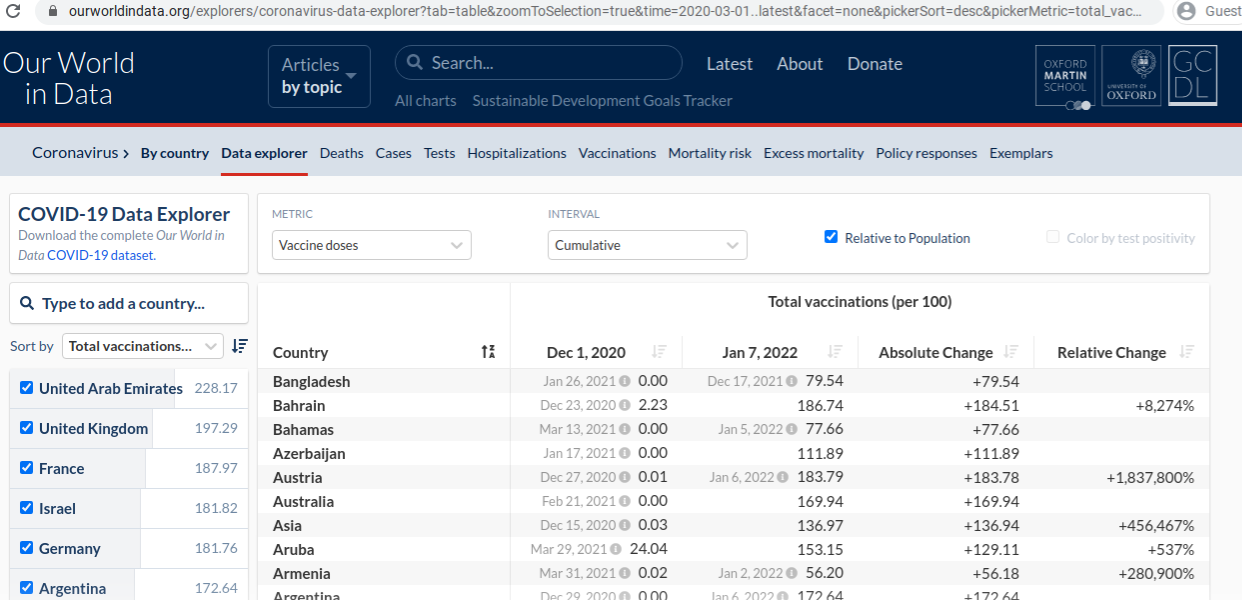
Data on vaccinations we get from [11].
Fig. 2
In the table below are data on deaths per million people for the countries with over 80% of fully vaccinated residents.
Table 2
There are 40 countries with vaccination rates below 20%. The average number of deaths per mln. In this group is equal to 160.79.
The first ratio (R1) is 975.66/787.93=1.24
The second ratio (R2) is 160.79/787.93=0.2
Let us be conservative and use the maximal value 1.24 as the deaths reduction factor for vaccinations (DRFV). Now we can determine the deaths reduction factor for solar radiation (DRFSR) from the equation:
GDRFSR=DRFV*DRFSR =>
DRFSR=GDRFSR/DRFV=58.6/1.24=47.3
If we compare the deaths reduction factors for solar radiation and vaccinations we see that
DRFSR more than 38 times bigger than DRFV.
We can perform similar calculations for the group of countries with the highest consumption of cod liver oil (CLO). This oil contains high concentrations of vitamins A, D, and omega-3 oil (see [7-8]).
In the table below are data on three such countries.
Table 3
We perform similar calculations as before, for this group of countries.
GDRFCLO=975.66/147.17=6.63.
DRFV=1.24
DRFCLO=GDRFCLO/DRFV=6.63/1.24=5.35
In the table below are listed all three deaths reduction factors: DRFSR, DRFCLO, DRFV
Table 4
From the table we see that the most important factor for reduction of deaths from covid-19 infections is solar radiation, then follows cod liver oil, and the last is vaccination.
Below is a picture that represent the data in table 4.
Fig. 3
This picture is worth many thousands words.
If you need more facts and opinions of medical experts, then watch this video: https://www.youtube.com/watch?v=w9h-XQm2qEY
Conclusions:
1. The best way to protect yourself against viruses is to expose yourself to solar radiation in dry places without winds and shadows.
2. The second simple way to protect yourself against viruses is to consume a lot of cod liver oil.
3. The third simple way to protect yourself against viruses is to get high quality supplements of vitamin D.
P.S. 1. This research was based on the data as of January 7, 2022. Future changes in the data may change some results.
2. If we use R2 instead of R1 then the picture is more impressive.
Fig. 4
In the next post we consider a simple way to make money by means of friendly arbitrage.
References
[1] How Your Immune System Fights Infection
https://www.webmd.com/cold-and-flu/immune-system-fight-infection
[2] Immune responses to viruses
https://www.immunology.org/public-information/bitesized-immunology/pathogens-and-disease/immune-responses-viruses
[3] How the Immune System Protects You From Infection
https://www.pfizer.com/news/hot-topics/how_the_immune_system_protects_you_from_infection
[4] The Human Immune System and Infectious Disease
https://www.historyofvaccines.org/index.php/content/articles/human-immune-system-and-infectious-disease
[5] Vitamin D and the Immune System
https://www.ncbi.nlm.nih.gov/pmc/articles/PMC3166406/
[6] Can Vitamin D Lower Your Risk of COVID-19?
https://www.healthline.com/nutrition/vitamin-d-coronavirus
[7] Mother Was Right About Cod Liver Oil
https://www.ncbi.nlm.nih.gov/pmc/articles/PMC2258476/
[8] Cod Liver Oil
https://www.nhc.com/cod-liver-oil
[9] Vitamin D in Israel
https://www.youtube.com/watch?v=w9h-XQm2qEY
[10] Death rates, by country
https://www.statista.com/statistics/1104709/coronavirus-deaths-worldwide-per-million-inhabitants/
[11] Vaccination rates, by country
https://ourworldindata.org/explorers/coronavirus-data-explorer?tab=table&zoomToSelection=true&time=2020-03-01..latest&facet=none&pickerSort=desc&pickerMetric=total_vaccinations_per_hundred&Metric=Vaccine+doses&Interval=Cumulative&Relative+to+Population=true&Color+by+test+positivity=false&country=USA~GBR~ISR~DEU~ARE~ARG~FRA
[12] Truth or Fiction: Vaccines Protect Against Hospitalization & Death
https://www.zerohedge.com/news/2022-01-19/truth-or-fiction-vaccines-protect-against-hospitalization-death
[13] Studies Provide Interesting Results on Post-COVID Vaccination Myocarditis Cases
https://www.publish0x.com/late-to-the-pol/studies-provide-interesting-results-on-post-covid-vaccinatio-xmmemjq
[14] Big Pharma's Siege of America
https://dailyreckoning.com/big-pharmas-siege-of-america/
[15] COVID vaccine rollout linked to rise in deaths, according to published data
https://www.naturalnews.com/2022-01-25-covid-vaccine-rollout-rise-in-deaths.html
APPENDIX
This data set was complied from sources [10-11] on January 7, 2022. In the second column are numbers of deaths (ND) per million persons, in the third column are rates (in %) of fully vaccinated (FV) residents of countries shown in the first column. Some countries for which vaccination data was absent are not included in this data set.
Table A1
Table A2
The spreadsheet with the data can be downloaded from this URL: **https://www.ispreport.xyz/data/data.tar**
Check the file (data.tar) on viruses before opening it. The file’s size should be not more than 8.7K. On some windows computers it may show sizes above 9k.
A simple way to defend online accounts against phishing attacks
There are three typical cases when a phishing attack happens.
Case 1. An attacker is trying to convince a user (via e-mail, SMS, or phone call) to visit a fraudulent website, which looks like the legitimate website. If the user follows the directions of the attacker, she/he arrives at the fraudulent website.
Case 2. An attacker sets up fraudulent websites with URLs similar to the legitimate site’s URL. When a user makes an error in typing the URL this user arrives at one of the fraudulent websites.
Case 3. An attacker implants a specific malware on a user’s computer, smartphone or tablet, which redirects web browsers to the fraudulent website when the user is trying to get to the login page of the legitimate website, and after this redirection replaces the URL of the fraudulent website on the URL of the legitimate website. In this case the user will be visiting the fraudulent website, but will think that she/he is visiting the legitimate website.
When the user enters a login name and password on the fraudulent website, this information is transferred to the attacker, who can use it to her/his own benefit.
Current security protocols require that users do not follow directions provided in e-mails, SMS, phone calls, etc. from persons unknown to them. Such security protocols may prevent a phishing attack in case 1, but will be useless in other cases.
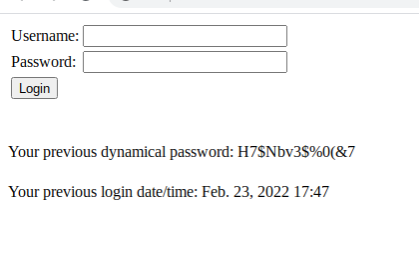
The simplest way to prevent a phishing attack in all three cases is to display information that is known only to the user, but is unknown to attackers on the login page. In this case, the user will know if a site she/he is visiting is the legitimate or fake one. The picture below shows a login page on which the previous dynamical password and login date/time are displayed.
By looking at this page the user can easily determine if this is a fraudulent website or the legitimate website.
In the next post we consider a simple way to defend yourself against multiple viruses (including Covid-19).
A simple solution to the private key-loss conundrum
**1. Problem**
Statistically, over 10% of users forget or lose their passwords or private keys for encrypted data. This is not a big problem if there is a password or private key recovery option, but it becomes a disaster when there is no a way to recover the lost or forgotten password or private key. According to cryptocurrency data firm Chainalysis, over three million bitcoins are considered lost due to forgotten passwords (see [1]). Stefan Thomas, San Francisco-based investor became famous when he revealed that he lost his private key to the hardware based cryptowallet IronKey, which holds 7,002 bitcoins (see [2]). The value of this loss (in dollars) was $479,784,042 on November 5, 2021. The value of losses from lost private keys to encrypted data, files, drives is not possible to estimate accurately.
To avoid such disastrous situations, users may use a simple four step approach to generate easy recoverable private keys, which are based on dynamical passwords.
**2. Solution**
Dynamical passwords are parametric, dynamic, recoverable, generated on demand, pseudo random passwords, that are not stored in electronic or paper form.
The most important property of dynamical passwords for us is easiness of recovery from some memorable parameters. Most common parameters are: key and date (year, month, day). If, for example, you choose a name and birth date of one of your relatives, friends or some famous persons you will be able to easily recover the password with these parameters.
In this article we learn how to generate recoverable 256-bit private cryptographic keys for bitcoin wallets using public dynamical password generators (DPGs). Our approach consists from the following four steps:
step 1 -define input parameters for the DPG;
step 2 -get dynamical passwords from a public dynamical passwords generator (DPG);
step 3 -select 32 symbols from the dynamical passwords;
step 4 -convert 32 symbols into a 256-bit bitcoin private cryptographic key.
**3. Step 1 Define parameters**
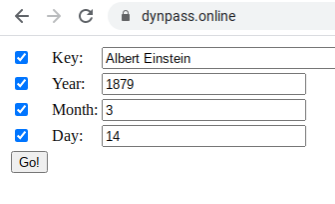
As a key we use the name of Albert Einstein and as a date his birthday: March 14, 1879.
We use a public DPG at URL: https://dynpass.online to generate 20 dynamical passwords as shown on the picture below.
Fig. 1
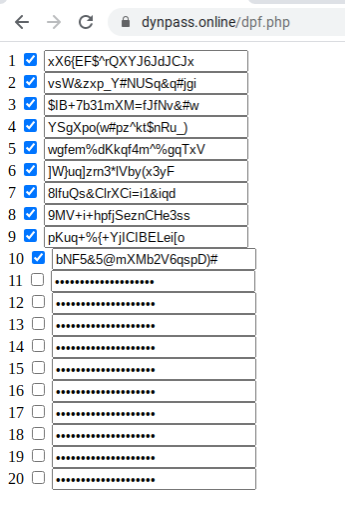
**4. Step 2** **-get dynamical passwords from a public dynamical passwords generator**
After clicking on the button “Go!”, we get the results shown in the picture below.
Fig. 2
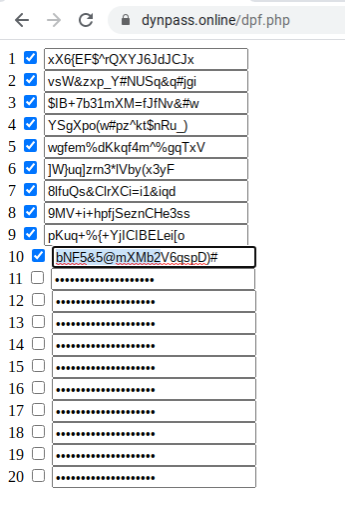
**5. Step 3 -select 32 symbols from the dynamical passwords**
Now, we combine password No. 9 (20 symbols) with 12 first symbols from the password No. 10. As a result we get the string of 32 symbols.
Fig. 3
**6. Step 4 -convert 32 symbols into a 256-bit private cryptographic key**
We can use any online string to bits converter, for example such as codebeautify.org/string-binary-converter, to convert the string of 32 symbols into a 256-bit private key, as shown in the picture below.
Fig. 4
For those who would prefer to do this in a linux terminal, the script below will be helpful. You should replace input parameters in the first four rows of the script.
key='test'
day=2
month=2
year=2022
url='https://dynpass.online/dpt/dpt.php'
curl -X POST -F 'key='$key -F 'day='$day -F 'month='$month -F 'year='$year $url >dp.tmp
out=$(awk ‘{if (NR<3) s=s $2;if (NR==3) s=s substr($2,1,2)} END {print s}’ dp.tmp)
echo “Your private key:”
echo $out |perl -lpe '$_=join " ", unpack"(B8)*"
The picture below shows behavior of this script.
Fig. 5
P.S. 1. For 512-bit private keys, 64 characters are required on step 3. For 1024-bit private keys, 128 characters are required on step 3, etc.
2. There are many ways to increase security of this procedure, for example such as:
-select more complex keys;
-use private dynamical password generators;
-use multiple online passwords generators and use output from one as keys for others. There are over 1,000 online passwords generators, over 1 million of pairs, over 1 billion of triplets , over 1 trillion of quartets, etc. Even the most powerful super computer will not be able to test all possibilities in a reasonable amount of time.
In the next post we consider a simple way to defend online accounts against phishing attacks.
**7. References**
1. Tens of billions worth of Bitcoin have been locked by people who forgot their key.
**https://www.nytimes.com/2021/01/13/business/tens-of-billions-worth-of-bitcoin-have-been-locked-by-people-who-forgot-their-key.html**
2. Lost Passwords Lock Millionaires Out of Their Bitcoin Fortunes.
**https://www.nytimes.com/2021/01/12/technology/bitcoin-passwords-wallets-fortunes.html**
The simplest way to manage multiple dynamic passwords in a highly secure way
In our time, everyone who uses computers or the internet needs passwords to access online accounts. Even access to devices, as well as virtual and physical places may require passwords, PINs, or access codes. Some studies (see [1-4]) indicate that an average number of passwords a user needs to manage is above 100.
Any static password can be cracked with a brute force method with 100% of certainty. Indeed, basic parameters of static passwords are: a length of passwords (lp) and a length of a set of symbols (ls) from which passwords are constructed. From these two parameters we can calculate a *number of all possible combinations* (NAPC) of passwords with these parameters,
which is equal to NAPC=ls^lp. If a time for testing a single password is equal to t1, then the time t_crack=t1*NAPC is the time when the password's combination will be found with 100% certainty. It should be noted that with some luck, it is possible to find the correct combination even from a single attempt. The probability of such an event is small p=1/NAPC, but it is not zero.
Dynamic passwords are changeable static passwords. To understand how frequently passwords should be changed we need to understand two important definitions: an *expected loss* (EL) resulting from a compromised password and a *level of tolerance* (LT) to the loses resulting from a compromised password.
An expected loss (EL) due to a compromised password is equal to the product of the probability of the password being cracked and a real loss in the case of the password being cracked. For example, suppose that a real loss (RL) from the compromised password is one million dollars and the probability that the password will be cracked in one day is equal to 0.00001. Then the expected loss for a day is equal to EL(1 day)=$1,000,000*0.00001=10 dollars, the expected loss for 10 days is equal to 100 dollars, and the expected loss for 100 days is equal to 1,000 dollars. A level of tolerance (LT) to the losses is the percentage of real loss you can tolerate. Once this parameter is determined, it is possible to calculate a period for password changes from the equation: EL(T)=LT*RL. For example, if the LT=0.1% then LT*RL=0.001*1,000,000 =1,000 dollars= EL(100 days). Therefore, the passwords should be changed in 100 days to satisfy the level of tolerance LT=0.1%.
Dynamic passwords create inconveniences for users, because users need to securely manage these password changes. Online and offline password managers are proposed to address these inconveniences. But the big problem with these password managers is the problem of risk concentration. When users use such password managers, they put "all their eggs in one basket." The password managers store passwords in an encrypted file called a vault, which is a target for attackers. If attackers hack this vault, they will be able by using the brute force method to crack this vault at some point in time. Every year, researchers find weaknesses in such password managers (see [5-8]); therefore they are very risky for users.
A password management system, which allows one to generate multiple passwords for multiple sites or/and accounts in a simple way, which does not store passwords on computers or paper, which allows users to recreate/recover complex and strong passwords with easy memorable information, will be satisfactory for most users of passwords.
Many security experts will say: "Such system is not possible, because it is well known that there is a trade-off between security and convenience. If we want strong secure passwords then they must be complex and not memorable, which creates an inconvenience in use and management of these passwords. On the other hand, if we generate simple and memorable passwords, they will not be secure."
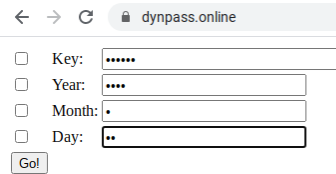
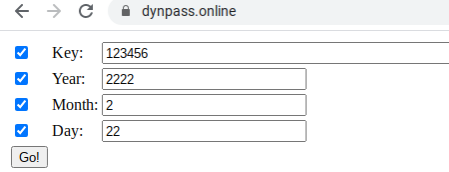
The password 123456 is easy to remember but is not secure. For many years this password was among the most popular. To convince skeptics, let us generate multiple strong passwords with a simple key: 123456 and the memorable date: February 22, 2222 with a public password generator (PG) available at URL https://dynpass.online .
As we can see in the picture below, all fields on the form are hidden by default to prevent other people behind the user’s backs from seeing the entered data. Users should verify that no one can see the user’s input before entering data.
Fig. 1
By checking a checkbox near a field, we can make it visible.
Fig. 2
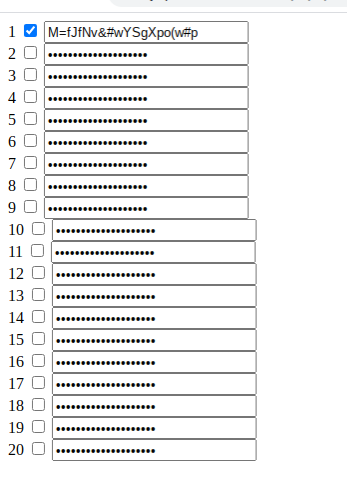
When we click on the "Go!" button, multiple passwords will be generated on the server and transferred via the secure internet communication protocol -HTTPS to the web browser on our computer. The passwords are not saved or stored on computers; they stay in the internal memory of the computer. The picture below shows the generated passwords.
Fig. 3
As we can see in the picture, all fields on the form are hidden by default to prevent other people behind our backs from seeing the generated passwords. To see a particular password, we need to check the corresponding checkbox, after verifying that no one can see this password. The generated passwords are very secure as we can see from the picture below.
Fig. 4
For users, who prefer to work in a linux terminal, the script below will be helpful.
key='test'
day=2
month=2
year=2022
url='https://dynpass.online/dpt/dpt.php'
curl -X POST -F 'key='$key -F 'day='$day -F 'month='$month -F 'year='$year $url
The picture below shows the result of an execution of this script.
Fig. 5
**Conclusions**
1. With a single click of the button we generated multiple highly secure passwords for multiple sites/accounts, using the easily memorable key and date.
2. It is super easy to change these passwords on any given date, by changing the date and use the same key.
3. The generated passwords can not be hacked with traditional password hacking tools, because these passwords are not saved in an encrypted file. It is not possible to find a black cat in a black room, if there are no cats in this room.
***References***
[1] World Password Day: How to Improve Your Passwords
https://blog.dashlane.com/world-password-day/#:~:text=According%20to%20our%202017%20findings,will%20skyrocket%20to%20300%20accounts
[2] Study Reveals Average Person Has 100 Passwords
https://tech.co/password-managers/how-many-passwords-average-person
[3] Average person has 100 passwords - study
https://securitybrief.co.nz/story/average-person-has-100-passwords-study
[4] Struggling with password overload? You're not alone
https://www.techradar.com/news/most-people-have-25-more-passwords-than-at-the-start-of-the-pandemic
[5] Password Managers Have A Security Flaw -- Here's How To Avoid It
https://www.forbes.com/sites/kateoflahertyuk/2019/02/20/password-managers-have-a-security-flaw-heres-how-to-avoid-it/?sh=656381704e16
[6] Password managers have a security flaw. But you should still use one.
https://www.washingtonpost.com/technology/2019/02/19/password-managers-have-security-flaw-you-should-still-use-one/
[7] Which Password Managers Have Been Hacked?
https://password-managers.bestreviews.net/faq/which-password-managers-have-been-hacked/
[8] Are password managers safe to use in 2021?
https://cybernews.com/best-password-managers/are-password-managers-safe/