Proof of Work vs Proof of Stake
It's been a while since I've gotten into any serious discussion about decentralized and robust consensus mechanisms in crypto. So far, I've been looking at the current trends, and it seems like 'Proof of Stake' (PoS) is starting to get hyped up as the new "solution" to the problems of Proof of Work (PoW) with its own issues either being overlooked or outright ignored. A million DeFi coins are coming into the market that are PoS instead of PoW, claiming to be the "next best thing".
I didn't do much commenting on the issue earlier of whether or not PoS is superior to PoW because I felt like I did not know enough about either one of them to have an educated opinion. I often saw people on r/btc dismiss PoS as a "ponzi scheme" or "economically unsustainable/flawed". At first, I thought it was merely an opinion held by some r/btc users because they would obviously be in favour of PoW (given that all the known versions of Bitcoin use PoW as their consensus system). In fact, I remember looking at people like u/ShadowOfHarbringer's (possibly one of the biggest PoS critics from what I've seen, but correct me if I'm wrong) comments and thinking that he has only dismissed PoS because it's not PoW, and Bitcoin (Cash), one of r/btc's favourite coins uses PoW.
After doing the research for myself, and thinking about it critically for a long time, I came to the same conclusion that Proof of Stake is fundamentally AND economically broken, and I can no longer take it seriously. It's surprising to me that many people who are knowledgeable in fields relevant to Bitcoin are still considering PoS despite this. It seems that rather than actually addressing any criticisms of PoS, PoS proponents just dismiss most concerns by saying that PoW has those same problems without elaborating any further, and then ending the discussion there. **I'm here to discuss why Proof of Stake is fundamentally flawed, and why Proof of Work is the only consensus mechanism that works (at least so far).** If you want to skip to certain sections in this article, I'll provide a 'table of contents' section, which you can navigate through using the links:
Contents:
Why Decentralization is Important https://read.cash/@IMightBeAPenguin/proof-of-work-vs-proof-of-stake-b5c8dd65#why-decentralization-is-important
What is Integral to a Decentralized Network and Consensus Mechanism https://read.cash/@IMightBeAPenguin/proof-of-work-vs-proof-of-stake-b5c8dd65#what-is-integral-to-a-decentralized-network-and-consensus-mechanism
Proof of Work vs Proof of Stake Incentives https://read.cash/@IMightBeAPenguin/proof-of-work-vs-proof-of-stake-b5c8dd65#proof-of-work-vs-proof-of-stake-incentives
Single Points of Failure https://read.cash/@IMightBeAPenguin/proof-of-work-vs-proof-of-stake-b5c8dd65#single-points-of-failure
Trade-offs https://read.cash/@IMightBeAPenguin/proof-of-work-vs-proof-of-stake-b5c8dd65#trade-offs
Conclusion https://read.cash/@IMightBeAPenguin/proof-of-work-vs-proof-of-stake-b5c8dd65#conclusion
Why Decentralization is Important
Often times, the word "decentralization" gets thrown around in the crypto space as a value proposition of cryptocurrency as a whole, and why cryptocurrency is good. At this point, so many people have just been convinced that "more decentralized" = better/important without ever thinking any more about the actual topic and *why it is important*.
**Decentralization is NOT the value proposition, nor is it the purpose of the blockchain, Bitcoin, and cryptocurrency in general.** This is a fundamental misunderstanding that many people (myself included) have had when it comes to this topic. *Decentralization is the means by which* *the actual value propositions,* ***censorship resistance*** *and* ***trustlessness*** *are achieved*. Satoshi writes about this in the Introduction section of the Bitcoin Whitepaper:
Commerce on the Internet has come to rely almost exclusively on financial institutions serving as trusted third parties to process electronic payments. **While the system works well enough for most transactions, it still suffers from the inherent weaknesses of the trust based model**. Completely non-reversible transactions are not really possible, since financial institutions cannot avoid mediating disputes. **The cost of mediation increases transaction costs, limiting the minimum practical transaction size and cutting off the possibility for small casual transactions**, and there is a broader cost in the loss of ability to make non-reversible payments for nonreversible services. With the possibility of reversal, **the need for trust spreads**.
If there was a means by which we could have a centralized database (which would as a result, make a large trade-off in the 'blockchain' trilemma, but also be more scalable) that was as censorship resistant as the blockchain today, I would not see any value proposition in a decentralized blockchain. But the truth is we haven't figured out how to make such a system because the two ideas are inherently incompatible. It's not possible for an entity to have almost full control over a network, but at the same time not have control over it.
To add, this is why I have had a hard time trying to empathize with any view of keeping blocks small. Simply put, if fees are high, the nature of the network itself maybe trustless, but it fundamentally fails at being censorship resistant, which makes it self-defeating, but that's a topic for another time.
What is Integral to a Decentralized Network and Consensus Mechanism
As discussed previously, the reason decentralization itself is important and valuable is because it allows for censorship resistance and trustlessness. But how exactly do we achieve this through decentralization?
The first problem that Bitcoin had to solve as a currency was being able to be censorship resistant and trustless in nature. The only solution to this was making it a system that is decentralized, which means that no single entity issues or controls everyone's coins. This would mean that there would need to be a way for transactions to only be done by those who actually own the coins, and nobody else. The solution to this was implementing digital signatures, which make it impossible for any single entity or anyone for that matter to spend others' money.
The second problem was introducing scarcity in such a manner that coins couldn't be counterfeited or printed out of thin air. For example, if each coin was a file, nothing would stop me from copying that file to send out multiple coins, and given those incentives, there would be no purpose to such a system. Even if nobody can spend funds from my wallet, I can still give myself free money out of thin air.
This also means that such a currency would also have to have 'memory' properties, meaning that once someone spends coins, they can't be re-spent by the same person. The solution to this was a ledger, which keeps track of all the transactions, so if an account in question spends more coins than it has, that will contradict an entry within the ledger, and the user in question won't be able to send the funds. So far, this means we have a ledger of which coins cannot be printed out of thin air and sent. Since the ledger is supposed to be decentralized, that means lots of people/entities will have a copy of that ledger, which brings up another issue...
Given that there will be many people with a copy of the ledger, how do we decide which is the correct one and which isn't, since it's entirely possible for two alternate ledgers to have conflicting transactions? This is especially important since if it wasn't solved, someone could simply present one copy of the ledger to the recipient and the rest of the network, and once the transaction has gone through, present the other copy, and the transaction has been reversed without any cost, effectively making it trivial to re-spend the coins.
In order to solve this issue, some sort of voting/consensus mechanism had to be implemented so the network can come to an agreement on the legitimate version of the ledger itself. This had to be done in such a fashion that nobody would have to trust anyone (votes cannot be faked), and such a decision can be made quickly. Ideally, we would have 1 user = 1 vote, or anything as democratic as possible (given that it is the fastest decision-making mechanism which doesn't put power in the hands of a single entity), but it's impossible to define '1 user' in a network that is permissionless, where any accounts and wallets can belong to anyone. On top of this, voting would have to be time sensitive because a decision needs to be made. We can summarize our consensus/voting mechanism requirements in a few points:
does not trust or assume others will act in good faith
is decentralized
impossible to fake
makes decisions in a timely manner
the end result is a unanimous vote
Proof of Work vs Proof of Stake Incentives
As a re-cap, these are the requirements that we came up with for a decentralized consensus and/or voting mechanism:
does not trust or assume others will act in good faith
is decentralized
impossible (or at the very least, extremely difficult) to fake
makes decisions in a timely manner
the end result is a unanimous vote
Intuitively, someone who isn't experienced with cryptocurrencies might infer that we could make 1 wallet = 1 user = 1 vote, but that wouldn't work because any attacker on the network could just make a script to generate multiple wallets and use their voting power to either attack the network or stall it, ensuring that the network couldn't reach an agreement, effectively killing it. This means that this mechanism doesn't follow any of our criteria. In a trustless network, we absolutely have to assume there will be attackers and that we cannot assume everyone has good or altruistic intentions. Given this information, there does exist a possible solution to this problem...
Since coins cannot be printed out of thin air, and they cannot be counterfeited, copied, or spent by another user (as established previously), it might be tempting for one to say to say that we should make 1 coin = 1 vote, and it might seem at first glance that it would work, but we run into other problems, such as:
*How do we make voting impossible/hard to fake?*
If we are basing our mechanism on 1 coin = 1 vote, we need to make sure every coin that is voting is unique. After all, what stops someone from just sending coins to multiple wallets and just re-voting with the same coins? We can easily solve this by making a single vote equal to the quantity of coins multiplied by their age in days, and that will solve our issue of votes being easy to fake.
*Where do the coins come from, and how do users vote with them?*
**The ONLY solution to this would be a single central party being given all of the coins ahead of time, and then distributing them to users so they can vote with them.** In terms of the requirements for our voting mechanism, it is impossible to fake, meaning that votes are at the very least unique. This would essentially be 'Proof of Stake'. We can also hypothetically reward voters by giving them more coins by acting honestly, but more on that later...
If we were to use this as a voting mechanism, it would meet our requirement of being impossible/difficult to fake, but it would not be suitable for voting as outlined because it is an inherently centralized mechanism, on top of one that assumes others will act in good faith, and can result in a vote not being unanimous (and potentially tied votes). What do I mean by this? Well, to elaborate on this point-by-point...
**It is an inherently centralized mechanism:**
When a central party is the one distributing coins, they have all of the voting power in the beginning. They are the absolute gatekeepers of the network, and can choose who and who not to assign votes to. This is equivalent to a dictator owning a nation, and saying that they're switching to democracy, but they get to choose who can vote.
**It assumes others will act in good faith:**
We have already established that a central party starts with all of the voting power, so the next question one might ask is *if coins are distributed fairly by the central entity, then shouldn't the voting mechanism meet all the requirements as stated previously?* In theory, this would make sense, but in practice, it completely ignores the issue in the first place... How do we verify that the coins have been distributed fairly when nobody knows who is behind what wallet?
Anyone can generate wallets as they please, and just shuffle their coins to make it look like the distribution is fair when in reality, all of the shuffled coins belong to the same entity. There is no way of verifying whether or not coins are distributed fairly, which means that you are relying on the central stakeholder acting in good faith to keep the network working and secure.
**It is not good at making unanimous decisions and reaching consensus**
Often times, the consensus rules can and do get changed. In such a case, the network is also faced with a voting decision in which there are two different ledgers of coins. The coins themselves are also separate, but what is important to realize is that there needs to be some way of making a decision on which ledger to keep, and which to abandon. If votes are cast using coins, the incentive of stakeholders is not to stake only one chain, but both. They are rewarded for stalling the actual network itself, and making it harder to reach consensus. Incentives cannot be forced in the same way since staking is done on two separate forks. It's not a good set of incentives, and presents a fundamental flaw.
**...So what is the solution?**
Knowing all of this, there does seem to be one last solution to the governance system of our mentioned decentralized ledger, and that is using computing power to enforce rules. This consensus system is what is called Proof of Work, and to this day is the only consensus mechanism that actually checks off all the boxes, or at the very least, more than any other proposed "solution". If we iterate over all of our requirements, and compare:
**Does not trust or assume others will act in good faith**
Proof of Work doesn't have to trust that others will act in good faith, because mathematically speaking, everyone, good and bad, has no choice but to do so. If someone is transacting with you, and the computational power that has gone into embedding your transaction into the blockchain is more than the cost of the transaction itself, you can know with almost complete certainty that your transaction will not be reversed by an attacker. Furthermore, there is no central party that starts with all the voting power and can choose to keep it for the rest of eternity. For any one party to maintain power over the network, it requires constant reinvestment into securing the network itself. If more capital comes into the network, the entity's voting power automatically goes down, making it harder for them to have any control over the network.
**Is decentralized**
This one is somewhat debatable, but so far, PoW has much stronger decentralization when compared to PoS and other consensus mechanisms. In PoS, if one entity controls most of the coins, they have that power for the rest of eternity. Nothing can be done to prevent or change that. It is permanent as long as they choose not to sell their coins. In PoW, just because someone has a majority of the hashrate, it doesn't mean it is set in stone. If hashrate grows, then said entity has lesser voting power, and the network can eventually return to state where it is once again decentralized.
**Impossible (or at the very least, extremely difficult) to fake**
There is no way of faking votes in PoW at all. Every vote is done with computation, which can only be done by actually voting with computing power. This is what allows SPV in Bitcoin to work. Users don't need to see anyone else's transactions but their own (cryptographically, and irrefutably proven) to know that they are on the correct chain, and that their transaction has been backed with computing power.
**Makes decisions in a timely manner**
Any time the network has to reach an agreement, and the consensus rules change, resulting in two different ledgers, there is no incentive to try and divide hashrate between two chains, like there is to have equal staking in Proof of Stake. If a miner tries to divide hashrate, they will lose money doing so, as one chain becomes less and less profitable to mine. The incentives are directly to make a decision with their voting power.
**The end result is a unanimous vote**
This one is self-explanatory, but basically, the incentive of profit and the expenses incurred for actually attacking the network directly enforces decision making to be one-side only.
Single Points of Failure
One of the biggest differences between PoW and PoS, apart from the incentives laid out is how easy it is for the entire network to fail. In PoS, if one entity has majority stake in the network, the entire network has effectively failed, and permanently. Voting power for the majority staker remains the majority without any way out. With PoW, a miner with the majority of the hashrate has to constantly reinvest if they want to maintain their power over it, but them maintaining that power even after reinvesting capital is not a guarantee. This also benefits the network because it makes it more secure.
Trade-offs
So this might beg the question... *Why even bother with PoS, and what does it do better than PoW?* A lot of the answers revolve around vague words like "better scalability" and "much greener", but the truth is, I have yet to see an actual argument as to why PoS is more scalable. Hardware for seeing, keeping, and accepting transactions stays the same, so I don't see why there would be any magical capacity increase. As for the only good argument, PoS is less energy intensive. The question is whether or not that is worth it for the trade-off of inherently being much less decentralized, having poor incentives, or even being worse overall for decision-making.
Conclusion
While PoS has become more popular among crypto enthusiasts, and is being seen as an alternative to PoW, in my opinion, it is nothing more than a false promise. Intuitively, it would make sense to think about using coins for voting, as they're scarce, and can't be faked, and it seems like such a simple solution, which is why I personally believe Satoshi knew this well before actually releasing the Bitcoin whitepaper back in 2008. I don't think PoS is a radically new and unique idea that it only came around well after Bitcoin's conception. But I'm no fortune teller, so time will tell...
Why I No Longer Support Big Blocks
After thinking about the scaling debate and really starting to educate myself on Bitcoin, I thought I had a lot of knowledge on how to scale Bitcoin by increasing the blocksize limit. Little did I realize that I was wrong. You see, it may seem like common sense to want to increase the blocksize, but after spending some time in the BCash community, I came to realize that this perspective is completely wrong, and blocks that are even slightly big according to my arbitrary standards means Bitcoin will become Visa and Mastercard 2.0. Satoshi put the limit in for a reason, and he absolutely never intended for it to be raised. What makes Bitcoin so great is decentralization, of which, BCash has none. With a 32 MB block limit, BCash requires a sophisticated data center for someone to be able to run a full node. Even with the REAL Bitcoin's blocksize limit of 1 MB, full nodes are too expensive to run, which is why intelligent developers like Luke-Jr suggest lowering the blocksize limit even more through a softfork (the only way to gain consensus that will never cause a chain split, and is 100% voluntary). https://bitcointalk.org/index.php?topic=1347.msg15366#msg15366 https://read.cash/@mtrycz/how-my-rpi4-handles-scalenets-256mb-blocks-539856cd
As I looked at the numbers, and it turns out that even with 1 MB blocks, there still are people who cannot run a full node, which isn't good enough for the world's reserve currency. I came to realize that even 1 MB is way too much, and encourages centralization, potentially making even BTC as bad as Mastercard. When it comes to wealth inequality in the world, there are people who earn less than a few dollars a day. If even the poorest cannot afford to run a full-node, only the richest people can. This made me realize that ideally, the blocksize limit should only be 300 KB, like Luke Jr suggests, but then it occurred to me: There are also people who cannot afford to run a full-node, because the hardware they have doesn't support it.
With this in mind, I realized that we need to make blocks 5 KB, so people can run their own full nodes on pocket calculators. However, not everybody has pocket calculators, or even has hardware. To ensure that even the homeless could afford to run a full node, I realized that blocks need to be small enough that people using Bitcoin can verify transactions, and keep records of the blockchain on pencil and paper. This would require blocks to only be 2 KB at most, but even then, there are people who are mentally slow, so instead, there should only be coinbase transactions in each block, so everyone can keep up with the blockchain. Only then did I realize that there's still a few serious issues that still weren't addressed: the filthy miners are centralizing the system and only care about short-term incentives even if it means compromising Bitcoin's core properties.
To add, illiterate people cannot write records of the blockchain on pencil and paper, and might even have to rely on third parties such as other people who are educated and literate. If you have to trust third parties, it truly isn't Bitcoin. If we want nodes to be as cheap as possible, we need 0 byte blocks. This means no bandwidth concerns for users, regardless of where they live. However, there still is the centralization pressure of having to store the blockchain, which none of us can risk if we want Bitcoin to be as decentralized a possible. This leads me to the ULTIMATE scaling solution for Bitcoin:
The next block should be -340 GB in size (or whatever the size of the current blockchain is, multiplied by negative 1), deleting the whole blockchain, making it disintegrate into nothingness, so that way, Bitcoin can be 100% decentralized. If people want to buy anything, they don't need their transaction to be immutable. They can just use Visa and Mastercard instead. It's 100% okay as long as the base layer is decentralized, and ABSOLUTELY EVERYONE can run their own full-node, which is why a blocksize limit any larger than -340 GB makes Bitcoin a centralized shitcoin!

How Scalable is Bitcoin?
It's interesting to see after the whole scaling debate how far tech has come in terms of SSDs, hardware processing, and internet speeds have come. I remember being back in 2015 seeing SSDs cost almost $1,000 for a terabyte of SSD storage, and $150 only getting you a 128 GB SSD (and that too SATA SSDs). Today, Moore's Law has still held true even for the 6 years that have passed since then. What's key here is understanding that storage drives themselves don't go down by 50% in price, but rather you can get double the storage for the same cost. It seems to be following Moore's Law almost perfectly, because today you can get an 8 TB SSD for ~$800, which is an 8x increase in storage capacity, which make sense, since 3 doubling cycles have passed by in the last 6 years. I remember in 2015 having a 25-30 Mbps connection speed, and that was average at the time. 100 Mbps was considered really fast, and the higher end of internet connections. Today, I have a 300 Mbps connection, and that's the lower end of being an internet user. It has outpaced Moore's Law, and goes along the lines of Nielson's Law.
This article was inspired by a post I saw on r/btc that claimed that both BCH and BTC are crippled in scaling, and neither are viable. The assertion was that since we would need 2 GB blocks to process the same transaction throughput as Visa or Mastercard, we would need 2 GB blocks, which is not possible since the maximum that has been shown so far are 20 MB blocks. I also did notice a comment from reddit user u/fixthetracking, who explained that developments in technology would make 16 GB blocks easily achievable in the next 5-10 years. There were some other calculations in the comment itself, but it does show that the requirements, as Satoshi mentioned, "are not as prohibitive as people may think". I wanted to do a thought experiment and see how much can Bitcoin scale, and exactly how viable on-chain scaling is with today's available hardware. This will go in depth into hardware and other developments that are currently in place. I will not be discussing the software aspects of things, but mostly the hardware and internet bandwidth and speed requirements to get larger blocks. I will specifically discussing (in order): https://www.reddit.com/r/btc/comments/lmnd96/bch_vs_btc_lets_be_honest_both_coins_are_crippled/
Scalability of Current Payment Methods
CPU
Hard Drives/Storage
Internet/Bandwidth
RAM
Software
Summary
Conclusion
Scalability of Current Payment Methods
In this part, I'm going to be looking at the scalability of current payment methods, which include credit cards and other forms of payment processors. Many times, we hear that Visa or Mastercard processes 65,000 transactions per second. This is generally a figure that is thrown around to make it look like the blockchain is not scalable for payments, when in fact the figure itself is not entirely accurate. The actual number itself comes from a 'fact sheet' provided by Visa themselves that specifically states a *65,000* *transaction messages per second (capacity)*. It's important to make this distinction because it doesn't mean that Visa itself actually handles that much throughput. This not only includes credit card transactions, but also other types of transactions such as 'cash transactions', which the fine print states. In fact, if Visa did try to handle and sustain that throughput for even a short amount of time, servers would likely crash, and not be able to keep up with the throughput. So then the question would be, *how much throughput does Visa really handle on a daily basis?* https://usa.visa.com/dam/VCOM/download/corporate/media/visanet-technology/aboutvisafactsheet.pdf
It's hard to find an exact number, as most figures are a guess as to how many transactions Visa handles per day. The range is usually anywhere from 1,800 to 24,000 transactions per second, which is very broad, and doesn't give us an accurate picture as to how much throughput the network actually handles. Luckily, I decided to do my own research! There were two sources that I used to give a better idea of throughput. The first is a document by Visa themselves, which details the number of transactions Visa has processed, while the second is from this website, which graphs the statistics of how many payments each payment processors processed in 2019. If we look inside the first document, it says that there were 182 Billion payments in 2018. Specifically, the document states that: https://s1.q4cdn.com/050606653/files/doc_financials/annual/2018/Visa-2018-Annual-Report-FINAL.pdf https://www.statista.com/statistics/261327/number-of-per-card-credit-card-transactions-worldwide-by-brand-as-of-2011/
We provide transaction processing services (primarily authorization, clearing and settlement) to our financial institution and merchant clients through VisaNet, our global processing platform. ***During fiscal 2018, we saw 182 billion payments and cash transactions with Visa’s brand, equating to an average of 500 million transactions a day***. ***Of the 182 billion total transactions, 124.3 billion were processed by Visa***.
So out of all of the transactions that happened, only 124 billion, or about 68% of the payments that were made were made were actually processed by Visa. This gives us a rough idea of how much throughput Visa has to deal with every day. Based on the calculations:
*124 billion transactions ÷ 365 days/year ÷ 24 hours/day ÷ 60 minutes/hour ÷ 60 seconds/minute = ~3,932 transactions per second*
We can assume similar scalability for other credit card processors like Mastercard and American Express. This gives us a benchmark of how scalable current systems are with today's technology - that too on a centralized network. As an equivalent, this would mean having blocksizes of around ~1 GB (give or take).
CPU Requirements
For CPU requirements, we would need to be able to have a CPU that can process at least 8,000 signature verifications per second. For some time, Core developers did say that CPU and bandwidth were the biggest bottlenecks for running "full-nodes". I was interested in exploring this topic, and came across some early entries in the Bitcoin Wikipedia regarding scalability with CPU requirements. One of the passages from the Wiki itself reads:
Bitcoin is currently able (with a couple of simple optimizations that are prototyped but not merged yet) to perform around 8000 signature verifications per second on an quad core Intel Core i7-2670QM 2.2Ghz processor. The average number of inputs per transaction is around 2, so we must halve the rate. This means 4000 tps is easily achievable CPU-wise with a single fairly mainstream CPU. http://ark.intel.com/products/53469
Keep in mind, this section dates back to 2012 - almost 9 years ago, and CPUs have improved significantly since then. If that isn't enough to convince you, I looked up the CPU model, and Intel released it back in 2011 (you can check the link). It is also worth mentioning that not too long ago, reddit user @ mtrycz made an article in which he benchmarks his Raspberry Pi 4, and sees how many transactions per second the CPU can process on Scalenet. The Raspberry Pi has no problem processing even 1,100 transactions per second. I was interested in other node implementations, so I looked at Flowee, and it turns out that @ TomZ had published an article specifically stating that even on their nodes, there were no issues processing 256 MB blocks on Scalenet. Specifically, to quote the article: https://read.cash/@mtrycz/how-my-rpi4-handles-scalenets-256mb-blocks-e356213b
Flowee the Hub worked quite well, with one volunteer testing it on his ***Raspberry Pi***, 4th generation. ***The 256MB blocks worked just fine, at speeds that show it can keep up without problems.***
The historical relevance of us successfully syncing 256MB blocks on a raspberry pi is based on the argument some years ago that we can never move from the 1MB block size because some people find RPi support important. ***This shows that scaling using a bigger blocksize in tandem with hardware and software improvement is not just viable, it is proven.***
***I predict that we will successfully sync 2GB blocks on a (then) modern RPi in a couple of years.***
So, it's not just one node implementation, and anecdotal evidence that a Raspberry Pi today can handle 1,100 transactions per second, ***but this has been well observed AND proven to be the case***. At the bare minimum, with the worst hardware possible, we can process at least 1/4th of Visa's throughput, which they likely spend tens or even hundreds of millions on servers to maintain. So then the important question would be *what is achievable with mainstream or maybe even higher end hardware?*
Interestingly enough, we have benchmarks on those too... Jonathan Toomim, an independent Bitcoin developer, already ran a benchmark which showed BCH being able to benchmark ***3,000*** ***transactions per second*** ***per core***. Keep in mind that even this CPU isn't all that high-end, and was released back in 2017, and this was processing near Visa level capacity for ***every core in the CPU***, which was forwarding transactions to other cores. To add, according to Toomim, a lot of the time was taken up because of the transaction generation rather than transactions being validated or blocks even being propagated. This means even a fairly mid range CPU could beat the transaction processing of Visa itself ***on a single core!*** So in the absolute worst case scenario, Bitcoin would be able to process thousands, if not, tens of thousands of transactions per second (on CPU), beating Visa by a landslide on home hardware. https://www.youtube.com/watch?v=j5UvgfWVnYg&t https://ark.intel.com/content/www/us/en/ark/products/80807/intel-core-i7-4790k-processor-8m-cache-up-to-4-40-ghz.html
This got me more interested in CPU requirements if users want to verify signatures and transactions, so it made me think... *How do we know how many transactions per second a given CPU can process based on the specs?* This actually was perfect timing for such a question because I am currently learning about Python, and the topics of concurrency and parallelism. I have next to no knowledge, but based on what I know, clock speed, and the number of cores are likely to be the main contributing factor to how many transactions can be processed on a CPU. So, I decided to dig deeper, and look for answers, until I came across a very useful thread on stackexchange, which summarized the parameters needed to calculate ECDSA signature verification:
**According to the SUPERCOP measurements**, ***an Intel Xeon E3-1220v6 ("Kaby Lake", roughly comparable to a low end 7000 series i7) with 4 cores at 3 GHz achieves 311689 cycles for one verification of an P-256 ECDSA signature*** https://bench.cr.yp.to/results-sign.html
So, from this, we know from this information that it takes ~312,000 cycles (let's just round it) to verify an ECDSA signature. I would assume that the cycles required for signature verification aren't inherent, so other CPUs should also take roughly the same number of cycles to verify a given signature. What's interesting is that this number gets even better as we look at the developments in CPU algorithms for both individual, AND batched signature verification. According to this paper written back in 2011, ECDSA signature verifications can be verified at 273,364 cycles per individual signature verification. So this number is within the same ballpark range, but according to the paper, even faster verification can be achieved by processing signatures in batches, where multiple signatures (64) are verified together. This cuts the verification time for individual signatures by ~51%, requiring only 134,000 cycles for a single signature verification. https://eprint.iacr.org/2011/368.pdf
I was curious as to whether we will ever be able to utilize batch verification, so I decided to do some research on the issue. Apparently, for ECDSA signatures, they cannot be verified in batches. At least, according to this article I read, which states that: https://medium.com/cryptoadvance/how-schnorr-signatures-may-improve-bitcoin-91655bcb4744#:~:text=Batch%20validation,in%20the%20block%20are%20valid.&text=With%20ECDSA%20every%20signature%20has,inversions%20and%202000%20point%20multiplications.
***With ECDSA every signature has to be verified separately***. Meaning that if we have 1000 signatures in the block we will need to compute 1000 inversions and 2000 point multiplications. In total ~3000 heavy operations.
So, in this case, we can't take advantage of batch verification (if I understand correctly). This means we can assume 273,364 cycles per signature. With this information, we can calculate the number of transactions Bitcoin/BCH can process based on CPU clock speed, and the number of cores, but we will have to make the following assumptions to get a realistic idea of how many transactions per second a given CPU can process:
- Windows 10 requires a minimum of 1 GHz clock speed to run on a CPU, so this will be subtracted from the computing power
- We will assume 75% utilization so that there's headroom for the CPU to accommodate other factors that might potentially use up power
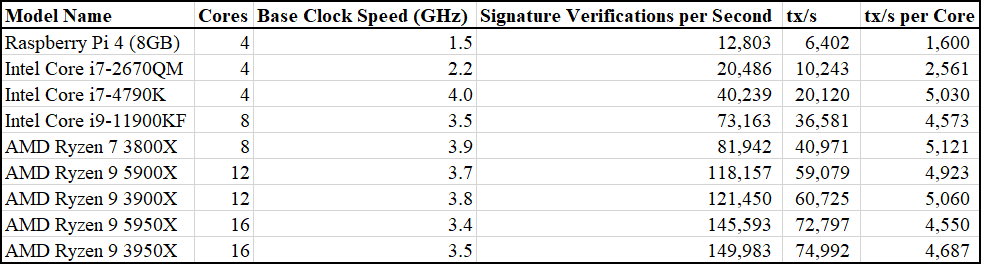
With these in mind, we get the following results (these are many present day CPUs):
So, as we can see... Achieving even the peak possible throughput of Visa is 100% doable on a mid-high end CPU. Even a Raspberry Pi 4 would technically be able to handle ~1.6 GB blocks if everything was properly optimized. These figures also tend to be in line (or at least roughly within the range of) with what tests have shown for CPU signature verification benchmarking, however it can vary from CPU to CPU based on other specs too. I am also planning to make an app for this (which I will put on GitHub once I understand how GitHub works, lol). It is also worth noting that Peter Rizun is working on cash drives (still technically an idea rather than in production), which will enable effectively unlimited throughput for next to 0 cost.
HDD/SSD Storage
Currently, there are two types of drives on the market: HDDs, and SSDs. HDDs (otherwise known as "hard drives") use moving parts to read and write data, and therefore are more vulnerable to data corruption, are much slower, and less reliable. The tradeoff is that they're relatively cheap in terms of cost. 1 terabyte of storage today is only going to run you ~$25 USD tops. SSDs (short for "solid state drives") don't have moving parts, and therefore are less vulnerable to data getting corrupted, much faster, and very reliable. Of course, the tradeoff is that they are much more expensive. Today, an SSD will cost at least $100 USD for a terabyte of storage (give or take). While HDD prices have remained somewhat stagnant (slowly declining), SSD prices look to be more promising and in my opinion, are likely to replace HDDs (which will likely become obsolete) in the near future when SSDs start becoming very cheap.
Since HDDs are fairly slow, they only have one interface, which is SATA. HDDs today use SATA III, which is capped at 6 Gbps, or 750 MB/s. In reality, HDDs are only able to run at 1/5th of this speed because they're inherently limited due to the outdated technology. A standard HDD today operates at ~150 MB/s read and write, which (purely based on read and write speeds) is technically enough to accommodate 90 GB blocks. At first, it may seem like this is a non-issue, but in reality, the bottleneck for HDDs isn't transfer speed. It's latency, which is time required for the head of the reader of the drive to be able to actually read or write data. The latency
Most standard HDDs come with a rotational speed of 7,200 RPM or 120 Hz. This means an average of 8.333... (call it 8 for simplicity) milliseconds for a cycle or rotation. This means that on average, it takes ~4 milliseconds (a half rotation) for the head to move to the desired location to store/alter data. In this case, read and write speeds would be fast enough that they can be ignored. I was interested in how this would affect download with a node that is trying to sync with the network or is running in sync with the network, so I had to look more into this. For HDDs, there is both a seek time, and the rotational latency (as explained above). So in total, we can expect a delay of at least 4 milliseconds when reading from, or writing to a file.
Files are stored in clusters, and are often fragmented. This means that for the blockchain, which would be ~250 GB, the actual time it would take would be much longer than the cumulative file size divided by the read/write speed. If we're purely looking at the HDD as the bottleneck for syncing, it will take half an hour at best, but several days at worst. The current cost of HDD space is pretty much next to none, each gigabyte costing roughly 2 pennies. So, with the largest drives commercially available today, we would technically be able to store 32 MB blocks for the next decade, and even Gigabyte blocks (like Visa) for 4 months.
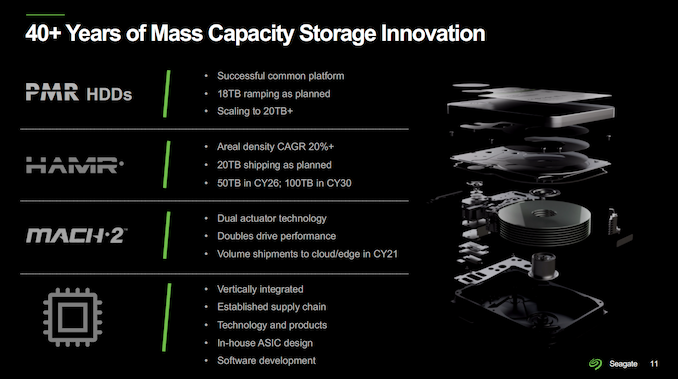
Current storage density is likely about 1 terabit or 125 gigabytes per square inch. What's even more exciting is that HDD manufacturers have already come up with a new technology called HAMR (short for "Heat Assisted Magnetic Recording"), and BPM (short for "Bit Patterned Media"), which together could easily achieve an areal density of 20 terabits, or 2.5 terabytes per square inch well within a decade from now. In fact, there's a whole article on Seagate's roadmap to 120 TB drives by 2030! The pictures below give a good idea of what's to come in the near future: https://www.anandtech.com/show/16544/seagates-roadmap-120-tb-hdds
I also wanted to add that I made a table/spreadsheet on how many years worth of n blocksizes a 120 TB HDD can hold:
From the looks of it, HDDs will have no issues with storage!
SSDs in comparison to HDDs are very fast, so they have two different working interfaces. The first one is the same SATA III. It's once again capped at the same 6 Gbps, or 750 MB/s, but since SSDs are faster, they can at least utilize 500-750 MB/s of the 750 MB/s that SATA III is designed to handle. The latency of SSDs is next to none (at least in comparison to HDDs), so in this case, the blockchain could likely sync at read/write speeds without any issues. The good news is that SSDs are also getting much cheaper (and at a faster rate) than HDDs. In my opinion, I think this will be the new technology to replace HDDs.
This brings me to the second interface SSDs have, which is PCIe, which is much more interesting than SATA because there isn't exactly a hard cap on transfer speeds... At least, not in the same way SATA has one. To summarize it, with PCIe, there are two 'parameters' for a PCIe SSD which is the actual generation of the SSD itself, and the number of lanes that the "bus" occupies for transferring data. With each generation, the possible throughput of a given lane doubles, and for every 2^x lanes, there is an additional doubling of data throughput. If this is a little hard to understand, this article from Wikipedia explains it well, along with this table I made (it's the same one from the article, but with a few modifications): https://en.wikipedia.org/wiki/PCI_Express
So even with today's tech, the speed of SSDs are more than enough to be able to actually handle gigabyte blocks without any issues. If we were purely using SSDs for 1 GB blocks, it would cost $8,000 in storage per year, today. So, obviously we're not going to have 1 GB blocks today, but if we were to, the storage cost wouldn't be extremely expensive even if we chose to put absolutely everything on SSD and not prune the data at all. With this knowledge, we can say that storage is unlikely to actually be an issue.
Internet/Bandwidth
Internet speed and bandwidth usage are things I've had a little bit of difficulty measuring with any conclusive answers. Earlier, I thought we could calculate internet speed requirements for upload by multiplying the "download" rate required for blocks by the number of upload peers and hops required to fully propagate the block. This would mean that an average user's internet connection (upload speed) would only be enough to propagate 128 MB blocks. I got the information from this website, which calculates the requirements of bandwidth for block propagation. It turns out that this is extremely outdated, and assumes "legacy" relaying of information across the network. I was curious on actual requirements for block propagation, so I asked a few people who did have knowledge on the issue. It turns out that the actual requirements for upload were much less of a bottleneck than I initially thought. https://www.speedtest.net/global-index https://iancoleman.io/blocksize/#block-size=128
So, not too long back, I asked about what the bandwidth requirements for Scalenet on BCH would be. According to this comment by @ jtoomim, the bandwidth requirements are actually much less than the specs given on the website above. Specifically: https://www.reddit.com/r/btc/comments/lvm64d/for_your_information_bitcoin_cash_node_bchn/gpe40xa?utm_source=share&utm_medium=web2x&context=3
256 MB over 600 sec is 0.42 MB/s or 3.4 Mbps. ***In practice, actual traffic is several times higher than this due to protocol overhead and the bandwidth requirements of sending/receiving*** `inv` ***messages to/from all of your peers, so actual usage is likely to be around 20 Mbps in each direction when spamming is going on.*** Otherwise, you can expect less than 0.1 Mbps of traffic on scalenet.
I got another helpful answer from reddit user @ Pablo Picasho, who came up with this answer: https://www.reddit.com/r/btc/comments/lvm64d/for_your_information_bitcoin_cash_node_bchn/gpd2dr2?utm_source=share&utm_medium=web2x&context=3
***Sending 256MB (megabytes) of tx traffic over 10 minute average block time would require ~3.5Mbps (note, mega_bits_ per second) upstream for each peer you'd want to send all of them to.*** Number of peers is configurable, but let's assume you have 8 and send to about half, that makes ***4x3.5Mbps = 14Mbps upstream***.
***One needs to add some extra for transmitting the blocks themselves, so let's double the above figure, or 28Mpbs.*** ***In practice, depending on node client, peers and implemented block transmission protocol, there could be substantial savings on the block transmission, but I think the ballpark is right ...*** I conclude you'd need quite a hefty upstream to be a productive player and not just a drag on the network.
Both numbers seem to be roughly the same, so I think using the calculation mentioned in the comment above makes sense, given that it will likely give us a good guess of what bandwidth requirements might be. With the current average connection speed world wide, users on nodes could technically run ~512 MB blocks according to the bandwidth requirements. So upload isn't all that much of a bottleneck or limiting factor. Hypothetically, if we wanted to run Visa level throughput on a node, it would only require roughly a 100 mbps connection speed, which is only about twice as fast as an average person's broadband upload. That's very conservative when you take into account that this is with today's tech, and with the scalability of a global payment network.
Another factor to take into account is actual bandwidth usage. Assuming the average user's bandwidth, the actual usage would be pretty high. About 18.4 terabytes in bandwidth usage per month. Most internet plans have unlimited data, but the exceptions that don't usually have a 1 TB cap. "Technically", someone can choose just not to upload as many transactions and only download (or have less peers), which will cut down bandwidth usage.
*Note:* *TCP/IP does seem to be a bottleneck, but it turns out that there are better protocols that can solve the current issues with it**. I don't have much knowledge on this subject, so I will choose not to comment on it.* https://www.reddit.com/r/btc/comments/l6fzk5/performance_improvements_for_bitcoin_cash_with/gl6s8ku?utm_source=share&utm_medium=web2x&context=3
RAM/Memory
For RAM, I am not as technically knowledgeable on the topic, but from my observations, RAM usage on my BCHN node tends to be exactly 4 times larger than that of the size of the mempool. I'm not sure for the actual usage of memory and how it might work on Bitcoin, but from other observations, this pattern also seems to hold true on Scalenet with larger blocks. Assuming this holds true, RAM wouldn't be much of an issue for running a node. Even for something like Gigabyte blocks. A Raspberry Pi could still technically handle them, though it would be a little bit painful for the system to handle.
Software
Currently, BCH is artificially bottlenecked by the blocksize cap. It's user configurable, but in practice, it still works similar to a normal hardcoded limit. The reason BCH doesn't have a hard cap is so that devs don't have power over it. According to some of the BCH devs, the actual amount that the software itself can process is much higher. Somewhere in the range of 128-256 MB without any issues, and just a few optimizations. If this is the case, then the software itself is actually limiting the potential scalability of the network. The hardware (from the looks of it) doesn't seem to be much of a concern. Especially when a Raspberry Pi today seems to have enough power to process Visa-level throughput (granted, without much headroom). Storage can become somewhat of a concern, but users are always free to prune data, so additional storage costs are only optional. https://www.reddit.com/r/btc/comments/lvm64d/for_your_information_bitcoin_cash_node_bchn/
Summary
With the current hardware (mid-range) available today:
A CPU can process many times the throughput of Visa or Mastercard (with Raspberry Pis technically being able to handle as much throughput as Visa, or a little more)
Average/below average RAM can likely handle gigabyte blocks with headroom
Storage isn't much of an issue because of pruning, but even for a few hundred, storage can be adequate for ~256 MB blocks for an entire year. With HAMR and other developments in storage within the next decade, storage could become dirt cheap. SSDs are going to drop in price too, and could potentially replace HDDs if the technology starts to really improve.
Average bandwidth speeds are technically enough to handle blocks of several hundreds of megabytes
What could be limiting scalability or potential scalability:
Software has capped blocksize, and other software optimizations need to be made (such as removing CPFP, and the chained limit). It's possible that the software itself could have other 'bottlenecks', but I don't have enough knowledge in this area to make an informed opinion
TCP/IP is a bottleneck, which can be changed so that users and miners running nodes can relay more transactions, and larger blocks
HDDs might potentially not allow for larger blocks because of a very high latency, but I'm unsure to what degree
From what I've learned so far, it seems that we technically have the hardware (even for an average user) to handle blocks that are hundreds of megabytes in size. Gigabyte blocks also seem relatively doable, but would be slightly expensive, requiring better than average hardware, and a lot more storage if a user is choosing not to prune. I would like to add that I'm not someone with a lot of knowledge in computer science or even computer engineering. I'm just someone enthusiastic about Bitcoin (Cash), so what I could be writing in this article could very well be wrong. I've done a lot of research to the best of my ability, so this is just a collection of what I know so far. I'm currently in the first year of my Computer Science degree, so when I know more about Bitcoin, I will make sure to write an updated version of this article, or update this article itself.
Conclusion
From the looks of it, average hardware today can process close to Visa level throughput (maybe a little bit less) while still remaining a peer-to-peer decentralized network that most people can afford to run a node on. It really isn't that far-fetched to have gigabyte blocks right now, although they aren't necessary. I think Satoshi's view on the scalability of Bitcoin encompasses how many of us feel about it today:
The existing Visa credit card network processes about 15 million Internet purchases per day worldwide. ***Bitcoin can already scale much larger than that with existing hardware for a fraction of the cost.*** ***It never really hits a scale ceiling***. If you're interested, I can go over the ways it would cope with extreme size.
Why Low Transaction Fees Are Not an Issue for Bitcoin
*I would like to apologize for not posting an article in a very long time. While I have been able to post and comment on r/btc, I have been busy with University, and I haven't come around to making articles in a long time because it generally requires a lot of resources and effort to make them (I generally don't make a lot of articles, because I am more focused on the quality of articles rather than the quantity). I have many ideas for articles that I'm working on, but they will likely be in the somewhat far future due to the amount of research I'm doing on them, and the fact that I'm constantly learning more and more about Bitcoin every day. The amount of knowledge I've gotten from r/btc alone has really been able to give me an informed view on subjects related to Bitcoin and cryptocurrency as a whole. I would like to thank r/btc for how much I've learned, because knowledge is one of the greatest gifts of all ;)*
I've seen many people (those who are opposed to low fees to use the blockchain) arguing that high fees are needed to secure the network, and keep miners incentivized to include transactions into the next block. The security model of Bitcoin long-term certainly is something worth thinking about, and I often think about it a lot myself. There are many discussions on r/btc regarding a fee-market, and the potential issues Bitcoin may face (economically) when the block reward becomes effectively none. While this is a valid concern (albeit, blown WAY out of proportion), I often see people argue that to make up for the subsidy, we absolutely NEED high transaction fees to secure the network from both the supply shock of a halving, and keep the blockchain sustainable from both an economic and security perspective. A lot of the times when I try making a discussion around this "issue" (a non-issue in my opinion), the argument goes something like this:
For the network to remain secure, fee revenue needs to eventually make up the entire block reward as the subsidy tends towards 0 Bitcoins per block. This is especially important as the block reward exponentially decays by half every four years.
If fees are low (less than a penny), we would need an absurdly high amount of volume to generate the same amount of money in fees, and ridiculously large blocks, with an example to argue their point as follows:
- BTC transaction revenue/block is $10.00/tx × 2,500 txs/block = $25,000 in fee revenue/block
- Even at Visa/Mastercard level throughput, transaction fees of $0.001 (or anywhere around under a penny) will not be enough to subsidize the block reward, and collect more in fees, where: $0.001/tx × 1,000,000 txs/block = $1,000.00 in fee revenue/block (or $0.01/tx, which is $10,000 in fee revenue/block)
- ∴ transaction volume has to be 25x greater than the mentioned volume above (1,000,000 txs/block), equating to a number of 25,000,000 txs/block or 3,600,000,000 txs/day, which is not even close to happening, and would require 10 GB blocks to work
Therefore, the entire economic model of high transaction throughput with lower fees is not only unsustainable, but also undesirable from both the perspective of profitability, economic sustainability, and security of the blockchain.
This means that only high fees are sustainable, and are the only way to secure the blockchain in a way that is economically sustainable, reliable, and desirable.
I think to some extent, even big-blockers have also fallen for this flawed argument (myself included, as illustrated in this reddit thread, and even this article I made a while ago discussing the fee revenue of Bitcoin [Cash] at scale). Many others have bought into the line of reasoning because at a surface level, it seems legit (it's so simple that often the details are overlooked as to why it is a flawed argument and doesn't hold ground when we actually understand how such an economy would work at scale if it were to do so). https://www.reddit.com/r/btc/comments/ixathj/bch_blocks_needs_to_be_able_to_process_67_gb/g66c9dh?utm_source=share&utm_medium=web2x&context=3 https://read.cash/@IMightBeAPenguin/the-economics-of-a-high-volume-low-fee-bitcoin-market-1d3e5d75
Another potential example of a big-blocker unintentionally (or perhaps not, if it is an example) buying into this would be Rick Falkvinge, where he details an example of how low transaction fees and high volume would work on Bitcoin at scale. I think he really hits the nail on the head when he explains why a pre-mature "fee-market" on Bitcoin is an inappropriate solution to something that is currently a non-issue when he discusses and mentions a quote from a book called *The Art of Computer Science* by Donald Knuth:
*Premature optimization is the root of all evil*
And I think this perfectly encompasses the view that I, along with many others have about the current "fee-market", or as Rick says it as it fundamentally is, a *barrier to entry.* This not only does not solve the problem, but it is like putting a dam in a river to stop the flow of water before we even know that flooding will be an issue to begin with. The functionality and usability of the system is compromised, and there is no additional realized benefit to running the system in this way. In fact, it might even have long-term consequences, both from the perspective of economics and security.
Anyways, I digress... Coming back to Rick's example of Bitcoin working at scale, his example, as he puts it, *because he wants to answer the question by not answering it,* goes something like this:
SWIFT processes $5 trillion worth of transaction volume per day[3]
We can assume an average transaction value of $10 (for the sake of argument)
Only 1 out of every 100 transactions pays a fee
That fee is only $0.01
Then it holds true that:
Bitcoin will make $50 million in transaction revenue daily
This is already much more than Bitcoin currently makes in transaction revenue through the block subsidy ($18,000,000 at the time of the video, and $32,000,000 right now)
While Rick makes it clear that this rough calculation is just an example "for fun", I think this gives way too much credit to the original view... Why? Because it makes it look like we will need an absurd amount of transaction volume to sustain the system and keep it going, which gives credit to the second part of the first argument. In his example, the assumption being made is that we will have 500 billion transactions happening daily on the blockchain. While this is possible if the blockchain gets lots of adoption, it certainly looks ridiculous in the near future, and it makes the actual argument look weaker than it really is. In this article, I'm going to break down why this is even less of a non-issue than even Rick points it out to be. I will be elaborating on each of these points:
Average transaction fees don't need to be $0.001, and we can see average fees of even 25 cents while Bitcoin is basically free to send
A genuine fee-market naturally puts a limit on the blocksize
There is a lot of time before the block subsidy runs out, so lower fees should be encouraged
Therefore, the design of bigger blocks are far better for ensuring sustainability in the economics and security of the blockchain
Now to get into each point:
Average transaction fees don't need to be $0.001, and we can see average fees of even 25 cents while Bitcoin is still almost free to send
A lot of the time, when I have seen arguments discussing the fees for individual transactions because people think the equation is as simple as taking a 250 byte transaction, multiplying it by the number of potential transactions in a given interval (such as a block, or a day), and then multiplying that number by an average transaction fee of $0.001 to get some small number in fee revenue. This doesn't work in terms of forming an argument against low fees, and higher transaction volume, because the argument itself is an oversimplified way of looking at how transactions (on the blockchain) would work in a larger economy. Right now, both Bitcoin Core AND Bitcoin Cash, the economy is pretty small, so we don't see very many large transactions in proportion to the "normal" ones.
If the economy of cryptocurrency grows, we absolutely will see much larger transactions taking place. Potentially those in the tens to hundreds of kilobytes for transactions that either have multiple inputs, multiple outputs, or even multiple inputs AND outputs. Why? Because such transactions are necessary and are inevitably going to happen when there are bigger merchants accepting cryptocurrencies for payments. For example, if a merchant is extremely popular, and is getting 2,500-3,000 transactions/purchases a day (let's assume a semi-large online retailer, who has to move their transactions daily to a multi-sig wallet that makes payments monthly), they will have transactions that are 300-500 KB in size. At current fee rates, that could be anywhere from $2-$20, depending on how urgently the merchant needs the transaction to be included into the next block. This is just a rough calculation, but it gives you an idea that with many merchants, average transactions sizes will be much larger, and therefore have a big impact on the average transaction fee.
This means that we could see fees of several dollars as the average transaction fee, but Bitcoins are still virtually free to send. I was curious as to how the distribution of payments might actually be at scale, so I looked at some statistics for payment processors, and how often merchants can get payments using a credit card. Here's what I found:
All of the big credit card processors have 40-50 million merchants respectively
There is a lot of overlap of merchants that accept all credit cards as a method of payment
Payments on credit cards take roughly 1-3 business days to settle
Knowing this information, which is only relevant to the PoS use-case (which is only a fraction of all potential use-cases), I would have to make a few assumptions regarding how transactions would work in terms of size for PoS transactions. The assumptions I am making are that:
The merchants almost completely overlap, making the total number of merchants accepting credit card payments 50 million
All of the credit card companies cumulatively process 10,000 transactions per second, and therefore 864 million transactions per day (we will round it to 1 billion to make things easier)
Diving the number of transactions per day (~1 billion), by the number of merchants gives us an average transaction count of 20 transactions per merchant daily
Merchant payments are sent every 24 hours, and therefore fully settled
50 million merchant payments are settled daily with an average of 20 inputs, and 1 output per transaction, giving us an average payment size of 3 KB
The average transaction fee per byte is $0.0002 or $0.20 per kilobyte, making a merchant payment pay $0.60 daily in fees
Each customer payment gives a lower fee (due to it being less necessary to be included in the next block) of $0.000005, giving an average transaction fee of $0.001 for a 200 byte transaction
Using all of these assumptions, we can calculate the average fee for a transaction, including both our merchant AND customer transactions by multiplying the average fee for each type, and then returning the average value:
[(50,000,000 merchant payments × $0.60/payment)+(1,000,000,000 customer payments × $0.001/payment)]/1,050,000,000 total payments = ~$0.03 per transaction
As we can see, the average fee is a good amount per transaction, and this is just discussing the PoS use-case, which is just one of many. What we can conclude is that despite transaction fees being next to nothing for the customer making a payment, the average transaction fee is a few pennies for a transaction. This is only an example, but it gives us an idea how the economics of a blockchain might work at scale. When we account for other use-cases with large transactions such as:
Cashfusion
Dice games (an example would be satoshi dice)
dividend payments
Gambling (Poker, Blackjack, Roulette, etc.)
DEXs
Smart contract payments (such as Flipstarter)
Large business transactions with hundreds or thousands of both inputs and outputs
Transactions with additional data (OP codes, multisignature, escrow, etc.)
With these use-cases, all of the transaction fees add up, and the average transaction fee could potentially be much larger, even if normal transactions are still very cheap. What makes it brilliant is that as the velocity of network transactions increase, so do the number of inputs potential transactions might have, further increasing fee revenue.
A genuine fee-market naturally puts a limit on the blocksize, because there is a cost to accepting transactions and larger blocks
When it comes to the topic of low fees, people think that just because fees are low for individual transactions that spam will occur on the network, and that blocks will have to be terabytes in size to get any meaningful revenue in fees, which will result in mass centralization. This is generally a slippery-slope, and strawman argument that many in favour of small-blocks use to justify keeping the blocksize limit at 1 MB (SegWit too). A great example of this would be a speech by Andreas Antonopoulos, in which his justification for not increasing the blocksize goes as follows:
At the moment, Bitcoin produces a 1 MB block every 10 minutes, and there about 3 million people trying to get their transaction into that 1 MB block, and as a result, fees have gone up.
Fees are a market based system for deciding which transactions are worth doing, and which transactions are not worth doing.
A lot of people don't like this. They don't like this solution. They would rather go back to a time when Bitcoin's fees were either negligible, or fixed.
There needs to be a mechanism by which transactions are prioritized and considered worth putting in, and there are two ways of solving this problem: The first would be someone deciding which transactions are spam, and which ones are worthwhile.
Inevitably, this person maybe a developer or group of developers who are writing code to prioritize transactions. This solution is undesirable because it gives power to a small group of people.
The other solution would be to keep the "market-based" system by which transactions are limited through the blocksize limit, and only "non-spam" transactions can go through.
To accommodate growth, we can keep the blocksize limited, so fees need to be increased for a transaction not to count as spam, or the blocksize limit can be increased.
Blocksize limits would have to be increased accordingly with more adoption:
1) Let's say that in 2 years, we have 30 million people using Bitcoin. So to maintain exactly the same level of fees we have today, we need a block that is 10 MB; one order of magnitude bigger.
2) 5 years from that, Bitcoin gets really really successful, and we need to get 300 million people to use it. Now we need 100 MB blocks.
3) 5 years from that, if Bitcoin and other technologies become astonishingly successful, we would need another order of magnitude to accommodate user. Now we're at gigabyte blocks, but it gets worse.
4) If we want transactions to be faster and cheaper, so you need another order of magnitude increase, just to make it cheaper than today, so that is a 10 GB block to accommodate 3 billion people.
5) But then we want people to use it as day-to-day currency, and use it like cash. Instead of 5 transactions a month, they want to do 50 transactions a month, and now you've got 100 GB blocks.
6) Even 100 GB blocks are pointless, because it only accommodates cash as a use-case. For small transactions to also be accommodated, we would need an order of magnitude increase, another order of magnitude increase for microtransactions, and then an additional order of magnitude increase for nanotransactions. This would mean petabyte blocks, therefore increasing the blocksize limit is not a solution.
There is another variation of this argument that follows:
- For 1 million people to make 5 transactions per month, we would need 500 KB blocks
- For 10 million people to make 5 transactions per month, we would need 5 MB blocks
- For 10 million people to make 50 transactions per month, we would need 50 MB blocks
- For 100 million people to make 50 transactions per month, we would need 500 MB blocks
*... And so on*
Therefore increasing the blocksize cannot be a solution, and it is a game we cannot win.
The essence of the argument here is that we would need petabyte blocks to accommodate global adoption, therefore we shouldn't increase the blocksize limit AT ALL. It's an absurd argument because it suggests that we shouldn't even bother putting a "temporary solution" unless and until we get a permanent one, despite the fact that preventing a temporary solution makes the issue worse, not that the premise itself is correct to begin with. Just to illustrate how ridiculous this is, here's an example:
Let's say your son/daughter has a disease that is terminal and will kill them in a matter of a few months. They are potentially on their death bed.
The cure for the disease is still being discovered, and might take a few months more than the day they die. There is no guarantee that it will save them, but there is a chance it could. The hospital you are in is working on the cure for said disease.
There is a temporary solution that will buy your kid more time, and there is enough to keep them alive for said timeframe, potentially allowing for them to have access to the cure when it comes out, saving them (if it works).
The only issue with this temporary solution is that every time a dose is taken, it has to issued at a regular interval (weekly), which costs resources and is less effective over time, which is why it can only buy a few more months of time. Additionally, this will add another $5,000 to your hospital bill.
Your doctor argues that since no cure is ready or exists right now, you shouldn't take the temporary solution either because "it's a game [you] can't win", and that you should allow your kid to die.
Your kid dies.
After you're done with the hospital, the doctor hands you a $100k bill. Do you happily pay for it and applaud the doctor for "*technological innovation*" and not taking "the easy solution"? Do you also continue to think to yourself *gee, it sure sucks that my kid died, but at least I'm not going to have fun staying poor because my hospital bill is cheaper.* https://www.reddit.com/r/btc/comments/7uds2r/this_is_doug_polk_i_have_a_question_about_my/
It illustrates how stupid the argument of keeping the blocksize limited to a ridiculously small amount is because it shows a belief that it is worth the cost of stalling, and potentially even harming adoption, or even killing Bitcoin long-term just so that some potential user can run a full-node (of which they have no financial or general incentive to do so), meaning that Bitcoin is "decentralized". I also want to address the fact that the slippery slope argument does NOT in any way justify keeping the blocksize to 1 MB. It is a non-answer that is frustrating to argue with because it still doesn't justify keeping the limit.
Getting to the topic of fee-markets, what's happening on BTC is not a fee-market. It is an artificial barrier to entry. In fact, it is potentially a bad thing, because it prevents economic activity from actually happening on the network. This is a term in economics known as a deadweight loss. Both Bitcoin Out Loud (John Moriarty), and Peter Rizun make great videos on this discussing the issue of preventing a free-market equilibrium through small blocks, and how allowing for bigger blocks allows a free market equilibrium to take place. I won't get into the full details, but here's the run-down: https://www.youtube.com/watch?v=RoDHyXRo2QQ&t https://www.youtube.com/watch?v=zwQHovqJGDs
There is a cost to making bigger blocks, and propagating them across the network (as blocks get bigger, each transaction (as a part of the block) costs more to include). This cost naturally puts a limit on the blocksize if miners want to maximize their revenue.
As someone who has some knowledge in economics, I find myself agreeing with this perspective because the cost of a block potentially being orphaned is an idea in microeconomics known as the marginal cost of producing a good. When talking about marginal costs, they specifically are defined as:
*The change in total production cost that comes from making or producing one additional unit [of a good]*
Additionally, transaction fees are the incentive to include a transaction in the next block, which is otherwise known in economic terms as marginal revenue, which is defined as:
*The revenue gained by producing one additional unit of a good or service.*
With this in mind, we know that:
There is a cost to including additional transactions in a block, which increases as blocks get bigger
There is revenue (marginal revenue) made from each transaction paying a fee.
Therefore, it holds true that:
*If a miner wants to maximize their profit, they will keep supplying blockspace to include transactions in their blocks until the marginal revenue (transaction fee) is equal to the cost of including a transaction into the next block. Given that there is a limit, as including more transactions burdens an additional cost in terms of block orphaning, while transaction fees remain flat, there is a natural limit to how big a miner can make a block until it is unprofitable to do so. Therefore, the blocksize won't be unlimited even if the limit itself is.*
If we want to demonstrate this relationship, we can do so by measuring how orphan rate increases with the size of blocks, and what it costs to include a transaction into a given block. Reddit user u/phillipsjk does a great job of this with his post *Estimating the marginal cost of a transaction on the Bitcoin (Cash) network**.* He goes into detail about all the costs involved in accepting a transaction into a block, and does a great in-depth analysis on how much it would cost to accept a transaction into the next block. The only issues with this model is that it doesn't factor in is the cost of block orphaning when a miner makes a block that is "too big", and it assumes VERY large blocks (8 GB). I can and will potentially calculate this if I can understand the equations for block orphaning probability and missed out revenue. https://www.reddit.com/r/btc/comments/7qi6mf/estimating_the_marginal_cost_of_a_transaction_on/
I don't know the equations for both block orphaning rates, and the cost to accept more data, but what I can assume (from the economic incentives) is that the rate of change (or slope/derivative) at which bigger blocks become more expensive to propagate increases... How do I know this? I know this because revenue (not profit) has to be a linear equation due to block revenue being a direct product of the fee per byte of block space, and therefore the slope is constant. For the marginal revenue to approach the marginal cost (and therefore the profit for an additional n bytes of data to also be $0) and be profitable before such a limit is reached, the equation for how 'expensive' a bigger block becomes to propagate has to have an increasing rate of change.
To model both the cost of propagating a block, and the revenue a given miner will get from accepting x bytes of data, I've made a graph. Let f(x) be the expense of propagating a given block, while g(x) is the revenue collected from fees (this is a very oversimplified because it doesn't take into account the coinbase reward/subsidy, and doesn't take fully into account the bidding that would be happening in the mempool, and instead assumes a flat linear fee):
As we can see, for bo th graphs, there is no gap at the beginning, where the block itself is empty. The miner is getting 0 revenue from fees, and is mining an empty block. As the miner includes more fees, they get more revenue. Notice the gap between the two functions? That is the profit a miner is getting for including x bytes of data. That represents the total profit from mining the block. We can subtract the expenses from the revenue to the the function of profit. The result is this:
If you look at the graph, you can see that bigger blocks in mining are more profitable to a point, but after that, it becomes a situation of diminishing, and even negative returns if the block is large enough for it to either be more expensive to include another transaction, or big enough to be orphaned, and the block reward not go to the miner in favour of a smaller block that propagated relatively quickly. This proves that there is a limit in reality for miners to make blocks bigger, and having no blocksize limit, or effectively no blocksize limit allows individual miners to set their own limits and maximize the profitability of mining blocks, thereby giving a better security model for Bitcoin. Not allowing miners to set their own blocksize limits (because of a quota that is well below how much can yield the maximum profit), will lead to a worse long-term security model because miners will no longer be able to make the best economic decisions when it comes to mining, making the entire system potentially unsustainable.
There is a lot of time before the block subsidy runs out, so lower fees should be encouraged
A lot of people seem to be extremely worried that Bitcoin's block reward halves about every 4 years. While the supply shock itself is an issue, it becomes less of an issue as fees make up a bigger percentage of the block reward. A common response to the issue of transaction fees making up a small percentage of the block reward is that "there is 120 years until the block subsidy runs out". Many people on the small block side of the debate do not consider this point because in some way, it does sound ridiculous because the economic consequences of a decreasing block reward are going to be felt way before the 120 year "deadline". Both points are correct. I find myself siding more in favour of the argument that we have 120 years for the block reward to run out because:
A fee market exists even without a hard cap on blocksizes
The growth for Bitcoin to sustain while still retaining value after every block reward halving is extremely sustainable, and can go on for a very long time.
We've covered the first point before, so I will be talking about the second one. Bitcoin's block reward started at 50 Bitcoins per block, and halved roughly every 4 years. Since we have gone through three halvings, the current block reward is only 6.25 Bitcoins per block. With this in mind, this means that Bitcoin itself has to double in value every 4 years just so the block reward can retain its value. It seems extremely difficult since exponential growth on its own is very unsustainable. While this will be true after a long amount of time, it won't be true for at least the foreseeable future. Here's some information just off the top of my head:
Over the last 8 years, Facebook has grown at an average rate of 31.5% per year
Over the last 12 years, eBay has grown at an average rate of 21.8% per year
Over the last 10 years, Microsoft has grown at an average rate of 24.4% per year
Over the last 10 years, Google has grown at an average rate of 21.0% per year
Over the last 10 years, Amazon has grown at a rate of 34.2% per year
Now what does this have to do with Bitcoin? These are stocks in a **regulated market with high liquidity**, and they have increased in value by more than enough to offset any potential value lost by the block reward halving. For Bitcoin's block reward to retain value, it only needs to grow by more than **18.92% per year on average**. To add to this, from 2012-2017, when the blocksize limit wasn't an issue, Bitcoin's transaction count doubled every year on average (actually even more, but this is a rough number). We can take this information, and model it to show how rewards can gradually make up more of the block reward while fees still remain low, and halvings are basically a non-issue. To model this, I will have to make a few assumptions:
We are starting at genesis block on January 1st, 2010 (this is for the sake of simplicity, and giving us a round number to start with)
Block reward halvings are exactly every 4 years, starting from 50 BTC per block
There are 1,000 transactions on the day of the genesis block, and the daily transaction count doubles every year for the next 12 years, then 50% per year for the next 12, 25% for the next 12, and so on...
The average transaction fee is $0.01
The BTC price (assuming it continues growing because it gets more users and can scale) can be modelled by this equation:
The given equation assumes a daily compounded return of 0.22% per day for the first decade, then 0.11% for the next one, 0.055% for the one after that, and so on...
The reason I made this equation myself was because I wanted to come up with something that is accurate in portraying the eventual plateau in price for Bitcoins (if they become THE currency for people to use, assuming deflationary economics don't harm it). It's also especially good in reflecting the potential price performance of Bitcoin because it is partially based on my previous function of transaction growth (but the increase halving every decade instead of 12 years or 3 halvings), and it is in big-part based on Hal Finney's email correspondence where he calculates Bitcoin being worth $10 million per coin if it takes over the entire world economy. My function doesn't come close to that number until at least 75 years have passed by from the genesis block. https://www.metzdowd.com/pipermail/cryptography/2009-January/015004.html
Inflation is already priced in
This price projection will continue indefinitely
With all of these assumptions, we come up with a few models for both Bitcoin's block reward, AND how sustainable fees are. I will make sure to add all of the files in a folder and share them so people can potentially take a look or make changes if needed to make the models more accurate.
To start, we can take a look at the block reward subsidy, and how it is affected after halvings. To do this, I multiplied the price by the block subsidy based on the number of years that have passed:
From this graph, we can see that the block reward subsidy only really becomes an issue and starts reducing significantly (and is unable to sustain) around 2045. That's a little bit less than 25 years from now, which is still a long time for the block reward to be subsidized. However, after 2045, it becomes a pretty big issue because the system absolutely needs to be sustainable by then unless Bitcoin happens to be less valuable per coin than the projected growth. Prematurely optimizing for this can have potentially severe economic consequences.
With our growth, we have assumed that Bitcoin transaction fees are $0.01 on average, starting with 1,000 transactions on the day of the launch (genesis), doubling at a rate of every year for twelve years, then increasing 1.5 times for the next 12, and so on. With this rate of growth, we see about 68 billion transactions by 2140, or the time when the block reward becomes 0 because of rounding. This is a realistic amount because the world population will be somewhere around 12,000,000,000 by then, meaning that the activity on the blockchain would be 5-6 transactions per person, per day, worldwide. When we add the total transaction fees with the subsidy, we get this graph:
Here is a linear scale of the same graph for comparison:
So the fees increase enough to compensate for any potential supply shock caused by the halvings. At first, there is quite a bit of volatility, but after a point, the halvings have next to no effect.
Bigger Blocks Ensure a Sustainable Economic and Security Model for Bitcoin
With all of this in mind, I think it goes to say that allowing for bigger-blocks leads to a better economic (and therefore) security model long term.
*Note: I will make sure to add all of my files afterwards. I just need to get them together.*
Big article coming soon! It's going to be split into several parts, and goes into depth on the current state of Bitcoin, the crypto community, and what is going on behind the scenes! ;)
Bitcoin Cash: The Race to Becoming the Dominant Chain Before the Next Halving (3.5 Years)
*Note: I've made this article because I feel that mass adoption is extremely important for moving BCH forward (I know, obvious) given the advantage we have with the new DAA fix. With ASERT being put on Bitcoin Cash, we can expect that BCH's halving comes an entire month after the BTC halving. If there is a severe accumulated drift on the BTC chain, this difference can potentially be even bigger. We could even see a difference in confirmation times by more than 2 months, which would put BCH in a good position. I feel that given this information, the importance of adoption is VERY urgent.*
Recently, I made an article that discussed the economics of big-block Bitcoin, and how fee revenue could work, given transaction volume and individual transaction fees. The surprising part about the math done on this is the conlcusion: Bitcoin Cash can become the dominant chain while still retaining a lower price per coin. This would actually end up making Bitcoin Cash much better than Bitcoin because the increased velocity (adoption) would add value to the network, and make the coins be worth a significantly higher amount in BTC than the current exchange rate. I think it will be VERY hard to get an increase in value such that 1 BCH > 1 BTC, but I definitely think it will be possible to get Bitcoin Cash at slightly higher than pre-fork highs.
I think a good goal to put forward is Bitcoin Cash being 25% higher than the peak of the bull-run in 2017. This would put Bitcoin Cash at being worth 0.30-0.35 BTC per coin. This gives an acheivable target for BCH to reach, while still relying less on price to be successful. In my opinion, it's close to over for BCH if this goal can't be reached because there is plenty of time to even get millions of users on BCH before the next halving. After that, it is entirely possible (and likely) that Lightning will work off of centralized hubs, while people don't care that they are essentially participating in centralized finance, so it is urgent (and I mean very urgent) to get A LOT of adoption on the network. From what the market has shown, BTC's network effects are very strong, and that makes it likely to go up in price (thus increasing the block reward by a substantial amount).
Assuming that the price of BTC will double every 18 months (nice), this will give BTC a price of $60k per coin. While it is hard to know what the price will be in the future, and it is hard to imagine (in our perspective) anything significantly higher than the ATH so far, it is entirely possible for BTC to take off even with its ridiculous limitations. Assuming that transaction batching is used almost purely for LN channels and transactions are expensive, but "bearable" at $0.025/byte of data, miners will collect $42,500 in fees for every block. This puts the total block reward at $417.5k pre-halving, and $230k post-halving. If BCH can manage to reach a value 0.325 BTC per coin (which will be hard, but nevertheless is possible), that leaves >$110k to be made in transaction fees.
If transaction fees are $0.35 on average (I'll talk about this later), that would mean that BCH would have to have 320k transactions per block, equating to 3 times the level of PayPal adoption at 540 transactions per second. Blocks would be 150 MB on average. This is all assuming that the cost of running a node tend to effectively $0, while people are willing to actually pay for transactions (there is a genuine fee-market instead of an artificially imposed one). This increase in throughput assumes a 0.7% increase in on-chain adoption daily (assuming 10k daily transactions on average on the BCH blockchain). This means that by ~2024, a fee market will have to be established, and the velocity of money will have to be higher than it is right now by almost a factor of 5,000x.
Over the last 3-3.5 years, Bitcoin Cash's transaction count has only doubled from 9k to 18k per day. That translates to a disappointing 0.06% increase in daily adoption of on-chain transactions. That absolutely won't cut it, and this project is pretty much guaranteed to fail if adoption is and continues to be this slow. We aren't even a tenth of the rate of growth of adoption that we need to have for succeeding to be plausible. This begs the question: Why has adoption been so slow? There's no denying that it has been, and BCH hasn't gone global yet (or even close to), but this is something that can be easily fixed to get back on track.
Part of the reason adoption has been slow is not because of ABC, but because of the community's small efforts towards increasing adoption. Increasing adoption hasn't been much of an effort beyond enthusiasts, and Bitcoin Cash does not particularly stand out in any way. While it is easy for the BCH community to see how it stands out, it is not for the rest of the crypto community, and pretty much everyone else. Even for its main stated use-case, it doesn't have anything special going for it. The special use-case right now is peer to peer cash, which many other coins can do a lot faster and cheaper. The reason some coins have succeeded in the market while others have not is because they have bothered going in a specific direction that gives them a narrow market to compete against. BTC is known as "digital gold" (despite how stupid this is, it definitely works), ETH is known for being the best at smart contracts, LINK is known for DeFi and oracles, XMR is known for being a privacy coin AND peer to peer cash, and so on.
A serious effort has to be made (I don't mean flipstarters, but something that is serious, and beyond a few enthusiasts) to bring mass adoption for Bitcoin Cash. With the current fees, it will basically be impossible for Bitcoin Cash to compete with Bitcoin on volume alone, which is why a fee market is bound to form in the future when mining isn't as profitable. This begs the question: *How is it possible to bring a sustainable and genuine fee market on Bitcoin Cash that can compete with Bitcoin while still keeping lower individual transaction fees?* Surprisingly enough I have an answer to this question: *Facilitate all possible types of payments to get the largest marketshare*. Currently, Bitcoin Cash has its limitations. Those limitations are the binary level of security between 0-conf, and 1 or more conf transactions.
This means there are only two types of transactions: faster, but less secure, or slower, but more secure. I think Storm is the potential game-changer here. It offers an option for people to have faster and more secure transactions. I think this needs to be worked on because it really gives Bitcoin Cash the killer use-case of being cash, and opens up the potential for a lot more revenue to be made by miners (further increasing the hashrate of the chain). With a transaction type that is faster, but also more secure, it will make sense for said transactions to be more expensive than a "normal" 0-conf transaction. Normally with Bitcoin Cash, businesses and people can't "instantly" settle transactions worth thousands of dollars, so this brings an additional use-case into the mix that can bring A LOT of fee revenue. If people want to move $5,000 to an exchange, why would they use Bitcoin Cash when they can use another coin that is faster and cheaper?
On top of this, businesses will eventually need to find a way to make transactions that are worth thousands of dollars without having to wait 10 minutes for each transaction to confirm. Storm provides this use-case without trading off orphan rates or anything else (to my knowledge). With this in mind, Bitcoin Cash's use-cases would look like this:
With this economic model, Bitcoin Cash can and will have all the economic benefits of Bitcoin without any of the drawbacks. It will get fees from being both a settlement layer, and peer-to-peer electronic cash. Normal daily transactions would be done through 0-conf with doublespend proofs, while high-value transactions that want near-instant settlement would be done through weak blocks/storm. The fees for instant/weak confirmations would be much higher than regular transactions ($1-$5 per transaction). Normal 0-conf transactions would still be pretty cheap (<$0.01-$0.25 per transaction) and would be included in the "strong" block. Anything that is a microtransaction can be done on second layers because miners won't miss out on any revenue when transaction fees are extremely low. Second layers will work better for microtransactions, because routing won't be an issue. Transactions that are a few pennies are almost guaranteed to route because they're unlikely to be restrained by channel capacities.
The other important part of this equation is the price of Bitcoin Cash relative to Bitcoin. If Bitcoin Cash wants to reach the value of 0.3-0.35 BTC, and the current value is 0.015 BTC (this is assuming a pessimistic case because of the future ABC split), the price relative to BTC will have to grow by a factor of 0.25% per day. While this isn't impossible, it will be very hard, and a lot of effort will need to be put into increasing BCH's value. This means a quarterly rate of growth of 25% compounded. This translates to roughly 2.5 times increase in BTC price *per year* relative to the last year.
*So, in other words: This isn't entirely hopeless, and if we play the cards just right, it is entirely possible for Bitcoin Cash to really take off...*
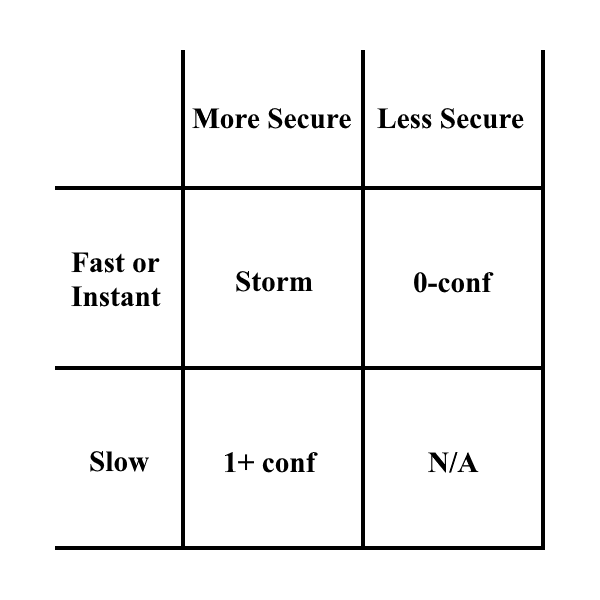
The Economics Behind Big-Block Bitcoin: An In-depth Analysis
Not too long ago, I made an article called *The economics of a high volume, low-fee Bitcoin market.* In that article, I went over a hypothetical scenario in which fees are extremely low, and Bitcoin Cash is the only peer-to-peer electronic cash that is being used for payments (this is quite an unrealistic assumption). Considering the fact that there are only 7-8 billion people on Earth, I find it extremely unlikely that a third of the global population will ONLY use Bitcoin Cash. There are plenty of alternative cryptocurrencies that are also viable alternatives including, but not limited to: Ethereum (2.0), XRP, Binance Coin, Litecoin, Bitcoin SV, Cardano, EOS, Monero, Digibyte, Dash, ZCash, Dogecoin, and many more. I believe that if we want decentralization, we shouldn't encourage only one coin as peer-to-peer cash, but several coins so the idea of decentralized peer-to-peer electronic cash is harder to stop/set back.
For this article, I wanted to take a closer look into "big-block economics", and take a more realistic approach of Bitcoin Cash's fee market with bigger blocks. One of the issues with Bitcoin Cash currently is that it is barely getting any revenue from fees. While it technically is cheap to use (<$0.01 per transaction), there aren't many transactions on the network, which results in fees being a very low percentage of the block reward. Currently, the percentage of fees making up the block reward is <0.02%. Right now it isn't much of an issue since the block reward subsidy is enough for miners to rely on, but later down the road it is something that makes or breaks the underlying security of the system, and as such, is extremely important.
I think the fees being very low right now is fine (as explained above), but as Bitcoin Cash acheives more adoption, especially on a global scale, a fee-market will develop regardless of how big the effective blocksize limit is. This is partially because of the fact that tech has and always will have limitations, incentivizing miners not to create blocks too big (as they need to propagate over the network quick enough) and fit their blocks with the transactions paying the highest fees, and the fact that those making high-value transfers who want their transaction to be guaranteed to be confirmed in 10 minutes will outbid other casual transactions by a large amount. My theory is that 0-conf with pre-consensus will be the overwhelming majority of transactions on Bitcoin Cash which will take 20-30 minutes to confirm (instead of going into the next block in 10 minutes), while higher value transactions will be included in the next block, paying higher transaction fees.
The authentically developed fee-market that will happen on Bitcoin Cash got me thinking: hashrate is not proportional to price, but is proportional to the actual block reward of each chain. This means that it is *technically* possible for Bitcoin Cash to have a higher hashrate than Bitcoin, but still have a lower value per coin/market cap. It would be a very confusing situation because by every technical definition, Bitcoin Cash would 100% be Bitcoin, but the market would still value the legacy chain as 'Bitcoin'. It would beg the question: *Which is the real Bitcoin?* Either way, if this does happen, it will be interesting to watch it unfold.
Now, back to the economics of big-block Bitcoin... If Bitcoin Cash wants to become the dominant chain *and* be secure long-term, it needs to be have more hashrate than Bitcoin. While hashrate (at least right now) is determined mostly by price because of miners' reliance on block subsidies, Satoshi designed Bitcoin so that the block reward slowly diminishes and is replaced by transaction fees to secure the network. This brings into consideration the importance of economic activity on a chain's security, and the fact that Bitcoin Cash doesn't need to be worth more per coin to be more secure (if economic activity is high enough). I think the first step to understand the economics of Bitcoin Cash becoming dominant is to mathematically understand what would need to happen for this to take place. To do so, we can develop an equation and understand how the hashrate of the chain is determined:
Hashrate is a result of the difference between revenue generated per block on Bitcoin and the cost of mining/running a node (though the cost of mining is the same, since both are SHA 256 chains, which renders this constant useless). To illustrate this, we can generate the equation:
*r =* (*p⋅b* + *t*⋅*f* ) - *e,*
*b & e* →0
*where:*
*r = revenue generated*
*p = price*
*b = block reward subsidy*
*t = transactions*
*f = fee per transaction*
*e = expenses (running a full node)*
Now if we take the short-term limit of this equation:
*r =* (*p⋅b* + *t*⋅*f* )
And the long-term limit:
*r = t*⋅*f*
What we can see from this equation is the obvious conclusion: ultimately the system will rely on transaction fees instead of the block reward. But where this comes handy is when using the current figures to determine how much revenue Bitcoin miners are getting in fees per block/day.
Currently, the average transaction fee for Bitcoin is $3.15 per transaction, and there are ~305,000 transactions per day on the network. This leads to miners making ~$960k in revenue from transaction fees alone. If we add the block reward, BTC miners are making ~$10.5 million in revenue per day. For Bitcoin Cash to match that revenue with current transaction fees, there would have to be 2 billion transactions per day on-chain. I think from this information, it is clear that Bitcoin Cash won't be 100% sustainable long-term with fees this low, but we can illustrate this relationship using the previous equation discussed above to find an equilibrium between lower fees, greater security, and coin value:
*Bitcoin revenue (per block)*
*r* = ~$75k
*where:*
*p⋅b* = ~$66.5k
*t⋅f* = ~$8,500
*Now, if we take the total block reward and divide it by the number of transactions on the network per block:*
*f* = *r/t*
*f* = $30 *per transaction*
*Since we want the revenue to remain constant per block, we get the equation:*
*t⋅f* = ~$75k
*And to match or overtake the revenue:*
*r = (n⋅t)(f/m)*
*=* ~$75k
*where:*
*r = revenue (per block)*
*t = number of transactions on the BTC network*
*f = fee per transaction*
*n = how many more transactions are taking place on the BCH network*
*m = a number* ≤*n, which indicates how much cheaper transactions are on the BCH network*
So for Bitcoin Cash to be sustainable long term and have a majority share of the SHA 256 hashrate, all it needs to do is have *n* times more transactions than the BTC network, but also be less than *n* times cheaper per individual transaction, including the block reward. To illustrate this relationship in a way that is easier to visualize, I decided to graph this out as a function on excel:
This graph gives us some idea as to how much it would take for Bitcoin Cash to become the dominant chain, but it doesn't show exactly the amount of adoption (in terms of relative throughput) needed in order to get more revenue per block than Bitcoin. So to illustrate this, I created another graph of the same function, but instead with more detailed labelling:
At Bitcoin Cash's current level of adoption (0.3 tx/s), fees would have to be ~$480.00 on average per transaction
At Bitcoin's current level of adoption (4.2 tx/s), fees would have to be ~$30.00 on average per transaction
At Ethereum's current level of adoption (16.7 tx/s), fees would have to be ~$7.50 on average per transaction
At PayPal's current level of adoption (134 tx/s), fees would have to be ~$0.94 on average per transaction
At Visa's current level of adoption (2.1k tx/s), fees would have to be ~$0.06 on average per transaction
At Visa's + MasterCard's current level of adoption (4.3k tx/s), fees would have to be ~$0.03 on average per transaction
With this, I think it is important to understand how urgent (and I mean VERY urgent) it is for Bitcoin Cash to get transactions on its network considering the fact that Bitcoin's adoption has been set back several years. While it is less than ideal that adoption has been set back at least a few years, this gives a big opportunity for Bitcoin Cash. The race here will be for the Bitcoin Cash network to get more in transaction fees than Bitcoin does in block subsidies and transaction fees. The key misconception here is that Bitcoin Cash needs to have transaction fees <$0.01 to have mass adoption. Fees only need to be enough to incentivize miners include transactions into the next block. As we know, the price of crypto is heavily manipulated, so getting actual uncensorable transactions along with higher transaction fee revenue on the network is the only real way to become the majority chain. So it is entirely possible for Bitcoin Cash to have a lower value per coin, but still become "the new Bitcoin" while Bitcoin becomes the legacy chain.
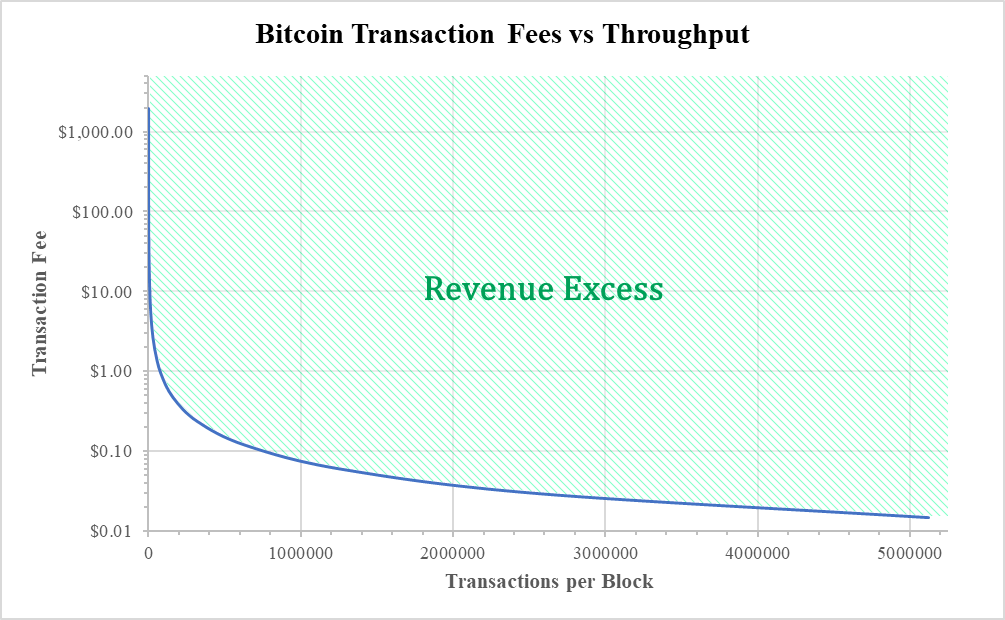
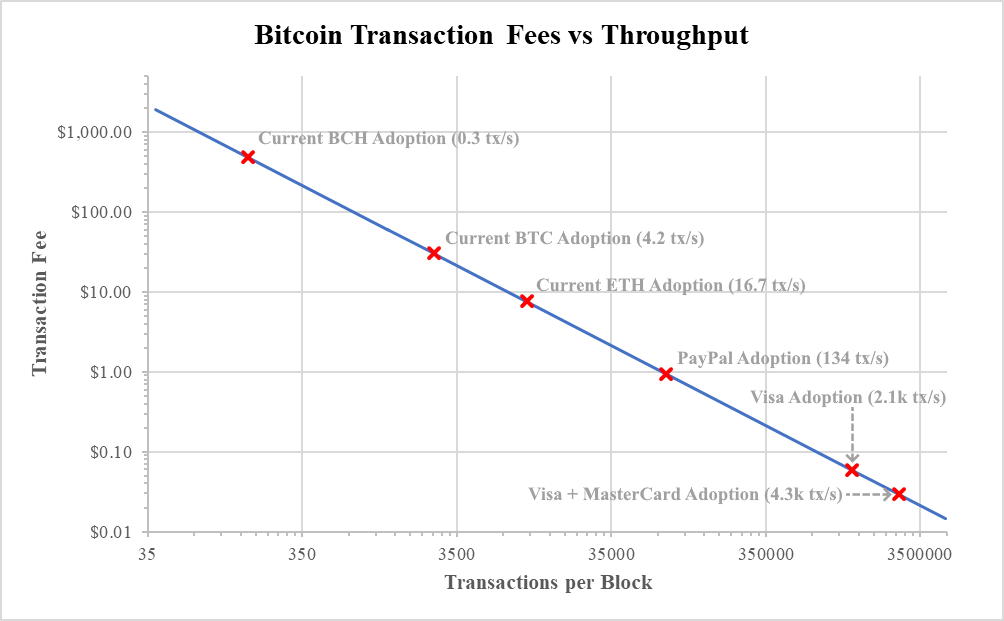
Bitcoin Cash: Governance Changes Moving Forward
With the recent conflict in the Bitcoin Cash community, it feels like a split is inevitable and this could potentially be the final nail in the coffin for Bitcoin Cash as a project. For me this is possibly the most frustrating situation to be in because it is obvious which party in this community is refusing to cooperate with everyone else. It seems like those currently involved with Bitcoin ABC do not care what the community wants, and are more interested in their cash-grabs. I hope the best for the future of Bitcoin Cash, but for now, **I'm completely out until things finally settle in November this year**. After the split, I will consider getting back into Bitcoin Cash if things go smoothly. It is very frustrating to deal with one node implementation choosing to intentionally make things go bad for everyone just because they are not getting exactly what they want, when this is what they signed up for. If one implementation is going to be the only one leading development, it does not make any sense for other implementations to exist.
With this in mind, I think it is important to address what exactly went wrong with the BSV split, and now what is likely to be the ABC split, and try to learn from those past experiences so that we can move this project forward. On top of learning from our mistakes, we need to change how our governance works when it comes to implementing upgrades, and what changes need to be made to the current system. So, here are my thoughts on what exactly needs to change:
1. Instead of seeing the Bitcoin Cash community as polarized factions that the community has to choose between, people should think for themselves, and reject those who are firm on their stances and unwilling to cooperate.
When it came to the BCH and BSV split, I feel like both sides were wrong and unwilling to cooperate, causing this split. The Bitcoin Cash community was forced to deal with either siding with Bitcoin ABC or Satoshi's Vision node implementations, and choosing the "lesser of two evils". Does this sound familiar? It's exactly like our current democracy system in terms of governance, and we already know how that's going... I severely urge people to NOT follow or admire any figure within this community blindly, no matter how much good they have done for Bitcoin Cash. Think on each of their decisions independently and evaluate them for yourselves. Bitcoin Cash is a community, but it is a community made up completely of individuals.
2. Ditch the 6 month scheduled hardforks in place of scheduled hardforks that have deadlines of 9-12 months.
With Bitcoin Cash, hardforks are scheduled every 6 months currently, and this has caused many issues. If Bitcoin Cash is updating every 6 months, that means businesses, nodes, and developers have to change their software relatively frequently in order to keep up with the chain. Not only is this inconvenient, but it also leads to rushed development, and overall slows down the potential rate of development with Bitcoin Cash. What I suggest is that updates happen somewhere within 9-12 months with no exact deadline, and all the node implementations check their progress with development, and agree upon the next hardfork date immediately after the previous hardfork is executed. Not only should hardforks happen somewhat infrequently, but we should not wait till May or November if we need to execute a hardfork for something urgent that fixes the user experience. For example, we should execute the DAA upgrade ASAP instead of waiting for the November deadline.
3. Hardforks should become more infrequent as Bitcoin Cash matures, so that there is more protocol stability.
While it is necessary to upgrade software, I feel like it is also unnecessary to make the update even every year after Bitcoin Cash matures as a project. After the next few hardforks taking place every 9-12 months, I think it makes sense to increase the timeframe to around 18 months afterwards (of course with the emergency hardforks in between). This will give businesses a stable protocol that they can build on top of, and will not have to frequently worry about updating, or have any potential issues with nodes going offline. Apart from increasing the blocksize, there should be slight modifications, optimizations, and improvements that make Bitcoin Cash have a more seamless user experience.
I think that if Bitcoin Cash can nail all of these things down, there will be a lot more respect for it from the outside community, and businesses will feel more encouraged to actually use Bitcoin Cash to its full potential.

Bitcoin Cash: Thoughts Moving Forward
From the recent chain of events in this last month (haha, pun not intended), it looks like ABC is going to intentionally cause a split so they can implement their own 'IFP' into the protocol. It looks like not many in this community are in support of such a move, but in some ways it might unintentionally be good for Bitcoin Cash. In the short term, things may be bad, but in the long term, things are looking bright for Bitcoin Cash. Once we have this split in November, a lot of ideas that were initially suppressed against the community's wishes will finally be able to be implemented into Bitcoin Cash.
I think the future for BCH is looking bright, as it seems that we will finally be able to cooperate with decentralized governance. All of the node implementations seem to be united on their approach to building BCH as peer to peer cash, and building its infrastructure. I have not completely given up hope yet for BCH, but if ABC manages to be the majority fork, or a big minority, I will admit that the Bitcoin experiment has failed. With what has happened in the past, regarding the BSV and BCH split, and now this upcoming split (though we don't know 100% if it is going to happen, but it is pretty likely), I wanted to communicate my thoughts on the future of Bitcoin Cash, and what I think about the upcoming split.
Firstly, I wanted to say that I wasn't expecting a split to occur. I remember that nearly everyone in the community was in agreement with Bitcoin Cash being a good cryptocurrency and having a bright future. To my knowledge, there weren't many issues or infighting within the community and everyone had respect for eachother, including all of the node implementations that work on development. I think one of the most appealing aspects of Bitcoin Cash to me was the fact that multiple teams of developers were collaborating with eachother and gaining consensus in order to move forward. To me, that was a sign that decentralized development makes Bitcoin Cash more like Bitcoin than Bitcoin itself.
Everything seemed to be smooth sailing, but then a sudden controversy came within the community. Though I was part of the community and browsing on an almost daily basis, I wasn't really up to date on current events, and admittedly didn't know much about what was going on in terms of development. I started hearing about people having to pay a "dev tax". I wasn't sure what this was, and if it was actually being implemented as a tax or not, but I thought it was just a temporary controversy that would eventually just fade away. I definitely was wrong about this. Nothing happened on the May hard fork (everything went smoothly), but now it was clear that there was some division within the community.
Though this was a bit concerning, I didn't put much weight to it because it didn't seem to take up much of the discussion in r/btc. There were people who were in favour of the ABC IFP proposal, but they were far and few in between. A few more months go by, and then there is news that BCHN has removed the "poison pill" from their implementation. Most people reasonably don't make a big deal out of it, but ABC proponents took this as a sign that a split was going to occur, despite BCHN specifically being opposed to a split. This theory that BCHN is in favour of a split rightfully upsets a lot of the community because it is mostly a baseless conspiracy based on one small thing that BCHN did to their code.
Either way, things go normally for a while until jtoomim formally proposes his new DAA fix for BCH in the upcoming November upgrade for Bitcoin Cash. The post is met with a lot of support from the community and developers as it is fully researched, backed by evidence, and furthermore, fixes an issue that has been plaguing Bitcoin Cash for ages. Despite this proposal gaining a lot of support by everyone, Bitcoin ABC decides to go their own way, and forcefully implement their Grasberg DAA, that is a modified version of Toomim's proposal, and implements drift correction: a "fix" (if you would call it that) that compensates for the block times dating back to the genesis block.
From here on out, things go downhill. It's obvious that ABC does not want to cooperate, and that they do not care about what the community supports or is against, and just wants to have things their way. This unsurprisingly does not sit well with the community, and many people responsible for the infrastructure behind Bitcoin Cash sign an agreement saying that they will only put their infrastructure behind the ASERT BCH implementation. This causes Bitcoin ABC to make a new announcement where they say that they are going to ALSO implement ASERT, but now they are going to force their IFP again, the previous point of contention within the community. From here on out, it seems obvious that a fork is going to happen.
After this statement about forcing the IFP got released, ASIC Seer makes a post specifically stating that most miners have already switched to BCHN, and that there would be nothing to worry about, come November. This is just a statement, and there is still no proof to back it up. Though this wasn't official, a lot of the community was relieved that there was a lot of support backing BCHN and other node implementations. Though a split is far from ideal, I think that this may be for the better, and I'm excited for what's to come in Bitcoin Cash's future.
Now that ABC is out of the equation, I am excited for many of the new features coming, and that are being worked on by other node implementations. I think what I'm excited about most are doublespend proofs and pre-consensus. I think this has a lot of potential for Bitcoin Cash, because now 0-conf transactions will be MUCH safer, and payment processors won't have to deal with being burnt with double-spends. To my knowledge, Bitcoin Cash Node is going to be implementing Storm, a form of pre-consensus later in the future.
This is a pre-requisite to Avalanche (IIRC), but has the potential for almost guaranteed safe 0-conf transactions, making Bitcoin Cash competitive with other cryptocurrencies that have near-instant and free transactions. I think this can launch new possibilities, such as an exchange built around the pre-consensus protocol, where people can deposit, and start trading instantly (with smaller amounts of money). This will also render second-layer solutions as obsolete and unnecessary, now that the base layer is instant, and almost free in terms of transactions.
Furthermore, I think progress will start going through quickly, now that there isn't any team intentionally stalling progress because of their own personal issues. Smart contracts are already possible on Bitcoin Cash, and AnyHedge is set out to launch fairly soon, which can potentially bring some of the DeFi hype to Bitcoin Cash. I think this will all be really good for user experience, and can potentially attract more users to it.
All-in-all things are looking fairly good AFTER the split, and I think this will have a very positive outcome for Bitcoin Cash, and the future of development. I think one thing we can definitely change about governance is having a different schedule for forking. I think we are better off "relaxing" (please don't take this as meaning doing less work) the schedule to 9-12 months, with consensus being reached on a fork initiation date, and then having emergency hardforks in the middle if necessary (an example would be like the DAA issues we are facing now). But overall, this makes me optimistic because I feel like things will start going through quickly. See you in November. :)

Proposal: BMP with Mining Pools and 'Locked' Hashrate for Voting
For the upcoming issues with governance in Bitcoin Cash, it's at least clear that the majority of the is against the proposal of the Grasberg DAA, and there currently is no good form of voting on this issue. In Bitcoin and Bitcoin Cash, voting comes from hashrate, and hashpower, and currently is challenging to gather actual results on hashrate voting, or even knowing exactly how much of the community is in support of, or against certain proposals for more technical aspects of development. A lot of people have referenced this chart to show that ABC has the overwhelming majority of hashing power, and that BCHN is in the minority, and therefore going to result in a BCHN minority split, despite the fact that BCHN wants to AVOID said split. https://cash.coin.dance/blocks/summary
Not too long ago, read.cash user JavierGonzalez made a post titled "Why Bitcoin Cash Need the BMP?" where he discussed the possibility of a new type of voting system called BMP, in which hashpower could be used to individually vote on open polls by dedicating their hashrate to any given option on the poll. This is a great system in my opinion, and the voting works just like Bitcoin: hashpower. I think that this can be integrated as a part of the development process for new changes on the BCH protocol to avoid a split, and can also give people an idea as to how likely it is that one feature or another is going to be implemented within the protocol, however, there also are other issues that come from voting purely on hashrate:
SHA 256 hashrate allocated on voting options on the polls can come from potentially conflicting interests, such as Bitcoin, and Bitcoin SV pools who will try and vote with their hashpower on what is worst for Bitcoin Cash, as an attempt to suppress it and suit their individual narratives
Any time a poll is launched, any big miner potentially having a size-able hashrate on BTC can switch over their hashrate to a pro-BCH pool to try and influence any potential results of said poll
If the time a poll launching is known, BTC and BSV pools and hashrate can collude to make changes to which pools they are assigning hashrate to, and ensure that any potential hashrate that might be or might have been in favour of certain proposals
I'm not someone with a lot of technical knowledge, but what I propose is a BMP poll that is held at a random time by a neutral third party in which pro-BCH pools vote on which path they want to take (ASERT or Grasberg), and have it time-locked so pools have enough time to be aware of said "poll", but there's not enough time for potentially conflicting hashrate to join in, and skew the results. Furthermore, pools could agree to lock hashrate at this time so that in the timeframe, hashrate can leave pools, but no new hashrate (potentially with ulterior motives) can join it. With this, I hope we can find an accurate way to measure how many of the miners are in support of one path over another, and by how much. Any other suggestions on how we can get fairer results are welcome.

local.bitcoin.com promotion stamp
Bitcoin Cash: Nowhere Near Dead, but a Long Way to Go...
With my last article, I feel like I spread a little bit of negativity about Bitcoin Cash, but I was just stating my concerns for the future of it, considering the current state of development and the community. Now coming to the third anniversary of when Bitcoin Cash forked, I thought it would be nice to look back at what we have achieved over its history, and why there still is a lot of potential for the future, because Bitcoin Cash is NOT dead, and there's still hope of it scaling for mass adoption. Looking back, I never really took Bitcoin Cash seriously, and this did not help after the crash of 2018, and the hash wars. I only started paying attention to Bitcoin Cash back in the second half of 2019 when I started thinking about the trade-offs between larger and smaller blocks. I eventually came to the realization that blocks would eventually need to increase, and low fees are necessary for mass adoption.
On August 1st, 2017, Bitcoin Cash forked off from Bitcoin as a result of disagreement within the community. At the time of the fork, it was only worth ~$220, and now that number has gone up to $330. A pretty big increase even over the course of 3 years, and especially great when one considers the fact that a lot of FUD was surrounding it and the hashwars took place (resulting in a split). I think the day Bitcoin Cash forked off is significant because it was right before the deployment of SegWit, giving miners an alternative if they were not in support of it, and it was the only attempt for Bitcoiners to bring bigger blocks to Bitcoin that managed to succeed. The first attempt at bigger blocks was BitcoinXT, which failed to deploy, followed by Bitcoin Classic, Bitcoin Unlimited, and finally Bitcoin 2X (SegWit 2X). All of these failed to activate, but the one that emerged was Bitcoin Cash. This marks the day when "big-blockers" were finally given the chance to succeed and work on on-chain scaling.
Though I was not part of the community back in 2017, we have done a lot since then that goes under-appreciated by the rest of the community (both Bitcoin Cash and Crypto), and I think it would be encouraging to take a look at how far we have come, and all of our accomplishments. In the last 3 years, we have:
Forked off right before SegWit was activated, giving miners who agreed to SegWit 2X an alternative in case it failed to activate (which it did)
Upgraded to 8 MB, and then 32 MB blocks, allowing for PayPal levels of scaling on a decentralized, peer-to-peer network
Fixed transaction malleability with the Schnorr signatures hardfork, which completely and provably solved malleability, unlike SegWit
Managed to stay in the top 5 coins for the last 3 years, despite all the FUD, misinformation, the fact that two of the biggest crypto exchanges dumped their customers' Bitcoin Cash (Xapo and Bitfinex), and the hash war, which resulted in a 60-40 split between Bitcoin Cash and Bitcoin SV
Added SLP tokens to Bitcoin Cash, allowing for multiple use-cases including, but not limited to: asset hedging, digitally representing stocks and commodities, the ability to give out tokens that yield dividends, and the ability to make stablecoins
Added non-fungible tokens, which allows for digital proof-of-ownership, and the ability to make non-fungible tokens for other use-cases such as concert and movie tickets
The ability to send completely encrypted messages through IPFS and Bitcoin Cash, allowing for more use-cases such as privacy and whistle-blowing without fear of attack
Come out with the first implementation of Bitcoin Cash wallet, Electron Cash with built in privacy including the new privacy protocol, CashFusion
Officially gotten Tether as an SLP token on Bitcoin Cash, making it the most practical way to transport Tether (cheaper than Liquid)
Performed a stress-test in which Bitcoin Cash handled more than 2 million transactions in a day, while transaction fees consistently remained <$0.01, along with many other days in which Bitcoin Cash handled >1 million transactions a day without the fees ever creeping anywhere near a penny
Upgraded to Canonical Transaction Ordering Ruleset, allowing for on-chain scaling to work more efficiently
Seen XThinner (a new block propagation technology in the works), and its ability to compress blocks far more efficiently than any other block propagation protocol so far (Compact Blocks, XThin, and Graphene)
To think that we have done so much in such a short period of time is amazing to say the least, and I think it shows that this project is far from dead, with a lot more potential in the future. Bitcoin Cash has only existed as a fork for 3 years, and it has already managed to maintain its position in the market, while also innovating every day, and keeping up-to-date. Though what is happening right now may be concerning for many, it is just another blip on the road to making a peer-to-peer cash system with worldwide adoption. That's all.

How NOT to Run a Community Project
I've been paying attention to the Bitcoin Cash ecosystem lately, and how development is going. People have legitimate concerns about the usability of Bitcoin Cash, and the future of it as a technology. For a while, there have been many issues plaguing Bitcoin Cash and preventing it from getting any potential adoption in the future, and I'm making this post because the direction things are going in are extremely concerning not only to me, but also others in this community. For anyone who has been up to date with BCH, you will know that we recently had a DAA meeting, where developers discussed potential solutions to Bitcoin Cash's flawed DAA. The current DAA is causing issues with oscillation, and discouraging "loyal" mining strategies, while encouraging those of switch mining, causing inconsistencies in hashrate, significantly degrading user experience, potentially deterring new users from using Bitcoin Cash.
With the last DAA meeting, it seemed like everybody was in consensus about the DAA being changed, and wanted to discuss potential solutions with the objective of reaching an agreement. I, along with many other saw this as a positive and thought that ABC was willing to compromise with others towards reaching a solution. After all, that's what Bitcoin Cash is all about. ABC and others have had disagreements in the past, but maybe now they have learned that the point of a protocol having multiple node implementations is so one party cannot have a hostile takeover of development. After all, even those who support Bitcoin ABC believe this to be the case. Little did I know, I was wrong to make such an assumption. Not long after, another read.cash article gets published where Bitcoin ABC says that they are going to go forward with a new DAA, which wasn't even proposed beforehand to other node implementations and developers. Their reasoning for this? https://youtu.be/vnvL8Q-6zgo?t=217
no concrete proposal has reached ABC at the time of this writing, which does not leave us with sufficient time to review adequately, simulate and test, and get feedback addressed before the feature freeze on August 15th.
With this statement in mind, it makes it look like ABC wanted to reach a consensus and a resolution, and were "moving forward with Grasberg" in good-faith. This evidently isn't the case, and it is obvious when you see the hypocrisy in this style of leadership because:
ABC is making it seem like it's important for node implementations to have time to review code and test it, making sure there aren't any issues with it before the feature freeze date
ABC feels as if the proposals given now don't give "adequate time" for testing and simulation for said feature freeze date
They're putting out their own DAA, of which, there aren't any officially published results by them on their website during a time in which by their own standards "which does not leave [other node implementations] with sufficient time to review adequately, simulate and test, and get feedback addressed before the feature freeze on August 15th", and then have the audacity to claim that they "[are] is inviting other parties to reproduce the results"
ABC didn't propose their solution. They said they were "going forward with it". They refused to acknowledge that there actually were other proposals which were more plausible for the November upgrade even though results had already been taken, were reproducible, and there was code available to them to assess. Bitcoin developer jtoomim had come up with a recent proposal for adding ASERT as the new DAA, which got a lot of community support, but didn't get acknowledged by ABC because he didn't "hand in a formal proposal in ABC's code", despite the fact that ABC could have copied the code, or at the very least acknowledged Toomim's proposal and request/remind him to give it in. I think this shows their true intentions.
Either way, I made this article to try and remind people that this isn't what Bitcoin Cash is about. The entire point of having several node implementations is for developers of said implementations to cooperate and reach a consensus on how to solve current issues with Bitcoin Cash, and improve it's usability as peer to peer electronic cash. I encourage other users and miners to ask themselves these questions:
*Do I want to run a node implementation that is unwilling to cooperate with others, and force their code, while implicitly threatening a split if they're completely on-board with it?*
*Do I want to run a node implementation that intentionally makes it hard to cooperate and reach consensus?*
*Does this style of leadership look familiar/has it happened in the past?*
*In the future, when this node implementation gets full power over development, are they going to do what is in my best interest as a miner/user?*
*Even if this node implementation does manage to cooperate this one time, is it worth still running it, despite having a track record of trying to force changes on the community, and are they going to continue being cooperative in the future?*
I think it's important to ask yourself these questions because they can make or break Bitcoin Cash as we know it right now. If you as a miner/user can see the route that ABC is taking, I encourage you to switch over to another node implementation that shows willingness to cooperate. For now, I've switched my interests and support over to another project because it seems like ABC is fully in charge (in terms of hashpower and exchange support), and that makes it unappealing to support Bitcoin Cash at this moment. That's all I want to say for now. If anything changes in the future, or if ABC is no longer a popular implementation, I will change my mind, and come back here to support Bitcoin Cash as a community member. For now, I'm supporting Monero, but I'll still be active on the r/btc subreddit.

Hey guys, sorry if I'm not active on Reddit. Someone on Reddit falsely reported my post of the emails between Peter Todd and John Dillon as doxxing material, resulting in the post getting deleted by Reddit, and my account getting suspended for 3 days. I find it interesting how my post was "automatically removed by Reddit" several weeks after it was made... Someone is reporting my profile, and I don't know who. Just yesterday, my account got hacked and I saw someone commenting with my account a post that I never made. Things are getting interesting...
A Closer Look Into "Who Funds Bitcoin Development?"
Not too long ago, BitMex Blog made an article titled Who Funds Bitcoin Development, back in March of 2020. Though our "conspiracies" may have been right all along, I decided to do some research because I found the topic particularly interesting. In the BitMex blog, there is a graph that shows who is funding Bitcoin development based on the number of developers: https://blog.bitmex.com/who-funds-bitcoin-development/
Right off the bat, it is extremely shady that Blockstream is one of the biggest investors in the space, but it doesn't end there. Blockstream's main investor which is a clear conflict of interest is DGC, also known as Digital Currency Group. The reason Digital Currency Group is such a big conflict of interest is because:
1. They have a current member of the Federal Reserve as a part of their "team".
2. They have considerable connections to legacy financial systems such as credit cards, and banks.
At first glance, this might seem like a mere coincidence, and ridiculous conspiracy theory, but it doesn't end there. I decided to take a deeper look into who exactly is funding Digital Currency Group, and more possible associations they might have with the current/legacy financial system. The nice thing about this is that there is a tool called Crunchbase which tells you who exactly is investing into what venture funds, and how they might be connected one another. I was first interested in Blockstream, which is the obvious "elephant in the room" so to speak.
A Look Into Blockstream
So I searched up Blockstream on Crunchbase, and luckily they are more public about their funding as compared to other organizations. When it comes to their initial seed capital (November 2014), everything seems fine, and this is reflected in the perspective that Adam Back holds on Bitcoin. Keep in mind that there still is a conflict of interest here since Liquid directly profits off of Bitcoin's inability to scale and have reasonably cheap transactions. So at this moment in time, Adam Back is in favour of increasing the Bitcoin blocksize limit. This view isn't just what Adam Back thinks as a Blockstream founder. Peter Wuille was also in support of increasing blocksize, and proposed a BIP to increase the blocksize limit (this is also 6 months before they receive funding from AXA Ventures) at the same rate of technological development. This is where things get interesting... https://twitter.com/adam3us/status/636410827969421312 https://github.com/bitcoin/bips/blob/master/bip-0103.mediawiki
In February of 2016, Blockstream opens another round of investing titled "Series A - Blockstream". In this funding round, institutional investors appear, and pour money into funding Blockstream. This is despite the fact that Blockstream has barely made any product yet, nor does it have solid financials. If Bitcoin transactions are already reasonably fast and cheap, what reason is there to invest in a sidechain with the purpose of fast and cheap transactions? It's naive to assume that such a business is being run in good-faith, as running in "good-faith" won't give its investors an ROI in this case. Interestingly enough, Adam Back starts endorsing sidechains and Lightning as the scaling solutions for Bitcoin. https://imgur.com/8U1ADYw
In this funding round, Blockstream got funding from a few institutional investors including Horizons Ventures, Digital Currency Group, and AXA Ventures. Horizons Ventures does not seem to have any conflicting interests, but where it gets interesting is with Digital Currency Group, and AXA Ventures. We already know about the connection between AXA Ventures and the Bilderberg Group, but this connection has plausible deniability, and is not a very strong one. It is a conflicting interest, but it can be passed off as a "conspiracy theory". As for Digital Currency Group, the conflicting interests are very evident. https://www.crunchbase.com/funding_round/blockstream-series-a--73434d84
Digital Currency Group has their first funding round in September of 2011, which gets a small venture firm to invest in their organization, but an irrelevant one at best. Their next funding round was not until more than 4 years later, and this is when the institutional investors start coming in. The start of the second funding round is in October of 2015, where the main investors are yet another venture capital firm, but more importantly, MasterCard. This is only a mere few months before Blockstream gets its investment for Digital Currency Group. I think it's safe to say that the capital coming from MasterCard was invested into Blockstream shortly after MasterCard decided to invest into Digital Currency Group. https://www.crunchbase.com/funding_round/digital-currency-group-seed--6068278f
* I also forgot to add, Digital Currency Group STILL has a member on their team who is currently a member of the Federal Reserve, Glenn Hutchins, and Blockstream's model of making money is from collecting monthly fees from investors.
Note: DCG also acquired Coindesk back in January of 2016
A Look Into Lightning Labs
The second biggest financial supporter of Bitcoin development is Lightning Labs. At first glance, there doesn't seem to be any connection with Lightning Labs and Blockstream, but it only takes a few minutes to find that connection. Lightning Labs was founded in 2016, and is a for-profit company building services to improve Lightning Network user experience. They had their first funding round in 2018, where investors came to pour capital into the company, despite Lightning Network not showing any signs of being promising. Who is one of the main investors in Lightning Labs? You guessed it! Digital Currency Group! https://www.crunchbase.com/funding_round/lightning-seed--60cff365#section-investors
As for Lightning Labs, where do they get their profit from? Those investors need to get their return from somewhere, and I certainly am not naive enough to believe that investors are just investing because they see potential and want Bitcoin to succeed. Well, I took the time to look at their website, and it looks like they're providing a few services related to the Lightning Network. The first and main service that they are providing is liquidity for Lightning through a product called "Loop". If you look at the website, it is a way of providing liquidity through Lightning, so users can easily keep funds flowing. The fees charged on this service are percentage-wise, so we know that it is a product that is supposed to generate profit. https://lightning.engineering/loop
We already know that Lightning Labs still (even after 4 years!) hasn't declared the Lightning Network production ready (which likely means that there are a lot of attack vectors, and Lightning transactions aren't safe), so if it's unsafe, someone might as well just use the normal feature of broadcasting a transaction. In fact, this is what people did not too long ago. This was until RBF was implemented, which an overwhelming majority of the community was NOT in favour of. Interestingly enough, the time this post was made was in November of 2015, which was right before the founding of Lightning Labs in 2016. Though I can't I accuse Lightning Labs of anything, my theory is that they saw the ruining of 0-conf transactions as an opportunity to capitalize on, since Lightning Network was going to be pushed and endorsed as a scaling solution. This only makes logical sense. Now that we know the link between Lightning Labs, and Blockstream, we can conclude with fair certainty that both entities have the same interests. https://www.youtube.com/watch?v=9bpNivBeTaM https://www.reddit.com/r/Bitcoin/comments/3ul1kb/peter_todds_rbf_replacebyfee_goes_against_one_of/
A Look Into Digital Currency Group
Digital Currency Group (abbreviated as DCG) is an organization/team with the supposed purpose of investing into building blockchain infrastructure, and helping Bitcoin as a technology. We have already established that they have strong links to MasterCard and the Federal Reserve, but if you look closely, they have one more investor that would benefit from Bitcoin's inability to have cheap and reliable transactions: Western Union. Though I wasn't there during the early days of Bitcoin, a lot of people who were will remember this image. It was very popular, and illustrated how much better Bitcoin is compared to legacy financial systems like Western Union for money remittance. Western Union joined the effort to fund DCG back in April of 2016, well before DCG decided to pour capital right into Lightning Labs. https://www.crunchbase.com/organization/digital-currency-group#section-investors https://imgur.com/kDArwVD
A Look Into Square Crypto
The third organization that appears to be a big contributor to the funding of Bitcoin development is Square Crypto. I was unsure of whether or not Square Crypto was related to Jack Dorsey's Square: Point of Sale, so I took a closer look at their twitter, and they claim that they are a separate organization, which is true. After going further into their twitter, it turns out that Jack Dorsey is the founder of Square Crypto, and the same guy who provided funding for Lightning Labs during one of their funding rounds. This is not mentioning that Jack Dorsey himself has a conflict of interest, being the owner of a point-of-sale application. Both Square and CashApp are centralized financial services with the likes of PayPal, Venmo, Western Union, MasterCard, and Visa. Jack seems enthusiastic about bringing more adoption to Bitcoin, and this can be illustrated with Square Crypto's commitment to make "Bitcoin for everyone". Making "Bitcoin for everyone" would imply a few things:
- Cheap, affordable fees https://twitter.com/sqcrypto/status/1130872897004810241
- The ability for Bitcoin to scale on-chain
- The ability for Bitcoin to be used by more people (implied by the second point)
- Educating others on Bitcoin
From the looks of it, Jack Dorsey has only invested a few million into Lightning Labs' development, while he has likely put at least tens, if not, hundreds of millions of dollars into Square and CashApp. Knowing this, it would be naive to assume that Bitcoin adoption and development is his priority, when most of his capital and net worth is put into projects with conflicting interests.
A Look Into MIT DCI
MIT DCI (the Massachusetts Institute of Technology Digital Currency Initiative) is the fourth-largest financial contributor to Bitcoin Core's development. When looking at the current team members, there are no real conflicting interests, or reasons any of them might want to stifle adoption in any way - at least at first glance. One of the team members are a current Bitcoin Core developer (Cory Fields), but has no connection to Blockstream, so there aren't any conflicting interests as far as we know. There is one more person who plays a role in "Bitcoin" development, and that is Thaddeus Dryja, who is one of the creators of the Lightning Network. Being the creator of the Lightning Network, he does have incentives to keep the blocksize small (which will push his second layer scaling solution), but drawing such a conclusion would be a bit of a stretch. For now, I think we should assume that he has good intentions, and give him the benefit of the doubt. I did a little more digging, and interestingly enough, there is more to MIT DCI than at first glance.
I looked up articles regarding MIT DCI, and there seems to be a link between the creator of DCI and Jeffrey Epstein. It turns out that Jeffrey Epstein has donated funds towards MIT for a while, and those who were subject to the bribes kept quiet about it. Specifically, there have been links between the creator of DCI and Epstein. It turns out that Jeffrey Epstein directly funded Ito, the creator of DCI. This doesn't necessarily mean the organization of DCI is bad itself, but it definitely is not a good look. Jeffrey Epstein funding DCI isn't bad because Epstein is a pedophile, but rather because he has ties to the legacy financial system, and is very much connected to a lot of political figures. https://finance.yahoo.com/news/jeffrey-epstein-bitcoin-intrigue-deserves-080028939.html
A Look Into Chaincode Labs
So far, it looks like Chaincode labs is pretty clean, but at the same time, not a lot is revealed about it. As far as the organization goes, it is funded by the two founders, but it doesn't seem like there is any active project or direct way of them receiving funding (at least, not that we know of). As of right now, Chaincode has two ex-Blockstream employees as a part of their team, but they don't have any financial ties as far as I know. Currently, their funding is mostly going towards research and development towards Bitcoin, but there isn't much going on. When looking up their organization on Crunchbase, there isn't any information on who their investors may be, or if there are any more investors.
**A Look Into DG Labs**
The sixth largest contributor to Bitcoin development is DG Labs, also known as DG Daiwa Capital. They are yet another venture firm, and at first glance don't seem suspicious, but it gets interesting when you dig deeper... Blockstream had three funding stages. The first one was in November of 2014, which did not have anything particularly suspicious about it. Blockstream managed to raise $21 million for initial funding from several investors, none of which have strong connections to legacy financial institutions. The second round was in February of 2016. This is where things got suspicious, with the funding of AXA Strategic Ventures, whose main player is part of the Bilderberg group. Now in the third funding round, Blockstream raised $25 million, but by only one investor, and that is DG Labs. DG Labs put their funding back in November of 2017, the peak of the last bullrun. So now we have established that DG Labs has direct connections with Blockstream, and their interests can be considered... mutual. https://www.crunchbase.com/funding_round/blockstream-undisclosed--0e4380a7#section-overview
A Look Into Acinq
I took a look into Acinq and its investors, and it doesn't seem to have much start-up capital (a few million), and is struggling to get adoption for its products. For now, Acinq looks clean, but I will do more research to spot any potential connections they might have with other mentioned partners.
A Look Into Bitfinex
Bitfinex is a well known exchange that has been in business since 2012. It doesn't have the best reputation, to say the least. Apart from this, they also are known for owning Tether. This isn't new, since it has been going on since 2014. Initially Bitfinex seems to just be an exchange like any other, but this story digs deeper. Bitfinex is known and notorious for market manipulation, and fraud. So already starting off, they don't have a very good reputation, but it gets worse. In general, the BTC community never advocates for Tether getting an audit despite their extremely shady behaviour. The last time they had a proper audit was back in June of 2018, and it still shows up as the last "proof of funds" which is over 2 years ago. Even though this already looks shady, Bitfinex is known to have connections with Blockstream. Of course, they were never public about their partnership, but that partnership was figured out later when the representative Zane Tackett admitted to Bitfinex investing in Blockstream. This would explain why Adam Back, founder of Blockstream has gotten defensive about Bitfinex, and failed to reasonably justify their lack of transparency. So now we know that Blockstream and Bitfinex are also closely connected, which definitely doesn't help with their reputations. https://en.wikipedia.org/wiki/Tether_(cryptocurrency)#:~:text=A%20spokesperson%20for%20Bitfinex%20and,by%20volume%20in%20the%20world. https://www.youtube.com/watch?v=wz-ziPfP00M https://web.archive.org/web/20200713054923/https://twitter.com/BitcoinErrorLog/status/1282542156146774017 https://www.coindesk.com/tether-confirms-relationship-auditor-dissolved https://tether.to/wp-content/uploads/2018/06/FSS1JUN18-Account-Snapshot-Statement-final-15JUN18.pdf https://youtu.be/fActT2J1ROo?t=85 https://www.reddit.com/r/btc/comments/havm3m/bitfinex_lawyer_adam_back_is_back_there_is/fv5mut0?utm_source=share&utm_medium=web2x
A Look Into Xapo
Xapo is a well known business that is a competitor to Coinbase. Like Coinbase, they are a Bitcoin bank, and NOT a Bitcoin wallet. Xapo has been in business since 2013, but they didn't start accepting capital from investors until early 2014. Interestingly enough, in their first funding round, they accepted capital from a few venture firms, but one investor stands out: Digital Currency Group. Hold on... Aren't they the same ones who funded Blockstream? Well, yes, so now we've established that Xapo is directly connected to DCG, but it gets worse. Looking into their second funding round, a new venture firm appears to also have funded Xapo: Greylock Ventures. What's interesting is that one of the biggest partners of Greylock Ventures is Reid Hoffman. Does that name sound familiar? It should. Reid Hoffman started funding Blockstream as early as 2014, so now he has investments both in Blockstream and Xapo. In other words, he was one of the first to fund Blockstream. If that isn't enough, there's more to know about Hoffman. https://www.crunchbase.com/funding_round/xapo-series-a--600c1e31#section-investors https://www.crunchbase.com/funding_round/xapo-series-a--2c5c4a0b#section-investors https://www.crunchbase.com/funding_round/blockstream-seed--3fcfe8a5#section-overview
When taking a closer look, Reid Hoffman is not just a part of Greylock Ventures or Blockstream, but he is also a part of another organization called FWD.us, which seeks to improve the failed immigration and criminal justice systems. Seems unrelated, right? Well, at first sight yes, but if you look at the founding team members of FWD, one of the founding members is Mark Zuckerberg, who is also the founder and creator of Facebook. Zuckerberg is the same one creating Libra: a direct competitor to the current cryptocurrencies that offers a completely centralized solution, which would be in support of the legacy financial system. It only gets better. If you look at the "members" section of Libra, Xapo is directly partnered up with them as an investor, along with the likes of Coinbase. So now it's very plausible that Xapo and Coinbase are both establishment puppets. We already know that Xapo is invested in Libra and funded by Greylock ventures, who is partnered with Reid Hoffman, an initial investor in Blockstream. Why would Reid be invested in a company that supposedly is "scaling/improving Bitcoin", while also being partnered with a competing product? It would make as much sense as working for Coca Cola (and claiming that I love my job and company) while drinking Pepsi on my lunch breaks. https://www.crunchbase.com/organization/fwd-us#section-lists-featuring-this-company https://libra.org/en-US/association/#the_members
Note: A lot of people who were members of MIT DCI are now part hired to be part of Facebook's Libra, which is directly funded by Xapo.
A Look Into Hardcore Fund
From the looks of it, Hardcore Fund is just another non-profit fund dedicated to raising money toward Bitcoin development. However, they aren't just any fund who just gives money to Core. They have a "donors" section, and a "donee" section. If you look at the donee section, funds are only pooled toward two developers. The first of them is Ben Woosley, who seemed to stop receiving funding in late 2019, so now there's only 1 developer receiving funds from the fund: Luke Dash Jr. Luke is a founder of Blockstream, which is a little bit suspicious, and I've tried searching up if he's still active in Blockstream, to which I couldn't find much information.
A Look Into BitMEX
BitMEX doesn't have much to see as of right now, but they do have an extremely shady reputation, and are known for manipulating market prices so they can collect liquidation fees.
A Look Into OKCoin, BTSE, Bull Bitcoin, Cardcoin, and Payvant
None of these financial contributors look to have any connections to those who fund most of Bitcoin development, and seem clean as of right now. If anything comes up, I will make sure to update this article accordingly, and ensure that all of the information here is up-to-date.
Conclusion
Out of all of the 17 financial contributors to Bitcoin development, 7 of them have ties to the legacy financial system which is pretty concerning since those 7 are some of the biggest contributors to this list, and make up a bigger amount of the total contributions than the other 10. If there is any more information, feel free to message me, and I will update the article, so everyone can know what's really going on. I'll be sure to also make a schematic which will illustrate all the connections between the big investors in Bitcoin development so people can understand what exactly is going on and how all of these organizations are potentially related. Until then, this is all I could get.


A Mining Software to Help With More Complex Mining Profitability Calculations (WIP)
This is going to be a brief article, but what I just wanted to say that I am currently in the works of making a mining profitability software that will be useful for calculating mining profitability calculations. Now I know what you might be thinking: *Why make another calculator when there already so many web apps out there that can do it for you?* My answer is simple! A lot of these web apps are missing important features like the average network growth rate, hardware selling cycles, additional overhead expenses, and much more. This is also just a personal project that I have an interest in. If and when I do release it, it's going to be open-source, and free.
I'm not a professional programmer, but I have some experience (beginner) in programming and know how to make GUI apps in Python, along with doing basic math operations, so I don't see building this app as an issue. I don't have any particular date that I am planning to release this software, so it might be a while since it's just a personal project. Since I am making this app, I would like some suggestions on what I should add to the app's features. So far, here are some features I'm planning on incorporating:
- Average network growth rate for future profitability projections [underway]
- Oscillations in hashrate through RNG (and therefore market price)
- Fee percentages/subsidizing [done]
- Production costs per coin [done]
- Payoff period/time till profitable [underway]
- Selling strategy
- Solo-mining risk/profitability (how much hashrate should one have for it to make sense to solo-mine)
- Starting block for inflation and reward halving cycles
- Which strategy is the most profitable for selling (selling to cover expenses, selling a portion monthly, or selling all coins monthly)
- Exchange fees
- Overhead expenses [underway]
- Multiple coins (including inflation cycles) [underway]
- The ability to add plug-ins and add-ons
These are some of the features I'm adding so far, but they're not coming in immediately. What other features would you like to see added? I'd definitely like to see some suggestions in the comments below!

I'm planning on making an article soon covering the funding behind Bitcoin Core, and how the VC capital investors are connected! Hopefully it goes well!
Ideas for Spreading Bitcoin Cash Adoption
I've been staying updated with the Bitcoin Cash community for a while, and I appreciate the efforts the community has taken to spread adoption (through merchants, and other ways of making the technology more useful such as cash accounts), but I feel like there is more potential to Bitcoin Cash than just being used as a digital cash for payments. So far we've seen many other use cases such as coloured coins (which aren't there yet, but are coming in the future), SLP tokens, token dividends, and IPFS. I think that we should start focusing on app development for other use-cases for Bitcoin Cash. I came up with a few ideas that might actually be very helpful for spreading Bitcoin Cash adoption while thinking about this, and decided to compile them into this article. Here are my ideas:
**1. A provably encrypted messaging app that uses IPFS for messages, and utilizes the Bitcoin Cash blockchain so that messages are safe, and no trust in a third party is needed**
I was thinking of this, and it seems like a great idea. The idea that I have in mind is a messaging app in which somebody can connect their username in a decentralized manner (such as a cash account), and then authorize requests from the app in such a way that a third party isn't involved in moving the money. What I mean by this is someone connects their wallet (which is connected to their cash account), and approves payment requests from the app. This would mean that the app speaks to your wallet and asks for a payment for sending messages, and since your wallet has approved requests from the app, it uses its private keys to make and sign transactions. This is without the app knowing the private keys to the wallet, and is 100% non-custodial so people don't have to worry about a third-party potentially stealing funds.
As an alternative, this app can provide user the ability to create their cash account then and there, having their wallet within the app, and topping it up so they can send messages. This messenger would be able to easily compete with other mainstream messengers because of the total privacy and anonymity, and the fact that nobody needs their email attached to their account. I think issues with password recovery can just be addressed by requesting another transaction that requires manual approval from the person holding the private keys of the registered wallet. Users should be given the option to register another wallet with it so that they can recover a forgotten password without having to reset or even deal with the long and tedious process of getting sent an email.
On top of this, this messenger will be completely ad-free, and not collect the information of the people messaging. Because of the low fees on Bitcoin Cash, it would be extremely cheap to send messages. For just $10.00, someone will be able to send at least 20,000 messages, but it'll likely be even more than that, and cheaper. Users will be able to choose between prepaid (top-ups) or just pay per message. Even if someone ends up sending 1,000 messages, it would only cost $0.50, and that's for messages that are 100% encrypted and private.
**2. A payment processor that uses stablecoins on the BCH blockchain, and competes with Visa, MasterCard, and Skrill for fast, cheap, secure, and reliable payments**
I think this is a very straightforward one. By avoiding other fees associated with banks and maintenance, a payment processor can be very competitive in fees, and if enough volume occurs on this payment processing software, the payment processor can make an extremely small spread, helping the Bitcoin Cash ecosystem, and cryptocurrency in general. I think part of this can be helping cryptocurrency because it improves the fiat to crypto bridge, which encourages people to buy cryptos without having to worry as much about fees. This will be even better than other payment processors because people won't have to worry much about charge-backs, and the user experience will be miles ahead of that of any payment processor today.
**3. A DEX for stocks, bonds, forex, and commodities using AnyHedge and SLP tokens**
This will be a great way to introduce complete, 0-spread trading (if enough liquidity builds up over time) for people to make trades on the stock market without having to go through the hassle of connecting a bank account, creating an account, or even waiting for deposit times. The nice part would be having your public address connected to the DEX, so you can view your balances of SLP tokens and BCH. This all can work on top of USDH, which will be the trading pair for all stock prices. The ability to hedge assets can potentially have a big impact on how people buy stocks and other commodities. It would essentially kill of all the big platforms which sometimes can have trading fees up to $20 per order made, and spreads spanning a few percent.
The user experience would be miles ahead of that of any other stock broker that exists because you would be able to make trades for practically free, instantly, and without having your ID connected to it in any way. This will also allow for people to create their own secure stock portfolios permissionlessly, and receive dividends without fees.
**4. Make our own layer 2 scaling solutions so people can make ultra small micro-transactions**
As far as I know, BCH is now already compatible with layer-2 scaling, which means we can freely create layer 2 solutions without issues. I think we should make something, but not make it similar to the Lightning Network (because of the inherent routing issues it will face). I think that this will really help Bitcoin Cash because it would show how nice it is to have layer-2 solutions when the first layer works seamlessly. I think we can take the second layer ideas from Ethereum and implement them into our coin so that it can stay on top and compete.
This would not only enable micro-transactions, but it also is a step forward in trying to improve the technology behind Bitcoin Cash. I don't see L2 as an issue whether or not it is trusted/custodial because nobody has to rely on it to function. I think we should reach a point where micro-transactions can take place on the BCH network, but they're just not recommended. I think we can potentially build this second layer to take the features from Nano (the block lattice) so there are instant and free transactions (with the trade-off of security).
These are just a few ideas I thought about for making Bitcoin Cash grow as a community and as a currency, and I see a lot of potential for it to have an impact on the current financial system. Cheap (and practically free) fees will keep banks in check, forcing them to compete with the low fees and user-experience. Since no one company or entity profits from DEXs, this will be even better because essentially it will be 0-spread for using services. Any other ideas for spreading adoption? I would like to see them in the comments below!

Bitcoin Cash is a Threat
When it comes to Bitcoin Cash, the coin gets a lot of hate from outside communities (specifically ones that are censored) including r/Bitcoin and r/CryptoCurrency. I know for a while, I didn't take Bitcoin Cash seriously until I learned about the truth behind Bitcoin, and how it had gotten hijacked by conflicting interests. I had been following the r/Bitcoin forum, but I wasn't an active member in it. I initially thought that Bitcoin Cash was a scam created by Roger Ver for his financial gains as an elaborate "bait-and-switch". The whole "Mt. Gox is solvent" (though that is NOT what he said) video did not help with the image I had of him. The r/Bitcoin narrative, and the popular opinion managed to convince me that the only reason that Bitcoin Cash is cheap is because nobody uses it.
Now this got me wondering why social attacks take place on Bitcoin Cash, and not on other coins like Ethereum, Monero, Nano, or even Bitcoin Bitcoin Gold. The common argument behind this is that it is "stealing" the Bitcoin name and brand to scam people into buying it. I find this an extremely weak line of reasoning because I've not seen the same complaints about Bitcoin SV or any other forks of Bitcoin. It all seems to be focused around Bitcoin Cash. Often times people will assert "If your coin is so good, why do you need to have 'Bitcoin' in the name? You should just re-brand and call yourself something else". This shows a clear lack of knowledge on how hard forks and disagreements within the community happen.
Both Bitcoin Cash and Bitcoin were the same coin, and have the same shared history (until the split). Both Bitcoin Cash supporters and Bitcoin supporters were Bitcoin supporters before the split, and we still identify strongly with the idea of "Bitcoin", and if a hardfork is going to take place (on Bitcoin), it is bound to take the "Bitcoin" part in its name because a) The Bitcoin branding is strong, and it communicates the idea that Bitcoin Cash is related to Bitcoin, and b) It's what the community that forked off believes Bitcoin should be. When looking at r/btc, it's clear that many people spend several days or even months creating accounts just to say "BCH bad, BTC good", or "BCH is bad because number go down. BCH is a dying project". It doesn't make sense for someone to comment that a project is a "dying project" if it is indeed a "dying project".
When asked about this, trolls tend to say something along the lines of "I'm concerned for others and don't want them to lose their money". Frankly, this is bullshit. It only takes 5 minutes of research to realize that Bitcoin BTC and Bitcoin Cash BCH, are different coins. If someone can't tell that difference (despite how clear it is), chances are they shouldn't be investing their money into crypto. It's an obvious attempt to try and mock those in support of BCH, and annoy people within the community. Not only is it not productive in any way, it is an obvious attempt to try and bring down BCH. What do they hope to accomplish by doing this? Constantly going on a sub where you know people will have views that oppose yours, and then expressing your controversial views not in the form of debate, but rather mocking simply to get a rise out of others. I think in a vague sense, they want to take Bitcoin Cash down to bring up Bitcoin. This brings a quote in mind:
Blowing out someone else's candle doesn't make yours any brighter
If someone feels that Bitcoin Cash isn't a threat in any way shape or form, they would not bother wasting their time to make comments every day to try and degrade those who do support it. Let's not forget: A lot of these trolls don't even bother posting on r/Bitcoin, despite it being more suited to their views, and solely use their account to comment on r/btc. Despite Bitcoin Cash having a relatively low value to Bitcoin, these people are still adamant on posting and commenting every single day. I think this proves one more thing: It's not the price that matters. It's the fact that the very existence of Bitcoin Cash gives it the potential of being a replacement to Bitcoin. Anytime the price rises, trolls are seemingly quiet about it, and don't make any comments, but when the price goes down, all of a sudden, the trolls are there to comment, and post saying "BCash is trash", "BCrash", and "BCH will go to $0.00" rather than bringing any actual arguments to the table.
Before anyone goes commenting on people on r/btc criticizing Bitcoin, the analogy doesn't apply. There's a difference between criticizing Bitcoin on a Bitcoin Cash sub as opposed to going to a Bitcoin Cash sub and mocking people in that community for the purpose of riling them up.
To summarize it: Bitcoin Cash is a threat to Bitcoin, and if people outside of the community really think it is a dying project, they wouldn't bother going specifically to that sub to try and bring it down. If something is dying as a project, it shouldn't be worth your time because it is irrelevant.

The economics of a high volume, low-fee Bitcoin market
When it comes to Bitcoin, there are two schools of thought on how the economic system should work. The first one of these is that Bitcoin should be a wealth transfer system in which low-frequency, high value transactions occur, so that the fees are proportionately low, and Bitcoin can compare with other methods of settlement like transporting gold, wire transfers or Western Union. This is the economic "policy" being advocated for by the Bitcoin Core team. The second economic model of Bitcoin is one in which Bitcoin is a peer-to-peer electronic cash system, and individual transactions have low fees, but there are more transactions happening on the network to compensate for it. A lot of people think that this economic model is unsustainable, and won't be enough to subsidize the entire network, but I disagree, so I decided to do the math to see how it would work out!
Before making any calculations on the economic model of Bitcoin and Bitcoin Cash, this model is going to be based on a few assumptions:
A blocksize limit of 8,192,000,000 bytes by 2036 (doubling every two years, and following the increases set out originally by Bitcoin XT)
Blocks are half full, and therefore 4,096,000,000 bytes in size, so the market regarding blocksize isn't distorted
Each transaction on average is 450 bytes
The average transaction fee is $0.005 (consistently under a penny)
Now taking the math into consideration, Bitcoin currently earns (and yields), $3,000,000,000 from the current block reward subsidizing. Assuming that Bitcoin Core decides to raise the blocksize limit to 8MB in the future (this is assuming with SegWit), and transaction fees are $10 for every on-chain transaction, the total yield of such a system (assuming that people will actually be willing to pay such high transaction fees) will be $9,344,000,000 a year. So far the math checks out in terms of replacing the block reward subsidy. This is effective in replacing in the block rewards (at current rates) 3 times over.
At first glance, this would seem to work, but it's working on a false assumption: That people will be willing to pay $10.00 in fees every time they want to transact on the Bitcoin network when there are other cryptocurrencies that are far faster and cheaper. Realistically, I can't see this economic model being sustainable because other cryptocurrencies are starting to take out of Bitcoin's share, and there is no incentive for people to pay high fees when they can just use those other currencies. It seems like Bitcoin mostly wants to compete with wire transfers, but realistically, there are other cryptocurrencies that can do that for cheaper . If a currency can function as peer-to-peer cash, then it can also replace the international bank transfer system, however the inverse is not true.
Now let's contrast this with the economic model of Bitcoin Cash. The Bitcoin Cash community wants to have high transaction volumes, but with low fees, so miners can earn from fees, AND people can transact without worrying about how much money they are going to lose. With the blocksize at 8,192,000,000 bytes, and the actual usage at 4,096,000,000 bytes of transactional data, this would mean that ~9,100,000 transactions are happening per block, which roughly equates to 15,170 transactions per second, and 1.3 billion transactions per day. If we take this figure, and multiply it by the average $0.005 transaction fee, the entire network will make $2.4 billion per year. This is with the conservative estimate of ~4GB blocks, which isn't where Bitcoin Cash is stopping. Double that figure to 8,192,000,000 bytes of usage, and now the network is earning ~$4.4 billion per year in fees. That seems pretty manageable, given that this supposed to be a global network for payments.
Now let's take this a step further: What if we want full global adoption? Currently around 2.5 billion people own a smartphone. Assuming that they will do ~10 transactions per day on average (at peak), that would mean 25 billion transactions per day, or almost 290,000 transactions per second. At this rate, the network would earn a total of ~$45 billion per year. Of course, this would require ridiculously large blocks (~80 GB), but this is not going to happen to any cryptocurrency anytime soon. Even looking at the statistics now, it's technically doable, as we have the tech to do so, but it would be extremely expensive to run a full node. You would have to have a 50 gigabit connection, which would only be available if someone is running a specialized server farm for mining.
TL:DR; Running Bitcoin as a global payment system with low fees and high transaction volume is not only sustainable, it also makes sense. If there are lots of transactions, each with low fees, people get great security, and at a lower individual cost.
At some point the network will either become unusable and expensive, or grow in size to the point where regular people can't run nodes, and only specialized server farms can. Assuming that there are even 450 server farms at global adoption levels (25 billion transactions per day), that would make the gross earnings for each farm $100 million on average. Even at current costs for storage, bandwidth, and technology, such a server would cost a few hundred thousand dollars per year (including labour costs), which is fairly negligible to the gross earnings that these servers will be making.
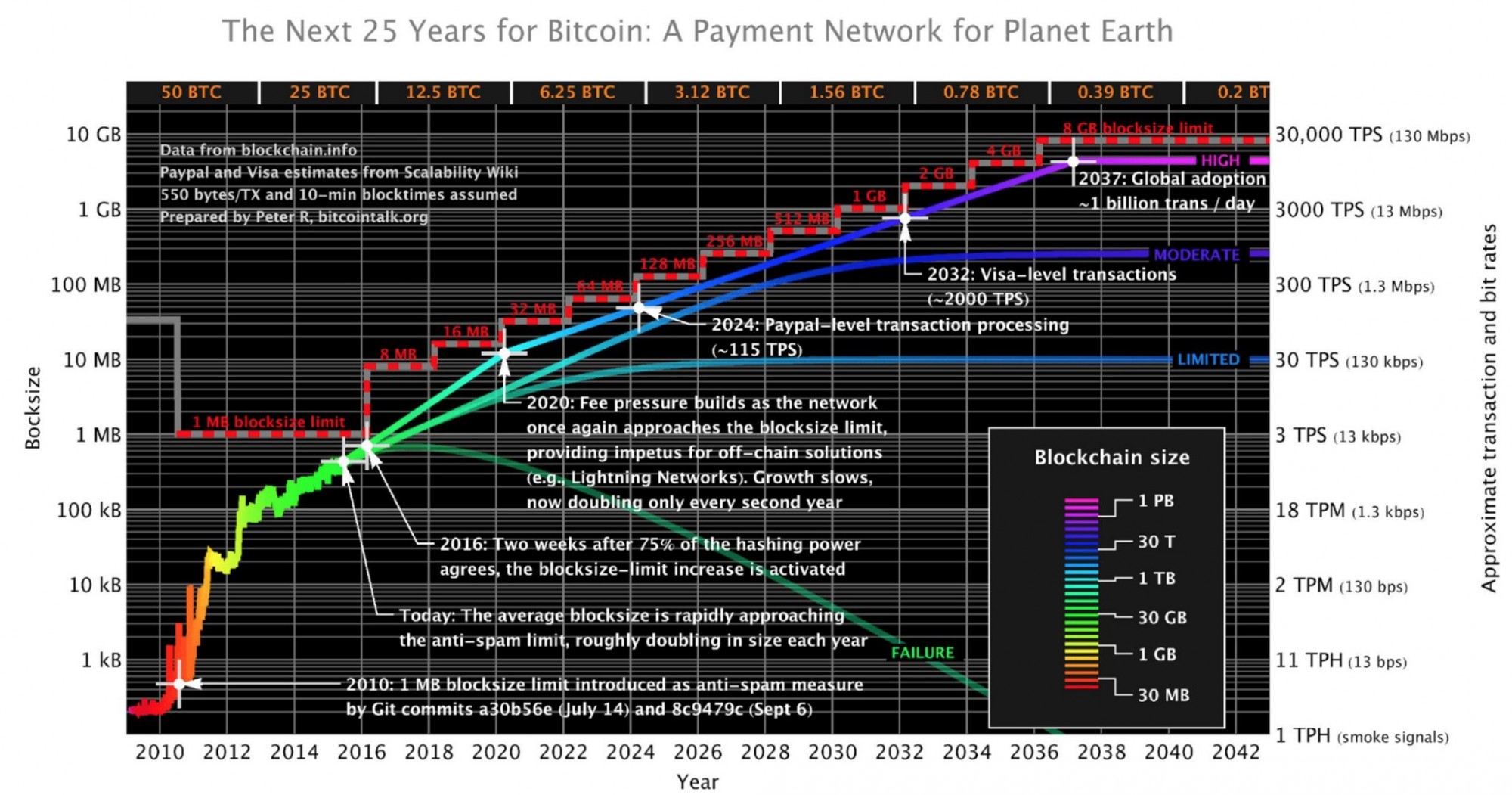
A Healthy Amount of Speculation is Important for Moving Bitcoin Cash Forward...
When it comes to r/btc, a lot of people in the Bitcoin Cash community don't seem to care about price at all when it comes to Bitcoin Cash. Just today, it lost a crazy amount of value, and is now worth less than Ethereum. The general community seems to be nonchalant over this, which is extremely worrying as the price matters A LOT when it comes to Bitcoin Cash. I'm not an SoV proponent, but yes, price 100% matters, and the direction this community is taking by focusing purely on utility is disappointing.
Let's be real: people aren't into Bitcoin Cash purely for being a medium of exchange, but they're also bullish on it, which is why they hold it as well instead of only spending. If we want BCH to succeed, we still need to see what outsiders think of it, and what we can do to change their perspective on Bitcoin Cash. Just to gauge an idea of what people think about Bitcoin Cash, I'll show a few examples of outsiders' views on Bitcoin Cash (specifically those who aren't just BTC maximalists).
One of the first examples I will be taking a look at is a video by Coin Bureau. Overall, he does not seem to have a positive view of Bitcoin Cash, and is skeptical of it, despite seeing its use-case:
Most people will look at the transactions per second, and total transactions on the Bitcoin network, and conclude that it must mean faster tps in general. However, this is just a reflection of the widespread use of the network.
This is true. The more this gap can narrow for Bitcoin and Bitcoin Cash, the easier it will be for Bitcoin Cash to attract the attention of those within the crypto community. They'll be more likely to Bitcoin Cash seriously, and considering its utility, adoption will increase without a doubt.
People are still using [BTC] extensively even if there may be slower transaction times. And the transaction times are indeed slower. I recently made a purchase with Bitcoin Cash and it confirmed almost instantly. A Bitcoin transaction of a similar size took me over 15 minutes. So, the Bitcoin Cash blokes have got that one going for them.
I think this will be solved once people start having issues with fees on Bitcoin, and eventually realize that there are plenty of other cryptocurrencies that provide fast and cheap payments. That time hasn't come, but when it does, we'll only lead in the transaction count and active addresses if we can build some amount of speculation and hype surrounding our coin, so many people are at the very least aware of it and holding it. When adoption increases, there will be people ready to spend Bitcoin Cash on purse.io, and many other websites where Bitcoin Cash is accepted.
The total transactions and throughput is important as it gives us an indication of the widespread adoption of the cryptocurrency in general. Taking a look at these charts, it appears to be quite stark. Despite the higher fees and slower transactions, bitcoin is used overwhelmingly more than Bitcoin Cash. In fact, transactional demand on Bitcoin Cash has been so low relative to Bitcoin that is not even filling up the blocks to the 8 megabyte limit originally set prior to the move to 32 megabytes, so not so great on the adoption front there.
One problem is that people think that the block size limit should only be raised when the network is at full capacity. I think more people should be educated on this topic, and it's important for people to educate others and explain that a network shouldn't be used to maximum capacity. The fact that we're increasing capacity is what matters.
Onto the next metric though network security or more specifically hash power. This is an important metric, as the more hash power there is backing a blockchain, the harder it becomes to run a 51% attack. The long and the short of it is a drop in hash power made it quite cheap to run a 51% attack on rented hash power take a look at those numbers compared to more established chains like Bitcoin and Ethereum and this makes sense if we switch over to the hashpower chart. For Bitcoin, you can see the amount of hashpower supporting it is many multiples of that of Bitcoin cash.
I think this can be clarified as not being as bad as it looks. We all know that the estimated vulnerability is not actually as high as the market perceives it to be. Bitcoin Cash is backed by a lot of hashpower, and there aren't very many financial incentives to 51% attack the network.
Sometimes Bitcoin miners do move over to the Bitcoin cash networks, but given the unique difficulty adjustment algorithm, they move back to the main Bitcoin chain pretty quickly. So on a pure comparison basis, yes Bitcoin cash is cheaper and faster to send. It has wide exchange support, and is backed by some pretty powerful people in crypto. It also has an enthusiastic community that is actively trying to increase its adoption among merchants, yet despite all of this, it's still nowhere near as popular as Bitcoin. The numbers don't lie unfortunately so then the main question is why well because it is not Bitcoin pure and simple. Despite many of its advantages, it's not Bitcoin. There's no denying that the overwhelming interest both from the retail side and from institutional investors is in Bitcoin.
Bitcoin Cash isn't Bitcoin in name, but it is the original idea that people in Bitcoin got into Bitcoin for. It is what made Bitcoin popular as a technology to begin with. I think it's important to realize this. If we don't build a healthy amount of speculation around Bitcoin Cash, it simply is just going to lose its spot in the market. It will eventually be overtaken by other coins, and then the whole "network effect" argument goes out the window. It's clear that Bitcoin Cash is doing something wrong, and that's reflected in the price of it. Despite people desperately pushing for merchant adoption, actual adoption has stagnated, on-chain transactions are at an all time low, and the supposed $200 million fund that was set out to improve Bitcoin Cash infrastructure has gone literally nowhere.
Also, as you can see, the whole DAA issues are brought up here, and so far, I find the progress on fixing Bitcoin Cash's DAA disappointing. Despite there being serious issues with Bitcoin Cash's DAA, and some developers even pointing out how this can be solved, it seems Bitcoin ABC isn't going to actually change ANYTHING in the November hardfork. Their reasoning is the resources required to change the algorithm are not covered by the funding. In my opinion, this isn't a good reason as to why the DAA shouldn't be changed. Bitcoin Cash Node clearly got more than enough funding to generate a study on the current DAA, and they're already coming out with a report in the next few weeks. If BCHN suggests a new DAA, I suggest we implement it, because keeping it is only going to make the price down even further.
Bitcoin Cash does get coverage, and is able to get its message out but it is definitely not as intently watched or followed as Bitcoin. Even when we were approaching the Bitcoin Cash having in April this year, no one was really following it. All eyes were still on the Bitcoin having in May. Here is a chart that shows the tweet volume of Bitcoin versus Bitcoin Cash and Bitcoin. s be pretty stark of course just because Bitcoin gets a lot of airtime it's not something against Bitcoin cash bitcoin gets way more interesting coverage than Ripple or Litecoin, or any of the other old coins, and this is just on the retail investor side. When it comes to the institutional investors, it's quite clear that they know which Bitcoin they want to hold. From legendary stock pickers to large quantifies. From dedicated crypto funds to investment trusts. And on the financial services side, they are lining up to provide solutions around Bitcoin trading or investment. The CME lists Bitcoin futures. Bakkt has Bitcoin options. Fidelity digital investments is offering bitcoin custody. So while Bitcoin Cash can be viewed as most aligned with peer-to-peer digital cash, Bitcoin is still viewed as the gold standard.
The fact that speculation is the reason that more people use Bitcoin should be taken seriously. It just proves that some amount of speculation is necessary for the survival and growth of the coin. So far, it looks like Bitcoin Cash is dying in terms of people interested, and how many people are actually transacting on the network. If our coin is useful already, we should bring in hype/speculation, so when more people get into Bitcoin Cash, they realize its usefulness is commerce and as a way of transferring money.
If we don't bring in ANY speculation, the coin is bound to fail. How are Roger Ver, Jihan Wu, and other strong Bitcoin Cash proponents and advocates not even slightly alarmed/worried about the absolutely abysmal price performance of Bitcoin Cash? Even Bitcoin SV has outperformed Bitcoin Cash in price, and looks to be on pace to overtaking it. Regardless of their view on Craig Wright, what incentive do people have to use Bitcoin SV over Bitcoin Cash? People aren't going to care about the usefulness of Bitcoin Cash in commerce when it only keeps tanking in value. At that point they might as well take credit cards with a slightly higher fee (and almost no volatility).
I remember the crazy Bitcoin and Bitcoin Cash moves that we were experiencing in the run-up to the SegWit2x activation in November of 2017. After the failed activation, Bitcoin started to collapse as Bitcoin cash rallied to over $1,600. Take a look at this chart of Bitcoin cash measured in SATs. Pretty big rally there. **I remember thinking to myself that it was unsustainable and would not last**. Over the rest of the late 2017 and early 2018 bull run Bitcoin cash was quite volatile compared to Bitcoin. However, ever since its May protocol upgrade, Bitcoin cash has been on a downward trend. There were momentary recoveries here and there, but all in all, a pretty bleak outlook.
This already tells you what you need to know about Bitcoin Cash. People are aware of its advantages, and how much more useful it is as a technology, but its usefulness doesn't matter if the price performance has been absolutely terrible, and continues to become worse over time. The price matters as well, and we should also start focusing on that, and try to actually take advantage of the speculative nature of the market since speculation on Bitcoin Cash would actually make sense, seeing as it is great in terms of technology and more people will actually use, as well as join the community. After the people join based on speculation, it will be hard for them to leave as the price rises, and the user experience is great. It can take great advantage of having a network effect.
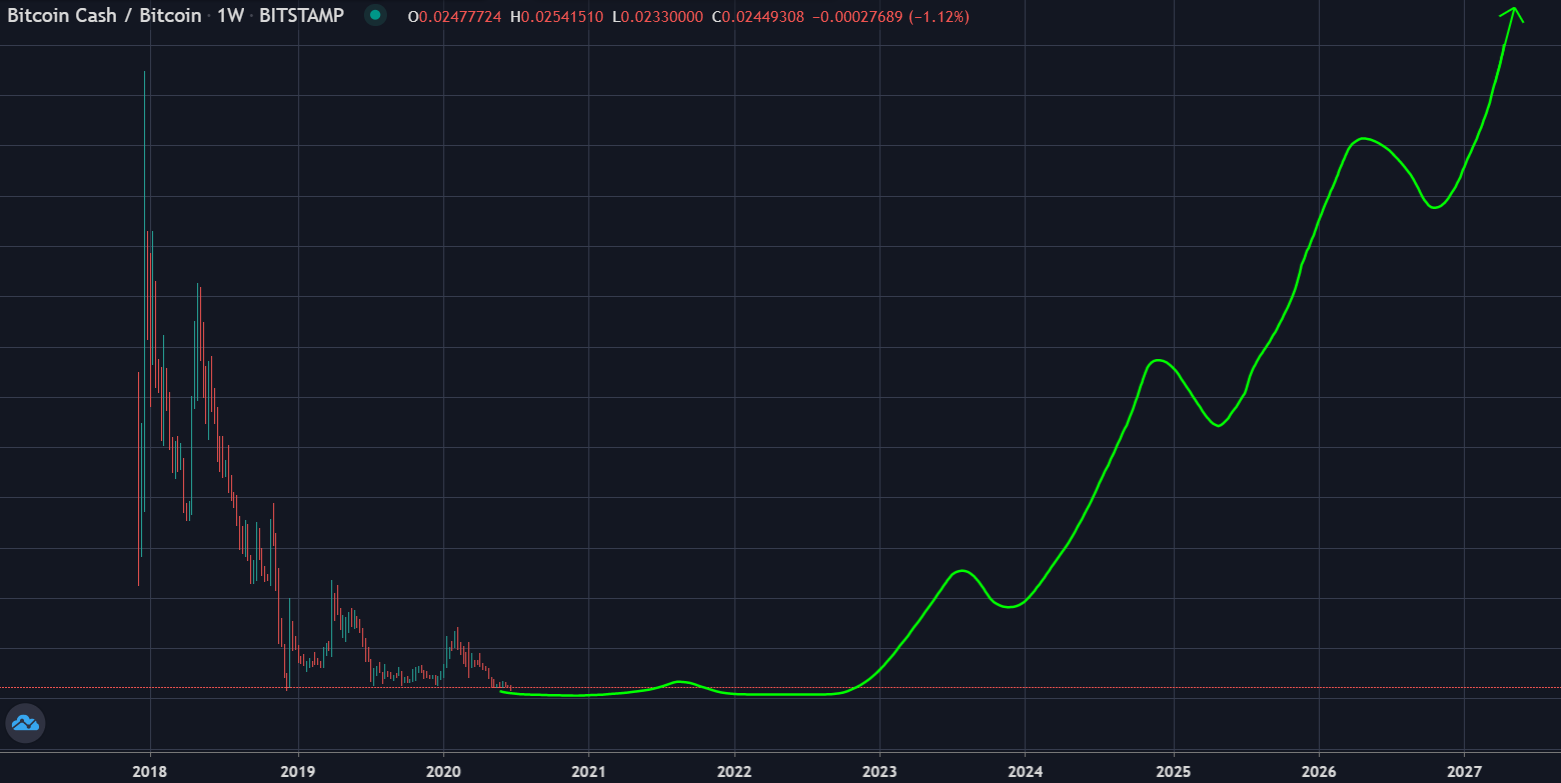
Why A Premature "Fee-Market" is Unsustainable for BTC
One of the many talking points that those in favour of BTC have are that the maximum block size should be intentionally kept low so that a fee market can develop. The reasoning behind this is the fact that transaction fees eventually need to replace the block subsidy. Though the block reward needs to be replaced by fees, I think this line of reasoning is extremely flawed, as a fee-market prematurely introduced gives a bad user experience, and does not sufficiently subsidize block rewards.
Let's take a look at how good the artificial restrictions placed on BTC are at developing a fee market:
- Currently, the average transaction fee is $1.30
- The block reward is currently 6.25 BTC per block (or ~$57,500 as of right now)
- The maximum block size is ~2.0 MB on Bitcoin (if you include SegWit in this figure)
- A block can only take a maximum of ~4,400 transactions, roughly equating to maximum throughput of 7.3 transactions per second
- This means that the maximum possible allowance for transactions per day is around 630,000 transactions
Using these metrics, we can calculate what percentage of the mining reward is covered by transaction fees. Doing some quick calculations at current usage, Bitcoin transaction fees can only subsidize 4.8% of the mining rewards, and this number is just based off of today's fiat value. If the fiat value of Bitcoin goes up, that number is only going to go lower.
For example, let's say Bitcoin somehow manages to enter a bullrun to $100,000. Evidently, people won't pay more than $25.00 in transaction fees, and even with that number, fees will only subsidize 14% of the block reward. This is assuming people will be willing to pay such high fees, when the reality is that they won't. Last bullrun has shown that to be the case, and so far, Bitcoin has only managed to be sustainable when the fees were around $2.00. With this in mind, the fee subsidizing drops to 1%. For Bitcoin to be sustainable on a low-volume, high-fee model, fees would need to be tens or even hundreds of dollars for the average transaction.

What Bitcoin Cash urgently needs to become successful in its goal as peer-to-peer electronic cash
When it comes to Bitcoin Cash as a cryptocurrency, the fundamentals are strong, and so far it seems like there are a lot more features coming to it in the future, but there's one thing about Bitcoin Cash that sticks out like a sore thumb: its poor performance as a cryptocurrency in terms of market value and return on investment. At best, active users on the network have stagnated, and adoption has been almost none, despite all the effort and resources put into trying to make Bitcoin Cash succeed. More interestingly, despite being far better in terms of innovation and user experience, Bitcoin Cash hasn't managed to gain any traction at all, and in fact seems to only be going down in value relative to Bitcoin.
Let's be honest: While price isn't everything, **it matters a whole lot more** than the Bitcoin Cash community would like to admit. When the price of Bitcoin Cash goes up, the hashrate also goes up as securing the network becomes more profitable, making it less prone to 51% attacks. The price is extremely important to BCH's value as a currency, but the primary goal is becoming peer-to-peer cash for the world, so to start things off, here's my list:
**Completely erase all traces of the IFP, including the dead code, and make it 100% clear that there will NEVER be a reactivation or attempt to reactivate it**
Regardless of the IFP being cancelled, the code supporting it should be removed from it, even if that code isn't being activated, or there are no plans to activate it in the future. If it is completely cancelled, there should be NO reason for it to still exist. It is extremely unfair that 12.5% of what a miner produces from a block reward (their property) goes towards funding development. From the perspective of a miner, why would anyone mine a chain in which a big amount of their profit goes towards people who didn't put in the labour or bear the expenses of creating a block? From this perspective, both Bitcoin and Bitcoin SV are far more economically viable to mine.
Regardless of your view as someone who is a part of the Bitcoin Cash community on whether the IFP is good or not, it's clear that other people within the crypto community see it as a bad thing for BCH, and rightfully so. We don't want to just appeal to Bitcoin Cash supporters. We also want to appeal to those outside of the Bitcoin Cash community. Developers shouldn't be given money and resources for free just because they're developers.
One of the main talking points in favour of the IFP is the question about how developers will get a consistent stream of income/funding for infrastructure development. I think this argument is extremely flawed, because it makes the assumption that consistent funds (also acquired for free) will help for infrastructure development when that's not necessarily the case (and in fact, quite the opposite). In fact, I think the fact that developers are not getting constant, guaranteed funding is what will help bring value to the Bitcoin Cash ecosystem.
If developers are not guaranteed funding, their only source of funding are investors who donate money based on how they feel about development, so funding completely relies on providing value to those within the ecosystem, rather than being guaranteed "donations" regardless of their performance as developers. If people are happy with the value you bring to development, they won't have an issue with giving you more money to support you.
**Replace the difficulty adjustment algorithm ASAP**
I've already made a post about this on Reddit, but I feel like it is **extremely** important for the future of Bitcoin Cash. With the current difficulty adjustment algorithm in place, confirmation times are extremely inconsistent and "loyal" miners are punished for helping to secure the network regardless of profitability. Not only does this strongly discourage miners from persistently supporting the chain, but it also makes it extremely easy for people who are opposed to Bitcoin Cash, and those who are following normal, profit-seeking incentives to take advantage of the system at the expense of network reliability and user experience. The longer this is in place, the longer Bitcoin Cash is going to bleed a slow and painful death.
**Completely remove the 50 chained unconfirmed transaction output limit, or significantly raise the limit to the point where there is no effective limit**
The 50 unconfirmed transaction output limit is an artificial bottleneck placed to discourage "spam" on the blockchain. The problem with this limit is that it prevents businesses from making efficient transactions on the blockchain, and ultimately kills the utility of Bitcoin Cash as a payment system. Businesses ultimately need to make payments with multiple outputs if they're paying employees, and if there is an extremely limited chained transaction limit, this discourages businesses in using Bitcoin Cash for payments.
Not too long ago, SatoshiDice, a business that has operated on Bitcoin for several years has had issues with this limit imposed on Bitcoin Cash. Some people are saying that developers "shouldn't be forced to work for free" to lift this limit, but I don't think funding is needed in order to remove this limit. In fact, I think this will be good for BCH, and therefore increase the value of the network, indirectly benefitting developers for raising this limit. SatoshiDice has already said that they're thinking of stopping business with Bitcoin Cash since this limit is getting in the way of them doing business. If people can't do business with Bitcoin Cash, they won't.
**Lift the 2MB soft limit put on blocksize**
The entire point of Bitcoin was to be able to scale on-chain through increasing the blocksize limit when the network needs it, and congestion is taking place. If our entire argument is that increasing the blocksize limit will allow for more throughput, and can be done efficiently, there should be no reason for a 2MB soft limit to be put into place, because then that just proves that Bitcoin can scale far better than Bitcoin Cash without even increasing the blocksize limit. If there is a limit of 2MB per block, that means the maximum throughput it can handle right now is less than that of BTC, which defeats the purpose of why Bitcoin Cash exists to begin with.
**The price needs to increase to a point where Bitcoin Cash can be taken seriously**
If I'm being 100% honest, Bitcoin Cash has a lot to worry about when it comes to price. It has been losing value to both Bitcoin itself and fiat currency, and NOT shown a single sign of going up anytime soon. As an investment for advancing the future of our economy, and bringing economic freedom to people all over the world, it has faired VERY poorly. Yes, its primary use is not as a store of value, but being a store of value is ALSO extremely important if you want people to take Bitcoin Cash seriously.
Why would anyone invest in a currency that is not only extremely volatile, but has also consistently lost value without any signs of going up in the future? Anyone who has seen the price crash that Bitcoin Cash has faced will think that the community is delusional for even thinking about the possibility of a "flippening" taking place, and you can't blame them. Bitcoin Cash has lost 88% of its value to Bitcoin since the split occurred in 2017. Why would anyone in their right mind invest in it, when they're extremely likely to lose money rather than gain it, even over a longer period of time? If the price manages to even go up to 0.15 BTC, people are much more likely to take Bitcoin Cash seriously.
**As a community, we need to go onto r/CryptoCurrency, and ACTIVELY debunk all the FUD, myths, and lies about Bitcoin Cash**
I think this one is one of the most important things about Bitcoin Cash's survival. Currently, the crypto community's view on Bitcoin Cash is extremely negative, and Bitcoin Cash is mocked for being a "shitcoin" or "scam". It is our job to educate others, and tell them the truth with irrefutable evidence so people can change their minds and be more open to it.
As far as Bitcoin Cash's future is concerned, I am extremely worried, and it looks like it's on the path to failure if things keep going the way they're going. I'm not a "concerned troll". I very much want it to succeed, but I'm getting more and more doubtful by the day. If Bitcoin Cash splits again in the future, or the IFP activates, I will drop all support for it, and go towards another project like Monero, Nano, or Ethereum. I hope we can all work together and make progress towards improving the community image of Bitcoin Cash, and its success as a cryptocurrency.
How Bitcoin Cash Can Get in the Spotlight Again
Bitcoin Cash has got a lot going for it, but unfortunately, it seems like the market doesn't realize the full value of utility yet, and if we can get the market to realize the full value of utility for a crypto, that is enough to drive Bitcoin Cash forward. In my perspective on what exactly needs to happen so that it can be successful as a crypto:
To start with, the price action of Bitcoin Cash seems to be fairly dead, and going nowhere in terms of volatility, because a lot of people lost faith in it after the price crash of 2018. For people to get faith back into Bitcoin Cash, a slow, but steady rise needs to occur in value relative to BTC. This rise should take BCH's value steadily from 0.025 BTC to 0.1 BTC within the span of ~10-12 months. This averages to 0.38% per day, and at the current price of BCH, that's only about $0.92, which isn't ridiculously high.
During this time of the next hardfork upgrade, the IFP should be implemented as purely voluntary with 'opting out' as default, giving users the ability to opt in. The IFP itself is very controversial, and therefore shouldn't be imposed or forced on the community. On top of this, the chained transaction limit should be completely removed, or placed with a MUCH higher limit like ~500 transactions.
Eventually because of the price rise, Bitcoin Cash will naturally get media attention. This should be used as much as possible to promote Bitcoin Cash as peer-to-peer cash, and when Bitcoin Cash is trending, big websites that are pro-BCH should put articles explaining what ACTUALLY happened, and why Bitcoin Cash is 'the real Bitcoin'. Especially websites like bitcoin.com should make an article titled 'Why does bitcoin.com support Bitcoin Cash?', explain concisely what exactly happened to Bitcoin, and the fact that the project got hijacked. To make sure that opposing parties can't call it propaganda, the article should state every single source for every single claim to the point where it is irrefutable, and the only "argument" the opposition can make is "this article is propaganda", but not have any evidence to back such a claim. https://bitcoin.com https://Bitcoin.com
When this bull-run happens, the last step would be for Bitcoin Cash to get bigger than Bitcoin, and then eventually get the Bitcoin name with it.
Since the markets right now are EXTREMELY price focused, rather than caring about the fundamental differences between Bitcoin and Bitcoin Cash, a price movement is absolutely necessary to ensure the survival of Bitcoin Cash. Yes fundamentals may be important, but if we want to get more market share, we need to have the price pump up in some way or another. We need to completely fade any criticisms about Bitcoin Cash.
Bitcoin Cash is a scam? Provide the real information in such a way that the masses can access it, and understand what actually happened to Bitcoin. The confirmation times are off? Change the difficulty adjustment algorithm to ensure that confirmation times are more consistent. Bitcoin Cash is a small minority hashrate? Change the difficulty adjustment algorithm so that 'gaming' it is less profitable, and 'loyal/persistent' mining is encouraged through more consistent profitability. This will incentivize more miners that are already in support of Bitcoin Cash, to use the "greedy" strategy less frequently. Bitcoin Cash has crashed in price and will never recover? The price can be made to go up based on the previous metrics.
Let's try to focus on somehow making the price go up, even though the fundamentals are important too. The reason I say this is because if people can speculate, and then buy Bitcoin Cash, there is a high chance of them getting interested in the fundamentals too. The speculative nature of the market can be taken advantage of, and then those who purely speculate can eventually learn fundamentals too, further increasing the credibility of BCH.
Bitcoin vs Bitcoin Cash Transaction Fees (High Transaction Throughputs)
Source
A lot of people claim that the only reason Bitcoin Cash is cheap is because nobody uses it, and no transactions happen on it. I did my own research, and using **bitinfocharts.com** (a very useful website for cryptocurrency statistics), I compiled the transaction fees when Bitcoin and Bitcoin Cash were experiencing similar transaction volumes (amounts), and from the data, it is clear that Bitcoin Cash functions **far better** at transferring money. The craziest part about this is the fact that the Bitcoin Cash transactions would confirm in the next block, giving relatively fast transactions, while Bitcoin itself had confirmation times up to hundreds of minutes, and still is very slow to this day. I just saw a thread earlier today where someone wanted to make a transaction on chain, and they had to pay a 40 cent fee for the Bitcoin to transfer (which took ~3 hours). They only transferred a few dollars, so the transaction was pretty much eaten up by the fees. https://bitinfocharts.com/
Someone made a thread related to these high transaction fees in **r/Bitcoin** back in 2016, and the mods deleted his original post: https://www.reddit.com/r/Bitcoin/
**https://www.reddit.com/r/Bitcoin/comments/48m9xq/average_confirmation_times/**
Another argument I hear supporting Bitcoin is that it is the most secure network, and while that is true at face value, there's more to it than that. People tend to cite **https://howmanyconfs.com/** as the website to support the idea that Bitcoin is the most secure network. The problem is that the security payoff is objectively worse. Bitcoin Cash might be 35x slower to get the equivalent security of the 6 confirmations on Bitcoin, but this completely ignores the fees needed to make such a transaction. If I want a 1 input, 1 output transaction with the same fees as Bitcoin Cash, I would have to wait for 504 blocks (minimum), and the fees would still be higher than that of Bitcoin Cash. After waiting 3.5 days, I think it's safe to say that the Bitcoin Cash transaction is already significantly more secure than the Bitcoin transaction after having 504 confirmations, when the Bitcoin transaction only has 1.
I think it's crazy that despite how much objectively better Bitcoin Cash is when compared to Bitcoin, I've never really seen anyone switch over and start supporting Bitcoin Cash instead of Bitcoin (mostly for price and speculative reasons).

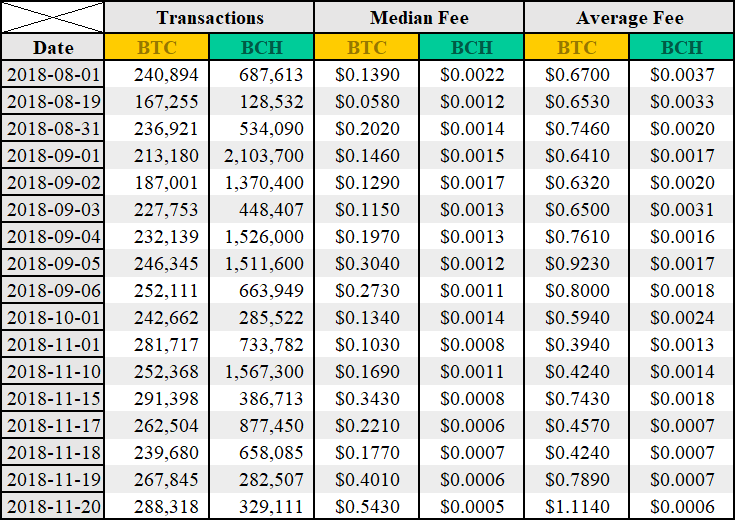
 @IMightBeAPenguin