Kryll Trading Bot
Kryll is a signal marketplace and advanced trading bot that can help you boost your market responsiveness. The platform combines proprietary technologies with exclusive features to offer new and institutional investors automated trading options.
What Issues Does Kryll Try to Solve?
The Kryll trading bot addresses a few of the most pressing issues that traders are currently facing. For starters, it frees up your time and allows you to keep up with market developments without being glued to your phone or computer. The market changes rapidly, and in a normal trading situation, you must keep track of these changes to avoid incurring excessive losses. These problems can be avoided by using a trading bot like Kryll.
**Hardware Restrictions**
Functional and hardware obstacles are another significant issue that Kryll is designed to solve. The network provides a cloud-based hosting option to ensure that your trading activity is still available. The gui can be used to set up a bot. The rest of the bot's activities are then stored in the cloud. This method saves you money on dedicated hardware and high-speed internet connections.
Benefits of Kryll
Users of Kryll have access to a variety of features that make it suitable for traders. To use the app, you don't need any prior knowledge. You can also make your strategy easier by using the follow-trade features available.
**Flexible Bot Setup**
Kryll provides a wide range of trading tools to satisfy your investment needs in terms of versatility. Price triggers, candlestick color and pattern analysis, and a variety of technical indicators, such as MACD, ICHIMOKU, Bollinger, and others, can all be used to program the bot to trade.
**Security**
Kryll provides you with a safe trading atmosphere in which to conduct your business. The network includes a sophisticated API to ensure that your exchange connections are safe. The API, in particular, does not necessitate any withdrawal privileges. It also has the ability to exchange tokens directly from a hardware wallet.
**Interoperability**
Kryll bots can be used on a range of common exchanges. Binance, Bittrex, HitBTC, Liquid, Kucoin, Kraken, and FTX are among the exchanges that are sponsored. From one simple gui, you can manage your entire portfolio and trade through all of your favorite exchanges.
How Kryll works
Kryll keeps the bot online by using a network of distributed servers. The network combines a platform with automated trading strategies, enabling everyone to find a stable and efficient crypto trading strategy. Here are some of the platform's strongest features.
**Signals**
Users can earn money by generating and exchanging signals. You can also browse top traders and follow those that match your risk tolerance. New traders would benefit from copy-trading platforms because they allow them to earn while they learn. When you're ready to go solo, you can start offering your services to new traders just starting out.
**Marketplace**
The marketplace serves as a one-stop shop for Kryll traders looking for the best trading signals. Multiple signals can be used to configure your bot. Using the marketplace feature, anyone can rent trading strategies from top traders. You can rent out your strategies to the community once you have the skills.
**Drag’n Drop Editor**
Kryll's configuration page is highly customizable. The framework includes a drag-and-drop programming feature that is much more user-friendly for new traders. You choose the signals you want to use and drag them onto your bot. There is no need for coding.
**Test your Bot**
The bot testing feature is another great feature that traders enjoy. Kryll, unlike the competition, provides users with free backtests. A backtest is where you run your trading scenario under various market conditions in the past to see how you would have done if the bot had been involved. This feature makes it simple to see when adjustments are needed and how those adjustments impact your ROI.
For advanced traders, Kryll has added a ProMode. This feature allows you to use a variety of technical research resources. When used in conjunction with the backtesting tool, experienced traders can benefit greatly from this feature, as it helps them to fine-tune the output of their bots.
**Exchange**
The “Swap” function in Kryll allows you to swap cryptocurrency directly. Swap is useful because it eliminates the need to log into several exchanges in order to execute trades. The Kryll gui allows you to trade directly. This functionality also provides an extra layer of security to your trading by allowing you to use Kryll cold storage features on exchanges.
**KRL token**
The Kryll trading bot ecosystem's native token is KRL. When traders use KRL, they can save money and time. KRL trading pairs deliver better prices than the platform's other options.
How to get Kryll
The first step is to create an account for yourself. It takes about ten minutes to complete the process, and you must have an email address to obtain an approval link. You can start programming your bot once you've registered. The market will give you access to the best trading strategies to use. You can also download the smartphone Dapp once you've found a trader who meets your requirements. The Dapp allows you to keep track of your trading bots' activities on the go using your smartphone or tablet. It's absolutely free to download and install, and it takes less than five minutes.
**Fees**
Kryll has a one-of-a-kind pricing structure. Running a Live Trading strategy, for example, costs a customer 0.033 percent of their current wallet value invested in the strategy per day. These fees, in particular, are paid in KRL. As a result, the platform's native token gains more value as a result of this strategy.
Conclusion
Kryll has a unique collection of features that make it an excellent choice for both new and seasoned traders. For both followers and leaders, the follow-trade feature offers a profitable learning opportunity. It's easy to see why Kryll is one of the most common trading bots available today when you consider these features and the simple drag'n drop gui. More traders are likely to follow this automated protocol because of its advantages and simplified approach, which provide a well-balanced trading experience.
Blockfolio
When you learn more about the crypto markets, you'll find that keeping track of your investments becomes a hassle, or at the very least, a time-consuming endeavour. Hundreds of exchanges and thousands of cryptocurrencies are now available to you. Portfolio trackers are a perfect way to keep track of all of these choices while keeping away from the non-essentials.
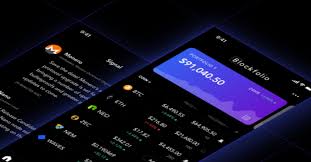
Blockfolio is a Bitcoin and cryptocurrency portfolio tracker that includes charting software, portfolio data, and price updates, among other features. Users may use these tools to find up-and-coming ventures while still keeping track of and maintaining their cryptocurrency investments.
Blockfolio has been a market leader for a long time. The platform incorporates a number of cutting-edge technologies and features that have contributed to its success. Notably, the platform has over 6-million registered active users, making it the world's most popular cryptocurrency tracking app at the moment.
Advantages of Blockfolio
You don't become the best cryptocurrency monitoring software by chance. Blockfolio offers a number of features that make investing easier and help you to stay on top of market trends. The platform has a simple interface that allows everyone to keep track of their portfolio in real time across various exchanges.
**Flexible**
Blockfolio has continuously improved its protocol to provide even more features to make your investment experience more effective. The platform now allows for direct trading of digital properties. You may also trade a large number of tokenized stocks listed on the FTX derivatives exchange. Unfortunately, the latter option is only open to users outside of the United States.
**Free**
Blockfolio is a free app that allows you to trade cryptocurrency and stocks without paying any fees. Because of the network's strong financial backing, you won't be bombarded with commercial banners and pop-ups as you will with other free trackers.
**Selection**
Blockfolio continues to broaden its reach in terms of range. The network is constantly expanding its tracking options by introducing new altcoins and tokenized stocks. The free app can also track fractional shares of tokenized stocks.
**Private**
To begin using Blockfolio, you do not need to register. As a result, no personal information is required to use the site. It is a favourite among privacy-conscious investors because of this approach.
Blockfolio: How it works
Blockfolio is a centralised system that serves its group of users from company servers. Despite its centralization, the risks to users are minimal because you do not provide any personal details to the company. Here are some of the main features that have helped Blockfolio become so popular.
**Tracking Instruments**
The app allows you to quickly monitor the price of over 10,000 coins through 300+ exchanges. You may also choose whether to manage your digital assets using the global average or the pricing of a particular exchange. You can also set time limits to help you develop your skills.
**Cutomizable Coin View**
You can concentrate on the projects that interest you with the customizable coin view. Price Alerts can also be set up to warn you when the price moves. These notifications can be triggered by a percentage of movement, a shift in value, or other important data. Notably, the app allows you to monitor your favourite cryptocurrency using your preferred fiat currency. Blockfolio frees up your day by allowing you to respond to market conditions quickly rather than gazing at your screen.
**Signal**
The Signal functionality on Blockfolio is special in that it is a one-way push notification device. The framework enables projects to submit critical information to investors without the additional noise that can be found on social media sites like Telegram and Discord. This feature currently includes over 300 projects. Zcash, Ark, Augur, Civic, and Neo are several notable cryptos.
**News**
The news tab is yet another useful feature designed to make your life easier. At the click of a button, you can keep up to date on all the most important business trends.
How to Use Blockfolio
After you've downloaded and activated the app, you're ready to start building your portfolio. The monitoring window is the first thing you'll note. The top 49 coins by market capitalization are shown here. You can search these coins and choose which ones to include in your personal portfolio tracker. You can also add coins that aren't on the list.
You must choose the trading pair and the exchange rate to be shown. You may also opt to see the coin's global average. After that, you'll need to specify how many coins you currently possess. You'll need to enter the transaction date for each of your holdings. Finally, press the Save button, and the data will appear in your portfolio.
A small bell will appear next to each of your possessions. The Price Alerts options are accessed by clicking the bell. You can configure your warnings by using percentages, values, and other parameters. You can also choose whether you want the updates to be one-time or on a daily basis.
Final Thoughts
It's also said that trading cryptocurrencies necessitates a level head and a lack of emotion. Blockfolio helps you to keep track of your coins without constantly staring at your screen. The network keeps adding new features and coins at a faster rate than the competition. These factors also aided Blockfolio in securing the top spot.
Airdrops
An airdrop is a marketing stunt in the crypto world in which tokens or coins are sent to blockchain wallets. It's usually done to support a new cryptocurrency or token.
This is generally achieved at no cost to the receiver. This is often done at random, or after an initial promotion of the upcoming airdrop, recipients are explicitly chosen.
Recipients may be asked to do something, such as retweet, to promote the digital asset. During the 2017 crypto coin boom, airdropping became increasingly common.
However, there is a crucial distinction to be made between an airdrop and an ICO (ICO). When an individual contributes money to the project's promotion, it becomes an ICO rather than an airdrop.
They've proved to be an incredibly successful way of supporting digital properties, and they still are. As a result of airdrops, participants are often encouraged to collect more coins or tokens.
This has frequently been shown to have an amplifying effect, with the buzz surrounding a coin or token aiding in the inflating of its value. Airdrops are often used to engender loyalty among participants, with subsequent airdrops distributing more of the asset to those who carry the most.
They also, however, triggered a schism in the crypto group. Since some people now equate airdrops with spam, some social media networks have banned ads advertising them.
Scammers have often taken advantage of their success to set up phoney airdrops in order to rob funds from unwitting participants. To combat this threat, websites like airdrop warning were created, which only lists legitimate coin and token airdrops.
**There are three types of airdrops**
The most popular form of airdrop is a **bounty airdrop**, which is used to promote and raise interest in a new token or coin.
**Holder airdrop:** This is a way of thanking token or coin holders for their loyalty. As a result, a receiver's obligation is to have the token or coin in question at the time of the airdrop.
When a blockchain forks, such as when Bitcoin Cash split from the Bitcoin blockchain in 2017, this is done as a **fork airdrop**. Participants in a fork airdrop would be needed to carry the coin of the pre-split cryptocurrency before obtaining coins of the new forked cryptocurrency.
The first airdrop, in some shape, was in 2010, along with the first Bitcoin faucet. Participants who completed those tasks earned 5 BTC as a reward at the time.
Although this may seem remarkable given how much a Bitcoin is worth today, it was only worth a fraction of that value at the time. Bitcoin Faucets still exist, but the incentives are far less than 5 BTC.
In 2017, Stellar Lumens (XLM) conducted an airdrop with the only stipulation that participants hold Bitcoin. About 19% of the total token supply was distributed. In 2018, another $125 million in XLM was allocated.

BCH vs LTC: The Better Coin
Satoshi Nakamoto suggested a new form of digital asset that would revolutionise value exchange a decade ago. He named it Bitcoin, a decentralised digital currency that is not influenced or regulated by any single individual. Satoshi's dreams became a reality thanks to blockchain technology. The bitcoin network was operated by a decentralised, stable, and open network of trust. Scalability, on the other hand, became a major problem as the network expanded exponentially.
Finding a scalability solution in a decentralised setting is a difficult task. The Blockchain Trilemma, as it is now called, is a challenge for decentralisation, stability, and scalability. It's the problem of coming up with a good solution for one of these features without impacting the other. Perhaps more difficult is reaching agreement on a single solution to the issue.
Any members of the Bitcoin community were foresighted enough to act early on. As a result, alternative cryptocurrencies have arisen. Litecoin was founded in 2011 by Charlie Lee, a Google and Coinbase computer scientist. An altcoin built on the bitcoin code with a few tweaks. With these improvements, it was able to achieve lower transaction fees and quicker transaction times while retaining the same degree of protection as bitcoin.
Bitcoin Cash was founded in 2017 after a controversial hard fork (BCH). It was the outcome of a dispute within the bitcoin community on how to solve Bitcoin's scalability problems. Since the fork's proponents were unable to obtain overwhelming support from the group, the fork was renamed Bitcoin cash. Bitcoin Cash is essentially Bitcoin with larger block sizes and other protocol enhancements. It can now achieve higher transaction bandwidth and lower transaction fees as a result of these improvements.
BCH VS LTC: TEAM COMPARISON
The success of any project depends greatly on the team behind it.
**Bitcoin Cash Team**
Bitcoin Cash team have done two split. First is with Craig Writh. The split was beneficial to the BCH group. It gave the company a chance to distinguish itself from Craig Wright, who rose to prominence after claiming to be Satoshi Nakamoto without evidence. The upgrade also allowed BCH to handle non-cash transactions including smart contracts and oracle prediction services.
The second split was with Amaury Sechet. A fork has done because Amaury wanted to implement a coinbase rule. He didn't succeed on his own plan.
The current BCH team's developmental potential has not been harmed as a result of the split. In reality, this provided BCH with a whole new set of opportunities. Having Roger Ver and Jihan Wu on board almost guarantees further success. The majority of BCH's developers and contributors came from the Bitcoin community. This can serve as a strong predictor of the BCH team's ability to execute.
**Litecoin Team**
The Litecoin Team, on the other hand, has a lot less drama on their side. It has never had to deal with a contentious fork in its eight years of existence. It also didn't see any intra-community strife. Litecoin Team, in my opinion, is a close-knit group. Furthermore, I've noticed that most Litecoin creation projects follow Charlie Lee's lead. This is in addition to the fact that Litecoin tends to serve as a test chain for potential Bitcoin implementations. It earned this reputation as a result of its rapid adoption of Bitcoin-related technologies.
**Winner: Bitcoin Cash**
I went with Bitcoin Cash because I believe it is the more involved and robust of the two teams. Disagreements and dramas are indicators of enthusiastic engagement. It also reflects the Team's and community's deep involvement. This isn't to suggest the Litecoin team isn't dedicated and committed. I'm merely claiming that Bitcoin Cash outperforms them in terms of strength.
Both teams are highly qualified professionals with a track record of success. The popularity of Litecoin and the success of Bitcoin for Bitcoin Cash developers are strong examples of this. They're also supported by some of the most powerful figures in the cryptocurrency world. For Bitcoin Cash, Roger Ver, and Litecoin, Charlie Lee. Furthermore, they have the support of foundations that oversee the construction of each project.
BCH VS LTC: Technogy
**BitcoinCash Technology**
Bitcoin Cash (BCH) is based on the same technology as Bitcoin. In fact, some in the crypto community believe it is a better version of BTC than Satoshi Nakamoto imagined. Bitcoin Cash chose to increase the maximum block size to 8 megabytes, which was later expanded to 32 megabytes. It's 32 times bigger than Bitcoin's and Litecoin's 1 MB blocks. Bitcoin developers, on the other hand, have chosen to support SegWit2x as a scalability solution and seem to be betting on 2nd layer scaling solutions like the Lightning Network.
As a result, Bitcoin Cash will process more transactions in the same period of time as Bitcoin. BCH should be able to do 32x more transactions if all transaction parameters are the same. BCH users don't have to spend as much to have their transactions checked because there is a smaller pool of pending transactions. Apart from that, after its last fork, BCH will be able to conduct smart contracts and oracle services.
**Litecoin Technology**
Since it shares the same codebase as Bitcoin (BTC), one might say that Litecoin (LTC) is also a fork of Bitcoin (BTC). This cryptocurrency, on the other hand, was not the product of a developer feud. Litecoin is a cryptocurrency that aims to be a lighter and faster version of Bitcoin. Between BTC and LTC, there are three main distinctions. To begin with, LTC has a maximum supply of 84 million units versus 21 million for BTC. Second, LTC employs the Scrypt hashing algorithm, while BTC employs SHA-256. Finally, LTC has a 2.5-minute block time, while BTC has a 10-minute block time. Except for Block Size, BTC and BCH have identical specifications.
Litecoin has always served as a beta chain for Bitcoin. In reality, LTC turned on segwit before BTC. It also employs the Lightning Network (LN) as a scalability solution at the second layer. Furthermore, recent LN developments allow atomic swaps between the BTC and LTC networks. By adding Confidential Transaction technology, LTC developers hoped to increase fungibility. Finally, Rootstock would add Litecoin support to add Ethereum-like smart contract features to Litecoin, not to be outdone by Bitcoin Cash.
**Winner: Both**
Similar scaling solutions exist for Bitcoin Cash and Litecoin. Despite their differences, both have shown that they can scale more than Bitcoin. The question of which is better in terms of current and expected technology is still open. Each should balance the other's offer in terms of potential innovations. Both projects' scaling strategies, in my opinion, are feasible.
Bitcoin Cash and Litecoin use similar technology to allow faster transaction times at a fraction of the cost of Bitcoin. In comparison to Bitcoin, which is quickly becoming more of a store of value, this allows them to behave more like a currency. Both are best suited to day-to-day transactions, resulting in a tie.
BCH VS LTC: Utility
The efficacy of Bitcoin Cash and Litecoin as a medium of exchange decides their worth. Simply put, they must be a reliable method of payment for everyday transactions. Their relevance is based on Bitcoin's inability to behave as such. This is due to transaction delay and expense exceeding the average consumer's tolerance threshold. Who wants to wait 10 minutes for a transaction to be completed? Isn't it true that no one wants to pay a $3-10 USD transaction fee for a $1 USD transaction?
**Bitcoin Cash Utility**
Bitcoin Cash (BCH) is a better choice as a payment medium than Bitcoin (BTC). Transactions are handled far more easily and with much less fees. As a result of being able to process more data per block, this is the immediate result. Furthermore, since it uses the same consensus mechanism and hashing algorithm as BTC, BCH provides the same degree of protection. They also have the same 600-second or 10-minute block time. BCH can be compared to BTC's identical twin with a small difference in predisposition.
**Litecoin Utility**
If Bitcoin Cash is the identical twin of Bitcoin, Litecoin (LTC) can be considered their close relative. They all have the same DNA, but Litecoin isn't as similar to Bitcoin as it is to Litecoin. To begin, it expanded its total supply to relieve users of the burden of dealing with decimal numbers. Second, it switched to Scrypt as its hashing algorithm to make it less vulnerable to advanced mining equipment. This acts as a barrier to mining operations being centralised. Finally, relative to BCH and LTC, it has a quicker block time of 150 seconds or 2.5 minutes.
**Winner: Bitcoin Cash**
The winner is Bitcoin Cash, which outperformed Litecoin as a digital currency.
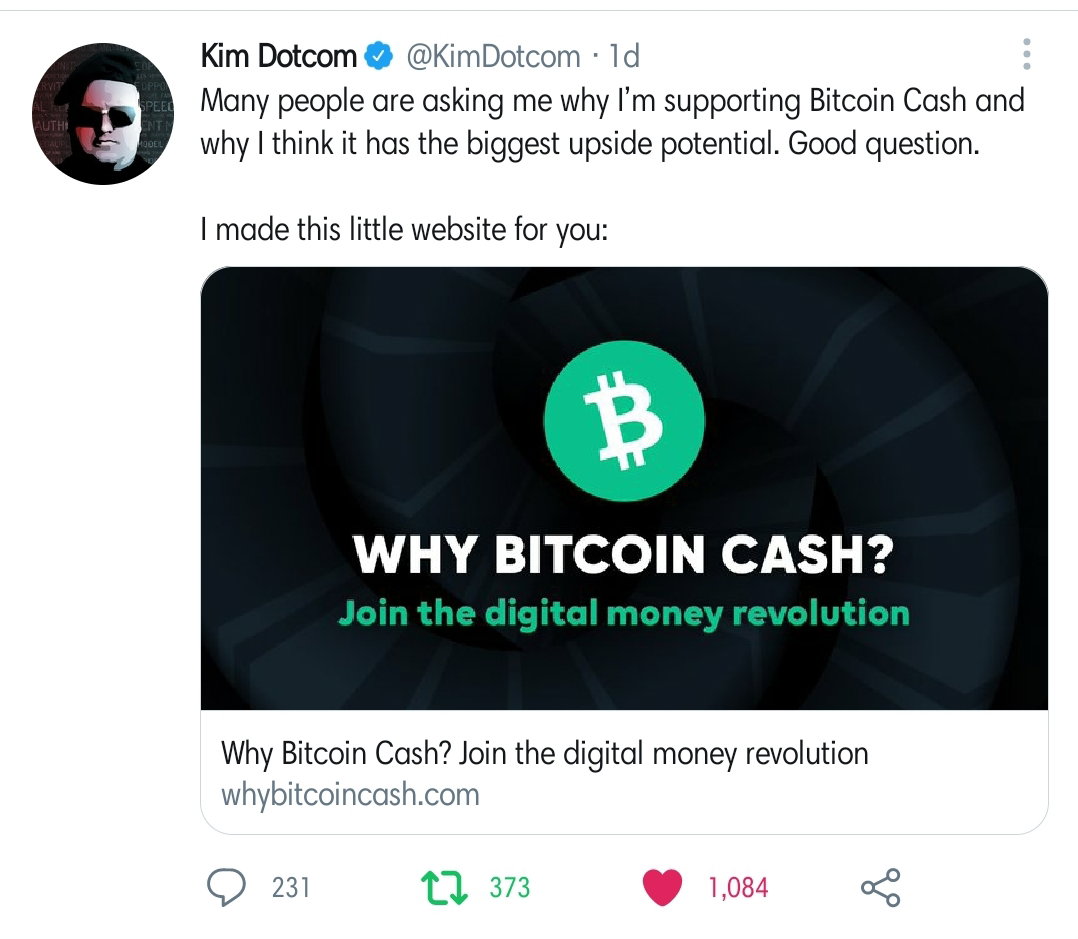
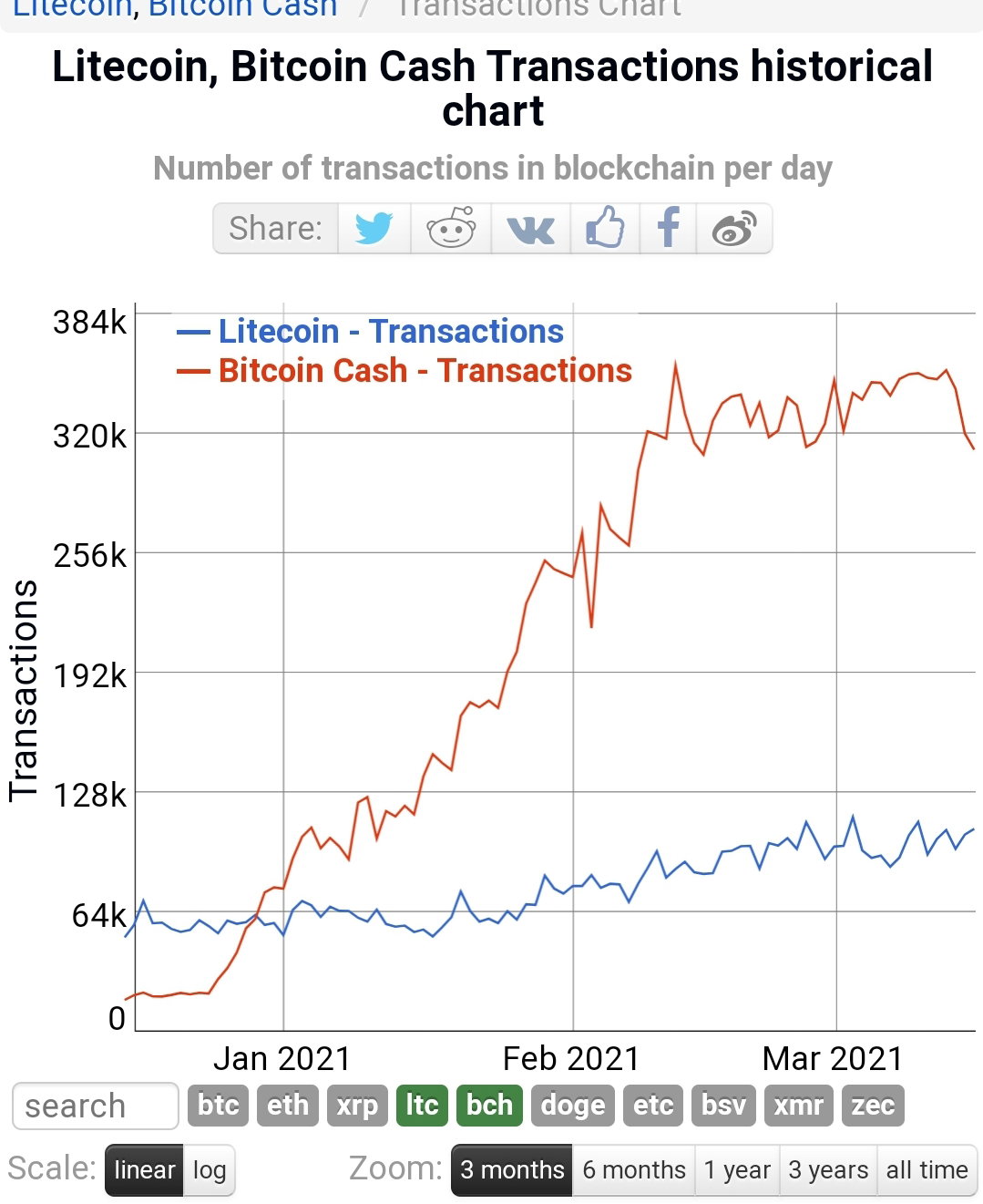
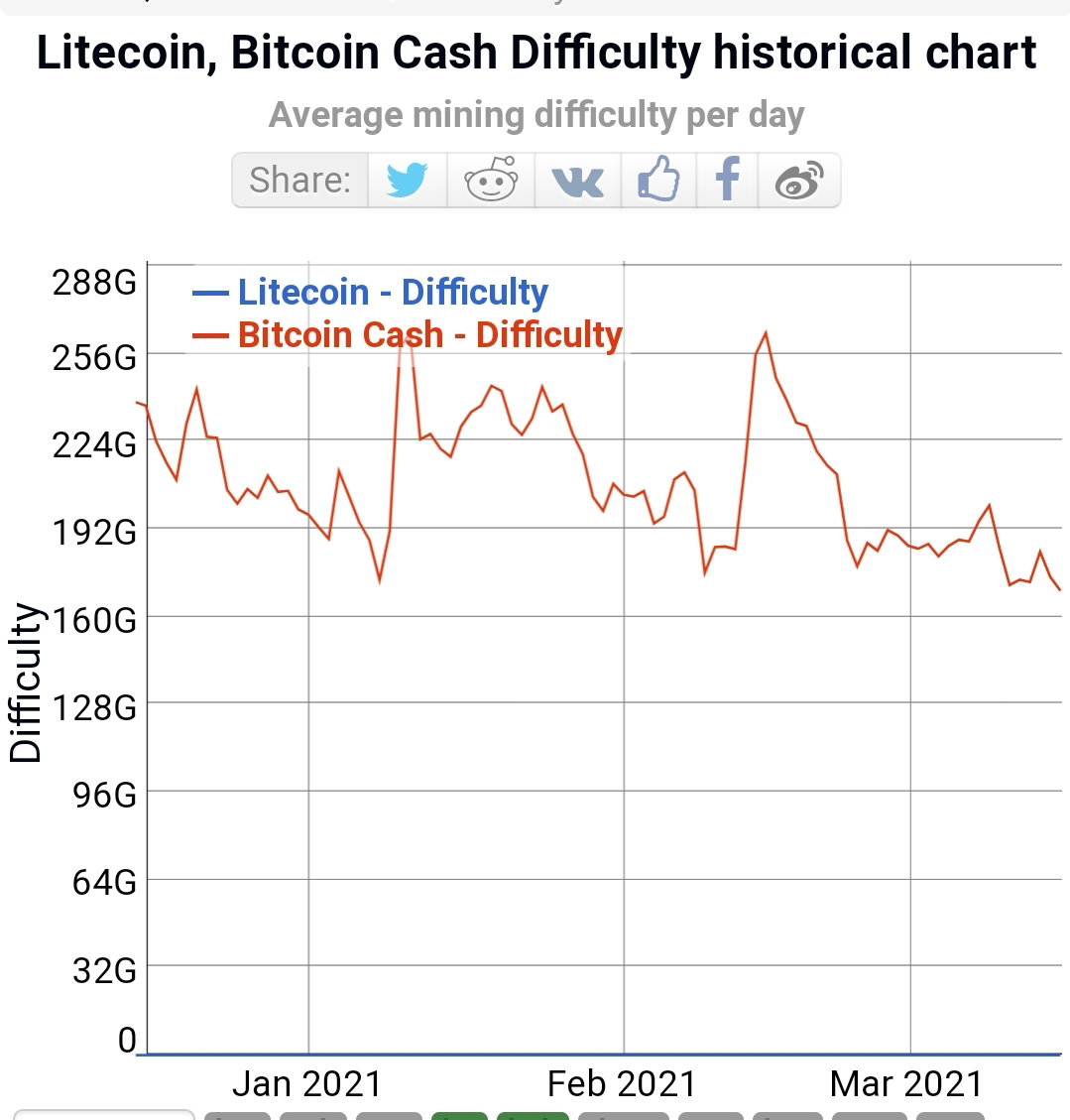
You can clearpy see by the images why I choose Bitcoin Cash as a winner.
The only disadvantage of BCH in this is that its blockchain is considerably larger than LTC's. This can be interpreted as an improvement in BCH's computational load. Despite this, mining difficulty for BCH is increasing, while mining difficulty for LTC is decreasing. This indicates that BCH is attracting more miners than LTC. This leads me to the final reason I choose Bitcoin Cash: it is currently a more stable network. I chose Bitcoin Cash because it was quicker, cheaper, and more safe.
BCH VS LTC: Adoption
Mass adoption is perhaps the most important goal of any cryptocurrency project for its success.
**Bitcoin Cash Adoption**
Being BTC's identical twin has its benefits. BCH is so similar to Bitcoin that it might be called a more scalable variant of Bitcoin. Many crypto-related websites and utilities that accept BTC almost always accept BCH as well. Furthermore, users would find it more appealing to use because it has substantially lower transaction fees and a quicker transaction time. The only big impediment to BCH's further acceptance could be the reluctance of crypto community members to abandon the incumbent chain.
**Litecoin Adoption**
Litecoin has generally been well-received by the bitcoin community. It has adopted a more realistic approach, serving as a backup or test chain for the bitcoin network. This aided in the creation of a peaceful coexistence atmosphere between BTC and LTC. However, LTC's ability to innovate and create its own brand may have been harmed by its lack of competitive drive.
**Winner: Bitcoin Cash**
This round is won by Bitcoin Cash for the following reasons. For starters, it is closely linked to the Bitcoin brand. The name alone makes a big difference, as Bitcoin is the most well-known brand on the planet. This is valid even outside of the cryptosphere. It has also been aggressively positioning itself as a stronger digital currency than the incumbent BTC. This is supported by actual results. As a result, a rising number of people prefer BCH to BTC as a form of digital cash. It's much more so than LTC.
We can see that BCH is gaining more momentum as compared to LTC. We can see that BCH consistently performs more transactions than LTC, and that it does so more quickly and for less money. This is on top of the fact that BCH's overall transaction count is rising higher than LTC's. This simply means that BCH is being used by more people than LTC.
The Clear Winner: Bitcoin Cash
In every way, Bitcoin Cash is currently outperforming Litecoin. Bitcoin Cash is currently gaining traction, and the market is responding positively. Positive changes in terms of alliances, company acquisitions, and protocol updates also seem to indicate that this momentum will continue.
Initial Coin Offering
Currently, there are a plethora of options for attracting project investment. New ones emerge as technology advances. The rapid growth of blockchain technology and cryptocurrencies ushered in a new form of attracting investment: the Initial Coin Offering (ICO).
Initial Coin Offerings (ICOs) are a relatively simple way for blockchain project developers to raise funds; for investors, it's a lucrative (albeit risky) investment tool.
ICO
What does the acronym ICO stand for? An Initial Coin Offering (ICO) is a form of investment attraction that arose as a result of the emergence of cryptocurrencies and is commonly used by blockchain startups. It entails selling a predetermined number of cryptocurrency tokens to buyers. The term comes from the financial term IPO, which stands for Initial Public Offering of Shares. Unlike IPOs, however, ICO investors do not have the same rights as shareholders. Participating in an ICO, in particular, does not entitle the investor to a share of the firm issuing the sale.
The project team sells digital tokens to investors in exchange for cryptocurrencies (usually Bitcoin or Ethereum) or, in rare cases, fiat currency throughout the ICO. These tokens can then be used as an internal currency on the project website or exchanged on cryptocurrency exchanges.
The first ICO, which raised over $5 million for the Mastercoin project in 2013, was one of the most recent fundraising methods. Ethereum, which raised $18.5 million in 2014 and has since produced millions of dollars in profit for its investors, is the most profitable ICO to date.
Whitepaper
A white paper is a text that details the project in great detail. In general, it provides a summary of the project's technological aspects, financial model, development roadmap, development team, and more, in addition to a general description of the project. For projects undertaking an ICO, the presence of a white paper is a kind of norm. It's a marketing tool, in certain respects, to entice potential investors and persuade them of the project's seriousness and potential.
Initial Coin Offering (ICO): how does it work?
ICOs are usually carried out in the following manner:
Developers come up with a product concept that typically involves blockchain technology.
Online magazines, social media networks, and forums are used by the developers to publicise their project. The project is generally just an idea at this stage. Following that, the developers assess the degree of interest in the project among investors.
The developers build a public ICO that outlines the contract's most relevant terms in detail. In order to make the deal, they have establish a legal entity.
Following the posting of the bid on the project's website, a marketing campaign to draw investors begins.
Investors purchase project tokens, which are usually sold on the project's website. Furthermore, developers try to get their token listed on a crypto exchange at this or a later stage of the ICO.
The project developers work on the project according to the roadmap after attracting the necessary amount of investment.
Pre-ICO
A pre-ICO (also known as a pre-sale) is a stage of raising funds for a project prior to the ICO's official launch. The token price is at its lowest during the pre-ICO era, while the risk to investors is at its highest.
Checking a Good ICO
Investing in an initial coin offering (ICO) is a highly lucrative — but often highly risky — type of investment. You should first perform a preliminary review of the ICO to reduce the risk of losing capital. Pay special attention to the following aspects of the ICO you're considering:
**The project's squad**. Learn as much as you can about the project's developers, especially about the team's background, which projects they've worked on previously, and in what capacities.
**Whitepaper**. Examine the project's white paper extensively. Projects without this guide should be avoided at all costs. After reading the white paper, you should have a better understanding of the project's prospects, characteristics, and benefits that set it apart from other projects, among other items. Clear terminology, precise wording, and an appealing, easy-to-understand business model are all positive indicators. A project that seeks to tackle a particular business problem would have a higher chance of succeeding.
**Road map**. A successful project roadmap should outline the phases of funding, including how the project intends to invest the funds raised, the timeline for each stage, and evidence of the feasibility and prospects of its chosen objectives.
**Legal standing (including an officially registered legal entity)**. Make sure there aren't any legal issues with the project.
**Social media and community**. Investigate the big discussion boards to find out what the average investor feels about the idea. Find out how the project is being covered by the media.
**Code quality is important**. The majority of cryptocurrency projects are free and open-source. You should try to evaluate the project code yourself if you have programming experience. The quality of the code will provide an indication of the developers' abilities and how seriously they are taking the project.
**Tokens are listed on the exchange**. If a token is set to be listed soon, particularly on a major crypto exchange, it's a good sign.
**Participants in an initial coin offering (ICO)**. If any major investors have confirmed their involvement in the ICO, it will be useful to know.
Thoughts
Keep in mind that investing in initial coin offerings (ICOs) is extremely risky. Only put money into investments that you can afford to lose.
Initial Exchange Offering
After the Mastercoin project conducted the world's first active Initial Coin Offering (ICO) in July 2013, several blockchain ventures have used this method to raise funds. The ICO fundraising model, on the other hand, has a number of flaws, which has contributed to the creation of alternative tools for cryptocurrency projects to raise funds. The Initial Exchange Offering is one of these relatively modern approaches (IEO). IEOs first appeared in 2019 as a response to investors' the skepticism of initial coin offerings (ICOs). Since then, this form of fundraising has increased in popularity.
Initial Exchange Offering
An Initial Exchange Offering (IEO) is a new way for blockchain companies to raise money, in which the cryptocurrency exchange takes over the task of assessing and choosing ventures and selling tokens. IEOs are, in effect, a new type of ICO, with an exchange serving as a main project partner. The coins are mentioned only a few days after the campaign has ended.
Binance and their IEO website, Binance Launchpad, were the first major exchange to offer an IEO and popularize the practice. Binance launched its first IEO in January 2019, the BitTorrent Tokens (BTT) auction, which sold out in less than 18 minutes and raised more than $7.1 million. The new token was added to Binance's listings a few days later and saw an almost immediate price spike of over eight-fold. The success of BitTorrent's token sale on the most popular cryptocurrency exchange triggered a chain reaction. Other cryptocurrency exchanges also shown an interest in hosting similar asset offerings, and promising blockchain startups have begun to flock to them.
How an Initial Exchange Offering works?
The first steps in conducting an IEO are similar to those in conducting an ICO, with a few notable exceptions. IEOs are usually carried out in the following manner:
1. Developers come up with a blockchain product concept and write a white paper for their venture.
2. They then send an application to the crypto exchange that handles IEOs.
3. Experts from cryptocurrency exchanges assess the white paper, current trends, and the project's future prospects.
4. A date is set for the IEO if they agree.
5. To draw buyers, the cryptocurrency exchange and developers run a marketing campaign.
6. The sale will begin at the scheduled time. The crypto exchange's own token is frequently used to buy the IEO's product.
7. The new coin is added to the list of assets exchanged on the exchange a few days after the IEO.
Phase of verification
Since a crypto exchange's integrity could be harmed if a project turns out to be fraudulent, crypto exchanges usually conduct a comprehensive review of projects. Until agreeing to execute an IEO, reputable crypto exchanges conduct a thorough review of the white paper and other aspects of the project. This greatly decreases the costs to investors as well as the time they spend analyzing the plan on their own.
IEO Benefits and Drawbacks
An Initial Exchange Offering (IEO) is a form of investment with numerous benefits for investors, developers, and crypto exchanges.
Investors are better safeguarded against fraud. The project is being introduced on a cryptocurrency exchange that is conducting a comprehensive investigation into the project's feasibility and potential prospects.
Since the IEO is managed by an exchange, developers don't have to worry about the protection of the token sale. The exchange also manages KYC/AML procedures, reducing the need for developers to deal with them.
The exchange lists new tokens much more quickly. This is one of the most crucial things to remember. With ICOs, there have been several instances where a seemingly successful project received the requisite amount of funding but was not listed on common exchanges for an extended period of time, negatively impacting the popularity and price of the distributed tokens. Some tokens did not begin trading on online exchanges at all, resulting in the failure of ventures and investor losses. For an IEO, this is not the case.
The pace at which you can raise money. During an ICO, the initial distribution of tokens will take anything from a few days to a month. When an IEO is released, a predetermined number of coins are distributed to their owners in a matter of minutes or even seconds. As a result, startups are not left in a state of uncertainty for long periods of time, and investors are not forced to wait weeks for a project to collect the requisite funds.
The demand for the chosen projects' tokens is higher due to their greater durability, and investors benefit much faster.
It is simpler and less expensive for developers to run a marketing campaign, allowing them to concentrate more on the product development.
Crypto exchanges that participate in IEOs benefit from reverse marketing as well as a sizable listing fee.
Unfortunately, there are many drawbacks to this strategy of attracting investment in blockchain startups.
The entry barrier is incredibly high. Starting a project with an IEO is not inexpensive, and it is only open to developers who have some financial resources.
Since exchanges guarantee the viability and potential of projects chosen for an IEO, they lose their credibility if their analysts fail to properly assess the project.
Legal ambiguity exists with IEOs, just as it does with ICOs, which may cast doubt on the projects' prospects.
Potential investors must go through KYC/AML procedures to participate in an IEO, which can discourage some investors.
How to Get Involved in an IEO
As an investor, it's reasonably simple to participate in an IEO.
1. After you've agreed on an IEO to invest in, you'll need to figure out which exchange the token sale will take place on.
2. Sign up for an account on the crypto exchange if you don't already have one.
3. Verify your account and complete the KYC/AML requirements.
4. Determine the cryptocurrencies you can use to participate in the IEO and purchase the required sum.
5. Wait for the IEO to begin before buying tokens. Keep in mind that the tokens for the potential project could sell out quickly.
**Also, keep in mind that, while an IEO is a safer investment option than an ICO, it is still extremely risky. Just invest money that you can afford to lose.**

PlusToken: A Ponzi Scheme
Plus Token
Plus Token was a high-yield investment platform disguised as a cryptocurrency Ponzi scheme. The platform's administrators shut down the service in June of this 2019. The scammers abandoned it by withdrawing over $3 billion in cryptocurrencies (Bitcoin, Ethereum, and EOS) and leaving the message "sorry we have run." This has resulted in an international manhunt for Plus Token's site administrators and developers. Since stolen funds were sold via Bitcoin OTCs, the Plus token has been blamed for causing Bitcoin prices to fall in 2019.
PlusToken had a sizable following in Korea and China, especially among non-cryptocurrency investors. Plus token was a High Yield investment scheme that gave huge incentives to unsuspecting victims in China and Korea in return for their “investment.” The scheme offered monthly returns ranging from 9% to 18%, with larger contributions yielding higher returns. This form of investment is similar to other High Yield investment schemes, such as “Bitconnect,” which went bankrupt in January of 2018.
Plus Token: How it works?
Plus Token is a classic Ponzi scheme that entices naive victims to invest by offering large returns with low initial investments. Plus Token created the appearance of a long-term enterprise by claiming that the funds would be used to build cryptocurrency-related items like the Plus Token Wallet and Exchange. Returns are created, on the other hand, by dividing recent investments to pay off older members. The idea of a long-term business is what qualifies this as a Ponzi Scheme, since victims assume they are investing in a company that produces high profits.
Plus Token had a robust referral program that paid out large incentives to members who referred friends and family to the program. Investors were divided into four “tiers” based on their investment amount and the number of additional referrals they would produce. This meant that the greater the amount of referrals a member made, the higher the reward. Members began referring their friends and family to invest large amounts of money in cryptocurrencies such as Bitcoin, Ethereum, EOS, and Litecoin.
**Payments stopped at June 2019**
The first signs of trouble appeared in June 2019, when users began noticing delays in fund withdrawals. Some users took to the Chinese social media platform "Weibo" to express their dissatisfaction, claiming that they had not received funds despite writing for 35 hours after sending withdrawal requests.
Initially, Plus token blamed the withdrawal delays on "higher miner fees." They reported that 1 sat /byte transactions were sent, causing long delays on the Bitcoin Blockchain. Plus, token supporters zealously encourage their followers to "believe" in the scheme and ignore "false facts."
**"Sorry, we have run"**
As money started to flow, one of the transactions included the note "Sorry, we have run" as a statement. This is self-explanatory – the scammers have begun their exit strategy and have fled the country.
**Arrested Plus Token Members**
According to information from Chinese news outlet CLS on July 30, 2020, the Ministry of Public Security detained 109 people in connection with the PlusToken scheme. This includes all 27 main suspects and another 82 core members suspected of being involved in the scam.
**Plus Token still scamming?**
On April 29, 2020, screenshots of the PlusToken app were circulated on Chinese social media, purporting to be a notification announcing the app's version 3.0 beta launch. The PlusToken team then released a further notice on May 4, 2020, stating that version 3.0 beta will undergo compatibility synchronization and that all transaction functions will be disabled. The note went on to say that once this version is live, some users who qualify would be rewarded. However, it appears that PlusToken's ringleaders are attempting to appease investors by giving them hope that the project will return.
Final thoughts
PlusToken is just the tip of the iceberg, as there are a slew of other crypto Ponzi schemes and scams out there. Cloud Token, S Block, and other cloud "mining" tokens are among them. Tokens that ‘guarantee' high returns without a transparent and auditable business plan should raise red flags, at the end of the day.

Why I choose Brave Browser
Why Brave browser? And not the Chrome browser is a question that can only be resolved once you've downloaded it and tried it out. Protection, speed, incentives, and privacy are the four key reasons for using the Brave browser.
The Brave browser is based on the Chromium framework, a Google-maintained open-source project that also acts as the basis for the Chrome browser. As a result, the Brave browser is compatible with virtually all Chrome extensions.
Brendan Eich, the developer of Javascript and co-founder of the Mozilla browser, co-founded Brave Software, which produces the Brave browser. It is available for desktop, Android, and iOS and is free to use.
Security
Since Chrome is a Google app, it saves user details such as location, logins, and so on. Brave, on the other hand, does not save any information about its users. It also upgrades to https automatically for secure, encrypted communication. This demonstrates that brave is much more safe than chrome.
Speed
Although Chrome is larger (1.8mb) and takes up more space, brave is smaller (1.244mb) and therefore loads faster. It doesn't support banner ads or ad trackers, which makes a website load eight times faster (as claimed by the brave software). The loading time is demonstrated in the video.
While the browser loads faster than Chrome, it is not eight times faster as the company says. The feature that I enjoyed the most about the browser is that you no longer have to see those irritating advertisements when surfing.
Privacy
This is where Brave outperforms chrome by a factor of ten. You can use two types of Private tab windows for it. The first is named New private tab window, and it functions in a similar way to Chrome's incognito window in terms of non-tracking technology. The second is Tor's New Private Window, which renders you totally anonymous or invisible to your ISP, boss, or the website you're visiting.
Rewards
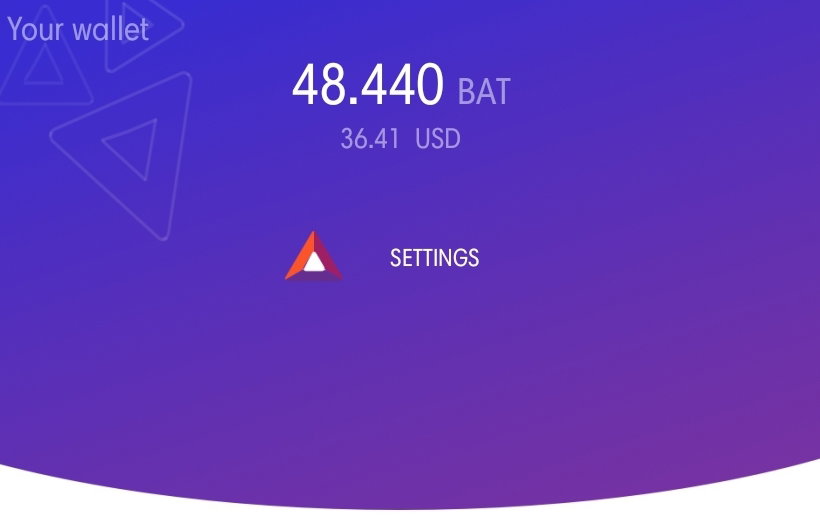
Through its Blockchain-based digital advertising platform, Brave software rewards its users. The native cryptocurrency token, BAT, is used to reward both content creators and their users (Basic Attention Token). Every month, users are also given a free token, which they can use to tip their favorite content creators, such as us.
Conclusion
Finally, I'd like to point out that the Chrome browser keeps you linked to the Google ecosystem at all times. This means you're being watched all the time, which is a serious breach of privacy. We've been avoiding it for quite some time because we've never had a better alternative. Thankfully, the Brave browser is now available.
CEX's vulnerabilities
Many analysts believe that cryptocurrencies have the potential to fundamentally alter not only the financial market, but also the way society functions. The ease with which one can create, manage, store, treat, transact, and account for cryptocurrencies is one of the arguments offered to support this position. Although the rise of Bitcoin and other big cryptocurrencies suggests that the latest digital gold has a position in the digital economy, constant cyber-attacks on cryptocurrency exchanges continue to erode confidence in cryptocurrencies, slowing their growth and adoption.
Several attacks on cryptocurrencies have occurred in recent years. For example, in June 2018, the South Korean cryptocurrency exchange Coinrail announced that it had been hacked. According to Yonhap, a Korean news agency, the hack resulted in losses of 40 billion won (36,9 million U.S. dollars). Coincheck, a Japanese cryptocurrency exchange, was hacked in January 2018, resulting in losses of more than $500 million USD. Youbit, a South Korean exchange, ceased operations and announced bankruptcy in December 2017 after being hacked twice.
Cryptocurrency exchanges must provide robust protocols for detecting and removing information security vulnerabilities to prevent attacks that result in major losses. While post-incident interventions can be successful, they are unlikely to completely eliminate negative consequences.
vulnerabilities of a centralized exchange
**Phishing vulnerability of cryptocurrency exchanges**
Also the most advanced technical safeguards are ineffective against phishing attacks on cryptocurrency exchanges. To give you an example, in 2015, criminals stole around $5 million from the bitcoin exchange Bitstamp as a result of a weeks-long phishing attack. A legitimate organization sent the fraudsters, who interacted with Bitstamp employees via email and Skype and persuaded one of them to download a file that he thought was legitimate. When opened, the attachment contained a malicious VBA script that installed a malicious file on the infected computer.
**Protections for hot wallets aren't present.**
An online cryptocurrency wallet that is linked to the Internet is referred to as a "hot wallet." To secure hot wallets, many cryptocurrency exchanges use single private keys. Criminals who gain access to a single private key may hack the hot wallet to which the private key is linked. Bitfinex (2016) and Parity (2016) are two recent examples of private key attacks (2017). The attacks resulted in damages of 65 million dollars (Bitfinex) and 30 million dollars (Bitfinex) as a result of the attacks (Parity). Using multisignature private keys, cryptocurrency exchanges can easily prevent similar attacks.
**Employee login credentials are not well protected.**
Cryptocurrency exchange employees often use weak passwords or store their login credentials in an insecure manner. As a result, criminals can easily obtain the login credentials. Employee login data were compromised in at least three attacks: BitThumb hack (2017), NiceHash hack (2017), and YouBit hack (2017). (2017). It's worth noting that employees' private computers are occasionally targeted by hackers. As a result, businesses must ensure that workers safeguard login credentials for software applications installed not only on work computers but also on personal computers.
**Vulnerabilities in software**
Various regulations require banks and other financial institutions to enforce data protection measures in order to protect their clients' deposits and prevent unauthorized transactions. However, since the blockchain industry is still in its early stages, a few of these laws extend to cryptocurrency exchanges. As a result, it's no surprise that many cryptocurrency exchanges have security flaws that enable hackers to steal large sums of money.
**Adaptability in transactions**
Blockchain proponents often claim that transactions on the blockchain are highly protected because they are registered on an allegedly immutable ledger. They also overlook the fact that each transaction requires a signature, which can be altered prior to the transaction's completion. The “Mt. Gox” hack, one of the biggest in cryptocurrency history, was carried out by hackers who sent code changes to a public ledger before the initial transactions were posted. The hacked exchange was bankrupted as a result of the attack, which resulted in a loss of 473 million dollars.
Final thoughts
The large number of cyber-attacks mentioned in this post, as well as multiple reports about cryptocurrency exchange security vulnerabilities, demonstrate a pressing social need for blockchain regulation. Governments could, in particular, mandate cryptocurrency exchanges to implement stringent information protection measures to prevent the theft of billions of dollars.

Crypto-to-Crypto Exhange
Crypto-to-crypto exchanges continue to be an important part of the blockchain industry. These platforms allow regular users to trade one type of digital asset for another based on the market value of the assets in question. There has been a demand for these services since the beginning of the cryptomarket. In today's market, there are a number of different crypto-to-crypto exchange protocols.
Centralized Exchanges
The most common type of crypto-to-crypto exchange is centralised exchanges. Users can load funds into network wallets and then trade their holdings via the exchange on these platforms. The majority of centralised exchanges are custodial, which means you must first deposit your assets on the network before trading. The main benefit of a centralised exchange is its ease of use and regulatory certainty.
Decentralized Exchanges
DEXs are the second form of crypto-to-crypto exchange currently in use (decentralized exchanges). Trading operations can be carried out directly from your wallet using these platforms. Since they don't keep huge amounts of users' crypto in network wallets, these networks are more secure against hackers. The disadvantage is that these channels are often unregulated.
What Issues Do Crypto-to-Crypto Exchanges Address?
Crypto-to-crypto exchanges assist with market adoption and growth. Users had to rely on forums and in-person transactions to obtain more cryptocurrency before they entered the market. The market slowed as a result of this strategy because it was too difficult to facilitate trades efficiently in this manner.
**Liquidity**
One of the first advantages that crypto-to-crypto exchanges introduced to the market was liquidity. For the first time, cryptocurrency users could easily locate the coins they wanted and exchange their holdings. Crypto-to-crypto exchanges continue to play an important role today.
**Open Market Access**
Another benefit of crypto-to-crypto exchanges is that they provide open market access. Crypto exchanges are only required to be regulated in most countries if they offer fiat-to-crypto trading pairs. For years, platforms like Binance have avoided offering fiat-to-crypto trading pairs. This decision helped the exchange establish itself as a trustworthy option while also raising public awareness of a number of high-value altcoin projects.
**Credibility**
To make a splash in the market, new ventures need liquidity. This is made possible by crypto-to-crypto exchanges like Uniswap. Users will keep track of new coins to see which projects are gaining traction. Having your token listed is, in most cases, a necessary step in launching a project publicly.
Advantages of crypto-to-crypto exchanges
Users profit greatly from crypto-to-crypto exchanges. When you remember that you had to meet someone in person before adding exchanges, these benefits are obvious. Imagine bringing $30,000 or more to a stranger to buy Bitcoin. If these useful platforms never took off, the market will be in this condition.
**Selection**
These platforms give users access to the entire market's variety. There are now crypto-to-crypto exchanges that allow new ventures to enter without having to pay a large fee. Platforms like Uniswap allow everyone to sell their coins to the general public. IEO was born as a result of this strategy.
**Exit the market**
Crypto-to-crypto exchanges are also useful for traders who want to get out of volatile markets. The advent of safe coins has increased the value of these platforms. Traders who convert their tokens to stablecoins will avoid market downturns. Stablecoins are digital assets whose value is derived from the value of other assets. Most of the time, these properties are fiat currencies like the US dollar.
What Are Crypto-to-Crypto Exchanges and How Do They Work?
Crypto-to-crypto exchanges operate in the same way as traditional stock exchanges do. One cryptocurrency is being exchanged for another. In most cases, these platforms allow for the purchase and sale of coins as well as the conversion of fiat currency into cryptocurrency. Many sites, for example, charge fees when you withdraw money from your account.
**Rate**
The price you pay for your cryptocurrency is determined by the actions of buyers and sellers. Each platform has its own set of fees, restrictions, and options. Your final price is determined by the buy and sell operation on both of these exchanges. The majority of exchanges base their Bitcoin prices on the network's trading volume.
**Trading Pairs**
Different crypto coin swap options are referred to as trading pairs. Trading pairs allow you to benefit from the fluctuating exchange rates of currencies. BTC/LTC or LTC/BTC, and ETH/BTC or BTC/ETH, are two of the most common crypto-to-crypto pairs right now.
Conclusion
Today, it's difficult to imagine a cryptocurrency industry without crypto-to-crypto exchanges. These networks are critical for growth and innovation. As a result, there are no more crypto-to-crypto exchanges than there have been in the past. Each new platform adds to the market's overall value by introducing new features. As a result, crypto-to-crypto exchanges are the industry's lifeblood.

Limit Order
Cryptocurrency trading isn't for the faint of core. Certain strategies would benefit those who have been exchanging digital currencies for a while.
Limit orders are one of the cryptocurrency trading strategies. Limit orders are a critical component of many investors' crypto trading success. When selling, these orders assist investors in keeping track of how much they spend and collect.
So, do you know what limit orders are and how they can be beneficial to you?
Limit order
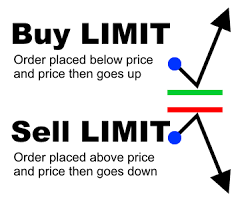
Limit orders are a form of trading order that enables traders to buy or sell cryptocurrencies at a predetermined price or even higher. The maximum price in a limit order is set by an individual cryptocurrency consumer. A trade happens only when the market price is equal to or higher than the specified amount when a cryptocurrency trader places a limit order. When using a buy limit order, a trader can buy at a limit price or a lower price. A trader can only sell at the cap or higher price while selling.
GTC (Good Till Cancelled) and IOC (Instant Till Cancelled) are the two most common forms of limit orders (Immediate or Cancel). During the exchange, GTC orders are left open until they are cancelled or filled by the business participant who obtains the order. IOC orders decrease instantly after the transaction happens, and the trader receives the remaining quantity of the order.
Another form of limit order is FOC (Fill or Kill). The order does not execute until it meets the full sum of the limit order in this case.
Placing a Limit Order and Using it
When putting and using a limit order, you can do the following:
Step 1: Go to your trading platform
You can access your trading platform through the internet. On your smartphone, choose either the trade or the place order tab.
Step 2: Identify the security that is being traded.
Determine which protection you want to place a limit order on. You must determine whether you are selling or buying stock.
Step 3: Set a price limit
Select whether you want to place a buy limit order or a sell limit order. You should not choose an unreasonably high or low stock price. Choose the highest price you're willing to pay for a security when placing a buy limit order. When placing a sale limit order, aim for the smallest amount you're willing to accept for a stock.
Step 4: Choose a Timeframe
Choose a time frame in which the security can reach your limit price. An order can only be made available for one day. If you want to prolong the order's length, use good until cancelled (GTC).
Step 5: Complete and Submit Your Order
Make sure you've defined the protection you'd like to exchange, your maximum price, whether you're buying or selling, and the length of the order. Verify that your information is accurate before submitting your order.
Step 6: Evaluate Your Order
Check your order to see when it has been completed. Check to see if it partially fills.
When Can Limit Orders Be Used?
When a trader is not in a rush, limit orders are the best option. These instructions cannot be carried out immediately. Limit orders save money since they wait for market fees to be low before buying cryptocurrencies.
Other Trade Orders
Crypto traders may use a variety of other strategies in addition to limit orders while trading their cryptocurrencies. Market orders and stop orders are two other common orders.
**Limit Orders vs. Market Orders**
Market orders enable traders to sell or buy cryptocurrencies immediately at the current market price.
Cryptocurrencies sell at whatever the market price is in market orders, whereas limit orders trade when the market price hits the limit price.
Market orders are executed immediately, while cap orders are not.
Another important distinction between market and limit orders is that the latter executes only when the order reaches the specified level. Market orders are often illustrated in the fills panel and can be partially filled at various rates. Limit orders, on the other hand, are stored in order books.
**When Should Market Orders Be Used?**
When you need your order to be executed quickly and don't care about the market price, you can use market orders. When selling a limited number of cryptocurrencies, market orders are also the best option.
When selling a highly liquid stock with a small bid-ask range, use market orders. The disparity between the highest price a buyer is willing to pay for a cryptocurrency and the lowest price a seller is willing to accept for the cryptocurrency is known as the bid-ask spread.
Limit Orders vs. Stop Orders
A stop order is one in which a specific price is defined as the stop price. The transaction request is triggered and executed when the stock hits the future price. Stop orders are divided into three categories: stop cap, stop business, and stop loss.
A stop-limit order executes a cryptocurrency transaction at a predetermined price or a better price. A stop market order, on the other hand, just executes an order for a specific number. When the price of cryptocurrencies falls, a stop-loss order is triggered, and the cryptocurrencies liquidate to prevent the loss.
The distinction between a stop order and a limit order is that a stop order transaction is not open to the market until it is prompted by a request. In comparison to the stop order, the limit order transaction is available to the entire cryptocurrency sector.
Limit orders do not take effect before the stock price hits the specified level, while stop orders may be triggered by short-term fluctuations. Limit orders trade when the market price is equal to or greater than the set price, and stop orders trade when the price moves above the set price.
Limit orders are used by investors to lock in a desired price before the orders exceed their specified sum or a better price. Stop orders, on the other hand, are used by investors to limit their losses.
**When Should Stop Orders Be Used**?
Stop losses are used by cryptocurrency exchangers to limit how much money they can lose on a profitable trade. Stop orders are often used by cryptocurrency traders to purchase assets with the potential to rise in value in the future, resulting in a large profit.
**Final Thoughts**
Trading cryptocurrencies is a complicated operation, but limit orders make it easier. Limit orders are ideal for trading volatile stocks because they safeguard the orders by limiting the price at which they are executed.
Limit orders eliminate the possibility of a trader's orders being executed at a price they don't want. Limit orders do not execute until the selling price is higher or equal to the set price, so traders expect their orders to be filled at a given sum.
Limit orders are clearly effective for crypto trading, as shown by the preceding context. When you're about to make your next crypto deal, why not use limit orders? The best way to go is to place a limit order.
Airdrop: free money from crypto space
There is nothing like "free money" in the business world. There is still something attached to such a stand when you pull it. Even if you can't see it right now, it will eventually manifest and kidnap you.
In the cryptocurrency world, however, "free money," also known as "Airdrops," is very popular, and it comes with no strings attached. However, before the token or coins are distributed to your wallet, you must meet certain conditions in order to be eligible for an airdrop.
As a result, the airdrop is essentially an award that you receive simply for using cryptocurrency. There are some of the requirements:
**Keep a few tokens or coins on hand.**
Some ventures, among other things, will airdrop tokens or coins to users if they are certain that they already own these coins. As a result, they'll conduct their investigation to make sure the consumer qualifies for airdropping. For example, OmiseGo recently distributed OMG tokens to users who had at least 0.1 ETH in their wallets.
This suggests that the free coins will only be given to those who promote the brand. As a result, if you don't use specific tokens, you shouldn't be waiting to obtain or benefit from their airdrop.
Subscribing to Their Platform
A basic requirement for any company is to treat new customers with respect. The way you handle first-time customers will determine whether or not they return to your shop. When it comes to the cryptocurrency space, the same expectations apply.
Airdropping is a method used by various crypto projects to welcome new subscribers on board. When you sign up for the project, you will be given a few tokens to get you started. The tokens are also a way for them to show their appreciation for your participation.
**Newsletter Subscription**
While the subscription to a newsletter and the crypto platform seem to be identical, they are not. When you sign up for their email, however, you might be registered for free tokens or coins.
**Share on Facebook and Twitter**
Almost all nowadays uses social media sites in some way. Using these platforms can provide you with the break you need to sow higher in the crypto room. You're selling your cryptocurrency if you share or write anything about it on social media.
As a result, if those posts catch the attention of the team, you might be the lucky airdrop winner of the day. You can get some by entering the Telegram channel, as well as other channels.
However, the above conditions aren't the only ones that restrict your ability to receive airdrops. Other means of communication are more likely to get you good news. As a result, it is important that you remain cautious and continue to use cryptocurrency. It's possible that you're on the verge of being fortunate and receiving the reward in your pocket.
Planned Airdrop
When you learn of a scheduled airdrop, it means the drop will take place on a specific date and time, and it will be confirmed ahead of time. In order to apply for such airdrops, you must do a few things as a customer.
For example, it could be declared that a user who accumulates a certain number of tokens in a given time would win a certain number of tokens, and so on. As a result, users will become more interested in participating in the contest.
Surprise Airdrops
This sort of airdrop isn't revealed ahead of time, and it involves taking a snapshot of the blockchain. The airdrop will begin with a “hold certain coin/token” with the intention of using the collected Snapchat. The surprise airdrop is primarily intended to benefit users that the project deems eligible. They keep it formal by announcing the dates for formalities and to ensure that all users are included.
The Importance of Airdrops in the Cryptosphere
Despite the fact that many in the fintech industry are unaware of the importance of airdrops, the crypto ventures in question typically profit in the end. What makes you think they wouldn't? Why would a platform offer away tokens rather than sell them for a fee, now that I think about it? There must be some hidden costs associated with an airdrop campaign.
Consider the following:
Decentralization is aided.
In the crypto world, increasing the level of protection for both a network and its users is a top priority. Possibility strengthens the network by connecting hundreds of account holders to PoS validators. Through airdropping a large number of tokens to Ethereum users, currencies have the ability to grow their business.
Boost Your Marketing Efforts
Companies work as hard as they can during Initial Coin Offerings (ICOs) to ensure that they get a larger share of the market. Giving out tokens to random investors is a simple way to do this, particularly for new brands. This would inspire more users to spend, resulting in a substantial rise in the investment rate.
Furthermore, as opposed to conventional commercials, airdrops have a better chance of cutting through the clutter. As a result, using this marketing technique assures the business of increased profit returns in a short period of time.
Increases Customer Satisfaction
It takes more than a bigger brand to gain users' confidence in a company to handle their money. Investors want to know that their money is well spent and that the business will rise to new heights within a given season. Airdrops allow users to learn about different currency tokens on a regular basis.
When you get the tokens for free and can monitor their progress, you'll be enticed to buy more to increase your profit margins. As a result, your trust in that currency will grow, and you will be able to spend significantly more.
Final thoughts
Airdrops can be found all over the crypto world. However, to stop working with the wrong team, it's best to make informed decisions about crypto airdrops. Additionally, if you have any questions about a specific airdrop process, consult the blockchain's website to avoid falling prey to a shady business.

Blockchain on Music Industry
The launch of bitcoin brought blockchain technology into the spotlight for the first time. In the financial industry, the innovation paved the way for creative solutions. Developers found that the technology could be useful in a variety of other fields as time went by. Ethereum's launch provided a forum for crypto developers and enthusiasts to build smart contracts and decentralized applications (dApps) for a variety of industries, including healthcare, food, justice, education, supply chain, and voting, among others.
One of the most unusual applications of blockchain technology is in the music industry. The music industry has risen in value over time, reaching billions of dollars. Despite its enormous progress, the industry is not without its flaws. One of the major problems in the industry is that artists are not paid royalties for their work. Blockchain technology has a number of advantages that will help to improve and revolutionize the industry. So, what role does blockchain play in the music industry?
**Monetization**
In the music industry, the blockchain system can provide a fast and safe way to handle money. Unfortunately, there are many instances of abuse in this vast industry. Artists are financially exploited by record labels, agents, festival promoters, and other third parties.
Even in this modern era, where the music industry has flourished, everybody profits but the artists. The revenue generated by blockchain technology will be transparent and traceable. It would also cut down on payment delays, making it easier for new artists to break into the mainstream music industry.
**Keeping Track of Things**
Blockchain-based record-keeping provides the music industry with secure backup, improved search capabilities, protection, and content control. Blockchain would also aid in the monitoring of sales records, the booking and management of shows, and the tracking of payments. People in the music industry may also use blockchain to store client information.
Typically, each of these tasks necessitates a lengthy process involving several individuals. All of these will be more transparent thanks to blockchain technology, which will save time. The records will be accessible to everyone on the blockchain, which will improve accountability for all parties involved.
**Distribution of music**
The music industry will gain a lot from blockchain technology when it comes to music delivery. The technology has the potential to provide a direct connection between artists and listeners. The blockchain system would eliminate multiple intermediaries that currently control the music industry due to its decentralized design. Industry players may also use the framework to create improved music distribution sites that are both open and inclusive.
The gatekeepers who regulate the majority of streaming make it a costly and time-consuming process to get music on reputable and well-known channels. As a result, blockchain would provide an opportunity for all musicians to showcase their work. It would also and the time it takes for newly released music to reach listeners.
**Smart Contracts**
Contracts are the lifeblood of the music industry. For personal gain, third parties in charge of artists' contracts often extort and prolong the procedures. Smart contracts will be made possible by the adoption of blockchain technology in the industry. Without any middlemen, blockchain can promote, validate, and negotiate contracts for artists. The method would be streamlined as a result of the technology, making it both cheaper and quicker.
Through maintaining records of deals open to all parties, blockchain also prevents contract violations and vulnerabilities built with malicious intent. Blockchain can assist in cleaning up the mischief that exists in certain record labels.
**Obtaining a license**
Licensing is a time-consuming, costly, and often difficult operation. The music industry necessitates a number of permits, which can be time-consuming for both new and established artists. Blockchain technology has the potential to simplify licensing processes and make them more efficient and transparent. Artists would be able to schedule their concerts, record music, and sign labels more easily if the licensing process is simplified.
**Consolidating**
Views, downloads, and streams would be easier to monitor with Blockchain technology. Charts and ratings are often inaccurate since they enable people to gather data from various sites and websites before adding the numbers together. These figures are often used in award shows to judge the success of songs and musicians.
In the music industry, award shows are common, exciting, and important. These ceremonies have been accused of racism in the past and have been shown to be inaccurate at times. Since it provides reliable and precise details for all to see and verify, blockchain can make them free, equal, and transparent.
**Copyright**
Non-affiliated parties that post music on their websites without permission cause substantial damages to copyrighted artists. During concerts, for example, many people record and share, splitting views and interest away from the true copyright owner.
All posts, shares, and actual sales can be tracked on blockchain, making it simple to assert the funds. Furthermore, the device would aid in the tracking and reporting of illicit music practices, thus safeguarding creative intellectual property.
Conclusion
It may take some time for the music industry to completely embrace the blockchain system, owing to the fact that many people profit from the current system's flaws. Some people are taking advantage of the music industry and abusing musicians. Since they stand to lose a lot, they will most likely be at the forefront of resisting and derailing these reforms.
On digital platforms like Spotify, blockchain adoption in the music industry is slowly gaining traction. By streamlining distribution channels, these improvements would undoubtedly favor both artists and consumers/listeners of music.

Mobile Crypto Mining
Crypto mining is a costly investment, as we all know. To start mining Bitcoin in 2020, for example, you'll need to invest in a high-end mining rig that costs upwards of $1000, make sure your energy is cheap, store it in a cool spot, and then link it to a mining pool.
Mining Bitcoin on a smartphone is absolutely impossible. It resembles Ethereum and other common mineable coins in several ways.
But wait, then what was the recent buzz about mining on the mobile? We all know mining is the task of verifying transactions, and as the number of miners increase, it becomes more and more complex to mine. How does one even imagine mining cryptocurrencies on a mobile device? Is it really feasible or financially viable?
Mobile cryptocurrency mining is feasible, but it comes with a long list of disadvantages. In fact, mining with your smartphone pales in comparison to any other type of mining hardware or software. In the current market, doing it on your mobile, at least for the ones at the top, will not yield enough benefit to justify the time and effort.
Crypto mining is widely marketed as a lucrative scheme. “Cryptocurrency mobile mining isn't complicated,” we learn. All you need is a good smartphone and a mining app to get started. The app works in the background when you use your phone, and you get rewarded.” However, the truth is much more complicated.
Mobile cryptocurrency mining isn't worth it, not that today's smartphones aren't powerful enough to mine cryptocurrencies. The key point is that the mining tools used by other miners are much more effective. This means they have a greater chance of winning the prizes, while mobile miners have a lower chance of earning any rewards.
Despite the fact that crypto mining on mobile is not especially profitable, projects arise that cater to potential customers by offering mobile mining. Mobile mining is a marketing technique in which ventures entice consumers by offering incentives in return for no investment. They move on to the next step after capturing a significant number of users. As a consequence, if played correctly, mobile mining can be a short-term successful technique for gaining users.
Several projects are currently available on the market that allow users to mine coins on their mobile devices. It is important to remember that, while they advertise mobile mining, it is not always lucrative and comes with the risk of overloading your phone with more tasks than it can manage.
After finding that there were a lot more mobile mining applications on the Play Store in 2019, Google decided to ban all mining apps due to the detrimental impact they had on smartphones. However, software can still be downloaded from third-party websites. Apple's developer guidelines specifically preclude developers from mining cryptocurrency in the background in iOS and Mac apps. In 2018, Apple effectively removed mining applications from the App Store.
Final thoughts
Mobile mining is unquestionably a profitable practice for new and upcoming ventures aiming to grow their user base. However, the same cannot be said for the mobile miners themselves. Mobile mining apps have the drawback of interfering with the output of your smartphone and, in most cases, causing harm to your computer. What seemed to be an easy way to raise some extra cash could end up causing more expenses in the long run. If you plan on doing cryptocurrency mobile mining with your $1,000 smartphone, you might not be able to make enough money to cover the costs.

Volatility
Cryptocurrency is a great investment tool due to its volatile and unstable nature. Cryptocurrency investments, when used appropriately, can be highly profitable. There are several different forms of cryptocurrencies on the market, and some are more volatile than others. The higher the investment risk, the more unpredictable it is.
The dangers and ambiguity posed by this instability are a big setback, as it makes some people wary of adopting cryptocurrencies. This continuous fluctuation in price and value allows incorporating cryptocurrencies as a medium of exchange in retail markets difficult. So, what is it about the cryptocurrency market that makes it so volatile?
Supply and demand
Demand and supply are not always consistent, and they aren't always predictable. When demand is high and supply is poor, as in a conventional product market, shortage causes prices to increase, and vice versa. Similarly, cryptocurrency rates fluctuate based on supply and demand. When demand grows while supply stays constant, prices rise. The instability of cryptocurrency is compounded by demand fluctuations.
Lack of regulation
Cryptocurrencies, unlike fiat currency, are self-contained and unregulated by the government. When it comes to fiat money, governments mainly maintain its stability by limiting its supply and accessibility. When there is inflation, steps are taken to keep the amount of money in circulation under control. This is easily achieved by raising loan interest rates to prevent people from borrowing, thus reducing the banks' cash flow.
The government also intervenes with necessary interventions in the event of deflation. The absence of such legislation in the cryptocurrency industry creates a lot of confusion and opportunities. As a result, cryptocurrencies are highly unpredictable, as their value fluctuates rapidly and without control.
Speculation
The trading industry is entirely based on public speculative activity. When people anticipate a drop in the value of a cryptocurrency, they try to sell as soon as possible and as much as they can to avoid losses. People are more likely to buy when progressive events and positive changes are expected, resulting in higher demand. This has an impact on market supply and demand. The value of a cryptocurrency will be determined by the number of willing sellers and buyers.
The majority of people rely on the media to keep up with the most recent and likely future status of the cryptocurrencies they care about. As a result, the media is a major source of speculation. If a country or two were to launch CBDCs, for example, the regular cryptocurrencies would be shaken, and such news might encourage cryptocurrency sellers to sell.
Usability and adoption
The more widely used a cryptocurrency is, the more valuable it becomes. The value of cryptocurrencies rises as more companies and businesses express interest in them. Online businesses and firms, for example, have begun to accept cryptocurrency as a form of payment. Such developments always result in an increase in the value of the cryptos that have been approved.
The involvement of well-known companies in specific crypto as a means of exchange completely changes the dynamics by arousing public interest. It's impossible to say which cryptocurrencies will be relevant and widely accepted in the future. This adds to the uncertainty, and cryptocurrencies remain extremely volatile due to the fact that their usability and adoption are constantly changing.
Large shareholders
Some cryptocurrencies are created in such a way that only a small number are produced. This means that a small number of people control a significant portion of the total coin supply. When such large shareholders, also known as whales, make decisions, the market as a whole is affected. If they sell, for example, the market will be flooded, and prices will fall. Furthermore, if they purchase and hoard, the supply would be reduced, causing prices to increase. Furthermore, if powerful people and successful corporations are bigger shareholders of cryptocurrencies, people would be more involved. Since they depend on such influence, cryptocurrencies are extremely volatile.
Scalability
Congestion problems have affected existing blockchain technology, causing delays in transaction processing and authentication. Over the years, the blockchain technology has made tremendous strides in terms of scalability. To make the blockchain framework more effective, there is still work to be done. The cryptocurrency markets are adversely impacted when device problems are not easily resolved. Users and investors who are distrustful of a cryptocurrency will sell it and switch to another digital currency or back to fiat money. Switching has an effect on cryptocurrency rates, making it more unpredictable.
Conclusion
The advantages and drawbacks of cryptocurrency volatility are addressed below. With all of the potential advantages of cryptocurrency adoption, it has yet to be recognised as a mainstream medium of exchange. Aside from trading, most cryptocurrencies are only useful as an investment strategy and a way of storing money. Holding money in the form of cryptocurrency is superior to keeping it in a bank because it is resistant to inflation, political, and economic turmoil.
It's important to comprehend the powers that push cryptocurrency volatility. Only in this way would crypto enthusiasts and investors be able to take advantage of the benefits of digital currencies and learn how to make meaningful income. If more people in the crypto scene may benefit from cryptocurrency uncertainty, there could be an increase in interest, leading to widespread adoption.

The Rabbit and the Turtle: BTC and BCH story
Have you heard about the parable about the race of the rabbit and the turtle? I have multiple times since young up until now.
The parable is about an arrogant rabbit and a hardworking turtle who have a race, and the clear winner should be the rabbit. But because of the rabbit's arrogance and lazing off, the hardworking turtle who didn't give up and continued the race won at the end.
This story taught me that no matter how hard life is, you will come out as a winner on your own race if you persevere.
**So what does this story have to do with BTC and BCH?**
**Am i implying here that BTC is the turtle, and the rabbit is BCH? And the clear winner is BTC?**
Yes! If its parable. 😅
Now, what if the rabbit is fast and hardworking and the turtle is just slow. So who will win?
BTC is the turtle because of its slow transactions but not that hardworking. It laze off since the small blockers didn't agree its blocksize limit. It became stagnant.
Lightning network? Is that an advancement on the network? Those BTC maximalist are still trying to tell that but in reality they didn't even use it by themselves.
We can compare BCH to a hardworking rabbit, its not just fast, but it also has perseverance. Hardworking on a way that Bitcoin Cash has lots of developement (p2p cash, decentalized, low fees, cashfusion, SLP, NFT, uncesorable media, and double spend proofs).
So who is the clear winner now? The turtle or the rabbit?
I'm not intending to ruin the parable. I'm just saying what can be the otherside of the story.
You won't reach a destination, if you're close to innovation. And that's what BTC did.
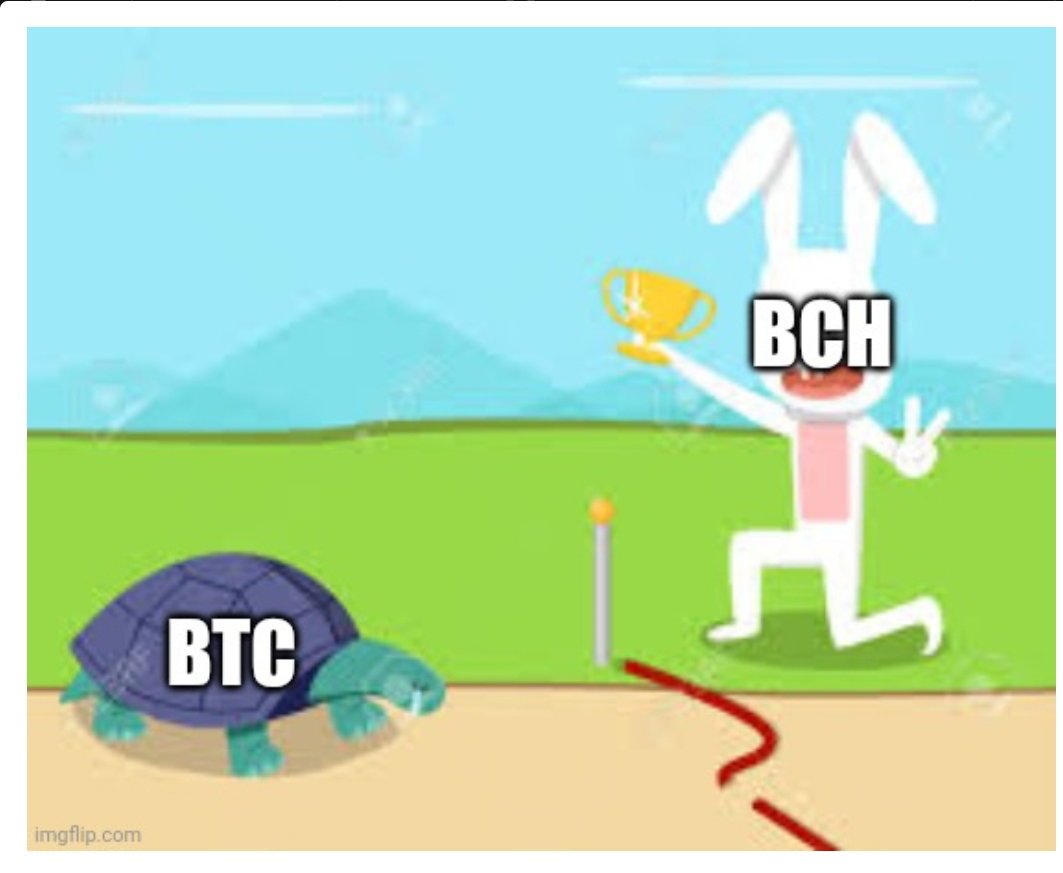
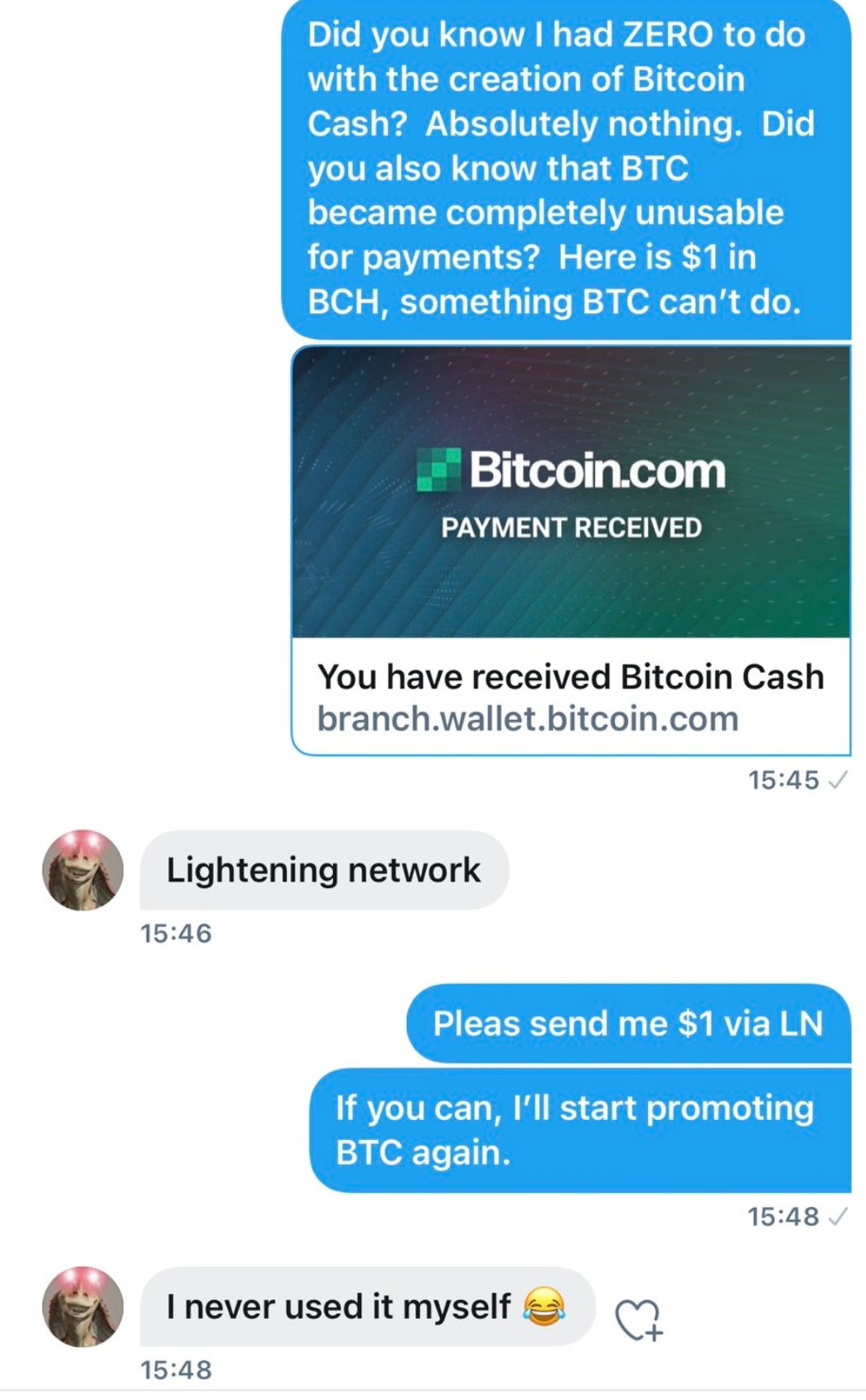
Mutual funds Versus ETFs
Both Mutual Funds and Exchange Traded Funds (ETFs) are available investment vehicles for those seeking to enter the stock market. The two options derive from the diversity of assets and similar strategies by which investors can diversify their portfolios and have a lot in common. Similarly, however, there are major differences and variations between mutual funds and ETFs, especially when it comes to their mode of management.
Mutual funds
In order to invest in shares, mutual funds may simply be described as a financial vehicle consisting of large sums of money collected from multiple investors. These funds are operated by practitioners who distribute the assets of the fund in an attempt to provide investors with dividends or capital gains.
Mutual funds offer investors the ability to access professional-managed stock portfolios such that each shareholder contributes, in turn, a quota to the fund's gains or losses. The output of the securities invested is tracked by adjustments in the fund's overall market cap. Typically, it is obtained as the aggregate production of simple investments.
In simpler terms, mutual funds include investors pooling cash and using the cash to buy securities such as bonds and stocks. At any point in time, the valuation of a mutual fund business is related to the performance of the purchased security asset. In summary, the investor actually buys a portion of the value of the portfolio when a share or unit of a mutual fund is bought.
Though stocks exercise the voting rights of their owners, mutual funds do not. The proportion of an investment in mutual funds does not amount precisely to a single holding, but to various securities. The typical mutual fund holds many different shares, offering shareholders, at a reasonably low price, important variations in their assets. This explains why the net asset value per share is often called the price of a mutual fund, expressed as either (NAV or NAVPS).
**Types**
Depending on the type of securities based on in their respective portfolios and the type of returns on investment (ROI) the companies expect, there are many types of mutual funds. For every investor, there is typically a form of investment. Alternative funds, sector funds, money market funds, target date funds, fund-of-funds, etc. are common forms of mutual funds.
Balanced fund
In order to minimise the risk associated with each asset class, this type of mutual fund is often referred to as an asset allocation fund because it invests in both bonds and stocks. One striking feature of this form of investment is the fact that the distribution of funds between groups remains constant, but the gap between funds would be very glaring. The goal of this style of investment is to obtain ROI but with minimal risk.
Index funds
In the past couple of years, index funds have become increasingly popular and have a strategy based on the assumption that it is very costly and sometimes difficult to beat the market consistently. This form of investment deals with global market indices, such as the S&P500 or the Dow Jones Industrial Average. This method is unconventional and does not require analysts' advice or analysis, and this eliminates the costs borne by shareholders before sharing the benefit.
Fixed-income funds
This category of mutual funds focuses on investments which return a fixed investment amount. Corporate bonds, government bonds, etc. are such investments. Here, the portfolio is certain to produce revenue that is then passed on to the investors. In order to make a profit from the sale, these funds are typically actively managed with the goal of purchasing low and selling higher.
Equity funds
This is the main group of mutual funds and deals mainly with equity investments. Equity funds have subcategories of their own: small, medium or large capital investments. Others are revenue-oriented, aggressive growth, value, etc. They are often known by their foreign equity or domestic stock investments and are based on the growth projections of their invested stocks.
ETFs
ETFs and mutual funds are similar, but ETFs are exchanged like standard stocks and listed on exchanges, unlike the latter. The SPDR S&P 500 ETF is a common example. An example of the instruments ETFs are authorised to contain is bonds, commodities, and stocks, or a mixture of securities. They have rates attached to exchange-traded funds, meaning they can be purchased or sold, making them marketable securities.
If mutual funds are purchased at the end of a trading day, ETFs can be purchased at any time of the day, but at differing rates, as ETF-related securities are exchanged during the day. Due to the various basic assets attached to it, the ETF allows for investment variations.
**Types**
Depending on price volatility, speculation, investor portfolios, etc., ETFs often come in different forms.
ETFs for bonds: These are government, government, local and corporate bonds.
Commodity ETFs: investing in commodities such as gold or crude oil, for example.
Currency ETFs: these are for major currencies such as the euro or the dollar.
Industry ETFs: these track future investment by particular industries such as the financial, agricultural or technical sectors.
Inverse ETFs: this includes earning by selling them at a specific value from falling stocks and anticipating a further market drop in order to repurchase at a much lower price.
It is necessary for investors to remember that Exchange Traded Notes (ETNs) can be confused for ETFs, and whether a specific ETN or ETF, as the case may be, fits into your investment portfolio, the investor should be sure to confirm the broker involved.
Where to invest
ETFs will be safer options over mutual funds for those who prefer low minimum investment amounts, since the former can be bought at market price for as little as $50 depending on the asset purchased. Mutual funds, however, with a NAV of around $100/share, have a minimum investment level of a few thousand dollars.
Mutual funds are preferable for an investor who wishes to have transactions conducted automatically and repeatedly, as automated transfers and withdrawals may be set up according to the desires of the investor, while ETFs, on the other hand, do not afford that ability.
ETFs provide investors with custom order forms based on expectations and market order values to have greater control over the prices of trades being performed. Mutual funds, on the other hand, provide investors at the point of investment with the same price as anyone else.
Mutual funds and ETFs have different advantages and should fit into any trading style selected by any investor. Therefore, considering both of them, especially when starting out, should not be a bad idea. It is important to note, however, that the fees and expenses associated with investing in mutual funds can be very costly, so the cost ratio of both investment options is quite important to consider before committing capital to either of them.
Secondly, both provide unique advantages that the other does not provide and this depends on the trader's choice. For example, even if historical data/price movements are not a guarantee of futuristic prices, traders who love to research historical data to track an asset movement will be inclined to trade ETFs over mutual funds.
Finally, as both alternatives offer diversified investment options, ETFs are used mainly for sector funds, while for total industry funds, mutual funds are the strongest. In summary, depending on the choice, the investment option should be selected.
Elon, You should choose wise
Who doesn’t knew or heard of the name Elon Musk? A man who have risen on top because of perseverance and his intellect.
Well, this article won’t discuss anything about his biography or so whatever. This was intended to open up his thought on joining the Bitcoin cash community.
One of the video of Elon Musk that I’ve watched is that he was talking about cryptocurrency. He said that he sees crypto as is effectively as a replacement for cash.
**So here’s where the question is, “Elon, why dogecoin and bitcoin”?**
We’ve seen a rally in the price of dogecoin as high as 0.08$ after Elon Musk tweeted about it and a rise in the price of Bitcoin when and Tesla bought $1.5b worth of bitcoin.
**Is Dogecoin the replacement you are telling in the video? Or is it Bitcoin?**
Dogecoin started as a meme then became a cryptocurrency. And I think it would never replace fiat. Yes, it runs on proof-of-work consensus mechanism. Its transactions are fast that it takes only 1 minute to process a transaction in the next block. But it was infinite like a cash that the government is printing.
https://twitter.com/DavidShares/status/1364297792978636809?s=09
Bitcoin? I think it would never happen. Bitcoin has long gone its path to be a digital cash. With its high-cost and slow transaction, why would people use it on their daily lives?
Lightning network? Nah. Check this video posted on twitter.
https://twitter.com/be_cashy/status/1364650868042260483?s=09
Choose a crypto that have those good qualities of both dogecoin and bitcoin but without a fallback. **Choose Bitcoin cash.**
Bitcoin cash has long proven that it was meant to be the digital payment system in the world even on mars.
**Security** – proof-of-work, no hack happened before (this is what I knew, correct me if I’m wrong)
**Fast transaction** – you can transfer funds around the world in an instant
**Low-cost** – average median fee is around 0.0026USD at the time of this writing
**Scarce** – with its limited supply of 21M coins, you won’t be worrying about inflation or more like government like schemes.
In the end, people will always choose what will work in their daily lives.
So Elon, choose wisely, choose Bitcoin Cash.
Securing your digital assets
A Bitcoin wallet should be kept safe and secure, much like a physical wallet. Security in the digital world can be daunting, with almost every day a new ransomware breach or hack is published. And while blockchain is recognized in cryptocurrency trading as the ultimate safety mechanism, digital currencies are only as secure as the digital wallet in which they are held.
As well as a piece of hardware, a Bitcoin wallet may be a desktop, tablet, or web app. Nobody can store, send, or receive digital coins without it. In order to understand the key idea behind the wallet, you do not have to go through loads of technical literature: it stores Bitcoins just like your physical wallet stores your cash. Technically, Bitcoin owners have a protected private key that enables them to get access to any wallet-encrypted Bitcoin address.
Returning to the types of a Bitcoin wallet, it should be noted that desktop ones are the most common because they give complete control over it to users
Wallets for smartphone, internet, or hardware also have their pros and cons. Hardware wallets, for example, are considered the most reliable, while web wallets pose some questions about digital money being stored online. And there is restricted functionality for mobile apps to store Bitcoins.
Here are some safety practices that will help to secure your investment in Bitcoin.
Using a wallet that is encrypted
Make sure there is encryption in your Bitcoin wallet. Encryption is a process in which information is transformed into code. The aim of this is to prevent access to it by others. Always use a strong password that's at least 16 characters long and includes letters, numbers and punctuation marks. Don't share it and don't forget it with someone. Bitcoin, unlike banks, has restricted password recovery options.
Two-factor authentication
Using dual authentication adds to your Bitcoin wallet an extra protection layer. In multiple ways, this can be achieved. A 6-digit code is given by the Google Authenticator app that changes by the minute and is unique to the user. Another alternative is to add a fingerprint-like biometric identification step. If you are using your wallet for online purchases, this is especially important.
Store it in cold storage
It is still vulnerable even if you hold digital currencies in a wallet installed on your personal device, since Bitcoin wallet apps usually store data in predictable locations. At least two digital wallets are best kept, one to trade and transact with and the other to store savings. This wallet should be stored in a safe position away from internet access, in what is known as cold storage, which means storing Bitcoin offline.
Be careful of updates
Using the new version of your Bitcoin app allows you to get updates on security and stability that are designed to help keep your wallet secure and avoid all sorts of problems. Many veterans of cryptocurrencies think it's best to turn off auto-updates and wait a few days after publishing an update to see if it has any bugs.
Do scheduled backups
Make regular backups of your private and public keys and hold copies with limited access in various secure locations. This could be on a portable hard drive, a flash drive, an optical disk, or even on paper. You may also store it on a backup system like Dropbox that is cloud-based. Only make sure to encrypt any data you upload to the cloud.
It is possible to keep your Bitcoin investment secure and safe by practicing these security measures.

Bitcoin has failed; Bitcoin cash to the rescue
Imagine Satoshi Nakamoto's face right now seeing his great invention Bitcoin has risen its price. What do you see in your mind?
Is he jumping with joy?
Or sighing with dissapointment?
For me it was the second one. Why? It is because..
Bitcoin has failed to be a digital cash?
Bitcoin was created for only one reason - to be a digital payment system replacing the intermediaton and trust vested on centralised financial institution.
It failed long time ago when small blockers disagreed to increase its blocksize.
**Why it had failed?**
Network congestion happened and caused slow and high-cost transaction.
**A true peer-to-peer digital cash should be:**
**1. Low-cost**
I think the goal to remove third parties in a transaction is also a way to lessen the burden of two parties paying extra fee.
Yes, Bitcoin transaction is secured but with its high transaction fee, it will feel like you are still paying a financial institution.
**2. Fast in transactions**
A simple explanation can be instantly seen on this picture.
Imagine those people are waiting in line at the cashier. Because of Bitcoin's transaction limit at 7tps, you will gonna wait in line for too long making a waste of your time.
A digital cash should be instant because a time that is wasted is a money that is lost.
Bitcoin should be used as a money
Bitcoin is more gaining popularity as an asset for profit, not a digital cash. A very far path where it should be as planned by Mr. Nakamoto.
Don't be upset Mr. Nakamato, Bitcoin Cash got your back
In 2017, a new coin was created, a hard fork from the original wherein its goal is to achieved what the original had failed to do.
Bitcoin Cash was born to solve the scalability issue of Bitcoin.
By increasing the blocksize limit, more transactions can be processed and congestion in the network that is causing higher fees can be solve.
Bitcoin cash was developed in a way a real peer-to-peer electronic cash was meant to be.
**If it meant to be a digital payment, why Bitcoin cash is still too undervalued?**
Bitcoin cash has gone a lot of ups and downs. Many attacks are done to devalue BCH because it is a threat. A threat to their money making scheme they have made.
This attacks was scattered everywhere to all bitcoin cash supporters on twitter.
**They always say that BCH has not increase the transaction fee because its transactions are few.**
We have just flipped bitcoin transactions per day, and the good thing is, median fee is around $0.0016 USD.
**Those transactions are micropayments**
Yes, maybe a lot of this transaction was made because of the platfrom **noise.cash**. But nevertheless of how big or small it is - "a transaction is still a transaction".
And you can look at this, the even big amounts of transactions still have lower fee.
Microtipping also proves that Bitcoin cash is for everyone. Poor or rich, true world use case matters.
**Bitcoin cash is not secured as Bitcoin is**
Name an event where the bitcoin cash network has been hacked. I doubt there is.
Thoughts
A sound money for everyone around the globe should always be fast to transact and do not rob you thru transactions fee. A coin with a true world use case will always come on top in the end.
Mr. Nakamoto will surely give us back a big smile when Bitcoin Cash completes what a Bitcoin should be.
So let us keep supporting each other and promote Bitcoin cash as a digital money for the world.
Ps: Thanks @MarcDeMesel for the generous tip you gave to my last article.
We can have our own Marc
Did you saw the new top tipped article "No, I will not stop telling people "BCH is Bitcoin."
How did you feel?
Motivated?
Jealous?
Or nothing at all?
Read.cash was created to spread bitcoin cash awareness. By writing an creative content, you can earn free bitcoin cash. It will just always depends if you can get the interest of the @TheRandomRewarder or other users on this platform.
I just visited the top tipped article, and found out that mostly of the articles that got tipped is about Bitcoin cash. (Well, this platform is invested and powered by BCH, so there is no argument on that). https://read.cash/?sort=top&duration=year
**So do we need to write all about bitcoin cash?**
*This is not to criticize those users who are writing about Bitcoin Cash (I know who are true and the ones who are just riding the trend).*
The simple answer is "No".
Read.cash was created in a same way like Bitcoin cash.
**No one is control of you** - you can write any topic that you want. No one will dictate what will you write. But remember, just refrain from attacking anyone or using explicit content on your article.
**It is for everyone** - no language barrier means you can use your own dialect to write you own article. Everyone is welcome to use read.cash
We all have our own Marc
On the top tipped articles, I also noticed that there are some articles that got lots of tip from @TheRandomRewarder alone. A glitch? I doubt. Those articles have so lots of views. Maybe the more view you can get, the more the tips you can get from the bot.
This just proves that we can get this too.
We can have our own Marc, big or small, lets appreciate what portion of BCH we can have. This for sure will go to the moon once people realize that **true world use case is way more important than store of value.**
Just write creatively and if lucky, maybe we can get the attention of the tipping bot and other big investors here on read.cash.
Share your experience about read.cash from other platforms. Invite other people to join. Let our stay here on read.cash leave a mark!


Start your BCH journey
If you're beginning to believe that Bitcoin Cash will be the future peer-to-peer digital cash of the world, you might begin with these to guide you.
Wallet.bitcoin.com
Download this wallet and it's totally free https://play.google.com/store/apps/details?id=com.bitcoin.mwallet
This supports Bitcoin Cash (BCH), Bitcoin (BTC) and Tether (USDT).
Local.bitcoin.com
You can buy Bitcoin cash from the wallet above or if you want to avoid fee, use https://local.bitcoin.com/ to directly purchase to other individuals.
Mint.bitcoin.com
This is a super cool feature wherein you can create your own cryptocurrency on top of Bitcoin Cash blockchain. Just avoid naming your coin with organization without their consent.
https://mint.bitcoin.com/#/portfolio
Satoshidice.com
If you want to try your luck, try this https://satoshidice.com/. No sign ups, just roll the dice, and if you win, funds will be automatically sent in to your wallet.
Cloudbet.com
If you are a sporty guy and wanted to support your team and earn, try https://www.cloudbet.com/en/
Free.bitcoin.com
Free Bitcoin Cash? Try https://free.bitcoin.com/ and https://noise.cash/
Purse.io/shop
Online shopping with Bitcoin cash? https://purse.io/shop got you covered and enjoy 15% discounts
Exchange.bitcoin.com
Want to enter trading? Try https://exchange.bitcoin.com/ an exchange with BCH trading.
You may now start your BCH journey. Good luck!
crypto- currency
Satoshi Nakamoto's the Bitcoin whitepaper states that BTC is a peer-to-peer electronic cash. This indicates that BTC was meant to be a digital currency that no one is in control of.
A currency, as defined by investopedia, is a medium of exchange for goods and services.
Yes, Bitcoin can be used for payments in thousands of stores and online platforms. As bitcoin became popular, it became clear that its network can only handle a certain amount of transactions.
Bitcoin network congestion proves that Bitcoin is slow and have higher fees. If you want your transactions to be fast, you need to pay some extra for your transaction to be prioritized by the miner.
**Bitcoin has no true world use case, unless your an idiot.**
For instance, you are eyeing for a certain merchandise for so long and then suddenly it became discounted for 20%. Will you use bitcoin as a payment?
That 20% off would be eaten by the network fee causing you to pay the same price as the original or even causing you to pay more.
One thing more.
Look at the picture above. Imagine those people buying at a store. Will a sane person wait for that long line for too long?
A real cryptocurrency has a true world use case. Anyone should use it for their daily transactions.
So if you still believe that Bitcoin is an electronic cash for the world, better think 1M times.
Btw, thanks sir @MarcDeMesel for my first tip.
Noise.cash true goal
Noise.cash is a microblogging site that is powered by Bitcoin Cash. It is like twitter, but more interesting is, you can earn free BCH.
By staying active with short posts and interacting with other users, you can get free tips from the system. You can now use this free tips to tip other users wherein a percentage of this tips will be given back to you depending of the percentage you set.
Why noise.cash was developed?
At first, the only reason why I think noise.cash was developed by Simon and funded by Marc de Mesel is to make BCH network activity grow.
And yes! We have increased our daily transactions compared to BTC.
But I've realized that this wasn't the true goal of noise.cash when someone on twitter criticized this increased BCH transactions. He said on a post that, "it was just only microtransactions".
**That is when I have thought of two things**
1. noise.cash want to prove the world that Bitcoin Cash has a true world use case
Those little microtransactions only shows that you can use Bitcoin cash on a daily basis. You can pay little amounts without getting robbed on the network transactions fee.
2. noise.cash want to prove that Bitcoin cash having big blocks is way more better
With Bitcoin cash 32mb block size, we can assure that transactions won't be congested on the blockchain, making transactions fast with very minimal fees.
A true cryptoCURRENCY is when you can transact even with little amount.
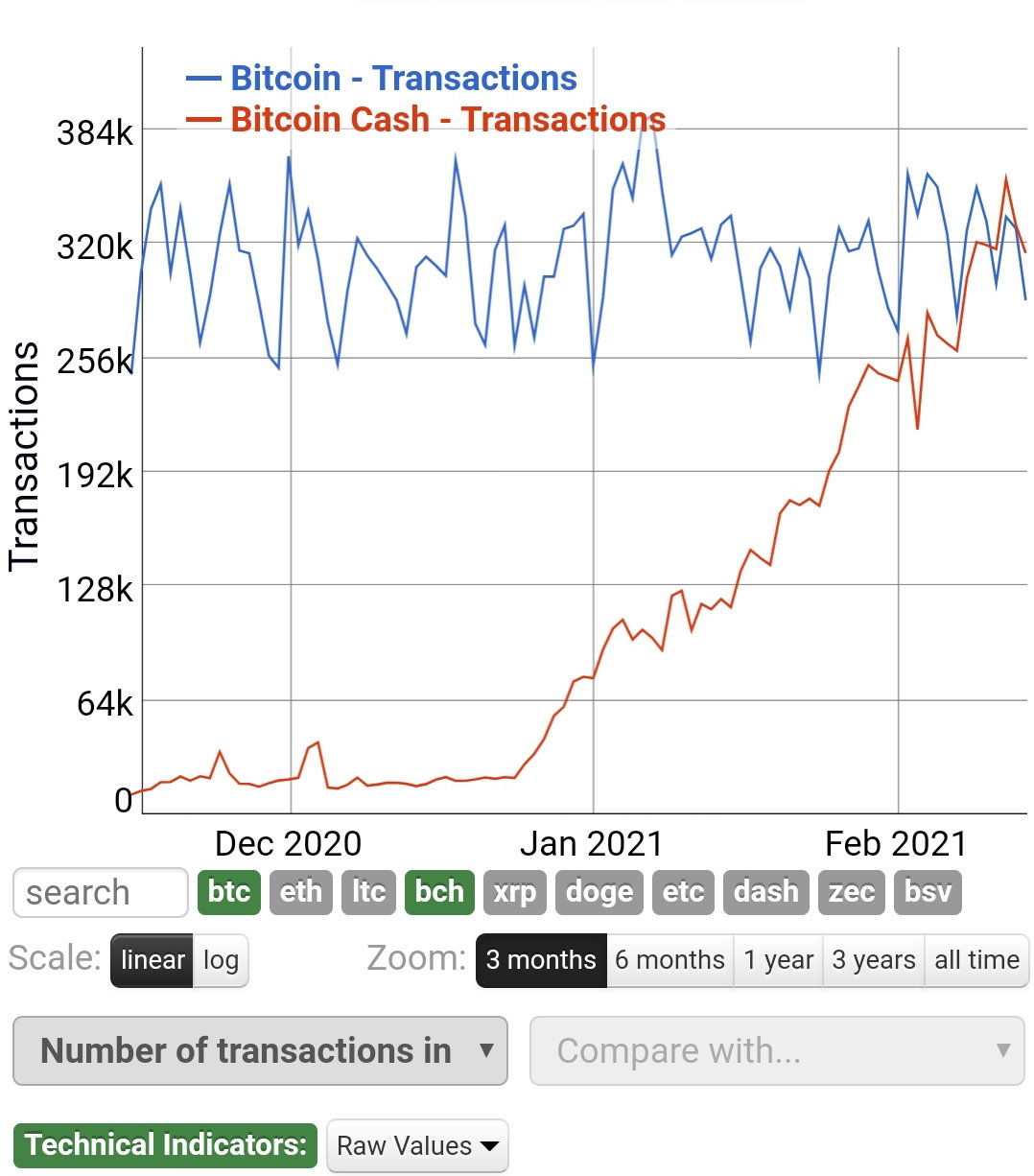
BCH sudden price up
We have our ups and downs, but definitely in the end we will be on top.
Bitcoin cash is now trading at 693$ at thisctime of this writing. A 19.8% increase for 24 hours.
So what did trigger Bitcoin Cash to finally get up?
There is one thing that is on my mind right now that triggered Bitcoin Cash to climb up again above 600$ mark - **Mr. Kim Dotcom.**
Mr. Kim Dotcom created a website called whybitcoincash.com to answer everyone who is criticizing him why he joined BCH. A simple innovation but very informative . This website highlights the benefits of Bitcoin Cash.
Mr. Dotcom is an internet entrepreneur who is behind megaupload and now, a supporter of BCH. He also said that for his next project K.IM, bitcoin cash will be use for the monetization payment. A bullish news up ahead for Bitcoin cash supporter.
You can check it out and be amazed on what it content it had here https://whybitcoincash.com/
After his tweet yesterday, BCH record a 728$ trading price today.
So if you're on twitter, please do follow Mr. Dotcom and start to share his tweet so people would know why should they choose Bitcoin Cash.
Btw, thanks also the read.cash and noise.cash developers and to the funding person, I've seen also great people here, big or small making their efforts on contributing to spread awareness about Bitcoin Cash.
Spend, replace and earn. Lets get into the moon.