 @Geri
edited
@Geri
edited
Pentium4 combo motherboards from HEAVEN: the born of Asrock Two months ago, i made a review about a not so fantastic LGA 775 combo motherboard. In this review, i will showcase a very similar, but a far more capable product. This product will shed light on hybrid motherboards from a different aspect, and tries to offer a better user experience based on the same hardware components. Ultimate backwards compatibility In the previous article, i have explained, after 2005, everything in the PC world has been changed. The 32 bit systems got replaced with the new 64 bit systems, the AGP graphics cards got replaced with the new PCI-E graphics cards. The IDE disk connectors got replaced with SATA ports. Floppy disk drives got obsolete, and first the motherboards got limited to support only a single floppy drive, then the floppy header got removed from the motherboards alltogether. Combo motherboards tried to bridge the two world together, adding AGP and PCI-E ports on the motherboard, offering multiple IDE and SATA ports to connect the older hard drives, and maybe integrating different RAM slots on the motherboard to give support for older type of memory types.
It's hard to do it properly The Asus motherboard which was previously tested, did this very wrong. The AGP and PCI-E integration worked, however, everything else was problematic. The DDR2 memory support was not complete due to bugous clock speed detection of the BIOS. The SATA ports had a design failure, preventing to release data cables. The fan speed control was dead out of the box. The BIOS was limited to a single floppy drive. Only Intel's first dual core CPU, the Pentium D worked in the board, and the Core2 processors refused to boot even after patching the microcode. That motherboard offered an upgrade path for older hardware to continue operation. It however didn't offered future compatibility, and the longevity of the system was not possible. Asus and the low-end Asrock was a spin-off of Asus. Asus was a very well establised name back then. It was associated with popular midrange and high-quality motherboards. There were companies illegally reverse engineering and cloning Asus motherboards. But at that time, Asus wasn't frequently used in low-end systems. Low end solutions are real cash-cows, when they can be sold in large quantities. The quality of the very cheap office motherboards was however not something Asus wanted to be associated with. The arrival of Asrock Asus came to the conclusion they will need new approach to conquer the low-end. Instead of starting long legal fighting with the Taiwanese cloners and budget clowns, they decided to make an agreement with them. Asus silently formed a new division within itself, contracting with all the potent low-end hardware lords. This division was called Asrock. The first two letters represent Asus, and the new division was detached from Asus under the new name. Asrock was able to get the older designs of Asus, and there were tasked to make low-end offerings based on those products. First products by Asrock The first few Asrock motherboards were truly horrible. For example, some of the early Asrock designs were built on official Asus designs, but lacking 3 of the 4 intended PCI slots, and half of the PCB was just empty without electronics - only containing the most basic electricity to power a cheap office PC. By following this strategy, Asus was able to distant themself from the potential brand damage these extremely low quality motherboards could cause to the brand, as they were branded Asrock. In the same time, Asrock got access to older Asus designs legally, and Asus got access to the budget segment, instantly being able to harvest significant market share and profits. From AthlonXP to LGA775 As Asrock was initially tasked with low-end solutions, they mostly focused on super cheap office motherboards, but also gathered experience in the construction of combo motherboards for the PC builder segment. They early AthlonXP motherboards frequently had SD and DDR RAM sockets, they released motherboards with multiple CPU sockets, or Pentium 4 motherboards containing both LGA 775 and Socket 478 CPU sockets. They released motherboards with future CPU upgrade slots, where a CPU card could be inserted into the motherboard with a CPU socket on it, allowing future CPU upgrades. Asrock climbing the ladder Asrock is owned by Asus, but it operates as an independent company. This meant Asus can't to too much to stop them from peeking out from their shadow. Within a few years, Asrock started to taste the midrange. They had bad reputation for their cheap designs, but they had the capital to make the required moves. The hybrid cpu socket on they motherboards were more of an interesting experiment than viable upgrade path, it was clear there is a new kid on the bloc which must be taken seriously. To help their growth, Asrock opened to the computer enthusiasts, and always tried to offer outstanding and special compatibility and long support cycle for their motherboards. Asrock was never reluctant to release a bios upgrade even for an aging motherboard to add support for new CPUs, even if that meant they will lose some sales on their newest offerings. And after 2005, the moon, the sun, the planets, all were on the proper spot on the sky. It suddenly went from a low-end champ to an ultimate upgrade solution, the brand became highly sought-after, suddenly becoming the top highly regarded brands of the industry. And that point is the focal point of this test. Asrock 775Dual-VSTA The star of this test will be this combo motherboard from Asrock, called 775Dual-VSTA. The motherboard of a member of a wide range of product line from Asrock, featuring hybrid combo motherboards. Asrock designed similar boards for the Socket 775, for the 939 and AM2 platforms as well. Initially, Asus itself also designed such combo motherboards. For example the ASUS P4V800D-X for the Socket 478, or the previously tested ASUS P5VDC-X released for the Pentium 4 chips (Pentium D support added with later bios). Motherboards from Foxconn, like the Foxconn 915A05 series (also running with 915P naming, as 915P7AD, 915PL7AE) were released for the Socket 775, but only supporting Pentium 4 chips. Gigabyte's GA-8I915ME and similar products also only supporting Pentium 4, and even Asrock's first few combo motherboards for the LGA775, such as the 775Dual-915GL and the ASRock 775Dual-880Pro, are only limited to Pentium 4 support. ECS 915P-A is also a Pentium 4 product only.
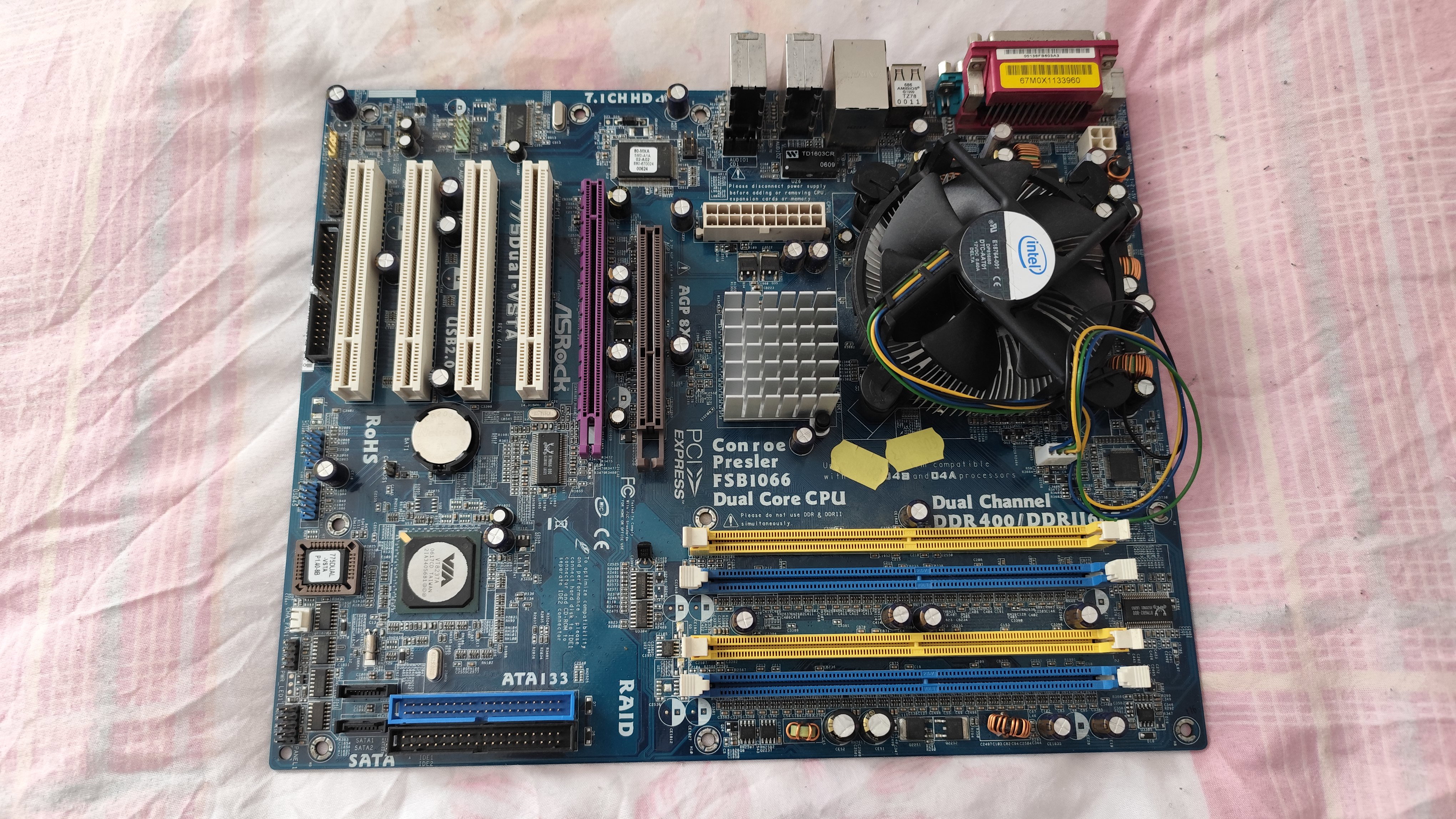
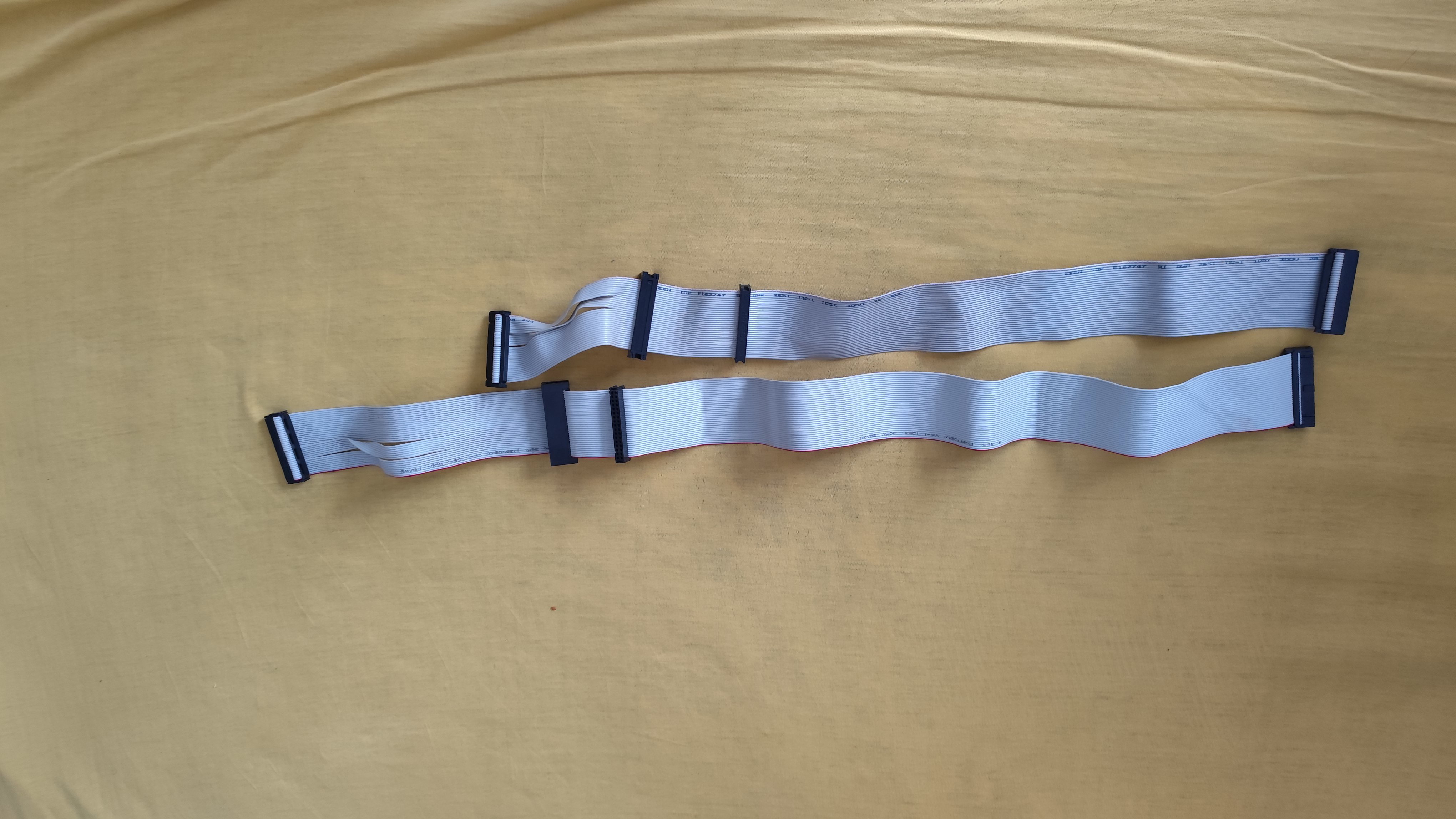
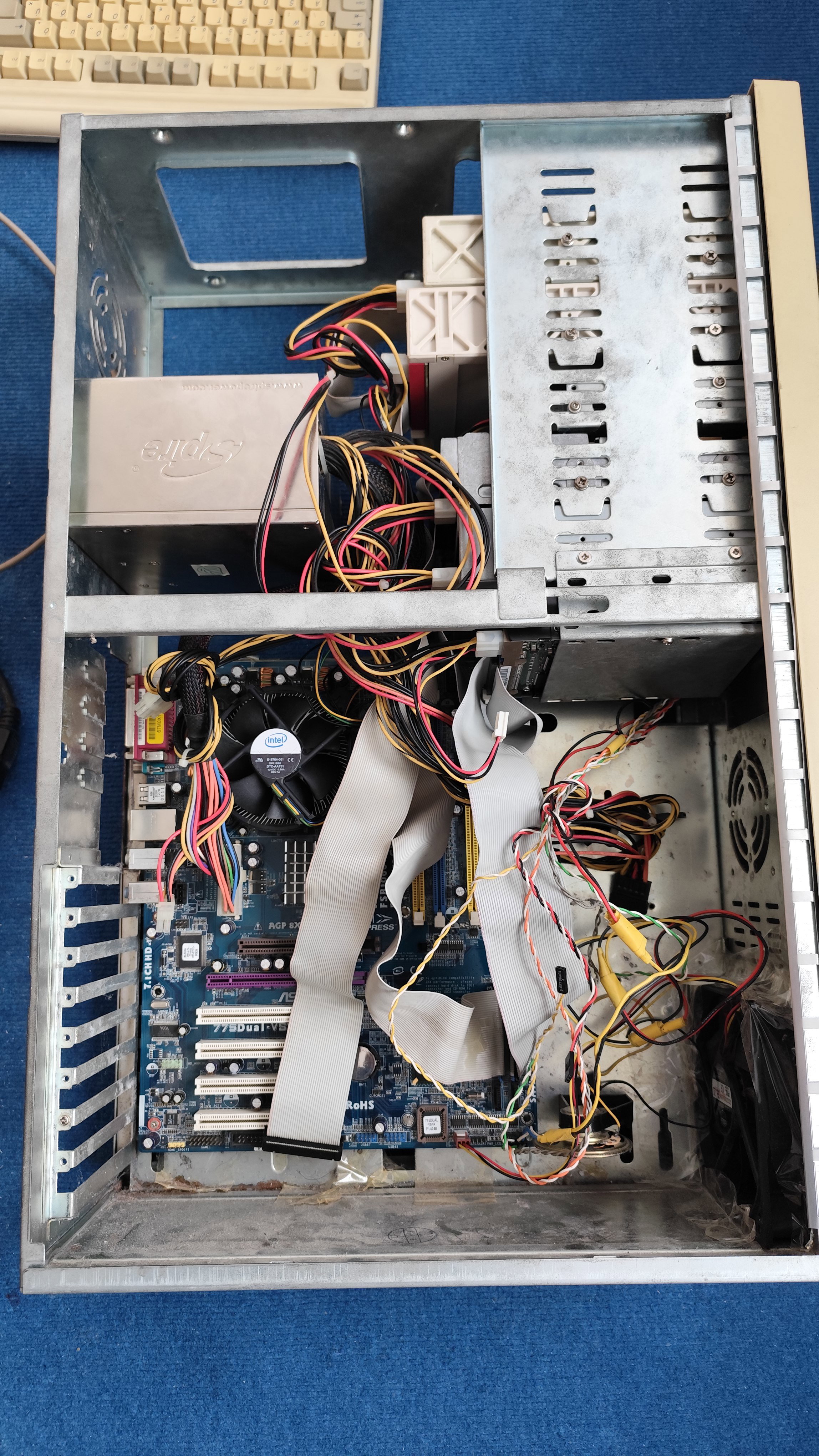
AMD combo motherboars were a little bit better. For the 939 and AM2 platform, other manufacturers and products, such as the ECS K8T890-A were offering good alternatives, supporting the new dual core AMD chips while having a very good range of connectivity. Biostar, with the Biostar NF3 250 and Gigabyte GA-MF3 were also released for the AM2 platform, and Asrock also entered this segment with the ASRock K8Upgrade-VM800. Biostar K8M800 Micro AM2 and MSI K9MM-V also a notable examples, but there are dozens of products for 939 and AM2 which i will not list, just noting, the situation was better, when using combo motherboards with the AMD platform. With the release of the Core2Duo and Core2Quad chips, the LGA 775 platform shadowed the 939 and AM2 platforms. The combo motherboards were limited to the Pentium4, and maybe with dual core Pentium D chips with a bios update. 939 and AM2 combo motherboards supported the Athlon64 x2 chips usually, the performance of those can only rival the Pentium D. This means a 939 or AM2 based combo motherboard were a better buy than an Intel P4-only board, but they are not match for a high-end Core2Duo or Core2Quad chip. The king of combo motherboards Asrock managed to release the 775Dual-VSTA in 2006 october, just a few weeks after the release of the first Core2Duo processors. It was based on their previous 775Dual-880Pro - they had to fix the power delivery circuit to support the new chips, and also they have patched the bios to support the new Core2 CPUs. This was a rather unusual step, as combo motherboards up to this point in time, were always targeting the absolute low end. The performance of any combo motherboard were lower compared to normal motherboards. For example, either the AGP or PCI-E, or both, is severely limited in bandwidth and compatibility, and the memory performance is also limited, especially when using the older memory standards. This meant, combo motherboards were not bought to be used with high end CPUs, and it was reasonable to assume they are going to be used with some Pentium4 or single core Athlon64 chips. The manufacturers which offered combo motherboards, usually not supported the newest chips. The ASUS P5VDC-X with the very first to support the Pentium D processor, got only released in 2006, one year later the release of the Pentium D processors. The ECS K8T890-A with dual core Athlon64 x2 support also got released in 2006, a year after the release of the first Athlon64 x2 chips, a few weeks before AMD released the new AM2 socket alltogether. This means Asrock's decision to support the new Core2 processors in a combo motherboard instantly after the release of Core2 itself, was something never tried before, but as Asrock and Asus already had combo LGA 775 motherboards with dual core chip support, they were able to do this with minimal risks and research. First impressions At first glance, the 775Dual-VSTA seems to be a good build. There are however some strange design decisions. The location of the floppy port is not ideal, and sadly newer motherboards tend to use this spot for the floppy port. Luckily, i was able to find a little bit longer floppy cable to be able to connect everything.
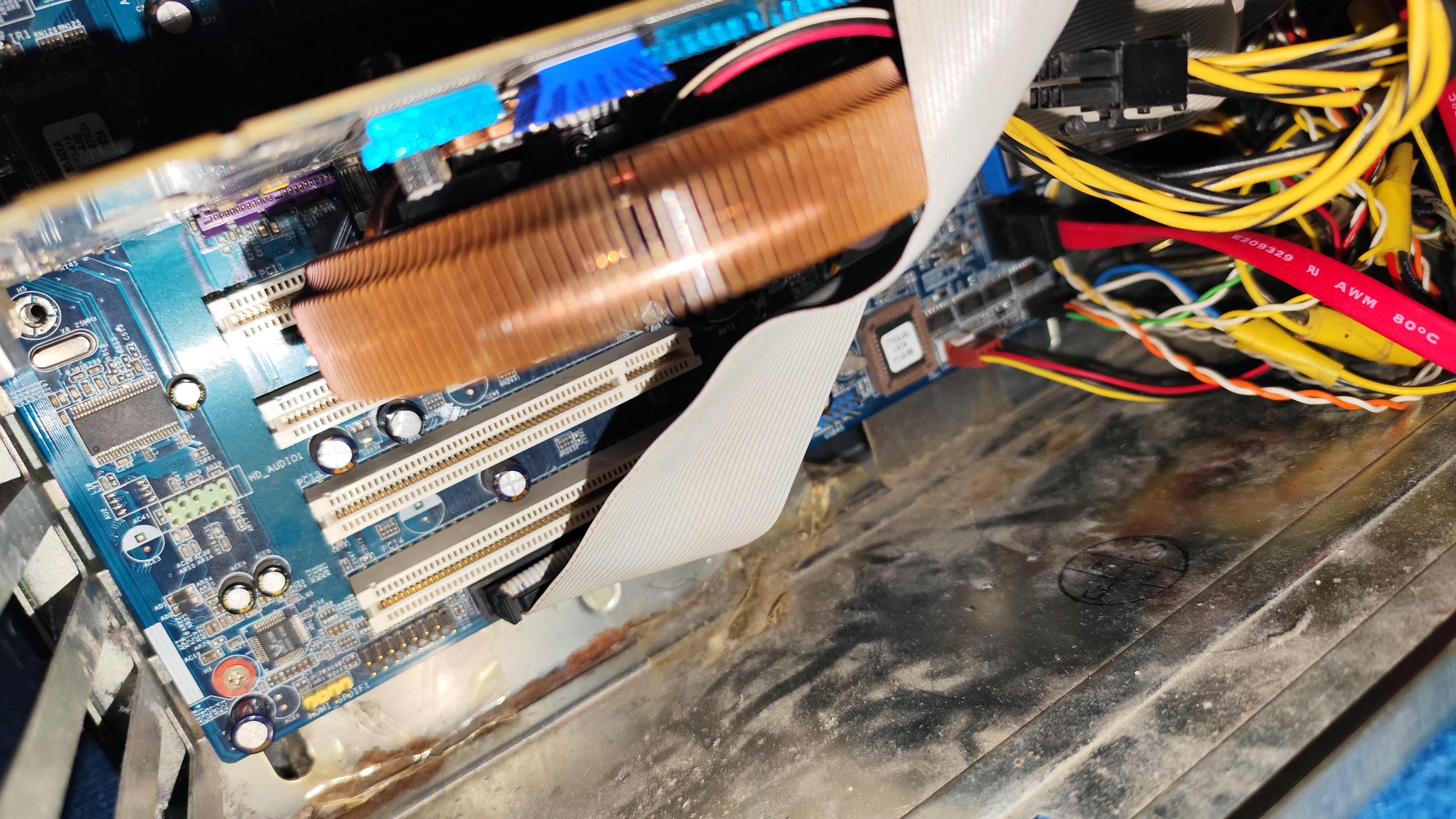
This floppy connector placement is used on motherboards ever since. Another bad impression is the location of the IDE ports. When a long graphics card is inserted in the PCI-E slot, the IDE cable can not be pulled out, and can not be plugged in. I was afraid the ide cable height will interfere with the graphics card, and it will be impossible to put long graphics cards into the motherboard, if the IDE ports are used, but that was thankfully not true. I have tested long graphics cards, and they booted without an issue. The ATX power supply connector's location is unusual. It will not be possible to plug in some power supply units when using this motherboard.
Turning it on Unlike the combo motherboard from Asus, tthe system powered up with the first RAM module i have put in. I got a Celeron CPU with the motherboard, and a cooler, but the heatsink was too small, so i have swapped it to a more beefy unit. I have quickly tested, if the system boots up with various graphics cards. I have tested a PCI ATi Mach64, an AGP FX5200, an TNT2 M64 (AGP), a Matrox G450, my AGP Radeon 3850, and then i have also tested a PCI-E nVidia Quadro 4000. Everything boots up in the motherboard, there were no issues. I didn't had to wiggle anything, even the IDE and floppy devices working fine without any issue. After i have verified everything works, i have downloaded all the drivers from Asrock's website, and i have searched for the latest beta bios. Updating the BIOS When the 775Dual-VSTA was released, only 65nm Core2Duo processors were in existence. No Core2Quads, and the later released 45nm Core2 based processors are also unsupported out of the box. Luckily Asrock made a bios, which contains support for new CPUs, and even Core2Quad. As i wanted to use a Core2Quad in this system, the bios had to be updated to the latest beta build. The latest beta bios is 3.19a and it was made in 2009, which meant Asrock have spent 3 years upgrading the system BIOS for this motherboard (previously, this was unheard of for combo motherboard, which are frequently only got bios updates for the first few months). The new BIOS also allows two 2GB DDR2 memory sticks to be used in the system. Updating the BIOS was uneventful, and after the update finished, i put my two 2GB DDR2 sticks into the motherboard. It booted up fine. Then i put in the Core2Quad Q9300, which is the strongest LGA775 CPU i have. The system booted.
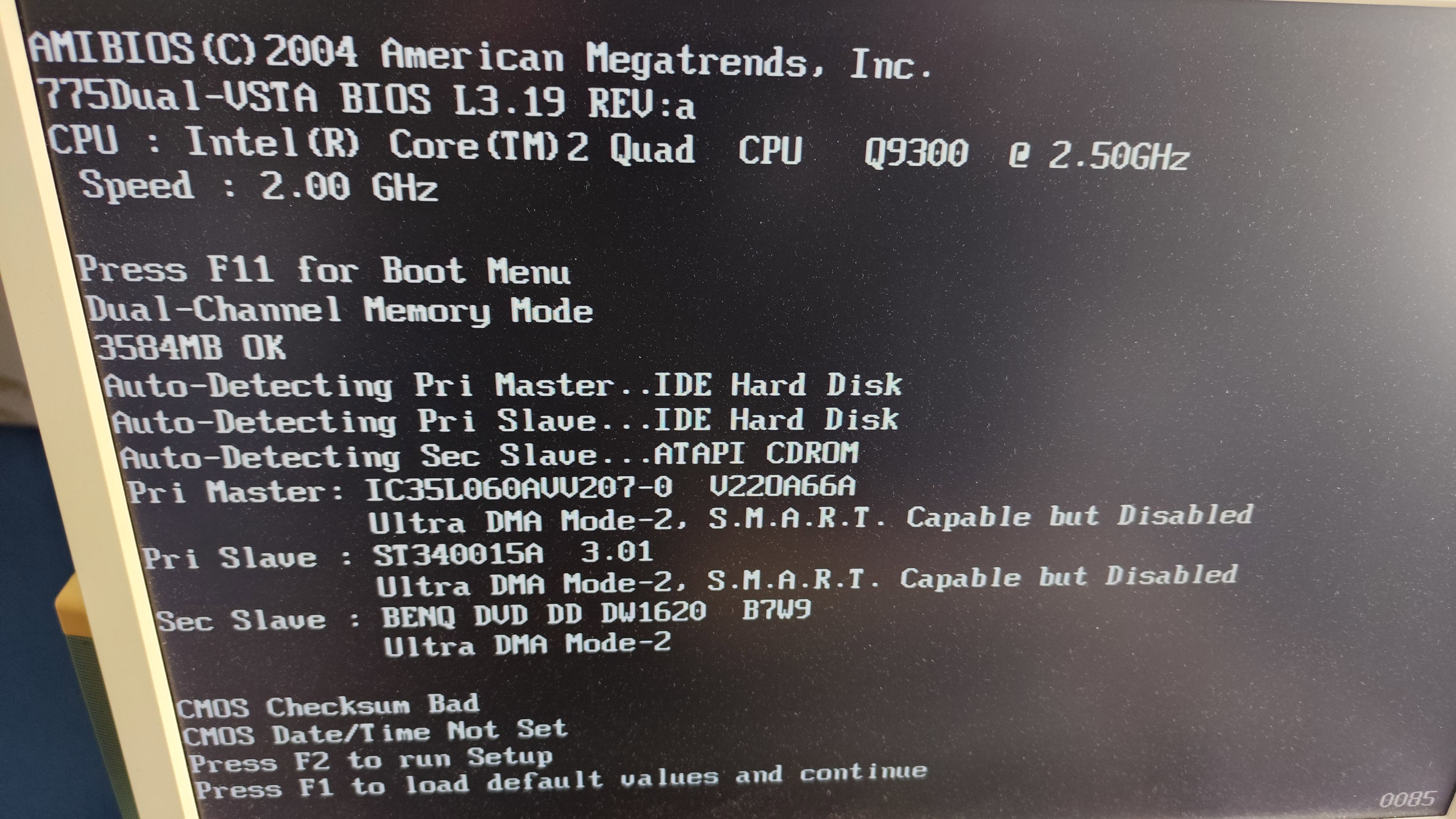
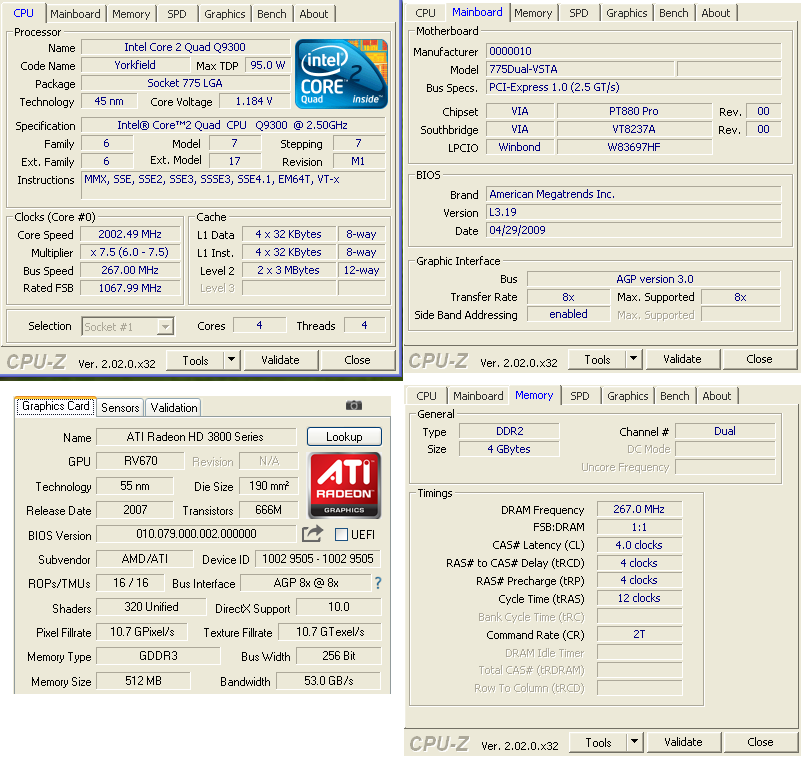
Limitations Asrock supports features long after the 775Dual-VSTA was released, however, there are some limitations. The first limitation i noticed is the memory size: despite 4 GB RAM is installed, only 3.5GB is available due to limitations of the chipset. This is fine, because i dont plan to run tasks demanding more than 2-3GB RAM on this computer anyway. Another limitation is the clock speed of the CPU. This system supports only 1066 MHz bus for the CPU, but the Core2Quad Q9300 utilizes an 1333 MHz system bus. This means the system booted up at 2 GHz instead of 2.5 Ghz. The motherboard allows overclocking the system bus, but even 5% overclock causes anomalies, so i decided not to overclock the system bus, as 2.1 GHz was already unstable.
Bugs When booting operating systems, one of the IDE slot sometimes gets undetected. This was a consistent problem in every 32 and 64 bit operating systems regardless of the kernel (Windows 9x, XP, Linux). This means before installing the operating system, its advised to hook up everything to the more compatible IDE port. Once everything is installed, the VIA chipset drivers must also be installed, and then the devices connected to the another IDE port will appear. This is a quite annoying bug, and i have never seen something similar previously. There is another annoying problem with some of the AGP graphics cards. When i put my AMD Radeon 3850 AGP into the system, it was unstable under heavy loads, and causing crashes in every 2-3 minutes. Going to the bios, and limiting the system to AGP4x solved the issue. However, i don't want to limit this card to AGP 4x, because it would cause a notable speed drop in some games. I was playing with the settings, and found something called "AGP 3.0 Calibration".
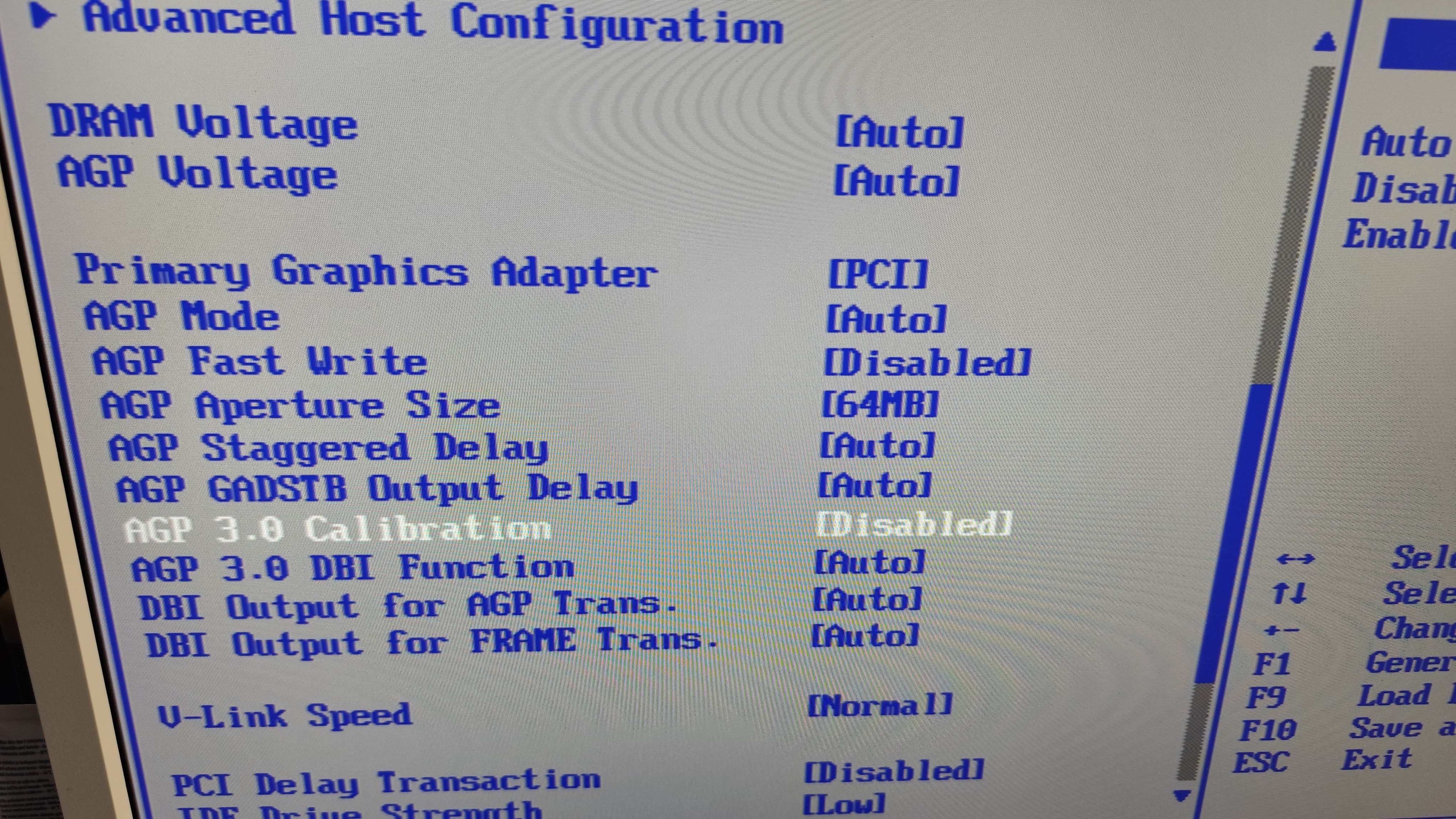
Disabling this fixed all the stability issues, and AGP 8x was usable again. In the ASUS board, the 3850 AGP likely only operated in 4x mode as well, because the 8x option was just simply missing from the BIOS list, but i have not made any complicated tests with that motherboard to verify that. The test system Motherboard: 775Dual-VSTA CPU: Core2Quad Q9300 @ 2.0 GHz RAM: 4GB DDR2-666 GPU: AMD Radeon 3850 AGP
Crysis Crysis is more of a techdemo than a game, but its scales with CPUs and GPUs very well. In the previous test with the Asus motherboard, the game was playable around 35 fps, but the CPU was clearly struggling, and running on its limits. This time, the chipset is the same, but the CPU is multiple times stronger. Lets see, if the Asrock motherboard manages to profit on this.
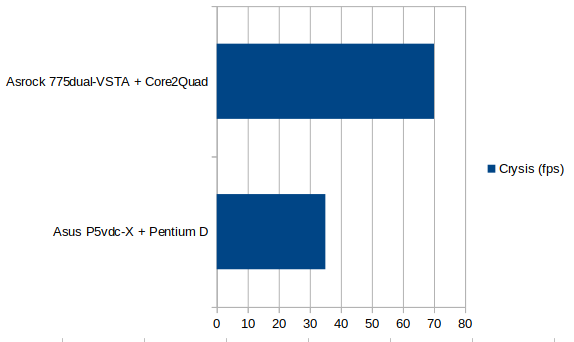
The Asrock 775Dual-VSTA is about twice as fast in games as the older Pentium D based combo motherboard from Asus. In programs utilizing more threads, the speed difference will be almost three times, or even more. The performance is better than the usual low-end performance of combo motherboards, almost bringing the system into the high-end league. Its not perfect The motherboard was far from perfection, but its magnitudes better than previous attempts of other companies. The memory just works, there are two working IDE ports and two working SATA connectors. The floppy port indeed supports A: and B: drive. The Core2Quad Q9300 boots up without issues after a bios update. This motherboard was able to operate with less headaches than the previous hybrid motherboards. But its far from perfect: the problematic AGP 3.0 Calibration settings in the BIOS are somehow enabled by default. The placement and compatibility of the IDE, floppy and ATX connectors are annoying. Some people also reported problems with some larger SSD disks, but i havent noticed anything. The Asrock 775Dual-VSTA and the similar motherboards from Asrock indeed offered backwards and forwards compatibility. They mixed this compatibility with any performance level the user wanted, including the top high end processors for years. This motherboard is also fantastic for those who want to build a computer for retro gaming: the AGP graphics card support can offer good Windows98 or old-scool Windows XP experience when combined with a TNT2 M64 card. The PCI-E port can offer good Windows 7 or Windows 10 experience. The support for A: and B: can offer good DOS experience. All within one flexible computer, using the Asrock 775Dual-VSTA combines the ultimate retro computer which unifies the eras of late 80s, up to 2020, and manages to run most of the software from this time range. One of the best combo motherboards in existence.

No comments yet