French taxation of income from the sale of digital assets - The thorny issue of stablecoins
Hello to all readers of these lines,
Today, I would like to give you a new reflection on the legislative framework of crypto-assets in French law.
You may have already read my other publications on the subject, these articles being drawn from different parts of a research paper written in 2018. More than 3 years after it was written, a real legal framework has been adopted both in terms of the regulations applicable to its actors and the taxation applicable to its users.
Although some problems remain, in particular the difficulty for some players to access bank accounts, as banks remain reluctant to this sector of activity, the framework is now fixed, drawing on the numerous French and European works on the subject.
From a tax point of view, the rules are fairly clear, even if one could criticise the complexity of the calculation methods and the restrictive nature of the reporting obligations for "small" users.
The evolution of the various digital assets registered on blockchain however renews the questions and, from a legal point of view, to wonder about the legal qualification of these assets, on which, as you will see below, the tax regime of the income derived from them depends.
In this respect, I invite you to refer to my previous articles which, even if they are old, are still relevant in terms of their legal nature.
**The tax framework for income derived from the transfer of digital assets by an individual**
There is a before and an after to 2019, since the Pact Law of 22 May 2019 created a specific, "sui generi" regime for capital gains on the sale of digital assets, which it also had to define.
Without going into the details of the calculation, which is complex and requires the intervention of a legal professional due to the youth of the legal regime and the technology itself, before this law, no legal regime existed, leading to this income being taxed on the basis of Article 150 UA of the General Tax Code (https://www.legifrance.gouv.fr/codes/article_lc/LEGIARTI000037988296/) in the category of capital gains on movable property not subject to another category (the so-called "broom" category).
The Pact Law created a specific regime for capital gains on the sale of digital assets, Article 150 VH bis of the General Tax Code (https://www.legifrance.gouv.fr/codes/article_lc/LEGIARTI000038612228/), referring to digital assets falling under the definition of Article L.54-10-1 of the Monetary and Financial Code (https://www.legifrance.gouv.fr/codes/article_lc/LEGIARTI000038509570/) :
*"For the application of this chapter, digital assets include:*
*1° The tokens mentioned in Article L. 552-2, excluding those that fulfil the characteristics of the financial instruments mentioned in Article L. 211-1 and the savings bonds mentioned in Article L. 223-1 ;*
*2° Any digital representation of a value that is not issued or guaranteed by a central bank or public authority, that is not necessarily attached to a legal tender and that does not have the legal status of a currency, but that is accepted by natural or legal persons as a means of exchange and that can be transferred, stored or exchanged electronically. "*
This definition encompasses, by its general definition, different realities and imposes a functional analysis.
Thus the category of digital assets is composed of tokens, defined in Article L.552-2 of the Monetary and Financial Code (https://www.legifrance.gouv.fr/codes/article_lc/LEGIARTI000038509545/) and subject to Article 150 VH Bis, and may fall under other categories if they incorporate or are subject to different regulations, namely those of financial instruments under L.211-1 of the Monetary and Financial Code (https://www.legifrance.gouv.fr/codes/article_lc/LEGIARTI000032469968/) and of savings bonds under L.223-1 of the Monetary and Financial Code (https://www.legifrance.gouv.fr/codes/article_lc/LEGIARTI000039260567/).
Therefore different qualifications, which imply to check the nature of each crypto and the rights they incorporate:
**Tokens**
Tokens are, according to Article L.552-2 of the Monetary and Financial Code (https://www.legifrance.gouv.fr/codes/article_lc/LEGIARTI000038509543) :
*"For the purposes of this chapter, a token is any intangible asset representing, in digital form, one or more rights that can be issued, recorded, stored or transferred by means of a shared electronic recording device that makes it possible to identify, directly or indirectly, the owner of said asset. "*
*However, if they incorporate the characteristics of financial instruments or cash vouchers, they will fall under their regime and the applicable taxation will be different:*
*" I. - Subject to the provisions specific to professional profits, capital gains realised by natural persons domiciled for tax purposes in France within the meaning of Article 4 B, directly or through an intermediary, on the sale for valuable consideration of digital assets mentioned in Article L. 54-10-1 of the Monetary and Financial Code or rights relating thereto, are subject to income tax under the conditions set out in this Article.*
*II. - A. - The provisions of I of this article do not apply, for the year of exchange, to transactions involving the exchange of digital assets defined in I or rights relating thereto, without a cash payment.*
*B. - Persons carrying out transfers for which the sum of the prices, as defined in A of III, does not exceed 305 € during the tax year, excluding the transactions mentioned in A of this II, are exempt.*
*III. - The gross capital gain or loss realised at the time of the transfer of goods or rights mentioned in I is equal to the difference between, on the one hand, the transfer price and, on the other hand, the product of the total acquisition price of the entire portfolio of digital assets by the quotient of the transfer price on the overall value of this portfolio.*
*A. - The transfer price to be taken into account is the actual price received or the value of the consideration obtained by the transferor, where applicable including the balance he has received or reduced by the balance he has paid at the time of the transfer.*
*The transfer price is reduced, on the basis of supporting documents, by the costs incurred by the transferor in connection with the transfer.*
*B. - The total acquisition price of the portfolio of digital assets is equal to the sum of the prices actually paid in legal tender for all acquisitions of digital assets or rights relating thereto made prior to the transfer and the value of each of the services and goods, other than digital assets or rights relating thereto delivered in exchanges that have benefited from the tax deferral provided for in A of II, including any balancing payments made, delivered in consideration for digital assets or rights relating thereto prior to that same transfer.*
*In the event of a free acquisition, the acquisition price to be used is the value used to determine the transfer tax or, failing that, the actual value of the digital assets or the rights relating to them determined at the time they entered the transferor's assets.*
*The total acquisition price determined by application of the first two paragraphs of this B is reduced by the sum of the fractions of initial capital contained in the value or price of each of the various transfers of digital assets or rights relating thereto, whether free of charge or for consideration, excluding exchanges that have benefited from the deferral of taxation provided for in A of II, that have been carried out previously. Where one or more exchanges with balancing payments received by the transferor have been made prior to the taxable transfer, the total acquisition price is reduced by the amount of the balancing payments.*
*C. - The overall value of the portfolio of digital assets is equal to the sum of the values, assessed at the time of the taxable transfer, of the various digital assets and related rights held by the transferor prior to the transfer.*
*IV. - Gross capital losses incurred during a tax year in respect of disposals of assets or rights mentioned in I, other than those falling within the scope of II, are deducted exclusively from gross capital gains of the same kind realised in respect of that same year.*
*V. - A. - The income tax corresponding to the capital gain mentioned in this article is paid by the natural person who, directly or through an intermediary, makes the transfer.*
*The taxpayers shall enter on the annual declaration provided for in Article 170 the total amount of the capital gain or loss realised in respect of the taxable transfers of the year. They shall attach to this declaration an appendix in accordance with a model drawn up by the administration, on which they shall mention and evaluate all the capital gains or losses realised on the occasion of each of the taxable disposals made during the year or the prices of each of the disposals exempted pursuant to B of II.*
*B. - A decree determines the declarative obligations incumbent on the taxpayers and interposed persons mentioned in I.*
*VI. - (Repealed). "*
We can retain from this definition that any representation of a value that is registered on a blockchain allowing the identification of the owner (Monero and certain blockchains raise the question here) is a digital asset, except if it incorporates certain rights falling under other categories.
**Digital tokens legally excluded from being a digital asset**
**Financial instruments**
**Financial securities -** equity, debt, bonds etc issued by a company with share. For example, the bond issue by Société Générale of a secured bond in the form of a security token on a public blockchain (https://www.societegenerale.com/fr/actualites/newsroom/societe-generale-emet-la-premiere-obligation-securisee-sous-forme-de-security) is the first successful experience of this type.
**Financial contracts -** These are defined in Article D.211-1 of the Monetary and Financial Code. The regime applies, not to digital assets, but to their financial and non-financial underlyings, such as binary options, futures or CFDs.
Other possible qualification
**« Bons de Caisses » -** These do not fall under the category of financial instruments and are an autonomous category. Bons de caisse are defined in Article L.223-1 of the Monetary and Financial Code as (https://www.legifrance.gouv.fr/codes/article_lc/LEGIARTI000039260567/) :
*« Bons de caisse are non-negotiable registered securities with an undertaking by a trader to pay at a specified time, issued in return for a loan. The conditions of their issue and their placing on sale or in circulation, by way of a public offer other than that aimed exclusively at qualified investors mentioned in 1° of Article L. 411-2 or that relating to a loan equal to or greater than an amount set by decree, are governed by the provisions of this chapter.*
*The savings bonds may not, in the same issue, confer identical debt rights for the same nominal value. »*
**The eternal question of stablecoins**
A slightly different question from other crypto assets (understand all the legal categories presented above and recorded on a shared electronic recording device, thus a blockchain).
We will directly set aside the financial qualifications, unsuitable for a stablecoin, to focus on that of simple tokens falling under the category of digital assets defined in Article L.552-2 and subject to taxation under Article 150 VH Bis, or that of virtual currency defined in Article L.315-1 of the Monetary and Financial Code (https://www.legifrance.gouv.fr/codes/article_lc/LEGIARTI000027007558/).
In practice, if stablecoins are qualified as digital assets, then inter-coupon transactions between digital assets are not taxed according to the regime for individuals provided for in Article 150 VH Bis.
Conversely, if stablecoins are qualified as electronic currencies, then the conversion of a digital asset into a stablecoin will be considered as a taxable event under the same regime for individuals
The qualification of digital asset raises a real question of tax contribution, and of discrimination in the face of transfers in real state currency such as proposed by exchanges and which will necessarily have to be addressed in the face of the rise of banks offering services in crypto currencies and proposing payment cards in euros backed by crypto currency accounts.
The qualification of virtual currency is also complicated to justify since it assumes some form of recognition of the legal tender status of stablecoins.
This is impossible for USD-indexed stablecoins, and would require the calculation of a new conversion gain when converting USD stablecoins into legal tender euros.
Regarding euro-linked stablecoins such as the recent Lugh (https://www.lesechos.fr/finance-marches/banque-assurances/casino-veut-ouvrir-la-voie-au-paiement-en-magasin-par-crypto-1299200), qualification as a virtual currency is also difficult since they are not issued by a central bank, which is historically a prerogative of public power. Whether one agrees or not with this prerogative, our global legal system is organised according to this presupposition, as other instruments of value exchange have always existed concurrently with state currencies without this attribute being recognised.
In the future, this question will have to be answered for a new type of stablecoin like AMPL and its rebase mechanism where the price tends to be stable thanks to fluctuations in the number of units of the protocol, allowing each user to keep, for the value of the AMPL deposited at any given time, the same value indexed to the dollar. Currently, other stablecoins are backed by a weighted countervalue of a colaterisation ratio, either in state currency or in digital assets like Bitcoin or Ethereum.

French Companies launched an euro stablecoin
French Companies launched an euro stablecoin
Did you know that 3 french companies (Casino (supermarket chain store) Société générale (Bank) and Coinhouse (exchange platform) launched an EUR stablecoin called "Lugh" based on Tezos blockchain (french project) ?
What are the legal issues ?
This launch by French players of a stablecoin pegged to the euro is particularly interesting from a legal perspective. Crypto-assets are considered as securities, a legal category relating to assets representing intangible rights such as shares in companies.
What is a security ?
Gains from the sale of a security are taxed at the progressive income tax rate, i.e. a flat tax of 30% composed of 12.8% tax and 17.2% social security contributions.
If you make both capital gains and losses on the sale of a security in euros, these will be offset for the year in question.
And so, for cryptocurrencies?
Currently, gains from the appreciation of crypto-currencies or cryto-assets are taxed only when converted to euros and not when interchanged between other crypto-currencies. This conception induces for many French users, and a fortiori European, the investment of gains from crypto-assets not to sell their positions in euro, but to convert them into stablecoins not indexed to the euro, such as the USD (Dai, Tether etc. ...).
It is currently considered that these stablecoin earnings, even when backed by a stable currency, are not yet secure.
The legal issue
The existence of a euro registered on blockchain will inevitably raise this question, since gains registered in stablecoin euro have no reason not to be taxed differently just because they are registered on a different medium.
In order to treat these two assets, the "normal" euro and the euro registered on blockchain, differently from a tax point of view, the legislator will have to show that the circumstances are different, and therefore justify a different treatment, but one that is necessary and proportionate to the goal pursued.
Declarative obligation
As a French taxpayer, you must declare your capital gains or losses yourself by means of a specific form and by declaring each of your accounts in crypto-assets. Since it is difficult to communicate each of the addresses of your wallet, it seems that the tax authorities are satisfied with the identity of the account holder in the case of CEX and have not yet decided on DEX and cold wallet.
Final thoughts
The future will tell how the legislator and judges will analyze the use of "Lugh".
Thanks to the 41 subscribers even if I have trouble understanding who enjoys reading this kind of information that can clearly be described as ultra restrictive.

Cardano (ADA), Sushiswap (SUSHI), Polygon (MATIC), Skale (SKL) are now available to trade on Coinbase
Why ETH 2.0 will pump the price ?
Because an ecosystem is built on ethereum with DeFi, so if transaction fees are going down with upgrade, price will go up to to limit the price drop for ETH's miner.
Then, ETH 2.0 with Proof-of-Stake update and staking reward, price will go up again to once again achieve a level of compensation equal to today, with more transactions at a lower price.
Miners will be the winners, even if the increase in the number of transactions will go hand in hand with the number of stakers, which seems necessary to induce a rise in the price a crash of the blockchain ecosystem, also possible.
What a world
Coinbase adds Numeraire (NMR) to the Coinbase Earn Program (3USD in NMR)
Improve your Faucet earnings with these Advices
Hey folks, since the recent big surge in crypto-price, I wanted to share you my own managing strategy of crypto-faucets.
It is really often said that it is not worth your time. I was agreeing to this statement for long time. But as I am full of doubt, I continued to claim different satoshis of different crypto.
Now in 2020, I change my mind and think a good managing of faucet routine could lead to high gains, almost passive if you have time to put in at the begining.
Many new tools alow you to optimize your gain, and as early miners, these few satoshis could surge in price and become a respectful amount, particurlarly for young person of people who does not want to buy crypto but earn them.
After years pf using faucets site, I now earn passively and constitute freely a nice amount of crypto I try to manage to make it grow.
I wanted to share to you for helping people to make free gains until you have some free time at the start and believe in mid/long-term growth.
Let me present you tools I use:
**FaucetPay :**
https://faucetpay.io/?r=803497
FaucetPay is a micro wallet who allow you to withdraw from all faucets site you use your claims in an unique wallet.
Really helpfull tool to agglomerate all yours satoshi knowing that you can convert all tokens from on to another.
Having a FaucetPay account sometime give you bonus on faucet site like lower minimum and faster withdraw.
The site looks good, it easy to use but also have many advanced functions like a native token to be released in 2021 (FEYORRA (FEY)).
There is also a referral program, faucet list, and earning page with offerwall and paytoclick.
**FireFaucet :**
https://firefaucet.win/ref/410430
FireFaucet is a faucet site with an interesting feature : Auto Claim point.
These auto-claims point allow you to start auto-claim each minute for 9 cryptocurrencies.
You can auto-claim Bitcoin, Litecoin, Dogecoin, Dash, Tron, Digibyte, Tether (TRC-2), Ethereum and Zcash).
https://firefaucet.win/ref/410430
You have setting to claim only crypto you want to claim with X1 to X4 option.
It is to most paying faucet site in my opinion.
Site is not really modern but works. Since the 4.6 update, your account balance is not in satoshis but in USD.
It means that if BTC pump, your btc balance will stay to the same USD value, so your amount of btc will decrease. On the reverse you are protected against dump.
It is finally the most interesting feature when used with other faucet site only in crypto claims.
Withdraw only market is low to claim more satoshi, and keep USD when market is high.
I strongly recommand this site who pay, with low withdrawl amount and easily and regularly reachable.
**CoinPot :**
https://coinpot.co/dashboard
Coinpot is one of the most kown Faucet site and it deserve to be mention in this post.
I used Coinpont since years and, despite some faucet were attacked this year, it still pay and constitue one of my major faucet earning regarding price pump from time to time.
CoinPot is kind the same tool than FaucetPay but only for the five CoinPot native faucets :
- BTC :
http://moonbit.co.in/?ref=C5346EBF5434
- BCH :
http://moonbitcoin.cash/?ref=BCF7C3080B54
- LTC :
http://moonliteco.in/?ref=E8112F1D1724
- DASH :
http://moondash.co.in/?ref=3C02E8784B0F
- DOGE :
http://moondoge.co.in/?ref=E46B54CDACFB
You can claim from each faucets site satoshis regarding the time you waited
There is incentive stuff like loyalty Bonus if you claim each day, random bonus and referral bonus to make your claims higher or lower regarding your activity.
With some regularity daily claims are quite respectful for the five Coinpot Faucet.
Morever, CoinPot have also its own native token, CoinPot tokens you can convert into crypto, keep to earn VIP reward. You earn CoinPot token each you claim on any CoinPot faucets.
It is also a big feature to improve your earning when well managed (keep them all for VIP Reaward, selle some of them and market is down).
As earning are satoshis, you can expect a big pump in a long term vision and it is quite helpfull when associated with FireFaucet USD earning.
**Free-litecoin and Free-ethereum : two leggit Faucet with interesting feature**
- Free-litecoin :
https://free-litecoin.com/login?referer=1180721
- Free-ethereum :
https://free-ethereum.io/?referer=883736
Both site are basically the same with the same interface and feature. It is basically a Faucet site which allow you to claim once per our Satoshis of Litecoin and Ethereum.
Amounts are quite low, but you can expect some earn at the end of the year. The interesting stuff is that both are really low minimum withdraw and give you daily interest reward when you reach a certain amount of token.
The actual annual interest is 8%. Once you have reached this minimum amount, it become an autofaucet and add you passive earning.
Expodential and passive growth of your free money. From little amount come big one.
I will not mention other leggit Faucets list who could have been added to my list because I do not use them anymore.
Do not hesitate to share them in the comment section to inform readers of others opportunities they have.
**Final though**
Using these site make me earn many crypto I tried to manage smartly to grow my portfolio.
These little earning by clincking were dust at the beggining, but with time, have a big leverage effect with all position I took and have a significant impact.
Most of my actual and quite respectful portfolio of crypto come from these little gains. Story will say if i twill continue, but I a quite confident it is not too late to develop this king of earning.
I think we are still in the early period, and is we will not become bilionnaire with an only claim in a BTC faucet as 12 years ago, there is still big gains to do.
Hope you enjoyed the reading and do not hesitate to tip me or like the article to show your support.
Coinbase add BAND and FIL to Coinbase Earn
Hello folks,
Just a quick post to inform you that Coinbase added two new lessons to Coinbase Earn program : BAND and FIL.
You can earn 12 USD in BAND and FIL by watching video and answering question in 3 lessons for each coin.
Let me show you :
First lesson is What is Band Protocol?
Second and last one are What are BAND Protocol oracles ?
If you have not claimed your BAND you can use this link and earn up to 40usd if 4 persons achieve the lessons.
https://coinbase.com/earn/band/invite/4bdcq0sy
Concerning Filecoin recently added to Coinbase there are 3 lessons again.
First is the classical : What is FileCoin ?
Second one is Storing Data with FileCoin:
Third and last is Retrieving Data with FileCoin
Hope you will able to make the course and earn these 12usd.
世界人権宣言 : 歴史上最も翻訳された文書
世界人権宣言(UDHR)は、1948年12月10日にパリのパレ・ド・シャヨーで開催された国連総会で採択されました。
世界人権宣言は、歴史上最も翻訳された文書である。
2020年には、国連人権高等弁務官事務所は、そのウェブサイト(https://www.ohchr.org/FR/UDHR/Pages/SearchByLang.aspx )で利用可能な520翻訳を、カウントします。
私はあなたの言語に応じてあなたのものを見つけるためにあなたを招待し、テキストはかなり短い(元のフランス語版で8ページ)されています。
人権のための国連高等弁務官のオフィスは、それにもかかわらず、国連の6つの公用語で作られたもの以外の翻訳の品質と精度に関する予約を持っています。アラビア語、中国語、英語、フランス語、ロシア語、スペイン語。
世界人権宣言のプロジェクト
1946年に経済社会理事会によって人権委員会が設置された。委員会は2回に分けて開催された。1947年6月に開催された第1回目は、大統領エレノア・ルーズベルト、副大統領P.C.チャン、報告者チャールズ・マリクで構成された。
第2回目は1948年5月21日に開催され,チャールズ・マリクの代わりにエミール・サンロットが参加し,報告者を拡大した。
- ジョン・ピータース・ハンフリー(カナダ)、国際連合人権部長。
- ウィリアム・ロイ・ホジソン(オーストラリア)、メンバー。
- エルナン・サンタ・クルス(チリ)、メンバー
- René Cassin(フランス)、会員。
- アレクサンダー・ボゴモロフ(ソ連)、会員
- チャールズ・デュークス(グレートブリテン・北アイルランド連合王国)、会員
世界人権宣言とは?
この文章は、個人の基本的な権利、その認識、法による尊重を定めたものです。
実際の法的な範囲はなく、権利の宣言にすぎないため、宣言的な価値しかありません。
30の条文で構成されたフランス語版は、国際連合の創設メンバーによって署名され、承認された公式の原文であり、承認された翻訳ではない。
また、すべての国、国家、政治体制による基本的人権の不可分の尊重の必要性を認識した8つの考慮事項を含む前文が含まれており、最後に国連総会による承認と宣言の発表で締めくくられています。
世界人権宣言の起草
アングロサクソンの影響を受けたジョン・ピータース・ハンフリーが作成した最初の準備草案は、多くのアメリカの州の権利章典をモデルにした権利のリストで構成されていました。
世界人権宣言の最終的な構造は、フランスの法学者ルネ・カッサンによって考案されました。
本文は前文から始まり、最初の条文は、先行する詳細な規定の解釈を導くことを意図した一般原則の記述に留保されており、この点でフランスの民法を模倣しています。
彼は、その構造を、段差に匹敵する考察の連続、個人、家族、社会的、政治的権利からなる 4 つの列、そして本文の最後の 3 つの条文からなる人間性の単一のビジョン9 で全体を統一する台座と見なしていた。
このような進行により、様々な条文の解釈に文脈を与えつつ、一般的な範囲を与えることが可能となっている。ルネ・カッサンの構造は、アングロサクソン構造のテキストの望ましい普遍的な範囲を容易にしている。さらに、フランス語の構造と言語は、国際協定のために世界の特定の地域で使用されてきたし、今も使用されています。
世界人権宣言の採択
58カ国が世界人権宣言の起草に参加。
- 50カ国が賛成票を投じました。
- 0名が反対票を投じた。
- 棄権8カ国(南アフリカ、サウジアラビア、ポーランド、チェコスロバキア、ユーゴスラビア、ソ連(ロシア、ウクライナ、ベラルーシ)、イエメン、ホンジュラス)。
どのような法的範囲のために?
国連総会は拘束力のある文書の作成を希望し、国連人権委員会にこの使命を託した。
このプロジェクトの結果、経済的、社会的および文化的権利に関する国際規約と市民的および政治的権利に関する国際規約という2つの補完的なテキストが生まれました。
この文書は、それを批准した国を拘束するものであり、今後の記事の主題となる。
お読みいただきありがとうございました。
Declaración Universal de los Derechos Humanos: El documento más traducido de la Historia
La Declaración Universal de los Derechos Humanos (DUDH) fue adoptada por la Asamblea General de las Naciones Unidas el 10 de diciembre de 1948 en París en el Palais de Chaillot.
La Declaración Universal de los Derechos Humanos es el documento más traducido de la historia.
En 2020, la Oficina del Alto Comisionado de las Naciones Unidas para los Derechos Humanos cuenta con 520 traducciones, disponibles en su sitio web (https://www.ohchr.org/FR/UDHR/Pages/SearchByLang.aspx ).
Les invito a encontrar la suya según su idioma, ya que el texto es bastante corto (8 páginas en su versión original en francés).
La Oficina del Alto Comisionado de las Naciones Unidas para los Derechos Humanos tiene, sin embargo, una reserva en cuanto a la calidad y la exactitud de las traducciones distintas de las realizadas en los seis idiomas oficiales de las Naciones Unidas: árabe, chino, español, francés, inglés y ruso.
**El proyecto de una Declaración Universal de Derechos Humanos**
El Consejo Económico y Social creó una Comisión de Derechos Humanos en 1946. La comisión se reunió en dos sesiones. La primera, en junio de 1947, estuvo compuesta por un Presidente, Eleanor Roosevelt, el Vicepresidente, P.C. Chang, y el Relator, Charles Malik.
La segunda se celebró el 21 de mayo de 1948, sustituyendo a Charles Malik por Emile Saint-Lot y ampliándose a :
- John Peters Humphrey, (Canadá), Director de la División de Derechos Humanos de las Naciones Unidas;
- William Roy Hodgson, (Australia), miembro;
- Hernán Santa Cruz, (Chile), miembro;
- René Cassin, (Francia), miembro;
- Alexander Bogomolov, (URSS), miembro;
- Charles Dukes (Reino Unido de Gran Bretaña e Irlanda del Norte), miembro.
**¿Qué es la Declaración Universal de Derechos Humanos?**
Este texto establece los derechos fundamentales de la persona, su reconocimiento y su respeto por la ley.
Sin un alcance jurídico real como tal, este texto es una proclamación de derechos, por lo que sólo tiene valor declarativo.
Su versión francesa, compuesta de 30 artículos, es un original oficial, firmado y aprobado por los miembros fundadores de las Naciones Unidas, y no una traducción aprobada.
Incluye también un preámbulo con ocho consideraciones que reconocen la necesidad del respeto inalienable de los derechos humanos fundamentales por parte de todos los países, naciones y regímenes políticos, y que concluye con el anuncio de su aprobación y proclamación por la Asamblea General de las Naciones Unidas.
**La redacción de la Declaración Universal de Derechos Humanos**
El primer borrador preparatorio elaborado por John Peters Humphrey, de inspiración anglosajona, consistía en una lista de derechos según el modelo de la Carta de Derechos de muchos Estados americanos.
La estructura final de la Declaración Universal de Derechos Humanos fue elaborada por René Cassin, un jurista francés que la comparó con el pórtico de un templo griego.
El texto comienza con un Preámbulo y reserva sus primeros artículos a la declaración de principios generales destinados a guiar la interpretación de las disposiciones detalladas que preceden, imitando en este punto el Código Civil francés.
Veía la estructura como una sucesión de consideraciones comparables a escalones, cuatro columnas constituidas por derechos individuales, familiares, sociales y políticos, y un frontón que unifica el conjunto en una única visión de la humanidad9 , compuesta por los tres últimos artículos del texto.
Esta progresión permite contextualizar la interpretación de los diferentes artículos, dándole al mismo tiempo un alcance general. La estructura de René Cassin facilita el alcance universal deseado del texto, más bien una estructura anglosajona. Por otra parte, la estructura y el idioma francés se ha utilizado y se sigue utilizando en ciertas regiones del mundo para los acuerdos internacionales.
**La adopción de la Declaración Universal de Derechos Humanos**
58 estados participaron en la redacción de la Declaración Universal de Derechos Humanos:
- 50 votaron a favor;
- 0 votaron en contra;
- 8 abstenciones (Sudáfrica; Arabia Saudita, Polonia, Checoslovaquia, Yugoslavia; Unión Soviética (Rusia, Ucrania, Bielorrusia), Yemen y Honduras).
**¿Para qué ámbito jurídico?**
La Asamblea General de las Naciones Unidas deseaba crear un texto vinculante y confió esta misión a la Comisión de Derechos Humanos de las Naciones Unidas.
El proyecto dio lugar a dos textos complementarios: el Pacto Internacional de Derechos Económicos, Sociales y Culturales y el Pacto Internacional de Derechos Civiles y Políticos.
Este texto es vinculante para los Estados que lo han ratificado, y será objeto de un futuro artículo.
Gracias por haberlo leído y no dude en suscribirse.
Universal Declaration of Human Rights : The most translated document in history
The Universal Declaration of Human Rights (UDHR) was adopted by the United Nations General Assembly on December 10, 1948 in Paris at the Palais de Chaillot.
The Universal Declaration of Human Rights is the most translated document in history.
In 2020, the Office of the United Nations High Commissioner for Human Rights counts 520 translations, available on its website (https://www.ohchr.org/FR/UDHR/Pages/SearchByLang.aspx ).
I invite you to find yours according to your language, the text being rather short (8 pages in its original French version).
The Office of the United Nations High Commissioner for Human Rights has nevertheless a reservation regarding the quality and accuracy of translations other than those made in the six official languages of the United Nations: Arabic, Chinese, English, French, Russian and Spanish.
**The project of a Universal Declaration of Human Rights**
A Human Rights Commission was created by the Economic and Social Council in 1946. The commission met in two sessions. The first in June 1947 was composed of a President, Eleanor Roosevelt, the Vice-President, P.C. Chang, and the Rapporteur, Charles Malik.
The second was held on May 21, 1948, replacing Charles Malik with Emile Saint-Lot and expanding to :
· John Peters Humphrey, (Canada), Director of the Human Rights Division of the United Nations;
· William Roy Hodgson, (Australia), member;
· Hernán Santa Cruz, (Chile), member;
· René Cassin, (France), Member;
· Alexander Bogomolov, (USSR), member;
· Charles Dukes (United Kingdom of Great Britain and Northern Ireland), Member.
What is the Universal Declaration of Human Rights?
This text sets out the fundamental rights of the individual, their recognition, and their respect by the law.
Without any real legal scope as such, this text is a proclamation of rights, therefore it has only declarative value.
Its French version, composed of 30 articles, is an official original, signed and approved by the founding members of the United Nations, and not an approved translation.
It also includes a preamble with eight considerations recognizing the need for the inalienable respect of fundamental human rights by all countries, nations and political regimes, and which concludes with the announcement of its approval and proclamation by the United Nations General Assembly.
**The drafting of the Universal Declaration of Human Rights**
The first preparatory draft developed by John Peters Humphrey, of Anglo-Saxon inspiration, consisted of a list of rights in accordance with the model of the Bill of Rights of many American states.
The final structure of the Universal Declaration of Human Rights was elaborated by René Cassin, a French jurist who compared it to the portico of a Greek temple.
The text begins with a Preamble and reserves its first articles to the statement of general principles intended to guide the interpretation of the detailed provisions they precede, imitating on this point the French Civil Code.
He saw the structure as a succession of considerations comparable to steps, four columns consisting of individual, family, social and political rights, and a pediment unifying the whole in a single vision of humanity,9 composed of the last three articles of the text.
This progression makes it possible to give context to the interpretation of the various articles while giving it a general scope. The structure of René Cassin facilitates the desired universal scope of the text more of an Anglo-Saxon structure. Moreover, the French structure and language has been and still is used in certain regions of the world for international agreements.
**The adoption of the Universal Declaration of Human Rights**
58 states participated in the drafting of the Universal Declaration of Human Rights :
- 50 voted in favor;
- 0 voted against;
- 8 abstentions (South Africa; Saudi Arabia, Poland, Czechoslovakia, Yugoslavia; Soviet Union (Russia, Ukraine, Belarus), Yemen, and Honduras).
**For what legal scope?**
The United Nations General Assembly wished to create a binding text and entrusted the UN Commission on Human Rights with this mission.
The project resulted in two complementary texts: the International Covenant on Economic, Social and Cultural Rights and the International Covenant on Civil and Political Rights.
This text is binding on the states that have ratified it, and will be the subject of a future article.
Thank you for having read it and do not hesitate to subscribe.

Herramientas útiles para escribir para creadores no ingleses
Hola a todos,
Un mensaje un poco diferente de lo habitual sobre la escritura en inglés para un hablante no nativo.
Puede que hayas visto que en Read.cash no podrás llegar a muchos lectores si escribes el contenido en otro idioma que no sea el inglés.
Puedes traducir tu contenido usando estas dos útiles herramientas:
Para traducir en y hacia cualquier idioma extranjero:
- https://www.deepl.com/translator
Para modificar y verificar la sintaxis y la gramática del contenido traducido :
- https://languagetool.org/fr/
Ambos son gratuitos en versión limitada (puedes comprar la "herramienta pro" si la necesitas), y bastante eficientes cuando se añaden uno al otro.
Ciertamente no reemplaza el aprendizaje del idioma y el habla nativa, pero le permite progresar y captar más lectores.
Espero que descubran y les gusten estas herramientas y me hagan saber lo que piensan o lo que podrían haber añadido.
ビットコイン(BTC)が12年目に突入 - 自分のバックミラーを見ながら
2020年31日(水)
序章
2008年10月31日、ビットコインの生みの親であるサトシ・ナカモト氏は、革新的な電子決済システムの特徴を紹介する9ページのテキスト文書「Bitcoin: A Peer-to-Peer Electronic Cash System(ビットコイン:ピアツーピア電子キャッシュシステム)」を投稿した。
実際には2009年1月に発売されたが、現在と比べて価格が低く、一部のオタクやリバタリアンにしか利用されていなかった。
2017年には、2017年1月に1,000ドルだったビットコインの価格が、12月には20,000ドルにまで爆発的に上昇しました。
価値が大きく下落した後、2018年秋には4,000米ドルで安定しました。
暗号ユニバースとの出会い
この時期に、私は暗号通貨に精通するようになり、偶然にもこの特定の世界に足を踏み入れました。
私はビジネス法の最終学年にいて、私の学位の検証で重要なノートとなる研究論文を提出しなければなりませんでした。
すでに新しい技術に興味を持っていた私は、暗号通貨のテーマを選びました。
私の目的は、よりよく理解するために、フランスの法律の基本に近い暗号通貨の概念を持ってくることでした。
そして、あなたが定義する必要があります理解する。
当時、このテーマについての法律の著者はほとんどおらず、規制もほとんどなかったため、この新しいテーマを理解するのに苦労しました。
そこで、私は自分で研究しなければなりませんでした。DYOR
私が知らなかったこのことわざは、暗号の世界では特に重要な意味を持っています。実際、このことわざは人生のあらゆる分野、特に法律に当てはまると思います。
ほぼ1年の研究の後、私は最終的に「Legal Aspects of Crypto-assets(暗号資産の法的側面)」と題した論文を提出し、質問に答えようとしました。
暗号資産は本物の通貨なのか?
通貨に適用される規制を研究することで、Crypto-assetsが本物の通貨ではないことは間違いありませんでした。しかし、実用化の研究では、Crypto-assetsが従来の通貨の代替品として使用されていることが確認されました。
これはさらに、フランスの法律で受け入れられている理論です:お金は価値と媒体の両方です。
Crypto-assetsは価値ですが、そのサポートは、その独占のため、通貨として認識されていません。
ブロックチェーンは、太古の昔からの貝殻のように、価値として使われているからこそ存在するこの価値の支持を表しています。
私の研究は、暗号の最も現代的な応用、すなわち分散型金融、ICO、分散型取引所などに興味を持つようになりました。
なぜなら、ブロックチェーンはそれ自体が価値に限定されない媒体だからです:それはトークン化と呼ばれる金融証券の非物質化のモードです。
そのため、トークンには金融的な権利(スマートコントラクトでブロックされたトークン)や議決権(ガバナンストークン)、あるいは財産権などが組み込まれています。
今日のこの宇宙に対する私の考え
研究結果が返ってきて、卒業証書の有効性が確認されると、研究の続きは後回しにしていました。
12年前の今日、謎に包まれたサトシ・ナカモトがビットコイン白書を発表したのは、まさか自分の創造物がこのような運命をたどることになるとは想像もしていませんでした。
その日からの過去を振り返ってみると、そして私がクリプトスの世界に足を踏み入れてからのことを考えると、何を考えていいのかわからなくなってきます。
クリプトスの世界と、世界のどこにいても障害物を最小限に抑えて機能する価値移転技術の恩恵をすべての利用者が受けられる自由な世界。
この可能性は、ほとんど常に国家の専売特許であり、今日ではこの活動を民間の銀行に外注している。
この観点から、ブロックチェーンは期待された革命ではありませんでした。なぜなら、暗号市場は自由の市場でもあり、伝統的な金融機関と同じ欠点(中央集権化と利益追求)を暗示しているからです。
しかし、古典的なお金とCrypto-assetsの間のこれらの出会いのポイントは、この技術がここに留まることを証明しています。
結論
他のすべての人間の発明と同様に、それらはユーザーがそれらを作るものになります。
数多くのプロジェクトが存在し、有望なものもあれば、そうでないものもある。興味を持つ人もいれば、そうでない人もいる。それは何よりも人間である。
ご注目いただき、また私の記事を読んでいただきありがとうございました。
Bitcoin (BTC) tiene ahora 12 años - Mirando en mi espejo retrovisor
Miércoles 31, 2020
Introducción
El 31 de octubre de 2008, el creador de Bitcoin, Satoshi Nakamoto, publicó un documento de texto de 9 páginas titulado "Bitcoin: un sistema de efectivo electrónico entre iguales" que presenta las características de un innovador sistema de pago electrónico.
Lanzado realmente en enero de 2009, su precio era bajo en comparación con el actual y su uso se limitaba a unos pocos empollones y libertarios.
En 2017, el precio de Bitcoin se disparó de 1.000 dólares en enero de 2017 a 20.000 dólares en diciembre.
Después de una importante caída de valor, su precio se estabilizó en 4.000 dólares en el otoño de 2018.
Encuentro con el Criptouniverso
Fue durante este período que me familiaricé con las cripto-monedas y entré en este mundo particular por casualidad.
Estaba en mi último año de derecho comercial y tuve que entregar un trabajo de investigación que sería una nota importante en la validación de mi título.
Ya interesado en las nuevas tecnologías, opté por el tema de las cripto-monedas.
Mi objetivo era acercar esta noción de cripto-moneda a los fundamentos del derecho francés para comprenderlo mejor.
Y para entenderlo hay que definir.
Como en aquel momento pocos autores jurídicos hablaban de este tema, y como casi no había reglamentación, tuve algunas dificultades para aprehender este nuevo tema.
Así que tuve que hacer mi propia investigación: DYOR
Este proverbio que no conocía es particularmente importante en el mundo de la criptografía. De hecho, creo que este proverbio es cierto para todas las áreas de la vida, especialmente la ley.
Después de casi un año de investigación, finalmente entregué mi disertación titulada "Aspectos legales de los criptoactivos" que trataba de responder a la pregunta:
¿Son los criptoactivos monedas reales?
Estudiando las regulaciones aplicables a las monedas, no había duda de que los Crypto-activos no lo eran. Sin embargo, el estudio de sus aplicaciones prácticas confirmó que los criptoactivos se utilizaban como sustituto de las monedas tradicionales.
Esta es además la teoría aceptada en la ley francesa: el dinero es a la vez un valor y un medio.
Los criptoactivos son un valor, pero su soporte no es reconocido como moneda debido a su monopolio.
La cadena de bloques representa el soporte de este valor, que existe sólo porque se utiliza como un valor, como lo fueron las cáscaras desde tiempos inmemoriales.
Mis investigaciones me llevaron a interesarme por las aplicaciones más modernas de la criptografía, es decir, finanzas descentralizadas, ICO, intercambios descentralizados, etc...
La cadena de bloques es un medio que no se limita al valor en sí mismo: es un modo de desmaterialización de los valores financieros, que se llama "tokenización".
Por lo tanto, las fichas incorporan derechos financieros (fichas bloqueadas en contratos inteligentes), derechos de voto (fichas de gobierno) o derechos de propiedad.
Mis pensamientos sobre este universo hoy en día
Una vez que el resultado de mi investigación fue devuelto y mi diploma validado, pospuse la continuación de mi investigación para más tarde.
Hace doce años, el misterioso Satoshi Nakamoto publicó el libro blanco de Bitcoin, ciertamente sin imaginar que su creación correría tal suerte.
Cuando miro al pasado desde esa fecha, y desde mi entrada en el mundo de los criptos, no sé qué pensar.
El mundo de las criptas y un mundo de libertad que permite a todos los usuarios beneficiarse de una tecnología de transferencia de valor que funciona con un mínimo de obstáculos en cualquier parte del mundo.
Esta posibilidad ha sido casi siempre monopolio del Estado, que hoy en día subcontrata esta actividad a bancos privados.
Desde este punto de vista, la cadena de bloqueo no ha sido la revolución esperada, ya que el mercado criptográfico es también un mercado de libertad, lo que implica las mismas deficiencias que las instituciones financieras tradicionales (centralización y búsqueda de beneficios).
Sin embargo, estos puntos de encuentro entre el dinero clásico y los criptoactivos demuestran que esta tecnología está aquí para quedarse.
Conclusión
Como todos los inventos humanos, se convierten en lo que los usuarios hacen de ellos.
Existen multitud de proyectos, algunos prometedores, otros no. Algunos están interesados, otros no. Es el ser humano por encima de todo.
Gracias por su atención y por leer mi artículo.

Hey folks,
Following my precedent article on Activity bonus I have update on it.
A blue button "claim" will appear after 10 days and you will be able to claim your daily bonus of ten days ago
First one I claimed 0,3 USD, yesterday 0,7 appears.
One you claimed it it will be deducted on your Activity bonus amount.
It means that your Activity bonus represent retard of 10 pending days.
If you don't claim your day 1 activity bonus it will be added to your claimable reward you can claim for 30 days.
Bitcoin (BTC) is now 12 years old - Looking in my rear-view mirror
Wednesday 31th, 2020
Introduction
On October 31, 2008, Bitcoin's creator, Satoshi Nakamoto, posted a 9-page text document entitled "Bitcoin: A Peer-to-Peer Electronic Cash System" that presents the features of an innovative electronic payment system.
Actually launched in January 2009, its price was low compared to today and its use was limited to a few nerds and libertarians.
In 2017, the price of Bitcoin exploded from USD 1,000 in January 2017 to USD 20,000 in December.
After a significant drop in value, its price stabilized at USD 4,000 in the fall of 2018.
Encounter with the Crypto-universe
It was during this period that I became acquainted with crypto-currencies and entered this particular world by chance.
I was in my final year of business law and had to hand in a research paper which would be an important note in the validation of my degree.
Already interested in new technologies, I opted for the subject of crypto-currencies.
My objective was to bring this notion of crypto-currency closer to the basics of French law in order to better understand it.
And to understand you have to define.
Since at that time few legal authors spoke about this subject, and since there was almost no regulation, I had some difficulties to apprehend this new subject.
So I had to do my own research: DYOR
This proverb that I didn't know is particularly important in the crypto world. In fact, I think that this proverb is true for all areas of life, especially law.
After almost a year of research, I finally handed in my dissertation entitled "Legal Aspects of Crypto-assets" which tried to answer the question:
Are Crypto-assets real currencies?
By studying the regulations applicable to currencies, there was no doubt that Crypto-assets were not. However, the study of their practical applications confirmed that Crypto-assets were used as a substitute for traditional currencies.
This is moreover the theory accepted in French law: money is both a value and a medium.
Crypto-assets are a value, but their support is not recognized as a currency because of its monopoly.
The blockchain represents the support of this value, which exists only because it is used as a value, as were shells from time immemorial.
My research led me to be interested in the most modern applications of crypto, i.e., decentralized finance, ICO, decentralized exchanges etc...
This is because the blockchain is a medium that is not limited to value in itself: it is a mode of dematerialization of financial securities, which is called tokenization.
Tokens therefore incorporate financial rights (tokens blocked in smart-contracts), voting rights (governance tokens) or property rights.
My thoughts on this universe today
Once the result of my research was returned and my diploma validated, I postponed the continuation of my research to later.
Twelve years ago to the day, the mysterious Satoshi Nakamoto published the Bitcoin white paper, certainly without imagining that his creation would meet such a fate.
When I look back at the past since that date, and since my entry into the world of cryptos, I don't know what to think about it.
The world of cryptos and a world of freedom that allows all users to benefit from a value transfer technology that works with a minimum of obstacles anywhere in the world.
This possibility has almost always been the monopoly of the state, which today subcontracts this activity to private banks.
From this point of view, the blockchain has not been the expected revolution, since the crypto market is also a market of freedom, which implies the same shortcomings as traditional financial institutions (centralization and profit-seeking).
However, these meeting points between classical money and Crypto-assets prove that this technology is here to stay.
Conclusion
Like all human inventions, they become what the users make of them.
Multitudes of projects exist, some promising, others not. Some are interested, others not. It is the human being above all.
Thank you for your attention and for reading my article.
Coinbase add Algorand (ALGO) to Coinbase Earn program
Hey folks,
Just a little post to inform you that Coinbase added ALGO token to their **Coinbase Earn progra****m**. https://www.coinbase.com/earn/maker
As you can see, you have to join the waiting list to be able to follow the curse.
By watching and answering to 3 different video which explain what is ALGO and how to use it, you will be able to win 6 USD of ALGO token.
Second lesson explain what is pure proof of stake.
Thiers show application and future of ALGO.
If you enjoyed the reading you can tip me below to encourage me to write more content like that.
You can read me on Publish0x https://www.publish0x.com/oos/coinbase-add-algo-token-to-coinbase-earn-program-xgdeoxw?a=y5eVO7JBaE
PoolTogether - The no-loss game powered by Ethereum
Hey folks,
Just a little post to make you discover one of the funniest app developed on the Ethereum blockchain : PoolTogether
This is basically a smart-contract as DeFi protocols are, but it is developed to work like a game.
If you know Defi, you already know how it works.
You can deposit DAI on the PoolTogether protocol to obtain tickets.
DAI you deposit are put into Defi Protocol to earn interest.
At the moment, all DAI deposited are locked into Compound to earn interest.
All the interest earned are the prize of the week.
Each week, one user will earn all the interest earned during this week.
You don't loose your DAI, and your ticket is available for next week.
You can't loose, but you can earn a big amount.
There is about 751 users who put almost 421.675 DAI into the PoolTogether Protocol.
As you can see, the actual prize is about 1.432 USD.
You must have a wallet to connect it to PoolTogether and deposit DAI.
PoolTogether recently updated his Protocol to V3 Version and there are new feature :
Suggesting next pool once 10.000 USD in prize reached ;
Referral program to earn free tickets.
You can reach PoolTogether by using these link :
Referral one that will make me earn tickets ; https://app.pooltogether.com/?referrer=0x467958706760cf7fe2c6bc5ec1bb55892fc0649c
Normal one that will make me earn nothing, but I understand you don't want it so I let you the choice. https://app.pooltogether.com/
My though is that kind of Protocol is really interesting as it is, more than Decentralized Finance, a decentralized lotery where nobody lose, and everybody can earn.
There is no earning for the company behind PoolTogether which take a big part of the earning as classical lotery we all know in our respective country.
Let me know your thoughs on it and I hope you discovered this Protocol by reading my article.
Many thanks for the reading.
Read.cash new feature - Activity bonus
Hey folks,
Just a little post to inform you that a new feature has been added to Read.cash : Activity bonus.
If you click on your wallet you will see a new information below your amount of Bitcoin cash
Let me show you :
It seem that advertisers pay users regarding their activity on Read.cash.
I have almost 0,07 USD which i could claim in 10 days if the amount is still more than 0,01 USD.
Did you notice it too?
I think it is a great feature and I cannot wait to see how it will work.
Let me know your thoughts on it.
You can now supply UNI and COMP in Compound Protocol
Hey folks,
Just a little post to inform you that Compound recently added two new tokens to Compound.
These are really recent tokens as it were released some month ago : UNI and COMP.
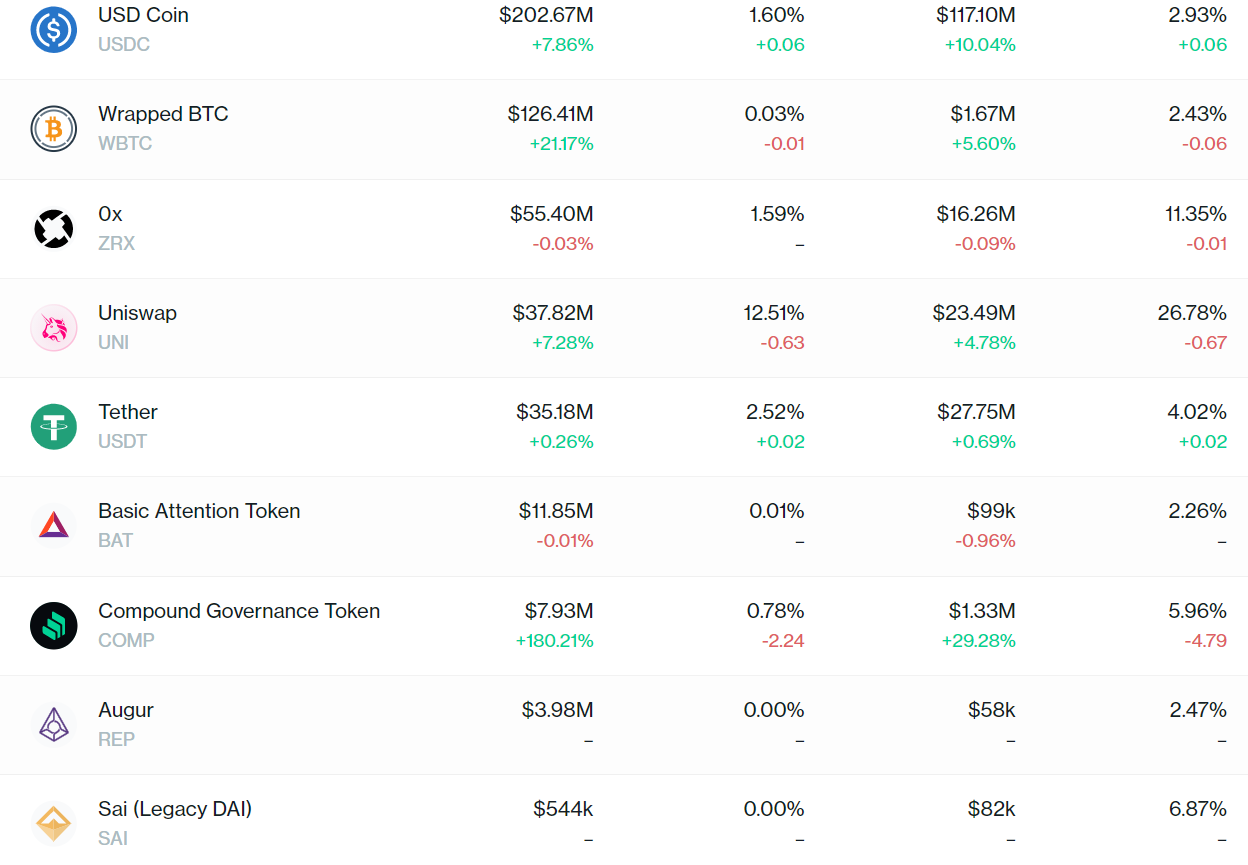
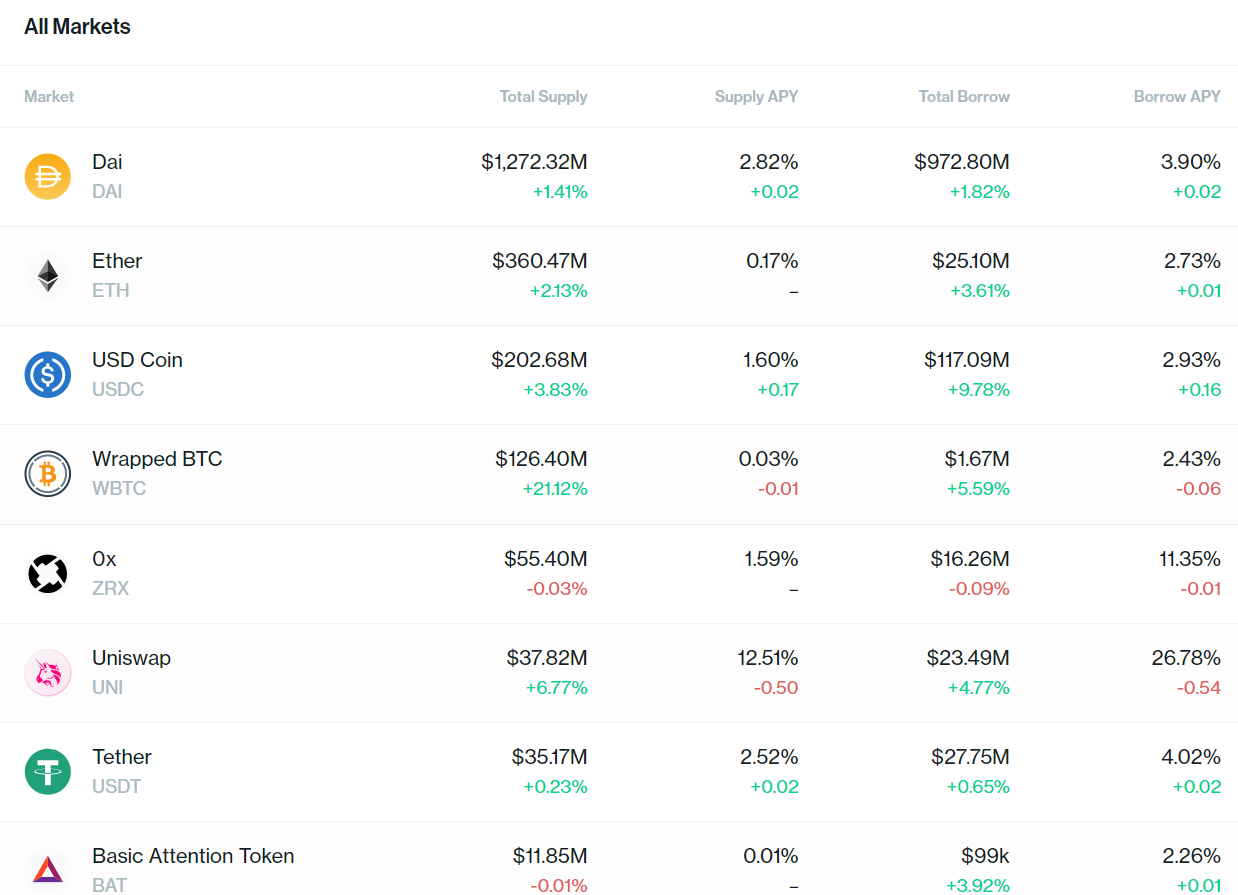
Now you can supply 10 differents token in Compound as SAI is not anymore used as you can see above.
My though is that it is a really interesting feature as UNI airdropped a large amount of UNI for their user. They now can supply their 400 UNI to earn 12.5% a year for free money.
COMP is a really surprising feature because Compound is still distributing COMP to the Protocol's user. You can earn COMP by supplying them to Compound and earn in the same time supply APY and distribution APY.
Hope you enjoyed the reading and let me know your thoughts on it.
Coinbase Earn program added an advanced lesson to Earn more COMP
Hey folks,
Just a little post to inform you that Coinbase, after added COMP governance token to their Coinbase Earn program, extent the lesson with advanced lesson.
As you can see, you have to join the waiting list to be able to follow the curse.
You can access to these lesson with the following link :
https://coinbase.com/earn/comp/invite/f4wshcg6
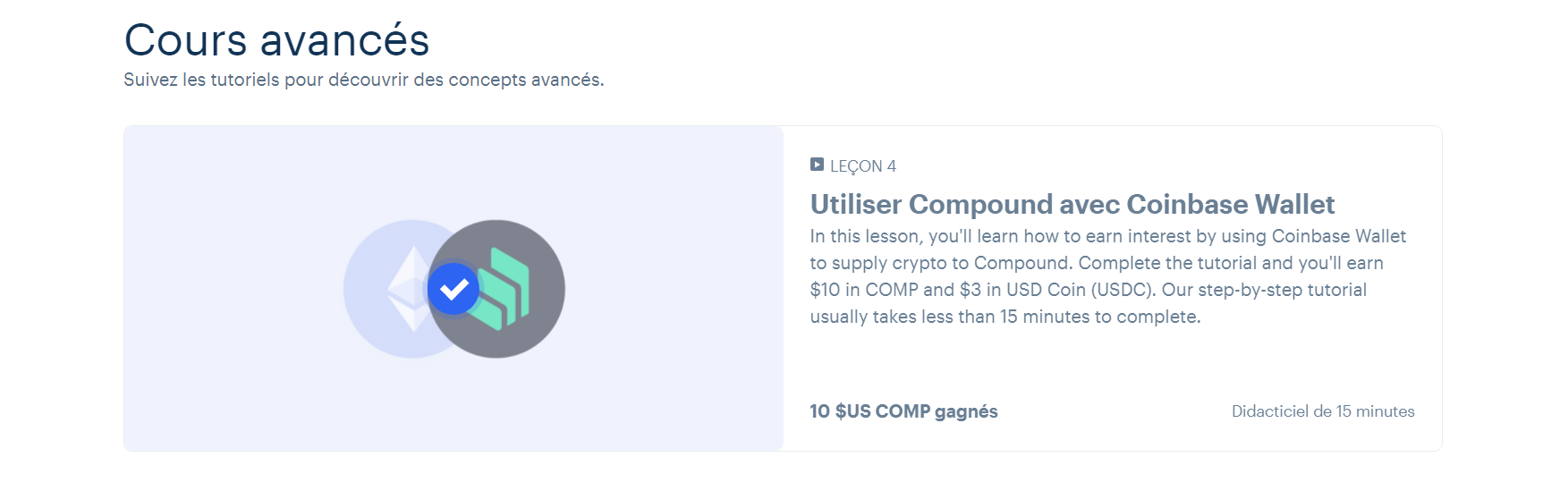
In this lesson you will learn to use Compound Protocol by supplying it. Welcome in the world of DeFi and smart-contract.
You have to create or use your Coinbase Wallet to interact with Compound and earn 10 USD in COMP.
Coinbase will send you 3USDC and enough ETH to cover the gas fees for supplying your USDC to Compound.
Follow the instructions provided by Coinbase and supply your 3USDC.
At the moment supply APY for USDC is 1.60% on Compound
Once the USDC supplied you will earn 10 USDC in COMP and know how to supply tokens on Compound.
Hope you enjoyed the reading.
What is a Data Protection Officer (DPO) ?
The Data Protection Officer (DPD) or the Data Protection Officer (DPO), accompanies and advises the person responsible for processing personal data in the process of complying with the texts in force [1].
The authorities in charge of monitoring the application of the General Regulation on Data Protection (GRDP) are, in France, the Commission nationale de l'informatique et des libertés (CNIL) (each European state has a national supervisory authority) and, at the European level, the European Data Protection Committee (EDPS).
The designation of a DPO is mandatory for companies whose "core business involves large-scale data processing that requires systematic and regular monitoring of individuals".
Failure to designate a DPO, even though it is mandatory, can be sanctioned by the CNIL with an administrative fine of up to 2% of worldwide turnover or €10,000,000.
The designation of a DPO is strongly recommended even if it is optional according to the GRDP since the absence of designation of a DPO must be the subject of a documentation relating to this choice which can be required in the event of control.
A DPO can be internal (employee in function or recruited to this position) or external (service provider) to the company. A single DPO may be appointed for the entire group. The identity of the DPO must be communicated to the CNIL.
A DPO must carry out certain missions relating to data protection and perform his or her duties with independence and confidentiality.
**1. Conditions for the appointment of a DPO**
Any controller or processor must appoint a DPO if [2] :
**a. Common condition :**
"Its core activity involves large-scale data processing".
Core business" should be understood as the set of essential activities that will enable an entity to carry out its core business; its core activity.
Conversely, not all of an entity's "core activities" are all of its support activities, which are traditionally common to all entities (the management of employee compensation, for example)[3].
« Large-scale processing" is assessed according to the number of people impacted, the volume of data and the duration and scope of the processing.
**b. Specific conditions :**
*i. Regular and systematic monitoring of the persons concerned*
If, in addition to the common requirement, data processing requires systematic and regular monitoring of individuals, then the designation of a DPO is mandatory.
Monitoring is "regular" if it is: continuous or occurs at regular intervals over a period of time; recurring or repeating at fixed times; occurring consistently or periodically [4].
Monitoring is "systematic" if it: occurs in accordance with a system; is pre-planned, organized or methodical; occurs as part of a general data collection program; and is carried out as part of a strategy.
**Examples of treatment requiring "regular and systematic monitoring:**
- Geolocation and Video-surveillance ;
- Connected devices ;
- Marketing activities based on profiling and monitoring of an individual's activities (targeted e-mails, behavioral advertising, etc.) [6].
*ii. Or the processing of particular categories of data*
If, in addition to the common requirement, the data processing concerns sensitive data or data relating to criminal convictions or offences, then the designation of a DPO is mandatory.
Sensitive data are data revealing racial or ethnic origin, political opinions, religious or philosophical beliefs, trade union membership, genetic, biometric, health data and data concerning sex life or sexual orientation[7].
**b. Penalty for failure to designate a mandatory OPD :**
The CNIL pronounces gradual sanctions: warning or formal notice to the organization; injunction, order to cease the violation of the DPO; limitation or temporary suspension of data processing; administrative sanctions if the previous injunctions have been unsuccessful [8].
In the case of failure to designate a mandatory DPO, the amount of the administrative fine may be up to €10,000,000 or, in the case of a company, up to 2% of the total worldwide annual turnover of the previous year, whichever is higher.
**d. Recommendations of the Supervisory Authorities (CNIL and CEPD) :**
Regardless of whether designation is mandatory or not, the European Data Protection Board (EDBP) recommends in its guidelines [10] that documentation should be prepared regarding the choice of whether or not to appoint a DPO.
This documentation may be required by the CNIL or the EDPS in the event of a review.
70,313 entities have appointed a DPO in France as at 14/09/2020.
**2. How the DPO is designated**
The choice of the DPO is free. It can be an internal person (internal DPO) or an external person (external DPO).
The designated person must have the professional qualities required to perform his or her duties, in particular independence and knowledge of data protection law (CNIL-approved bodies issue certificates based on these competency standards) [11].
Once designated, the identity of the DPO must be communicated to the CNIL (online declaration) and to the persons concerned by the processing. An enterprise group may designate a single DPO provided that he or she is "easily reachable from each place of establishment" [12].
If an external DPO is used, the CNIL and the DGCCRF recommend checking the nature of the services offered, since compliance requires more than a simple exchange or sending of documentation but real personalized support to identify actions and ensure their follow-up.
**3. DPO activities**
**a. Missions of the DPO**
The list of missions established by the GRDP is not exhaustive[13], but its main tasks are to inform and advise the controller or processor and the persons concerned by the processing, to monitor compliance, to cooperate and contact the CNIL, to carry out risk analysis and impact assessments and to keep the register of processing operations[14].
**b. Operating conditions**
The DPO must be involved by the data controller or processor, prior to any processing, in matters relating to the protection of personal data.
The DPO must carry out his duties with Confidentiality, Independence and Responsibility [15].
The controller or processor must allow the DPO to carry out his tasks, which implies access to the data and processing mechanisms, as well as verification that these tasks do not place the DPO in a conflict of interest situation.
________________________________________
1] Art. 37 to 39 of the GRDP.
2] Art. 37, par. 1 of the GRDP.
3] Cons. 97 of the GRDP.
4] WP 243 rev.01.
5] WP 243 rev.01.
6] Cons. 24 of the GRDP.
7] Art. 10 of the GRDP.
8] Art. 58.2 of the GRDP.
9] Art. 83.4 of the GRDP.
[10] https://www.cnil.fr/sites/default/files/atoms/files/wp243rev01_fr.pdf
11] Deliberation. CNIL n°2018-317 and n°2018-318 of September 20.
12]Art. 37, par. 2 of the GRDP.
13]Art. 39 of the GRDP.
14] In principle, it is the person responsible or a subcontractor to set up this register (Art. 30 par. 1 and 2 of the GRDP), who may entrust this task to the DPO: Guidelines WP 243 rev.01.
15] Art. 28 of the GRDP : Only the controller or processor can be held liable, not the DPO.

Coinbase add MKR Governance Token to Coinbase Earn program
Hey folks,
Just a little post to inform you that Coinbase added MKR governance token to their Coinbase Earn program. https://www.coinbase.com/earn/maker
As you can see, you have to join the waiting list to be able to follow the curse.
By watching and answering to 3 different video which explain what is MKR and how to use it, you will be able to win 6 USD of MKR gouvernance token.
If you enjoyed the reading you can tip me below to encourage me to write more content like that.
European Crypto News – September 2020 edition
Here I am back with a new format, more succinct, which will allow me more regularity.
The objective is to compile the news that I consider important in the world of crypto-currencies on the European territory. A simple summary with the links to deepen the subject will be provided
Don't worry, the law will never be far away but much less developed than in my previous articles.
I invite you to read my academic research on the subject if you wish to go deeper into the topics covered in these reviews. You can also do your own research (DYOR is valid for everything).
I hope you will like it.
**France choose TEZOS blockchain for his CBDC experiment :**
As I mentioned in this previous article (https://www.publish0x.com/fla/public-crypto-currency-why-and-how-banque-de-france-successf-xdrndnv ), France, like many European countries, has launched an experiment with a European central bank digital currency (CBDC) based on the blockchain.
The advantages of using this type of technology are numerous, and the experiment seems to be progressing rapidly. France is trying to position itself as a leader in this experimentation with, I find, a lot of determination and relevance.
It was announced on September 15, 2020 that the Banque de France experiment led by Société Générale would use the TEZOS blockchain, in partnership with Nomadic Labs. The objective is to test the technical feasibility of such a use.
The arguments put forward for this choice are :
- Use of the proof-of-stake consensus instead of the less energy consuming proof-of-work.
- Public and decentralized governance.
There is no doubt that further information will be provided in the future on the results of this experimentation.
**The CJEU recalls the principle of net neutrality:**
In a judgment dated 15 September 2020, the Court of Justice of the European Union (CJEU) considers that the principle of net neutrality precludes an Internet Service Provider (ISP) from favouring certain services and applications by means of preferential access bundles.
This decision is the first interpretation of Article 3 of Regulation (EU) 2015/2120 of 25 November 2015, establishing measures on access to an open Internet and amending Directive 2002/22/EC on universal service and users' rights relating to electronic communications networks and services and Regulation (EU) No. 531/2012 on roaming on public mobile communications networks within the Union.
This article 3 of the European directive enshrined the principle of net neutrality, in contrast to recent US decisions. Indeed, it states that :
- The right of end-users to access and distribute content, to use and provide applications and services, and to operate the terminal equipment of their choice (paragraph 1)
- The fact that the agreements and ISPs and their customers do not limit the exercise of the above rights (paragraph 2)
- The obligation for ISPs to treat all traffic "equally". However, with the possibility of implementing "reasonable" traffic management measures. That is, among other things, based not on commercial considerations, but on "objective differences in the technical requirements for quality of service for certain categories of traffic. Unless they are necessary to comply with legislation, to protect the integrity and security of the network or to "prevent imminent congestion and mitigate the effects of exceptional or temporary congestion" (paragraph 3).
The European judge therefore holds that slowing or blocking measures are incompatible with the general obligation of equal and non-discriminatory treatment of traffic on the exercise of end-users' rights, as long as they are based on commercial considerations, and not on objective differences between the technical requirements in terms of quality of service for certain categories of traffic.
However, this means that an operator is then entitled to discriminate against traffic based on objective differences according to the technical requirements of the network, but not because of the identity of the partner (Deezer, Youtube etc...).
Read.cash improvement : BCH paid by the fund should be only used for tipping
***Thursday, August 6th, 2020***
The Read.cash community is still shocked by the Meme contest which led to the explosion and departure of the creator of Read.cash.
I won't go back on the fact that led to the actual situation, but I think most of the Read.cash community regret that departure and is still hoping for his come back.
More personally, @Read.Cash have all my support for the free work this only person did, leading to paying thousands of users coming from a lot of country in the world, developing their knowledge and offer them a wonderful tool to use for any activity.
The only limit of Read.cash is the human creativity.
The way this person created this platform with his personal money have to inspire people, particularly these days when Bitcoin Cash community is fighting each other.
My though is that there is a lack of volunteering in the crypto community in general. Most of users are missing the most important point of crypto-currencies and I am quite sad to see how the "Satoshi revolution" is used.
From the user who just see USD eq. to leaderboard of BCH staff who are fighting each other for power, you are all missing that the main point of this technology is decentralization and equality.
This technology give to all people a common financial rule for all user, with no way for States to prohibit a money movement from a state to another.
That's the point. The only point why crypto was created. Using crypto as a support for real money or trying to grab the power is the opposite way of what crypto is about.
With this introduction, you could think "there is no fucking link between the title and what your are writing".
You are right. The point I wanted to show is related to Read.cash. This platform was created by voluntering, to share to the most people this technology. But using it like it is is not fair.
Early BCH adopters tips large amount to other early BCH early adopters, and not to new users while they are to future of BCH.
I won't blame it, most of the content on this platform is low-quality when it is not just plagiarism.
People try to be rewarded but don't understand why and how. You can't see many comment beside "early BCH users" post that doesn't make sense at all. These post are lost between article about flower or kitchen recipe.
To incentive people to write great content, I have a suggestion :
**BCH paid by the funds shouldn't be withdrew by users but only tipped to other.**
You could think it is unfair for new users, but it will incentive them to tip good content with their BCH coming from the fund, and to write good content to be tipped.
With this feature, news "great-quality" users will be tipped and they will appears as "good authors". Read.cash fund will work like a fund : BCH coming from the fund will be used to tip users, then they will be able to withdraw their tip.
Only BCH tips could be withdrew, not BCH fund coming from the fund. Daily spent will remain to the same amount, but only BCH tip will go outside the platform.
Let me know in comment your though and I hope you enjoyed the reading.

Ethereum tips are now live on Publish0x
Hey folks,
A new short post today to inform you that Publish0x now allow to tip and be tipped with Ethereum.
The feature was announced last month and is now live since ~~few days~~ (thanks to @Otek for the precision) today.
I really enjoy that implement, because many crypto-currencies I use are ERC-20 token, tokens using Ethereum network.
I can’t wait to see how i twill evolve and to withdraw my first Ethereum tips on Publish0x.
**Update :**
Publish0x team published this article announcing ETH tips : https://www.publish0x.com/publish0x-official-blog/ethereum-eth-integrated-for-tipping-min-withdrawal-increased-xpjroye***?a=y5eVO7JBaE*** https://www.publish0x.com/?a=y5eVO7JBaE
Main information are :
**ETH will replace DAI Stablecoin as the main tipping token**, so you now can earn ETH, BAT, and LRC;
**Minimum withdrawal is now 1USD equ.;**
DAI balance will be exchanged to the corresponding value in ETH on **18th of August 2020;**
All of tips are now **30% higher**.
You can sign up on Publish0x if you are not yet registered with the following link. https://www.publish0x.com?a=y5eVO7JBaE

Hey folks, hope you are well
Just a short post to ask a question to read.cash users : how could I delete an article I posted ? I don't figure how I could do it in other way than updating the article I want to delete without the text, but it still appears on my profile page.
If it is not yet possible I think it could be a good feature to implement.
Thanks for your answer if it is possible.
Have a great day.
 @FrenchLegalAspect