What is ideology actually?
In daily life, during conversation, at school, on television, on the Internet, in the newspaper, etc. We come across many concepts everywhere. Although we use these concepts quite a lot in daily speech, we do not know exactly what these concepts mean. Our emotion is the result of an experience independent of the concept, that the concepts have positive or negative meanings, sometimes arousing emotions such as happiness and sometimes fear. One of these concepts is the concept of ideology. When the adventure of ideology is examined from a historical perspective, everything is tried to be explained through it and the source of all problems is tried to be attributed to this concept. This poses a problem. For this reason, it immediately causes the definition of this concept and the explanation of this concept in depth. Thus, the aim of eliminating the question marks in the minds of our esteemed readers is tried to be realized.
Ideology is a concept defined as a worldview in its most general form. Many different definitions have been made on this concept. From these definitions, you can reach different sets of information about this concept. A worldview, science of ideas, ideals is defined as a set of thoughts used to direct the behavior of individuals or institutions. It is a concept that takes itself as a subject in the field of politics, philosophy, religion and values. When examined in complex life, the concept of ideology is a concept that explains how society works, what is the role of individuals in society, and which is the best path to follow in complexity.
Contrary to popular belief, ideology is not defined as a simple set of political assumptions. It is a concept that helps us to make sense of political and social life. It is a concept that gives the map of the society and enables us to act within the society. As it is thought, ideologies play a role not only in the formation of group identities, but also in the shaping of individual identities. Ideologies are concepts formed as a result of philosophical assumptions produced by people. It is not built spontaneously, but on the basis of a philosophical, social and political past behind it. It tries to explain the past, present and future in a way that is consistent with each other. Ideologies generally motivate communities towards a common goal.
Ideology is a word of French origin. It means thoughts that are powerful enough to influence the behavior of a person or institution(s). In terms of meaning, ideology means a way of thinking, a way of life, a set of political ideas, a political doctrine, an economic system, a system of ideas that legitimizes a social action, a belief system, and more. According to scientist Allard, it is defined as a system that defines the goals of the thoughts and actions of individuals and how to achieve these goals, and determines the quality of social and physical realities.
The teacher of the teachers, the valuable scientist Şerif Mardin, also made a definition of ideologies instead of defining ideology. According to Mardin, ideologies are a concept that undertakes the function of ensuring the protection of worldview in order to give a new world of meaning to a society by using the principles of transferring and protecting social, political and historical symbols.
There is a reason behind making such different definitions about ideology. The best scientist to explain the reason for this is known as Foucault. According to Foucault, the reason for these differences is that ideology is a concept open to interpretation. Due to this feature, it undergoes a meaning change by gaining different meaning contents according to different individuals, thinkers, and segments of society. Therefore, it deals with different features from each other. There is no valid standard definition of ideology in the world of social sciences. However, it is defined specifically by individuals or disciplines. It does not carry a meaning content that is generally accepted by everyone.
Antoine Destutt de Tracy is the most well-known of the commentators on ideology. Tracy is one of the Enlightenment philosophers. He was the first to define this concept as the science of thought. Tracy defined this concept as the science of the human mind. Tracy defined this concept as a science that studies human thought, the laws of thought and the resources of thought. With this definition, Tracy sees ideology as the supreme of all sciences. In short, according to this interpretation, we can define ideology as the science of scientific thought.
After Tracy's comments, Karl Marx also commented on this subject. Marx relates ideology to social infrastructure. While Marx's infrastructure covers everything related to the economy, the superstructure includes everything outside the economy (religion, language, culture, family, science…). Marx defends the understanding of historical materialism. According to this understanding, thought does not determine material reality. On the contrary, the understanding of material reality determines thought.

Communication in Business
Communication; It is one of the indispensable requirements for the continuation of the life cycle among living things. It is possible to talk about the existence of a form of communication that ensures order not only between humans but also among other living things. So what is communication? It is a question that has a simple answer but has a powerful effect on life. In addition to the known forms such as oral and written, there are also symbolic forms that vary from culture to culture. Body language, eye contact, chosen words are important factors in faceless communication. Communication skill, which is very important in daily life, manifests itself as workplace productivity in business life. Communication skills are very valuable not only for people-oriented departments such as marketing, purchasing, public relations or human resources, but also for other sectors.
Communication, which started as an instinctive behavior in humans in the early ages, enabled to interact with large masses in writing with Gutenberg's invention of the printing press in the 15th century. Clear expressions are very important in written communication as well as in verbal communication. Communication types such as short and clear e-mails and social media correspondence prevent possible communication accidents, as they will convey the message to the other party in a way that does not allow comments. Communication is the main instrument of building a strong bridge between people for whatever purpose, and although it may seem easy, it passes through different filters such as minds, paradigms, prejudices and knowledge in different human masses. Studies say that the same message is interpreted differently by different people. The use of written communication method in addition to verbal communication in working environments is also important for keeping written records. In addition to correspondence with a legal dimension, e-mails and notifications containing a commitment also impose mutual responsibilities on individuals and institutions in business life.
***Communication Methods in Business Life***
With the changing world, techniques have emerged that make communication more practical in business life. In the business world where time is very precious and productivity is an important performance criterion, communicating in the shortest way and in the most accurate way contributes to business and corporate efficiency. For this reason, businesses and institutions receive training that will benefit their employees about effective communication methods in business life. In addition to improving the communication between the employee and the manager, feedback trainings in the workplace also provide valuable data to see the problems that arise in the working system and the areas that can be improved and to take the necessary actions.
Communication is also the exchange of feelings and thoughts between people. It is not a one-sided process in both daily life and business life. In addition to being a cyclical process with multiple buyers, it is also a value-creating/generating cycle. The language, words and body language used during both written and oral communication give messages to the other party in which the word, body language and tone of voice are coordinated together. When people hear something from their own lives, the communication bridge is also easier to establish. Particularly, the parties who use storytelling technique in presentations and bilateral dialogues manage to communicate effectively. The ability of the message to touch the emotion of the listener is important for the beginning and continuation of the listening action.
Making short and clear sentences both while writing and speaking,
Using sincere and clear expressions,
Using professional courtesy language,
Listening or reading without prejudice and for understanding,
Fluent speaking and writing style
Giving memorable and effective listening examples.
Why is Communication Important in Business Life?
Communication begins for humans as soon as they are born. Babies use crying, their only means of communication, to express their wishes. The baby, whose needs are satisfied every time he cries, uses this technique as a communication tool. When he starts to speak, he learns different communication methods over time, while describing himself with limited words. In business life, communication proceeds a little more hierarchically. While this was much more formal in the past, today it is much more direct when talking about technological developments, education system, generation gap. In particular, the change in hierarchical structures, the vertical organization structure being replaced by horizontal organization and matrix structures brought people from all levels to interact directly with each other. Although the new system caused different communication accidents at first, it is indisputable that it creates an environment that facilitates the understanding of different generations and employees in different positions.

What is the Zeigarnik Effect?
In the daily rush, we all leave some works, moments and therefore memories unfinished. The mind remembers such situations more easily than completed events. This incompleteness gives rise to a feeling of discomfort that increases over time. When it is thought that we have to keep up with many tasks at the same time, it is inevitable that this syndrome is experienced by everyone. The functional structure of people, which is among the most important benefits of modern life, brings along a tiring life. The problems created by this and countless other situations and their solutions are explained by the science of psychology. Ways to get rid of this syndrome and continue with your life are explained.
The Zeigarnik Effect, which proves the existence of Gestalt Theory and Principles, which is one of the most important theorists of psychology, is present in perceptual and cognitive effects. We act with the feeling of uneasiness created by this situation. Unfinished loves, daily chores or procrastination are constantly spinning around in our head. We want to finish them and continue our work. Explaining the Zeigarnik Effect brings with it a solution to procrastination. It is considered as the response of the brain to unfinished work.
What is the Zeigarnik Effect?
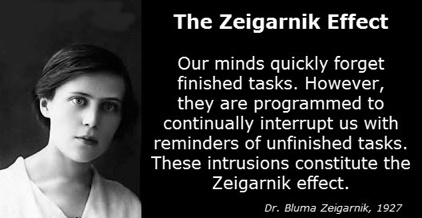
The Zeigarnik Effect, also known as the Unfinished Syndrome, refers to the fact that individuals remember incomplete things more easily than completed tasks. It defines why we constantly remember our unfinished relationships. Our recollection of unfinished love is an effect that connects the cause-effect relationship between leaving the holiday and returning home. This situation, which keeps your brain busy all the time, is the harbinger of the syndrome. It is a very difficult situation to live with the thought that unfinished events should be remembered and completed. Unfinished business in our minds prevents us from continuing our lives. Thinking about the unfinished business while doing something causes concentration problems. It presents an inefficient process as one of the keys to efficiency is focus.
How Was the Zeigarnik Effect Discovered?
The Zeigarnik Effect was interestingly discovered by the Russian Psychologist Bluma Zeigarnik, born in 1901. The scientist's inspiration is the waiters. They go to the restaurant of the University of Berlin with a group of psychologists, including Professor Kurt Lewin, his doctoral thesis advisor and also the founder of Positive Psychology. Zeigarnik notices a gason trying to take all the orders. The waiter tries to remember the orders without writing them down on paper. It can complete orders during the service process. When Zeigarnik could not stand it any longer and asked the waiter how she did it, his answer was surprising. The waiter said that after he delivered the orders, she erased these mental notes from his mind. Later, Zeigarnik and Lewin, with an irresistible sense of curiosity, decide to experiment with the subject.
Zeigarnik and Lewin find that unfinished business occupies the mind. She makes determinations that completed works cause a feeling of relaxation. Zeigarnik turns this determination into an experiment by giving 138 children arithmetic problems and puzzles. The puzzles are taken back after the children have completed half of what they have. When Zeigarnik probes the children's memory an hour later, she realizes that he remembers better what she left unfinished. In her experiment with adults, it turns out that they also remember tasks they couldn't finish 90% better than those who did. The research report prepared by Lewin and Zeigarnik as a result of their experiments was published in the Psychologische Foschung Journal in 1927. After numerous attempts, she finds that it is from cognitive tension arising from the need to keep the task in mind. This happens in a healthy way with the effect of motivation, expectation of reward and desire to succeed.
What are the Zeigarnik Effect Prefixes?
Bluma Zeigarnik, after whom the syndrome is named, continues his experiments to test hypotheses. Achieves results on an average of 20 simple tasks such as stringing beads, puzzles, and solving math problems.
Bead Stringing Experiment: Zeigarnik challenges a group of participants to string beads 15 times. During the event, she prevents him from stringing the beads in 3 randomly chosen ones. She directs the other beads to string. After a while, she asks the subjects which bead sequence they remember. Subjects indicate that they did not forget the sequence they left unfinished.
Novel Experiment: It is carried out with two different groups. Se gave the first group time to complete the tasks that needed to be completed before the experiment. In the second, it starts the experiment without giving this time. Participants are asked to read novels during the experiment. As a result, it is seen that the first group, who was given time to complete the works, understood the novel better than the others. The second group has difficulty concentrating.
Puzzle Completion Experiment: This experiment is performed by Kenneth McGraw about 60 years after the effect was proven. A group of subjects is asked to complete the puzzle in exchange for money. Because the money is given before the puzzle is finished, some people think the experiment is over and leave the environment. However, the experiment begins later. The remaining people take the money and continue to puzzle.
Anagram Experiment: Performed in the 1960s by a memory researcher named John Baddeley. Participants are given answers to the anagrams they cannot finish and are asked to say the words they do not remember. It is seen that the incomplete ones are remembered instead of the ones that are completed successfully.
Reasoning Experiment: In an experiment conducted by Kenneth McGraw and Jirina Fiala in 1982, participants are interrupted before completing their task. 85% of the subjects say they want to continue their task even after the experiment is over.

How to Love Your Work?
You woke up with the sound of the alarm clock in the first light of the morning. Your eyes are still tightly closed. In fact, you should get up and get ready right away, but you cannot leave your warm bed. After one, two, but after the third snooze, you turned off the alarm and finally opened your eyes. The new day is on your shoulders with the same burdens as the previous day, not with the sparkles of the sun.
What if you didn't have to work? A familiar scenario? For most of us, the answer is unfortunately yes. But we know that for some of us this is not the case. So what separates us from them? Why do some of us wake up before dawn with a great desire to start work, while others choose to laze at home?
In the dictionary, what moves people is defined as motivation. So why don't we all act on this motive? Is this motive internal or related to external factors? According to experts, the most important factor in determining and achieving one's goals is motivation. Research shows that you can influence your own motivation level and self-control.
Motivation can be extrinsic. This is why some people are inspired by outside forces. Consideration, appreciation or appreciation of others raises their motivation. Motivation can also be internal and inspiration can come from within a person. For some, working, researching, learning, reading or traveling is a passion beyond mere action. People do not need encouragement or motivation from others to do them.
*Motivation in Business*
Undoubtedly, the first condition of being motivated in working life is to do your job with love. This, in turn, develops a sense of commitment to work. According to psychologists who specifically study employee motivation, motivated employees are one of the hardest to find. According to another study conducted by Dale Carnegie Training, the number of unaffiliated employees in businesses is by a significant margin more than engaged employees.
Only 45 percent of managers and supervisors and only 23 percent of people at other levels feel engaged, creative and confident in their work. One of the biggest factors affecting employee commitment is the employee's dissatisfaction with their supervisor. Studies have shown that people who have problems with their bosses are not connected to their workplaces by 80%.
*What Does the Employee Want?*
So what steps do leaders need to take to motivate their employees? Conditions in business life change from day to day. Bosses also need to understand that their employees' wants and needs are changing. This is even better understood when learning how to create a culture in which Generation Z members can be successful.
Employees want to be considered, valued, approved or appreciated by their bosses. If we look at businesses with bosses doing this, we can quickly notice that employees are relatively more committed to their jobs. Apart from improving working conditions and creating organizational culture, co-workers working in cooperation also increase the motivation and commitment of the person to his work.
*Things To Do For You*
There are things we can do to keep our motivation high. If we list the most effective motivation methods;
Convince yourself of what you want to do.
Surround yourself with other people who work hard.
Divide your tasks into smaller tasks.
Focus on what you're doing.
Remind yourself why you are there and always try to stay positive.
Manage your time well to be more organized and scheduled
*Meditate*
I have one more suggestion. A very effective motivation method in recent years: Meditation. In its most general sense, meditation means reviewing something and reflecting on facts or situations. In other words, it is staying in the moment and turning to our own mind. Practicing meditation methods is a very useful motivational technique to calm down and relax.


Chaotic
-You know, there are some in your life; It's as if they exist to create a constant problem for you. He puts lock upon lock upon your freedom.
-Karmic experiences karmic experiences cleansing cleansing experiences, there are certain events that follow you throughout your life. Wherever you go, it appears under every cover.
-You say: "Why do these events and these people follow me?"
-These are the determinants of the reasons why you are in your worldly life and the markers of the emotions you need to change.
-We are all born to work as a cleanser of the cosmic contamination that has built up.
-“So I'm actually a cleaner? Is it just because of cleanliness that I'm in the world?”
-The idea that the purpose of our life, which we so extol, is a cleansing process may sound very demeaning and unfair. We really shouldn't take life so lightly. “Experiencing” is the main reason we are here. In order to get rid of the negative charges that have swarmed over our soul like a nightmare, we create experiences to process the causes of these charges and eliminate them. The main purpose in every action we take is to process the experience that this action brings to us and transfer this gift as energy to our higher self.
-Before we all got here, we set out our famous "contracts" and contract assistants. We created scenarios suitable for our karmic burdens that we needed to clear, and we were born in the appropriate time period. As soon as we were born, we forgot who and what we are in order to fulfill this duty properly.
“Should we forget?”
-This question has really crossed everyone's mind hundreds of times. Imagine, can you force an entity with unlimited powers and abilities to go through a difficult process by squeezing it into the body without forgetting it?
-That's why it should be forgotten.
-We began to struggle to fulfill our karmic burden in earthly amnesia. While our assistants with whom we made an agreement are giving us all kinds of difficult experiences, they are neither aware of this task, nor are we aware that we have given them this task voluntarily.
-Challenging experiences list
-Take a look at your life. What events and people challenge you the most?
-What emotions hold you captive and impasse when you encounter them?
-Make a list of them. Examine it one by one and you will not see a very long list. In general, the subjects that are put into your eyes for you to see and that you generally choose not to see will be collected under a few headings.
-This is your "Karmic List"
-In fact, when you look at your life with a straight logic, out of the mood of drama and the psychology of I am a victim of life, there are usually memories that contain the same energy patterns that have been experienced dozens of times.
-The reason why these events are repeated dozens of times is because we do not understand what we need to go into awareness and receive. So we are the reason why our lives are a tragedy of disasters. The first time you assumed this was the case, you would be relieved of this burden in one go, instead of the same painful experiences. Then you would fit dozens of cleanings in a single life and enjoy life.
-It's time to put aside the logic of this is how it goes and to examine your life piece by piece.
-Make a list of events in your life that challenge you and come back into your life again and again.
-Make a list of people who have given you different and challenging experiences in your life.
-Lets! Per task to make your life more efficient.
Managing time Effectively
Time is the only resource in the world that has been democratically given to people. A rich person has 24 hours a day, and a poor person has 24 hours a day. When the concept of time, which is democratically equal among people, is managed effectively, individuals benefit. The concept of time is a concept that cannot be compensated in any way and cannot be reversed. When it is not used efficiently, the work of individuals can be disrupted and things to be done can be delayed.
Here, the concept of time management came into play. The concept of time management is a concept that enables the efficient and effective use of a democratically distributed 24 hour day for everyone. A person who can manage time is a rich person. The concept of time management emerged with the problem of not being able to spare time for themselves as people entered a more intense and fast-paced working process with the business world that developed with the Industrial Revolution. Human beings, who could not spare time for themselves, started to complain about this situation and postponed their work all the time. In order to eliminate this problem, modern man, that is, the individual, has met the concept of time management.
Although all people have 24-hour clocks, some people can accomplish much more with their own time than others. The answer to this is that those people can manage time effectively. So what is time management? It is a concept that allows a person to organize and plan how much time to devote to certain tasks or activities. This concept causes the person to be more productive and get efficiency. In addition to these, while the person is more successful in his life, he experiences less stress. Modern people must learn this concept, which offers great opportunities for those who want to reach important life and career goals.
A modern person who wants to use his time effectively and efficiently must first learn what he does for 24 hours. He spends most of his time sleeping and working. This is followed by the actions of eating, traveling, self-care and learning. We know how much time we have during the day to be successful in life. The important thing is that we need to make correct and effective decisions by using the time we spend efficiently.
***Learning the Eisenhower Matrix***
The Eisenhower Matrix is an approach developed by the former US president and named after him. The Eisenhower Matrix is a tactic that will enable one to manage time successfully. It is an easy tactic to implement among the tactics given about this concept. What you need to do in the content of the Eisenhower Matrix is to divide the work of the person into 4 categories. Eisenhower Matrix works weekly, monthly, yearly etc. It is suitable for people who want to plan for a long time. The Eisenhower Matrix is divided into 4 categories, and people place their jobs in these categories and determine their order of importance and urgency. They do their work in this order. So, in which categories does the Eisenhower Matrix determine the importance of people's work?
Urgent and Important: Represents the work that the person needs to do immediately. It is out of the question to postpone this work. For example, preparing for a presentation that you will make tomorrow morning can be included in this category.
Urgent But Not Important: It represents the works that need to be done without wasting time, but we can include the works that do not require the occurrence of a crisis situation in this category.
Important But Not Urgent: It is a category that directly or indirectly affects different areas.
Not Insignificant and Not Urgent: Too much time should not be devoted to the works and situations in this category. Doing this will save you time.
If there is no order of priority among the tasks to be done, problems such as being scattered while doing those tasks, using inefficient methods such as trying to deal with more than one task at the same time, and wasting too much time with unnecessary works may arise. The Eisenhower Matrix eliminates this problem and places an order of importance and urgency for the work to be done.
Avoiding Time Traps:
Avoiding time traps allows one to manage one's time effectively. However, while people caught in time traps start to use time effectively, it brings inefficiency by keeping up with the traps caught. The aim is to stay away from time traps and thus to end the day with effective time management. I said it is very important to stay away from time traps, so what are these time traps?
bad communication,
unnecessary visitors,
Attending meetings without purpose
Not knowing how to say no
Indiscipline,
Inability to control one's self adequately
Dealing with more than one job at the same time,
It is relying on false information.
Staying away from time traps means avoiding the above-mentioned items and similar items. In order to stay away from time traps, you need to make a good plan of the work you will do and follow this plan.

The power of being the First
***The first of everything is special. First love, first child, first job. All are special.***
Being a leading company in offering products to the market requires high performance in terms of both creativity and application speed. Everything starts in the mind first. Therefore, investing in thinking and innovation is one of the basic inputs of being a pioneer. However, being a pioneer does not always ensure being the most profitable company.
Pioneering cannot be achieved simply by creating a new product. So companies that fail to bring a product to market first need to take the lead in other areas instead of following the lead to ensure profitability. Followers who pay attention to these issues can achieve profitability.
Being a pioneer in the market is not always achieved by creating a new product, but sometimes by introducing an old product to a new market. It is an important opportunity to take a place in the market by being inspired by products that have been successful in other geographical markets, especially in a country like Turkey, which is not in a leading position in technological developments.
Those who want to take the lead should abandon the "I know everything, I do it" approach. It is difficult to catch up with the speed required to be a pioneer without benefiting from the knowledge and experience of others. In particular, making use of existing and tested technologies often ensures being the first and reaching the production capacity that can become widespread in the market.
When bringing a product to the market, it is necessary not to surrender to the engineers and to bring the product to the market as soon as the features that will create the most value for the customers start to work well. Expecting a product to be idealized and to include many features usually means risking both losing the leading position and making it difficult to perceive the real value for the customer. To be a pioneer in the market, “perfect is the enemy of the good.” The concept should not be forgotten.
However, it can be dangerous to engage in an intense marketing activity without waiting for the product to be accepted in the market. For this reason, it should not be forgotten that there is a need for time to test the product in certain markets and to make adaptations in line with customer expectations. Likewise, it is important for the product to reach the production and distribution capacity necessary for its widespread introduction to the market. It has been observed that advertisements are more beneficial to their competitors, since their availability in distribution channels cannot be ensured in many products launched with an intense advertising campaign.The drive to take advantage of a new technology alone can turn into a disadvantage, especially when network economies prevail. For example, Sony's not licensing Betamax technology to others, and VHS's rapid spread by licensing eventually led to the VHS standard winning. With a similar approach, Apple strengthened Microsoft by not licensing its operating system to other PC manufacturers. Therefore, over-confidence and passion delays reaching sufficient prevalence, making it impossible to gain a wide usage area.
Gaining popularity and recognition in the market requires a significant marketing investment. Therefore, either allocates the necessary resources to create brand value, or cooperates with companies with reliable brand value.
The fact that the first entrants bind profitable customers to long-term contracts makes it difficult for their competitors who want to follow them closely. At the same time, long-term contracts help the leading firm widen the gap by improving its investment capacity. Similarly, entering into exclusive agreements with important suppliers is an approach that facilitates leading companies to maintain this position.One of the issues that leading companies should pay attention to is to avoid inviting competitors to the market by keeping prices too high. It is important to ensure the permanence of the leadership that the profit is used to finance the prevalence in the market and the developments in the product, rather than channeling it to other activities. Continuity in investment is required for continuity in success.
One of the requirements of leadership is good management of human resources capable of achieving this position. It is known that employees with leadership and creativity abilities act as magnets for others. Ensuring the loyalty of employees with these qualifications to the company is one of the important tools of continuous development.
In summary, being a pioneer can be achieved not only by developing a creative product, but also by carrying out many activities that will become widespread in the market and make this position sustainable. In order to turn the advantage of being a pioneer into profitability, it is necessary to plan and implement these activities and the necessary resources.
Why we try to learn all our lives?
The basis of creating added value is knowledge. As knowledge spreads over time, its power to create value decreases. Therefore, ensuring that the employees of a focused company are constantly improving themselves is critical to ensuring the continuity of the company.
For example, management consulting companies that work to bring about change in order to contribute to the solution and development of their customers' problems attach special importance to the continuous development of their employees. Because widespread information does not require consulting services for customers. Therefore, consultants should always be one step ahead. For counselors who live by teaching and triggering change, continuous learning is actually a struggle for survival.
Continuous learning is an indispensable element not only for the consultancy profession, but also for the continuity of development and competitiveness in all companies. As with any resource, the development of human resources requires good planning and effective implementation.
Companies that have begun to see the importance of human resources and the need to increase their investments in order to develop this valuable resource, as a first reflex, allow their employees to participate more intensively in the "attractive" trainings offered in the market. There are even those who see how many hours of training they provide per employee per year and share it with the public as an image investment. There are definitely benefits from these trainings.
However, education investments, which come to the fore as a more important investment with each passing year, need to be seriously planned like other investments and try to increase their efficiency. Since "our most valuable resource is human resources," its most effective use should be one of the "most important works" of companies.
There are two goals for companies in planning the development of their employees: to provide employees with company standards and values and to ensure that the person performs his/her duty as he/she should, and to prepare high-potential employees to create added value for the company at other levels by increasing their vision and knowledge.
The first step of education planning is to make the right planning. First of all, it should be determined which current or potential problems the company will face and what competencies it needs to solve them. Training planning yields more efficient results when linked to the company's strategic priorities.
The second step is to measure the expected results from the training. Because unmeasured performance cannot be improved. The most important mistake in training planning is measuring only the inputs, as in many areas whose results are difficult to measure. In other words, the only criterion followed by the management is training-hours per employee. The decisions to be made as a result of this measurement technique are only to increase or decrease this criterion. However, there is a need to develop measures regarding the benefit obtained from the training received, even if it is difficult. Thus, only “how much education?” not only to the question of "how much benefit" and "from whom, what education?" Data that can answer questions can also be collected.
The benefit of the training is provided by the use of new information after the training. Therefore, the preparation of the business environment provided in the period after the training in accordance with the use of new information and the planning of the timing of the training accordingly are factors that increase the efficiency of training investments. The concept of “just-in-time” increases productivity in education as well as in production. The widespread use of technology in education makes it possible to provide just-in-time education at many points.
Another issue to be considered is that training planning should not be seen as an activity that is carried out only depending on the job of the human resources department or the demand of the employee. Because education is only part of people management.
When training planning is considered as a part of both performance management and career planning, it can yield more efficient results. Performance management and career planning are among the most important duties of senior management. Therefore, training planning should be considered by senior management as an investment in performance management and career development processes.
In order to compete with the world, we must use all our resources efficiently and effectively. Ensuring that investments made in order to continuously develop human resources, which have become the most important resource in our age, are also effective, and this process is well managed.


Accepting change in Business Life
Those who can adapt to changing conditions in times of crisis are successful, while those who cannot make change perish. The crisis is both an opportunity and a threat in terms of rapid change. For this reason, institutions need to increase their pace of adapting to change in the crisis that surrounds the world.
In order to achieve institutional change, first of all, it is necessary to convince the institution of the necessity and urgency of change. One of the most effective ways to achieve this is to ensure that performance is compared with external best practices, not between units within the organization. In other words, it is to make benchmarking studies a corporate culture.
Change is learning. Learning deeply enough to change behavior. Therefore, in order to ensure institutional change, people who can set an example at every level in the institution should be united around the change goal. Establishing a coalition that believes in change and demonstrates this belief through experience should be among the first steps of institutional change.
For change, first of all, an impressive vision must be put forward. So what is an impressive vision? An impressive vision is a dream that reveals a compelling vision of the future, is purpose-oriented enough to guide decisions, yet flexible enough to encourage initiative, easily explained, and realistic enough to excite those who are subject to change.
Effectively sharing the vision is as important as creating it. For this, simplicity of the message, enriching it with examples, ensuring the continuity of communication, discussing the weak points without ignoring them, and above all, change leaders need to act in harmony with the vision not only with their words but also with their behaviors.
There is no change without faith. The most effective tool in spreading belief is success. This is why, while planning the change process, attention should be paid to short-term gains as well as long-term benefits. Effective communication of short-term gains also helps to realize these benefits.
Therefore, focusing both on achieving these short-term successes and celebrating the first successes exaggeratedly increases the organization's adoption and ownership of change.
It is perceived as an important symbol that the leaders of the organization show that they adopt the change not only with their words but also with their actions, and their participation in the celebration of the first successes, albeit small, is perceived as an important symbol and increases the ownership of the change process in the organization.
To bring about organizational change, leaders need to build a coalition to support change from within and outside the organization. In the coalition that supports such a change, the presence of people from all walks of life, from the board of directors to the factory worker, and especially the people around them, helps to embrace the change in every platform. It is important that those who embrace change also have the skills and competencies to realize the change. Because the unity of discourse and action of those who embrace the vision helps to increase trust and grow the coalition.
One of the most important factors preventing change from being permanent is that the information and performance management systems in the institution are not structured in accordance with the new order. Without changing the incentive systems that reflect the old values and were established to protect those values, it becomes difficult to motivate the employees with innovations. Likewise, if the information system required by the new system is not established, the information-based decision-making process will not work. First of all, changing information and human resources management systems and enabling them to support change is one of the most important steps to institutionalize change.Leaders who enable change are primarily capable of self-evaluation; aiming at continuous improvement; valuing people; They are people who accept continuous learning, transparency, communication and sharing as a philosophy of life and can set an example by reflecting this understanding in their behaviors.
In summary, institutions need to provide opportunities, develop and support change leaders at all levels in order to maintain their change competencies.
Planning with Scenario
In times of high uncertainty, the work of those who perform both strategic planning and budgeting becomes more difficult. Last year, many companies preferred to work with quarterly budgets instead of annual budgets. Many companies, on the other hand, are content to identify the effects of uncertainties with sensitivity analysis. Sensitivity analyzes can be used to determine how small changes in the market will affect the income statement and balance sheet. However, in environments where uncertainties are high, not only marginal changes, but also changes in steps to be taken in the face of different realizations should be evaluated. For example, although the results of minor errors in exchange rate forecasts can be detected by sensitivity analysis, scenario studies would be more accurate since the measures to be taken in the face of a 50% devaluation would have to be very different.
Uncertainties in the behavior of both the future and current and potential competitors make strategic planning difficult. In this respect, many institutions carry out strategic thinking in the form of "scenario analyzes" instead of an immutable strategic plan. First time II. It is known that after the World War II, "scenario analysis" started to be used in the future planning of the think tank RAND Corp.
Through scenarios, strategic planning encourages creativity. Teams that perform strategic planning in organizations often have a similar mental model of work. Often important enough to participate in the strategy generation process! To come to a position, it is expected to have worked in the institution for a long time. However, the fact that those who have been in the same environment for a long time have similar experience also reduces the intellectual differences between them. For this reason, some organizations include people with different experiences who are outside and/or new to the organization in the strategy development process. Scenario analysis encourages creativity as it allows for modeling of personal differences of opinion and uncertainties about the future.
Scenario analysis also allows the flexibility and resilience of adopted strategies to be tested in the face of different future scenarios. Thus, it becomes easier to determine and follow the indicators related to the breaking points of the strategies. It also allows for resource planning to reduce the risks associated with the identified strategies.
Scenario analysis helps to prepare alternative plans close to the main plan. In this way, the adaptation speed of the institution to the changing conditions increases. Determining the steps to be taken in the face of changing conditions in preparation for the uncertainty of the future increases the richness of strategic thinking.
Scenario analysis also accelerates the organizational learning process. Determining the strengths and weaknesses of the institution and the opportunities and threats that the institution will face in different future scenarios helps to gain some experiences without incurring the cost of learning by living.
Scenarios developed and analyzed in the scenario planning process reveal different alternatives, unlike classical forecasting and market research, which carries the current situation forward with mathematical models. Thus, by recognizing the warning signals and revealing the facts underlying the scenarios; surprises can be avoided, changes and shocks can be adapted more easily and treated more effectively. The expected result from scenario planning is to enable employees to constantly think and exchange views about the future.
Today, companies, large or small, want to involve their employees more in the creation of their strategies and futures, and scenarios are becoming important tools for these efforts. However, pre-testing the decisions that can be made according to different possibilities will provide companies with significant competitive advantages.
For these reasons, the use of scenarios in strategic planning is becoming more common day by day. Because those who have strategic intellectual preparation gain the opportunity to direct the events instead of following and reacting to them. The way to be successful in the future is to prepare the future.
 @ForWork