Religions of the World
Atheism
Atheism is the absence of belief in any Gods or spiritual beings. The word Atheism comes from *a*, meaning without, and *theism* meaning belief in god or gods
**Bahá'í**
The Bahá'í faith is one of the youngest of the world's major religions. It was founded by Bahá'u'lláh in Iran in 1863.
Iran was then mainly a Muslim country, and the faith was proclaimed by a young Iranian, who called himself The Báb. He said that a messenger would soon arrive from God, who would be the latest in a line of prophets including Moses, Muhammad and Jesus Christ.
Buddhism
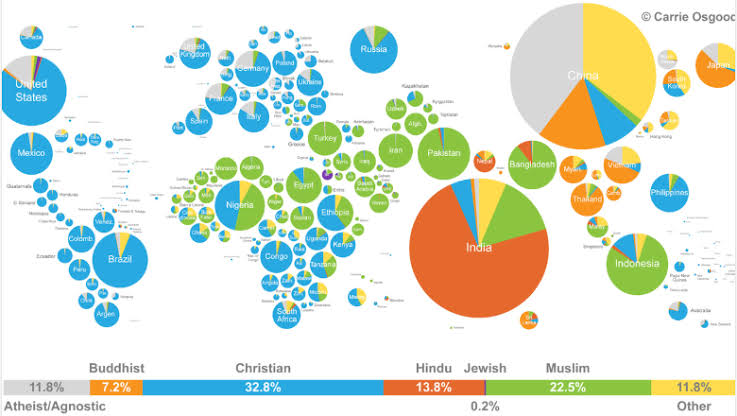
Buddhism is a spiritual tradition that focuses on personal spiritual development and the attainment of a deep insight into the true nature of life. There are 376 million followers worldwide.
Buddhists seek to reach a state of *nirvana*, following the path of the Buddha, Siddhartha Gautama, who went on a quest for Enlightenment around the sixth century BC.
There is no belief in a personal god. Buddhists believe that nothing is fixed or permanent and that change is always possible. The path to Enlightenment is through the practice and development of morality, meditation and wisdom.
Buddhists believe that life is both endless and subject to impermanence, suffering and uncertainty. These states are called the *tilakhana*, or the three signs of existence. Existence is endless because individuals are reincarnated over and over again, experiencing suffering throughout many lives.
It is impermanent because no state, good or bad, lasts forever. Our
Grammar Exam:P3-Pronouns
They have done _______ work properly.
them
they're
there
their
There are two types of possessive pronouns: possessive pronouns (mine, hers, ours, etc.) and possessive determiners. We use them to refer to possession and ‘belonging’. We use possessive determiners before nouns: Is that your dress?. In the English language there are 7 possessive determiners: my, your, his, her, its, our and their.In the test sentence ‘They have done _____ **work properly.’ some possessive determiner is omitted that is used before the noun ‘work’: ‘They have done whose work?’.As the context is given in the test: ‘They have done** _____ work…’, it is evident that further the speaker informs somebody about these people’s work. Therefore, the possessive determiner that correlates with the personal subject pronoun ‘they’ is ‘their’: ‘they’ (the personal subject pronoun) → ‘their’ (the possessive determiner).Therefore, we choose ANSWER 4: their.
Test 2-Pronouns
Jake, we haven't seen you for ages. When will you come and see ______ ?
them
we
our
us
In the test sentence ‘Jake, we haven't seen you for ages. When will you come and see ____ **?’ some personal object pronoun is omitted. In the English language there are 7 personal object pronouns: me,you, him, her, it, us, and them.We use personal object pronouns after (1) verbs as the object of the verb (I love her, but she doesn't love me.; I saw her at the university yesterday.) and after (2) prepositions: He is talking to her about them.As the context is given in the test: ‘Jake, we haven't seen you for ages…’, it is evident that in the next sentence ‘When will you come and see** ____ ?’ the speakers (‘we’) invite Jake to their place. Therefore,the personal object pronoun that correlates with the personal subject pronoun ‘we’ is ‘us’: ‘we’ (the personal subject pronoun) → ‘us’ (the personal object pronoun).Therefore, we choose ANSWER 4: us.
Grammar Exam
Pronouns.
Sarah spoke to Brad Pitt _____ .
themselves
itself
himself
yourself
When the subject or the object in a sentence refer to the same person or thing we use a reflexive pronoun. Reflexive pronouns (myself, himself, ourselves etc) end in -self (singular form) or –selves (plural form). They refer back to the subject forms of personal pronouns.Reflexive pronouns can be used with nouns to mean ‘me (or you/him/her etc) and nobody else’ to emphasize a particular person/persons or animal/animals (male or female): Did you talk to the hostess herself or just to one of her assistants?; Do you want to meet George himself, or could his sister help you?;It is the party leaders themselves who make the decisions. In the sentence ‘I spoke to Angelina Jolie herself!’, the speaker emphasizes that he or she spoke to Angelina Jolie personally NOT somebody else.In the test sentence ‘Sarah spoke to Brad Pitt _____ .’ the particular man is emphasized – Brad Pitt.Sarah spoke to Brad Pitt personally NOT somebody else. Thus, we need the reflexive pronoun ‘himself’ –ANSWER 3.

Non Plus Preposition (Grammar Test)
His fear __ flying is always a problem.
of
for
to
at
We should remember that some nouns are used with specific prepositions after them: 'fear of'
Do you have an allergic reaction ___ antibiotics?
at
on
with
to
We should remember that some nouns are used with specific prepositions after them: 'reaction to'.
I have a recipe ___ paella with seafood. I can give it to you.
for
of
to
with
We should remember that some nouns are used with specific prepositions after them: 'recipe for'.
Modal Verbs Test in Grammar Test
**I don't know where to go next summer. I ____________ go to London.**
have to
should
must
may
`We use the modal verb 'may' when it is possible that something will happen.`
**My car is too dirty. I ______________ clean it immediately.**
might
can
must
may
`We use the modal verb 'must' when we talk about duties or when it is necessary to do something.`
**He is a good sportsman, but he ______________ stop smoking.**
**may**
can
might
should
`We use the modal verb 'should' when we give advice or recommend something.`
**It's very cold outside. We __________ put on warm clothes.**
can
could
may
have to
`We use the modal verb 'have to' when it is not our idea to do something, when we are forced to do something by somebody or by circumstances.`
 @Foodwar