Hello everyone good evening from Nigeria I had a very busy day and my schedule was tight so I couldn't login since morning....I know I've really missed a lot....too bad I'm really tired and wanna rest and hope tomorrow I'll make a good post.... Goodnight lovelies
@Ericmannie
Joined 2 August 2020 · 92 posts
Fx beginner,cool,love fun,shy and most importantly, I'm a Nigerian..... subscribe and like
120 KT
0 KT · 40¢ received · 0 KT · 8¢ given
Posts
Hello everyone, good evening from Nigeria Just came on since morning and I know I've missed a lot.... Had a very busy scg
Giveaway from @orni. Don't miss this opportunity to get a few points Here is the link https://read.cash/@Orni/giveaway-90fe966d Wishing you the best
Loving too deep So many people are scared of love,others are scared of commitment and some are even scared of a relationship. But loving too deep is some statement that really makes me laugh....can you really control how much you love a person? Some people would say yes but I'll say no. Why? Cause I've been in love and I'm still in and Everytime I hear that voice I feel like nothing else matters apart from talking to that person. Till right now I don't know the exact reason I Love that person and I can't even control how I feel about her. It's natural and most times is eternal. We don't love to deep,when u love,u erase all questions,even when u have trust issues u Find yourself believing that person,u see yourself falling but not too deep instead in fantasies. You see a future with that person....love itself is a deep and highly intoxicating feeling and when it's reciprocated....you feel like you flying,every seems to be sparkling around u and you keep this twinkles in your eyes. If you ever feel like you're loving too deep then that love wasn't reciprocated and the other person doesn't love u like u think they do....cause true love doesn't ask questions. Now the big questions,which are you scared of? Love, commitment or relationship?

Entry for Jane's YouTubers contest Hello everyone, good morning from Nigeria This is my entry for @jane YouTubers contest I'm sharing a link to my YouTube video where a girl is breaking up with her boyfriend because he doesn't give her time and attention so she wasn't happy and decided to leave,the point of the video is that even if you love someone and the person is acting up without reasons,learn to walk away peacefully. The message is so simple and short. Here is the link: https://m.youtube.com/watch?v= I love vlogging cause it gives me a chance to show people my ideas virtually and it makes me happy. You can join up with the contest on here: https://read.cash/@Jane/youtubers-contest-4bc6cc94 Wish me luck

Look what we've done I know you've seen them,yeah you have...the things we have done to nature and the atmosphere. From overpopulation to pollution to burning of fossil fuels and deforestation... Overpopulation Human rising birth rate compared to death rate has cause increase in numbers which causes urbanization and industrialization,thereby promotion deforestation which causes soil erosion,loss of farm lands and promoting food scarcity and increases the competition to survive. So you see the chain as it goes...we are the cause of our own problems. Pollution Increased human activities resulting from over population lead to increased disposal of wastes....so more wastes are deposited in the environment and the atmosphere every passing day which is detrimental to nature and also to us at Large. Deforestation Like I said up top human activities has led to deforestation which is gradually reducing the number of wildlife and the number of trees too. We are gradually reducing the oxygen concentration in the air which has a lot of effects on us and nature at Large but the big guns around don't even care. Burning of fossil fuels Now this is the issue with the most threatening problems. When fossil fuels are burned, they release carbon dioxide and other greenhouse gases, which in turn trap heat in our atmosphere, making them the primary contributors to global warming and climate change. If we don't change now we can make the world more uncomfortable for us ,which almost getting uncomfortable right now. If you like my article please don't forget to hit like and subscribe,thank you Thanks to @Rakibbec03 @CrazyInsane for your sponsorship,I really appreciate #nature #humanity



+1 more
The nightmare that hit horoshima and nagasaki and the reasons behind it. When growing up I heard about the nuclear bomb dropped in horoshima and nagasaki and I always wanted to know more about it when I grow up and when the chance came,I grabbed it and I'm sharing it with you guys now. A quote i got from Robert Fisher's article says and I quote: "Is the decision to bomb Hiroshima and Nagasaki morally wrong? 75 years later, the question is more difficult to answer than first appears." In the early 1980s, the Harvard law professor Robert Fisher proposed a new, gruesome way that nations might deal with the decision to launch nuclear attacks. It involved a butcher’s knife and the president of the United States. Writing in the Bulletin of Atomic Scientists, Fisher suggested that instead of a briefcase containing the nuclear launch codes, the means to launch a bomb should instead be carried in a capsule embedded near the heart of a volunteer. That person would carry a heavy blade with them everywhere the president went. Before authorising a missile launch, the commander-in-chief would first have to personally kill that one person, gouging out their heart to retrieve the codes. When Fisher made this proposal to friends at the Pentagon, they were aghast, arguing out that this act would distort the president’s judgement. But to Fisher, that was the point. Before killing thousands, the leader must first “look at someone and realise what death is – what an innocent death is. Blood on the White House carpet”. Killing a person with a butcher’s knife may be a morally repugnant act, yet in the realm of geopolitics, past leaders have justified their atomic acts as a political or military necessity. Following the nuclear bombs dropped on Hiroshima and Nagasaki – 75 years ago this month – the decision was justified only in terms of its outcome, not its morality. The bombing ended World War Two, preventing further deaths from a protracted conflict, and arguably discouraged the descent into nuclear war for the rest of the 20th Century. Deep ethics: The long-term quest to decide right from wrong How would nuclear war change humanity? Hiroshima and Nagasaki: Women survivors of the atomic bombs Yet those positive consequences cannot obscure the fact that on 6 and 9 August 1945, two of humanity’s most destructive objects brought the horrifying power of the atom onto two civilian cities. We can attempt to describe the events through numbers: at least 200,000 people killed by the flashes, firestorms and radiation; tens of thousands more injured; an unquantifiable inter-generational legacy of radiation, cancer and trauma. I can still remember the individual stories – of mothers and children, of priests and doctors, of ordinary lives transformed in a moment. Or we can memorialise the relics left behind, as described in the poem No More Hiroshimas: “The ones that made me weep... The bits of burnt clothing. The stopped watches. The torn shirts. The twisted buttons”. But there is perhaps no adequate way to capture that scale of human suffering. Can it ever be right to launch a nuclear attack against civilians? In what circumstances could such a decision be morally justified? In recent years, researchers and philosophers have explored the moral questions raised by nuclear weapons, and their conclusions suggest there are few easy answers. The survivors are known as "hibakusha" meaning The greater good First, let’s consider the argument that the US government, led by president Harry S Truman, made for the Hiroshima and Nagasaki bombing. Following the events, the US framed its decision as an unfortunate but necessary act for the greater good. “The principal political, social, and military objective of the United States in the summer of 1945 was the prompt and complete surrender of Japan,” wrote the US Secretary of War Henry Stimson in 1947. The alternative – a ground invasion – could have resulted in the death of more than one million US soldiers, Stimson asserted, and potentially many more on the Japanese side. Perhaps that explains why in 1945, a Gallup poll found that 85% of Americans approved of the bombing. If Truman felt any regret, he did not show it. One of the closest hints of contrition came from the diary of the secretary of commerce, who wrote that Truman called a halt to any further bombing after Nagasaki because “he didn’t like the idea of killing ‘all those kids’”. Yet, while there is no doubt that protracted war between the allies and Japan would have led to a heavy death toll, some historical accounts suggest that reality was more complex at the time. By focusing retrospectively only on the outcome – the end of the fighting and 75 years of nuclear-free warfare – alternative historical paths were closed off. What would the Japanese have done if the Americans had elected a show of force first, dropping a bomb in Tokyo Bay rather than onto two cities? Had the Emperor already resolved to ask his government to surrender? And was the estimate of one million American deaths through a ground invasion accurate? These what-ifs will never be known and can never be known The reasoning that Stimson presented for the decision can nonetheless be seen as a utilitarian argument that the bombing prevented a greater degree of overall suffering, says the Japanese philosopher Masahiro Morioka. In a recent paper, he drew parallels between the Hiroshima/Nagasaki bombings and the utilitarian dilemmas raised by the “trolley problem”. Originally proposed by philosopher Phillipa Foot, one of the simplest versions of this thought experiment asks people to weigh up whether they would sacrifice one person’s life to save five, by redirecting the track of a runaway trolley to kill that individual. In his university lectures in Japan, Morioka presented this version of the trolley problem to his students, and like many people who are asked to consider the scenario, they told him they would divert the trolley so that only one person dies. “They were shocked to realise that they made the same decision as Truman and Stimson,” he says. Yet Morioka argues that seeing Hiroshima and Nagasaki through the sanitised logic of a utilitarian greater good argument obscures the perspective of the dead and injured. “How the victims would think is erased from the problem,” he explains. “I believe that we should imagine seriously how the killed victims would think if they were alive here.” Morioka said that while he can see the basic logic in the justification of the bombing, he believes that it lacks humanity. “By making a justification, we are led to pretend that the perspective of the victims did not exist at all, which is morally and spiritually wrong, problematic and repugnant.” Degrees of separation: Perhaps that’s also what Fisher had in mind when he proposed his butcher’s knife idea. Blood on the White House carpet. The neuroscientist Rebecca Saxe tackles the moral dilemmas underpinning Fisher’s protocol in a class she teaches on the science of morality at Massachusetts Institute of Technology. Like Morioka, Saxe points out that if the US president was fully committed to the utilitarian logic of reducing the total amount of suffering during war, they should have no qualms with carving out the person’s heart to get the nuclear codes. What is one extra innocent life, if you are prepared to kill tens of thousands for the greater good? Perhaps some presidents would reach for the knife, but as Fisher’s friends in the Pentagon pointed out, the horrific proximity of the act might give them pause. After all, killing a person to get the codes has all the elements that make a brutal murder prohibited and punishable. As Saxe points out, the act would be premeditated, intentional, not in self-defence, and instrumental (it uses people as a means to an end). If you agree that murder by this definition is always wrong for individuals, can there be a moral justification for leaders and nations? Psychologists who study our moral attitudes have described the squeamishness felt by the idea of murder up close as “action aversion”. When people are asked to place themselves in a scenario that involves pushing, stabbing or shooting, for instance, they are less likely to support the idea of killing for the greater good. In the trolley problem, a majority of people support the case for switching a lever to divert the tracks, allowing the trolley to kill one person. But many hesitate when presented with a different scenario that involves pushing a man from a bridge to block the lethal trolley. (It is a grim coincidence that this unfortunate person is sometimes described as a “fat man”, which was also the code name of the bomb dropped on Nagasaki). The mathematics of death in this scenario are the same – one life for five – but something about the act of pushing feels wrong to many people. (Though notably not all – one study showed that college students with psychopathic traits, for example, are more likely to endorse utilitarian judgements that involve harm). In 2012, one group of psychologists designed an experiment that captured people’s “action aversion” in a truly inventive way. The researchers asked participants to perform acts of violence such as striking an experimenter’s fake leg with a hammer, or whacking a realistic toy baby onto a table. Even though people knew they would cause no harm, the acts prompted a strong psychological response, suggesting we may have a hard-wired moral aversion to doling out direct violence. As the psychologists pointed out, there is a “dark side” to such action aversion. Their findings also suggested that when people are detached from the realities of harm, there are fewer mental obstacles that might otherwise give them pause. “Signing one’s name to a torture order or pressing the button that releases a bomb each have real, known consequences for other people, but as actions they lack salient properties reliably associated with victim distress,” they wrote. Perhaps a geographical and temporal detachment from the human realities of Hiroshima and Nagasaki in 1945 goes some of the way to explaining why so many Americans still support Truman’s decision. Perhaps Stimson’s case for a greater good – all those hypothetical American lives saved – also still carries weight in the national memory. Five years ago, on the 70th anniversary of the bombings, the Pew Research Center asked Americans again what they thought of the bombing. While a lower percentage approved compared with the 1940s, 56% of US respondents said they believed the decision was justified. The perspective of the Japanese is, unsurprisingly, utterly different. In the Pew survey, only 15% of Japanese people agreed that the bombing was justified. And while 40% of Japanese people described the events as “unavoidable” in a 2016 study conducted by the broadcaster NHK, a higher proportion of 49% said “they can’t forgive even now”. This is despite the fact that an ever-smaller proportion of Japanese people still survive from 1945: the average age of the hibakusha – the victims who directly experienced the bombing – is now well over 80 years old. Other nations, too, would seem to approve less of nuclear attacks than the US, at least if snapshot surveys are anything to go by. In one poll, people around the world were asked if “nuclear weapons are morally wrong”. People in the US were notably less likely to agree compared with citizens of the UK and France, which are also nuclear powers. To dive deeper into US attitudes to nuclear weapons, one 2013 study titled “Atomic Aversion: Experimental Evidence on Taboos, Traditions, and the Non-Use of Nuclear Weapons” asked Americans to put themselves in the position of a leader authorising a strike on a base in the Middle East. The researchers wondered whether there might be a moral “taboo” against using the nuclear option, compared with a conventional weapon. They found that the people in their study were actually more likely to make a decision based on the effectiveness of the weapon and whether or not it would lead to escalation, rather than shunning nuclear weapons as inherently wrong or taboo. Yet Brian Rathbun of the University of Southern California argues that there is more nuance to the morality of the decision-making displayed in this study than first appears. “There was a presumption that those people were morally dastardly,” he says, but that conclusion is based on only one very narrow definition of morality. Psychologists and neuroscientists once studied moral decision-making predominantly through the lens of harm, fairness and concern for other people. For example, one approach was to peer at people’s brains while they caused or observed pain in others. But around a decade ago, it began to emerge that people’s “moral foundations” – how they decide what is right and wrong – are more complex, and crucially, differ according to background, culture and political ideology. Progressive liberals, for instance, are more likely to make judgements based on the moral foundations of “care” and “fairness”, aiming to avoid harm to others, or embracing political issues such as equality (which might suggest that scientists previously had spent a bit too much time focused on studying only liberal morality). Traditional conservatives, by contrast, are often more likely to prioritise the moral values of “loyalty”, “respect for authority” and “purity/sanctity”, and so make moral choices that favour traditions, societal stability, and preserving the way of life of their communities and nations. It’s not that conservatives are uncaring and liberals disloyal – the moral foundations can be present across society – but the point is that each person has different priorities about which values are most important to them when weighing up what is right or wrong. “We consult these underlying moral intuitions to figure out our position on an issue that we've never heard,” says Rathbun. Consider people’s reasoning for justifying violence. When a conservative supports policies like the death penalty, torture or military force, they are not setting aside their ethical values, even if a liberal might strongly disagree. And a liberal supporting a protest movement that leads to public disorder and violent clashes with authority might find disagreement with their political opponents, but they are guided by what they believe is moral. Last year, Rathbun and Rachel Stein of George Washington University set out to explore how people’s moral foundations affected their attitudes to nuclear weapons. Like with the “Atomic Aversion” study, the pair asked participants from the US to put themselves in the shoes of a leader weighing up whether to make a nuclear strike against a military base, varying factors such as weapon effectiveness, the identity of the enemy, and associated casualties. The pair found that people who prioritised so-called “binding” moral values of loyalty and respect for authority – which probably evolved to strengthen the “in-group” and protect against external threats – were more likely to approve of the use of nuclear weapons in their scenarios. They also, perhaps unsurprisingly, were more likely to endorse the actions of a leader who had launched a nuclear attack. Even stronger support for nuclear weapons was found among people who value the moral rule of “an eye for eye” – perhaps one of the oldest ethical principles. People with these binding and retributive values were also less likely to abandon their position as civilian casualties rose. However, they were not indifferent – support for the nuclear option dropped fairly steeply once the casualties exceeded 10,000, and was very low in all groups by the time the death toll reached a million. All this suggests that it’s impossible to answer whether the use of nuclear weapons is inherently right or wrong – whether they should be taboo or allowed under some circumstances – because it depends on the moral framework of the individual. For those who would wish to avoid nuclear war, an arguably more important question to ask would be how the aggregate moral views of a nation collectively influence a politician’s choices in the fog of conflict. What matters, says Rathbun, is that public opinion has the power to influence the likelihood of a nuclear launch. “Politicians rely on an intuitive sense about what they think the public will allow,” he says. “They're always operating under a sense of ‘what can I do’ and ‘what can I not do’.” And as historical trends in polling have shown, public attitudes towards nuclear weapons can shift over time. While support in the US is overall lower than the mid-20th Century, there’s nothing to say that this can’t reverse. One recent study, for example, found that public backing for the ban on US nuclear tests has declined since 2012. Meanwhile, the current US administration is reportedly contemplating a resumption of testing on American soil. A future leader, with their finger hovering over the nuclear button, will always make their decision under what Rathbun calls a “shadow of morality”. “The conclusion that's been reached since time immemorial is that international relations is a realm of human interaction devoid of moral content,” he says. “From an evolutionary point of view, I think that's impossible. Human beings just cannot help but moralise.” The end of everything There is one final moral dimension to consider when exploring the rights and wrongs of nuclear weapons, which was articulated by the Oxford University philosopher Toby Ord in his recent book The Precipice. The explosive power of thermonuclear bombs is so great in the 21st Century that they pose an existential risk of triggering a nuclear winter, caused by smoke from firestorms blocking sunlight for years. “Hundreds of millions of direct deaths from the explosions would be followed by billions of deaths from starvation, and – potentially – by the end of humanity itself,” he writes. Ord argues that human extinction would be a disaster of such magnitude that working to prevent it should be the world’s number one moral concern. Not only because everybody on Earth would perish, but also because it would mean that trillions and trillions of as-yet unborn people would not live – and flourish – in the coming millennia. “We stand poised on the brink of a future that could be astonishingly vast, and astonishingly valuable,” Ord writes. Yet our power to destroy ourselves – and all the generations that could follow – is outpacing our wisdom. In Ord’s view, the morality of nuclear war looks quite different if you consider it as an existential, species-level threat, rather than through the lens of national conflicts. The scientific revolution that led to the splitting of the atom requires a moral revolution as well After WWII, a monument was built at ground zero in Hiroshima. It features the words: “Let all the souls here rest in peace; for we shall not repeat the evil.” “The word ‘we’ means not only the people in Hiroshima city, but also all human beings on Earth, including the entire Japanese and US citizenry,” according to Morioka, who shows the monument to his Japanese students whenever he discusses the 1945 bombings with them. Five years ago at this site, a former US president paid his respects to the Japanese people, and said the following words: “The very spark that marks us as a species – our thoughts, our imagination, our language, our tool-making, our ability to set ourselves apart from nature and bend it to our will – those very things also give us the capacity for unmatched destruction… Technological progress without an equivalent progress in human institutions can doom us. The scientific revolution that led to the splitting of the atom requires a moral revolution as well.” It doesn’t matter which president said the words. What matters was that, like 10 other US presidents of varying political affiliations since 1945, he did not find himself facing the same decisions that led to that terrible week 75 years ago this month. For all this time, both Republicans and Democrats – along with the leaders of other nuclear-armed nations around the world – have had the opportunity and power to reach for the codes that launched an atomic bomb against their enemies. Robert Fisher’s controversial proposal to embed those protocols in the heart of an innocent volunteer was, obviously, never taken up. Yet remarkably, perhaps luckily, no global leader since Truman has ever used them. Whatever your views on the rights and wrongs of atomic weaponry, that cannot be anything but a victory. #nature #humanity If you like and enjoyed my article don't forget to subscribe and like...then stay tuned for more
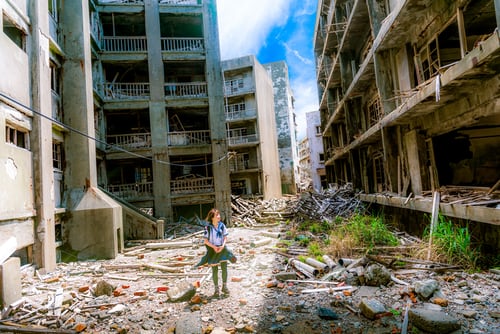
Hello everyone, I've been on RC for a week and I've had a lot of interesting experiences, I've seen good posts,funny ones, touching posts, motivating posts,some really good stories and some very irrelevant posts....but overall I find this platform interesting and encouraging for anyone who wants to be a blogger.... Thank you This is my entry for @cold3ndice sponsorship contest Here is the link https://read.cash/@Cold3ndice/sponsorship-b023a01d
Another giveaway going on by @jane Please participate and don't miss out This is the link https://read.cash/@Jane/weekend-giveaways-3cd73989
Hello everyone, good morning @Cutie_Angel_Mukta is doing a giveaway and the steps are so simple Just follow the mechanics here https://read.cash/@Cutie_Angel_Mukta
Hello everyone, @its_deepu sponsorship contest is finally over and results will be announced by tomorrow 11pm to 12am Indonesian time... Here is the link to the post so you can complete the tasks https://read.cash/@Its_deepu/sponsorships-results-date-timing-ae5cabfc Thanks for your support
Sponsorship by graeden Hello everyone, I've found the perfect sponsor for you, @z_graeden is celebrating a month old here and giving out sponsorship to the first 15 to 20 persons who follow the mechanics of this post https://read.cash/@z_graeden/sponsorship-30ae459d @z_graeden makes verygood posts and my favorite is my mother,I love the way he explicably and poetically explained the roles of mothers...moms are the best and I love my mom so much. I wish you all the best
Application for sponsorship Username : @Ericmannie Date : 3/8/20 Previous platforms : minds.com Hey community !! I'm Eric, a forex beginner,biochemist and a fashion designer. I've always loved blogging but never had the motivation to do it but since I registered on read cash few days ago I've seen that passion burning up and I've made a few articles on here. Categories : world,show organizer, emotions, research and nuclear. (For now) My previous work https://read.cash/@Ericmannie/the-male-female-pay-differences-no-one-talks-about-f9b93eca https://read.cash/@Ericmannie/our-world-between-10-years-e3df4fbf https://read.cash/@Ericmannie/fear-b6067b88 I know I'm a new writer but I believe I can give good articles on the above topics. Looking forward for the response from the community. Submitting to : https://read.cash/c/get-sponsored-2a0b(this is link of our platform) Hey guys we're at very early stage of our community. We're really going to build a very strong community for publishers as well as the readers.

Hey.....do you want a sponsor? I Know you do, I've found the perfect sponsor for you,his name is @its_deepu You can head over to this link and grab it now https://read.cash/@Its_deepu/ill-sponsor-you-4861a67b Sir Deepu I really need this sponsorship cause It's really nice when u know you got someone who supports you and you wouldn't wanna fail him or her and that makes you do more.
Hey,do you love nuclear? Cause my next strings of posts will be on the nuclear bomb dropped in nagatomo and horoshima. Subscribe,stay tuned and be blessed
Hello everyone, good evening from Nigeria....have you seen the daily trivia post from @jacie_hughes....if you haven't,this is the link to the post https://read.cash/@Jacie_hughes/daily-win-trivia-a1e26248#comment-af137019 And don't forget to subscribe to him, he's a good content writer.... wishing you the best
The male-female pay differences no one talks about It’s not just base pay that women earn less of compared to men in the workplace, rewards like Equity-based awards, like stock option grants, are offered more often to men, as suggested by new research. Studies have found that women are paid less than male colleagues is a stubborn fact in the US workplace. As of July, women earned 84 cents for every dollar a man earned. It is a discrepancy that has garnered significant attention from scholars, the media and sex discrimination lawsuits. But this figure only tells part of the story regarding gender pay inequality. Felice Klein,a professor of business management at Boise University once said and I quote "I have long studied compensation and inequality and know that base pay is only one way that women are disadvantaged in the workplace. Recent research by myself and colleagues shines a light on how female employees – particularly in the tech industries – likewise lose out when it comes to other forms of pay that receive far less attention: equity-based awards." These are stock grants, in which employees are offered shares in the firm as a form of pay, and stock option grants that offer the right to buy company stock at a preset price in the future. The value of both are tied to the employing organisation’s market price. *Less of an option? Equity-based awards are commonly used in technology firms and startups and can make up a substantial part of employees’ compensation. In fact, according to the 2014 General Social Survey, which was administered to a national random sample of working adults, 20% of all workers in the private sector own stock and stock options in their companies. Some estimates suggest the average value of stock options to employees who receive them is $249,901, and the average value of stock is $60,078. Felix Klein and his colleagues tested this cause he really wanted to see if gender played a role when it comes to equity-based pay. Aaron D. Hill of the University of Florida, Ryan Hammond at the data storage company Pure Storage, Ryan Stice-Lusvardi at Stanford University and Felice Klein analysed equity-award data from two technology organizations. They found a gender gap for equity-based awards ranging from 15% to 30% – even after controlling for the typical reasons that women tend to earn less than men, such as differences in occupation and length of service at a company. *What’s in a name? They wanted to know what could be behind the discrepancy, so they ran an experiment in which they asked working professionals to play the role of a manager in a fictitious company. Participants were asked to read a set of employee performance reviews and distribute stock options to their team based on one of two criteria often used for equity-based awards: retaining talent and recognising high potential employees. The fictional employees were randomly assigned one of two gender-typical names, Steven and Susan, so that each profile was given the man’s name half the time and a woman’s the other half. This helped ensure that any differences between the profiles did not affect the results. What emerged was a gender gap favouring men when it came to distributing stock options based on retention – but not based on potential. In other words, the data showed when it came to equity being used as an incentive to keep employees at the company, there was a significant gender gap. Their results were backed up by what they saw in the data provided by the technology firms, as well as publicly available data of executives. These findings came at a time when many companies are seriously looking at gender pay discrepancies. But even with efforts underway to address the gender gap in base pay and bonuses, I believe that many businesses do not appear to be focusing equal attention to equity-based awards. I found out interviews conducted with 27 human resources professionals at both public and private companies. Although nearly all interviewees acknowledged their employers were doing pay audits for base pay, and sometimes bonuses, only three said their companies conducted audits on equity-based awards. I also found evidence of this within the two technology companies they studied. There were small to no gender gaps in salary and bonuses after controlling for typical reasons that women receive less pay; however, large gender gaps existed in equity-based awards. Unequal equity Part of the reason this gender gap in equity awards exists is down to why they are handed out to employees in the first place. Stocks and options are most often distributed to employees to keep them from leaving. In fact, a survey of 217 companies found that almost 90% said retention was the primary objective of their stock option programme. Their interviews with HR professionals backed this up. Interviewees described equity-based awards as retention incentives for “high performers” and as “a forward-looking reward programme.” And studies have shown that men tend to be perceived as more capable in work settings than women and as such are likely viewed as more important to retain in a company and often seen as a higher risk of leaving for a rival. As a result, men are likely to receive more equity-based awards than women. While some companies are working hard to address gender inequality, their findings suggest that efforts should be applied more broadly to all forms of pay. Thanks for reading through,hope you enjoyed it? Subscribe to me for more And special thanks to @Rakibbec03 and @CrazyInsane for their sponsorship, though I haven't seen their logos yet... Lol #peace #introvert #inequality

Giveaway time Oh ok, it's give away time from Eric,I registered on this platform 4days ago and the experience has been wow,I reached 50views after 24hrs of being active? Who wouldn't be happy,so I'm giving out 0.01 to everyone who complete these tasks. 1.subscribe to me. 2.like this article 3.like this https://read.cash/@Ericmannie/sunday-night-with-eric-0caf07d3 4.share this post mentioning me so that others can see and participate and post the link of shared post below in the comment box. Note: offer runs till Sunday and the price could increase Stay tuned for more
It was raining hard that evening and we both got really wet when we got home,I was wet from head to toe but she was wet everywhere....it was so cold I took out my favorite duvet and placed it over her but she had other plans. She pulled me closer as I was trying to leave and before I could know it......... Hehehehe, subscribe to me to finish the story @reo and @ Christy asked for a short story....u want the longer full one, just subscribe,like n comment on any of my post with the hashtag #story
Hello everyone, @crazyinsane is giving out sponsorship to everyone who follows the rules on this post https://read.cash/@CrazyInsane/im-giving-out-sponsorship-91a73d63 It's easy just follow the rules and earn This is my entry https://read.cash/@Ericmannie/our-world-between-10-years-e3df4fbf I wish everyone the best
If I was gonna be a fruit,i would have loved to be a banana,cause bananas are soft, sweet and tall; that's exactly what I am. Meanwhile there's a giveaway going on here,just click the link and follow the rules then get your rewards https://read.cash/c/share-your-thoughts-syt-a50c/post-2b4721c1 Wishing everyone the best
Good morning everyone,my friend @jewel is doing a giveaway cause he just reached 1000views, good thing is,they will be price for everyone.... wishing everyone luck You can check out @jewel giveaway here https://read.cash/@Jewel/bch-giveway-79621cad
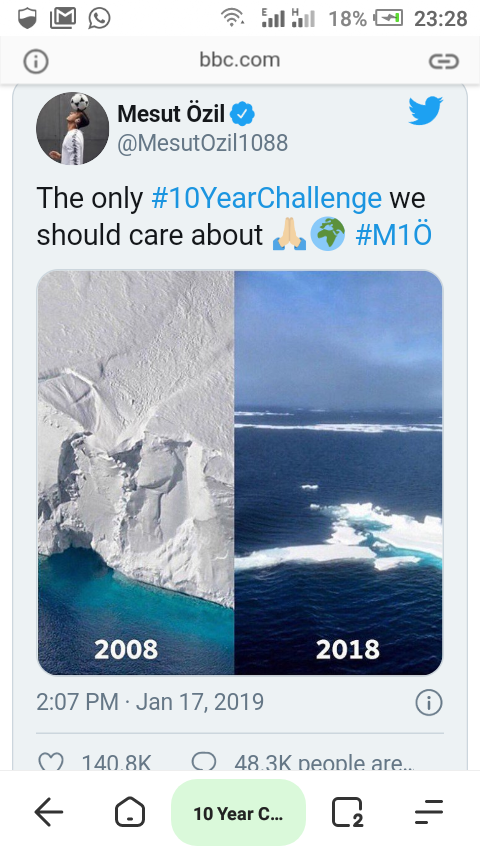
Our world between 10 years If you could remember,there was a "10 year challenge" that trended so much on social media last year If not, the premise is simple - post a 2009 photo of yourself next to a recent one, to show how much you've changed. Millions was taken part, but some criticised it for being - among other things - narcissistic, ageist and sometimes a bit sexist. But then people used the hashtag to reflect on bigger changes. Such as... Climate change A tweet by footballer Mesut Ozil compares what appears to be a large iceberg on the left, and a melted iceberg on the right. Although the meme wasn't entirely accurate - the photo on the left, of the Getz Ice Shelf in Antarctica, was taken in November 2016 rather than in 2008 - there's no denying that shrinking ice sheets continue to be a major issue. What we learned about green living from a 7-day experiment According to Nasa , Antarctica is losing about 127 gigatonnes of ice mass every year, while Greenland loses 286 gigatonnes annually. This, they say, is largely down to rising global temperatures being absorbed by oceans. The planet's average surface temperature has risen by about 0.9C since the late 19th century - and about a third of that has happened in the last decade. Environmental activist groups are also used the hashtag to highlight this issue. A post from Greenpeace bent the challenge a bit, by comparing archival photos from 1928 with images taken by Swedish photographer Christian Aslund in 2002. And Martin Kobler, the German Ambassador to Pakistan, tweeted out an article about climate change in the Pakistani region of Balochistan. According to the latest Global Climate Risk Index , Pakistan has been the eighth most-affected by climate change over the last two decades. Plastic pollution The year 2018 was when the world really woke up to the reality of plastic pollution as well as climate change. Scientists calculate that about 10m tonnes of plastic waste end up in the oceans every year - and that some of that can take hundreds of years to biodegrade. So some campaigners turned the #10YearChallenge on its head to show that, while we might have changed a lot in the last decade, the plastic we throw away remains almost exactly the same. Global conflicts On 17 December, 2010, a Tunisian street vendor called Mohamed Bouazizi refused to pay a bribe to local officials, so had his fruit and vegetable cart confiscated as a result. Faced with an unforgiving bureaucratic process, he set himself on fire . This act, less than 10 years ago, was the catalyst for what was later known as the Arab Spring - a wave of protests across the Middle East and North Africa that, in some cases, led to bloody civil wars and a refugee crisis that saw a record number of people forced from their homes. To reflect on this, then-and-now photos of conflicts in Syria, Libya and Iraq have been posted on Twitter - with thriving street scenes contrasted with stark images of crumbling buildings. People are also posting photos of Yemen, where a three-year civil war has led to the world's worst humanitarian crisis today . And some positive changes too People also shared some of the things that appeared to have improved over the last decade. According to statistics from the World Bank and the UN, extreme poverty is currently at its lowest overall level in recorded history , child mortality and youth illiteracy are both down, and global average life expectancy has increased. But, sadly, this doesn't show the whole picture. While extreme poverty is at its lowest level globally, it is still getting rapidly worse in Sub-Saharan Africa - where the average extreme poverty rate is now about 47%. And although youth literacy has increased overall, it's still lowest in less developed countries - and it affects young women more than men.According to the most recent data, 59% of all illiterate youth are girls. While environmental damage is still very much an issue, there's no doubting that awareness of it has increased, leading many people and countries to try and switch to sustainable sources of energy. The International Energy Agency says that renewables surged in 2016 , thanks in no small part to a boom in solar panel installation in China. Covid-19 And how can we forget the deadly pandemic that has been affecting the economy and general activities of people all over the world. This deadly virus has affected 19,211,912 persons,killed 716,029 and a little over 12million people have recovered.... If changes are not made,the next 10years could be worse. Subscribe,like,comment and upvote for more from me and don't forget Sunday night with Eric Here's a link to the post: https://read.cash/@Ericmannie/ so u know what it's all about Don't forget to like and comment there too #Peace #introvert #SYT
Sunday night with Eric So starting this Sunday, I'll be hosting a show here each Sunday and I swear it's gonna be great. This is how it will go....first of all you'll send an email to my Gmail account:iconicobes@gmail.com and I'll post it here as anonymous 1,2 and 3 according to the order it was received, the email should issues based on your relationship or anything, please it Should be relevant that u want to seek people's opinions on. After I post on the eveningof every Sunday,the Audience will comment with theeir opinion on the issues and the person with best comment will get a tip from me and the next best two comments will also get a tip from me..... So shall we....let the messages start rolling in now, Sunday is not far, it's going to be fun and thrilling, subscribe and see the thrilling stories and issues that are going to come in come Sunday. #sundaynightwithEric #introvert

Giveaway entry for macronald's contest Hi Jenny...as you step into this new age,I pray for divine wisdom,courage,love,blessings,good health and favour over you,may God grant you your heart desires and take you to heights you never thought you could attain....happy birthday Jennifer. With love from Eric, Nigeria. @Macronald https://read.cash/@Macronald/giveaway-my-kid-sisters-birthday-5199329f

Hello everyone, there's a giveaway going on at worldwide idea and I encourage everyone to participate. Here is the link to the giveaway post... https://read.cash/@Cold3ndice/2nd-round-giveaway-event-a4a7d7fc Wishing everyone the best
Tiny confusions Hi everyone, I'm new here and and it's nice to meet you all...my name is Eric and I'm a Nigerian....I hope we get to know each other more as time goes on. Now over to my post Why is it said to be " give him his book and not give her she book"? Why are stuffs carried by ships called CARGO and those carried by cars called SHIPMENT"? Why can I shot a dear in my pajamas when pajamas is not actually a place? These are some of my tiny confusions..... English can be really wierd

Fear Fear is that feeling that restricts us from doing what we can,it makes u see things that ain't real,it makes u focus on the negatives and always highlights the dangers out of everything. Fear is a farce and isn't real.... Don't get me wrong, dangers and negatives are real and everything has a dark side.....but the fear of these things won't make you face,confront, challenge or even wanna do anything. No one is fully out of fear though, there's something we are all scared of....some are scared of love,some needles ( like me),some are scared of parenting and all other stuffs, but you can reduce fear......but how? Big question. U can,by 1.eliminating the dangers from your mind 2.being more positive,and barely dwell on negatives 3.Face your challenges,if it doesn't kill u,it makes u stronger 4.learn to be calm and bold always 5.take responsibility of your actions Dangers are real but fear is just a whack subduing feel,kill that bastard now. #peace #introvert @Rakibbec03 sponsorship is currently going on Here is the link to the post to @Rakibbec03 original post: https://read.cash/@Rakibbec03/sponsorship-17ae415e

Behind the curtains I grew up,shy I don't mix up,why? Others were beautiful But I wasn't cheerful I had weak spots And I couldn't even talk When they whip my buttocks Mama was like "Go get my phone from that house" No!, send Mike U remember I am afraid of mouse. I wrote the group works, well indoors The others took the cheers cause I couldn't talk outdoors Yes that was the little me, living behind the curtains. #peace #introvert @Rakibbec03 sponsorship is currently going on Here is the link to the post to @Rakibbec03 original post: https://read.cash/@Rakibbec03/sponsorship-17ae415e
Behind the curtains I grew up,shy I don't mix up,why? Others were beautiful But I wasn't cheerful I had weak spots And I couldn't even talk When they whip my buttocks Mama was like "Go get my phone from that house" No!, send Mike U remember I am afraid of mouse. I wrote the group works, well indoors The others took the cheers cause I couldn't talk outdoors Yes that was the little me, living behind the curtains. #peace #introvert