New York City Coin - The Future of Crypto is here
New York is a city of dreams, a city of infinite opportunities and infinite entertainment. So what, if you could combine all 3?
Well, that's where the concept of a City Coin kicks in. Imagine a world, where you don't have to pay taxes for the upkeep of the city and the infrastructure development. Imagine a world where you get paid by your city for being a good noble citizen. Imagine a world where your city expenses are subsidized just because you hold a City Coin.
The possibilities are just endless. And New York City has begun its journey.
New York City has got its own digital token in line with the incoming mayor's vision of transforming the Big Apple into a Cryptocurrency Hub, and making it a crypto-friendly city.
The coin is called **NYCCoin** and has been launched by CityCoins, a civic-minded community and open-source protocol that gives investors an avenue to support their cities by expanding their crypto treasury while earning for themselves. When bought or mined, it allocates 30% of its reward to the city. https://www.citycoins.co/nyccoin
NYCCoin's launch follows close behind **MiamiCoin**, which to date has earned more than **$21.3 million** for the city of Miami since its August 2021 launch. https://www.okcoin.com/prices/miamicoin-mia-price-chart https://www.globenewswire.com/Tracker?data=1BurT6GNckVp9_s0-Dk5_YVx31BCGSONdeK2uum8qlcDHdIbLhQtVmDNA3U9g5aCbSE_4gDjwG8NP5QAASwMBraKom46fDELub-3wXZLTas=
While Austin, Texas was a close contender, the community eventually chose New York, propelled by the incoming mayor's pro-crypto stance,
The Mayor announced he will take his **first three paychecks** in Bitcoin, days after Miami Mayor Francis Suarez said he will take his next one in the same asset. https://www.businessinsider.com/nyc-mayor-eric-adams-bitcoin-paycheck-three-months-crypto-2021-11?utm_source=markets&utm_medium=ingest
Maimi’s Mayor has said that he hopes MiamiCoin will support his city enough that his residents would not have to pay taxes.
It's important to note that there is no formal partnership between the cities and the CityCoins. The selected city, however, does have to accept the project and the designated wallet that is custodied for them. They can choose to convert these assets into US dollars.
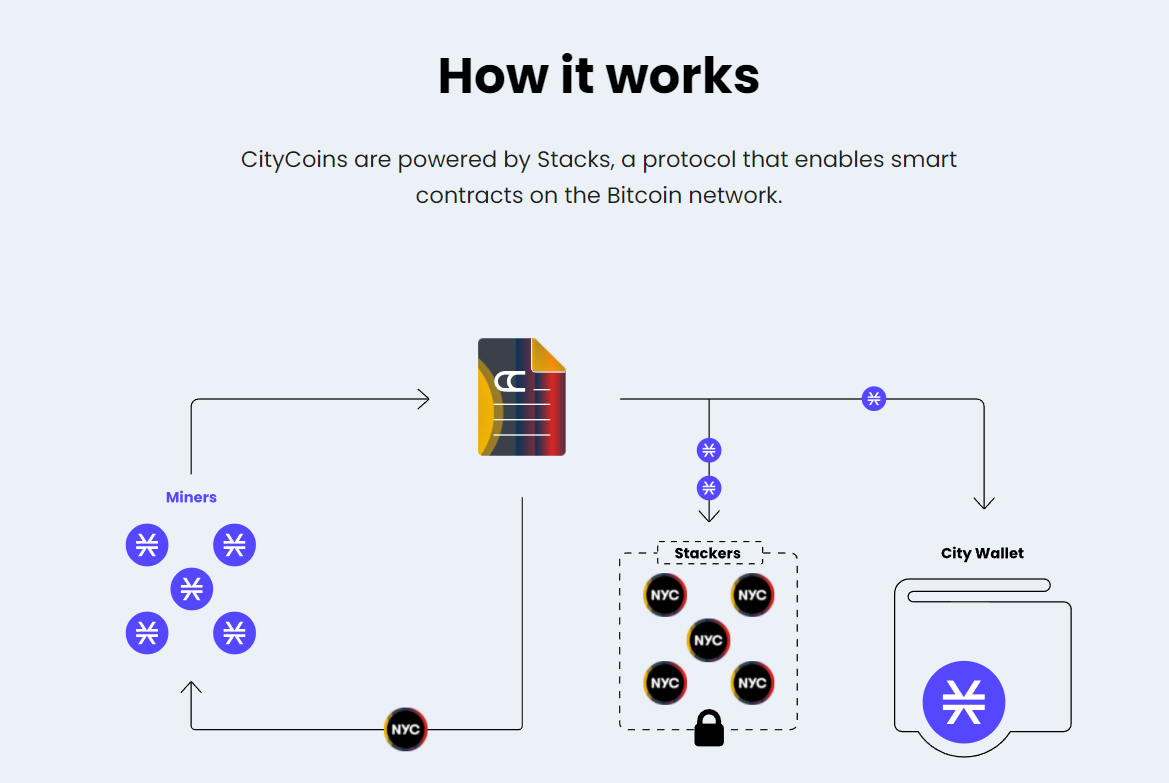
CityCoins is powered by the Stacks protocol, an open-source network that allows developers to easily build decentralized applications and smart contracts on top of the bitcoin blockchain. The native token of the Stacks Protocol is STX.
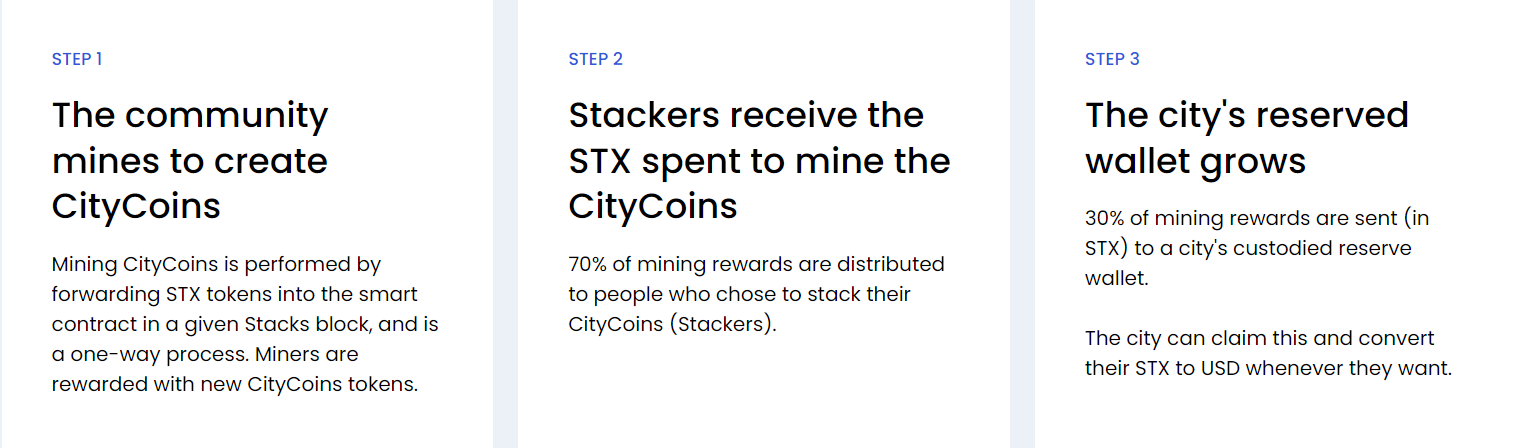
The NYCCoin treasury consists of STX, which is sent by miners when they forward the funds to a Stacks smart contract for the right to compete in a mining competition. Whenever STX is forwarded by miners, 30% makes its way into the city treasury.
Whenever the city wishes, they may access their reserved STX inside the wallet. At that point, New York City may use its treasury for whatever it likes, and can stack those STX to earn BTC.
**Tokenomics of STX**
STX has been trading at around $2.34 and has a market valuation of $3 billion, according to **CoinMarketCap**. It is ranked 54th overall. https://coinmarketcap.com/currencies/stacks/
It has a Max Supply of 1.81 Billion coins, with almost 1.29 Billion in Circulating Supply.
Tokenomics of the NYC (New York Coin)
The New York Coin has a total supply of a little over 143 Billion tokens, i.e., 143,761,098,438 NYC coins with a current Marketcap of $4 M. The market cap may look relatively small right now, but its key to note that the concept of a city coin is relatively new and it will take quite some time for people to understand this concept and start using it. https://coinmarketcap.com/currencies/newyorkcoin/
Since the city gets 30%, the remaining 70% can be stacked or temporarily locked by coin holders who earn STX, the crypto of the stacks protocol, and bitcoin. The city coins in general are also not issued or distributed before the start of mining.
What can NYCCoin holders do with their coins?
Anyone can mine NYCCoin, program NYCCoin via smart contracts, and even earn BTC from the protocol as it gets more usage.
NYCCoin is also a new way for developers to create applications and experiment with innovative use cases. Developers can create apps that use NYCCoin for access control (to digital or physical spaces), trading, lending, smart contract execution, and much more.
For example, within two months of launching, a CityCoiner created a “Mint-with-MIA” feature for MiamiCoin. As a result, holders can now **create or buy NFTs with their CityCoin**. https://www.citycoins.co/post/what-it-means-to-be-a-citycoiner https://www.citycoins.co/post/create-and-buy-nfts-with-miamicoin
Final Thoughts
CityCoins chooses the cities based on their own assessment. Their goal is to set up coins in 200 "startup cities" all over the world in the next two years. https://www.citycoins.co/
With its significant increase in the coin market, the New York Coin has drawn most investors’ attention, and interested investors need to understand the tokenomics of the New York Coin before investing their funds into this crypto token.
With a recent high increase in its percentage in the coin market, the New York City coin has seen significant growth in its price and number of holders. As of the time of writing this article, the New York City coin price is $0.00003176. https://www.citycoins.co/nyccoin
It's only a matter of time, give it a few years and you will see these models turn into realities, where every large city will launch its own Coin.
Citizens who hold or mine these coins will get special privileges to use the services of the city. You could get faster access at Airport check-in counters, or a special shorter queue to board the flight, or even get a priority reservation for a dinner table at your favorite upscale restaurant. A tourist to the city could get special rides across the city, or get reservations at the best hotel rooms the city has to offer
I imagine a day when citizens don't have to pay taxes to the city, instead, the city pays the citizens for being part of the city and contributing to its overall development.
The possibilities are endless. It's New York City afterall.
Ferrari Is Launching Its Own Collection Of NFTs
Owning a Ferrari is a very expensive dream for most, but now with Ferrari’s new NFTs, that dream could be a lot closer for many racing fans.
NFTs, or non-fungible tokens, are a new type of digital asset that has been trending as big tech builds the Metaverse. Owning an NFT is like owning the real thing, only that the real thing is digital.
With prices ranging from $250K to up to $1.8 Million owning a brand new Ferrari is strictly for deep pockets. But now, to please its fan base, Ferrari will soon sell digital Ferrari NFTs. https://corporate.ferrari.com/en/ferrari-and-velas-performance-and-innovation-new-winning-partnership
They have signed a multi-year deal with Swiss technology firm Velas Network. During the course of this deal, the firm will create various digital content for fans of the brand. The announcement on Ferrari’s website noted that both companies will work together to issue “exclusive digital content” for cars of the automotive manufacturer. https://corporate.ferrari.com/en/ferrari-and-velas-performance-and-innovation-new-winning-partnership
Velas is a global player in the NFTs and blockchain sector. It owns the Velas NFT Marketplace where organizations, companies, and teams are able to develop NFTs for their user base. They are known internationally for their openness and leadership in blockchain, digital products, and services. https://velas.com
In 2022 when Formula 1 kicks off the iconic red Ferrari car will run with Velas name on it. Velas will also be the title sponsor for Ferrari’s Esports Series Team. The Esports series is a virtual championship where FIA Formula 1 World Championship teams compete digitally.
The partnership with Ferrari opens the blockchain firm to a whole new user base. Ferrari, which has made its mark as one of the leading luxury and sports car brands in the world, has a fanbase of millions. Its official Instagram account currently sits above 21 million followers, while its Twitter account has more than 3.3 million followers. https://www.instagram.com/ferrari/?hl=en https://twitter.com/ScuderiaFerrari
Velas says it makes sense for them to team up with Ferrari because they are the “*fastest and most energy-efficient blockchains in the world*” and Ferrari has the fastest cars.
Many have criticized blockchains running crypto trades and NFTs services due to massive energy use and the impact it has on the planet. But Ferrari chose Velas not only because of their speed. The company is a carbon-neutral operation. “*They have revolutionized the world of blockchain by creating a pioneering, energy-efficient platform that operates at unparalleled speed*,” Ferrari says.
It is still unclear what Ferrari digital products will Velas develop. The company could even go as far as creating its own crypto. It is only a matter of time until the natural evolution of the new digital economy becomes widely accepted by the automotive industry.
Tesla at some point accepted cryptocurrencies and will probably switch back to them. Velas hinted that they have a wide range of benefits and services for the Ferrari fan base. They added they will be “*opening a new dimension for the sport and the brand.*” https://www.ferrari.com/en-IN
Following the announcement of the partnership, the Velas token, VLX, had seen a significant uptick in its price. Previously trending around $0.25, the digital asset has rallied to peak above $0.4. https://www.coingecko.com/en/coins/velas
**Final Thoughts**
Earlier this year, Lamborghini introduced its own **NFT collection via Elysium Bridge** in the form of an entire online museum. Ferrari and Lamborghini won't be the last to race into the NFT space, either. The intersection between crypto, blockchain, NFT technology, and the automotive industry is only just revving its engine. https://news.bitcoin.com/when-lambo-elysium-bridge-ferruccio-lamborghini-museum-to-launch-nft-collection/
The future of NFTs within the automotive collector's market is very bright, there is a lot of potential here. The marketplace for memorabilia as well as the cars themselves is already huge, not just in North America, but globally."
While most may sigh in exhaustion at the thought of even more varied NFTs, it's true that the crypto-based art is only just unfolding and will continue to expand into many other areas over the next several years.

The Golden Moments of Crypto in 2021
It’s been a record year for the cryptocurrency markets, which very briefly surpassed $3 Trillion in value in November. What a moment it was for everyone, especially the Bitcoin Maximalists.
Bitcoin, the largest cryptocurrency by market value, and Ethereum, the second-largest, hit their respective all-time-highs, while Alt-coins, like meme-inspired Dogecoin, Shiba Inu surged in popularity.
Other digital assets, like Non-Fungible Tokens, or NFTs, sold for Millions of dollars alongside fine art in major auction houses like Sotheby’s and Christie’s. In addition to art, NFTs representing in-game assets and digital land soared in value as well.
Blockchain-based applications, including Decentralized Finance, or DeFi, garnered interest from both retail and institutional investors, pushing the growth of Web3, which is the decentralized iteration of the internet based on blockchain technology that powers NFTs and underpins cryptocurrencies.
All of this helped push cryptocurrency into the mainstream in 2021.
Though there were countless defining moments this year, here are some key highlights.
Bitcoin surpassed $1 Trillion in market value for the first time
On February 19, Bitcoin hit $1 Trillion in market cap for the very first time. The milestone came after major institutional investors and notable financial companies began to support the cryptocurrency earlier in the year. Companies including Tesla, Square and MicroStrategy started to use their Balance sheets to buy Bitcoin.
Interest in NFTs exploded after Beeple’s $69 Million sale
When Mike Winkelmann, the artist known as Beeple, sold his piece called “Everydays: The First 5000 Days” as an NFT in March, it was historic for a number of reasons.
For one, the sale made Christie’s the first major auction house to sell a fully digital, NFT-based piece of artwork. Also, for the first time, Christie’s allowed ETH as payment for the artwork’s principal price. And the $69.3 Million sale price for the NFT was record-breaking at the time.
This sale prompted mainstream coverage of NFTs that wasn’t seen before.
Overall in 2021, the NFT market had its “best year yet” with over $23 Billion in trading volume, a report by analytics platform DappRadar found. Blockchain-based Metaverses had over $500 Million in trading volume and in-game assets represented as NFTs garnered $4.5 Billion in trading volume.
China banned cryptocurrency — again
In September, the People’s Bank of China confirmed its continued crackdown on cryptocurrency.
According to a Q&A on its website, the PBOC said that all crypto-related activities are illegal in China, including services such as trading digital assets, order matching, token issuance, and derivatives. In addition, overseas crypto exchanges providing services in mainland China are also illegal, the PBOC said.
China’s renewed crackdown on Bitcoin mining throughout the year pushed the market elsewhere, and in October, data from the University of Cambridge showed that the U.S. became the No. 1 destination for Bitcoin miners.
The data stated that 35.4% of Bitcoin’s hash rate, which is the collective computing power of all miners, was in the U.S. as of July, overriding China for the first time. Cambridge also found that China’s average monthly share of the global hash rate in July zeroed out, which was a major reversal from September 2020 when China captured about 67% of the market.
The crypto markets bounced back in a big way within a few weeks itself, leading to Bitcoin and Ethereum posting respective all-time-highs
El Salvador adopted Bitcoin as Legal tender
In June, El Salvador passed a new law to adopt Bitcoin as legal tender, becoming the first country to do so.
The law allows Bitcoin to be used as payment for goods and taxes in El Salvador. Businesses can price their goods in Bitcoin, and exchanges will not be subject to capital gains tax.
Ethereum launched EIP-1559 and prepared for the merge to Eth2
In August, a major upgrade to Ethereum went live. The upgrade, called London fork, included Ethereum Improvement Proposal (EIP) 1559, which changed the way transaction fees, or “gas fees,” are estimated. It also started the reduction of ETH’s supply, thus paving the way for the deflationary tokenomics for ETH
Additionally, Ethereum developers prepared for the network’s upcoming shift to a Proof of Stake (PoS) model through a number of upgrades throughout the year.
Currently, Ethereum operates on a Proof of Work (PoW) model, wherein miners must compete to solve complex puzzles in order to validate transactions. This model gets a lot of criticism for its environmental impact since it requires an extreme amount of computer power. Also, it slows down the transactions and the gas fees go through the roof.
In 2022, Ethereum plans to shift to a Proof of Stake model, where users can only validate transactions according to how many coins they hold, rather than the energy-intensive mining rigs used now. This move is part of the merge to Ethereum 2.0 or Eth2.
Eth2 will be hugely impactful since it will change the Ethereum infrastructure and ultimately make mining obsolete.
Ethereum competitors earn market share
As demand for Ethereum, the most used blockchain network, surged this year, other projects emerged in an attempt to compete.
Two include Avalanche and Solana, both of which launched in 2020 as platforms for smart contracts and the creation of decentralized applications. Each of their tokens, AVAX and SOL, respectively, jumped into the top 10 cryptocurrencies and earned market share among the rest.
As a result of competitors such as these, the total value locked (TVL) on DeFi increased seven times year-over-year, surpassing $200 Billion, DappRadar reported. However, almost 60% of the TVL still remains on Ethereum.
Elon Musk contributed to Dogecoin’s record high
In May, just before Elon Musk made his “Saturday Night Live” debut, the price of Dogecoin began to spike. On May 8, the day of Musk’s SNL appearance, Dogecoin hit an all-time high of about 73 cents, according to Coin Gecko.
But its price quickly retreated from that peak. As Musk appeared on the show, dogecoin fell as much as 29.5% and dropped to 49 cents at one point.
This was representative of the roller-coaster run that Dogecoin had all year, most of which had to do with Musk. The Tesla and SpaceX CEO has been a consistent supporter of the meme-inspired cryptocurrency. Dogecoin’s rally first began in February after a series of tweets from Musk, and since, he has continued to hype up the digital coin.
The first U.S. futures-based Bitcoin ETF launched
In October, the ProShares futures-based Bitcoin ETF made its market debut on the New York Stock Exchange under the ticker “BITO.”
The Bitcoin futures ETF tracks contracts that speculate on the future price of the digital asset, rather than the current or “spot price” of the cryptocurrency itself. As a result, the prices of the ETF and Bitcoin don’t necessarily match.
Nonetheless, the ProShares Bitcoin futures ETF saw one of the biggest first days on record for ETFs.
The first Bitcoin upgrade in four years activated
Taproot, a highly anticipated upgrade to Bitcoin, went into effect in November. It was Bitcoin’s first major upgrade since 2017.
Taproot introduced what’s called Schnorr signatures, which help Bitcoin transactions become more private and efficient, and less expensive. Most importantly, the upgrade better enables Bitcoin to execute smart contracts or collections of code that carry out a set of instructions on the blockchain.
DAOs enter the mainstream
In November, DAOs, or decentralized autonomous organizations, caught the attention of mainstream media after ConstitutionDAO raised over $40 Million to buy a rare copy of the U.S. Constitution at auction.
Though Billionaire Ken Griffin, CEO of hedge fund Citadel, outbid ConstitutionDAO, it brought attention to DAOs, which were previously only known by the crypto community, to the masses and gave a glimpse of what innovations may come in 2022.
Over $600 Million was stolen in a record DeFi hack
In August, DeFi platform Poly Network was hacked. Initially, over $600 Million was stolen.
Experts said that the hacker was able to exploit an issue within the network’s code. Though the hacker ultimately returned the stolen funds, it was one of the biggest cryptocurrency thefts ever.
This kind of fraud was not uncommon throughout the year. Over $7.7 Billion was stolen in cryptocurrency scams worldwide in 2021, according to a report by blockchain analytics firm Chainalysis. That’s an 81% rise compared to 2020.
Rug pulls, a type of scam where developers abandon a project and leave with investors’ funds, became the “go-to scam” of the DeFi ecosystem, Chainalysis wrote in its report. In 2021, rug pulls accounted for over $2.8 Billion stolen, or 37% of all cryptocurrency scam revenue, compared to 1% in 2020.
Metaverse came into the limelight
After Facebook announced the change of their name to Meta, it woke up the sleeping coins – SAND, GALA, MANA, etc. These coins have been around for quite some time but had not picked up any momentum. Ironically, the much-needed trigger from a centralized entity – Facebook.
Immediately after the news, other entities woke up too, including the VC community – which started pouring crazy amounts of money in funding any company which had the word “meta” in their company name or doing anything close to Metaverse. FOMO effect caught with the Venture Capital firms as well.
Does this mean that next year we will buy land in the virtual world and that we will invest our digital assets in buying clothes for our avatars in the Metaverse? This may not come in 2022, but the foundations are being laid for a very exciting new reality, and those pioneering users who offer their support to successful projects will find themselves in an advantageous position in years to come.
New blockchain projects focused on Metaverses will emerge, and we will get to participate in coins that could offer some very interesting and unique investment opportunities
So, that’s it, folks. That’s a wrap on 2021
See you all in 2022 – Have a fantastic New Year with your friends and family.
2022 - The Creators Economy
With more than 50 million content creators across the globe and social media using new monetization tools and social commerce features, 2022 will witness an explosion of creative energy and the birth of a new type of online economy.
It has never been a better time to be a content creator: the cost for entry is incredibly low –sometimes totally free.
You just need a device and an internet connection, social media platforms from TikTok to YouTube started creator funds in 2021, including incentives and monthly payments based on performance.
The goal - to encourage creators to continue making content that keeps readers on their platforms and enables them to make a living out of it.
In 2022, as the creator economy booms, social commerce is the next step. In fact, it has already been in use in China for the past 10 years. This year, it will arrive in the U.S. and Europe as platforms and some of the world’s biggest brands are implementing new sophisticated tools to drive more traffic and sales.
One great example of this is Livestream shopping. The concept took off in 2021, combining active real-time communication between the content creator (host) and his/her audience and auction-style urgency that can create a FOMO effect.
The power of influencers and the frictionless **one-click** purchase flow helped this approach drive more sales in less time and decreased cart abandonment for the brands and companies that used it.
Watch as more companies take this approach in 2022, and develop new similar social commerce models and tools.
**Movers & Shakers**
**Tagger**
A few weeks back, **Tagger** raised $15 Million to tap into the Creator Economy.
Many brands rely on influencers to stay relevant in online discourse, but finding the right public figure can be tricky. That’s where Tagger comes in.
Though it started in 2015 by Peter Kennedy as a music discovery service, the Santa Monica-based startup has evolved into an influencer marketing platform that helps companies search for influencers to promote their services or products. Dave Dickman jumped on board as CEO in 2017.
That shift has apparently paid off. The 65-person company just raised $15 million in Series B funding from Five Elms Capital, a global investor in software businesses. It also counts companies like Bose, Tinder, and HBOMax as its clients.
Tagger offers a suite of other features including an ambassador program, a digital wallet, and an influencer verification process.
Tagger’s pitch is simple - It provides companies with the tools to plan campaigns and measure popularity.
**CreatorIQ**
Influencer Marketing startup CreatorIQ has raised $40 Million to make Analytics more accurate. The funding will be used to build out its brands and influencer software, deploy AI to determine how engaged social media stars are and with which audiences.
CreatorIQ chief executive Igor Vaks said the funding is a key part of building out an accurate analytics platform that can track an influencer's true impact. It's easy for social media analytics to be inflated by bot accounts or duplicate followers, and Vaks wants CreatorIQ to develop technology that will get as accurate of a read on someone's social footprint as possible.
CreatorIQ competes with a number of firms on the West Coast that are in the influencer marketing data business, including Tagger and Grin, a similar firm based in San Francisco.
Influencer marketing is quickly becoming more popular, and Statista reported that between 2019 and 2021 the market size nearly doubled -- by the end of this year the **market share is expected to hit $13.8 billion.** https://www.statista.com/statistics/1092819/global-influencer-market-size/
The Culver City-based company has raised $80.8 million since its 2014 launch. CreatorIQ has roughly 300 clients, including big-box brands like Sephora, Salseforce, Disney and Unilever.
Unilever is both a client and a backer of CreatorIQ; it bought in during the startup's March 2019 Series B funding round worth $12 million and also contributed funding to this round. New investor Silver Lake Waterman joined this round, along with existing backers TVC Capital, Affinity Group, and Kayne Partners Fund, a private equity division of Mid-Wilshire-based Kayne Anderson Capital Advisors.
CreatorIQ's platform is currently used in 65 countries and it's compatible with global social media platforms like YouTube, TikTok, Weibo, Line, and Instagram. The platform uses artificial intelligence to monitor engagement on posts in ad campaigns and keeps detailed data on influencers, including their follower count.
This data is valuable (more than gold): along with other factors, it helps the company's clients decide which spokespeople and audiences to target for marketing campaigns.
**Final Thoughts**
Social platforms like Facebook and its subsidiary Instagram as well as YouTube and Snapchat are beginning to open up their creator marketplaces to influencers who want to take full advantage of selling in-app.
TikTok is getting in on the hustle too and announced in August it would let marketing companies also integrate with its data beginning this month. https://techcrunch.com/2021/08/31/tiktoks-new-creator-marketplace-api-lets-influencer-marketing-companies-tap-into-first-party-data/
Content creators have been around for a long time, but in 2022, brands and social platforms will finally grasp the importance of their role for both society and business. I
We are just at the stage of fueling the rocket that will blast the creator economy into the stratosphere. It's time to get onto the ship - the ladder is already out there and the access is very easy.
You just need to take the first step.
Millennial NFT Investor rakes in nearly $100,000 in 6 months with a Virtual Car Repair Shop
Robert Doyle, a 37-year old has made just under $97,345 in six months from virtual assets based in Polka City.
Polka City investors earn money with non-fungible tokens that represent land, businesses, and other assets.
The Metaverse ecosystem has taken off since Facebook's name change to Meta. The Metaverse has grown astronomically over the past few weeks, with people spending millions of dollars on virtual land. And investors like 37-year-old Robert Doyle are already making money out of those assets.
Doyle owns a virtual car-repair shop and a bank in a Metaverse that isn't even fully live yet, and he's made almost $100,000 in six months.
Polka City, where Doyle's virtual property sits, is a Metaverse gaming platform that launched in 2021. Players can buy non-fungible tokens that represent virtual taxis, gas stations, billboards and even motorcycles. They then earn weekly interest paid in the platform's native token, Polkacity or POLC.
While the game itself is scheduled to launch soon, users can already own and trade digital assets. The platform's roadmap describes the game as the "GTA of Cryptocurrency", in a nod to the cult "Grand Theft Auto" series of action video games set in a virtual world.
According to Doyle, "I do think this could be a billion-dollar game. So if this game gets to a billion-dollar market cap, the price of the token could be $30, $40, $50, depending on what happens. And these will pay out for quite some time, going forward, because the game hasn't even launched yet."
Doyle has accumulated 111,646 Polkacity coins, which have gained almost 500% in price in the past 12 months.
The bulk of them have come from Doyle's ownership of the Virtual Car Repair shop. Once the game launches, he said he will also get money from people using his Car Repair shop and will get 25% of POLC loan fees from his virtual bank.
The game's roadmap opens up potential profit from ownership in stages. The owners of Virtual Discos and Art Galleries in Polka City should be able to profit from these by mid 2022
The NFTs that represent assets in the Metaverse were not cheap. The Car Repair shop cost Doyle $23,000, and the Bank cost $3,500
For him, these assets are really for the end-game, and all this will pay off for years to come. He is confident that he would be able to pay for his mortgage, his medical, his car payments, his food for the family with just this one NFT
Metaverses have existed in various forms over the years. But Facebook's decision in October to rebrand as Meta helped accelerate the boom in interest.
Two-and-a-half years ago, Doyle was a real estate agent. Now he says he makes a living from cryptocurrency and associated projects, nodes, staking and mining. He also heads up a crypto research company, called Cryptonairz, that helps people generate passive income.
Doyle has warned that this approach to investing does come with risks - "It does take some time to understand what you're getting into. You need to look at the market cap, you need to look at the team, you need to look at the development. You need to look at the community," he said.
**Final Thoughts**
This is how the future is going to look like. Whether we understand it or not at this point in time, is totally irrelevant. What we need take note is that, its all happening right now in front of us.
An alternative reality - Metaverse is where the next set of assets and infrastructure will get created. Its where people would like to go to get entertained, not to the movie halls or the disco joints or concerts.
When you get to enter your favorite artists' concert with all your friends across the globe in a Metaverse, without having to travel, stay in hotels, pay exorbitant ticket prices, get pushed around the gates, etc; then the choice becomes very clear.

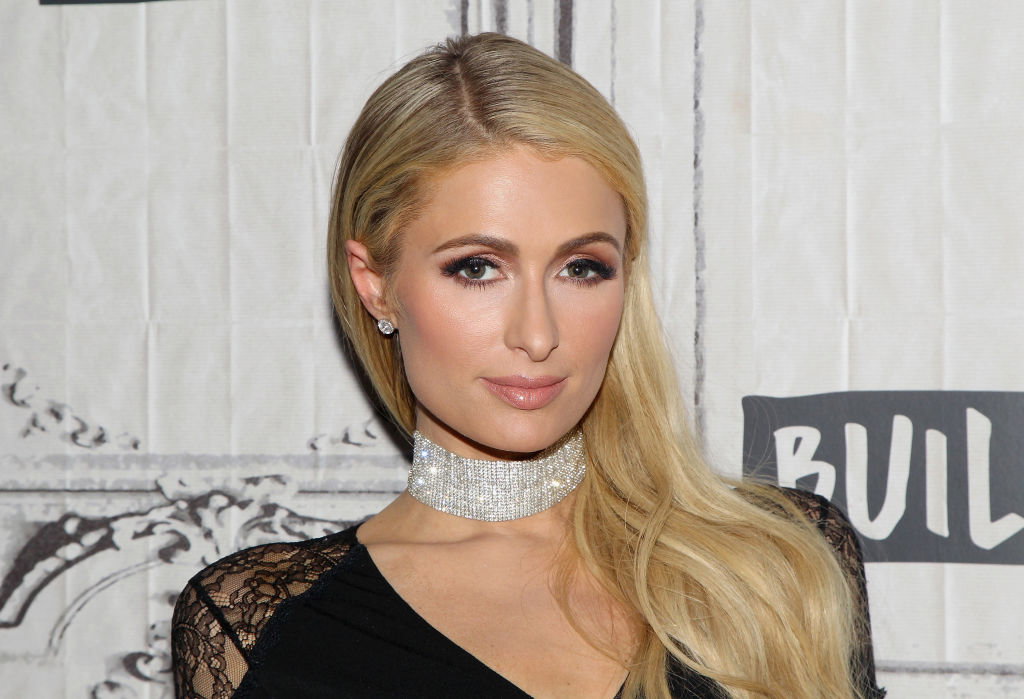
Paris Hilton, The US Reality TV Star Launches Metaverse Business On Roblox
Paris Hilton, the most famous celebrity of our times is no longer just a celebrity. She has transformed herself into a digital powerhouse. Who would even imagine that Paris Hilton will come this far and even play a role in the Metaverse ecosystem?
Well, here she is.
With the help of her husband Reum and Gersh, a former Walt Disney Co and Time Inc executive, she has created a media enterprise around one of pop culture’s original influencers.
Paris Hilton commands as much as $1 million a night working as a celebrity DJ, entertaining partiers at clubs in China, Dubai, and on the Spanish vacation island of Ibiza.
Hilton has created an island in the online virtual world, dubbed "Paris World", where visitors can explore digital replicas of her Beverly Hills estate and its dog mansion.
Users (aka visitors) can stroll the boardwalk inspired by the carnival wedding celebration, she and her husband Carter Reum hosted earlier this year at the Santa Monica Pier in California, and explore the island in a luxury sports car or Sunray yacht.
This New Year’s Eve, she will be playing an electronic set for the revelers who drop by a venue of a different sort – her virtual island on Roblox. Like other virtual hangouts, Paris World will collect small payments for purchasing virtual clothing or booking a ride on a jet-ski.
Hilton, 40, joins a clutch of celebrities and brands rushing to embrace the Metaverse, a broad term referring to a persistent virtual world. Facebook’s Mark Zuckerberg popularized the term this year when he renamed the company to Meta to emphasize the Metaverse’s central role to the company’s future.
Global brands such as Tommy Hilfiger have launched a line of digital ready-to-wear fashion for Roblox avatars. Nike opened a virtual world called Nikeland in November, where visitors can play dodgeball with friends, lace on a pair of virtual Air Force 1 sneakers, and win medals. Rappers Lil Nas X and Travis Scott have also held concerts last year for millions of virtual concertgoers.
For the socialite and reality TV-star turned entrepreneur, Paris World is the latest venture launched by her new media company, 11:11 Media. She and veteran media executive Bruce Gersh aim to capitalize on the burgeoning creator economy, in which celebrities like Los Angeles Lakers’ LeBron James leverage their influence to produce films, television shows and podcasts, brand marketing and to sell merchandise.
She has leveraged her gossip pages notoriety into 19 different consumer product lines, including perfumes, apparel, lingerie, cosmetics, sunglasses watches, shoes, handbags, and jewelry, which together generated an estimated $4 billion in revenue over the past decade.
11:11 Media has launched "This Is Paris", a podcast in which she speaks candidly about her family and friends, and a pair of reality TV series, Cooking With Paris on Netflix and Paris In Love, about her engagement and marriage to Reum.
Hilton has also tapped into the mania for non-fungible tokens, collaborating with designer Blake Kathryn to sell three unique pieces of digital art — one of which fetched in excess of $1.1 million, according to online auction platform Nifty Gateway.
According to Gersh, "The final piece of the digital space is the Metaverse. And that there’s a real opportunity for Paris to influence, even at a younger level than who her core customer is. We’ve built a fantastic, whimsical world that we believe her fans and new fans will just love"
**Final Thoughts**
All these points in only one direction - the mass adoption of Metaverse. The single most reason, I believe, people will enter the Metaverse is because of its entertainment value. It has been proven all along; that games, music, art, entertainment, are the main reasons why technology innovations go mainstream.
Imagine what good the smartphones be if there was no Youtube, Facebook, Instagram, Apple Music, Spotify?
Similarly, the next set of companies that will attract a billion users will be entities that create and populate the Metaverses. If we are not building Metaverses now, we are going to be left behind. It's time to take the shovel and start digging.
How BIG can the NFT space become?
Well, massively BIG. No, let me correct that - Insanely BIG.
This is why -
Amazon, Netflix, and Hulu host over 23,000 pieces of on-demand video content. Disney+ and HBO Max have added nearly 10,000 more.
AR and VR creators are busy populating the Metaverse with 3D models. Marketplaces like TurboSquid are offering 60,000 3D models today and are poised for growth.
In music, the world releases about 100,000 albums every year, each with multiple tracks that can generate millions of plays. Recording artists are moving toward self-publication models on services like SoundCloud and Audius and toward self-distribution models like Spotify.
Shutterstock is home to over 330 million stock photographs that can be licensed and collect royalties.
Over a billion domain names are registered each year, with 400m registered in the first quarter of 2017.
We upload nearly 1.8 billion images per day to the Internet or a stunning 657 billion images per year.
In social media, we generate around 200 billion tweets per year, some of which accrued tens of millions of views and become iconic pieces of history or popular culture.
There are over 600 million blogs on the internet today.
All of the above (and more) can be converted into NFTs and monetized.
This list is just scratching the surface of the broad spectrum of digital content. But we shouldn’t think of NFTs as tokenized digital content itself. A core insight is that NFTs are much better understood as encapsulating intellectual property rights to the assets they describe
To fully appreciate this view, consider that we rarely own anything on the internet today.
we license ebooks from Amazon or other book reading sites
we rent music plays from Spotify, Apple Music
we make payments to borrow domains from a registrar for a little while.
even when we create our own content, the rights to it are often owned by the content platform, distributor, or label.
Most importantly, if we cannot truly own digital content, or easily license it, we will almost surely never resell it.
Blockchains and NFTs will change this state of affairs dramatically. First, they will digitize the rights to digital content in the form of blockchain assets. Second, they will allow for the assets to be placed on secondary markets.
Final Thoughts
Thus, we can view NFTs as *liquid intellectual property* for all forms of digital content, a marketplace that is measured in trillions of units that is about to be tokenized.
Crypto is no longer just about Bitcoin. It's rapidly transforming into NFTs, DeFi, Metaverse, and Play to Earn, Web3 environments.
The sooner we appreciate and understand the importance of all this, and embrace this in our daily lives - the better and bigger pay offs will be for us
Did you know that in the summer of 2017, anyone with an Ethereum wallet could claim the tokenized Crypto Punks digital characters on the Larva Labs platform for free, paying only a few cents in Ethereum transaction fees?
Snowfro, a Mexico City-born generative artist and technologist, was there for the original CryptoPunk claiming event in 2017.
Today he owns over 60+ CryptoPunks, including seven Zombies, two Apes, and a partial claim to one of the nine Aliens — the rarest CryptoPunk character.
He’s also one of the few Larva Labs designated CryptoPunks moderators and is recognized in the crypto community by his Zombie avatar.
In March 2021, two of the nine CryptoPunk ‘Aliens’ in existence were purchased for 4,200 ETH each ($7.5 million USD)
Being at the right time, at the right place, and taking some early risks, has huge payoffs.
If you looking to buy Ethereum for the 1st time or the nth time, or just sitting on the sidelines wondering where Ethereum will go, you need to first understand how and what Vitalik Buterin (founder of Ethereum) thinks.
Without understanding his philosophy, it's impossible to appreciate or have a strong conviction in Ethereum
This brilliant essay by him provides a peek into his fascinating mind - vitalik.ca/general/2021/03/23/legitimacy.html
P.S: I bought more ETH last night and today morning after reading his essay :-)
A quick primer on Decentralized Crypto Domain (Web 3.0).
The existing login or sign-up systems are now less and less dependent on email. For instance, you can create new accounts on any website using your Facebook or Google credentials.
As digital and crypto natives, such interoperability is not at all foreign, and we have been doing so by approving sign-in with our wallets whenever we want to use decentralized applications.
The naming protocol will become your internet identity. There are currently four popular decentralized DNS protocols -
- Ethereum Naming System (ENS)
- Handshake (HNS)
- Unstoppable Domain (UD) (P.S - I have already purchased CryptoMaverick.coin at UD)
- Y.at. (Yat)
I prefer UD purely because it is a one-time purchase and the NFT minting on Polygon is super easy.
I did look up ENS as well to get .eth domain, which was relatively cheap $5 onwards. But the gas fees (obviously) were just astronomical ($60).
 @CryptoMaverick