Blockchain and Artificial Intelligence - The Future of Technology
***What is artificial intelligence (AI)?***
Artificial intelligence is the ability of a program to learn. It also means the science and engineering of intelligent computer programs. These algorithms can understand patterns, solve problems without human instruction and use large data sets. These algorithms can analyze external data inputs, learn from these data, and use the acquired knowledge while performing tasks to achieve specific goals.
At the most basic level, there are mainly two types of AI – narrow AI and strong AI.
Narrow AI targets specific or limited tasks such as facial recognition, spam filtering or playing chess. On the other hand, Strong AI has the ability to perform many different tasks instead of a single task. He could potentially have a human-level cognition and perform any mental operation that a human can. Although Narrow AIs are used today, Strong AI has not yet emerged. In fact, many experts are skeptical about whether this is possible.
While it is impossible to predict the potential impacts of strong AI, many believe that the future of blockchain and AI will be interrelated. It can be argued that these two will be the most important technologies for the coming decades.
Therefore, it is important to closely examine how AI and blockchain may interact in the future.
Synergy of AI and blockchain
***AI improvements for blockchain***
Mining requires large amounts of computational power and energy. Distributed ledgers sacrifice efficiency for features such as immutability and censorship resistance. AI can offer a high level of efficiency in optimizing energy consumption, which can be beneficial for improving mining algorithms.
One of the main criticisms of blockchain systems is that these systems require very high energy. Desirable crypto economics and security features create computational tasks that would not otherwise be necessary. Reducing the consumption of Proof of Work blockchains can be beneficial for the entire industry and support the widespread use of blockchains.
AI can also optimize the storage needs of blockchains. The distributed ledger can quickly grow to large sizes, as transaction history is maintained across all nodes. If the storage needs are high, the barrier to entry will be high, which can potentially reduce the decentralization of the network. AI could introduce new database sharding techniques that could make the blockchain smaller and store data more efficiently on the chain.
***Decentralized data economy***
Data is increasingly becoming a valuable asset that must not only be securely stored, but also shared. Efficient AI systems rely heavily on data, and data can be stored on blockchains with a very high level of reliability.
At its core, a blockchain is a secure, distributed database shared by all participants in the network. Data is kept in blocks, and each block is cryptographically linked to the previous one. This makes it extremely difficult to change stored data without damaging network consensus (for example, with a 51% attack).
Decentralized data exchanges aim to create a new data economy running on the blockchain. These exchanges can make data and data stores accessible to anyone (or anything) easily and securely. By connecting to this data economy, AI algorithms can use a larger set of external inputs and learn faster. In addition, the algorithms themselves can be traded on marketplaces. Thus, the development of algorithms that become available to a wider audience can be accelerated.
Decentralized data exchanges have the potential to revolutionize data storage. At its most basic, anyone can have the opportunity to rent their local storage for a fee (paid in tokens). As a result, existing data storage service providers are forced to improve their services to keep up with the competition.
Some of these data marketplaces are already in use, but they are not mature enough yet. AI systems also benefit if data and storage service providers are encouraged to maintain high data integrity.
Decentralized supercomputers
Training AI requires a high level of computational power as well as quality data that enables algorithms to learn. AI algorithms often use a type of computational system known as an artificial neural network (ANN). ANNs learn to perform tasks by evaluating many examples. These ANNs require a significant amount of computational power when examining millions of parameters to perform the specified task.
If data can be shared on a blockchain, why not share computing power? In some blockchain applications, users can lend the computing power of their machines to others who want to perform complex calculations through a peer-to-peer (P2P) marketplace. Users are incentivized with tokens in exchange for sharing their computing power.
AI systems can be trained on these computing platforms much more efficiently and at lower cost. While the primary focus of early uses was to create 3D computer graphics, this focus may slowly shift towards AI.
As these Decentralized Applications (DApps) evolve, companies that provide computing power may face fierce competition. Much of this computing power is used much more efficiently as users are allowed to profit by renting out their idle computing power. In theory, every CPU or GPU in the world can be run as a node in a decentralized supercomputer, if not used for anything else.
AI decisions to be more auditable
Decisions made by AI systems can be difficult for humans to understand. These algorithms work with such large amounts of data that it would be practically impossible for any human to repeat and control the giving processes as much as AI.
If decisions are recorded on a per-data point basis, there is a clear audit trail that humans can control, thereby increasing confidence in the decisions made by AI algorithms.

Ethereum...
Ethereum is a decentralized computing platform. You can think of Ethereum as a desktop or laptop computer, but it does not run on a single device. Instead, it runs simultaneously on thousands of machines from all over the world, which means Ethereum has no owner.
Like Bitcoin and other cryptocurrencies, Ethereum allows you to transfer digital money. But it has the capacity to do much more than that. For example, you can create your own code and interact with applications created by other users. All kinds of sophisticated programs can be made available on Ethereum because it is very flexible.
In its simplest form, the main idea behind Ethereum is that developers can create and make available code that runs on a distributed network rather than a central server. So theoretically, these apps cannot be shut down or censored.
**What makes Ethereum valuable?**
We briefly mentioned that Ethereum can run codes on a distributed system. Therefore, outside parties cannot manipulate the programs. These codes are added to Ethereum's database (eg blockchain) and can be programmed to be unmodifiable. In addition, the database is publicly viewable so users can audit a code before interacting with it.
This means anyone can unlock apps that cannot be taken offline from anywhere. More interestingly, since the native unit, ether, stores value, these applications can set conditions for value transfer. These programs that create applications are called smart contracts. In most cases, they can be configured to operate without human input.
Predictably, the idea of "programmable money" has attracted users, developers, and businesses from all over the world.
**What is the difference between Ethereum and Bitcoin?**
Bitcoin uses blockchain technology and financial incentives to create a global digital currency system. It has introduced some key innovations that allow users in different parts of the world to coordinate without the need for a central party. With each participant running a program on their own computer, it has become possible for users to reach consensus on a financial database within a trustless, decentralized environment.
Bitcoin is often referred to as the first generation blockchain. It was not created as a very complex system and this feature offers strength in terms of security. It is designed to be particularly inflexible so that security is prioritized as the base layer. Thus, the smart contract language in Bitcoin is extremely restricted and does not succeed in incorporating applications other than money transfer.
In contrast, second-generation blockchains have more capabilities. These platforms allow a higher level of programmability in addition to financial transactions. Ethereum gives more freedom for developers to experiment with their own code and create Decentralized Applications (DApps).
Ethereum is the first of the second generation blockchain wave and has remained at the forefront to this day. It shows similarities to Bitcoin and can perform many of the same functions. But the two blockchains are very different from each other and each has its own advantages over the other.
**How does Ethereum work?**
We can define Ethereum as a state machine. This means you have a snapshot of the current view of all account balances and smart contracts at any given time. Certain actions cause the state to update, meaning all nodes update their snapshots to reflect this change.
Smart contracts running on Ethereum are triggered by transactions (from users or other contracts). When a user sends a transaction to a contract, each node on the network runs the contract and records the output. This is done using the Ethereum Virtual Machine (EVM), which translates smart contracts into instructions that computers can read.
A special mechanism called mining is used to update the status (for now). Mining is done with the Proof of Work algorithm, similar to Bitcoin. We will talk about this in detail in the next sections.
**What is a smart contract?**
A smart contract is just a code. Code is not a smart or contract as we know it. But the code is called intelligent because it implements itself under certain conditions, and is in a sense a contract because it ensures the fulfillment of agreements between the parties.
Computer scientist Nick Szabo came up with this idea in the late 1990s. He used the example of a vending machine to explain the concept and stated that vending machines can be considered as the predecessor of modern smart contracts. In the vending machine example, there is a simple contract being implemented. The user throws a coin into the machine and the machine gives the product the user wants.
A smart contract applies the same logic in digital terms. When two ethers are sent to this contract, the code says "Hello, World!" You can enter a simple condition such as send your reply.
**Who created Ethereum?**
In 2008, an anonymous developer (or developer community) published the Bitcoin whitepaper under the pseudonym Satoshi Nakamoto. As a result, the world of digital money has changed permanently. A few years later, a young programmer, Vitalik Buterin, started thinking about taking the idea one step further and finding a way to use it in all kinds of applications. The concept eventually emerged as Ethereum.
Ethereum was coined by Buterin in 2013 in his blog post Ethereum: The Ultimate Smart Contract and Decentralized Application Platform. In this post, Buterin explained the idea of a full Turing blockchain, a decentralized computer that can run any application given enough time and resources.
Over time, the types of applications that can be used on a blockchain have become limited only by the developer's imagination. It aims to find out whether the Ethereum blockchain technology has valid uses outside of the deliberate design limitations of Bitcoin.
**How was Ether distributed?**
Ethereum was launched in 2015 with an initial supply of 72 million ether. More than 50 million of these tokens were distributed in a public token sale called the Initial Coin Offering (ICO), where participants can purchase ether tokens in exchange for bitcoin or fiat currencies.
source: academy.binance.com
Fed Announces Its Interest Rate Decision: Bitcoin Forecast from Mike Novogratz
The Fed's interest rate decision has become clear. The American central bank has announced that it has increased the interest rate by 25 basis points, in line with the expectations. Thus, interest rates in the USA rose to the range of 0.25 percent to 0.50 percent. In addition, the Fed has increased interest rates for the first time since 2018. After the Fed increased interest rates, there was no significant change in the price of Bitcoin (BTC).
*Mike Novogratz: Bitcoin will be traded between $30,000 and $50,000 this year*
After the Fed rate decision, BTC climbed above $ 40,000 and is currently trading at $ 41,041. Michael Novogratz, CEO and founder of Galaxy Digital, predicted in an interview with Bloomberg TV that Bitcoin will reach $500,000 in the next five years. Novogratz said that Bitcoin will be traded in the range of 30 thousand to 50 thousand dollars this year. The cryptocurrency market has been in a bearish trend since the beginning of 2022. The current geopolitical crisis has forced all governments to include cryptocurrencies in their future policies. Factors such as Russia's invasion of Ukraine and the Fed's rate hike affect the market deeply.
Michael Novogratz stated that the FED has not started to increase interest rates, they have not started to draw liquidity from the system, and therefore, Bitcoin (BTC) will remain sideways between $ 30 thousand and $ 50 thousand throughout the year. The famous investor believes that Bitcoin grew much faster last year than the internet did in the 1990s. Mike Novogratz said that Bitcoin has little chance of a “quick” recovery at a time when the Fed plans to raise interest rates and take strong quantitative tightening measures. It is reported that the Fed is planning at least four rate hikes this year, which can go up to 7-8 if inflation is not quickly brought under control. Novogratz expects Bitcoin to stay in the $30,000 to $50,000 range this year.
**These levels must be beaten for a sustainable rally!**
According to experts, retail investors should not be overly optimistic. With today's price action, BTC is bouncing above its 20-day EMA and 50-day moving average. However, there is still a big problem. BTC is still a long way from its 200-day moving average (DMA) at $48,622. However, if Bitcoin surpasses these levels, we can confirm the uptrend.
What makes bitcoin valuable?
Bitcoin gets its value from many different features. Ultimately, both crypto and fiat currencies have value because they are trusted. As long as society believes in the fiat money system, money will continue to have value. The same can be said for Bitcoin: Bitcoin has value because users believe it, but there are other factors to consider.
Unlike fiat currencies, Bitcoin does not have a central bank and its decentralized nature has allowed the creation of a unique financial system. Blockchain technology offers a high level of security, usability and many other benefits. It also offered a revolutionary way of transferring value globally. Bitcoin can also act as a store of value, similar to gold in many ways.
One of the biggest challenges for crypto beginners is understanding how and why cryptocurrencies like Bitcoin (BTC) hold value. The coin is digital, there is no physical entity backing it, and the concept of mining can be very confusing. From one perspective, mining creates new bitcoins out of nothing. However, in practice, a very costly investment must be made in order to successfully mine. So how can all of this make BTC valuable?
Think about the money we all use on a daily basis. Our banknotes are no longer backed by gold or other assets. The money we borrow is mostly just numbers on the screen, thanks to fractional reserve banking. States and central banks such as the Federal Reserve can issue new coins and increase the money supply through economic mechanisms.
Although there are important differences, BTC as a digital form of money shows some similarities with the fiat money we are all used to.
**Why does money have value?**
In short, it is trust that gives money its value. Money is basically a tool used to exchange value. Any object can be used as money, provided its local community accepts it as payment for products and services. In the early days of civilization, all kinds of objects, from stones to seashells, were used as money.
**What is fiat currency?**
Fiat money is money that is issued and formalized by a government. Today, our society exchanges value using notes, coins, and digital numbers in our bank accounts (which also determine how much credit or debt we have).
In the past, people could convert their paper money into gold or other precious metals at banks. At that time, this mechanism ensured that the value of currencies such as the US dollar remained backed by an equal amount of gold. But the vast majority of countries have stopped using the gold standard, and this standard no longer forms the basis of our monetary system.
After being disconnected from gold, we now use fiat money unsupported by anything. This divergence has given governments and central banks more freedom to adopt monetary policies and influence the money supply. Some of the key features of fiat money are:
It is issued by a central authority or state.
It has no intrinsic value. It is not backed by gold or any other commodity.
It has potentially unlimited supply.
**Why is fiat money valuable?**
With the abolition of the gold standard, we now have a currency that has apparently no value. But the money is still used to pay for food, bills, rent and other things. As we mentioned earlier, money derives its value from collective trust. Thus, a government must strongly support and successfully manage fiat in order to be successful and maintain a high level of trust. Looking at the examples of Venezuela and Zimbabwe, we can easily see how the system deteriorates when trust in the government or the central bank is lost due to hyperinflation and unsuccessful monetary policies.
**Why is crypto valuable?**
Although cryptocurrencies have some common features with the standard money idea we have in mind, they also have important differences. While some cryptos like PAXG are indexed to commodities like gold, most cryptocurrencies do not have an underlying asset. Instead, trust again plays an important role in the value of a cryptocurrency. For example, people see Bitcoin as worth investing in because they know that others also trust Bitcoin and see it as a payment system and a medium of exchange.
For some cryptocurrencies, usability is also an important factor. You may need to use a service token to access certain services or platforms. Therefore, the token of a high-demand service will also be valuable. Not all cryptocurrencies are the same, so their values actually depend on the characteristics of each coin, token or project.
In the case of Bitcoin, we can narrow it down to six features that we'll talk about in more detail later: availability, decentralization, distribution, trust systems, rarity, and security.
**What is intrinsic value?**
Many debates about the value of Bitcoin are about whether this coin has intrinsic value. So what does this mean? When we look at a commodity such as oil, we see that it has intrinsic value in terms of energy, production of plastics and other materials.
Stocks also have intrinsic value in that they represent shares in a company that offers a product or service. In fact, many investors do fundamental analysis to calculate the intrinsic value of an asset. On the other hand, fiat money has no intrinsic value as it is just a piece of paper. As we mentioned earlier, fiat money derives its value from trust.
The traditional financial system has many investment options with intrinsic value, from commodities to stocks. Forex markets are an exception to this, as they trade in fiat currencies and traders often profit from short or medium-term currency fluctuations. So, what about Bitcoin?
**Why is Bitcoin valuable?**
The value of Bitcoin is a subjective subject where many different ideas are put forward. Of course, it can be said that the value of Bitcoin is its market price. But this does not fully answer our question. The main issue here is why people think Bitcoin has value in the first place. Let's take a closer look at some of the features that make Bitcoin valuable.
**The value of Bitcoin in terms of usability**
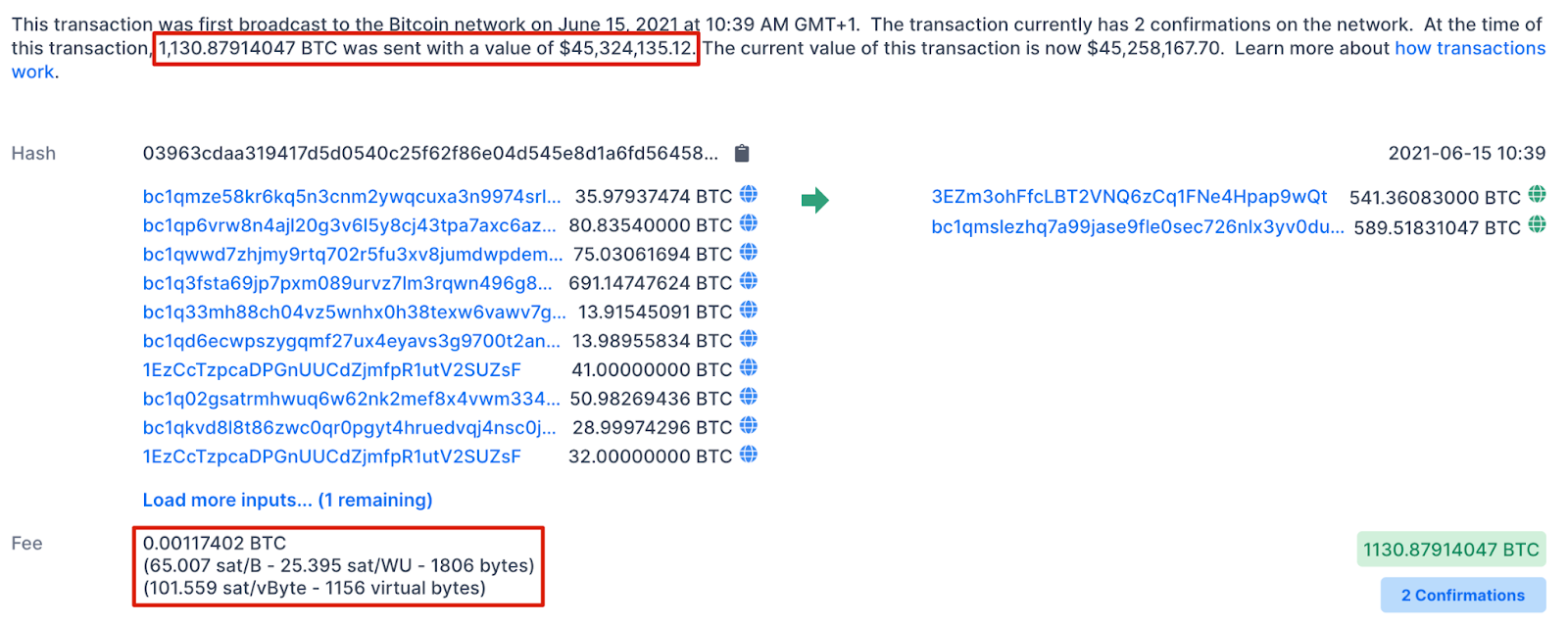
One of the main benefits of Bitcoin is its ability to quickly transfer large sums of value to anywhere in the world without the need for intermediaries. While it is relatively expensive to send small amounts of BTC due to transaction fees, it is also possible to send millions of dollars cheaply. Below you can see a Bitcoin transaction worth approximately $45,000,000 sent with a transaction fee of less than $50 (as of June 2021).
While Bitcoin is not the only network that makes this possible, it is the largest, safest and most popular network. Lightning Network also enables small transactions as a layer 2 application. But regardless of the amount, being able to make cross-border transactions is definitely valuable.
**The value of Bitcoin in terms of decentralization**
Decentralization is one of the most important features of cryptocurrencies. Blockchains eliminate central authorities, giving more power and freedom to the user community. Since Bitcoin is open source, anyone can help improve the Bitcoin network.
Even the monetary policy of this cryptocurrency works in a decentralized way. For example, the work of miners is to verify and confirm transactions, but they also allow new bitcoins to be added to the system at a predictable, stable rate.
Bitcoin's decentralization gives it a very robust and secure system. Nodes in the network cannot make decisions for everyone on their own. Group reconciliation is required for all transaction verifications and protocol updates. This protects Bitcoin from mismanagement and abuse.
**Bitcoin's value in rarity**
It is within the framework of Bitcoin that it has a limited supply of 21,000,000. No more new coins will be added as Bitcoin miners mine the last coin in about 2140. While traditional commodities such as gold, silver and oil are limited, new reserves are discovered each year. These discoveries make it difficult to calculate exactly how rare the commodity is.
After all BTCs are mined, in theory BTC should be deflationary. As users lose or burn coins, the supply will decrease, possibly causing prices to rise. Therefore, Bitcoin holders see great value in the rarity of the coin.
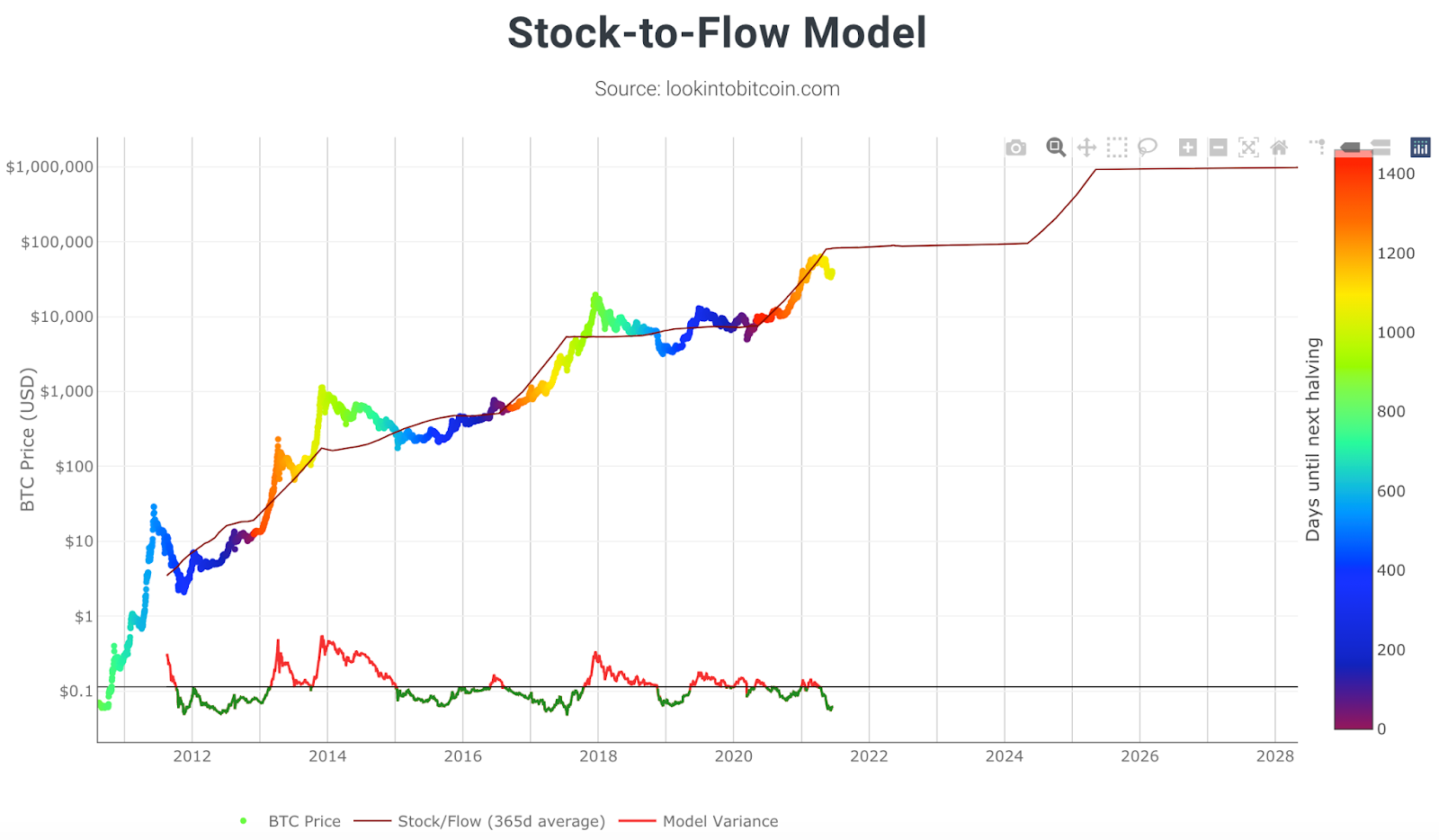
Bitcoin's rarity has also paved the way for the popular Stock-to-Flow model. This model tries to predict the future value of BTC based on annual Bitcoin mining and total stock. When tested retrospectively, the model has managed to model the price curve quite accurately to date. According to this model, the primary driver of Bitcoin's price is its rarity. A possible correlation between price and rarity causes Bitcoin holders to use the coin as a store of value.
source: academy.binance.com
ABRA CEO's Long Term bullish prospect of Ethereum
Bill Barhydt, CEO and inventor of the well-known cryptocurrency wallet service Abra, explained why he believes Ethereum (ETH) is a much better investment than Bitcoin (BTC). He also set a price prediction of $40,000 for ETH, which shows his confidence in its future development. He also noted that Ethereum is used for various reasons such as DeFi, stablecoins, NFTs and even games. It also has a “network effect”; This means that the value of cryptocurrencies will likely increase as the number of customers increases, making it an even greater utility.
***Useful uses of Ethereum (ETH)***
The main argument that makes Ethereum so valuable is that it has use cases. According to Bill, the network effects of Bitcoin (BTC) make it an unreliable, immutable and unmanipulated backup asset. In terms of flexibility, reliability, and value enhancement, Ethereum network effects are much more practical in terms of short-term exponential growth. Also, Bitcoin has become deflationary due to the burning of Ethereum, while the quantity of Bitcoin is stable, meaning its supply is actually decreasing over time. With this in mind, some analysts have said that it is extremely likely that Ethereum will dethrone Bitcoin in the next 10 years. Ethereum, a long-time large-scale competitor to Bitcoin, has several technological challenges it must solve in order to gain market dominance.
That's exactly what Ethereum developers hope to achieve with an update to the underlying blockchain dubbed "Ethereum 2.0". Upcoming changes will include the application of a processing technique known as "shredding". Currently, all data added to the Blockchain version must be verified by all participating nodes. However, by incorporating sharding into the mix, Ethereum 2.0 can significantly improve the efficiency of resource use. The new system will do this by dividing the data validation tasks among groups of nodes, with each node responsible for validating only the data it receives. This enables the entire Blockchain to use parallel processing, potentially increasing overall capacity by a greater proportion. Ethereum is moving from proof-of-work (PoW) to proof-of-stake (PoS) consensus. It is planned as a vital part of the strategy to scale Ethereum through updates.
What is DeFi 2.0 and how important is it ?..
It's been almost two years since DeFi (Decentralized Finance) took off in 2020. Since then, we've seen hugely successful DeFi projects like UniSwap, decentralization of trading and finance, and new ways to make money in the crypto world. But there are still problems to be solved in such a new space, similar to what we have experienced with Bitcoin (BTC). In response to these problems, the term DeFi 2.0, which describes the next generation of DeFi decentralized applications (DApp), has become popular.
As of December 2021, DeFi 2.0 is not fully operational, but we can already see the first steps. You can find out what you can expect from DeFi 2.0 and why DeFi 2.0 is needed to solve major problems in the DeFi ecosystem in our article.
**What is DeFi 2.0?**
DeFi 2.0 is a movement that aims to solve the problems seen in the original DeFi and take it one step further. While DeFi has revolutionized the delivery of decentralized financial services to anyone with a crypto wallet, it also has some weaknesses. Crypto is already familiar with this process, with second-generation blockchains like Ethereum (ETH) developing Bitcoin. DeFi 2.0 will also need to comply with new compliance regulations that governments want to enforce, such as KYC and AML.
Let's go through an example. Liquidity Pools (LPs) have had great success in the world of DeFi, allowing liquidity providers to monetize transaction fees by staking token pairs. But if the rate of tokens changes, liquidity providers run the risk of losing money (temporary loss). A DeFi 2.0 protocol can offer insurance against this loss for a small fee. This solution can benefit users, stakers and the DeFi world in general by offering more incentives to invest in LPs.
**What are the limitations of DeFi?**
Before we talk about the usage areas of DeFi 2.0 in more detail, let's talk about the problems it tries to solve. A large part of these problems are the problems faced by blockchain technology and cryptocurrencies in general:
1. Scalability: Services offered by DeFi protocols on blockchains with high traffic and gas fees are often slow and expensive. Simple tasks can take a long time to complete and the process becomes cost-inefficient.
2. Oracles and third-party information: Financial products that need outside information need better quality oracles (third-party data sources).
3. Centralization: In DeFi, the goal should be more decentralization. However, many projects still have not adopted the DAO principles.
4. Security: Many users fail to manage or understand the risks of DeFi. Users stake millions of dollars on smart contracts that they are not entirely sure of being secure. Although security audits are in progress, the effectiveness of these audits may decrease as updates are made.
5. Liquidity: The fact that markets and liquidity pools are dispersed across different blockchains and platforms divides liquidity. Providing liquidity also causes the funds and their total value to be locked. It is often not possible to redeem tokens staked in liquidity pools elsewhere, leading to capital inefficiency.
**Why is DeFi 2.0 important?**
DeFi can be daunting and difficult to understand, even for experienced crypto users and those who hold their crypto long-term. But its goal is to lower the barrier to entry and create new earning opportunities for crypto holders.
DeFi 2.0 is important because it can democratize finance without increasing risk. At the same time, DeFi 2.0 also tries to provide a better user experience by trying to solve the problems we talked about in the previous section. If he can achieve this and offer better incentives, in the end, everyone can win.
**DeFi 2.0 usage areas**
We don't have to wait to see DeFi 2.0 usage areas. There are already projects offering new DeFi services on many different networks, including Ethereum, Binance Smart Chain, Solana, and other blockchains compatible with smart contracts. Here we will examine some of the most common of these uses:
**Unlocking the value of staked funds**
If you have previously staked a token pair in a liquidity pool, you received LP tokens in return. In DeFi 1.0 you can increase your yield by staking LP tokens in a yield farm. Before DeFi 2.0, what could be done in terms of value was limited to this. Millions of dollars are locked in safes that provide liquidity, but in fact, it is possible to further increase capital efficiency.
DeFi 2.0 takes this one step further and uses these yield farm LP tokens as collateral. This collateral can be used to issue tokens through a process similar to that in MakerDAO (DAI). Exactly what the mechanism will be may differ from project to project, but the main idea is that your LP tokens can be used for new opportunities while still generating returns, while remaining locked in.
**Smart contract insurance**
It is quite difficult to examine smart contracts in detail if you are not an experienced developer. Without this information, you can only partially evaluate a project. This creates a large amount of risk when investing in DeFi projects. With DeFi 2.0 it is possible to get DeFi insurance on certain smart contracts.
Imagine farming Yield and staking LP tokens in a smart contract. If the smart contract is breached, you may lose all your invested funds. An insurance project may offer you a guarantee for a fee for the funds you invest in the yield farm. But it should be noted that this will be for a specific smart contract. You will generally not be able to receive a payment if the liquidity pool agreement is breached. On the other hand, if the yield farm contract is violated, but you have insurance, you can most likely get paid.
**temporary loss insurance**
If you invest in a liquidity pool and start liquidity mining, any change in the price ratio of the two tokens you lock can cause financial loss. This process is called temporary loss, but the new DeFi 2.0 protocols are working on new methods to eliminate this risk.
For example, let's say you add a token to a one-sided LP that doesn't require you to add a token pair. The protocol then adds its native token as the other side of the pair. Both you and the protocol are then paid out of the fees charged for swapping the pair.
Over time, the protocol creates an insurance fund from the fees it earns to protect your invested funds against the effects of temporary loss. If the accumulated fees are not enough to cover the losses, the protocol may issue new tokens. Even if the amount of tokens accumulated is greater than the debt, these tokens can be stored for later or burned to reduce the supply.
**Who is in control of DeFi 2.0?**
With all these features and uses, you may be wondering who is in control of DeFi 2.0. Blockchain technology always tends towards decentralization. DeFi is no different. One of the first projects of DeFi 1.0, MakerDAO (DAI) has set a standard for this trend. More and more projects are now giving their community a say.
Many of the platform tokens also serve as governance tokens, offering voting rights to token holders. It is reasonable to expect DeFi 2.0 to bring more decentralization. But the role of regulatory compliance and regulation is also becoming more and more important for DeFi.
**What are the risks of DeFi 2.0 and how can these risks be avoided?**
DeFi 2.0 has the same risks as DeFi 1.0. The most important of these risks and what you can do to keep yourself safe are:
1. The smart contracts you interact with may have backdoors and weaknesses, or the contracts may be hacked. Audits also never guarantee the security of the project. Do as much research as possible about the project and remember that investing always poses a risk.
2. Legal regulations may affect your investments. Governments and regulators around the world have begun to consider the DeFi ecosystem as well. While regulations and laws can bring security and stability to crypto, some projects may have to make changes to their services as new rules are created.
3. Temporary loss. Even with temporary loss insurance, there is a huge risk for anyone wishing to mine liquidity. It is never possible to minimize the risk.
4. You may have difficulty accessing your funds. If you are staking from the website UI of a DeFi project, it might be a good idea to also access the smart contract via the blockchain explorer. Otherwise, you may not be able to withdraw your funds if the website is out of service. But before you can interact directly with the smart contract, you will need some technical expertise.
source: academy.binance.com
What is the Difference Between Binance Smart Chain and Ethereum?
Binance Smart Chain (BSC) and Ethereum may seem very similar at first glance. DApp and tokens developed on BSC are compatible with Ethereum Virtual Machine (EVM). You may have noticed that public wallet addresses are the same on both blockchains. There are even cross-chain projects operating on both networks. However, there are some notable differences between the two chains. If you're not sure which chain to use, it can be helpful to know and understand the differences.
**Blockchain traffic and DApp ecosystem**
As of June 2021, Ethereum hosts more than 2,800 DApps on the blockchain, compared to about 810 on BSC. The difference is considerable, but considering that BSC is still very young, it can be seen as a strong and growing ecosystem.
Active addresses are also an important on-chain metric to consider. Despite being a newer blockchain, BSC set a record 2,105,367 addresses on June 7, 2021. This is more than double Ethereum's record of 799,580 addresses on May 9, 2021.
So, what could be the reason behind the sudden growth of BSC? BSC's fast approval times and low fees have contributed greatly to this growth. The growing popularity of NFTs and their compatibility with popular crypto wallets such as Trust Wallet and MetaMask may also play a role in BSC's growth.
If we look at day-to-day transactions, there is an even bigger difference between the two chains. In BSC it is faster and less costly for users to move their funds and interact with smart contracts. Below, you can see BSC's daily record of 12 million transactions and its current status of over 4 million.
On the other hand, Ethereum's daily transaction count has never exceeded 1.75 million. For users who need to move their funds frequently, BSC appears to be the more popular option. Daily transactions should also be evaluated in the context of active addresses. At the time of writing this article, BSC has a higher number of users, and their average transaction count is also higher.
**Most used DeFi Dapps on Ethereum and BSC**
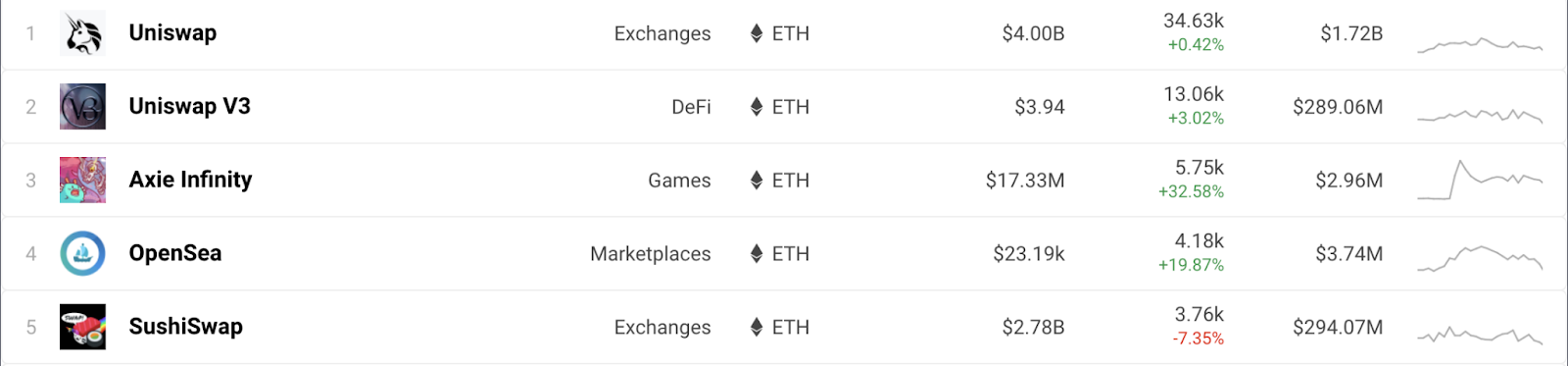
When it comes to decentralized finance, there are numerous DApps available on both BSC and Ethereum due to the compatibility of blockchains. Developers can easily migrate their applications from Ethereum to BSC, and new BSC projects often use open source code from Ethereum under a different name. Let's take a look at the top five DApps on Ethereum by number of users, according to DAppRadar.
Here you can see that there are two DeFi Automated Market Makers (UniSwap and SushiSwap), a crypto game (Axie Infinity) and a peer-to-peer marketplace (OpenSea). If you look at the top five of the BSC, you'll also find many similarities.
PancakeSwap was created with a hard fork from Uniswap. Autofarm and Pancake Bunny are yield farms. This is a category we haven't seen in Ethereum's top five. Biswap and Apeswap are Automated Market Makers (AMA). Yield farms tend to be more efficient on Binance Smart Chain as transaction fees are lower on BSC and transactions are much faster. These factors make AMAs a popular option for BSC users.
When it comes to crypto games, Ethereum is indeed the home of the most popular games. Although there are games similar to CryptoKitties and Axie Infinity on BSC, they have not been able to reach as large audiences as the classic games on Ethereum.
**Transfers between networks**
If you have deposited BEP-20 or ERC-20 in your wallet before, you may have noticed that the Ethereum and BSC wallet addresses are the same. So if you choose the wrong network when withdrawing your tokens from one exchange, you can easily get those tokens back from the other blockchain.
If you have accidentally withdrawn ERC-20 tokens to the BSC, you can find these tokens at the corresponding BSC address. You can do the same if you accidentally sent tokens from BSC to Ethereum. In either case, fortunately, you won't lose your funds permanently. For a more detailed guide, How to Recover Cryptos Transferred to Wrong Network on Binance? You can read our article.
**Transaction fees**
Both BSC and Ethereum use a gas model for transaction fees, which measures the complexity of the transaction. BSC users can set a gas fee based on network demand, and miners will prioritize transactions with a higher gas price. But the London hard fork of Ethereum introduces some new regulations that will likely eliminate the need for high transaction fees.
The Ethereum update creates a new pricing mechanism where a base fee is applied per block. The base fee varies depending on the demand for transactions. Thus, users will not have to determine the gas price themselves.
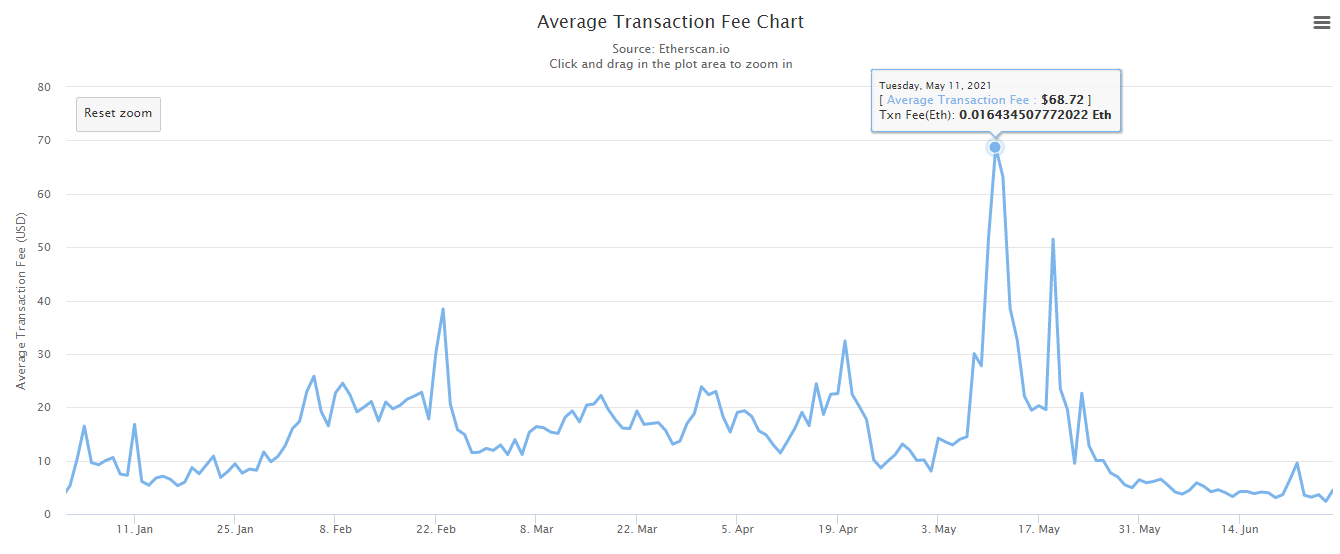
In retrospect, gas fees on Ethereum are much higher compared to BSC. The highest average was seen in May 2021 with 68.72 USD. Although this trend has started to change, Ethereum is still more expensive.
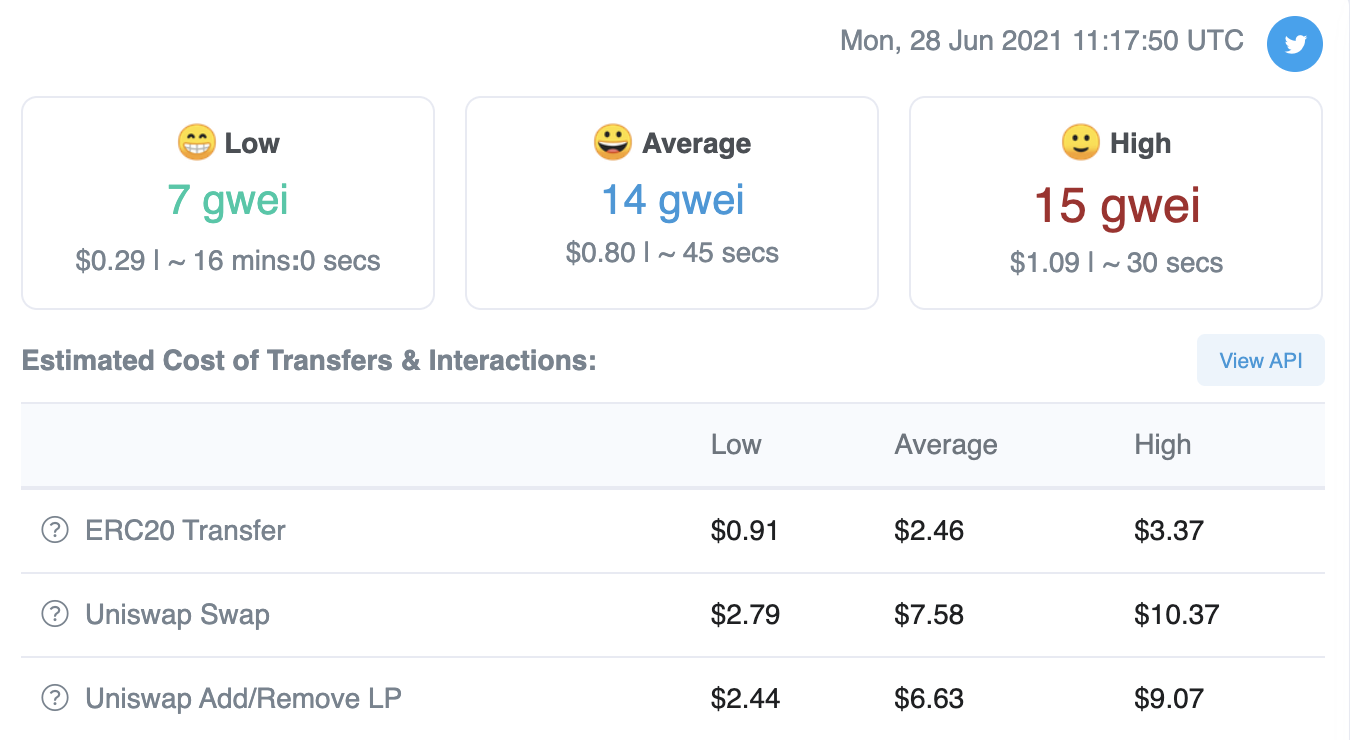
To see the picture more, let's take a look at Ethereum average gas costs from Etherscan. The top three numbers show the current gas prices of Ethereum. For both BSC and Ethereum, one gwei is equivalent to 0.000000001 BNB and ETH. If you pay at a lower price, it will take much longer for your transaction to be processed.
For a simple transaction such as sending an ERC-20 token to another wallet, the average price at the time of writing this article is $2.46 USD. This amount increases to $7.58 when using a Uniswap liquidity pool with multiple transactions.
Below you can see that a transaction equivalent to an ERC-20 transfer on the Ethereum gas tracker took place on BSC with a transaction fee of only 0.03 USD. BSC calculated this amount by multiplying the gas (21,000) used by the transaction by the gas price of 5 gwei.
**Processing time**
Measuring average transaction times on blockchains can be a little tricky. While a transaction is technically complete once miners confirm the block it is in, other factors can also affect your wait time:
If you haven't set your transaction fee high enough, miners may delay your transaction or even not include it in a block.
Building more complex interactions with the blockchain requires multiple transactions. Adding liquidity to a liquidity pool is an example.
Most services will only accept a transaction as valid after a certain number of blocks have been confirmed. These extra confirmations reduce the risk that vendors and service providers will have their payments canceled if the block is rejected by the network.
If we look at the gas statistics above for Ethereum, we see that transaction times range from 30 seconds to 16 minutes. These numbers take into account successful transactions, but do not take into account any extra validation requirements.
For example, if you deposit ETH (ERC-20) into your Binance account, you have to wait for 12 network confirmations. As you can see from the chart below, considering that each block is mined in about 13 seconds, you will have to wait an extra 156 seconds before depositing ETH into your spot wallet.
In BSC, on the other hand, the average block time is 3 seconds. When we compare this with Ethereum's 13 seconds, we see an improvement of about 4.3 times in speed.
Ethereum's Proof of Work (PoW) consensus mechanism is similar to Bitcoin's, but very different from BSC's Proof of Staked Authority (PoSA) mechanism. But this difference will soon disappear. The network will start using the Proof of Stake (PoS) mechanism with Ethereum 2.0.
BSC's PoSA combines elements from Proof of Authority (PoA) and Delegated Proof of Stake (DPoS). 21 validators sequentially generate blocks and in return receive BNB transaction fees as a reward. Being a validator requires running a node and staking at least 10,000 BNB to become an elected candidate.
Other users, known as Delegators, stake BNB behind an elected candidate. According to the staked amount, the first 21 selected candidates then process the blocks in order. This whole process starts over every 24 hours. Delegates also receive a share of the rewards earned by validators.
Ethereum's PoW is a very different system. Instead of the community choosing validators, there is a race to solve a computational puzzle. Anyone can participate, but you need to buy or rent special mining equipment. The higher the computational power you have, the more likely you are to solve the puzzle before others and verify a block. Successful miners receive transaction fees and ETH rewards as rewards.
While PoW is an effective way to achieve consensus and ensure network security, developers have also tried using other mechanisms. Their aim is to find more efficient and environmentally friendly alternatives without sacrificing safety.
For these reasons, the Ethereum network will transition to Proof of Stake. Validators will stake ETH for a chance to generate blocks. Other validators will "certify" the block and check that the block is correct. If a person generates a block containing fraudulent transactions, they risk losing all their staked coins. After that, validators receive rewards for successful blocks and confirmations. If large amounts of ETH are directly deposited and staked, malicious validators risk losing their funds.
Source: https://academy.binance.com/
What You Didn't Know About Crypto Airdrop
Crypto airdrop is a marketing strategy used by crypto startups to promote their projects and new tokens. The native cryptocurrency of the project is distributed free of charge to existing and potential users. Sometimes, users need to complete some simple promotional activities such as following the project on their social media accounts and sharing their posts in order to receive the tokens or coins.
There are different types of airdrops and each crypto project may have its own terms. But most airdrops are aimed at the same goal: to increase awareness and general interest in the project. Some airdrops are made directly to users' wallets, while others may require receiving cryptos manually.
Anyone with a crypto wallet can get an airdrop, but beware of scammers. There are many airdrops to defraud users that steal funds from your wallet when you receive or transfer free tokens. Before receiving an airdrop, you should always check that the project is genuine. If you need to link your wallet to the airdrop website, it's worth being extra careful.
**What is a crypto airdrop?**
A crypto airdrop refers to the transfer of digital assets from one crypto project to multiple wallets. The main idea is to distribute the coins or tokens to current and potential users to raise awareness for the project. These tokens are distributed free of charge, but some airdrops require users to complete certain tasks before receiving the token. Crypto airdrops were popularized in the initial coin offering (ICO) boom in 2017, but are still used as a marketing strategy by many crypto projects today.
**How do crypto airdrops work?**
There are different types of crypto airdrops, but usually a small amount of crypto is distributed to multiple wallets (usually on Ethereum or Binance Smart Chain). There are also projects that deploy NFTs instead of standard cryptos, though less common.
Some projects distribute without demanding anything in return, while others may require you to perform certain tasks so that you can receive the cryptos. Often these tasks include following social media accounts, subscribing to a newsletter, or keeping at least a certain amount of coins in your wallet. However, it is not always guaranteed that you will receive airdropped tokens.
In some cases, airdrops are only made to wallets that interact with the project's platform before a certain date. 1INCH and Uniswap are popular examples using this method to support early users. But unlike ordinary airdrops, thousands of dollars worth of distributions were made in these.
**Why do crypto projects airdrop?**
As we mentioned earlier, blockchain projects distribute free tokens to grow their networks and be adopted by more people. The high number of token holders is a positive measure. At the same time, the project becomes more decentralized in terms of token ownership. Crypto airdrops also encourage free token recipients to use and promote the project. This could help the project build its initial user base before being listed on crypto exchanges.
On the other hand, airdrops can also give the wrong impression of growth. Therefore, it is important to consider other factors when assessing the rate of adoption. For example, if a particular token is held by hundreds of thousands of addresses but is not actually used by anyone, then the project is either a scam or has failed to attract the attention of the community.
**Are crypto airdrop and ICO the same thing?**
Crypto airdrops and ICOs are different concepts, although both involve new cryptocurrency projects. Airdrops do not require any investment from participants, while ICO is a method of community funding.
In ICO, the project team organizes a token sale to raise funds from investors. ICOs became popular in 2014 when a community funding event was held to support the development of Ethereum. In 2017, there was an ICO explosion in the crypto world, with hundreds of new projects using this method. If you want to learn more about ICOs, What is an ICO (Initial Coin Offering)? You can read our article.
**Airdrop types**
As we mentioned before, it is possible to airdrop cryptocurrencies in different ways. There are a few other types besides the standard airdrops that transfer cryptos to multiple wallets. Some common examples include reward airdrops, private airdrops, and airdrops to token holders.
**Award airdrop**
Reward airdrop requires users to complete certain tasks. Examples of these tasks are sharing a post about the project on Twitter, joining the project's official Telegram channel, or creating a post on Instagram and tagging a few friends. In order to receive a reward airdrop, you will likely be asked to fill out a form stating your wallet address and provide proof of fulfillment of the tasks.
**special airdrop**
A private airdrop only sends crypto to certain wallets. Usually, recipients have a background in the project, such as being an active community member or being among the initial supporters of the project.
In September 2020, decentralized exchange (DEX) Uniswap airdropped 400 UNI to all wallets that interacted with its protocol before a certain date. This governance token gives token holders the right to vote on decisions regarding the future development of the project.
**Airdrop for token holders**
Airdrops for token holders distribute free tokens to people who hold a certain amount of digital currency in their wallet. The project team usually takes a snapshot of users' crypto holdings at a specific date and time. If the wallet balance meets the minimum requirement, buyers can receive free tokens based on their savings at the time the snapshot was taken.
Many new projects airdrop tokens to bitcoin (BTC), ether (ETH) or BSC wallet holders because they have the largest communities in the crypto world. For example, Stellar Lumens (XLM) distributed 3 million XLM to BTC holders in 2016, and the airdrop was made exclusively for users on the Bitcoin network.
**How to get an airdrop?**
As we mentioned before, the process may differ from project to project. But the most important thing to get an airdrop is a cryptocurrency wallet. MetaMask is a popular and easy to use crypto wallet. Once you have a wallet, you can check if you have received free tokens here. If you haven't received the tokens, you will probably need to interact with a website to receive the airdrop.
**How to avoid airdrop scams?**
It can be difficult to determine if an airdrop is genuine. You should definitely do your own research (DYOR) before participating in an airdrop, especially if you need to link your wallet to a website. Sometimes scammers will airdrop tokens to several wallets, but when you try to transfer these tokens to a crypto exchange or another wallet, they will withdraw funds from your wallet.
Sometimes, scammers can advertise a fake airdrop that redirects you to a phishing site. They may try to trick you into linking your wallet to a website that is very similar to the original site. As soon as you link your wallet and sign a transaction, they withdraw the other tokens in your wallet. These types of scams are often found on fake Twitter and Telegram accounts that look a lot like official accounts.
Some airdrop scams require you to send crypto to an unknown wallet address so you can unlock your free tokens. Genuine airdrops never ask for your funds or your bailout. You need to be wary of airdrop emails and direct messages.
In order not to be a victim of fraud, be sure to review the official website and social media channels of the project. Bookmark the official links and check if the project actually has an airdrop event. If you don't know anything about the project, you need to do some extra research to find out what the crypto community has to say. If you can't find enough information, you're probably better off ignoring this airdrop.
For extra protection, you can create a new airdrop-only wallet and email address. This way, you can ensure that your funds stay safe in your personal wallet from phishing attempts associated with airdrops. And most importantly, you should never share your private keys with anyone.
source: https://academy.binance.com/
About Blockchain Technology
I think we are very lucky to be alive at the beginning of blockchain technology. The next generation will be much luckier.
People or institutions that follow and invest in cryptocurrencies firstly question how this system works. When we say what is blockchain, which has a decentralized system, or what is a blockchain, it is a database that keeps track of transactions made in an encrypted structure consisting of blocks. Looking at the block structure, it is seen that it is distributed and open to the public.
Each transaction in the blockchain system corresponds to a block. The blocks created in the system, which operates as an encrypted chain, cannot be changed and the passwords are unbreakable. Blockchain technology, which is a system where all transactions are carried out digitally, is used in many areas. But the most common usage area is cryptocurrency transactions and cryptocurrency mining.
**What are the Features of Blockchain Technology?**
In order to better understand how to make a blog chain, we have listed a few important features of the system below.
*It is a global digital passbook.*
Each block on the chain contains a series of transactions, and each time a new transaction occurs on the blockchain, a record of that transaction is added to each participant's blockchain wallet.
A database managed by multiple participants is known as distributed ledger technology (DLT).
Blockchain transactions are recorded with an immutable cryptographic signature called a hash.
It is not possible to change a block in the chain.
Each block is encrypted.
**How to Make a Blog Chain?**
The blockchain model consists of blocks and records. When we say records, it consists of all content and data in a systematic structure. Records are very important. Because all input-output, money transfers, entered purchase-sell orders, customer records are recorded in this area. When we say blocks, it is the processing of records and turning them into blocks. Records form the structure of the blockchain. It is created entirely digitally and with maximum encryption, accompanied by special algorithms.
Blockchain technology has started to become widespread not only in the purchase, sale and production of cryptocurrencies, but also in many different areas. Although there is still an area where there is a trust problem, you can find the usage areas of the blockchain system, which is increasingly used globally.
**Financial sector:** The financial sector is the most used reason for the blockchain system. In this chain, all kinds of payment transactions are carried out with cryptocurrencies. Payments are made by the method called peer to peer and extra commission fees are not requested as in banks. In blockchain technology, financial transactions are carried out both individually and institutionally.
**Foreign trade:** The chain, which has started to be used in foreign trade transactions and prevents high payments such as interest and commission, has a high usage rate in foreign trade payments. On the other hand, with blockchain technology, it is possible to carry out an advantageous foreign trade independent of many issues such as documents, intermediaries, commissions, by overcoming many prominent steps in foreign trade. With smart contract, digital invoice and blockchain technology, it has also made a name for itself in the import and export sector.
**Supply chain:** Thanks to the smart contracts offered by the blockchain technology, which makes it possible to make the supply chain fast, secure and with less cost, it has become an effective method in delivering products to the consumer without any problems.
**Smart contract:** In transactions made through the blockchain, all transactions are digital and secure, shortening the process and reducing paperwork etc. as well as reducing costs. For this reason, blockchain technology, which enables fast and secure handling of many daily tasks, enables smooth transactions by using smart contracts in individual or corporate transactions.
Health sector: It has a database that provides immediate access to personal or institutional health information in the health sector. By storing health information and data in the blockchain, individuals can access them quickly whenever needed.
Donation: Blockchain is also used globally in social responsibility projects such as fundraising. All stages can be recorded and seen by the donor, and the transparency of the blockchain is very advantageous for donors and institutions in this area.
When it comes to types of blog chains, blockchain technology has entered the lives of many with cryptocurrencies. Virtual currencies, or cryptocurrencies, are trading, production or other transactions using the blockchain application. Among the blockchain types, the most widely used and the first ones that come to mind are the crypto money types called Bitcoin and Ethereum.
When we talk about virtual currencies, there are many cryptocurrencies other than bitcoin and ethereum, and we have listed below the cryptocurrencies, each of which has an important capacity in the blockchain financial money market.
**Bitcoin:** It is the most well-known digital currency, an alternative to currencies such as the dollar and the euro. It is abbreviated as BTC and is the first cryptocurrency. The answer to the question of who invented the first cryptocurrency was found by Satoshi Nakamoto in 2009. Although the market value of Bitcoin is fluctuating, it shows growth momentum.
**Ethereum:** Described as Blockchain 2.0, Ethereum was found by Russian-Canadian writer and programmer Vitalik Buterin, born in 1994. Ethereum is the most preferred and also highly mined cryptocurrency today. It is the cryptocurrency with the highest market capacity after Bitcoin. It is known that Ethereum mining is done by more than 600 thousand people globally.
**Dogecoin (DOGE)**: It is a popular cryptocurrency with a high preference rate. Also known as Doge. Its market value is high.
**Cardano:** It is a virtual currency that was found in 2017. It is a decentralized blockchain technology structure. Its total supply is limited to 45 billion units.
**Chiliz (CHZ)**: It is a cryptocurrency that emerged in 2018. Alexandre Dreyfus was found.
**Ripple (XRP):** It is a centralized cryptocurrency. It uses blockchain technology, but the ledgers are managed by Ripple Net, not a blockchain wallet.
**Litecoin (LTC):** Invented by Charlie Lee. It is the first altcoin.
**Tether (USDT):** Its value is in US dollars. It is called a stablecoin. One tether is equivalent to one US dollar.
**Chainlink (LINK)**: Developed by a business called SmartContract. It is a decentralized cryptocurrency. It is a unit in the field of blockchain technology where different transactions can be performed off-chain.
Bitcoin&Bitcoin Cash&AAVE Analysis/09.03.22-Right perspective
**First of all, I would like to thank my sponsors.You can follow them here.**
Buying bitcoin cheaper by scaring the small investor is the most important move that whales always make and will do. Keep this in mind, friends.While people are so scared, the price spikes are the works of whales.
**Remember!** Buy the Fear, Sell the Greed.
Fibonacci is my favorite love after my wife :D
**If you are ready, shall we begin??**
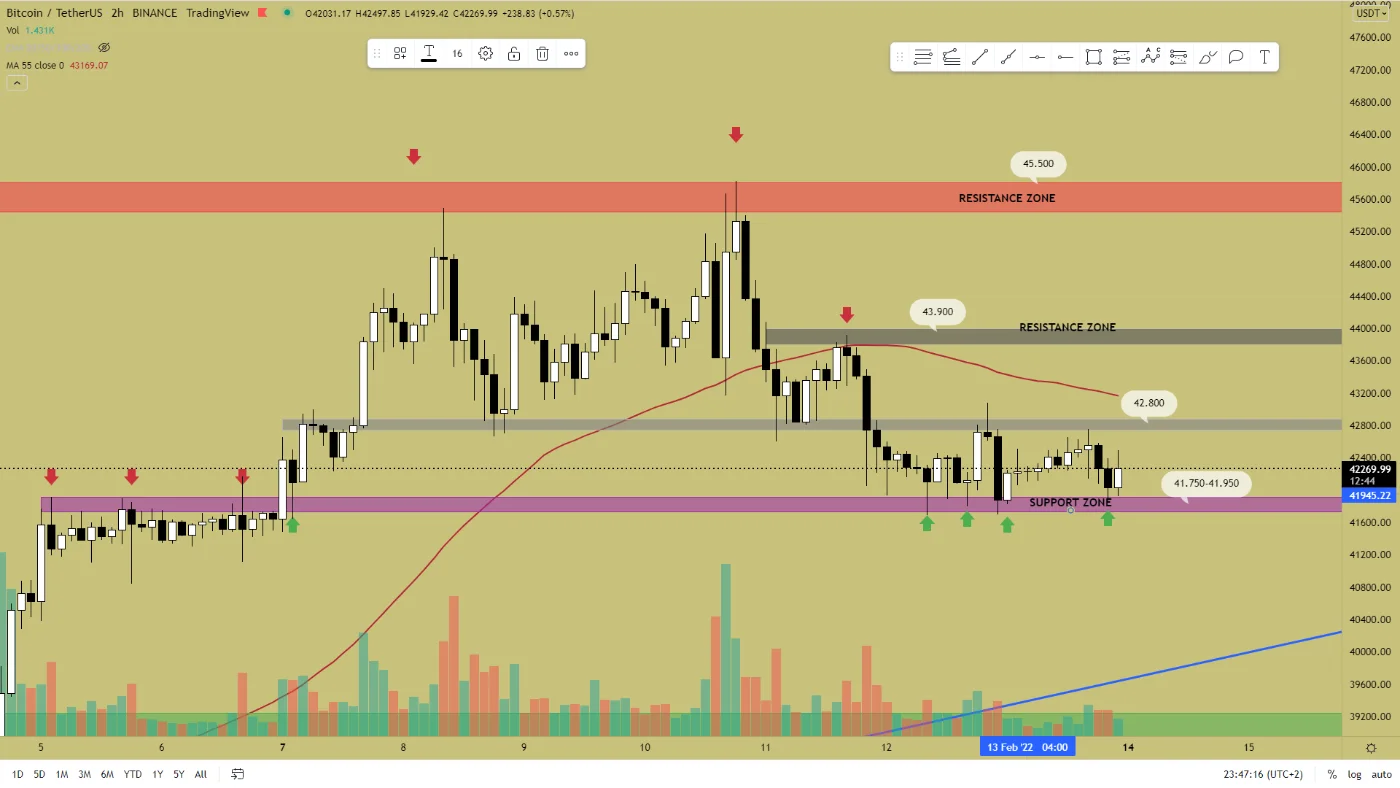
*****Let's start wih Bitcoin!*****
**Market Cap**
**$802,137,106,921**
**Currently Price**
**$42,265.31**
**source:** https://coinmarketcap.com/currencies/bitcoin/
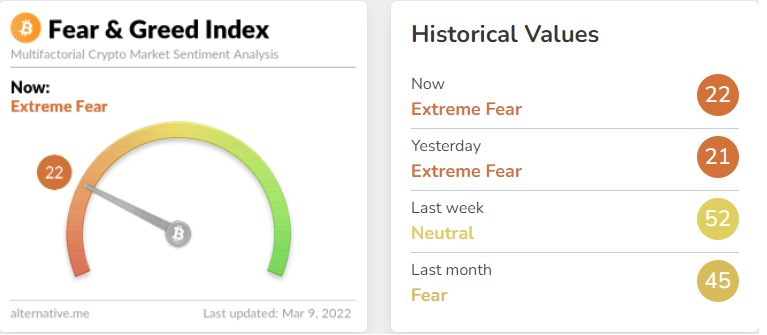
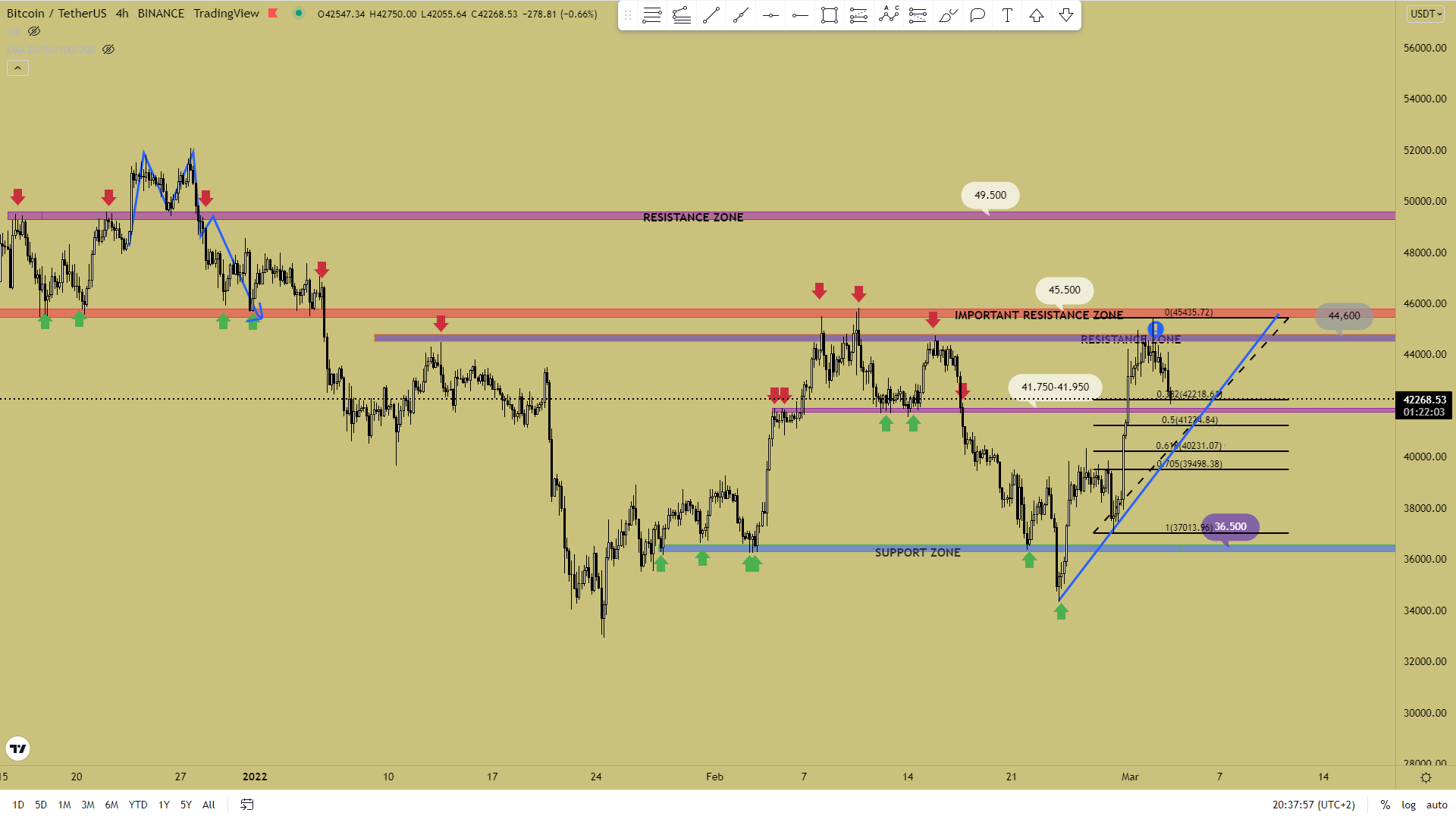
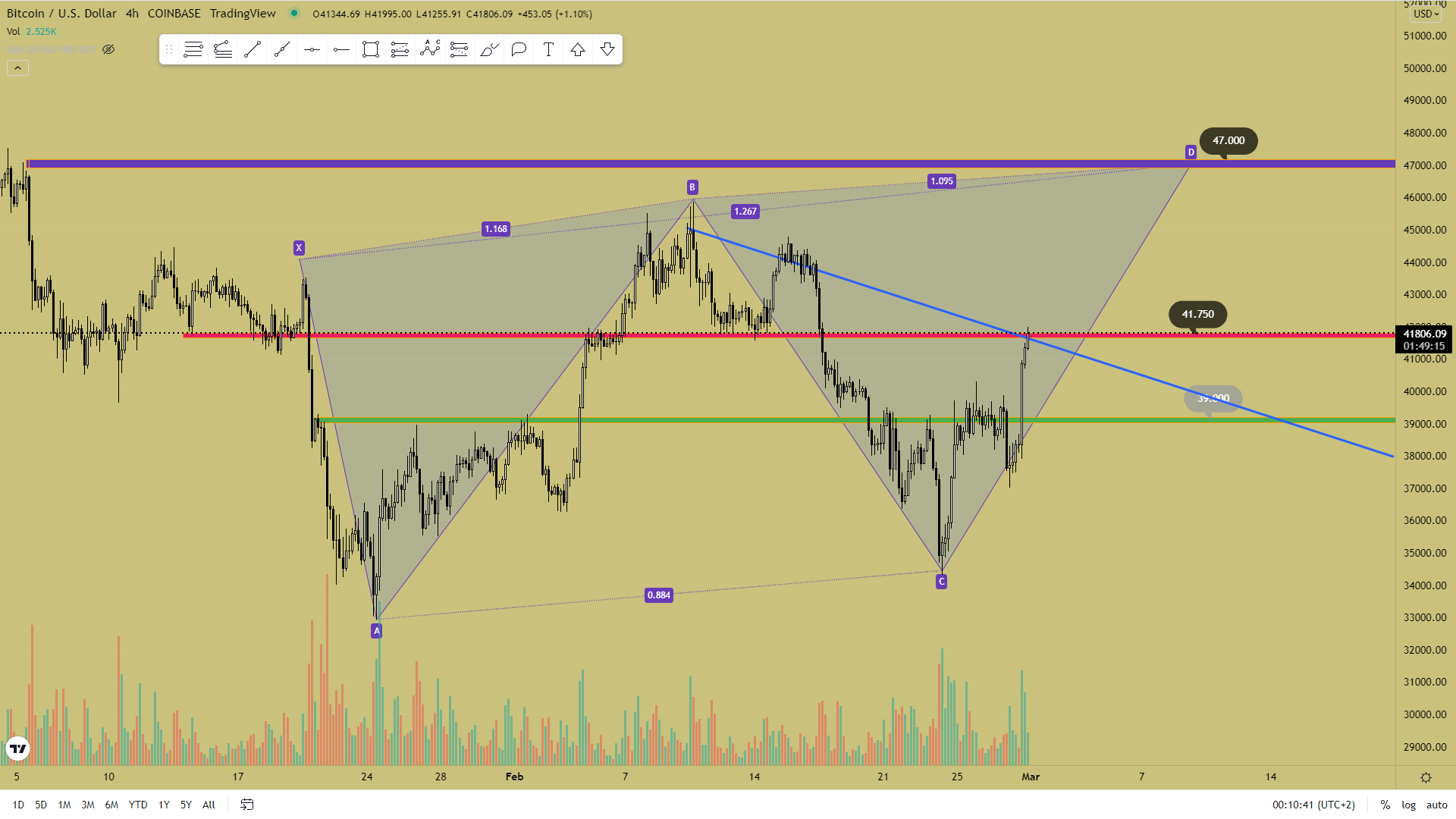
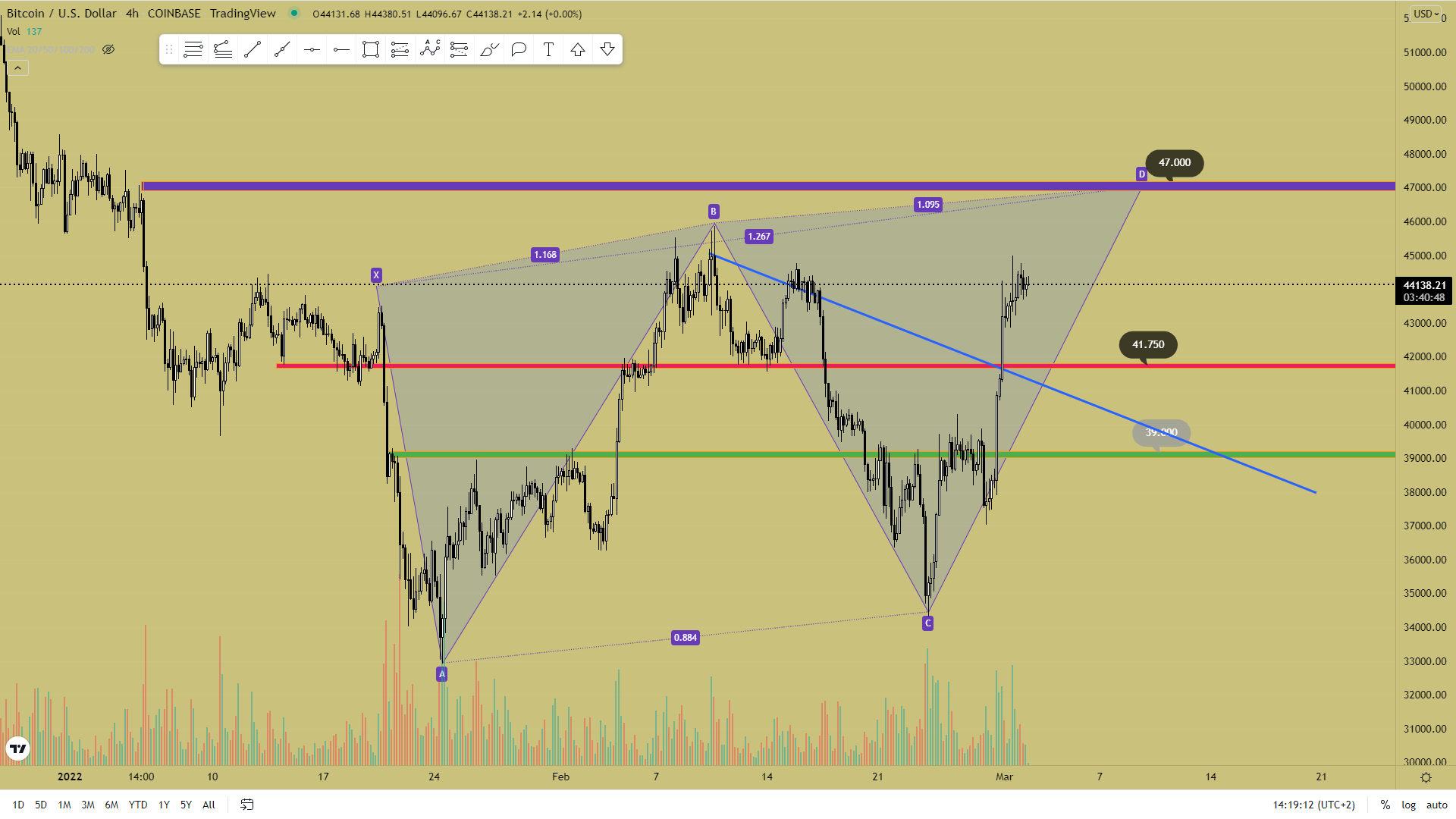
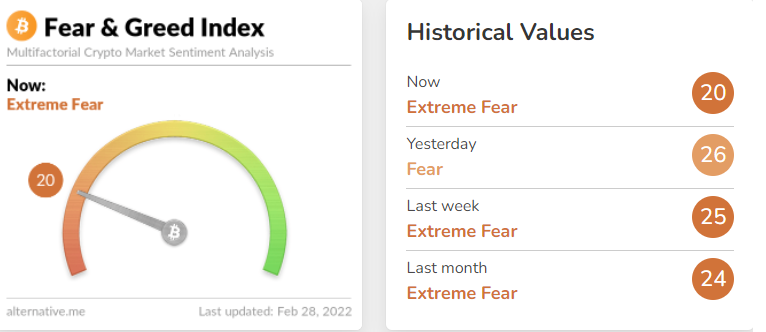
I've been telling you for about 15 days now that whales are buying bitcoins as the price drops. you can see this in all my posts.The fear and greed index is not rising, but the price suddenly crossed the 42000 level, there can be only one explanation for this. this is how whales act like i said :) they love fear.I am following the purple line from below that i have drawn on the chart it works fine as a support.The 44,500 region is very important as I have shown.Let's see how the price will move.
https://alternative.me/crypto/fear-and-greed-index/
Everyone is afraid in the market, but the price is rising? :))
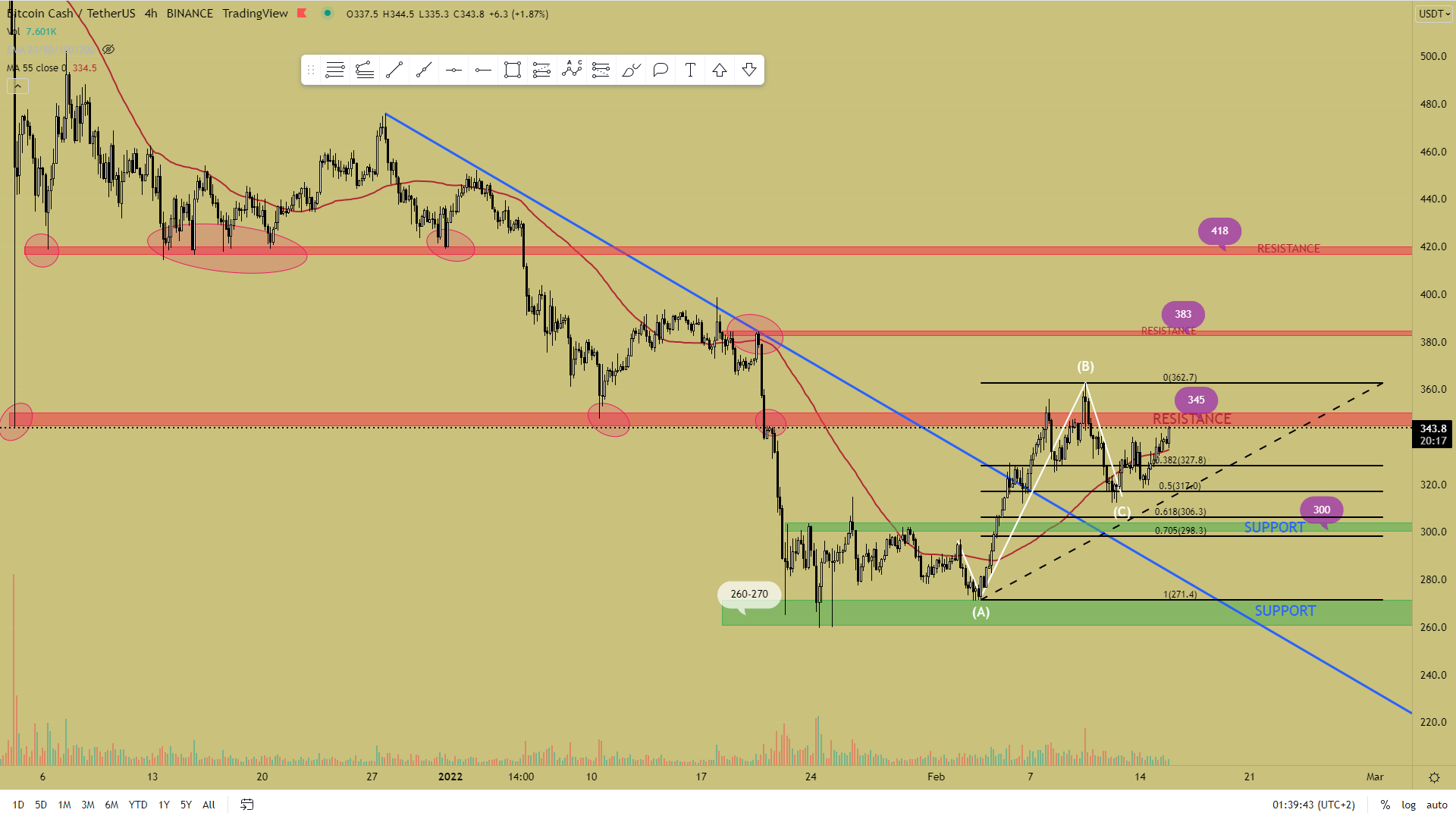
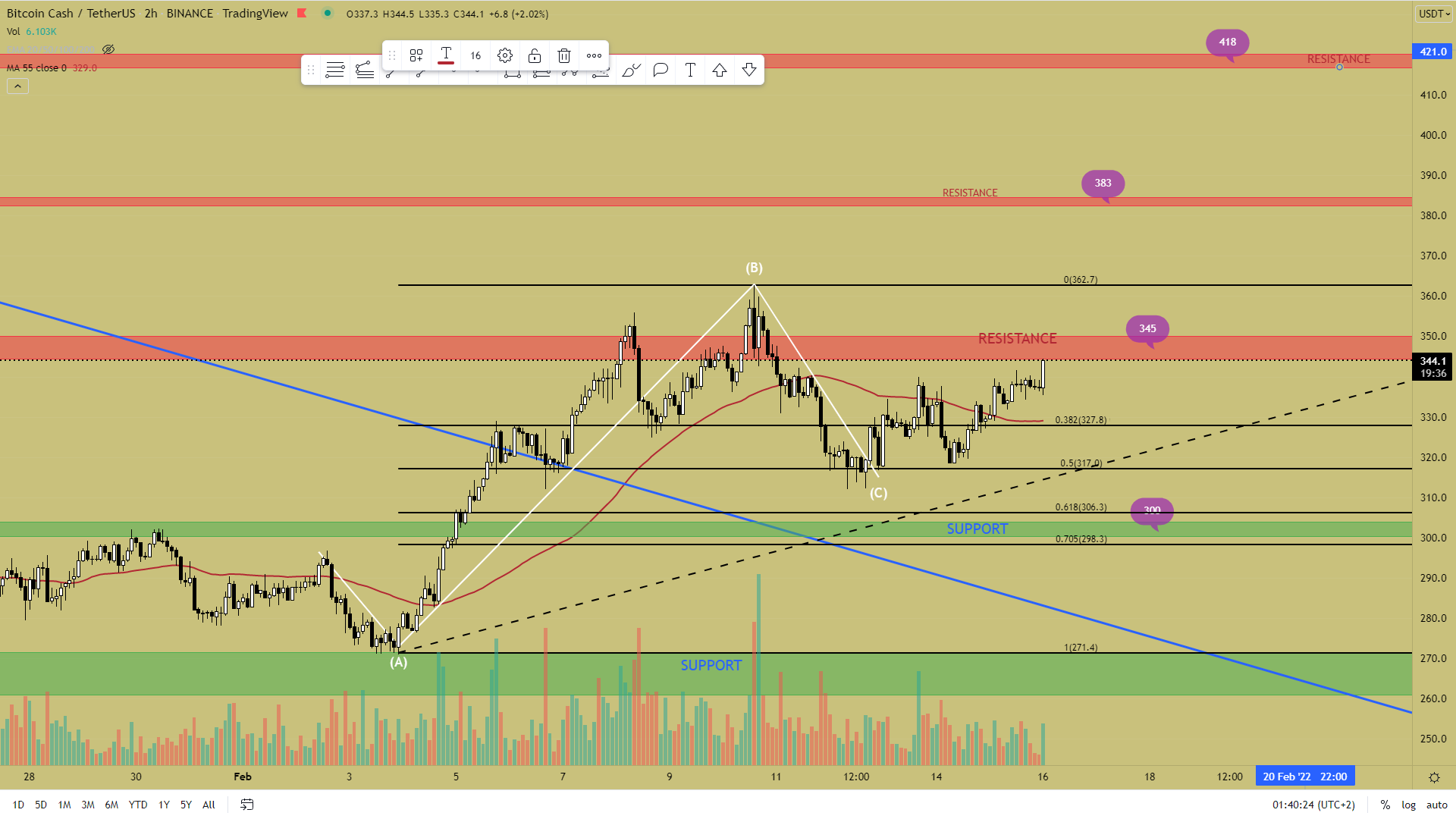
*****Next is Bitcoin Cash.*****
**Market Cap**
**$5,877,222,815**
**Currently Price**
**$309**
**source:** https://coinmarketcap.com/currencies/bitcoin-cash/
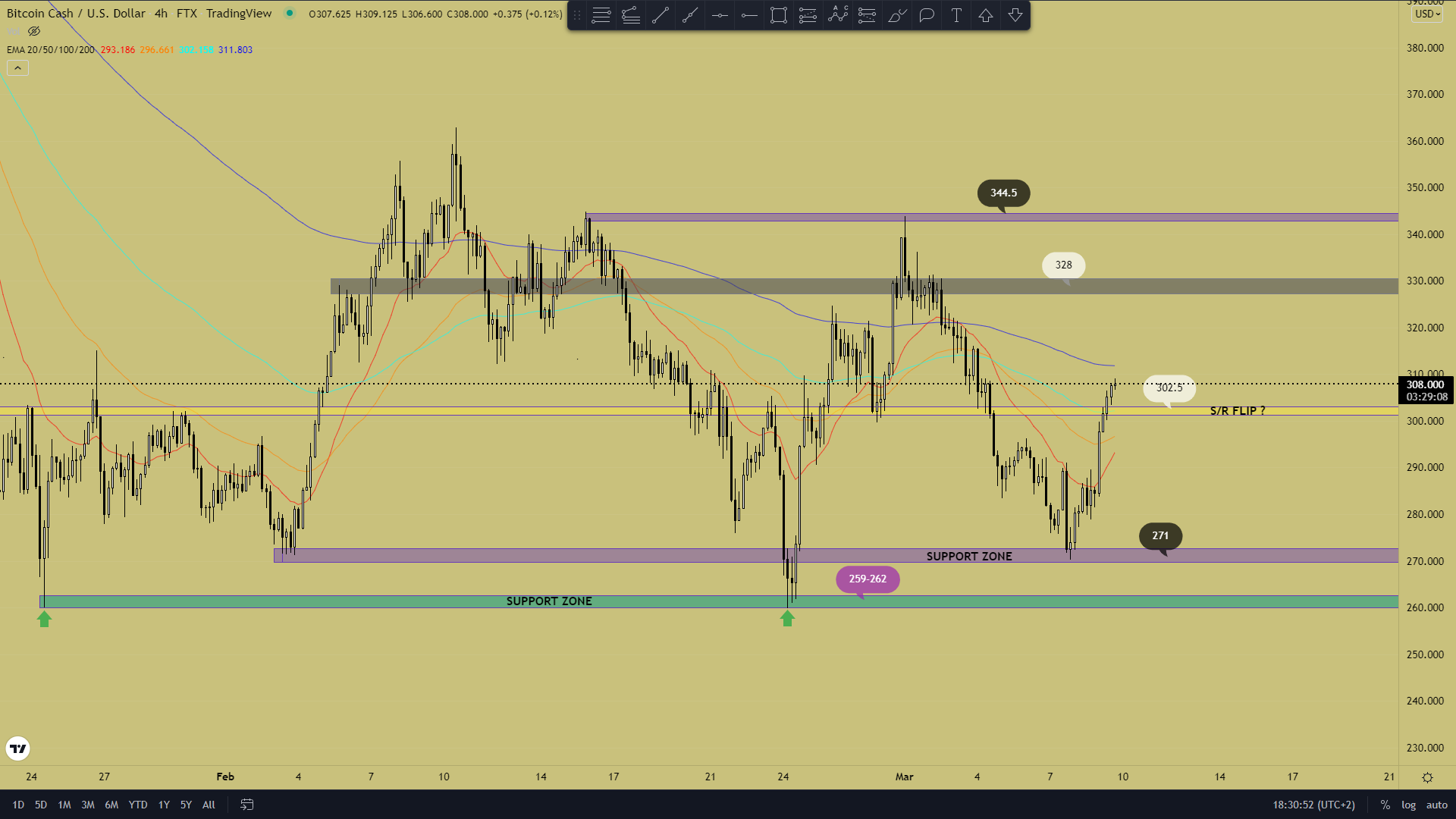
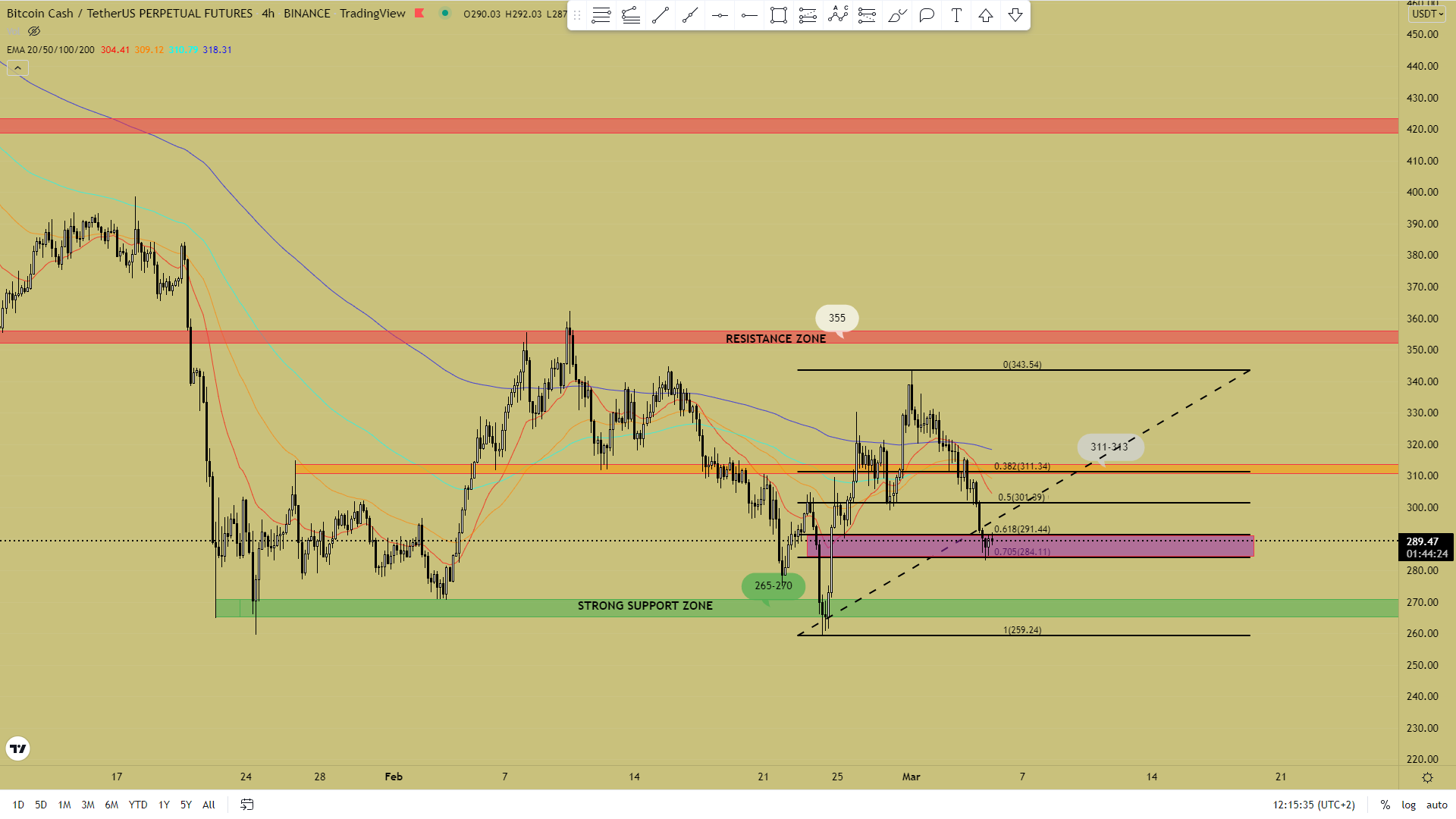
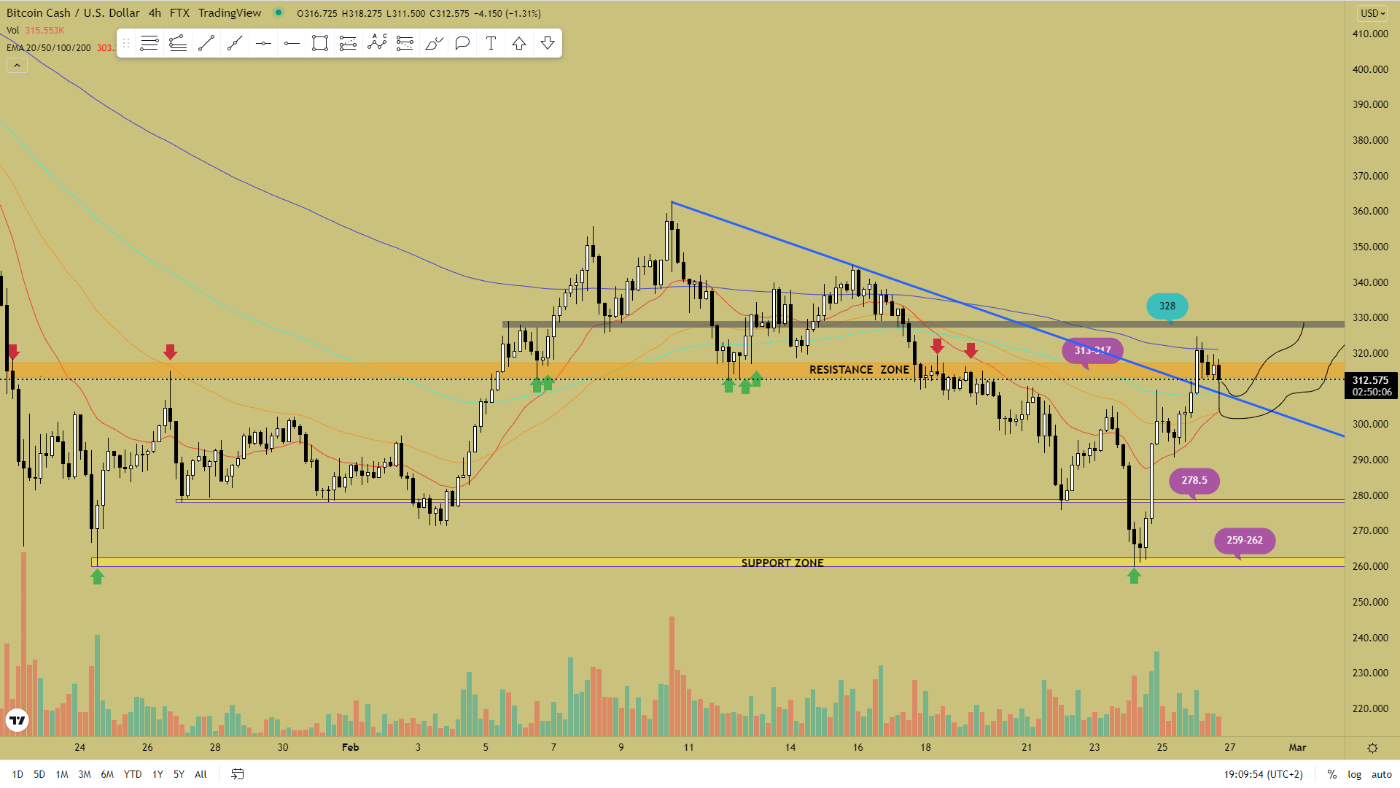
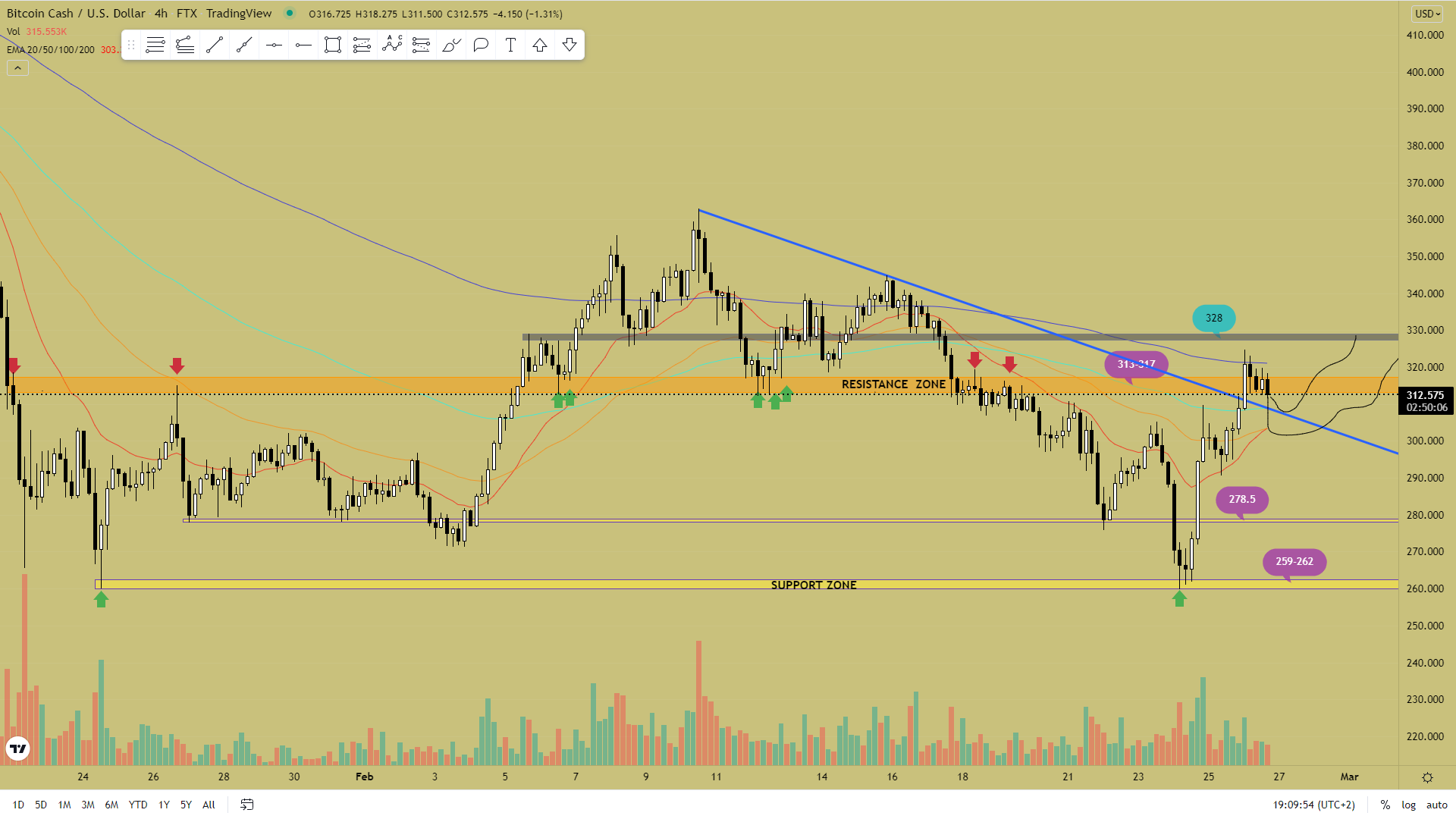
With the rise of bitcoin, bitcoin cash gained a nice momentum.It received good support from the 271 support zone and continues to rise. We are currently above the yellow horizontal resistance zone of 302.5 and as long as we stay above it, our target is the 328 resistance zone.
*****Next is AAVE*****
**Market Cap**
**$1,753,435,143**
**Currently Price**
**$128.63**
**source:** https://coinmarketcap.com/currencies/aave/
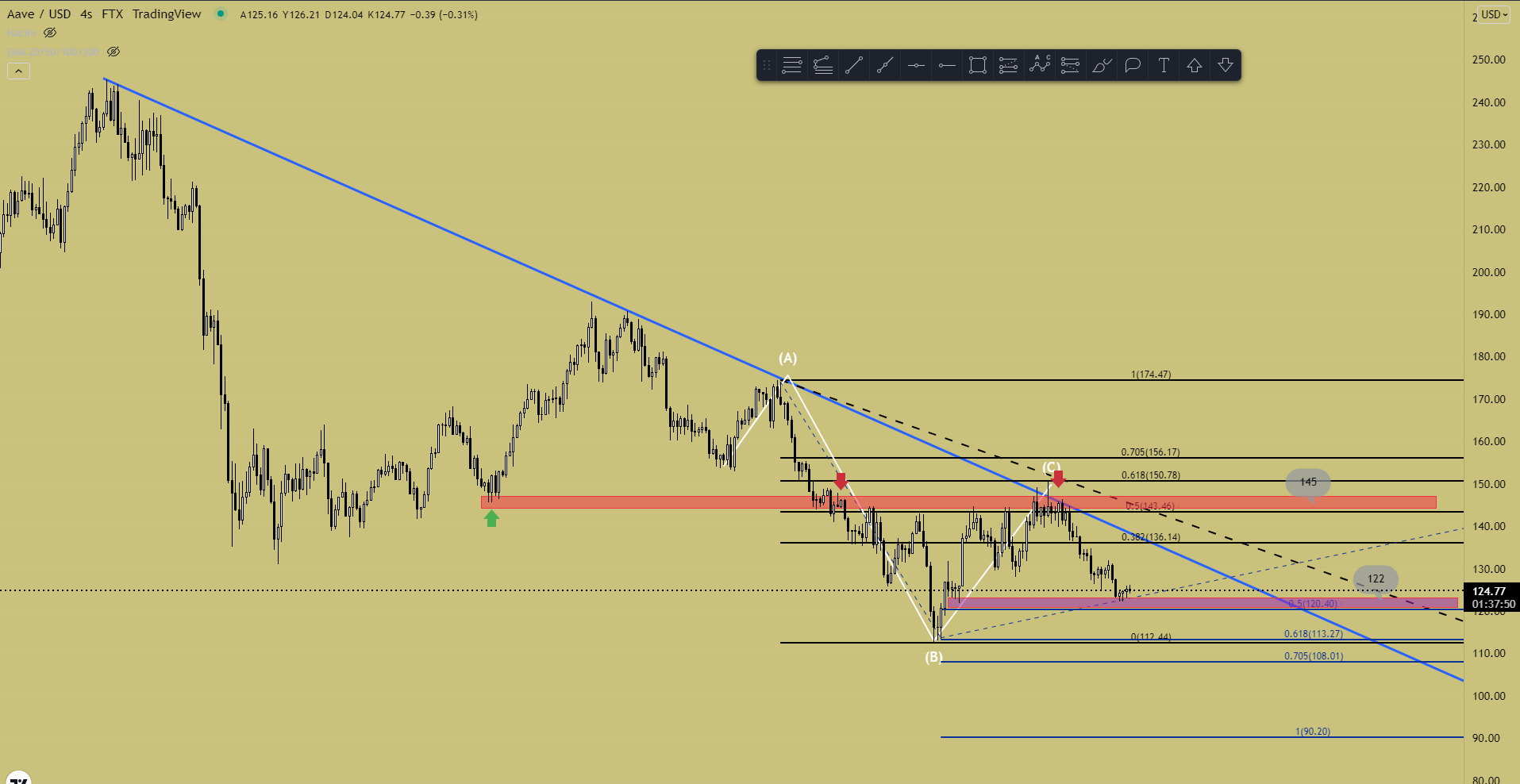
We are at the breaking point of the strong downtrend line from above.If bitcoin continues to rise, a little re-test and an upward move would be very nice.If there is no extra news, our first target where the price wants to go is the 145 level.For me, the breakdown of the falling trend is very important, it tried this place many times but failed. this time it came strong, if bitcoin supports it, I expect fast rises.
that's it for today :)
Btw I'm thinking of increasing the analysis of altcoins day by day.
Those were my market comments today, thank you for reading.
See you again soon. I will be here after this.
**Respects.**
What will web 3.0 bring us?
**First of all, I would like to thank my sponsors.You can follow them here.**
You always hear it as web 3.00, don't you?
***What is Web 3.0?***
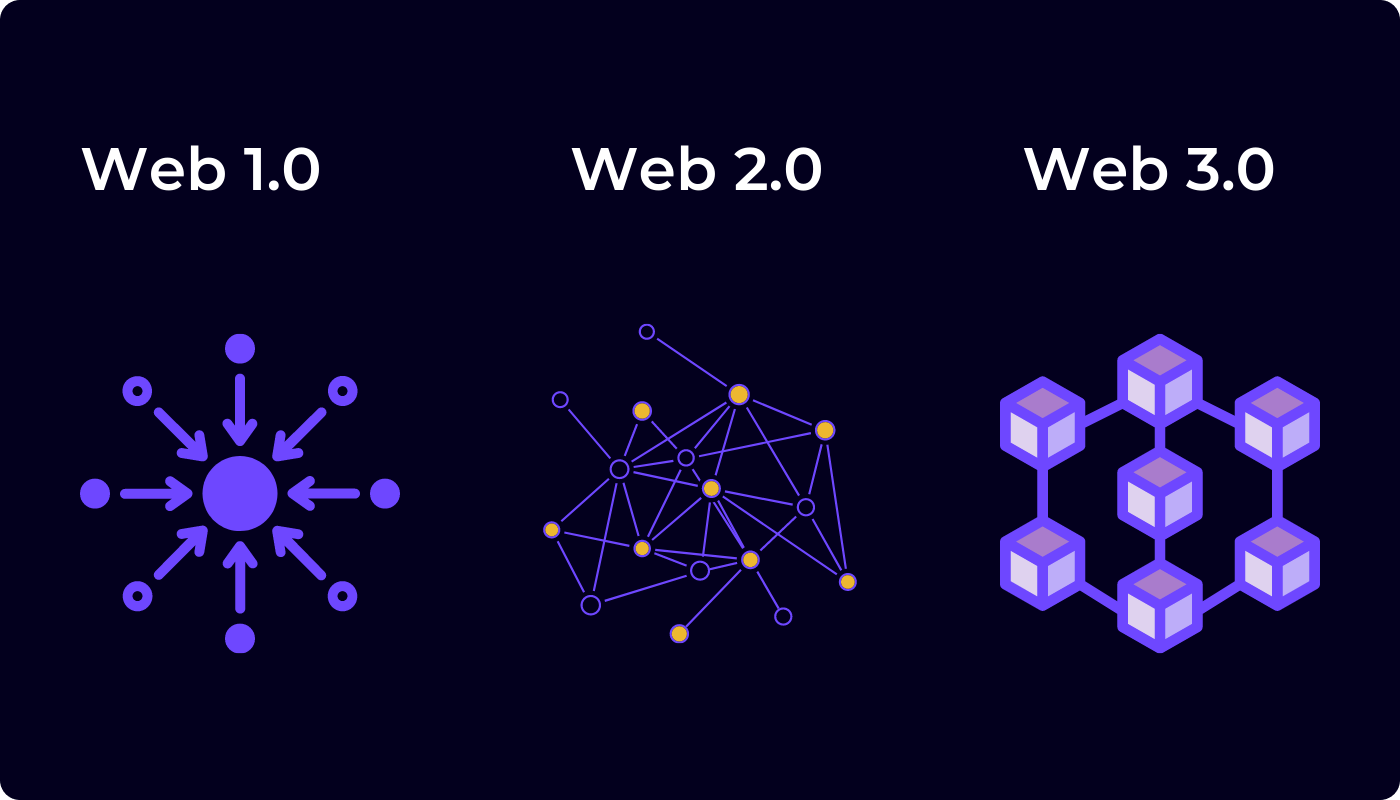
Web 3.0 (aka Web3) is a next-generation internet technology that relies heavily on machine learning, artificial intelligence (AI), and blockchain technology. This concept was created by Gavin Wood, founder of Polkadot and co-founder of Ethereum. While Web 2.0 will focus on user-created content located on central websites, Web 3.0 will give users more control over their online data.
It aims to create open, connected, intelligent websites and applications, and to make data more understandable by machines. Decentralization and digital economies also play an important role in Web 3.0, allowing us to value content created on the Internet. It is important to understand that Web 3.0 is a concept in flux. There is no single definition of the concept and what it means exactly may differ from person to person.
**How does Web 3.0 work?**
Web 3.0 aims to deliver personalized and relevant information faster using artificial intelligence and advanced machine learning techniques. The development of smarter algorithms and Big Data analytics means machines can intuitively understand and suggest content. Web 3.0 will also focus on user ownership of content and supporting accessible digital economies.
Today's websites often display static information or user-generated content such as forums and social media. While this approach allows for data to be published in a way that is accessible to large audiences, it does not address the needs of individual users. A website should present information uniquely to each user, similar to the dynamism of communication between people in the real world. In addition, in Web 2.0, users lose ownership and control of this information as soon as information becomes online.
Another important person behind the concept of Web 3.0 is computer engineer Tim Berners-Lee, creator of the World Wide Web (World Wide Web). Lee shared his ideas for the future of the web in 1999:
I imagine the Web (and the computers here) would have the ability to analyze all the data on the Web (content, connections, and transactions between computers and people). A "Semantic Web" that will make this possible has not yet been created, but when it is created, the mechanisms that are constantly used in trading, bureaucracy and in our daily lives will be managed through machines talking to each other.
Berners-Lee's vision later merged with Gavin Wood's message. Here, a huge repository of decentralized information will be accessible to websites and applications. These sites and applications will understand and use data in a way that caters to users' needs. Blockchain acts as a solution to fairly manage this online identity, data and property.
**A brief history of the development of the Internet**
To better understand Web 3.0, let's look at where we are now and how we got here. In the last twenty years there have been great changes:
**Web 1.0**
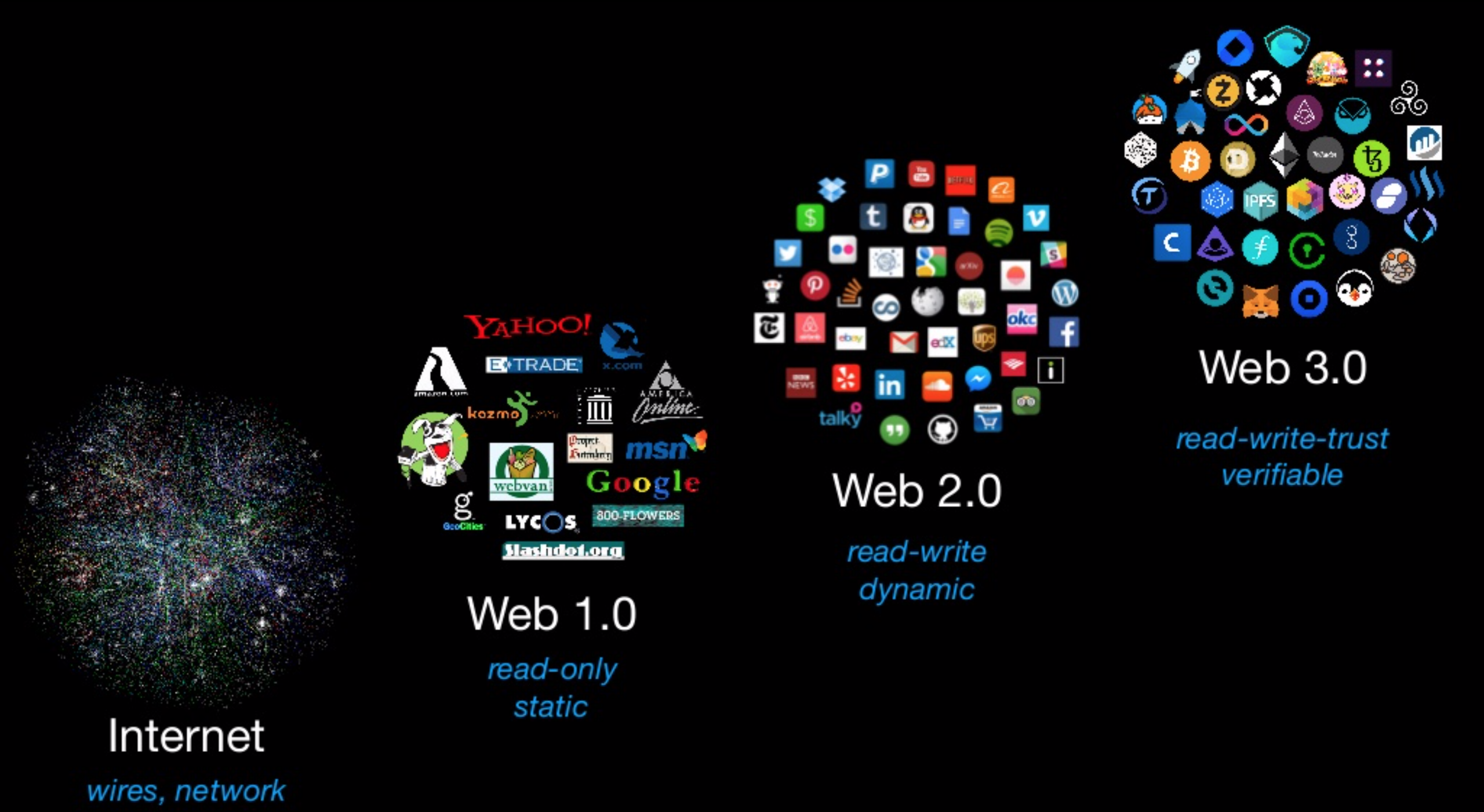
The original internet gave us an experience now known as Web 1.0. The term was coined by author and web designer Darci DiNucci in 1999 to describe the difference between Web 1.0 and Web 2.0. In the early 1990s, websites are created using static HTML pages that can only display information. It is not possible for users to change data or upload their own data. Social interactions are limited to simple chat programs and forums only.
**Web 2.0**
At the end of the 90's, a trend towards a more interactive internet started. With Web 2.0, users were able to interact with websites through databases, server-side processes, forms and social media. These tools have transformed the web experience from static to dynamic.
Web 2.0 has increased the importance given to user-generated content and the interoperability between different sites and applications. Web 2.0 is for less observation, more participation. By the mid-2000s, many websites had migrated to Web 2.0 and large technology companies began building social networks and cloud-based services.
**Future and Web 3.0**
The development of the semantically intelligent web makes sense when we look at the history of the internet. Data is first presented to users statically. Later, users started to interact with the data in a dynamic way. Now algorithms will use all the data to improve the user experience and make the web more personalized and familiar. Just look at YouTube or Netflix to see the power of the algorithms and how much they've already improved.
While its boundaries are not fully drawn, Web 3.0 can leverage peer-to-peer (P2P) technologies such as blockchain, open source software, virtual reality, Internet of Things (IoT), and many other elements. Web 3.0 also aims to make the internet more open and decentralized. In the current framework, users have to use network and cellular data providers that access their personal data and information. With the development of distributed ledger technologies, this may soon change and users can take ownership of their data back.
**Main features of Web 3.0**
It's still a long time before Web 3.0 is fully adopted, but its core concepts are almost defined. The following four topics are often ranked as the most important features of the Web 3.0 future.
**Semantic formatting**
Over time, the ability of machines to understand data and human-created content has evolved. But there is still a long way to go to create a seamless experience with full understanding of the semantics. For example, the use of the word "bad" can mean "good" in some situations, for example figuratively. This is extremely difficult for a machine to understand. But with Big Data and more information to work with, artificial intelligence has begun to better understand what we write on the web and present this information intuitively.
**Blockchain and cryptocurrencies**
Data ownership, online economies and decentralization are key elements of Gavin-Wood's Web3 future. We'll dive into each of these topics in a moment, but blockchain provides a tried and tested system for achieving many of these goals. One person's power to tokenize assets, move information on-chain, and create a digital identity are key innovations that have allowed Web 3.0 to emerge.
**3D visualization and interactive view**
Simply put, the look of the web will change drastically. There is already a trend towards three-dimensional environments, including even virtual realities. The meta-universe is one of the areas leading these experiences, and many people are already familiar with socializing with 3D video games. User interface (UI) and user experience (UX) fields are also working on presenting information to web users in more intuitive ways.
**artificial intelligence (AI)**
Artificial intelligence is the key to turning human-created content into machine-readable data. Even today, we often encounter customer service auto-response services, but this is just the beginning. Artificial intelligence can both present and organize data to us. This makes it a versatile tool for Web 3.0. Better still, the AI will learn and evolve, thus reducing the burden of future human development.
**What makes Web 3.0 superior to its predecessors?**
Combining the major features of Web 3.0 would, in theory, offer many advantages. But it should be noted that all these advantages are based on the success of the underlying technology:
1. Lack of a central control point - Agents removed from the equation will no longer be able to control user data. This freedom also reduces the risk of censorship by government or companies and reduces the effectiveness of Denial of Service (DoS) attacks.
2. More connections between information - As more products connect to the Internet, the amount of information that algorithms can analyze increases thanks to larger datasets. This can help provide more accurate information specific to each user's needs.
3. More efficient viewing - When using search engines, it can sometimes be difficult to find the best results. But over the years, search engines have gotten better at finding semantically related results based on search context and metadata. This provides a more convenient web view that can help anyone easily find exactly the information they are looking for.
4. Advertising and marketing become more successful - No one likes to be showered with online advertisements. But if the ads appeal to your needs, they can become useful rather than annoying. Web 3.0 aims to improve advertising by leveraging smarter AI systems and targeting specific audiences based on customer data.
5. Better customer support - Customer service is essential for a smoother user experience on websites and web apps. But many successful web services struggle to scale their customer service operations because the cost is so high. With the use of smarter chat programs that can talk to multiple customers at the same time, users can benefit from a better experience when communicating with their support units.
In what ways does crypto fit Web 3.0?
When it comes to Web 3.0, blockchain and crypto have enormous potential. Decentralized networks successfully create incentives for more informed data ownership, governance and content creation. Some of the features of crypto that have the most appeal to Web 3.0 include:
1. Digital crypto wallets - Anyone can create a wallet that allows you to transact and acts like a digital identity. You do not need to create an account or save your information with a central service provider. You have full control of your wallet and it is often possible to use the same wallet on more than one blockchain.
2. Decentralization - Thanks to blockchain, information and power can be easily distributed among a large number of people in a transparent manner. This is quite different from Web 2.0, where the leading tech giants dominate much of our online lives.
3. Digital economies - Having data on the blockchain and using decentralized transactions creates new digital economies. This allows us to easily value and sell online products, services and content without the need for banks and personal information. This openness facilitates access to financial services and empowers users to start earning.
4. Interoperability - On-chain DApp and data are becoming more and more interoperable. Blockchains developed using the Ethereum Virtual Machine easily support each other's DApps, wallets and tokens. This further enhances accessibility wherever needed for a connected Web 3.0 experience.
Web 3.0 usage areas
While Web 3.0 is still in development, there are some examples in use today:
Siri and Alexa virtual assistants
Both Apple Siri and Amazon Alexa offer virtual assistant services that fulfill many conditions for Web 3.0. Artificial intelligence and natural language processing help both services better understand voice commands. As the number of people using Siri and Alexa increases, so do the suggestions and interactions of the artificial intelligence of these applications. This provides a great example of a semantically intelligent web application from the Web 3.0 world.
source: https://academy.binance.com
**Respects.**
https://academy.binance.com/en
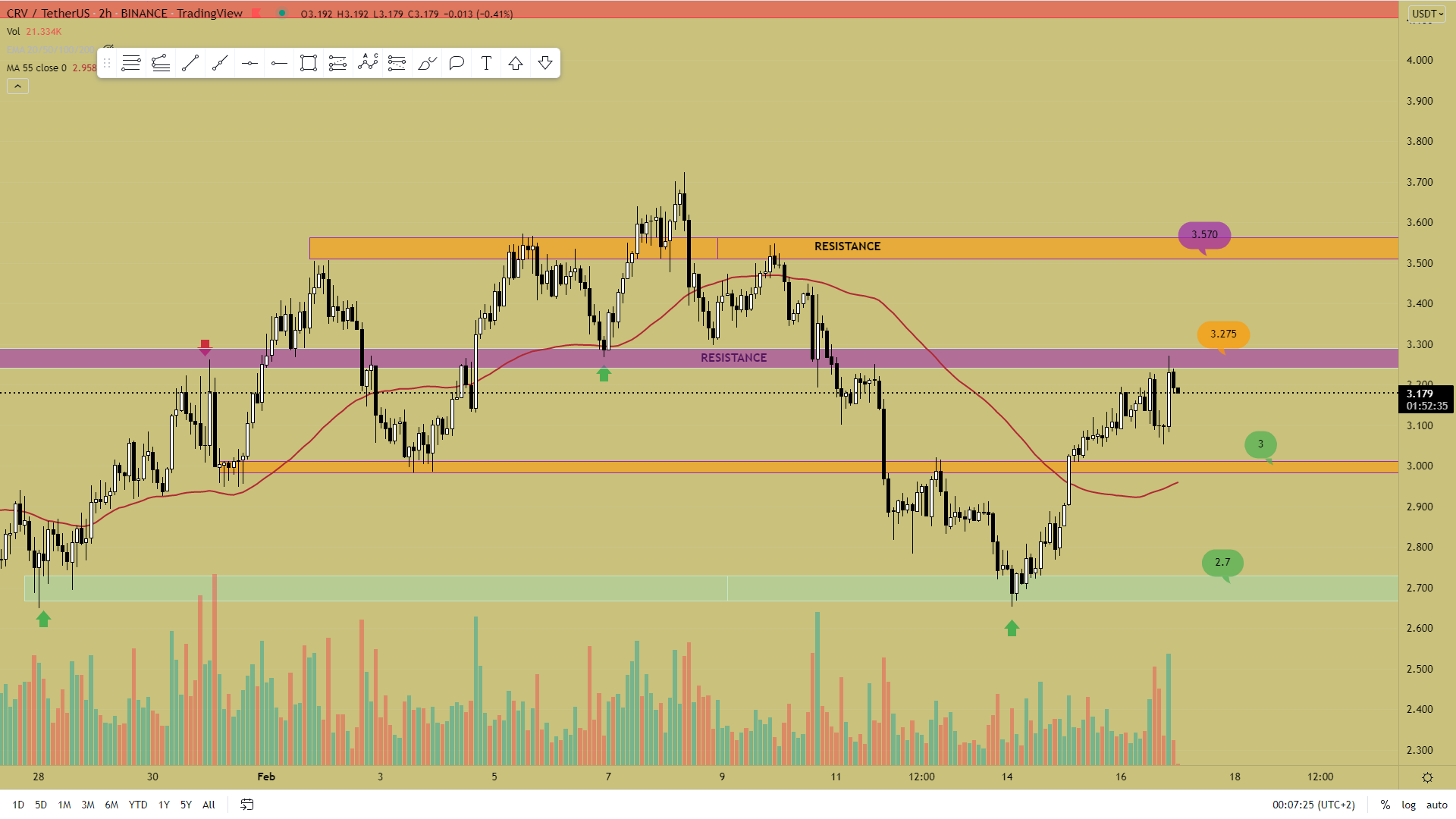
Curve DAO Token &Total2&Bitcoin Cash Analysis/07.03.22-Right perspective
**First of all, I would like to thank my sponsors.You can follow them here.**
**I want to tell you something**
-*The reason why prices are so volatile is that the margin side is used too much. In the past years, the pricing was real as it was mostly on the spot side. But now that most people are on the margin side, the system sees the movements and holds the market with the opposite position accordingly.*
**The posts on this page are not investment advice .I am not a financial advisor. Just sharing my thoughts.**
My motto is Keep things simple.
Follow the Trendlines, not the Headlines.
I will try to show you what I see.We will look at many altcoin analyzes.
**Remember!** Buy the Fear, Sell the Greed.
Fibonacci is my favorite love after my wife :D
**If you are ready, shall we begin??**
*****Let's start with Bitcoin Cash*****
**Market Cap**
**$5,323,608,745**
**Currently Price**
**$280.17**
**source:** https://coinmarketcap.com/currencies/bitcoin-cash/
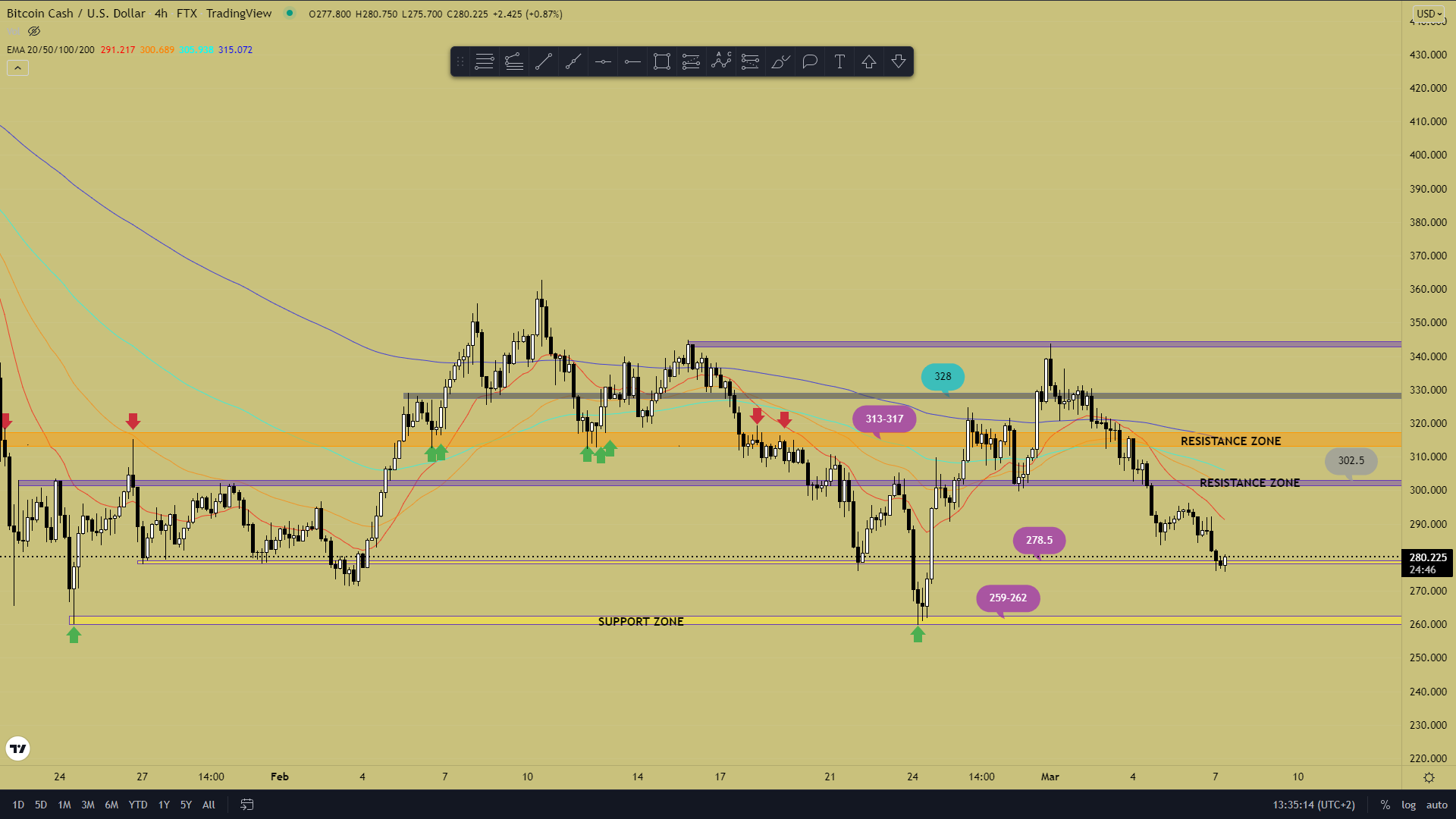
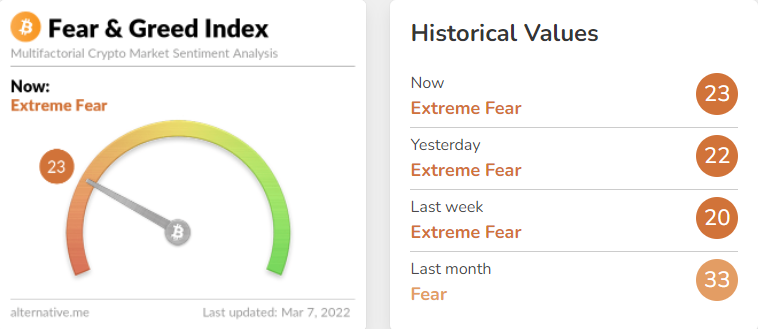
Let's look at bitcoin cash that we all love :) The price is trying to hold on to the support zone. As Bitcoin falls, I see whales buying from below.We are currently stalling at 280 levels.Since the next week is the fed decision, all small investors are afraid to buy crypto money, so who is buying at these prices when no one is buying? :)
recipe : https://alternative.me/crypto/fear-and-greed-index/
You understand what i am saying, do not you ?
*****Next is Crv(Curve DAO Token)*****
**Market Cap**
**$932,040,207**
**Currently Price**
**$2.04**
**source:** https://coinmarketcap.com/currencies/curve-dao-token/
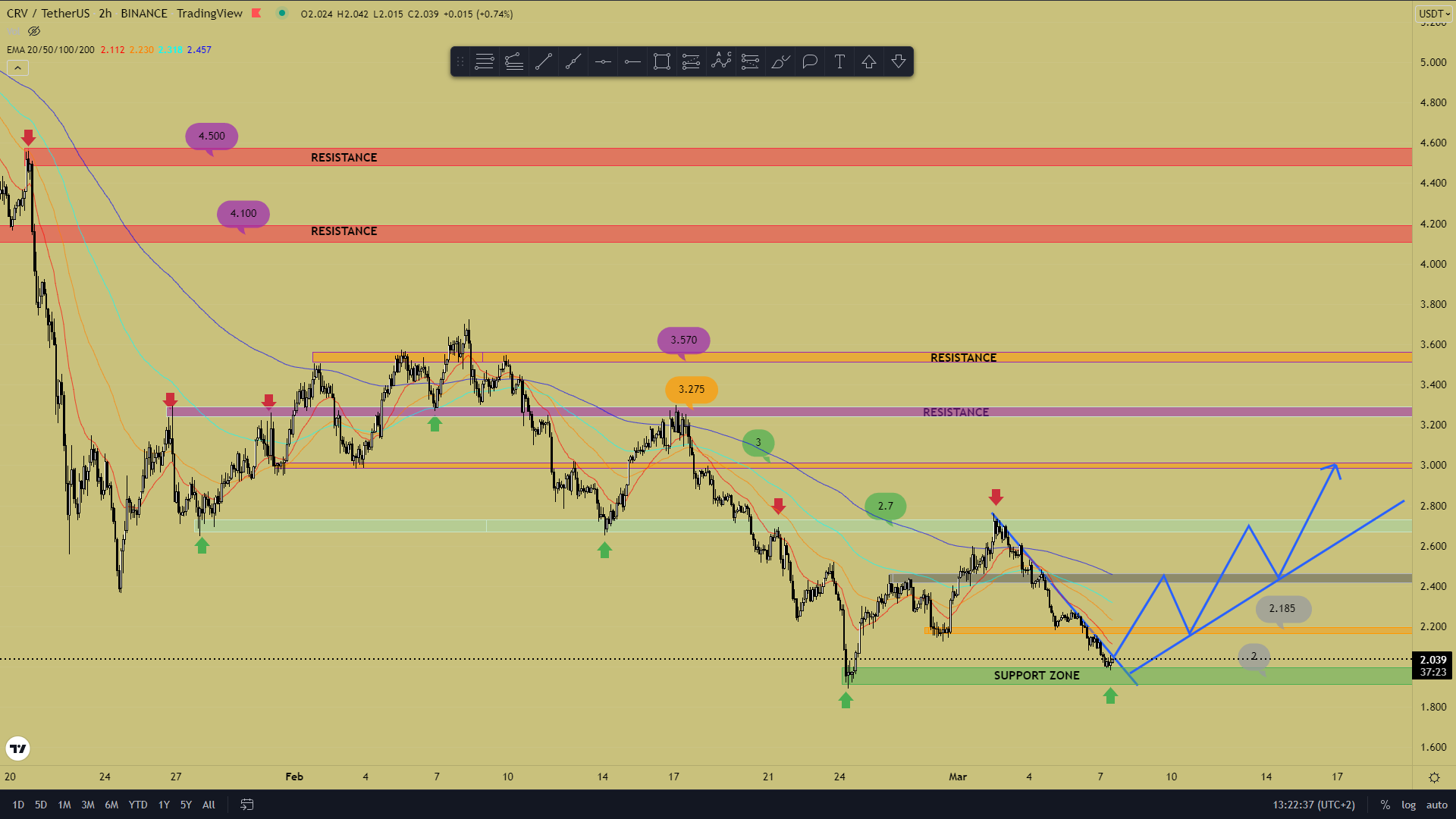
I think prices will go up in a short time after the Fed rate announcement. If you ask how it will go, I drew my expectation on the chart. whales will constantly scare people and buy cheap.when the price came to the support zone, there were good buys,(2).After breaking the downtrend line from above, I'm waiting for a re-test and an upward move.Let's wait and see, it's a little while.
*****Next is Total 2*****
I have drawn my expectation for you in this chart.
**I want to inform you about** *****Total 2*****
*****What is Total 2 ?*****
****TOTAL**** shows the top 125 cryptocurrencies by total market cap.
TOTAL2 shows the total market capitalization of the 125 top cryptocurrencies excluding BTC. OTHERS shows the total market capitalization of the top 125 cryptocurrencies, excluding BTC and some other top cryptocurrencies..
**Please do not confuse these two.**
Btw I'm thinking of increasing the analysis of altcoins day by day.
Those were my market comments today, thank you for reading.
See you again soon. I will be here after this.
**Respects.**
What are the famous big bitcoin investors thinking right now ..?
Hello everyone.
Today I want to tell you some news.
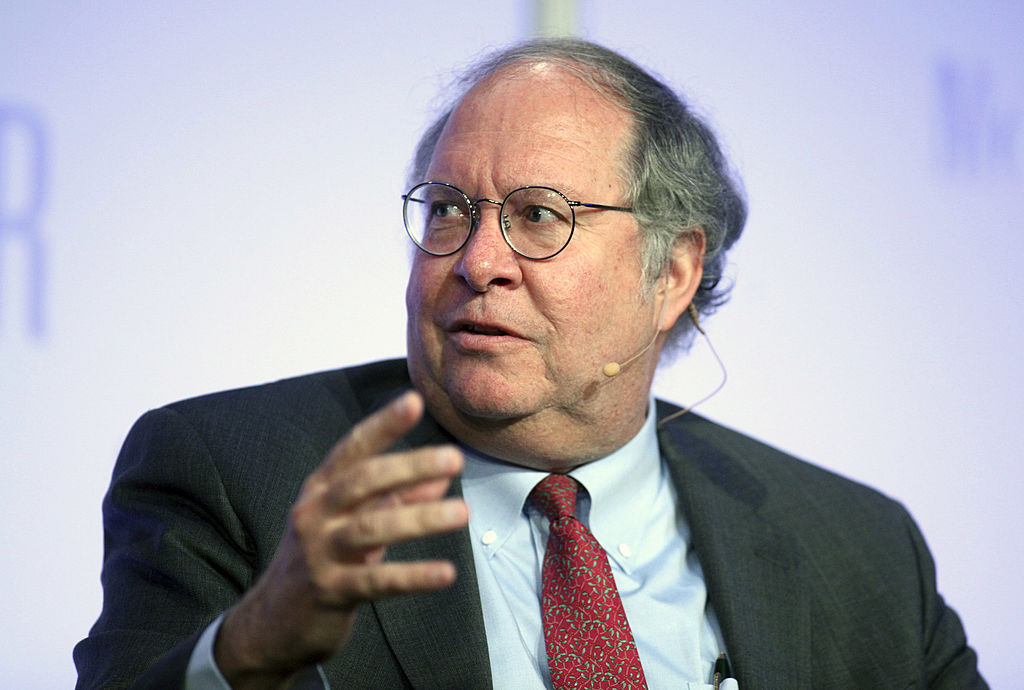
Striking Bitcoin Comment From Investor **Bill Miller!**
Bitcoin plays a critical role in times of crisis
The founder and chief investment officer of Miller Value Partners likens Bitcoin (BTC) to digital gold. According to Miller, BTC acts as a store of value. The executive's comments came after the US and EU announced that prominent Russian oligarchs were freezing their assets and imposing large-scale sanctions on the country. Miller said he sees this as a potential problem that countries will try to solve. According to the seasoned billionaire investor, Bitcoin (BTC) has a chance to become the new reserve currency for countries in emergencies. The famous entrepreneur states that Bitcoin will allow individuals and countries to control their assets without fear of sanctions that cut their foreign currency reserves.
While many countries, especially the USA, impose sanctions on Russia and Russian businessmen, according to experts, Bitcoin and cryptocurrencies can reduce the effect of the sanctions imposed by the West.
Russian billionaires can circumvent sanctions thanks to cryptocurrencies. The United States began to impose harsh sanctions against Russia, which began invading Ukraine. He also stressed that the European Union will impose large-scale and targeted sanctions. Despite these concrete steps to weaken the Russian economy, these sanctions may not be very effective for a country like Russia, which already uses cryptocurrencies widely. As in the case of Iran, countries that have been sanctioned generally try to circumvent these sanctions in various ways. Miller invests heavily in Bitcoin (BTC). BTC represents 50 percent of his personal assets.
However, experts stated that centralized exchanges can detect Russia-based transactions by tracking transactions on the Blockchain network. None of the Russian billionaires on the sanction list have yet openly stated that they own cryptocurrencies. According to research, 12 percent of Russian citizens declared that they own cryptocurrencies.
Stunning Inflation And Bitcoin Statement **From Kiyosaki!**
**How to make money during inflation?**
Robert Kiyosaki made striking statements about inflation and Bitcoin to his 1.8 million Twitter followers. Rich Dad Poor Dad is an important book written by Kiyosaki and Sharon Lechter in 1997. The book has been on the New York Times Best Seller List for over six years. More than 32 million copies of the book have been translated into more than 51 languages in more than 109 countries. Kiyosaki tweeted on Friday:
''HOW TO PROFIT FROM INFLATION. Biden wants inflation. I counter his criminal actions by investing in Texas and N. Dakota OIL. Just bought a GOLD mine in Utah. Investing in Texas APARTMENTS houses. Saving GOLD, SILVER, BITCOIN. Don’t be a BIDEN victim. Invest like a CAPITALIST.''
Kiyosaki has warned investors about inflation several times before. The economist accuses President Joe Biden, his administration and the Fed of destroying the dollar. The author also warned of a major economic crisis last year. In November, he said he had similarly bought more gold, silver, Bitcoin, ethereum, real estate and oil as inflation concerns rose.
**Bitcoin message: buy bottom**
Kiyosaki is known for frequently giving investment and financial advice on social media. The economist, in his post on Twitter in January, emphasized that the correction in the market is an excellent opportunity to make money. The famous writer pointed out that the markets offer discounts and that it is the best time to buy. According to the expert, the stock market claimed that this is the best time to get rich, as Bitcoin and gold depreciate. Kiyosaki said, “Great news. The NASDAQ fell 2 percent, gold 0.2 percent, Bitcoin 1.4 percent and S&P 1.6 percent. Markets are crashing. The Fed doesn't print money. Wonderful news. Market crashes are the best time to get rich. Go shopping when Walmart and financial markets are on sale.” made the statement.
Kiyosaki, who has little faith in traditional markets and has always been a big supporter of cryptocurrency investments, believes in the possibility of a rebound in markets and equities soon. That's why he recommends buying the stock and Bitcoin (BTC) dips.
As we will remember, in November 2021, Bitcoin rose to $ 69,000 by making ATH. Although it is far from those levels for now, Bloomberg analyst Mike McGlone stated that Bitcoin (BTC) and cryptocurrencies show a diverging power, especially when compared to stock markets.Mike McGlone said in his past statements that the corrective action that many expected, especially for stock markets, was delayed. Despite this situation, the analyst made the analogy of “digital gold” for Bitcoin, stating that the price of Bitcoin (BTC) “shows a diverging power” in his statement on the Twitter platform. The analyst stated that Bitcoin is ready for victory and that after the ATH it made last year, BTC will be subject to deflationary pressures.
***McGlone***: “BTC is moving towards global digital collateral”
On the other hand, the Analyst stated that the losses experienced by BTC in 2022 are half the losses of the Nasdaq 100, and stated that he thinks it is taking firm steps towards becoming a global digital collateral for Bitcoin. Here is Mike McGlone's tweet on the subject:
''#Bitcoin $40,000 or #Nasdaq 14,000? Digital #Gold Set to Prevail - Bitcoin faces deflationary forces after 2021 excesses, but the crypto shows divergent strength. With 2002 losses less than half those for the Nasdaq 100, Bitcoin may be maturing toward global digital collateral''
As we may remember, the occupation between Russia and Ukraine started on February 24, and BTC had a short-term decline. On that date, McGlone said that “despite the presence of negative risks, this decline presents a pretty good buying opportunity for long-term investors.”
*and let's look at the fear and greed index*
Aave&Bitcoin&Bitcoin Cash Analysis/05.03.22-Right perspective
**First of all, I would like to thank my sponsors.You can follow them here.**
**The posts on this page are not investment advice .I am not a financial advisor. Just sharing my thoughts.**
My motto is Keep things simple.
Follow the Trendlines, not the Headlines.
I will try to show you what I see.We will look at many altcoin analyzes.
**Remember!** Buy the Fear, Sell the Greed.
Fibonacci is my favorite love after my wife :D
**If you are ready, shall we begin??**
**Let's start with Bitcoin!**
**Market Cap**
**$742,387,150,418**
**Currently Price**
**$39,124.55**
**source:** https://coinmarketcap.com/currencies/bitcoin/
Today I want to look at bitcoin from a broader perspective.for me bitcoin has 3 important regions.I must admit that whales do a very good job of scaring people.for them, lowering the price means they get bitcoin much cheaper.they are not afraid because they know very well what to do when.we small investors have to do is be patient. We need to see where the whales' next move will come from and stay in the direction they're going.You know the fed's statement this month (15 - 16 March) and the battle continues, all of which make investors hesitant to buy bitcoin.
**Next is Bitcoin Cash!**
**Market Cap**
**$5,508,128,388**
**Currently Price**
**$289.90**
**source:** https://coinmarketcap.com/currencies/bitcoin-cash/
Let's take a look at the bitcoin cash chart, the price is currently near the 0.705 level, which is the fibonacci final retracement zone. If the price goes down more from here, I think there will be reaction buying from the levels I drew with the strong support zone green.
**Next is Aave**
**Market Cap**
**$1,692,844,284**
**Currently Price**
**$124.21**
source: https://coinmarketcap.com/currencies/aave/
price failed to break the blue falling trendline it was tried a lot but could not pass.We are now in the last support zone. If it wants to rise, the price must stay above this point.
source: https://alternative.me/crypto/fear-and-greed-index/
like i said, whales know how to scare :)
**I want to give you some information about Aave.**
**What Is Aave (AAVE)?**
Aave is a decentralized finance protocol that allows people to lend and borrow crypto.
Lenders earn interest by depositing digital assets into specially created liquidity pools. Borrowers can then use their crypto as collateral to take out a flash loan using this liquidity.
Aave (which means “ghost” in Finnish) was originally known as ETHLend when it launched in November 2017, but the rebranding to Aave happened in September 2018. (This helps explain why this token’s ticker is so different from its name!)
AAVE provides holders with discounted fees on the platform, and it also serves as a governance token — giving owners a say in the future development of the protocol.
Who Are the Founders of Aave?
Aave, and its predecessor ETHLend, were founded by Stani Kulechov. At the time, he was frustrated at the lack of lending applications on Ethereum — and his project was built before decentralized finance even existed. https://coinmarketcap.com/alexandria/article/what-is-decentralized-finance
Kulechov is a serial entrepreneur who went to law school and began programming when he was a teenager. He was an early adopter in the blockchain space. The CEO has said that he wanted to rebrand ETHLend as Aave so the company could offer a wider range of services beyond Ether lending.
According to Kulechov, Aave’s main target market are people who are already engaged in the cryptocurrency community.
What Makes Aave Unique?
Aave has several unique selling points when compared with competitors in an increasingly crowded market. During the DeFi craze in the summer of 2020, it was one of the biggest projects in terms of the total value of crypto locked in its protocol. https://coinmarketcap.com/alexandria/article/what-is-decentralized-finance
The project allows people to borrow and lend in about 20 cryptocurrencies, meaning that users have a greater amount of choice. One of Aave’s flagship products are “flash loans,” which have been billed as the first uncollateralized loan option in the DeFi space. There’s a catch: they must be paid back within the same transaction.
Another big selling point is how those who borrow through Aave can alternate between fixed and variable interest rates. While fixed rates can provide some certainty about costs during times of volatility in the crypto markets, variable rates can come in handy if the borrower thinks that prices will fall in the near future.
Find out more about Compound (COMP) here https://coinmarketcap.com/currencies/compound/
Discover how Maker (MKR) tokens work https://coinmarketcap.com/currencies/maker/
Learn about cryptocurrencies with CMC Alexandria https://coinmarketcap.com/alexandria/
CoinMarketCap Blog: The latest news and features https://blog.coinmarketcap.com/
How Many AAVE (AAVE) Coins Are There in Circulation?
Circulation is linked to the total value locked on Aave, as tokens are burned whenever the protocol gathers fees.
An initial coin offering was held in November 2017, where $16.2 million was raised by selling one billion AAVE tokens at a rate equivalent to $0.0162 a piece. At the time, 23% of AAVE tokens were assigned to its founders and project. https://coinmarketcap.com/alexandria/glossary/initial-coin-offering-ico
AAVE tokens have been built based on the ERC-20 standard, and they are designed to be deflationary. In the event of a shortfall in the DeFi protocol, staked tokens would be used as collateral as a last resort. https://coinmarketcap.com/alexandria/glossary/erc-20
In July 2020, Aave unveiled plans to hold a token swap. This means that the 1.3 billion AAVE tokens in circulation would be swapped for the newly minted AAVE cryptocurrency at a ratio of 1:100, creating a total supply of 16 million AAVE. (Three million of this would be held in reserve.)
How Is the Aave Network Secured?
Aave’s open-source protocol is built on Ethereum, a blockchain that is currently making the transition from Proof-of-Work to Proof-of-Stake.
source: https://coinmarketcap.com/currencies/aave/
Btw I'm thinking of increasing the analysis of altcoins day by day.
Those were my market comments today, thank you for reading.
See you again soon. I will be here after this.
**Respects.** https://coinmarketcap.com/alexandria/article/a-dive-into-ethereum-2-0 https://coinmarketcap.com/alexandria/article/proof-of-work-vs-proof-of-stake
BNB&Ethereum&Bitcoin Analysis/03.03.22-Right perspective
**First of all, I would like to thank my sponsors.You can follow them here.**
**The posts on this page are not investment advice .I am not a financial advisor. Just sharing my thoughts.**
My motto is Keep things simple.
Follow the Trendlines, not the Headlines.
I will try to show you what I see.We will look at many altcoin analyzes.
**Remember!** Buy the Fear, Sell the Greed.
Fibonacci is my favorite love after my wife :D
**If you are ready, shall we begin??**
**Let's start wih Ethereum**
**Market Cap**
**$339,331,568,795**
**Currently Price**
**$2,832.24**
https://coinmarketcap.com/currencies/ethereum/
I don't see any problems in etrhereum at the moment.Price seems to be making healthy pullbacks.It doesn't scare me if it drops to 2600.As long as it doesn't break below the 0.618-0.705 fibonacci levels, our target is up.
**Next is BNB**
**Market Cap**
**$66,439,242,158**
**Currently Price**
**$402.98**
https://coinmarketcap.com/currencies/bnb/
These drops are completely normal, the price will drop a little first, the whales will scare people so they can buy the coins cheaper :)The drop in the price to 380-390 levels should not scare us.Some whales can come into play from level 392.
**Next is Bitcoin**
**Market Cap**
**$801,656,137,186**
**Currently Price**
**$42,251.19**
https://coinmarketcap.com/currencies/bitcoin/
Yes let's get to the most important :)
41.750-41.950 level is the first support area that appears now.We need to follow the Fibonacci levels.Now, a little more price drop looks good for rapid rises.I think whales continue to scare people.
yesterday this number was 52 :)
source : https://alternative.me/crypto/fear-and-greed-index/
I want to give you some information about Decentraland(**BNB)**
What Is BNB?
Launched in July 2017, Binance is the biggest cryptocurrency exchange globally based on daily trading volume. Binance aims to bring cryptocurrency exchanges to the forefront of financial activity globally. The idea behind Binance’s name is to show this new paradigm in global finance — Binary Finance, or Binance.
Aside from being the largest cryptocurrency exchange globally, Binance has launched a whole ecosystem of functionalities for its users. The Binance network includes the Binance Chain, Binance Smart Chain, Binance Academy, Trust Wallet and Research projects, which all employ the powers of blockchain technology to bring new-age finance to the world. BNB is an integral part of the successful functioning of many of the Binance sub-projects. https://coinmarketcap.com/alexandria/glossary/blockchain
Who Are the Founders of BNB?
Changpeng Zhao is the founder and CEO of Binance. In 2001, Zhao joined Bloomberg as head of tradebook futures development. He spent four years with the company and later joined Fusion Systems as a partner. https://www.linkedin.com/in/cpzhao/
Since 2013, Changpeng Zhao has been actively involved with blockchain technology and cryptocurrencies. He became head of development at Blockchain, and in 2015 he founded BijieTech. In 2017, Zhao officially launched Binance, and he has been the CEO of the company ever since.
He Yi is a co-founder and chief marketing officer at Binance. She started her career as a TV anchor and presenter on China Travel TV in 2012. Later, in 2014, Yi co-founded OKCoin, which was the largest fiat-to-crypto exchange in China at the time. In 2017, she joined forces with Changpeng Zhao, and together they created the largest crypto exchange globally — Binance. https://www.linkedin.com/in/he-yi-448ab81b7/
What Makes BNB Unique?
Binance is a unique ecosystem of decentralized, blockchain-based networks. The company has grown to be the leading crypto exchange in a number of countries, and their side organizations are attracting significant interest as well.
One of the biggest competitive advantages Binance has is its drive for development. While the company started only as a crypto exchange back in 2017, today, Binance has spread its services among numerous different spheres. According to the company website, its mission is to become the infrastructure services provider for the entire blockchain ecosystem.
Since launching the BNB, the exchange has also benefited from increased investor interest in the token. BNB went through a significant price increase at the beginning of 2021, which has put it on the map of enterprise investors.
Measures like BEP-95 have upgraded the already deflationary tokenomics to make BNB even more deflationary. Following the proposal, gas fees on Binance Smart Chain have become even lower, as the network burns a part of the fees to decentralize further. The proposal was modeled after Ethereum's famous EIP-1559. https://coinmarketcap.com/alexandria/article/how-binance-smart-chain-increased-bnb-s-value-the-bep-95-upgrade https://coinmarketcap.com/alexandria/article/ethereums-london-hard-fork-goes-live
This has helped Binance overcome several exploits of protocols on BSC, such as a $200M exploit of Pancake Bunny and several hacks of Cream Finance. Despite these hacks, users return to Binance for its low fees and the abundance of lucrative meme coins in its ecosystem. https://coinmarketcap.com/alexandria/article/pancake-bunny-price-crashes-after-defi-token-targeted-in-flash-loan-attack https://coinmarketcap.com/currencies/pancakebunny/ https://coinmarketcap.com/alexandria/article/cream-finance-suffers-another-flash-loan-attack https://coinmarketcap.com/currencies/cream-finance/ https://coinmarketcap.com/alexandria/article/baby-doge-coin-up-143-as-other-memecoins-bleed
What are crypto debit cards? https://coinmarketcap.com/alexandria/article/what-are-crypto-debit-cards
How Many BNB Are There in Circulation?
There is an initial maximum supply of 200,000,000 BNB coins, of which 168,137,036 are currently in circulation as of September 2021.
Binance conducts quarterly burning of the BNB supply, with the goal of reducing the total supply by half — or 100,000,000 BNB. On July 18, 2021, it conducted its 16th quarterly burning, which was worth $390 million in BNB price at the time of burning. However, that was not the most expensive burn — on April 16, 2021, the exchange burned nearly $600 million worth, in BNB price at the time of burning.
According to the Binance whitepaper, exactly half of the maximum supply of BNB tokens was allocated towards the initial coin offering (ICO) and public sale of the token. The ICO was held in July 2017 shortly after the exchange launched, and saw Binance raise $15 million in funding, with BNB price at $0.10 during the ICO. Taking BNB price today, that represents an almost 4200X return on investment (ROI). Another 40% of the total supply, or around 80,000,000 BNB coins, was distributed among the founding members and team. Finally, the remaining 10% of the maximum supply was split among angel investors. https://whitepaper.io/document/10/binance-whitepaper https://coinmarketcap.com/alexandria/glossary/roi
How Is the BNB Network Secured?
Initially, the BNB started as a traditional ERC-20 token on the Ethereum blockchain. Later on, the company introduced its own blockchain, and the coins started being issued from the Binance blockchain, secured by the Tendermint byzantine-fault-tolerant (BFT) consensus mechanism. https://coinmarketcap.com/alexandria/glossary/erc-20 https://coinmarketcap.com/currencies/ethereum/ https://coinmarketcap.com/alexandria/glossary/byzantine-fault-tolerance-bft
While ERC-20 tokens rely on the proof-of-stake (PoS) consensus, which allows them to be extremely scalable, and allows for the creation of smart contracts. Unlike PoS, the Binance blockchain does not support smart contract functionalities. In contrast, the Bitcoin blockchain is secured by the proof-of-work (PoW) consensus, which is far more limited and consumes large amounts of electrical and computing power.
source: https://coinmarketcap.com/currencies/bnb/
Btw I'm thinking of increasing the analysis of altcoins day by day.
Those were my market comments today, thank you for reading.
See you again soon. I will be here after this.
**Respects.** https://coinmarketcap.com/alexandria/glossary/proof-of-stake-pos https://coinmarketcap.com/alexandria/glossary/proof-of-work-pow
Bitcoin&XRP(Ripple)&XTZ(Tezos) Analysis/02.03.22-Right perspective
**First of all, I would like to thank my sponsors.You can follow them here.**
**The posts on this page are not investment advice .I am not a financial advisor. Just sharing my thoughts.**
My motto is Keep things simple.
Follow the Trendlines, not the Headlines.
I will try to show you what I see.We will look at many altcoin analyzes.
**Remember!** Buy the Fear, Sell the Greed.
Fibonacci is my favorite love after my wife :D
**If you are ready, shall we begin??**
**Let's start wih Bitcoin!**
**Market Cap**
**$835,483,806,081**
**Currently Price**
**$44,036.76**
**source:** https://coinmarketcap.com/currencies/bitcoin/
If we look at the bitcoin chart, I have drawn the key support and resistance zones for you.I've been telling you for a week that whales scare small investors and buy bitcoins at low prices.Those who want to take a look can review my previous articles. :) We see the same jam we experienced at 39000 level at 44000 level.Price failed to try this place 4 times.if price crosses here, 45500 important resistance zone will be waiting for us.I will show you my expectation in the chart below.
I shared this expectation with you yesterday.
How are we going ? What do you think ? :)It is normal for the price to correct from time to time. even healthier.
Next is XRP (Ripple)
**Market Cap**
**$37,036,345,534**
**Currently Price**
**$0.7724**
https://coinmarketcap.com/currencies/xrp/
Xrp in a coin I expect nice rises if bitcoin continues to rise.We can say that our line from below works as a nice support.For now it's holding nicely above the 0.76 region.With bitcoin rising, we may experience some pullback from the 0.85 important resistance zone.
**Next is XTZ (Tezos)**
**Market Cap**
**$3,084,799,670**
**Currently Price**
**$3.51**
https://coinmarketcap.com/currencies/tezos/
The graphic I shared on February 27
and current :)
I said I expected the same move and now we've almost reached our destination :)
If the price stays above 3.5, the first place to go is 3.8.price may want to go up again from the yellow support zone if it pulls back a little.
https://alternative.me/crypto/fear-and-greed-index/
I've been saying for days that whales buy bitcoins at low prices and scare the small investor and buy more bitcoins, right?I think the small investor is starting to stop being afraid now. :)
Btw I'm thinking of increasing the analysis of altcoins day by day.
Those were my market comments today, thank you for reading.
See you again soon. I will be here after this.
**Respects.**
Bitcoin&Bitcoin Cash&Total 2 Analysis/01.03.22-Right perspective
**First of all, I would like to thank my sponsors.You can follow them here.**
**The posts on this page are not investment advice .I am not a financial advisor. Just sharing my thoughts.**
My motto is Keep things simple.
Follow the Trendlines, not the Headlines.
I will try to show you what I see.We will look at many altcoin analyzes.
**Remember!** Buy the Fear, Sell the Greed.
Fibonacci is my favorite love after my wife :D
**If you are ready, shall we begin??**
**Let's start wih Bitcoin!**
**Market Cap**
**$792,898,625,730**
**Currently Price**
**$41,795.51**
**source:** https://coinmarketcap.com/currencies/bitcoin/
If you have read my previous articles, I have always said that small investors are afraid and sell their coins, but every time the price drops, I see that strong buyers continue to buy bitcoin. I wrote them when I was at 36000 and now we are at 41.800 levels :) If fear prevails in the market, whales come into play.Do you want me to prove it to you?
source: https://alternative.me/crypto/fear-and-greed-index/
price came from 36000 to 41.800.In these markets, technical analysis and news are valid up to a point. The fact of the matter is psychology. They play with people's psychology in such a way that they take out more where you say it won't come out anymore, they drop more from where you say it won't fall from here, so that they can buy what you have for cheaper.
Next is Bitcoin Cash.
**Market Cap**
**$6,231,127,002**
**Currently Price**
**$328**
**source:** https://coinmarketcap.com/currencies/bitcoin-cash/
I showed you that I expected 2 rises on February 26, so I said that these declines were fake.Let's see what happens together shall we?
I drew the 2nd line according to our support zone and ah it turned exactly from there and the price came to the level I expected.. I 'm happy about it now :))
**so do you remember that??**
***Next is TOTAL 2***
*****What is Total 2 ?*****
****TOTAL**** shows the top 125 cryptocurrencies by total market cap.
TOTAL2 shows the total market capitalization of the 125 top cryptocurrencies excluding BTC. OTHERS shows the total market capitalization of the top 125 cryptocurrencies, excluding BTC and some other top cryptocurrencies..
**Please do not confuse these two.**
Let's see if the price will make a move towards our purple resistance as it has in the past.
Btw I'm thinking of increasing the analysis of altcoins day by day.
Those were my market comments today, thank you for reading.
See you again soon. I will be here after this.
**Respects.**
Decentraland(MANA)&Xtz(Tezos) Analysis/27.02.22-Right perspective
**First of all, I would like to thank my sponsors.You can follow them here.**
**The posts on this page are not investment advice .I am not a financial advisor. Just sharing my thoughts.**
My motto is Keep things simple.
Follow the Trendlines, not the Headlines.
I will try to show you what I see.We will look at many altcoin analyzes.
**Remember!** Buy the Fear, Sell the Greed.
Fibonacci is my favorite love after my wife :D
**If you are ready, shall we begin??**
**Let's start with XTZ (Tezos)**
**Market Cap**
**$2,898,987,693**
**Currently Price**
**$3.30**
https://coinmarketcap.com/currencies/tezos/
I want you to look at the xtz chart I shared 2 days ago and the current xtz chart.
This chart belongs to 25.02.2022
this chart is the current price chart
If you remember, I told you that if there is a rise in bitcoin, it can rise as I have drawn before.Now it is working exactly as we expected.Of course, there will be fluctuations in between, you didn't expect a straight market, did you? :)
You can see that the price has gone up 10 percent from the level I already stated.bitcoin is fighting hard to stay above the 39000 level. This is good news.For the news to be better, upward movements should start without sagging below 39000.Thus, it will be much easier for us to reach our goal of 3.8 in xtz.
**Next is Decentraland(MANA)**
**Market Cap**
**$4,891,673,508**
**Currently Price**
**$2.67**
**source :**https://coinmarketcap.com/currencies/decentraland/
just look at how the fibonacci 0.5 level works beautifully, it's like poetry :)
I usually trade on support-resistance levels and strictly Fibonacci reversal points.now we need to cross the downtrend line from above.Our first target is the red horizontal line.then the obstacles in front of us lighten :)
Fear&Greed Index is still the same, the market is fearful and people are waiting for a move.
source:https://alternative.me/crypto/fear-and-greed-index/
I want to give you some information about Decentraland(**MANA)**
**What Is Decentraland (MANA)?**
Decentraland (MANA) defines itself as a virtual reality platform powered by the Ethereum blockchain that allows users to create, experience, and monetize content and applications. https://coinmarketcap.com/currencies/ethereum/
In this virtual world, users purchase plots of land that they can later navigate, build upon and monetize.
Decentraland was launched following a $24 million initial coin offering (ICO) that was conducted in 2017. The virtual world launched its closed beta in 2019 and opened to the public in February 2020. Since then, users have created a wide range of experiences on their parcels of LAND, including interactive games, sprawling 3D scenes and a variety of other interactive experiences. https://coinmarketcap.com/alexandria/glossary/initial-coin-offering-ico
Decentraland uses two tokens: MANA and LAND. MANA is an ERC-20 token that must be burned to acquire non-fungible ERC-721 LAND tokens. MANA tokens can also be used to pay for a range of avatars, wearables, names, and more on the Decentraland marketplace. https://coinmarketcap.com/alexandria/glossary/erc-20
Who Are the Founders of Decentraland?
Decentraland was co-founded by Ariel Meilich and Esteban Ordano — both of whom have stepped down from major positions at the project, but still work alongside Decentraland as advisors.
Ariel Meilich previously held the role of project lead at Decentraland between 2017 and 2020, and is a serial entrepreneur that has founded several other startups, including an online translation agency and a CRM platform. He also worked as an analyst at Charles River Ventures, a prominent Silicon Valley venture fund.
On the other hand, Esteban Ordano is Decentraland's former tech lead and has a long and varied history in the cryptocurrency space working as a software engineer at BitPay, Inc., an advisor to Matic Network and briefly operated his own smart contract development firm known as Smart Contract Solutions. https://coinmarketcap.com/currencies/matic-network/
Esteban is also credited with co-founding Zeppelin Solutions, an established blockchain technology infrastructure company.
Although Ariel and Estaban are no longer leading the project, the development of Decentraland is still ongoing, with efforts being directed by the recently established Decentraland Foundation.
**What Makes Decentraland Unique?**
Decentraland is built for content creators, businesses and individuals that are looking for a new artistic medium, business opportunity, or source of entertainment.
In total, the Decentraland gameworld — termed the “Metaverse” — is divided into 90,601 individual parcels of LAND, each of which is represented by an ERC-721 non-fungible token. Each LAND is exactly 16m x 16m (256 square meters) and can be found at a particular coordinate in the Metaverse. https://coinmarketcap.com/alexandria/glossary/erc-721
Though LAND holders are free to develop their plot into whatever they choose, much of the Metaverse is broadly divided into several districts, each of which has a different size and theme. These districts were generated through individual crowdsales for MANA tokens, and parcels of LAND in these districts cannot be traded.
As of January 2021, the cyberpunk-themed Aetheria is the largest district — comprising a total of 8,008 LAND.
Decentraland is also one of the growing number of projects to use a decentralized autonomous organization (DAO) structure for governance decisions. As a result, MANA toker holders are in control of how the Decentraland world behaves, by proposing and voting on policy updates, the specifics of upcoming LAND auctions and the types of content that are allowed with the Metaverse. https://coinmarketcap.com/alexandria/glossary/decentralized-autonomous-organizations-dao
Besides being a creative outlet, many Decentraland users currently monetize their LAND through leasing, advertising and paid experiences. Likewise, other users generate an income by creating and selling items on the Decentraland marketplace for MANA tokens.
**How Many Decentraland (MANA) Coins Are There in Circulation?**
As of January 2021, just north of 1.49 billion MANA tokens were in circulation. This is equivalent to around 68% of the current total supply of 2.19 billion MANA.
The original total supply was set at 2.8 billion MANA, but has been reduced as more than 600 million MANA have been burned as a result of LAND auctions.
There is also a range of further burn mechanisms in place to further reduce the circulating supply of MANA, including a 2.5% MANA burn on Decentraland marketplace transactions.
MANA was originally designed to inflate at 8 percent in the first year, decreasing gradually over time to reduce the rate of inflation. But inflation is currently disabled. As per the Decentraland glossary, there are no plans to initiate this inflation "until necessary". https://docs.decentraland.org/decentraland/glossary/
In total, 40% of the MANA supply was sold during the 2017 initial coin offering (ICO). In addition, 20% was reserved to incentivize the community, 20% went to the development team and other early contributors, and the remaining 20% was held by Decentraland. Project lead tokens are no longer vested.
How Is the Decentraland Network Secured?
MANA is an ERC-20 token. This means it is based on the Ethereum blockchain. https://coinmarketcap.com/currencies/ethereum/
Ethereum is secured by a massive decentralized network of miners, which work together with thousands of nodes to ensure the Ethereum blockchain—and hence the MANA tokens—is protected against attacks. https://coinmarketcap.com/alexandria/glossary/51-attack
As one of the most battle-tested blockchains in current usage, Ethereum is currently the most popular network for crypto tokens that don’t have their own native blockchain.
source: https://coinmarketcap.com/currencies/decentraland/
For more information you can visit the website.
Btw I'm thinking of increasing the analysis of altcoins day by day.
Those were my market comments today, thank you for reading.
See you again soon. I will be here after this.
**Respects.**
https://coinmarketcap.com/alexandria/glossary/blockchain
Bitcoin Cash&Total2 Analysis/26.02.22-Right perspective
**First of all, I would like to thank my sponsors.You can follow them here.**
Hello everyone.
**The posts on this page are not investment advice .I am not a financial advisor. Just sharing my thoughts.**
My motto is Keep things simple.
Follow the Trendlines, not the Headlines.
I will try to show you what I see.We will look at many altcoin analyzes.
I hated politics my whole life.I think the current war is all about politics..It saddens us to see such bad things in 2022.states and rich people will go on with their lives as if they never happened after 1 year, but unfortunately it is common people like us who suffer.I don't want to watch the news.......anyway i don't want to continue because if i keep talking i will say bad things.
Let's talk a little bit about cryptocurrencies.
Despite bad news from Ukraine, bitcoin seems to be holding steady.
**Let's start with Bitcoin Cash**
**Market Cap**
**$5,951,891,766**
**Currently Price**
**$313.04**
**source:** https://coinmarketcap.com/currencies/bitcoin-cash/
Reaction buying came in as we expected from strong support level of 259-262.With strong candles, the price brought itself up to 262 levels.It's normal for us to experience a slight withdrawal right now.Staying above the blue line showing the downtrend breakout from above, I'm waiting for it to re-test and booom :)
If we're going up, i expect it to go 2 ways.
1-From the downtrend line as i said.
2-Reversal from the intersection of the moving averages
First we have to go to level 328.It doesn't look bad for now.
***Next is TOTAL 2***
*****What is Total 2 ?*****
****TOTAL**** shows the top 125 cryptocurrencies by total market cap.
TOTAL2 shows the total market capitalization of the 125 top cryptocurrencies excluding BTC. OTHERS shows the total market capitalization of the top 125 cryptocurrencies, excluding BTC and some other top cryptocurrencies..
**Please do not confuse these two.**
TOTAL 2 is a very important data source in my opinion.If the price doesn't go straight up, I expect it to repeat what it did in the past.You can follow the support and resistance zones.
**Crypto Fear & Greed Index**
source: https://alternative.me/crypto/fear-and-greed-index/
Fear&Greed index is still in fear, who do you think makes these purchases when everyone is so scared? :)) Whales love fear.
Btw I'm thinking of increasing the analysis of altcoins day by day.
Those were my market comments today, thank you for reading.
See you again soon. I will be here after this.
**Respects.**
Xtz(Tezos)&Avax(Avalanche)&Bitcoin Analysis/25.02.22-Right perspective
**First of all, I would like to thank my sponsors.You can follow them here.**
**The posts on this page are not investment advice .I am not a financial advisor. Just sharing my thoughts.**
My motto is Keep things simple.
Follow the Trendlines, not the Headlines.
I will try to show you what I see.We will look at many altcoin analyzes.
If you are ready, shall we begin??
**Remember!** Buy the Fear, Sell the Greed.
fibonacci is my favorite love after my wife :D
I told you this sentence in my previous post.
**small investor is afraid, big whales are not afraid :)**
Bitcoin was at 35000 when i said that, from there big whales stepped in and its price was over 39,500. Unfortunately, there is no good news on the Russian side.I hope this war ends soon..If good news comes the price could go to our orange horizontal resistance 41.8800.42000 region very quickly.
**Let's start with Bitcoin**
**Market Cap**
**$737,147,624,810**
**Currently Price**
**$38,862.85**
Now we are trying to pass the 39000 level again, if we stay above 39000 it will be good for us.Our first target is 41,800-42,000 we can get a reaction from here.
by the way, I want to show you how the 0.618 fibonacci level, which I marked in green, works as a support.
as you can see small investors are still scared...with good news next month may be good for us.
source: https://alternative.me/crypto/fear-and-greed-index/
**Next is XTZ (Tezos)**
**Market Cap**
**$2,754,940,973**
**Currently Price**
**$3.13**
https://coinmarketcap.com/currencies/tezos/
Xtz(Tezos) is a coin I follow closely
You see how well our green support works.Our question is, do you think it might be doing the same upward movement? just like i drew :)
If the price stays above the yellow resistance zone we are now, our first target is to quickly break out to the orange resistance zone 3.8 with an increase as it did before.
Our resistance zones, 3.8-4,100-4,500 and 5,300 respectively.If there is a possible bitcoin drop, the 2,550 region will be waiting for us.
**I want to give some information about XTZ(Tezos)**
What Is Tezos (XTZ)?
Tezos is a blockchain network that’s based on smart contracts, in a way that’s not too dissimilar to Ethereum. However, there’s a big difference: Tezos aims to offer infrastructure that is more advanced — meaning it can evolve and improve over time without there ever being a danger of a hard fork. This is something that both Bitcoin and Ethereum have suffered since they were created. People who hold XTZ can vote on proposals for protocol upgrades that have been put forward by Tezos developers.
To learn more about this project, check out our deep dive of Tezos. https://coinmarketcap.com/alexandria/article/a-deep-dive-into-tezos
This open-source platform bills itself as “secure, upgradable and built to last” — and says its smart contract language provides the accuracy that is required for high-value use cases. According to Tezos, its approach means that it is futureproof and will “remain state-of-the-art long into the future,” meaning it can embrace developments in blockchain technology.
The technology underpinning Tezos was first proposed in a white paper that was released in September 2014. After a series of delays, the Tezos mainnet launched four years later.
Who Are the Founders of Tezos?
Arthur Breitman was the man who wrote the Tezos white paper — and in a nod to Satoshi Nakamoto, he wrote his works under the pen name L. M. Goodman. He argued that one of Bitcoin’s biggest failings was the lack of a governance process that invited contributions from the community who use the network — as well as the fact that new tokens couldn’t be issued through this blockchain. https://coinmarketcap.com/alexandria/article/who-is-satoshi-nakamoto
He and his wife Kathleen founded a startup called Dynamic Ledger Solutions which was tasked with writing the code that would underpin the Tezos protocol. This company was subsequently purchased by the Tezos Foundation to ensure that it owned all of the intellectual property rights relating to the network.
What Makes Tezos Unique?
Although staking is common across blockchains, Tezos has a unique twist on this process. Participants can get involved with the network’s governance through “baking,” where they effectively stake 8,000 XTZ. This creates a financial incentive to act honestly.
Bakers are then tasked with voting on proposed changes to the blockchain’s code in a four-step procedure that takes approximately 23 days. Proposals that receive support from the vast majority of participants are put through their paces on a testnet for 48 hours and are fully implemented if they are backed by a super-majority.
Tezos is also unique because of how it has started to be used by high-profile businesses. In September 2020, it was announced that the French banking giant Societe Generale planned to use this blockchain for experimenting with a central bank digital currency.
Big cryptocurrency exchanges such as Binance and Coinbase have also unveiled support for Tezos staking, meaning users can receive rewards based on the XTZ that they hold. This is not a feature that’s seen too widely across digital assets.
**Related Pages**:
Read in-depth tech deep dives on CMC Alexandria https://coinmarketcap.com/alexandria/categories/tech-deep-dives
Glossary: What is staking? https://coinmarketcap.com/alexandria/glossary/staking
Discover which cryptos have recently been added to CMC https://coinmarketcap.com/new/
CoinMarketCap Blog: The latest features and analysis https://blog.coinmarketcap.com/
A Deep Dive Into Tezos https://coinmarketcap.com/alexandria/article/a-deep-dive-into-tezos
How Many Tezos (XTZ) Coins Are There in Circulation?
Our data shows that 743,862,304 XTZ are in circulation at the time of writing.
A token sale for Tezos was held back in July 2017 — and during this ICO, a total of 65,681 BTC and 361,122 ETH was raised. At the time, this was worth $232 million, securing its place as one of the largest initial coin offerings ever held.
While 80% of this initial supply went to investors, 20% was split equally between the Tezos Foundation and Dynamic Ledger Solutions.
The mainnet’s launch was delayed by a series of lawsuits from some disgruntled investors, who argued that XTZ amounted to unregistered securities.
How Is the Tezos Network Secured?
Like other blockchains, Tezos uses a proof-of-stake consensus mechanism. https://coinmarketcap.com/alexandria/article/proof-of-work-vs-proof-of-stake
Anyone can become a validator and contribute to the smooth running of the network by making a security deposit. To incentivize honest behavior, rewards are given to those who work in the best interests of the blockchain — and those who act dishonestly risk losing their stake altogether.
source: https://coinmarketcap.com/currencies/tezos/
For more information you can visit the website.
Next is Avax(Avalanche)
**Market Cap**
**$18,558,175,952**
**Currently Price**
**$75.52**
https://coinmarketcap.com/currencies/avalanche/
There have been good buys from 65 strong support areas and now we have reached the level of 76, which I drew with purple, which is the thin horizontal support level.
If we want to rise, we need to spend time above 76.
Btw I'm thinking of increasing the analysis of altcoins day by day.
Those were my market comments today, thank you for reading.
See you again soon. I will be here after this.
**Respects.**
Matic(Polygon)&Bitcoin Analysis/24.02.22-Right perspective
Hello my friends.
Unfortunately, our resistance zones worked very well today.
I have detailed it in the graphics for you.
**Let's start with Matic(Polygon)**
I want to show you how great some patterns work.
**Market Cap**
**$10,918,911,023**
**Currently Price**
**$1.45**
https://coinmarketcap.com/currencies/polygon/
After retesting the 1,880 resistance zone you see how it works great 2 times more and from there the price kept going down again..I hope our support zone works.If there is a rise, we have to pass the 1.6 region quickly.
**Next is Bitcoin :@**
**Market Cap**
**$708,081,266,364**
**Currently Price**
**$37,321.36**
https://coinmarketcap.com/currencies/bitcoin/
Do you see the 39000 level I drew in my previous articles?..
Some people don't believe in technical analysis,So is this all a coincidence? I do not think so :)
Just look at the lines I drew and you decide.
We have to stay above 36500.This is really important.
The fear and greed index tells us exactly everything right now., small investor is afraid, big whales are not afraid :)
source: https://alternative.me/crypto/fear-and-greed-index/
anyway,
**I want to give some information about Matic(Polygon)**
*What Is Polygon (MATIC)?*
Polygon (previously Matic Network) is the first well-structured, easy-to-use platform for Ethereum scaling and infrastructure development. Its core component is Polygon SDK, a modular, flexible framework that supports building multiple types of applications.
To learn more about this project, check out our deep dive of Polygon Matic. https://coinmarketcap.com/alexandria/article/what-is-polygon-matic
Using Polygon, one can create optimistic rollup chains, ZK rollup chains, stand alone chains or any other kind of infra required by the developer. https://coinmarketcap.com/alexandria/article/optimistic-rollups-for-the-rest-of-us https://coinmarketcap.com/alexandria/glossary/zero-knowledge-rollups
Polygon effectively transforms Ethereum into a full-fledged multi-chain system (aka Internet of Blockchains). This multi-chain system is akin to other ones such as Polkadot, Cosmos, Avalanche etc. with the advantages of Ethereum’s security, vibrant ecosystem and openness.
The $MATIC token will continue to exist and will play an increasingly important role, securing the system and enabling governance.
Polygon (formerly Matic Network) is a Layer 2 scaling solution backed by Binance and Coinbase. The project seeks to stimulate mass adoption of cryptocurrencies by resolving the problems of scalability on many blockchains. https://coinmarketcap.com/alexandria/glossary/layer-2
Polygon combines the Plasma Framework and the proof-of-stake blockchain architecture. The Plasma framework used by Polygon as proposed by the co-founder of Ethereum, Vitalik Buterin, allows for the easy execution of scalable and autonomous smart contracts.
Nothing will change for the existing ecosystem built on the Plasma-POS chain. With Polygon, new features are being built around the existing proven technology to expand the ability to cater to diverse needs from the developer ecosystem. Polygon will continue to develop the core technology so that it can scale to a larger ecosystem.
Polygon boasts of up to 65,000 transactions per second on a single side chain, along with a respectable block confirmation time of less than two seconds. The framework also allows for the creation of globally available decentralized financial applications on a single foundational blockchain.
The Plasma framework gives Polygon the potential of housing an unlimited number of decentralized applications on their infrastructure without experiencing the normal drawbacks common on proof-of-work blockchains. So far, Polygon has attracted more than 50 DApps to its PoS-secured Ethereum sidechain.
MATIC, the native tokens of Polygon, is an ERC-20 token running on the Ethereum blockchain. The tokens are used for payment services on Polygon and as a settlement currency between users who operate within the Polygon ecosystem. The transaction fees on Polygon sidechains are also paid in MATIC tokens. https://coinmarketcap.com/alexandria/glossary/erc-20 https://coinmarketcap.com/alexandria/glossary/side-chain
Who Are the Founders of Polygon?
Polygon (formerly Matic Network) was launched in October 2017. Polygon was co-founded by Jaynti Kanani, Sandeep Nailwal and Anurag Arjun, two experienced blockchain developers and a business consultant.
Before moving to its network in 2019, the Polygon team was a huge contributor in the Ethereum ecosystem. The team worked on implementing the Plasma MVP, the WalletConnect protocol and the widely-used Dagger event notification engine on Ethereum.
The team included co-founder of Polygon, Jaynti Kanani. Jaynti, a full-stack developer and blockchain engineer currently serves as the CEO of Polygon.
Jaynti played an integral role in implementing Web3, Plasma and the WalletConnect protocol on Ethereum. Prior to his blockchain involvement, Jaynti worked as a data scientist with Housing.com.
Co-founder and chief operations officer of Polygon, Sandeep Nailwal is a blockchain programmer and entrepreneur. Before jointly starting Polygon (formerly Matic), Sandeep had served as the CEO of Scopeweaver, and the chief technical officer of Welspun Group.
Anurag Arjun is the only non-programming co-founder of Polygon. As a product manager, he has had stints with IRIS Business, SNL Financial, Dexter Consultancy and Cognizant Technologies.
What Makes Polygon Unique?
Polygon is self-described as a Layer 2 scaling solution, which means that the project doesn’t seek to upgrade its current basic blockchain layer any time soon. The project focuses on reducing the complexity of scalability and instant blockchain transactions.
Polygon uses a customized version of the Plasma framework which is built on proof-of-stake checkpoints that run through the Ethereum main-chain. This unique technology allows each sidechain on Polygon to achieve up to 65,536 transactions per block.
Commercially, the sidechains of Polygon are structurally designed to support a variety of decentralized finance (DeFi) protocols available in the Ethereum ecosystem. https://coinmarketcap.com/alexandria/article/what-is-decentralized-finance
While Polygon currently supports only Ethereum basechain, the network intends to extend support for additional basechains, based on community suggestions and consensus. This would makePolygon an interoperable decentralized Layer 2 blockchain platform
Polygon (MATIC) London Hard Fork and EIP-1559 Upgrade
Polygon announced the much-anticipated London Hard Fork and Ethereum Improvement Proposal (EIP) 1559 upgrade will go live on the mainnet on Jan. 18, 2022. The upgrade will completely change the way the fee mechanism works on the Ethereum network — it eliminates first-price auction as the main fee calculation mechanism and instead uses a base fee that is burned, instead of sent to miners. Although it does not lower transaction fees, it makes it more stable, allowing users to estimate costs better and reduce overpayment.
However, as MATIC tokens are burned as base fees — and MATIC has a fixed supply of 10 billion tokens — it will have a deflationary effect on the digital asset. Polygon’s core team projected an annual burn of MATIC amounting to 0.27% of the token’s total supply — around 27 million tokens. This deflationary pressure will most likely benefit validators and delegators the most, as rewards for processing transactions on Polygon are denominated in MATIC. Furthermore, base fee will increase automatically once the block is filled up, resulting in fewer spam transactions and less network congestion. Ethereum mainnet’s London Hard Fork went live on Aug. 5, 2021.
https://coinmarketcap.com/alexandria/article/ethereums-london-hard-fork-goes-live
source: https://coinmarketcap.com/currencies/polygon/
For more information you can visit the website.
Btw I'm thinking of increasing the analysis of altcoins day by day.
Those were my market comments today, thank you for reading.
See you again soon. I will be here after this.
**Respects.**
Bitcoin&XRP(Ripple) Analysis/23.02.22-Right perspective
Hello my friends.
I think we are in better shape than yesterday.I'm not saying we are in very good shape, don't get me wrong :) just yesterday was a scarier day..
Our support levels have worked well, which is good news.
**Let's Start with Bitcoin**
**Market Cap**
**$717,816,252,211**
**Currently Price**
**$37,817.38**
https://coinmarketcap.com/currencies/bitcoin/
Do you see our blue support zone??
Price got support where it should be.We can see good rises with good news from russia.. I hope.
**Next is XRP(Ripple)**
**Market Cap**
**$33,974,339,722**
**Currently Price**
**$0.7078**
https://coinmarketcap.com/currencies/xrp/
I'm positive for this coin for some reason:) It looks very nice.we have to pass level 0.75-0.76 fast...but all conditions will be broken if the war continues..
**I want to give some information about XRP(Ripple).**
What Is XRP?
To begin with, it’s important to understand the difference between XRP, Ripple and RippleNet. XRP is the currency that runs on a digital payment platform called RippleNet, which is on top of a distributed ledger database called XRP Ledger. While RippleNet is run by a company called Ripple, the XRP Ledger is open-source and is not based on blockchain, but rather the previously mentioned distributed ledger database.
The RippleNet payment platform is a real-time gross settlement (RTGS) system that aims to enable instant monetary transactions globally. While XRP is the cryptocurrency native to the XRP Ledger, you can actually use any currency to transact on the platform.
While the idea behind the Ripple payment platform was first voiced in 2004 by Ryan Fugger, it wasn’t until Jed McCaleb and Chris Larson took over the project in 2012 that Ripple began to be built (at the time, it was also called OpenCoin).
How Does XRP Work? https://read.cash/@CryptoEd0/xrprippleavaxavalancheanalysis190222-right-perspective-2cb4303e#how-does-xrp-work
XRP was created by Ripple to be a speedy, less costly and more scalable alternative to both other digital assets and existing monetary payment platforms like SWIFT.
RippleNet’s ledger is maintained by the global XRP Community, with Ripple the company as an active member. The XRP Ledger processes transactions roughly every 3-5 seconds, or whenever independent validator nodes come to a consensus on both the order and validity of XRP transactions — as opposed to proof-of-work mining like Bitcoin (BTC). Anyone can be a Ripple validator, and the list is currently made up of Ripple along with universities, financial institutions and others.
How Do You Store XRP? https://read.cash/@CryptoEd0/xrprippleavaxavalancheanalysis190222-right-perspective-2cb4303e#how-do-you-store-xrp
You can either store your XRP on an exchange, where the exchange is responsible for the safety of your asset, or store your XRP in a cold or hot wallet.
source: https://coinmarketcap.com/currencies/xrp/
Btw I'm thinking of increasing the analysis of altcoins day by day.
Those were my market comments today, thank you for reading.
See you again soon. I will be here after this.
**Respects.**

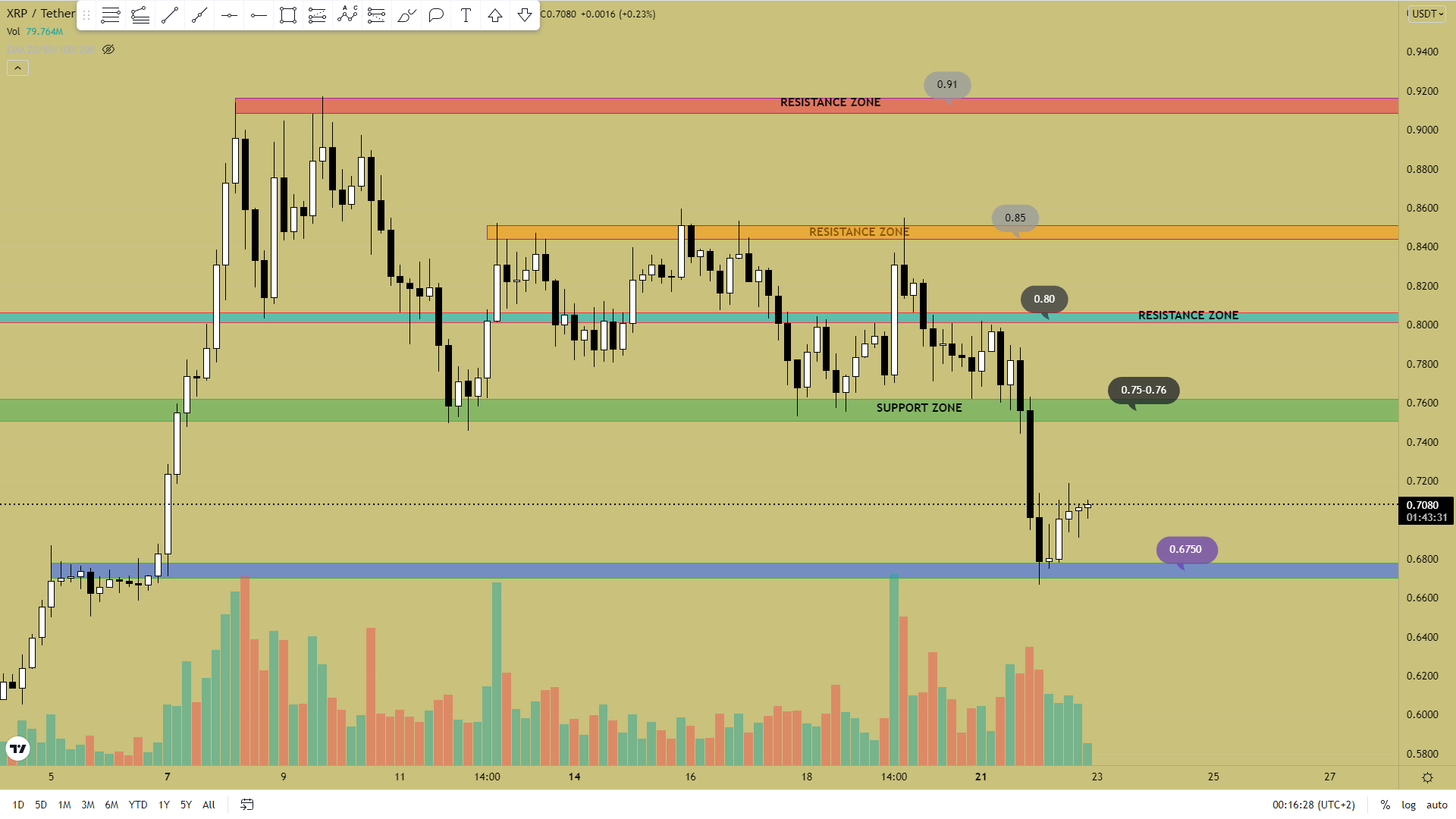
Bitcoin Cash&Ethereum Analysis/22.02.22-Right perspective
**Hello everyone.**
**The posts on this page are not investment advice .I am not a financial advisor. Just sharing my thoughts.**
My motto is Keep things simple.
Follow the Trendlines, not the Headlines.
I will try to show you what I see.We will look at many altcoin analyzes.;
Now the market is in complete fear because of Putin's statements and statements from NATO.There are so many ridiculous things going on that if Putin didn't come out and make a statement, the market was going well.I don't want to say too much about this subject.I want to share support and resistance points,because i hate politics...
**Let's Start with Ethereum**
**Market Cap**
**$316,128,615,042**
**Currently Price**
**$2,641.58**
https://coinmarketcap.com/currencies/ethereum/
We can see that the 3000 support zone is working well for now. the last time he came to this region, we see that he made such experiments and went up.We can see that the 3000 support zone is working well for now. We see that the last time the price came to this zone, it tried to break it, but rose without success.
**Next is Bitcoin Cash**
**Market Cap**
**$5,654,090,854**
**Currently Price**
**$296.95**
https://coinmarketcap.com/currencies/bitcoin-cash/
Price is currently in support zone.I think this is a strong support zone, but if the bad news about the war doesn't keep coming, we can turn away from here. at least that's what technical analysis tells us.If this is passed, 260-270 is the support zone that I trust very much in the long run.
**We need good news from Russia right now.Then we will be much more comfortable.We'll wait and see.That's all I have to say for today.Thank you everyone for reading.**
Btw I'm thinking of increasing the analysis of altcoins day by day.
Those were my market comments today, thank you for reading.
See you again soon. I will be here after this.
**Respects.**
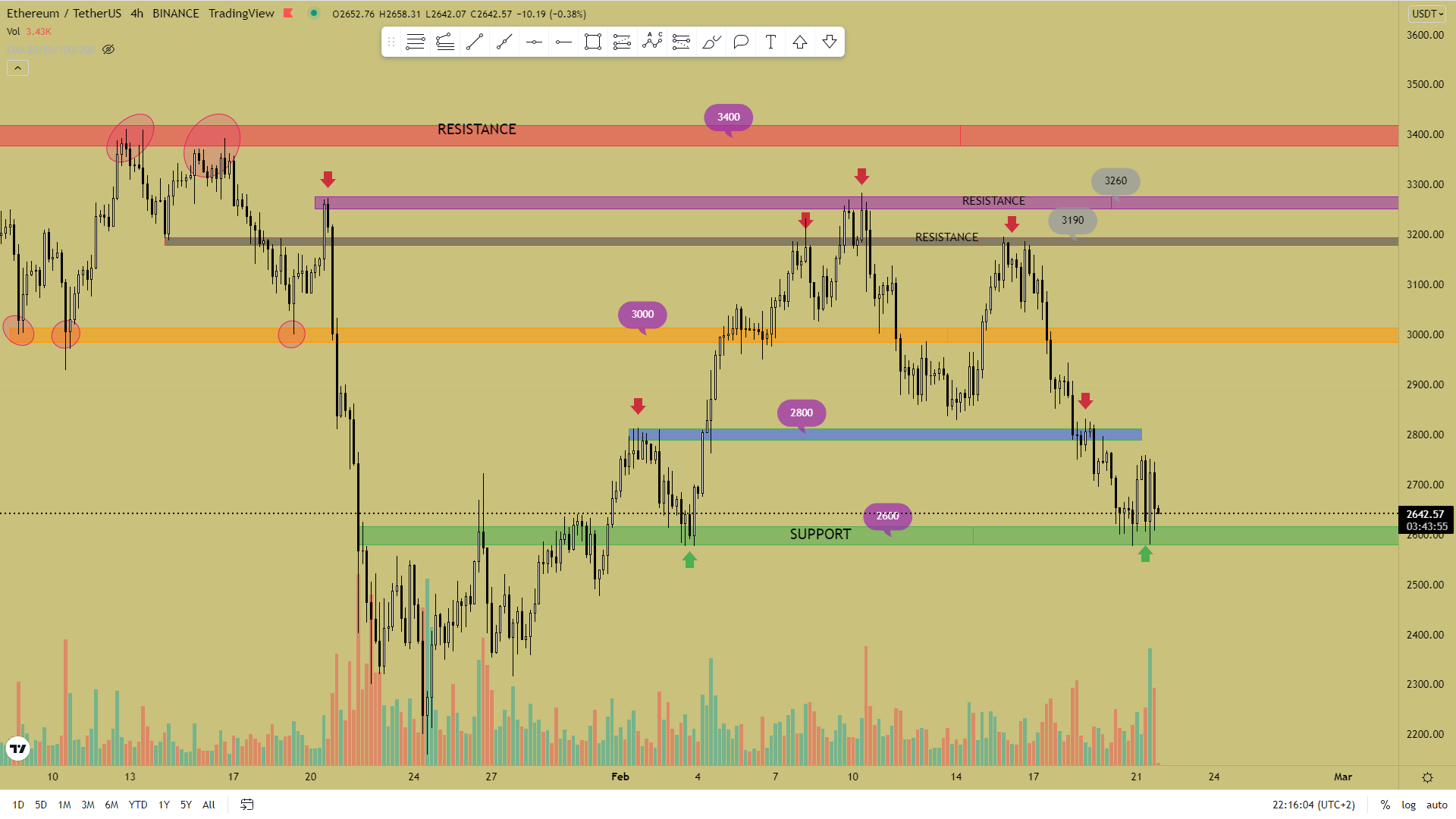

Bitcoin&XRP(Ripple) Analysis/20.02.22-Right perspective
As I've been saying for a week, if there is news about the war and bad news from the fed, the price will be affected a lot.British Prime Minister Johnson said that Russia is preparing for the biggest war in Europe since the Second World War.Look at this....This kind of news will keep the price down.Could this drop in prices be a buying opportunity? It's hard to make money without taking risks.But I think the market needs to stabilize a bit first and without russia's positive statements about the war people will not want to invest in bitcoin.Even the words of war are affecting the global markets very badly. Not only bitcoin but all markets have been badly affected.Please learn to be patient in these critical times.This is the bottom, it may be further down than anywhere you call it.I think it would be best to wait until good news comes from Russia.Of course, everyone should make their own choice, it is not investment advice.Don't forget to follow the trend and be cautious, use stoploss.don't invest with anyone's ideas, get ideas from everyone and apply your own.
**The posts on this page are not investment advice .I am not a financial advisor. Just sharing my thoughts.**
My motto is Keep things simple.
Follow the Trendlines, not the Headlines.
I will try to show you what I see.We will look at many altcoin analyzes.
Source: https://alternative.me/crypto/fear-and-greed-index/
If we look at the fear and greed index,As you can see, it went up to 44 levels last week.But bad news, bad news...this bad news scares people.market is not looking good right now.
**XRP(Ripple)**
**Market Cap**
**$37,728,932,105**
**Currently Price**
**$0.7861**
*Although it is not very accurate to look at technical analysis right now, xrp has stood very strong compared to other altcoins.Even if the price breaks below the Fibonacci 0.705 zone 2 times, currently trying to stay above this zone.It is difficult, but if bitcoin moves up, xrp can use this power and make fast rises.*
**I want to give some information about XRP(Ripple).**
What Is XRP?
To begin with, it’s important to understand the difference between XRP, Ripple and RippleNet. XRP is the currency that runs on a digital payment platform called RippleNet, which is on top of a distributed ledger database called XRP Ledger. While RippleNet is run by a company called Ripple, the XRP Ledger is open-source and is not based on blockchain, but rather the previously mentioned distributed ledger database.
The RippleNet payment platform is a real-time gross settlement (RTGS) system that aims to enable instant monetary transactions globally. While XRP is the cryptocurrency native to the XRP Ledger, you can actually use any currency to transact on the platform.
While the idea behind the Ripple payment platform was first voiced in 2004 by Ryan Fugger, it wasn’t until Jed McCaleb and Chris Larson took over the project in 2012 that Ripple began to be built (at the time, it was also called OpenCoin).
How Does XRP Work? https://read.cash/@CryptoEd0/xrprippleavaxavalancheanalysis190222-right-perspective-2cb4303e#how-does-xrp-work
XRP was created by Ripple to be a speedy, less costly and more scalable alternative to both other digital assets and existing monetary payment platforms like SWIFT.
RippleNet’s ledger is maintained by the global XRP Community, with Ripple the company as an active member. The XRP Ledger processes transactions roughly every 3-5 seconds, or whenever independent validator nodes come to a consensus on both the order and validity of XRP transactions — as opposed to proof-of-work mining like Bitcoin (BTC). Anyone can be a Ripple validator, and the list is currently made up of Ripple along with universities, financial institutions and others.
How Do You Store XRP? https://read.cash/@CryptoEd0/xrprippleavaxavalancheanalysis190222-right-perspective-2cb4303e#how-do-you-store-xrp
You can either store your XRP on an exchange, where the exchange is responsible for the safety of your asset, or store your XRP in a cold or hot wallet.
source: https://coinmarketcap.com/currencies/xrp/
Btw I'm thinking of increasing the analysis of altcoins day by day.
Those were my market comments today, thank you for reading.
See you again soon. I will be here after this.
**Respects.**
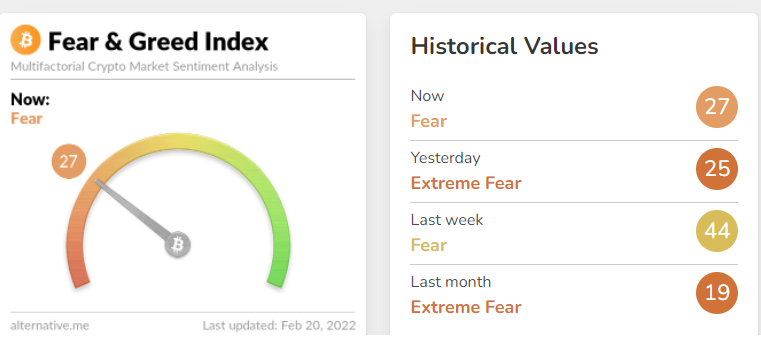

XRP(Ripple)&AVAX(Avalanche)Analysis/19.02.22-Right perspective
Fed approves rules banning its officials from trading stocks, bonds and also cryptocurrencies... what am i writing for days :)
The bad news that may come from the fed will directly affect the market, we should pay attention to this and they succeeded.We went from 45000 levels to below 4000 again...
But! something caught my attention...As the price drops, very strong buyers continue to collect bitcoins.This makes us wonder if the falls are fake.Next month is very important, it will show our direction.Let's move on to our technical analysis.
**Let's Start with AVAX(******Avalanche)****
**Market Cap**
**$20,987,321,181**
**Currently Price**
**$85.56**
source: https://coinmarketcap.com/currencies/avalanche/
In the article I shared the other day, I said that Avax found good support.so where did the price find support again? :) our uptrend from the bottom still works great.As long as the day does not close under this rising trend, I look at it positively.If the price wants to go up, it should quickly cross the 87.5 level.unless bitcoin is dropped with ridiculous explanations :)
**Next is XRP(Ripple)**
**Market Cap**
**$37,642,001,180**
**Currently Price**
**$0.7848**
source: https://coinmarketcap.com/currencies/xrp/
Unfortunately, Our blue horizontal resistance field worked fine.If the price drops further, I expect the same performance from our green support zone.As you can see, the price returned from the resistance 2 times in millimeters.I hope we pass that area easily on the 3rd try. (0.80)
**I want to give some information about XRP(Ripple).**
What Is XRP?
To begin with, it’s important to understand the difference between XRP, Ripple and RippleNet. XRP is the currency that runs on a digital payment platform called RippleNet, which is on top of a distributed ledger database called XRP Ledger. While RippleNet is run by a company called Ripple, the XRP Ledger is open-source and is not based on blockchain, but rather the previously mentioned distributed ledger database.
The RippleNet payment platform is a real-time gross settlement (RTGS) system that aims to enable instant monetary transactions globally. While XRP is the cryptocurrency native to the XRP Ledger, you can actually use any currency to transact on the platform.
While the idea behind the Ripple payment platform was first voiced in 2004 by Ryan Fugger, it wasn’t until Jed McCaleb and Chris Larson took over the project in 2012 that Ripple began to be built (at the time, it was also called OpenCoin).
How Does XRP Work?
XRP was created by Ripple to be a speedy, less costly and more scalable alternative to both other digital assets and existing monetary payment platforms like SWIFT.
RippleNet’s ledger is maintained by the global XRP Community, with Ripple the company as an active member. The XRP Ledger processes transactions roughly every 3-5 seconds, or whenever independent validator nodes come to a consensus on both the order and validity of XRP transactions — as opposed to proof-of-work mining like Bitcoin (BTC). Anyone can be a Ripple validator, and the list is currently made up of Ripple along with universities, financial institutions and others.
How Do You Store XRP?
You can either store your XRP on an exchange, where the exchange is responsible for the safety of your asset, or store your XRP in a cold or hot wallet.
source: https://coinmarketcap.com/currencies/xrp/

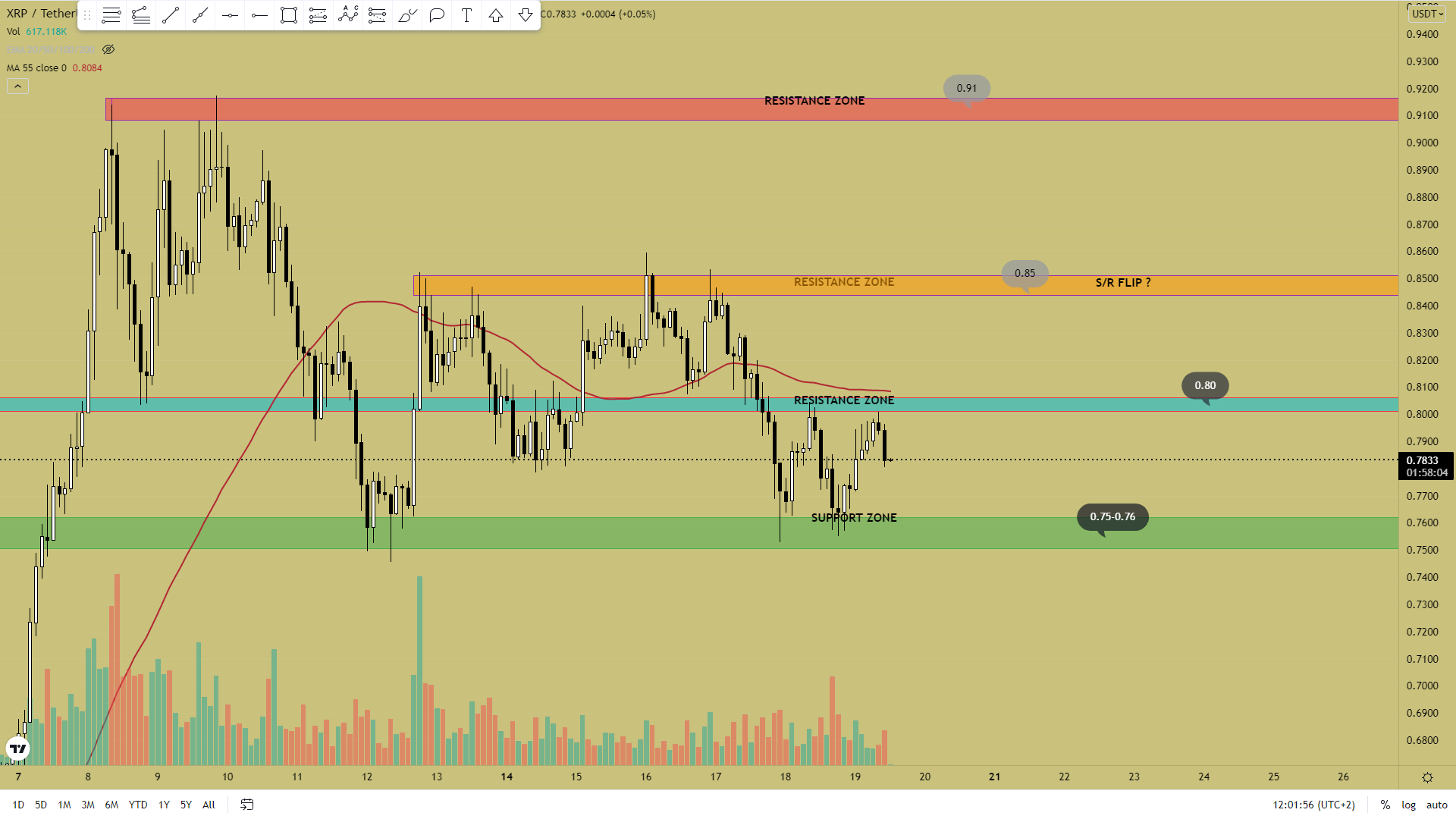
AVAX(Avalanche)&Bitcoin Analysis/ 18.02.22-Right perspective
Friends, I've been talking about the Russia-Ukraine tension for 3-4 days.The constant bad news is making the market nervous and kidnapping investorsbut I also know that big investors who buy as they fall are evaluating these falls.I think these declines are buying opportunities.Let's wait and see.
**First of all, I would like to thank my sponsors.You can follow them here.**
If you are ready, shall we begin??
**The posts on this page are not investment advice .I am not a financial advisor. Just sharing my thoughts.**
My motto is Keep things simple.
Follow the Trendlines, not the Headlines.
I will try to show you what I see.We will look at many altcoin analyzes.
Today,
***We will examine 2 charts.***
***1-(Bitcoin)***
***2-AVAX(*****Avalanche)**
**Let's Start with Bitcoin**
**Market Cap**
**$771,681,828,442**
**Currently Price**
**$40,582**
https://coinmarketcap.com/currencies/bitcoin/
Like i said, i see lows as buying opportunities.If good news comes from the Russia-Ukraine tension, it will reflect positively on the market and a rapid recovery will begin.As for the technical analysis part, as you can see the support-resistance levels i expected.I'm waiting for 2 types of rise,
1- My first expectation is a rapid rise to the 42000 level directly.
2-The second option is that it falls to the 39000 region and reacts from there and rises.
**Next is AVAX(******Avalanche)****
**Market Cap**
**$21,297,519,463**
**Currently Price**
**$87.14**
https://coinmarketcap.com/currencies/avalanche/
*Let's talk about technical analysis,*
The yellow horizontal line, which is our support zone, is 87.5.price has received a reaction from here for now but if bitcoin continues to drop a little more,**note the blue line coming from the bottom.**You see how well it works.If crossed there, our 80.5 horizontal orange support zone will be waiting for us.
**I really like this coin and I trust the project of this coin.You ask why?**
**What Is Avalanche (AVAX)?**
Avalanche is a layer one blockchain that functions as a platform for decentralized applications and custom blockchain networks. It is one of Ethereum’s rivals, aiming to unseat Ethereum as the most popular blockchain for smart contracts. It aims to do so by having a higher transaction output of up to 6,500 transactions per second while not compromising scalability. https://coinmarketcap.com/currencies/avalanche/ https://coinmarketcap.com/alexandria/glossary/layer-1-blockchain https://coinmarketcap.com/currencies/ethereum/ https://coinmarketcap.com/alexandria/de/glossary/smart-contract
This is made possible by Avalanche’s unique architecture. The Avalanche network consists of three individual blockchains: the X-Chain, C-Chain and P-Chain. Each chain has a distinct purpose, which is radically different from the approach Bitcoin and Ethereum use, namely having all nodes validate all transactions. Avalanche blockchains even use different consensus mechanisms based on their use cases.
After its mainnet launch in 2020, Avalanche has worked on developing its own ecosystem of DApps and DeFi. Different Ethereum-based projects such as SushiSwap and TrueUSD have integrated with Avalanche. Furthermore, the platform is constantly working on improving interoperability between its own ecosystem and Ethereum, like through the developmentof bridges. https://coinmarketcap.com/alexandria/de/glossary/decentralized-applications-dapps https://coinmarketcap.com/alexandria/de/glossary/defi https://coinmarketcap.com/alexandria/glossary/bridges
Who Are the Founders of Avalanche?
Avalanche was launched by Ava Labs, founded by Cornell University professor Emin Gün Sirer, and Cornell University computer science PhD’s Kevin Sekniqi and Maofan “Ted” Yin. Gün Sirer is a veteran in cryptographic research, having designed a conceptual peer-to-peer virtual currency six years before the release of the Bitcoin whitepaper. He was also involved in work on Bitcoin scaling solutions and research on Ethereum before the infamous The DAO hack in 2016.
From that research arose the whitepaper that led to the foundation of Ava Labs in 2018. The project closed a seed round in February 2019 that included investors such as Polychain, Andreessen Horowitz and Balaji Srinivasan. Avalanche closed its initial coin offering in 2020 in under 24 hours, raising $42 million in the process.
What Makes Avalanche Unique?
Avalanche attempts to solve the blockchain trilemma, which posits that blockchains cannot achieve a sufficient degree of decentralization at scale. A consequence of this are high gas fees, as is often the case on Ethereum. https://coinmarketcap.com/alexandria/de/glossary/blockchain-trilemma
To solve this problem, Avalanche designed three interoperable blockchains.
The Exchange Chain (X-Chain) is employed to create and exchange the native AVAX tokens and other assets. Similar to the ERC-20 standard on Ethereum, these tokens follow a set of standardized rules. It uses the Avalanche consensus mechanism.
The Contract Chain (C-Chain) hosts smart contracts and decentralized applications. It has its own Avalanche Virtual Machine, similar to the Ethereum Virtual Machine, allowing developers to fork EVM-compatible DApps. It uses the Snowman consensus mechanism.
The Platform Chain (P-Chain) coordinates network validators, tracks active subnets and enables the creation of new subnets. Subnets are sets of validators, sort of like a validator cartel. Each subnet can be validating several blockchains, but a blockchain can only be validated by one subnet. It also uses the Snowman consensus mechanism.
This division of computing tasks enables higher throughput without compromising on decentralization. For instance, private blockchains on the network could require its subnet’s validators to be sufficiently geographically decentralized or comply with certain regulations. Following this modular structure, Avalanche improves its interoperability with other blockchains wishing to integrate with the Avalanche ecosystem. Furthermore, the two different consensus mechanisms are designed with each blockchain’s requirements in mind, further improving their efficiency.
source:https://coinmarketcap.com/currencies/avalanche/.
Btw I'm thinking of increasing the analysis of altcoins day by day.
Those were my market comments today, thank you for reading.
See you again soon. I will be here after this.
**Respects.**
https://coinmarketcap.com/alexandria/de/glossary/throughput
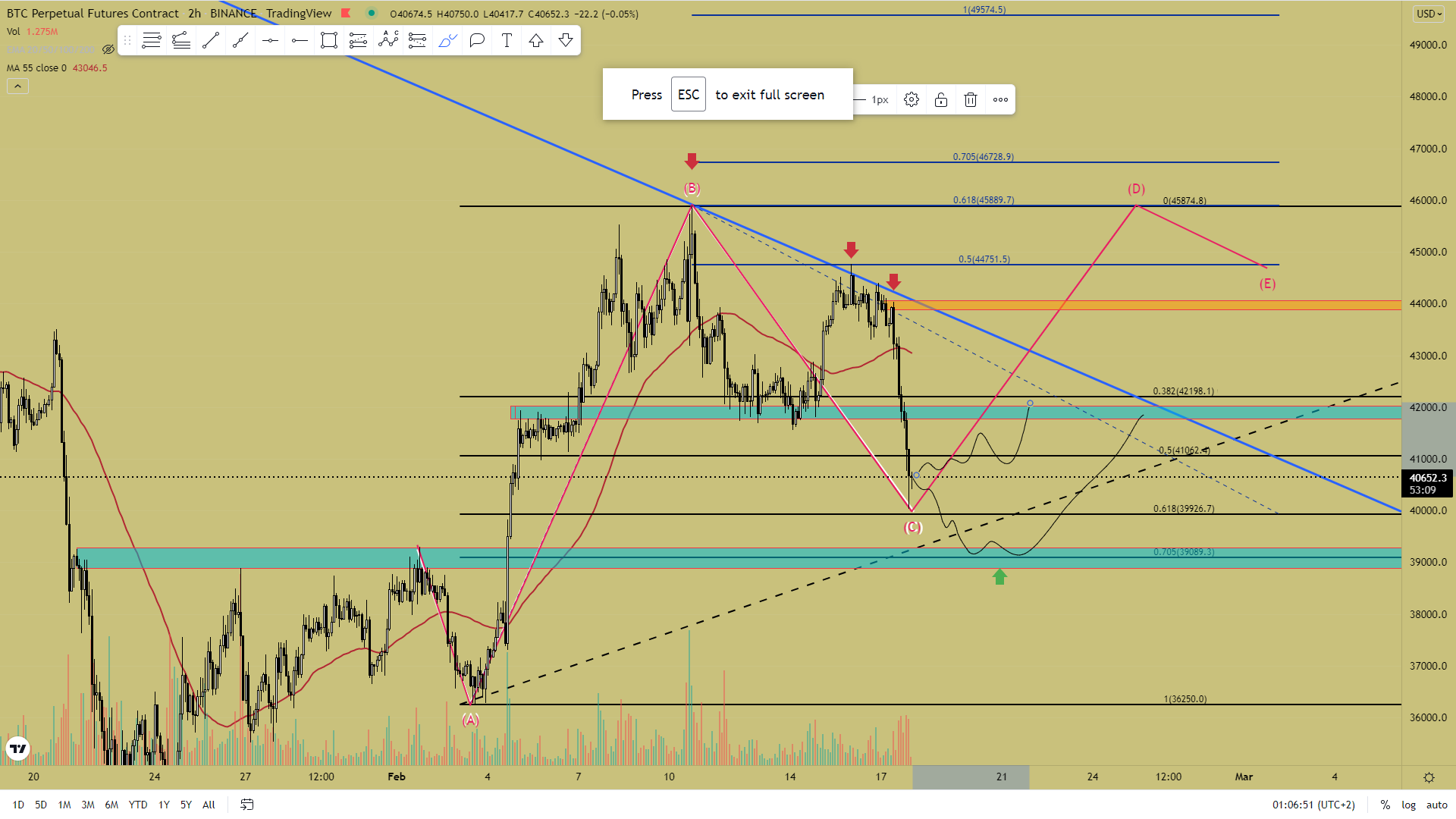

XRP&Ethereum&CRV(Curve) Analysis/17.02.22-Right perspective
**First of all, I would like to thank my sponsors.You can follow them here.**
**The posts on this page are not investment advice .I am not a financial advisor. Just sharing my thoughts.**
**Hello everyone!**
My motto is Keep things simple.
Follow the Trendlines, not the Headlines.
I will try to show you what I see.We will look at many altcoin analyzes.
***We will examine 3 charts.***
Today,
**Let's Start with XRP(Ripple)**
**Market Cap**
**$40,251,675,504**
**Currently Price**
**$$0.842**
https://coinmarketcap.com/currencies/xrp/
If we look at the XRP chart, we can see that the blue support line from the bottom works very well 5 times.Also worked as support at the intersection with the horizontal blue support zone.Now we are in the strong orange resistance zone.If strong sales come from here, we can return to 0.80 level again.If the price wants to go up, its target will be to go to 0.91 quickly.
**Next is Ethereum**
**Market Cap**
**$375,133,798,386**
**CurrentLy Price**
**$3,144.85**
https://coinmarketcap.com/currencies/ethereum/
Let's talk about ethereum.Do you see the graph I drew and shared with you last week?Support and resistance levels are working so well that I don't even need to change them.3190 level continues to work as resistance for now.The support and resistances on the chart are clear, the plan is clear.
**Next is CRV(Curve DAO Token)**
**Market Cap**
**$1,425,902,200**
**CurrentLy Price**
**$3.20**
https://coinmarketcap.com/currencies/curve-dao-token/
I love this token.While bitcoin is falling, it can sometimes make very good attacks.(sometimes) :) After finding support at 2.7 level,Managed to break ''3'' resistances with a beautiful candle but failed to break through the strong resistance in purple and the price turned right from there.It will gather strength again and try to pass this time. first target 3,570.
**Today, I didn't want to share because there is no change in bitcoin, we are still at 44000 level.**
***Information about ripple.***
Ripple; It aims to enable banks, payment providers, digital asset exchanges and companies to send money and value globally, in any size, securely, with low transaction fees and near free, using advanced blockchain technology.
XRP on the digital asset sending blockchain Archived 30 July 2020 at the Wayback Machine. through cryptocurrency. As of November 2020, XRP ranks fourth in market size among all cryptocurrencies [3]. Ripple company serves more than 300 financial institutions and more than 40 countries.
Btw I'm thinking of increasing the analysis of altcoins day by day.
Those were my market comments today, thank you for reading.
See you again soon. I will be here after this.
**Respects.**
Bitcoin Cash&bitcoin&TOTAL Analysis/16.02.22-Right perspective
**First of all, I would like to thank my sponsors.You can follow them here.**
If you are ready, shall we begin??
Hello everyone, I said at the top of my post yesterday that I was expecting a rise:)
and we managed to stay above 44000.Now we Shouldn't go below 44 000.
**The posts on this page are not investment advice .I am not a financial advisor. Just sharing my thoughts.**
My motto is Keep things simple.
Follow the Trendlines, not the Headlines.
I will try to show you what I see.We will look at many altcoin analyzes.
***We will examine 3 charts.***
Today,
**Let's Start with Bitcoin Cash (We all love this don't we :)**
**Market Cap**
6,509,873,643$
**Currently Price**
$342.91
https://coinmarketcap.com/currencies/bitcoin-cash/
Who missed bitcoin cash ? :)
The support and resistance levels I mentioned before are the same.If you want to see it, please check my old posts.Price is making a nice effort to break above the 345 zone.The price turned very well from the fibonacci 0.5-0.618 level and came this far.(C point where a-b-c point is).If we can go above the 350 level, the previous peak 362.7 will be waiting for us, we can get a reaction from here.The 383 resistance is the region with strong sellers.We are heading towards critical areas.
(*I think you might want to take a closer look at the chart)*
I leave it here for you
**Next is Bitcoin**
**Market Cap**
844,322,630,737 $
**Currently Price**
$44,537.41
https://coinmarketcap.com/currencies/bitcoin/
Now you know, I've been saying for days how important the gray zone is.Finally the price managed to rise above this zone.As you can see, after the price went up, it wanted to go down 4-5 times again, but buyers made strong defense.Now our first target is 45,500, here it may not be easy to pass...
**Next is TOTAL**
You see the blue resistance line coming from below, right?
The 8th wonder of the world :))
Price tried this line 9 times but failed and then the rise began.
The price has returned very nicely from the point I have specified as the Fibonacci golden ratio (0.618) and also the C point.
We are now in the purple resistance zone again.
What is TOTAL?
****TOTAL**** shows the top 125 cryptocurrencies by total market cap.
TOTAL2 shows the total market capitalization of the 125 top cryptocurrencies excluding BTC. OTHERS shows the total market capitalization of the top 125 cryptocurrencies, excluding BTC and some other top cryptocurrencies..
**Please do not confuse these two.**
**I say it again, the market is now waiting for the fed statement.**
Btw I'm thinking of increasing the analysis of altcoins day by day.
Those were my market comments today, thank you for reading.
See you again soon. I will be here after this.
**Respects.**
Bitcoin&Ethereum&ADA Analysis/15.02.22-Right perspective
I won't make my post too long today.Because everything is going as I told you yesterday :) ( little tip, price wants to go up I hope they let it:)
**The posts on this page are not investment advice .I am not a financial advisor. Just sharing my thoughts.**
Hello everyone!
My motto is Keep things simple.
Follow the Trendlines, not the Headlines.
I will try to show you what I see.We will look at many altcoin analyzes.
Today,
*We will examine 3 charts.*
**Let's start with Bitcoin**
**Market Cap**
**$806,051,987,879**$
**Currently Price**
**$42,511.05**
https://coinmarketcap.com/currencies/bitcoin/
I'm not going to say anything different from what I said yesterday.As you can see our purple support line continues to do its job very well. :) likewise in our gray resistance zone...We will see together which way it will break.Let's see if we can be above the gray zone in my next post.
Look at the graph i posted yesterday, support and resistance zones are very clear.let's see what is going to happen.
**Next is Ethereum**
**Market Cap**
**349,361,282,299$**
**Currently Price**
**2,920.99 $**
Our blue support zone is working very clearly.Let's take a look at the chart I posted yesterday.
Tried many times but price failed to break our support zone,as you see...Remember what I said about point c and Fibonacci? :)) now i'm listening, please compare the charts.
Next is ADA(Cardano)
**Market Cap**
**35,345,726,154$**
**Currently Price**
**1.05 $**
https://coinmarketcap.com/currencies/cardano/
As a bonus i want to show this graph.The region I have designated as the strong support region, price has tried this region at least 6 times but every time the price got here, it managed to go up.Our first resistance zone is the 1.1 level.we can get a little reaction from there.In case of a possible decline, our first stop is region 1, which is our strong support region.
**I say it again, the market is now waiting for the fed statement.**
Btw I'm thinking of increasing the analysis of altcoins day by day.
Those were my market comments today, thank you for reading.
See you again soon. I will be here after this.
**Respects.**
I would also like to thank my valuable supporters here.Please follow them.
Bitcoin Cash&Ethereum&Bitcoin&Matic Analysis/14.02.22-Right perspective
**The posts on this page are not investment advice .I am not a financial advisor. Just sharing my thoughts.**
Hello everyone!
My motto is Keep things simple.
Follow the Trendlines, not the Headlines.
I will try to show you what I see.We will look at many altcoin analyzes.
Today,
*We will examine 4 charts.*
*Firstly,* remember the market is uneasy right now, we have to be ready for the downturns.Fed statement scares investors.Let's continue to study our charts but we have to consider the bad possibilities.
**Let's start with Bitcoin Cash (We all love this don't we :)**
Market Cap
**6,364,770,955$**
Currently Price
**$335.30**
**(**https://coinmarketcap.com/currencies/bitcoin-cash/)
How did our gray zone work , you decide please :) I showed this area yesterday.
Level 328 is now working to get us up.The orange zone might push us a bit.The resistance level, I wrote on the left side as the s/r flip zone in my previous article has now turned into a support level. S/R Flips: Firstly S/R stands **for Support/Resistance**, the idea behind the flip is that this method of setup is confirmed when price reclaims a level that was previously lost, then uses that now taken level as new support or resistance.
**Next is Bitcoin**
**Market Cap**
803,180,847,903$
**Currently Price**
42,367.92$
**(**https://coinmarketcap.com/currencies/bitcoin/)
How our support zones work my friends :)Purple support zone still does its job great..I don't want to say too much, let's stick to our plan.We're fine as long as we don't fall below the purple line.We have to cross that 42,800, then we can get a response from 43,900.Unless the bad news comes...This is important.
**Next is MATIC(**Polygon)
Market Cap
**12,516,649,004$**
Currently Price
**$1.67**
**(**https://coinmarketcap.com/currencies/polygon/)
Watch out for the blue support line coming from the bottom, this is testing the zone for the 3rd time.We have to stay above the gray support zone.If bitcoin breaks out nicely, and we stay above the 1,750 zone,the rise can be very quicly.
Please attention the structure I circled :) how well it worked ?I can explain this later.
**Next is Ethereum**
**Market Cap**
**346,893,778,936$**
**Currently Price**
**2,878.06$**
**(**https://coinmarketcap.com/currencies/ethereum/)
I want to show you how Fibonacci is a wonderful thing..You can see very clearly how each level works, I have colored it for you.Fibonacci, known as the golden ratio, seems to be returning from the (0.618 level).So point c. If you want to rise, we need to go above 3000 level.Frankly, the market is very unstable right now. We need to be careful.Our levels are clear, I'll keep sticking to the plan.
Btw I'm thinking of increasing the analysis of altcoins day by day.
Those were my market comments today, thank you for reading.
See you again soon. I will be here after this.
**Respects.**
 @CryptoEd0