The ULTIMATE Best Life Advice Compilation:
The Ultimate Life Advice Compilation - Get Wiser!
JCPaisita's Life Advice? Follow the Trail of Opportunity!
The best advice I received. This is a good question, I have been blessed to be surrounded by really good people in my life.
People say, friends, come and go but the really good ones you can count with the palm of your hand and are the ones that stay and become family in the good and the bad.
One friend stands out, he told me once don't let the train pass you by.
When he first said it, I had no clue what he was talking about, but let me tell you when you follow your passion and you see the train of opportunity you know, and you must grab it and hold it and get on that train and follow your dream.
That's right the train of opportunity comes and you must take it, because it may be the only time that it will stop for you.
I am happy to say that Concave is a community of friends, normal people with dreams. Are we getting on the train?
____________________________
Don't Dwell in the Past: Pan's Old Days.
Don't dwell in the past, always look forward.
It's ok to reminisce about the old days every now and then, but don't get hung up on mistakes or any bad stuff that happened in the past.
If we can learn from something in the past and implement changes that improve our lives going forwards, then that's absolutely fine.
But don't fall into the trap of lingering in the past, as that can tether you there and make you more and more melancholic, if not worse.
You can't change the past, so it's best to accept it and then pay it no mind any longer than necessary.
Instead, focus on the present (where you actually live) and always try to look towards the future.
It shouldn't be something concrete that you can achieve and then it's over (not that you *shouldn't* have that), but try to find something perennial that accompanies you throughout your life, a **conceptual companion**, so to speak.
Like e.g. a passion or general interest, so that you always have something to look forward to.
Something that gets you out of the bed in the morning.
Of course, finding something like that is not necessarily very easy, so how would you even begin to think about what it should be (without it feeling lame and thus ineffective)?
In order to figure that out, it helps significantly to first figure out want you to want from/in life.
That's usually easier said than done, but instead of trying to figure out what you want from/in life, it helps (IMO it's actually a prerequisite) to first figure out who you *really* are, i.e. to figure out what makes you tick.
That may sound trivial and as a given that you "know" who you are and what you want, because you're in your own head after all. But until we've gone through deep **introspection** we tend to only know ourselves as much as the average person knows roughly how a TV works.
In order to discover your true and honest self, you need to start asking yourself questions about yourself that **focus on self-discovery** and try to go deeper with every subsequent question.
It can start with a general question: `What are things that I enjoy in life?`
After you found a few things you can get more specific and ask yourself: `Which things do I enjoy that seem to be characteristic for me specifically?`
( For example, I personally love all kinds of puzzles-boxes, riddles, brain-teasers, etc.)
Then you could continue with: `*Why* do I enjoy these things? What about them is it that creates this enjoyment for me? What triggers it?`
( For me I can imagine that the generalization of my previous example is that I seem to enjoy the analysis of more or less complex systems and trying to understand how they work so that I can make use of them. )
To answer that you could pick one specific thing you enjoy and ask `What about this makes me enjoy it?`, `Why do I enjoy it where other people don't enjoy it?"`
( Here I could think that I like the problem-solving aspect of these systems. To encounter a question, a mystery, and trying to find a good or satisfying answer or solution. )
After a while, your self-questioning will start to get more and more abstract, because you're following the thread inwards towards the core of what makes you you.
( To continue my example: Why do I desire to solve problems, find solutions to riddles, analyze systems, and master them? Maybe it's because I yearn for control over the world. Maybe by *understanding* a system, I can *make use* of it.
And this control gives me confidence and a feeling of security in life.
So maybe I yearn to understand systems and solve problems because I seek confidence by means of control (over the physical world).
Do this line of questioning with many other starting points and you'll eventually get a significant level of understanding about yourself that you might not have had before.
The beautiful thing is, once you get a good understanding of who you really are, why you like certain things and dislike other things etc.
You will (as a side-effect) **automatically discover** what you want from life, i.e. you will find your perennial goal or reason d'être that you can always look forward to.
Because by understanding yourself, the things you desire and give you passion will have revealed themselves as well, as they are part of what defines you.
For some, that can be the desire to care for people in need.
For others, that could be building things. Be it homes, machines, art, programs, etc.
For yet others, that could be understanding complex systems.
Or a combination and/or sequence of these things (like understanding complex systems, then using that knowledge to build something from it, etc.)
Personally, in the past, I was feeling down most days because my mind regularly went to `What if I had done X... or what if Y happens?`.
I always had trouble going to sleep because of that, my mind racing with these questions and problems.
Once I took the time for some significant introspection in order to discover my core self, everything that I actually wanted and desired revealed itself to me, and I never felt glum about the future from that point onwards.
And this has been the case for more than 12 years so far.
**TL;DR**
Don't dwell in the past.
Discover yourself via deep introspection. (Seriously, take the time, it's one of the best things you'll do in life.)
=> Byproduct: You'll reveal what you want from life and automatically recognize your life's conceptual companion(s).
I.e. not something concrete you can reach, but something perennial that accompanies you throughout your life. Something which gets you out of bed in the morning, something you'll always have to look forward to.
_________________________________
Pick Some Ideas: Nemonasa's Advice!
In our lifetime there is so much advice that would be delivered to us where we need to pick some of those ideas and let them guide us in finding some solitude on how to live our lives in general.
In my case, it's business advice that was given to me by my supervisor when Im still in the corporate world. She said that if I ever plan to go to business is that "you should never taint your name in everything you do because you can scam or lie on a customer only once but if your
true to a client you can eventually create a loyal customer"
From that moment onwards her words engraved me deeply. When I once got into a computer repair and retail business I always told my customer that I am not here to take their money, rather I am here to try to fix problems in the best way possible where I have some expertise. In that honest approach of mine, I made a strong client base within the community. In all honesty, all the customer item serial numbers are being recorded for total checking and my shop has just a few incidents of dissatisfied customers.
Finally, the word of advice from my supervisor has helped me develop in every facet of my life today. Honesty is a big deal to me for I always strive to be a good person even when others are not.
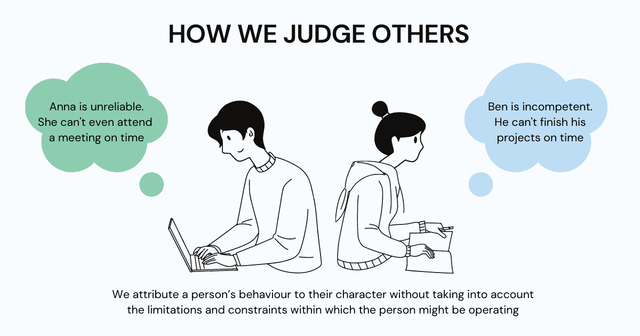
What is Fundamental Attribution Error?
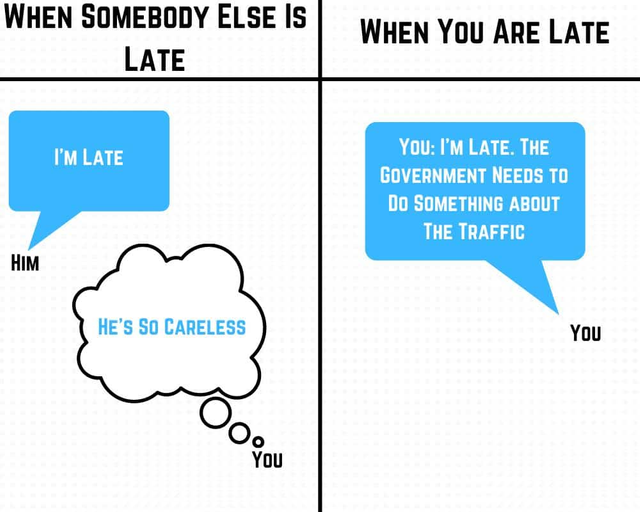
**Fundamental Attribution Error is the Tendency to Explain the Actions of Others According to Their Personality Traits While Downplaying Situational Factors. However, Explaining Our Own Behavior With Situational Factors and Downplay Personality Traits.**
Explaining Fundamental Attribution Error: Theory of themadman (∞)
An issue that could never be resolved in my opinion, the only way I see a slight shift in removing bias from these equations is to remove the individual from the situation and judge the situation itself, for example:
”Degenape came late to work because he’s irresponsible”
Rather than look at who he is as a person, we have to look at the issue of someone coming late to work and ask ourselves how bad of an offense that is and how we can help to avoid it.
It doesn’t stop there.
We judge people for good and bad and yet we don’t judge ourselves at all, we give ourselves excuses as to why things happen to us and not why things happen to other people.
Another example is ”degenape only got this job because he got lucky” vs. ”I got this job because I work hard”.
Is this avoidable?
The answer could be yes but in order for that to happen we must remove individuals from the equation and simply look at the situation at hand, both people got jobs and that should be that there shouldn’t be any more to it.
But we are wired with envy, jealousy, and judgment, and we feel entitled to speak our opinions on individual situations to boost our own success and minimize our failures.
Does this mean you should never formulate an opinion?
No.
It just means you should formulate an opinion on the action itself and not the individual.
______________________
Dunning Kruger? Fundamentally Flawed Bias? JimDougan (∞)!
None of us wants to believe that we are fundamentally flawed human beings.
We believe that our intentions are pure. So when we look at ourselves we are going to say, it’s not me, but this situation which is causing me to react this way.
I have noticed this is true regardless of how someone conducts themselves.
For example, people who only think of themselves don’t go to bed saying that to themselves, they lie to themselves and rationalize their behavior.
So it is natural when we see someone behaving in a manner we don’t agree with to say, we’ll that person is just x type of person.
It’s just who they are, they can’t help it.
Rather than attribute their actions to the situation they are in and ask if could something have caused this behavior.
The cure starts with being honest with ourselves.
When we look at our lives we need to say is there something fundamental about who I am that is causing this situation & when we can be honest with ourselves we can begin to be honest when looking at others and considering their situation.
_____________________________
Short-Term Satisfaction: Covering Our Own Insecurities by tommywun (∞)
It's very hard to see our own flaws, and gives a cozy (at least in the short term) satisfaction to think that others failed due to their personalities - it's just a way to cover our own insecurities.
But when it's us who fail...
Well, the situation was obviously unfair.
It's tough and can only be dealt with through a level of honesty which I've always found difficult. But it's the path to freedom...
To be honest, I see a relationship with God as being very helpful - my attempts to be honest with myself are so private, so personal that it helps that there's someone who sees all - preferably someone who genuinely likes me and understands the difficulties of life and is on my side as I work through them.
You see I don't work through them at some high level of skill, or in any way that the world would approve of.
It's more like a toddler having their handheld and learning how to walk - it's incredibly difficult to be that honest and not just that but be aware in the first place.
They say denial is the shock absorber for the soul, and it takes a belief that we're loved to even allow ourselves the opportunity to see our own faults.
Awareness grows with love, not force - some part of us already knows it all, but we're waiting until we feel loved enough to show ourselves more of the truth.
So yeah, I've noticed this error quite commonly in myself.
What’s The Bitcoin vs Ethereum Smart Contracts Thing, Anyway?
Exploring the difference between Bitcoin and Ethereum Smart Contracts on a wide sample of crypto thought leaders.
Ethereum Has Experience & Eth 2.0: Bitcoin Has Potential!
Several things, first of all, the smart contracts on Ethereum have existed for 5 years now contrary to bitcoin where the smart contracts have been reactivated last year.
This allowed the creation of a whole ecosystem around these smart contracts on Eth, notably the DeFi and so on.
Ethereum is also much more accessible in terms of development and smart contracts for different developers.
I think it’s silly to compare the price of transactions of the two blockchains and their scalability.
I think that many people have also gone to Ethereum because they are waiting impatiently for the arrival of ETH 2.0 which should solve the problem of fees. However we should not spit on the bitcoin smart contracts, we still have to wait for them to develop
**Rutrab (∞)**
_________________________
Time in the Game: But BTC is MASSIVE!
Well, I would say one of the biggest differences is time in the game. ETH has implemented smart contracts for a longer period of time than BTC and this has provided it a unique advantage in as far as it has allowed many L2 and other chains to develop compelling smart contracts on their own chains.
BTC had smart contract functionality but received it until recently with (I think Taproot) as a result of what seemed to be a shortsighted concern about security.
With that being said BTC is beginning to implement a smart contract system because I believe resistance is futile at this point.
If BTC is the gold standard then ETH is the silver standard, but making significant moves in the utility aspect of the chain to set itself apart.
BTC is massive and has a first movers advantage and with such a massive blockchain and system in place, I believe they could effectively implement smart contracts to increase the utility of BTC and have it compete with the likes of ETH rising L2s.
**JonelyBonely(🧠, ∞)**
__________________________
Tx Speed, Insane Costs, Security:
Even considering this is a great point for discussion. We all agree ETH did a pretty amazing job with the introduction of smart contracts and is the basis for so many Layer 2 solutions and projects.
Other than that it's sh!t lets be real here.
Costs are insane. Tx speed is not the best. And looking back — well security isn’t the greatest either, this may very well be due to the introduction of so many links and connections.
I myself have not considered that some1 would try to work on BTC Blockchain again.
The block size limit and tx speed is also not the greatest.
Is it really worth it? Or just go rebuild and take the good parts of it onto a new chain?/Project?
What are your thoughts?
**tana (∞)**
________________________
Blockchain Competition is Always Healthy: EVM Development
I would say it’s very good that such competition between blockchains emerges, because it, for sure, generates a lot of motivation and new ideas for developers of both BTC and ETH.
As users of those chains, we get products that are continuously improved and more effective.
Smart contracts on EVM were the first ones, so it’s obvious that better virtual machines’ architectures and better smart contracts handling mechanisms arise at some point in time.
I’m just surprised why EVM development stays behind compared to other projects being in active development.
Introducing Proof of Stake and sharding could breathe new life into Ethereum, but it seems we need to wait a bit for it.
The competition between chains becomes more and more interesting. Sometimes the best solutions aren’t the main ones that are used by the majority of people.
This applies also to a blockchain’s world.
**sinthael (∞)**
__________________________
I Read an Article on BTC Smart Contract Supremacy:
I don’t doubt that all of the things in this article are true, but if they are, then why isn’t everyone using bitcoin for smart contracts and DApps?
Bitcoin dropped the ball unfortunately and Vitalik either saw this or genuinely felt that it wasn’t achievable with bitcoin and then he moved in.
There is no denying that Ethereum has a lion’s share of the best Devs and thinkers in the space and I can’t see a world where they all move back to bitcoin.
Also, I am happy with ETH being the leader of the space. I trust that their hearts are in the right place and I share their vision for a decentralized future.
**Point Rat (∞)**
_________________________
It’s All About Adaptability, Versatility, and Flexibility:
Ethereum is highly flexible, versatile, and adaptable in terms of the use cases and logic of its applications, but it is more like a software company that enables the implementation of Decentralized Applications.
The decision of what is being built is up to its developers. For developers who are keen to create such decentralized applications, Ethereum comes with a great number of tools, libraries, and protocols that allow it to build such applications faster.
It does not have any central servers that store data and process transactions for all of the applications, therefore the applications are safe and secure. All transactions are recorded in the Blockchain system.
This does not allow any of the transactions to be altered or manipulated.
These cryptocurrencies are also not stored on the server and are totally independent of one another.
It also comes with a group of very talented programmers and developers, so that no one developer can control the decision-making of the entire system. As a result, the development of the applications has been very fast.
IMO, leave well alone. BTC is a store of value that paved the way for Ethereum and many more things to come.
**sweetfantasy (∞)**
_____________
It’s All Just Boomer Coin Talk!
They are both becoming boomer coins so outdated compared to so many of the new chains.
I’ve never been involved with BTC personally I go into crypto too late to bother chasing it.
But have had a fair amount of interactions with ETH. But to be honest, the way gas fees are these days.
I was actually going to buy the spoon NFT until the gas ran half as high as the mint cost. For me BTC wins out overall, 1 it has the pedigree of the name.
2 is the market cap, 3 is the better value store. It will always be the original coke while ETH is the Pepsi.
ETH is starting to reach a point where it is too unsustainable and way too hard for the casual to get involved in at this current point.
Imagine you make your first transaction and get some cool little NFT that you have heard so much about you are super excited and bam.
That’ll be 100 buck gas.
You don’t even know what gas is at this point? and Gwei? and adjusting and waiting for times when the network work isn’t so busy? hard pass for the casual if you ask me, so until that change it is a barrier to entry in the greater growing sphere.
ETH still has better utility than almost anything else, but man my prediction for 2022 is that will also change and fast.
**DotSamaDude (∞)**
________________________
Poorly Decentralized Solutions Aren’t Bullish:
Centralized, or poorly decentralized, solutions are unlikely to be successful on Bitcoin as an alternative to smart contracts on Ethereum.
One project that is already trying to do this is RGB, a decentralized top layer based on the Lightning Network and the Bitcoin blockchain, thanks to which it is possible to issue digital assets.
Furthermore RGB, being based on Lightning Network, in theory, has already solved the scalability problems that Ethereum has not yet solved, although the launch of Ethereum 2.0 is expected shortly, which should solve them.
Another initiative in this sense is that of BIP119, (called CheckTemplateVerify) which enables new smart contract types.
Bitcoin remains the main point of reference in the crypto sector, and this could give it the necessary push in the long term to establish itself in the smart contract sector.
Why Feedback Loops and Systems Are Hotter Than Kathryn Winnick
**Feedback loops are the force that shapes systems and organizations over time. To understand a complex system, look for its feedback loops. To steer a complex system, initialize a feedback loop.**
Feedback is a Powerful Behavioral Tool: **C-小5(∞)’s** Thoughts.
Any behavior or action made by anything or something will have a certain result, which is feedback. And any whole is a system, and any system will have a feedback effect, that is, A can lead to B, and similarly, B can also lead to A.
This creates a feedback system. The feedback system creates a snowball effect in the market, which can also be used to explain the Matthew effect, which the winner takes.
Feedback is also positive and negative. Every day, with different goals in different directions, we get involved in different feedback loops.
In real life, the feedback will be delayed and the feedback loop of the system will shake.
This is the real system.
________________________
Complex Systems: Feedback is Vital in its Operations
Complex systems can be found everywhere, such as what we often call: ecological chains, bee colonies, ant colonies, interpersonal networks, neural networks, human immune systems, computer networks, and global economic trade.
In all these systems, numerous independent bits of intelligence interact with each other in many ways.
How each person, as an individual, can better adapt to this society is a question we must think about. Sometimes it is not that you need to be strong, but that your opponents are strong and you must be strong or be eliminated.
Just like the Red Queen effect, you must run differently to maintain the original position, you want to go beyond, and you must come up with twice or even more times the speed to do so.
Each of us must constantly learn and evolve to adapt to this complex system in order to better gain a foothold in this society.
Although we often shout about fairness, equality, and freedom, we have to face the reality that human society is stratified, aggregated, diverse, labeled, and non-linearly developed, which means that we cannot achieve fairness in an absolute sense.
Each person possesses an internal model adapted to the world, and each one is different, and each one interacts with others.
The accumulation of only knowing is building blocks, gradually piled up through different simple parts, but each person has a different shape and height of the patchwork.
We can better adapt to complex systems only by learning important models of ideas from important disciplines through interdisciplinary learning.
________________________
Complex and Adaptive Systems Thinking: **Molecularity (∞)** Typed This!
“The notion of complex adaptive systems thinking is epistemically suspect.” “Because we are steeped in the logic of complex adaptive systems thinking, everyone is caught in a closed loop of escalating complexity and accelerating risk.”
“While it includes all the individuals as players, it robs them of any real agency, since they are caught in a perpetual action-reaction cycle.
As a result, we become sufferers of our own actions. The notion of complex adaptive systems thinking is also epistemically futile because it necessarily implies systemic closure, [because] every adaptation to pressure simultaneously injects more adaptive pressure into the system.
It is a continuously escalating, perpetual motion machine of antibiotics and bacteria, insects and pesticides, markets and trade, nuclear arms and weapons defense, viruses and vaccines.
7 Inside complex adaptive systems thinking, closure [is] predicated on the very properties of the model itself.”
Sorry to go on.. but there is just a lot of quotable writing in this article “In our highly complex and volatile world, most of our efforts to create new potential worlds hardly materialize on the global stage.
Is it possible, though, to reframe the big questions of climate change, existential risk, institutional crisis, and the breakdown of meaning from one of adaptive pressure on a global scale to a theory of complex potential states on a human scale?
In a world as diverse in people and rich in meanings as our big change might come from small acts by everyone operating everywhere in the contexts that already present themselves in their ordinary lives — even though these contexts seem disconnected.
These acts might be instances of what Connolly calls “the uncanny processes of creativity.” “The process is uncanny,” Connolly writes, “because creativity is neither the simple result of a profound intention nor the realization of a preordained principle waiting to be elaborated.”
This last part here, about the uncanny process of creativity, feels prescient and relevant to our work here in Concave.
The crypto space is undoubtedly a domain in which it often feels like “everyone is caught in a closed loop of escalating complexity and accelerating risk.” Thus, we contend with many of the pitfalls described by Roy, when we find ourselves as a collective guided, consciously or unconsciously, by the characteristics of complex adaptive systems (CAS) thinking.
___________________
Feedback Control in Mines and Complex Production Factories: **C-halfpianx(∞)**
Feedback control is widely used in modern electronic engineering. In the industrial production of factories and mines, the use of a feedback digging system can achieve production automation, in the amplifier circuit using feedback control can stabilize the static operating point and amplification, reduce nonlinear distortion, expand the frequency band and change the input resistance and output resistance, etc…
Where a certain way to the system of an output quantity (such as current, voltage, or other physical quantities) part or all back to the system’s input side, this back feeding process is called feedback control.
The closed loop formed by the output side of the system and the input side of the system is called the inverse control loop. In order to achieve feedback control of any physical quantity, should have two important links, which is:
(1) any control system, its output, and an input connected to form a closed anti-confusion control loop;
(2) the control of the output physical quantity under control, must be formed to control the physical quantity under control of the error signal.
If the above two important links, we can achieve feedback control for any physical quantity of the sinusoidal signal.
Interestingly, I discovered Concave thanks to a feedback loop. I read an article written by the amazing Concave researchers about what happened with Temple, and I was surprised at its great insights and accurate analysis.
In the end, the main problem that Temple had was the creation of a feedback loop that went in the opposite direction of what the designers of the protocol wanted.
One must be very careful with feedback loops, because positive ones reinforce themselves and get faster and faster, reaching an end state before we can even do something to stop them.
This is something that one must have always in mind when analyzing all the new protocols that are coming into space lately since almost all of them propose a feedback loop (but using the more trendy term “flywheel”) that could end up working differently as intended.
Feedback loops are dangerous and powerful at the same time. Even a negative feedback loop could turn into a positive one (the one that reinforces itself) if one is not careful.
But one has to love the emergent behaviors that they produce!
What is the Nash Equilibrium?
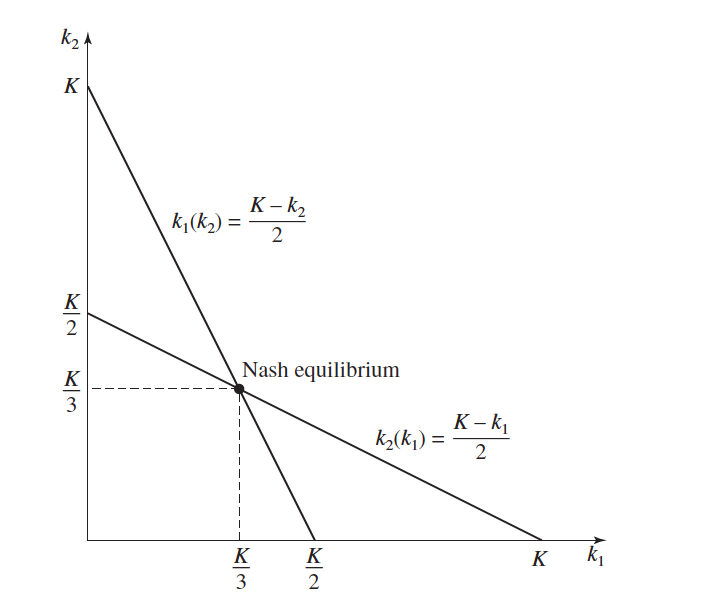
The Nash equilibrium is a type of solution — proposed by John Forbes Nash in 1950 — commonly used in game theory… But what is it?
Concave’s Community Explains: What is the Nash Equilibrium?
Here’s what **Coussins** has to say about that:
*“The Nash equilibrium is a type of solution — proposed by John Forbes Nash in 1950 — commonly used in game theory, whose very definition emphasizes its self-fulfilling character.*
*A Nash equilibrium is, in fact, a combination of individual decisions, called “strategies”, where each one correctly anticipates the choices of the others; there is self-realization since the outcome realized is the result of decisions made in the belief that it will be realized.*
*In fact, the big — and only — question a player asks himself when making his choice is, in game theory: what will the other player do?*
*The player’s beliefs about the behavior of the others are therefore essential to the decision. The diversity of beliefs can thus correspond to a multiplicity of equilibria.*
*What does the theory predict about the players’ choices?*
*Nothing very precise, since it depends on what each player thinks the other will do.*
*In fact, many outcomes of a game can result from the choices of “reasonable” individuals: so there is no particular reason to favor equilibria.*
*One might even question the use of the word “equilibrium” to refer to Nash solutions since the rules of the games exclude any process (they assume a unique and simultaneous choice on the part of the players). “*
****He then continues by giving us a bit more info, context, and even some examples:****
*John Nash defined an interaction situation as stable if no agent has an interest in changing its strategy.*
*The formalization of this simple observation has been essential for game theory.*
*Origin of the notion A game is a formal framework where several agents decide on a strategy, knowing that their utility depends on the choices of all.*
*Before Nash, the determination of a stable situation had no formal method. Even if the current translation of a Nash equilibrium may seem simplistic, the considerable possibilities of resolution opened up by Nash earned him the “Nobel Prize” in economics in 1994, jointly with Reinhard Selten and John Harsanyi.*
*This definition applies to games with any number of players. Nash showed that all results found before him lead to stable equilibria in his sense.*
*Optimality First example Two players simultaneously choose a number between 0 and 10. The player who announced the smaller number wins that number, and the other player wins the same minus two.*
*In case of a tie, both players suffer the penalty of two. The only Nash equilibrium in this game is when both announce zero.*
*In all other pairs of strategies, the player who announces more or the same can improve his result by declaring less. The Ice Cream Man Example Two ice cream vendors must choose a location on a given length of the land.*
*Since the prices and products are the same, each customer will go to the shop closest to him. It is easy to see that the only Nash equilibrium for these two merchants will be when they are both sides by side in the center of the beach, although this is the least suitable position for customer satisfaction.*
*This example is often cited as a negative counterpart to Adam Smith’s invisible hand. The limit of rationality Rational players can be expected to choose the Nash equilibrium.*
*Can we say that agents who declare that they want nothing are intelligent? Similarly, in the case of the prisoner’s dilemma, the single Nash equilibrium is the least desirable solution, when both betray.*
*Ian Stewart stated Experimental economics has shown that in certain simple situations, human beings do not spontaneously behave in a Nash-optimal strategy.*
*Uniqueness Any game can have many Nash equilibria or none at all — this is the case for the game of distinction.*
*Nevertheless, Nash managed to show that any game with a finite number of players and a finite number of strategies admits at least one Nash equilibrium in mixed strategy — that is if we consider as a possible strategy to draw randomly (with fixed probabilities) between several strategies.”*
By this time, we usually have a lot of community contributions laid out for you, but this time, **Philosopher Coussins** really drove the ball forward and put down the work with an awesome contribution, the one you see above.
It feels like a big wall of text, but it’s totally worth reading as you’ll understand the concept pretty well with this explanation.
Now, let’s take a look at some other contributions…
____________________________
Nash Equilibrium and the Prisoner Dilemma:
**Philosopher Rutrab** was the first mind who brought the Prisoner Dilemma first.
Here’s what he had to say about that:
*“Nash equilibrium is a decision-making theory. Have you ever heard about the prisoner’s dilemma? let me explain it to you:*
*The story goes like this; Two thieves plan to rob a store. As they approach the door, the police arrest them for trespassing.*
*The police suspect that the pair planned to rob the store but they lack the evidence to prove it.*
*They, therefore, require a confession to charge the suspects with a more serious crime. The interrogator separates the suspects and tells them each:*
*“We are charging you with trespassing which will land you a one-month jail sentence. I know you were planning to rob the store but I can’t prove it without your testimony.*
*Confess to me now, and I will dismiss your trespassing charge and set you free. Your friend will be charged with attempted robbery and face 12 months in jail.*
*I’m offering your friend the same deal. If you both confess, your testimony is no longer as valuable and you will both receive 8 months in jail.”*
*Both players are self-interested and want to minimize their jail time. What should they do? (cf: picture!).*
*Player 1’s available strategies are the rows (Quiet or Confess) and their corresponding payoffs are the first numbers in each cell.*
*Players 2’s available strategies are the columns and their corresponding payoffs are the second numbers in the cells.*
*If player 1 stays Quiet and player 2 stays Quiet the game ends in the top left corner of the matrix.*
*If both players Confess the game ends in the bottom right corner of the matrix and so on.*
*Now a lot of strategies come to our mind, but how can we all agree? Just communicate anon.”*
_______________________________________
**Some Context on The Prisoner Dilemma:**
In the real world, people don’t always reach that mutually beneficial point.
Prisoner’s Dilemma is a famous example of why two completely “rational” individuals fail to reach an equilibrium point.
It’s about two accomplices (A & B) who are caught for a crime. The police have enough evidence to convict on a lesser charge.
The only problem, the police know, but can’t prove that the pair committed the crime.
They have a choice: confess or remain silent.
Say if one confesses and the other remains silent, the one who confesses is let go, while the other is convicted of murder.
Or if they both confess, they both serve time for the lesser charge.
If they both remain silent, they will both serve time for the lesser charge.
The dilemma faced by each of the prisoners is obviously: which is the best option?
Following this, the Nash equilibrium is at the point where neither prisoner A nor B will benefit from changing strategy.
**Conclusion**
If they stay silent, they remain in the dilemma, as there is a benefit to be had by confessing.
But if both confess, then there’s no benefit in changing strategy (keeping silent again).
So the equilibrium point for the Prisoner’s Dilemma is that both prisoners confess.
What is Time & Why it Matters to Bitcoin:
Time is an intricate concept Philosophers chewed on since the beginning of time, but did you know it matters to Bitcoin?
What is Time? Concave Philosophers Answer:
Let’s read what our **Philosopher Torbern** had to say about time:
*"Time isn’t a substance because it is common to all experienced beings. It’s not individuatable in the right way. Time isn’t property because we don’t predicate it universally on substances.*
*“Being at T1” looks like property because it can be predicated universally, and “being at” looks like a relation. But if “S is at T1” is the relation, then we have the same problem with T1 that we did with Time itself.*
*This motivates claims about Time as an abstract structural feature of reality, a coordinating system of some sort, and then have to deal with whether you take abstract structures as necessarily mental or as objectively existent entities a la our boy Plato."*
Time is a human concept to measure day and night. But it is abstract at the beginning since humans haven’t invented numbers just yet, but they know something is moving constantly like stars are changing day and night. People observe the universe from the beginning of human culture. They measure anything around them. From Sun, Moon, and Stars. It’s just a moment to symbolize something, the concept of changing pace of the Universe can sometimes be calculated, and now we call it Time. — **Degen Solana added.**
**Philosopher Lazy** had a different description of time, letting us know that time isn’t really what it appears to be, and that its “frames” are not really the continuum we perceive…
`Unfortunately, there is no theory or experiment that can confirm whether time flows in a continuous manner or is like every frame in a movie, giving the impression of continuity, in fact, it is an intermittent succession.`
`The study of the continuity or discontinuity of time also involves another question, that is, whether time has a beginning or not.`
`To this, there is no definite answer yet. Because the famous Big Bang theory believes that time-space has a beginning; while some other scientists have pointed out that the scale of “time” does not have an instant start.`
`Because according to the principles of quantum mechanics, time intervals smaller than the so-called Planck Time are undetectable. Planck time is 10 -43 seconds.`
`Therefore, it is impossible to calculate the new state of the universe in a very short period of time. In short, based on the current theory, the first cry about the universe will always be unknown.`
______________________________________
The Twist: Concave Stuns Philosophers!
After this complex question, we asked our Philosophers to answer, we threw them a curveball and decided to present them with an even harder question to ponder.
This question was — Why is Bitcoin a Time-Chain?
Now, this took a bit more time of isolated thinking, but we know our Concavian Philosophers have the most brilliant minds in Crypto, hence they were able to answer.
Take a look at what they thought out…
_____________________________________
Why is Bitcoin a Time-Chain?
Let’s start by taking a look at **Philosopher DeusSiveCrypto**’s answer:
*"Because there are at least two chains in Bitcoin: the blockchain and the transaction chain. This latter chain, less well known, is sufficient to trace the history of all transactions of a coin. Blockchain solidifies a particular chain of transactions into an authoritative order, thus avoiding double-spending. The blockchain and the chain of transactions together constitute an immutable chain of events over time, or in short: a timechain. The reference to time in terminology indicates that what has happened cannot be erased. The events of history are like set in stone, that’s my thoughts.*
*And as Satoshi said: “Nodes collect new transactions into a block, hash them into a hash tree, and scan through nonce values to make the block’s hash satisfy proof-of-work requirements. When they solve the proof-of-work, they broadcast the block to everyone, and the block is added to the timechain. The first transaction in the block is a special one that creates a new coin owned by the creator of the block."*
Then, **The** **Anonymous Philosopher** answered:
`Why is Bitcoin called a time chain… firstly, most people don’t call it a time chain, other than hardcore bitcoiners.`
`Most people call it a blockchain. little known fact: in the original code base, Satoshi called it a “timechain” in his comments. not to mention the fact that Satoshi calls the blockchain a “timestamp server” all throughout the whitepaper.`
`It's called a time chain, because it solves the problem of determining which events happened at which time, in different parts of the world… aka, it solves the double spending problem.`
`If I’m in NYC and I send a bitcoin txn, and someone else is in China and sends a txn, how do we know which txn came first? in a decentralized, trustless, manner? the fact is, we cannot know.. and in real-time, it doesn't matter if the NYC txn happened first, because if the China txn gets in the blockchain first, then for all of our intents and purposes, it DID happen first.`
`A good blog post that goes into this is here: https://grisha.org/blog/2018/01/23/explaining-proof-of-work/ the combination of proof of work, with bitcoin’s difficulty adjustment, which keeps block times around ~10min, allows the blockchain to be sort of a ‘clock’… in fact, some bitcoiners on Twitter, as well as some bitcoin news websites, already cite the time, or timestamp their news articles, not with normal times such as Dec 4th at 9:30am, but rather with block numbers, aka the time is currently Block 712572`
We love getting our community to answer questions for us… but most of all we LOVE to read the thoughts of our Concavian Philosophers.
They are some really brilliant chads!
Crypto Alpha: Berachain
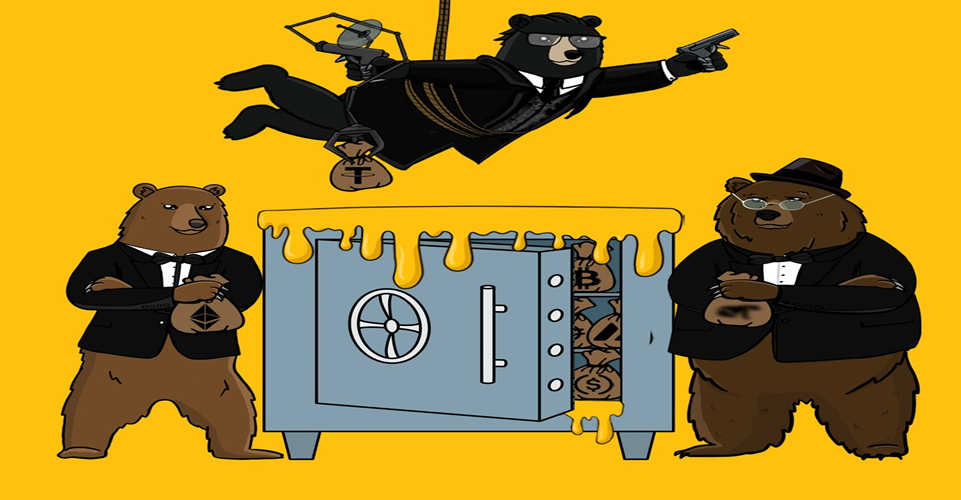
Do you want some alfa my noob crypto friends? Here’s a new upcoming L1 blockchain coming in hot, onto the Crypto scene with some three weed-smoking bears as associates.
Do you want some alfa my noob crypto friends? Here’s a new upcoming L1 blockchain coming in hot, onto the Crypto scene with some three weed-smoking bears as associates.
Berachain is the name of the project and from now on friends, you should be on the look-out at their discord **https://discord.com/invite/berachain** and their Twitter **https://twitter.com/berachain** so that we can all WAGMI with the Bears.
Here is some information that I gathered that can come in handy in your research about Berachain. The project Berachain is made by the same team that made the renowned Bong Bears NFT, the first rebasing NFT project and now a distinguished project in Defi community for the Bong Bears NFT floor price is now at a staggering price of 66.67 ETH that’s a $114,669, and that’s a proof that the team already made it.
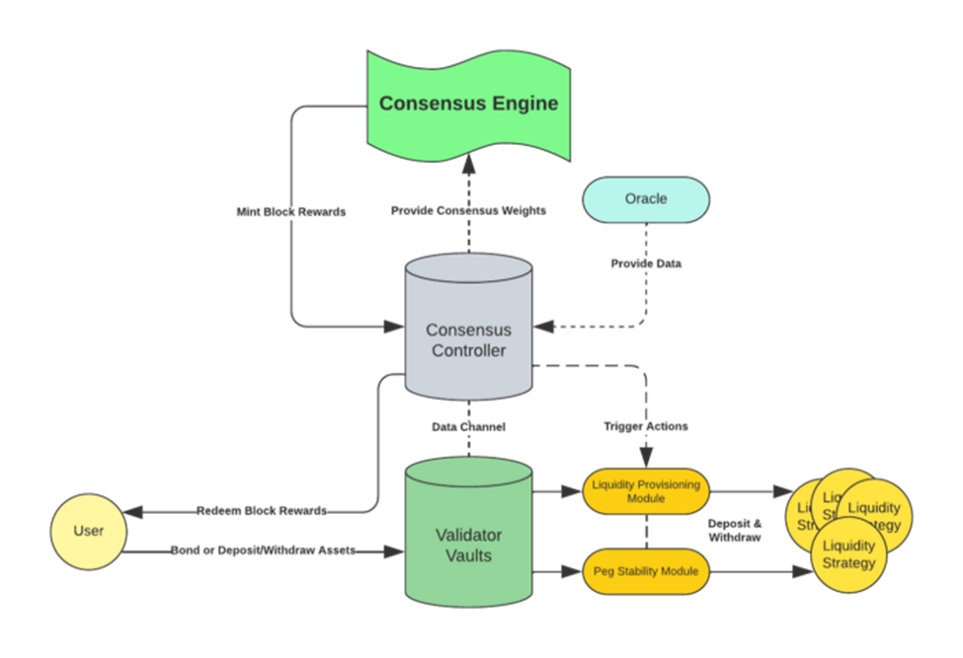
*As one of the core creators of Giga Bear “Smokey The Bera” explained that Berachain is an EVM-compatible layer one blockchain, built using the Cosmos SDK and secured by the novel Proof-of-Liquidity Consensus Protocol. The chain’s economics are tied together through a tri-token structure, composed of a gas token Bera, the native stablecoin Honey and the Bera Governance Token (BGT).*
*We built Berachain to enable staked assets securing a chain to serve as a source of productive capital and provide liquidity to users of that chain ecosystem. Our goal is to effectively align incentives at the chain level to create the deepest and most capital efficient pools of liquidity in DeFi, while providing users with the highest degree of flexibility and control over their staked assets while securing the chain.*
*Users can stake various L1, stable, and blue-chip DeFi tokens, delegate them to a validator and begin earning block rewards in the form of Bera. Block rewards are paid out proportional to the reward weight of a given asset, and the amount of total USD-denominated liquidity that those assets are providing to the ecosystem as opposed to the quantity of the gas token alone, as seen in traditional PoS systems.*
*These staked assets may be utilized in a virtualized AMM (paired with Honey), a perpetual exchange, or as collateral for loans denominated in Honey. The revenues generated from these activities in swap fees, interest rates, and funding rate payments are given back to stakers and BGT holders.*
As a crypto noob, I still need to look up some nasty crypto words to better understand what our Giga Bear Smokey is trying to expound about Berachain and maybe it can also be a help to your research on the project.
_______
**EVM-compatible**
This means the ability to write and deploy smart contract code that is compatible with the Ethereum virtual machine and can therefore be recognized by the Ethereum nodes like my fav Polygon Chain
**Cosmos SDK**
Is an open-source framework for building multi-asset public Proof-of-Stake (PoS) blockchains. , like the Cosmos Hub, as well as permissioned Proof-of-Authority (PoA) blockchains. Blockchains built with the Cosmos SDK are generally referred to as application-specific blockchains, Binance Chain is an example of a Cosmos SDK chain.
**Proof-of-Liquidity Consensus Protocol** is an algorithm employed by cryptocurrency protocols to reach consensus. It is a new type of consensus where you can stake multiple L1 and stable coins to the blockchain validator thus allowing the validator to provide liquidity on the chain’s native virtualized AMM (CrocSwap).
**Berachain Token**
Why are there three native tokens that would exist in the chain, in GOT there is the Faith of Seven where its followers have seven gods for seven aspects of their god, while Berachain believes that there are three aspects in the overall operation of a chain.
1. **$BERA**: the gas token of Berachain, a medium to both price a unit of work and perform said work in the form of smart contract execution
2. **$BGT**: the governance token of Berachain, a medium to organize and come to a consensus and make decisions about the future of the network in a democratic function
3.**$HONEY**: the native consensus collateralized stablecoin, a medium in which to transact through a common stable denomination
Finally, why would I try to dig more on Berachain, first as Smokey has said that a user can stake various L1, stable, and blue-chip DeFi tokens, delegate them to a validator and begin earning block rewards in the form of $BERA. As a simple crypto noob guy, I would definitely stake all my stable coins in their liquidity pool to earn me some $BERA if Berachain would make it I also gonna make it while my stable still has the same value from the start of my staking.
While “Dev Bear” one of the core bears said that BeraChain is a truly DeFi native L1, designed from the ground up to align incentives between investors, buildooors, and users interacting with the network. And the Berachain foundation has a good arrangement in place on every buildoors that would choose to build within the chain. The buildoors protocols instantly have liquidity as a service bootstrapped against $HONEY, a source of yield for their governance token for their treasury or users, and a close alignment with the chain ecosystem.
That’s why the writing’s on the wall, that Berachain is gonna make it big in the Crypto World for they have a proven team behind the project that has a goal of unifying all the Defi native community. All Defi communities under one blockchain would be mind-blowing for Crypto, in general, that’s why I am bullish even in the bearish times that Berachain is the next big L1 coming out.
Deep Liquidity, Builder-Ready, Perpetual Protocol Dex
*Perpetual Protocol* — an on-chain perpetual futures DEX with deep liquidity and builder-ready composability
In my search for a way to open short or long positions on certain cryptocurrencies in DeFi, I came across an exciting project called Perpetual Protocol. Below I would like to share my insights about this protocol.
About Perpetual Protocol and Its Goals:
Perpetual Protocol aims to provide a secure and user-friendly platform to trade financial derivatives and futures. After its launch in 2019, a reorientation to perpetual futures took place in mid-2020. The first version was launched in December 2020 on the xDai network, and version 2 in November 2021 on Optimism.
______________
Main Derivative Product: Perpetual Futures
Perpetual futures are the most traded financial derivatives in the crypto world. Initially traded only on centralized platforms, they have now found their way into DeFi. With (perpetual) futures, one may gain price exposure to a certain financial product without actually holding the underlying asset and be used for price speculation, hedging, and arbitrage.
In contrast to regular future contracts, perpetual futures do not expire and can be held or traded for an indefinite amount of time.
With regular future contracts, the price of an asset’s futures, which may differ from the price of the underlying asset, converges as the settlement date approaches.
In the case of perpetual future contracts, the divergence between the two prices is counteracted by recurring funding.
Depending on whether the price of a future is trading above or below the price of the underlying asset, a positive or negative funding rate results. In the former case, open long positions fund the open short positions.
In the latter case, the opposite happens. Thus, the deviation between future and asset prices can be minimized.
On top of that, price speculation and arbitrage trading further minimize the price divergence between derivatives and the spot market. In addition to betting on falling prices, perpetual contracts also enable trading in leveraged products — with all its dangers.
Perpetual Protocol: How Does it Work?
Perpetual Protocol enables easy trading of perpetual contracts for the largest and most popular cryptocurrencies. The platform follows DeFi’s way that users always have control over their assets and can trade them in a transparent and permissionless manner.
While the protocol initially used USDC primarily as collateral, users can now also use other tokens as a margin. The corresponding tokens/collaterals are then paid out when a position is closed.
A major change in the iteration to version 2 of the protocol is that the execution of trades and organizing positions uses Liquidity on Uniswap V3. At the core of the protocol is the clearinghouse smart contract. This burns and mints so-called “v-tokens” for the user.
When a user deposits tokens on the platform, the clearinghouse contract generates v-tokens with the maximum possible leverage.
For example, if a user deposits 100 USDC, 1000 vUSD would be generated. If the user then wants to open a future position, v-tokens are used for this purpose.
For example, if the user wants to open a long position on ETH using USDC as a margin, the clearinghouse contract would be instructed to trade vUSD tokens for vETH token.
In this case, the protocol would rely on a Uniswap V3 vUSD-vETH LP. In this case, the user does not have to use the full leverage, i.e. only use part of his USDC previously exchanged for vUSD.
When the position is to be closed, the user can exchange his vETH tokens back against vUSD tokens. At this moment, profits or losses are fixed or secured according to the price development of ETH.
In addition to traders, market participants can also act as makers and provide perpetual futures with liquidity. Similar to regular LPs, the makers earn money from the fees of the trades.
Makers can also use leverage to provide liquidity. In detail, the provision of liquidity is a bit more complicated than with normal AMM.
For example, makers have to decide within which price range they want to provide liquidity. Thus, makers only earn money on price ranges for which they provide liquidity.
For example, if a market participant wants to provide liquidity to a vUSD-vETH pool, the user deposits USDC with clearinghouse contract, which in turn mines v-tokens and automatically generates liquidity for the corresponding token pair on a Uniswap V3 LP.
Specifically, the clearinghouse contract mines vUSD and vETH tokens in a correct ratio and automatically adds them to the vUSD-vETH LP. Similar to ordinary LP, makers are affected by impermant loss due to the price dynamics of each token in the LP.
This requires special care with the management of their strategy. The protocol is based on DeFi-typical permissionless ways, the funds of the market participants are kept in a single pool and thus all positions have this pool as collateral. This margin model, which is also called cross margin, has certain pitfalls that need to be considered when using it.
On the one hand, it simplifies the handling of the positions or the margin, since a user does not have to add or remove the margin for each individual position. On the other hand, it should be noted that individual positions influence each other.
Thus, a highly leveraged position, which develops contrary to the market participant’s expectations, can influence others own positions and even liquidate them.
However, you can also choose a different margin model. This corresponds to an isolated margin, where a user holds several wallets for individual positions.
Finally, it should be mentioned that perpetual protocol is a prime example of how projects are made possible by the use of layer 2 networks such as Optimism and Arbitrum.
Through this use, the required high data throughput and the low fees can make successful use of DeFi perpetual futures possible in the first place. It is to be assumed that just by this kind of protocol rollups will gain in importance.
The developers of the perpetual protocol also intend to enable financial derivatives not only on cryptocurrencies, but also to expand to other markets such as forex, commodity, and stock trading.
So let’s stay excited about how the whole crypto space will develop with further interesting permissionless applications like Perpetual Protocol.
Government Abuse & Tyranny: Philippines & Violence
We always love to give voice to our community, and in a recent pitch, we asked our community to let us know if they ever experienced governmental abuse or oppression.
One of the respondents was Nemonasa, the writer of our recent article on Beefy Finance.
If you want to read his story, then read below for his thoughts. Do excuse the occasional typo, as Nemo isn't a native English speaker, but has put his heart into this.
_________________
Here's The Rundown: Nemonasa's Experience
In the wake of the 2015 Philippines election, an eccentric strong man and a breath of fresh air emerged top in the survey. Then an outspoken mayor from Davao City, a southern city in the Mindanao peninsula, pledged to solve the country's drug problem within the first 3 months of his term if he would be elected as president.
It is his campaign slogan that we would drench the famous Manila Bay with the blood of those involved in the drug trade. Then came the Philippines election in May 2015 and it was a landslide victory for Duterte for he leads on more than 6 million votes against his nearest rival then DILG Secretary Mar Roxas the ruling party candidate.
Even before Duterte took office on June 30, 2016, the execution of a suspected drug suspect began as if it was a premonition of what had to come under the rule of Philippine President Rodrigo Duterte. Duterte immediately appointed Ronald “Bato” Dela Rosa as the country's Chief of Police for Duterte known Bato way back then as a strong implementer of the infamous “Oplan Tokhang” in Davao City. Bato immediately carried out the wishes of Duterte to get to work as the result of the “war on drugs” that has led to the deaths of over 12,000 Filipinos to date, mostly urban poor.
At least 2,555 of the killings have been attributed to the Philippine National Police. Duterte and other senior officials have instigated and incited the killings in a campaign that could amount to crimes against humanity.
_______
Violence in Full Swing? Cheap Homicides...20 Php!
The Philippine Police headed by Bato Dela Rosa has been very effective in implementing their strategy to combat drugs just to give Duterte a result on whatever it may take to lead them for they have the full backing of the President. The alleged extrajudicial killing of thousands of suspected drug dealers and users in the Philippines is now in full swing for the president always calls out to shoot individuals who are involved in drugs because he reasons if the suspect is just trialed for his alleged crime, he would just go back out in the street after 3 months and be back as business as usual as if you shoot a guy it would only cost the government 20 Php.
Just for the sake of good results, some Philippine Policemen are being accused of trying to falsify evidence so that they can have the suspect nabbed or gunned down. An example of that is the case of a certain teenage boy - Kian Loyd Delos Santos - who was fatally shot by police officers conducting that said drug operation. Kian was only a 17 years old student who is just playing basketball on his community court when two police officers dragged him to a dark alley and shot him to death, the officers then planted a .38 caliber pistol and a sachet of meth for the purpose that the boy is resisting and then engage on a gun shoot-out with them. The three policemen involved in this incident have been found guilty of murder in this high-profile case.
_______________
Extra-Judicial Killing - Approved by the Big Man:
Duterte's anti-drug campaign, the alleged extrajudicial killing of thousands of suspected drug dealers and users would go down as a dark time for the Philippines, for the Philippine government headed by President Duterte overused its power for the repeated death threats against those involved with illegal drugs. The sad part of this article is that there are still so many pending cases of extrajudicial killings, Official government figures last year put that number at nearly 6,000 while Human rights organizations claim more than 20,000 have been killed since 2016. When would justice come for the families of the victims?
Duterte's War on Drugs: To Each, Their Opinion.
My thoughts on “The Philippines Government/Duterte’s” War on Drugs, is that it was very wrong from the start for all the big brains behind the operation; they just execute human beings just to have a presentable graph to be shown for Duterte. These law officers overuse their power to disregard human lives just to execute the government campaign on drugs. The Philippine congress even tried to abolish its own Philippine Commission of Human Rights by giving a budget of 1000 Php for the year 2018.
I voted for Duterte in the hope of change and the promise of eradicating corruption on all levels. History tells otherwise for Filipino people still linger in an uncertain future with inflation and unemployment at an all-time high.
Hope to find a job soon to help my country's economy.
______________
We thank Nemonasa for his thoughts on this issue and hope you guys enjoyed reading about his opinion as well!
Again, please do excuse the occasional typo, as obviously the writer isn't a native English Speaker.
What is Beefy Finance? Nemonasa Will Tell You!
Beefy Finance is a Decentralized, Multi-Chain Yield Optimizer platform that allows its users to earn compound interest on their crypto holdings.
What is Beefy Finance?
Through a set of investment strategies secured and enforced by smart contracts, Beefy Finance automatically maximizes the user rewards from various liquidity pools (LPs), automated market-making (AMM) projects, and other yield farming opportunities in the DeFi ecosystem.
The main product offered by Beefy Finance is the 'Vaults' in which you stake your crypto tokens. The investment strategy tied to the specific vault will automatically increase your deposited token amount by compounding arbitrary yield farm reward tokens back into your initially deposited asset. Despite what the name 'Vault' suggests, your funds are never locked in any vault on Beefy Finance: you can always withdraw at any moment in time.
DeFi applications are unique in the sense that they are permissionless and trustless, meaning that anyone with a supported wallet can interact with them without the need for a trusted middleman. While you have funds staked in a vault, you remain 100% in control of your crypto.
____________________
What’s a Yield Optimizer?
And how does Beefy.finance work
DeFi is hard for newcomers, we know it, and there is no way around it. But one of Beefy’s purposes is to help democratize finance, so we want to make an effort to try to explain how some of the DeFi pieces work together.
____________
What Does Optimizing Yields Mean?
Yield optimization can be loosely defined as using data analysis and optimization techniques to maximize performance and revenue. In DeFi, this could be approached by a platform aggregator designed to apply algorithmic strategies to obtain high APYs.
This is what Yearn.finance (YFI) does on Ethereum, and what Beefy.finance is building in Multi-Chain (BSC,Polygon,Avax and many more L1 blockchains) . Another way to put it would be like a Smart Savings Account which takes advantage of the best opportunities in the market to benefit its users.
Beefy’s approach to this is to algorithmically automate yield opportunities in Multi Chain so users/farmers don’t have to constantly make decisions and take manual actions.
For those new to decentralized finance (DeFi), yield farming is simply a way to make some interest as opposed to just “gains” with your crypto holdings.
Money is one thing, but time is the most important asset of all.
_________
What does real yield reflect?
Real Return = Nominal Return - Inflation
Similarly, the real yield is the nominal yield of a deposited bond minus the rate of inflation. If a bond yields 5% and inflation is running at 2%, the real yield is 3%.
Thus some of the Beefy LP mooVaults can fetch you a more than 23% TUSD-BUSD sLP thus giving a depositor of 16.1% annual real yield from this pool if the inflation rate stays the same for a full year for the global Q1 inflation rate for this year is at 6.9% based on International Labor Organization Statistic.
How to use the Beefy Finance LP mooVaults
A user just needs to connect his/her web3 wallet like metamask and choose on what chain he wants to deposit to earn some yield.
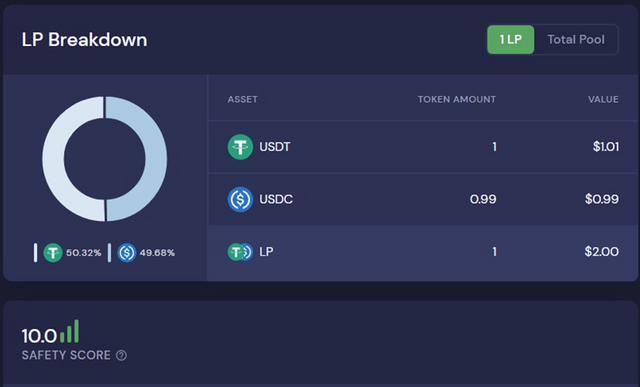
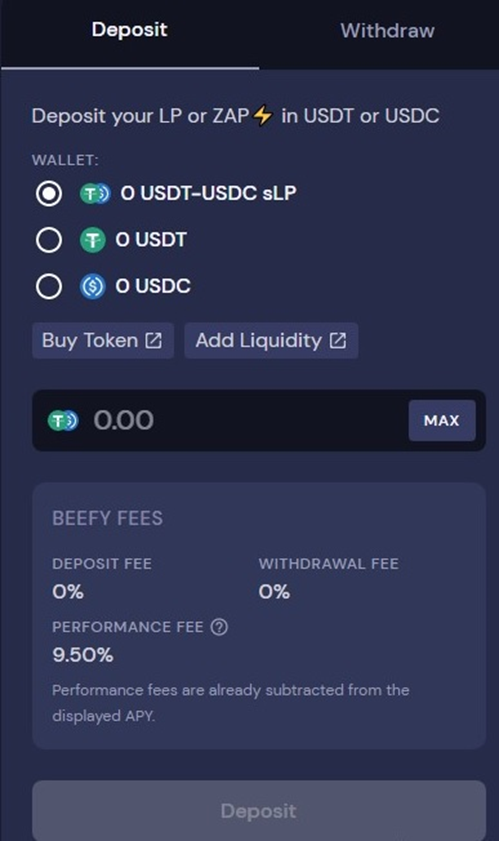
For example, he chose BSC Chain and wanted to farm some stable coins like USDT-USDC, all he needed was just he chose that vault and had the proper coins in his wallet to be deposited on the LP vault to gain a 22.23% APY.
After executing the deposit button, you just gonna sit back and relax to earn a daily yield interest of 0.0548% on your stablecoin pairing without the daily actions and regular fees associated with manual optimization.
________________
mooVaults APY
The Beefy Finance (BIFI) ecosystem delivers compound interest through its mooVaults.
The mooVaults are Beefy Finance vaults built to deliver compound interest.
Beefy Finance boasts the deliver a growing annual percentage yield (APY) that grows. mooVaults compound APY by compounding or reinvesting the interest into the principal regularly.
_________________________
My personal thoughts on Beefy Finance
As a Crypto beginner or noob, Beefy finance is my personal choice for stable/altcoins farming for it gives me a choice on farming on Multichain thus Ethereum has very costly gas fees. My personal favorite blockchain is Polygon and Beefy Finance offers USDT-USDC farming on the Cone protocol.
I really love how simple it is to navigate on their UI and how they present the APY you want to earn daily or annually because most Crypto Noob always thinks that APY is a daily percentage earned. Beefy finance also has a very low withdrawal fee of 0.1% or 0.05% which would definitely be a gain for a depositor.
The Beefy token (BIFI) with a limited 80.000 supply is also a good hold for you to be part of the whole project while also earning BNB from the yields generated by their vaults.
Finally, Beefy Finance is definitely a good yield farming protocol for it is very secure and simple to navigate and understand even if you are new to DEFI. You just have to deposit your tokens and start earning while leaving all the hard work to Beefy.
References:
https://dappradar.com/polygon/defi/beefy-finance
https://medium.com/@roastyb
https://medium.com/@pspfrench
https://medium.com/@marketmadhouse
Who Am I? Introducing Concave!
If you're around ReadCash for any serious amount of time, you probably know that we have been publishing one daily article, and we're all about quality.
Even though we have no tips so far - and that's fine, we're a protocol with a solid treasury - we have some views, and as we want to contribute to the conversation here, we thought it would be a good idea to tell you about us.
However, as you may have seen in our previous articles, we're pretty community-driven, and so we asked a community member - Nemonasa - to describe us to you.
If this sounds like your cup of tea and you're curious, then read below.
(Please excuse some typos as the article is big and though we corrected it, English isn't Nemonasa's Native Language - also, please note that this is Nemo's opinion, and that you should research us in our official site if you're inclined to really learn about Concave).
________________________
Concavian Nemonasa Describes Concave: The Builder's Co-Op
As a true believer in Concave, I would like to take you to the depths of the cave where miner’s gonna mine some dividends from the CO-OP while keeping everything simple for a newbie miner like me.
_____________________________
What is Concave
Concave is a community-driven, product and investment organization (CO-OP) that aims to bring value to investors through the development of innovative DeFi products and active treasury management.
While also focusing on its vision of creating the fabled “Heaven on Earth” & becoming a Network State as the current world decays around us.
Concave aims to explore the concepts of John Nash’s “Ideal Money” & sees money through the lens of George Gilder’s Information Theory.
We value Proof of Work and we want to work with those who want to work with us.
We believe in the concept of “serious play” and infinite games. Concave is a place that attracts Winners. We want to win, and most importantly, win as a team (CO-OP).
__________________________
Why Trust Concave?
Concave is made up of many ex/current Olympus DAO members; our combined dev experience and expertise in DeFi spans years of knowledge.
While the dev team is all 10x devs (dev that does 10x the work of normal devs) having written and audited a huge amount of code for Olympus DAO already, the policy team are all seasoned battle-hardened policy members from other projects or established seasoned TradFi people with years of monetary and policy experience.
Lastly, the guys of the community and marketing team are all passionate and dedicated members that are known to have a big impact within the crypto space.
_________________________
The Concave MVP:
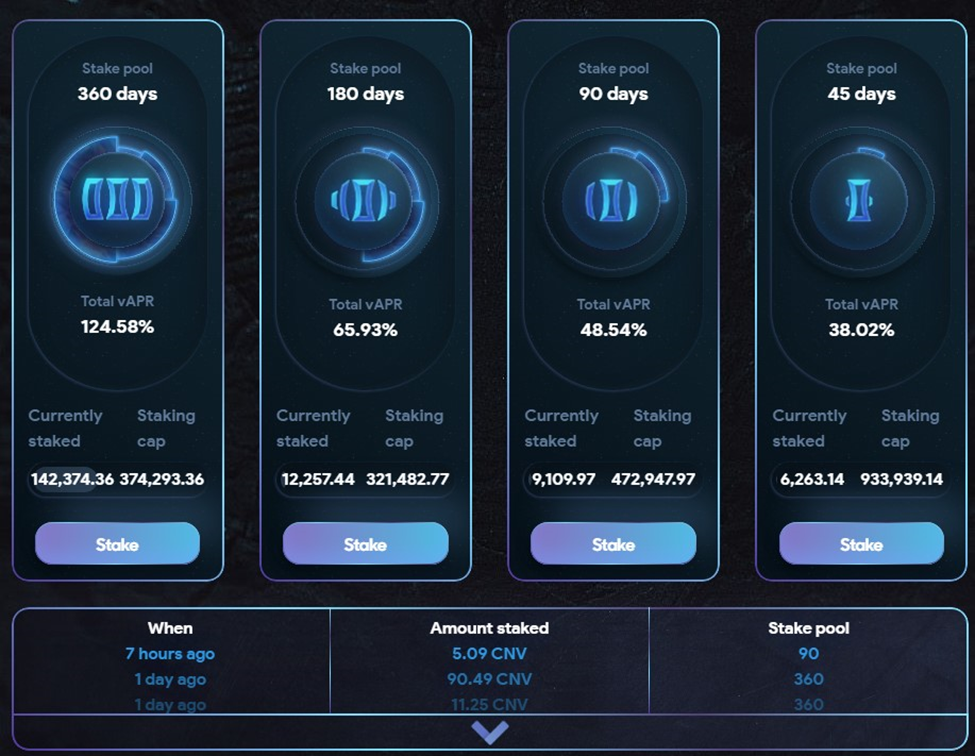
**“CNV Liquid Staking”** from my own knowledge is where you deposit a certain amount of token for a specific time period where a stake can expect to receive boosted rewards based on term length.
Here’s the catch: why choose to stake on Concave? Because the protocol penalizes short-term stakers with dilution, rewards long-term stakers with non-dilution, and attracts bond revenue in the process.
After staking your CNV for a time period you can expect rewards in both the native CNV token and non-native tokens such as DAI or Frax.
“Dynamic Bond Market” also from my simple interpretation without the xy=k formula is where you purchase CNV and vest it also on a specific period and expect an ROI percentage of what is indicated when you enter the bonding process.
There is also a YOUTUBE Tutorial on Concave Bonding and Staking **How to Stake and Bond on Concave protocol** https://www.youtube.com/watch?v=im3z6TAMMFA
https://www.youtube.com/watch?v=im3z6TAMMFA
**“NFT Marketplace”** is where you list your CNV Stake Position for sale if you intend to liquidate your position for any given reason. You can list below market price or above for a given amount of time. Dai token is the currency that is being used at the moment in the marketplace.
There is also a YOUTUBE Video on NFT Marketplace
https://www.youtube.com/watch?v=LcAk2QhHjBM
**How to Concave NFT Marketplace** https://www.youtube.com/watch?v=LcAk2QhHjBM
“AMM” Concave engineers' innovative design of the CNV AMM algorithm allows LPs to deploy deep liquidity allows for different pairs (e.g. CNV-DAI) to accrue extremely deep liquidity within a tight peg and allows LPs to earn more with less capital investment. The AMM has been optimized with cheaper gas fees and swap fees to be set at 0.25%
______________________
What are the Concave 3 Tokens?
aCNV: Price is $50 per token. These are offered only to the community members who are qualified for WL on Concave's initial token supply. WL community members can buy them up to their respective allocated amounts. These can be swapped into Concave native $CNV tokens and stake right after launch without any cliff period or vesting schedule.
bbtCNV: Price is $10 per token. These are offered to seed investors with allocations in the range of a few hundred thousand. There is both a 1-month cliff and a vesting schedule, which means seed investors can only redeem and swapped to $CNVtheir bbtCNV starting month 2 and in a controlled manner. Note that the unredeemed bbtCNV will NOT grow as supply grows so they will be diluted. This means that bbtCNV is not necessarily a better deal vs. the aCNV.
pCNV: This is a token paid to team contributors who will be motivated to fight for the long-term success of Concave. You do not pay for pCNV; you have to earn it with your high-quality contribution,
How is the Concave Treasury Managed?
Concave has developed sophisticated and efficient treasury management strategies to take advantage of the yield-generating opportunities in DeFi.
Given the large size of our team and our vast experience in the field, we are always looking to innovate and form new treasury management strategies to exploit marketplace inefficiencies.
The experimental nature of the DeFi ecosystem gives us opportunities to generate immense value for our stakeholders.
Treasury Management is broken down into the following key portfolios:
● Investment Research
● Delta Neutral
● Stable Farms
A Youtube video on the Concave treasury would be nice to check: **Concave Flywheel** https://www.youtube.com/watch?v=6Fjq6VlslRE
https://www.youtube.com/watch?v=6Fjq6VlslRE
___________
**How does it feel inside the Concave Community or Cave Family?**
In my own experience being in the Concave discord server is mostly simply fun with sometimes thrilling in what you can learn and discover while having a constructive conversation with your fellow miner.
This is the only server where I truly have a good time chilling in the gen where you can meet those miners with intensive experience in Defi Space where you can learn a thing or two on my own skill development in Crypto Space.
It wouldn't be honest if I were not affected by all those FUD, I think if you have intensive knowledge of what is happening in a project, you can feel secure even if there are tough times inside Concave.
**Finally why I am a Concavian and still be a Concavian after you read this article?**
I am new on Defi and in Crypto overall but in Concave community is where I learn and still learning skills on Crypto while meeting good people I now have a personal bond with them even though we all anon but I always feel they are real people who are also concerned if you have some trouble on anything.
Also Concave has created a system where your contribution as a miner is being paid in spoon value where you can redeem your spoon to a loot box and other redeemable items in the shop.
Having fun, forming bonds, and finally being paid for your contribution is why I am very bullish on what Concave wants to achieve long term.
Shootout to all my friends in the cave:
These are real people I always love to have a good conversation with them, you can too if you join Concave discord https://discord.com/invite/concave
Balancer Protocol: A Thorough Analysis
Balancer Protocol: A Thorough Analysis
Balancer could simply be defined as an AMM (Automated Market Maker) built on Ethereum, but this definition would not do justice to a protocol that has proved to be one of the most interesting DeFi protocols of the last few years.
Balancer could simply be defined as an AMM (Automated Market Maker) built on Ethereum, but this definition would not do justice to a protocol that has proved to be one of the most interesting DeFi protocols of the last few years.
Started in 2018 as a research project by Balancer Labs, an organization founded by Mike McDonald and Fernando Martinelli, the protocol was launched in 2019 in its v1 version, and since then has quickly become a core building block in the DeFi space**.**
The vision that has driven the founders was that of building a **permissionless asset management protocol** to enable anybody to turn their **portfolio** into an **index fund,** but with a substantial difference when compared to index funds in **tradFi**: rather than paying a **fund manager** to rebalance the fund, the individual providing the capital would earn fees from traders that would rebalance the portfolio by following **arbitrage opportunities**.
___
Balancer v1 vs. Balancer v2
Even though Balancer v1 proved to be a product of absolute value, Balancer Team recognized the need for an improved version that was released in May 2021.
This evolution of the protocol was the result of the many feedback received by other teams that built their products on top of Balancer v1. Martinelli and MacDonald realized that a different and more flexible architecture was needed to meet the needs of the crypto industry.
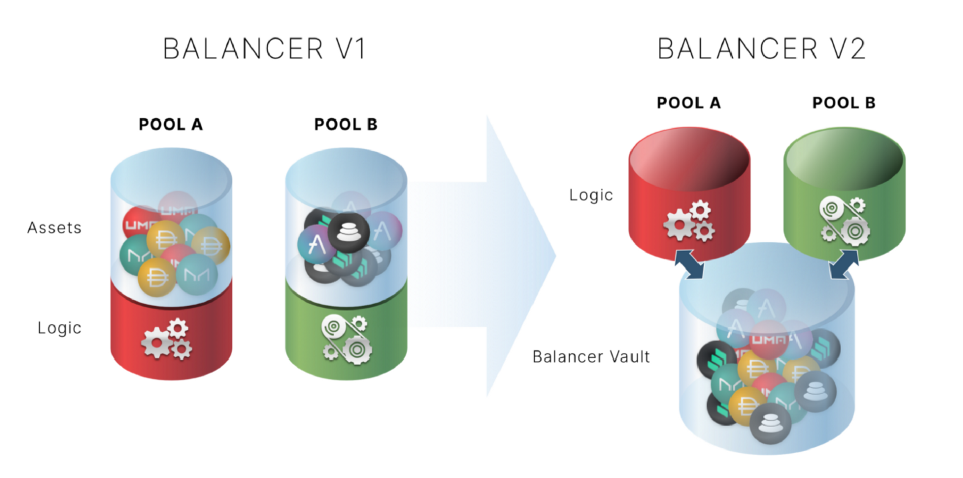
The main core difference that came with v2 is the Balancer Vault, a single contract to hold and manage all assets added to the Balancer Pools.
In the next paragraphs, we’ll have a look in more detail at the core features that make Balancer one of the most powerful and used protocols in DeFi.
____
The Vault
Thanks to the new architecture of Balancer v2, the vault allows the separation of logic from the accounting and management of the pool. This not only simplifies contracts but enables users and developers to create new pools with minimal effort and focus only on the pool logic that is now limited to swaps, joins, and exits.
The vault can host many different types of pools, providing they respect a few requirements.
Differently in v1, where every pool had its own vault, in v2 one single vault holds the assets of all pools, and users who want to create their own AMM just need to define pool logic and plug the pool into the vault.
This way gas cost is reduced as multi-hop tradings happen in the vault without generating on-chain transactions, thus improving gas efficiency.
Even though pool balances are held together, the vault keeps them isolated from one another and guarantees that no malicious activities can be carried out to steal funds from another pool.
At the same time, the depth of the combined liquidity held in the vault does not impact the price in individual pools but enables some interesting features like **Flash Loans** and **Flash Swaps**. Flash loans are uncollateralized loans carried out in a single transaction (loan and repay with interests) while flash swaps allow traders who identify a discrepancy in price between two assets to take advantage of an arbitrage opportunity without the need to hold any of the input tokens.
_____
Balancer Pools
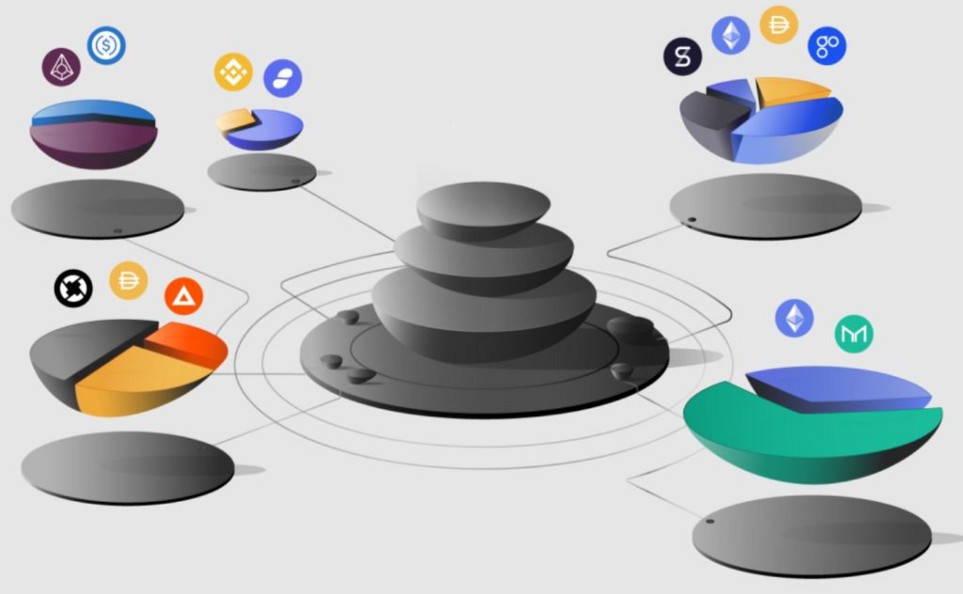
ABalancer Pool is an **automated market maker** that functions as a **self-balancing weighted portfolio** and **price sensor** and is the fundamental building block of Balancer protocol.
What makes Balancer Pools unique is their flexibility. Whereas other protocols have pools with constrained parameters, Balancer allows pools of any composition, enabling developers to build their own custom pools.
Users and teams who want to take advantage of Balancer features have numerous choices when deploying a new pool:
- *Weighted Pools*
- *Stable Pools*
- *MetaStable Pools*
- *Liquidity Bootstrapping Pools*
- *Managed Pools*
Let’s have a look at each of those.
____
Weighted Pools
Weighted pools allow users to implement many different strategies, thanks to their flexibility and configurability.
They are a great choice for pairs of tokens that are loosely or not correlated at all like DAI/WETH. Weighted pools enable users to create pools with up to eight tokens (up to 28 tradable pairs) and assign to each token a customizable weight, as in the 80/20 pool or the 60/20/20.
Weighted Pools allow users to choose their level of exposure to a certain asset, according to their strategies and previsions on the trend of a certain token.
For example, users who are bullish on WBTC will choose to provide liquidity to a 80/20 WBTC-WETH pool, while other users whose strategy is to mitigate impermanent loss could choose a 20/20/60 WBTC/WETH/DAI pool.
WeightedPools are based on an **N-dimensional invariant surface**, a generalization of the **constant product formula**: https://balancer.finance/whitepaper/
Starting from the formula above that describes a market maker based on a pool made by two assets, Balancer extended it to manage pools of two or more assets.
**How does this work?**
Incomparison with the xyk formula, the general formula describes a value function (V) that introduces the concept of weight. V is a function of tokens Weights and Balances are constrained to a constant:
Where V is the constant value, t is the variable ranging through tokens, Bₜ is the balance of token t, W
is the weight associated with token t, normalized so that the sum of all weights is
For example, a three token pool with the following distribution of 20% ETH — 20% WBTC — 60% DAI would look like this when applying the formula above:
The formula above defines an invariant-value surface as illustrated below, such as no matter what trades are carried out in the pool, the share of the value of each token in the pool remains constant.
Each point on the surface represents a Spot Price for each pair of tokens in the pool and is defined by the weights and balances of that pair of tokens only. At any moment Spot Price can be calculated using the following formula:
Where Bᵢ and Wᵢ are respectively the Balance and Weight of the token being sold by the trader (going into the pool),
Bₒ and Wₒ are the Balance and the Weight of the token being bought by the trader (going out of the pool). From this equation, it’s easy to see that if weights are held constant then the spot price changes only when balances change.
In the hypothesis liquidity isn’t added or removed from the pool itself, then the only way balances can change is when trades occur.
When market prices differ from pool prices, traders take advantage of arbitrage opportunities by buying and selling assets and thus rebalancing the pool.
This way the owner of the pool earns fees on trades and saves on the operation connected to fund rebalancing.
**PROS**
- Highly customizable
- Exposure control
- Numerous trading pairs in a single pool
**CONS**
Slippage grows with the asymmetry of the pool
______
Stable Pools
Stable pools are meant for assets that are expected to trade at near parity. Here the takeaway is to lower price impact as much as possible to allow very large trades.
**PROS**
- Low price impact
- Batch Swaps are gas efficient as the stable pools are managed by in the same protocol
MetaStable Pools
Metastables Pools are an extension of StablePools and focus on non-pegged highly correlated tokens such as base tokens and their derivatives for example DAI/cDAI.
**PROS**
Good for correlated assets such as wstETH-ETH
______
Liquidity Bootstrapping Pools
Liquidity Bootstrapping Pools take advantage of customizable weights allowing users to define weights that change dynamically as a function of time from a range that span from 1/99 to 99/1 for a pair TokenA/TokenB.
Users can define the start and end weight balance as well as times at which weights are adjusted toward the end value.
**PROS**
- A change in weight can trigger a Buy/Sell pressure on the pair of tokens in the pool, often leading the price to reach the agreed-upon market price
- Incentivize the widespread distribution of tokens during early-stage token launch
- Enable the team to kickstart token liquidity by employing a minimal starting capital.
_____
Managed Pools
Managed Pools are highly customizable pools, enabling users to implement sophisticated strategies and pools with up to 50 tokens.
**PROS**
- Highly customizable
Boosted Pools
Boosted Pools allow for deep stablecoin liquidity, allowing traders to swap at the near-parity exchange rate, and boosted rewards for LP coming from trading fees on Balancer plus rewards coming from external protocols to which idle tokens are forwarded.
**PROS**
- High capital efficiency for LP
- Deep liquidity pool.
______
Custom Pools
Custom Pools are created with developers in mind. Thanks to the Balancer V2 architecture, teams are able to develop their own custom pools, worrying about the logic of their protocol and leaving accounting management to Balancer.
**PROS**
- Enable teams to easily build and deploy a custom pool taking advantage of Balancer architecture.
______
The Asset Manager
Asset Manager is born with the aim of solving the generalized problem of capital inefficiency of AMM that arose in the past years.
What Asset Manager does is lend tokens to lending protocols in order to improve the pool’s yield, while making sure that the vault always holds a buffer.
The buffer acts like a safety cushion to ensure that the pool does not run out of tokens. When the pool gets close to this event can replenish its balance by calling back tokens from the Asset Manager.
______
Oracles
Oracle is functionality available for certain pools like MetaStablePool and Weighted Pools2tokens and allows the pool to be a price sensor for its tokens.
Oracles can be used to:
- Retrieve the instant price of a token
- Retrieve a Time Weighted Average Price (TWAP)
In v2 oracles have been made resistant to sandwich attacks by using **accumulators** (see **Oracle — Balancer** for further details), a feature firstly used in Uniswap v2. https://docs.balancer.fi/products/oracles
_____
Governance and veBal
Last March, Balancer deployed veBal, the vote escrow token for holders of BAL token.
Since the inception of Balancer, one of the aims of Balancer Labs was to create a protocol that would slowly but steadily shift from centralized governance to distributed governance, bringing Balancer Lab to be one of the many teams contributing to the success of the protocol.
With the veBal Activation Proposal being approved by the Balancer community, the new governance system kicked off and holders of BAL have now the possibility of locking their BAL token in exchange for voting power while liquidity providers can stake their LP tokens to continue receiving liquidity mining incentives, thus encouraging BAL holders to support Balancer in the long term.
Besides this, the new governance system will bring more advantages (see **veBal is live — Balancer** for more details). https://medium.com/balancer-protocol/vebal-is-live-aeda1ae13e20
_____
Conclusions
Since its release in 2019, Balancer has improved steadily and proved to be one of the king protocols in DeFi.
Their approach to pools has revolutionized the way index funds are managed and opened to a wide range of possibilities for users and teams when designing new pools, possibilities that were not available before.
Is no surprise that many teams have decided to build their protocols on top of Balancer v2 and as the protocol makes its way toward full decentralization there’s no doubt Balancer will continue to be one of the top protocols in the crypto space.
**To summarise the key points:**
- Balancer is a community-driven protocol and has recently kicked off the new governance system to go fully decentralized with the vote escrow token veBAL
- Balancer evolution from v1 to v2 brought significant improvements with the introduction of a single vault, improving security and gas cost efficiency and decoupling pool logic from asset accounting and management, thus reducing contract complexity and enabling anyone to easily create and deploy new pools
- Balancer offers different types of pools to fit the diverse needs of builders and users who wish to deploy their portfolio
- Balancer offers even more functionalities and products such as oracles, Asset Managers, Flash Loans, and Flash Swaps.
____________
*References*
***https://docs.balancer.fi/***
***https://balancer.fi/whitepaper.pdf***
***What is Balancer Protocol? Everything You Need to Know (cryptopotato.com)*** https://cryptopotato.com/balancer-protocol-guide/
***Balancer V1 in Review. When Balancer launched in 2020, we… | by rabmarut | Balancer Protocol | Medium*** https://medium.com/balancer-protocol/balancer-v1-in-review-cd6ab5f4531
***Introducing Balancer V2: Generalized AMMs | by Fernando Martinelli | Balancer Protocol | Medium*** https://medium.com/balancer-protocol/balancer-v2-generalizing-amms-16343c4563ff#:~:text=The%20main%20architectural%20change%20between,the%20token%20management%20and%20accounting.
***https://medium.com/balancer-protocol/building-liquidity-into-token-distribution-a49d4286e0d4***
***What is Liquidity Pool (LP) in DeFi? — The Babylonians (theancientbabylonians.com)*** https://www.theancientbabylonians.com/what-is-liquidity-pool-lp-in-defi/
***Impermanent Loss Explained With Examples & Math — The Chain Bulletin*** https://chainbulletin.com/impermanent-loss-explained-with-examples-math
***My Vision for Balancer Protocol — General Chat — Balancer*** https://forum.balancer.fi/t/my-vision-for-balancer-protocol/2123
***Balancer Facilitates Record-High Liquidity Bootstrapping Pool For HydraDX | by Stanislav Kozlovski | Balancer Protocol | Medium*** https://medium.com/balancer-protocol/balancer-facilitates-record-high-liquidity-bootstrapping-pool-for-hydradx-f08b6b0a3aee
***Building Liquidity into Token Distribution | by Mike McDonald | Balancer Protocol | Medium*** https://medium.com/balancer-protocol/building-liquidity-into-token-distribution-a49d4286e0d4
***https://medium.com/balancer-simulations/understanding-balancer-pools-c2b877dcc082***
***https://medium.com/balancer-protocol/calculating-value-impermanent-loss-and-slippage-for-balancer-pools-4371a21f1a86***
***https://medium.com/balancer-protocol/balancer-v2-generalizing-amms-16343c4563ff#:~:text=The%20main%20architectural%20change%20between******,the%20token%20management%20and%20accounting****.* https://medium.com/balancer-protocol/balancer-v2-generalizing-amms-16343c4563ff#:~:text=The%20main%20architectural%20change%20between,the%20token%20management%20and%20accounting
***https://medium.com/balancer-protocol/vebal-is-live-aeda1ae13e20***
Is Craig Wright Satoshi Nakamoto?
Time to get to the bottom of it, according to a whole lot of experts on the matter, or simple Concavians and their thoughts…
Craig Wright, you may know him from Bitcoin Satoshi Vision (BSV), claims he is the one and only Satoshi Nakamoto…
…but is he really?
Concave decided to do what it does best — ask the community for insight — and this is what we got in return.
Just another rabbit hole that is worth diving into.
______________
**Is Craig Wright, Satoshi Nakamoto?**
Well, let’s start our dive by reading what **CONCAVE MAXI Vabos (∞)** thinks of it:
*Respectfully, no. He is the biggest larper and capper there is. He has the audacity to claim to be Satoshi when he won’t move Satoshi’s Bitcoin as a form of Proof. It is the easiest and simplest Proof of Work that he can do to prove and establish that he is Satoshi.*
**CameronD (∞)** has a completely different oppinion:
*It’s funny how crazy people get about this topic. I think he probably is Satoshi, and I also think he’s an asshole.*
*BTCers can’t stand the idea that their idol is nothing like they imagined him to be.*
*I personally don’t really care, and I think that both BSV and BTC will be relegated to the sidelines as blockchain technology evolves and moves past the economic incentive problems inherent in PoW and PoS with projects like SAITO.*
So, as you can see, even in our tight-knit community and across our crypto reach, we do have different opinions and people who think he is Satoshi, while others abhor the idea.
Pretty divisive topic, which makes it even more interesting.
**bulew (∞)** wrote a bit more about it and brought the burden of proof to the mix.
*Craig Wright announced, following the investigations conducted by Wired and Gizmodo, to be the identity hiding behind the pseudonym of Satoshi Nakamoto.*
*However, in front of the request for proof (notably cryptographic) and after the delivery of a forged document, he went back explaining that he did not wish to provide this type of proof.*
*However, he continues to claim to be Satoshi Nakamoto. In addition, a trial is taking place this winter in Florida: the family of a deceased man is suing his former partner to regularize the control of their assets.*
*The assets? : more than one million bitcoins belonging to Satoshi Nakamoto. The family of the deceased man claims that he and his partner were hiding together behind the name Nakamoto, and that they are therefore entitled to half of this fortune.*
*But Craig Wright has just obtained from the judges the ownership of these bitcoins… These elements feed the thesis that Satoshi Nakamoto is an alias hiding several people.*
*Craig Wright, in any case, is quite different from the initial desire of SN to hide his true identity …*
Now, when considering BTC and Craig’s BSV, what are the differences?
Well, they are thoroughly documented, but what does the average Bitcoin lover know about it?
We’ve decided, again, to ask the Concave Community.
_____________
**What is the difference between BTC and BSV?**
Well, let’s start by looking at quite a big answer from **Dziunek (∞):**
*Bitcoin Cash and Bitcoin SV differ in important ways in a number of respects, making the two networks incompatible with each other and ultimately contributing to the chain split that occurred on 15 November 2018.*
*First and foremost, the two projects differ in the maximum capacity of a transaction block -. In the source code of Bitcoin SV, there has been a restoration of four operation codes that were present in bitcoin from the very beginning, but were later removed from it (this is supposed to be one of the elements of compliance with “Satoshi Nakamoto’s vision”).*
*The restored Script operation codes are OP_MUL (multiple), OP_INVERT (invert), OP_LSHIFT, OP_RSHIFT According to nChain, this is to restore necessary functionality for developers that was removed from the BTC code.*
*Bitcoin Cash, after the network split, also has a minimum transaction weight limitation of no less than 100 bytes, as a protection against DDoS attacks.*
*Bitcoin SV has no such lower limit. Bitcoin Cash also has an OP_CHECKDATASIG operation code for acknowledging messages outside the blockchain network, which is ultimately intended to develop functionality related to smart contracts, among other things.*
*According to nChain, the above operation code is redundant and has not been added to the Bitcoin SV repository.*
Let’s take a look at a more superficial answer now to balance them out:
*BSV is known as Bitcoin SV, where the “SV” stands for Satoshi Vision. ) originally set out in his Bitcoin white paper.*
*Unlike other competing BCH implementations that are competing to make unnecessary changes to Bitcoin, Bitcoin SV’s development roadmap is designed to restore Satoshi Nakamoto’s initial protocol, maintain protocol stability, perform massive scaling, and then allow large enterprises to confidently develop and create project activity based on a solid Bitcoin Cash (BCH) foundation*
**C-Vain (∞) — 究极摸鱼的MOD** posted the answer above, but he had some support from some members.
We’re highlighting **noeftie**’s answer:
*I agree with @C-Vain (∞) — 究极摸鱼的MOD. As previously established: BSV is a fork of BTC, hence it is different by design.*
*Some notable differences are: Name: BTC vs BSV Founded in: 2009 vs 2018 Hashrate: : 93b vs 2b Etc..*
*However, the biggest difference is the choice of block size. Where BTC opts for smaller blocks, BSV’s block size is in theory unlimited.*
*What is behind this is a fundamental difference in the economical and philosophical approaches.*
*Where the former (BTC) prioritizes decentralization, the latter prioritizes utility, as a bigger block size ensures the flexibility to increase the networks’ capacity.*
*Bigger block sizes require more computing power, increasing the threshold to join the network, and amplifying centralization.*
*In conclusion, I’d argue that the biggest difference is the trade-off between decentralization on the one hand (BTC), and utility or TPS on the other (BSV).*
____________________________
What do you think?
Do YOU think Satoshi is, in reality, BSV’s Craigh Wright?
What about BCH’s role in all of this, and what about your position in Bitcoin wars?
Whatever your opinion is, you got to admit, this is pretty interesting stuff!
_________________
Bitcoin Genesis Block: Why the Unspendable Satoshi’s Idea
Bitcoin Genesis Block: Why the Unspendable Satoshi’s Idea.
Is the Bitcoin Genesis Block spendable? Why or Why Not?
This is the question we at Concave decided to ask our community members, not only to get a lot of different beliefs and explanations but also to gauge how Satoshi’s idea was interpreted by the general crypto community.
If you’re intrigued by this concept or just want the social experiment element of it, then read below for the answers we got.
_____________
Can you spend the Genesis Block on Bitcoin? Why or Why Not?
The first person we asked was Concavian **NotoriousCastel (∞)#3733**, who answered:
*I don’t think so. Its function is as essential as the need to create a foundation before building a house since it is a “fountain” block.*
*No matter which chain you select, if you look at its history, you will always find its own genesis block at the root of that crypto-currency.*
*A genesis block also serves to guarantee communication between two nodes. This is because two nodes can only be matched if they have the same genesis block.*
*Otherwise, the two nodes would be incompatible. On the other hand, it is important to keep in mind that each node has its own initial block, creating a huge network in which a genesis block of higher difficulty can never be replaced by one of lower difficulty.*
*Imagine for a moment a pyramid of blocks, at the top of which would be the genesis block presiding over the rest of the blocks.*
*No matter how many links you descended, they would all be anchored to their origin.*
On the other hand, **akerlof#8331** answered:
*“Genesis block is the first sync point for a state of truth (the blockchain) and cannot be spent given a design decision by SN.*
*It’s the creation mechanism and the start of the lineage of all preceding blocks. How could one spend the genesis block if no tokens exist prior to its creation on chain?*
*I think that is why SN kept the first tx out of the chain and why it is hardcoded for nodes to sync to.”*
These are two of the answers we decided to highlight in text, but here’s another view of the concept, this time in code and by the hand of Concavian **zers#5962.**
`“01000000 — version`
`0000000000000000000000000000000000000000000000000000000000000000 — prev block`
`3BA3EDFD7A7B12B27AC72C3E67768F617FC81BC3888A51323A9FB8AA4B1E5E4A — merkle root`
`29AB5F49 — timestamp`
`FFFF001D — bits`
`1DAC2B7C — nonce`
`01 — number of transactions`
`01000000 — version`
`01 — input`
`0000000000000000000000000000000000000000000000000000000000000000FFFFFFFF — prev output`
`4D — script length`
`04FFFF001D0104455468652054696D65732030332F4A616E2F32303039204368616E63656C6C6F72206F6E206272696E6B206F66207365636F6E64206261696C6F757420666F722062616E6B73 — scriptsig`
`FFFFFFFF — sequence`
`01 — outputs`
`00F2052A01000000–50 BTC`
`43 — pk_script length`
`4104678AFDB0FE5548271967F1A67130B7105CD6A828E03909A67962E0EA1F61DEB649F6BC3F4CEF38C4F35504E51EC112DE5C384DF7BA0B8D578A4C702B6BF11D5FAC — pk_script`
`00000000 — lock time`
`// Special case for the genesis block, skipping connection of its transactions`
`// (its coinbase is unspendable)`
`if (block.GetHash() == chainparams.GetConsensus().hashGenesisBlock) {`
`if (!fJustCheck)`
`view.SetBestBlock(pindex->GetBlockHash());`
`return true;`
`}`
________________
What Does it Mean that the Genesis Block Cannot Be Spent? Why did Satoshi Do This Intentionally?
This was the follow-up question presented to the community.
We wanted to probe what the people from the Crypto economy perceived as the reason behind Satoshi’s intention.
Here are some answers worth reading, starting with the insight provided by **Chev (∞) Uncle Cleetus#0001.**
*“The Times 03/Jan/2009 Chancellor on brink of second bailout for banks”*
*It was his legacy, the first block, only he had keys to it, and he vanished. He ensured the first block had one POF: himself.*
*Consensus would never be able to challenge the message, block, and monument it represented to him. The riot of all transactions leads to block one. He locked it, and he disappeared.*
*They can change everything but not the first block, the one he planted, engraved with the headline that represents the reason it needs to exist in the first place.”*
*“Burn it all but the message will forever exist that the birth of a decentralized distributed and public ledger, essentially as a mission statement. The world as it is right now is the reason the world cannot go on as it is now.”*
*“The decentralized vision was born from collective collaboration, but that first block represents the start. The chain begins as one and grows. The chain on block one was centralized.*
*Centralization was what resulted in “The Times 03/Jan/2009 Chancellor on brink of second bailout for banks”*
*This centralized block, represents the beginning of 1 (cannot decentralize from one) but also, its permeance now shows as the root that started the entire tree.*
*Every branch and ledger and node and consensus and difficulty change started because of and as a result of the centralized control. It’s almost like he didn’t want the centralized block to pollute the chain.”*
*“Kinda my first and best fit I think. If the first block is secured with a single point of failure, and that point of failure is removed, the genesis reference will never alter “*
**4valanche (∞)#0713** even decided to do a bit of research beforehand, so our efforts have proven to send people down rabbit holes, which is nice!
Here’s his take:
*“This is how the Bitcoin client worked when Satoshi created it: The client maintains a block database and a transaction database.*
*When it finds that its block database is empty, it inserts the genesis block into its block database to get things started.*
*This block includes a transaction sending 50 BTC to 1A1z…, but the client does not insert this transaction into its transaction database.*
*So even though this transaction is part of the block chain, if the client sees a transaction spending this 50 BTC, it won’t be able to find the 50 BTC transaction in its transaction database, and the spending transaction will be rejected. In other words, the genesis block’s transaction isn’t considered to be a “real transaction” by the original Bitcoin client.*
*(Current versions of Bitcoin-Qt handle the block/transaction databases in a totally different way, so the genesis block’s transaction is now just a weird special case in the code.)*
*This could easily have been an oversight, or Satoshi could have intended this transaction to be unspendable. This quirk wasn’t discovered until after Satoshi disappeared, so no one had a chance to ask him. Not my work, found this online.*
*Very good explanation though.”*
In conclusion, we’ll leave you with **ΛMΛ8999#8760’s** perception of it:
*“The foundation stone is the first stone set in the construction.*
*All other stones will be set in reference to this stone, thus determining the position of the entire structure Let’s change a few words now: The foundation block is the first block set in the network.*
*All other blocks will be set in reference to this block, thus determining the position of the entire network. The Genesis Block was a sacrifice to the Bitcoin network”*
____
We Love Probing the Community on Discord: Get People to Think!
This is just one of the many topics we send our community down into.
We love having more than just your old regular crypto community — we really like sending them down investigative and argumentative rabbit holes and making sure a lot of knowledge is shared so everyone can grow.
We’ll make sure to publish these things often so you guys can also participate in the discussion right here on **Read.Cash**
Metaverse Gamification: PhalaWorld
Metaverse Gamification: PhalaWorld
**PhalaWorld** is an exciting project. If you love DeFi, Gamification, Metaverse, and Crypto, read this article! https://twitter.com/PhalaWorld
A gamification layer on top of Phala Network
Hello miners, I would like to introduce PhalaWorld which is based on the soulbound NFT technology introduced by Vitalik Buterin.
PhalaWorld (PW) is a Metaverse Gamification Extension based on the Phala Network blockchain.
Phala Network
To briefly introduce PhalaWorld it is necessary to know about Phala Network, it is a parachain on Kusama and Polkadot that intends to build a decentralized cloud computing infrastructure in such a way as to serve as a foundation for dApp development via innovative smart contracts called **Phat Contracts**. The Phala Network currently boasts over 128,000 vCPUs establishing itself as one of the largest on the Web3. Phala workers run the programs in Secure Enclaves, a privacy technology already embedded into modern processors, enabling versatile and confidential execution. https://medium.com/phala-network/introduction-of-fat-contract-dea79ffcf0dc
Introduction
PhalaWorld is a gamification extension to bring blockchain and Dapp into the metaverse based on Phala Network. The new “Play to Build” concept combines user behavior, characters, communities, and science fiction stories on the Phala blockchain, integrating strategy, development, MMORPG, and other game types.
Phat Contract enables verification and synchronization of data in Soulbound metadata through a script, indexing can include:
Off-chain:
- Twitter
- Discord Level.
- Forum performance
- Participating or not participating in a local meeting
On-chain:
- Defi active
- NFT active
- Multi-chain active
By creating a SoulBound NFT system, PhalaWorld mapped on-chain/off-chain activities into the metaverse games. PhalaWorld’s story begins after the first nuclear war. There are 8888 survivors in total, including 4 species (Cyborg, AI-Spectre, Pandroid, X-Gene) and 5 careers.
The team is partnering with RMRK and Bit. Country to develop NFT and Metaverse gaming infrastructure.
Let’s go into depth on what types of NFTs will be available:
Spirit NFT
Spirit NFT represents all on-chain and web2 activities of a member (staking, mining, participation in governance but also discord experience points, GitHub contributions, social influence, etc…) this NFT is not transferable or tradable. Spirit is a non-transferable NFT generated with unique on-chain identities, which are coupled with the decentralized identity protocol My Crypto Profile. Spirit links PhalaWorld to the virtual world via Phat contract, encoding a player’s accruing values based on their on-chain/ off-chain behaviors.
Vitalik Buterin published a Soulbound article and emphasized the concept of “proof of presence” derived from World of Warcraft. Players must engage in certain behaviors to acquire the most powerful soulbound items, rather than purchasing them with money. The PW team shares this soulbound concept and believes that user behavior is a very valuable asset, which can even represent the user in a metaverse. Therefore, in PW they have designed Spirit NFT so that it represents much more of who you are and not just what you can afford.
Shell NFT
Shell NFT represents the in-game character, this NFT is transferable and negotiable. The total amount of Shell NFT is 8888 and there are 3 rarities — Legendary(8), Magic(80), and Prime Edition (8800). Each rarity has its unique accessories and components.
The Shell NFTs are minted on Khala Network (Phala’s canary network which runs as a Kusama parachain). Obtaining a Khala account is essential-it and can only be created through Polkadot.
**Here’s a guide on Khala — Don’t worry, no ref links, just instructional stuff:**
`How to create a Khala account?`
`Article: https://docs.google.com/document/d/1yH8SRR0cbxLRkcfTYuU83xjfQiK2mgT5J349wA5HwjU/edit?usp=sharing`
`Video: https://www.youtube.com/watch?v=Q3yHQqKrMl4&t=1s`
`Where to get K-PHA?`
`https://forum.phala.network/t/topic/876`
The project is under construction and will most likely be released in Q4, currently, you can already mint the **Spirit NFT** via the official **website** and add data via web2 and web3 accounts such as Twitter, discord, GitHub or metamask, polkadot.js. https://twitter.com/PhalaWorld/status/1539281405951234053 https://www.phalaworld.com/
PhalaWorld community
The PhalaWorld community is growing, currently, the Twitter account registers more than 6,000 followers, and the discord server has about 3,500 members. The environment is very welcoming and members are enthusiastic about the sneak peeks shared by the team. Useful initiatives have taken place within the discord server to get whitelisted for the Shell NFT mint. All the time, initiatives are held to obtain discord experience points that will go to increase the skills of the NFT Spirit. The invitation is of course open to explore this interesting new experience and get to know the **discord community**. https://discord.gg/g7mYTrGXCk
Personal Considerations
According to Datareportal’s report, we spend about 7 hours connected to the internet every day, which is over 40% of the time we are awake. Blockchain technology applied to the digital footprint each user leaves on the internet will enable the creation of meritocratic environments. A decentralized tool that can combine these two elements will have a decidedly innovative impact on the quality that the internet and web3 can offer in the future.
I believe that the use of this technology in the gaming field is only the beginning and the creation of scenarios that could go far beyond our imagination.
LUSD Analysis: Liquity Stable Opinion Article & Crypto Review
**LUSD Analysis: Liquity Stable Opinion Article & Crypto Review**
There are a lot of Stablecoins in Crypto, and today we’re reviewing LUSD, the Liquity Stable and Protocol
In our seeking to find a stable value where we can lock our profits in it and chill, we try not to forget the original principles and we work on not falling in ‘sheep’s clothing but inwardly are savage wolves, and by that I mean all the stablecoins that face a problem in:
value accrual
Centralization.
That’s why for today’s piece, I wanted to discuss one of the stables that I admired for a long time, and recently after the freezing event of USDC, it gained some momentum.
_______________________
A Deeper Look at LUSD: Some Crypto Context
**Introduction**
LUSD is the sable coin behind the system “liquity” which is a **decentralized borrowing protocol** where you are able to mint against your ETH at a ratio of 110%, interest-free
So for example, I can deposit 110$ worth of eth >> stake them in the platform, and voila, I can mint now 100 $LUSD, I can redeem my beloved ETH only when I redeposit the LUSD I borrowed, and by that the LUSD minted will be burned.
What is cool about liquidity, and more importantly decentralized-friendly, is that there is no direct place to mint it. Where the team had made sure of this, and it was left to the community to build. The contract’s parameter was set at the moment of creation and there are **different frontends** to interact with it. You can find all the frontends available **here**. https://www.liquity.org/frontend
All frontends providers are compensated by $LQTY tokens, and they can choose a certain ratio where the hosts can devise these LQTY tokens with the community using their frontend, kickback rate.
_____________________________
**Liquidation mechanism**
The first important question we always need to ask in any lending and borrowing platform is “ how the liquidation happens “ in order to make sure the funds that we are lending are safu.
At Liquidity, they created what so-called **“stability pools”**
A stability pool is a place where people can deposit their LUSD to provide liquidation funds or “stability providing” for the smart contract to be able to liquidate those who will be under-collateralized and make sure that worth of ETH deposited >> worth of LUSD minted.
So for example, a miner can benefit from this mechanism in 2 places:
Miner A wishes to buy ETH at a discounted value, he can deposit some LUSD in this pool, in case of a liquidation event, the funds are used to purchase ETH with a negative premium in exchange for his LUSD.in addition to get some sweet 7.5% APR in LQTY token
**A good example is given by the Liquity team**
2. Miner B is more degen, and he likes to build bots, he can create a bot that will trigger the liquidation contract, and by that will be compensated with 200 LUSD + 0.5% of the stability pool collateral as a reward for this service.
**Redemption**
In the process of attempting to keep a hard peg mechanism where truly every 1LUSD = 1 USD in value, the team developed a redemption mechanism where people can use 1LUSD to redeem (1$ worth of ETH — a certain fee), a mechanism mostly used by arbitrageurs to gain in case of **1 LUSD < 1 USD** (acquire USDC, swap USDC for LUSD from curve or Uniswap, exchange LUSD for ETH on liquity, sell ETH for USDC) the fee will be **a base rate * 0.5%** https://docs.liquity.org/faq/lusd-redemptions
To avoid being redeemed (Rukka coming and swapping your ETH), you can always keep your LTV above 150%, or else your ETH will decrease in value but your share of LUSD will increase. But I see that there is no actual loss for lenders unless LUSD failed to hold the peg. (no rest for the wicked)
_____________________________________________
**Liquidity across defi**
I made a tour to see how liquidity is spread across AMMs.
More than 50% of LUSD is provided in the stability pool, which is so healthy for the liquidation mechanism as we spoke before.
On curve finance, LUSD is paired with the 2 Basepools and both are incentivized with a good share of the curve emission gauge.
Currently, LUSD is around 1.03$ (kek), due to the buying shock that happened, it can be depegged if people tried to short it by depositing eth, minting LUSD, and swapping it to 3crv or crvFRAX, but people now feel safer with LUSD than ever.
(3crv all of them are able to be compromised by regulations, crvFRAX is USDC and wrapped USDC iykyk)
__________________________________
There are pools on uniV3 as well, but due to their small liquidity I won’t mention them (curve V2 fan)
Liquity team moved above mainnet and is experiencing at the moment L2 integrations, starting with **velodrome**. https://app.velodrome.finance/liquidity
So the 2 scenarios for deppeg I guess are for the moment protected :
1- LUSD << USD, Go and buy LUSD from an AMM and redeem it for a discounted ETH
2- LUSD >> USD, you can mint at a higher value and profit for some cents for the dollar, wait until it gets down to pay for your debt, and pray to pope andy that you are not liquidated until then.
Or just mint and enjoy farming :)
**Extra thoughts**
The pool I'm excited about is sUSD/LUSD and to see how it will succeed, I think it’s time when all the decentralized stable coins step ahead and create their own stable pool on Curve, similar to LUSD,sUSD, and others.
A new wave of stables is coming, so be safe and always DYOR.
All About TUSD: Stablecoin Scoop
Learn more about the first of its kind, the TUSD Stablecoin. Love it or Hate it, it definitely bears weight in Crypto.
Introduction
Over the last few years, the crypto market has seen the rise of many different stablecoins, the first of which was USDT.
Though stablecoins proved themselves to be essential in the blockchain industry, the main problem has always been to guarantee the security and stability of the peg of these coins.
In this article, we aim to introduce TUSD (True USD), one of the most reliable stablecoins fully collateralized by USD.
**TUSD** is the first of a number of stablecoins, all tied to real assets, launched on March 8th, 2018 by **TrustToken**. The coin exists in its **ERC20** version on Ethereum and **BEP2** version (Binance Chain). TUSD is the first independently verified digital asset redeemable 1-for-1 for US dollars and supports over 100 trading partners amongst the biggest players in the crypto space.
TrustToken
**TrustToken**, based in San Francisco, California, was founded in 2017 by a team of big brains from Stanford, UC Berkeley, PwC, Google, and Palantir.
The core team is currently made of the following members:
- **CEO**: **Rafael Cosman** https://www.linkedin.com/in/rafaelcosman
- **Sen. Director Finance & COO**: **Alex De Lorraine** https://ie.linkedin.com/in/alexdelorraine
- **Chairman of the Board**: **Tom Shields** https://www.linkedin.com/in/tomshields
- **Chief Technology Officer**: **Marek Kirejczyk** https://www.linkedin.com/in/kirejczyk/?originalSubdomain=pl
- **Chief Investment Officer**: **Bill Wolf** https://www.linkedin.com/in/bill-wolf-5015a343
- **General Counsel**: **Diana Bushard** https://www.linkedin.com/in/diana-bushard-21ab461/
The team behind TrustToken is made of nearly 80 employees located in Europe, Asia, and North America:
Since 2017 the company has grown significantly by releasing a wide range of successful products in the crypto space:
- ***TruFi***: the core product of TrustToken, a lending protocol with stable returns in TUSD for lenders, an on-chain credit line for borrowers with no need for collateral. TrueFi is in an ongoing process of decentralization (TruFi DAO). Since November 2020 TrueFi has facilitated ~$1.5B of loan originations and more than $1B of repayments, with no defaults to date, with a mission to grow TruFi has the definitive protocol for the nearly $10 trillion global lending market.
- ***TrueFx***: A stablecoin basket built on the five TrueCurrencies launched by TrustToken, available on **Balancer**
- **Stablecoins**: Five stablecoins fully collateralized to their currency counterpart: TUSD, TAUD, TGBP, TCAD and THKD
True USD Stablecoin
TUSD (True USD) is the first stablecoin launched in April 2018. It’s a fully collateralized, independently audited, redeemable 1:1 for U.S. Dollars and is currently one of the most transparent stablecoins in the crypto market.
The idea for TUSD came when doubts about whether USDT was fully backed and had reliable banking relationships arose, that’s why in mid-2018 TrustToken issued TUSD to address these problems and offer to the market the most reliable stablecoin ever created.
*Barolosan — Today’s Writer*
**But how does it work?**
TUSD functions through an Ethereum smart contract that enables a tokenized version of the U.S. Dollar to be issued or redeemed.
When a user buys TUSD through TrustToken, the smart contract generates and issues an equivalent amount of TUSD that gets sent to the User’s Ethereum wallet.
Users can exchange Dollars for TUSD directly with third-party escrow accounts, rather than forward the money through the TUSD network.
When a user redeems TUSD for USD the smart contract burns the TUSD provided by the user and credits on the user account the equivalent amount of U.S. Dollars, removing permanently the user’s TUSD from the circulating supply.
What’s even better is that TrustToken doesn’t charge commissions when a user buys or redeems USDT for USD. So what’s in for TrustToken? Well, they basically generate revenues by collecting interests on the U.S. dollars held in the escrow accounts.
Why IS TUSD considered so reliable?
What makes TUSD so reliable are the mechanisms that ensure at any time that the token is fully collateralized by U.S. Dollars, though reducing the risk of depeg due to market bias.
Fully collateralization is guaranteed by the fact that the US Dollars backing the coin are held securely by licensed trust companies. Using multiple escrow accounts, token holders are provided with legal protection against misappropriation. TrustToken doesn’t have access to the escrow funds, making TUSD even more secure.
At present, TrueUSD collaborates with five trusted partner banks — Signature Bank, Silvergate Bank, Prime Trust, First Digital Trust, and BitGo.
But what makes TUSD even more reliable is that, besides monthly reports released by Escrow Partners (those who hold the funds), the TUSD token offers real-time attestation 24x7**.**
According to public information, TUSD has also become the first stablecoin with on-chain live attestations TUSD has launched its Proof of Reserve & Supply reference contracts and live attestations through collaboration with **Chainlink** and **Armanino,** the first one being an industry-leading decentralized oracle solution while the second being one of the top 25 accounting firms in the U.S.
These collaborations have exceptionally increased the reliability of TUSD compared to other stablecoins.
Right now TUSD is supported by major centralized lending platforms such as Nexo, Celsius, Dharma, Crypto.com, and many others.
As of August 2022, TUSD has ranked the fifth-largest USD-pegged stablecoin with a market cap of around $1.1 billion and over 400,000 holders, following USDT, USDC, BUSD, and DAI.
In the second half of 2019 has been released a BEP2 version of TUSD token on the Binance Chain, thus increasing the usage and circulation of this stablecoin.
Still, a lot has to come from TrustToken and TUSD. At the end of 2021 TrueUSD has announced the launch of an Incentive Plan called Fountain, inspired by the idea of an endless flow.
And no better name could have been chosen for this program since $ 1 Billion worth of TUSD and other assets will fuel this plan that will serve as an incubator to finance new projects in the DeFi space with the aim of stimulating the growth of the ecosystem.
This initiative shows once more how TUSD aims to become one of the most prominent players in the stablecoin and DeFi scenario in the years to come.
Conclusions
Let’s summarise the pros and cons of TUSD:
PROS
- TUSD is fully licensed and regulated in US
- TUSD is fully backed 1 for 1 to US Dollars
- Funds that back the token are held by licensed trusted partners, TrustToken doesn’t have access to funds
- TUSD provides real-time attestation
-Users can redeem at any time with zero fees
CONS
- *Centralised*: TUSD is a fully centralized stablecoin
*No Anonymity:* Users who want to access TUSD need to perform KYC and AML
This article was written by Concavian Barolosan.
 @Concave