 @Ash.parsa
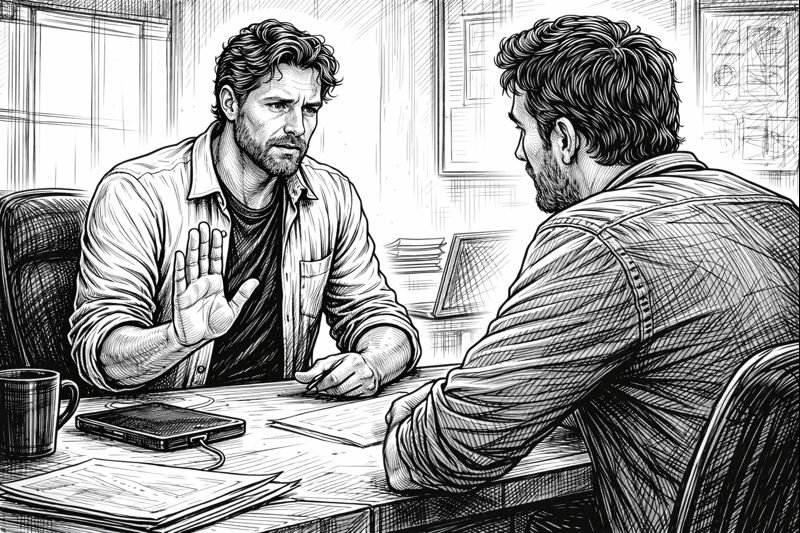
The No That Was Said Simply That “no” wasn’t said out of anger. It wasn’t even said out of courage. It was closer to exhaustion—exhaustion from explaining, from justifying, from fighting for something I wasn’t sure the other person truly understood. The offer came from someone whose background I knew well. He wasn’t a bad person. He might have even meant well. He talked about a joint project, a reasonable budget, a chance to be seen. But there was one condition: the tone of the work needed to change a little. Simpler. More digestible. Something that would “sell better.” We sat across from each other. He spoke in numbers; I spoke in feelings. He talked about the general audience; I talked about reality. The distance between us wasn’t personal or hostile—it was professional, but deep. In a moment I didn’t expect, I said: “No.” I didn’t explain. I didn’t leave the door open. Just no. I surprised myself with my own directness. For a moment, it felt like I had finally defended myself. Like this time, I hadn’t backed down. He shrugged. Said it was fine. Said there were other projects. And the meeting ended right there. When I walked out, I felt light. The kind of lightness that makes you think you did the right thing. I told myself some “no’s” are necessary. Some boundaries, if not drawn, make you lose yourself. A few weeks later, the same project was made with another director. I watched it—not to compare, just out of curiosity. It wasn’t a bad film. In some parts, it was even good. But it didn’t make me angry or happy. I just thought: if it were mine, it would have been different. Months passed. No new work came. Not that project, not something similar. The calls became fewer—not suddenly, but slowly, like the light fading at the end of the day. I realized that “no” wasn’t just an answer; it was also a signal. A signal I might have taken more seriously than I intended. One night I wondered: what if instead of “no,” I had said, “Let me think about it”? What if I hadn’t closed the door completely? If I had shown a little flexibility, would I really have betrayed myself—or just found a way to stay? The truth is, I still don’t know. That “no” came from the right place, but maybe not at the right time. Maybe it needed to be said, but not in that form. Today, when I think about that moment, I’m neither regretful nor certain. I only know that some “no’s,” like some “yeses,” must be said at exactly the right time. And professional life is full of decisions that are neither completely wrong nor completely right—we just understand their impact much later.
No comments yet