 @Arif.12
more from that month
@Arif.12
more from that month
North Pole
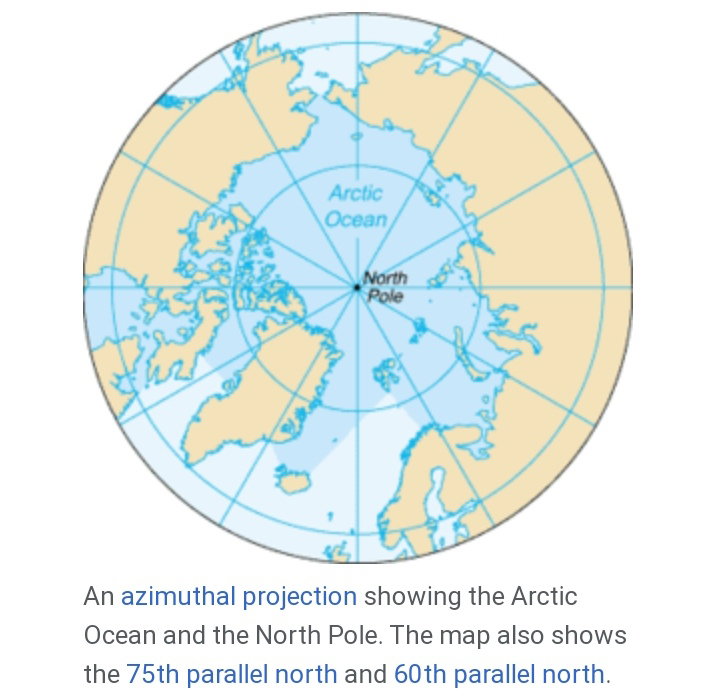
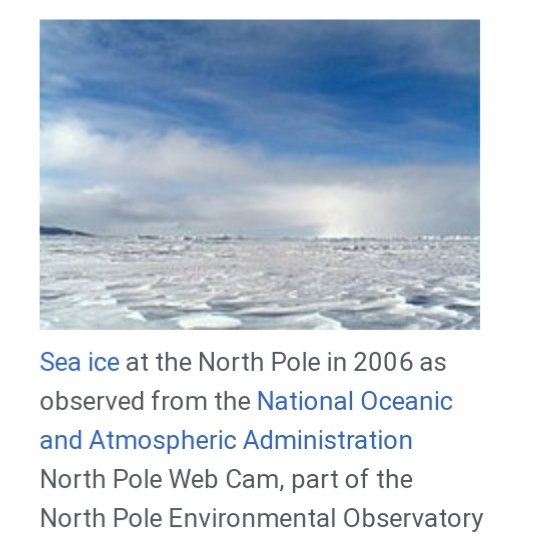
An azimuthal projection showing the Arctic Ocean and the North Pole. The map also shows the 75th parallel north and 60th parallel north. https://en.m.wikipedia.org/wiki/Map_projection#Azimuthal_(projections_onto_a_plane) https://en.m.wikipedia.org/wiki/75th_parallel_north https://en.m.wikipedia.org/wiki/60th_parallel_north Sea ice at the North Pole in 2006 as observed from the National Oceanic and Atmospheric Administration North Pole Web Cam, part of the North Pole Environmental Observatory https://en.m.wikipedia.org/wiki/Sea_ice https://en.m.wikipedia.org/wiki/National_Oceanic_and_Atmospheric_Administration
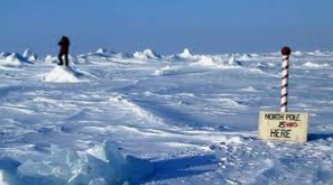
The **North Pole**, also known as the **Geographic North Pole** or **Terrestrial North Pole**, is (subject to the caveats explained below) defined as the point in the Northern Hemisphere where the Earth's axis of rotation meets its surface. https://en.m.wikipedia.org/wiki/Northern_Hemisphere https://en.m.wikipedia.org/wiki/Earth%27s_rotation The North Pole is the northernmost point on the Earth, lying diametrically opposite the South Pole. It defines geodetic latitude 90° North, as well as the direction of true north. At the North Pole all directions point south; all lines of longitude converge there, so its longitude can be defined as any degree value. Along tight latitude circles, counterclockwise is east and clockwise is west. The North Pole is at the center of the Northern Hemisphere. The nearest land is usually said to be Kaffeklubben Island, off the northern coast of Greenland about 700 km (430 mi) away, though some perhaps semi-permanent gravel banks lie slightly closer. The nearest permanently inhabited place is Alert in the Qikiqtaaluk Region, Nunavut, Canada, which is located 817 km (508 mi) from the Pole. https://en.m.wikipedia.org/wiki/South_Pole https://en.m.wikipedia.org/wiki/Latitude https://en.m.wikipedia.org/wiki/True_north https://en.m.wikipedia.org/wiki/Longitude https://en.m.wikipedia.org/wiki/Kaffeklubben_Island https://en.m.wikipedia.org/wiki/Greenland https://en.m.wikipedia.org/wiki/Alert,_Nunavut https://en.m.wikipedia.org/wiki/Qikiqtaaluk_Region While the South Pole lies on a continental land mass, the North Pole is located in the middle of the Arctic Ocean amid waters that are almost permanently covered with constantly shifting sea ice. The sea depth at the North Pole has been measured at 4,261 m (13,980 ft) by the Russian Mir submersible in 2007[1] and at 4,087 m (13,409 ft) by USS *Nautilus* in 1958.This makes it impractical to construct a permanent station at the North Pole (unlike the South Pole). However, the Soviet Union, and later Russia, constructed a number of manned drifting stations on a generally annual basis since 1937, some of which have passed over or very close to the Pole. Since 2002, the Russians have also annually established a base, Barneo, close to the Pole. This operates for a few weeks during early spring. Studies in the 2000s predicted that the North Pole may become seasonally ice-free because of Arctic ice shrinkage, with timescales varying from 2016 to the late 21st century or later. https://en.m.wikipedia.org/wiki/Antarctica https://en.m.wikipedia.org/wiki/Arctic_Ocean https://en.m.wikipedia.org/wiki/Sea_ice https://en.m.wikipedia.org/wiki/MIR_(submersible) https://en.m.wikipedia.org/wiki/Arktika_2007 https://en.m.wikipedia.org/wiki/North_Pole#cite_note-1 https://en.m.wikipedia.org/wiki/USS_Nautilus_(SSN-571) https://en.m.wikipedia.org/wiki/Amundsen%E2%80%93Scott_South_Pole_Station https://en.m.wikipedia.org/wiki/Soviet_Union https://en.m.wikipedia.org/wiki/Russia https://en.m.wikipedia.org/wiki/Drifting_ice_station https://en.m.wikipedia.org/wiki/Barneo https://en.m.wikipedia.org/wiki/Climate_change_in_the_Arctic
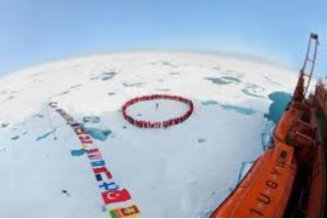
Attempts to reach the North Pole began in the late 19th century, with the record for "Farthest North" being surpassed on numerous occasions. The first undisputed expedition to reach the North Pole was that of the airship *Norge*, which overflew the area in 1926 with 16 men on board, including expedition leader Roald Amundsen. Three prior expeditions – led by Frederick Cook (1908, land), Robert Peary (1909, land) and Richard E. Byrd (1926, aerial) – were once also accepted as having reached the Pole. However, in each case later analysis of expedition data has cast doubt upon the accuracy of their claims. https://en.m.wikipedia.org/wiki/Farthest_North https://en.m.wikipedia.org/wiki/Norge_(airship) https://en.m.wikipedia.org/wiki/Roald_Amundsen https://en.m.wikipedia.org/wiki/Frederick_Cook https://en.m.wikipedia.org/wiki/Robert_Peary https://en.m.wikipedia.org/wiki/Richard_E._Byrd Day and night The sun at the North Pole is continuously above the horizon during the summer and continuously below the horizon during the winter. Sunrise is just before the March equinox (around 20 March); the sun then takes three months to reach its highest point of near 23½° elevation at the summer solstice (around 21 June), after which time it begins to sink, reaching sunset just after the September equinox (around 23 September). When the sun is visible in the polar sky, it appears to move in a horizontal circle above the horizon. This circle gradually rises from near the horizon just after the vernal equinox to its maximum elevation (in degrees) above the horizon at summer solstice and then sinks back toward the horizon before sinking below it at the autumnal equinox. Hence the North and South Poles experience the slowest rates of sunrise and sunset on Earth. https://en.m.wikipedia.org/wiki/Midnight_sun https://en.m.wikipedia.org/wiki/Polar_night https://en.m.wikipedia.org/wiki/Sunrise https://en.m.wikipedia.org/wiki/March_equinox https://en.m.wikipedia.org/wiki/Solstice https://en.m.wikipedia.org/wiki/Sunset https://en.m.wikipedia.org/wiki/September_equinox
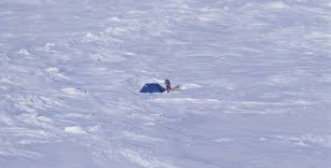
The twilight period that occurs before sunrise and after sunset has three different definitions: https://en.m.wikipedia.org/wiki/Twilight a civil twilight period of about two weeks; https://en.m.wikipedia.org/wiki/Twilight#Civil_twilight a nautical twilight period of about five weeks; and https://en.m.wikipedia.org/wiki/Twilight#Nautical_twilight an astronomical twilight period of about seven weeks. https://en.m.wikipedia.org/wiki/Twilight#Astronomical_twilight These effects are caused by a combination of the Earth's axial tilt and its revolution around the sun. The direction of the Earth's axial tilt, as well as its angle relative to the plane of the Earth's orbit around the sun, remains very nearly constant over the course of a year (both change very slowly over long time periods). At northern midsummer the North Pole is facing towards the sun to its maximum extent. As the year progresses and the Earth moves around the sun, the North Pole gradually turns away from the sun until at midwinter it is facing away from the Sun to its maximum extent. A similar sequence is observed at the South Pole, with a six-month time difference. https://en.m.wikipedia.org/wiki/Axial_tilt Time In most places on Earth, local time is determined by longitude, such that the time of day is more or less synchronised to the position of the sun in the sky (for example, at midday, the sun is roughly at its highest). This line of reasoning fails at the North Pole, where the sun rises and sets only once per year, and all lines of longitude, and hence all time zones, converge. There is no permanent human presence at the North Pole and no particular time zone has been assigned. Polar expeditions may use any time zone that is convenient, such as Greenwich Mean Time, or the time zone of the country from which they departed https://en.m.wikipedia.org/wiki/Longitude https://en.m.wikipedia.org/wiki/Greenwich_Mean_Time
2 comments
It's too cold
Yaaps