 @xuanling11
more from that month
@xuanling11
more from that month
Currency Comparison: Bitcoin vs Dollar

This article may show you something that you may have already known, but I want to show you the different aspects of Bitcoin and the US Dollar. Which one is a better currency? The answer is that it depends. Bitcoin is a decentralized currency using a peer-to-peer network called Proof-of-Work consensus without a need for third parties to process the transaction. https://coinmarketcap.com/currencies/bitcoin/ The US dollar is a centralized currency that the central bank oversees and facilitates transactions through a trust system. Both currencies have their own method to prevent double-spending. Bitcoin through cryptographic technology of unique digital signature and mining verification process while the dollar system uses the bank as a third party to verify the account integrity and to reject bad checks. There are many other metrics that I want to share with you. **Comparison Metrics**: I will show you the metrics to compare these two currencies through the following factors: - Total in circulation - Market capitalization - Divisibility - Hard fork - Transaction speed - Transaction cost - Layer 2 solution - Price volatility - Energy consumption - Illegal spending - Inflation/deflation **Total in circulation** It is how much money that exists in the system. Bitcoin: 18.8 million US Dollar: 2.19 trillion https://fred.stlouisfed.org/series/CURRCIR%20 **Market capitalization** It is how much the total worth of market value is in the system. Bitcoin: 0.92 trillion US Dollar: 2.19 trillion **Divisibility** It is what is the smallest amount of money it can be traded with. Bitcoin: 0.00000001 or 1 satoshi https://99bitcoins.com/satoshi-usd-converter/ US Dollar: 0.01 At current rate: 1 satoshi = USD $0.00049 **Hard fork** The hard fork is when code changes so much that it is no longer backward-compatible with earlier blocks. https://www.coinbase.com/learn/crypto-basics/what-is-a-fork Bitcoin: hard fork to Bitcoin cash US Dollar: hard fork to detach from Gold pegged currency after 1971 https://en.wikipedia.org/wiki/Bretton_Woods_system%20 **Transaction speed** It is how fast transactions can be made. Bitcoin: 60 minutes or faster https://blog.tezro.com/cryptocurrency-transaction-speeds/%20 US Dollar: immediately if pay in cash but 1 - 2 days for the check **Transaction cost** It is how much it costs to process the transaction. Bitcoin: $2.79 per transaction https://ycharts.com/indicators/bitcoin_average_transaction_fee US Dollar: 0 per transaction using cash **Layer 2 solution** It is a scaling solution that is additional to the established protocol to help process transactions. https://coinmarketcap.com/alexandria/article/what-are-cryptocurrency-layer-2-scaling-solutions Bitcoin: Lightning network https://en.wikipedia.org/wiki/Lightning_Network US Dollar: credit card payment system While the lightning network in Bitcoin reduces transaction fees, the credit card payment system increases dollar pays. Especially the payment between international, the dollar system charged up to 3% of each payment transaction. https://www.investopedia.com/foreign-transaction-fee-vs-currency-conversion-fee-know-the-difference-4768955%20 **Price volatility** It is how each currency fluctuates each day. Bitcoin: volatile US Dollar: stable Bitcoin is notorious for its fluctuating price that was marked as risky and it gained a reputation as security rather than currency. While the dollar is stable, other currencies may fluctuate largely. For instance, the Zimbabwe dollar shoots up 250,000,000% in July 2008. https://en.wikipedia.org/wiki/Zimbabwean_dollar **Energy consumption** It is how much energy is consumed per transaction of the currency.
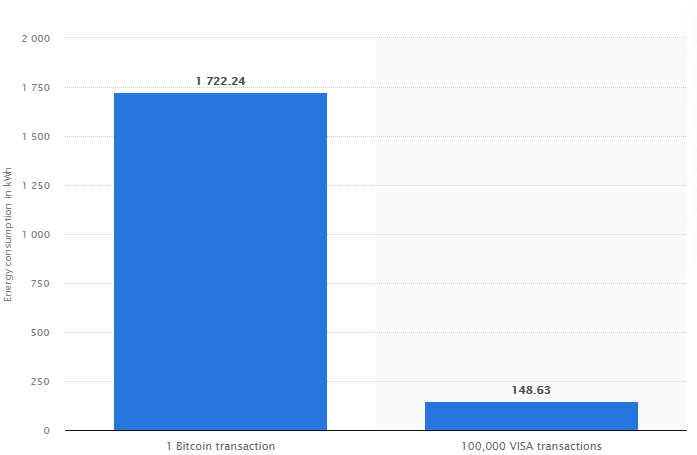
Bitcoin: 1 BTC per 1,722.24 kilowatt-hours https://www.statista.com/statistics/881541/bitcoin-energy-consumption-transaction-comparison-visa/ US Dollar: nearly zero 1 kilowatt-hour means a light bulb of 100-watt operating 10 hours. http://www.wrecc.com/what-uses-watts-in-your-home **Illegal spending** It is how much money is involved in illegal activities. Bitcoin: $10 Billion https://headtopics.com/us/illegal-use-of-bitcoin-dropped-by-50-in-2020-citibank-reports-18945490%20 US Dollar: $100 Billion https://cointelegraph.com/news/crypto-vs-cash-how-the-numbers-stack-up-on-drugs-guns-murders%20 **Inflation/deflation** It is how each currency may hedge against inflation or deflation. https://www.investopedia.com/terms/i/inflation.asp https://www.investopedia.com/terms/d/deflation.asp%20 Bitcoin: Inflation and Deflation US Dollar: Deflation Inflation means supply exceeds demand. The dollar devalued because it issued too much and exceeded what society needed. Deflation is when demand exceeds supply. It causes a decline in the price of goods and services. Bitcoin price will rise in the long term simply because it capped the supply and Bitcoin can be divisible more flexible than dollars as a smaller unit to use. The dollar does not have a fixed supply and it is fixed only with 100s. The dollar will continue to devalue while Bitcoin will continue to rise. **Here is the summary table to conclude the above discussion**
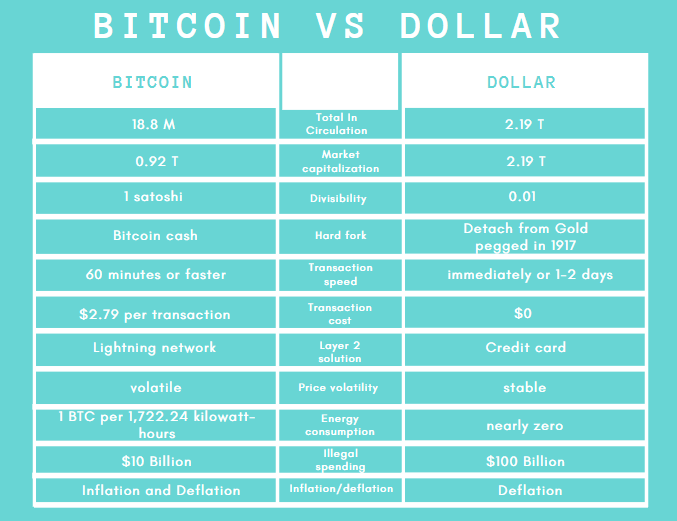
**In conclusion** There you go. Which system do you like the most? Hint: starts with B***
No comments yet