Game "probability"
In games, like games of coinfaucet.net or if you play CryptoHeroes, there are a recent discussion about people not getting the correct probability of item they're supposed to get. Let's talk about CryptoHeroes example here, but this may apply to other examples too. https://coinfaucet.net/ https://ecosystem.pixeldapps.co/cryptoheroes
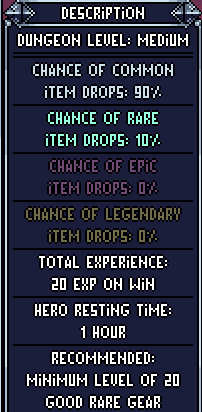
This is what you see in the description box when you want to go for dungeon. The game have 90% chance of dropping common items, and 10% chance of dropping rare items, but people started reporting that they played the dungeon say 100 times, but they only got 3-7 rare items. What happened? Is it false of this probability mentioned?
Actually not. **That's because we thought the probability are mutually dependent when they are mutually independent**. The explanations are available on lots of web pages, which you can search up online, but let's talk about it a little here. Remember this article aims to raise your awareness between the difference, these are not original ideas, popular among statisticians; but not very among end users like us.
So the idea is, you can "roll the dice" for 100 times and get 0 rares, in the case above, and the probability is still 10%. Reason is, they're mutually independent; what you get before does not affect what you get after. Just because you haven't get a rare in the previous 50 dungeons doesn't mean your 51th "roll" will be 50% chance of getting a rare. That's mutually dependent. Mutually independent means, whatever you have before doesn't affect whatever you have in the future. Your next 50 rolls after you got 50 common items, might still not get you another rare items, as the chance is still, 10%.
There may be some biases in the configuration though, especially we don't use a quantum computer to generate probability number in most cases (though there are developments of real quantum computer already available, and services to generate purely random number, you can search for IBM Quantum or quantum computer or other brands like IonQ quantum computer on Google). What we have is a pseudo-random quantum generator, and at a certain time, we might have a configuration that are biased towards a small number being generated on subsequent calls, another block of time biased towards larger number being generated on subsequent calls, hence decreasing/increasing our chance of hitting the threshold to get a rare equipment.
Any method to increase your probability?
This goes towards the programmer's side. Usually when we program probability, we program a threshold. When a number is larger than that threshold, then it's rare. If it's less than or equal to that threshold, then it's common.
random_number = generate_integer_between_1_and_100_inclusive()
threshold = 90
if random_number > threshold: # 91-100 inclusive
print("You got a rare item.")
else: # 1-90 inclusive
print("You got a common item.")
Instead of the above, you could have the value spread out instead. Let's see a naïve implementation of the detail.
random_number = generate_integer_between_1_and_100_inclusive()
these_are_rares = [5, 15, 25, 35, 45, 55, 65, 75, 85, 95]
if random_number in these_are_rares:
print("You got a rare item.")
else:
print("You got a common item.")
If you would like to increase the probability at a certain range:
# --snip--
these_are_rares = [5, 6, 7, 27, 28, 29, 65, 66, 67, 99]
# --snip--
These also can work out. (Of course, you might want to find way to create these systematically instead of hard-coded ones, like using random number generator to generate these numbers, or use the equal-spacing ones will have libraries to do that in Python, most probably in other languages too, or any method you can think of). Without thresholding, especially if your random number generator (RNG) keeps generating number in certain ranges most of the times, this might offer a higher probability (or lower, since you can program against it if you know how your RNG works) for getting certain items.
Conclusion
Hope you now understand how random number works in games, and don't be shocked the next time, if you can't get any wins matches those that you expect it to, just because of the difference between you expecting a mutually dependent outcome vs the computer's RNG producing a mutually independent outcome.
"Pay to win" is difficult to evade
It's difficult to evade "pay to win". There are games that tries their best to not "pay to win", but essentially it's hard, believe me. The moment you can buy something, and it is linked to some stats that differs with each items, it's most likely pay to win. Let's see several examples and how to create a game that's not pay to win.
Not pay to win's "pay to win"
Consider the game Gods Unchained. The cards have different quality (check here for the anatomy), each quality rarer than each other, hence they sell for more on the marketplace (perhaps 10x more as the quality increases, but not necessarily true, check on Immutable X Market then click Gods Unchained for more details). However, the quality does not affect the stats of the card; what's supposed to be strength 2 health 2 will still be regardless of its quality. That's what is explained as not "pay to win". You can buy rarer cards as a collection, but it won't make you win. https://godsunchained.com/ https://hive.blog/hive-173286/@cbizz/anatomy-of-a-gods-unchained-card-simple-straightforward-diagram-of-gu-cards https://market.immutable.com/
But it's still pay to win. Card games in general, you can buy a specific card that is "strong" compared to other weaker cards that you get. Not just in blockchain, but physical card games allows player to trade or sell very strong/excellent quality card (that has a high win rate) independently of the deck for a far more expensive price than how much it's usually sold on average. If you have the funds, you could spend a significant amount on gathering a good deck as an investment, and you expect you can win lots of game. In blockchain, winning means earning back.
What one wants to express here is, it's still "pay to win". The design didn't totally evade the element.
Of course, most games are still pay to win, without telling you they're "not pay to win". Example: Thetan Arena is pay to win (you get better NFTs that are stronger, more health, and faster speed than the ones they give you for free). Example: Galaxy Online are pay to win (your opponent that buy energy or Solarium or in-games items from the marketplace can build without waiting for resource gathering; while someone whom don't pay will have to wait, so a winning in terms of time, and time means monopoly in games that fight against each other). You list it. https://galaxyonline.io/
Really not "pay to win" games
We mentioned that "stats" attached to marketplace nfts allow for pay to win. To not "pay to win", remove the differences in stats. Example, you may be selling nfts for profile photo, or nfts for sound effect, graphic effects, and different designs of the same object that does not affect gameplay in any way. You may sell shirt of different design; wearing it only shows a more handsome/beautiful NFT, not add 1000 health to that NFT. Then, it's not pay to win.
Other non pay-to-win nft might include selling "season" (spring, summer, autumn, winter) background effects, selling weather nfts might be another. Though, weather nfts should be more vigilant on what type of game you're designing: one might be attacking from a town, with catapults and fire projectiles. If your fire projectile don't get extinguish during heavy rain, it could be explained via "oil can't be extinguish", but it could also give a twerk to the gamers hoping to get it extinguish.
Any further concerns?
To design a game with "not pay to win" is difficult. Some considerations include:
If your nft does not offer extra advantages over mine, why should one buy it? (except for hobby collectors)
What is a reasonable price to pay for nft that doesn't offer advantages? (i.e. pricing is usually determined by its use cases; but if it doesn't have proper use cases, what is the acceptable price range for widespread trading? Whether or not this might be lower than a pay to win perks requires more research, which I don't know)
How many players can you attract to the game? (it's predicted to be many, because people like non pay-to-win games. For others, it's not. Early joiners of the game are far forward from newbies, and newbies might want to catch up by quickly buying pay-to-win perks. Without pay-to-win, newbie requires training their strategies by learning online; which is good, but not everybody are willing to do that. Who are your targeted audience then? And are you happy with your final audiences?)
Conclusion
Designing a non "pay-to-win" game isn't easy; lots of factors can tilt you towards pay-to-win. Be thoughtful, and you could always ask the community for thoughts, if they support your to-be-designed game.
(This article is also written in publish0x here). https://www.publish0x.com/games-and-entertainment/pay-to-win-is-difficult-to-evade-xknlypq