 @thesotiris
more from that month
@thesotiris
more from that month
"God Is Dead and We Have Killed Him": Interpreting Nietzsche's Most Famous Quote

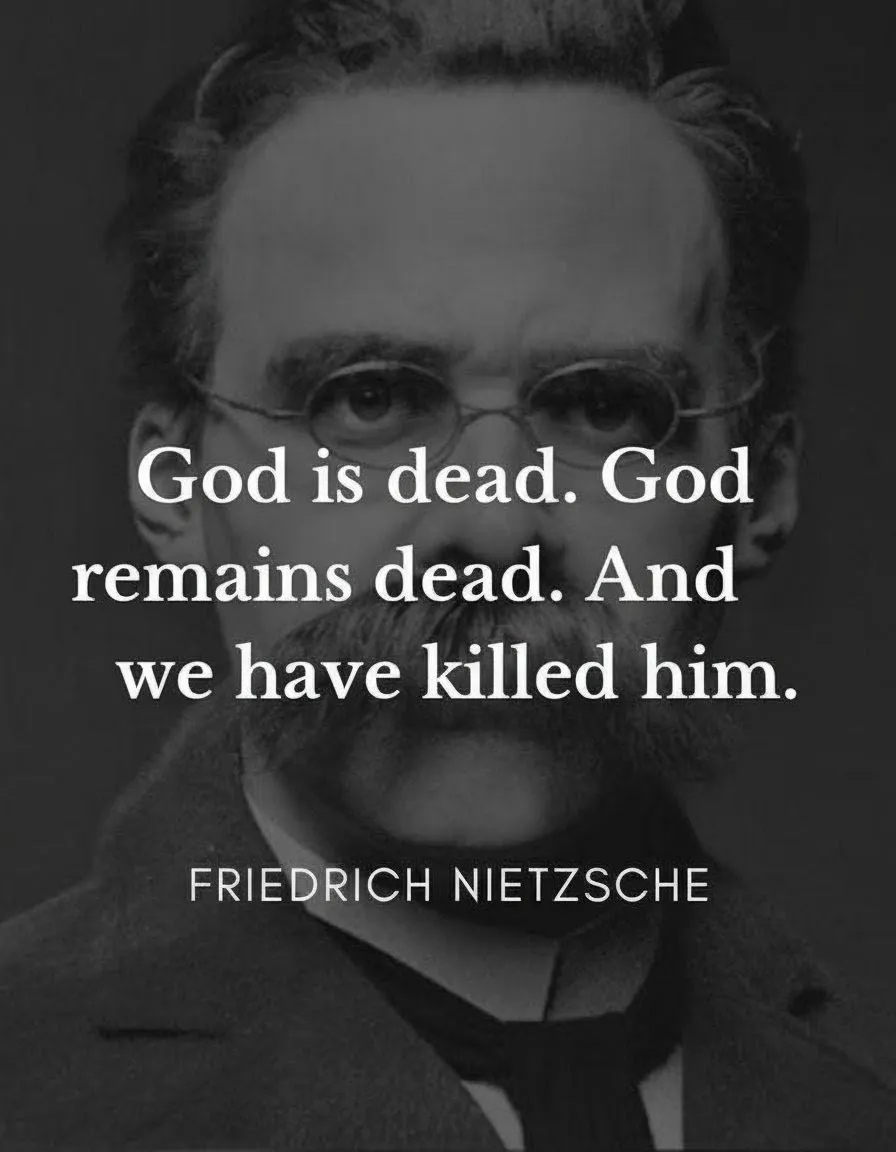
19th-century Europe can be characterised as industrious and paradigm-shattering. New political ideologies emerged while the decline of Hebrew mythology (mainstream Christianity) was steep. It was natural, thus, for the unabashedly and philosophically afflicted to observe and point out this weakening of religiosity in an era when scientific and engineering leaps called into question demonstrably false religious claims. What better way to announce a profound fall of religiosity than with the proclamation “*God is dead!*”, the quote for which Friedrich Nietzsche is most known? https://sotiris.substack.com/p/the-evil-of-abraham https://sotiris.substack.com/p/abrahamism-must-end https://sotiris.substack.com/p/peak-philosophy ***“God is dead. God remains dead. And we have killed him”.*** ***~ Friedrich Nietzsche*** I believe this wasn’t all Nietzsche was trying to tell us. The proclamation “*God is dead*” is not only a simple observation of the fall of manmade religiosity, and its displacement by equally irrational in their religiosity ideological cults, such as socialism, fascism, and democracy. https://sotiris.substack.com/p/statism-is-the-new-flat-earth https://sotiris.substack.com/p/socialism-fascism https://sotiris.substack.com/p/hitler-was-controlled-opposition https://sotiris.substack.com/p/the-dumbest-objections-against-statelessness-2 No. I think what Nietzsche meant by “*God is dead*” is that the concept of a benevolent, all-knowing, all-powerful “god” was losing ground: This world is obviously not the result of a benevolent, loving deity, and people are finally beginning to notice. **A quick observation of reality and simple deduction show that this world is the result of neither benevolence nor love**. At best, this world is the result of indifference or absurd randomness. https://sotiris.substack.com/p/proof-of-god https://sotiris.substack.com/p/on-our-cosmic-abandonment https://sotiris.substack.com/p/deducing-the-absurdity-of-reality If reality is indeed the consequence of a conscious, purposeful will instead of cold randomness, then it is definitely not benevolent nor all-powerful. **Nature is demonstrably flawed and indifferent**. **This existence seems more and more like a** **simulation** **whose purpose is beyond us and does not account for us**. We as individuals don’t have a purpose, but rather, we simply serve a purpose that is not for us. Any arbitrary purpose we delude ourselves that our life has is a purpose that does not transcend this simulation. Whatever purpose we have, if we have, for existing is a purpose that is for something or someone else, perhaps data generation, as is the purpose of all simulations. https://sotiris.substack.com/p/what-is-the-meaning-of-existence https://sotiris.substack.com/p/why-god-made-you https://sotiris.substack.com/p/the-case-for-the-simulation-theory Nietzsche never truly rejected the spiritual or the metaphysical. He simply denied the claim that divinity, or demiurgia, was ever benevolent. Once we free ourselves from this irrationality, the deluded Stockholm syndrome of sanctifying a frail reality and a flawed, needy demiurge. https://sotiris.substack.com/p/no-religion-represents-god https://sotiris.substack.com/p/what-is-god **A demiurge of reality would not be perfect or complete if it had a need to create**. Once we break the shackles that bind us to the prison of comforting delusion, we can be free to explore philosophy. Wisdom requires pain, the pain of truth, the pain of **knowing that you can’t know**, and that **you can’t attribute value to your existence simply on the merit of existing**; your life doesn’t come by default with built-in value or worth. https://sotiris.substack.com/p/freedom-is-inseparable-from-philosophy Ultimately, this is the humiliating humbleness that torments us all deep down. Attempt to hide it with the **translucent mask of** **narcissism** all you want; you’re not fooling anyone. https://sotiris.substack.com/p/the-narcissism-of-free-will
No comments yet