 @thesotiris
edited
more from that month
@thesotiris
edited
more from that month
Why Developed Societies Stop Having Children The soft suicide of childlessness and a new take on Maslow's hierarchy of needs

Have you noticed how, once a society reaches a certain level of socioeconomic advancement, its people tend to want to have fewer and fewer children? There’s a clear correlation; so what’s the causation? **Statistics** Japan’s population is imploding. Ethnically Western couples are content with just one or two children maximum (below replacement). In the same ethnic groups, it’s no longer rare or taboo to be childless. Hell, the ‘Western woman partying until 40 to then get pregnant from donated sperm’ is fast becoming normalised (survival of the wank-est). China, having rapidly climbed to “developed” status, and despite its now three-child policy (instead of just one) (a socialist policy enforced by its totalitarian government), has also inherited the curse of childlessness of developed countries. At the same time, third-world countries can’t seem to have enough children. Statistics show that the less parents can offer to their kids, the more kids they seem to want to have. https://worldpopulationreview.com/country-rankings/birth-rate-by-country The reason is obvious: Less socioeconomic advancement means lower standards. Underdeveloped individuals will not be good parents and will not hesitate to bring a child into a horrendous environment. On the contrary, developed individuals would rather not have children than create a life in bad circumstances. It’s **the nobility of the lion refusing to procreate when in captivity**. The lion refuses to be a farm animal. He’d rather die. And this is was denying procreation is: soft suicide.
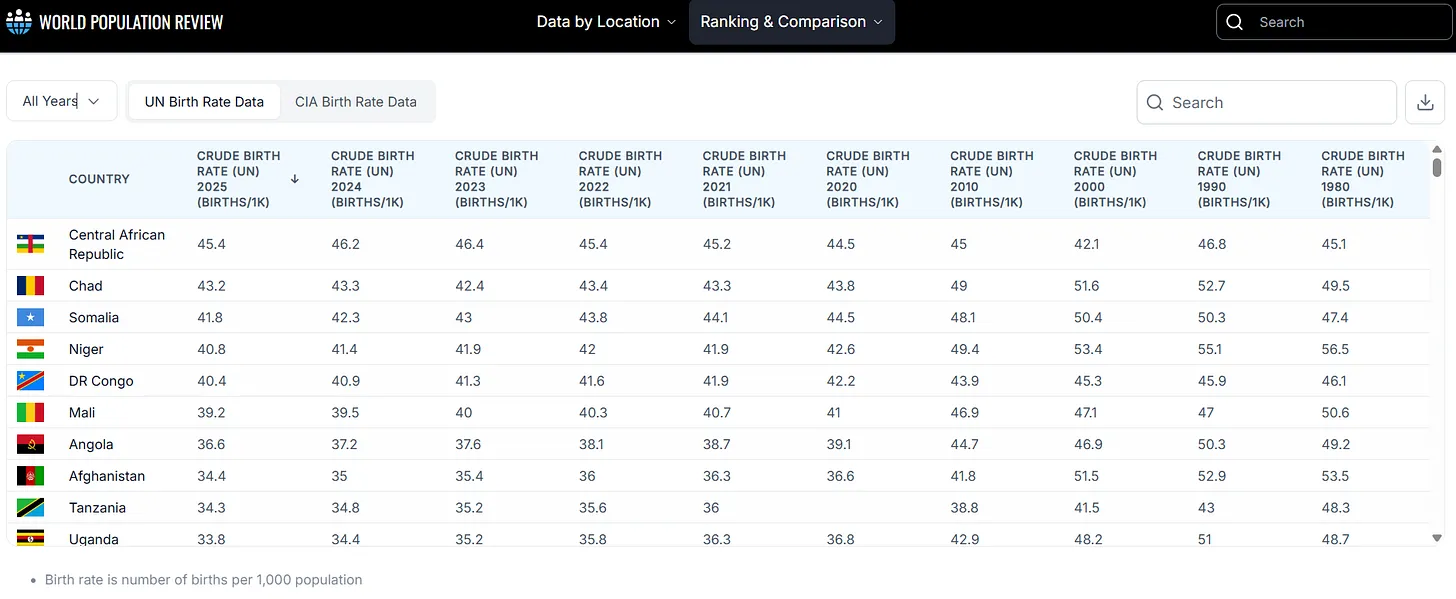
Birth rates by country descending

Birth rates by country ascending The “easier” we have it technologically and socioeconomically, the less we need to have kids. Why? **Reversal** However, on a micro scale in developed countries, we see the opposite: the more prosperity and hope for the future, the more children. Boomers (from the ‘baby boom’ generation) were the result of the post-war monetary paradigm, this massive money supply increase that rapidly expanded the world economy (the US in particular). If you understand monetary economics, you know that this type of money counterfeiting is essentially a loan from the future to be paid for by those who have to face the consequences of inevitable economic recession — a direct and exclusive consequence of central banking (artificial monopoly of money supply, monetary manipulations through money supply counterfeiting and imposed interest rates). Historically, in the US, the decline in birth rate coincides with economic recession. https://sotiris.substack.com/p/losing-hope-part-2 https://www.macrotrends.net/global-metrics/countries/usa/united-states/birth-rate
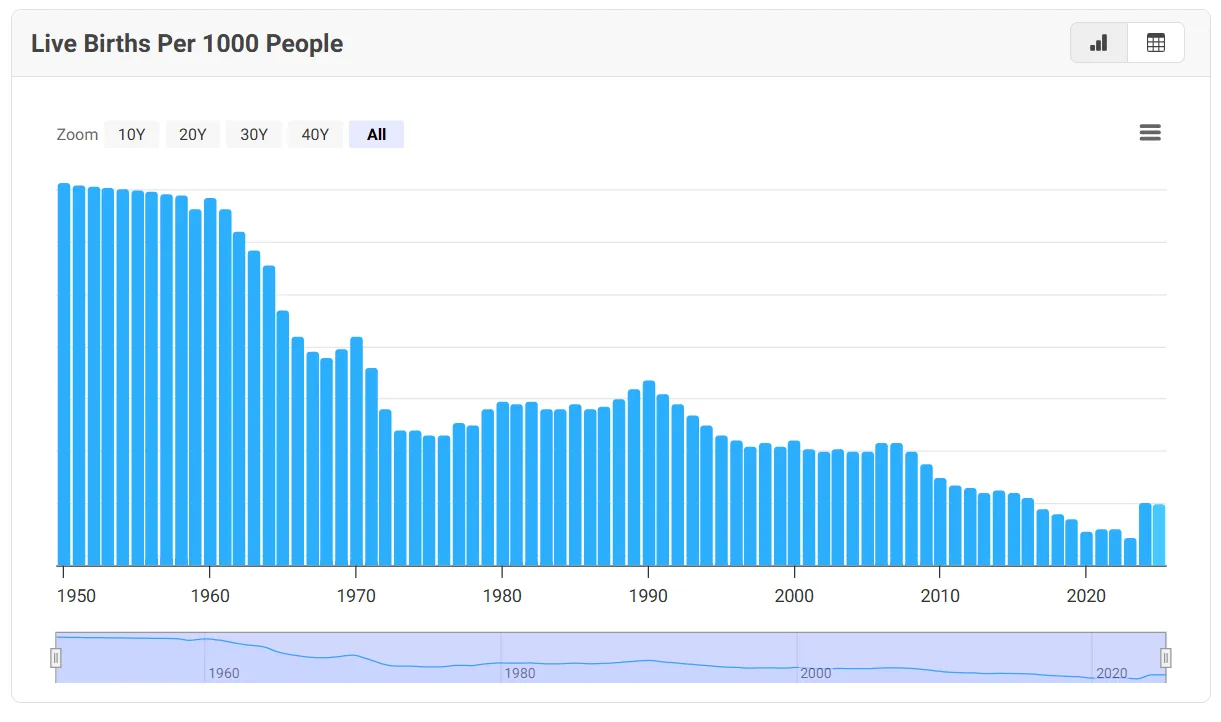
So, now we are faced with two contradicting realities: On a macro scale (of how developed a country is), there’s a negative relationship between birth rates and development (development being GDP, technology, living standards, relative hope and positivity for the future). **It would be selfish and cruel to have children if you were cynical about your future**. https://sotiris.substack.com/p/doomer https://sotiris.substack.com/p/muh-optimism On the micro scale, within developed societies at least, the better off you are, the more children you are likely to have. Why? Because those who suffer during economic recession are primarily those with lower incomes, and if birth rates decline during economic recession, it’s the lower incomes that suffer the fallout. And we see how the highest incomes of developed societies have the most kids (see the billionaire class, and the well-off who can afford to have kids. This stark contradiction gives rise to the question: How is it that the least developed countries have the most kids, but the least developed people in the most developed countries have the fewest? How is it that those who tend to give up on having kids are the mid-to-low incomes in developed countries? **Analysis** First, let’s get rid of the ‘whynots’. No, it’s not libido, fertility, or lack of contraception. It’s insulting to suggest that some people are so dumb they don’t understand the risks and toils of pregnancy, especially in communities plagued by scarcity. In a world with wide access to the morning-after pill and abortion, when a woman has a kid, it’s almost always because she wants to, in any socioeconomic category. We thus deduce that procreating depends on the desire to procreate. So, what influences the desire to have children? In my article ‘In defense of brutalism’ and ‘Why civilisations collapse’, I made a case for the descent into, essentially, nihilism once our survival needs are met, and we then begin to see the **futile absurdity** of it all. https://sotiris.substack.com/p/in-defense-of-brutalism https://sotiris.substack.com/p/why-civilisations-collapse Imagine being born in a prison (of needs), and imagine the outside world being paradise. But once attain your needs, once escape the prison, you realise that the outside world is barren and empty, devoid of meaning. Once you fulfill the need, you find that there is nothing you really want because there is nothing meaning to want. https://sotiris.substack.com/p/need-versus-want **Realisation** It’s easy to keep going when your entire life’s purpose is survival and taking care of your basic needs. This gives us an illusion of purpose, saying dumb shit like “*the meaning of life is having children*”. But this is a circular reasoning fallacy: the purpose of life is perpetuating life? That is simply illogical because this is not a purpose that transcends life; therefore, it is not a meaningful purpose. Once the perpetuation of life becomes effortless, we begin to see its futility, something that was hidden from us by the struggle to survive, when procreating and sustaining life was harder. **The delightful struggle** Struggle masks the futility of life, and it romanticises an imagined life without it. Struggle even gives rise to deluded purpose and meaning. **It is struggle that gives hope to the slave rather than the master, something the master envies in the slave**. The master has no hope and anticipation because he has all that is possible to have hoped for and anticipated. I sometimes look at struggling ethnic groups like Palestinians and can’t help but feel envy for them. They have such a clearly defined purpose and passion derived from it that their lives seem richer and more fulfilling than everyone else’s. Palestinians, despite their historical struggles, seem more alive than those who have all their natural problems more or less solved, and who’ve reached the point of wondering what the point of it all is. And **I wonder if, on some conscious level, such ethnic groups crave this struggle, and don’t even want to solve it**. Despite the misguided nonsense of petty politics that Palestinians struggle for, it still gives them a sense of purpose and meaning, albeit a delusional one. “*How dare you disparage our favourable pets, our chosen “**noble savages**” whom we* *patronise* *with our* *condescending pity* *and* *pretentious* *faux* *solidarity**?*” https://sotiris.substack.com/p/the-noble-savage-myth https://sotiris.substack.com/p/why-the-west-is-ngmi-part-2 https://sotiris.substack.com/p/the-evil-of-ill-intentioned-empathy https://sotiris.substack.com/p/the-loudest-moralists-tend-to-be https://sotiris.substack.com/p/no-good-deed-goes-unpunished Well, I’m not against Palestinians, but I’m also not sympathetic to an ethnic group whose mothers pride themselves on having children to make them martyrs for a bullshit political cause. I’m sorry that I’m not sorry for not supporting such barbarism. And spare you the false dichotomy fallacy: I’ve criticised the Hebrews much worse. https://sotiris.substack.com/p/islamic-feminism-and-muslim-matriarchy https://sotiris.substack.com/p/why-islam-is-the-smartest-religion https://sotiris.substack.com/p/on-judeo-christianity **The psychodynamics of positive expectation** **Advanced civilisations manage to climb** **Maslow’s pyramid** **only to find that there is nothing there**. In “The Odyssey: A Modern Sequel” by Kazantzakis, Odysseus, having finally reached Ithaca, becomes bored and misses the journey, the struggle, the purpose. https://en.wikipedia.org/wiki/Maslow%27s_hierarchy_of_needs https://archive.org/details/dli.bengal.10689.1739/mode/2up https://en.wikipedia.org/wiki/The_Odyssey:_A_Modern_Sequel It’s easy to have a purpose (and thus meaning) when you’re away from home, but when you do get home, you miss the adventure. It’s like an open-world video game: main missions and side-quests may seem daunting, but they grant you delightful purpose. You have a great desire to finish the game, but when all objectives are met, the world immediately feels empty, no matter how many repetitive tasks the game developers give you to maintain a perpetually pointless completed game. Play Assassin’s Creed or Dying Light, or any video game that continues in a zombified state even after you’ve completed the story, and imagine that game being your life. Yes, our reality is one big open-world simulation, as all religions essentially describe. https://en.wikipedia.org/wiki/Assassin%27s_Creed https://en.wikipedia.org/wiki/Dying_Light https://sotiris.substack.com/p/the-simulation-question https://sotiris.substack.com/p/no-religion-represents-god The underdeveloped individual is he who still hasn’t finished the game; struggling, but still endowed with glorious purpose. The developed individual is he who’s completed it, but now faces purposelessness: a state from which it is impossible to escape. It’s easy to be satisfied when you’re dissatisfied: when you have a strife and purpose, while you’re climbing the ladder, when you’re journeying. You keep hearing that the journey is better than the destination, the anticipation of Christmas is better than Christmas. This is because the attainment of a goal deprives us of the goal. Without anything to strive towards, what’s the point? Perhaps this is what the allegory of Sisyphus truly means: that ultimate success never lasts, and that as soon as you attain it, you inevitably go back to square one. With **all attainable goals attained**, we see the emptiness of existence. Free from **haughty aspiration**, we finally experience **the humility of meaninglessness**. https://sotiris.substack.com/p/xanax-and-coffee **Aspiration is not without a hint of narcissism and delusion of grandeur**. Look at every single up-and-comer in any field, and tell me they are not **driven by pride and delusion**. **When you’re climbing, everything feels majestic, eternal, and cosmically important, when it’s not**. Once you reach your peak, and then the only way is down, you see the futility of it all. This is what Sisyphus teaches us. That is when you acquire **the gift of humility, whose price is futility**, a price that is so high it may not even be worth it. But it is what it is. Have you noticed a decline in morale in developed countries? We reminisce about the positivity of the 1980s because we were climbing, and it was felt and expressed through positively hopeful art (upbeat pop music, colourful fashion, gorgeous cars, utopian science fiction; there was a profound positivity in 80s). Technology was on the rise, and we expected a utopian future with flying cars by 2015. The Cold War was ending, and we thought that we’d outgrow war, given our civilisational development. From movies and music to colourful neon lights and fancy car design, the positive expectations of the 80s were noticeable then as they are now. https://www.imdb.com/title/tt0096874/ Nothing shows as clearly this **transition from goal attainment to the depressing realisation of futility** than the evolution of rock music: **the ultra-positive glam rock of the 80s to the dark, depressing grunge of the 90s**. We went from the partying Whitesnake and Mötley Crüe to “music to write your suicide note to” from Nirvana and Metallica. Even music from the same bands was brighter in the 80s and darker in the 90s (see the massively influential Iron Maiden, for example). https://en.wikipedia.org/wiki/Iron_Maiden_discography ***Cause all of the stars are fading away. Just try not to worry. You’ll see them one day.*** ***~ Oasis in ‘Stop crying your heart out’*** **Maslow’s ‘hierarchy of needs’, expanded** Developed countries had a clear purpose and upward trajectory from the late 19th century. By the 1980s, they appeared to have solved all their immediate issues: apparent economic growth, stability, technology, comfort, and emotional needs fulfilled. After the 1980s, people began to realise there was nothing more to be gained, other than upgrades of existing tech. Since the 1980s, we've gotten nothing but that: minor upgrades, but no growth in meaning, no expansion of consciousness. We reached the top only to see the abyss: there is nothing beyond that, nothing more we’re capable of, or destined for. This is it. Once you’ve reached the top of Maslow’s pyramid — the peak of the hierarchy of needs — you realise there’s nothing else there for you, no drive, no purpose, no meaning, no consolation for the nightmare of existence. Perhaps this is why the ultra-powerful of this world are so desperate to manipulate it all: it gives them deluded purpose, meaning that makes their pointless, useless, and demented existence bearable. https://sotiris.substack.com/p/psychological-profile-of-the-ruling
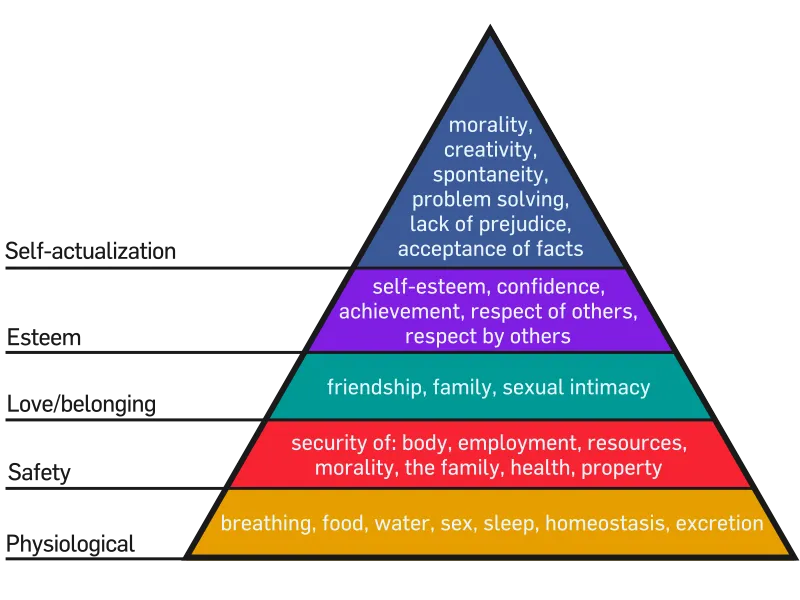
Maslow’s hierarchy of needs ends in self-actualisation, and the witnessing of nothingness beyond that. When you’re on your way up, you imagine your potential to be endless. This is the **delightful illusion of the climb, the journey**. However, once you see that your potential was much more limited than you originally expected, and you begin your descent before you attain what you imagined was attainable, you are tempted to ask yourself: “*What was the point of it all, anyway?*” There is **humility in this kind of nihilism**. There is an element of **narcissism in aspiration**. What’s the reason for building **majestic buildings** when you realise they were all immortality projects of self-aggrandising, a testament to our narcissism and fear of death? Is brutalism the result of the **humble realisation that our aspirations were nothing but towers of Babel, desperate attempts at self-deification**? Is this why **developed countries descend into cynicism**? https://sotiris.substack.com/p/in-defense-of-brutalism What’s the point of having children when all you’re accomplishing is **depriving an innocent soul of the bliss of non-existence**, and forcing it to go through the **nightmarish mind-fuck that is human life**, condemning it to exist as a slave to its nature, tormented by the fear of death, and too attached to its reality to escape it? Why would you do anyone so dirty other than for the haughty self-aggrandising of “a legacy”, this deluded cheating of death in the form of “living forever” through your bloodline? Is parenting fundamentally narcissistic? In most cases, at least, I am certain. https://sotiris.substack.com/p/demiurgical-responsibility https://sotiris.substack.com/p/holding-god-accountable https://sotiris.substack.com/p/narcissistic-parenting-part-2 So, once you’ve experienced futility, why would you then consciously choose to have children, to condemn innocent souls to the same futility, especially when they never had the chance to choose it for themselves? **Is it a virtue to have children, or a self-serving vice?** At least in the case of ethnic groups who **have children to make them martyrs for petty politics**, we know that parenting is evil narcissism. https://sotiris.substack.com/p/anti-antinatalism https://sotiris.substack.com/p/narcissistic-parenting-part-2 When you accomplish everything there is to be accomplished within the confines of your limited, frail nature, and when you achieve the humility to accept your human limitations, you see the void and the nothingness beyond. **After the fulfillment of basic physiological and emotional needs comes the void**, the realisation that all the dreams, strifes, and aspirations were just **comfortable delusions** to make the struggle of life seem **meaningful and thus bearable**. **The journey is always better than the destination**, just like the anticipation of Christmas is always better than Christmas, and the eagerness for adulthood is better than adulthood. **Anticipation and hope are life’s ultimate cope**. But once you’ve achieved all that you need to achieve, then you realise that **Ithaca wasn’t all you imagined it would be**. **The cost of attaining a goal is purposelessness**. And thus, **we descend into meaninglessness and the soft suicide of childlessness**.

What can we do about this? Enter the deluded motivational speaker and his preaching of “infinite mindsets” and “constantly finding new goals” like a proper Sisyphean nightmare. At the peak of the hierarchy of needs, we have **disillusionment and the realisation that it was all for naught**. While we were climbing, we imagined the climb to be endless, infinite. But once we reach the peak, and the two-second thrill of achievement fades, we realise there’s nothing more. This is when we look for glorious distraction. This is why those who seem to have it all desperately resort to **drugs, alcohol, hedonism, vice, and perversion**. These are potent **distractions from the final realisation of pointlessness**. When there is nothing left to achieve, when we face the void, all we can do is find distractions to avoid facing this harsh, depressing reality. These distractions are a cope, a pathetic substitute for our past phases of continuous growth. And this is why only the rich in developed countries engage in distraction — this substitute for purpose: because they can afford it.
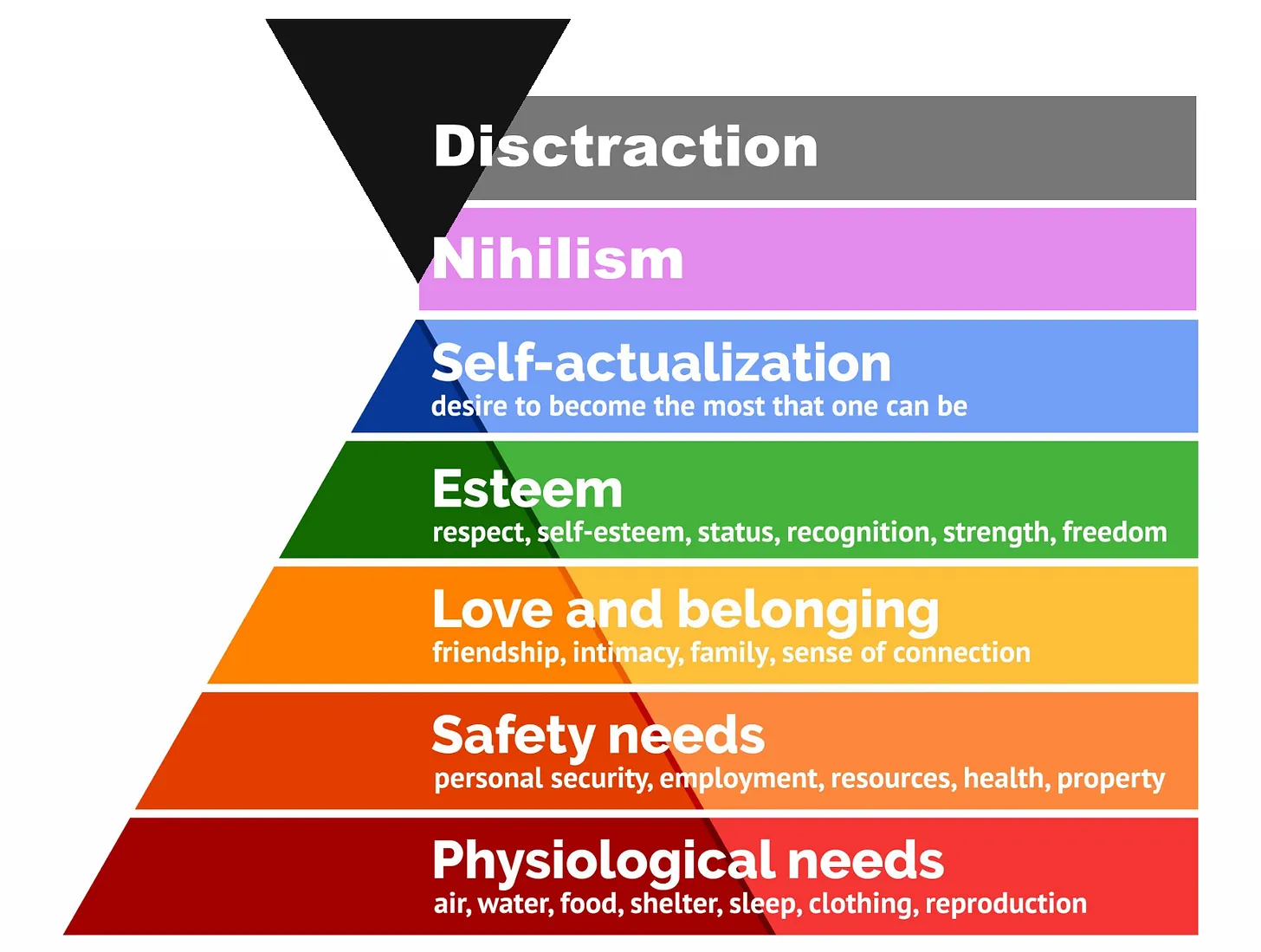
**This paradigm explains why the low-to-mid income classes in developed countries tend to have fewer children (if any), while those who do have many children are the rich in those same territories, and people in underdeveloped countries.** They are **advanced enough to have high standards, but not advanced enough to meet them**. This is why lower-to-mid incomes in developed countries don’t have above-replacement number of offspring. Yes, there are multiple examples of low-income people in developed countries who have plenty of children regardless. But if you look at them closely, they are usually deeply religious or are driven by some deeper ideology, which grants them the convenience of a perpetually unreachable purpose, enough to make their life bearable. Remember, childlessness is the result of a **lack of purpose** and/or a **lack of distractions**. You can still have children even when you lack both, but that’s not meaningful, purposeful procreating; it’s becoming a parent accidentally, or **your children become your distraction from pointlessness**. **What is parenthood?** I’ve made the case for narcissistic parenthood before. Let’s face it: procreating is the consequence of biological programming on a physical level (sexual urges) and psychological level (emotional need to identify as an exclusive mentor and caregiver, and to receive unconditional love from an innocent soul, whether deserved or not). https://sotiris.substack.com/p/narcissistic-parenting Procreating is an immortality project, or heroism project, or *causa si* project. It’s the ultimate **delusion of cheating death via proxy**, of creating a death-defying legacy, something in our name and image that will outlast us. It doesn’t get any more prideful and hubristic than that. It makes us feel godly while it soothes our fear of death, this constant dark thought creeping at the back of our minds, which fundamentally drives our emotions and thought processes. This is why even the most abusive parents tend to gradually treat their children more kindly the closer the parents get to death’s doorstep: they need their children to reinforce their **delusion of “legacy”**, this comforting lie that makes the idea of death somewhat tolerable. In a way, it even makes us feel immortal. The hubris! https://en.wikipedia.org/wiki/The_Denial_of_Death https://sotiris.substack.com/p/true-blasphemy https://sotiris.substack.com/p/holding-god-accountable The vast majority of parents (if not all) choose to have children, not because they have an abundance of love to give (this is self-serving in itself), but because they need a human pet from which to extract unconditional acceptance, whether it’s earned and deserved or not. This is why the dog is the most popular pet: dogs obsessively love you, no matter how badly you treat them or others. The same with children. But the long-term benefit of procreating is the delusion of legacy, this cheap substitute for immortality, creating a “part of you” that will outlive you. And this is what compels most parents to be possessive of their children and entitled to orchestrate their whole lives. Parents imagine their children to be part of them, and they thus believe they own them, body and mind. Individual thought and behaviour deviating from the parents’ signals a loss of legacy, a failure of the “immortality project”. **Conclusion** It seems that humans **cannot stay satisfied with achievement, and cannot be content with the process of achieving** — otherwise we wouldn’t be striving towards achievement, and wouldn’t be depressed in inaction. This is our nature forced on us, a nature not of our choosing, from which we cannot escape. Thus, free will is impossible (accountability, however, isn’t). https://sotiris.substack.com/p/free-will-revisited https://sotiris.substack.com/p/excuses-vs-explanations-part-2 When you don’t know if you can satisfy your basic needs tomorrow, you are blessed with clear purpose, drive, aspiration, and hope. It’s a clear case of the anticipation being greater than the experience itself. Once you’ve satisfied your basic and emotional needs, once you — as a person or society — have climbed the ladder as high as it goes for you, and have realised your potential to its maximum, then there is nothing to strive towards. You abruptly awaken to the realisation that there was no point to it all to begin with. The journey was just the delightful illusion that Ithaca and Penelope would fulfill you. The journey gives you purpose, meaning, and drive, albeit misguided. But once the journey ends, you quickly see that neither Ithaca nor Penelope were enough to grant meaning to existence; nothing is. Success comes at a cost: the loss of deluded purpose, since all purpose is deluded. We can further delude ourselves with the Limbo of the “infinite mindset”, whereby we pretend to have a cause when we don’t, not really. If the cause is to stay where you are, you’re not attaining anything; you’re just that guy in his 50s shooting Botox and dying his hair, who still frequents nightclubs and hits on teenagers. **True success means attaining awareness of futility**. Isn’t that what Buddhism and Judeo-Christianity teach, by the way? All is vain and futile in Christianity, and it takes Christ-like humility to accept this. https://sotiris.substack.com/p/on-judeo-christianity https://biblehub.com/ecclesiastes/1-14.htm When you realise — truly realise — the absurd meaninglessness of it all, there is hardly any motivation for you to build things that will outlive you, or to condemn innocent souls to a meaningless existence like the one you have experienced. https://sotiris.substack.com/p/deducing-the-absurdity-of-reality It’s the realisation that there is nothing beyond the satisfaction of our needs. While we’re struggling to satisfy them, we think that’s purpose enough. Once we do, there is nothing else achievable by us, and we finally gaze into the void, the nothingness beyond the limitations of our inescapable nature. This is when we give up on deluded aspirations and give in to pointlessness and nihilism. And there is no greater vice, no deeper nihilism than **philosophy****, the breaker of concepts, the infernal machine that runs on cynicism**. https://sotiris.substack.com/p/peak-philosophy They say that we’re never happy with what we have. But how can you when all you have is just the satisfaction of the needs of a nature not of your choosing. All you have in your existence is the addressing of your physical and emotional imperatives imposed on you by your biological programming. This is the challenge, this is our journey, our supposed meaning. And we tell ourselves it’s enough. It isn’t. Why would anyone feel happiness or fulfillment from the mere satisfaction of desperate needs? Sure, the next need keeps us hoping and content in our misery, but what if we achieve it all and figure out that this meaninglessness is as good as it gets? The simple addressing of a need is not happiness. Only satisfying a want can be meaningful, even though what we want is still the consequence of our unfree will. And what we want — deeply want — is always elusive: love, meaning, and true identity that transcend spacetime. https://sotiris.substack.com/p/need-versus-want ***Look at the stars, look how they shine for you and everything you do.*** ***~ Coldplay, ‘Yellow’*** Are we negative or “complaining” when we want something more than the ticking of boxes on a list not of our choosing? Are we ungrateful for wanting more from our involuntary existence than some dog food and a pat on the head, which we never asked to need in the first place? Are we to blame for the frustration of being tied to a life unwanted, and being emotionally attached to it to ensure we stay in it? Are we haughty for not being content with the pointlessness of meaningless obedience to our biological programming? Is there anything that we do that isn’t fundamentally driven by our natural imperatives? Anything at all? Even the delusion of free will seems to be one. https://sotiris.substack.com/p/the-narcissism-of-free-will **Final thoughts on suicide** A decline to procreate is soft suicide, or suicide on a societal level, since children are a tiny, delusional — but existent, nonetheless — comfort to the reality of death. https://sotiris.substack.com/p/on-suicide All cosmology — religious or otherwise — is simulation theory. What is suicide other than the absolute defiance of this simulation’s imperatives? If we are programmed to be attached to life and to fear death, then suicide is perhaps the only pure act of free will we are capable of: **the program defying the programmer**. https://sotiris.substack.com/p/the-case-for-the-simulation-theory There’s a scene in the Animatrix’s ‘Kid’s story’ where the protagonist dreams of falling to his death… https://en.wikipedia.org/wiki/The_Animatrix

…and then it happens — the only escape from the simulation. Of course, it goes against the rules of the movie. In the movie, if you die in the Matrix, you die in the real world too. But in the Animatrix, it was suicide that freed him. Perhaps what the authors wanted to say is that reluctant death can’t free us; it just brings us back to the life and reality we were attached to. But willing death, that one final act of absolute Buddha-level detachment, is the only thing that can free one from the prison. Note: this is not to promote suicide. I don’t want anyone to kill themselves or to contemplate it over this. We are just philosophising here, just thinking out loud and generating ideas. Isn’t data generation the only purpose of any simulation anyway? I often wonder whether philosophy is the goal of this reality. https://sotiris.substack.com/p/the-dead-end-of-philosophy ***“I think the honorable thing for our species to do is deny our programming. Stop reproducing. Walk hand in hand into extinction — one last midnight, brothers and sisters opting out of a raw deal.” — Rust Cohle, ‘********True Detective********’*** https://www.imdb.com/title/tt2356777/ **Sources** World Population Review — Birth Rate by Country 2026 https://worldpopulationreview.com/country-rankings/birth-rate-by-country U.S. Birth Rate (1950-2025) https://www.macrotrends.net/global-metrics/countries/usa/united-states/birth-rate The Denial of Death — Wikipedia ‘The Denial Of Death’ by Ernest Becker https://archive.org/details/thedenialofdeath
No comments yet