 @thesotiris
more from that month
@thesotiris
more from that month
The Narcissism of "Free Will" Claiming false credit is the equivalent of rejecting due accountability The miserable man wants to believe that all misfortune must be fully attributed to factors outside of his control, a coping mechanism to relieve him of self-blame on top of suffering failure. The successful man wants to attribute all his accomplishments to himself and his alleged “free will”, thus claiming full credit for all his blessings as if it were all up to him and him alone; a self-credit bias that fosters the hedonism of self-aggrandisement. https://sotiris.substack.com/p/free-will-exists They are both wrong. These two extremes are yet another false dichotomy. Reality lies in between these two extremes, and on different levels. We deserve **neither blame nor credit** for whatever happens to us, or for whatever we achieve. If you are **humble** enough to accept your agency in your failures, then you should be humble enough to deny owning credit for unearned merit randomly bestowed upon you. This is a follow-up to ‘Why I Reject Free Will’. For added context, read ‘Excuses vs. Explanations [Part 2]’. https://sotiris.substack.com/p/why-i-reject-free-will https://sotiris.substack.com/p/excuses-vs-explanations-part-2

**A personal story** I once argued with an insufferable relative afflicted with narcissistic personality disorder — a hopelessly individual, desperate for recognition. He arrogantly claimed full credit for and ownership of his supposed “success”, which was just a lucrative, parasitical, and useless position in government, of all places. He claimed credit for his supposed merit, simply “studying hard” in school to get the best grades. He attributed all his status to his intellect, hard work, and good decisions, **failing to realise that his confession of a by-default higher intellect, propensity for toiling, and superior decision-making skills was an admission of sheer, random, and undeserved luck** — so much for intelligence, or at least intellectual honesty. While he was making the claim that his “free will” was superior by default, he was indivertibly admitting that will could not be free; he somehow inherited it randomly from nature. Who he was was a product of randomness. We all are. He further insinuated that my by-comparison failures were due to the fact that I did not work hard enough at school, as he did. Yet, people tend to make erroneous conclusions through inductions and association fallacies (so much for his superior “intellect”). I *did* study hard. Straight after university, I was among the first three finalists out of 1800+ applicants for just six highly sought-after positions at one of the largest local banks at the time. Not only was the position a privileged one, but it would have also been the start of a career in finance, which at the time was what I wanted. But **hard work rarely pays off**, and all the proof you need lies right in front of you: look around and witness that **the hardest-working people earn the least, and the positions rewarded the most are by far the least strenuous**. And this is just for money and status as parameters of success. In other areas of life, like romance, health, creativity, spirituality, and peace of mind, you’ll find that, often, the people who work the least to succeed in those areas seem to succeed the most. While hopefuls struggle to no avail, others seem to have success fall into their laps. Back to my story… Months of examinations and on-the-spot aptitude tests proved that I was good for the role. I received a letter and a phone call from the bank’s HR manager informing me that I was among the top 3 candidates. She congratulated me and asked whether I was still interested. I said I was interested. I was overwhelmed with joy and a sudden surge of positivity, and a renewed sense of faith for a world that, up until then, seemed to hate me. So, the HR manager informed me that I should receive an offer in the next couple of months. Those two months were among the happiest of my life because I possessed hope — false hope. Months pass, and nothing. I kept waiting, and waiting, working as a bartender to survive. No one gave me a chance at a corporate job, not in that economy at the time. Then an acquaintance of mine who happened to be working at that same bank called me up: “*I thought you told me you were in the first three finalists of the exams. Today we’re onboarding the first six recruits, and you’re not among them. Are you sure you passed the exams?*” I felt a coldness in my stomach. I understood immediately what had happened. I reached out to the HR manager. After a while, I got a hold of her and she indirectly, though clearly, admitted that there were “other factors” involved in the recruitment process, and that the examination was but one. So basically, it was nepotism. See? I *did* work hard, and I *did* deserve that spot on the basis of merit, but **hard work and merit don’t necessarily pay off**. **Random luck determines all**. I was just unlucky, and I deserved no blame for that failure. Not only that, but I understandably lost my motivation to work hard elsewhere, since patterns of consistent failure reinforce a mindset of defeatism that closes doors — a vicious cycle of failure. Why would I work hard when anybody can push me out of the way as easily and randomly as being born in a powerful family with connections and money? And this attitude is not unjustified. In the meantime, I happened to know one of those six new hires. Ironically enough, he was connected to this insufferable relative of mine who kept insisting that I somehow failed because “I didn’t work hard enough”. So, I met this job robber shortly after the incident, and he had the gall to be boastful about his political party affiliation that helped him essentially steal from me and others our rightful positions. Imagine having in your life two people, one who blames you for things outside of your control, and another who caused you failure outside of your control; and they are affiliated together, without being able to connect the dots. **Life is nothing if not tragicomical and ironic**. This sort of coincidence is so astronomically improbable that it makes you wonder whether there’s a god up there getting a sick, twisted kick out of fucking with you. This job thief even made fun of me for “still looking for a decent job” when I was down on my luck professionally. This is the level of evil we’re talking about here. https://sotiris.substack.com/p/the-evil-of-abraham And there were no other opportunities after that. The world economy was in restructuring, and I was getting older. There were simply no corporate opportunities for a late-twenties guy without any practical experience. I tried relentlessly, but no one would give me a chance, not even for an internship. Yes, sometimes it *is* too late. Some will arrogantly call this “excuses” from their position of fragile safety, but these are explanations. I still have to suffer my failures, and I’m not asking for anyone’s cheap, condescending pity. ***“It is possible to commit no mistakes and still lose. That is not a weakness; that is life.”*** ***— Captain Jean-Luc Picard, Star Trek TNG*** Nobody recognised my hard work, because my hard work didn’t pay off. Only results matter, not effort or merit. And **we mistake results for merit**. For the **blamers** out there, my failure was my fault, when in fact, I could not have worked any harder; there was no higher position in that examination process. I was at the top of the exam. What caused my failure was totally out of my hands. That failure was not my burden to bear. I cannot be blamed for it. But it would have been nice if someone, anyone, had recognised this, at least. See how cruel people can be in their reckless demands for blanket accountability, insisting that you punish yourself for things over which you had no agency? Nobody congratulated me, nobody recognised me for my hard work, even though factors outside of my control sabotaged its promised results. People only recognise results, in spite of effort or worth. People care only if you do. And they don’t care *how* they make it either. This personal story of failure that was not my fault, despite the hard work that never paid off, is one of many. Those who claim that “hard work pays off” suffer from survivorship bias, as they make logically fallacious conclusions based on their own random success, neglecting to consider those who did everything right and still failed. https://en.wikipedia.org/wiki/Survivorship_bias People tend to claim full ownership, credit, and praise for their successes even if they never deserved them, like the guy who robbed me of my position. He was going around bragging about his “accomplishment” of getting an extremely sought-after position, and he even bragged about the political connections he called upon that actually gave him that job; decades of his father kissing the asses of politicians and freemason suckups paid off. Maybe this is sucking up what people mean by “hard work”. If whoring oneself for favours at the expense of others is “hard work”, then yes, **prostitutes deserve praise too** for the hardest of jobs. **The impossibility of free will** It is possible to deny the existence of free will while still holding yourself and others accountable. It’s a false dichotomy to claim otherwise. Yes, your failures are due to deterministic randomness, but you still have to live with them — **this is what makes you accountable, even though you’re not to blame**. It’s up to you to manage the aftermath. You are not to blame for failing, but you are still responsible… not for failing, but for mitigating the results of your failures. Regardless, it *is* possible to **appreciate the determinism of our existence while still holding yourself accountable** for your actions. While **free will is impossible**, the conscious awareness of this fact may in fact be the only measure of free will we can possible attain. The only freedom a prisoner can taste is the knowledge that he is in a prison; **those prisoners who delude themselves they are free are hopelessly enslaved**. Why is free will impossible, you ask? **Free will is impossible because every thought and action is psychodynamic**. Every cognitive process, every assessment of sensory input, every conscious or subconscious conclusion we make… all these are dependent on and determined by our already ingrained and established neural pathways, or mental architectures, or thought processes. Sure, you can “reprogram” your brain, but the will to do so (and in which direction) must first come from your already set neural pathways. Your brain’s architecture is 100% designed by your genetics as well as your random experiences thrown at you by sheer luck, especially the foundational, most impressionable experiences you had during your developmental years. This means that **who you are was and still is hopelessly and absolutely at the mercy of mere chance**: the random experiences you had while growing up and keep having, the genetics and the parents you happened to be born into, the era and region you found yourself in, the afflictions or blessings that just happened to fall into your lap. There is no free will. There can be no free will because, without some already established cognitive algorithms or fundamental rules determining our cognition, there can be nothing to process, no thought to be made. We cannot exist as clearly defined individuals if free will exists, too. It’s arrogant and quite uncompassionate to insist that we are governed by free will when we see so many people, much less fortunate than we are, suffer the inescapable psychodynamics of their trauma. It is sociopathic to compare yourselves to victims of child rape and other irreversibly life-defining trauma, and then pat yourself on the back for “making it” as opposed to them, simply because you refuse to recognise your luck compared to them. **Yet another false dichotomy** ‘Full blame’ or ‘full absolution’ is yet another deluded false dichotomy from lazy binary mindsets. Deduction and discernment are rarely a contest between two extreme and diametrically opposed possibilities. There are just things that weren’t your fault at all, nor your responsibility. It’s not a denial of responsibility to accept this. You never chose to be thrown into this existence, let alone select a family and environment that are nurturing and protective. So, **you never chose who you’d become, let alone choose how well you’d do in life**. If you see yourself as the **villain**, you’d want to attribute your failures to parameters outside of your control. If you see yourself as a **hero**, you’d want to attribute your successes to your free will alone. Both are wrong because free will is impossible, but we are also responsible for actions that were and are within our control. **We are responsible for our mistakes, but we are not to blame**. The difference is that, if you blame yourself, you assume you have no control over what you did, which means you identify with your failures, internalise your failures, and then, sooner or later, you won’t even accept any responsibility for them, since they are part of your inescapable nature. And all **you’ll want is to keep failing to validate your identity as a failure**, as we all want to keep validating our internalised identities. **This is what happens when you blame people instead of just empowering them with responsibility**. Responsibility is showing them how they had and still have control over their actions. Blaming is reinforcing their image as a failure. This is why I loathe all these “success gurus” with their passive-aggressive toxic positivity. This is the vital difference between holding someone responsible and blaming them. All the woke degenerates out there are the product of severe child trauma coupled with the cruel, uncompassionate blaming from toxically “positive” moralists who keep blaming people for their failures, instead of only gracing them with the power of responsibility. https://sotiris.substack.com/p/the-scourge-of-moralism And the irony is that, **appealing to “free will” to blame people is deterministic in itself**: it infers that they are corrupt by their nature, and they cannot change, that they felt inclined to freely choose to fail, instead of just falling involuntarily. It’s ironic because the proponents of supposed “free will” are the ones blaming and shaming and guilt-tripping others, thus instilling a deterministic helplessness in people. Then there are the proponents of “free will” who claim full credit for their decision-making and alleged “hard work”, as if hard work never failed (especially harder work than they could have ever known). The audacity of someone reciting the mindless mantra “hard work pays off” is the insinuation that they work harder than you, without ever bothering to hear your story or recognise your strife. They claim they were never lucky, and that they just happened to have greater will and discernment to make all the right choices and work harder than all the rest. **Do they not hear themselves how they themselves make a case for determinism as opposed to free will?** Do they not see that their own inference, that they were by default imbued with greater willpower, intelligence, and wisdom, proves that free will cannot exist? And believe me: hard work is extremely easy when you have insider knowledge that your hard work will pay off, when you are assured that you have the opportunity to succeed. Luck makes hard work not only bearable but a joy. You know how easy it is to work when you have hope and expectation. You know how unmotivated you get to toil needlessly when patterns of consistent failure convince you there’s no point in swimming upstream.
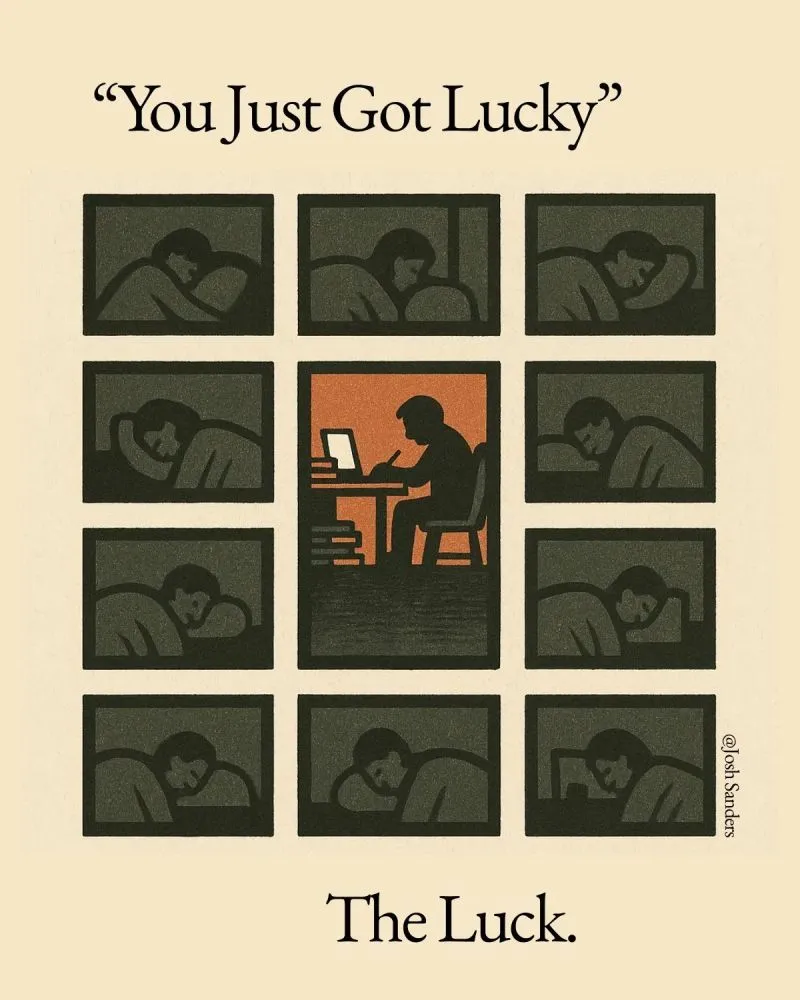
***It takes humility to accept responsibility for your mistakes.*** ***It also takes the same humility to deny credit for your successes.*** **Blaming** It’s easy to kick people when they’re down. When we see someone down on their luck, we immediately jump to **convenient conclusions**: “*They chose their misfortune. Nothing bad ever happens to people randomly. They wanted to fail. They deserved it!*” Not only is this sociopathic and uncompassionate, but it is a deluded and arrogant coping mechanism to manage our own insecurities. https://sotiris.substack.com/p/some-compassion It suits us to believe in this fairytale — that people somehow choose to fail consciously — because **we are cowards**; like an ostrich, we wish to deny the reality that random and undeserved misfortunes can happen to anyone, and we have neither the responsibility nor the blame for them. For example, a female entering young adulthood after systematically being sexually abused throughout most of her childhood doesn’t stand much of a chance of making it in life. And for the few anecdotes of those you did regardless of their trauma, you can accept that they were lucky later in life, stumbling onto some blessing, some hero, some insightful nugget of knowledge that served as the catalyst to picking up the pieces of their lives and making the most of what was left in them. But make no mistake: trauma is still there. https://sotiris.substack.com/p/muh-optimism **You blame people for their misfortunes because you’re afraid to admit to yourself that any misfortune can hit you at any given point**. Accidents and physical disease happen all the time… And mental disease, the most overlooked, is the one that denies us free will the most. ***With what authority do you presume to blame people for their badly dealt hand on top of them having to live with it?*** Cruelty comes in the face of guilt-tripping. See, for example, the concept of “original sin” in Abrahamism. https://sotiris.substack.com/p/abrahamism-must-end **Be fair** **Accept ownership of your blessings, without claiming credit for them,** No one’s denying the hard work you put in, right after you were lucky to be blessed with opportunity, ability, and a favourable environment. Hard work is easy when you already have the opportunity. Denying opportunity and claiming all the credit is **hubris**. Here’s yet another annoyingly self-aggrandising post by people demanding to be worshipped, supposedly for their “hard work”. In fact, they just advertise their narcissism by **denying recognition of their favourable circumstances**. It reads “*You just got lucky*”, then insults our intelligence with a picture of a desk worker among pictures of people sleeping. The inference is that those who talk of luck never worked hard enough. The arrogance and presumed superiority here are vomit-inducing, to assume to know for a fact that others never worked hard — harder even — and still failed.
Claiming full credit for your successes is an appeal to free will, as if you and you alone were responsible for them. This is why the notion of free will is narcissistic. **The appeal to free will inevitably ends up being an admission of determinism**: the messenger brags about being smarter and more hardworking by default so as to make better choices than others. Free will cannot exist; even its most vehement proponents reject it without even realising it. Free will indeed… We are condemned by our psychodynamics. We can pretend to have free will all we want, but we can’t deny our **inherent neural pathways** that determine our will. **Middle ground** Blaming people for their mistakes is wrong because it suggests self-loathing, self-punishment, and disempowerment. Instead, only holding them accountable, without blaming them, is empowering and insightful, because you open their eyes to all the ways they have control over their world. ***“With great power comes great responsibility” is wrong…*** ***It’s the other way around:*** ***“With great responsibility comes great power”.*** **Accountability is not only for taking responsibility for mistakes. Accountability is also for denying credit for success.** Accountability does not only mean accepting responsibility for mistakes that you could have avoided; it also means rejecting credit for fortunes that fell into your lap. Even if you claim you made the “right choices” or you “worked harder”, you still admit that you were **blessed by nature** with greater insight, and stronger tolerance for hard work. If you claim full credit for your successes while you insist on fully blaming the unfortunate for their misfortunes, then **you cannot be accountable** yourself. You fail to muster the **humility** to admit to yourself that all your wins were the result of blind chance, and all the work you put into it was just you joyfully responding to random opportunity. And when you too fail, we know you won’t have the humility to accept your role in your downfall; you’ll become like the victim-minded caricatures you keep blaming for their mistakes, pointing fingers and making excuses for yourself. We know this because you unfairly seek credit for your successes; we can assume that, similarly, you’ll deny your part in your failures. **Determinism** We are all the consequence of randomness. There is no free will, but that doesn’t mean you have no control or that you aren’t responsible for your mistakes or crimes. Notice how the most visceral proponents of the imaginary concept of ‘free will’ do so only to claim credit for their unearned fortunes in life. “*I had trouble in life, but I managed to push through!*” is nothing but a boast about being born stronger, smarter, and better by default, if not to hide the nepotism that gave them a boost. They pretend to be pro-accountability, but in reality, all they want is undeserved self-aggrandisement — this is the function of the concept of ‘free will’. We are all the product of randomness. We came to be in this physical existence, imbued with **biological programming**, and at the mercy of **random life experiences** that define our **cognitive architecture** early on. We rely on the environment we **circumstantially** find ourselves in to motivate us, to protect us, to define us. **Clarifications — The meaning of rejecting free will** I’m used to getting **visceral reactions** when I tell people I don’t believe in free will; they immediately jump to non-sequitur conclusions that I deny self-accountability, and in doing so, absolve all criminals by justifying their crimes. But this is not what I mean at all. If only people would just give me the benefit of the doubt and listen. So, why do I reject free will? Is it because I reject accountability? Absolutely not. It is precisely BECAUSE of accountability. All my writings about the denial of ‘free will’ were leading to this: to **take away my arrogance** when I do accomplish something: I accept that **I deserve no credit for my successes**, since they were reliant upon **mere chance** and my **randomly defined psychodynamic**. However, I still hold myself responsible for my mistakes and crimes, because it was still **within my power to avoid them**. I do not blame myself, but I instead empower myself with the knowledge that I have some power and control over my environment, despite the confines of my unfree will. **Denial of free will does not absolve criminals**; this holds them accountable while also showing them that it is within their power to change. **Blaming them that they “freely” chose to be villains is the most deterministic notion, that their freedom somehow led them to crime**. This is what makes them identify with crime, thus motivating them to keep doing it to validate their identity. ***It is astonishing…*** ***Insisting on “free will” is the most deterministic thing you can do.*** Also, **denying free will** **takes away agency from my abusers** and therefore **nullifies the meaning of their abuses**. This is **not an excuse for their actions, just an explanation**. They are **still responsible for the harm** they inflicted on me. But since there was no free will in the harm they inflicted on me, there was no meaning to it. This reduces my trauma. Whatever they did to me was like an act of nature, something that happened without ‘free will’ behind it. It is less traumatic to fall and break your leg than it is for someone to break your leg on purpose. The latter has humiliating and self-deprecating implications for you, but **only if you assign free will to your abuser**. **If you consider them as a mindless, will-less apparatus, then you mitigate the trauma**. Still, this is no free pass for them. Even though they were not free to will their abuses unto you, they are still responsible towards you, because you aren’t free from feeling resentful of them either. **Key takeaways**

Your success is not as praiseworthy as you might have assumed. You are still reliant upon your nature, environment, genetic potential, developmental window, timing, opportunity, and random luck — even if it’s just **the luck of not having been unlucky**. Take professional athletes, for example. There is **nothing impressive about professional athleticism**. Sure, they work out hard, but **how hard can it be to work out when you’re paid to do it?** How difficult or praiseworthy is it to achieve peak athleticism when it’s your full-time job, complete with the time and professional support to optimise your performance? I’m not impressed by champions and gold medalists. They don’t inspire me at all. **Who really inspires me is that full-timer mum of three who still squeezes that body pump class three times a week into her busy schedule**. She doesn’t get paid to work out; she *pays* to work out even though she’s exhausted from her proper job. That’s much more impressive to me than a pro athlete who gets paid handsomely to work out. And these pro athletes usually give up training completely after they retire; it goes to show how much they would have worked out if the paycheck wasn’t their primary driver. Just not impressive at all. Accountability is not only for recognising your role in your failures. Accountability is also for rejecting undue credit for your successes. It’s about recognising the limited role you played in what you succeeded in life, whatever your opportunity, genetic potential, and favourable direction your developmental window gave you. This reliance of success on circumstantial opportunities from the external environment is the easiest to prove: entrepreneurs only make in specific regions and eras of the world where, in a given time period, socioeconomic factors allow for such success. Silicon Valley emerged in California, not Burma, for a reason: it’s opportunity and our hopeless reliance on our environment. Much like no organism can survive (let alone thrive) unless its **cosmic environment** is ideal, so does success rely on factors totally outside of our control. Lastly, this obsession with taking full responsibility for your failures and not holding others responsible for holding you back is a deluded, toxic positivity. Yes, you can’t blame people who never really harmed you, and you can’t hold yourself back thinking you need your abusers’ approval as a prerequisite to moving on. https://sotiris.substack.com/p/toxic-motivators-and-toxic-positivity But what about those who actually did harm you and determined your life’s course? Are you to absolve them of their crimes? Are you to give them a free pass so that they keep perpetuating their abuses against you and others? What about those nomadic professional-beggar cultures that deliberately amputate their babies to earn sympathy and thus more pity money? When they grow up, should they not hold responsible those who condemned them in a life of debilitation? https://sotiris.substack.com/p/no-good-deed-goes-unpunished Notice how your abusers will always insist that you are **overly responsible for your trauma**, especially the trauma that *they* inflicted on you, but they never hold themselves accountable for the damage they caused. ***Be suspicious of appeals to free will. The motivation behind it is usually their self-aggrandising, your psychological abuse, or deflection of their accountability.***
No comments yet